M
ASTER OF
S
CIENCE IN
M
ARKETING
M
ASTERS
D
ISSERTATION
#F
EMVERTISING
:
E
MPOWERING
W
OMEN
T
HROUGH
T
HE
H
ASHTAG
?
A COMPARATIVE ANALYSIS OF CONSUMERS
’
REACTION TO FEMINIST ADVERTISING ONT
WITTERR
ITA
A
BREU
R
ODRIGUES
M
ASTER OF
S
CIENCE IN
M
ARKETING
M
ASTERS
D
ISSERTATION
#F
EMVERTISING
:
E
MPOWERING
W
OMEN
T
HROUGH
T
HE
H
ASHTAG
?
A COMPARATIVE ANALYSIS OF CONSUMERS
’
REACTION TO FEMINIST ADVERTISING ONT
WITTERR
ITA
A
BREU
R
ODRIGUES
S
UPERVISOR
:
S
ANDRA
M
ESTRE
C
UNHA
I would like to thank my supervisor, Sandra Cunha, for her constant availability; for having respected my ideas and helped me to achieve them; for all the help and encouragement in moments of doubt (which were many!) and for believing and trusting in me since the beginning. My parents, who have done everything for me to have the best education possible, for the values they instilled me since I was little, for all the love and support and for believing in me, even when I don’t. I hope to make you proud.
My sister, Joana, for calming me down like no one else does.
My friends and colleagues, Gabriela and Vinicius, for all the hours spent talking about our subjects and for being there in moments of inspiration and lack off it, in moments of happiness and moments of doubt and despair. This would have not been the same without you. Because in the end, it all worked out… We did it!
My friends, Raquel and Cláudia, for the advices, help, motivation and encouragements during this process and always. But, most of all, for 6 years of complicity and sincere friendship. Last but surely not least, I would like to thank my boyfriend, Luís, for having put up with me and accompanied me through all the moments of nervousness and desperation, for believing in my abilities and remind me them off when I need it. Most of all, for being there, always.
I
A
BSTRACTFemvertising or commodity feminism is a marketing strategy used by brands by means of which
they seek to inspire and empower women through pro-female messages at the same time as they promote their products and generate greater brand engagement. This evolving trend in advertising built upon the use of social media and a particular tool, the hashtag, creates new movements of empowerment through the creation of specific online spaces in which consumers establish personal and emotional connections with brands and other consumers.
This thesis proposes a critical study of the techniques and messages in femvertising through a comparative study of two ad-campaigns as well as a content analysis of consumers’ response to the same. Joining theoretical research on the concepts of public sphere, social media, hashtag activism, feminism and empowerment, results of this study suggest that consumers have positive attitudes towards the messages promoted in these types of ad-campaigns as well as towards the brands that use their power to address social issues as consumers feel empowered and heard. Results also show that the way these campaigns are constructed have an impact in the way they are perceived by consumers, the way they relate to it and the conversations sparked around these campaigns through the use of the hashtag.
Keywords: femvertising; commodity feminism; feminism; social media; hashtag; consumer perception; brand
ABSTRACT ...I 1. INTRODUCTION ... 3 2. LITERATURE REVIEW ... 4 2.1. Public Sphere ... 4 2.1. Social Media ... 6 2.1.1. Social Media ... 6 2.1.2. Hashtag ... 8 2.1.3. Hashtag activism ... 9
2.2. Feminism and empowerment ... 11
2.2.1. Feminism and Postfeminism ... 11
2.2.2. Commodity Feminism and Empowerment ... 13
3. RESEARCH QUESTIONS ... 16
4. METHODOLOGY ... 17
5. ANALYSIS OF RESULTS AND DISCUSSION ... 19
5.1. Use of “femvertising” by Always and Covergirl ... 19
5.2. Consumer’s perception, reaction and relation with “femvertising” ... 23
5.2.1. Consumers and the brands ... 23
5.2.2. Consumers and the campaigns ... 25
5.2.2.1. Positive attitude towards the campaign ... 25
5.2.2.2. Negative attitude towards the campaign ... 30
5.3. Consumer’s use of the hashtag and participation in an alternative public sphere .... 31
6. CONCLUSIONS AND RECOMMENDATIONS FOR FURTHER STUDIES ... 37
REFERENCES ... 41
APPENDIXES ... 46
I
NDEX OF FIGURES Figure 1- Consumers' attitude towards the brand ... 23Figure 2- Consumers' attitude towards the campaign ... 25
Figure 3 - Consumers' positive attitude towards the campaign ... 26
Figure 4 - Consumers' self-identification with the message and/or cause ... 26
2
Figure 6 - Consumers' behaviour towards the campaign ... 31
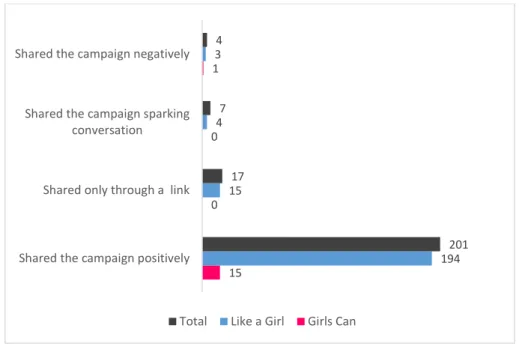
Figure 7 – Consumers’ share of the campaign ... 32
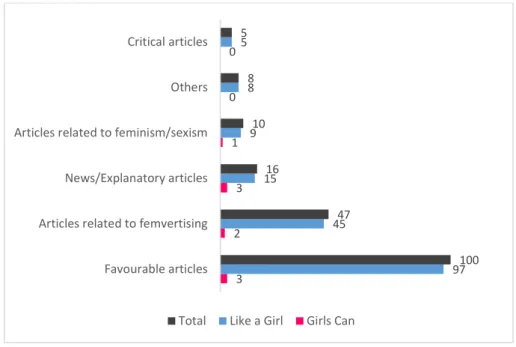
Figure 8 - Consumers' association of other links ... 33
Figure 9 - Word cloud for hashtags referring concepts - Like a Girl Campaign ... 35
Figure 10 - Word cloud for hashtags expressing feelings - Like a Girl Campaign ... 36
I
NDEX OF TABLES Table I - Grouped hashtags – Like a Girl campaign ………501. INTRODUCTION ... 3 2. LITERATURE REVIEW ... 4 2.1. Public Sphere ... 4 2.1. Social Media ... 6 2.1.1. Social Media ... 6 2.1.2. Hashtag ... 8 2.1.3. Hashtag activism ... 9
2.2. Feminism and empowerment ... 11
2.2.1. Feminism and Postfeminism ... 11
2.2.2. Commodity Feminism and Empowerment ... 13
3. RESEARCH QUESTIONS ... 16
4. METHODOLOGY ... 17
5. ANALYSIS OF RESULTS AND DISCUSSION ... 19
5.1. Use of “femvertising” by Always and Covergirl ... 19
5.2. Consumer’s perception, reaction and relation with “femvertising” ... 23
5.2.1. Consumers and the brands ... 23
5.2.2. Consumers and the campaigns ... 25
5.2.2.1. Positive attitude towards the campaign ... 25
5.2.2.2. Negative attitude towards the campaign ... 30
5.3. Consumer’s use of the hashtag and participation in an alternative public sphere .... 31
6. CONCLUSIONS AND RECOMMENDATIONS FOR FURTHER STUDIES ... 37
REFERENCES ... 41
APPENDIXES ... 46
I
NDEX OF FIGURES Figure 1- Consumers' attitude towards the brand ... 23Figure 2- Consumers' attitude towards the campaign ... 25
Figure 3 - Consumers' positive attitude towards the campaign ... 25
Figure 4 - Consumers' self-identification with the message and/or cause ... 26
Figure 5 - Consumers' praising of the campaign ... 28
Figure 6 - Consumers' behaviour towards the campaign ... 31
2
Figure 8 - Consumers' association of other links ... 33 Figure 9 - Word cloud for hashtags referring concepts - Like a Girl Campaign ... 35 Figure 10 - Word cloud for hashtags expressing feelings - Like a Girl Campaign ... 36
I
NDEX OF TABLES3
1. I
NTRODUCTIONSocial media’s growing importance is no secret to us all. As in January 2016 there were 3.416 billion internet users from which 2.307 billion were active social media users (We Are Social, 2016) with social networking accounting for 28% of the time spent on the internet (Global Web Index, 2015). With the immediacy and viral nature of some social media platforms such as Twitter and blogs, news consumption and consumers’ participation and relationship with it have fundamentally changed, going from a top-down flow of information to a bottom-up flow as users participate and influence more and more the larger public conversation (Martin & Valenti, 2013).
The Occupy Wall Street movement and the Arab Spring were one of the first events that featured prominent use of social media and one particular tool: the hashtag. Since then, numerous social movements have started on social media and later on spread on to the public sphere. Scholars recognize the power lying on these platforms deeming them as contributors to identity building as they bring materiality to the production of meaning (Milan, 2015) changing the way we talk about urgent social issues. #YouOkSis, #SolidarityIsForWhiteWomen, #WhyIStayed,
#RapeCultureIsWhen and #YesAllWomen are only a few of numerous movements that started
online with specific hashtags and have changed feminist discourse and how we talk about it.
Brands have clearly seen an opportunity in social media and, more specifically, in the use of hashtag as a way of sparking conversations, communicate with clients and promote their products to generate greater brand engagement. Commodity feminism or femvertising - feminist advertising which seeks to inspire and empower women through pro-female messages – has become wildly popular over the last few years with more and more brands adopting this strategy, changing the way they approach women. “Real Beauty Sketches” by Dove, “I will what I want” by Under Armours, “Inspire Her Mind” by Verizon and “Like a Girl” by Always are only a few examples of femvertising campaigns that have been launched since 2013.
According to the 2014 SheKnows Media survey, more than half of respondents stated that they had purchased products specifically for the portrayal of women in their advertising campaigns and that they liked pro-female ads as they believe it breaks down gender-equality barriers and over two thirds of respondents thought brands should be responsible for using advertising to promote positive messages to women and girls. Harvard Business Review states that promoting physical and emotional well-being encouraging love and connection between consumers and the brand, among other, will benefit brands (Reker, 2016).
4
The present study aims to comparatively analyse two femvertising campaigns taking into account both the sender’s (brand) and the receiver’s (consumers/viewers) side through two selected campaigns with their own hashtags specifically created for the purpose of the same: Always’ “Like a Girl” campaign with the #LikeAGirl hashtag and Covergirl’s “Girls Can” commercial with the #GirlsCan hashtag.
The main objectives are to understand the type of messages conveyed in this type of advertisements, the way consumers react and relate with this type of messages and to understand how consumers use the created hashtag in their participation in the public sphere. By doing a comparative analysis, the goal is to understand if the type of campaign has an influence in the reception of the same and in consumers’ participation.
There seems to be a growing interest in scholarship surrounding these types of campaigns as well as the use of the hashtag in social movements and more specifically, social movements linked to feminism. This study aims to combine both perspectives, including the receiver’s side through an analysis of consumers’ reaction to these campaigns as there seems to be a gap in scholarship from that perspective. This study hopes to make a contribution to marketing clarifying how consumers relate with these types of messages, promoting important insights for brand management.
2. L
ITERATURER
EVIEW 2.1. Public SphereThe concept of deliberative democracy and public sphere was most famously conceptualized by Jürgen Habermas, whose theories are still considered to be the foundation for contemporary authors theorizing democracy and the public sphere (Fraser, 1990; MacNamara, 2012). According to Habermas (2012), the public sphere constitutes a mediated space in which political participation is enacted discursively through a “body of private persons assembled to discuss matters of public concern or common interest” (Fraser, 1990 p. 58).
For Habermas, this public space was open and accessible to all and therefore an inclusive space, but some authors, such as Fraser (1990), criticise his “utopian” conceptualization of deliberative democracy and public sphere for not taking into account the multiplicity of publics or “competing publics” and for resting on gender and class exclusions (Fraser, 1990; Knoppers, 2014).
5
As Fraser (1990) explains, civil society, which is a non-governmental “network of clubs and associations” that cover a variety of areas in the representation of citizens, was the basis for the liberal public sphere, but these associations were not accessible to all. When the bourgeois class was formed, they emerged as an elite and their practices and norms progressively became hegemonic and therefore they became, in a way, “the public” (Fraser, 1990). But as Fraser (1990) states, bourgeois were never the only existing public, in matter of fact, there have always been a multiplicity of “counter-publics” but because certain groups, such as men from racialized ethnicities and women in general, were barred from political participation and because their relationship with the bourgeois had always been conflictual, the bourgeois public became the hegemonic and dominant one (Eley, 1990; Fraser, 1990). Now, this exclusion is not purposeful or inherent to Habermas’ conceptualization of the public sphere. As said earlier, he saw it as an open space accessible to all, where people could debate as “social peers”, but political exclusion is in part due to social or class construction and so, even though these exclusions were soon formally eliminated, they still remained ideologically, further perpetuating group marginalization. As Fraser (1990, p.63) affirms, “the social inequalities among the interlocutors were not eliminated, they were bracketed”.
Habermas (2012) restricted his conceptualization to the “liberal model of the bourgeois public sphere” ignoring other publics or “competing publics” who were seen, not as a sign of diversity but as a sign of rupture and decline, therefore, emphasizing its singularity (Eley, 1990; Fraser, 1990). Fraser (1990) and Eley (1990) take a different stance arguing that in stratified societies assuring the plurality of publics helps in advancing participatory parity, hence allowing “subordinated groups” or “subaltern counter-publics” to have their own discursive space in which they can deliberate, contest, negotiate and enact their social identities. Besides the multiplicity of publics, Fraser (1990) draws attention to the fact that one’s participation in one public is not exclusive, which means there is the possibility of participating in more than one public and “the memberships of different publics may partially overlap” (p. 70).
Going back to Habermas’ definition of the public sphere, there is a clear delimitation in what matters should be discussed and those are, in his sense, subjects of “public concern or common interest”. As Eley (1990, p. 17) notes, “the specification of a public sphere necessarily implies the existence of another sphere that is private, and by contrast with what Habermas sometimes implies, (…) the boundaries between these two domains are not fast but permeable”. For a better understanding of this distinction and of what should count as a public matter or a private matter, Fraser (1990) examines the multiple senses of “publicity” which are: “(1) state-related; (2) accessible to everyone; (3) of concern to everyone; and (4) pertaining to a common good or
6
shared interest” (p.71) and two additional senses of “privacy” which are “(5) pertaining to private property in a market economy; and (6) pertaining to intimate domestic or personal life, including sexual life” (p.71).
According to Fraser (1990), there should not be a previous delimitation of what is and what is not of common concern, since it is precisely through “discursive contestation” that this is decided. As she exemplifies, domestic violence was, until recently, considered a matter of private concern. Thanks to discursive contestation and deliberative processes, it is, now, considered a common and public concern (Fraser, 1990).
Fraser (1990) adopts a critical stance towards the terms “privacy” and “public” arguing that these “are not simply straightforward designations of social spheres; they are cultural classifications and rhetorical labels” (p.73) that can, in some cases, lead to the enclaving of certain subjects to particular and specialized discursive arenas and therefore protect them from public contestation hence perpetuating class dominance and subordination.
2.1. Social Media 2.1.1. Social Media
The World Wide Web was born in 1991, when Tim Berners-Lee connected hypertext technology to the internet through a publicly accessible link, giving birth to a new type of “networked communication” (Van den Berg, 2014; Van Dijck, 2013). The internet goes from being almost exclusively reserved to academic and research environment to being, generally speaking, accessible to the public.
However, with the advent of “Web 2.0” the internet takes on new dimensions becoming a communications infrastructure continuously developed and modified by its users in a participatory and collaborative way, becoming the “ideological and technological foundation” of social media (Kaplan & Haenlein, 2010; Van den Berg, 2014). Based on O’Reilly’s (2007) guiding principles of the Web 2.0, Anderson (2007) introduces six ideas to better explain its impact: (1) “individual production and user generated content”; (2) “harness the power of the crowd” which means individuals can contribute to improve the service; (3) the gathering and management of a great volume of data into “data sources”; (4) “architecture of participation” as in a service that encourages mass participation; (5) “network effects” that benefit existing users of a service as more people use it; and (6) “openness” of information that can be used, in part, to innovate the Web. As Anderson (2007) states, referring to Tim Berners-Lee and addressing an existing general confusion surrounding the relation between Web 1.0 and Web
7
2.0, the former was also about collaboration and connecting people suggesting it should be seen as “a fork in the road of the technology's development, one which has meant that the original pathway has only recently been re-joined” by the latter (p. 5).
As Van Dijck (2013) puts forward, social media platforms are “dynamic objects” that are constantly changing in response to their users. The early 2000’s saw a boom in the proliferation of social media changing the way we communicate and relate to each other. Inventorying of all social media platforms would be a hazardous and probably impossible task, but there seems to be a consensus on the types of platforms that exist which are: collaborative projects or user-generated content (UGC) such as Youtube and Wikipedia; blogs; content communities that allow the media share among users; social networking sites (SNS) such as Facebook, Linkedin and
Twitter; play and game sites (PGs) and trading and marketing sites (TMSs) such as Amazon and Ebay (Van Dijck, 2013; Kaplan & Haenlein, 2010). Even though there is a categorization of types
of social media, it is important to have in mind that these are not strictly delimited which means that one platform can easily be part of another platform category. As Van Dijck explains, “there are no sharp boundaries between various platform categories because carving out and appropriating one or more specific niches is part of the continuous battle to dominate a segment of online sociality” (2013: 8). The present work will be focusing on SNS.
Boyd and Ellison (2007) define social networking sites as “online services where individuals can (1) create a public or semi-public profile within a bounded system; (2) articulate a list of other users with whom they share a connection; and (3) view and traverse their list of connections and those made by others within the system”. SNS allow their users to network and communicate with other members, to form groups and to have discussions (Carstensen, 2015).
The increased mobile internet accessibility in a variety of devices further nurtures social media popularity and, consequently, as mentioned before, its development. Social media have become an integrant part of our daily lives, allowing for the creation of “dynamic and constant meaning” through their use (Van den Berg, 2014; Hinton & Hjorth, 2013; Van Dijck, 2013). As in January 2016, there were 3.416 billion internet users from which 2.307 billion were active social media users and of those, 1.968 billion were active mobile social users (We Are Social, 2016). According to the Global Web Index (Global Web Index, 2015), social networking accounts for 28% of the time we spend on the internet and from 2012 to 2015 the average time we spend on the mobile web has increased from 1.24 hours to 1.99 hours a day.
It is safe to say that the evolution from Web 1.0 to Web 2.0 has changed the way users interact with the internet, going from merely accessible content platform to participative and
8
collaborative ones (Anderson, 2007; Hinton & Hjorth, 2013; Van Dijck, 2013) and thus going from mere users to “produsers” (Van Dijck, 2013).
2.1.2. Hashtag
In 2006, Twitter was launched as a micro-blogging site allowing users to write and post up to 140 character texts or “tweets” and share them with friends or any interested readers through text messages, instant messaging, e-mail or directly through the web (Java, Finin, Song & Tseng, 2007; Gunn, 2015; Van den Berg, 2014; Lotan, Graeff, Ananny, Gaffney, Pearce & Boyd, 2011). Users can define if their accounts are either public or private. In the first case anyone can read their tweets even with no Twitter account created but in order to post or join conversations, users need to create one. On Twitter, one can simply post “tweets” for followers – users who subscribe to a particular account and its posts - to see it or share information and link content. As said earlier, SNS allow people to network and communicate with other members, to form groups and start conversations (Carstensen, 2015). Twitter also allows users to start conversations through public or direct messaging between users and to participate in conversations according to their topics through the use of a hashtag (Gunn, 2015; Van den Berg, 2014).
Social Media platforms are dynamic and constantly evolving according to users’ needs. In its early days, Twitter did not have all the functionalities it has today and served primarily as a platform in which users could follow their friends’ accounts. Besides the functionality of the reply format through the “@” symbol and the possibility to upload multimedia, one of the most significant “user-led innovations” was the hashtag (Bruns & Burgess, 2011). A hashtag, represented by the hash symbol (#), sorts and selects information or conversations according to their theme (Gunn, 2015; Bruns & Burgess, 2011; Van den Berg, 2014) aggregating them and making them retrievable by search (Zappavigna, 2012).
The hashtag was originally proposed by Chris Messina, a San-Francisco based technologist, who thought of creating a tag system that would allow people to follow and participate in conversations according to their topics (Bruns & Burgess, 2011; Van den Berg, 2014). The hashtag was already being used in chat rooms but started getting popular through the tag
#sandiegofire during San Diego forest fires that occurred in October 2007 in order to spread the
information (Bruns & Burgess, 2011; Van den Berg, 2014). In 2009, Twitter officially adopted the hashtag as a tag system and other platforms followed: Google + and Instagram in 2011,
9
There has been an increase in academic research surrounding social media and more specifically Twitter, the communities it comprises and patterns of use (Gunn, 2015; Zappavigna, 2012). Java et al. (2007) found that people use microblogging for “daily chatter”, “conversations”, “sharing information/URLs” and “reporting news” also dividing its users in three categories: “information sources” – working as a hub with a large number of followers-, “information seekers” – might post rarely but follow others regularly- and “friends”. Naaman, Boase and Lai (2010), extend their work categorizing users into “meformers” which are users more focused on their “self” and “informers” driven by information sharing (Zappavigna, 2012). Bruns and Burgess (2011) focused specifically on the hashtag arguing it could be used for different purposes: (1) “mark tweets as relevant to specific known themes and topics”; (2) as an “attempt to address an imagined community of users who are following and discussing a specific topic”; (3) “make tweets visible to others following the hashtag, increasing their potential exposure”; (4) as a “means of emphasis”; (5) “express the sender’s emotional or other responses”; (6) as “twitter memes” for one’s entertainment.
Authors highlight social media’s, and more specifically Twitter’s, ability to create publics and communities gathered around topics of interest in which they actively participate through conversation constituting audiences that can, in some cases, overlap with other audiences (Bruns & Burgess, 2011; Bonilla & Rosa, 2015). Thus, we can see how these platforms form spaces for public discussion and resemble Fraser’s (1990) conceptualization of the public sphere discussed earlier. As Bruns and Burgess (2011; p.6-7) put it:
What we see emerging is not simply a fragmented society composed of isolated individuals, but instead a patchwork of overlapping public spheres centred around specific themes and communities which through their overlap nonetheless form a network of issue publics that is able to act as an effective substitute for the conventional, universal public sphere of the mass media age; the remnants of that mass-mediated public sphere itself, indeed, remain as just one among many other such public spheres, if for the moment continuing to be located in a particularly central position within the overall network.
2.1.3. Hashtag activism
Events such as Occupy Wall Street and the Arab Spring, both in 2011, featured prominent use of Social Media, especially through hashtags, both for the organization of people around the causes and for information dissemination, widening the reach of generated discussions to a world scale (Tufekci & Wilson, 2012; Lim, 2012; Juris, 2012; Lotan & al., 2011). News coverage and people
10
in general coined the Arab uprisings as “Revolution 2.0” (Lim, 2012, p.232), “Twitter Revolution” and “Facebook Revolution” (Tufekci & Wilson, 2012, p. 365) as a reference to the central role Social Media played in the unfold of these events. Some authors believe it is an oversimplification to exclusively associate the uprisings with these platforms (Lim, 2012; Tufekci & Wilson, 2012) but stress the importance social media have acquired and the power they have to facilitate the establishment and enlargement of networks, representing “tools and spaces in which various communication networks that make up social movement emerge, connect, collapse, and expand” (Lim, 2012, p.234).
As seen before, social media and generally speaking, the internet as it becomes more and more available and open to anyone, constitute an alternative space or a “subaltern public sphere” (Harlow & Harp, 2012, p. 199) where people have the possibility to voice their opinion or different views and find support among others sharing the same ones, playing a “central role in the process of identity construction” (Gerbaudo & Treré, 2015, p. 865).
Polletta and Jasper (2001, p. 285) define collective identity as:
An individual’s cognitive, moral, and emotional connection with a broader community, category, practice, or institution. It is a perception of a shared status or relation, which may be imagined rather than experienced directly, and it is distinct from personal identities, although it may form part of a personal identity.
Milan (2015) sees Social Media as contributors to identity building as they have changed the way we see ourselves, interact with each other and relate to the world and suggests approaching them as “actors on their own right” (p. 888). She contends that social media bring materiality to the production of meaning as it is a space accessible from different platforms and devices that allow for a particular dynamic among individuals. This materiality translates into what she calls the “politics of visibility” fostered by three mechanisms: (1) performance – each individual can become a hero of the story by joining protests and making them visible to others; (2)
interpellation – users can attract other users; and (3) reproducibility – social media allow for a
constant re-enactment of social actions. These three mechanisms re-establish bonds between users advancing group solidarity resulting in “the ‘collective’ being experienced through the ‘individual’” (Milan, 2015, p. 896).
As it has been discussed, social media constitute a free space characterized by the velocity of information flow. Some scholars highlight positive aspects of these interactional platforms and the way they allow symbolic production of meaning, fuelling collective identity and, thus, collective action. The self-publishing functionality of these platforms backed by a commenting
11
community creates a space in which users or “produsers” share personal opinions and experiences. This “storytelling” and relationship-building capacity enable discourse and users’ identification with specific causes (Martin & Valenti, 2013) without relying on organizations (Clark, 2016) and facilitate the organization of offline movements (Carstensen, 2015; Clark, 2016). In the particular case of Twitter, the hashtag aggregates narratives resulting in a searchable archive of experiences that also become interpretative frames of reference for present and future social phenomena (Clark, 2016).
But, on the other hand, scholars remind that there are still less positive aspects of these platforms that have to be taken into account when analyzing the power of social media. First of all, social media are still not equally accessible for everyone (Clark, 2016). In addition, the fact that anyone can voice their opinion using a hashtag does not mean it is being correctly used or at least being used with the original intention a specific hashtag was created (Stache, 2015). Stache (2015) also points out the fact that the discussion of certain issues on these platforms does not make permanent changes per se, it is necessary to take action toward political and social changes. Milan (2015) reminds that even though activists can select specific causes or specific activities to identify with, thus encouraging diverse participation, this can contribute to social movements’ fragility, contradiction and instability as it does not require the same degree of responsibility that offline activist groups do.
According to Twitter’s annual report (2015), the most impactful events were the 2015’s terrorist attacks with the hashtags #jesuischarlie, #prayforparis and #porteouverte; the Black Lives Matter with the hashtags #BlackLivesMatter, #Ferguson #BaltimoreProtests that were shared more than 9 million times; legalization of homosexual marriage in the U.S.A and Ireland with the hashtags #HomeToVote and #LoveWins; the refugee crisis with the hashtag #WelcomeRefugees; prejudice and racism debate with the hashtag #IStandWithAhmed.
2.2. Feminism and empowerment 2.2.1. Feminism and Postfeminism
Establishing a unique standpoint on feminism is not a task that goes without some debate and challenge. Tong (2009) argues that there is not only one theory or perspective on feminism that fits into a categorization but many that essentially fit into a list of labels that are “incomplete and highly contestable” (2009, p.1): liberal; radical; Marxist/socialist; psychoanalytic; care-focused; multicultural/global/colonial; ecofeminist and postmodern/third wave. These approaches are considered as being provisional answers that intersect with each other as they
12
are not a definite and whole answer to “women’s questions”. Tong’s categorization refers to a postmodern/third wave in reference to another common categorization in which feminism is classified as belonging to a first, second and third wave (Maclaran, 2012; Kinser, 2004).
First-wave feminism was marked by the historical gathering at Seneca Falls in 1848 for women’s rights even though some authors attribute the beginning of women’s movement to the First Nation American and African American women as they paved the way years before Seneca Falls convention for women’s rights (Kinser, 2004). First-wave feminists often coined as “suffragettes” (Maclaran, 2012) were campaigning primarily for “rights to property and wages, rights to guardianship of their children, rights to equal education, rights to political voice and, though hardly unanimously, the right to vote” (Kinser, 2004, p. 128). Women won their right to vote in 1920 and from that point on women’s activism has continued through feminist movement even though it would take years for the movement and its causes to receive the attention and affection from the media and mass public (Kinser, 2004). During the 1960’s the U.S.A were going through a paradigmatic shift, political and socially speaking, and public and media attention were concentrated on civil rights activism. Women activists realized they were still being discriminated as much as their fore sisters were years before, translating the “esprit
de corps out of which arose wave feminism” (Kinser, 2004, p. 129). First and
second-wave feminism labels were coined, at the same time, by Marsha Lear as a way of negotiating a feminist space and as a way of reviving the movement rooted in an older ground positioning it “as a further evolution of earlier and larger movement” (Kinser, 2004, p. 129). Second-wave feminists expanded the debate and their fight to a broader range of issues such as reproductive rights, employment discrimination, domestic violence among others (Baxandall & Gordon, 2002). By the end of the 1980’s women had made advancements regarding to their rights on the home front and in the workplace and so, basic notions of gender equity seemed to be a part of their lives, but as Kinser (2004) puts it, “often at the level of shared stock of knowledge rather than shared convictions and practices” (p. 130).
Women of colour and ethnicity were the pioneers of the third-wave feminism as they critiqued second-wave feminists for the pretended homogeneity of the experience of being a woman not taking into account characteristics such as race, class and sexuality thus failing to adequately address their everyday life (Mann & Huffman, 2005). Thus, third-wave feminists sought to understand how forms of oppression are intertwined and understand how women are different and possess different sets of identities (Tong, 2009) therefore focusing more on the individual than on society (Johnston & Taylor, 2008). As third-wavers reclaimed their identities, they sought to reverse patriarchal associations and reclaimed signifiers of femininity such as
make-13
up and clothing and their sexuality appearing as empowered selves (Mann & Huffman, 2005; Lazar, 2006).
There seems to be a consensus among popular media and public discourse that we are now living in the postfeminist era. However, this debate poses some challenges as it raises polarized opinions. For some, post-feminism stands for a liberation from “outdated” restraints of feminism (Gamble, 2006). For others, it undermines feminism as, according to the postfeminist ideology, women no longer need to be feminists nor need feminism as they have already gained gender equity and feminist goals have already been achieved. Thus, post-feminism encompasses a backlash against feminism making it easy for young women to assume that gender equality is the norm deeming feminists and what they fight for as unnecessary and outmoded (Hall & Rodriguez, 2003; Pomerantz, Raby, & Stefanik, 2013; Lumby, 2015; Tong, 2009; Kinser, 2004; Lazar, 2006). Hall and Rodriguez (2003) believe post-feminism is a myth as women continue to defend feminism. Lumby (2015) urges scholars to look beyond the feminist and postfeminist binary in a sense of understanding speaking positions and learn from them:
“Perhaps another way to understand this challenge is to see that it’s not just a matter of
speaking positions – it’s a matter of listening positions (…) It is not a matter of bringing a
given set of feminist concerns or theoretical constructs to an object of study. It is about being open to having those concerns or constructs changes by what we encounter.”
(Lumby, 2015, p. 608)
2.2.2. Commodity Feminism and Empowerment
Commodity feminism is a commercial and advertising approach that strategically appropriates feminist values distilling them from their political content in the service of commodity consumption (Lazar, 2006; Reker, 2016; Gill, 2008). This corporate strategy employs themes of empowerment focusing on individual consumption as a source of identity, identification and affirmation as well as social change (Johnston & Taylor, 2008).
In order to understand the concept of empowerment it is necessary to address the concept of power which is a crucial concept for feminists. Conceptualisation of power revolves around the distinction between power-over, which refers to “domination and control of one person or group over another person or group” and power-to also known as personal empowerment. (Yoder & Kahn, 1992, p.382). Power-over is represented at four levels of analysis: societal, organizational, interpersonal and individual. Power-to or personal empowerment has to do with “the control one feels over one’s own thoughts, feelings and behaviours” (p. 384). There have
14
been other conceptualizations that have included other concepts such as power with as solidarity and alliances and power within seen as transforming consciousness and reinterpreting needs. According to Manuh (2006), these four forms of power overlap and are considered as processes and not ends in themselves. Thus, the author defines empowerment as “all those processes where women take control and ownership of their lives” (Manuh, 2006, p. 7).
Advertising has deeply changed over the course of the years adapting to economical, technological and social changes (Gill, 2008). Although women have always been a prominent feature in advertising it seems that there has always been a “tense relationship” between feminism and marketing as it has put forward idealized images of women that they should conform to (Maclaran, 2012, p. 462). During the late 60’s and through the 70’s/80’s feminists criticized and depicted the market as a manipulative and patriarchal system that confined and ideologically controlled women through domesticity (Maclaran, 2012). During the 80’s and early 90’s advertisers began to recognize how unattainable and idealized images of femininity were affecting women and started incorporating themes of liberation and empowerment as a way to re-engage with female consumers (Maclaran, 2012; Gill, 2008). As it has been mentioned before, third-wave feminism characterized itself for dissociating itself from second-wave feminism and for the reconciliation with consumption as it started to be seen as a form of personal and sexual expression through purchasing power (Maclaran, 2012). Thus, new images of women started circulating as they were now defined by individuality, self-acceptance, choice and independence (Cole & Hribar, 1995; Gill, 2008; Lazar, 2006).
According to Cole and Hribar (1995), Nike emerged as a clear profile in the postfeminist imaginary being celebrated for its “participation in changing American values related to gender, fitness and advertising. Nike is credited with questioning prevalent ideas about women and for raising America’s consciousness” (1995, p. 358). From 1990 to 2000 Nike launched a series of ground-breaking campaigns to women (Grow & Wolburg, 2006). The first one is known as the “Empathy/Dialogue campaign” aimed at women and the celebration of their expression of the self through sports and exercise. Thus, exercise, health and working on the body are shown as a way of showcasing self-control and as a personal choice appealing to self-transformation and growth. In this way, Nike presents itself as an alternative to the normalizing discourse. As the authors put it: “In so doing, Nike rewrites feminist history, identity, community and solidarity by promoting a popular knowledge of empowerment embedded in bodily maintenance and the consumption of Nike products” (1995, p. 362). Sales increased in 25% for two consecutive years after the campaign was launched and by 1995, 4.7 billion dollars of annual athletic shoes sales
15
were accounted by women who also constituted the largest segment of the athletic shoe market (MacLachlan, 1995 and Promice, 1993 as cited in Cole & Hribar, 1995).
Most recently, Dove’s “campaign for Real Beauty” launched in 2004 based on Dove’s 2003 report “The real truth about beauty”, appeared as a criticism to conventional beauty ideals challenging consumers to share the same social goals and further concealing corporate objectives by cultivating brand loyalty (Johnston & Taylor, 2008; Murray, 2015; Murray, 2013). As mentioned earlier, feminists have fought against oppressive beauty standards that have destructive effects on women’s relationship with their bodies and self-acceptance since the 1970’s. In 2003, Dove conducted a worldwide study and found that less than 2% used the word “beautiful” to describe themselves, 75% wanted representations of women to reflect diversity through age, shape and size and 76% wanted the media to portray beauty as more than physical (Etcoff, Orbach, Scott, & D'Agostino, 2004; Murray, 2015; Murray, 2013). Besides unveiling a whole new market for Dove, this repositioning of the brand allowed it to identify it as “a problem solver rather than a perpetuator” of the dominant messages surrounding beauty (Murray, 2015, p. 534):
“Just as women lay some of the blame for the perpetuation of inauthentic beauty on popular culture and the mass media, they also believe that that the latter can be a force for reconfiguring the former so that true beauty becomes the new standard – with unprecedented power to open minds and move emotions.”
(In Etcoff et al., 2004, p. 47)
Through cause branding, corporations tap into consumers’ emotions and identities to encourage brand commitment, rarely focusing on the product itself and creating instead an emotional level of fulfilment and commitment through messages of empowerment and support for female causes (Reker, 2016; Murray, 2013).
Another strategy used by corporations in femvertising is users’ participation through a hashtag slogan thus creating an online space in which consumers engage in the cause through conversation symbolically starting an online movement (Reker, 2016). As seen above, Twitter promotes interconnectedness between users and other platforms. Its structure itself and the interactive features nurture a distinctive channel for marketing communication as it promotes conversation between users and brands (Kwan & Sung, 2011). This ongoing conversation happens in all three stages of the marketing process which are (1) pre-purchase – marketing
research; (2) purchase – sales promotion and (3) post-purchase – customer services (Kwan &
Sung, 2011; Kaplan & Haenlein, 2010). Thus, a “synergistic effect” is created, increasing brand awareness and driving more traffic to the brand or product (Kwan & Sung, p. 6).
16
Scholars are critical about the challenging effects of commodity feminism in relation to dominant ideology of beauty and the legitimation of feminist movements as it rather encourages women to “enact a postfeminist sensibility” (Murray, 2015; Murray, 2013; Gill, 2008); reframes and perpetuates the importance of beauty (Johnston & Taylor, 2008) and encourages individual difference without making real structural and social changes and instead minimizing structural and institutionalized gender inequalities (Johnston & Taylor, 2008; Lazar, 2006; Murray, 2015). But as Lazar (2006) points out, the incorporation of feminist /postfeminist discourse into ad campaigns makes it harder to critique these ads as they cleverly integrate messages of social consciousness. As she explains, writing off “consumer feminism as nothing more than an empty(ied) feminist signifier is to overlook the complex and clever assimilation” of these types of messages (2006, p. 507). Murray (2015) also draws attention to the fact that even though this type of branding might be oppressive as it reinforces women’s relationship to consumer culture, users do not interpret these strategies as such. Kesby (2005) adverts that “empowerment is not a linear process of enlightenment but a repetitive performance in space” (p. 2057) and individual transformation needs to develop on a collective level through “material spaces” in order to make structural changes instead of merely conceptual ones.
3. R
ESEARCHQ
UESTIONSOn the assumption that social networks constitute alternative public spheres in which publics and communities gather around topics of interest in which they actively participate through conversation, it is important to understand how brands and consumers use these platforms and more specifically the hashtag as a way of voicing their opinion, thus forging collective identity. The main objectives of the present research are (1) to understand how brands communicate with consumers through femvertising with the creation of specific hashtags and (2) to understand how the consumers perceive and relate with this type of messages through the use of these hashtags.
In order to get to the essence of what this research proposes to explain, three research questions were formulated:
1. How are brands using the hashtag in their ad-campaigns and what messages are conveyed in them?
17
3. How are consumers using the hashtag in their participation in an alternative public sphere?
4. M
ETHODOLOGYThe present study can be defined as an exploratory research based on a qualitative analysis of the data including discourse analysis and online participation observation. Exploratory studies allow us to gain insights about a specific theme or phenomenon whose nature is uncertain with the advantage of being “flexible and adaptable to change” (Saunders, Thornhill, & Lewis , 2009, p. 130). In this particular case, the exploratory research combined issues belonging to the marketing field and social media framed by feminist theory, allowing the identification of relevant attitude and behavioural patterns regarding the use of the hashtag in the specific case of two ad-campaigns in order to develop structures from these same constructs (Malhotra & Birks, 2003).
Qualitative studies seek an in-depth and interpreted understanding of the social world (Snape & Spencer, 2003) presenting themselves as an “opportunity to explore a subject in as real a manner as is possible” (Saunders, Thornhill, & Lewis , 2009, p. 482).
As the research objectives were, on one hand, to understand how brands communicate with consumers through femvertising and, on the other hand, to understand how consumers perceive and relate with this type of messages through the use of specific hashtags, both sides, transmitter and receiver, had to be analysed.
In order to do so, two ad-campaigns were first selected in accordance with three criteria: firstly, both ad-campaigns had to challenge gender norms through pro-female messages; secondly, both needed to belong to companies from the same industry, in this particular case fast moving consumer goods (FMCG) brands were chosen and, thirdly, both ad-campaigns had to feature a hashtag directly associated and created for the specific purpose of each campaign. Following these three criteria the two selected ad-campaigns were Always’ “Like a Girl” campaign with the hashtag #likeagirl and Covergirl’s commercial “Girls Can” with the hashtag #girlscan.
After the transcription of both ad-campaigns, a critical discourse analysis was conducted to analyse both commercials in pursuance of making explicit how power is exercised in or by discourse (Wodak & Meyer, 2001; Dijk, 2001). To do so, both context (situation setting, actions, participants and their mental representations) and structures of text (meaning, form, style, topics) were considered (Dijk, 2001).
18
The “receiver side” was analysed through the hashtags as they were specifically created for each ad-campaign and constitute a discussion space for consumers in which they free-willingly participate providing spontaneous insights excluding any possibility of interference, from the researcher, with the public’s response to the ad-campaigns. To do so, time frames were first selected for each ad-campaign in order to obtain data for this study: the week after the launching of each campaign on Youtube (from June 26th to July 3rd of 2014 for the #LikeAGirl campaign and from February 21st to 28th of 2014 for the #GirlsCan commercial) and a week during the present time of the research (from June 1st to 8th of 2016) in order to understand if the hashtag was still relevant and being used in the same context by consumers. An extra period of time was considered for the “Like a Girl” campaign from Always (February 2nd of 2015) as the commercial aired during the 49th edition of the Super Bowl creating another moment of great exposure to the audience. The advanced search feature of Twitter was then used to filter tweets that were posted on each of the date sets containing the following hashtags: #likeagirl;
#likeagirlalways; #girlscan; #girlscancovergirl and either one of the following words as a way of
restricting results and going straight to users who somehow associated the campaign and the hashtags to these concepts: “feminism”, “power”, “sexism”, “empowering” and “stereotypes”. All of the posts filtered by Twitter were selected and copied to Word documents resulting in 961 tweets that were then filtered again excluding any comments that were made in a language other than English, French, Spanish or Portuguese, any comments made by the brands and any comments that resembled spam. The resulting 935 tweets were then transferred to Maxqda, a qualitative data analysis software.
To analyse tweets, and therefore the perceptions of consumers/users towards the ad-campaigns, a content analysis was conducted. Content analysis seeks, in a systematic and objective way, to understand and interpret society analysing discourse as a means to not only understand what is being said (manifest content) but also, and mostly, discourse’s latent content or what is in between the lines (Bardin, 1977). Specifically, content analysis not only describes and quantifies phenomena but also makes “replicable and valid inferences from texts (or other meaningful matter) to the context of their use” (Krippendorff, 2004, p. 18). Content analysis being a nonreactive and nonobtrusive as well as a context sensitive research method, allows us to grasp feelings, behaviours, actions and reflexions from the consumers and thus extract meaning from their responses turning them into data that is “significant, meaningful, informative, and even representational to others” (Krippendorff, 2004, p. 41).
Data was organized and analysed according to categories that emerged from the data itself. First, open-coding was used as tweets were first being read and then, lists of categories were
19
grouped and classified under three higher order headings: (1) Consumer attitude towards the brand; (2) Consumer attitude towards the campaign; (3) Consumer behaviour towards the campaign. Categorization was handled in a flexible way allowing for the emergence of new categories as tweets were analysed and new information surfaced. The same categorization was used for tweets in both ad-campaigns. For the purpose of this study, comments in response to tweets and external links were analysed and any images visible after the selection of tweets were not considered.
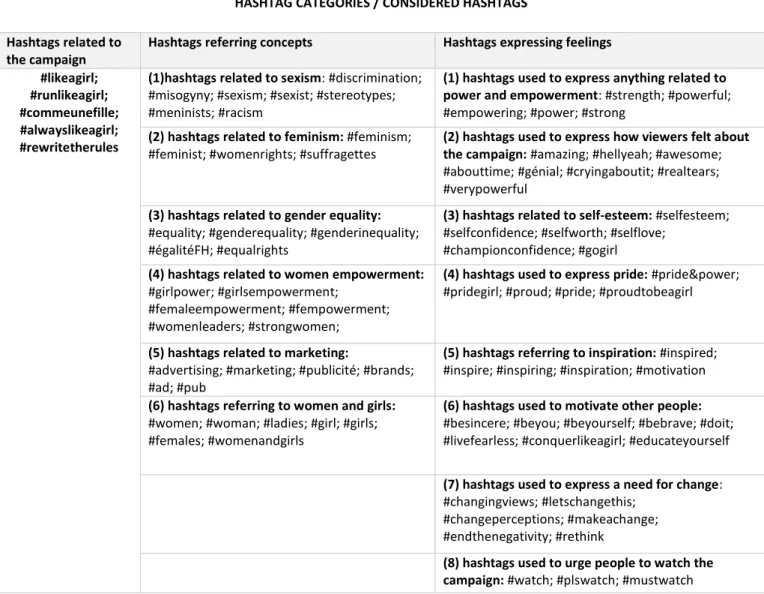
A distinct categorization was created to analyse the use of the hashtags, specific to each ad-campaign resulting into five major categories: (1) hashtags belonging to other ad-campaigns; (2) hashtags used to express feelings or personal thoughts; (3) hashtags referring concepts; (4) hashtags referring brands; (5) hashtags related to the campaign.
5. A
NALYSIS OFR
ESULTS ANDD
ISCUSSIONIn this chapter, results of the conducted analysis to both campaigns and consumers’ response to the same will be explored and discussed, following the structure and order of the research questions that were previously formulated.
5.1. Use of “femvertising” by Always and Covergirl 5.1.1. Like a Girl - Always
Always’ “Like a Girl” campaign launched its first video commercial online on June 26th 2014 gathering more than 62 million views on YouTube till date. Through a series of advertisements,
Always pledges to help young girls in their journey through puberty by rallying people to change
perceptions and depreciative attitudes towards young girls.
The commercial starts with the preparation of a sound set with a clapper closing in front of the camera as a teenager walks in with a background music made of the repetition of the same piano keys. The commercial’s director asks her to show her what it looks like to run like a girl. Five participants, three young women in their teenage years and two males, one adult and one child, emulate a girl running unnaturally with exaggerated movements, smiling and worried about her looks in accordance to Goffman’s (1976) findings that women smile more frequently and more expansively than men (Kendall & Tannen, 2008). The director then asks to show what it looks like to fight like a girl. Participants depict the situation with a typical “catfight” and portraying girls as being in a weak and defensive position. Finally, the director asks to show
20
what it looks like to throw like a girl. Yet again, girls are stereotypically shown as being unenergetic and inefficient in their moves, clearly proving that the expression “like a girl” is denoted as an insult. “We asked young girls the same question” flashes on the screen. The same questions are asked to a group of four pre-pubescent girls who, this time, respond with energetic movements as they actually run on set, clean non existing sweat, throw strong punches and face the camera with determination. Here, the brand intents to show consumers that young girls have not yet been conditioned by the negative connotations of doing something like a girl. As music stops, “When did doing something ‘like a girl’ become an insult?” flashes on the screen and the commercial’s director asks participants another set of questions such as “Do you think you just insulted your sister?”, “Is like a girl a good thing?” and “when they’re in that time between 10 and 12 how do you think it affects them when somebody uses ‘like a girl’ as an insult?” guiding both participants and viewers in their reflection about the demonstrated behaviour.
As girls are asked to reflect about the experience and their behaviour, viewers are put in the same situation of personal reflection confronting them with either the fact that they have used the expression or that they have personally experienced the insult. Viewers can feel in girls’ response to the questions that they are constantly criticized for what they do and how they do it and confronted with expected attitudes and behaviours. But as girls reflect upon it and one of them is given the chance to respond and advise younger girls, a clear evolution can be seen as her response shows a growing confidence (“Doesn’t matter what they say”, “I’m going to do it anyway”) and sense of pride and acceptance of her female identity. In the end, the director gives one of the older girls a chance to redo it and a final montage of girls swinging a ball, showing karate moves and running towards the camera in slow motion, concludes with a final title card inciting people to take action: “Let’s make #likeagirl mean amazing things. Join us to champion girl’s confidence at always.com”.
5.1.2. Girls Can – Cover Girl
Covergirl’s “Girls Can: Women empowerment” video commercial launched online on February
21st 2014, gathering till date over 5,866 million views on Youtube. Covergirl aimed to encourage women to break barriers and achieve anything they set their minds to, making it easier for the next women and thus making the “world a little more beautiful” for everyone. The commercial stars African-American actress Queen Latifah, lesbian comedian Ellen DeGeneres, Colombian actress Sofia Vergara, American pop singer Katy Perry, African-American singer-songwriter
21
Janelle Monae, rapper of Mexican origins Becky G, pop-rock singer Pink and Elite Level Women’s Tournament Roller and ice hockey player Natalie Wiebe.
The minute-long commercial starts with Ellen DeGeneres stating “Girls can’t. Sometimes you hear it but more often you feel it” as quickly changing frames of the celebrities behind the camera with a clapper in front of them or in backstage alternate with the expressions “hear it” and “feel it” flashing on alternating white, pink and black backgrounds. Celebrities then take turns stating common misconceptions of what women cannot do such as “rock”, “be strong”, “be funny”, “rap”, “play the lead”, “run the show” or “dance crazy” which are directly associated to these celebrities’ personalities or work. Increasingly faster overlapping voices saying “girls can’t” with the same expression flashing on black background are interrupted as music stops abruptly and Queen Latifah states “Yeah, girls can”. The next part of the commercial follows these celebrities being interviewed and talking about their personal experiences and how they got to where they are now by challenging the expected behaviour translated in the following expressions: “everybody told me that I couldn’t do it”, “I was always told”, “I heard that girls couldn’t rap (…) couldn’t own businesses”. These women are shown as the living proof that women can do anything they want to as they talk about their personal experiences and advise other women to challenge the norms by just being “courageous” and themselves. The final part of the commercial works as an incentive or motivation to viewers as they are rallied to defy expectations with a sort of chant in which each celebrity takes turn: “Girls can’t? Yes they can! Come on Covergirls! Rap! Be funny! Be off the Wall! Rock! Be strong! Run the show! Make the world a little more easy, breezy and beautiful”.
5.1.3. Comparative discussion
Both ad-campaigns show similar characteristics in their construction, filming and message. First of all, both brands spread pro-female messages through the figure of the “young girl” as a symbol of the feminist cause. The use of this figure is obvious in Always’ campaign as real young girls were cast for the purpose. In Covergirl’s commercial, even though adult female celebrities were cast, the young girl’s figure is used rhetorically as in no circumstance the word “women” is used. This figure has a potent effect on viewers as it puts them in a self-reflective position facilitating the remembrance of lived experiences from childhood in which they were told that they could not do something or were judged because of their gender. Plus, it also puts viewers in a protective position of future generations as they are confronted with the harmful effect of these experiences not only in women’s self-confidence but also in the general perpetuation of sexism.
22
Secondly, both ad-campaigns feature documentary-like characteristics, once again more obvious in the “Like a Girl” campaign, with frames showing elements from behind the scenes, such as clappers, lights, staff and characters through the camera lens giving a more personal and authentic feeling to the commercials, granting credibility and legitimacy to the message. The storyline construction also shows some similarities. Both commercials start off with an introduction after which viewers are first confronted with preconceptions and societal expectations of how girls should behave and what they should or not do. Then, there is a deconstruction of these misconceptions by displaying challenging attitudes and living examples of people that went against the norms, finally motivating girls to accept themselves and take pride on who they are. Still, Always’ campaign takes it a little further by functioning almost as a self-therapy session as participants and viewers are compelled to reflect upon the demonstrated behaviour and given a chance to reconcile with and accept themselves in an emotional and touching way as the brand gives them the chance to redo it. By doing this, these campaigns allow, in a way, women to gain public access in Lakkoff’s opinion, as they gain “interpretive control, [and] ability to determine the meaning of events in which they are involved” (as cited in Kendall & Tannen, 2008, p.557).
Both brands position themselves as feminist products and defenders of the feminist cause showing their commitment to the protection and empowerment of women through their products, “developing attachments based on experiences, emotions, lifestyles and other benefits instead of focusing on the physical properties of the brand” (Reker, 2016, p. 17). In none of the commercials are physical products from Always nor Covergirl mentioned as means of empowerment nor actually featured, even though there is a more obvious allusion to Covergirl and its products with the inclusion of its slogan “easy, breezy, beautiful” in the end of the commercial, the makeup seen on the starring celebrities and the constant reference to the brands’ colours.
If Always’ campaign aims to change perceptions and attitudes through emotion, Covergirl’s commercial appears as softer and bubblier advertisement reconciling, in some way, viewers with the feminist cause deconstructing the general misconception that feminist supporters cannot be feminine. By starring women of different races, ethnicities and sexual orientations, Covergirl is including all women in the feminist cause meeting a well-known criticism of third-wave feminists who critiqued second-wave feminists for the pretended homogeneity of the experience of being a woman not taking into account some characteristics such as race (Mann & Huffman, 2005). Both of these campaigns seek to promote self-acceptance in women through
23
their individualities and choices, presenting themselves as examples of commodity feminism (Cole & Hribar, 1995; Gill, 2008; Lazar, 2006)
5.2. Consumer’s perception, reaction and relation with “femvertising” 5.2.1. Consumers and the brands
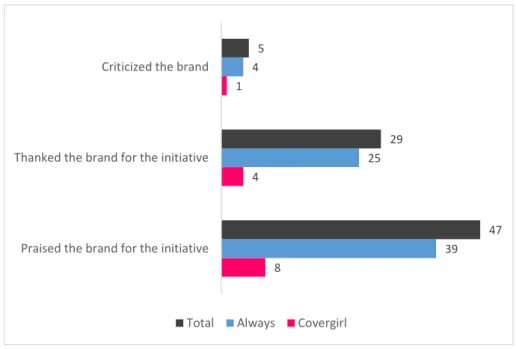
Findings show that 81 occurrences (5%) out of a total of 1619 categorizations fell under theme 1 which represents individuals who, either positively or negatively, related to the brands establishing a direct contact with them through comments and the use of the hashtags. Tweets were divided into three sub-categories which represented: (1.a) users who thanked the brand for the initiative; (1.b) users who complimented the brand for the initiative and (1.c) users who criticized the brand (Figure 1). For a better overall understanding of categorizations, refer to Appendix 3.
Figure 1- Consumers' attitude towards the brand
Users who thanked the brand
25 out of the 29 occurrences that fell under sub-category 1.a were directed towards Always through the “Like a Girl” campaign leaving the remaining 4 to Covergirl. Consumers thanked the brands for creating ad-campaigns that transmitted and represented power to women, that tackled and fought stereotypes and for creating a self-confidence movement. Some examples of tweets categorized under sub-category 1.a are as follows:
8 4 1 39 25 4 47 29 5
Praised the brand for the initiative Thanked the brand for the initiative Criticized the brand
24
#Hashtag @Being_ABelieber _ June 29: @Always Thank you for spreading a movent for girls
confidence everywhere. Im going to spread the power #LikeAGirl
Artistry Agency @ArtistrySA _ June 27: Thanks to #Always for creating a campaign that will hopefully eradicate the negative stereotypes that come with the phrase #likeagirl
Shaira Barton @ShairaBarton _ February 26: Thank you @COVERGIRL for this inspiring commercial. #girlscan #empowering
Users who complimented the brand
Most of the categorizations of theme nº 1 fell under sub-category 1.b representing users that complimented brands for their initiative. 39 out of the 47 occurrences belong to users commenting Always’ campaign and 8 to Covergirl’s. Users appreciated the fact that corporations are using their status and power to address these type of messages or do good, especially the beauty and cosmetic industry in which representations of women are most subjected to unrealistic standards. Overall, the use of empowering messages and stereotypes defiance were complimented. Some examples of tweets categorized under sub-category 1.b are as follows:
Hava Goldberg @HavaGoldberg _ July 2: Confident girls become strong women. Kudos to @Always for using their corp power for good
https://www.youtube.com/watch?v=XjJQBjWYDTs … #LikeAGirl
Kristina @TinakWildcat _ July 2: P&G doing amazing things with their market power #likeagirl Pretty Public Beauty @devin_giannoni _ February 25: @COVERGIRL I'm so impressed by ur initiatives as a company w/#girlscan. Ur empowering women w/true meaning of beauty - follow ur passions.
Users who criticized the brand
The remaining 5 occurrences fell into sub-category 1.c representing users that criticized Always and Covergirl for using feminism as a means of making money and for not taking into account men, thus perpetuating sexism:
Christian Lind @aMusicVideoaDay _ June 27: Hey @Always you do realize that #LikeAGirl has been used as an insult on both gals and guys, right? http://youtu.be/XjJQBjWYDTs #sexism #fail
Nina Orezzoli @abullyforyou _ July 3: @Always, my feminism is not your marketing. If you want to affect change, you have to do more than create a hashtag. Opinionated #LikeAGirl Bailey Gerrits @fish2bicycle: Capitalism and feminism can't mix. #girlscan #dove Stop selling empowerment.
25 5.2.2. Consumers and the campaigns
Figure 2- Consumers' attitude towards the campaign
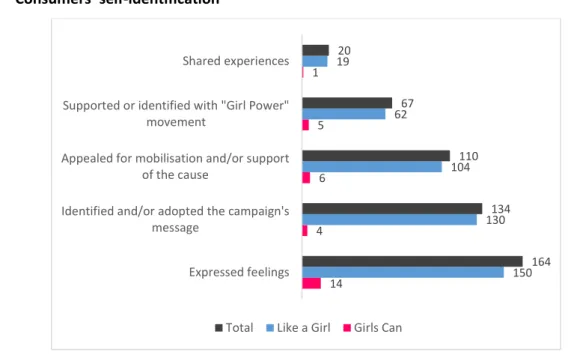
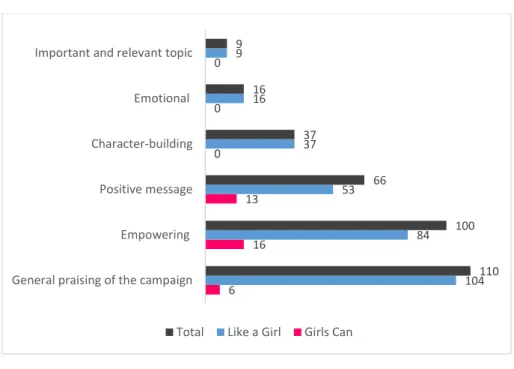
Most of the occurrences, 968 (59,8%) out of 1619 categorizations, fell under theme 2 representing consumers who somehow related to the campaigns demonstrating either positive or negative attitudes towards them (Figure 2). Tweets were divided into two sub-categories which represented: (2.a) users who showed a positive attitude towards the campaign with 950 occurrences and (2.b) users who showed a negative attitude towards the campaign with 18 occurrences. Sub-category 2.a was divided into 3 themes: (2.a.1) self-identification with the cause and/or message of the campaign; (2.a.2) praising/compliment of the campaign; and (2.a.3) advisement of visualization and/or sharing of the campaign.
5.2.2.1. Positive attitude towards the campaign
Figure 3 - Consumers' positive attitude towards the campaign
69 5 880 5 949 10 Positive attitude Negative attitude
Total Like a Girl Girls Can
30 35 4 465 352 130 495 387 134
Self-identification with the message/cause Praising of the campaign Advisement to watch and/or share the
campaign