REM WORKING PAPER SERIES
Impact of public and private sector external debt on economic growth
Jorge Silva
REM Working Paper 024-2018
January 2018
REM – Research in Economics and Mathematics
Rua Miguel Lúpi 20,1249-078 Lisboa, Portugal
ISSN 2184-108X
Any opinions expressed are those of the authors and not those of REM. Short, up to two paragraphs can be cited provided that full credit is given to the authors.
1
Impact of public and private sector external debt on economic growth *
Jorge Silva+ #
Abstract
We assess the effect of the Portuguese external debt of the private and public sectors on economic growth for the period 1999-2014. We study the channels through which external debt may affect economic growth: demand, supply and external accounts. Regarding aggregate demand, we evaluated private saving, public investment in volume and real GDP per person employed. The external debt of the public sector showed some evidence of having a detrimental influence on private saving, but a favourable effect on public investment in volume. The gross external debt of the private sector positively influenced public investment. Concerning aggregate supply, we analysed the production function per person employed in the private sector. Private external debt positively affected the gross value added in volume per person employed. Public external debt negatively impacted the gross value added in volume per person employed and the total factor productivity. Regarding external accounts, the private external debt affected the primary income account, though it had a low coefficient.
Key words: external debt, economic growth, public sector, private sector, Portugal JEL: C22, E44, F34, G15, H63
* The opinions expressed are those of the author and not necessarily those of his employer. I thank Luís Catão and other participants at the 5th UECE Conference on Economic and Financial Adjustments, 24th June 2016 for the useful comments.
+ ISEG – School of Economics and Management, Universidade de Lisboa, email: [email protected].
2
1. Introduction
The relationship between economic growth and debt is an attractive subject in the macroeconomics field. In this study, we concentrate on the case of Portugal and highlight the relationship between the stock of external debt and economic growth. Portugal is an interesting case study due to a specific feature that emerged after the introduction of the euro area: high external debt as percentage of GDP when compared to other countries.
For this reason, we study public debt and economic growth, as well as the debt of other institutional sectors and economic growth. Therefore, we analyse the external debt of the private and public sectors. In this study we will assess the consequences of leveraging and orderly deleveraging on the channels through which external debt may affect economic growth.
In addition, we can identify the amount of public debt held by non-residents. While public debt held by residents may not be very detrimental for the economic growth rate, government debt held by non-residents may have negative consequences on the external accounts and on economic growth. Furthermore, the external debt of the private sector could have an impact on private gross added value and would necessarily assign future resources generated by the private sector to the payment of interests, rents, and profits to the rest of the world.
This paper is organized as follows: section two presents a literature review, section three addresses the methodology, section four details the data, section five discusses the results, section six presents the robustness analysis, and section seven concludes.
2. Literature review
Reinhart & Rogoff (2010) studied the links between public debt, economic growth and inflation in both developed and emerging countries. The study established some debt-to-GDP thresholds. Unexpectedly, the relationship between public debt and economic growth was found to be similar among emerging and advanced economies. Furthermore, in emerging markets, there was evidence of a more relevant threshold for total gross external debt, when compared with total public debt. Public and private debts were almost entirely foreign currency denominated, while the domestically issued component was mainly denominated in the home currency. The authors considered that
3
it was relevant to study thresholds for external debt (both public and private) because emerging markets are often more dependent on external borrowing. The main conclusion of Reinhart & Rogoff (2010) was that both advanced countries and emerging markets with a high debt-to-GDP ratio (i.e. above the threshold of 90%) were associated with remarkably lower economic growth. In the case of low external debt-to-GDP (below 60%), economic growth was associated with adverse results for emerging market countries.
Afonso & Jalles (2013) studied the links between growth, productivity and government debt. The authors used a panel estimation of 155 countries for the period 1970-2008 as well as growth equations and growth accounting techniques. The authors tested endogeneity, simultaneity, non-linearities and threshold effects. They concluded that fiscal consolidation promoted growth in a non-Keynesian fashion. There was a negative impact of the government debt ratio on growth for the full sample, and with higher household and government debt there is lower output growth. Higher debt ratios have a positive impact on total factor productivity (TFP), but are detrimental to public and private investment. In the case of the OECD countries, debt maturity increases economic growth, while financial crises are detrimental to growth. The authors found endogenous debt ratio thresholds of 59% for the full country sample and 58% for the euro area countries. In addition, an increase of 10% in the debt ratio had a negative (positive) impact on growth in the case of countries with a debt ratio above (below) 90% (30%).
Checherita-Westphal & Rother (2012) studied the impact of government debt on the per capita GDP growth rate in 12 euro area countries for the period 1970-2008. The authors used panel fixed-effects and dealt with potential endogeneity (simultaneity or reverse causation) through different ways: one-year and five-year forward growth rates and potential GDP growth rates, quadric relationship in debt, and instrumental variables estimation models. The channels through which government debt had a non-linear impact on the economic growth rate were private saving, public investment and TFP. In addition, the authors consider the stock of private debt as an important variable when investigating the relationship between public debt and economic growth. The authors concluded that when debt levels are above the debt turning point between 90-100% of GDP, there are lower long-term growth rates. Therefore, many countries of the euro area have debt levels that may have a detrimental impact on the growth of GDP.
4
Delong & Summers (2012) studied the role of fiscal policy in a depressed economy, such as the United States. In the case of short-term nominal interest rates at the zero lower bound, with high cyclical unemployment, large output gap and excess capacity, an increase in government expenditure would not be offset by monetary policy nor neutralized by supply-side bottlenecks.
Moreover, there is evidence that a deep and prolonged downturn has a negative impact on the path of potential output. In fact, even with a small amount of hysteresis, an expansionary fiscal policy may be self-financing. If it is not, expansionary fiscal policy may raise the present value of future potential output.
Fiscal policy has an important role in severe downturns in the aftermath of a financial crisis, more so than in normal times. Delong & Summers (2012) presented their main conclusions about fiscal policy in a depressed economy: the Keynesian multiplier is substantially larger than the relative small value in normal times; austerity in a depressed economy can deteriorate the long-run fiscal balance; an economy will be unlikely to benefit from an expansionary fiscal policy only if the government has to pay a high premium over the social rate of time discount.
Krugman & Eggertsson (2011) presented a New Keynesian-style model of debt-driven slumps, in which some agents have an overhang of debt. In addition, there is a forced deleveraging, which depresses aggregate demand. The authors considered several approaches: Fisherian debt deflation, the liquidity trap, the paradox of thrift, the Keynesian-type multiplier and a rationale for expansionary fiscal policy. When there is an abrupt downward revision regarding how much debt is safe for individual agents, a sudden shift to deleveraging can create major macroeconomic problems. The authors consider that someone must spend more to offset the fact that debtors are reducing their consumption. In conclusion, the purpose of fiscal expansion should be to temporarily sustain employment and output while the private sector deleverages.
Pattillo et al. (2011) have studied the non-linear impact of external debt and of debt reduction on economic growth for 93 developing countries during the period from 1969-1998. The methodology used was fixed effects as well as generalized method of moments (GMM) in order to control for potential endogeneity. The dataset included nominal debt and net present value of external debt. The results suggest that the impact of debt became detrimental at about 160-170% of exports or 35-40% of GDP, i.e. debt had a non-linear effect on economic growth. Doubling debt could slow per capita
5
economic growth rate by about 1/3p.p. to 0.5p.p.. However, the turning point may vary according to country specific characteristics. In addition, investment was not the main channel through which external indebtedness reduced the economic growth rate. In fact, the quality of investment and the TFP growth were the main channels, which is consistent with other previous studies.
Reis (2013) studied the low economic growth rate between 2000 and 2012 in Portugal. During this period the Portuguese economy grew less than the USA during the Great Depression and less than Japan during its Lost Decade. Reis (2013) presented a new hypothesis to clarify this evidence, i.e. the misallocation of abundant capital flows from abroad. The author used a model of credit frictions. If financial integration exceeds financial deepening, productivity will fall and generate a slump. Furthermore, relatively unproductive firms in the non-tradable sector expanded at the expense of more productive tradable firms.
During the slump, there were large capital inflows from abroad, which allowed a steady growth rate of consumption. An increase of capital inflows due to a fall in the interest rate at which Portugal could borrow from abroad allowed a consumption boom as well as large capital inflows to finance it, which decreased net foreign assets. There was an increase in imports and the non-tradable sector. Therefore, the expansion of the non-tradable sector at the cost of the tradable sector caused a rise in employment and real wages in the non-tradable sector and an appreciation of the real exchange rate. Reis (2013) rejected some theories that had been presented by previous authors:
• Low education, low TFP, the increase in government size, the rigid labour market, the inefficient legal system and the inability to compete in world trade; • Exchange rate of entering monetary union at too high a value;
• Wage growth in Portugal, rise of unit labour cost when compared with Germany and unemployment.
Portugal became financially integrated with the rest of the euro area and net foreign borrowing rose, which left it particularly exposed to the international financial crisis 2008-2009. After 2010, there was a sudden stop in capital flows, which plunged the country into a crisis.
In addition, the author explained the similarities and differences between Portugal, and Ireland and Spain. Portugal has a less developed financial system (i.e. less financial
6
deepening), which caused largely misallocated capital inflows, an expansion of the unproductive non-tradable sector, and a fall in productivity.
Schclarek (2004) studied the relationship between debt and economic growth for 59 developing countries and 24 industrial countries for the period 1970-2002. In this study, the author took into account public and private debt, external debt as well as four different dependent variables: GDP per capita growth rate, the TFP growth rate, the capital accumulation growth rate, and the private savings rate. In the case of developing countries, lower external debt levels were associated with higher economic growth rates. This negative relationship was explained by public external debt and was not driven by private external debt. The main channel was the capital accumulation growth, while the relationship between TFP growth and external debt is limited. Private savings rates presented mixed results. There was no evidence for an inverted-U shaped relationship between external debt and economic growth. Regarding industrial countries, there was no significant relationship.
Afonso & Sousa (2011) used a Bayesian Structural Autoregression model and a Fully Simultaneous System approach to study the macroeconomic effects of fiscal policy in Portugal for the period 1978-2007 using quarterly data. There was evidence that an increase in government spending had a negative impact on real GDP through crowding out effects of private consumption and investment. In addition, there was a positive impact on the price level and a mixed impact on the financing costs of government debt.
3. Methodology
In this section we explain the potential effect of leveraging or deleveraging of the public and private sectors on economic growth. Additionally, we present the stylised facts of the Portuguese case.
3.1 Channels through which external debt may affect economic growth
We discuss the variables that may be dependent on the evolution of external debt. Despite some channels having been mentioned in in economic theory, some of them may not be impacted by external debt in the Portuguese case.
7
Private saving rate
The stock of external debt and the level of interest rates determine the amount of future interest payments demanded of Portugal. Higher (net) external debt has a permanent impact on the primary income account due to higher interest payments. In addition, there is a decrease of the available income of families, which leads to less consumption and/or saving.1 The amount of external debt of financial and non-financial corporations determines the future interest payments from these Portuguese institutional sectors to non-residents.
Public investment
A high stock of external debt of the public sector determines a high level of payments to foreign institutions and a reduction of the primary income account. This amount of interest payments decreases the fiscal space of the government budget to finance projects. Considering the objective of fiscal consolidation, the government may cut primary expenditure allocated for public investment, including the creation and maintenance of public infrastructure. Therefore, higher debt interest payments may reduce the fiscal space in the government budget and reduce social transfers and public investment.
The growth rate of GDP per person employed
In the public sector, external debt may increase the public expenditure on salaries (higher number of civil servants) and the purchase of goods and services in volume as well as public investment in volume. If there is a low marginal propensity to import, the fiscal multiplier is larger. This positive impact requires a large share of public investment, consumption by civil servants and the purchase of nationally produced goods and services. In this manner, public external debt may allow an increase in GDP. In the private sector, external debt may finance investment and increase the stock of capital. If the new investment is based on expensive high technology, there needs to be an improvement in productivity and the rate of return in order to pay interests on the external private debt. However, this positive impact may be weaker if a large share of the investment is from imports.
1 The amount of external debt of households is residual. However, financial institutions may borrow from the international financial markets and lend to households for consumption.
8
The growth rate of gross value added per person employed of the private sector The amount of external debt may be allocated to finance private investment and increase the ratio of the stock of capital per worker. Therefore, if the private sector were able to achieve a rate of return of investment higher than the interest rate of the external debt, a positive impact of private external debt on productivity and economic growth would be possible.
TFP growth rate of the private sector
There are many factors that may affect TFP, although it is not easy to identify them. In recent literature, the degrees of capacity utilisation of labour and capital as well as the level of efficiency have been presented as the main factors. However, external debt may also be a factor with an impact on capacity utilisation and efficiency. In addition, external debt may allow higher levels of investment and stock of capital to achieve an optimum level and economies of scale. Therefore, these companies can sell products and services in external markets, which means an improvement in competitiveness. Investment growth rate of the private sector
The external amount of debt of the private sector may have a positive or negative impact on private investment. On one hand, the amount of external debt may allow financing higher investments and increase the stock of capital, as well as economies of scale and improvement of knowledge. Furthermore, external debt may allow access to new business through mergers and acquisitions. On the other hand, in the case of a high level of external debt and a high amount of interest, the external debt reduces the ability of non-financial corporations to invest and increase the stock of capital. In addition, financial institutions reduce lending due to high leveraging, which has an impact on the investment of non-financial corporations.
Primary income account
When there is a structural decrease in the primary income account, it is more difficult to achieve equilibrium of external accounts, since the balance of payments naturally includes the primary income account. When there is a reduction in the primary income account, the trade balance needs to increase (and/or balance of capital, current transfers) in order to attain the equilibrium of the balance of payments and offset the reduction of the primary income account. Therefore, in the case of a lack of improvement in exports, a decrease in imports will be required. However, imports include public and private
9
consumption as well as investment, thus a reduction of investment is detrimental to potential output and economic growth.
3.2 External debt - the stylised facts of the Portuguese case
This study includes variables of external debt of the public sector and external debt of the private sector. Figure 1 presents the evolution of total gross external debt and net external debt as a percentage of GDP during the period 1995-2014. The gross external debt-to-GDP ratio increased more than the net external debt-to-GDP ratio due to the increase of Portuguese assets around the rest of the world.
[Figure 1]
We decompose the net international investment position of the Portuguese economy into public and private sectors as well as into different periods. There was an increase in leveraging of the private and public sectors from 1996 until the financial crisis of 2009. During the period 2010-2014 there was an orderly deleveraging of the private sector and leveraging of the general government sector. The different paths of the public and private sectors are consistent with economic theory. In the aftermath of the 2009 financial crisis, the private sector debt level shrunk sharply, while public sector debt increased rapidly.
Additionally, we assess the correlation between the net investment position and gross external debt for the public and private sectors as well as for the total economy. There was a strong negative correlation between these variables. In addition, we use the gross external debt indicator in the econometric estimations to assess the likely impact of external debt on economic growth.
Figure 2 shows the external debt and net external debt of the private sector as a percentage of GDP for the period 1996-2014. There was an increase of external liabilities (gross external debt) but also an increase of external assets. In addition, there was a deleveraging during the economic and financial adjustment programme (EFAP).2 In the case of external liabilities and external assets, it is important to stress that there are different ratings/creditworthiness between debt liabilities and debt assets, as well as
2 The EFAP was the agreement between the Portuguese authorities and foreign institutions during the period 2011-2014. This programme aimed at supplying financial assistance to the general government and fostering structural reforms in the economy.
10
different interest rates levels.3 However, the net external debt of the private sector was low for many years over the period 1999-2014.
[Figure 2]
There is a similarity between gross public external debt and net gross external debt. The amount of public sector assets in the rest of the world is not sizeable. There is no evidence of deleveraging in the public sector during the period 1996-2014. In addition, the share of public debt held by non-residents in the total public debt is the gross public external debt.
Figure 3 details the path of total public debt, and the decomposition between debt held by residents and debt held by non-residents. During the period 2000Q1-2001Q4, the public debt-to-GDP ratio was below the 60% threshold stipulated in the Stability and Growth Pact, and the public external debt ratio was lower than the ratio of public debt held by residents. In the period 2002Q1-2010Q1, the public debt-to-GDP ratio increased above the threshold of 60% due to public external debt, while debt held by residents was stable. On the other hand, in the period 2010Q2-2011Q1, there was a reduction of the weight of public external debt, which was supported by an increase of debt held by residents and increases of debt from the central bank. For more detail, presents external debt by institutional sector. Finally, during the EFAP (2011-2014), there were loans from international institutions (the IMF, ECB and EC) and reimbursements of public debt at maturity.
Concerning the split between public debt held by residents and public debt held by non-residents, Afonso & Silva (2017) compare the cases of Portugal and Ireland. The authors calculate the ratio between public debt held by non-residents and public debt held by residents and estimate their determinants during the period 2000Q2–2014Q4. In Portugal, the results show that better fiscal positions, higher systematic stress in Europe and higher shares of monetary financial institutions’ (MFIs) cross-border holdings of public debt increase the share of non-resident held debt, while rising sovereign yields decrease that ratio. For Ireland, the results are statistically weak.
[Figure 3]
3 It is important to stress that Figure 2 presents external debt at market value, while reimbursement will be at nominal value.
11
Figure 4 shows that during the EFAP the increase of gross public external debt was greater than the reduction of gross private external debt. While the private sector presented orderly deleveraging in the period 2010-2014, the public sector increased its external debt due to the funding received from international institutions (the IMF, EC and ECB) to finance net borrowing.
[Figure 4]
The other MFIs experienced an increase in the level of external debt until 2010, but it decreased after that due to the deleveraging measures underlying the EFAP. The Portuguese central bank has seen its external debt rise, especially after 2009, given its support to national financial institutions. The weight of this external debt has been relevant since the financial crisis of 2009.
4. Data
The main sources are Statistics Portugal (INE) and Banco de Portugal (BdP). The focus of this study is the period 1999-2014, including the early years of the euro area, as well as the EFAP in Portugal. However, some series are available for a larger time range, which is useful for econometric robustness analyses. Data from national accounts were released by INE and financial data from BdP.
Some variables are available only in nominal terms, for example, external debt by institutional sector. In addition, we calculate some ratios to be able to use percentages of GDP. Our ratios were based on data from BdP for the numerator and data from INE for the denominator.
In this study we consider the public sector, private sector and total economy. The institutional sectors underlying the European accounts system are general government, households, non-financial corporations, financial corporations and the rest of the world. Therefore, we consider that the public sector is the general government, while the private sector comprises the remaining institutional sectors.
5. Results
On the demand side, we consider private saving, public investment in volume and real GDP per person employed. In the case of the supply side, we study the inputs of the
12
production function of the private sector as channels of transmission - TFP and investment per person employed. Furthermore, we study the primary income account to quantify the impact of external debt on external accounts.
Equation (1) presents the set of main determinants for the dependent variable:
ܻ௧ = ߚ+ ߚଵ∆ܧݔݐܾ݀݁ݐ௧ି௩+ ߚଶ∆ܧݔݐܾ݀݁ݐ௧ି௨+ ߚଷ∆ܺ௧௧௧ + ݑ௧ (1) where ܻ௧ is the dependent variable; ∆ܧݔݐܾ݀݁ݐ௧ି௨is the quarter-on-quarter change of the ratio between external debt of the public sector and GDP in quarter t-j; ∆ܧݔݐܾ݀݁ݐ௧ି௩ is the quarter-on-quarter change of the ratio between external debt of the private sector and GDP in quarter t-j; and ܺ௧௧௧ is the set of control variables.
Since some variables may have a unit root, being I (1), we build series with no unit root (I (0)). For example, there is evidence that the external public debt as percentage of GDP has a unit root. In the case of the private sector, there is a unit root, but the probability of a wrong conclusion is higher.
5.1 Demand side
We present the determinants of the variations of private saving, public investment and GDP per person employed. Table 1 presents the determinants of the variation of the private saving-to-GDP ratio. The most important variable was the 3-month Euribor rate. A positive variation of 100 basis points decreased the private saving as percentage of GDP by 1.14p.p. (column 3). This result was explained by the private sector's higher interest payments than revenues. The variation of the external debt of the public sector showed statistical significance, although it had a low coefficient. An increase of 1p.p. of the public debt held by non-residents had a detrimental impact of 0.08p.p. on the private saving-to-GDP. Variations of the gross private external debt ratio had no impact on private saving.
[Table 1]
We assess the evolution of the gross saving of each institutional sector over the period 1999-2014. The saving rate decreased until 2009 and increased in the final years. Households and non-financial institutions had a similar weight in the period 1999-2009, but the gap between the two sectors increased in the last years. The public sector had negative gross saving throughout most of the period of analysis.
13
In the case of public investment, Table 2 details the estimation results for the control variables. There was a positive correlation between the y-o-y variation of public investment in volume and external debt.
[Table 2]
In column 3, an increase of the lagged public debt-to-GDP ratio (1p.p.) had a negative impact on the growth rate of real public investment (1.67p.p.). This result suggests that the increase of public debt in previous quarters was offset by the reduction of public investment. In addition, a higher budget balance (lagged) positively affected public investment in volume, while public consumption had no effect.
There was evidence of a positive impact on public investment from both private and public external debt. This suggests that external debt may have provided the funds for public investment. The coefficient linked to private external debt was lower than the coefficient associated to public external debt. This result was expected, because public external debt provides the funding for current and investment public spending. However, private external debt may have been channelled to fund the private and public sectors.
The coefficient of determination is low, which may mean that public investment expenditure was a discretionary fiscal variable.
For the real GDP per person employed, we report in Table 3 the results of other relevant variables for the quarterly GDP per person employed. The growth rate of the euro area was determinant for the growth of GDP per person employed in Portugal. However, it is important to stress that the variation rate of GDP per person employed in Portugal (column 3) was around 0.34%, when the economic growth rate in the euro area was 1%. There was a negative effect due to lagged variations of the Euribor rate. Furthermore, the variation of the private and public external debt had a marginal impact on economic growth and productivity, i.e. the coefficients were low (regression 1) or had no statistical significance (regression 3).
[Table 3]
We have assessed other determinants such as the weight of private investment on GDP, the share of public expenditure in GDP, the public revenue-to-GDP ratio, and the degree of openness. However, these variables did not have an impact on the growth of
14
productivity (GDP per person employed) and we do not present them in order to save space.
Regarding the labour market, there is a difference between GDP per person employed and GDP per capita due to the variation of the employment-to-population ratio. This discrepancy is explained by changes in the unemployment rate and labour force participation rate. In this study, we focus on GDP per person employed in order to determine the evolution of productivity. During the second half of the period of analysis, the employment-to-population ratio decreased due to higher unemployment rates as well as a decrease in the labour force participation rate.
5.2 Supply side
We estimate the growth rate of the gross value added (GVA) per person employed of the private sector as well as TFP and real private investment per person employed. Equation (2) is the production function of the private sector, where ܻ௧ is the GVA in volume of the private sector, ܣ௧ is the TFP of the private sector, ܭ௧ is the capital stock of the private sector and ܮ௧ is the private employment. There will be only constant returns to scale if 1 − ߙ − ߚ = 0, where α is the elasticity of the real GVA to the variation of the stock of capital and β is the elasticity of real GVA to the variation of employment.
ܻ௧ = ܣ௧ ܭ௧ఈ ܮఉ௧ (2)
The GVA per person employed is obtained by equation (3) ܻ௧
ܮ௧ =
ܣ௧ ܭ௧ఈ ܮఉ௧
ܮ(ଵିఉ)௧ ܮఉ௧ (3)
After some iterations, we find the GVA per person employed in equation (4), where ݕ௧ means the GVA per person employed and ݇௧ఈ is the stock of capital per person employed.
ݕ௧ = ܣ௧
15
Dividing equation (4) of the period t by the same equation of the same quarter of the previous year (t-4) and applying the logarithmic operator we obtain equation (5).
݈݊ ൬ݕݕ௧ ௧ିସ൰ = ݈݊ ൬ ܣ௧ ܣ௧ିସ൰ + (1 − ߙ − ߚ) ∗ ݈݊ ൬ ܮ௧ିସ ܮ௧ ൰ + ߙ ∗ ݈݊ ൬ ݇௧ ݇௧ିସ൰ (5)
Finally, we find the growth rate of the GVA per person employed of the private sector, where (1 − ߙ − ߚ) ∗ (−∆%݈௧) is the probable impact in the absence of constant returns to scale. Equation (6) presents the decomposition of the growth rate of the GVA per person employed of the private sector when considering a general production function.
∆%ݕ௧= ∆%ܣ௧+ (1 − ߙ − ߚ) ∗ (−∆%݈௧) + ߙ ∗ ∆%݇௧ + ϵ୲ (6)
where ∆%ݕ௧ is the y-o-y variation rate of the real GVA per person employed of the private sector; ∆%݇௧ is the y-o-y growth rate of real stock of capital per person employed in the private sector; ∆%ܣ௧ is the y-o-y variation rate of private sector TFP; and ∆%݈௧ is the y-o-y growth rate of private employment. There are many variables that can determine TFP, such as the external debt of the private and public sectors. Table 4 details the estimation results.The estimation of the regression in column 1 took as an assumption a Cobb-Douglas production function, i.e. constant returns to scale and ߙ + ߚ = 1. The estimated coefficient was 0.41, in which an increase of 1% in the stock of capital per person employed caused a positive variation of 0.41% of the ratio GVA per person employed. However, it is important to stress that this conclusion was constrained to the assumption of constant returns to scale: ߙ + ߚ = 1. On the other hand, the estimations in columns 2 and 3 took into account the possibility of the absence of economies of scale and ߙ + ߚ ≠ 1. These estimations may suggest decreasing returns to scale during the period 2000-2014 in the production function per person employed of the private sector.
Additionally, in regressions 1 and 2 the constant term was not significantly different from zero. Therefore, we can deduce that the y-o-y growth of the TFP of the private sector may have been zero during the period of analysis. Furthermore, the variation of external debt (private and public sectors) had an impact on the production function per person employed of the private sector, but the coefficients had a low magnitude.
16
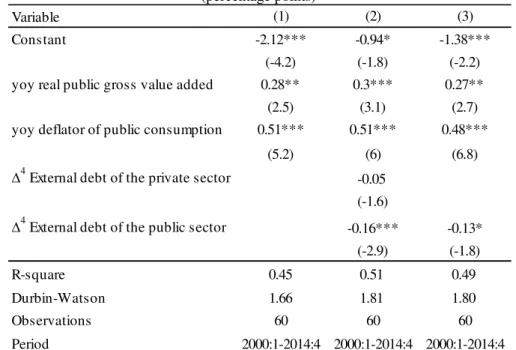
In the following tables, we study the determinants of each of the inputs of the production function. Concerning the TFP of the private sector, Table 5 presents the results of the estimations.4 Column 1 shows that in the case of no variation in public
sector salaries and in the prices underlying purchases of goods and services (deflator of public consumption), as well as no variation in real salaries of civil servants and real depreciations (real GVA of the public sector), the y-o-y variation of TFP in the private sector was -2.12p.p. during the period 2000-2014. In addition, an increase of real GVA (1%) of the public sector had a positive impact on the growth rate of TFP of the private sector (0.28p.p.). Furthermore, an increase of 1% in the deflator of public consumption had a positive impact on the variation rate of TFP (0.51p.p.). It is important to stress that these two variables are similar to the nominal GVA of the public sector. Consequently, we can conclude that the impact of the public sector on private TFP was positive. However, this positive impact was less than proportional.
There is no evidence that gross private external debt had an impact on the TFP of the private sector during the period 2000-2014 (columns 2). On the other hand, public external debt negatively affected the dependent variable.
In addition, we have tested variables such as the capacity utilisation and the stock of capital, but we do not report the results for the sake of parsimony and the absence of statistical significance.
[Table 5]
In addition, we study the y-o-y variation of the private investment in volume per person employed. In this context, we used 2SLS estimators to avoid the likely problem of endogeneity between real investment per person employed and GVA in volume per person employed. To solve the endogeneity issue, we used an instrumental variable, the economic activity indicator from BdP, since there is notably a strong correlation between this indicator and the private GVA in volume.
Moreover, a positive variation of 1p.p. in real public investment decreased the y-o-y real private investment per person employed by 0.15p.p. (column 1). Additionally, an increase of 100 basis points of the Portuguese 10-year sovereign yield had a negative impact on the y-o-y growth of real private investment per person employed (1.41p.p.).
4
The dependent variable “total factor productivity of the private sector” was obtained assuming a Cobb-Douglas production function.
17
In addition, an increase of the real GVA of the private sector (1p.p.) had a positive impact on the y-o-y growth of the private investment in volume per person employed (1.62p.p.). In this context, the 2SLS estimator takes into account the possible endogeneity between real investment and GVA in volume. Therefore, we find evidence of a crowding out effect during the period 2000-2014, i.e. an increase in public investment had a negative impact on the private investment in volume per person employed. That effect was due to the reduced amount of capital available to the private sector and higher interest rates. Regarding the effect of external debt (private and public sectors) on the private investment in volume per person employed ratio, Table 6 shows that it had weak statistical significance.
[Table 6]
5.3 External accounts
We now study the impact of gross and net external debt on the balance of payments, in particular the effect of external debt on the primary income account. Therefore, the primary income account is one of the components of the balance of payments. The impact of a high stock of gross and net external debt may have a detrimental effect on the primary income account. The primary income account records financial flows stemming from transactions between residents and non-residents. There are receipts and payments related to income from labour, direct investment, interests, portfolio investment and other investment - loans and deposits.
Table 7 presents the econometric estimations and Figure 5 shows the decomposition between the interests received from the rest of the world and the interests paid to the rest of the world.
[Table 7]
Column 1 shows the positive effect of the lagged y-o-y variation of the trade balance as percentage of GDP (1p.p.) on the dependent variable (0.48p.p.). This effect was partially offset by the interaction between the lagged 3-month Euribor rate and the variation of the trade balance. Unexpectedly, the lagged rise of the private external debt positively affected the dependent variable, but the coefficient was low.
Hence, despite a significant deterioration in the Portuguese net external debt, there has not been a corresponding fall in the primary income account. Therefore, it is important
18
to present a decomposition of the primary income account in order to understand how an increase of the net external debt of the Portuguese economy did not explain a deterioration of the primary income account. The interest account is included in the primary income account. Figure 5 details the weight of interest on GDP for the case of liabilities, assets and balance.
[Figure 5]
Regarding the liabilities, Figure 6 shows that throughout the period 1997-2009, despite an increase of the amount of gross external debt, the amount of interests did not increase in the same proportion due to fluctuating interest rates.
[Figure 6]
Additionally, taking into account the amount of interests and stock of external debt, it is possible to calculate a proxy of the interest rates of liabilities and assets. Figure 7 presents the interest rates level over the period 1996-2014. With the exception of 2009, the interest rates underlying liabilities were higher than the interest rates underlying assets. We conclude that not only the nominal amount, but also the interest rate level of the liabilities is higher when compared to assets. Throughout the period 1996-2014 there was a significant reduction of the interest rates underlying liabilities and assets. This decrease was important to avoid the impact of increasing net external debt on the primary income account.
[Figure 7]
6. Robustness analysis
In this section we assess some factors that may be critical for the results, notably the correlation between economic growth and external debt.
The possible endogeneity between economic growth and debt is a controversial issue in studies on this subject. The previous literature summarised in this paper took into account the economic growth indicator as a dependent variable, while the debt ratio was the independent variable. We assess if there was an impact of external debt of the private and public sectors on the channels through which external debt may affect the economic growth rate. This methodology aims at avoiding the problem of endogeneity, using lagged independent variables.
19
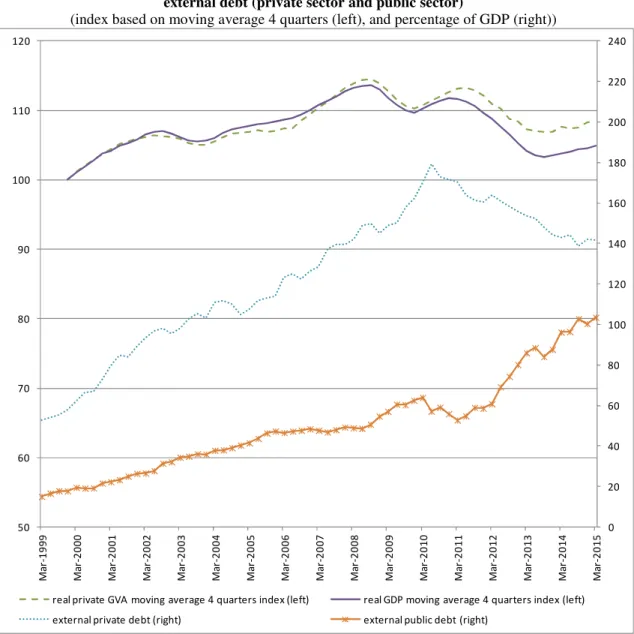
In addition, we assess the path of GVA of the private sector and the real GDP of the total economy during the period 1999-2014 as well as the external debt of the private and public sectors (Figure 8). The growth of real GDP and GVA in volume of the private sector was around 10% over ten years (1999Q4-2009Q4).
In the period 1999Q4-2009Q4, real GDP increased around 10%, while the external debt of the private sector increased by 104.1p.p. of GDP (net external debt increased 27.7p.p. of GDP) and external debt of the public sector increased 44.7p.p. of GDP. During the period 1999-2009, the sum of the variation of real GDP (i.e. the sum of flows detailed in equation (7)) was 83.2% of real ܩܦܲଵଽଽଽ. However, the stock of external debt increased around 170.5p.p (119.8p.p. and 50.7p.p. of the private and public sectors, respectively) as measured by nominal ܩܦܲଵଽଽଽ (equation (8)):
න ൣݎ݈݁ܽ ܩܦܲ ௧௧௧− ݎ݈݁ܽ ܩܦܲ ଵଽଽଽ௧௧൧, ଶଽ ௧ୀଵଽଽଽ (7) ∆݁ݔݐܾ݀݁ݐ ଵଽଽଽିଶଽ௧௧ = ቆ݁ݔݐܾ݀݁ݐ ଶଽ ௧௧ ܩܦܲ ଵଽଽଽ − ݁ݔݐܾ݀݁ݐ ଵଽଽଽ௧௧ ܩܦܲ ଵଽଽଽቇ. (8)
In the period 2010-2014 there was a deleveraging of the external debt of the private sector, while the public sector debt held by non-residents increased (public external debt). In addition, the total economy real GDP and the private GVA in volume of the private sector decreased. There was a reduction of economic growth and a larger gap between real GDP of total economy and GVA in volume of the private sector. This larger gap was explained by a reduction of real GVA of the public sector (i.e. salaries of civil servants in volume and depreciations are included in the GVA of the public sector).5
[Figure 8]
7. Conclusions
We assess the potential impact of the external debt of the private and public sectors on the Portuguese economic growth for the period 1999-2014. We study the relationship between the external debt variables and the channels through which external debt may
5 The difference between real GDP of the total economy and GVA in volume of the private sector rose during the period 2012-2014 due to nominal reduction in the public sector salaries.
20
affect economic growth. These channels were the dependent variables. The variation of external debt ratios and control variables were the independent variables.
On the demand side, we studied private saving, public investment in volume and real GDP per person employed. The gross external debt of the private sector positively impacted public investment. The external debt of the public sector showed some evidence of having a detrimental impact on private saving and a positive effect on public investment. Furthermore, private saving was negatively determined by the 3-month Euribor rate. GDP per person employed as a measure of productivity was positively correlated with the growth rate of the euro area (although at lower levels in the growth rate of Portugal) and negatively correlated with the 3-month Euribor rate. Public investment growth was negatively explained by the lagged public debt-to-GDP ratio.
For aggregate supply, we analysed the likely impact of external debt of the private and public sectors on the production function per person employed of the private sector. We conclude that external debt did not explain real investment per person employed in the private sector. The GVA in the private sector was positively affected by private external debt, but negatively affected by public external debt (however, both coefficients were low). In addition, the coefficient of elasticity of the GVA per person employed with respect to capital did not have statistical significance.6 This result means that the production function of the private sector did not present constant returns to scale during the period 1999-2014, i.e. there was some evidence of decreasing returns to scale. TFP was negatively affected by public external debt.7
Regarding external accounts, the primary income account-to-GDP was positively explained by the trade balance-to-GDP; and negatively explained by the interaction between the lagged 3-month Euribor rate and the trade balance-to-GDP. Public external debt had no impact on the primary income account-to-GDP, while private external debt had a slight impact. Despite a significant deterioration in the Portuguese net external debt during the period 1999-2014, a corresponding deterioration of the primary income account-to-GDP did not occur in the same proportion. This result was a combination of two different factors: the impact of a substantial reduction of interest rates levels was
6 This conclusion was not constrained to a Cobb-Douglas production function. 7 This conclusion was constrained to a Cobb-Douglas production function.
21
stronger than the unfavourable gap between the interest rate underlying the liabilities and the interest rate of assets.
Finally, we considered other variables in the estimations, but we did not present them in order to save space. This set of variables includes terms of trade, fiscal revenue-to-GDP, the public debt-to-GDP threshold of 60%, capacity utilisation and lagged variables.
8. References
Afonso, António, and João Tovar Jalles. “Growth and Productivity: the role of Government Debt.” International Review of Economics and Finance, 2013: 384-407. Afonso, António, and Jorge Silva. “Determinants of nonresident government debt ownership.” Applied Economics Letters, 2017: 107-112.
Afonso, António, and Ricardo Sousa. “The macroeconomic effects of fiscal policy in Portugal: a Bayesian SVAR analysis.” Portuguese Economic Journal, 2 February 2011: 10:61-82.
Checherita-Westphal, Cristina, and Philipp Rother. “The impact of high government debt on economic growth and its channels: An empirical investigation for the euro area.” European Economic Review, July 2012: 1392–1405.
Delong, J. Bradford, and Lawrence H. Summers. “Fiscal Policy in a Depressed Economy.” Brookings Papers on Economic Activity, Spring 2012: 233-298.
Krugman, Paul, and Gauti B. Eggertsson. “Debt, Deleveraging, and the Liquidity Trap: A Fisher‐Minsky‐Koo approach.” 14 2 2011.
Pattillo, Catherine, Hélène Poirson, Ricci, and Antonio Luca. “External debt and growth.” Review of Economics and Institutions, Fall 2011.
Reinhart, Carmen M., and Kenneth S. Rogoff. “Growth in a Time of Debt.” American
Economic Review, May 2010: 573-578.
Reis, Ricardo. “The Portuguese Slump and Crash and the Euro Crisis.” Brookings
Papers on Economic Activity, Spring 2013: 143-193.
Schclarek, Alfredo. “Debt and Economic Growth in Developing and Industrial Countries.” December 2004.
22
Figure 1 – Gross external debt and net external debt: total economy
(percentage of GDP)
Source: BdP – Banco de Portugal, INE – Statistics Portugal and own calculations.
Figure 2 – Gross external debt and net external debt: private sector
(percentage of GDP)
Source: BdP – Banco de Portugal, INE – Statistics Portugal and own calculations.
‐50 0 50 100 150 200 250 300 M a r‐ 1 9 9 6 M a r‐ 1 9 9 7 M a r‐ 1 9 9 8 M a r‐ 1 9 9 9 M a r‐ 2 0 0 0 M a r‐ 2 0 0 1 M a r‐ 2 0 0 2 M a r‐ 2 0 0 3 M a r‐ 2 0 0 4 M a r‐ 2 0 0 5 M a r‐ 2 0 0 6 M a r‐ 2 0 0 7 M a r‐ 2 0 0 8 M a r‐ 2 0 0 9 M a r‐ 2 0 1 0 M a r‐ 2 0 1 1 M a r‐ 2 0 1 2 M a r‐ 2 0 1 3 M a r‐ 2 0 1 4 M a r‐ 2 0 1 5
Gross external debt Net external debt
‐50 0 50 100 150 200 M a r‐ 1 9 9 6 M a r‐ 1 9 9 7 M a r‐ 1 9 9 8 M a r‐ 1 9 9 9 M a r‐ 2 0 0 0 M a r‐ 2 0 0 1 M a r‐ 2 0 0 2 M a r‐ 2 0 0 3 M a r‐ 2 0 0 4 M a r‐ 2 0 0 5 M a r‐ 2 0 0 6 M a r‐ 2 0 0 7 M a r‐ 2 0 0 8 M a r‐ 2 0 0 9 M a r‐ 2 0 1 0 M a r‐ 2 0 1 1 M a r‐ 2 0 1 2 M a r‐ 2 0 1 3 M a r‐ 2 0 1 4 M a r‐ 2 0 1 5
23
Figure 3 – Public debt: total, held by non-residents (external debt) and held by residents
(percentage of GDP)
Source: BdP – Banco de Portugal, INE – Statistics Portugal and own calculations.
Figure 4 – Gross external debt: total economy, private sector and public sector
(percentage of GDP)
Source: BdP – Banco de Portugal and INE – Statistics Portugal and own calculations.
0 20 40 60 80 100 120 140 M a r‐ 2 0 0 0 M a r‐ 2 0 0 1 M a r‐ 2 0 0 2 M a r‐ 2 0 0 3 M a r‐ 2 0 0 4 M a r‐ 2 0 0 5 M a r‐ 2 0 0 6 M a r‐ 2 0 0 7 M a r‐ 2 0 0 8 M a r‐ 2 0 0 9 M a r‐ 2 0 1 0 M a r‐ 2 0 1 1 M a r‐ 2 0 1 2 M a r‐ 2 0 1 3 M a r‐ 2 0 1 4 M a r‐ 2 0 1 5
Total public debt Public debt held by non‐residents Public debt held by residents
0 50 100 150 200 250 300 M a r‐ 1 9 9 6 F e v ‐1 9 9 7 Ja n ‐1 9 9 8 D e z‐ 1 9 9 8 N o v ‐1 9 9 9 O u t‐ 2 0 0 0 S e t‐ 2 0 0 1 A g o ‐2 0 0 2 Ju l‐ 2 0 0 3 Ju n ‐2 0 0 4 M a i‐ 2 0 0 5 A b r‐ 2 0 0 6 M a r‐ 2 0 0 7 F e v ‐2 0 0 8 Ja n ‐2 0 0 9 D e z‐ 2 0 0 9 N o v ‐2 0 1 0 O u t‐ 2 0 1 1 S e t‐ 2 0 1 2 A g o ‐2 0 1 3 Ju l‐ 2 0 1 4 Ju n ‐2 0 1 5
Gross external debt Gross external debt: General Government
Gross external debt: Private sector
24
Figure 5 – Interest: credit, debit and balance
(percentage of GDP)
Source: BdP – Banco de Portugal, INE – Statistics Portugal and own calculations.
Figure 6 – External debt and interest payments
(percentage of GDP)
Source: BdP – Banco de Portugal, INE – Statistics Portugal and own calculations.
‐3 ‐2 ‐1 0 1 2 3 4 5 6 M a r‐ 1 9 9 6 M a r‐ 1 9 9 7 M a r‐ 1 9 9 8 M a r‐ 1 9 9 9 M a r‐ 2 0 0 0 M a r‐ 2 0 0 1 M a r‐ 2 0 0 2 M a r‐ 2 0 0 3 M a r‐ 2 0 0 4 M a r‐ 2 0 0 5 M a r‐ 2 0 0 6 M a r‐ 2 0 0 7 M a r‐ 2 0 0 8 M a r‐ 2 0 0 9 M a r‐ 2 0 1 0 M a r‐ 2 0 1 1 M a r‐ 2 0 1 2 M a r‐ 2 0 1 3 M a r‐ 2 0 1 4 M a r‐ 2 0 1 5
Interest ‐ credit Interest ‐ debit Interest ‐ balance
0.0 1.0 2.0 3.0 4.0 5.0 6.0 0 50 100 150 200 250 300 M a r‐ 1 9 9 6 M a r‐ 1 9 9 7 M a r‐ 1 9 9 8 M a r‐ 1 9 9 9 M a r‐ 2 0 0 0 M a r‐ 2 0 0 1 M a r‐ 2 0 0 2 M a r‐ 2 0 0 3 M a r‐ 2 0 0 4 M a r‐ 2 0 0 5 M a r‐ 2 0 0 6 M a r‐ 2 0 0 7 M a r‐ 2 0 0 8 M a r‐ 2 0 0 9 M a r‐ 2 0 1 0 M a r‐ 2 0 1 1 M a r‐ 2 0 1 2 M a r‐ 2 0 1 3 M a r‐ 2 0 1 4 M a r‐ 2 0 1 5
25
Figure 7 – Interest rates of external debt and external assets
(percentage of GDP)
Source: BdP – Banco de Portugal, INE – Statistics Portugal and own calculations.
0.0 0.5 1.0 1.5 2.0 2.5 3.0 3.5 4.0 4.5 D e z‐ 1 9 9 6 D e z‐ 1 9 9 7 D e z‐ 1 9 9 8 D e z‐ 1 9 9 9 D e z‐ 2 0 0 0 D e z‐ 2 0 0 1 D e z‐ 2 0 0 2 D e z‐ 2 0 0 3 D e z‐ 2 0 0 4 D e z‐ 2 0 0 5 D e z‐ 2 0 0 6 D e z‐ 2 0 0 7 D e z‐ 2 0 0 8 D e z‐ 2 0 0 9 D e z‐ 2 0 1 0 D e z‐ 2 0 1 1 D e z‐ 2 0 1 2 D e z‐ 2 0 1 3 D e z‐ 2 0 1 4 D e z‐ 2 0 1 5
26
Figure 8 – Gross value added in volume (private sector), real GDP (total economy) and gross external debt (private sector and public sector)
(index based on moving average 4 quarters (left), and percentage of GDP (right))
Source: BdP – Banco de Portugal, INE – Statistics Portugal and own calculations.
0 20 40 60 80 100 120 140 160 180 200 220 240 50 60 70 80 90 100 110 120 M a r‐ 1 9 9 9 M a r‐ 2 0 0 0 M a r‐ 2 0 0 1 M a r‐ 2 0 0 2 M a r‐ 2 0 0 3 M a r‐ 2 0 0 4 M a r‐ 2 0 0 5 M a r‐ 2 0 0 6 M a r‐ 2 0 0 7 M a r‐ 2 0 0 8 M a r‐ 2 0 0 9 M a r‐ 2 0 1 0 M a r‐ 2 0 1 1 M a r‐ 2 0 1 2 M a r‐ 2 0 1 3 M a r‐ 2 0 1 4 M a r‐ 2 0 1 5
real private GVA moving average 4 quarters index (left) real GDP moving average 4 quarters index (left)
27
Table 1 – Estimations of the y-o-y quarterly change of private saving-to-GDP ratio
(percentage points)
Notes: t-statistics in brackets. *, **, *** denote significance at 10, 5 and 1% levels. Heteroskedasticity and Autocorrelation Consistent Covariance (HAC) or Newey-West estimator. Equations were estimated by OLS.
Table 2 – Estimations of the y-o-y quarterly change of public investment in volume
(percentage points)
Notes: t-statistics in brackets. *, **, *** denote significance at 10, 5 and 1% levels. Heteroskedasticity and Autocorrelation Consistent Covariance (HAC) or Newey-West estimator. Equations were estimated by OLS.
Variable (1) (2) (3)
Constant -0.26 0.18 0.05
(-0.9) (0.5) (0.2)
Δ4
Primary income account as % of GDP 0.03 0.13 0.12
(0.1) (0.4) (0.4)
Δ4 Euribor 3 months -1.08*** -1.13*** -1.14***
(-3.9) (-4.6) (-4.6)
∆4
External debt of the private sector (t-3) 0.01
(0.7) ∆4
External debt of the public sector (t-3) -0.09** -0.08*
(-2.5) (-2.5) R-square 0.27 0.32 0.32 Durbin-Watson 1.77 1.86 1.85 Observations 64 64 64 Period 1999:1-2014:4 1999:1-2014:4 1999:1-2014:4 Variable (1) (2) (3) Constant -4.91 -4.58 -4.82*** (-0.6) (-0.5) (-0.5)
yoy public consumption in volume -0.15
(-0.1) ∆4 Budget balance-to-GDP (t-1) 1.22* (1.9) ∆4 Public debt-to-GDP (t-4) -1.5* -1.56* -1.67* (-1.9) (-1.8) (-2) ∆4
External debt of the private sector (t-3) 0.98* 0.98* 1.06*
(1.8) (1.8) (1.8)
∆4
External debt of the public sector (t-3) 1.43*** 1.44*** 1.53***
(3.3) (2.9) (3.3)
R-square 0.23 0.23 0.24
Durbin-Watson 2.28 2.28 2.13
Observations 52 52 52
28
Table 3 – Estimations of the y-o-y quarterly growth rate of GDP per person employed
(percentage points)
Notes: t-statistics in brackets. *, **, *** denote significance at 10, 5 and 1% levels. Heteroskedasticity and Autocorrelation Consistent Covariance (HAC) or Newey-West estimator. Equations were estimated by OLS.
Table 4 – Estimations of the y-o-y quarterly change of the growth gross value added per person employed in the private sector
(percentage points)
Notes: t-statistics in brackets. *, **, *** denote significance at 10, 5 and 1% levels. Heteroskedasticity and Autocorrelation Consistent Covariance (HAC) or Newey-West estimator. Equations were estimated by OLS.
Variable (1) (2) (3)
Constant -0.05 0.40 0.10
(-0.1) (1.5) (0.3)
yoy real GDP of the euro area 0.33*** 0.35*** 0.34***
(3.2) (4.7) (4.1)
Δ4
Euribor 3 months (t-2) -0.57** -0.52**
(-4.2) (-3.1) ∆4
External debt of the private sector (t-2) 0.04* 0.03
(1.8) (1.4)
∆4
External debt of the public sector (t-2) 0.08*** 0.03
(2.9) (1.2) ρ 0.68*** 0.63*** 0.64*** (9.3) (7.3) (7.2) R-square 0.64 0.68 0.69 Durbin-Watson 1.76 1.77 1.75 Observations 69 69 69 Period 1997:4-2014:4 1997:4-2014:4 1997:4-2014:4 Variable (1) (2) (3) Constant 0.19 0.40 1.31*** (0.4) (0.6) (2.9) yoy private stock of capital volume per person employed 0.41*** 0.27 -0.25
(3.2) (1.1) (-1.3) Impact of the sum of the elasticities 0.15 0.66***
(0.6) (3.8) ∆4 External debt of the private sector 0.07***
(3.8) ∆4 External debt of the public sector -0.08**
(-2.3) ρ 0.60*** 0.59*** 0.45*** (4.8) (4.6) (3.3) R-square 0.41 0.42 0.49 Durbin-Watson 2.05 2.06 2.18 Observations 59 59 59 Period 2000:2-2014:4 2000:2-2014:4 2000:2-2014:4
29
Table 5 – Estimations of the y-o-y quarterly change of the growth rate of total factor productivity in the private sector
(percentage points)
Notes: t-statistics in brackets. *, **, *** denote significance at 10, 5 and 1% levels. Heteroskedasticity and Autocorrelation Consistent Covariance (HAC) or Newey-West estimator. Equations were estimated by OLS.
Variable (1) (2) (3)
Constant -2.12*** -0.94* -1.38***
(-4.2) (-1.8) (-2.2)
yoy real public gross value added 0.28** 0.3*** 0.27**
(2.5) (3.1) (2.7)
yoy deflator of public consumption 0.51*** 0.51*** 0.48***
(5.2) (6) (6.8)
∆4
External debt of the private sector -0.05 (-1.6) ∆4
External debt of the public sector -0.16*** -0.13* (-2.9) (-1.8)
R-square 0.45 0.51 0.49
Durbin-Watson 1.66 1.81 1.80
Observations 60 60 60
30
Table 6 – Estimations of the y-o-y quarterly change of the growth rate for the investment per person employed of the private sector
(percentage points)
Notes: t-statistics in brackets. *, **, *** denote significance at 10, 5 and 1% levels. Heteroskedasticity and Autocorrelation Consistent Covariance (HAC) or Newey-West estimator. Equations were estimated by 2SLS.
Variable (1) (2) (3)
Constant 5.75** 1.19 3.23
(2.5) (0.4) (1)
Portuguese 10-year sovereign yield -1.41*** -1.01** -1.16***
(-3.8) (-2.4) (-2.8)
yoy real public investment -0.15*** -0.16*** -0.15***
(-6.1) (-6.8) (-6.2)
yoy real private gross value added 1.62** 1.67*** 1.85**
(3.1) (3.5) (3.7)
∆4
External debt of the private sector (t-2) -0.17* -0.14
(-1.8) (-1.3)
∆4
External debt of the public sector (t-2) 0.25* 0.17
(1.8) (1.1)
Instruments
constant √ √ √
yoy activity indicator √ √ √
yoy real public investment √ √ √
Portuguese 10-year sovereign yield √ √ √
∆4
External debt of the private sector (t-2) √ √
∆4
External debt of the public sector (t-2) √ √
R-square 0.63 0.63 0.65
Durbin-Watson 1.90 1.84 1.91
Observations 60 60 60
31
Table 7 – Estimations of the y-o-y quarterly change of the primary income account-to-GDP
(percentage points)
Notes: t-statistics in brackets. *, **, *** denote significance at 10, 5 and 1% levels. Heteroskedasticity and Autocorrelation Consistent Covariance (HAC) or Newey-West estimator. Equations were estimated by OLS. Variable (1) (2) (3) Constant -0.64*** -0.65*** -0.6*** (-3.9) (-3.7) (5.1) ∆4 Trade balance as % of GDP (t-4) 0.48*** 0.48*** 0.5*** (4.6) (4.8) (5.1)
Euribor 3 months (t-4) * ∆4 Trade balance as % of GDP (t-4) -0.09*** -0.09*** -0.1***
(-2.7) (-2.7) (-3)
∆4
Euribor 3 months (t-4) 0.01
(0.1) ∆4
External debt of the private sector (t-4) 0.04*** 0.04*** 0.04***
(3.3) (3.2) (3.2)
∆4
External debt of the public sector (t-4) 0.01 0.01
(0.6) (0.6)
R-square 0.37 0.37 0.37
Durbin-Watson 2.18 2.18 2.19
Observations 60 60 60