Food Science and Technology ISSN 0101-2061
DI:
D http://dx.doi.org/10.1590/1678-457X.01316
1 Introduction
Flavor is one of the most important attributes of foods in determining consumer acceptance and there has been an increasing interest to study its impact on quality of a food product. In the case of tropical fruits, aroma constituting of volatile components is one of the most appreciated characteristics, which determines its quality and it is particularly sensitive to compositional alterations (Ibáñez et al., 1998; Barreto et al., 2013). In addition, tropical fruits are often inexpensive, extremely rich in vitamins and can be used in a wide range of food products (Pino et al., 2001). Among the tropical and subtropical fruits, the avocado
(Persea americana, Mill.) is very much appreciated, and it
occupies a prominent place in the market due to its nutritional value, especially fibers and lipids. Moreover the fruit has soft flavor and low sugar content (about 10 g/kg of pulp), and thus is even recommended for diabetic suffering people since it serves as high-energy food (Sinyinda & Gramshaw, 1998; Maitera et al., 2014), maintain skin elasticity (Athar & Nasir, 2005) and reduce the coronary heart risk (Berasategi et al., 2012).
Botanically, avocado fruit is classified in three varieties: West Indian, Mexican and Guatemalan races (Morton, 1987).
The Collinson and Fortuna cultivars are Guatemalan x West Indian hybrids, while Barker and Geada are of West Indian race (Brasil, 1971; Medina, 1980). In Brazil, the fruit is classified in two groups (Brasil, 1971): the first group, in which Barker, Collinson and Geada cultivars are included, are suitable for long-distance transport and hence are commercialized as whole fruit, while the second group, in which Fortuna cultivar belongs, is delicate due to its consistency having soft pulp texture and it is more suited for oil extraction.
The physico-chemical composition of avocado fruit pulp and oil has been reported earlier (Turatti & Canto, 1985; Martinez et al., 1988; Lozano et al., 1993; Bora et al., 2001, Moreno et al., 2003; Berasategi et al., 2012, Mooz et al., 2012; Galvão et al., 2014; Indriyani et al., 2016). However, the information on the composition of volatile flavor constituents of avocado is limited. A total of 90 volatile compounds were reported to be present in an Australian cultivar Sherwil and the major compounds identified were pentanal, hexanal. (E)-2-hexenal, β-caryophyllene and α-copaene (Whitfield et al., 1980). Avocado fruits harvested in Mexico were analyzed by Yamaguchi et al. (1983) who
Identification of volatile compounds in cultivars barker, collinson,
fortuna and geada of avocado (
Persea americana
, Mill.) fruit
Mercia de Sousa GALVAD1, Maria Lúcia NUNES2, Patricia Beltrão Lessa CDNSTANT1, Narendra NARAIN1*
Received 15 Jan., 2016 Accepted 13 Mar., 2016
1 Laboratory of Flavor and Chromatographic Analysis, Post-graduate Program in Food Science and Technology – PROCTA, Universidade Federal de Sergipe – UFS, São
Cristóvão, SE, Brazil
2 Departament of Food Technology, Universidade Federal do Ceará – UFC, Fortaleza, CE, Brazil
*Corresponding author: [email protected]
Abstract
The objective of this paper was to determine the volatile profile of four cultivars - Barker, Collinson, Fortuna and Geada of avocado (Persea americana, Mill.) fruit and to perform a detailed study on the effect of volatiles extraction conditions. The best conditions for extraction for Collinson and Fortuna cultivars were by using a mixture of pentane and ethyl ether (2:1) as solvent for 80 min, while for Barker and Geada cultivars, the solvents were hexane and pentane-ether (2:1), respectively but for a shorter extraction period of 60 min. A total number of 158 compounds were separated in all 4 avocado cultivars, among them eighty-four volatile compounds were identified. The principal volatile compounds viz. hexanal, ethyl acetate, methyl dodecanoate, 2,5-dimethyl furan, 1,3-butanediol, 2-ethylphenol, 2-butanol, α−bergamotene, β−caryophyllene, (E)-2-decenal were common in all the 4 cultivars. (E)-2-pentenal which possesses fruity aroma was found only in the cultivar Fortuna while ethyl acetate possessing fresh fruity flavor was present in higher content in Collinson cultivar. Benzaldehyde which possesses characteristic fruity and nutty odor note was present at a higher concentration (4.3%) in only Geada cultivar and in traces in Barker cultivar but it was not detected in Collinson and Fortuna cultivars.
Keywords: avocado; aroma; quality; pulp; GC-MS.
identified 52 volatile compounds, the main compounds being C6 alcohols and aldehydes (hexanol, (E)-2-hexenol, (E)-3-hexenol, (Z)-3-hexenol, (E)-2-hexenal. Pino et al. (2000) analyzed volatile constituents of two cultivars (California and Haas) of avocado and reported the presence of 35 compounds, most of these being terpene types such as (E)-nerodilol, β-caryophyllene, β-pinene, trans-α-bergamotene and β-bisabolene. Working with another cultivar Moro grown in Cuba, Pino et al. (2004) reported the principal volatile compounds being (Z)-nerodilol, (E,E)-2,4-decadienal, (E,E)-α-farnesene, β-caryophyllene, caryophyllene oxide and α-copaene. Dbenland et al. (2012) studied the influence of maturity and ripening on aroma volatiles of Haas cultivar of avocado and reported an 85% decline in the amount of hexanal from firm to fully ripe fruit. Forty three compounds were found to be present in cultivar Fuerte of avocado fruit cultivated in Egypt (El-Mageed, 2007). Volatile profile of avocado pulp of 3 cultivars Simmonds, Booth 7 and Monroe were monitored during the ripening of fruit as affected by 1-methylcyclopropene (Pereira et al., 2013). However, to the best of our knowledge, no data are yet published on some largely grown avocado cultivars in Brazil.
The main cultivars of avocado grown In Brazil, are Fortuna, Hass, Fuerte, Geada and Yard. The Experimental Station of Itambé (IPA - region in the Pernambuco, Brazil) recommends the cultivation of Collinson, Barker, and Fortuna cultivars especially in the northeast region of Brazil where these are largely grown. Thus the objective of this work was to initially obtain volatile extracts, following a modified simultaneous distillation and extraction technique, from avocado pulp of different cultivars viz. Barker, Collinson, Fortuna and Geada by varying the extraction conditions such as use of different solvents and extraction time in order to evaluate the number of compounds present in these volatile extracts followed by identification and quantification of the volatile compounds present in the pulps of different cultivars.
2 Materials and methods
2.1 Materials
Avocado fruits of four cultivars, Barker, Collinson, Fortuna and Geada were obtained from a farm located in Goiana city in the Pernambuco state of Brazil. The fruits were transported to the laboratory in the city of João Pessoa in the standard cardboard boxes currently used for export packaging and did not have any application whatsoever of inhibitor or accelerator for the control of maturation. Fruits free from any apparent skin damage were selected for analysis. The ripe mature fruit, after being washed with distilled water, was cooled to 2 oC. The skin and kernel were separated manually by using a stainless steel knife and the pulp macerated. The solvents and authentic standard flavor compounds were of more than 99.5% purity and belonged to the firms, Merck and Sigma-Aldrich, respectively.
2.2 Volatiles isolation
The volatile compounds from the pulp of avocado fruit were extracted by simultaneous distillation and extraction technique using a modified procedure Likens and Nickerson’s apparatus (Likens & Nickerson, 1964). The extraction conditions were
initially optimized by varying the parameters such as: solvent (hexane or a mixture of pentane and ethyl ether in proportion 2:1) and extraction period (40, 60, 70 or 80min), with the objective to obtain a large number of compounds on chromatographic analysis. The weight of pulp (150 g), the volume (200 mL) of water added and the volume (20 mL) of the solvent were fixed. The extracts were concentrated to a final volume of 0,3 mL under flow of nitrogen gas (Narain & Galvão, 2004).
2.3 High resolution gas chromatography/mass spectrometry
A combined system of Varian gas chromatograph (GC 3800) coupled with mass spectrometer (Saturn 2000R) and its processing workstation was used. Two microliters of the concentrated volatile extract was injected in the column in split (1:20) mode. Capillary GC investigations were carried out on a 30 m (length) x 0.25 mm (internal diameter) polyethylene glycol innophase bondable polar capillary column (HP-INNDWax; 0.25 μm film thickness; Hewlett Packard, Inc., Palo Alto, USA). The carrier gas was helium (99.995% pure) and column head pressure was maintained at 11.5 psi having a flow rate of 1 mL/min. The oven temperature was programmed: initiation at 30oC for 5 min, increased at 7 oC/min to 100 oC, maintained at 100 oC for 5 min, increased at 1 oC/min to 130oC, followed by a later increase of 10 oC/min to 195 oC wherein it was maintained for 45 min. The temperatures of the injection port and the GC/MS interface were 190 oC and 210 oC, respectively. The mass spectrometer was operated in the electron ionization mode with an electrical energy of 70 eV and an ion source temperature of 250 oC. The mass spectrum was scanned between 33 and 450 atomic mass units at 0.3 sec interval.
2.4 Compounds identification
The linear retention index (LRI) values for unknowns were determined based on retention time and index data obtained by analyzing a series of normal alkanes (C6-C25). Volatile components were positively identified by matching their RI values and mass spectra with those of standards, also run under identical chromatographic conditions in the laboratory. The identification was also based on matching an unknown mass spectrum with the spectra available on the NIST (National Institute of Standards and Technology, USA) and mass spectral data system or the literature (Jennings & Shibamoto, 1980; Adams, 1995; Kondjoyan & Berdagué, 1996).
2.5 Statistical analysis
All determinations were obtained from triplicate measurements and results are expressed as means ± standard deviations. All results were processed using the SAS software (SAS Institute, Cary, NC) Version 9.1.3. Significant differences between the mean values of different characteristics were determined by applying Tukey’s test for multiple comparisons at the probability of 5% (p ≤ 0.05).
3 Results and discussion
solvents, Table 1 summarizes the data on number of peaks in different chromatograms and its quantitative representation classified according to the peak area.
The data presented in Table 1 reveal the capture of a larger number (84) of volatile compounds when the extraction was performed using the pulp of cultivar Collinson, with the solvent mixture pentane-ether (2:1) for 80 min. However, for Barker and Geada cultivars a better extraction was obtained after 60 minutes, using hexane and pentane-ether (2:1) as a solvent, respectively. The best condition for extraction from Fortuna cultivar was the one realized for 80min, regardless of the solvent, when it was possible to separate 50 volatile compounds. It was also observed that increasing the extraction time from 40 to 80 min did not result in any major change in number of compounds in the extract obtained from Collinson and Geada cultivars. The extraction time which showed better efficiency in capturing the volatiles from Barker and Geada cultivars was 60min which
is lower than that for Fortune and Collinson varieties (80 min). Chaintreau (2001) reported that the higher the lipid content of food matrix greater is the time required for volatiles extraction as lipid-containing matrix strongly increases the required time. Thus, the ideal conditions of extraction for a large number of volatile compounds depend on the cultivar of avocado and its lipid content (Galvão et al., 2014).
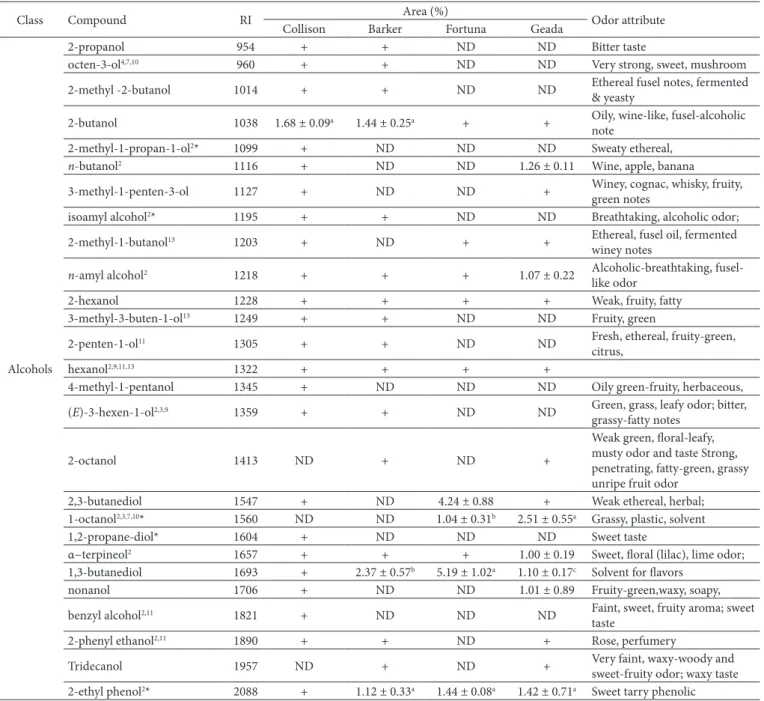
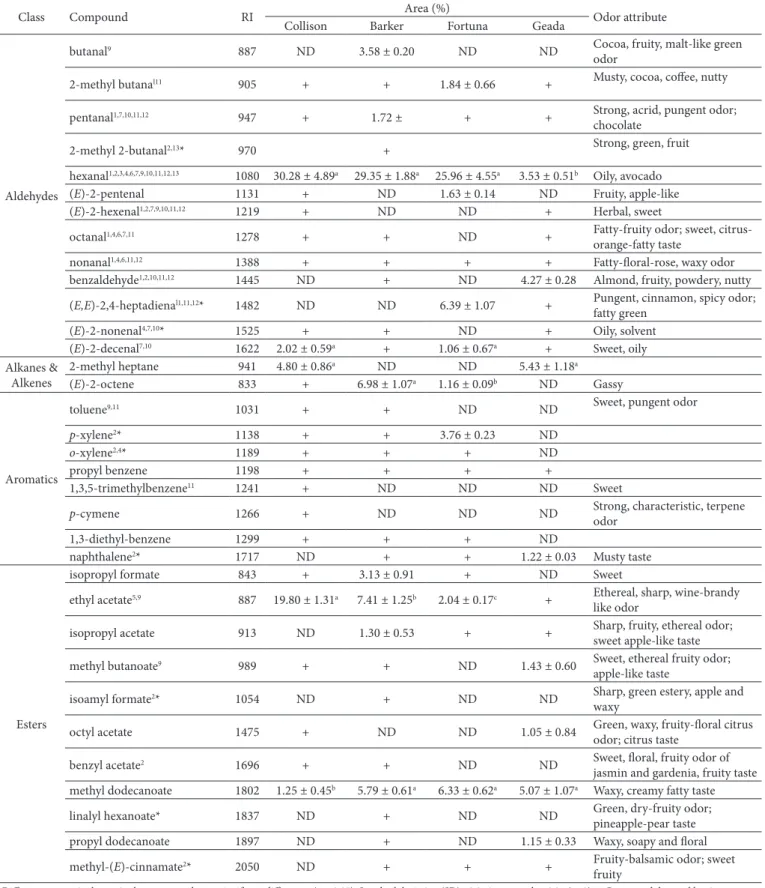
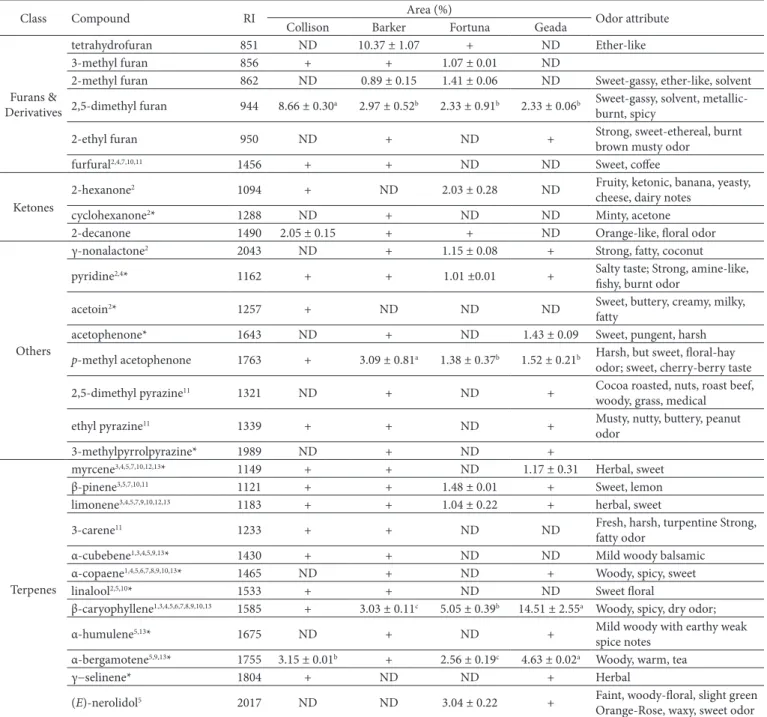
Table 2 lists the volatiles compounds identified in pulp of different cultivars - Collinson, Barker, Fortuna and Geada of avocado along with their characteristic odor notes.
A total number of 158 compounds were separated in all 4 avocado cultivars (Collinson, Barker, Fortuna and Geada), out of which 65 compounds were positively identified, 25 tentatively identified and 68 compounds could not be identified mainly due to the lack of standard organic compounds.
Table 1. Distribution of number and peak area of volatile components in chromatograms resulting from different extracts obtained by varying extraction conditions of pulp from different cultivars of avocado fruit.
Number Cultivar Extraction conditions Total number of peaks
According to the peak area
Solvent Time (min.) > 10% 1 to 10% < 1%
1
Collinson
n-hexane
40 13 3 9 1
2 60 17 3 9 5
3 70 14 4 6 4
4 80 19 3 2 14
5
Pentane-ethyl ether
40 17 2 15
-6 60 12 2 10
-7 70 61 3 4 54
8 80 84 2 9 73
9
Barker
n-hexane
40 41 2 15 24
10 60 82 2 13 67
11 70 58 1 16 41
12 80 43 3 14 26
13
Pentane-ethyl ether
40 18 2 12 4
14 60 9 2 5 2
15 70 55 3 5 47
16 80 17 4 4 9
17
Fortuna
n-hexane
40 19 2 5 12
18 60 24 2 17 5
19 70 30 2 9 19
20 80 50 2 25 23
21
Pentane-ethyl ether
40 25 2 9 14
22 60 37 2 8 27
23 70 32 3 10 19
24 80 50 4 12 34
25
Geada
n-hexane
40 30 2 10 18
26 60 52 2 21 29
27 70 44 3 15 26
28 80 53 1 12 40
29
Pentane-ethyl ether
40 36 1 21 14
30 60 82 1 26 55
31 70 66 2 20 44
Table 2. Volatile compounds present in pulp of different cultivars (Collinson, Barker, Fortuna and Geada) of avocado along with their characteristic odor notes.
Class Compound RI Area (%) Ddor attribute
Collison Barker Fortuna Geada
Alcohols
2-propanol 954 + + ND ND Bitter taste
octen-3-ol4,7,10 960 + + ND ND Very strong, sweet, mushroom
2-methyl -2-butanol 1014 + + ND ND Ethereal fusel notes, fermented
& yeasty
2-butanol 1038 1.68 ± 0.09a 1.44 ± 0.25a + + Dily, wine-like, fusel-alcoholic
note
2-methyl-1-propan-1-ol2* 1099 + ND ND ND Sweaty ethereal,
n-butanol2 1116 + ND ND 1.26 ± 0.11 Wine, apple, banana
3-methyl-1-penten-3-ol 1127 + ND ND + Winey, cognac, whisky, fruity,
green notes
isoamyl alcohol2* 1195 + + ND ND Breathtaking, alcoholic odor;
2-methyl-1-butanol13 1203 + ND + + Ethereal, fusel oil, fermented
winey notes
n-amyl alcohol2 1218 + + + 1.07 ± 0.22 Alcoholic-breathtaking,
fusel-like odor
2-hexanol 1228 + + + + Weak, fruity, fatty
3-methyl-3-buten-1-ol13 1249 + + ND ND Fruity, green
2-penten-1-ol11 1305 + + ND ND Fresh, ethereal, fruity-green,
citrus,
hexanol2,9,11,13 1322 + + + +
4-methyl-1-pentanol 1345 + ND ND ND Dily green-fruity, herbaceous,
(E)-3-hexen-1-ol2,3,9 1359 + + ND ND Green, grass, leafy odor; bitter,
grassy-fatty notes
2-octanol 1413 ND + ND +
Weak green, floral-leafy, musty odor and taste Strong, penetrating, fatty-green, grassy unripe fruit odor
2,3-butanediol 1547 + ND 4.24 ± 0.88 + Weak ethereal, herbal;
1-octanol2,3,7,10* 1560 ND ND 1.04 ± 0.31b 2.51 ± 0.55a Grassy, plastic, solvent
1,2-propane-diol* 1604 + ND ND ND Sweet taste
α−terpineol2 1657 + + + 1.00 ± 0.19 Sweet, floral (lilac), lime odor;
1,3-butanediol 1693 + 2.37 ± 0.57b 5.19 ± 1.02a 1.10 ± 0.17c Solvent for flavors
nonanol 1706 + ND ND 1.01 ± 0.89 Fruity-green,waxy, soapy,
benzyl alcohol2,11 1821 + ND ND ND Faint, sweet, fruity aroma; sweet
taste
2-phenyl ethanol2,11 1890 + + ND + Rose, perfumery
Tridecanol 1957 ND + ND + Very faint, waxy-woody and
sweet-fruity odor; waxy taste 2-ethyl phenol2* 2088 + 1.12 ± 0.33a 1.44 ± 0.08a 1.42 ± 0.71a Sweet tarry phenolic
Different superscript letters in the same row denote significant differences (p < 0.05); Standard deviation (SD) <0.01 is reported as 0.01 (n=3); + Compound detected but its area was less than 0.5%; ND: Not detected; * Tentative identification; 1Reported in pulp of Australian hybrid cultivar “Sherwil” (Whitfield et al., 1980); 2 Reported in pulp of Mexican cultivar
(Yamaguchi et al., 1983); 3 Reported in avocado leaves of Guatemalan and West Indian races (King & Knight, 1992); 4 Reported in pulp of fruit obtained from Israel (Sinyinda &
Gramshaw, 1998); 5 Reported in pulp of California and Hass cultivars (Pino et al., 2000); 6 Reported in pulp of Mexican cultivar (Moreno et al., 2003); 7 Reported in pulp of Mexican
cultivar (Lopez et al., 2004); 8 Reported in pulp of Moro cultivar from Cuba (Pino et al., 2004); 9 Reported in pulp of Fuerte cultivar from Egypt (El Mageed, 2007); 10 Reported in pulp
of Hass cultivar from Mexico (Guzmán-Gerónimo et al., 2008); 11 Reported in oil of pulp of Australian cultivar (Haiyan et al., 2007); 12 Reported in pulp of Hass cultivar from Mexico
Class Compound RI Area (%) Ddor attribute
Collison Barker Fortuna Geada
Aldehydes
butanal9 887 ND 3.58 ± 0.20 ND ND Cocoa, fruity, malt-like green
odor
2-methyl butanal11 905 + + 1.84 ± 0.66 + Musty, cocoa, coffee, nutty
pentanal1,7,10,11,12 947 + 1.72 ± + + Strong, acrid, pungent odor;
chocolate
2-methyl 2-butanal2,13* 970 + Strong, green, fruit
hexanal1,2,3,4,6,7,9,10,11,12,13 1080 30.28 ± 4.89a 29.35 ± 1.88a 25.96 ± 4.55a 3.53 ± 0.51b Dily, avocado
(E)-2-pentenal 1131 + ND 1.63 ± 0.14 ND Fruity, apple-like
(E)-2-hexenal1,2,7,9,10,11,12 1219 + ND ND + Herbal, sweet
octanal1,4,6,7,11 1278 + + ND + Fatty-fruity odor; sweet,
citrus-orange-fatty taste
nonanal1,4,6,11,12 1388 + + + + Fatty-floral-rose, waxy odor
benzaldehyde1,2,10,11,12 1445 ND + ND 4.27 ± 0.28 Almond, fruity, powdery, nutty
(E,E)-2,4-heptadienal1,11,12* 1482 ND ND 6.39 ± 1.07 + Pungent, cinnamon, spicy odor;
fatty green
(E)-2-nonenal4,7,10* 1525 + + ND + Dily, solvent
(E)-2-decenal7,10 1622 2.02 ± 0.59a + 1.06 ± 0.67a + Sweet, oily
Alkanes & Alkenes
2-methyl heptane 941 4.80 ± 0.86a ND ND 5.43 ± 1.18a
(E)-2-octene 833 + 6.98 ± 1.07a 1.16 ± 0.09b ND Gassy
Aromatics
toluene9,11 1031 + + ND ND Sweet, pungent odor
p-xylene2* 1138 + + 3.76 ± 0.23 ND
o-xylene2,4* 1189 + + + ND
propyl benzene 1198 + + + +
1,3,5-trimethylbenzene11 1241 + ND ND ND Sweet
p-cymene 1266 + ND ND ND Strong, characteristic, terpene
odor
1,3-diethyl-benzene 1299 + + + ND
naphthalene2* 1717 ND + + 1.22 ± 0.03 Musty taste
Esters
isopropyl formate 843 + 3.13 ± 0.91 + ND Sweet
ethyl acetate5,9 887 19.80 ± 1.31a 7.41 ± 1.25b 2.04 ± 0.17c + Ethereal, sharp, wine-brandy
like odor
isopropyl acetate 913 ND 1.30 ± 0.53 + + Sharp, fruity, ethereal odor;
sweet apple-like taste
methyl butanoate9 989 + + ND 1.43 ± 0.60 Sweet, ethereal fruity odor;
apple-like taste
isoamyl formate2* 1054 ND + ND ND Sharp, green estery, apple and
waxy
octyl acetate 1475 + ND ND 1.05 ± 0.84 Green, waxy, fruity-floral citrus
odor; citrus taste
benzyl acetate2 1696 + + ND ND Sweet, floral, fruity odor of
jasmin and gardenia, fruity taste methyl dodecanoate 1802 1.25 ± 0.45b 5.79 ± 0.61a 6.33 ± 0.62a 5.07 ± 1.07a Waxy, creamy fatty taste
linalyl hexanoate* 1837 ND + ND ND Green, dry-fruity odor;
pineapple-pear taste
propyl dodecanoate 1897 ND + ND 1.15 ± 0.33 Waxy, soapy and floral
methyl-(E)-cinnamate2* 2050 ND + + + Fruity-balsamic odor; sweet
fruity
Different superscript letters in the same row denote significant differences (p < 0.05); Standard deviation (SD) <0.01 is reported as 0.01 (n=3); + Compound detected but its area was less than 0.5%; ND: Not detected; * Tentative identification; 1Reported in pulp of Australian hybrid cultivar “Sherwil” (Whitfield et al., 1980); 2 Reported in pulp of Mexican cultivar
(Yamaguchi et al., 1983); 3 Reported in avocado leaves of Guatemalan and West Indian races (King & Knight, 1992); 4 Reported in pulp of fruit obtained from Israel (Sinyinda &
Gramshaw, 1998); 5 Reported in pulp of California and Hass cultivars (Pino et al., 2000); 6 Reported in pulp of Mexican cultivar (Moreno et al., 2003); 7 Reported in pulp of Mexican
cultivar (Lopez et al., 2004); 8 Reported in pulp of Moro cultivar from Cuba (Pino et al., 2004); 9 Reported in pulp of Fuerte cultivar from Egypt (El Mageed, 2007); 10 Reported in pulp
of Hass cultivar from Mexico (Guzmán-Gerónimo et al., 2008); 11 Reported in oil of pulp of Australian cultivar (Haiyan et al., 2007); 12 Reported in pulp of Hass cultivar from Mexico
(Dbenland et al., 2012); 13 Reported in pulp of West Indian cultivar from Florida, USA (Pereira et al., 2013).
Among the identified components in all avocado cultivars were 27 alcohols, 13 aldehydes, 11 terpenes, 11 esters, 9 aromatics, 6 furans and 3 ketones. Ninety volatile compounds were identified among all the four cultivars, while 22 compounds were common in all cultivars. However, thirty-four compounds were identified for the first time in this work on avocado pulp. Among them some important compounds from fruity/floral/sweet aroma standpoint are: 3-methyl-1-penten-3-ol (green, fruity), 2-octanol
(floral), 1,2-propane-diol (sweet), nonanol (fruity), tridecanol (sweet-fruity), (E)-2-pentenal (fruity), isopropyl formate (sweet), isopropyl acetate (fruity), octyl acetate (fruity-floral, waxy), linalyl hexanoate (fruity), propyl dodecanoate (floral), 2-decanone (floral), acetophenone (sweet), p-methyl acetophenone while those with fatty/oily/waxy notes are: 2-propanol (bitter), 2-butanol (oily), 2-hexanol (fatty, fruity), 4-methyl-1-pentanol (oily), methyl dodecanoate (waxy, fatty).
Table 2. Continued...
Class Compound RI Area (%) Ddor attribute
Collison Barker Fortuna Geada
Furans & Derivatives
tetrahydrofuran 851 ND 10.37 ± 1.07 + ND Ether-like
3-methyl furan 856 + + 1.07 ± 0.01 ND
2-methyl furan 862 ND 0.89 ± 0.15 1.41 ± 0.06 ND Sweet-gassy, ether-like, solvent 2,5-dimethyl furan 944 8.66 ± 0.30a 2.97 ± 0.52b 2.33 ± 0.91b 2.33 ± 0.06b Sweet-gassy, solvent,
metallic-burnt, spicy
2-ethyl furan 950 ND + ND + Strong, sweet-ethereal, burnt
brown musty odor
furfural2,4,7,10,11 1456 + + ND ND Sweet, coffee
Ketones
2-hexanone2 1094 + ND 2.03 ± 0.28 ND Fruity, ketonic, banana, yeasty,
cheese, dairy notes
cyclohexanone2* 1288 ND + ND ND Minty, acetone
2-decanone 1490 2.05 ± 0.15 + + ND Drange-like, floral odor
Dthers
γ-nonalactone2 2043 ND + 1.15 ± 0.08 + Strong, fatty, coconut
pyridine2,4* 1162 + + 1.01 ±0.01 + Salty taste; Strong, amine-like,
fishy, burnt odor
acetoin2* 1257 + ND ND ND Sweet, buttery, creamy, milky,
fatty
acetophenone* 1643 ND + ND 1.43 ± 0.09 Sweet, pungent, harsh
p-methyl acetophenone 1763 + 3.09 ± 0.81a 1.38 ± 0.37b 1.52 ± 0.21b Harsh, but sweet, floral-hay
odor; sweet, cherry-berry taste
2,5-dimethyl pyrazine11 1321 ND + ND + Cocoa roasted, nuts, roast beef,
woody, grass, medical
ethyl pyrazine11 1339 + + ND + Musty, nutty, buttery, peanut
odor
3-methylpyrrolpyrazine* 1989 ND + ND +
Terpenes
myrcene3,4,5,7,10,12,13* 1149 + + ND 1.17 ± 0.31 Herbal, sweet
β-pinene3,5,7,10,11 1121 + + 1.48 ± 0.01 + Sweet, lemon
limonene3,4,5,7,9,10,12,13 1183 + + 1.04 ± 0.22 + herbal, sweet
3-carene11 1233 + + ND ND Fresh, harsh, turpentine Strong,
fatty odor
α-cubebene1,3,4,5,9,13* 1430 + + ND ND Mild woody balsamic
α-copaene1,4,5,6,7,8,9,10,13* 1465 ND + ND + Woody, spicy, sweet
linalool2,5,10* 1533 + + ND ND Sweet floral
β-caryophyllene1,3,4,5,6,7,8,9,10,13 1585 + 3.03 ± 0.11c 5.05 ± 0.39b 14.51 ± 2.55a Woody, spicy, dry odor;
α-humulene5,13* 1675 ND + ND + Mild woody with earthy weak
spice notes α-bergamotene5,9,13* 1755 3.15 ± 0.01b + 2.56 ± 0.19c 4.63 ± 0.02a Woody, warm, tea
γ−selinene* 1804 + ND ND + Herbal
(E)-nerolidol5 2017 ND ND 3.04 ± 0.22 + Faint, woody-floral, slight green
Drange-Rose, waxy, sweet odor Different superscript letters in the same row denote significant differences (p < 0.05); Standard deviation (SD) <0.01 is reported as 0.01 (n=3); + Compound detected but its area was less than 0.5%; ND: Not detected; * Tentative identification; 1Reported in pulp of Australian hybrid cultivar “Sherwil” (Whitfield et al., 1980); 2 Reported in pulp of Mexican cultivar
(Yamaguchi et al., 1983); 3 Reported in avocado leaves of Guatemalan and West Indian races (King & Knight, 1992); 4 Reported in pulp of fruit obtained from Israel (Sinyinda &
Gramshaw, 1998); 5 Reported in pulp of California and Hass cultivars (Pino et al., 2000); 6 Reported in pulp of Mexican cultivar (Moreno et al., 2003); 7 Reported in pulp of Mexican
cultivar (Lopez et al., 2004); 8 Reported in pulp of Moro cultivar from Cuba (Pino et al., 2004); 9 Reported in pulp of Fuerte cultivar from Egypt (El Mageed, 2007); 10 Reported in pulp
of Hass cultivar from Mexico (Guzmán-Gerónimo et al., 2008); 11 Reported in oil of pulp of Australian cultivar (Haiyan et al., 2007); 12 Reported in pulp of Hass cultivar from Mexico
An earlier work (Whitfield et al., 1980) reported a maximum of 90 volatiles compounds identified in avocado pulp. However, in the present study, the higher number of compounds recorded could be related to two factors such as selection of specific avocado varieties and the method of extraction employed when compared to other studies. Furthermore, the experimental conditions were also optimized which contribute to the achievement of better results. Although there was such difference seen in the number of peaks, the majority classes of compounds in all published work were seen to be those of terpenes and aldehydes. All terpenic compounds identified in this work were previously reported. However, among the 13 compounds belonging to aldehydes class found in this study, only one compound reported first time in this work was (E)-2-pentenal, which possesses fruity aroma and was found only in the cultivar Fortuna.
Among the principal volatile compounds, the compounds such as hexanal, ethyl acetate, methyl dodecanoate, 2,5-dimethyl furan, 1,3-butanediol, 2-ethylphenol, 2-butanol, α-bergamotene, β-caryophyllene, (E)-2-decenal were common in all the 4 cultivars.
The major compounds identified in avocado pulp of cultivar Fortuna according to their distribution were hexanal (26%), (E,E)-2,4-heptadienal (6.4%), methyl dodecanoate (6.3%), 1,3-butanediol (5.2%), β−caryophyllene (5.1%), 2,3-butanediol (4.2%), p-xylene (3.8%), (E)-nerolidol (3.0%) and α−bergamotene (2.6%) while for the Geada cultivar the compounds were β−caryophyllene (14.5%), 2-methyl heptane (5.4%), methyl dodecanoate (5.0%), α−bergamotene (4.6%), benzaldehyde (4.3%), hexanal (3.5%) and octanol (2.5%). Collinson cultivar constituted of main compounds viz. hexanal (30.3%), ethyl acetate (19.8%), 2,5-dimethylfuran (8.7%), 2-methyl heptane (4.8%), α−bergamotene (3.1%), (E)-2-decenal (2.0%) and 2-butanol (1.7%) while pulp of Barker cultivar contained hexanal (29.3%), tetrahydrofuran (10.4%), ethyl acetate (7.4%), (E)-2-octene (7.0%), methyl dodecanoate (5.8%), butanal (3.6%), isopropyl formate (3.3%), p-methyl acetophenone (3.1%), β−caryophyllene (3.0%), 2,5-dimethyl furan (3.0%) and 1,3-butanediol (2.4%).
Among the volatile compounds identified in this study, hexanal represented over 25% of the total chromatogram in Fortuna, Collinson and Barker cultivars, this result is coherent with most of the work published (Yamaguchi et al., 1983; Guzmán-Gerónimo et al., 2008, Pereira et al., 2013; Dbenland et al., 2012). Hexanal (linoleic acid derivative) has been reported to be a volatile compound present in avocado pulp together with [E] 2-hexenal, octanal and nonanal. This compound is one the most abundant volatiles present in avocado and is mostly associated with low maturity fruit. The changes that occur in this compound also are known to characterize a green or grassy aroma. Dne of the clearest associations of aroma volatiles with flavor is related to the changes that occur in hexanal, 2-hexenal and 2,4-hexadienal, three aldehydes which characterize for a green or grassy aroma which is associated with ripening (El-Mageed, 2007, Pereira et al., 2013; Dbenland et al., 2012).
According to Haiyan et al. (2007), hexanal arises from linoleic acid, whereas octanal and nonanal are oleic acid derivatives. Hexanal levels were generally lower in avocado in which there was a higher oleic acid content which was also observed in our results. These results correspond to the physical and chemical
parameters presented earlier, as well as to some studies on avocado oil (Haiyan et al., 2007; Villa-Rodríguez et al., 2011; Galvão et al., 2014).
The volatile compounds methyl dodecanoate, (E,E)-2,4-heptadienal, hexanal, γ-nonalactone, (E)-2-decenal, 2-hexanol, nonanal, 2-octanol, 4-methyl-1-pentanol, 2-butanol and (E)-2-nonenal are known for fatty, waxy and oily notes. Among all cultivars studied in this work, most of these compounds were present in greater amounts in the avocado pulp from Fortuna cultivar which possessed higher fat content (16%) as reported earlier (Galvão et al., 2014).
Among the compounds detected in all cultivars of avocado 22 compounds were present only in Collinson cultivar while 13 compounds were in Barker cultivar, and only one compound each pertained to Fortune and Geada cultivar. However, most of these compounds could not be identified. Among the specific compounds which could be identified, 2-methyl-1-propan-1-ol (traces), 4-methyl-1-pentanol (traces), 1,2-propane-diol (traces), benzyl alcohol (traces), 1,3,5 trimethylbenzene (traces), p-cymene (traces) and acetoin (traces) were in Collinson cultivar while butanal (3.58%), 2-methyl 2-butanal (traces), isoamyl formate (traces), linalyl hexanoate (traces) and cyclohexanone (traces) were in Barker cultivar.
The difference in concentration of some volatile compounds among the cultivars could be explained by several factors including the lipid concentration of the pulp for example the high concentration of hexanal in Fortuna cultivar could be related to the higher lipid content (16 g/100 g) of this pulp. Ethyl acetate was present in higher content in Collinson cultivar and this compound has an appreciative and fresh fruity flavor which could be responsible for high acceptability of this cultivar.
The aromatic profile of Barker cultivar was quite similar to that of Collinson variety which could be related primarily due to the almost same lipid content of these pulps, being 12% and 13%, respectively. Fourteen volatile compounds viz. 2-propanol, octen-3-ol, 2-methyl butanol, isomayl alcohol, 2 hexanol, 3-methyl 3-buten-1-ol, 2-penten-1-ol and 3 hexen-1-ol, toluene, (E,E)-2,4-heptadienal, benzyl acetate, furfural, 3-carene, α-cubebene, α-copaene and linalool were common in these cultivars. However, these compounds were not found in the cultivars of Fortuna and Geada.
Among the fruits of the West Indian race (Barker and Geada), 4 compounds such as 2-octanol, tridecanol, benzaldehyde and propyl decanoate were present only in these cultivars However in hybrid (West Indian vs Guatemala) fruits belonging to Collison and Fortuna cultivars the compounds viz.2,3-butanediol and (E)-2-pentenal were specific and presente in both these cultivars.
(4,3%) in only Geada cultivar and in traces in Barker cultivar but it was not detected in Collinson and Fortuna cultivars.
Among all these cultivars, the cultivars Geada and Fortuna cultivars are largely produced and commercialized in Brazil (Francisco & Baptistella, 2005; Cabia et al., 2014). According to Souza (2008), Brasil is a country where avocado production is mainly for the domestic market where Fortuna cultivar occupies good produtivity, good resistance to diseases and its higher pulp yield (Campos, 1984). However, this cultivar is considered to be of low aroma intensity and is mostly utilized for oil extraction while the cultivar Geada is much appreciated for its pleasing aroma.
4 Conclusions
This work studied the volatile composition of Barker, Collinson Geada and Fortuna cultivars of avocado fruit. The ideal conditions of extraction for capture of a large number of volatile compounds depend on the cultivar of avocado. The higher concentrations the some volatile compounds in Fortuna cultivar was related to higher lipid content. Hexanal was the main compound for Barker, Collinson and Fortuna cultivars while β−caryophyllene was for Geada cultivar. The aromatic profile of Barker cultivar was quite similar to that of Collinson variety which could be related primarily due to the almost same lipid content of these pulps. Benzaldehyde which possesses characteristic fruity and nutty odor note was present at a higher concentration (4.3%) in only Geada cultivar and in traces in Barker cultivar but it was not detected in Collinson and Fortuna cultivars.
Acknowledgements
The authors are grateful to IPA (Empresa Pernambucana de
Pesquisa Agropecuária) for providing fruits for this study, and
thank CNPq (National Council for Scientific and Technological Development), Brazil for financing this research under a research project of INCT-Tropical Fruits.
References
Adams, R. P. (1995). Identification of essential oil components by gas
chromatography/mass spectroscopy. Chicago: Allured Publishing
Corporation.
Athar, M., & Nasir, S. M. (2005). Taxonomic perspective of plant species yielding vegetable oils used in cosmetics and skin care products. African Journal of Biotechnology, 4(1), 36-44. http://dx.doi. org/10.5897/AJB2005.000-3009.
Barreto, L. C. D., Moreira, J. J. S., Santos, J. A. B., Narain, N., & Santos, R. A. R. (2013). Characterization and extraction of volatile compounds from pineapple (Ananas comosus L. Merril) processing residues.
Food Science and Technology (Campinas.), 33(4), 638-645. http://
dx.doi.org/10.1590/S0101-20612013000400007.
Berasategi, I., Barriuso, B., Ansorena, D., & Astiasarán, I. (2012). Stability of avocado oil during heating: Comparative study to olive oil. Food Chemistry, 132(1), 439-446. http://dx.doi.org/10.1016/j. foodchem.2011.11.018. PMid:26434313.
Bora, P. S., Narain, N., Rocha, R. V. M., & Paulo, M. Q. (2001). Characterization of the oils from the pulp and seeds of avocado
(cultivar Fuerte) fruits. Grasas y Aceites, 52(3-4), 171-174. http:// dx.doi.org/10.3989/gya.2001.v52.i3-4.353.
Brasil. Ministério do Interior. (1971). Contribuição ao desenvolvimento
da agroindústria: abacate, mamona (Vol. 3, 47 p.). Rio de Janeiro:
Grupo Executivo de Irrigação para o Desenvolvimento Agrícola/ Fundação Centro Tropical de Pesquisa e Tecnologia de Alimentos. Cabia, N. C., Daiuto, E. R., Vieites, R. L., & Smith, R. E. (2014). Maintaining the quality and antioxidant capacity of ‘Hass’ avocados after applying 1-methylcyclopropene (1-MCP). The Natural Products Journal, 4(3), 233-240. http://dx.doi.org/10.2174/2210315504666141112222421. Campos, J. S. (1984). Abacaticultura paulista (Boletim Técnico, No.
181, 29 p.). Campinas: CATI.
Chaintreau, A. (2001). Simultaneous distillation-extraction: from birth to maturity-review. Flavour and Fragrance Journal, 16(2), 136-148. http://dx.doi.org/10.1002/ffj.967.
El-Mageed, M. A. A. (2007). Development of volatile compounds of avocado and casimiroa during fruit maturation. Arab Universities
Journal of Agricultural Sciences, 15, 89-100.
Francisco, V. L. F. S., & Baptistella, C. S. L. (2005). Cultura do abacate no Estado de São Paulo. Informações Econômicas, 35(5), 27-41. Galvão, M. S., Narain, N., & Nigam, N. (2014). Influence of different
cultivars on oil quality and chemical characteristics of avocado fruit. Food Science and Technology, 34(3), 539-546. http://dx.doi. org/10.1590/1678-457x.6388.
Gayet, J. P. (1995). Características das frutas de exportação. In Empresa Brasileira de Pesquisa Agropecuária – EMBRAPA. Abacate para
exportação: procedimentos de colheita e pós-colheita (pp. 9). Brasília:
EMBRAPA.
Guzmán-Gerónimo, R. I., López, M. G., & Dorantes-Alvarez, L. (2008). Microwave processing of avocado: Volatile flavor profiling and olfactometry. Innovative Food Science & Emerging Technologies, 9(4), 501-506. http://dx.doi.org/10.1016/j.ifset.2008.05.003.
Haiyan, Z., Bedgood, D. R. Jr, Bishop, A. G., Prenzler, P. D., & Robards, K. (2007). Endogenous biophenol, fatty acid and volatile profiles of select oils. Food Chemistry, 100(4), 1544-1551. http://dx.doi. org/10.1016/j.foodchem.2005.12.039.
Ibáñez, E., López-Sebastián, S., Ramos, E., Tabera, J., & Reglero, G. (1998). Analysis of volatile fruit components by headspace solid-phase microextraction. Food Chemistry, 63(2), 281-286. http:// dx.doi.org/10.1016/S0308-8146(98)00001-6.
Indriyani, L., Rohman, A., Riyanto, S. (2016). Physico-chemical characterization of avocado (Persea americana Mill.) oil from three Indonesian avocado cultivars. Research Journal of Medicinal Plants, 10(1), 67-78. http://dx.doi.org/10.3923/rjmp.2016.67.78.
Jennings, W. G., & Shibamoto, T. (1980). Qualitative analysis of flavor
and fragrance volatiles by glass capillary gas chromatography. New
York: Academic.
King, J. R., & Knight, R. J. (1992). Volatile components of leaves of various avocado cultivars. Journal of Agricultural and Food Chemistry, 40(7), 1182-1185. http://dx.doi.org/10.1021/jf00019a020.
Kondjoyan, N.; Berdagué, J. L. (1996). A compilation of relative
retentive indices for analysis of aromatic compounds. Champanelle:
Laboratóire Flaveur.
Likens, S. T., & Nickerson, G. B. (1964). Detection of certain hop oil constituents in brewing products. Proceedings of the American
Brewing Chemist, 5(5), 5-13.
of Chromatography. A, 1016(1), 87-90. http://dx.doi.org/10.1016/j. chroma.2004.03.020. PMid:15139417.
Lozano, Y. F., Mayer, C. D., Bannon, C., & Gaydou, E. M. (1993). Unsaponifiable matter, total sterol and tocopherol contents of avocado oil varieties. Journal of the American Oil Chemists’ Society, 70(6), 561-565. http://dx.doi.org/10.1007/BF02545319.
Maitera, D. N., Dsemeahon, S. A., & Barnabas, H. L. (2014). Proximate and elemental analysis of avocado fruit obtained from Taraba state, Nigeria. Indian Journal of Science and Technology, 2(2), 67-73. Martinez, L. No., Camacho, R. F., Rodriguez, V. S., & Moreno, R. M.
V. (1988). Extraction and characterization of avocado oil. Grasas
y Aceites, 39, 272-277.
Medina, J. C. (1980). Alguns aspectos tecnológicos das frutas tropicais e
seus produtos (Série Frutas Tropicais, Vol. 10, 296 p). Campinas: ITAL.
Mooz, E. D., Gaino, N. M., Shimano, M. Y. H., Amancio, R. D., & Spoto, M. H. F. (2012). Physical and chemical characterization of the pulp of different varieties of avocado targeting oil extraction potential.
Ciência e Tecnologia de Alimentos, 32(2): 274-280. http://dx.doi.
org/10.1590/S0101-20612012005000055.
Moreno, A. D., Dorantes, L., Galíndez, J., & Gúzman, R. I. (2003). Effect of different extraction methods on fatty acids, volatile compounds, and physical and chemical properties of avocado (Persea americana
Mill.) oil. Journal of Agricultural and Food Chemistry, 51(8), 2216-2221. http://dx.doi.org/10.1021/jf0207934. PMid:12670159. Morton, J. (1987). Laureaceae. In J. F. Morton. Fruits of warm climates
(pp. 91-102). Miami: Morton.
Narain, N., & Galvão, M. S. (2004). Volatile aroma compounds in mango fruit cv. Tommy Atkins - A preliminary study. Acta Horticulturae, 645(645), 671-776. http://dx.doi.org/10.17660/ActaHortic.2004.645.89. Dbenland, D., Collin, S., Sievert, J., Negm, F., & Arpaia, M. L. (2012).
Influence of maturity and ripening on aroma volatiles and flavor in ‘Hass’ avocado. Postharvest Biology and Technology, 71(0), 41-50. http://dx.doi.org/10.1016/j.postharvbio.2012.03.006.
Pereira, M. E. C., Tieman, D. M., Sargent, S. A., Klee, H., & Huber, D. J. (2013). Volatile profiles of ripening West Indian and Guatemalan-West
Indian avocado cultivars as affected by aqueous 1-methylcyclopropene.
Postharvest Biology and Technology, 80(0), 37-46. http://dx.doi.
org/10.1016/j.postharvbio.2013.01.011.
Pino, J. A., Marbot, R., & Vazquez, C. (2001). Characterization of volatiles in strawberry guava (Psidium cattleianum Sabine) fruit. Journal of
Agricultural and Food Chemistry, 49(12), 5883-5887. http://dx.doi.
org/10.1021/jf010414r. PMid:11743779.
Pino, J. A., Marbot, R., Rosado, A., & Fuentes, V. (2004). Volatile components of avocado (Persea americana Mill.) cv. Moro grown in Cuba. Journal of Essential Oil Research, 16(2), 139-140. http:// dx.doi.org/10.1080/10412905.2004.9698676.
Pino, J. A., Rosado, A., & Aguero, J. (2000). Volatile components of avocado (Persea americana Mill) fruit. Journal of Essential Oil Research, 12(3), 377-378. http://dx.doi.org/10.1080/10412905.2000.9699539. Sinyinda, S., & Gramshaw, J. W. (1998). Volatiles of avocado fruit.
Food Chemistry, 62(4), 483-487.
http://dx.doi.org/10.1016/S0308-8146(97)00190-8.
Souza, A. V. (2008). Mercado nacional e mundial para o abacate. In S. Leonel (Drg.), Abacate: Aspectos técnicos da produção (pp. 7-16). São Paulo: Universidade Estadual Paulista/Cultura Acadêmica Editora. Turatti, J. M., & Canto, W. L. (1985). Insaponificáveis do abacate.
Boletim ITAL, 22, 311-329.
Villa-Rodríguez, J. A., Molina-Corral, F. J., Ayala-Zavala, J. F., Dlivas, G. I., & González-Aguilar, G. A. (2011). Effect of maturity stage on the content of fatty acids and antioxidant activity of ‘Hass avocado. Food
Research International, 44(5), 1231-1237. http://dx.doi.org/10.1016/j.
foodres.2010.11.012.
Whitfield, F. B., Last, J. H., Chaplin, G., & Bannister, P. A. (1980). Volatile flavour components of the fruit of the avocado. In Proceedings of the
8th International Congress Essential Oils. Fedarom, Cannes-Grasse.