A Work Project, presented as part of the requirements for the Award of a Master Degree in Management from the NOVA – School of Business and Economics
3D Printing and the Future Retail Supply Chain
Christoph Armbruster, 2863A Project carried out on the Master in Management Program, under the supervision of: Professor José Crespo de Carvalho
Disclaimer
With this disclaimer, Christoph Armbruster, ensures that the following work project to obtain the Master of Science degree in Management is conducted by himself. The mentioned references have been used solely. The copyright remains with the author and the contents must not be published without the approval of the author.
Acknowledgement
This work project consummates my academic journey at Nova School of Business and Economics. Therefore, several people need to be acknowledged. First, I would like to express my gratitude to Professor José Crespo de Carvalho who has supervised and supported me through the whole project in an extraordinary manner. His valuable advices and comments helped me to continuously improve my thesis. Furthermore, I would like to thank my interview participants who have strongly supported me with their expert opinions of the elaborated topic. Finally, I would like to thank my family, friends and fellow students who made it possible to finish my master studies successfully.
Lisbon, 5th January 2017
Christoph Armbruster
Abstract
Nowadays, the development of innovative technologies to satisfy individual consumer needs is vital for successful companies. Since several years additive manufacturing attains high media attention as a new paradigm of value creation for various industries. This paper studies 3D printing and the possible applications in the retail industry shaping new supply chain strategies. The concept of 3D printing and the state-of--the-art retail supply chain will be examined and potential benefits of the implementation of 3D printing displayed. Furthermore, a scenario is developed and a new supply chain concept will be derived to shape the retail supply chain of the future.
KEYWORDS
Table of Content
Disclaimer ... ii Acknowledgement ... ii Abstract ... iii List of Figures ... vi List of Tables ... viList of Abbreviations & Glossary ... vii
1. Introduction ... 1
1.1 Problem Definition ... 1
1.2 Methodology ... 2
2. Literature Review / Status Quo... 3
2.1 3D Printing ... 3
2.1.1 Definition and Techniques ... 3
2.1.2 Market Prospects ... 4
2.1.3 Current Industry Applications ... 4
2.1.4 Potentials and current Constraints ... 5
2.2 Context and Major Supply Chain Components in the Retail Industry ... 7
2.2.1 Retail Market and Economic Model ... 7
2.2.2 Major Supply Chain Components ... 7
2.2.3 Current Use Cases of 3D printing in Retail ... 8
2.2.4 Retail Challenges ... 9
2.3 Merging 3D Printers with Retail Supply Chain... 10
2.3.1 Potential Benefits ... 10
3. Scenario Analysis of the Future Retail Supply Chain ... 11
3.1 Impact on Economy ... 12
3.2 Impact on Human Resource Management ... 13
3.3 Impact on Accounting ... 14
3.4 Impact on Corporate Finance ... 15
3.5 Impact on Sales & Marketing ... 15
3.6 Impact on Manufacturing ... 16
3.7 Impact on Logistics ... 17
3.8 Impact on IT Infrastructure ... 18
3.9 Impact on Laws & Regulations ... 19
4.1 Business Scenario Development ... 19
4.2 Possible Future Retail Supply Chain ... 20
4.2.1 Overcoming Retail Challenges ... 21
4.2.2 Overcoming technological Constraints ... 22
5. Critical appraisal and next Steps of Investigation ... 23
6. Conclusion ... 25
Bibliography ... 26
List of Figures
Figure 1: 3D printing: Light Processing ... 38
Figure 2: 3D printing: Laser Sintering ... 38
Figure 3: 3D printing: Extrusion ... 39
Figure 4: 3D printing: Material Jetting ... 39
Figure 5: Additive Manufacturing Market Development ... 40
Figure 6: Current Retail Supply Chain ... 40
Figure 7: Trend in Online Sales ... 41
Figure 8: Globalization: Evolvement towards Personalization ... 41
Figure 9: Cost Structure of additive Manufacturing vs. traditional manufacturing ... 42
Figure 10: Working Capital Comparison ... 42
Figure 11: Current IT Infrastructure of a Supply Chain ... 43
Figure 12: Scenario Development of the Future Retail Supply Chain ... 43
Figure 13: Postponed Personalization ... 44
List of Tables
Table 1: 3D printing: Possible Materials... 45Table 2: Summary of Potential Pros and Cons of 3D printing ... 45
Table 3: 4 Types of Consumer Products ... 46
Table 4: Lean Manufacturing: Reduction of Waste (Muda) ... 46
List of Abbreviations & Glossary
3D Three Dimensional
CAGR Compound Annual Rate Growth
DIY Do-It-Yourself
DC Distribution Center
E-Commerce The buying & selling of products/ services by businesses and consumers through an electronic medium.
M-Commerce Type of e-commerce: The use of handheld devices such as smart phones or tablets to buy & sell products/ services.
S-Commerce Type of e-commerce: The use of social media to promote purchases & sales online through ratings or pick lists.
Push Principle Principle that defines how products/ services go to the market. Push: Taking the product directly to the consumer.
Pull Principle Principle that defines how products/ services go to the market. Pull: Motivation of consumer to seek for a certain product/ service.
Kaldor-Hicks Improvement A Kaldor-Hicks improvement is used to assess economic re-allocation of resources to obtain a benefit improvement.
HRM Human Resource Management
IFRS International Financial Reporting Standards
Conjoint Study A Conjoint study is a statistical market survey to obtain how consumers value attributes of a product/ service.
IT Information Technology
EDI Electronic Data Interchange
Muda Japanese word for: “futility; wastefulness”
It is a is a key concept in the Toyota Production System (TPS). There are 7 ways to increase value-added work (see Table 4).
1. Introduction
1.1 Problem Definition
The globalization of markets is a dominating trend of the 21st Century and characterizes the merging of former local markets to global consumer markets. Since most value creation is bonded to a certain production location new challenges are arising for organizations to respond to global consumer needs (Lars-Gunnar Mattsson 2003). Additionally, digitalization and consumers are increasingly shaping company’s structures and supply chains by purchasing goods anywhere at any time (Niemeier, Zocchi, and Catena 2013). Especially the retail industry is characterized by fast-evolving consumer demands where products and services are globally demanded and increasingly personalized to fit individual needs (Ian Geddes 2016). Innovative technologies like 3D printing, which attained high media attention over the past decade, offer the retailing industry the chance to enhance their competitive position in the global markets and implement new supply chain concepts to respond adequately to those individual needs.
The book “Fabricated. The new world of 3D printing”, which is discussing 3D printing in general, created the motivation to further research the impact of 3D printing on the retail supply chain specifically. The quotation, “Bursts of innovation happen when an emerging technology removes a once prohibitive barrier of cost, distance, or time”, is highly applicable to 3D printing since it might remove cost barriers of manufacturing, is location independent and might also be time efficient. Consequently, the prerequisites indicate that 3D printing can overcome the arising challenges faced by the retail industry (Lipson and Kurman 2013, 11). This work project takes a practical approach to examine 3D printing and the future of the retail supply chain by highlighting possible 3D printing potentialities and limitations, and possible supply chain transformations. First, the 3D printing process, market characteristics and its potentials will be described to establish a fundamental
understanding of the technology. Moreover, the state-of-the-art retail supply chain will be analyzed and potential benefits of implementation of 3D printing will be identified, followed by a qualitative study which is outlining an application scenario for 3D printers in retail. Ultimately a changed supply chain concept is derived. In the end, next steps to investigate will be highlighted to establish a precise depiction of 3D printing and the future of the retail supply chain.
1.2 Methodology
When conducting a scientific paper, two research approaches can be used. Firstly, an inductive research where a new model is developed based on actual findings. Secondly, a deductive research where the applicability of an existing theory is tested based in empirical findings (Bryman and Bell 2015). This paper is based on inductive research, developing a possible new retail supply chain concept. At first, secondary research was conducted to examine the current state of 3D printing and the retail supply chain, followed by primary research based on expert interviews. It was necessary to conduct interviews with several experts in different fields to gain valuable insights about 3D printing and the retail supply chain. The qualitative research approach was selected for this paper specifically since qualitative data is important when studying a topic which does not have a single truth (Patton 2002). Furthermore, Sekaran states that the main advantage of qualitative research is that a topic is examined from various perspectives (Sekaran 1992). Consequently, qualitative research is appropriate for this study since the future of the retail supply chain with 3D printers incorporated is uncertain at present. The literature review and the qualitative research results form the basis for the development of a future scenario. The data sources used can be divided in primary and secondary data sources (Patton 2002). Primary data was obtained through informal interviews (Appendix A). This data has been used to validate in what extend 3D printing is benefiting the retail sector. The secondary data sources were collected from literature and journal articles.
2. Literature Review / Status Quo
2.1 3D Printing
2.1.1 Definition and Techniques
3D printing is defined as a manufacturing process of a three-dimensional product from a computer-driven digital file. In an additive process, multiple layers are laid down successively to create various objects. Each of the layers can be regarded as a thinly horizontal cross-section of the object (Robert Dehue 2016). This is in contrast with traditional manufacturing processes, which generally subtracting materials by cutting, drilling or other techniques. The History of basic 3D printing can be traced to 1986 when Chuck Hull filed a patent application for the technology (Shane Hickey 2014). Nowadays, 3D printing evolved significantly allowing the creation of complex designs including cavities and interlocking parts through several different techniques (Lipson and Kurman 2013, 11).
The 3D printing process commences with the creation of a 3D digital file with a 3D programming software. After a digital object is generated it is uploaded to the 3D printing device where it can be printed in materials like plastics, metals or ceramics – but also nourishments, bio materials or several other substances. The most commonly used techniques are light processing (1), laser sintering (2), extrusion (3) and material jetting (4)(Stan Cramer 2016) (Table 1).
1. Light processing is acknowledged to be the first 3D printing process, hardening liquid polymers when the light hits the surface. It is directed through the X- and Y-axes to precisely hardening the material in the desired form. As soon as a layer is done, the platforms moves within the Z-axes to harden the next layer until the object reached its precise final shape (Figure 1).
2. Laser sintering is working with powdered materials. The laser is applied to the surface of a tightly compressed powder in the X- and Y-axes to form the desired shape by sintering. Once a layer is done a roller is compressing the powder again – this is iterated until the final shape is reached (Figure 2).
3. Extrusion is the most frequently used 3D printing process. It works by melting polymers into fibers which are layered by an extruder according to the desired shape of the object. The layers harden and bond with the prior layer once its deposited (Figure 3).
4. Material jetting is a process where liquid materials are precisely jetted onto a platform layer by layer. This process allows the use of various printing heads and thus, various materials. The layers are hardened by UV light, creating very exact objects (Figure 4).
2.1.2 Market Prospects
The above-mentioned techniques have gained promising market prospects in the recent years. According to Wohlers Associates, which is the worldwide leading consultancy on additive manufacturing, the current market volume of 3D printers is $5,165bn which equals a total growth rate of (CAGR) of 25.9% in comparison to 2015 (Figure 5). Equally noteworthy is that during the last 27 years the CAGR for the 3D printing industry is 26.2%, indicating the consistent upward trend of this technology (Wohlers, Caffrey, and Campbell 2016).
2.1.3 Current Industry Applications
3D printing has almost limitless fields of application. At present, the major sectors are the automotive and manufacturing industry, the aerospace industry, pharma and healthcare, the DIY sector and the retail industry. Starting in the automotive and manufacturing industry, the major prospects are that 3D printing will be able to consolidate various parts into one complex part and produce spare parts for aftersales processes right at the point of use. Furthermore, rapid prototyping will increase the speed of product development and
testing, and production tooling costs will be lowered since 3D printing devices will solely use raw materials to produce finished goods in a single process. In the Aerospace sector, 3D printing will allow to manufacture highly complex geometry parts with superior product characteristics concerning weight, density or other specific material properties. In the pharma and healthcare industry 3D printing might chance the way medical treatments are undertaken. Surgeries can be planned more accurately based printed anatomical models through CT scans and highly personalized implants or prosthetics can be created for specific individual needs. In the DIY sector, mainly hobbyist and technology enthusiasts use 3D printing devices developing their own forms and objects. In the future this might create a business of selling digital designs directly which allows the consumer to print it at home. Within the retailing sector the number of application scenarios seems limitless. 3D printing can be used to create decorations, toys, jewelry, games, fashion articles or many other products. Furthermore, it will enhance aftersales services generating a much more valuable consumer experience which will ultimately lead to a higher brand consciousness (Tom DeGarmo 2014). According to Sculpteo’s global study, most companies (63%) are currently using 3D printing technology to prototype their developments. 27% are experimenting how it might be applicable to their business needs and 26% are using the technology in production processes. Moreover, 17% stated that 3D printing devices are used in Marketing and Sales. Those numbers reveal that the technology is on the one hand highly promising and already in use but on the other hand that it is still at its very beginning and many more potentialities will be identified in the future (Clément Moreau 2015).
2.1.4 Potentials and current Constraints
Steve Sammartino, a digital entrepreneur/venture capitalist and 3D printing enthusiast provocatively states that “3D printing will have a bigger economic impact than the internet” (Sarah Sedghi 2015). The above-mentioned facts indicate that 3D printing has
the ability to disrupt whole industries but at present has not reached the adequate level of development to do so. Organization prioritized development objectives concerning the implementation of 3D printing from the seemingly endless list of application fields including the acceleration of product development, customization, on demand production, cost reduction, production flexibility, aftersales processes and the enabling of consumer co-creation (Clément Moreau 2015). By widely adopting 3D printing into these processes there will be significant impacts on these organizations. Especially the supply chain might shrink to minimum level through on-demand production at the point of use without delivery or warehousing costs included. Thus, logistics and transportation costs are reduced significantly. Considering the economic impact, 3D printing might be able to weaken the economic viability of traditional mass production by allowing to produce with a much more flexible cost structure. Additionally, consumer experience and the consumer relationship is extensively changed allowing companies to enhance interaction and increasingly sell personalized products (Jonathan Bray 2014). the three major current constraints of the technology are quality & costs, speed and materials. 3D printers are not able to produce at the same costs and simultaneously same quality as traditional manufacturing machineries. If trying to achieve the same quality of 3D printed products, the number of outputs is significantly reduced which increases costs and ultimately reduces profitability. With generally three materials in use and a lot of research on new materials 3D printing has a very limited scope at the moment. (See also Table 2: summary of potential pros and cons) In the following it will be further investigated what impacts these potentialities will have on the retail supply chain. Therefore, the state-of-the-art retail supply chain with its major components will be examined.
2.2 Context and Major Supply Chain Components in the Retail Industry
2.2.1 Retail Market and Economic Model
The retail market is very broad by nature – it includes not only grocery stores, fashion, furniture and home appliances but also jewelry, beauty products and many more. Thus, the worldwide retail sales are projected to grow to $26.83 trillion in 2017 (Statista 2016). Especially “retail-emerging” countries like China and India will increase this number during the next years due to their evolving middle class and promising growth prospects (A.T.Kearney 2016). The most defining factor of the retail market is the consumer. When shopping for products consumers expect amongst other things convenience, fast deliveries, free returns and multi-channel sales through digital platforms. To be able to fulfill these expectations the retail supply chain needs to be highly efficient and visible. The current economic model of the retail industry is clearly characterized by economies of scale meaning that low costs and high volumes with moderate variety are one of the main sources of competitive advantage and end-user customization is only occasionally established. The cost structure for production can be clearly divided in fixed and variable costs. In the concept of economies of scale the unit costs decrease with increasing production volume by allocating the fixed cost on a higher number of units. These effects only can be gained through high volumes and an adequate supply chain design including clear specializations and organizational routines (Irene J. Petrick et al. 2015).
2.2.2 Major Supply Chain Components
In the following a generally valid, current retail supply chain with its major components will be examined (Figure 6). The supply chain can be described with four major blocks which are raw materials, suppliers/distributors, retailer and consumer. These blocks are supported by information, transportation, 3Pl’s and warehousing processes. Raw materials are transported to suppliers where they are processed into semi-finished or finished goods.
These goods are stored or directly transferred to the retailers’ central Distribution Centers. From the Central DC the goods are moved to the regional DC’s in order to fulfill demands. Consumer interaction within the supply chain is ensured through multi-channel sales. In the context of retail multi-channel sales include offline channels like brick & mortar stores, outlets, flash sales, pop-up stores, catalogues and online channels like e-, m- and s-commerce, and broadcast TV.
Using this design, retailers can be regarded as the focal coordinator of the supply chain in which every block has its clear responsibilities and roles. The activities of the supply chain include purchasing, operations, distribution and information integration. Large retailers like Walmart, Inditex or Amazon basis for success is the effective coordination of their supply chain activities. Their key capabilities, to drive market leadership, are to configure and manage the supply chain on a global scale. This implies the management of geographical diversification and individual locational needs since most products are produced in “The factory of the World”-China but sold globally. The major goal is to supply consumer at the right location, at the time, with the right quantity/quality and at the right price to meet the high expectations and enhance the brand experience. Traditionally, the basis for it are sophisticated forecasting models based on the “push” principle to approximately supply the right demands to each point of sales. Since the evolvement of real time data analytics demand-driven models enable the “pull” principle which is focused on consumer demands. Thus, retailers can achieve more accuracy in demand visibility, transportation and inventory control.
2.2.3 Current Use Cases of 3D printing in Retail
Like mentioned before the technology is highly promising but barely used in the retail environment at present. When regarding the in the following described use cases the major part of the initiatives seem to be introduced to raise awareness and educate the consumer
about 3D printing and its possibilities. There are few examples of 3D printed products like the Nike Vapor HyperAgility Cleat – a football shoe which midsole is entirely 3D-printed to improve the players’ performance (Ariela Lenetsky 2016). The Dutch Company 52shapes is 3D-printing their whole portfolio of designer lamps offering one new design per week, while Polychemy from Singapore is 3D-printing jewelries which can be completely customized (Paul Eikelenboom 2016) (Aaron Issac 2016). Another prominent example is the recently launched Pi-top laptop which case is 3D-printed offering the consumer an individual DIY laptop layout (Pi-Top 2016). Despite these small specialized 3D-printing retail businesses also market leaders like Leroy Merlin, Staples and Amazon increased their efforts to include 3D printers in their supply chain. Leroy Merlin, a French hardware store leader, and Staples, a worldwide known office supply company, included 3D-printers in their stores to promote the technology and the new way of DIY, allowing the consumers to directly prototype their own designs at the store. Furthermore, Amazon shortly implemented a 3D-pinted products marketplace to their website enabling consumers to personalize their desired products (Claire Chabaud 2015). These use cases show the trend that 3D printing is currently implemented in the interface between retailer and consumer allowing a new way of consumer interaction, reduced transportation costs and a faster time-to-market.
2.2.4 Retail Challenges
As most industries, the retail industry is facing major challenges as well. Like mentioned before the concept of economies of scale with low costs and high volumes developed a consolidated and mature market which is highly competitive. Distribution/transportation, warehousing, coordination and innovation processes need to be highly efficient in order to be successful. Additionally, consumers are evolving. At present, consumers tend to purchase online where a high service level and convenience is expected at any point during
shopping (Figure 7). In this context retailers are expected to offer free returns of products, cross channel sales, an easy-to-use website with features like click-buy and one-day/same-day deliveries to their consumers. Furthermore, personalization and consumer interaction during the process of purchasing of services or products is gaining higher value. According to “The Deloitte Consumer Review” on average 36% are interested in purchasing personalized products or services (Nigel Wixcey et al. 2015). Consequently, retailers need to become increasingly flexible in manufacturing processes and product innovation to enhance the brand experience for the consumer. At present, the evolvement of globalization towards mass personalization (Figure 8) is posing an enormous challenge since low costs customizable production are seldom established within the retail supply chain. Thus, many retail supply chains are not capable to fulfill this kind of responsiveness in a cost-effective manner. Even multi-channels sales are posing a major organization challenge and increasing the supply chain complexity to retailers since all channels need to be able to fulfill demands at any point of time. Network inventory concepts like single stock pools on a first come first serve basis for all channels are counteracting this challenge but are hardly able to cope with the fickle demands and consumers. Thus, 69% of retailers stated in a survey conducted by Relex that forecasting effectively and short replenishment processes across the supply chain is a key challenge for their business success (Mikko Kärkkäinen 2016). Generally, the responsiveness and the ability to customize need to be increased dramatically to be able to cope with the expectations of the consumer.
2.3 Merging 3D Printers with Retail Supply Chain
2.3.1 Potential Benefits
By introducing 3D printing in the retail supply chain various benefits may be achieved to adequately cope with the highlighted challenges in the future. Regarding transportation, major cost savings are achieved when 3D printing is implemented in the supply chain since
goods are not transported globally anymore. Localized production in close proximity to the point of use is reducing costly global transportation processes of semi-finished or finished goods since retailers will source for raw materials that are substantially cheaper to transport. Although the last-mile delivery will still be necessary, in total transportation and handling cost are significantly reduced. In terms of warehousing 3D printing could mean that inventories reduced and the number of warehouses will shrink to a minimum since production is taking place at the point of use where it is directly consumed/delivered to the consumer which ultimately lowers costs. Production might be shifted directly to the point of use which makes production independent from the major manufacturing sites and consequently increases the demand-driven responsiveness of the supply chain drastically. Additionally, 3D printing allows higher geometric complexity during production and reduces cost significantly since less tooling is needed, less waste is produced and labor is solely needed for supervision. Moreover, 3D printers are highly flexible in production allowing retailers to produce a high variety of personalized products with no high additional costs to satisfy the needs of the evolving consumers. This makes product development cycles shorter which ultimately leads to a faster time-to-market and a better supply of the market. Economically spoken, 3D printing might be shifting production from a low cost, high volume economies of scale model to an economies of one model in which single-unit production and low volumes with high varieties are still cost effective (Irene J. Petrick et al. 2015) (Figure 9). All in all, 3D printers have the ability to shrink the supply chain and make it less complex by reducing transportation and warehousing processes, improving personalized and demand-driven production and innovation.
3. Scenario Analysis of the Future Retail Supply Chain
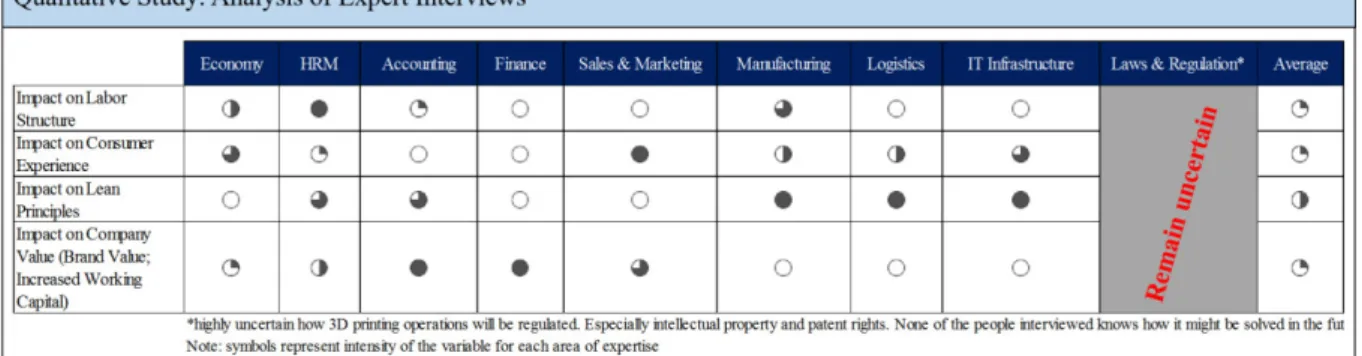
For a further assessment of the impacts of 3D printing on the retail supply chain several experts including professionals with or without technology expertise and professors fromthe areas Micro-/Macro-Economy, Marketing, Accounting, IT, HRM and Corporate Finance have been interviewed to obtain a profound knowledge. In the following the impacts on each area of expertise will be summarized. The interview outcomes in combination with the literature review will help to derive a scenario for a future retail supply chain (Table 5).
Table 1: Qualitative Study: Analysis of Expert Interviews
Source: own Table based on expert Interviews
3.1 Impact on Economy
The impact of 3D printing might be able to disrupt highly developed economies. When 3D printing is implemented less international trade will be executed since companies produce finished goods at the point of use and mainly source for raw materials. Thus, economies that rely heavily on exports will face major challenges. China, “the factory of the World”, for example will need to reinvent their current economy focusing extensively on local demands, human capital and innovation to move up the value chain. Consequently, with the implementation of 3D printing a redistribution of value creation will take place which is changing the economic environment in many countries. However, it is prognosticated that 3D printing especially enables benefits for consumers. According to the Kaldor-Hicks Improvement, production cost of personalized products will be reduced which means that consumers are able to purchase more value with less money which displays a cost-benefit improvement. Entry costs in the market are theoretically low but to achieve a high quality
which consumers are clearly looking for, huge investments are needed. Considering the employment rates, 3D printing will on the one hand reduce the number of jobs in manufacturing based economies but will also create job in different areas like technical supports or printer development. Especially there, governments are responsible to offer social mobility through free tuition, balanced incentives and an enhanced legal system.
3.2 Impact on Human Resource Management
The three major challenges in Human Resource Management (HRM) are the impact of technology in general, ergonomics and energy efficiency, and retaining talent. When considering 3D printing in the retail supply chain in this context it is obvious that it will impact all three major challenges of HRM. Technology in general used to change the way HRM is carried out several times in each industrial revolution. With the rise of 3D printing several impacts will once again change processes and standards. When 3D printing is implemented in the supply chain, less jobs will be necessary to carry out production since the main task is to oversight process and not actively participate in it. Consequently, payrolls, administrative supports and ultimately costs will shrink in HRM. Furthermore, production will be location independent which rises the necessity of globally spread virtual teams to coordinate the supply chain. New joint venture opportunities might rise as well which increases the need of further developing a common culture throughout the teams and the new supply chain collaborators. A common culture is created when the focal company is able to preserve a strong identity and values meaning that they exactly know what is means to work for the company. Another point that fosters a common culture is the HR matching - meaning that employees are motivated, engaged and committed to work for the company. Considering ergonomics and energy efficiency, 3D printing will benefit the employees work environment. With other technologies like augmented reality the supervision of production will be easier and employee friendly. In terms of energy
efficiency people might have to relocate to different open office spaces or can work in their virtual teams from home which is increasing the energy efficiency of buildings significantly. Especially once 3D printing is implemented, retaining talent is a major task in HRM. The goal must be to establish an ecosystem of 3D printing talent. Therefore, no generally valid concept is in place, but creating teams with diverse knowledge meaning bringing 3D printing and business experts together to establish a “common language” is very important to develop a pool of experts within the supply chain. New competence centers might arise out of those teams and new jobs are created within those centers. All in all, HRM and the employees are highly affected by 3D printing. Both need to evolve to deal with the challenges that arise with the implementation of 3D printers.
3.3 Impact on Accounting
Accounting within the supply chain will change with the rise of 3D printing as well. At present accounting relies heavily on the ERP system of the supply chain which is connected worldwide and partly acting with real time data. 3D printing will improve the visibility of stock keeping which is benefiting accounting significantly. By decreasing the number of stock the working capital of the supply chain will increase which will save the supply chain collaborators costs and ultimately accounting efforts since the higher the inventory the more capital is tied up. Low inventories are increasing the working capital ratio and offer opportunities to expansion with the free working capital. An example of an improved working capital ratio is included in the appendix (Figure 10). Another point that will be affected are the IFRS since reliable and globally valid accounting standards for 3D printed products and transmission of digital files need to be established. At present, especially the taxation of digital files is a major challenge for companies.
3.4 Impact on Corporate Finance
In Corporate Finance, there might be relationship specific investments within the supply chain. New Joint ventures, equity cross participation or specific contracts with advanced 3D printing companies will be established to enhance the knowledge and the usage of the printers. At present, the 3D printing industry is not in a consolidation phase meaning that there are no major M&A activities apparent. Considering the stock market value of the company, investors tend to invest in more transparent supply chains with low perception of risk and high cashflows. Through 3D printing the supply chain might shrink to a minimum in terms of storage, handling and transportation which makes it more predictable for investors and thus, easier to invest. Furthermore, cashflows will be positively affected as well since liabilities are reduced significantly. All in all, 3D printing will have a high impact on the firms’ value and the ability to expand in the future.
3.5 Impact on Sales & Marketing
Marketing and Sales will experience a drastic impact of 3D printing. Like mentioned above, consumers are evolving and expecting incremental values and services. 3D printers will allow to improve the supply of personalized products and thus, will increase the consumer satisfaction and experience. It is not likely that 3D printers will surpass traditional manufacturing in terms of cost but since many consumers would pay a premium for personalization it is a valid option to use additive manufacturing. Also, the storytelling approach in marketing in which high consumer interaction is facilitated will be significantly improved. Disney, e.g., recently introduced a tool which enabled consumers to customize the face and skin of action figures for a fraction of traditional costs using 3D printers (Disney Research 2013). When considering the 4 types of consumer products – convenience products, shopping products, specialty products and unsought products (Table 3), convenience products are purchased at low prices and most frequently, e.g. detergent, magazines or fast food. Shopping products are usually compared in quality,
price and style before being purchased and include clothing, furniture and services. Specialty products are products with distinct characteristics for which consumers are willing to invest an extra effort like e.g. high-priced specific equipment or designer cloths. Unsought products are products consumers do not know or know but do not consider purchasing it. Examples include life insurances or funeral services. Considering these information, it becomes clear that especially for shopping and specialty products additive manufacturing processes have the highest potentials. In these categories, high consumer interaction, personalization and brand identification is desired. Rewards for creative campaigns in these categories that tap into both, the digital and analog world, are impressive with high social media coverage and community engagement in design. A rising challenge will be how to construct pricing models that fit to highly personalized products and digital models. Conjoint studies might be able to overcome this challenge but since there is no mass-personalization in place at the moment it is still uncertain.
3.6 Impact on Manufacturing
The impact of 3D printing on manufacturing is uncertain. Undoubtedly, there are many potentials of 3D printing but traditional manufacturing has still a higher cost effectiveness at present. Although, traditional manufacturing has several intermediate processes like transportation and assembly 3D printing is still estimated to be 10 to 100 times more expensive and much slower for most parts (Sherman 2009). Especially physical boundaries in viscosity and friction will inhibit 3D printing to become as fast as traditional processes. Due to the lower speed average costs are much higher in comparison which makes 3D printing less profitable for mass produced or slightly customized products. Furthermore, traditional manufacturing is a mature technology which has been in use for decades while 3D printing is relatively new. Thus, drawbacks in quality and accuracies can still be identified when using 3D printers. Additionally, the number of available materials to 3D
printing is currently very limited in comparison to traditional manufacturing. However, when considering the principles lean production and the reduction of waste (Muda) (Table 4), 3D printing may have significant impact in the long-term. It has the ability to affect each point of the reduction of waste principles, but especially reduces inventories, transportation, handling, motion and waiting processes. Like mentioned above, additive manufacturing might be able to create an economies of one model in which single-unit production and low volumes with high varieties are still cost effective. In this area 3D printing may compete with traditional manufacturing which would lead the way into a new paradigm of customization. All in all, 3D printing can be regarded as a complement to traditional manufacturing to further customize modular products but not a substitute in the near future.
3.7 Impact on Logistics
If 3D printing is delivering its full potential the impact on logistics will be tremendous. Considering Outbound Logistics, when products are produced at the point-of-use the number of finished goods being shipped will reduce significantly. Thus, international shipping operation costs will be reduced and the firms focus is switched to raw materials which are easier to transport rather than to finished goods. Moreover, 3D printing enables a better management of demand uncertainties by offering a more transparent and digital supply chain. Thus, after the implementation of 3D printing, transportation process between the supply chain blocks are significantly reduced. Considering Inbound logistics, the principles of lean manufacturing and waste reduction can be pursued. During production with 3D printers handling, waiting and motion processes will be reduced. Moreover, the stock keeping and required inventories are reduced and associated costs like maintenance, obsolescence of goods or rent are eliminated. Consequently, capital is freed for new investments. Surely, it is uncertain in which timeframe these changes will occur
since at present there is a high need for transportation and warehousing processes to fulfill demands adequately.
3.8 Impact on IT Infrastructure
The current IT infrastructure is visualized with the help of porter’s value chain in Figure 11. Mostly every company is using an ERP database as foundation of their IT processes where all information is gathered. Every activity of the value chain, HRM e.g., has its own sophisticated software module. Furthermore, a smooth and real-time communication between the specific supply chain collaborators is ensured through protocols and content transmission. Protocols can be divided in standards and mechanisms. Standards in this context means data standards like EDI, XML or Web-services that are commonly used. Mechanisms are facilitators that these standards can be used and transferred between the supply chain collaborators. Content in this context might be transmitted in the above-mentioned formats (EDI, XML, Web-services) and contain mainly invoices, receipts, order request or other information. When adding 3D printing to the infrastructure minor impacts are predicted because none of the processes of the value chain and thus no software modules will be replaced fully. There might occur minor changes/shrinkages in all of them – e.g. In- and Outbound Logistics since 3D printing might reduce the administrative efforts of it. It is expected that a new protocol standard and new mechanisms need to be introduced to allow companies to transfer 3D-files and its characteristics safely within the supply chain. Despite to the small changes in the IT infrastructure new major behavioral evolvements are likely to occur. To establish a 3D printing ecosystem and to increase involvement of consumers, retailers might consider to introduce and support 3D printing communities in which consumers and retailers interact with each other. Through offering the community toolkits to design and print in an open source environment the quality, accuracies and speed might be accelerated significantly. In that way, the technology is
further exploited and explored, and incremental innovation might be derived from it which ultimately the retailer can use to gain new revenue stream. It is uncertain how this might change the whole business model of the retailer but as seen in the past in telecommunication or the music industry there might occur a shift to a digital service-oriented business model.
3.9 Impact on Laws & Regulations
Regarding Law & Regulation there is one major issue of 3D printing that will have high influences – Intellectual property rights and patents. 3D printing is enabling consumers to copy products multiple times. In that sense, the principles of intellectual property rights are lost since there are no extra charges once a consumer owns a 3D-file. Consequently, the patterns of what happened to the music or movie industry will be repeated for 3D printed products meaning that the business models are disrupted by piracy. It is still highly uncertain how this can be regulated, but simultaneously it is highly urgent to find new arrangement and mechanisms. Possible solutions might be software to control the copies or biometric passwords to protect the own business. Otherwise companies might have to constantly innovate to an extent where copying is not possible anymore.
4. Scenario Development for the Future Retail Supply
Chain
4.1 Business Scenario Development
Like mentioned in chapter 2.2.3 “current use cases of 3D printing in Retail”, 3D printing is mainly used by small specialized businesses to produce jewelries or furniture. It is barely seen that major retailers like Nike use additive manufacturing in other initiatives than promoting their brand or educate their consumers about the technology. Undoubtedly, 3D printing will evolve from the present use cases to more advanced applications in the retail supply chain. The conducted qualitative study has shown that there will be impacts for the supply chain when 3D
printing is implemented (Table 5). The major uncertainty is how fast it will develop within the retail supply chain. In Figure 12 a possible future evolution of 3D printing in retail is illustrated. Scenario 1 is the current state of application in prototyping, educating and small specialized businesses. This scenario will be explored to the boundaries prior to an evolvement towards other applications. Scenario 2 is characterized by the ability of the retailers to postpone the final production step until the consumers decided on their personal preferences. Nevertheless, the desired long-term aspiration of retailers remain the ability to produce localized right at the point of use to improve the responsiveness and certainly to mass produce personalized products, which is illustrated as Scenario 3. In the near Future, it is likely that Scenario 2 “postponed personalization” will take place. It displays the optimal balance between coping with the major challenges in the retail sector and 3D technology constraints.
4.2 Possible Future Retail Supply Chain
In the following Scenario 2 will be described in detail to gain a profound understanding that it is a likely scenario of 3D printing operations in the retail supply chain. First of all, this Scenario is displaying an adaption of the current supply chain rather than a disruptive change of the entire business model. Postponement or postponed personalization in this context is referring to form postponement meaning that the completion of production is delayed until a consumer is ordering his desired personalized product. Therefore, the product has a modular design meaning that different modules are forming the end-product. The goal is to postpone the creation of a finished good as long as possible to be able to establish a make-to-order environment. This late-stage postponement is increasing agility and flexibility of traditional manufacturing since it allows companies to respond to changes in the market adequately (Bowersox and Closs 1996). Figure 13 is illustrating how the form postponement scenario is designed in the supply chain. Modular components of products are manufactured according to the push principle meaning that production is highly forecast-driven. Afterwards these goods are stored until the consumers
order their personalized products. This point can be regarded as decoupling point in which the pull principle is applied changing production to an order-driven/make-to-order production system. In that manner, the working capital ratio is significantly increased since the goods are already paid before the final production set. This will increase the ability of companies to further invest and ultimately increase their value. Like stated earlier, 3D printing can be regarded as a complement to traditional manufacturing in the near future. In this Scenario, at the decoupling point where the product is personalized, 3D printing is an adequate complement to manufacture certain differentiating modules to traditional manufacturing. Through that, 3D printing allows to manufacture personalized products without eliminating the cost-effectiveness of traditional manufacturing. Furthermore, it enables companies to adequately fulfill the consumer wishes for personalization. Especially for shopping and specialty products it will be applicable. Consumers tend to do extra efforts during the purchasing process and want to be engaged in the design process to later own a personalized product. This co-creation is fostering the order-driven/make-to-order principle and is enhancing the consumer interaction and experience. In this Scenario, no further storage is needed since the product is produced in a make-to-order manner and only transportation costs will be added. In general, this will reduce the complexity of personalization, increases the variety of offered products and responsiveness, and reduces demand uncertainties. In the following it will be outlined how the major challenges of retail will be reduced and why it is applicable although 3D printing still has several technological constraints at present.
4.2.1 Overcoming Retail Challenges
Like mentioned in chapter 2.2.4 “Retail Challenges”, the retail industry is dealing with several challenges which might be significantly reduced with the proposed postponed personalization. First, high efficiency and cost effectiveness in every process along the supply chain displays a major challenge. Retailers need to benefit from economies of scale to manufacture at low costs
with high volumes to stay competitive which often diminishes the ability to personalize products. With a postponed personalization retailers are able to traditionally manufacture semi-finished good in accordance to economies of scale and are able to increase their flexibility and responsiveness to individual consumer needs. Moreover, the uncertainty in forecasting was stated as one of the major challenges in retail which is reduced since there is a decoupling point where the pull principle is enforced. This ultimately leads to reduced Muda (Table 4), reduced inventory and consequently to a higher cost effectiveness. Furthermore, consumer evolve meaning that higher service, more interaction and co-creation is desired and premium prices are paid if retailers are able to deliver these values. With postponed personalization, the consumer experience is enhanced significantly. There is high interaction between the retailer and the consumer during the co-creation process of a personalized product which will ultimately increase the consumer experience. Additionally, retailers are enabled to increase the storytelling approach for their products which will undoubtedly benefit the brand loyalty of consumers (Disney e.g.: Disney Research 2013). Like mentioned before, this is especially applicable to shopping and specialty products.
4.2.2 Overcoming technological Constraints
Like mentioned in chapter 2.1.4 “Potentials and current Constraints” and elaborated during the qualitative study, there are several technological constraints of 3D printing. Nevertheless, the postponed personalization is coping with these constraints finding a balance between a cost-effective supply chain and a high degree of personalization. First, traditional manufacturing is heavily profiting from economies of scale, has higher quality at present and in the near future, and is much faster than additive manufacturing. In the near future, it is very unlikely that 3D printing might substitute manufacturing but with the application as postponed personalization it is adding high value to the supply chain success by fulfilling individual needs. Another constraint is that 3D printing will not be able to eliminate logistic operations and stock keeping
but it helps to reduce overall costs. Less inventory will be needed since forecasting accuracy is increased through the pull principle. Additionally, inventory costs of modular semi-finished goods represent only a fraction of inventory costs of finished goods. Depending on whether where the final production step is executed also transportation costs might be reduced significantly. Since 3D printing is able to move the last production step to close proximity to the point of use, transportation costs will decline. Other constraints can be identified in HRM and consumer education. At the moment, there is little company-internal knowhow about 3D printers and how to implement them into the supply chain. Postponed personalization can be regarded as a first introduction step of 3D operations within the supply chain around which knowledge teams can be formed to establish a “common language” and explore additional application opportunities within the organization. Consumer education is another constraint which 3D printing is facing. It is a continuous process to develop a communities and basic knowledge about 3D printing. Without educated consumers no ecosystem in which retailers and consumers interact can be created. With a first immersion in the technology within a postponed personalization consumers rise awareness about opportunities 3D printers hold. Considering the mentioned constraints, it becomes obvious that Scenario 3 is unlikely in the near future since technology needs to be explored further to become more effective in order to establish mass-personalization capabilities.
5. Critical appraisal and next Steps of Investigation
There are several issues that remain undiscussed in this paper. It is providing the foundation to further research additional fields that need to be examined to fulfill the prerequisites for a postponed personalization. First, the determination of the optimum supply chain design needs to be elaborated. Uncertainties like the ideal number of manufacturing sites and their location and distribution centers need to be defined to ensure a successful and cost-effective postponed personalization. Several implications like optimal response time to orders, image of local
presence, duties, transportation costs and local labor needs to be considered in this decision. Furthermore, the decision whether cost-effective centralized warehouses or response-effective localized warehouses is beneficial remains uncertain at present and further research is required to determine ideal the supply chain layout. These doubts go hand in hand with the decision of the optimal decoupling point of the semi-finished product for personalization. Additionally, the suitability of every product for personalization with 3D printing needs to be elaborated. Especially for shopping and specialty products it might be feasible. Therefore, the ability to modularize/standardize components of the products need to be further investigated to introduce a cost-effective postponed personalization. This kind is modular product flexibility is required to establish an effective personalization process in general since it helps to improve the overall flexibility of the supply chain. Furthermore, at present it is uncertain how 3D printers will develop. For certain production steps, there might still be quality or build-time drawbacks in the future. A profound research of the capabilities to manufacture certain personalized modules with 3D printers need to be conducted to ensure a high product quality. Another very important point that undoubtedly needs further research is a quantitative comparison between a traditional manufacturing supply chain and a new postponed supply chain including 3D printers. Especially production, logistics, inventory and investment cost need to be compared carefully in order to reach a conclusion whether it is feasible for a certain product. Many of the current studies conducted, elaborate only the production comparison of single parts instead of taking all supply chain effects like logistics, inventory and investment into account. A holistic quantitative study needs to be conducted certainly. Additionally, to this comparison the readiness of labor for postponed personalization with 3D printers need to be ensured by e.g. introducing guidelines and standards within the supply chain to educate labor.
6. Conclusion
Within the scope of this paper, the initial research question has been elaborated and answered. It takes a practical approach to display the future of the retail supply chain with 3D printers by deriving an application scenario “postponed personalization” from literature reviews and a qualitative study. Despite the seemingly endless application potentialities of 3D printing the impact in the near future on the retail supply chain will rather be not disruptive. The vision of a shrunk supply chain with no inventories, localized 3D printing mass-customization and only last-mile transportation is still a distant future scenario. However, within the concept of postponed personalization 3D printers can be implemented. It can be regarded as complement to traditional manufacturing to personalize products within the last production step. Referring to the initial statement that consumers are demanding, fast-evolving and desire more interaction and personalization to fulfill their high expectations, this paper illustrated in which way 3D printing operations help to adequately respond to fickle demands and consumers through postponed personalization while maintaining cost-effectiveness. The combination of economies of scale in traditional manufacturing and the ability to personalize in the last production steps through 3D printers is offering companies new opportunities to reduce cost while consumer interaction, product varieties and responsiveness is increased. Consequently, it becomes obvious that 3D printers have the highest potential to improve the retail supply chain when established in a postponed personalization approach. With this paper foundation for further research is established. Undoubtedly, this new supply chain concept needs to be analyzed more deeply in order to reach a maturity level at which it can be executed.
Bibliography
A.T.Kearney. 2016. The global Retail Development Index. Global Retail Expansion at a Crossroads. https://www.atkearney.de/documents/856314/8252937/Global+Retail+Expansion+at+a+Crossroad s+%E2%80%93+2016+GRDI.pdf/3f671a9b-f663-4a42-a26b-1450f26e21a0 (accessed November 10, 2016).
Aaron Issac. 2016. Endless Possibilities. Customize Your Jewellery In a Variety of Different Precious Metals & Gems. Add Your own Custom Text Or Initials, & View Your Creations In Real-Time 3D Before Purchase! http://www.polychemy.com/ (accessed November 14, 2016).
Ariela Lenetsky. 2016. 3D Printed Footwear | Nike Vapor HyperAgility Cleat.
http://www.arch2o.com/3d-printed-footwear-nike-vapor-hyperagility-cleat/ (accessed November 14, 2016).
Bowersox, Donald J. and David J. Closs. 1996. McGraw-Hill series in marketing, Logistical management. The integrated supply chain process / Donald J. Bowersox, David J. Closs. New York, London: The McGraw-Hill Companies.
Bryman, Alan and Emma Bell. 2015. Business research methods. Oxford: Oxford University Press. Claire Chabaud. 2015. 3D printing and the future shape of retail industry.
https://www.sculpteo.com/blog/2015/12/23/3d-printing-and-retail-industry/ (accessed November 14, 2016).
Clément Moreau. 2015. The State of 3D Printing. The data you need to understand the 3D printing world and build your 3D printing strategy.
http://www.sculpteo.com/static/0.30.0-64/download/report/Sculpteo_State_of_3D_Printing.pdf (accessed November 7, 2016). Disney Research. 2013. Fabricating 3D Figurines With Personalised Faces.
https://s3-us-west- 1.amazonaws.com/disneyresearch/wp-content/uploads/20150202064404/D-Tech-Me-Fabricating-3D-Figurines-With-Personalised-Faces-Paper.pdf.
Ian Geddes. 2016. Retail Trends 2016. Redefining convenience.
https://www2.deloitte.com/uk/en/pages/consumer-business/articles/retail-trends-2016.html (accessed November 2, 2016).
Irene J. Petrick et al. 2015. 3D Printing disrupts Manufacturing:. How Economies of One Create New Rules of Competition. http://www.tandfonline.com/doi/pdf/10.5437/08956308X5606193 (accessed November 21, 2016).
Jonathan Bray. 2014. 3D Printing and the new Shape of Industrial Manufacturing.
http://www.pwc.com/us/en/industrial-products/assets/3d-printing-next_manufacturing-pwc.pdf (accessed November 7, 2016).
Lars-Gunnar Mattsson. 2003. Reorganization of distribution in globalization of markets:. the dynamic context of supply chain management.
http://www.emeraldinsight.com/doi/full/10.1108/13598540310500259 (accessed November 2, 2016).
Lipson, Hod and Melba Kurman. 2013. Fabricated. The New World of 3D Printing. 1st ed. s.l.: Wiley.
Mikko Kärkkäinen. 2016. State of the Retail Supply Chain 2016. Research findings on Supply Chain Planning & Execution. https://www.relexsolutions.com/wp-content/uploads/2016/04/martec-web-
report-2016.pdf?__hssc=197871792.3.1479900471735&__hstc=197871792.306726dd11e5027c69528e3 3b30dd5a5.1478605805255.1478605805255.1479900471735.2&__hsfp=2379261618&hsCtaTrac king=7689be37-ba40-45be-af8e-3c5b7da7082b%7C101d64c0-5930-4927-9727-6e7286f2c20d (accessed November 23, 2016).
Niemeier, Stefan, Andrea Zocchi, and Marco Catena. 2013. Reshaping Retail. Why Technology is Transforming the Industry and How to Win in the New Consumer Driven World. 1st ed.
Nigel Wixcey et al. 2015. The Deloitte Consumer Review. Made-to-order: The rise of mass personalization. https://www2.deloitte.com/content/dam/Deloitte/ch/Documents/consumer-business/ch-en-consumer-business-made-to-order-consumer-review.pdf (accessed November 23, 2016).
Patton, Michael Q. 2002. Qualitative research & evaluation methods. 3rd ed. Thousand Oaks, Calif., London: Sage.
Paul Eikelenboom. 2016. Everything about 52Shapes. http://shop.holland.com/en/designer-brand-designers-brands/brand-label-brands/52shapes/ (accessed November 14, 2016).
Pi-Top. 2016. pi-topCEED. https://www.pi-top.com/ (accessed November 14, 2016).
Robert Dehue. 2016. What is 3D Printing? http://3dprinting.com/what-is-3d-printing/ (accessed November 2, 2016).
Sarah Sedghi. 2015. 3D printing will have a bigger economic impact than the internet, technology specialist says. http://www.abc.net.au/news/2015-04-01/3d-printing-impact-bigger-than-internet-expert-says/6365296 (accessed November 7, 2016).
Sekaran, Uma. 1992. Research methods for business. A skill-building approach / Uma Sekaran. 2nd ed.
Shane Hickey. 2014. Chuck Hull: the father of 3D printing who shaped technology. Hull knew his invention would take up to 30 years to find its way into people's homes. Today the possibilities appear endless. https://www.theguardian.com/business/2014/jun/22/chuck-hull-father-3d-printing-shaped-technology (accessed November 4, 2016).
Sherman, Lilli M. 2009. Additive Manufacturing. New Capabilities for Rapid Prototypes And Production Parts. http://www.ptonline.com/articles/additive-manufacturing-new-capabilities-for-rapid-prototypes-and-production-parts (accessed December 1, 2016).
Stan Cramer. 2016. The Free Beginner’s Guide. 04 – 3D Printing Processes.
http://3dprintingindustry.com/3d-printing-basics-free-beginners-guide/processes/ (accessed November 4, 2016).
Statista. 2016. Total retail sales worldwide from 2013 to 2018 (in trillion U.S. dollars).
https://www.statista.com/statistics/443522/global-retail-sales/ (accessed November 10, 2016). Tom DeGarmo. 2014. Technology Forecast: The future of 3-D printing. The road ahead for 3-D
printers. http://www.pwc.com/us/en/technology-forecast/2014/3d-printing/features/assets/pwc-3d-printing-prototyping-finished-products.pdf (accessed November 7, 2016).
Wohlers, Terry T., Tim Caffrey, and R. I. Campbell. 2016. Wohlers report 2016. 3D printing and additive manufacturing state of the industry : annual worldwide progress report. Fort Collins, Colorado: Wohlers Associates.