Early transition to microdiets improves growth, reproductive performance and 1
reduces skeletal anomalies in zebrafish (Danio rerio) 2
3
Gil Martins1,2, Patrícia Diogo1,2, Wilson Pinto3, Paulo J. Gavaia1,2* 4
5
1
Center of Marine Sciences (CCMAR
)
, University of Algarve, Campus de Gambelas 68005-139 Faro, Portugal. 7
2
Department of Biomedical Sciences and Medicine, University of Algarve, Campus de 8
Gambelas 8005-139 Faro, Portugal 9
3
Sparos Lda, Área Empresarial de Marim, Lote C, 8700-221 Olhão, Portugal 10
11
*Corresponding author: Tel: +351.289 800057; Fax: +351.289 800069. Email address: 12 [email protected] 13 14 Abstract 15
Zebrafish is a model species with a high variability of feeding regimes among fish 16
facilities. The use of live feeds for early life stages is a common practice and few 17
studies have focused early weaning into microdiets. The lack of standardized feeding 18
protocols amongst research facilities promotes discrepancies in biological performances 19
and few studies relate dietary regimes to zebrafish development. The objective of this 20
work was to assess the effect of an early transition into microdiets in zebrafish 21
development by evaluating growth, survival, reproductive performance and skeletal 22
anomalies. These parameters were assessed in one group exclusively fed on Artemia 23
nauplii and two groups fed on microdiets (commercial and experimental). Results 24
showed that an early weaning with the two microdiets significantly improved zebrafish 25
growth and reproductive performance, while a decrease in incidence of vertebral 26
column anomalies was observed. A high survival was also maintained in fish fed 27
microdiets at an early developmental stage when comparing to exclusive Artemia 28
nauplii feeding. In conclusion, early weaning with high quality microdiets is beneficial 29
for zebrafish growth, reproductive performance and skeletal development, contributing 30
to the standardization of zebrafish husbandry practices. 31
32
Keywords: microdiets, skeletal anomalies, reproduction, growth, zebrafish feeding 33 protocol 34 35 Introduction 36
Zebrafish is an important model species in numerous areas, including developmental 37
biology, ecotoxicology, neurobiology, biomedicine and aquaculture.1–5 In the past two 38
decades, the development of novel technologies and molecular tools contributed to the 39
increase in relevance of this species in biomedical research.1–4 However, procedures 40
concerning zebrafish husbandry, such as feeding protocols and nutritional composition 41
of diets utilized, vary markedly among fish facilities.1,6–10 This lack of standardization 42
in husbandry procedures leads to a high degree of variability in fish growth performance 43
and reproductive success, and until today the modulation of zebrafish dietary 44
requirements is still poorly addressed.10,11 The broodstock diet is highly relevant in 45
teleosts, not only to its health state but also to the quality of its gametes and progeny.12– 46
14
The maintenance of body homeostasis is affected by the interaction between nutrition, 47
metabolism, gene expression and epigenetic changes that modulate intracellular 48
signaling pathways.14 In this sense, it has been proposed a possible biological 49
mechanism of nutritional “imprinting” events that modulate gene expression and 50
epigenetic patterns that could be transmitted to the progeny.15–18 Therefore, nutrition 51
research is highly relevant towards the standardization of zebrafish rearing, which can 52
be achieved through the use of microdiets with controlled nutritional composition. 53
Zebrafish larvae are commonly fed with live preys including paramecia (Paramecium 54
sp.), rotifers (Brachionus sp.) and Artemia nauplii (Artemia sp.)1,6,8,11,19–21 until weaning 55
at subadult stage (~30 days post-fertilization).22 After weaning, juvenile and adult 56
feeding may rely on a wide variety of diets, from flakes for aquarium species, to 57
extruded microdiets, often primarily developed for aquaculture species.3,23 When both 58
diet types are compared, extruded diets generally result in improved larval quality and 59
growth performance, as well as a superior water quality.9 Moreover, a continuous 60
supply of live feeds is often common in zebrafish feeding during the juvenile and adult 61
stages, namely concerning Artemia nauplii. This strategy contributes as an 62
environmental enrichment factor, stimulating the natural predatory behavior of 63
fish10,24,25 and lowering stress related to captivity, thus improving fish welfare.26 These 64
different feeding protocols implemented in fish facilities resulted in different nutritional 65
compositions that may affect development. The use of a standardized diet in zebrafish 66
rearing facilities is of utmost importance to increase the reproducibility of research 67
conducted with this model.11 68
High reproductive performance in zebrafish is one of the most desired outcomes 69
amongst the research community, since embryos are often the main focus of 70
developmental studies, also frequently being a limiting factor in experimental designs.11 71
For this purpose, the ultimate goal for zebrafish is to reach the adult stage in a short 72
period of time, or to modulate and enhance its reproductive performance through the 73
dietary regime.22 Diet composition provided to zebrafish breeders is extremely 74
important for egg production, fertilization and hatching rates.13,27–29 For instance, the 75
presence of specific phospholipids in the diet were shown to be essential for improving 76
zebrafish sperm quality and reproductive performance.13 On the other hand, a diet based 77
on flakes led to a negative effect in zebrafish reproduction by reducing egg 78
production.20 Furthermore, the inclusion of Artemia nauplii in the dietary regime lead to 79
an improvement of gamete production, fertilization rates and spawning performance in 80
zebrafish.23,27 The continuous improvement of microdiets is essential to increase the 81
zebrafish reproductive performance.3,11,25 82
Zebrafish has also been successfully used as a model to understand cellular and genetic 83
aspects of vertebrate skeletogenesis,30,31 since it has a mineralized bone matrix similar 84
to mammals, with both endochondral and intramembranous ossification as well as 85
functional osteoblasts, osteocytes and osteoclasts.5,31–33 However, little is known about 86
the effect of the dietary regime on zebrafish skeletal development.13,34 Therefore, this 87
work aimed at evaluating the effect of an early transition from live feeds (Artemia 88
nauplii) to microdiets (commercial and experimental) and their impact on skeletal 89
formation in zebrafish larvae when compared to a feeding regime exclusively based on 90
Artemia nauplii. In addition, this study evaluated the effect of these dietary treatments 91
on zebrafish growth and reproductive performance. 92
93
Material and Methods 94
Ethics Statement 95
All animal manipulations were performed in compliance with the Guidelines of the 96
European Union Council (86/609/EU) and transposed to the Portuguese law for the use 97
of laboratory animals on research by “Decreto Lei n° 129/92 de 06 de Julho, Portaria n° 98
1005/92 de 23 de Outubro”, and according to the European parliament council 99
directive´s for protection of animals used for scientific research (2010/63/EU). All 100
animal protocols were performed under a “Coordinator-researcher” license from the 101
Direção-Geral de Veterinária, Ministério da Agricultura, do Desenvolvimento Rural e 102
das Pescas, Lisbon, Portugal, under the “Decreto Lei n°113/2013 de 7 de Agosto” 103
relative to the protection of animals used for scientific research. 104
105
Housing conditions 106
A breeding population of zebrafish wild-type AB strain (ZFIN ID: ZDB-GENO-107
960809-7) maintained at the Centre of Marine Sciences (CCMAR, Portugal) for more 108
than 10 generations was used to generate the embryos used in the trial. The fish room 109
had a controlled photoperiod with a 14:10 hour light:dark cycle and humidity close to 110
60%.35 Fish were housed in 3.5 L tanks placed in a 980 L recirculating system 111
(ZebTEC®, Tecniplast, Italy). The water quality was maintained by partial water 112
renewal (10% of total volume daily) and through filtration: biological filtration (ceramic 113
beads), mechanical filter (pleated cartridge filters, 50 µm), carbon filter (granular 114
activated carbon filter) and ultraviolet sterilization (180 000 µWs/cm2). Water 115
conditions were as follows: temperature: 28.0 ± 1 ºC; pH 7.5 ± 0.2; and conductivity 116
750 ± 30 µS. Nitrogen compounds were monitored weekly, presenting values constantly 117
below 0.1 mg/L (NO2- and NH4+) and below 50 mg/L (NO3-) throughout the 118
experimental period. 119
120
Fish rearing and diet preparation 121
A broodstock group of AB strain males (n = 15) and females (n = 15), between 4 - 5 122
months, were crossed and approximately 1000 eggs were collected and incubated at 123
28.0 124
± 0.5 ºC in 1L nursery tanks (density of 200 eggs/L) with E2 embryo medium 125
containing 50 ppt of methylene blue (Sigma-Aldrich, Spain) to reduce bacterial and 126
fungal growth.13,19 At 5 days post-fertilization (dpf), 900 larvae were pooled and 127
divided into triplicates (100 larvae/L) for each treatment group. 128
The experimental design comprised 3 different treatment groups: the first group, was 129
fed with 3 meals of Artemia nauplii per tank (AF 480; INVE, Belgium) with a supply of 130
5000 nauplii per meal between 5 and 10 dpf. Between 11 and 20 dpf, 10 000 nauplii per 131
meal were supplied; between 21 and 30 dpf, 15 000 nauplii were supplied per meal. 132
From 30 dpf until the end of the breeding trials, the fish were fed two meals containing 133
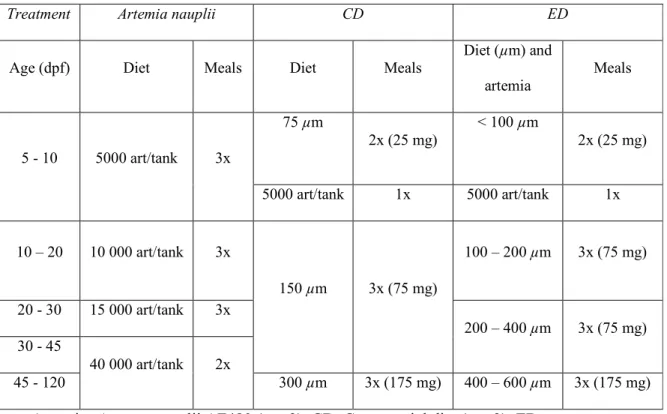
40 000 Artemia nauplii per tank (Fig. 1). Commercial diet (CD) and Experimental diet 134
(ED) groups were reared in a co-feeding regime (5 and 8 dpf) with 5000 Artemia nauplii 135
per tank once a day, and twice a day with extruded diets. From 8 to 30 dpf fish were fed 136
with 3 meals a day with microdiets representing 15 to 20% of larvae body weight. From 137
30 dpf until the end of the breeding trials each fish tank was fed with microdiets 138
representing 3 to 5% of fish body weight (Table 1). 139
The CD contained the following ingredients: fish meal, lecithin, wheat gluten, dried 140
seaweed, fish oil, maize starch, vitamins and minerals. The ED was produced using the 141
following main ingredients: fish meal, fish solubles, lecithin, wheat gluten, vitamins and 142
mineral premixes. Briefly, the ED was produced by Sparos Lda (Olhão, Portugal) using 143
extrusion at low temperatures as main production process. Powder ingredients were 144
mixed in a double helix mixer and ground in a micropulverizer hammer mill (SH1, 145
Hosokawa-Alpine, Germany). The powders were humidified and agglomerated by low 146
temperature extrusion (Dominioni Group, Italy). Resultant pellets were dried in a 147
convection oven (OP 750-UF, LTE Scientifics, United Kingdom) for 4 h at 60 ºC, 148
crumbled (Neuero Farm, Germany) and sieved to desired size ranges (<100 µm, 100 – 149
200 µm, 200 – 400 µm and 400 - 600 µm). These size ranges were adapted according to 150
fish mouth size and developmental stage. Proximate composition of dietary treatments 151 is shown in Table 2. 152 153 Reproduction trials 154
At 120 dpf, fish were divided according to their sex, based on to the differences in 155
morphology and pigmentation.22 The reproductive performance trials started when fish 156
were prone for mating events (3 - 4 month old). Males and females were housed in 157
separated 3.5 L tanks to improve their reproductive efficiency.36 Two breeding groups 158
of 2 males and 3 females were randomly chosen from population and set up in a 159
standard 1 L breeding tanks (Tecniplast, Italy) (n = 5 crosses) 15 h before the spawning 160
period (adapted from Lawrence et al.22). Couples were allowed to mate 1 h after the 161
beginning of the light phase by removing the plastic partition that kept both sexes 162
separated. Fish returned to their respective housing tanks 2 h after the beginning of the 163
spawning period, being crossed with 15 days of interval between spawning events to 164
maximize gametes release. The eggs were collected and incubated as previously 165
described. At 3 dpf, the number of hatched embryos was determined under a 166
stereomicroscope (Leica MZ6, Leica, Germany). 167
Zebrafish larvae were raised in static conditions in 1 L breeding tanks between 5 to 15 168
days post-fertilization (100 larvae/L) with daily water renewal (50%). At 15 dpf, larvae 169
were transferred to 3.5 L tanks (25 larvae/L) in a ZebTEC recirculating system with a 170
flow rate of 150 mL/min until fish reached the adult stage (3-4 months). 171
172
Fish sampling 173
A group of 10 larvae from each tank (n = 30 observational units) were sampled for 174
standard length (SL) at 15, 30, 60 and 120 dpf. Larvae were photographed using a 175
Digital camera (Canon Power shot G12, Canon, Japan) attached to a stereomicroscope 176
(Leica MZ6, Leica, Germany), and images were analyzed using ZEISS AxioVision 177
(version 4.8, Carl Zeiss, Germany). The groups of larvae with 15 and 30 dpf were 178
euthanized with a lethal dose of tricaine methanesulfonate (MS-222; Sigma-Aldrich, 179
Spain) and stored at -20 °C, freeze-dried, and weighted to determine dry weight (DW). 180
Juvenile (60 dpf) and adult fish (120 dpf) were anesthetized with 150 mg/L of MS-222, 181
measured and weighted. 182
To evaluate larvae skeletal anomalies, 30 larvae per tank (n = 90 observational units) 183
were sampled at 30 dpf, euthanized with a lethal dose of MS-222 and fixed in a 4% 184
buffered paraformaldehyde solution at 4 °C for 24 h. Larvae were subsequently washed 185
with a phosphate buffer saline 0.1 M, pH 7.4 solution and stored in 75% ethanol at room 186
temperature (adapted from Gavaia et al.37). Whole-mount acid-free double staining was 187
performed using alcian blue 8GX (Sigma-Aldrich, Spain) for cartilage and alizarin red S 188
(Sigma-Aldrich, Spain) for mineralized bone.38 Briefly, samples were stained in alcian 189
blue 8GX for 1.5 h and passed through a decreasing series of ethanol concentrations (96 190
to 25%), and hydrated with distilled water before being stained overnight with alizarin 191
red S in a potassium hydroxide solution (KOH) (Sigma-Aldrich, Spain) at 0.5%. 192
Samples were cleared with a 0.5% KOH solution and stored in a solution of 90% 193
glycerol (Merk Millipore, Billerica, MA) at room temperature. The detection of skeleton 194
anomalies was performed following the nomenclature by Bird and Mabee39 and 195 Bensimon-Brito et al.40. 196 197 Data analysis 198
Results were expressed as means ± standard deviation (SD).Data normality was tested 199
using a Kolmogorov-Smirnov test. Mean differences between treatments for fish growth 200
and length were analyzed using a Kruskal-Wallis test followed by a Mann-Whitney U 201
Test (p < 0.05). Statistical differences between treatments for skeletal anomalies were 202
evaluated with Person´s Chi-squared test (p < 0.05). Significant differences between 203
treatments for the number of eggs and the number of eggs per female was evaluated 204
using a Student´s t-test (p < 0.05). IBM SPSS Statistics 25.0 software was used for data 205
and statistical analysis. 206 207 Results 208 Larval performance 209
No significant differences were observed between treatments for fish survival during the 210
course of the experiment (Table 3). At 15 and 30 dpf, fish fed CD had a significantly 211
higher standard length (SL) than larvae fed with Artemia nauplii and ED (Table 3). No 212
significant differences were observed for SL of fish from the ED and Artemia treatment 213
at 15 DPF. However, at 30 dpf, the ED dietary treatment resulted in higher SL values 214
than in the Artemia nauplii treatment (Table 3). No significant differences were 215
observed between CD and ED treatments until the end of the experiment (60 and 120 216
dpf), in which both treatments obtained higher SL values than larvae fed with Artemia 217
nauplii (Table 3). There were no significant differences between treatment groups 218
regarding dry weight at 15, 30 and 60 dpf (Table 3). Significant differences were 219
observed when fish reached 120 dpf, where fish fed with CD and ED showed a 220
significantly higher weight than fish fed with Artemia nauplii (Table 3). 221
At 120 dpf, no statistical differences were observed regarding fish sex ratios of the 222
progeny obtained by breeders from the different dietary treatments. However, a higher 223
number of males was observed in all treatments (Table 3). 224
225
Reproductive performance 226
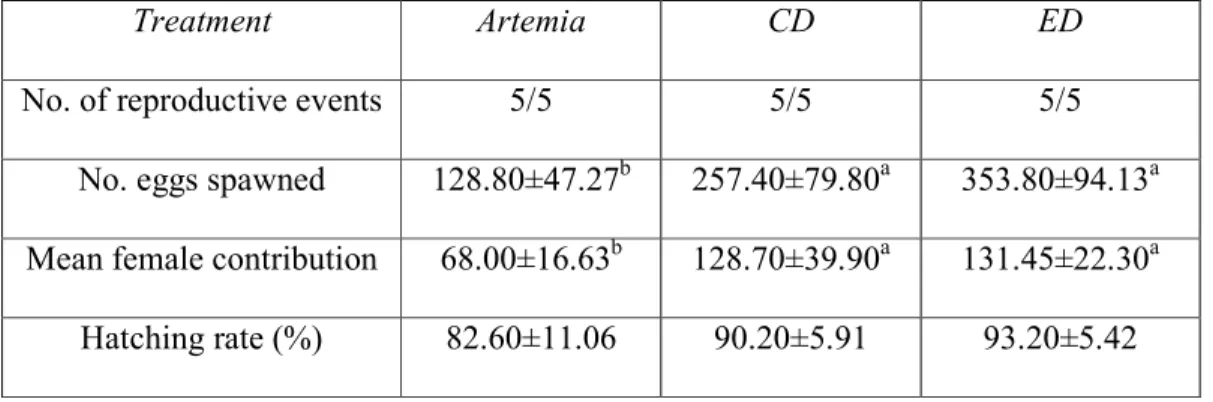
Fish fed with CD and ED presented a significantly higher number of spawned eggs, as 227
well as a higher female contribution, when compared to fish fed with the Artemia 228
nauplii feeding regime (Table 4). However, there were no statistical differences in 229
embryo hatching rate observed between the different treatments (Table 4). 230
231
Skeletal development 232
Skeletal evaluation was performed at 30 dpf, when all skeletal structures were 233
completely formed. Fish fed with Artemia nauplii showed a significantly higher 234
incidence of total skeletal anomalies (90.00 ± 10.00%) than fish fed with CD (48.33 ± 235
1.67%) and ED (51.11 ± 4.44%) feeding regimes (Fig. 1 A). No statistical differences 236
were observed for skeletal anomalies between fish fed with both microdiets (Fig. 1 A). 237
There were no significant differences observed in the distribution of skeletal anomalies 238
throughout the zebrafish vertebral column between treatment groups. However, most of 239
the detected anomalies were found in the fish posterior region (caudal fin vertebrae) 240
(Fig. 1 B). No statistical differences were observed in the number of anomalies between 241
the different treatment groups (Fig. 1 C). The most common anomalies observed were 242
vertebral fusions, compressions, lordosis, scoliosis and shortened vertebrae. Vertebral 243
fusions were identified by the presence of secondary neural arches. Compressions 244
caused deviations to the normal pattern of the vertebral column (Fig. 2). 245
Discussion 247
This work assessed the viability of an early introduction of microdiets and live feed 248
replacement in the dietary regime of zebrafish, a widely used model in biomedical 249
research. Although live feeds such as paramecia, rotifers or Artemia nauplii are a 250
common practice in zebrafish husbandry. Results from the current study showed benefic 251
effects of using a short co-feeding regime with microdiets and Artemia nauplii followed 252
by an early transition to a feeding regime composed solely by microdiets (CD and ED). 253
An early transition to microdiets increased larvae growth, maintaining a high survival 254
and lower prevalence of skeletal anomalies when compared to exclusive live feed 255
(Artemia nauplii) regime. Therefore, shortening the live feed administration period is 256
beneficial in zebrafish larvae rearing. 257
The transition from live feeds to microdiets is known to be a sensitive period in fish 258
development. Few studies were conducted with an earlier transition from live feeds to 259
commercial or experimental extruded diets, especially at the onset of exogenous feeding 260
in zebrafish larvae.10,23,41 In our study, the highest standard length values at 15 dpf were 261
achieved by larvae fed with CD (6.34 ± 0.45 mm) when compared with larvae fed the 262
ED (5.89 ± 0.53 mm) and Artemia nauplii (6.11 ± 0.68mm). Despite the differences in 263
rearing densities, the observed values of larvae length in the CD treatment group were 264
comparable to those obtained by Kaushik et al.23 (approximately 8 mm) at the same age 265
(15 dpf) with a similar feeding protocol. Moreover, results from the current study are 266
also similar to those obtained by Gómez-Requeni et al.41, who used a commercial diet 267
(JBL Novo Tom Artemia diet; JBL GmbH & Co., Germany) until 16 dpf, achieving a 268
fork length of 6.84 mm. The larval growth observed in our study, was identical to 269
Kaushik et al.23 at 60 dpf (approximately 22.5 mm). Consequently, the dietary protocol 270
proposed in the current study reflects a normal zebrafish larval growth when compared 271
to previously conducted studies. 272
Broodstock nutrition is an essential factor to optimize breeder´s reproductive ability, 273
improving thus gamete quality and fertilization rates, as well as the progeny quality.12,13 274
More specifically, the diet composition is known to affect reproductive performance in 275
zebrafish in terms of clutch size, hatching rate and consequently larval growth 276
performance.10,13,29 In our feeding trial we observed that both microdiets (CD and ED) 277
achieved significantly higher number of eggs spawned when compared to fish fed 278
exclusively on Artemia nauplii, yielding a clutch size above zebrafish average 279
(approximately 200 eggs/female).36 The lower number of eggs observed in Artemia 280
nauplii treatment may be related to its suboptimal nutritional composition,27–29 which is 281
known to have impact on fish reproduction.20 This suggest that Artemia nauplii does not 282
fulfil the nutritional requirements necessary for optimal oocytes production and quality. 283
It is known that highly unsaturated fatty acids (HUFAs) and phospholipids have a 284
particularly relevant role in zebrafish broodstock nutrition, since they improve 285
reproduction performance and gametes quality.13,29,42 Arachidonic acid (ARA), 286
eicosapentaenoic acid (EPA) and docosahexaenoic acid (DHA) are involved in 287
reproduction processes such as oocyte maturation, ovulation, spawning, hatching 288
success and larval quality.43,44 Zebrafish have the ability to biosynthesize EPA and 289
DHA from α-linolenic acid (LNA, 18:3n-3) and ARA from linoleic acid (LA, 18:2n-6). 290
The biosynthesis extent is dependent on the activities of desaturase and elongase 291
enzymes, however the rate at which this biosynthesis occurs remains to be 292
established.45,46 Ishak et al.46 observed higher ARA level in pre-vitellogenic and 293
matured follicles while DHA level were higher during late vitellogenic and maturation 294
stage, consequently HUFA synthesis is involved in oocyte maturation and ovulation. 295
Since Artemia nauplii contain low DHA and higher ARA composition,47 we suggest 296
that the low content in DHA might compromise oocyte late maturation. Furthermore, 297
the inclusion of those HUFA´s in zebrafish diet may contribute to a reduction of 298
metabolic effort invested in biosynthesis and favoring the metabolic investment on 299
gamete production. It is known that dietary phosphatidilcholine and 300
phosphatidilethanolamine supplementation improve significantly reproductive 301
performance and sperm quality in zebrafish.13 Therefore, not only the diet total lipid 302
content but also the specific lipid categories and their ratios might play an important 303
role on zebrafish reproduction.48 The fact that the nutritional composition of microdiets 304
is easier to modulate than the nutritional profile of live feed, indicates that microdiets 305
can be an important nutritional tool to improve the reproduction of zebrafish. 306
During zebrafish development, the timing of ingestion of specific nutrients as well as 307
the bioavailability of certain nutrients (e.g. lipids, amino acids, vitamins and minerals)49 308
may affect the process of skeletal formation. The majority of the skeletal anomalies 309
found in this study were located in caudal fin vertebrae, with the presence of fusions in 310
the last vertebrae, scoliosis and deviations in relation to other vertebrae. The remaining 311
affected structures presented lordosis and vertebral compressions caused by 312
compression forces with consequent abnormal vertebra formation. Zebrafish is 313
particularly susceptible to the incidence of skeletal anomalies in caudal fin vertebrae, 314
has previous reported.50 Despite the predominant number of anomalies in the pre-caudal 315
fin vertebrae, zebrafish fed exclusively with live feed (Artemia nauplii) showed a 316
significantly higher prevalence in skeletal anomalies when compared to fish fed with 317
CD and ED. Artemia nauplii is known to lack essential nutrients, such as selenium, zinc, 318
copper and manganese that are important for fish development and skeletogenesis.51 319
Moreover, as previously mentioned, Artemia nauplii composition in HUFAs may be 320
unsuitable for a correct bone formation. Since high EPA levels inhibit the extracellular 321
matrix mineralization and a high DHA content is required for a correct bone formation 322
by altering the cell phenotype, gene expression and mineralization capacity. Inadequate 323
levels of these HUFAs in Artemia nauplii are likely related to an incorrect 324
skeletogenesis.49,52 The same relationship between DHA and the correct bone 325
formations were observed by Izquierdo et al.53 with a decrease in 50% the number of 326
skeletal anomalies of red porgy with higher DHA supplementation in the diet. However, 327
the EPA and DHA requirements differ between marine and freshwater species and 328
comparisons on the effects of these dietary factors in marine/freshwater fish 329
development should be taken carefully. Still, comparing the nutritional profile of 330
Artemia nauplii and microdiets used in the current study, it is possible to observe that 331
mineral content in Artemia nauplii represents only approximately 35-40% of the values 332
observed in the microdiets. Future studies should understand if these reduced levels in 333
the total mineral content or in specific minerals such as calcium, phosphorous or 334
respective ratio; are responsible for the higher prevalence of skeletal anomalies in 335
zebrafish fed with Artemia nauplii. Nevertheless, like in HUFAs, it is possible that the 336
mineral fraction of Artemia nauplii may be inadequate for a correct skeletal 337
development of zebrafish and its use as main dietary source should be avoided in 338
zebrafish husbandry, especially in studies assessing skeletal development. Further 339
research is required to establish the nutritional requirements of zebrafish, thus allowing 340
to improve microdiets used in zebrafish husbandry, contributing for an adequate 341
development and skeletogenesis. The standardization of zebrafish nutrition is a pressing 342
matter, live feeds are labor intensive and prone to pathogenic contaminations which can 343
compromise fish health.25 Since microdiets are practical, nutritionally controlled and 344
expected to present lower biosecurity risks, they are a promising tool for standardization 345
purposes. Ultimately, the development of standardized high quality microdiets specific 346
for zebrafish would lead to a higher experimental reproducibility in rearing 347
methodologies between research facilities. 348
In conclusion, this study showed that an early transition to microdiets significantly 349
improved zebrafish growth and reproductive performance, while decreasing the number 350
of vertebral column anomalies and maintaining a high survival when compared to the 351
Artemia nauplii feeding regime. This study therefore, contributes to the improvement of 352
zebrafish husbandry by ameliorating zebrafish development, quality and reproduction 353
through an early introduction of microdiets. 354
355
Acknowledgments 356
This work is part of project 23000-ZEBRAFEEDS co-financed by FEDER through PO 357
Algarve 21 in the framework of QREN 2007-2013. Patrícia Diogo acknowledge the 358
financial support from the Portuguese Foundation for Science and Technology (FCT) 359
through the doctoral grant SFRH/BD/974662013. This work was partly founded by the 360
FCT and the European Commission (ERDF-COMPETE) through PEst-361
C/MAR/LA0015/2011 project and by the FCT through UID/Multi/04326/2013 project. 362
The authors acknowledge the support of Ana Marreiros for the statistical analysis. 363
364
Disclosure Statement 365
No competing financial interests exist 366
367
References 368
1. Lawrence C. The husbandry of zebrafish (Danio rerio): A review. Aquaculture 369
2007;269:1–20. 370
2. Hwang WY, Fu Y, Reyon D, Maeder ML, Tsai SQ, Sander JD, et al. Efficient 371
genome editing in zebrafish using a CRISPR-Cas system. Nat Biotechnol 372
2013;31:227–229. 373
3. Lawrence C. New frontiers for zebrafish management. Methods Cell Biol 374
2016;135:483-508. 375
4. Ulloa PE, Iturra P, Neira R, Araneda C. Zebrafish as a model organism for 376
nutrition and growth: Towards comparative studies of nutritional genomics 377
applied to aquacultured fishes. Rev Fish Biol Fish 2011;21(4):649–666. 378
5. Fernández I, Gavaia PJ, Laizé V, Cancela ML. Fish as a model to assess chemical 379
toxicity in bone. Aquat Toxicol 2018;194:208–226. 380
6. Carvalho AP, Araújo L, Santos MM. Rearing zebrafish (Danio rerio) larvae 381
without live food: Evaluation of a commercial, a practical and a purified starter 382
diet on larval performance. Aquac Res 2006;37:1107–1111. 383
7. Castranova D, Lawton A, Lawrence C, Baumann DP, Best J, Coscolla J, et al. 384
The effect of stocking densities on reproductive performance in laboratory 385
zebrafish (Danio rerio). Zebrafish 2011;8:141–146. 386
8. Lawrence C, Best J, James A, Maloney K. The effects of feeding frequency on 387
growth and reproduction in zebrafish (Danio rerio). Aquaculture 2012;368– 388
369:103–108. 389
9. Siccardi AJIII, Garris HW, Jones WT, Moseley DB, D'Abramo LR, Watts SA. 390
Growth and Survival of Zebrafish (Danio rerio) Fed Different Commercial and 391
Laboratory Diets. Zebrafish 2009;6:275–280. 392
10. Monteiro JF, Martins S, Farias M, Costa T, Certal AC. The Impact of Two 393
Different Cold-Extruded Feeds and Feeding Regimens on Zebrafish Survival, 394
Growth and Reproductive Performance. J Dev Biol 2018;6:1–15. 395
11. Watts SA, Powell M, D’Abramo LR. Fundamental Approaches to the Study of 396
Zebrafish Nutrition. ILAR J 2012;53:144–160. 397
12. Izquierdo MS, Fernández-Palacios H, Tacon AGJ. Effect of broodstock nutrition 398
on reproductive performance of fish. Aquaculture 2001;197:25–42. 399
13. Diogo P, Martins G, Gavaia P, Pinto W, Dias J, Cancela L, Martínez‐Páramo S. 400
Assessment of nutritional supplementation in phospholipids on the reproductive 401
performance of zebrafish, Danio rerio (Hamilton, 1822). J Appl Ichthyol 2015;31: 402
3–9. 403
14. Elsamanoudy AZ, Neamat-Allah MAM, Mohammad FAH, Hassanien M, Nada 404
HA. The role of nutrition related genes and nutrigenetics in understanding the 405
pathogenesis of cancer. J Microsc Ultrastruct 2016;4:115–122. 406
15. Lucas A. Programming by Early Nutrition: An Experimental Approach. J Nutr 407
1998;128:401S–406S. 408
16. Waterland RA, Jirtle RL. Early nutrition, epigenetic changes at transposons and 409
imprinted genes, and enhanced susceptibility to adult chronic diseases. Nutrition 410
2004;20:63–68. 411
17. Symonds ME, Sebert SP, Hyatt MA, Budge H. Nutritional programming of the 412
metabolic syndrome. Nat Rev Endocrinol 2009;5:604-610. 413
18. Rocha F, Dias J, Engrola S, Gavaia P, Geurden I, Dinis MT, Panserat S. Glucose 414
overload in yolk has little effect on the long-term modulation of carbohydrate 415
metabolic genes in zebrafish (Danio rerio). J Exp Biol 2014;217:1139–1149. 416
19. Westerfield M. The Zebrafish Book. A Guide for the Laboratory Use of Zebrafish 417
(Danio rerio), 4th ed. University of Oregon Press, Eugene, OR, 2007. 418
20. Markovich ML, Rizzuto NV, Brown PB. Diet Affects Spawning in Zebrafish. 419
Zebrafish 2007;4:69–74. 420
21. Best J, Adatto I, Cockington J, James A, Lawrence, C. A novel method for rearing 421
first-feeding larval zebrafish: polyculture with Type L saltwater rotifers 422
(Brachionus plicatilis). Zebrafish 2010;7:289–295. 423
22. Lawrence C, James A, Mobley S. Successful Replacement of Artemia salina 424
nauplii with Marine Rotifers (Brachionus plicatilis) in the Diet of Preadult 425
Zebrafish (Danio rerio). Zebrafish 2015;12:366–371. 426
23. Kaushik S, Georga I, Koumoundouros G. Growth and Body Composition of 427
Zebrafish (Danio rerio) Larvae Fed a Compound Feed from First Feeding 428
Onward: Toward Implications on Nutrient Requirements. Zebrafish 2011;8:87– 429
95. 430
24. Wilson C. Aspects of zebrafish larval rearing. ILAR J 2012;53:169–178. 431
25. Watts S.A, Lawrence C, Powell M, D’Abramo LR. The Vital Relationship 432
Between Nutrition and Health in Zebrafish. Zebrafish 2016;13:S72-S76. 433
26. Cahu C, Zambonino-Infante J. Substitution of live food by formulated diets in 434
marine fish larvae. Aquaculture 2001;200:161–180. 435
27. Meinelt T, Schulz C, Wirth M, Kurzinger H, Steinberg C. Dietary fatty acid 436
composition influences the fertilization rate of zebrafish (Danio rerio Hamilton-437
Buchanan). J Appl Ichthyol 1999;15:19–23. 438
28. Meinelt T, Schulz C, Wirth M, Kurzinger H, Steinberg C. Correlation of diets 439
high in n-6 polyunsaturated fatty acids with high growth rate in zebrafish (Danio 440
rerio). Comp Med 2000;50:43–45. 441
29. Jaya-Ram A, Kuah MK, Lim PS, Kolkovski S, Shu-Chien AC. Influence of 442
dietary HUFA levels on reproductive performance, tissue fatty acid profile and 443
desaturase and elongase mRNAs expression in female zebrafish Danio rerio. 444
Aquaculture 2008;277:275–281. 445
30. Witten PE, Hansen A, Hall BK. Features of mono- and multinucleated bone 446
resorbing cells of the zebrafish Danio rerio and their contribution to skeletal 447
development, remodeling, and growth. J Morphol 2001;250:197–207. 448
31. Spoorendonk KM, Hammond CL, Huitema LFA, Vanoevelen J, Schulte-Merker 449
S. Zebrafish as a unique model system in bone research: The power of genetics 450
and in vivo imaging. J Appl Ichthyol 2010;26:219–224. 451
32. Laizé V, Gavaia PJ, Cancela ML. Fish: A suitable system to model human bone 452
disorders and discover drugs with osteogenic or osteotoxic activities. Drug Discov 453
Today Dis Model 2014;13:29–37. 454
33. Tarasco M, Laizé V, Cardeira J, Cancela ML, Gavaia PJ. The zebrafish 455
operculum: A powerful system to assess osteogenic bioactivities of molecules 456
with pharmacological and toxicological relevance. Comp Biochem Physiol Part - 457
C Toxicol Pharmacol 2017;197:45–52. 458
34. Siccardi AJIII, Padgett-Vasquez S, Garris HW, Nagy TR, D'Abramo LR, Watts 459
SA. Dietary Strontium Increases Bone Mineral Density in Intact Zebrafish (Danio 460
rerio): A Potential Model System for Bone Research. Zebrafish 2010;7:267–273. 461
35. Diogo P, Martins G, Quinzico I, Nogueira R, Gavaia PJ, Cabrita E. Electric 462
ultrafreezer (− 150 °C) as an alternative for zebrafish sperm cryopreservation and 463
storage. Fish Physiol Biochem 2018:1–13. doi:10.1007/s10695-018-0500-6 464
36. Kurtzman MS, Craig MP, Grizzle BK, Hove JR. Sexually segregated housing 465
results in improved early larval survival in zebrafish. Lab Anim 2010;39:183–189. 466
37. Gavaia PJ, Sarasquete C, Cancela ML. Detection of Mineralized Structures in 467
Early Stages of Development of Marine Teleostei Using a Modified Alcian Blue-468
Alizarin Red Double Staining Technique for Bone and Cartilage. Biotech 469
Histochem 2000;75:79–84. 470
38. Walker MB, Kimmel CB. A two-color acid-free cartilage and bone stain for 471
zebrafish larvae. Biotech Histochem 2007;82:23–28. 472
39. Bird NC, Mabee PM. Developmental Morphology of the Axial Skeleton of the 473
Zebrafish, Danio rerio (Ostariophysi: Cyprinidae). Dev Dyn 2003;228:337–357. 474
40. Bensimon-Brito A, Cancela ML, Huysseune A, Witten PE. The zebrafish (Danio 475
rerio) caudal complex - a model to study vertebral body fusion. J Appl Ichthyol 476
2010;26:235–238. 477
41. Gómez-Requeni P, Conceição LEC, Jordal AEO, Rønnestad I. A reference growth 478
curve for nutritional experiments in zebrafish (Danio rerio) and changes in whole 479
body proteome during development. Fish Physiol Biochem 2010;36:1199–1215. 480
42. Nowosad J, Kucharczyk D, Targońska K. Enrichment of Zebrafish Danio rerio 481
(Hamilton, 1822) Diet with Polyunsaturated Fatty Acids Improves Fecundity and 482
Larvae Quality. Zebrafish 2017;14(4):364-370. 483
43. Sorbera LA, Asturiano JF, Carrillo M, Zanuy S. Effects of polyunsaturated fatty 484
acids and prostaglandins on oocyte maturation in a marine teleost, the European 485
sea bass (Dicentrarchus labrax). Biol Reprod 2001;64:382–389. 486
44. Bell JG, Sargent JR. Arachidonic acid in aquaculture feeds: current status and 487
future opportunities. Aquaculture 2003;218:491–499.45. 488
45. Hastings N, Agaba M, Tocher DR, Leaver MJ, Dick JR, Sargent JR, Teale AJ. A 489
vertebrate fatty acid desaturase with ∆5 and ∆6 activities. Proc Natl Acad Sci 490
2001;98(25):14304-14309. 491
46. Ishak SD, Tan SH, Khong HK, Jaya-Ram A, Enyu YL, Kuah MK, Shu-Chien AC. 492
Upregulated mRNA expression of desaturase and elongase, two enzymes involved 493
in highly unsaturated fatty acids biosynthesis pathways during follicle maturation 494
in zebrafish. Reprod Biol Endocrinol 2008;6:1–10. 495
47. Conceição LEC, Yúfera M, Makridis P, Morais S, Dinis MT. Live feeds for early 496
stages of fish rearing. Aquac Res 2010;41:613–640. 497
48. Sargent JR, Tocher DR, Bell JG: The Lipids. In Fish Nutrition, 3rd ed. Halver JE 498
and Hardy RW, (eds), pp. 181–257. Academic Press, San Diego, CA, 2002. 499
49. Boglione C, Gavaia P, Koumoundouros G, Gisbert E, Moren M, Fontagné S, et al. 500
Skeletal anomalies in reared European fish larvae and juveniles. Part 1: normal 501
and anomalous skeletogenic processes. Rev Aquac 2013;5:S99–S120. 502
50. Fazenda C, Martins G, Gavaia PJ, Cancela ML, Conceição N. Generation of 503
zebrafish Danio rerio (Hamilton, 1822) transgenic lines overexpressing a heat-504
shock mediated Gla-rich protein. J Appl Ichthyol 2018;34:472–480. 505
51. Nordgreen A, Penglase S, Hamre K. Increasing the levels of the essential trace 506
elements Se, Zn, Cu and Mn in rotifers (Brachionus plicatilis) used as live feed. 507
Aquaculture 2013;380–383:120–129. 508
52. Viegas MN, Dias J, Cancela ML, Laizé V. Polyunsaturated fatty acids regulate 509
cell proliferation, extracellular matrix mineralization and gene expression in a 510
gilthead seabream skeletal cell line. J Appl Ichthyol 2012;28:427–432. 511
53. Izquierdo MS, Socorro J, Roo J. Studies on the appearance of skeletal anomalies 512
in red porgy: Effect of culture intensiveness, feeding habits and nutritional quality 513
of live preys. J Appl Ichthyol 2010;26:320–326. 514
54. Camargo WN, Durán GC, Rada OC, Hernández LC, Linero JG, Muelle IM, et al. 515
Determination of biological and physicochemical parameters of Artemia 516
franciscana strains in hypersaline environments for aquaculture in the Colombian 517
Caribbean. Saline Syst 2005;1:9. 518
FIG 1 - Zebrafish skeletal anomalies detected at 30 dpf in Artemia nauplii (Artemia), Commercial Diet (CD) and experimental diet (ED) treatments in terms of: (A) Total incidence of anomalies (%), (B) Anomalies
distribution in the vertebral column (%), (C) Load of anomalies in the vertebral column (%). Statistical differences between treatments in the total incidence of anomalies was evaluated with Pearson´s
FIG 2 - Zebrafish most common skeletal anomalies observed at 30 dpf in Artemia nauplii (Artemia), Commercial Diet (CD) and experimental diet (ED), detected by the double staining (Alcian blue and Alizarin
red S). Cartilage is stained in blue and mineralized bone is stained in red. (A) Fusion in the last caudal fin vertebra, No. 29 -30, identified by the presence of secondary neural arches (white arrow, CD) (B) Caudal fin
vertebral deviation in relation to other vertebra, No. 30 (compression; black arrow); severe anomaly of the haemal arche, that supportsthe caudal fin (white arrow; Artemia) (C) Secondary neural arche in the last
caudal fin vertebrae, No. 30 (white arrow); existence of a broken neural arche (asterisk; Artemia) (D) Lordosis in precaudal vertebrae, No. 7 and 8 (white arrow), associated to a vertebral compression (black arrows; ED) (E) Precaudal vertebral compression, that led to an abnormal vertebra formation, No. 8 (black arrow); presence of a short length vertebrae, No. 9 (compression) (white arrow; CD) (F) Scoliosis in caudal
fin vertebrae (compression, white arrows; CD). Scale bars = 0.1 mm 189x94mm (300 x 300 DPI)
FIG 1 - Zebrafish skeletal anomalies detected at 30 dpf in Artemia nauplii (Artemia), Commercial Diet (CD) and experimental diet (ED) treatments in terms of: (A) Total incidence of anomalies (%), (B) Anomalies distribution in the vertebral column (%), (C) Load of anomalies in the vertebral column (%). Statistical differences between treatments in the total incidence of anomalies was evaluated with Pearson´s chi-squared test (p < 0.05).
FIG 2 - Zebrafish most common skeletal anomalies observed at 30 dpf in Artemia nauplii (Artemia), Commercial Diet (CD) and experimental diet (ED), detected by the double staining (Alcian blue and Alizarin red S). Cartilage is stained in blue and mineralized bone is stained in red. (A) Fusion in the last caudal fin vertebra, No. 29 -30, identified by the presence of secondary neural arches (white arrow, CD) (B) Caudal fin vertebral deviation in relation to
other vertebra, No. 30 (compression; black arrow); severe anomaly of the haemal arche, that supportsthe caudal fin (white arrow; Artemia) (C) Secondary neural arche in the last caudal fin vertebrae, No. 30 (white arrow); existence of a broken neural arche (asterisk; Artemia) (D) Lordosis in precaudal vertebrae, No. 7 and 8 (white arrow), associated to a vertebral compression (black arrows; ED) (E) Precaudal vertebral compression, that led to an abnormal vertebra formation, No. 8 (black arrow); presence of a short length vertebrae, No. 9 (compression) (white arrow; CD) (F) Scoliosis in caudal fin vertebrae (compression, white arrows; CD). Scale bars = 0.1 mm
Table 1 - Zebrafish experimental feeding protocol
Treatment Artemia nauplii CD ED
Age (dpf) Diet Meals Diet Meals
Diet (µm) and artemia Meals 5 - 10 5000 art/tank 3x 75 µm 2x (25 mg) < 100 µm 2x (25 mg) 5000 art/tank 1x 5000 art/tank 1x 10 – 20 10 000 art/tank 3x 150 µm 3x (75 mg) 100 – 200 µm 3x (75 mg) 20 - 30 15 000 art/tank 3x 200 – 400 µm 3x (75 mg) 30 - 45 40 000 art/tank 2x 45 - 120 300 µm 3x (175 mg) 400 – 600 µm 3x (175 mg) Artemia, Artemia nauplii AF480 (n = 3); CD, Commercial diet (n = 3); ED,
Table 2 - Proximate compositions of dietary treatments Treatment Artemia nauplii CD ED Crude protein (g/100 g, DM) 54 59 63 Total lipid (g/100 g, DM) 12 14 20 Ash (g/100 g, DM) 5 14 14 Crude fiber (g/100 g, DM) - 0.2 0.1 Gross energy (KJ/100 g, DM) - 20.8 21 ARA (20:4 n-6, g/100 g, DM) 0.9 – 1.3 0.1 0.05 EPA (20:5 n-3, g/100 g, DM) 0.3 – 2.4 1 0.5 DHA (22:& n-3, g/100 g, DM) 0.4 2.3 0.8
Artemia, Artemia nauplii AF480; CD, Commercial diet; ED, Experimental diet; DM, dry matter; ARA, Arachidonic acid; EPA, Eicosapentaenoic acid; DHA,
Docosahexaenoic acid *Camargo et al. 55
Table 3 - Growth, weight and survival performance Treatment Artemia CD ED 15 dpf Mean SL (mm) 6.11±0.68b 6.34±0.45a 5.89±0.53b Mean DW (mg/larvae) 0.31±0.00 0.19±0.03 0.20±0.02 Survival (%) 77.33±2.87 80.33±2.62 77.67±2.87 30 dpf Mean SL (mm) 6.38±1.10c 8.94±1.34a 8.03±1.14b Mean DW (mg/larvae) 1.28±1.17 1.93±1.70 1.96±1.81 Survival (%) 76.33±2.49 79.00±1.63 76.67±2.62 60 dpf Mean SL (mm) 14.34±2.61b 23.41±2.62a 21.76±2.21a Mean DW (mg/larvae) 52.29±27.53 78.93±51.36 86.74±46.03 Survival (%) 76.33±2.49 79.00±1.63 76.67±2.62 120 dpf Mean SL (mm) 26.67±1.76b 33.00±1.47a 31.26±6.06a Mean DW (mg/larvae) 344.00±147.78b 600.79±136.20a 498.57±164.25a Survival (%) 76.33±2.49 79.00±1.63 76.67±2.62 Sex-ratio (% of males) 25.00±6.25 28.99±0.42 37.09±1.37 Data are mean±SD
Statistical differences (Kruskal-Wallis test followed by a Mann-Whitney U Test, p < 0.05) are represented by letters
dpf, days postfertilization; SL, standard length; DW, dry weight; Artemia, Artemia nauplii (n = 3); CD, Commercial diet (n = 3); ED, Experimental diet (n = 3)
Table 4 - Zebrafish reproductive performance at 120 days post-fertilization
Treatment Artemia CD ED
No. of reproductive events 5/5 5/5 5/5
No. eggs spawned 128.80±47.27b 257.40±79.80a 353.80±94.13a Mean female contribution 68.00±16.63b 128.70±39.90a 131.45±22.30a Hatching rate (%) 82.60±11.06 90.20±5.91 93.20±5.42 Data are mean±SD
Statistical differences (Student´s t-test, p < 0.05) are represented by letters Mean female contribution, total number of eggs/number of females Artemia, Artemia nauplii; CD, Commercial diet; ED, Experimental diet