IUL - School of Social Sciences and Humanities Department of Social and Organizational Psychology
Good refugees, bad migrants? Stereotype content, threat perception and
helping orientations towards refugees, migrants and economic migrants in
Germany
Mia Caroline Wyszynski
Dissertation submitted as partial requirement for the conferral of Master in Psychology of Intercultural Relations
Supervisor:
DoutoraRita Guerra, Investigadora Auxiliar,
ISCTE – University Institute of Lisbon
Co-supervisor:
Dr. Kinga Maria Bierwiaczonek, Assisstente Convidada,
ISCTE – University Institute of Lisbon
IUL - School of Social Sciences and Humanities Department of Social and Organizational Psychology
Good refugees, bad migrants? Stereotype content, threat perception and
helping orientations towards refugees, migrants and economic migrants in
Germany
Mia Caroline Wyszynski
Dissertation submitted as partial requirement for the conferral of Master in Psychology of Intercultural Relations
Supervisor:
DoutoraRita Guerra, Investigadora Auxiliar
ISCTE – University Institute of Lisbon
Co-supervisor:
Dr. Kinga Maria Bierwiaczonek, Assisstente Convidada
ISCTE – University Institute of Lisbon
I
“The terminology used is not simply a neutral way of reporting on what is happening, but instead works to present those involved in different ways—as either deserving of sympathy
II
Acknowledgements
I would like to express my gratitude towards my two excellent supervisors, Prof. Dr. Rita Guerra and Dr. Kinga Bierwiaczonek, who have accompanied this journey with reassuring patience, energetic encouragement and sophisticated academic input. I felt challenged and encouraged at the same time- thank you for your great support!
Also, I would like to thank the numerous study participants who took time to answer the
comprehensive survey questions and provide constructive feedback. Your participation was crucial to realize this study, aiming at a deeper understanding regarding the social perception of displaced people and related helping intentions in Germany.
Furthermore, I want to thank my parents, who supported me in different valuable ways and who were always open for a critical dialogue. Even though we sometimes have different perspectives on contemporary political issues and engage in fervid debates, I always felt your loving support. In addition, I am deeply grateful to have wonderful friends, who were always there for me, when I was struggling and insecure during this process. They provided me with fresh ideas, interesting insights and empowering understanding- thank you so much!
Finally, I cannot finish these acknowledgements without stating my deep thankfulness to Francisca, who had to endure me and the emotional ups and downs during the time of my thesis. Thank you for your caring support during all the phases of this project, bringing picnic to ISCTE and driving until Ribatejo so I could have this beautiful view on the river while writing.
III Abstract
The present study examined the effect of group labels on social perception and helping
behavioral intentions towards displaced people in Germany. Specifically, it examined whether activating different social categories to refer to displaced people impacts threat perceptions among host society members, as well as, their autonomy and dependency helping orientations towards the newcomers. Participants (N = 304) were randomly assigned to one of the three conditions (refugee vs. migrant vs. economic migrant) and read fabricated case vignettes, featuring a displaced person who arrived to Germany recently. Results indicate that, as predicted, the use of different group labels impacts stereotypes held by host society members, as well as their helping orientations. While the label refugees triggered paternalistic
stereotypes and evoked dependency-oriented helping intentions, the label economic migrants elicited envious stereotypes and a decrease in help affirmation. Consequences and practical implications to strengthen peaceful intergroup relations between host society members and newcomers are discussed.
Keywords:
Social perception, group labels, stereotypes, intergroup threat, helping behavior, refugees, migrants, Germany
PsycINFO Codes:
2720 Linguistics & Language & Speech
3000 Social Psychology
3020 Group & Interpersonal Processes
IV Resumo
O presente estudo examinou o efeito dos rótulos dos grupos na percepção social e nas intenções comportamentais de ajuda às pessoas deslocadas na Alemanha. Especificamente, examinou se a ativação de diferentes categorias sociais na referência a pessoas deslocadas afeta a percepção de ameaça dos membros da sociedade de acolhimento, bem como as suas orientações de ajuda (autonomia vs. dependência) aos recém-chegados. Os participantes (N = 304) foram aleatoriamente distribuídos por três condições experimentais (refugiado vs. migrante vs. migrante económico) e leram as vinhetas de casos fabricados, sobre uma pessoa deslocada que chegou à Alemanha recentemente. Os resultados indicam que, como previsto, a utilização de rótulos de grupos diferentes afeta os estereótipos dos membros da sociedade acolhimento, bem como suas orientações de ajuda. Enquanto o rótulo de refugiados desencadeou estereótipos paternalistas e evocou intenções de ajuda orientadas para a dependência, o rótulo de migrantes económicos activou estereótipos invejosos e uma diminuição na afirmação de ajuda. São discutidas as consequências e implicações práticas para fortalecer relações intergrupais pacíficas entre membros da sociedade acolhimento e recém-chegados.
Palavras-chave:
Percepção social, rótulos de grupo, estereótipos, ameaça intergrupal, comportamento de ajuda, refugiados, migrantes, Alemanha
Códigos PsycINFO:
2720 Linguística e Linguagem e Discurso
3000 Psicologia Social
3020 Processos Grupais e Interpessoais
V Index Acknowledgements III Abstract IV Resumo V Index VI
Index of Tables VIII
Index of Figures IX
Introduction 1
Chapter I – Literature Review 3
Labels, Social Perception and Intergroup Relations 3
Stereotype Content Model 4
Intergroup Threat 6
Intergroup Helping 8
Autonomy-/ Dependency-oriented Helping 10
Present Study 11
Hypotheses 12
Chapter II -Method 13
Participants and Procedure 13
Manipulation 14
Measures 14
Dependent variables 14
Mediators 16
Sociodemographic questions 16
Chapter III – Results 16
Competence and Warmth 16
Symbolic and Realistic Threat 17
Helping Orientations 17
Indirect Effects of the different labels 18
Autonomy-oriented Helping 19
Opposition to Helping 19
Dependency-oriented Help 20
Affirmation of Help 20
VI
Limitations and future research 25
Practical implications 27
Conclusion 29
References 30
Appendix A – Reliability of the measures 38
VII
Index of Tables
Table 1. Means of stereotype content by experimental condition
Table 2. Means of intergroup threat by experimental condition
Table 3. Means of helping orientation by experimental condition
Table 4. Effects of predictor and mediator variables for all dependent variables controlling for political orientation
VIII
Index of Figures
Figure 1. Theoretical model
1 Introduction
According to the UN Refugee Agency (UNHCR), there are currently 68.5 million forcibly displaced people worldwide- the highest number since UNHCR was founded in the aftermath of the Second World War (UNHCR, 2018). Considering the wider migration context, including migrant workers, internally displaced people, refugees and asylum seekers, the World Migration Report estimates a total of 244 million displaced people worldwide (IOM, 2017). In the European context, and especially in Germany, civil society played a crucial role in welcoming and supporting the newly arrived people. The topic is debated extensively in the public sphere and plays a vital role in recent political elections (Infratest dimap, 2017). Yet, political leaders use different labels to refer to these displaced people (e.g., refugees, migrants, economic migrants) and also in mass media different terminology, such as European migrant crisis or refugee crisis is used to describe the current situation (Goodman et al., 2017). In everyday language the different labels are often used interchangeably and without further validation of their correctness (Kotzur, Forsbach & Wagner, 2017). However, social psychological research shows that different descriptions and group labels can activate different stereotypes and emotions (Lee & Fiske, 2006). Subsequently, attitudes of the host society members are not only influencing their behavioral intentions to help (or not help) but are also contributing to an intergroup climate between host society members and newcomers, which impacts immigrants’ acculturation preferences (Christ, Asbrock, Dhont, Pettigrew & Wagner, 2013).
From a social psychological perspective there are several studies measuring attitudes towards immigrants in different national contexts (e.g., Esses, Deaux, Lalonde & Brown, 2010; Ward & Masgoret, 2006; Guerra, Gaertner, António & Deegan, 2015) but not necessarily taking into account the potential impact of different types of displaced people. However, a very recent study examined support and opposition towards immigrants based on the perceived voluntariness of migration and related emotional reactions (Verkuyten,
Mepham & Kros, 2018). As Verkuyten and colleagues (2018) showed, perceived
involuntariness, which is often referred to as forced migration, elicits feelings of empathy and therefore higher support for the newcomers. On the contrary, perceived voluntariness elicits stronger emotions of anger leading to less support. This suggests that different groups of displaced people are perceived differently by host society members.
2
Indeed, research on social cognition shows that group-related information is processed at different levels, ranging from the broader overall category to more specific subgroup levels (Richards & Hewstone, 2001, Deutsch & Fazio, 2008). Nonetheless, in the field of social psychology, only a few studies distinguish different subcategories of newly arrived people (Murray & Marx, 2013). Research in that area shows that the perceptions of subgroups of migrants differ, affect people’s behavior and attitudes and predict more liberal or restrictive policy attitudes (see Verkuyten, 2004). In the Australian context, for example, Hartley and Pedersen (2015) found that participants showed significantly higher levels of threat, anger and prejudice towards asylum seekers than towards resettled refugees.
The current study tests the previous finding that different subcategories of displaced people trigger different reactions in host societies and explores its importance in the German context. While in 2017 the overall number of asylum applications in the European Union decreased significantly, Germany still accounted for the major part (31%) of all first-time applications in Europe (Eurostat, 2017).
The study will add to the existing research by examining the potential impact of different social categories (refugees, migrants, economic migrants) on the majority members’ helping behavior intentions towards them. Specifically, we will examine social perception within the stereotype content model (SCM; Fiske, Cuddy, Glick, & Xu, 2002) and assess whether activating different social categories to refer to displaced people impacts threat perceptions of the host society and the different types of help (dependency- vs. autonomy-oriented; Nadler, 2002) host society members are willing to provide.
The following sections present the theoretical framework and relevant concepts. The first chapter illustrates the importance of labels in social perception and intergroup relations and elaborates on the stereotype content model as well as the role of intergroup threat, by putting a special focus on their importance in the migration context. Finally, it presents recent insights from intergroup helping research and depicts the Intergroup Helping as Status
3
Chapter I – Literature Review
Labels, social perception and intergroup relations
Labels and linguistic representations have an important function in social relations- they create and share meaning and shape intergroup dynamics. How people speak about others affects the way they interact with each other, and, vice-versa, the relationship people have impacts the language they choose to refer to the other (Carnaghi & Bianchi, 2017).
Since the formulation of the Sapir-Whorf hypothesis, linguistic factors are considered of crucial importance in people’s perception of the world and subsequently affect how people perceive social groups (see Sapir, 1921). Language plays a crucial role in the context of social categorization, as it involves labeling groups that carry different connotations (Allport, 1954). Classifying people into categories helps us to simplify the complex social world but also contributes to intergroup biases between ingroup and outgroup members, leading to stereotyping and discrimination (Macrae & Bodenhausen, 2000). Evidence from social psychological research shows that prejudice and stereotypes towards a social group can change as a function of the group label (Galinsky et al., 2013; Hall, Phillips & Townsend, 2015; Rios & Ingraffia, 2016). According to Carnaghi and Maas (2007) stereotypes can be activated by simple category labels as well as by negative derogatory labels. Studies from the context of ethnic minority labeling showed evidence that the use of dual labels leads to more positive outgroup attitudes and this is stronger for participants that endorse multiculturalism (Verkuyten & Thijs, 2010).
In the context of refugees and migrants there is a strong debate about category use and the appropriate label (Verkuyten et al., 2018), as each category infers different qualities and circumstances (Goodman et al., 2017). In the public discourse, refugees are depicted as deserving support, representing a moral category, whose support is an ethical duty (Morris, 2012) and whose position of social worth is based on their vulnerability (Goodman et al. 2017). Contrary to that, group labels regarding migrants and economic migrants are presented as an immoral category, undeserving support (Goodman et al., 2017). In fact, in some cases a distinction is made between “real” refugees and “bogus” refugees in the public discourse and mass media. Research showed that the distinction between the different labels “genuine” and “bogus” asylum seekers serves to delegitimize asylum-seekers in general, by casting doubt about their “real” identity and right to claim asylum (Lynn & Lea, 2003).
4
Furthermore, social psychological research indicates that the label that is used to describe newly arrived people impacts public attitudes and emotions towards the newcomers. As shown by Verkuyten and colleagues (2018), people that are labelled as voluntary migrants (coming for voluntary reasons) elicit higher levels of anger and subsequently lower
willingness for support, while people that are perceived as coming for involuntary reasons elicit higher levels of empathy and higher support for policies aimed at cultural rights and public assistance for newcomers (Verkuyten et al., 2018). Similarly, an experimental study conducted in Germany indicated that among various factors including religion, gender and level of education, the reason for seeking refuge (political persecution vs. economic hardship) was most decisive regarding a positive attitude towards the newcomers (Ditlmann,
Koopmans, Michalowski, Rink & Veit, 2016).
Based on these findings the present study proposes that there are crucial differences regarding the social perception and stereotype content for refugees, migrants and economic migrants. With the aim to assess the social perception of the different group labels in the German context, the study draws on a well-known theoretical framework: the Stereotype Content Model (Fiske et al., 2002).
Stereotype Content Model
Research in social psychology identified warmth and competences as the two
fundamental dimensions of social perception (Abele, Cuddy, Judd & Yzerbyt, 2008; Cuddy et al., 2009; Markus & Kitayama, 1991). The Stereotype Content Model (Fiske et. al. 2002) holds that social groups are evaluated along these two dimensions and the combination of both dimensions influences people’s emotions and behavioral intentions towards groups (Cuddy, Fiske & Glick, 2007). The model assumes that people are evolutionarily predisposed to first assess whether the other intents to harm or help them (warmth dimension) and then evaluate the other’s capacity to act upon this intention (competence dimension). With warmth being the primary dimension of social perception, warmth appraisals have a greater impact than competence appraisals on interpersonal and intergroup relations (Fiske, Cuddy & Glick, 2007). The warmth dimension includes likability and trustworthiness and evaluates whether the other poses a threat to the ingroup. Consequently, warmth ratings are negatively
associated with competition and threat perception (Cuddy et al., 2009; Kervyn et al., 2015). The competence dimension is linked to independence and efficacy (Cuddy et al., 2009) and social status is positively related with perceived competence (Brambilla, Sacchi, Castellini & Riva, 2010).
5
Different from early stereotype research that focused on a simple ingroup/outgroup model and conceptualized stereotypes as reflecting unidimensional negative attitudes (Allport, 1954), the Stereotype Content Model hypothesizes ambivalent or mixed outgroup orientations by using a 2x2 framework. The model postulates that all social groups are perceived along the two dimensions of warmth and competence with each dimension having two levels of
intensity (high/low). Different combinations of perceived warmth and competence results in four types of stereotypes. People who are perceived as high on warmth but low on
competence evoke paternalistic stereotypes, eliciting feelings of pity (e.g., elderly people). Social groups that are perceived as low on warmth and low on competence are subject to contemptuous stereotypes, groups considered high on warmth and high on competence are admired, while groups high on competence but low on warmth elicit envious stereotypes (Fiske et al., 2002).
Subsequently, each combination of the two trait dimensions predicts different emotions toward the outgroup. Research from the US context showed that depending on the label that is used, immigrant groups vary with regards to warmth and competence perception (Lee & Fiske, 2006). The generic immigrant is perceived as incompetent and untrustworthy. However, when specified by nationality, ethnicity and social class, immigrants receive ambivalent stereotypes (high-low or low-high) regarding competence and warmth (Lee & Fiske, 2006). The group that received the lowest values on both dimensions was
undocumented immigrants. Nevertheless, a recent study based on national survey data from Canada (N = 1.080) shows that system-sanctioned pro-migrant ideologies of the government in power corresponds with more positive stereotype content towards migrants- that is, an increase in perceived warmth and competence (Gaucher, Friesen, Neufeld & Esses, 2018).
The cross-cultural generalizability of the SCM is supported by a study in the German context that found stable clusters of warmth and competence evaluations with most of the groups receiving ambivalent stereotypes (Eckes, 2002). Asbrock (2010) confirmed previous findings that in Germany Turks are perceived as the typical foreigners being stereotyped as cold and incompetent. Contrary to that, Asians were evaluated as high status immigrants being assessed high on warmth and high on competence (Asbrock, 2010). However, both studies were conducted before 2015, when Germany became the major destination of asylum seekers in Europe with German authorities registering more than 1.1 million new asylum applications (BMI, 2016). Based on the significant increase of newly arriving people their social perception and related aspects such as threat levels might have changed. Along with
6
nationalism (Pehrson, Brown & Zagefka, 2009), social dominance orientation (Duckitt & Sibley, 2010) and dehumanization (Esses, Veenvliet & Medianu, 2011) perceived threat is one of the main predictors for negative attitudes toward migrants (Esses, Hodson & Dovidio, 2003). We therefore assessed perceived threat levels based on the theoretical approach of the Integrated Threat Theory (Stephan & Stephan, 2000).
Intergroup Threat
The rise of anti-immigrant organizations like the Identitäre Bewegung and the third-place finish of the far-right party Alternative für Deutschland in the 2017 German
parliamentary election, reflect widespread anti-immigrant sentiments in German society. From a social psychological perspective threat perception is a crucial explanatory factor for negative outgroup attitudes and several studies indicate a strong correlation between
perceived threat and outgroup attitudes (for a meta-analysis, see Riek, Mania & Gaertner, 2006). A variety of different types of intergroup threat have been identified and a concept that provided evidence on a theoretical and empirical level is the distinction between realistic and symbolic threat (Brambilla & Butz, 2013; Stephan, Ybarra & Morrison, 2009; Wagner, Christ & Heitmeyer, 2010). This approach originated in the Integrated Threat Theory, which initially comprised four components: realistic threats, symbolic threats, intergroup anxiety and
negative stereotypes (Stephan & Stephan, 2000). Stephan and Renfro (2002) revised the approach and reduced it to realistic and symbolic threat, understanding intergroup anxiety and negative stereotypes as subtypes of threat. In the framework of Integrated Threat Theory, it is irrelevant whether threat perceptions are accurate or not, so whether perceived threats are legitimate or not. The group members perception of threat is crucial in influencing their outgroup attitudes (Stephan & Stephan, 2000). In accordance, a study in Germany found that perceived threat predicted attitudes towards immigrants better than actual threat (Semyonov, Raijman, Tov & Schmidt, 2004).
The concept of realistic threat stems from Realistic Conflict Theory that holds that negative intergroup attitudes arise when two groups compete for a scare resource and thereby threaten the wellbeing of the ingroup (Sherif, 1966). In Integrated Threat Theory realistic threat is conceptualized as a threat to the physical or material well-being as well as the economic and political power (Stephan & Renfro, 2002). Symbolic threat refers to perceived differences with regards to values, morality, attitudes and beliefs. The concept is closely related to Social Identity Theory (Tajfel & Turner, 1979) and Symbolic Racism Theory
7
(Kinder & Sears, 1981) as the perceived threats are linked to ingroup identity and the belief in the moral correctness of one’s own system of values and believes (Stephan et al., 2002).
Various studies in the context of perceived intergroup threat focus on outgroup
attitudes towards immigrants. Ward and Masgoret (2006), for example, applied the Integrated Threat Theory to investigate attitudes towards immigrants in New Zealand. Results showed that increased contact with immigrants and the endorsement of multicultural ideology caused lower levels of perceived threat and more positive attitudes towards immigrants (Ward & Masgoret, 2006). Another study indicated that attitudes toward immigrant groups in the United States were most negative when group members perceived both symbolic and realistic threat (Stephan, Renfro, Esses, Stephan & Martin, 2005). In addition, research from Germany showed that perceived threat levels are higher, if the majority group members expect that the immigrant group has a different acculturation attitude than themselves (Rohmann,
Piontkowski & van Randenborgh, 2008). Stephan and colleagues (2002) found that the historical perception of an intergroup conflict affects the perceived intergroup threat. In their study Black and White students who were aware about the history of intergroup conflict between their groups indicated higher levels of perceived realistic and symbolic threat than students who did not have this perception of history (Stephan et al., 2002).
Another factor that influences intergroup threat is the power dynamics between the groups (Stephan & Stephan, 2000). High power group are less likely to feel threatened by low power groups, while low power groups are more prone to perceive threat by high power outgroups. A Canadian study showed that native Canadians felt more threatened by White Canadians than White Canadians by native Canadians (Corenblum & Stephan, 2001). At the same time, high power groups react stronger to threat than low power groups, aiming at protecting their resources and higher social status (Stephan, Ybarra, Morrison, 2009). On an individual level, high social dominance orientation- that is, preference for hierarchical society structures and domination over lower status groups- is related to higher perceived threat (Duckitt & Sibley, 2010). Paternalistic stereotypes towards refugees indicate low levels of perceived power and intergroup threat, while the broader category of migrants might be associated with higher realistic and symbolic threat levels.
As threat is known to affect intergroup attitudes, it is also likely to affect behavioral intentions toward the outgroup. This study focuses on one specific kind of behavioral intentions, that is, helping intentions. It applies the model of Intergroup Helping as Status
8
Relations (IHSR; Nadler, 2002) to examine the type of help (autonomy- vs. dependency-oriented help) that majority members are willing to provide as a function of the group label migrant, economic migrant and refugee.
Intergroup Helping
Traditionally, psychological research on helping focused on helping behavior between individuals, neglecting the important role of group membership and intergroup relations in helping (van Leeuwen & Zegefka, 2017). Research on interpersonal helping explored under which conditions and why people offer help (Dovidio, Piliavin, Schroeder & Penner, 2006; Siem, Lotz-Schmitt & Stürmer, 2014). Darley & Latané’s studies on the well-known
bystander effect (Darley & Latané, 1968) mark the beginning of social psychological research with regards to helping. This early approach focuses on situational determinants and holds that the higher the number of bystanders, the less likely it is that one of them will engage into helping behavior. Different factors, such as diffusion of responsibility and pluralistic
ignorance contribute to the bystander effect.
Another influential model assumes that the likelihood of providing direct or indirect helping is related to the perceived costs and rewards (Dovidio, Piliavin, Gaertner, Schroeder & Clark, 1991). According to the arousal-cost-reward model people perceive others need of help as physiologically arousing and will engage in a behavior that is arousal-decreasing and associated with the lowest net costs. Intervention in a situation may cause personal costs such as physical harm, while not intervening may involve emotional costs (e.g., feeling guilty). If the costs of helping are high (e.g., the bystander is in danger), an indirect intervention (e.g., calling the police) is more likely, while if the costs of not helping are high (e.g., life threat for the victim) and costs for helping are low (e.g., bystander is not at risk), direct intervention is more likely. However, according to the Empathy-Altruism model (Batson, Duncan,
Ackerman, Buckley & Birch, 1981), helping behaviors are not only determined by a cognitive analysis of costs and benefits.
The Empathy-Altruism model differentiates egoistic help from empathic concern that leads to altruistic behavior. It assumes the existence of pure altruism, free from egoistic concerns and states that "feeling empathy for (a) person in need evokes motivation to help (that person) and benefits to (the) self are not the ultimate goal of helping; they are unintended consequences" (Batson & Shaw 1991, p. 114). Contrary, the Negative-State Relief model (Cialdini & Kenrick, 1976) postulates that egoistic motives lead people to help others in order
9
to reduce their own negative feelings. More recent studies reconsidered different personality variables to explain helping behavior (Graziano & Habashi, 2015). Other studies found that socioeconomic status predicted helping behavior. In this line of research, Piff and colleagues (2010) found that people with a lower socioeconomic status were more generous and helpful towards others in need as compared to their upper-class counterparts.
To sum up, it is widely accepted that in the end it is a combination of personality and situational variables that explains helping behavior (Nadler, 2012). Recently, a growing number of scholars distinguishes the concept of helping from more general prosocial behavior and altruism research (see van Leeuwen & Zagefka, 2017). While altruistic acts are carried out with the intention to benefit others (Batson & Shaw, 1991), contemporary definitions of helping point out that helping may be motivated by a genuine concern to benefit the other (Sierksma & Thijs, 2017) but this altruistic motivation is not a prerequisite for helping. Consequently, helping can be defined as “the provision of aid (…) through acts that may or may not be motivated by the intention to benefit another” (Nadler, 2012, p. 395).
Furthermore, over the past years research shifted from a mere interpersonal
perspective towards integrating an intergroup perspective that accounts for group membership and the social context in which helping interaction occurs. This research focuses not only on the giver perspective, but also on the recipient side as well as the relation between help-givers and receivers. However, this approach to consider the motivation and attitudes of the help receivers and analyze helping relations as a mutual relationship is relatively new and there is a very limited number of studies conducted so far.
In Germany, an increasing number of research projects are trying to understand people’s motivation for helping refugees and migrants (Karakayali & Kleist, 2016). As pointed out by Verkuyten and colleagues (2018), helping towards refugees and migrants occurs in a highly polarized and politicized context. Depending on the label used to referred to them, some groups might be considered as deserving more help than others. Results from Germany indicate that the perceived deservingness is a crucial factor in driving support for displaced people (Ditlmann, Koopmans, Michalowski, Rink, & Veit (2016). However, only very few studies distinguish between the different subgroups of displaced people. Similarly, only recently psychologists started to examine factors that could explain the provision of different types of help (Maki et al. 2017). The current study addresses these two research gaps. Specifically, it examines whether distinguishing the different subgroups of displaced
10
people into refugees, migrants and economic migrants, would affect the type of help people are willing to provide. It therefore draws on the Intergroup Helping as Status Relations (IHSR) model (Nadler, 2002; Nadler, Halabi, Harapz-Gorodeisky & Ben-David, 2010) that differentiates between two types of help: autonomy-oriented help and dependency-oriented help.
Autonomy-/ Dependency-oriented Helping
The Intergroup Helping as Status Relations model combines research on helping relations with findings from Social Identity Theory (Tajfel & Turner, 1979). Based on the assumption that people see themselves as group members instead of individuals when group membership is salient, the IHSR model defines giving and receiving help as “a mechanism by which groups maintain, assert, or challenge existing power relations “(Halabi & Nadler, 2017, p. 205). A central assumption of the approach is that intergroup relations are affected by the perceived stability and legitimacy of status relations between the groups. Depending on how the intergroup status relations are perceived, different types of help are provided and accepted. If the social hierarchy is seen as insecure and status differences are considered illegitimate and unstable, the low-status group perceives the social hierarchy as changeable and challenges the existing hierarchy. In this case the low-status group is only receptive to
autonomy-oriented help. Autonomy-autonomy-oriented help refers to the provision of knowledge, skills and tools by the high-status group, so that low-status groups can gain empowerments and independence through identifying and solving their own problems (Nadler, 2012). Contrary to that, under the condition that social hierarchies are seen as secure with legitimate and stable status differences, lower status groups are willing to accept dependency-oriented help. Dependency-oriented help does not provide any tools to solve the problem independently but rather creates dependency on the higher status group, who solves the problem directly for the low-status group. This implies that the help-recipients are viewed as less able to solve their own problems (Nadler, 2015).
If the low-status group strives for social equality and challenges status differences, and the high-status group offers dependency-oriented help, low-status group members might interpret the high-status group’s provision of help as a manipulative strategy to maintain their social dominance (Halabi, Dovidio & Nadler, 2016). The provision of dependency-oriented help enhances the low-status group’s dependence on the high-status group’s resources and thereby perpetuates social inequality. To defend their advantaged position in insecure
11
hierarchies, high-status groups sometimes provide dependency-oriented help, irrespective of the lack of need by the low-status group (Nadler, Harpaz-Gorodeisky, & Ben-David, 2010). This mechanism is called defensive helping (Nadler et al., 2010) and often describes helping relations between migrants and host society members. Jackson & Esses (2000) showed, that when immigrants are viewed as posing an economic threat, majority members tend to provide dependency-oriented help. However, the creation of a common ingroup identity may lead to empowerment through the provision of autonomy-oriented help (Nadler et al., 2010). The perception of requesting help differs between high- and low-status groups. While the request for help by high-status group members is interpreted as expressing a motivation to succeed, the request for help by low-status group members is associated with their lack of ability (Nadler, 2012). The role of cross-group helping to perpetuate the status-quo and existing social inequalities was supported by a recent study showing that the endorsement of benevolent sexism predicted men’s preference for dependency-oriented help to women, strengthening traditional gender roles and inequality (Shnabel, Bar-Anan, Kende, Bareket & Lazar, 2016). In the present study it was expected to find similar results with regards to the provision of help towards refugees. While all three subgroups that the study covers (refugees, migrants and economic migrants) might be considered low-status groups relative to the German majority group, we expected different stereotype content for the subgroups, leading to different types of help. Specifically, paternalistic stereotypes expected towards refugees may favor the provision of dependency-oriented help. Migrants and especially economic migrants, however, were expected to evoke contemptuous stereotypes that might lead to opposition to help.
Present Study
The present study tests the effect of group labels on the perception of displaced people and intentions for intergroup help. In particular, it examines whether the different group labels of refugee vs. migrant vs. economic migrant affect the type of help (autonomy-oriented help vs. dependency-oriented help vs. no help) that host society members are willing to provide. Furthermore, it tests whether the relationship between different group labels and help provision is mediated by stereotype content and intergroup threat. Considering previous findings regarding group labels, intergroup threat and cross-group helping, we formulated the following theoretical model (Figure 1) and hypotheses.
12 Figure 1. Theoretical model
Hypotheses
H1: The label refugee will trigger paternalistic stereotypes (higher warmth than competence) (H1a), while the labels economic migrant and migrant will evoke contemptuous stereotypes (lower warmth than competence) (H1b).
H2: The labels economic migrant and migrant will elicit higher levels of intergroup threat, both symbolic (H2a) and realistic (H2b), than the label refugee.
H3: The label refugee will elicit higher support for dependency-oriented helping relative the labels economic migrant and migrant (H3a). The label economic migrant will elicit higher opposition to helping (H3b), relative to the labels refugee and migrant.
H4: The impact of the different labels (refugee/ migrant/ economic migrant) on helping orientations and opposition to help will be mediated by intergroup threat (H4a) and by stereotype content (H4b).
13
Chapter II -Method Participants and Procedure
Participants were recruited via e-mail and social media platforms, using convenience sampling. A link to an online survey on the Qualtrics platform was sent to individuals as well as to different social organizations, football clubs and orchestras. An informed consent stating that the study was voluntary, anonymous and confidential was displayed to all participants on the first screen of the survey. In the end of the questionnaire, participants could opt for taking part in a lottery to win a short-trip stay to Lisbon and/ or receiving the results of the study. One hundred and three participants did not meet the inclusion criteria and were consequently excluded from the analysis: 18 participants did not have German citizenship and 85
participants answered to less than 71% of the survey and were considered dropouts. The final sample comprised of 304 German citizens who were randomly assigned to one of the three conditions (108 in the refugee condition, 106 in the migrant condition, 90 in the economic migrant condition).
The mean age of the participants was 36.34 (SD = 13.54, range: 18-80) and 176
participants (57.9%) were female. Regarding the educational level of the sample, 46.4% of the participants had a higher university degree (a master degree or equivalent). Most of the
participants were employees (46.7%), followed by students (29.6%) and people who are self-employed (11.5%). The majority of the participants indicated that they live comfortably on their income (47.7%) and rated their own social status as high (57.2%). 179 participants (59.5%) helped refugees and migrants in the past. Most common were material donations (36.2%), followed by providing German lessons and money donations (both 20.1%). 87.5% of the participants identified as German and only 3% as German and belonging to an ethnic minority. In terms of political views, the sample was rather left-winged (M = 2.85, SD = 1.04, range: 1-6) and participants indicated low levels of religiousness (M = 2.86, SD = 1.93, range: 1-7).
The study consisted of six parts: First, the informed consent was displayed to the participants. A filter question regarding the participant’s nationality was included to assure that all participants have German nationality. Second, participants were randomly assigned to one of the conditions and received the manipulation measures. Third, measures of the
mediator variables and dependent variables were introduced. Fourth, the control variables were presented and fifth, participants answered to sociodemographic questions. In this part, participants were asked whether they had helped refugees and migrants in the past and
14
whether they had a specific group of people in mind while answering the questions regarding helping orientations, stereotype content and threat. This included the imagined origin, gender and age group of the person described in the case vignette. Finally, participants were
debriefed.
All questions and items were randomized and the response scale was 1-7 unless it was stated otherwise.
Manipulation
The manipulation consisted of a case vignette. Depending on the condition, the person presented in the text was called refugee, migrant or economic migrant. The label by which the newly arrived person was called was the only change that was made- the rest of the text was identical in all three conditions. The text was fabricated by the research team and reads as follows:
A refugee/ migrant/ economic migrant arrived to Germany five months ago to start a new life. The legal procedures are still ongoing and this
refugee/migrant/economic migrant has an undefined legal status at the moment. This is a common situation that affects refugees/migrants/ economic migrant in Germany and there are several organizations and individuals that provide support to refugees/migrants/economic migrants in similar situations. However, it is still unclear for these organizations what kind of help exactly they should be providing, and which actions are most effective to help refugees/migrants/ economic migrants during this waiting period.
Participants were asked to provide their opinion by evaluating the statements regarding helping behavior, stereotype content and threat.
Measures
Dependent variables
Helping behavior intentions were evaluated with a scale provided by Maki and colleagues (2017). The items were adapted to the respective condition of the participant, for example: the original item to measure autonomy orientation states “Teaching people to take care of themselves is good for society because it makes them independent” (Maki et al., 2017, p.50) and in our context we adapted it to “Teaching refugees/migrants/economic migrants to take care of themselves is good for society because it makes them independent”. Because the
15
scale is relatively recent, it has not undergone a formal validation and it was translated to German by the author of the current study, we opted for conducting an exploratory factor analysis to check if the translated scale shows the same factor structure. We conducted an EFA with Principal Axis Factoring with oblimin rotation and Kaiser normalization on the items. Scree plot analysis determined the number of retained factors, and pattern matrices were examined for factor loadings (Costello & Osborne, 2005, p.3).
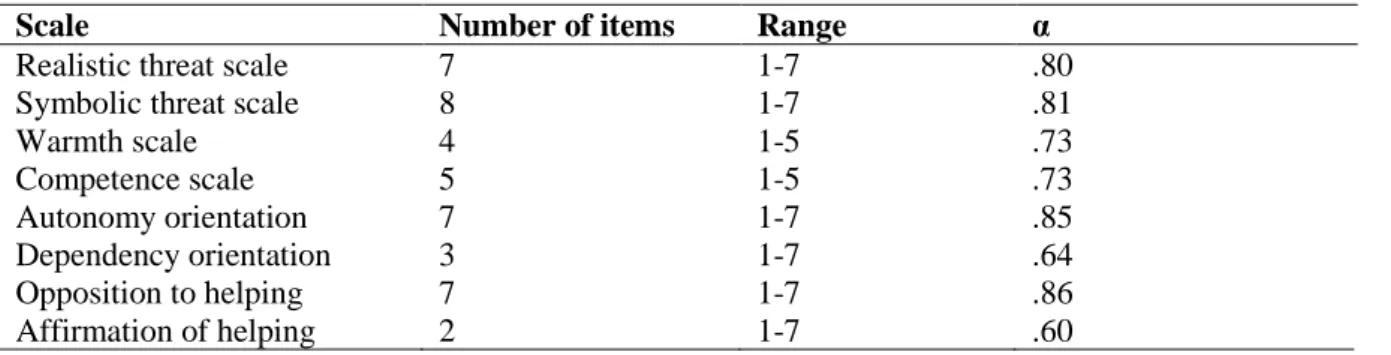
Initially, a five-factor solution explaining 57.2% of variance was revealed, but its proprieties were not satisfactory. The item “I help refugees/ migrants/ economic migrants because they are unable to help themselves” was removed, as it did not load on any of the factors, having a lower saturation than .4. Two items showed cross-loadings and were consequently removed: the item “We help refugees/migrants/economic migrants develop skills and knowledge to help themselves” (loaded on factor 2 and 5) and the item “I help refugees/ migrants/ economic migrants because I like solving other people’s problems” (loaded on factor 4 and 5). In addition, the item “Germans help refugees/ migrants/ economic migrants because they like taking care of people’s problems” was removed, as it was the only item left in factor 5 and showed low communalities. Finally, the item “In general, solving refugees’/ migrants’/ economic migrants’ problems for them is bad for society, because they come to expect it in the future” was removed due to low saturation. After removing these items, the EFA resulted in a clearer four-factor solution that roughly reproduced the theoretical dimensions of helping orientations and explained 57.3% of total variance. In addition to the three factors that are part of the original scale (autonomy-oriented helping, dependency-oriented helping and opposition to helping), a fourth factor, which was named “affirmation to help” was identified. Opposition to helping was assessed with seven items (e.g. „Helping refugees/ migrants/economic migrants only makes them more needy in the future”, α = .86). Autonomy-oriented helping intentions were also assessed with 7 items (e.g. “The goal of helping should be to make sure refugees/migrants/ economic migrants can eventually take care of their own needs”, α = 85). Dependency-oriented helping was evaluated with three items (e.g. „Helping is all about fixing refugees’/ migrants’ /economic migrants’ problems for them”, α = .64). The extra factor that was identified in the context of the EFA, Affirmation of helping, was measured with 2 items (e.g. “I like to try to help people even if the issue might come up again”, α = .60). The items were measured on a 7-point Likert scale (1 = strongly disagree to 7 = strongly agree). Higher scores equaled stronger endorsement of the respective helping orientation.
16 Mediators
Stereotype content was measured with the warmth and competence scale (Fiske, Cuddy, Glick and Xu, 2002). Warmth was assessed with 4 items (tolerant, warm, good
natured, sincere, α = .73) and competence with five items (competent, confident, independent, competitive, intelligent, α = .73). Participants indicated on a 5-point Likert scale (1= not at all to 5 = extremely) how much they agreed.
Symbolic and realistic threat were measured using Stephan’s and colleagues’ intergroup threat scale (Stephan, Ybarra & Bachman, 1999). Realistic threat was assessed with seven items (e.g. “Refugees/ migrants/ economic migrants have increased the tax burden on Germans”, α = .80). Symbolic threat was evaluated with eight items (e.g. „Refugee/ migrant/ economic migrant intake is undermining German culture”, α = .81). Items were measured on a 7-point Likert scale (1 = strongly disagree to 7 = strongly agree) and positive items were reversed, so that higher values indicated greater perceived threat.
Sociodemographic questions
Regarding demographics, gender, age, education, job situation, satisfaction with income situation as well as self-perceived social status were assessed. Moreover, using the political self-placement scale (Jost, 2006) the participant’s political orientation was measured (ranging from 1 = far-left to 7 = far-right). Similarly, religiousness was assessed (1 = not at all religious to 7 = very religious).
Chapter III – Results
Competence and Warmth
We conducted a 3 treatment condition (economic migrant vs. refugee vs. migrant) X 2 stereotype content (warmth vs competence) mixed model ANOVA to test whether there was a difference between warmth and competence perceptions depending on the experimental condition (H1). Results revealed the predicted interaction between treatment condition and stereotype content, F(2, 300) = 6.55, p = .002, ηp2 = .042. Pairwise comparisons showed that
participants in the refugee condition revealed significantly higher warmth than competence, p = .006, whereas participants in the economic migrant condition revealed significantly higher competence than warmth, p = .018 (see Table 1). In the migrant condition, the differences regarding competence and warmth perceptions were not significant, p = .490. These results
17
partially confirm H1, showing that the label refugee triggered more paternalistic stereotypes (high on warmth but low on competence H1a). In addition, the label economic migrant elicited more envious stereotypes (low on warmth and high on competence). H1b was partly confirmed since results did not reveal the expected differences between perceived competence and warmth in the migrant condition.
Table 1. Means of stereotype content by experimental condition
Refugee Migrant Economic Migrant
Warmth 3.16 (0.08) 3.32 (0.08) 3.12 (0.09)
Competence 2.96 (0.08) 3.27 (0.08) 3.31 (0.09)
Symbolic and Realistic Threat
We conducted a 3 treatment condition (economic migrant vs. refugee vs. migrant) X 2 intergroup threat (realistic threat vs symbolic threat) mixed model ANOVA, to test whether there was a difference between realistic and symbolic threat perceptions, depending on the experimental condition (H2). Contrary to our hypothesis, the interaction between condition and intergroup threat was not significant F(2, 298) = 0.95, p = .909. Pairwise comparisons did not show significant differences between perceived realistic and symbolic threat across
conditions (see Table 2).
Table 2. Means of intergroup threat by experimental condition
Refugee Migrant Economic Migrant
Realistic Threat 2.42 (1.02) 2.35 (0.87) 2.43 (0.79) Symbolic Threat 3.87 (1.04) 3.77 (0.88) 3.83 (0.98)
Helping Orientations
In addition, we conducted a 3 experimental condition (economic migrant vs refugee vs migrant) MANOVA to examine the effects of our manipulation on different forms of helping (autonomy-oriented helping, dependency-oriented helping, opposition to helping and
18
Table 3. Means of helping orientation by experimental condition
Refugee Migrant Economic Migrant
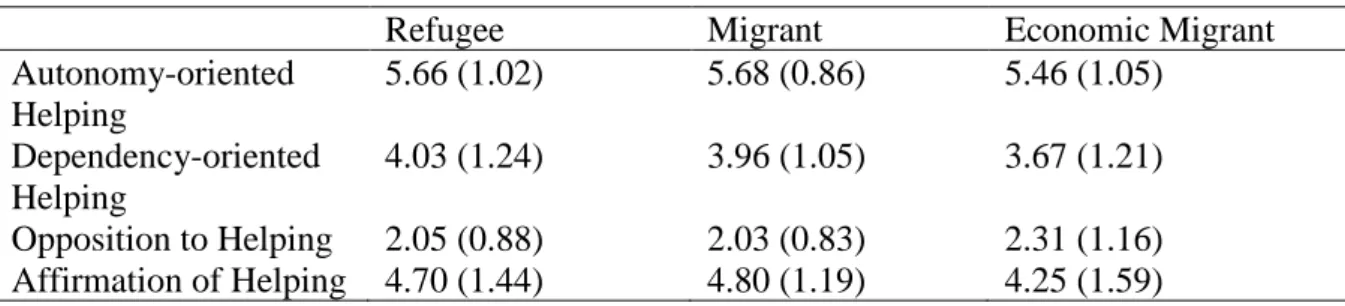
Autonomy-oriented Helping 5.66 (1.02) 5.68 (0.86) 5.46 (1.05) Dependency-oriented Helping 4.03 (1.24) 3.96 (1.05) 3.67 (1.21) Opposition to Helping 2.05 (0.88) 2.03 (0.83) 2.31 (1.16) Affirmation of Helping 4.70 (1.44) 4.80 (1.19) 4.25 (1.59)
Results did not reveal a significant multivariate effect of condition on the dependent variables, V = 0.043, F(8,586) = 1.629, p =.114, ηp2 = .022. Nonetheless, as expected, univariate
tests revealed a significant effect of the treatment condition on affirmation of helping F(2, 295) = 4.693, p = 0.010, ηp2 = .031. There was also a marginal effect on opposition to helping
F(2, 295) = 2.785, p = 0.063, ηp2 = .019, as well as on dependency-oriented helping F(2, 295)
= 2.382, p = 0.094, ηp2 = .016.
Pairwise comparison revealed that, as expected, participants in the economic migrant condition revealed significantly stronger opposition to helping (M = 2.31, SD = 1.16) than participants in the refugee condition (M = 2.05, SD = 0.88), p = 0.041. Also, in comparison to participants in the migrant condition (M = 2.03, SD = 0.83), participants in the economic migrant condition revealed significantly stronger opposition to helping, p = 0.038. No significant results were found with regards to autonomy-oriented helping. However, as expected, the label refugee (M = 4.03, SD = 1.24) elicited more dependency-oriented helping than the label economic migrant (M = 3.67, SD = 1.21), p = 0.037. Finally, participants in the economic migrant condition (M = 4.25, SD = 1.59) revealed significantly less affirmation of helping than participants in the migrant (M = 4.80, SD = 1.19) and refugee (M = 4.70, SD = 1.44) conditions. These results partially confirm H3a, demonstrating that the label refugee elicits higher support for dependency-oriented helping than the label economic migrant but no significant differences were found between the refugee and migrant conditions. Furthermore, as expected (H3b), the label economic migrant predicted more opposition to helping.
Indirect effects of the different labels
We ran four parallel mediation models with 5000 bootstrap samples for percentile bootstrap confidence intervals using the SPSS PROCESS macro (Hayes, 2018) to test the indirect effects of our experimental condition on autonomy-oriented helping,
dependency-19
oriented helping, opposition to helping and affirmation to helping (H4). In each model the experimental manipulation served as predictor (dummy-coding: X1 migrant = 0 vs. refugee = 1 vs. economic migrant = 0; X2 migrant= 0 vs. refugee = 0 vs. economic migrant = 1). Realistic threat, symbolic threat, and a difference score for competence and warmth (i.e., higher values mean more competence than warmth) were the mediators in the model and political orientation was used as covariate.
Autonomy-oriented helping
Contrary to the hypothesized (H4b), the indirect effect of the group label on autonomy-oriented helping through the difference score for competence/ warmth was not significant (X1: B = .019, SE = .018, 95% CI [-.008, .059]; X2: B = -.026, SE = .024, 95% CI [-.085, .007]). Similar findings were found for realistic threat (X1: B = -0.002, SE = .039, 95% CI [-.092, .070]); X2: B = -.023, SE = .037, 95% CI [-.103, .047]) and symbolic threat (X1: B = .002, SE = .013, 95% CI [-.025, .033]); X2: B = .003, SE = .013, 95% CI [-.024, .033]). Nonetheless, the label economic migrant triggered significantly more competence than warmth (B = .232, p = .035), and realistic threat was negatively related to autonomy-oriented helping (B = -.330, p = .000), that is higher levels of perceived realistic threat decreased autonomy-oriented helping. The analysis also revealed that the total effect of the treatment condition on autonomy-oriented helping was not significant (total effect X1: B = .018, p = .894 and total effect X2: B = -.215, p = .127).
Opposition to helping
The indirect effect of the group label on opposition to helping through the difference score of competence/ warmth was not significant (X1: B = -.007, SE = .014, 95% CI [-.042, .017]; X2: B = .010, SE = .019, 95% CI [-.025, .052]). Results revealed similar findings for realistic threat (X1: B = -0.004, SE = .035, 95% CI [-.070, .072]); X2: B = .021, SE = .03, 95% CI [-.043, .090]) and symbolic threat (X1: B = .002, SE = .021, 95% CI [-.043, .048]); X2: B = .006, SE = .022, 95% CI [-.038, .052]). Thus, results showed no significant indirect effects of the group label on opposition to helping. Nonetheless, the label economic migrant, relative to the other conditions, elicited significantly more competence than warmth (B = .232, p = .035). Realistic (B = .297, p = .000), as well as symbolic threat (B = .153, p = .028) were positively related to opposition to helping. That is, higher levels of intergroup threat increased opposition to helping. The total effect of the treatment condition on opposition to helping was
20
not significant when comparing refugees with migrants and economic migrants (total effect X1: B = -.013, p = .920). However, the total effect of the treatment condition on opposition to helping was significant when comparing economic migrants with refugees and migrants (total effect X2: B = .271, p = .044).
Dependency-oriented help
Contrary to H4, results showed no reliable indirect effects of the group label on dependency-oriented helping through the competence/ warmth score (X1: B = .010, SE = .017, 95% CI [-.020, .048]; X2: B = -.014, SE = .025, 95% CI [-.073, .026]). Similarly, there was no reliable indirect effect of the group label on dependency-oriented helping through realistic threat (X1: B = .000, SE = .011, 95% CI [-.026, .021]); X2: B = .001, SE = .012, 95% CI [-.025, .029]) and symbolic threat (X1: B = -.004, SE = .023, 95% CI [-.058, .042]); X2: B = -.006, SE = .023, 95% CI [-.062, .037]). Realistic (B = .018, p = .860), as well as symbolic threat (B = -.152, p = .102) were not related to dependency-oriented help. Neither was the competence/ warmth score related to dependency-oriented help (B = -.062, p = .497). Results revealed that the total effects of the treatment conditions on dependency-oriented helping were not significant (total effect X1: B = .056, p = .729 and total effect X2: B = -.303, p = .074).
Affirmation of help
Supporting H4b, the label economic migrant indirectly decreased affirmation of helping through higher competence than warmth values (X2: B = -.044, SE = .037, 95% CI [-.135, .004]). The effect of the label economic migrant on the difference score on competence and warmth was significant (X2: B = .232, SE = .042, p= .035, 95% CI [.017, .448]), such that participants in that condition perceived the targets as higher in competence than in warmth. Increased perceptions of competence were then significantly related to less affirmation of helping (B = .-189, SE = .091, p= .039, 95% CI [-.268, -.010]). Realistic (B = -.408, p = .000), as well as symbolic threat (B = -.407, p = .000) were negatively related to affirmation of help. That is, higher levels of intergroup threat, decreased affirmation of help.
The analysis also revealed that the total effect of the treatment condition on affirmation of helping was not significant for the refugee label (total effect X1: B = -.039, p = .835). However, results showed a significant negative total effect of the label economic migrant on affirmation of helping (total effect X2: B = -.550, p = .005).
21
Figure 2. Indirect effects of the label economic migrant on affirmation of helping. Note: * = p < 0.0 5, ** = p < 0.01, the dotted lines are not-significant paths.
22
Table 4. Effects of predictor and mediator variables for all dependent variables controlling for political orientation
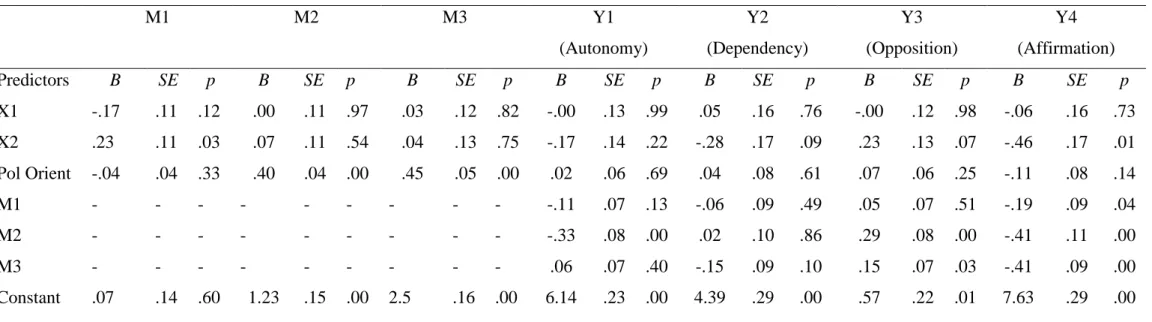
Note: X1 = refugee vs. migrant and economic migrant, X2 = economic migrant vs. migrant and refugee; Pol Orient = Political Orientation; M1 = Competence/Warmth score, M2 = Realistic Threat, M3 = Symbolic Threat
M1 M2 M3 Y1 (Autonomy) Y2 (Dependency) Y3 (Opposition) Y4 (Affirmation) Predictors B SE p B SE p B SE p B SE p B SE p B SE p B SE p X1 -.17 .11 .12 .00 .11 .97 .03 .12 .82 -.00 .13 .99 .05 .16 .76 -.00 .12 .98 -.06 .16 .73 X2 .23 .11 .03 .07 .11 .54 .04 .13 .75 -.17 .14 .22 -.28 .17 .09 .23 .13 .07 -.46 .17 .01 Pol Orient -.04 .04 .33 .40 .04 .00 .45 .05 .00 .02 .06 .69 .04 .08 .61 .07 .06 .25 -.11 .08 .14 M1 - - - -.11 .07 .13 -.06 .09 .49 .05 .07 .51 -.19 .09 .04 M2 - - - -.33 .08 .00 .02 .10 .86 .29 .08 .00 -.41 .11 .00 M3 - - - .06 .07 .40 -.15 .09 .10 .15 .07 .03 -.41 .09 .00 Constant .07 .14 .60 1.23 .15 .00 2.5 .16 .00 6.14 .23 .00 4.39 .29 .00 .57 .22 .01 7.63 .29 .00
23
Chapter IV – Discussion
Migration continues to be a central topic on the political agenda in Germany and the country accounted for the highest number of persons granted protection status in Europe in 2017 (Eurostat, 2018). With the aim to strengthen peaceful intergroup relations it is therefore of crucial importance to understand how these newcomers are perceived by German majority members and examine factors that might affect their willingness to engage in prosocial behavior. Building on previous research regarding labels (e.g. Carnaghi & Bianchi, 2017), stereotype content (Fiske et al., 2002), threat perceptions (Stephan et al., 2005) and helping relations (Nadler, 2002; Maki et al., 2017), this study investigated whether the labels used to describe newly arrived people impact social perception and intergroup helping intentions. Overall, our findings show that the terms used to describe displaced people matter and have far reaching consequences. The findings seem especially striking when considering that the labels used to refer to displaced people in media coverage (see Goodman et al., 2017), political discourse (see Rowe & O’Brien, 2014) or private conversation are often used in an undifferentiated manner, ignoring individual experiences and lacking further validation, for example, regarding the assumed flight motives (Kotzur et al., 2017).
As predicted, results indicated that the labels chosen to describe the newcomers affect stereotype content and the majority members’ willingness to provide help. As hypothesized, results revealed a significant interaction between condition and stereotype content.
Supportive of H1a, the label refugee evoked higher warmth than competence ratings, indicating paternalistic stereotypes towards refugees. H1b was only partially confirmed, as economic migrants received higher competence than warmth ratings but results did not reveal the expected difference between perceived warmth and competence in the migrant condition. The finding is in line with previous research in the German context, showing that the label economic migrant elicited anger and lower willingness to welcome newcomers (Ditlmann, Koopmans, Michalkowski, Rink & Veit, 2006. However, no differences were found for the label migrant. This might be explained by the fact that the label migrant represents a broad category, evoking heterogeneous understandings and outcomes (Moses, 2006).
As previous research showed that warmth perceptions can be related with perceived threat (Fiske et al., 2002), we subsequently hypothesized that the refugee label would evoke lower levels of intergroup threat than the economic migrant and migrant label (H2). However,
24
results did not show statistically significant differences regarding perceived symbolic and realistic threat as a function of the group label. Furthermore, there is an ongoing debate regarding the two-dimensional conceptualization of intergroup threat, as symbolic and
realistic threat dimensions are empirically highly correlated. Consequently, new approaches in social psychology argue for an extension of the two-component model by adding another form of threat that goes beyond scarce resources and threatened national culture and identity. For instance, Verkuyten and Martinovic (2017) propose a third dimension of perceived threat, collective psychological ownership threat, which is related to the psychology of possessions and describes a perceived gatekeeper right to decide whether someone is permitted access or not, e.g. to a country that is perceived as one’s own country. As collective psychological ownership threat may impact the social perception of newcomers, future research in the migration context could integrate this approach to examine whether there are differences in perceived ownership threat depending on the group label.
Consistent with our hypothesis (H3a), the label refugee elicited significantly higher support for dependency-oriented help relative to the label economic migrant. Contrary to the hypothesized, results did not reveal a significant difference regarding dependency-oriented help between refugees and migrants. However, confirming H3b, results showed that the label economic migrant increased the host majority members’ opposition to provide help. This finding is in line with previous research in Germany showing that economic refugees are evaluated less positively than war refugees, eliciting more harmful action tendencies than supportive behavioral intentions (Kotzur et al., 2017). Overall, our findings did not illustrate the expected differences of group labels on autonomy-oriented helping intention. This might be related to the fact that the Helping Orientations Inventory scale, developed by Maki and colleagues (2017), is a relatively new instrument and lacks consistent validation in different contexts and towards different target groups. For instance, in our study the factorial structure of this scale differed from the one reported by the scale’s authors. While Maki et al., 2017, reported only three factors, we found a four-factor structure, with affirmation of help as a fourth dimension. This suggests the scale may not be robust to the study context. In the context of the present study the items might have been not accurate enough to detect significant differences regarding autonomy-oriented helping intentions.
Nonetheless, while the total effect of the condition on autonomy-oriented help was not significant, realistic threat was negatively related to autonomy-oriented helping. That is, higher levels of perceived realistic threat were related to decreased intentions to provide
25
autonomy-oriented help. This finding is consistent with the basic assumption of the IHSR model (Nadler, 2002) that high status majority group members show less willingness to provide autonomy-oriented help to the lower status group if they perceive the established social hierarchy as threatened by the newcomers. Similarly, in line with several studies showing that threat decreases pro-social behavior (Halabi, Dovidio & Nadler, 2008), results showed that higher levels of intergroup threat were related to increased opposition to help. Contrary to our expectations (H4a), the effect of the group label on helping intentions was not mediated by intergroup threat perceptions. However, stereotype content seems to influence peoples’ willingness to provide help. Partially supportive of H4b, the label economic migrant evoked less affirmation of help, and this effect occurred via lower warmth and higher
competence perceptions.
Overall, our findings are consistent with the work of other researchers (Czymara & Schmidt-Catran, 2016; Ditlmann et al., 2006) that examines the crucial role of group labels and their impact on social perception and behavioral intentions towards the different types of displaced people in Germany.
Limitations and future research
Our findings support the importance of group labels and suggest that there may exist a social hierarchy between the different subtypes of displaced people, with refugees being perceived as the most positive and supported subgroup. Economic migrants, in turn, were evaluated rather negatively, being exposed to envious stereotypes and overall lower levels of help provision. Despite the novel theoretical contribution, these results should be interpreted with caution and as limited in their generalizability. The convenience sample (N= 304) used for this study was not representative for the general native population. In particular, the current sample is more left-winged and possessed a higher educational degree than average. As it is known that political orientation strongly correlates with relevant intergroup variables (e.g. threat perception), in our analyses we controlled for political orientation. Thus, to strengthen our theoretical claims and test its generalizability, future studies could attempt to replicate these findings with representative samples, as well as, in different national contexts.
Another limitation of the present study is related to the use of self-reported measures of helping orientations. Minding the intention-behavior gap (Sheeran & Webb, 2016), it
26
seems important to consider the effect of labels not only on helping orientations but on actual helping behavior. Also, in order to add to this field of research, future studies could explore alternative theoretical explanations. For instance, given their importance for migrant-host members relations, perceived voluntariness (see Verkuyten, Altabatabaei & Nooitgedagt, 2018) as well as, perceived deservingness (see Rink & Veit, 2016) could be examined as additional variables to better understand the impact of using different labels when referring to displaced people.
Also, this study did not assess emotions evoked by the different labels. As proposed by the Intergroup Emotions Theory (Mackie & Smith, 2015), group-based emotions are a key determinant of behavioral intentions. Thus, integrating this aspect in future research could provide further insights regarding the underlying psychological mechanisms that account for behavioral intentions towards different subgroups of displaced people. In addition, relying on implicit measures to examine intergroup threat perceptions could help to rule out social desirability norms prevailing in the German context. Building on previous research
(Verkuyten & Thijs, 2010) future studies could also examine whether the different labels of refugee, migrant and economic migrant are associated with presumed ethnicity or country of origin. Such an approach could provide further insights to understand whether certain categories of displaced people are stereotypically associated with a specific ethnic origin.
Furthermore, it is important to note that the label effect found in this study might also be related to linguistic features. Participants in the refugee and migrant conditions were presented with a single noun (refugee or migrant), while in the economic migrant condition, the adjective “economic” could have activated the migration motive. Previous research has shown that people may form different impressions of others when nouns rather than
adjectives were used to describe them (Carnaghi et al., 2008). Thus, future studies could further control for the use of nouns and adjectives in the labelling of displaced people.
Research also shows that the relation between different labels for displaced people and related outcomes is highly context-dependent, dynamic and evolves over time (see, for
example, Kumsa, 2006). In the German context, the term “migrant” became noticeably more present in the public debate after the significant increase in asylum applications in 2016 (Bundeszentrale für politische Bildung, 2016). Accordingly, some experts argue that its connotation changed over time, being used increasingly to mean “not a refugee” and thus not deserving legal entitlements (Carling, 2015). Therefore, it would be interesting to conduct a