UNIVERSIDADE DA BEIRA INTERIOR
Engenharia
Implementing and Evaluating Nonsingular Matrices
Generators for the Hill Cipher
(Versão Final Após a Defesa Pública)
Moisés Alfredo da Cunha Ferreira
Dissertação para obtenção do Grau de Mestre em
Engenharia Informática
(2º ciclo de estudos)
Orientador: Prof. Doutor Pedro Ricardo Morais Inácio
Co-orientadora: Profª Doutora Aleksandra Mileva
Dedications
To my family, specially my mother, who gave me everything in this life, the main responsible for all I achieve; and my father, who passed away too soon, to whom I cannot show how I am following all of his advice.
Acknowledgments
First of all, I thank God for everything He has done in my life. Secondly, I would like to thank all my teachers and colleagues in the master’s course, without forgetting my dear supervisor, Professor Pedro Inácio, for making my master’s degree a success. I would also like to thank the co-advisor for this project, Professor Aleksandra Mileva from Macedonia, and the doctoral student Bernardo Sequeiros, for all the support in all of the process, from the beginning until the end. I cannot forget Professor Mário Freire, who made some very important corrections as well. Finally, I thank my graduation faculty, ISP/UKB, for the scholarship provided by INAGBE.
Resumo
A Cifra de Hill (Hill Cipher) é um exemplo clássico de um sistema criptográfico com propriedades muito interessantes, nomeadamente a implementação dos conceitos de confusão e difusão ap-resentados por Shannon como propriedades essenciais para as cifras; no entanto, a sua forma básica é vulnerável a Known Plaintext Attacks (KPAs). Esta dissertação apresenta um método efi-ciente para gerar matrizes não singulares, baseado no método de eliminação de Gauss-Jordan, que permite gerar uma nova matriz para cada bloco a ser cifrado. A cifra Randomized Key Hill Cipher (RKHC), descrita nesta dissertação, usa o referido método e adiciona um passo, quer ao algorítmo de cifra, quer ao algoritmo de decifra para tratar mensagens que contenham padrões (ex: uma sequência de zeros), a fim de aumentar a segurança contra KPAs, Chosen Plaintext Attacks (CPAs) e Chosen Ciphertext Attacks (CCAs). Uma avaliação da performance, mediante uma implementação não optimizada do algorítmo RKHC na linguagem ANSI C, é incluída e com-parada com implementações optimizadas do Advanced Encryption Standard (AES) e do Salsa20, juntamente com uma discussão acerca da segurança e das limitações em relação aos ataques de criptanálise mais relevantes. A prova de que o método proposto possui aleatoriedade com elevada entropia nas matrizes e criptogramas gerados é apresentada mediante resultados prove-nientes de testes estatísticos da biblioteca TestU01 para a avaliação rigorosa da aleatoriendade dos outputs gerados.
Palavras-chave
Cifra de Hill, chave aleatória, Gauss-Jordan, matrizes não singulares, cifra simétrica, cifra por blocos.
Resumo alargado
Este resumo alargado tem como objetivos apresentar, na Língua Portuguesa, o conteúdo desta dissertação mais detalhadamente em relação à seccão anterior, pois a maior parte do conteúdo desta dissertação está escrito na Língua Inglesa.
Introdução
O primeiro capítulo tem como objetivo enquadrar o trabalho descrito ao longo desta dissertação, introduzindo o tema geral e apresentando a motivação, bem como o enquadramento relativo ao mesmo. Neste capítulo também é apresentado o problema que este trabalho se propõe a resolver e os seus objetivos. É ainda apresentada a abordagem seguida para resolver o problema proposto e as principais contribuições do trabalho.
Enquadramento, Descrição do Problema e Objetivos
A Cifra de Hill - Hill Cipher (HC) é um exemplo clássico de um sistema criptográfico com pro-priedades interessantes, nomeadamente a implementação dos princípios de difusão e confusão, defendidos por Shannon como propriedades fundamentais para as cifras; a HC tem um grande nível de entropia, obtida mediante a multiplicação de cada texto limpo (bloco) por uma matriz invertível. A HC tem atraído a atenção de muitos investigadores nos últimos anos, com o intuito de corrigir as suas limitações que ainda não foram conseguidas até ao momento, nomeadamente a vulnerabilidade a KPA, pois, quando uma mesma matriz é usada para cifrar vários blocos de texto, entre outras limitações, tais como CPA e CCA.
A motivação deste trabalho provém do estudo da Cifra de Hill (HC) clássica, focando na sua componente principal, a matriz que é usada como chave da cifra. Esta matriz deve ser não singular para que possa ser invertida e usada no momento da decifra; a geração de tais matrizes de forma pseudo-aleatória tem sido alvo da atenção da comunidade investigativa. Portanto, este trabalho descreve um novo método para gerar tais matrizes e o analisa no âmbito de uma nova variante da HC. Neste caso, a HC é modificada, a fim de melhorar a sua segurança.
O principal problema que este trabalho se propõe resolver é a vulnerabilidade da HC em relação a KPA, pois, quando vários textos são cifrados com a mesma matriz chave, torna fácil a recuper-ação da mesma por meio da resolução de um sistema de equações lineares trivial. Outro prob-lema que este trabalho pretende resolver é o facto de, até ao momento, não haverem métodos eficientes na literatura para gerar matrizes não singulares que possam ser usadas como chave de cifra para cada bloco de texto. Além da vulnerabilidade em relação a KPA, a HC também é vulnerável a CPA e CCA (ex: para uma entrada de blocos formados inteiramente por zeros, a HC sempre dá como saída o mesmo bloco de zeros).
O principal objetivo desta dissertação é, portanto, desenvolver uma variante segura da HC. Para alcançar este objetivo é necessário: a) apresentar um método eficiente para gerar ma-trizes não singulares pseudo-aleatórias; b) modificar o algorítmo de cifra e o de decifra da HC, a fim de corrigir as vulnerabilidades contra KPA, CPA e CCA; c) avaliar as referidas modificações e o método proposto (aqui denominado por RKHC).
A abordagem escolhida para resolver o referido problema começou com o estudo das modifi-ix
cações da HC encontradas na literatura. Essas modificações foram importantes para perceber o que já foi feito para resolver as vulnerabilidades em relação a KPA, CPA e CCA. Em seguida, como nenhuma dessas modificações apresenta um método eficiente para gerar matrizes não singulares pseudo-aleatórias, um método baseado na eliminação de Gauss-Jordan foi proposto, implementado e analisado. Este método é capaz de gerar todas as matrizes necessárias, ou seja, para uma determinada ordem n, o método permite gerar todas as matrizes não singulares contendo apenas 0s e 1s. O passo a seguir consistiu em analisar como as debilidades do HC, em relação a textos-limpos ou criptogramas específicos (tal como vetores inteiramente formados por zeros), podem ser revistas para a proposta das modificações que resolvem tais problemas, fazendo com que o algorítmo seja resistente a esses ataques. Para testar o método proposto, uma implementação não otimizada do RKHC na linguagem ANSI C foi levada a cabo e comparada com implementações otimizadas do AES e do Salsa20 em termos de benchmarking. A famosa biblioteca TestU01, para avaliação rigorosa de aleatoriedade em testes estatísticos, foi usada para avaliar o algorítmo proposto para geração de matrizes não-singulares, a fim de assegurar que os outputs têm entropia suficiente para ser usados em cenários criptográficos.
Principais Contribuições
As principais contribuições alcançadas ao longo da investigação e desenvolvimento deste projeto podem ser apresentadas da seguinte forma:
1. Um método eficiente para gerar uma matrix não singular dada uma determinada seed (semente), implementado na linguagem ANSI C e avaliado. A novidade deste método é que este gera todas as matrizes não singulares possíveis para qualquer ordem n, de forma eficiente e com um vasto espaço de chaves;
2. Um algorítmo eficiente para gerar diretamente uma matriz inversa, baseado especifica-mente no algorítmo referido na primeira contribuição, foi também proposto, implemen-tado e avaliado;
3. A dissertação também descreve uma modificação da HC (RKHC), nomeadamente os algo-rítmos de cifra e de decifra, utilizando o método referido acima para cifrar/decifrar cada bloco de texto limpo/criptograma com uma matriz pseudo-aleatória diferente, com meios adicionais de prevenir ataques de KPA, CPA e CCA;
4. Também foi parte deste trabalho uma criptanálise inicial em relação a HC e a RKHC, uti-lizando vários modelos e ataque.
Fundamentação Teórica e Trabalhos Relacionados
O capítulo 2 descreve os conceitos relacionados com este trabalho: os fundamentos da crip-tografia, as cifras simétrica e assimétrica (de chave pública), os PRNG e CSPRNG, o conceito de testes estatísticos e a famosa biblioteca TestU01. Vários modelos de ataque são apresentados, uma vez que são ferramentas estudadas profundamente ao longo do trabalho para provar a se-gurança do sistema criptográfico apresentado.
Finalmente, é apresentada a HC clássica, juntamente com os seus pontos fortes e fracos, além disso, são apresentados vários trabalhos relacionados para melhorar a segurança da HC, tais trabalhos incluem múltiplas multiplicações de matrizes, geração de matrizes por tentativa e erro, uso de matrizes auto-invertíveis (matrizes iguais às suas respetivas inversas), entre outras tentativas.
Randomized Key Hill Cipher (RKHC)
Os capítulos 3 e 4 descrevem o sistema criptográfico proposto (RKHC) e sua avaliação.
No capítulo 3 é apresentada a principal contribuição desta dissertação que consiste no referido sistema criptográfico, uma variante segura do HC, RKHC, explorando o uso de CSPRNG para gerar uma matriz chave diferente para cada bloco submetido à cifra/decifra. O algorítmo proposto para gerar matrizes não singulares módulo 2 é baseado no método de eliminação de Gauss-Jordan, um algorítmo simples, mas não foi encontrado algum que use esta abordagem, muito menos um método eficiente que cumpra tal tarefa. Neste capítulo são ultrapassados os prob-lemas encontrados nos outros trabalhos relacionados apresentados no capítulo anterior, pois estes apresentam três problemas fundamentais, nomeadamente: (i) a suscetibilidade à KPA; (ii) o tamanho e a transmissão da chave; (iii) a predição dos outputs gerados para blocos formados unicamente por zeros (são gerados zeros igualmente). Para tratar dos dois primeiros proble-mas, são apresentados algorítmos para gerar, de forma eficiente, matrizes pseudo-aleatórias módulo 2 e suas respetivas inversas para cada bloco. Para resolver o terceiro problema, um passo adicional é incluído nos procedimentos de cifra e decifra. Esses procedimentos são de-scritos detalhadamente. Aqui é assumido que o número de letras do alfabeto usado é igual a 2 (n = 2). Isto significa que as operações aritméticas são feitas módulo 2. Muitas vezes, XOR (⊕) é usado para referir a soma módulo 2 e cada letra da mensagem é referida como bit. A cifra RKHC proposta é eficiente e segura em relação a outras variantes da HC. A resistência da RKHC contra os ataques básicos também foi analisada e o algorítmo mostra-se resistente a cada um deles com as modificações apresentadas.
Quanto ao capítulo 4, é reservado à uma análise prática de uma implementação não otimizada da RKHC em ANSI C, comparada com implementações de algorítmos conceituados, nomeadamente o AES e o Salsa20. Além do benchmarking, os testes também incluem avaliação da aleato-riedade das matrizes geradas pelo método associado ao RKHC, mediante a biblioteca TestU01, sendo que, a RKHC passou em todos os testes de aleatoriedade a que foi submetida e mostrou-se muito melhor que o único algorítmo que encontramos na literatura para gerar matrizes não singulares (método desenvolvido por [Ran93]).
Conclusões
O capítulo final desta dissertação apresenta as conclusões e o trabalho futuro que pode ser lev-ado a cabo como continuidade e melhoramento deste trabalho.
Aqui foi salientado que o foco deste trabalho foi a pesquisa e desenvolvimento de uma vari-ante do HC denominada RKHC com melhor segurança em relação à cifra original, bem como em relação às variantes apresentadas no capítulo 2. Foi frisado que o trabalho apresenta méto-dos eficientes e seguros para cifrar e decifrar, utilizando matrizes pseudo-aleatórias geradas através de algorítmos eficientes e criptograficamente seguros. O método (sistema criptográ-fico) proposto também apresenta resistência contra modelos de ataque como KPA, CPA e CCA; isto foi demonstrado para os ataques básicos e brevemente discutido em relação aos ataques mais poderosos, nomeadamente a criptanálise diferencial e a linear. Apesar da versão proposta estar concebida de forma a resistir a esses ataques todos, mais trabalho será necessário realizar para assegurar que não foram cometidos enganos ao demonstrar a segurança.
Outra contribuição forte referida neste capítulo tem a ver com o desenho, desenvolvimento, xi
implementação e testes, nomeadamente a grande superação do algorítmo proposto em relação ao único método que encontramos na literatura para geração de matrizes não singulares pseudo-aleatórias, principalmente na resistência aos testes estatísticos levados a cabo com a biblioteca TestU01, o que prova o seu valor para aplicações criptográficas. Outro facto importante é que foi provado que o método proposto gera todas as matrizes não singulares para um determi-nada ordem n dada. A performance do sistema criptográfico proposto foi avaliada cifrando e decifrando ficheiros de diferentes tamanhos e comparando com o AES e o Salsa20, tais testes mostram que o RKHC ainda é muito inferior à esses dois algorítmos em termos de banchmarking, talvez por se tratar de uma varinate não otimizada.
No que diz respeito ao trabalho futuro, muita coisa pode ser feita para melhorar o método proposto: uma criptanálise mais aprofundada será necessária, eventualmente verificada por outras pessoas. A cifra deve ser submetida a outros métodos de criptanálise tais como: meet-in-the-middle and bicliques rebound attacks, related-key attacks, invariant subspace attacks, algebraic attacks or integral attacks, entre outros; a fim de mostrar mais claramente os pontos fortes e fracos da cifra. Além disso, é necessário implementar uma versão otimizada da mesma, implementar também algumas das outras variantes mais recentes da HC e comparar com a RKHC em termos de benchmarks para provar melhor as vantagens do método proposto em relação aos outros. Finalmente, comparar a versão otimizada com os algorítmos mais conceituados como o AES, o Salsa20, entre outras cifras simétricas.
Abstract
Hill Cipher is a classical example of a cryptosystem with interesting properties, namely that it implements the diffusion and confusion concepts coined by Shannon as essential properties for ciphers; nonetheless, its basic form is vulnerable to KPAs. This dissertation presents an ef-ficient method to generate nonsingular key matrices, based on the Gauss-Jordan elimination procedure, which provides means to generate a new matrix per each block submitted to en-cryption. RKHC, described along this dissertation, uses that method and adds a step to both the encryption and decryption algorithms to deal with messages containing patterns (e.g., a sequence of zeros), in order to increase their strength against KPAs, CPAs and CCAs. A perfor-mance evaluation of a non-optimized implementation in the C programming language of RKHC is also included, compared with those of optimized implementations of AES and Salsa20, along with a discussion of its security and limitations under the well-known cryptanalysis attacks. The claim that the proposed method embeds randomness with high entropy into the generated ma-trices and ciphertext is corroborated by results of the TestU01 library for stringent randomness statistical tests.
Keywords
Hill Cipher, randomized key, Gauss-Jordan, nonsingular matrices, symmetric cipher, block ci-pher.
Contents
1 Introduction 1
1.1 Motivation and Scope . . . 1
1.2 Problem Statement and Objectives . . . 2
1.3 Adopted Approach for Solving the Problem . . . 2
1.4 Main Contributions . . . 2
1.5 Dissertation Organization . . . 3
2 Background and Related Work 5 2.1 Introduction . . . 5
2.1.1 Cryptography Fundamentals . . . 5
2.1.2 Symmetric vs. Asymmetric Ciphers . . . 6
2.1.3 Pseudo Random Number Generator (PRNG) . . . 14
2.1.4 Statistical Tests and TestU01 Library . . . 17
2.1.5 Attack Models . . . 18
2.2 Classical Hill Cipher . . . 22
2.3 Existing Hill Cipher Modifications . . . 23
2.3.1 First Attempts on Correcting the Known Plaintext Attack . . . 23
2.3.2 Iterated Hill Cipher . . . 24
2.3.3 Hash Hill Cipher . . . 24
2.3.4 Randomized Hill Cipher . . . 24
2.4 Conclusions . . . 25
3 Randomized Key Hill Cipher (RKHC) 27 3.1 Introduction . . . 27
3.2 Encryption and Decryption Key Matrix Generation . . . 27
3.3 Number of Generated Matrices . . . 32
3.4 RKHC Encryption and Decryption . . . 33
3.5 Cryptanalysis on RKHC . . . 34
3.5.1 Basic Attack Models . . . 34
3.5.2 Differential Cryptanalysis . . . 36
3.5.3 Linear Cryptanalysis . . . 37
3.6 Conclusions . . . 37
4 RKHC Implementation, Tests and Results 39 4.1 Introduction . . . 39
4.2 Implementation . . . 39
4.3 Matrix Generator Randomness Tests . . . 39
4.4 RKHC Benchmarking . . . 40
4.5 Conclusions . . . 42
5 Main Conclusions and Future Work 43 5.1 Main Conclusions . . . 43
5.2 Future Work . . . 43
References 45
List of Figures
2.1 A communication using cipher to assure confidentiality over an insecure channel (adapted from Stinson [Sti05]). . . 5 2.2 The Offset Codebook (OCB) encryption and decryption algorithms (adapted from
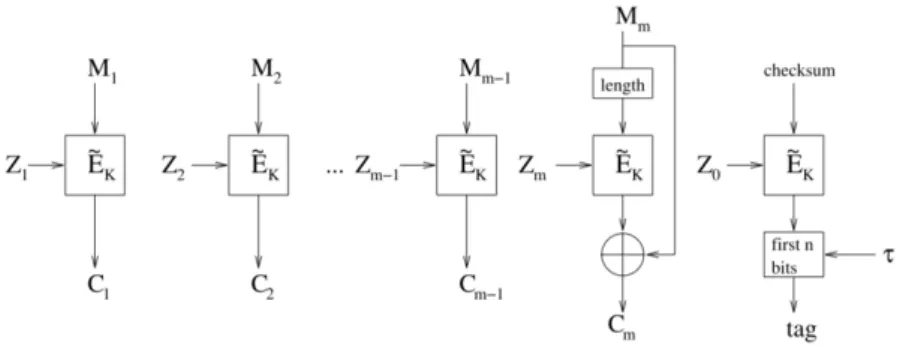
Rogaway et al. [RBB03]). . . 12 2.3 Tweakable Block Chaining (TBC): a mode of operation for a tweakable block
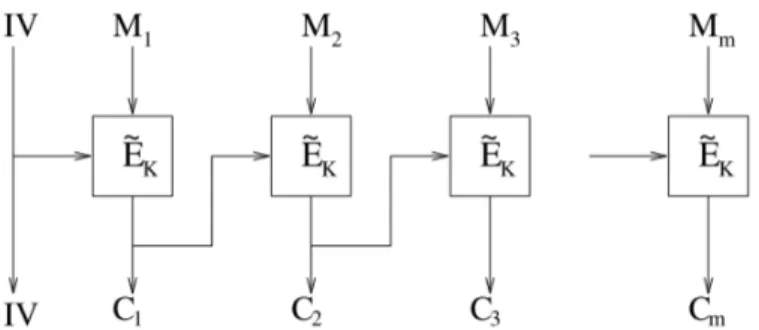
ci-pher. Each ciphertext becomes the tweak for the next encryption. Note that to decrypt a block, one needs only the key, Ci, and Ci−1, so decryption can be done
in parallel. . . 13 2.4 Tweak Incrementation Encryption (TIE): a mode of operation for tweakable block
ciphers to produce secure symmetric encryption. The initial tweak Initialization Vector (IV) is chosen randomly (or sequentially) and incremented by 1 for each successive block. . . 13 2.5 Tweakable Authenticated Encryption (TAE): Authenticated encryption mode based
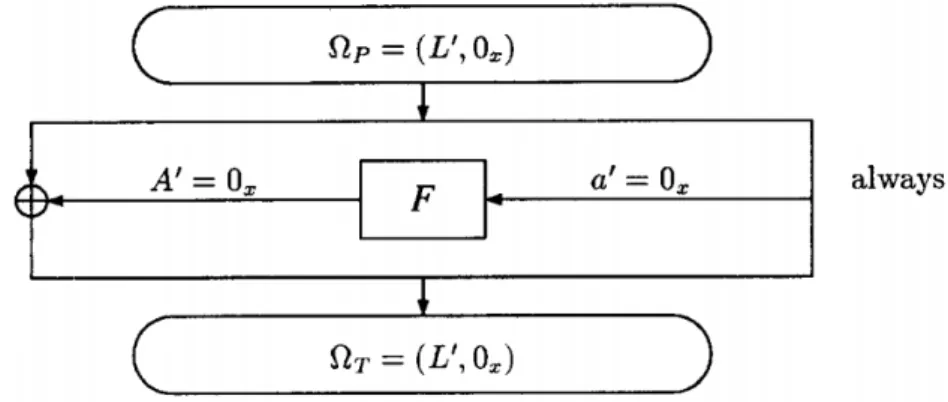
on a tweakable block cipher. . . 14 2.6 A one-round characteristic with probability 1 is (for any L') for DES-like
cryptosys-tems. . . 20
List of Tables
4.1 Summary of the results concerning tests with the TestU01 batteries of tests
(ver-sion 1.2.3 of TestU01 was used in this work). . . 40
4.2 Processing time (s) for Salsa20, AES-CBC and RKHC during encryption. . . 41
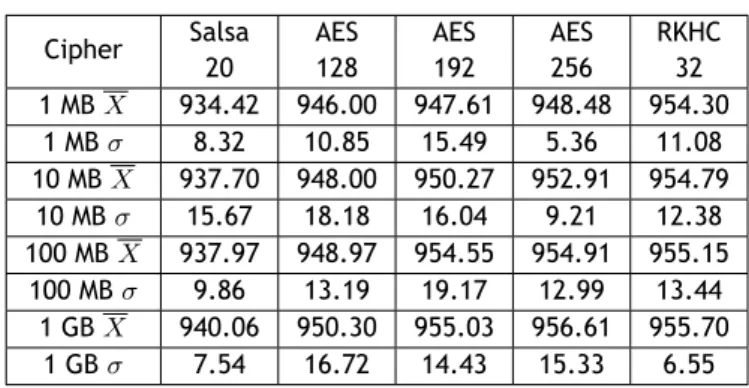
4.3 Processing time (s) for Salsa20, AES-CBC and RKHC during decryption. . . 41
4.4 Memory (KB) usage for Salsa20, AES-CBC and RKHC during encryption.. . . 41
4.5 Memory (KB) usage for Salsa20, AES-CBC and RKHC during decryption.. . . 41
List of Algorithms
1 Encryption Key Matrix Generation Algorithm. . . 28
2 Algorithm for Inverting the Key Matrix. . . 30
3 Algorithm for Directly Generating the Inverted Key Matrix. . . 32
4 RKHC Encryption. . . 34
5 RKHC Decryption. . . 34
Acronyms
AAD Additional Authenticated Data
AES Advanced Encryption Standard
ACM Association for Computing Machinery
ANSI American National Standards Institute
CBC Cipher Block Chaining
CCA Chosen Ciphertext Attack
CIPH Cipher
CCA2 Adaptive Chosen Ciphertext Attack
CFB Cipher Feedback
CMAC Cipher-based Message Authentication Code
COA Ciphertext Only Attack
CPA Chosen Plaintext Attack
CPU Central Processing Unit
CSPRNG Cryptographically Secure Pseudo Random Number Generator CCS Computing Classification System
CTR Counter
DDR3 Double Data Rate type 3
DES Data Encryption Standard
3DES Triple Data Encryption Standard
ECB Electronic Code Book
FIPS Federal Information Processing Standard
GB Gigabyte
GF(2) Binary Galois Field
GCM Galois Counter Mode
GCTR Galois Counter
GHz Gigahertz
GHASH Galois Hash (Function) - defined as GHASH(H, A, C) = Xm+n+1. H is the Hash Key
(a string of 128 zero bits encrypted using the block cipher), A is data which is only authenticated (not encrypted), C is the ciphertext, m is the number of 128-bit blocks in A, n is the number of 128-bit blocks in C.
GMAC Galois Message Authentication Code
HC Hill Cipher
HRNG Hardware Random Number Generator
INAGBE Instituto Nacional de Bolsas de Estudo (Angola) ISP Instituto Superior Politécnico (Angola)
IBM International Business Machines
IDEA International Data Encryption Algorithm
ISAAC Indirection, Shift, Accumulate, Add And Count
ISO International Organization for Standardization
IV Initialization Vector
KB Kilobyte
KPA Known Plaintext Attack
LSB Less Significant Bit
MB Megabyte
MDS Maximum Distance Separable
MAC Message Authentication Code
MSB Most Significant Bit
NIST National Institute of Standards and Technology
OFB Output Feedback
OCB Offset Codebook
OS Operating System
PCBC Propagating Cipher Block Chaining
PKCS5 Public Key Cryptography Standards 5
PKCS7 Public Key Cryptography Standards 7
PRNG Pseudo Random Number Generator
PRP Pseudo Random Permutation
RAM Random Access Memory
RC4 Rivest Cipher 4
RC5 Rivest Cipher 5
RC6 Rivest Cipher 6
RKHC Randomized Key Hill Cipher xxiv
RNG Random Number Generator
SSL Secure Sockets Layer
TAE Tweakable Authenticated Encryption
TBC Tweakable Block Chaining
TIE Tweak Incrementation Encryption
TLS Transport Layer Security
TRNG True Random Number Generator
UBI Universidade da Beira Interior
UKB Universidade Katyavala Bwila (Angola)
W3C World Wide Web Consortium
WEP Wired Equivalent Privacy
XOR exclusive OR
Chapter 1
Introduction
This document describes a project developed as part of the work for the attainment of a mas-ter degree in Compumas-ter Science and Engineering at Universidade da Beira Inmas-terior (UBI). The dissertation addresses the subject of Implementing and Evaluating Nonsingular Matrices Gener-ators for the Hill Cipher. Section 1.1 presents the motivation for the project and its scope. The two subsequent sections present the adopted approach and the main contributions of this work, respectively. Finally, the last section describes the structure of the dissertation, composed of five chapters.
1.1
Motivation and Scope
Hill Cipher (HC) is a classical example of a cryptosystem with interesting properties, namely the implementation of the diffusion and confusion concepts, which Shannon determined as essential properties for ciphers; HC provides a very high level of entropy, obtained through matrix mul-tiplications to which plaintexts are submitted to. Another HC advantage is the simplicity of the encrypting and decrypting processes. It has, thus, attracted the interest of many researchers along the years, in an attempt to deal with its limitations, which were not solved completely until now, namely the Known Plaintext Attack (KPA) vulnerability, when the same matrix is used to encrypt many plaintext blocks, and others, such as Chosen Plaintext Attack (CPA) and Chosen Ciphertext Attack (CCA).
The main motivation of this work comes from the study of the classical HC, though it mostly fo-cuses on its most important component, the matrix that is used as encryption key of the cipher. This matrix has to be nonsingular, so that it can be inverted for the decryption process, and generating pseudo-random matrices with such property has received little attention from the research community. This work describes a new method to generate such matrices and analyses it in the scope of a modified HC. In this case, HC was modified to improve its security, and it is part of the contributions of this work.
The scope of this dissertation encompasses the areas of cryptography and computer security, as it aims to evaluate and explore the aforementioned new method applied on a modified HC that does not have its traditional vulnerabilities. Under the 2012 version of the ACM Computing Classification System (CCS), the topics that best describe this dissertation are the following:
• Security and privacy - Block and stream ciphers;
• Security and privacy - Cryptanalysis and other attacks;
• Theory of computation - Cryptographic protocols.
1.2
Problem Statement and Objectives
The main problem addressed by this work is the Hill Cipher (HC) vulnerability against KPA, when many plaintext blocks are encrypted using the same key matrix, which makes it easy to recover the key matrix by solving a trivial system of linear equations. Other problem that this work attempts to solve is that, to the best of our knowledge, there are no efficient methods in the literature to generate nonsingular matrices that can be used as key matrices for each plaintext block. Besides the KPA vulnerability, HC is also vulnerable to CPA and CCA (e.g., for a block of zeroes as input, HC always outputs a block of zeros as well).
The main objective of this dissertation is, then, to design a secure HC variant. In order to reach this aim, it is necessary to: a) present an efficient method to generate pseudo-random nonsingular matrices; b) modify the HC encryption and decryption algorithms in order to prevent KPA, CPA and CCA; c) evaluate the proposed method and modifications.
1.3
Adopted Approach for Solving the Problem
The chosen approach to solve the aforementioned problem began with the study of existing HC modifications. These different modifications were important to ascertain what was already made against KPA, CPA and CCA vulnerabilities. Next, and as none of them presents an ef-ficient method for generating pseudo-random nonsingular matrices, a method based on the Gauss-Jordan elimination procedure was proposed, implemented and analyzed. This method is capable of generating all needed key matrices. The next step consisted in thinking how the HC susceptibility to specific plaintexts or ciphertexts (such as 0 filled vectors) could be addressed and proposing modification that solve these problems, allowing the algorithm to be resistant to KPA, CPA and CCA. In order to test the proposed method, a non-optimized implementation in the ANSI-C programming language of Randomized Key Hill Cipher (RKHC) was, then, performed and compared to optimized implementations of Advanced Encryption Standard (AES) and Salsa20 in terms of benchmarking. The well-known TestU01 library for stringent randomness statistical tests was used against the proposed nonsingular matrix generation algorithm, as to ensure that its outputs have enough entropy to be used in cryptography scenarios.
1.4
Main Contributions
The main contributions achieved from the research and development of this project can be summarized as follows:
1. An efficient algorithm to generate a pseudo-random nonsingular matrix for a given seed was proposed, implemented in ANSI-C programming language and evaluated. The novelty of this method is that it generates all possible nonsingular matrices efficiently and with very good space coverage properties;
2. An efficient algorithm to invert a given nonsingular matrix was proposed, implemented and evaluated;
3. An efficient algorithm to directly generate an inverted matrix based specifically on the algorithm mentioned as first contributions was also proposed, implemented and evaluated; 2
4. The dissertation also describes a HC modification (RKHC), namely the algorithms for en-cryption and deen-cryption using the method above to encrypt/decrypt each plaintext/ci-phertext block with a different pseudo-random matrix with additional means to prevent KPA, CPA and CCA;
5. An initial cryptanalysis on HC and RKHC using several attack models was also part of this work.
The aforementioned contributions are planned to be part of the subject of an international journal paper. This publication will potentially include a lengthier version of the cryptanalysis and considerations on optimized implementations of the algorithms.
1.5
Dissertation Organization
This dissertation is organized as follows:
• Chapter 1 – Introduction – presents the main motivations of this work, its scope, the ad-dressed problem and objectives, the adopted approach for solving the adad-dressed problem, the main contributions and the structure of the document;
• Chapter 2 – Background and Related Work – presents concepts and definitions that are important to understand the work described herein, as well as previous works concerning the HC;
• Chapter 3 – Randomized Key Hill Cipher (RKHC) – discusses the proposed RKHC as a secure variant of HC, and includes an analysis of the most common attack models used against block ciphers;
• Chapter 4 – RKHC Implementation, Tests and Results – describes all of the tests performed on the RKHC implementation, and their results, and discusses as well a comparison with other state-of-the-art algorithms;
• Chapter 5 – Main Conclusions and Future Work – analyses the developed work, as well as its main results and limitations from a broader perspective, and identifies potential future work that can be pursued to improve it.
Chapter 2
Background and Related Work
2.1
Introduction
This chapter describes the background and main concepts related to this work, from cryptog-raphy fundamentals, symmetric and asymmetric ciphers, PRNG and CSPRNG, the concept of statistical tests and the well-known TestU01 library. The most common attack models are pre-sented as well. Finally, the classical HC cryptosystem, its strengths and weaknesses and several works related to posterior improvements are described as well.
2.1.1
Cryptography Fundamentals
According to Stinson [Sti05], the fundamental objective of Cryptography is to enable two people, typically referred, nowadays, to as Alice and Bob, to communicate over an insecure channel in such a way that an opponent, Oscar, cannot understand what is being said. Alice encrypts the plaintext, using a predetermined key, and sends the resulting ciphertext over the channel. Oscar, upon seeing the ciphertext in the channel by eavesdropping, cannot determine what the plaintext was; but Bob, who knows the encryption key, can decrypt the ciphertext and reconstruct the plaintext. Figure 2.1 illustrates this description.
Figure 2.1: A communication using cipher to assure confidentiality over an insecure channel (adapted from Stinson [Sti05]).
Stinson refers to Cryptanalysis as the process of discovering the plaintext from the ciphertext without knowing the decryption key in an efficient manner, and a cryptographic algorithm or cipher as a mathematical function employed for the encryption and decryption of messages. Ciphers can be divided into two categories: symmetric key and public key ciphers. Both are defined by Laskari et al. [LMSV07]. In symmetric-key ciphers, the sender and the receiver of the message, secretly, choose and share the same key that will be used for encryption and decryption. A drawback of this type of cryptosystems is that it requires prior communication of the key between the sender and the receiver through a secure channel, before any message is sent. Public-key ciphers, on the other hand, are designed in such a way that the key used for encryption is publicly available and differs from the key used in decryption, which is secret. Although these two keys are functionally interrelated, the computation of the secret key from 5
the public key is computationally intractable. Thus, using the public key, anyone can send an encrypted message, but only the owner of the secret key can perform the decryption. These different categories of ciphers are briefly described with examples in the next subsection.
2.1.2
Symmetric vs. Asymmetric Ciphers
According to Goldreich [Gol09], a fundamental distinction between encryption schemes refers to the relation between the aforementioned pairs of the keys (i.e., the encryption-key and the decryption-key). The simpler (and older) notion assumes that the encryption-key equals the decryption-key; such schemes are called private-key (or symmetric).
2.1.2.1 Stream Ciphers vs. Block Ciphers
This dissertation is focused on symmetric cipher systems, which are generally classified into block and stream ciphers. According to Cusick [CDR04], the essential distinction between them is as follows:
A stream cipher specifies a device with internal memory that encrypts the jth digit mj of the
message stream into the jth digit cj of the ciphertext stream by means of a function which
depends on both the secret key k and the internal state of the stream cipher at time j. The sequence z∞= z0z1...which controls the encryption is called the key stream or the running key.
The deterministic automaton which produces the key stream from the actual key k and the in-ternal state is called the key stream generator or the running key generator.
A block cipher breaks each plaintext message into successive blocks and encrypts each block M under the control of a key k into a ciphertext block C = (c1, ..., cn), where the plaintext and the
ciphertext alphabet are usually identical. Each block is typically several characters long. Simple substitution and homophonic substitution ciphers are examples of block ciphers, even though the unit of encryption is a single character. This is because the same key is used for each char-acter. A block cipher is, generally, created using a Pseudo Random Permutation (PRP) which, as described, e.g., by Luby and Rackoff [LR88], is a function that cannot be distinguished from a random permutation and can be built from a pseudo-random function using a Luby–Rackoff construction, which is built using a Feistel network, in order to be a strong PRP.
2.1.2.2 Stream Ciphers Examples
Some examples of well-known stream ciphers can be briefly described as follows:
• Rivest Cipher 4 (RC4) — designed and presented in 1987 by Ron Rivest [Riv87], RC4 is a cipher that uses a large internal state that is stored in an array of words. Because of a simplicity of design and a high speed offered by software implementation, the cipher has gained popularity in many internet applications such as TLS/SSL (Transport Layer Secu-rity/Secure Sockets Layer) and Wired Equivalent Privacy (WEP) [OPSS13]. More recently, its use has been decreasing.
• Salsa20 — according to Bernstein [Ber08b], Salsa20 is a family of 256-bit stream ciphers designed in 2005 and submitted to eSTREAM, the ECRYPT Stream Cipher Project. Salsa20 has progressed to the third round of eSTREAM without any changes. The 20-round stream 6
cipher Salsa20/20 is consistently faster than AES and is recommended by the designer for typical cryptographic applications. The reduced-round ciphers Salsa20/12 and Salsa20/8 are among the fastest 256-bit stream ciphers available and are recommended for appli-cations where speed is more important than confidence. The fastest known attacks use ≈ 2153simple operations against Salsa20/7, ≈ 2249simple operations against Salsa20/8, and
≈ 2255simple operations against Salsa20/9, Salsa20/10, etc.
According to its designer, Daniel J. Bernstein [Ber05], the core of Salsa20 is a hash function with 64-byte input and 64-byte output. The hash function is used in counter mode as a stream cipher: Salsa20 encrypts a 64-byte block of plaintext by hashing the key, nonce, and block number and XORing the result with the plaintext. The designer defines the Salsa20 hash function, the Salsa20 expansion function, and the Salsa20 encryption function. In Ecrypt-Net research [Sal12], it is shown that the algorithm supports keys of 128 bits and 256 bits. During its operation, the key, a 64-bit nonce (unique message number), a 64-bit counter and four 32-bit constants are used to construct the 512-bit initial state. After r iterations of the Salsa20/r round function, the updated state is used as a 512-bit keystream output. Each output block is an independent combination of the key, nonce, and counter and, since there is no chaining between blocks, the operation of Salsa20/r resembles the operation of a block cipher in counter mode. Salsa20/r, therefore, shares the very same implementation advantages, in particular the ability to generate output blocks in any order and in parallel. The maximum length of the keystream produced by Salsa20/r is 270bits.
The round transformation of Salsa20 uses a combination of three simple operations: ad-dition modulo 232, bit rotation and exclusive OR (XOR). The efficient implementation of
these operations in software gives the good software performance of the cipher. Within eSTREAM, three main variants of Salsa20 – depending on the number of rounds r – were pro-posed: Salsa20/8, Salsa20/12 and Salsa20/20. Each provides a different security vs. per-formance trade-off. Salsa20/20 is recommended by the designer for “encryption in typical cryptographic applications”. The eSTREAM committee suggested the use of Salsa20/12, as offering the best balance among the different versions, combining very good performance with a comfortable margin of security.
This stream cipher is of particular interest in this work, because it was chosen as the Cryptographically Secure Pseudo Random Number Generator (CSPRNG) that was used to generate the non-singular matrices in a real implementation of the proposed modified HC. Nonetheless, any CSPRNG could be used for that purpose.
• ChaCha8 — Bernstein [Ber08a] presented a 256-bit stream cipher based on the 8-round cipher Salsa20/8. The changes from Salsa20/8 to ChaCha8 improve diffusion per round, Conjecturally increasing resistance to cryptanalysis, while preserving (and often improv-ing) time per round. ChaCha12 and ChaCha20 are analogous modifications of the 12-round and 20-round ciphers Salsa20/12 and Salsa20/20, respectively. Chacha8 was not chosen for the tests presented in this work because it did not increase the performance of the tests compared to Salsa8, curiously.
2.1.2.3 Block Ciphers Examples
Some examples of well-known block ciphers can be briefly described as follows:
• Data Encryption Standard (DES) — DES was the first encryption standard to be recom-mended by National Institute of Standards and Technology (NIST) (e.g., Singh and Main [SM11]). It is based on an algorithm proposed by International Business Machines (IBM) called Lu-cifer. DES became a standard in 1974. Since that time, many attacks and methods were discovered that exploit weaknesses of DES, which made it an insecure block cipher. Triple Data Encryption Standard (3DES) is an enhancement of DES. In this standard, the en-cryption method is similar to the one in original DES but applied 3 times to increase the encryption level. However, it is a known fact that 3DES is slower than other block ci-pher methods. DES uses 64-bit block size and 56-bit keys, which makes it vulnerable to nowadays brute force attacks [Mat94].
• International Data Encryption Algorithm (IDEA) — IDEA is a 128 bits key block cipher algo-rithm designed by Xuejia Lai and James L. Massey of ETH-Zürich, and was first described in 1991 [Bas11]. The original algorithm went through few modifications and was finally named as IDEA. The mentioned algorithm works on 64-bit plaintext and ciphertext blocks (at one time). For encryption, the 64- bit plain text is divided into four 16 bits sub-blocks. Each of these blocks goes through 8 rounds and one Output Transformation Phase. • Rivest Cipher 5 (RC5) – according to Rivest [Riv94], RC5 has a variable word size, a
vari-able number of rounds and a varivari-able-length secret key. RC5 works with two-word input (plaintext) block size and a two-word output (ciphertext) block size. The nominal choice for word is 32 bits, and RC5 operates over 64-bit plaintext and ciphertext block sizes. Al-lowed values for words are 16, 32 and 64. the size of the plaintext and ciphertext blocks is always twice the value of the size of the words. The number of rounds and the number of bytes in the secret key is a value from 1 to 255.
• Blowfish — Blowfish was designed in 1993 by Bruce Schneier [Sch94, Sch95] working under a Feistel network with 16 rounds, 64-bits block size and a key from 32-bits to 448-bits (default key of 128 bits).
• Advanced Encryption Standard (AES) — AES was presented in 2001 by NIST as the USA Standard [Sta01, Pub01] for symmetric key cipher, and the project winner was Rijndael, developed by Vincent Rijmen and Joan Daemen, beating others like: MARS, Rivest Cipher 6 (RC6), Serpent and Twofish. AES operates over 128 bits sized blocks and with keys with sizes of 128 bits (10 rounds), 192 bits (12 rounds) and 256 bits (14 rounds). It is, currently, considered the de facto standard in terms of symmetric key cryptography, with many modern processors providing native optimized functions or implementations of this cipher.
2.1.2.4 Block Ciphers Modes of Operation
Some examples of well-known block ciphers modes of operation are presented below. This presentation was inspired by a Dworkin work [Dwo01]:
• Electronic Code Book (ECB) — ECB is the default mode of operation of block ciphers, and can be simply described as follows:
ECB Encryption: Cj =CIPHK(Pj) f or j = 1...n;
ECB Decryption: Pj =CIPH−1K (Cj) f or j = 1...n.
• Cipher Block Chaining (CBC) — CBC is a mode whose encryption process features the com-bining (i.e., chaining) of the plaintext blocks with the previous ciphertext blocks to improve 8
the cascade effect. The CBC mode requires an Initialization Vector (IV), which is combined with the first block of plaintext (thus natively supports re-usage of the same key for dif-ferent messages). The IV does not need to be secret, but it must be unpredictable. CBC is one of the most widely used cipher modes, specially for encryption of files.
CBC encryption (and decryption) can be described with recursive formulas:
C1=CIPHK(P1⊕ IV);
Cj=CIPHK(Pj⊕ Cj−1) f or j = 2...n.
CBC Decryption:
P1=CIPH−1K (C1)⊕ IV;
Pj=CIPH−1K (Cj)⊕ (Cj−1) f or j = 2...n.
• Propagating Cipher Block Chaining (PCBC) — PCBC is a variant of CBC, in which each block of plaintext is XORed with both the previous plaintext block and the previous ciphertext block before being encrypted. As with CBC mode, an IV is used in the first block.
• Cipher Feedback (CFB) — CFB features the feedback of successive ciphertext segments into the input blocks of the forward cipher to generate output blocks that are XORed with the plaintext to produce the ciphertext, and vice versa. The CFB mode requires an IV as the initial input block. The CFB mode also requires an integer parameter, denoted s, such that 1≤ s ≤ b, with b denoting the size of the block. In the specification of the CFB mode below, each plaintext segment (Pj#) and ciphertext segment (Cj#) consist of s bits. The value of s is sometimes incorporated into the name of the mode, e.g., the 1-bit CFB mode, the 8-bit CFB mode, the 64-bit CFB mode, or the 128-bit CFB mode.
CFB Encryption: I1=IV; Ij=LSBb−s(Ij−1)|Cj#−1 f or j = 2...n; Oj=CIPHK(Ij) f or j = 1, 2...n; Cj#= Pj#⊕ MSBs(Oj) f or j = 1, 2...n. CFB Decryption: I1=IV; Ij=LSBb−s(Ij−1)|Cj#−1 f or j = 2...n; Oj=CIPHK(Ij) f or j = 1, 2...n; Pj#= Cj#⊕ MSBs(Oj) f or j = 1, 2...n.
• Output Feedback (OFB) — OFB features the iteration of the forward cipher on an IV to generate a sequence of output blocks that are XORed with the plaintext to produce the ciphertext, and vice versa. The OFB mode requires that the IV is a nonce, i.e., the IV must be unique for each execution of the mode under the given key.
OFB Encryption: I1=IV; Ij= Oj−1f or j = 2...n; Oj=CIPHK(Ij) f or j = 1, 2...n; Cj= Pj⊕ Ojf or j = 1, 2...n− 1; Cn∗= Pn∗⊕ MSBu(On). OFB Decryption: I1=IV; Ij= Oj−1f or j = 2...n; 9
Oj =CIPHK(Ij) f or j = 1, 2...n;
Pj = Cj⊕ Oj f or j = 1, 2...n− 1;
Pn∗= Cn∗⊕ MSBu(On).
• Counter (CTR) — CTR is a confidentiality mode that features the application of the forward cipher to a set of input blocks, called counters, to produce a sequence of output blocks that are XORed with the plaintext to produce the ciphertext, and vice-versa. The sequence of counters must have the property that each block in the sequence is different from every other block. This condition is not restricted to a single message: across all the messages that are encrypted under the same key, all the counters must be distinct. In this recommendation, the counters for a given message are denoted T1, T2, ..., Tn.
CTR Encryption: Oj =CIPHK(Tj) f or j = 1, 2...n; Cj = Pj⊕ Oj f or j = 1, 2...n− 1; Cn∗ = Pn∗⊕ MSBu(On). CTR Decryption: Oj =CIPHK(Tj) f or j = 1, 2...n; Pj = Cj⊕ Oj f or j = 1, 2...n− 1; Pn∗= Cn∗⊕ MSBu(On).
• Galois Counter Mode (GCM) — according to McGrew and Vieg [MV04], GCM is a block cipher mode of operation that uses universal hashing 1 over a GF(2) (Binary Galois Field) 2 to
provide authenticated encryption3. It can be implemented in hardware to achieve high
speeds with low cost and low latency. Software implementations can achieve excellent performance by using table-driven field operations. It uses mechanisms that are supported by a well-understood theoretical foundation, and its security follows from a single reason-able assumption about the security of the block cipher. This mode admits pipelined and parallelized implementations and have minimal computational latency in order to be use-ful at high data rates. CTR has emerged as the best method for high-speed encryption, but it provides no protection against bit-flipping attacks. GCM fills this need. Below is presented the definition of GCM for 128-bit block ciphers as the standard size. The mode is slightly different when applied to 64-bit block ciphers.
GCM has two operations, authenticated encryption and authenticated decryption. The cryptosystem presented by Dworkin [Dwo07] uses the following prerequisites: approved block Cipher (CIPH) with a 128-bit block size; key K; definitions of supported input-output lengths; supported tag length t associated with the key.
The authenticated encryption operation has the following inputs, each of which is a bit string:
– IV (whose length is supported);
– Plaintext P (whose length is supported);
– Additional Authenticated Data (AAD) A (whose length is supported).
There are two outputs:
1Hash function selected at random from a family of hash functions with a certain mathematical property. 2A finite field of elements, thus GF (2) is a Binary Galois Field (finite field with only 0 and 1).
3
Encryption which simultaneously provides confidentiality, integrity, and authenticity on the data.
– A ciphertext C;
– an Authentication tag Y .
Encryption steps:
1. Let H = CIPHK(0128).
2. Define a block, J0, as follows:
If len (IV) = 96, then let J0= IV ||031||1.
If len (IV)̸= 96, then let s = 128 . [len(IV)/128]-len(IV), and let J0= GHASHH(IV||0s+64||[len(IV)]64).
3. Let C = GCTRK(inc32(J0), P).
4. Let u = 128 . [len (C)/128] - len (C) and let v = 128 . [len (A)/128] - len (A). 5. Define a block, S, as follows:
S = GHASHH (A || 0v || C || 0u|| [len(A)]64|| [len(C)]64).
6. Let T = MSBt(GCTRK(J0, S))
7. Return (C, T ).
The decryption operation has the following inputs:
– IV (whose length is supported); – Ciphertext C;
– AAD A;
– Authentication tag T .
The output is either the plaintext P or indication of an authenticity FAIL. Decryption steps:
1. If the bit lengths of IV, A or C are not supported, or if len(T)̸= t, then return FAIL. 2. Let H = CIPHK(0128).
3. Define a block, J0, as follows:
If len (IV) = 96, then let J0= IV ||031||1.
If len (IV)̸= 96, then let s = 128 . [len(IV)/128]-len(IV), and let
J0 = GHASHH(IV||0s+64||[len(IV)]64).
4. Let P = GCTRK(inc32(J0), C).
5. Let u = 128 . [len (C)/128] - len (C) and let v = 128 . [len (A)/128] - len (A). 6. Define a block, S, as follows:
S =GHASHH(A || 0v || C || 0u || [len(A)]64 || [len(C)]64).
7. Let T′=MSBt(GCTRK(J0, S))
8. If T = T′, then return P ; then return FAIL.
According to McGrew and Vieg [MV04], the strength of the authentication of P , IV and
A is determined by the length of the authentication tag. When the length of P is zero, GCM acts as a Message Authentication Code (MAC) on the input A. The mode of operation that uses GCM as a stand-alone message authentication code is denoted as Galois Mes-sage Authentication Code (GMAC). An alternative to the GMAC mode for Authentication is Cipher-based Message Authentication Code (CMAC) presented by [Dwo16], which is based on a symmetric key block cipher.
• Offset Codebook (OCB) — according to Rogaway et al. [RBB03], OCB is another mode of operation that simultaneously provides confidentiality and authenticity. OCB encrypts and authenticates a nonempty string M{0, 1} using [|M|/n] + 2 block-cipher invocations, where n is the block length of the underlying block cipher. Additional over-head is small. Desirable properties of OCB include the ability to encrypt a bit string of arbitrary length into a ciphertext of minimal length, cheap offset calculations, cheap key setup, a single underlying cryptographic key, no extended-precision addition, a nearly optimal number of block-cipher calls, and no requirement for a random IV. The scheme is presented in Figure 2.2.
Figure 2.2: The OCB encryption and decryption algorithms (adapted from Rogaway et al. [RBB03]).
• Tweakable Block Ciphers — tweakable block ciphers were presented by Liskov et al. [LRW02] as a cryptographic primitive in which a cipher has not only the usual inputs — message and cryptographic key — but also a third input, the tweak. The tweak serves much the same pur-pose that an IV does for CBC mode or that of a nonce for OCB mode. Liskov et al. [LRW11] present a strong tweakable block cipher which uses a family H of functions with signa-ture{0, 1}t−→ {0, 1}n that is said to be an ε-almost 2-xor-universal hash function family if
P rh[h(x)⊕ h(y) = z] ≤ ε holds for all x, y, z with x ̸= y, where the probability is taken
over h chosen uniformly at random from H (a hash function family). This strong tweakable block cipher uses a key (K, h) where K−→ {0, 1}k and h←− H, and is given by:
EK,h(T, M ) = EK(M⊕ h(T )) ⊕ h(T ),
DK,h(T, C) = DK(C⊕ h(T )) ⊕ h(T ).
Tweakable modes of operation are presented as well, namely the Tweakable Block Chain-ing (TBC) (schematized in Figure 2.3), Tweak Incrementation Encryption (TIE) (schema-tized in Figure 2.4) and Tweakable Authenticated Encryption (TAE) (schema(schema-tized in Figure 2.5). Yan [Yan15] says the goals for tweakable block ciphers and modes of operations are: achieving efficiency (since changing the tweak should be less costly than changing the key) and security (since even if an adversary has control of the tweak input, the tweakable block cipher may remain secure). All of this is made by separating the roles of cryptographic key (uncertainty) from that of tweak (variability).
Figure 2.3: TBC: a mode of operation for a tweakable block cipher. Each ciphertext becomes the tweak for the next encryption. Note that to decrypt a block, one needs only the key, Ci, and Ci−1, so
decryption can be done in parallel.
Figure 2.4: TIE: a mode of operation for tweakable block ciphers to produce secure symmetric encryption. The initial tweak IV is chosen randomly (or sequentially) and incremented by 1 for each
successive block.
2.1.2.5 Padding
For the ECB, CBC, and CFB modes, the plaintext must be a sequence of one or more complete data blocks (or, for CFB mode, data segments) [Dwo01]. In other words, for these three modes, the total number of bits in the plaintext must be a (positive) multiple of the block (or segment) size. If the data string to be encrypted does not, initially, satisfy this property, then the format-ting of the plaintext must entail an increase in the number of bits. A common way to achieve the necessary increase is to append some extra bits, called padding, to the trailing end of the data string as the last step in the formatting of the plaintext. An example of a padding method is to append a single1 bit to the data string and, then, to pad the resulting string by as few 0 bits, possibly none, as necessary to complete the final block (segment). Other methods may be used; in general, the formatting of the plaintext is outside the scope of this recommendation. For the above padding method (bit padding), the padding bits can be removed unambiguously, the receiver can determine that the message is, indeed, padded. One way to ensure that the receiver does not mistakenly remove bits from an unpadded message is to require the sender to pad every message, including messages in which the final block (segment) is already com-plete. For such messages, an entire block (segment) of padding is appended. Alternatively, such messages can be sent without padding if, for every message, the existence of padding can be reliably inferred, e.g., from a message length indicator. A padding scheme similar to bit padding is the Trailing Bit Complement padding, in which, if the data ends in a 0 bit, all the padding bits will be ones (1s). If the data ends in a 1 bit, all the padding bits will be zeros (0s) [pada]. Another padding scheme similar to the bit padding is the ISO/IEC 7816-4 [ISO05]. While in Bit Padding we start with a1 bit, in this case we start by a mandatory byte valued 0x80 followed by as many00 as possible. This scheme is also known OneAndZeroes Padding [padb] 13
Figure 2.5: TAE: Authenticated encryption mode based on a tweakable block cipher.
or only ISO 7816-4 [pada]. Below, several other byte padding schemes used in symmetric block ciphers are briefly presented:
• Zero (Byte) Padding — all padding bytes are zeros. This type of padding is rather unreliable (what happens if the data ends with zeros?) and should be used only if necessary in legacy applications [pada];
• ANSI X.923 — in ANSI X.923, if N padding bytes are required (1 < N ≤ B), set the last byte as N and all the preceding N− 1 padding bytes as zero [padb];
• ISO 10126 — in ISO 10126, the last byte of the padding (thus, the last byte of the block) is the number of pad bytes [pada]. All other bytes of the padding are some random data [pada]. W3C Padding is similar to ISO 10126 padding. This method is not recom-mended since only one padding byte is ever checked when decrypting and this opens up security vulnerabilities [padb];
• PKCS5 and PKCS7 — in PKCS5, if the block length is B, then add N padding bytes of value N to make the input length up to the next exact multiple of B. If the input length is already an exact multiple of B then add B bytes of value B. Thus padding of length N between one and B bytes is always added in an unambiguous manner. After decrypting, check that the last N bytes of the decrypted data all have value N with 1 < N ≤ B. If so, strip N bytes, otherwise throw a decryption error [padb]. PKCS7 is identical to PKCS5 [pada], but PKCS5 has only been defined for block ciphers that use a 64-bit (8-byte) block size.
2.1.3
Pseudo Random Number Generator (PRNG)
According to Rukhin et al. [RSN+01], a PRNG uses one or more inputs and generates multiple
pseudo-random numbers. Inputs to PRNG are called seeds. In contexts in which unpredictability is needed, the seed itself must be random and unpredictable. Hence, by default, a PRNG should obtain its seeds from the outputs of a true Random Number Generator (RNG); i.e., a PRNG re-quires a RNG as a companion.
The outputs of a PRNG are deterministic functions of the seed; i.e., all true randomness is confined to the seed generation. The deterministic nature of the process leads to the pseudo-random term. Since each element of a pseudo-pseudo-random sequence is reproducible from its seed, only the seed needs to be saved if reproduction or validation of the pseudo-random sequence is required. Ironically, pseudo-random numbers often appear to be more random than random numbers obtained from physical sources. If a pseudo-random sequence is properly constructed, each value in the sequence is produced from the previous value via transformations which appear 14
to introduce additional randomness. A series of such transformations can eliminate statistical auto-correlations between input and output. Thus, the outputs of a PRNG may have better statistical properties and be produced faster than a RNG. Random and pseudo-random num-bers generated for cryptographic applications should be unpredictable. In the case of PRNGs, if the seed is unknown, the next output number in the sequence should be unpredictable in spite of any knowledge of previous random numbers in the sequence. This property is known as forward unpredictability. It should also not be feasible to determine the seed from knowl-edge of any generated values (i.e., backward unpredictability is also required). No correlation between a seed and any value generated from that seed should be evident. To ensure forward unpredictability, care must be exercised in obtaining seeds. The values produced by a PRNG are completely predictable if the seed and generation algorithm are known. Since in many cases the generation algorithm is publicly available, the seed must be kept secret and should not be derivable from the pseudo-random sequence it produces. In addition, the seed itself must be unpredictable.
2.1.3.1 Random Number
According to Kelsey et al. [KSF99], a random number is a number that cannot be predicted by an observer before it is generated. If the number is to be in the range 0... 2n− 1, an observer
cannot predict that number with probability any better than 1/2n. If m random numbers are
generated in a row, an observer, given any m− 1 of them, still, cannot predict the mth with any better probability than 1/2n.
2.1.3.2 Hardware Random Number Generators (HRNGs)
An Hardware Random Number Generator (HRNG) or True Random Number Generator (TRNG) or RNG uses a non-deterministic source (i.e., the entropy source), along with some processing function (i.e., the entropy distillation process) to produce randomness [RSN+01]. The use of a
distillation process is needed to overcome any weakness in the entropy source that results in the production of non-random numbers (e.g., the occurrence of long strings of zeros or ones). The entropy source typically consists of some physical quantity, such as the noise in an electrical circuit, the timing of user processes (e.g., key strokes or mouse movements), or the quantum effects in a semiconductor. Various combinations of these inputs may be used. The outputs of an HRNG may be used directly as a random number or may be fed into a PRNG. To be used directly (i.e., without further processing), the output of any TRNG needs to satisfy strict randomness criteria as measured by statistical tests in order to determine that the physical sources of the TRNG inputs appear random. For example, a physical source such as electronic noise may con-tain a superposition of regular structures, such as waves or other periodic phenomena, which may appear to be random, yet are determined to be non-random using statistical tests. For cryptographic purposes, the output of RNG needs to be unpredictable. However, some physical sources (e.g., date/time vectors) are quite predictable. These problems may be mitigated by combining outputs from different types of sources to use as the inputs for an RNG. However, the resulting outputs from the RNG may still be deficient when evaluated by statistical tests. In addition, the production of high-quality random numbers may be too-time consuming, making such production undesirable when a large quantity of random numbers is needed. To produce large quantities of random numbers, PRNGs may be preferable.
2.1.3.3 Cryptographically Secure Pseudo Random Number Generator (CSPRNG)
According to Rose et al. [RGX11], a CSPRNG is seeded with unpredictable inputs in a secure way so that it is unfeasible to distinguish its output from a sequence of random bits. As defined herein, a CSPRNG has all properties of a normal PRNG, and, in addition, at least two other properties. One of these properties, referred to as the next bit test, states that given a sequence of m bits generated from a generator, no feasible method can predict the (m + 1)th bit with
probability significantly higher than one half. The second property, referred to a malicious seeding
resistance, states that even if an attack can gain full or partial control of the inputs to the CSPRNG
for a period (time), it is still unfeasible to predict or reproduce any random output from the CSPRNG. A pseudo-random number generation scheme is relatively straightforward in a CSPRNG. It can be, for example, a block cipher running in counter mode or output feedback mode, a stream cipher using a seed as cipher key, or a nested structure of hashing. A complicated part in CSPRNG design is how to seed and reseed the CSPRNG. Reseeding is a process used to update the sequential logic of a CSPRNG, which has been previously seeded, with a new seed. Such reseeding makes it more difficult to break a deterministic number generation algorithm.
2.1.3.4 PRNG Examples
Good examples of PRNGs include the Mersenne Twister and the Xorshift generators:
• Mersenne Twister, developed in 1997 and published in 1998 by Matsumoto and Nishimura [MN98], is a very popular PRNG with a period of 22199371and 623-dimensional
equidistri-bution up to 32-bit accuracy, while using a working area of only 624 words. In 2006, the WELL family of generators was developed. The WELL generators, in some ways, improve the quality of the Mersenne Twister, which has a too-large state space and a very slow recovery from state spaces with many zeros [PLM06].
• Xorshift generators were introduced in 2003 by George Marsaglia [M+03] and comprise a
family of very fast generators based on a linear recurrence. A xorshift PRNG produces a sequence of 232− 1 integers x, or a sequence of 264− 1 pairs (x, y), or a sequence of
296− 1 triples (x, y, z), etc., by means of repeated use of a simple computer construction:
XOR a computer word with a shifted version of itself. There are versions of xorshift which combine it with a non-linear function (e.g., xorshift+ or xorshift*) and pass some strong statistical tests. Another successor of Xorshift is the xoroshiro128+.
2.1.3.5 CSPRNG Examples
There are a number of standardized CSPRNG designs, such as FIPS 186-2, ANSI X9.17-1985, ANSI X9.31-1998 and ANSI X9.62-1998. Unfortunately, many of these designs are not satisfactory under certain circumstances. For example, two design flaws of the ANSI X9.17 PRNG have been identified by J. Kelsey et al. at Fast Software Encryption, 5th International Workshop Proceedings, Springer-Verlag, 1998 [RGX11].
The CSPRNGs that deserve special attention in this section are the following:
• Both Yarrow and Fortuna CSPRNGs [KSF99] have reseeding controls with support from com-plicated schemes for entropy accumulation. Yarrow does not specify a concrete method to evaluate entropy for reseeding while Fortuna reseeds the system periodically when the fastest entropy pool source is ready. Both of them use block ciphers in counter mode for pseudo-random number generation and use hash algorithms extensively for reseeding. 16
Use of block ciphers in counter mode and hash algorithms for reseeding is computationally expensive and time-consuming [RGX11]. So Fortuna is a Yarrow refinement. There are four major components in Yarrows: 1. An Entropy Accumulator which collects samples from entropy sources, and collects them in the two pools; 2. A Reseed Mechanism which periodically reseeds the key with new entropy from the pools; 3. A Generation Mech-anism which generates pseudo-random outputs from the key; 4. A Reseed control that determines when a reseed is to be performed [KSF99].
• The Blum–Micali algorithm is a CSPRNG presented in 1984 by Blum and Micali [BM84]. Blum– Micali gets its security from the difficulty of computing discrete logarithms.
• ISAAC - Indirection, Shift, Accumulate, Add And Count (ISAAC) is a well known CSPRNG, and a stream cipher designed by Robert J. Jenkins Jr. in 1993 [Pud01]. ISAAC shares some similarities with RC4.
• Finally, Salsa20 and ChaCha20 (the later is a variation of the first), as presented above, are both secure stream ciphers and may be used as CSPRNG by using their outputs as pseudo-random numbers.
2.1.4
Statistical Tests and TestU01 Library
Rukhin et al. [RSN+01] shows that various statistical tests can be applied to a PRNG sequence to
compare and evaluate it to a truly random sequence. Randomness is a probabilistic property; that is, the properties of a random sequence can be characterized and described in terms of probability. The likely outcome of statistical tests, when applied to a truly random sequence, is known a priori and can be described in probabilistic terms. There are an infinite number of pos-sible statistical tests, each assessing the presence or absence of a pattern which, if detected, would indicate that the sequence is nonrandom. Because there are so many tests for judging whether a sequence is random or not, no specific finite set of tests is deemed complete. In ad-dition, the results of statistical testing must be interpreted with some care and caution to avoid incorrect conclusions about a specific generator. In a nutshell, within the context of PRNG, the purpose of a statistical test is to conclude about the matching of an theoretical hypothesis against estimations conducted over empirical data.
The TestU01 Library [LS07] is presented by Pierre L’Ecuyer and Richard Simard of the Université de Montréal, as a software library in ANSI C for empirical testing of random number generators. It provides general implementations of the classical statistical tests for random number gener-ators, as well as several others proposed in the literature, and some original ones. These tests can be applied to the generators predefined in the library and to user-defined generators. Spe-cific test suites for either sequences of uniform random numbers in [0, 1] or bit sequences are also available. Basic tools for plotting vectors of points produced by generators are provided as well. Additional software enables one to perform systematic studies of the interaction between a specific test and the structure of the point sets produced by a given family of RNG. That is, for a given kind of test and a given class of RNG, to determine how large should be the sample size of the test, as a function of the generator’s period length, before the generator starts to fail the test systematically.
The software tools of TestU01 are organized in four classes of modules: those implementing RNG, those implementing statistical tests, those implementing predefined batteries of tests, 17
![Figure 2.1: A communication using cipher to assure confidentiality over an insecure channel (adapted from Stinson [Sti05]).](https://thumb-eu.123doks.com/thumbv2/123dok_br/18673043.913970/31.892.271.670.677.840/figure-communication-cipher-confidentiality-insecure-channel-adapted-stinson.webp)
![Figure 2.2: The OCB encryption and decryption algorithms (adapted from Rogaway et al. [RBB03]).](https://thumb-eu.123doks.com/thumbv2/123dok_br/18673043.913970/38.892.146.706.331.603/figure-ocb-encryption-decryption-algorithms-adapted-rogaway-rbb.webp)