ARTIGO ORIGINAL
RESUMO
Introdução: A obtenção da melhor história farmacoterapêutica possível é uma etapa crucial da reconciliação da medicação. O objetivo foi avaliar as potenciais contribuições das principais fontes de informação disponíveis – doente/cuidador, Processo Único, Plataforma de Dados da Saúde e – para obter uma mais exacta melhor história farmacoterapêutica possível.
Material e Métodos: Foi realizado um estudo transversal observacional. Incluíram-se doentes adultos a tomar pelo menos um me-dicamento. A entrevista com o doente foi realizada na admissão e os dados do Processo Único e da Plataforma de Dados da Saúde recolhidos retrospetivamente. A concordância entre as fontes de informação foi avaliada. Na plataforma de dados da saúde, os dados foram recolhidos em quatro janelas temporais: os últimos três, seis, nove e 12- meses. Os dados omitidos entre os diferentes tempos foram analisados.
Resultados: Participaram 148 doentes, com uma idade média de 54,6 ± 16,3 anos. Foram recolhidos 1639 medicamentos. Destes, 29% foram obtidos simultaneamente nas três fontes de informação, 40% foram obtidos apenas na Plataforma de Dados da Saúde e 5% foram obtidos exclusivamente a partir do doente. O número total de fármacos recolhidos na Plataforma de Dados da Saúde nos diferentes tempos foi 778 (três meses), 1397 (seis meses), 1748 (nove meses) e 1933 (12 meses).
Discussão: A consulta da Plataforma de Dados da Saúde permite obter dados omitidos nas outras fontes de informação e a recolha dos seis meses precedentes é o procedimento mais eficiente para constituir a base da melhor história farmacoterapêutica possível. Conclusão: A Plataforma de Dados da Saúde deve ser a fonte de informação preferencial para complementar a entrevista do doente/ cuidador de forma a aumentar a exatidão da melhor história farmacoterapêutica possível, particularmente se a informação for recolhida em relação aos seis meses precedentes.
Palavras-chave: Anamnese; Reconciliação de Medicamentos; Registos Eletrónicos em Saúde
Contribution of Different Patient Information Sources to
Create the Best Possible Medication History
Contribuição de Diferentes Fontes de Informação para
Obter a Melhor História Farmacoterapêutica Possível
1. CAPES Foundation. Ministry of Education. Brasília. Brazil.
2. Departamento de Farmacologia e Cuidados Farmacêuticos. Faculdade de Farmácia. Universidade de Coimbra. Coimbra. Portugal. 3. Coimbra Institute for Clinical and Biomedical Research. Faculdade de Medicina. Universidade de Coimbra. Coimbra. Portugal. 4. Centro de Investigação Interdisciplinar Egas Moniz. Instituto Universitário Egas Moniz. Monte de Caparica. Portugal. 5. Grupo de Farmacoepidemiologia. Research Institute for Medicines - iMed. ULisboa. Universidade de Lisboa. Lisboa. Portugal. 6. Serviço de Psiquiatria. Centro Hospitalar e Universitário de Coimbra. Coimbra. Portugal.
7. Departamento de Psiquiatria. Faculdade de Medicina. Universidade de Coimbra. Coimbra. Portugal.
8. Laboratório de Farmacologia. Departamento de Ciências do Medicamento. Universidade do Porto. Porto. Portugal. Autor correspondente: Isabel Vitória Figueiredo. [email protected]
Recebido: 20 de março de 2019 - Aceite: 04 de setembro de 2019 | Copyright © Ordem dos Médicos 2020
Joelizy OLIVEIRA1,2, Ana Cristina CABRAL2,3, Marta LAVRADOR2,3, Filipa A. COSTA4,5, Filipe Félix ALMEIDA6,
António MACEDO6, Carlos SARAIVA7, Margarida CASTEL-BRANCO2,3, Margarida CARAMONA2,
Fernando FERNANDEZ-LLIMOS8, Isabel Vitória FIGUEIREDO2,3
Acta Med Port 2020 Jun;33(6):384-389 ▪ https://doi.org/10.20344/amp.12082 ABSTRACT
Introduction: Obtaining the best possible medication history is the crucial step in medication reconciliation. Our aim was to evaluate the potential contributions of the main data sources available – patient/caregiver, hospital medical records, and shared electronic health records – to obtain an accurate ‘best possible medication history’.
Material and Methods: An observational cross-sectional study was conducted. Adult patients taking at least one medicine were in-cluded. Patient interview was performed upon admission and this information was reconciled with hospital medical records and shared electronic health records, assessed retrospectively. Concordance between sources was assessed. In the shared electronic health records, information was collected for four time-periods: the preceding three, six, nine and 12-months. The proportion of omitted data between time-periods was analysed.
Results: A total of 148 patients were admitted, with a mean age of 54.6 ± 16.3 years. A total of 1639 medicines were retrieved. Only 29% were collected simultaneously in the three sources of information, 40% were only obtained in shared electronic health records and only 5% were obtained exclusively from patients. The total number of medicines gathered in shared electronic health records consider-ing the different time frames were 778 (three-months), 1397 (six-months), 1748 (nine-months), and 1933 (12-months).
Discussion: The use of shared electronic health records provides data that were omitted in the other data sources available and retrieving the information at six months is the most efficient procedure to establish the basis of the best possible medication history. Conclusion: Shared electronic health records should be the preferred source of information to supplement the patient or caregiver interview in order to increase the accuracy of best possible medication history of the patient, particularly if collected within the prior six months.
Keywords: Electronic Health Records; Medical History Taking; Medication Reconciliation
INTRODUCTION
Unsafe medication practices and medication errors are
medication-ARTIGO ORIGINAL related incidents and preventable hospital admissions.1,2
Therefore, within the framework of the general plan for pa-tient safety, in 2016, the Portuguese General Directorate of Health [Direção Geral da Saúde (DGS)] published a clini-cal practice guideline on medication reconciliation: Norma 018/2016.3 The purpose of this guideline was to encourage
the implementation of medication reconciliation – the formal process in which health care professionals partner with pa-tients to ensure accurate and complete medication informa-tion transfer at interfaces of care.4 Medication reconciliation
has demonstrated to improve safety and efficacy of medi-cation prescribed between transitions of care, and reduc-ing the risk of adverse events and consequently patients’ medication-related morbidity and mortality.5-7
Medication reconciliation is a three-stage process. The first stage consists of gathering the best possible medica-tion history (BPMH), which represents a compilamedica-tion of dif-ferent sources of information to obtain a list with the current medications (prescribed and non-prescribed) the patient was using before the transfer of interface of care; the sec-ond stage involves comparing the BPMH with a list of the current prescribed medication at the new interface of care, with the aim of identifying discrepancies; and finally in the third stage, these discrepancies are ‘reconciled’ with the medical team by differentiating intentional and unintentional ones.3 Thus, obtaining the BPMH is a crucial step to initiate
the reconciliation process, since incomplete or inaccurate medication histories can increase the risk of medication-related errors and potential harm.8-11 Unresolved
discrep-ancies may lead to discontinuation of clinically important medicines, or introduction of inappropriate or interacting medicines, which can potentially lead to hospital admis-sions, readmisadmis-sions, or increase hospital stays.12
The World Health Organization (WHO) defends the use of a systematic process to obtain the BPMH, considering the patient/caregiver as the main source of information.4
How-ever, since patient’s information may not always be reliable, other sources should be used to enhance the accuracy of medication history, such as hospital medical records (HMR) and shared electronic health records (SEHR). SEHRs are increasingly used worldwide and are leading to decreases in the number of medication errors and their role in the provision of health care is progressively recognized.13-16 In
Portugal, in June 2012, an universal and centralised patient electronic health record platform [Plataforma de Dados da Saúde (PDS)] – was developed, enabling health profession-als to have access to all the patient’s clinical information,17
becoming one of the main sources to consider in medica-tion reconciliamedica-tion to obtain supplementary informamedica-tion to patient reports. The Portuguese PDS connects more than 370 health care instituitions, including all the public hos-pitals in Portugal, compiling their medical records into five central data bases.
Our aim was to evaluate the potential contributions of the three main data sources available in Portugal – patient/ caregiver, HMR, and SEHR (the Portuguese PDS) at differ-ent time frames – to obtain an accurate and reliable BPMH.
MATERIAL AND METHODS
An observational study was conducted in an acute care unit of the Center for Integrated Responsibility of Psychia-try and Mental Health, Coimbra University Hospital (CHUC) (January 2015 – February 2016). The study was approved by the Ethics Committees of Hospital University Center of Coimbra (CHUC-008-15) and University of Coimbra Faculty of Medicine (CE 109/2014). All participants signed an in-formed consent prior to their inclusion in the study.
Population and setting
This acute care unit consists of 27 beds in each of the two wards. The median length of hospitalization is 1.5 months, which means that the hospital unit receives on av-erage 432 patients per year. Patients older than 18 years of age and taking at least one medicine at the moment of admission in the unit were invited to participate in the study. Exclusion criteria comprised pregnancy, patients controlled without medication, or patients unable to communicate by themselves or through a caregiver (due to cognitive impair-ment or language barriers).
Data sources
Data were obtained through three sources of informa-tion:
• Patient/caregiver – A standardized face-to-face in-terview was conducted by a trained pharmacist, us-ing a data collection form, with the patient or the car-egiver, within 72 hours after admission. When it was not possible to establish an interview with the patient due to serious mental impairment or other situations compromising the reliability of the information col-lected, the caregiver was invited. The main variables of interest collected were: medications currently tak-en, including prescription and non-prescription med-icines, patient’s medical conditions, allergies, and information about previous adverse drug reactions. • Hospital medical records – HMR, the electronic
medical record commonly used at the hospital, were used to collect information on the clinical information pertaining to the moment of admission at the mental unit, including admission diagnoses, and medicines prescribed at admission, and medicines identified during admission process as currently used (t0). This data source was assessed retrospectively. • Shared electronic health record – SEHR (the
Por-tuguese PDS) was accessed online from the acute care unit and was used to obtain the patient’s medi-cation history from the preceding year. This data source contains all the medicines prescribed to the patient, sequentially ordered, since 2012, which creates the need to define the best time cut-off to enable an efficient and feasible consultation in clini-cal practice. Information was collected for four time-periods: the preceding three months (t3), six months (t6), nine months (t9), and 12-months (t12).
ARTIGO ORIGINAL Data analysis Medicines were classified using the anatomical thera-peutic chemical classification (ATC), with detail at the first level (ATC 1) and second level (ATC 2).18 Descriptive
sta-tistics were performed. To compare the four time cut-offs of the SEHR [the preceding three months (t3), six months (t6), nine months (t9), and 12-months (t12)], information was as-sessed using the proportion of omitted data in each of these moments and then sub-analysed by the ATC group. The selection of the best retrospective cut-off was made based on two criteria: a) proportion of medicines lost when reduc-ing the period of time analysed, and b) clinical relevance of the potential treatment omission and the potential substitu-tive effects of another prescribed medicine to the patient (e.g., the omission of sertraline was considered irrelevant if Mirtazapine was newly prescribed). Medicines omitted from six to nine months analysis and from nine to 12-months analysis were classified by analysing the medical records as: medicines for acute conditions, changes in prescribed medicine, dose treatment changes, end of treatment, or real omissions.
RESULTS
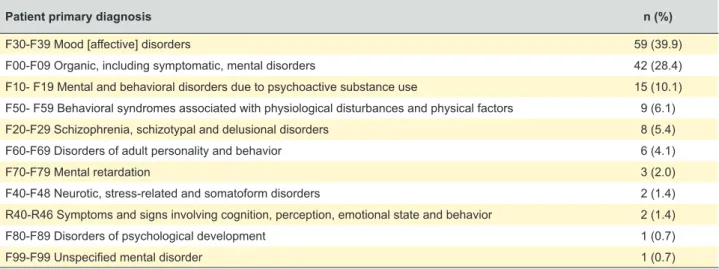
During the study period, 148 patients were admitted to the acute mental health unit, with a mean age of 54.6 years (SD = 16.3) and 75 (50.7%) were females. Patient primary diagnoses are presented in Table 1.
SEHR best retrospective time cut-off
Table 2 provides the proportion of medicines omitted when considering one retrospective cut-off compared to the imediately longer period of time. A total of 778 medicines were retrieved considering the three months’ time frame, 1397 medicines in the six months’ time frame, 1748 medi-cines in the nine months’ time frame, and 1933 medimedi-cines considering the 12-months’ time frame of the SEHR. Com-paring the three months off versus the six months cut-off, the information obtained decreased 44.3%, while the decreases were lower in the remaining cut-offs
compari-sons (20.1% t6 vs t9, and 9.6% t9 vs t12). Table 3 presents the causes ascertained for medication omissions from six to nine months and from nine to 12-months analyses, classify-ing 55 as real omissions from six to nine months cut-off, and 19 from nine to 12-months.
Contribution of each information source to BPMH
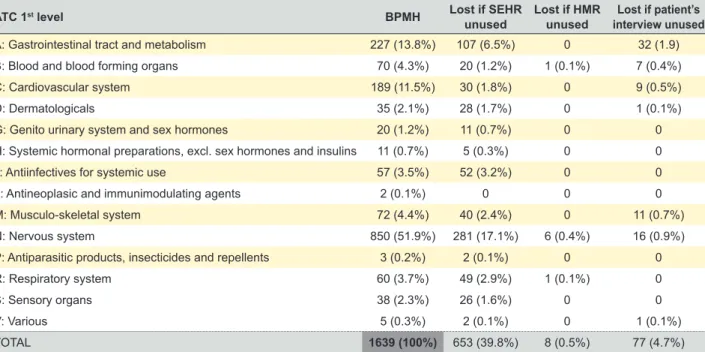
After aggregating the medicines obtained from the three sources (i.e., patient/caregiver, HMR, and SEHR at six months) a total of 1639 medicines were found. Only 476 medicines (29%) were included in the three sources analysed. Ignoring one of these three sources to create the BPMH produced substantially different results. A total of 653 (39.8%) medicines would be lost if the 6-months retro-spective cut-off of the SEHR is not used, eight (0.5%) when the HMR is not used, and 77 (4.7%) when patient/caregiver is not interviewed (Table 4). A total of 157 medicines omitted when using only the SEHR would be recuperated using any of the two other sources (Fig. 1).
DISCUSSION
In our study we evaluated the potential contributions of the three main available data sources (patient/caregiver, HMR, and SEHR) to obtain an accurate BPMH. Consider-ing the large amount of information contained in SEHR, it was necessary to define the best time cut-off, especially be-cause the literature is not consistent in establishing the best time frame to an SEHR retrospective consultation, with dif-ferent authors suggesting difdif-ferent time cut-offs: Kalb et al19
used the information of the previous 14 months; Lau et al9
used the information of the previous 12 months, while Prins
et al20 and Soler-Giner et al21 used the information of the
previous six months. In our study, nearly 45% of the medi-cines retrieved in the six month analysis would be ignored if we had retrieved information only from the three more recent months. Medication for the nervous system (group N) presented the most similar profile when comparing the information at three and six months.
The number of medicines lost reduced to about 20%
Table 1 – Patient primary diagnosis coded by the International Statistical Classification of Diseases and Related Health Problems 10th
Revision (ICD 10)
Patient primary diagnosis n (%)
F30-F39 Mood [affective] disorders 59 (39.9)
F00-F09 Organic, including symptomatic, mental disorders 42 (28.4)
F10- F19 Mental and behavioral disorders due to psychoactive substance use 15 (10.1)
F50- F59 Behavioral syndromes associated with physiological disturbances and physical factors 9 (6.1)
F20-F29 Schizophrenia, schizotypal and delusional disorders 8 (5.4)
F60-F69 Disorders of adult personality and behavior 6 (4.1)
F70-F79 Mental retardation 3 (2.0)
F40-F48 Neurotic, stress-related and somatoform disorders 2 (1.4)
R40-R46 Symptoms and signs involving cognition, perception, emotional state and behavior 2 (1.4)
F80-F89 Disorders of psychological development 1 (0.7)
ARTIGO ORIGINAL
Table 2
– Distribution of medicines registered at the SEHR at the four time points by
ATC code
Number (%) of medicines recorded in SEHR
in the preceding months
Medicines omitted ATC 1 st level 3 m 6 m 9 m 12 m 3 m vs 6 m 6 m vs 9 m 9 m vs 12 m n % n % n % n % n % n % n %
A: Gastrointestinal tract and metabolism
83 10.7 171 12.2 214 12.2 230 11.9 88 51.5 43 20.1 16 7.0
B: Blood and blood forming organs
24 3.1 55 3.9 68 3.9 69 3.6 31 56.4 13 19.1 1 1.4 C: Cardiovascular system 70 9.0 155 11.1 194 11.1 209 10.8 85 54.8 39 20.1 15 7.2 D: Dermatologicals 11 1.4 31 2.2 46 2.6 57 2.9 20 64.5 15 32.6 11 19.3
G: Genito urinary system and sex hormones
11 1.4 18 1.3 24 1.4 30 1.6 7 38.9 6 25.0 6 20.0
H: Systemic hormonal preparations, excl. sex hormones and insulins
6 0.8 11 0.8 12 0.7 13 0.7 5 45.5 1 8.3 1 7.7 J:
Antiinfectives for systemic use
21 2.7 53 3.8 67 3.8 86 4.4 32 60.4 14 20.9 19 22.1 L:
Antineoplasic and immunimodulating agents
1 0.1 2 0.1 2 0.1 2 0.1 1 50.0 0 0 0 0 M: Musculo-skeletal system 28 3.6 60 4.3 87 5.0 107 5.5 32 53.3 27 31.0 20 18.7 N: Nervous system 479 61.6 752 53.8 908 51.9 976 50.5 273 36.3 156 17.2 68 7.0 P:
Antiparasitic products, insecticides and repellents
1 0.1 2 0.1 2 0.1 2 0.1 1 50.0 0 0 0 0 R: Respiratory system 26 3.3 53 3.8 75 4.3 97 5.0 27 50.9 22 29.3 22 22.7 S: Sensory organs 16 2.1 33 2.4 41 2.3 47 2.4 17 51.5 8 19.5 6 12.8 V: V arious 1 0.1 1 0.1 8 0.5 8 0.4 0 0 7 87.5 0 0 TOT AL 778 100 1397 100 1748 100 1933 100 619 44.3 351 20.1 185 9.6
SEHR: shared electronic health record
when comparing six and nine months and to nearly 10% when comparing nine and 12-months analyses. This may be a consequence of the re-peat prescribing system in Portugal, where a pa-tient can obtain a prescription order with up to six months validity. Of these 351 medicines lost when comparing the six months and the nine month cut-offs, only 55 (15.7%) were real omissions, with 15 medicines (4.3%) considered as potentially seri-ous omissions (anticoagulant, antiplatelet and an-tihypertensive medicines). These findings suggest that retrieving the information at six months is the most efficient procedure to constitute the basis of the BPMH.
The use of SEHR to obtain BPMH allows not only identifying inaccurate doses and frequencies of prescribed medicines22 but also increases the
accuracy of BPMH by providing data that were omitted in the other data sources available. In agreement with the WHO recommendations,4 we
found that the SEHR should be supplemented with a face-to-face interview with the patient or the pa-tient’s caregiver. When supplementing the SEHR with the interview, the two drug classes more fre-quently added to the BPMH were the gastrointes-tinal tract drugs (ATC group A), followed by nerv-ous and musculoskeletal system drugs (groups N and M, respectively). This way, the use of SEHR allows a reduction in the frequency of the main er-rors of the medication history identified at admis-sion to hospital.23 Similar results were obtained in
other studies made with National databases.24 Our
study also demonstrated that the HMR does not add relevant data to that obtained with the other two information sources. In summary, the three sources present different strengths: while the SEHR revealed as the source providing more and more accurate information, patient or the patient’s caregiver interview added information about non-prescription medicines and shared non-prescription medicines,25 and finally HMR complemented the
BPMH with hospital-based prescriptions.
Although the SEHR demonstrated the high-est potential to feed the BPMH, several limita-tions should be considered and overcome. The existence of different computerized prescribing systems among hospitals requires the use of infor-mation transfer processes to ensure that informa-tion is not lost when submitted to central reposito-ries like the Portuguese Plataforma de Dados da Saúde – PDS. Technology-based solutions are be-ing pointed as an important way to improve health care of patients with polypharmacy and multiple long-term conditions.26 Consequently, in the
fu-ture, shared medication information repositories could simplify the reconciliation during the transi-tions of care, and increase patient safety.27
ARTIGO ORIGINAL Table 3Omissions – Causes of medicines omission between t6 vs t9 and between t9 vs t12 t6 vs t9 t9 vs t12
Types of omission n (%) n (%)
Medicines for acute conditions 165 (47.0) 93 (50.3)
Medicines switches (i.e., changes in prescribed medicines) 93 (26.5) 56 (30.3)
Changes in treatment dose 24 (6.8) 10 (5.4)
End of treatment 14 (4.0) 7 (3.8)
Real omissions
Potentially serious real omissions 55 (15.7)15 (4.3) 19 (10.3)7 (3.8)
TOTAL 351 (100) 185 (100)
Table 4 – Distribution of medication on the BPMH by ATC code and relative loss of information from each of the three sources considered
ATC 1st level BPMH Lost if SEHR
unused Lost if HMR unused interview unusedLost if patient’s
A: Gastrointestinal tract and metabolism 227 (13.8%) 107 (6.5%) 0 32 (1.9)
B: Blood and blood forming organs 70 (4.3%) 20 (1.2%) 1 (0.1%) 7 (0.4%)
C: Cardiovascular system 189 (11.5%) 30 (1.8%) 0 9 (0.5%)
D: Dermatologicals 35 (2.1%) 28 (1.7%) 0 1 (0.1%)
G: Genito urinary system and sex hormones 20 (1.2%) 11 (0.7%) 0 0
H: Systemic hormonal preparations, excl. sex hormones and insulins 11 (0.7%) 5 (0.3%) 0 0
J: Antiinfectives for systemic use 57 (3.5%) 52 (3.2%) 0 0
L: Antineoplasic and immunimodulating agents 2 (0.1%) 0 0 0
M: Musculo-skeletal system 72 (4.4%) 40 (2.4%) 0 11 (0.7%)
N: Nervous system 850 (51.9%) 281 (17.1%) 6 (0.4%) 16 (0.9%)
P: Antiparasitic products, insecticides and repellents 3 (0.2%) 2 (0.1%) 0 0
R: Respiratory system 60 (3.7%) 49 (2.9%) 1 (0.1%) 0
S: Sensory organs 38 (2.3%) 26 (1.6%) 0 0
V: Various 5 (0.3%) 2 (0.1%) 0 1 (0.1%)
TOTAL 1639 (100%) 653 (39.8%) 8 (0.5%) 77 (4.7%)
BPMH: best possible medication history; SEHR: shared electronic health record; HMR: hospital medical record
Figure 1 – Venn diagram exhibiting the contribution of each data
source for the BPMH
653 (39.8%) 8 (39.8%) (15.9%)260 476 (29.0%) 8 (39.8%) 157 (9.6%) 77 (4.7%) SEHR HMR Patient/ Caregiver Study limitations
Our study has included patients admitted to an acute mental hospital unit. We cannot ensure that the results are similar to those that could be obtained with patients with other medical conditions or recruited in other hospital units in Portugal.
CONCLUSION
Electronical health records represent the most compre-hensive source of information to create the patient’s BPMH, although SEHR should be supplemented with a patient or patient’s caregiver interview. The most efficient medication data retrieval process should consider a 6-month retrospec-tive analysis of the SEHR.
PROTECTION OF HUMANS AND ANIMALS
The authors declare that the procedures were followed according to the regulations established by the Clinical Research and Ethics Committee and to the Helsinki Decla-ration of the World Medical Association.
DATA CONFIDENTIALITY
ARTIGO ORIGINAL use at their working center regarding patients’ data
publica-tion.
CONFLICTS OF INTEREST
The authors declare they have no conflict of interest.
FUNDING SOURCES
This work had no financial support.
REFERENCES
1. Gleason KM, McDaniel MR, Feinglass J, Baker DW, Lindquist L, Liss D, et al. Results of the Medications at Transitions and Clinical Handoffs (MATCH) study: an analysis of medication reconciliation errors and risk factors at hospital admission. J Gen Intern Med. 2010;25:441-7. 2. World Health Organization. Assuring medication accuracy at
transitions of healthcare. Patient Safety Solution Volume 1, Solution 6. 2007. [accessed 2019 Jan 10]. Available from: http://www.who.int/ patientsafety/solutions/patientsafety/PS-Solution6.pdf.
3. Direcção Geral de Saúde. Norma 018/2016: Reconciliação da medicação. Lisboa: DGS; 2016.
4. World Health Organization. The High 5s Project standard operating protocol - assuring medication accuracy at transitions in care: medication reconciliation. Geneve: WHO; 2014.
5. World Health Organization. Medication without harm: WHO’s Third Global Patient Safety Challenge. [accessed 2018 May 23]. Available from: http://www.who.int/patientsafety/medication-safety/en/.
6. Franco-Donat M, Soler-Company E, Valverde-Mordt C, García-Muñoz S, Rocher-Milla A, Sangüesa-Nebot MJ. Medication reconciliation at hospital admission and discharge in an orthopedic surgery and traumatology department. Rev Esp Cir Ortop Traumatol. 2010;54:149-55.
7. Mekonnen AB, McLachlan AJ, Brien JA. Pharmacy-led medication reconciliation programmes at hospital transitions: a systematic review and meta-analysis. J Clin Pharm Ther. 2016;41:128-44.
8. Johnston R, Saulnier L, Gould O. Best possible medication history in the emergency department: comparing pharmacy technicians and pharmacists. Can J Hosp Pharm. 2010;63:359-65.
9. Lau HS, Florax C, Porsius AJ, De Boer A. The completeness of medication histories in hospital medical records of patients admitted to general internal medicine wards. Br J Clin Pharmacol. 2000;49:597-603. 10. Slain D, Kincaid SE, Dunsworth TS. Discrepancies between home
medications listed at hospital admission and reported medical conditions. Am J Geriatr Pharmacother. 2008;6:161-6.
11. Abuyassin BH, Aljadhey H, Al-Sultan M, Al-Rashed S, Adam M, Bates DW. Accuracy of the medication history at admission to hospital in Saudi Arabia. Saudi Pharm J. 2011;19:263-7.
12. Tiihonen M, Nykanen I, Ahonen R, Hartikainen S. Discrepancies between in-home interviews and electronic medical records on regularly used drugs among home care clients. Pharmacoepidemiol Drug Saf. 2016;25:100-5.
13. Munck LK, Hansen KR, Molbak AG, Balle H, Kongsgren S. The use of shared medication record as part of medication reconciliation at hospital admission is feasible. Dan Med J. 2014;61:A4817.
14. Moore P, Armitage G, Wright J, Dobrzanski S, Ansari N, Hammond I, et al. Medicines reconciliation using a shared electronic health care record.
J Patient Saf. 2011;7:148-54.
15. Bassi J, Lau F, Bardal S. Use of information technology in medication reconciliation: a scoping review. Ann Pharmacother. 2010;44:885-97. 16. Marien S, Krug B, Spinewine A. Electronic tools to support medication
reconciliation: a systematic review. J Am Med Inform Assoc. 2017;24:227-40.
17. SPMS. PDS - Plataforma de Dados da Saúde. [accessed 2017 Jul 10]. Available from: http://spms.min-saude.pt/2013/11/pds-plataforma-de-dados-da-saude/.
18. World Health Organization. International Statistical Classification of Diseases and Related Health Problems 10th Revision (version 2010). [accessed 2017 JUL 10]. Available from: https://www.whocc.no/atc/ structure_and_principles.
19. Kalb K, Shalansky S, Legal M, Khan N, Ma I, Hunte G. Unintended medication discrepancies associated with reliance on prescription databases for medication reconciliation on admission to a general medical ward. Can J Hosp Pharm. 2009;62:284-9.
20. Prins MC, Drenth-van Maanen AC, Kok RM, Jansen PA. Use of a structured medication history to establish medication use at admission to an old age psychiatric clinic: a prospective observational study. CNS Drugs. 2013;27:963-9.
21. Soler-Giner E, Izuel-Rami M, Villar-Fernandez I, Real Campana JM, Carrera Lasfuentes P, Rabanaque Hernandez MJ. Calidad de la recogida de la medicación domiciliaria en urgencias: discrepancias en la conciliación. Farm Hosp. 2011;35:165-71.
22. Wang T, Biederman S. Enhance the accuracy of medication histories for the elderly by using an electronic medication checklist. Perspect Health Inf Manag. 2012;9:1-15.
23. Tam VC, Knowles SR, Cornish PL, Fine N, Marchesano R, Etchells EE. Frequency, type and clinical importance of medication history errors at admission to hospital: a systematic review. CMAJ. 2005;173:510-5. 24. Daupin J, Rosseaux G, Lebel D, Atkinson S, Bedard P, Bussieres JF.
Comparison of information available in the medication profile of an electronic health record and the inpatient best possible medication history in a mother and child teaching hospital center. J Popul Ther Clin Pharmacol. 2016;23:e131-41.
25. Beyene K, Aspden T, Sheridan J. Prescription medicine sharing: exploring patients’ beliefs and experiences. J Pharm Policy Pract. 2016;9:23.
26. Molokhia M, Majeed A. Current and future perspectives on the management of polypharmacy. BMC Fam Pract. 2017;18:70.
27. Bails D, Clayton K, Roy K, Cantor MN. Implementing online medication reconciliation at a large academic medical center. Jt Comm J Qual Patient Saf. 2008;34:499-508.