IUL - School of Social Sciences
Department of Social and Organizational Psychology
Emotions and Acceptance towards Artificial Intelligence and its Evolution
Gabriela Morais dos Santos
Dissertation submitted as partial requirement for the conferral of Master in Social and Organizational Psychology
Supervisor:
Doutor Nelson Campos Ramalho
Assistant Professor, ISCTE-IUL – University Institute of Lisbon
iii
Acknowledgements
There have been five years since this journey through university has begun and this dissertation means the end of a cycle.
For that reason, I want to thank first to those without whom this dissertation would not have been possible: the participants. Thank you all for your time and all the patience, and willing to help me through the entire process.
Coming from this, I want to give a special thanks to two of my friends. José Nuno, there are no words to describe all the patience you had with me and all the help you gave me when bringing all your friends to participate in my experiment. I’m sure life will pay you back for such generosity. Magda Rocha, you’ve been my “thesis-fellow” for months and were there through all my paranoia moments. You surely deserve a place in heaven, thank you for everything.
Speaking of friends, there goes a very special thank you, from the bottom of my heart, to my crew from Aveiro: Joana Rolo, Sílvia Xavier and Adriana Costa – you girls rock!
To my soon-to-be Electrical and Computer Engineer, I want to thank all the advice, all the help, all the curiosities you shared about technology, all the patience and all the love. You are one of the fiercest people I know and your willing to fight for your dreams goes beyond the limits of human nature and that sure makes you a precious being in this wild World. So, thank you, Tiago Guedes, you truly inspired me to be writing these lines today.
Before my final thanks, I cannot forget the person who made all this possible. The person who was the source of all brainstorming right from the very beginning, the one with unimaginable thoughts, unmeasured ambition and contagious energy. Thank you so much, Professor Nelson Ramalho, for sharing all your wisdom and for all the unconditional support throughout the entire process.
And finally, I want to not only thank but to dedicate this Master’s Dissertation to the two most important people of my life. One for providing me an exquisite education and all the means for me to achieve my dreams. You gave me everything I needed before you even knew me and you have always put myself first, no matter what – thank you, Mother. The other, for being my dearest role model since I was born. For helping me through a variety of situations and for always showing me the way, even before I knew I would get there – thank you, Brother. For different reasons, you are both the strongest people I know and inspire me every day to become a better version of myself. Sometimes I wonder if you are both superhumans, but then I realise you are just my family and that I am the luckiest person in the World.
iv Resumo
A Inteligência Artificial (IA) é um dos mais recentes e entusiasmantes enigmas da sociedade atual, e as suas aplicações aumentam de dia para dia. Sem nos apercebermos, lidamos com a IA nas formas mais subtis. O seu rápido desenvolvimento tem espoletado várias opiniões entre cientistas, tais como Elon Musk e Stephen Hawking, devido às consequências controversas que a IA poderá implicar. Além das opiniões dos especialistas, todos os que pertencem à sociedade irão ser afetados, quer positiva, quer negativamente.
O presente estudo visa a compreender quais as emoções espoletadas pela evolução da IA, e se essas emoções tomam um papel moderador no efeito da aceitação da IA na concordância ou discordância com a sua evolução, com ou sem reguladores.
Conduzimos um estudo com metodologia mista numa amostra de 205 participantes, aplicando um questionário online, onde avaliámos as emoções dos participantes relativamente aos estímulos apresentados em três tempos distintos. Posteriormente, realizámos uma entrevista semiestruturada.
Concluímos que, em oposição ao que é encontrado na literatura, as emoções negativas tendem a aumentar, à medida que o conhecimento relativo à IA é aprofundado. Simetricamente, as emoções não-negativas tendem a diminuir. As emoções negativas parecem funcionar como moderadoras da relação entre as variáveis supramencionadas.
Em adição, a visão dos participantes relativamente à evolução da IA parece ser favorável, no entanto, os participantes reconhecem a existência de reguladores como uma necessidade imperativa.
v Abstract
Artificial Intelligence (AI) is one of the ultimate riddles of today’s generations and its applications are increasing day by day. Without realising, we deal with AI in the subtlest ways. Its rapid development has triggered several opinions among scientists, such as Elon Musk and Stephen Hawking, due to the controversial consequences it may imply. Apart from experts’ opinions, everyone belonging in society will be affected, whether positively or negatively.
The present study aims to understand what kind of emotions are triggered by AI evolution, and if those emotions play a moderator role on the effect of AI acceptance on the agreement on which AI should evolve or not, with or without regulators.
We ran a mixed methodology through a sample of 205 participants, applying an online survey, where we assessed the participants’ emotions regarding AI stimuli across three times, and further conducting a semi-structured interview.
We concluded that, as opposite to what literature states, negative emotions tend to rise as the contact and knowledge regarding AI deepens. Symmetrically, non-negative emotions tend to decrease. Negative emotions seem to function as a moderator on the relationship between variables mentioned above.
Also, the participants’ vision towards AI evolution seems to be hopeful, yet they recognise the need for regulators to be imperative.
vii Index
List of Tables and Graphs ... viii
List of Figures ... ix
List of Acronyms ... x
INTRODUCTION ... 1
CHAPTER I – Literature Review ... 3
1.1. Artificial Intelligence: Definition and Applications ... 3
1.1.1. AI’s application areas ... 3
1.1.2. AI today and AI tomorrow ... 6
1.2. Emotions ... 9
1.2.1. Cognitive aspects of emotion ... 11
1.3. Acceptance and Emotions towards AI and its evolution ... 12
1.4. Research model and propositions ... 14
CHAPTER II – Method ... 15
2.1. Data Analysis Strategy ... 15
2.2. Sample ... 15 2.3. Procedure ... 16 2.3.1. Stimuli ... 17 2.5. Measures ... 19 2.5.1. Emotions ... 19 2.5.2. AI Acceptance ... 22 2.5.2. Decision on AI evolution ... 23
CHAPTER III – Results ... 25
3.1. Descriptive and Bivariate Analysis ... 25
3.2. Quantitative Data ... 30
3.2.1. Analysis within the whole sample ... 30
3.1.2. Analysis with sample split by variable ‘sex’ ... 34
3.2.1. Qualitative data ... 44
CHAPTER IV – Discussion and Conclusions ... 47
4.1. Results discussion ... 47
4.2. Limitations and future research ... 52
viii
List of Tables and Graphs Table 2.1 – Frequencies of participants' area of activity
Table 2.2 - Confirmatory factor analysis of the variable Emotions in all three times Table 2.3 - Factor loadings across all three measurement moments
Table 3.1 - Descriptive Statistics
Table 3.2 - Bivariate Spearman Correlations
Table 3.3 - Moderations with moderator ‘Negative Emotions’ Table 3.4 - Moderations with moderator ‘Non-Negative Emotions’ Table 3.5 - Moderations with moderator ‘Surprise’
Table 3.6 - T1: Comparative moderations (by 'sex') with moderator ‘Negative Emotions’ Table 3.7 - T1: Comparative moderations (by 'sex') with moderator ‘Non-Negative Emotions’ Table 3.8 - T1: Comparative moderations (by 'sex') with moderator ‘Surprise’
Table 3.9 - T2: Comparative moderations (by 'sex') with moderator ‘Negative Emotions’ Table 3.10 - T2: Comparative moderations (by 'sex') with moderator ‘Non-Negative Emotions’ Table 3.11 - T2: Comparative moderations (by 'sex') with moderator ‘Surprise’
Table 3.12 - T3: Comparative moderations (by 'sex') with moderator ‘Negative Emotions’ Table 3.13 - T3: Comparative moderations (by 'sex') with moderator 'Non-Negative Emotions' Table 3.14 - T3: Comparative moderations (by 'sex') with moderator 'Surprise'
Table 3.15 - Frequencies of participants' vision on AI evolution Table 3.16 - Frequencies of participants' experienced emotions
ix List of Figures
Figure 1.1 - Arnold's Appraisal Theory of Emotion (Reeve, 2009, p.345)
Figure 1.2 - Lazarus' Complex Appraisals: Types of Benefit, Harm, and Threat (Reeve, 2009, p. 347)
Figure 1.3 - Research Model
Figure 2.1 - Screenshot segments of Video #1 Figure 2.2 - Screenshot segments of Video #2 Figure 2.3 - Screenshot segments of Video #3 Figure 2.4 - CFA AI Acceptance
Figure 3.1 - New Research Model
Figure 3.3 - ModGraph T2: Negative Emotions, Against/In Favour (female) Figure 3.3 - ModGraph T2: Negative Emotions, Without Regulators (female) Figure 3.5 - ModGraph T2: Non-Negative Emotions, With Regulators (female) Figure 3.5 - ModGraph T2: Non-Negative Emotions, Without Regulators (female) Figure 3.6 - ModGraph T2: Surprise, With Regulators (female)
Figure 3.8 - ModGraph T3: Negative Emotions, Against/In Favour (female) Figure 3.8 - ModGraph T3: Negative Emotions, With Regulators (female) Figure 3.9 - ModGraph T3: Negative Emotions, Without Regulators (female) Figure 3.10 - ModGraph T3: Surprise, Against/In Favour (female)
x
List of Acronyms AI – Artificial Intelligence
TAM – Technology Acceptance Model EAS – Emotion Assessment Scale
1
INTRODUCTION
Artificial Intelligence – or AI – is one of the ultimate riddles of today’s generations. We have now entered an Era where the study of intelligence and its processes is no longer limited to psychologists and philosophers. Today, intelligence exists in the field of technology as a field of study, on which scientists and engineers’ greatest ambition is to export intelligence that is characteristic to humans, to artificial agents, enabling them to perform any activities that are currently done by humans. AI exists in several forms and has applications in several fields. Basically, it is a set of complex algorithms build towards a specific purpose, and the main focus today is to improve those algorithms and build an AI that is capable of learning by itself. However, to do so, known algorithms so far are not enough, therefore there have been studies focusing on neural networks (Ertel, 2007; Luger, 2009), for example, in order to achieve more accurate and complex algorithms.
AI has several applications and opinions towards it being advantageous or disadvantageous are quite controversial. There is, in fact, a main focus on its advantages and how it may improve so many fields, for instance medicine, investigation, healthcare, and so many others. Notwithstanding, there are some identities with a special status towards AI that seem to be worried about its development and future consequences, such as Elon Musk and Stephen Hawking. These individuals reinforce the idea that the need for AI regulators is imperative, in order to avoid future catastrophes.
From this emerges the importance to look at society and understand people’s knowledge and understanding towards AI, considering that if it really takes a relevant stand, society will be affected, whether positively or negatively. Therefore, we recognise that it is essential to assess people’s acceptance towards AI and their vision regarding its evolution. It is central to measure what kind of emotions are triggered when people are exposed to the existent information regarding AI and its future perspectives, in order to comprehend if emotions play a decisive role when it comes to accepting AI and its evolution. Emotions are considered to be central in social psychology, therefore it only makes sense to assess them, since the development of such kind of technology will irrevocably affect society. These kinds of findings may end up to be considered essential, due to the fact that it is important that a certain evolution is well accepted by the ones involved, in order to avoid social disruptions.
The structure of this dissertation will focus on the aspects mentioned above, in order to provide a holistic knowledge regarding this theme and, hopefully, relevant conclusions.
2
We will begin contextualising the state of the art with Chapter I, highlighting the definition of AI, its application areas, and what really exists nowadays and its future perspectives. As explained before, emotions play a central role in social psychology, therefore, we will also clarify its definition and understand how AI acceptance and people’s emotions are imperative when mentioning AI and its evolution.
Chapter II will describe the methodologies used in the present study, clarifying the variables studied as well as the procedure steps and used stimuli.
Results of the conducted analysis will be reported in Chapter III and further discussed in Chapter IV. This last chapter will also mention limitations occurred in the present study and provide suggestions for future studies.
3
CHAPTER I – Literature Review 1.1. Artificial Intelligence: Definition and Applications
Artificial Intelligence – or AI – is one of the ultimate riddles of today’s generation. In fact, if we think properly, the “artificial” part of its name is truly recent. However, the study of “intelligence” itself has been done for years by philosophers and psychologists who try to understand memory, learning, thinking, seeing and reasoning processes (Russel & Norvig, 1995). The point is, while some are concerned about the study of intelligence processes, others are interested in building intelligence itself. And that is where AI enters. AI was formally introduced by John McCarthy – an American computer science pioneer and inventor, considered to be the father of AI – in a conference in Dartmouth in 1956 (Copeland, 1993; Gips, 1979; Russel & Norvig, 1995). Besides trying to understand it, engineers all over the world, following the previous work of the so named fathers of AI (Marvin Minsky, McCarthy, Allen Newell, Herbert Simon and Cliff Shaw) have been focusing on the development of agents that possess an artificial intelligence with abilities as closer as to the ones of human intelligence.
So, what is, in fact, AI?
It is considered to be a subdivision of computer science on which its main goal is to programme computers and create computing machines and systems that once would require human intelligence (Brent, 1988; Ertel, 2017; Gips, 1979). It uses symbolic reasoning and sophisticated knowledge structures and techniques so that its operations’ performance can be analogous to human learning and decision-making (Atkinson, 2016; Brent, 1988; Hillman, 1985; Russel & Norvig, 1995).
1.1.1. AI’s application areas
AI is an extremely complex subject – and we could not expect less, considering it works with such complicated processes that intelligence combines (Luger, 2009) – that embraces several fields (Brent, 1988; Gips, 1979; Ginsberg, 1993; Hillman, 1985; Russel & Norvig, 1995). Depending on the specifications of each field, it may be also named as machine learning, machine intelligence, deep learning, and cognitive computing (Atkinson, 2016). These specifications vary according to what each intelligent agent actually does. Please note that there are, in fact, AI application areas with different characteristics, however, we must not completely dissociate them from each other, considering most of AI systems are a merge of several AI
4
fields. On the following topics we will expose some of the existent fields of AI and give a few examples of its applications within each field.
Game Playing:
As explained by Luger (2009), Ginsberg (1993) and Gipps (1979), this field begun its development with the use of board games such as chess, checkers and de 15-puzzle, due to the fact that this type of games has characteristics that make them ideal research models. This AI domain is dominated by the use of techniques that are called heuristics (i.e. problem-solving strategies), which constitute a major area of AI research (Luger, 2009). The success achieved with computer-based game playing lead this field to world championships (Gipps, 1979; Luger, 2009). One of most recent examples of these AI advances and their success is Google’s AphaGo AI - a game-playing AI created by DeepMind (a company by Google) – who beat the world’s best Go player last year in China (Mozur, 2017). This AI agent as recently been generalised so it may be able to learn other games as well. Now named AlphaZero, it beat the world champion chess program (Stockfish 8), after only four hours of learning the rules to chess (Gibbs, 2017).
Automated Reasoning and Theorem Proving:
The research regarding this field was responsible for much of the preliminary work in formalizing search algorithms and developing programming languages (Luger, 2009). Although these systems are not always perfectly accurate, they have shown importance in assisting several problems, for instance, the design and verification of logic circuits, control of complex systems, and verification of the correctness of computer programs (Luger, 2009). Furthermore, modern theorem provers behave as intelligent assistants to human activities (Luger, 2009), including medical diagnosis and information retrieval (Nilsson, 2014).
Expert Systems:
These systems work with a combination of a theoretical understanding of a certain problem and several heuristic problem-solving rules regarding that problem (Luger, 2009; Pannu, 2015). That is why expert systems are programs that work within a certain specialized domain (Copeland, 1993; Hillman, 1985; Luger, 2009; Nilsson, 2014), for example, medical diagnosis (Agha, Jarghon & Naser, 2017; Gipps, 1979; Hamet & Tremblay, 2017; Hillman, 1985; Luger, 2009; Nilsson, 2014; Rekhawi, Ayyad & Naser, 2017) , treatment prescription (Luger, 2009), study of molecules (Hamet & Tremblay, 2017; Luger, 2009; Nilsson, 2014) , computer system configuration (Hillman, 1985; Luger, 2009), geological information for oil prospecting (Hillman, 1985) and evaluating ore deposits (Luger, 2009; Nilsson, 2014), analysing the performance of electronic circuits (Stallman & Sussman, 1977), and preventing cyber assaults (Anwar & Hassan, 2017).
5
A very curious example of an expert system - showing the immense variety of this field - is Watermelon Expert System developed by Abu-Nasser and Abu-Naser (2018), which combines two different programming languages and helps farmers to detect watermelon diseases through a pleasant user interface, providing solutions for those problems.
Natural Language Understanding:
This field focuses on the development of programs that have the ability to read, understand, analyse, and generate human language despite the type of speech (formal, informal, colloquial or even slightly slang) (Gips, 1979; Hillman, 1985; Luger, 2009; Pannu, 2015). It relies on several disciplines other than AI, such as computational linguistics, philosophy, and cognitive psychology (Nilsson, 2014), and it is widely used in speech understanding, semantic information processing, question answering, information retrieval, language translation (Gips, 1979; Pannu, 2015). One very clear and known example of this type of systems is Apple’s iOS Siri, “OK Google” in Google Now, and Microsoft’s Cortana, all virtual assistants who use natural language understanding to answer questions, make recommendations, delegate user’s requests to other apps, and a series of other functions using AI.
Modeling:
Whether we talk about human performance (Luger, 2009), natural systems (biological, sociological, economic or ecological), or problem-solving systems, modeling is referred by Pannu (2015) as “the ability to develop an internal representation and set of transformation rules which can be used to predict the behaviour and relationship between some set of real-world objects or entities” (p. 80).
Attached to this field is one of the most seductive approaches regarding AI to the ones who study it: neural networks. According to Luger (2009), this approach “seeks to build intelligent programs using models that parallel the structure of neurons in the human brain or the evolving patterns found in genetic algorithms and artificial life” (p. 29). Additionally, Ertel (2007) refers to this field as “the bionics branch within AI” (p. 245). We can illustrate this field by mentioning Neuralink, an American neurotechnology company founded by Elon Musk that claims to be developing implantable brain-computer interfaces, using AI and neural networks. The main goal of this company for now is to find ways to treat serious brain diseases, being that in the future it aims to achieve human enhancement (i.e. cognitive abilities) (Newitz, 2017).
Learning and Adaptive Systems:
These systems are able to adapt their behaviour based on previous experience, meaning they are capable of learning and building new algorithms in order to readjust themselves to a specific situation (Ertel, 2017; LeCun, Bengio & Hinton, 2015; Pannu, 2015). This happens,
6
for exemple, in cybernetics, and concept formation (Pannu, 2015). Often embodied with perception techniques (Nilsson, 2014), they are also able to recognise patterns and analyse certain scenes (Pannu, 2015).
Robotics:
By last, the field of robotics is the most well-known area by population in general, since everyone has already seen a robot, whether it was complex or not. Robotics is (or might be, depending on each case) a combination of all of the fields above (Pannu, 2015), concerning the design and utility of intelligent agents (Hillman, 1985). It comprehends a spectrum of disciplines besides AI, such as mechanical engineering, industrial engineering, computer science, physics, materials science, manufacturing systems engineering, and control theory (Hillman, 1985). The difference from the other areas is that these systems – the robots – are capable of moving over terrain and manipulate objects (Gips, 1979; Luger, 2009; Nilsson, 2014; Pannu, 2015). There is a diversity of areas on which robotics has been applied: healthcare (Breazeal & Scassellati, 2000; Robinson, MacDonald & Broadbent, 2014), education (André, Baker, Hu, Rodrigo & Boulay, 2017), work (Nezhad, 2015), social companion (Dautenhahn, 2004; Konok, Korcsok, Miklósi & Gácsi, 2018), transportation/navigation (Pannu, 2015), industrial automation (Pannu, 2015), agriculture (Emamgholizadeh, Kashi, Marofpoor & Zalaghi, 2014; Pannu, 2015; Patrício & Rieder, 2018), rescue (Schneider, Wildermuth & Wolf, 2015), underwater operations (Riva, 2017), and so many others (Pannu, 2015). Another important example to give, also due to its controversial aspects, is robotics applied in military purposes with the use of autonomous robots, often known as killer robots or killer drones, aiming to replace soldiers in wars and battlefields (Coeckelbergh, 2011; Sauer & Schörnig, 2012). These weapons, once programmed, are capable of finding a target and operate according to its judgement of the situation, without human intervention or supervision (Coeckelbergh, 2018; Leveringhaus, 2016).
1.1.2. AI today and AI tomorrow
About five years ago we did not even have internet (3G mobile data) in our mobile phones. Today, our mobile phones show us adds about the thing we were just talking about to the person next to us.
It took just a few years for AI to evolve in a way that is actually unknown for many of us. In fact, it has already proven to exceed human performance in several fields (a few already mentioned above), such as image recognition, speech transcription and direct translation (Atkinson, 2016; Spiegeleire, Maas & Sweijs, 2017). We are almost entering some sort of
7
wizarding world, considering we even have self-driving cars (we cannot really find these in everyday life yet, but there have been several competitions for autonomous robots on which a very common category are autonomous vehicles, and their development has evolved quite a lot). Despite all of these advances regarding AI, it has still not reached its peak and it is considered to be quite limited in terms of what it does right now and what it might be able to do in the future (Atkinson, 2016; Lu, Li, Chen, Kim & Serikawa, 2018).
As described by Spiegeleire, Maas and Sweijs (2017), literature commonly categorises AI in the three following generations:
Artificial Narrow Intelligence (ANI or “narrow AI”), often paired with an infant, it is related to machine intelligence that is restricted to specific tasks, equalling or exceeding human intelligence. An example is Google’s AlphaGo already mentioned;
Artificial General Intelligence (AGI or “strong AI”), which is an advanced level of AI and it is considered to be paired with adults, meaning it equals human performance on any task;
Artificial Superintelligence (ASI) is the pinnacle of AI, where it surpasses human intelligence and performance across all tasks and fields.
We can say that right now we stand somewhere between ANI and AGI, and the path just keeps flowing forward. There have been remarkable advances in neuroscience and computer science (Hinton & Salakhutdinov, 2006). AI is currently the nucleus of several enterprises’ business model, such as Apple, Amazon, Google, Facebook, IBM, and Microsoft and there has been a punch in the automotive industry when it comes to the investment of AI systems and AI programs by Toyota, Ford Motors, Mercedes-Benz, and BMW (Spiegeleire, Maas & Sweijs, 2017). Furthermore, we can highlight the advances in natural language processing, cybersecurity, and face recognition algorithms - for example, Google’s GooLeNet, Facebook’s DeepFace, and Yahoo’s DeepDense (Spiegeleire, Maas & Sweijs, 2017). All of these extraordinary advances culminate to the conclusion that we are currently in the Cognitive Era (Kelly, 2015), characterised by systems that do not need to be entirely programmed and are able to learn and function in an autonomous way (Spiegeleire, Maas & Sweijs, 2017).
So, what does this Cognitive Era provide us and what are AI’s future perspectives?
As stated by Kelly (2015), “as with every revolutionary technology, our initial understanding will be limited – both by the world’s complexity and by our own deeply ingrained biases and heuristics. However, for all these limitations, progress is imperative” (p. 10). But what exactly is this progress? According to Spiegeleire, Maas & Sweijs (2017), there
8
are two possible scenarios regarding AI evolution. One is that AI will be continuously evolving and slowing down, meaning there will be a period of strong evolution and development, followed by a period of stagnation. The other scenario is that AI will evolve exponentially until there is an intelligence explosion where AI supersedes human intelligence across all fields (Spiegeleire, Maas & Sweijs, 2017). Spector (2006) asserts that “not only should the AI systems of the future grow and learn, but their developmental and learning processes should be crafted by the most powerful designer of adaptive complexity known to science: natural selection (p. 1253). But when will this happen? Actually, the timeline of AI evolution generates disagreement among experts (Bostrom, 2014). Armstrong and Sotala (2015) concluded that 50% of experts (from the sample they studied) consider this superintelligence will be achieved by 2040, whilst 90% assume it will happen by 2075.
Attached to this thematic of AI evolution, there is another important topic to mention and that is AI regulation.
Is AI evolution regulated somehow?
Right now, there is no entity concerned whatsoever with AI regulation, meaning their developers and users are the ones responsible for its control. However, as it has been said before, AI is evolving faster everyday and its final goal is to supress humans across all fields (Kelly, 2015; Spector, 2006; Spiegeleire, Maas & Sweijs, 2017). There is, somehow, a dichotomic vision towards this topic and, for that reason, we can say that there are several advantages and benefits linked to AI (mentioned in AI application areas), but there are also a number of potentially dangerous disadvantages (Armstrong, Bostrom & Shulman, 2016; Armstrong & Sotala, 2015). We are talking about labour displacement (or even suppression), negative economic impact (due to an increase in economic inequality between developed and underdeveloped countries), loss of privacy, societal disruptions, machine bias, automated surveillance, among others (Atkinson, 2016; Spiegeleire, Maas & Sweijs, 2017). This exponential development is somehow subject of concern and entails risks, especially when regarding governmental and national security aspects (Allen & Chan, 2017).
Furthermore, these concerns are exalted by illustrious identities in the field of technology, such as Elon Musk and Stephen Hawking:
“Success in creating effective AI, could be the biggest event in the history of our civilization. Or the worst. (…) Unless we learn how to prepare for, and avoid, the potential risks, AI could be the worst event in the history of our civilization. (…) It could bring great disruption to our economy. (…) I am an optimist and I believe that we can create AI for de good of the world.
9
We simply need to be aware of the dangers, identify them, employ the best possible practice and management, and prepare for its consequences well in advance.”
(Stephen Hawking at the Web Summit 2017 technology conference in Lisbon, Portugal) “I think we should be very careful about artificial intelligence. (…) Increasingly scientist think there should be some regulatory oversight maybe at the national and international level, just to make sure that we don’t do something very foolish. With artificial intelligence, we are summoning the demon.”
(Elon Musk at the MIT Aeronautics and Astronautics department’s Centennial Symposium, 2014) Now we wonder… Why is there only a need for regulation in capital markets and not in technological markets? An example for this is the market of Crypto coins (the known Bitcoins), which is an unstable and volatile market that originated several parallel interests. Technology is ahead of regulation, instead of existing regulators to act in a preventive way in this market. Right now, we are dealing with a reactive mentality instead of a proactive one. From this, urges the need for control and regulation that focuses on defining rules and limits towards AI, controlling possible risks and preventing catastrophes (Ramamoorthy & Yampolskiy, 2018; Spiegeleire, Maas & Sweijs, 2017).
All these conclusions are taken within an experts’ community, but it is well known that this evolution will affect society in general, either negatively or positively. And how do people really feel about AI and its evolution?
1.2. Emotions
Before we move on to the answer for the question stated above, it is important to clarify the concept of emotions, for further understandings.
Considered to be central to the field of psychology, emotions are more complex than we might think and its definition is equally complex and hard to stipulate (Arriaga, 2010; Reeve, 2009; Shiota & Kalat, 2007). They are considered to be multidimensional, existing as biological, subjective, purposive, and social phenomena (Izard, 1993; Reeve, 2009). However, emotion is not defined by any of these dimensions individually, but by the sum of its parts. Reeve (2009) declares that “emotion is that which choreographs the feeling, arousal, purposive, and expressive components into a coherent reaction to an eliciting event” (p. 301). In fact, the definition of emotion is often misleading by the definition of feelings and vice-versa. The truth
10
is that they complement each other, but it is important to understand the differences. Damasio (2003) explains that, in a very raw conception, emotions come first and feelings come after. Feelings are perceptions and, somehow, the expression of emotions. They emerge when our body conforms to the characteristics of a certain emotion, let’s say, when we are conscious of our emotions, enabling us to feel in a certain way (Damasio, 1994).
Furthermore, in an attempt to build an integrative and consensual definition of emotion, Kleinginna and Kleinginna (1981) came to the following conclusion: “emotion is a complex set of interactions among subjective and objective factors, mediated by neural/hormonal systems, which can (a) give rise to affective experiences such as feelings of arousal, pleasure/displeasure; (b) generate cognitive processes such as emotionally relevant perceptual effects, appraisals, labelling processes; (c) activate widespread physiological adjustments to the arousing conditions; and (d) lead to behaviour that is often, but not always, expressive, goal-directed, and adaptive” (p. 355).
And what really causes an emotion?
We know that what triggers an emotion is a significant stimulus event, however, it is not clear if they are primarily biological or cognitive phenomena (Reeve, 2009), yet we know both enter de equation. They work as an integrative system, reuniting social, cultural, and history of the individual, as well as evolutionary, phylogenetic, and history of the species (Buck, 1984; Levenson, 1994; Reeve, 2009). Also, Plutchik (1985) sees emotion as a process formed by a succession of events that converge into a complex feedback system.
And how do emotions manifest?
As explained by Arriaga (2010), there are several ways in which an emotion can manifest, such as: expressive behaviour (facial expressions, body language, vocalizations), physiologically (heart rate, breathing, blood pressure, muscle tension, electrodermal activity), and neurologically (evoked potentials).
We have by now given a holistic knowledge of what emotions are, but we have not yet mentioned how many emotions exist and which ones there are. Emotions can be classified as primary/basic (in a more biological perspective) or secondary (in a more cognitive perspective). Fear, anger, disgust, sadness, joy, and interest are considered to be the basic emotions (Reeve, 2009). Some authors also refer contempt, surprise, shame, and guilt (Ekman, 1992; Izard, 1991). Secondary emotions are the more complex ones, evolving a combination of primary emotions and other external factors. Examples of secondary emotions can be jealousy, envy, pride, love, gratitude, and so on (Lazarus, 1991; Reeve, 2009).
11
There are several models that help to understand emotions. We highlight Russel’s Circumplex Model of Affect (Russel, 1980), which is commonly used to test emotional facial expressions, and affective states; Plutchik’s Wheel of Emotions (Plutchik, 1980), a three-dimensional model that describes the relations among emotions, enabling us to understand how complex emotions interact and change over time; and a more recent one, Lövheim’s Cube of Emotions (Lövheim, 2012), a three-dimensional model which explains eight basic emotions through combinations of neurotransmitters dopamine, noradrenaline, and serotonin.
According to Roseman, Antoniou and Jose (1996), emotions can be differentiated into categories: negative emotions, and positive (or non-negative) emotions. In negative emotions we find emotions such as fear, sadness, frustration, disgust, anger, contempt, shame, guilt, dislike, and regret. In positive emotions we find hope, joy, relief, liking, and pride. Surprise, however, stands in both negative and positive categories, due to the fact that it is caused by an unexpected circumstance.
1.2.1. Cognitive aspects of emotion
As previously mentioned, emotions do not only emerge from biological aspects, but they also emerge from information processing, social interaction, and cultural contexts (Reeve, 2009). Besides, complex emotions cannot be assessed by means of purely biological analysis, such as facial expressions, or endocrine systems activity. So, how can we understand these emotions?
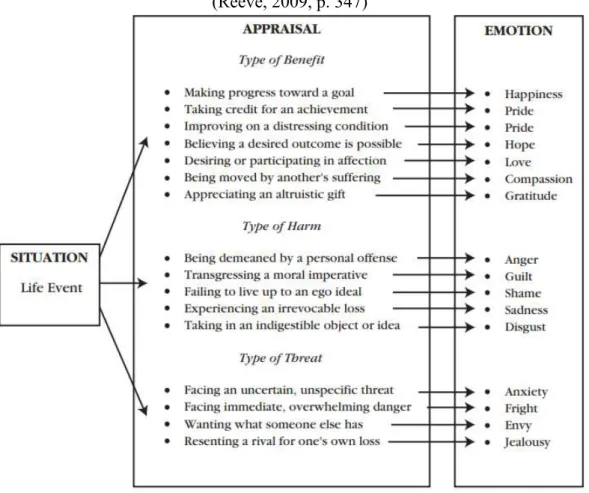
From here emerges the concept of appraisal, which stands for an estimate of the personal significance of a certain event (Reeve, 2009). Several authors have focused on this thematic, and we will highlight two of them. The following figures illustrate these cognitive emotion’s mechanism in a very understandable way, through Arnold’s Appraisal Theory of Emotion (Arnold, 1960), and Lazaru’s Complex Appraisals (Lazarus, 1991), respectively.
12
1.3. Acceptance and Emotions towards AI and its evolution
Now that we have clarified the concept of emotions, we may resume the question previously asked and reflect about it: how do people really feel about AI and its evolution?
First, it is important to understand if people really are familiar with the concept of AI and how they accept it. Indeed, nowadays AI is present even in many smartphones, however, the public in general still has a very poor knowledge and understanding of technology and AI specifications (Atkinson, 2016). This acceptance towards AI may vary in two extremes, that is, people tend to have whether a very positive attitude towards AI, or a very negative one (Crowed & Friess, 2013), meaning people may recognise that AI might be extremely beneficial in several fields, as they may also hold onto the belief that AI will destroy humanity.
There are a few studies regarding technology acceptance, for example, Davis, Bagozzi & Warshaw (2016), that even proposed a Technology Acceptance Model (TAM). However, this study refers to technology in general, and does not mention AI specifically. On the other hand, there are, in fact, several studies that analyse people’s acceptance towards robots (Breazeal & Scassellati, 2000; Cañamero & Fredslund, 2000; Dautenhahn, 2004; Hancock, Billings &
Figure 1.2 - Lazarus' Complex Appraisals: Types of Benefit, Harm, and Threat (Reeve, 2009, p. 347)
13
Schaefer, 2011; Kaplan, 2004; Nadel et al., 2006; Ray, Mondada & Siegwart, 2008; Nomura, Suzuki, Kanda & Kato, 2006; Partala & Surakka, 2004). All these studies concluded that individuals tend to accept robots in a very positive way and give them a very positive status. This, somehow, makes sense. If we look back at social psychology, we stand before several theories, and we highlight the Contact Hypothesis (Allport, 1954) which claims that under certain circumstances, as intergrupal contact increases, the preconceptions and prejudices among groups will decrease. This hypothesis is only valid when groups share similar status and characteristics. Having this said, we must not fully extend this theory when speaking of interactions between humans and AI. However, due to what is found in literature, it seems to apply in a holistic way, meaning that acceptance towards AI probably increases when the knowledge and contact with it also increases. However, as previously explained, we must remember that robots – the main focus of the existent studies (Breazeal & Scassellati, 2000; Cañamero & Fredslund, 2000; Dautenhahn, 2004; Hancock, Billings & Schaefer, 2011; Kaplan, 2004; Nadel et al., 2006; Ray, Mondada & Siegwart, 2008; Nomura, Suzuki, Kanda & Kato, 2006; Partala & Surakka, 2004) regarding this theme – belong to robotics, which is one of the fields of AI. From here we consider that studying only robots’ acceptance is quite reductive, considering AI can assume so many diverse forms and act in so many different fields. Robotics is just a small piece of the puzzle and AI does not have to be confined into a human or animal-like figure. AI equals to algorithms combined to something grateful and capable of achieving so much more that public in general actually knows. These acceptance studies (Breazeal & Scassellati, 2000; Cañamero & Fredslund, 2000; Dautenhahn, 2004; Hancock, Billings & Schaefer, 2011; Kaplan, 2004; Nadel et al., 2006; Ray, Mondada & Siegwart, 2008; Nomura, Suzuki, Kanda & Kato, 2006; Partala & Surakka, 2004) focus mainly on whether people consider robots/technology to be positive or negative, but they do not focus on truly perceiving what kind of emotions are triggered by AI, meaning what people actually feel towards this theme. Instead, the existing studies that relate emotions and AI tend to be more specific and technical, often focusing on how to confer human emotions to artificial agents (Cañamero & Fredslund, 2000), while others only focus on studying people’s anxieties towards humanoid robots (Nomura, Suzuki, Kanda & Kato, 2006; Szollozy, 2017).
And what about what people really feel and thing about this thematic? Should not we try to understand people’s raw perceptions of AI and its evolution? Should not we provide society a holistic knowledge regarding AI and its future perspectives?
It is important to understand society’s perspectives regarding AI today and AI in the future.
14 1.4. Research model and propositions
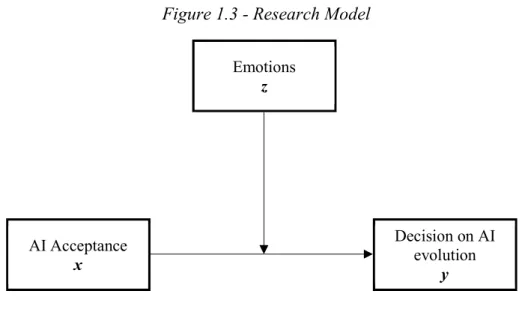
Based on literature review, our research model suggests that emotions moderate the effect of AI acceptance on the decision towards AI evolution, and we intend to understand how this relationship processes.
According Lazarus (1991) and Reeve (2009), negative emotions are a typical response to uncertainty and the unknown. Therefore:
Proposition 1 (P1): As the progressive contact with AI deepens (as enacted by exhibiting the stimuli throughout all three times), we expect negative emotions to diminish.
In addition, considering that society in general has a poor knowledge and understanding of AI (Atkinson, 2016):
Proposition 2 (P2): As the progressive contact with AI deepens (as enacted by exhibiting the stimuli throughout all three times), we expect non-negative emotions to increase.
Therefore, due to the progressive contact and knowledge regarding AI:
Proposition 3 (P3): We expect non-negative emotions to significantly and positively moderate the effect of AI acceptance on the decision towards AI evolution.
Decision on AI evolution y AI Acceptance x Emotions z
15
CHAPTER II – Method 2.1. Data Analysis Strategy
Considering this research combined both quantitative and qualitative methodologies, the nature of each variables will determine the data analysis specifications.
For quantitative variables, we will submit the variables “emotions” and “acceptance” to a confirmatory factor analysis (using IBM SPSS Amos) in order to assess their psychometric quality. According to Hair, Black, Babin and Anderson (2010), the following criteria should be applied so as to consider the factorial solutions as valid: CMIN/DF < 3, with a non-significant p-value (although this fit index might be discarded due to sample size bias), CFI > .92, TLI > .92, and RMSEA < .07. Also, PCFI is considered to be better when values are closer to 1, so we will report that value as well, in order to decide on the factorial solution parsimony. Additionally, if the previous criteria do not apply, we will use Lagrange Multipliers to identify possible biases from certain items, suggesting their removal (Hair, Black, Babin & Anderson, 2010).
In order to analyse the research models and propositions, our first thought was to conduct moderations using PROCESS v2.16 (Hayes, 2013), but that brought us a limitation due to the fact that we were not able to control other variables’ effects (i.e.: “sex”). For that reason, we will conduct those moderations using the method proposed by Baron and Kenny (1986), so we can control the mentioned effects. The variable “sex” will then be controlled by means of a hierarchical regression so we can understand if it adds value to the initial moderation models. All of the analysis mentioned above will be achieved by using Software IBM SPSS Statistics 24. Furthermore, we will use software Modgraph (Jose, 2013) for a better understanding of the significative moderation models with significative interaction effects.
For qualitative variables, we will extract a global appreciation from the answers that participants gave to both questions asked, and we will categorise those answers in order to build a new set of variables, and further conduct frequencies analysis for each category.
2.2. Sample
The sample used in this study was made following a convenience and also snowball approach, considering we asked our friends and a few known people to answer the survey and those people recommended others. By doing it this way, we managed to gather the sample quickly, saving us a lot of time. The nature of this type of sampling advises caution when
16
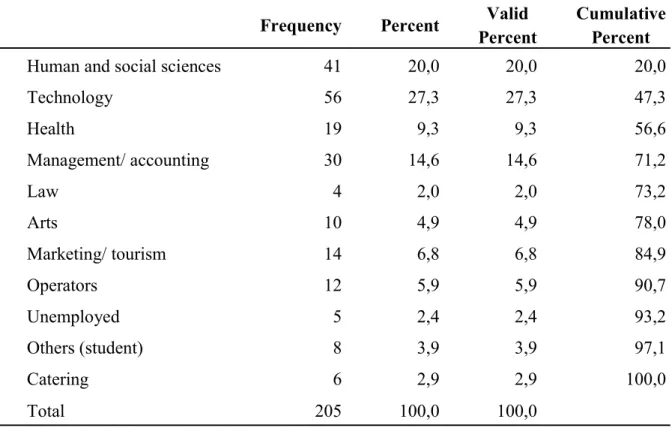
analysing data and interpreting findings and assuming them as externally valid. A total of 205 individuals composes the sample, of which 106 are male. The majority of the sample is single (92.2%), with ages ranging from 18 to 36 years old, averaging 23.7 years old. Table 2.1 shows the 11 categories in which the participants’ area of activity (professional or academic) settles, and we can see that the larger group in the sample (27.3%) works/studies in the technology field.
Table 2.1 – Frequencies of participants' area of activity Frequency Percent Valid
Percent
Cumulative Percent
Human and social sciences 41 20,0 20,0 20,0
Technology 56 27,3 27,3 47,3 Health 19 9,3 9,3 56,6 Management/ accounting 30 14,6 14,6 71,2 Law 4 2,0 2,0 73,2 Arts 10 4,9 4,9 78,0 Marketing/ tourism 14 6,8 6,8 84,9 Operators 12 5,9 5,9 90,7 Unemployed 5 2,4 2,4 93,2 Others (student) 8 3,9 3,9 97,1 Catering 6 2,9 2,9 100,0 Total 205 100,0 100,0 2.3. Procedure
The research design comprehended two phases, the first quantitative and the second qualitative. In the first phase, the participants were requested to answer an online survey powered by Qualtrics, which started with acknowledging the nature of the study and giving the informed consent. Next, the participants were presented with an emotions scale to rate their baseline emotional status (e.g. sliding a bar from 0 to 100 according to each emotion intensity felt at that moment). This was the first moment that intended to establish the baseline measures. The second moment started with exhibiting video #1 that explains what is AI. After watching the video, the participants were challenged to give examples of AI use in their daily life. After that, participants rated the ascribed degree of AI acceptance on six dimensions.
17
The third moment started with video #2 offering examples of nowadays AI applications. Upon completion, participants registered how they felt emotionally while watching the video. For that purpose, they used the same scale as in moment one.
The fourth moment started with exhibiting video #3 that showed three testimonies from three renowned individualities with divergent opinions concerning AI. The first question after watching the video concerned asking whether each participant have already seen any of the testimonies (this is a control variable). After we asked each participant to state their degree of agreement in a six-point Likert scale (1 Total disagree to 6 Total agree) regarding the evolution of AI, the evolution of AI with regulation, and the evolution of AI without regulation. After participants took a stand, we asked them to fill in the emotions scale again always taken as reference the moment they were watching video #3. Lastly, participants gave some sociodemographic data for sample characterization.
The second phase of this study comprehended a qualitative approach, meaning the participants were submitted to a short semi structured interview, covering two main questions: 1 – “Considering all the questions you answered and the videos you saw, please justify your decision and clarify your vision regarding AI evolution.”; 2 – “During the experiment and while watching the videos, was(were) there any emotion(s) that stood out?”.
The reason why we opted for a mixed methodology (quantitative plus qualitative) settles in two main aspects. First, it could work as a plan b if the quantitative part failed for some reason (e.g.: assessing the emotions properly). The second aspect is that, considering that we are dealing with an innovative (and somehow controversial) theme, it became much more interesting to really listen to what the participants had to say, rather than limit their voice to quantitative measures. In addition, as stated in literature review, psychometric measures are not always enough to understand complex emotions, and this approach allows participants to express themselves freely. This approach adds much more richness to the study and provides interesting and valuable information.
2.3.1. Stimuli
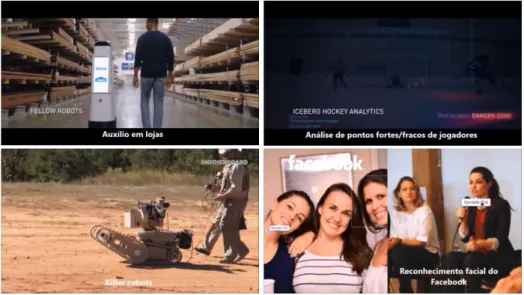
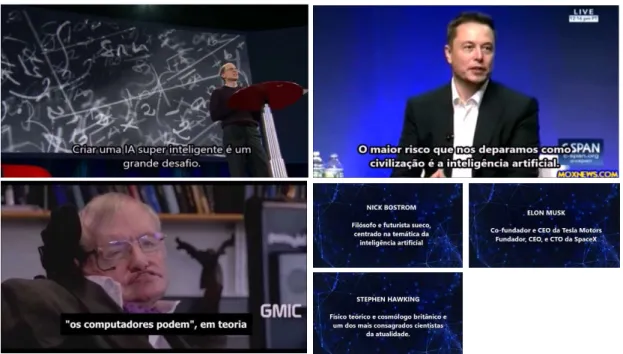
The stimuli we used for this experiment were three videos. The following sections explain the contents of those videos and each video is illustrated with screenshots of itself.
Video #1:
Video #1 has 1’11’’ of duration and provides an AI definition, clarifying what it is and which kind of forms it may assume. The purpose of this video is to state an equal baseline of knowledge for all participants.
18 Video #2:
Video #2 lasts 1’30’’ and illustrates a few examples regarding AI’s utility and how it is used in today’s days (e.g. in health, music, transportation, etc). This video makes the participants confront their previous knowledge with reality, in terms of AI’s utility.
Figure 2.1 - Screenshot segments of Video #1
19 Video #3:
Video #3 is the longest (6’57’’ of duration) and shows three testimonies from three renowned individualities with divergent opinions concerning AI. Namely, a neutral one stating that it has advantages and disadvantages (Nick Bostrom), another with a caveat against AI without regulation (Elon Musk) and another one with a more hopeful vision of AI (Stephen Hawking). These testimonies were intended to face the participant with a critical positioning towards the future of AI.
2.5. Measures
The following topics describe the specifications of each variable under study - “emotions”, “AI acceptance”, and “decision” -, and how we will measure them.
2.5.1. Emotions
When searching for an instrument to measure the variable “emotions”, we struggled due to the number of instruments that, in fact, exist, but are quite extensive as to the number of items, for example, EAS - Emotion and Assessment Scale by Carlson, Collins, Stewart, Porzelius, Nitz and Lind (1989). Using a scale like this would overextend the time of the survey, what would encourage the participants’ withdrawal and also some difficulties in obtaining voluntary
20
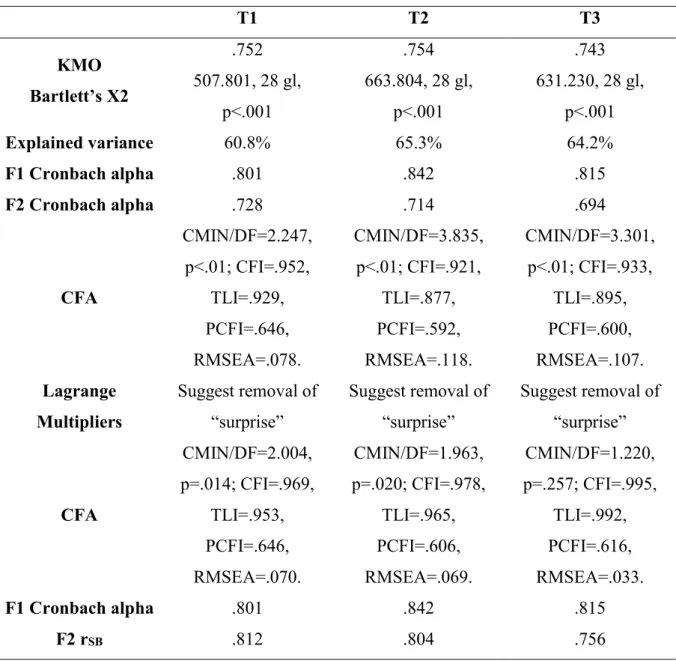
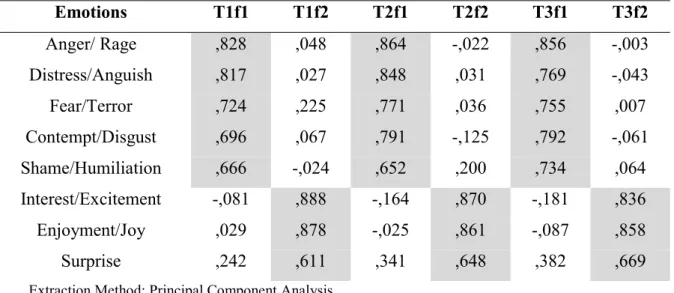
participations. Considering these aspects, we searched for a more objective scale that would not take too long for the participants to answer and so emotions were measured with eight items extracted from Lövheim’s (2012) cube of emotions, following the example of Moyle, Moyle, Bec and Scott (2017). This is in fact an interesting instrument to use in this experiment, due to the fact that it has been applied in the development of AI and several attempts to reach the biologically-inspired artificial emotions (Hsu, Chen & Heh, 2014; Talanov & Toschev, 2014; Vallverdú, Talanov, Distefano, Mazzara, Tchitchigin & Nurgaliev, 2016). The items that we used were: shame/humiliation, distress/anguish, fear/terror, anger/rage, contempt/disgust, surprise, enjoyment/joy, interest/excitement and participants were asked to register on a Visual Analytic Scale (VAS) from 0 to 100 points (0 is equivalent to ‘nothing’) how much they were they feeling each emotion. These measurements took place three times: 1) as a baseline concerning the extent the participant was experiencing each emotion at the time of response, 2) after seeing video #1 and video #2 (what is AI and what are its applications) participants were requested to rate each emotion experienced while watching it, and 3) after seeing video #3 (personalities positioning concerning AI) and referring to subjective emotion experience while watching it. Psychometrically the emotions should organize around dimensions (as stated in literature review, one concerning positive/non-negative and the other negative emotions) which we can use for comparison purposes between moments if the factor structures hold across the three measurements. Table 2.2 reports findings for confirmatory factor analyses and the respective reliabilities
21
Table 2.2 - Confirmatory factor analysis of the variable Emotions in all three times
T1 T2 T3 KMO Bartlett’s X2 .752 507.801, 28 gl, p<.001 .754 663.804, 28 gl, p<.001 .743 631.230, 28 gl, p<.001 Explained variance 60.8% 65.3% 64.2% F1 Cronbach alpha .801 .842 .815 F2 Cronbach alpha .728 .714 .694 CFA CMIN/DF=2.247, p<.01; CFI=.952, TLI=.929, PCFI=.646, RMSEA=.078. CMIN/DF=3.835, p<.01; CFI=.921, TLI=.877, PCFI=.592, RMSEA=.118. CMIN/DF=3.301, p<.01; CFI=.933, TLI=.895, PCFI=.600, RMSEA=.107. Lagrange Multipliers Suggest removal of “surprise” Suggest removal of “surprise” Suggest removal of “surprise” CFA CMIN/DF=2.004, p=.014; CFI=.969, TLI=.953, PCFI=.646, RMSEA=.070. CMIN/DF=1.963, p=.020; CFI=.978, TLI=.965, PCFI=.606, RMSEA=.069. CMIN/DF=1.220, p=.257; CFI=.995, TLI=.992, PCFI=.616, RMSEA=.033. F1 Cronbach alpha .801 .842 .815 F2 rSB .812 .804 .756
22
Table 2.3 - Factor loadings across all three measurement moments
Emotions T1f1 T1f2 T2f1 T2f2 T3f1 T3f2 Anger/ Rage ,828 ,048 ,864 -,022 ,856 -,003 Distress/Anguish ,817 ,027 ,848 ,031 ,769 -,043 Fear/Terror ,724 ,225 ,771 ,036 ,755 ,007 Contempt/Disgust ,696 ,067 ,791 -,125 ,792 -,061 Shame/Humiliation ,666 -,024 ,652 ,200 ,734 ,064 Interest/Excitement -,081 ,888 -,164 ,870 -,181 ,836 Enjoyment/Joy ,029 ,878 -,025 ,861 -,087 ,858 Surprise ,242 ,611 ,341 ,648 ,382 ,669
Extraction Method: Principal Component Analysis Rotation Method: Varimax with Kaiser’s Normalization a. Rotation converged in 3 iterations
As the factor analyses are steady in all the three moments, we reason the emotions are comparable across time. Likewise, because “surprise” did not factorize, we will use it separately. So, emotions are measured on three aspects: negative emotions, non-negative emotions, and surprise.
Besides using the scale mentioned above, we intended to assess the participants’ emotions through their expressions while exposed to the stimuli, using FaceReaderTM from
software NOLDUS. For that, we recorded the participants’ face and uploaded those recordings to the software mentioned, however, as we were not familiar enough we the software, we tested in ten participants before conducting that analysis through the whole sample. This method failed to work, so we decided to quit this option.
2.5.2. AI Acceptance
The instrument to measure the variable “acceptance” was based on the Fast Form of the Technology Acceptance Model (TAM) proposed by Chin, Johnson and Schwarz (2008), which was created from its Original Form introduced by Davis (1986). This model aimed to understand what determined the acceptance of a new system, especially computers, through the users’ perceptions of it (Chin, Johnson & Schwarz, 2008). This could help to predict and identify if a certain new system would be acceptable or not for the population, and pursue with it (Davis, Bagozzi & Warshaw, 1989). Although this instrument refers to ‘technology’ in general, it gets somewhat specific to everyday gadgets used by people in general. However,
23
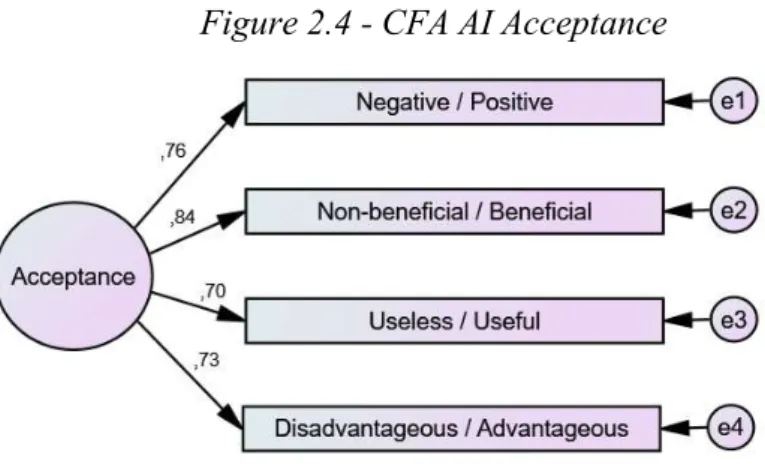
when it comes to AI, it is impossible to reduce it to a simple day-to-day gadget and we struggled to dovetail the TAM instrument on its extent to the AI theme. Having that said, we decided to adapt a few items and build the scale by ourselves. “Acceptance” was then measured with six items through a six-point Likert scale (negative/6-positive, non-beneficial/6-beneficial, 1-useless/6-useful, 1-ineffective/6-effective, 1-inefficient/6-efficient, 1-disadvantageous/6-advantageous). This scale was presented to the participants after video #1.
A confirmatory factor analysis showed two of the items (efficient and effective) had an unacceptable low communality and were excluded to have a single factor valid solution (KMO=809, X2 Bartlett = 323.777, 6 gl, p=.000) explaining 68.1% variance after rotation. The
CFA showed valid fit indices for this 4-item factor (CMIN/DF=1.237, p=.29, CFI=.999, TLI=.996, PCFI=.333, RMSEA=.034) which is also reliable (Cronbach’s alpha=.842).
2.5.2. Decision on AI evolution
This variable will be named “decision” and is separated into three different variables, concerning three different decisions: “against/in favour of AI evolution”, “against/in favour of AI evolution with regulators” and “against/in favour of AI evolution without regulators”. Participants had to rate each of these variables with a 6-point Likert scale (1 – in favour; 6 – against). This variable took place after video #3, so it allows us to understand one’s position regarding this subject, assuring that every participant got the exact same information throughout the experiment. In order to promote a clear visualization and consequent interpretation of the following results, these variables were recoded into: 1 – against and 6 – in favour.
25
CHAPTER III – Results
Chapter III will present all results obtained throughout the entire analysis. It will begin by presenting descriptive and bivariate statistics concerning quantitative variables, so we can understand the correlations among variables and their relevance for the study.
Further specific analysis regarding all quantitative and qualitative variables under study will be exposed.
3.1. Descriptive and Bivariate Analysis
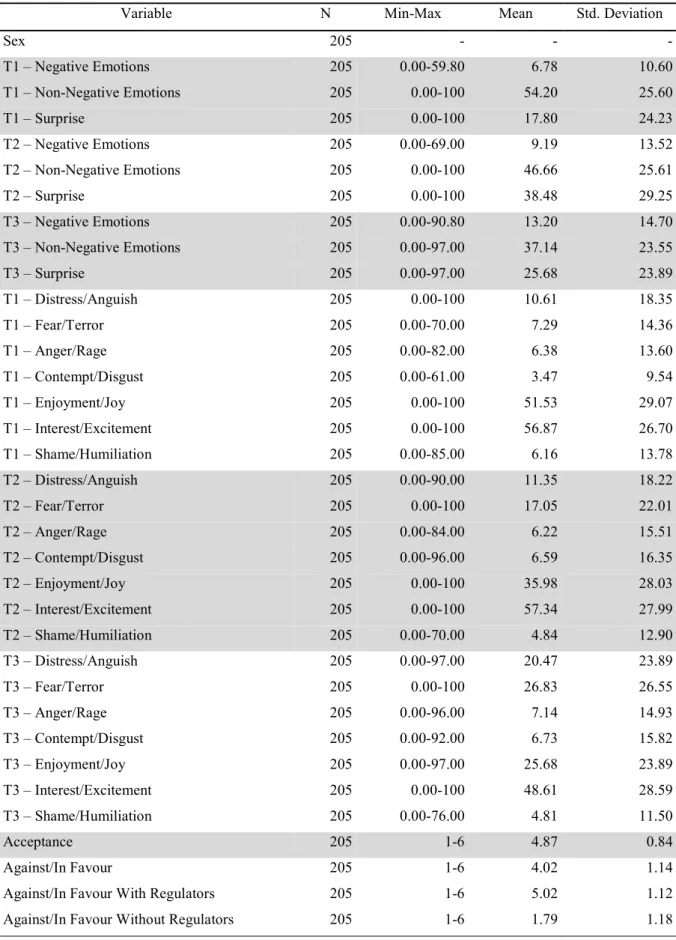
Descriptive statistics show, for each variable, the sample number (N), minimum and maximum values registered on each response, mean and standard deviation. Bivariate statistics show the relationship between all variables under study, evidencing some relevant correlations. The variables covered in both descriptive and bivariate statistics are the socio-demographic variables (“sex”), “negative emotions”, “non-negative emotions” and “surprise” in all three times of measurement (the items that compose these variables will also be reported separately and will be considered as separate variables for further analysis), “acceptance”, and the three decisions regarding AI evolution (“decision against/in favour”, “decision against/in favour with regulation”, “decision against/in favour without regulation”). All descriptive analysis is shown in table 3.1 below.
Table 3.1 shows us clear changes through all three times. The average of negative emotions tends to rise from T1 to T2, and from T2 to T3. The reverse happens with non-negative emotions, on which the average tends to decrease throughout all three times. Surprise’s average has its peak at T2 (where participants were exposed to existent AI applications) and then decreases in T3. The same applies to emotions individually in a very similar way, while negative emotions tend to rise throughout the times, and non-negative emotions tend to decrease. Interest, on the other hand, remains high through all three times (reaching its peak at T2, alike surprise). When looking at decisions on AI evolution, we can see that the decision on AI evolution is relatively high, being superior when adding regulators. The opposite happens when considering AI evolution without regulators, on which the average is sharply low.
Table 3.2 reports Spearman correlations, and we can see that there are several significant correlations. However, we must keep in mind that all variables are show, that is, we show emotions as composite variables (factors, as explained previously), and we also report them separately in that analysis, so it is only predictable that they tend to relate within each other.
26
Table 3.1 - Descriptive Statistics
Variable N Min-Max Mean Std. Deviation
Sex 205 - - - T1 – Negative Emotions 205 0.00-59.80 6.78 10.60 T1 – Non-Negative Emotions 205 0.00-100 54.20 25.60 T1 – Surprise 205 0.00-100 17.80 24.23 T2 – Negative Emotions 205 0.00-69.00 9.19 13.52 T2 – Non-Negative Emotions 205 0.00-100 46.66 25.61 T2 – Surprise 205 0.00-100 38.48 29.25 T3 – Negative Emotions 205 0.00-90.80 13.20 14.70 T3 – Non-Negative Emotions 205 0.00-97.00 37.14 23.55 T3 – Surprise 205 0.00-97.00 25.68 23.89 T1 – Distress/Anguish 205 0.00-100 10.61 18.35 T1 – Fear/Terror 205 0.00-70.00 7.29 14.36 T1 – Anger/Rage 205 0.00-82.00 6.38 13.60 T1 – Contempt/Disgust 205 0.00-61.00 3.47 9.54 T1 – Enjoyment/Joy 205 0.00-100 51.53 29.07 T1 – Interest/Excitement 205 0.00-100 56.87 26.70 T1 – Shame/Humiliation 205 0.00-85.00 6.16 13.78 T2 – Distress/Anguish 205 0.00-90.00 11.35 18.22 T2 – Fear/Terror 205 0.00-100 17.05 22.01 T2 – Anger/Rage 205 0.00-84.00 6.22 15.51 T2 – Contempt/Disgust 205 0.00-96.00 6.59 16.35 T2 – Enjoyment/Joy 205 0.00-100 35.98 28.03 T2 – Interest/Excitement 205 0.00-100 57.34 27.99 T2 – Shame/Humiliation 205 0.00-70.00 4.84 12.90 T3 – Distress/Anguish 205 0.00-97.00 20.47 23.89 T3 – Fear/Terror 205 0.00-100 26.83 26.55 T3 – Anger/Rage 205 0.00-96.00 7.14 14.93 T3 – Contempt/Disgust 205 0.00-92.00 6.73 15.82 T3 – Enjoyment/Joy 205 0.00-97.00 25.68 23.89 T3 – Interest/Excitement 205 0.00-100 48.61 28.59 T3 – Shame/Humiliation 205 0.00-76.00 4.81 11.50 Acceptance 205 1-6 4.87 0.84 Against/In Favour 205 1-6 4.02 1.14
Against/In Favour With Regulators 205 1-6 5.02 1.12
28 * p<0.05; ** p<0.01
30 3.2. Quantitative Data
Considering variable “sex” had some correlations with other variables, we decided to incorporate it as a control variable in our research model. After running moderations with this variable, we realised that it added significant value to our initial model. For that reason, our research model now includes the variable sex as part of the relationship. We also tested a control variable concerning previous exposure to the stimuli (i.e. if the participants had already seen any of the videos) and it showed no relevance.
The updated research model is represented in figure 3.1. Please note that, as explained in Chapter I, this is the holistic model of our study, meaning all the analysis will comprehend all three emotion categories (negative, non-negative, and surprise), all three decisions on AI evolution (against/in favour, with regulators, and without regulators), through all three moments (T1, T2, and T3). For parsimony sake, we will only highlight and further discuss significative results.
3.2.1. Analysis within the whole sample
The following tables (3.3, 3.4, and 3.5) report results obtained when conducting moderations with the whole sample, encompassing all variables mentioned above. The boxes in light grey mean the model is significative, whilst the boxes in dark grey mean the model is significative and that there is a significative interaction term.
Table 3.3 reports moderation findings regarding the moderator variable ‘negative emotions’, across all three times and all three decisions (dependent variables). As we can see, negative emotions seem to have a great impact on the relationship between AI acceptance and the decision towards its evolution. The strength of the model increases throughout the times, as
Decision on AI evolution y AI Acceptance x Emotions z Sex
31
we can see through the adjR2. The models in T1 and T2 are significative with significative main
effects (except when the dependent variable is ‘decision without regulators’), however, it is only in T3 that the models show themselves as significative, with a significative interaction term.
Table 3.3 - Moderations with moderator ‘Negative Emotions’
T1 T2 T3 N eg at iv e E m ot io n s Against/In Favour Model: adjR2= .083 F(4,200)= 9.542, p<.001 Sex: B= -.631, t= -4.262, p<.001, 95%IC -.924, -.339 AI Acceptance: B= .352, t= 3.984, p<.001, 95%IC .178, .527 Interaction term: B= .010, t= 1.160, p=.247, 95%IC -.007, .026 Model: adjR2= .257 F(4,200)= 18.600, p<.001 Sex: B= -.571, t= -4.117, p<.001, 95%IC -.844, -.297 AI Acceptance: B= .298, t= 3.618, p<.001, 95%IC .136, .460 Interaction term: B= -.014, t= -1.941, p=.054, 95%IC -.028, .000 Model: adjR2= .363 F(4,200)= 30.044, p<.001 Sex: B= -.530, t= -4.137, p<.001, 95%IC -.783, -.277 AI Acceptance: B= .338, t= 4.443, p<.001, 95%IC .188, .488 Interaction term: B= -.016, t= -3.217, p=.002, 95%IC -.026, -.006 With Regulators Model: adjR2= .049 F(4,200)= 3.617, p=.007 Sex: B= -.193, t= -1.254, p=.211, 95%IC -.496, .110 AI Acceptance: B= .309, t= 3.363, p=.001, 95%IC .128, .490 Interaction term: B= .003, t= .351, p=.726, 95%IC -.014, .020 Model: adjR2= .082 F(4,200)= 5.582, p<.001 Sex: B= -.166, t= -1.094, p=.275, 95%IC -.465, .133 AI Acceptance: B= .274, t= 3.047, p=.003, 95%IC .097, .452 Interaction term: B= -.010, t= -1.297, p=.196, 95%IC -.025, .005 Model: adjR2= .130 F(4,200)= 8.615, p<.001 Sex: B= -.150, t= -1.015, p=.311, 95%IC -.440, .141 AI Acceptance: B= .311, t= 3.549, p<.001, 95%IC .138, .483 Interaction term: B= -.019, t= -3.299, p=.001, 95%IC -.030, -.008 Without Regulators Model: adjR2= .004 F(4,200)= 1.196, p=.314 Sex: B= -.190, t= -1.147, p=.253, 95%IC -.516, .137 AI Acceptance: B= -.037, t= -.375, p=.708, 95%IC -.232, .158 Interaction term: B= .014, t= 1.499, p=.136, 95%IC -.004, .032 Model: adjR2= -.006 F(4,200)= .693, p=.597 Sex: B= -.170, t= -1.015, p=.312, 95%IC -.499, .160 AI Acceptance: B= -.058, t= -.585, p=.559, 95%IC -.254, .138 Interaction term: B= -.001, t= -.070, p=.944, 95%IC -.017, .016 Model: adjR2= .029 F(4,200)= 2.511, p=.043 Sex: B= -.143, t= -.871, p=385, 95%IC -.466, .180 AI Acceptance: B= -.038, t= -.393, p=.695, 95%IC -.230, .154 Interaction term: B= -.015, t= -2.346, p=.020, 95%IC -.027, -.002
32
The moderation models using ‘non-negative emotions’ as the moderator are shown in the following table 3.4. The findings reported show that all models are significative with significative main effects (apart from the ones where the dependent variable is ‘decision without regulators’, which is only significative in T3), however, none of the models show a significative interaction term.
Table 3.4 - Moderations with moderator ‘Non-Negative Emotions’
T1 T2 T3 N on -N eg at iv e E m ot io n s Against/In Favour Model: adjR2= .138 F(4,200)= 9.193, p<.001 Sex: B= -.640, t= -4.277, p<.001, 95%IC -.935, -.345 AI Acceptance: B= .356, t= 3.973, p<.001, 95%IC .179, .533 Interaction term: B= -.002, t= -.715, p=.476, 95%IC -.009, .004 Model: adjR2= .168 F(4,200)= 11.271, p<.001 Sex: B= -.527, t= -3.510, p=.001, 95%IC -.824, -.231 AI Acceptance: B= .297, t= 3.346, p=.001, 95%IC .122, .472 Interaction term: B= .001, t= .396, p=.693, 95%IC -.005, .007 Model: adjR2= .236 F(4,200)= 16.724, p<.001 Sex: B= -.425, t= -2.930, p=.004, 95%IC -.711, -.139 AI Acceptance: B= .281, t= 3.325, p=.001, 95%IC .114, .447 Interaction term: B= .000, t= -.124, p=.901, 95%IC -.008, .007 With Regulators Model: adjR2= .056 F(4,200)= 4.011, p=.004 Sex: B= -.210, t= -1.362, p<.175, 95%IC -.514, .094 AI Acceptance: B= .292, t= 3.155, p=.002, 95%IC .109, .474 Interaction term: B= .001, t= .433, p=.666, 95%IC -.005, .008 Model: adjR2= .062 F(4,200)= 4.369, p=.002 Sex: B= -.129, t= -.822, p=.412, 95%IC -.439, .181 AI Acceptance: B= .284, t= 3.055, p=.003, 95%IC .101, .467 Interaction term: B= .004, t= 1.356, p=.177, 95%IC -.002, .011 Model: adjR2= .084 F(4,200)= 5.689, p<.001 Sex: B= -.081, t= -.517, p=.606, 95%IC -.389, .227 AI Acceptance: B= .255, t= 2.799, p=.006, 95%IC .075, .434 Interaction term: B= -.003, t= -.870, p=.385, 95%IC -.011, .004 Without Regulators Model: adjR2= -.004 F(4,200)= .818, p=.515 Sex: B= -.207, t= -1.239, p=.217, 95%IC -.537, .123 AI Acceptance: B= -.027, t= -.266, p=.791, 95%IC -.224, .171 Interaction term: B= -.004, t= --1.164, p=.246, 95%IC -.012, .003 Model: adjR2= .005 F(4,200)= 1.231, p=.299 Sex: B= -.134, t= -.789, p=.431, 95%IC -.470, .201 AI Acceptance: B= -.038, t= -.378, p=.706, 95%IC -.237, .160 Interaction term: B= .007, t= 1.879, p=.062, 95%IC .000, .013 Model: adjR2= .036 F(4,200)= 2.898, p=.023 Sex: B= -.055, t= -.324, p=.746, 95%IC -.388, .278 AI Acceptance: B= -.068, t= -.697, p=.487, 95%IC -.262, .125 Interaction term: B= .007, t= 1.680, p=.095, 95%IC -.001, .015