EUROPEAN ORGANIZATION FOR NUCLEAR RESEARCH (CERN)
CERN-PH-EP/2012-206 2013/03/21
CMS-TOP-11-028
Search for flavor changing neutral currents in top quark
decays in pp collisions at 7 TeV
The CMS Collaboration
∗Abstract
The results of a search for flavor changing neutral currents in top quark decays t →
Zq in events with a topology compatible with the decay chain tt → Wb+Zq →
`νb+ ``q are presented. The search is performed with a data sample corresponding
to an integrated luminosity of 5.0 fb−1of proton-proton collisions at a center-of-mass
energy of 7 TeV, collected with the CMS detector at the LHC. The observed number of events agrees with the standard model prediction and no evidence for flavor changing
neutral currents in top quark decays is found. A t → Zq branching fraction greater
than 0.21% is excluded at the 95% confidence level.
Submitted to Physics Letters B
c
2013 CERN for the benefit of the CMS Collaboration. CC-BY-3.0 license
∗See Appendix A for the list of collaboration members
1
1
Introduction
The top quark decays with a branching fraction of nearly 100% to a bottom quark and a W
boson, t → Wb. However, some extensions of the standard model (SM) predict that the top
quark can also decay through a neutral Z boson, t → Zq, where q is a u or c quark. This
decay is suppressed in the SM by the GIM mechanism [1] and occurs at the level of quantum
loop corrections only. The branching fractionB(t → Zq)is predicted to beO(10−14)[2], far
below the experimental reach of the Large Hadron Collider (LHC). Detection of this signal would therefore be an indication of a large enhancement in the branching fraction and clear evidence for violations of the SM prediction. There are several models, for example R-parity-violating supersymmetric models [3] and topcolor-assisted technicolor models [4], that predict
enhancements of the t→Zq decay whereB(t→Zq)could be as large asO(10−4).
Previous searches for the flavor changing neutral currents in top quark decays performed at the
Tevatron by CDF and D0 determined aB(t → Zq)upper limit of 3.7% [5] and 3.2% [6] at the
95% confidence level (CL), respectively. At a center-of-mass energy of 7 TeV, the tt production cross section at the LHC at the next-to-leading order is 157.5 pb for an assumed top quark mass of 172.5 GeV, which is twenty times larger than that at the Tevatron at a center-of-mass energy of 2 TeV. This enables event samples with leptonically decaying vector bosons to be used more effectively. These samples have well determined backgrounds. A recent search
in the three-lepton channels performed at ATLAS with an integrated luminosity of 2.1 fb−1
reported aB(t→Zq)upper limit of 0.73% [7].
We expect B(t → Zq)to be small and look for tt→Zq+Wb→ ``q+ `νb final state events,
which produce three-lepton (eee, eeµ, µµe, µµµ) final states. This choice results in a measure-ment with reduced background and fewer signal events. The analysis uses a data sample
cor-responding to an integrated luminosity of 5.0 fb−1 of proton-proton collisions at√s = 7 TeV,
recorded by the Compact Muon Solenoid (CMS) experiment during 2011.
2
The CMS Detector
The central feature of the CMS apparatus is a superconducting solenoid, 13 m in length and 6 m in diameter, which provides an axial magnetic field of 3.8 T. Within the field volume there are several particle detection systems. Charged particle trajectories are measured by silicon pixel
and silicon strip trackers, covering 0 ≤ φ ≤ 2π in azimuth and |η| < 2.5 in pseudorapidity,
where η is defined as−log[tan θ/2]and θ is the polar angle of the trajectory of the particle with
respect to the counterclockwise proton beam direction. A crystal electromagnetic calorimeter and a brass/scintillator hadron calorimeter surround the tracking volume, providing energy measurements of photons, electrons and hadron jets. Muons are identified and measured in gas-ionization detectors embedded in the steel return yoke outside the solenoid. The detector is nearly hermetic, allowing energy balance measurements in the plane transverse to the beam direction. A two-tier trigger system selects the most interesting proton-proton collision events for use in physics analysis. A more detailed description of the CMS detector can be found in Ref. [8].
3
Basic Selection
Events with two opposite-sign, isolated leptons (e or µ) consistent with a Z-boson decay and an extra charged lepton are selected, e+e−e±, e+e−µ±, µ+µ−e±, µ+µ−µ±. All three leptons must
2 3 Basic Selection
have |η| < 2.5 (|η| < 2.4). Events are required to pass at least one of the ee or µµ
high-pT double-lepton triggers. Their efficiencies for events containing two leptons satisfying the
analysis selection are measured to be 99%, 98%, 91% and 93% for the eee, eeµ, µµe and µµµ channels, respectively.
Muon candidates are reconstructed with a global fit of trajectories using hits in the tracker and the muon system. The muon candidate must have associated hits in the silicon strip and pixel detectors, have segments in the muon chambers, and have a high-quality global fit to the track trajectory. The efficiency for these muon selection criteria is at least 99% [9].
Electron reconstruction starts from clusters of energy deposits in the electromagnetic calorime-ter, which are matched to hits in the silicon strip and the pixel detectors. Electrons are identi-fied using variables which include the ratio between the energy deposited in the hadron and the electromagnetic calorimeters, the shower width in η, and the distance between the calori-meter shower and the particle trajectory in the tracker, measured in both η and φ. The selection criteria used are optimized [9] to maintain an efficiency of approximately 95% for the electrons from W or Z decays.
The invariant mass of at least one e+e− or µ+µ− pair is required to be between 60 GeV and
120 GeV. If two dilepton pairs lie in this mass window, the one closest to the Z mass is taken. Due to the high instantaneous luminosity of the LHC, there are multiple interactions per bunch crossing (pileup). Therefore, events are required to have at least one good primary vertex,
which is chosen as the vertex with the highestΣpT2of its associated tracks. All leptons, which
are used to select or reject events, must come from the same primary vertex. The µ+µ− pair
opening angle is required to differ from π radians by more than 0.05 radians to reject cosmic rays.
Electrons and muons from Z and W decays are expected to be isolated from other particles. A
cone of size∆R ≡ p
(∆η)2+ (∆φ)2 = 0.3 is constructed around the lepton momentum
direc-tion. The lepton relative isolation is quantified by summing the transverse energy (as measured in the calorimeters) and the transverse momentum (as measured in the silicon tracker) of all objects within this cone, excluding the lepton, and then dividing by the lepton transverse mo-mentum [10]. The resulting quantity, corrected for additional underlying event activity due to
pileup events, is required to be less than 0.125 (0.1) for Z→ `+`−(W→ `
ν). This requirement
rejects misidentified leptons and background arising from hadronic jets.
The third lepton in the event should be the result of a leptonic decay of a W boson. In order to
increase the electron purity, more stringent reconstruction requirements are used for W → eν
candidates. In this case the selection criteria are optimized [9] to reject the background from jets while maintaining an efficiency of 80% for the electrons from W or Z decays. The muon purity for the Z selection described above is high and the same reconstruction requirements are
used to identify W→µνcandidates. Events with a fourth lepton satisfying the W→ `νcriteria
are rejected.
The jets and the missing transverse energy vector (−Σ~pT) and its magnitude (E/ ) are recon-T
structed using a particle-flow technique [11]. An anti-kT clustering algorithm [12] with a
dis-tance parameter of 0.5 is used for jet reconstruction. The energy calibration [13] is performed separately for each particle type in the jet, and the resulting jet energies require only a small correction accounting for thresholds and residual inefficiencies. In addition, a correction for pileup is included and jets are required to satisfy identification criteria that eliminate jets
orig-inating from noisy channels in the calorimeters [14, 15]. Jets are required to have pT >30 GeV,
Neutri-3
nos from W-boson decays escape detection and produce a significant momentum imbalance in the detector. We require the missing transverse energy to be larger than 30 GeV.
The samples of Drell–Yan events with invariant mass of lepton pairs m`` larger than 50 GeV,
SM tt, Ztt, Wtt and WZ are generated using MADGRAPH [16]. The samples of WW and ZZ
diboson events are simulated usingPYTHIA [17], while single-top-quark events are generated
usingPOWHEG[18–20]. The signal sample pp→tt→Zq+Wb → `+`−q+ `±
νb(` =e, µ, τ)
is generated with MADGRAPHand the top quarks decay and hadronize throughPYTHIA. Due
to the loss of top quark spin information for FCNC inPYTHIA, events are reweighted
accord-ing to the SM prediction of the helicity distribution. This study is not sensitive to the choice of anomalous coupling settings, which are taken into account in systematic uncertainties. The set of parton distribution functions used is CTEQ6L [21]. The CMS detector response is
simu-lated using a GEANT4-based [22] model, and the events are reconstructed and analyzed using
the same software used to process collision data. The simulated events are weighted so that the trigger efficiencies, reconstruction efficiencies and the distribution of reconstructed vertices observed in data are reproduced.
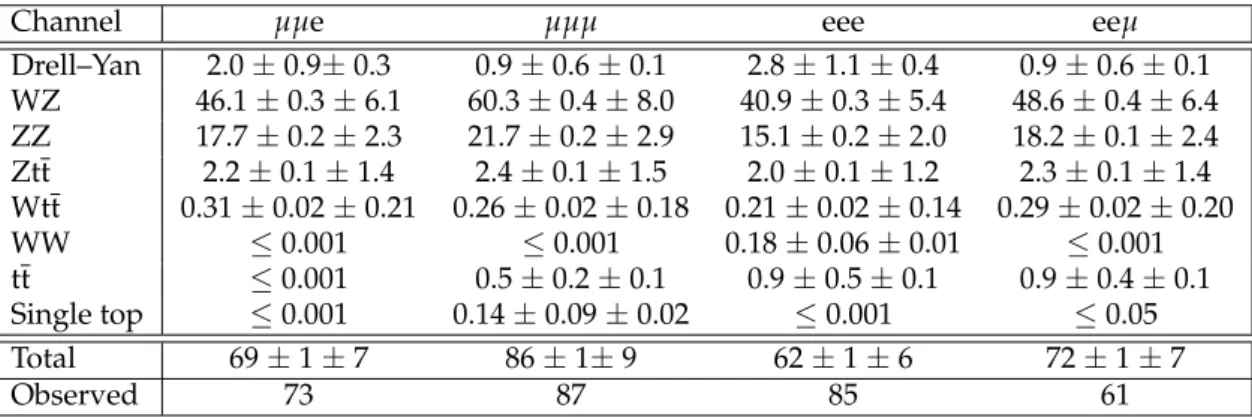
The observed and expected yields based on MC after the basic event selection described above
are listed in Table 1. The initial data sample of 1.3 (1.6) million Z to ee(µµ)events is reduced
to less than 100 events per three-lepton channel. All entries in Table 1 also include the τ decay mode contributions. Single-top-quark production is dominated by the Wt channel. The total yields are dominated by diboson production and a reasonable agreement is observed between data and simulation. The details of the background estimations are discussed in Section 5. Table 1: Event yields and background predictions based on simulated events for all three-lepton channels after the basic event selection, which includes the trigger, Z boson, third three-lepton, fourth-lepton veto and missing transverse energy requirements for an integrated luminosity of
5.0 fb−1. The uncertainties include the statistical and systematic components separately (in that
order).
Channel µµe µµµ eee eeµ
Drell–Yan 2.0±0.9±0.3 0.9±0.6±0.1 2.8±1.1±0.4 0.9±0.6±0.1 WZ 46.1±0.3±6.1 60.3±0.4±8.0 40.9±0.3±5.4 48.6±0.4±6.4 ZZ 17.7±0.2±2.3 21.7±0.2±2.9 15.1±0.2±2.0 18.2±0.1±2.4 Ztt 2.2±0.1±1.4 2.4±0.1±1.5 2.0±0.1±1.2 2.3±0.1±1.4 Wtt 0.31±0.02±0.21 0.26±0.02±0.18 0.21±0.02±0.14 0.29±0.02±0.20 WW ≤0.001 ≤0.001 0.18±0.06±0.01 ≤0.001 tt ≤0.001 0.5±0.2±0.1 0.9±0.5±0.1 0.9±0.4±0.1 Single top ≤0.001 0.14±0.09±0.02 ≤0.001 ≤0.05 Total 69±1±7 86±1±9 62±1±6 72±1±7 Observed 73 87 85 61
Figure 1 shows the distributions for data and simulated events of the missing transverse energy,
transverse mass of the W boson candidate (mT), and the scalar sum of the transverse energy
ST, after the trigger, Z boson, third lepton, fourth-lepton veto, missing transverse energy, and
the additional requirement of two or more jets. The STvariable is defined asΣpT`+ΣpTj+E/ ,T
where only the three leptons and two jets from the tt candidate are considered. The mT is
calculated using the transverse momentum and azimuthal direction of the third lepton and the
4 4 Signal Reconstruction [GeV] T E 0 50 100 150 200 Events / 10 [GeV] 0 2 4 6 8 10 12 14 16 18 20 -l + l → * γ Z/ t t t /Zt t Wt WW/WZ/ZZ Single-top = 1%) B Zq ( → t Data -1 = 7 TeV, 5.0 fb s CMS (a) ) [GeV] T E (l+ T m 0 50 100 150 200 Events 0 2 4 6 8 10 12 14 16 18 20 -l + l → * γ Z/ t t t /Zt t Wt WW/WZ/ZZ Single-top = 1%) B Zq ( → t Data -1 = 7 TeV, 5.0 fb s CMS (b) [GeV] T S 0 200 400 600 800 1000 Events / 50 [GeV] 0 5 10 15 20 25 Z/γ*→l+l -t t t /Zt t Wt WW/WZ/ZZ Single-top = 1%) B Zq ( → t Data -1 = 7 TeV, 5.0 fb s CMS (c)
Figure 1: Comparison between data and simulated events for an integrated luminosity of 5.0 fb−1, after the basic event selection described in Section 3 and requiring at least two jets, for:
(a) the missing transverse energy distribution, (b) the reconstructed`ν transverse mass of the
W boson candidate, and (c) the scalar sum of the transverse energy for the jets, charged leptons,
and neutrino, ST. The data are represented by the points with error bars and the open histogram
shows the expected signal assuming B(t → Zq) is equal to 1%. Stacked solid histograms
represent the dominant backgrounds. The statistical uncertainties of these backgrounds are around a few percent level and are not drawn.
4
Signal Reconstruction
For the t → Zq → `+`−j signal, a full reconstruction of the top quark mass m
Zj is possible
and straightforward, but the possibility of a combinatorial background arises since there is no unambiguous way to pair multiple light-quark jets with the Z boson. Therefore all possible combinations are examined.
The invariant mass of the W and b jet system (mWb) can be reconstructed by assuming that the
4.1 STSelection 5
vector information, while the longitudinal component is calculated as pzν= pz`(px`pxν+py`pyν+mW2/2) ±E` q (px`pxν+py`pyν+mW2/2)2−ETν2 (E2`−p2z`) E2 `−p2z` ,
where E`, px`, py`, and pz` are the energy and momentum components for the lepton, while
the neutrino ETν, pxν and pyν are estimated from the reconstructed missing transverse energy
magnitude and direction, and imposing the constraint that the invariant mass of the lepton and
the neutrino is equal to the W-boson mass (mW). If the discriminant is found to be negative,
it is set equal to zero. In events in which there are two possible solutions for pzν, the solution
with the smaller magnitude of pzν, is taken; studies with simulated signal events show that this
solution is the correct one more than 60% of the time.
Next, we add the requirements on jets, mZj, and mWb to the basic selection described in
Sec-tion 3, and search for tt → Wb+Zq in two ways. One selection requires a minimum value
of ST and loose requirements on mZj and mWb. The second selection is stricter, with tight
re-quirements on the mZjand mWbquantities and the requirement that one of the jets should be
consistent with the hadronization of a b quark, namely a “b jet”. In this Letter, we refer to these
two selections as the “ST” and “b-tag” selections, respectively. The first selection is the more
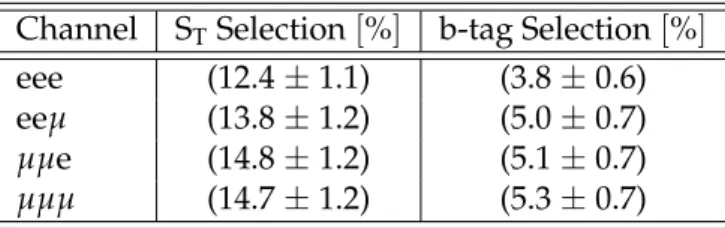
sensitive and hence is taken as the reference analysis. Table 2 shows the estimates of the overall signal efficiency determined from simulated events.
Table 2: Signal selection efficiency for each three-lepton channels in percent. The efficiency is calculated as the fraction of events with leptonically (e, µ, τ) decaying W and Z bosons passing the selection. Only statistical uncertainties are shown.
Channel STSelection[%] b-tag Selection[%]
eee (12.4±1.1) (3.8±0.6)
eeµ (13.8±1.2) (5.0±0.7)
µµe (14.8±1.2) (5.1±0.7)
µµµ (14.7±1.2) (5.3±0.7)
4.1 ST Selection
In the ST selection, at least two jets with pT > 30 GeV are required, which are assumed to
come from the primary vertex. A constituent track candidate in a jet is removed from the reconstruction if it does not point to the same vertex, but there is no association requirement between jets and the Z candidate which is chosen in the basic selection.
A candidate event is required to have ST above 250 GeV, mZj and mWb are required to be
be-tween 100 GeV and 250 GeV. The ST requirement reduces the boson-jet combinations. The ST
distribution of the best candidate is shown in Figure 1. All possible tt combinations are exam-ined and the reconstructed tt pair that has the largest separation in azimuthal angle is selected.
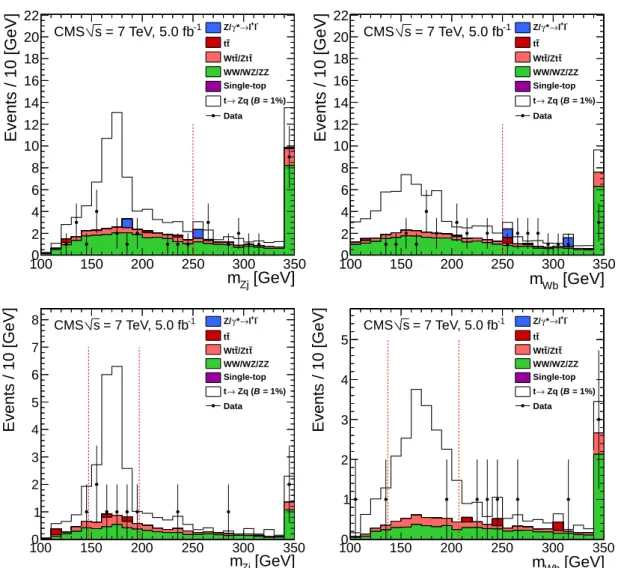
Figure 2 (top) shows the comparison of the distributions of mZjand mWbin data and simulation
after the basic event selection described in Section 3 (Table 1), combined with the two or more
jets and the STrequirements.
4.2 b-tag Selection
To further reduce the background from diboson events, a b-tag based selection is performed. In this selection, at least two jets are required to be associated with the primary vertex associated with the Z candidate and the event can contain only one b jet.
6 5 Background Estimation
The b jets are identified by the track counting high-efficiency b-tagging algorithm described in Ref. [23], which relies on tracks with large impact parameter significance. This tagging method has an identification efficiency of 65% to 85% for b jets with transverse momentum between 30 GeV to 100 GeV and a misidentification rate below 15%.
The jet which gives the invariant mass of mZjclosest to the top mass is selected and the
recon-structed top quark mass mZj is required to be within 25 GeV of the assumed top quark mass,
mt =172.5 GeV, while mWbis required to be within 35 GeV of mt.
Figure 2 (bottom) shows the comparison between data and simulated events for mZjand mWb
after the basic event selection and requiring at least two jets, one of which is a b jet.
5
Background Estimation
Backgrounds are estimated from the yields of simulated events passing the full selection for WW, WZ, ZZ, Wtt, Ztt, and single-top-quark production, while estimates based on data are made for Drell–Yan and tt backgrounds. The uncertainties in the background estimation given below include, in order, the statistical and systematic components.
The WZ and ZZ production are the dominant diboson backgrounds. The production of W pairs
has a higher cross section, but is unlikely to contain both an extra high-pT lepton and a b jet.
The diboson background estimates are 13.6±0.2±2.6 (0.72±0.01±0.15) and 1.09±0.02±0.21
(0.058±0.001±0.012) for the WZ and ZZ processes in the ST(b-tag) selection. These estimates
have been rescaled by 1.3±0.1 to take into account the overall normalization difference
ob-served between data and simulation for the zero jet events, after the event selection given in Section 3. The uncertainty of the rescaling factor estimated from statistical fluctuations in the data contributes to the systematic uncertainties on the diboson background estimates. The single-top-quark background is smaller than 0.01 at the 95% CL in both selections.
The Ztt and Wtt cross sections are of the same order [24]. The corresponding background
estimates are 3.75±0.06±2.30 (0.260±0.004±0.160) and 0.54±0.03±0.36 (0.039±0.002±
0.026) for the Ztt and Wtt processes in the ST(b-tag) selection.
The Drell–Yan background is small due to the minimum 30 GeV requirement of missing trans-verse energy. Other backgrounds from QCD multijet events in which a jet could be misiden-tified as a lepton are negligible. It is possible for SM tt to satisfy the Z selection when both W bosons decay leptonically into the same flavor, but the third lepton and the top quark mass requirements will reject these events.
The Drell–Yan and tt background estimates are based on two data samples. The first sample is composed of all events satisfying the basic event selection with two or more jets and loose
re-quirements in ST, mZj, and mWb. The second sample also has loose requirements in ST, mZj, and
mWb, but in addition it also has a less stringent isolation criteria for the third lepton. Therefore,
the second sample is an admixture of the purer three-lepton sample plus events with a misiden-tified lepton, originating from jets or heavy-flavor decays, or genuine three-lepton events that were lost in the signal sample due to the more stringent isolation requirement. The number of events in the two samples are then related by the efficiency of events with nominal lepton isolation and the probability of a jet to be misidentified as a lepton. Using the genuine and misidentified lepton efficiencies, which are both determined from data, the yield of genuine and misidentified three-lepton events is found. This measurement is turned into an estimate of the Drell–Yan and tt background after subtracting the contribution from dibosons and tak-ing into account the change in acceptances and efficiencies (e.g. b-taggtak-ing) after the full signal
7 [GeV] Zj m 100 150 200 250 300 350 Events / 10 [GeV] 0 2 4 6 8 10 12 14 16 18 20 22 -l + l → * γ Z/ t t t /Zt t Wt WW/WZ/ZZ Single-top = 1%) B Zq ( → t Data -1 = 7 TeV, 5.0 fb s CMS [GeV] Wb m 100 150 200 250 300 350 Events / 10 [GeV] 0 2 4 6 8 10 12 14 16 18 20 22 -l + l → * γ Z/ t t t /Zt t Wt WW/WZ/ZZ Single-top = 1%) B Zq ( → t Data -1 = 7 TeV, 5.0 fb s CMS [GeV] Zj m 100 150 200 250 300 350 Events / 10 [GeV] 0 1 2 3 4 5 6 7 8 -l + l → * γ Z/ t t t /Zt t Wt WW/WZ/ZZ Single-top = 1%) B Zq ( → t Data -1 = 7 TeV, 5.0 fb s CMS [GeV] Wb m 100 150 200 250 300 350 Events / 10 [GeV] 0 1 2 3 4 5 -l + l → * γ Z/ t t t /Zt t Wt WW/WZ/ZZ Single-top = 1%) B Zq ( → t Data -1 = 7 TeV, 5.0 fb s CMS
Figure 2: Comparison between data and simulated events of the mZj and mWb distributions
after the basic event selection described in Section 3 for an integrated luminosity of 5.0 fb−1,
requiring at least two jets and: (Top) the minimum ST value, as required in the ST selection;
(Bottom) exactly one b jet as required in the b-tag based selection. The data are represented by
the points with error bars and the open histogram is the expected signal assumingB(t →Zq)
is equal to 1%. Stacked solid histograms represent the dominant backgrounds. The statistical uncertainties of these backgrounds are around a few percent level and are not drawn. The last bin contains all the overflow events. The red dotted lines show the boundaries of the allowed mass region.
8 7 Results
selections are made. The total contribution of Drell–Yan and tt events, after the ST and b-tag
selections are estimated to be 1.5±0.5±0.4 and 0.06±0.02±0.01, respectively. The statistical
and systematic uncertainties are estimated from the amounts of the events of these two data samples and the uncertainty of the lepton isolation efficiencies measured with data. These es-timates are compatible with the expectations based on simulated events. The total estimated backgrounds are given in Table 3.
Table 3: Background composition, observed and expected yields, and limits at the 95% CL
for all three-lepton channels combined for the ST and b-tag selections for an integrated
lumi-nosity of 5.0 fb−1. The uncertainties in the background estimation include the statistical and
systematic components separately (in that order).
Selection ST b-tag
WZ background 13.59±0.20±2.58 0.718±0.011±0.150
ZZ background 1.09±0.02±0.21 0.058±0.001±0.012
Drell-Yan and tt background 1.52±0.46±0.41 0.055±0.017±0.012
Ztt background 3.75±0.06±2.30 0.260±0.004±0.160
Wtt background 0.54±0.03±0.36 0.039±0.002±0.026
Total background prediction 20.49±0.51±3.51 1.13±0.02±0.22
Observed events 11 0
Expected limit at the 95% CL B(t→Zq) <0.40% B(t→Zq) <0.41%
Observed limit at the 95% CL B(t→Zq) <0.21% B(t→Zq) <0.30%
6
Systematic Uncertainties
The systematic uncertainties come from the trigger efficiency, choice of parton distribution functions, lepton selection, pileup modeling, missing transverse energy resolution, uncertainty
on the tt cross section and diboson rescaling, b-tagging efficiency for high-pTb jets [23], and jet
energy scale [13]. The prescription given in [25] is used to determine the uncertainty from the choice of parton distribution functions.
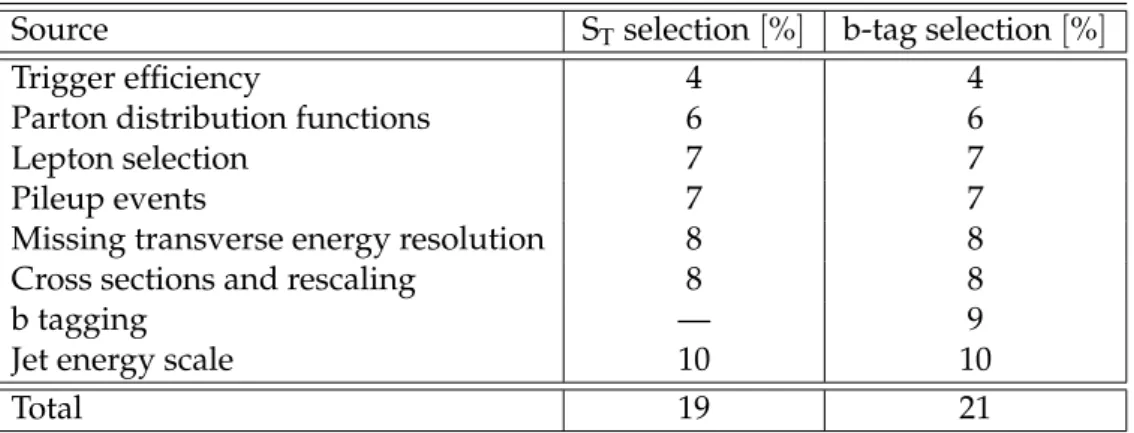
In addition, there is a 2.2% uncertainty on the luminosity measurement [26]. All these sources combine to give a 19% (21%) relative uncertainty on the signal acceptance times efficiency in the ST (b-tag) selection.
The systematic uncertainties are summarized in Table 4. The systematic uncertainty of the background estimation is listed with the total background prediction given in Table 3.
7
Results
In the ST (b-tag) selection, we expect 20.5±3.5 (1.1±0.2) events from the SM background
processes and we observe 11 (0) events for all four channels combined. When all statistical and systematic uncertainties are taken into account, the probability for the expected number of events, 20.5, to fluctuate to 11 events, as observed, or fewer is 5%. No excess beyond the
SM background is observed and a 95% CL upper limit on the branching fraction of t → Zq is
determined using the modified frequentist approach (CLsmethod [27, 28]). A summary of the
observed and predicted yields and limits are presented in Table 3.
The calculation of the upper limit is based on the information provided by the observed event count combined with the values and the uncertainties of the luminosity measurement, the
back-9
Table 4: Summary of the systematic uncertainties for the event selection in percent for the ST
and b-tag selections. There is an additional 2.2% uncertainty due to the luminosity measure-ment.
Source STselection[%] b-tag selection[%]
Trigger efficiency 4 4
Parton distribution functions 6 6
Lepton selection 7 7
Pileup events 7 7
Missing transverse energy resolution 8 8
Cross sections and rescaling 8 8
b tagging — 9
Jet energy scale 10 10
Total 19 21
ground prediction, and the fraction of all tt → Zq+Wb → ``q+ `b events expected to be
selected. The signal event yield is obtained from the efficiency times acceptance and branching
fraction for simulated events. AsB(t→Zq)is expected to be small, the possibility of both top
quarks decaying via flavor changing neutral currents is not considered.
The best observed and expected 95% CL upper limits on the branching fraction B(t → Zq)
are 0.21% and 0.40%, respectively, obtained in the ST selection from the combined three-lepton
analyses. The one-sigma boundaries of the expected limit are 0.30–0.59%. The correspond-ing observed and expected upper limits, and one-sigma boundaries for the b-tag selection are
0.30% , 0.41% and 0.30–0.53%, respectively. The expected limit for the ST and b-tag selections
show that they have comparable sensitivity. The one with slightly better expected limit is taken as the final result.
8
Summary
A search for flavor changing neutral currents in top quark decays in tt events produced in
proton-proton collisions at√s =7 TeV is presented. A sample of three-lepton events is selected
from data recorded by CMS during 2011 corresponding to an integrated luminosity of 5.0 fb−1.
These events are compatible with a pp→tt→Zq+Wb→ ``q+ `νb(` =e, µ)topology. Since
three-lepton events originating from the SM processes are rare the background contributions
are small. No excess of events over the SM background is observed and aB(t →Zq)branching
fraction larger than 0.21% is excluded at the 95% confidence level.
Acknowledgments
We congratulate our colleagues in the CERN accelerator departments for the excellent perfor-mance of the LHC machine. We thank the technical and administrative staff at CERN and other CMS institutes, and acknowledge support from: FMSR (Austria); FNRS and FWO (Belgium); CNPq, CAPES, FAPERJ, and FAPESP (Brazil); MES (Bulgaria); CERN; CAS, MoST, and NSFC (China); COLCIENCIAS (Colombia); MSES (Croatia); RPF (Cyprus); MoER, SF0690030s09 and RDF (Estonia); Academy of Finland, MEC, and HIP (Finland); CEA and CNRS/IN2P3 (France);
10 References
BMBF, DFG, and HGF (Germany); GSRT (Greece); OTKA and NKTH (Hungary); DAE and DST (India); IPM (Iran); SFI (Ireland); INFN (Italy); NRF and WCU (Korea); LAS (Lithuania); CIN-VESTAV, CONACYT, SEP, and UASLP-FAI (Mexico); MSI (New Zealand); PAEC (Pakistan); MSHE and NSC (Poland); FCT (Portugal); JINR (Armenia, Belarus, Georgia, Ukraine, Uzbek-istan); MON, RosAtom, RAS and RFBR (Russia); MSTD (Serbia); MICINN and CPAN (Spain); Swiss Funding Agencies (Switzerland); NSC (Taipei); TUBITAK and TAEK (Turkey); STFC (United Kingdom); DOE and NSF (USA).
References
[1] S. L. Glashow, J. Iliopoulos, and L. Maiani, “Weak Interactions with Lepton-Hadron Symmetry”, Phys. Rev. D 2 (1970) 1285, doi:10.1103/PhysRevD.2.1285.
[2] J. A. Aguilar-Saavedra et al., “Top quark physics”, Acta Phys. Polon. B 35 (2004) 2671, arXiv:hep-ph/0410110.
[3] J. A. Aguilar-Saavedra, “Top flavor changing neutral coupling signals at a linear collider”, Phys. Lett. B 502 (2001) 115, doi:10.1016/S0370-2693(01)00162-9,
arXiv:hep-ph/0012305.
[4] G. Lu et al., “Rare top quark decays t→cV in the top-color-assisted technicolor model”,
Phys. Rev. D 68 (2003) 015002, doi:10.1103/PhysRevD.68.015002,
arXiv:hep-ph/0303122.
[5] CDF Collaboration, “Search for the flavor changing neutral current decay t→Zq in p ¯p
collisions at√s=1.96 TeV”, Phys. Rev. Lett. 101 (2008) 192002,
doi:10.1103/PhysRevLett.101.192002, arXiv:0805.2109.
[6] D0 Collaboration, “Search for flavor changing neutral currents in decays of top quarks”, Phys. Lett. B 701 (2011) 313, doi:10.1016/j.physletb.2011.06.014,
arXiv:1103.4574.
[7] ATLAS Collaboration, “A search for flavour changing neutral currents in top-quark decays in pp collision data collected with the ATLAS detector at sqrt(s) = 7 TeV”, JHEP
1209(2012) 139, doi:10.1007/JHEP09(2012)139, arXiv:1206.0257.
[8] CMS Collaboration, “The CMS experiment at the CERN LHC”, JINST 03 (2008) S08004,
doi:10.1088/1748-0221/3/08/S08004.
[9] CMS Collaboration, “Measurements of inclusive W and Z cross sections in pp collisions
at√s = 7 TeV”, JHEP 01 (2011) 080, doi:10.1007/JHEP01(2011)080,
arXiv:1012.2466.
[10] CMS Collaboration, “Performance of CMS muon reconstruction in pp collision events at sqrt(s) = 7 TeV”, JINST 07 (2012) P10002, doi:10.1088/1748-0221/7/10/P10002,
arXiv:1206.4071.
[11] CMS Collaboration, “Particle–Flow Event Reconstruction in CMS and Performance for
Jets, Taus, and EmissT ”, CMS Physics Analysis Summary CMS-PAS-PFT-09-001, (2009).
[12] M. Cacciari and G. P. Salam, “Dispelling the N3myth for the ktjet-finder”, Phys. Lett. B
641(2006) 57, doi:10.1016/j.physletb.2006.08.037,
References 11
[13] CMS Collaboration, “Determination of jet energy calibration and transverse momentum resolution in CMS”, JINST 06 (2011) P11002,
doi:10.1088/1748-0221/6/11/P11002, arXiv:1107.4277.
[14] CMS Collaboration, “Missing transverse energy performance of the CMS detector”, JINST 06 (2011) P09001, doi:10.1088/1748-0221/6/09/P09001,
arXiv:1106.5048.
[15] CMS Collaboration, “Identification and filtering of uncharacteristic noise in the CMS hadron calorimeter”, JINST 05 (2010) T03014,
doi:10.1088/1748-0221/5/03/T03014, arXiv:0911.4881. [16] J. Alwall et al., “MadGraph 5: going beyond”, JHEP 06 (2011) 128,
doi:10.1007/JHEP06(2011)128, arXiv:1106.0522.
[17] T. Sj ¨ostrand, S. Mrenna, and P. Skankds, “PYTHIA 6.4 physics and manual”, JHEP 05 (2006) 026, doi:10.1088/1126-6708/2006/05/026, arXiv:hep-ph/0603175. [18] P. Nason, “A new method for combining NLO QCD with shower Monte Carlo
algorithms”, JHEP 11 (2004) 040, doi:10.1088/1126-6708/2004/11/040, arXiv:hep-ph/0409146.
[19] S. Frixione et al., “Matching NLO QCD computations with parton shower simulations: the POWHEG method”, JHEP 11 (2007) 070,
doi:10.1088/1126-6708/2007/11/070, arXiv:0709.2092.
[20] S. Alioli et al., “A general framework for implementing NLO calculations in shower Monte Carlo programs: the POWHEG BOX”, JHEP 06 (2010) 043,
doi:10.1007/JHEP06(2010)043, arXiv:1002.2581.
[21] P. M. Nadolsky et al., “Implications of CTEQ global analysis for collider observables”, Phys. Rev. D 78 (2008) 013004, doi:10.1103/PhysRevD.78.013004.
[22] GEANT4 Collaboration, “GEANT4—a simulation toolkit”, Nucl. Instrum. Meth. A 506 (2003) 250, doi:10.1016/S0168-9002(03)01368-8.
[23] CMS Collaboration, “Performance of b-jet identification in CMS”, CMS Physics Analysis Summary CMS-PAS-BTV-11-001, (2011).
[24] CMS Collaboration, “Measurement of the Associated Production of Vector Bosons with Top-Antitop Pairs at 7 TeV”, CMS Physics Analysis Summary CMS-PAS-TOP-12-014, (2012).
[25] M. R. Whalley, D. Bourilkov, and R. C. Group, “The Les Houches accord PDFs (LHAPDF) and LHAGLUE”, (2005). arXiv:hep-ph/0508110.
[26] CMS Collaboration, “Absolute Calibration of the Luminosity Measurement at CMS: Winter 2012 Update”, CMS Physics Analysis Summary CMS-PAS-SMP-12-008, (2012). [27] T. Junk, “Confidence level computation for combining searches with small statistics”,
Nucl. Instrum. Meth. A 434 (1999) 435, doi:10.1016/S0168-9002(99)00498-2, arXiv:hep-ex/9902006.
[28] A. L. Read, “Presentation of search results: the CLstechnique”, J. Phys. G 28 (2002) 2693,
13
A
The CMS Collaboration
Yerevan Physics Institute, Yerevan, Armenia
S. Chatrchyan, V. Khachatryan, A.M. Sirunyan, A. Tumasyan
Institut f ¨ur Hochenergiephysik der OeAW, Wien, Austria
W. Adam, E. Aguilo, T. Bergauer, M. Dragicevic, J. Er ¨o, C. Fabjan1, M. Friedl, R. Fr ¨uhwirth1,
V.M. Ghete, J. Hammer, N. H ¨ormann, J. Hrubec, M. Jeitler1, W. Kiesenhofer, V. Kn ¨unz,
M. Krammer1, D. Liko, I. Mikulec, M. Pernicka†, B. Rahbaran, C. Rohringer, H. Rohringer,
R. Sch ¨ofbeck, J. Strauss, A. Taurok, P. Wagner, W. Waltenberger, G. Walzel, E. Widl, C.-E. Wulz1
National Centre for Particle and High Energy Physics, Minsk, Belarus
V. Mossolov, N. Shumeiko, J. Suarez Gonzalez
Universiteit Antwerpen, Antwerpen, Belgium
S. Bansal, T. Cornelis, E.A. De Wolf, X. Janssen, S. Luyckx, L. Mucibello, S. Ochesanu, B. Roland, R. Rougny, M. Selvaggi, Z. Staykova, H. Van Haevermaet, P. Van Mechelen, N. Van Remortel, A. Van Spilbeeck
Vrije Universiteit Brussel, Brussel, Belgium
F. Blekman, S. Blyweert, J. D’Hondt, R. Gonzalez Suarez, A. Kalogeropoulos, M. Maes, A. Olbrechts, W. Van Doninck, P. Van Mulders, G.P. Van Onsem, I. Villella
Universit´e Libre de Bruxelles, Bruxelles, Belgium
B. Clerbaux, G. De Lentdecker, V. Dero, A.P.R. Gay, T. Hreus, A. L´eonard, P.E. Marage, T. Reis, L. Thomas, C. Vander Velde, P. Vanlaer, J. Wang
Ghent University, Ghent, Belgium
V. Adler, K. Beernaert, A. Cimmino, S. Costantini, G. Garcia, M. Grunewald, B. Klein, J. Lellouch, A. Marinov, J. Mccartin, A.A. Ocampo Rios, D. Ryckbosch, N. Strobbe, F. Thyssen, M. Tytgat, P. Verwilligen, S. Walsh, E. Yazgan, N. Zaganidis
Universit´e Catholique de Louvain, Louvain-la-Neuve, Belgium
S. Basegmez, G. Bruno, R. Castello, L. Ceard, C. Delaere, T. du Pree, D. Favart, L. Forthomme,
A. Giammanco2, J. Hollar, V. Lemaitre, J. Liao, O. Militaru, C. Nuttens, D. Pagano, A. Pin,
K. Piotrzkowski, N. Schul, J.M. Vizan Garcia
Universit´e de Mons, Mons, Belgium
N. Beliy, T. Caebergs, E. Daubie, G.H. Hammad
Centro Brasileiro de Pesquisas Fisicas, Rio de Janeiro, Brazil
G.A. Alves, M. Correa Martins Junior, D. De Jesus Damiao, T. Martins, M.E. Pol, M.H.G. Souza
Universidade do Estado do Rio de Janeiro, Rio de Janeiro, Brazil
W.L. Ald´a J ´unior, W. Carvalho, A. Cust ´odio, E.M. Da Costa, C. De Oliveira Martins, S. Fonseca De Souza, D. Matos Figueiredo, L. Mundim, H. Nogima, V. Oguri, W.L. Prado Da Silva, A. Santoro, L. Soares Jorge, A. Sznajder
Instituto de Fisica Teorica, Universidade Estadual Paulista, Sao Paulo, Brazil
C.A. Bernardes3, F.A. Dias4, T.R. Fernandez Perez Tomei, E. M. Gregores3, C. Lagana,
F. Marinho, P.G. Mercadante3, S.F. Novaes, Sandra S. Padula
Institute for Nuclear Research and Nuclear Energy, Sofia, Bulgaria
V. Genchev5, P. Iaydjiev5, S. Piperov, M. Rodozov, S. Stoykova, G. Sultanov, V. Tcholakov,
14 A The CMS Collaboration
University of Sofia, Sofia, Bulgaria
A. Dimitrov, R. Hadjiiska, V. Kozhuharov, L. Litov, B. Pavlov, P. Petkov
Institute of High Energy Physics, Beijing, China
J.G. Bian, G.M. Chen, H.S. Chen, C.H. Jiang, D. Liang, S. Liang, X. Meng, J. Tao, J. Wang, X. Wang, Z. Wang, H. Xiao, M. Xu, J. Zang, Z. Zhang
State Key Lab. of Nucl. Phys. and Tech., Peking University, Beijing, China
C. Asawatangtrakuldee, Y. Ban, S. Guo, Y. Guo, W. Li, S. Liu, Y. Mao, S.J. Qian, H. Teng, D. Wang, L. Zhang, B. Zhu, W. Zou
Universidad de Los Andes, Bogota, Colombia
C. Avila, J.P. Gomez, B. Gomez Moreno, A.F. Osorio Oliveros, J.C. Sanabria
Technical University of Split, Split, Croatia
N. Godinovic, D. Lelas, R. Plestina6, D. Polic, I. Puljak5
University of Split, Split, Croatia
Z. Antunovic, M. Kovac
Institute Rudjer Boskovic, Zagreb, Croatia
V. Brigljevic, S. Duric, K. Kadija, J. Luetic, S. Morovic
University of Cyprus, Nicosia, Cyprus
A. Attikis, M. Galanti, G. Mavromanolakis, J. Mousa, C. Nicolaou, F. Ptochos, P.A. Razis
Charles University, Prague, Czech Republic
M. Finger, M. Finger Jr.
Academy of Scientific Research and Technology of the Arab Republic of Egypt, Egyptian Network of High Energy Physics, Cairo, Egypt
Y. Assran7, S. Elgammal8, A. Ellithi Kamel9, S. Khalil8, M.A. Mahmoud10, A. Radi11,12
National Institute of Chemical Physics and Biophysics, Tallinn, Estonia
M. Kadastik, M. M ¨untel, M. Raidal, L. Rebane, A. Tiko
Department of Physics, University of Helsinki, Helsinki, Finland
P. Eerola, G. Fedi, M. Voutilainen
Helsinki Institute of Physics, Helsinki, Finland
J. H¨ark ¨onen, A. Heikkinen, V. Karim¨aki, R. Kinnunen, M.J. Kortelainen, T. Lamp´en, K. Lassila-Perini, S. Lehti, T. Lind´en, P. Luukka, T. M¨aenp¨a¨a, T. Peltola, E. Tuominen, J. Tuominiemi, E. Tuovinen, D. Ungaro, L. Wendland
Lappeenranta University of Technology, Lappeenranta, Finland
K. Banzuzi, A. Karjalainen, A. Korpela, T. Tuuva
DSM/IRFU, CEA/Saclay, Gif-sur-Yvette, France
M. Besancon, S. Choudhury, M. Dejardin, D. Denegri, B. Fabbro, J.L. Faure, F. Ferri, S. Ganjour, A. Givernaud, P. Gras, G. Hamel de Monchenault, P. Jarry, E. Locci, J. Malcles, L. Millischer, A. Nayak, J. Rander, A. Rosowsky, I. Shreyber, M. Titov
Laboratoire Leprince-Ringuet, Ecole Polytechnique, IN2P3-CNRS, Palaiseau, France
S. Baffioni, F. Beaudette, L. Benhabib, L. Bianchini, M. Bluj13, C. Broutin, P. Busson, C. Charlot,
N. Daci, T. Dahms, L. Dobrzynski, R. Granier de Cassagnac, M. Haguenauer, P. Min´e, C. Mironov, M. Nguyen, C. Ochando, P. Paganini, D. Sabes, R. Salerno, Y. Sirois, C. Veelken, A. Zabi
15
Institut Pluridisciplinaire Hubert Curien, Universit´e de Strasbourg, Universit´e de Haute Alsace Mulhouse, CNRS/IN2P3, Strasbourg, France
J.-L. Agram14, J. Andrea, D. Bloch, D. Bodin, J.-M. Brom, M. Cardaci, E.C. Chabert, C. Collard,
E. Conte14, F. Drouhin14, C. Ferro, J.-C. Fontaine14, D. Gel´e, U. Goerlach, P. Juillot, A.-C. Le
Bihan, P. Van Hove
Centre de Calcul de l’Institut National de Physique Nucleaire et de Physique des Particules, CNRS/IN2P3, Villeurbanne, France, Villeurbanne, France
F. Fassi, D. Mercier
Universit´e de Lyon, Universit´e Claude Bernard Lyon 1, CNRS-IN2P3, Institut de Physique Nucl´eaire de Lyon, Villeurbanne, France
S. Beauceron, N. Beaupere, O. Bondu, G. Boudoul, J. Chasserat, R. Chierici5, D. Contardo,
P. Depasse, H. El Mamouni, J. Fay, S. Gascon, M. Gouzevitch, B. Ille, T. Kurca, M. Lethuillier, L. Mirabito, S. Perries, V. Sordini, S. Tosi, Y. Tschudi, P. Verdier, S. Viret
Institute of High Energy Physics and Informatization, Tbilisi State University, Tbilisi, Georgia
Z. Tsamalaidze15
RWTH Aachen University, I. Physikalisches Institut, Aachen, Germany
G. Anagnostou, S. Beranek, M. Edelhoff, L. Feld, N. Heracleous, O. Hindrichs, R. Jussen, K. Klein, J. Merz, A. Ostapchuk, A. Perieanu, F. Raupach, J. Sammet, S. Schael, D. Sprenger,
H. Weber, B. Wittmer, V. Zhukov16
RWTH Aachen University, III. Physikalisches Institut A, Aachen, Germany
M. Ata, J. Caudron, E. Dietz-Laursonn, D. Duchardt, M. Erdmann, R. Fischer, A. G ¨uth, T. Hebbeker, C. Heidemann, K. Hoepfner, D. Klingebiel, P. Kreuzer, J. Lingemann, C. Magass, M. Merschmeyer, A. Meyer, M. Olschewski, P. Papacz, H. Pieta, H. Reithler, S.A. Schmitz, L. Sonnenschein, J. Steggemann, D. Teyssier, M. Weber
RWTH Aachen University, III. Physikalisches Institut B, Aachen, Germany
M. Bontenackels, V. Cherepanov, G. Fl ¨ugge, H. Geenen, M. Geisler, W. Haj Ahmad, F. Hoehle, B. Kargoll, T. Kress, Y. Kuessel, A. Nowack, L. Perchalla, O. Pooth, J. Rennefeld, P. Sauerland, A. Stahl
Deutsches Elektronen-Synchrotron, Hamburg, Germany
M. Aldaya Martin, J. Behr, W. Behrenhoff, U. Behrens, M. Bergholz17, A. Bethani, K. Borras,
A. Burgmeier, A. Cakir, L. Calligaris, A. Campbell, E. Castro, F. Costanza, D. Dammann, C. Diez Pardos, G. Eckerlin, D. Eckstein, G. Flucke, A. Geiser, I. Glushkov, P. Gunnellini, S. Habib, J. Hauk, G. Hellwig, H. Jung, M. Kasemann, P. Katsas, C. Kleinwort, H. Kluge, A. Knutsson,
M. Kr¨amer, D. Kr ¨ucker, E. Kuznetsova, W. Lange, W. Lohmann17, B. Lutz, R. Mankel, I. Marfin,
M. Marienfeld, I.-A. Melzer-Pellmann, A.B. Meyer, J. Mnich, A. Mussgiller, S. Naumann-Emme, J. Olzem, H. Perrey, A. Petrukhin, D. Pitzl, A. Raspereza, P.M. Ribeiro Cipriano, C. Riedl,
E. Ron, M. Rosin, J. Salfeld-Nebgen, R. Schmidt17, T. Schoerner-Sadenius, N. Sen, A. Spiridonov,
M. Stein, R. Walsh, C. Wissing
University of Hamburg, Hamburg, Germany
C. Autermann, V. Blobel, J. Draeger, H. Enderle, J. Erfle, U. Gebbert, M. G ¨orner, T. Hermanns, R.S. H ¨oing, K. Kaschube, G. Kaussen, H. Kirschenmann, R. Klanner, J. Lange, B. Mura, F. Nowak, T. Peiffer, N. Pietsch, D. Rathjens, C. Sander, H. Schettler, P. Schleper, E. Schlieckau, A. Schmidt, M. Schr ¨oder, T. Schum, M. Seidel, V. Sola, H. Stadie, G. Steinbr ¨uck, J. Thomsen, L. Vanelderen
16 A The CMS Collaboration
Institut f ¨ur Experimentelle Kernphysik, Karlsruhe, Germany
C. Barth, J. Berger, C. B ¨oser, T. Chwalek, W. De Boer, A. Descroix, A. Dierlamm, M. Feindt,
M. Guthoff5, C. Hackstein, F. Hartmann, T. Hauth5, M. Heinrich, H. Held, K.H. Hoffmann,
S. Honc, I. Katkov16, J.R. Komaragiri, P. Lobelle Pardo, D. Martschei, S. Mueller, Th. M ¨uller,
M. Niegel, A. N ¨urnberg, O. Oberst, A. Oehler, J. Ott, G. Quast, K. Rabbertz, F. Ratnikov, N. Ratnikova, S. R ¨ocker, A. Scheurer, F.-P. Schilling, G. Schott, H.J. Simonis, F.M. Stober, D. Troendle, R. Ulrich, J. Wagner-Kuhr, S. Wayand, T. Weiler, M. Zeise
Institute of Nuclear Physics ”Demokritos”, Aghia Paraskevi, Greece
G. Daskalakis, T. Geralis, S. Kesisoglou, A. Kyriakis, D. Loukas, I. Manolakos, A. Markou, C. Markou, C. Mavrommatis, E. Ntomari
University of Athens, Athens, Greece
L. Gouskos, T.J. Mertzimekis, A. Panagiotou, N. Saoulidou
University of Io´annina, Io´annina, Greece
I. Evangelou, C. Foudas5, P. Kokkas, N. Manthos, I. Papadopoulos, V. Patras
KFKI Research Institute for Particle and Nuclear Physics, Budapest, Hungary
G. Bencze, C. Hajdu5, P. Hidas, D. Horvath18, F. Sikler, V. Veszpremi, G. Vesztergombi19
Institute of Nuclear Research ATOMKI, Debrecen, Hungary
N. Beni, S. Czellar, J. Molnar, J. Palinkas, Z. Szillasi
University of Debrecen, Debrecen, Hungary
J. Karancsi, P. Raics, Z.L. Trocsanyi, B. Ujvari
Panjab University, Chandigarh, India
S.B. Beri, V. Bhatnagar, N. Dhingra, R. Gupta, M. Jindal, M. Kaur, M.Z. Mehta, N. Nishu, L.K. Saini, A. Sharma, J. Singh
University of Delhi, Delhi, India
Ashok Kumar, Arun Kumar, S. Ahuja, A. Bhardwaj, B.C. Choudhary, S. Malhotra, M. Naimuddin, K. Ranjan, V. Sharma, R.K. Shivpuri
Saha Institute of Nuclear Physics, Kolkata, India
S. Banerjee, S. Bhattacharya, S. Dutta, B. Gomber, Sa. Jain, Sh. Jain, R. Khurana, S. Sarkar, M. Sharan
Bhabha Atomic Research Centre, Mumbai, India
A. Abdulsalam, R.K. Choudhury, D. Dutta, S. Kailas, V. Kumar, P. Mehta, A.K. Mohanty5,
L.M. Pant, P. Shukla
Tata Institute of Fundamental Research - EHEP, Mumbai, India
T. Aziz, S. Ganguly, M. Guchait20, M. Maity21, G. Majumder, K. Mazumdar, G.B. Mohanty,
B. Parida, K. Sudhakar, N. Wickramage
Tata Institute of Fundamental Research - HECR, Mumbai, India
S. Banerjee, S. Dugad
Institute for Research in Fundamental Sciences (IPM), Tehran, Iran
H. Arfaei, H. Bakhshiansohi22, S.M. Etesami23, A. Fahim22, M. Hashemi, H. Hesari, A. Jafari22,
M. Khakzad, M. Mohammadi Najafabadi, S. Paktinat Mehdiabadi, B. Safarzadeh24, M. Zeinali23
INFN Sezione di Baria, Universit`a di Barib, Politecnico di Baric, Bari, Italy
17
N. De Filippisa,c,5, M. De Palmaa,b, L. Fiorea, G. Iasellia,c, L. Lusitoa,b, G. Maggia,c,
M. Maggia, B. Marangellia,b, S. Mya,c, S. Nuzzoa,b, N. Pacificoa,b, A. Pompilia,b, G. Pugliesea,c, G. Selvaggia,b, L. Silvestrisa, G. Singha,b, R. Venditti, G. Zitoa
INFN Sezione di Bolognaa, Universit`a di Bolognab, Bologna, Italy
G. Abbiendia, A.C. Benvenutia, D. Bonacorsia,b, S. Braibant-Giacomellia,b, L. Brigliadoria,b,
P. Capiluppia,b, A. Castroa,b, F.R. Cavalloa, M. Cuffiania,b, G.M. Dallavallea, F. Fabbria,
A. Fanfania,b, D. Fasanellaa,b,5, P. Giacomellia, C. Grandia, L. Guiduccia,b, S. Marcellinia, G. Masettia, M. Meneghellia,b,5, A. Montanaria, F.L. Navarriaa,b, F. Odoricia, A. Perrottaa, F. Primaveraa,b, A.M. Rossia,b, T. Rovellia,b, G. Sirolia,b, R. Travaglinia,b
INFN Sezione di Cataniaa, Universit`a di Cataniab, Catania, Italy
S. Albergoa,b, G. Cappelloa,b, M. Chiorbolia,b, S. Costaa,b, R. Potenzaa,b, A. Tricomia,b, C. Tuvea,b
INFN Sezione di Firenzea, Universit`a di Firenzeb, Firenze, Italy
G. Barbaglia, V. Ciullia,b, C. Civininia, R. D’Alessandroa,b, E. Focardia,b, S. Frosalia,b, E. Galloa, S. Gonzia,b, M. Meschinia, S. Paolettia, G. Sguazzonia, A. Tropianoa,5
INFN Laboratori Nazionali di Frascati, Frascati, Italy
L. Benussi, S. Bianco, S. Colafranceschi25, F. Fabbri, D. Piccolo
INFN Sezione di Genova, Genova, Italy
P. Fabbricatore, R. Musenich
INFN Sezione di Milano-Bicoccaa, Universit`a di Milano-Bicoccab, Milano, Italy
A. Benagliaa,b,5, F. De Guioa,b, L. Di Matteoa,b,5, S. Fiorendia,b, S. Gennaia,5, A. Ghezzia,b,
S. Malvezzia, R.A. Manzonia,b, A. Martellia,b, A. Massironia,b,5, D. Menascea, L. Moronia,
M. Paganonia,b, D. Pedrinia, S. Ragazzia,b, N. Redaellia, S. Salaa, T. Tabarelli de Fatisa,b
INFN Sezione di Napolia, Universit`a di Napoli ”Federico II”b, Napoli, Italy
S. Buontempoa, C.A. Carrillo Montoyaa,5, N. Cavalloa,26, A. De Cosaa,b,5, O. Doganguna,b,
F. Fabozzia,26, A.O.M. Iorioa, L. Listaa, S. Meolaa,27, M. Merolaa,b, P. Paoluccia,5
INFN Sezione di Padovaa, Universit`a di Padovab, Universit`a di Trento (Trento)c, Padova, Italy
P. Azzia, N. Bacchettaa,5, D. Biselloa,b, A. Brancaa,5, R. Carlina,b, P. Checchiaa, T. Dorigoa, U. Dossellia, F. Gasparinia,b, U. Gasparinia,b, A. Gozzelinoa, K. Kanishcheva,c, S. Lacapraraa, I. Lazzizzeraa,c, M. Margonia,b, A.T. Meneguzzoa,b, J. Pazzinia,b, N. Pozzobona,b, P. Ronchesea,b, F. Simonettoa,b, E. Torassaa, M. Tosia,b,5, S. Vaninia,b, P. Zottoa,b, G. Zumerlea,b
INFN Sezione di Paviaa, Universit`a di Paviab, Pavia, Italy
M. Gabusia,b, S.P. Rattia,b, C. Riccardia,b, P. Torrea,b, P. Vituloa,b
INFN Sezione di Perugiaa, Universit`a di Perugiab, Perugia, Italy
M. Biasinia,b, G.M. Bileia, L. Fan `oa,b, P. Laricciaa,b, A. Lucaronia,b,5, G. Mantovania,b, M. Menichellia, A. Nappia,b, F. Romeoa,b, A. Sahaa, A. Santocchiaa,b, A. Spieziaa,b, S. Taronia,b,5
INFN Sezione di Pisaa, Universit`a di Pisab, Scuola Normale Superiore di Pisac, Pisa, Italy
P. Azzurria,c, G. Bagliesia, T. Boccalia, G. Broccoloa,c, R. Castaldia, R.T. D’Agnoloa,c,
R. Dell’Orsoa, F. Fioria,b,5, L. Fo`aa,c, A. Giassia, A. Kraana, F. Ligabuea,c, T. Lomtadzea,
L. Martinia,28, A. Messineoa,b, F. Pallaa, A. Rizzia,b, A.T. Serbana,29, P. Spagnoloa,
P. Squillaciotia,5, R. Tenchinia, G. Tonellia,b,5, A. Venturia,5, P.G. Verdinia
INFN Sezione di Romaa, Universit`a di Roma ”La Sapienza”b, Roma, Italy
18 A The CMS Collaboration
P. Meridiania,5, F. Michelia,b, S. Nourbakhsha,b, G. Organtinia,b, R. Paramattia, S. Rahatloua,b, M. Sigamania, L. Soffia,b
INFN Sezione di Torino a, Universit`a di Torino b, Universit`a del Piemonte Orientale (No-vara)c, Torino, Italy
N. Amapanea,b, R. Arcidiaconoa,c, S. Argiroa,b, M. Arneodoa,c, C. Biinoa, N. Cartigliaa,
M. Costaa,b, N. Demariaa, C. Mariottia,5, S. Masellia, G. Mazzaa, E. Migliorea,b, V. Monacoa,b,
M. Musicha,5, M.M. Obertinoa,c, N. Pastronea, M. Pelliccionia, A. Potenzaa,b, A. Romeroa,b,
R. Sacchia,b, A. Solanoa,b, A. Staianoa, A. Vilela Pereiraa
INFN Sezione di Triestea, Universit`a di Triesteb, Trieste, Italy
S. Belfortea, V. Candelisea,b, F. Cossuttia, G. Della Riccaa,b, B. Gobboa, M. Maronea,b,5,
D. Montaninoa,b,5, A. Penzoa, A. Schizzia,b
Kangwon National University, Chunchon, Korea
S.G. Heo, T.Y. Kim, S.K. Nam
Kyungpook National University, Daegu, Korea
S. Chang, D.H. Kim, G.N. Kim, D.J. Kong, H. Park, S.R. Ro, D.C. Son, T. Son
Chonnam National University, Institute for Universe and Elementary Particles, Kwangju, Korea
J.Y. Kim, Zero J. Kim, S. Song
Korea University, Seoul, Korea
S. Choi, D. Gyun, B. Hong, M. Jo, H. Kim, T.J. Kim, K.S. Lee, D.H. Moon, S.K. Park
University of Seoul, Seoul, Korea
M. Choi, J.H. Kim, C. Park, I.C. Park, S. Park, G. Ryu
Sungkyunkwan University, Suwon, Korea
Y. Cho, Y. Choi, Y.K. Choi, J. Goh, M.S. Kim, E. Kwon, B. Lee, J. Lee, S. Lee, H. Seo, I. Yu
Vilnius University, Vilnius, Lithuania
M.J. Bilinskas, I. Grigelionis, M. Janulis, A. Juodagalvis
Centro de Investigacion y de Estudios Avanzados del IPN, Mexico City, Mexico
H. Castilla-Valdez, E. De La Cruz-Burelo, I. Heredia-de La Cruz, R. Lopez-Fernandez, R. Maga ˜na Villalba, J. Mart´ınez-Ortega, A. S´anchez-Hern´andez, L.M. Villasenor-Cendejas
Universidad Iberoamericana, Mexico City, Mexico
S. Carrillo Moreno, F. Vazquez Valencia
Benemerita Universidad Autonoma de Puebla, Puebla, Mexico
H.A. Salazar Ibarguen
Universidad Aut ´onoma de San Luis Potos´ı, San Luis Potos´ı, Mexico
E. Casimiro Linares, A. Morelos Pineda, M.A. Reyes-Santos
University of Auckland, Auckland, New Zealand
D. Krofcheck
University of Canterbury, Christchurch, New Zealand
19
National Centre for Physics, Quaid-I-Azam University, Islamabad, Pakistan
M. Ahmad, M.I. Asghar, H.R. Hoorani, S. Khalid, W.A. Khan, T. Khurshid, S. Qazi, M.A. Shah, M. Shoaib
Institute of Experimental Physics, Faculty of Physics, University of Warsaw, Warsaw, Poland
G. Brona, K. Bunkowski, M. Cwiok, W. Dominik, K. Doroba, A. Kalinowski, M. Konecki, J. Krolikowski
Soltan Institute for Nuclear Studies, Warsaw, Poland
H. Bialkowska, B. Boimska, T. Frueboes, R. Gokieli, M. G ´orski, M. Kazana, K. Nawrocki, K. Romanowska-Rybinska, M. Szleper, G. Wrochna, P. Zalewski
Laborat ´orio de Instrumenta¸c˜ao e F´ısica Experimental de Part´ıculas, Lisboa, Portugal
N. Almeida, P. Bargassa, A. David, P. Faccioli, P.G. Ferreira Parracho, M. Gallinaro, J. Seixas, J. Varela, P. Vischia
Joint Institute for Nuclear Research, Dubna, Russia
I. Belotelov, P. Bunin, M. Gavrilenko, I. Golutvin, I. Gorbunov, A. Kamenev, V. Karjavin, G. Kozlov, A. Lanev, A. Malakhov, P. Moisenz, V. Palichik, V. Perelygin, S. Shmatov, V. Smirnov, A. Volodko, A. Zarubin
Petersburg Nuclear Physics Institute, Gatchina (St Petersburg), Russia
S. Evstyukhin, V. Golovtsov, Y. Ivanov, V. Kim, P. Levchenko, V. Murzin, V. Oreshkin, I. Smirnov, V. Sulimov, L. Uvarov, S. Vavilov, A. Vorobyev, An. Vorobyev
Institute for Nuclear Research, Moscow, Russia
Yu. Andreev, A. Dermenev, S. Gninenko, N. Golubev, M. Kirsanov, N. Krasnikov, V. Matveev, A. Pashenkov, D. Tlisov, A. Toropin
Institute for Theoretical and Experimental Physics, Moscow, Russia
V. Epshteyn, M. Erofeeva, V. Gavrilov, M. Kossov5, N. Lychkovskaya, V. Popov, G. Safronov,
S. Semenov, V. Stolin, E. Vlasov, A. Zhokin
Moscow State University, Moscow, Russia
A. Belyaev, E. Boos, V. Bunichev, M. Dubinin4, L. Dudko, A. Gribushin, V. Klyukhin,
O. Kodolova, I. Lokhtin, A. Markina, S. Obraztsov, M. Perfilov, S. Petrushanko, A. Popov,
L. Sarycheva†, V. Savrin, A. Snigirev
P.N. Lebedev Physical Institute, Moscow, Russia
V. Andreev, M. Azarkin, I. Dremin, M. Kirakosyan, A. Leonidov, G. Mesyats, S.V. Rusakov, A. Vinogradov
State Research Center of Russian Federation, Institute for High Energy Physics, Protvino, Russia
I. Azhgirey, I. Bayshev, S. Bitioukov, V. Grishin5, V. Kachanov, D. Konstantinov, A. Korablev,
V. Krychkine, V. Petrov, R. Ryutin, A. Sobol, L. Tourtchanovitch, S. Troshin, N. Tyurin, A. Uzunian, A. Volkov
University of Belgrade, Faculty of Physics and Vinca Institute of Nuclear Sciences, Belgrade, Serbia
P. Adzic30, M. Djordjevic, M. Ekmedzic, D. Krpic30, J. Milosevic
Centro de Investigaciones Energ´eticas Medioambientales y Tecnol ´ogicas (CIEMAT), Madrid, Spain
20 A The CMS Collaboration
Llatas, N. Colino, B. De La Cruz, A. Delgado Peris, D. Dom´ınguez V´azquez, C. Fernandez Bedoya, J.P. Fern´andez Ramos, A. Ferrando, J. Flix, M.C. Fouz, P. Garcia-Abia, O. Gonzalez Lopez, S. Goy Lopez, J.M. Hernandez, M.I. Josa, G. Merino, J. Puerta Pelayo, A. Quintario Olmeda, I. Redondo, L. Romero, J. Santaolalla, M.S. Soares, C. Willmott
Universidad Aut ´onoma de Madrid, Madrid, Spain
C. Albajar, G. Codispoti, J.F. de Troc ´oniz
Universidad de Oviedo, Oviedo, Spain
H. Brun, J. Cuevas, J. Fernandez Menendez, S. Folgueras, I. Gonzalez Caballero, L. Lloret Iglesias, J. Piedra Gomez
Instituto de F´ısica de Cantabria (IFCA), CSIC-Universidad de Cantabria, Santander, Spain
J.A. Brochero Cifuentes, I.J. Cabrillo, A. Calderon, S.H. Chuang, J. Duarte Campderros,
M. Felcini31, M. Fernandez, G. Gomez, J. Gonzalez Sanchez, A. Graziano, C. Jorda, A. Lopez
Virto, J. Marco, R. Marco, C. Martinez Rivero, F. Matorras, F.J. Munoz Sanchez, T. Rodrigo, A.Y. Rodr´ıguez-Marrero, A. Ruiz-Jimeno, L. Scodellaro, M. Sobron Sanudo, I. Vila, R. Vilar Cortabitarte
CERN, European Organization for Nuclear Research, Geneva, Switzerland
D. Abbaneo, E. Auffray, G. Auzinger, P. Baillon, A.H. Ball, D. Barney, J.F. Benitez, C. Bernet6,
G. Bianchi, P. Bloch, A. Bocci, A. Bonato, C. Botta, H. Breuker, T. Camporesi, G. Cerminara, T. Christiansen, J.A. Coarasa Perez, D. D’Enterria, A. Dabrowski, A. De Roeck, S. Di Guida, M. Dobson, N. Dupont-Sagorin, A. Elliott-Peisert, B. Frisch, W. Funk, G. Georgiou, M. Giffels, D. Gigi, K. Gill, D. Giordano, M. Giunta, F. Glege, R. Gomez-Reino Garrido, P. Govoni, S. Gowdy, R. Guida, M. Hansen, P. Harris, C. Hartl, J. Harvey, B. Hegner, A. Hinzmann, V. Innocente, P. Janot, K. Kaadze, E. Karavakis, K. Kousouris, P. Lecoq, Y.-J. Lee, P. Lenzi, C. Lourenc¸o, T. M¨aki, M. Malberti, L. Malgeri, M. Mannelli, L. Masetti, F. Meijers, S. Mersi, E. Meschi, R. Moser, M.U. Mozer, M. Mulders, P. Musella, E. Nesvold, T. Orimoto, L. Orsini, E. Palencia Cortezon, E. Perez, L. Perrozzi, A. Petrilli, A. Pfeiffer, M. Pierini, M. Pimi¨a,
D. Piparo, G. Polese, L. Quertenmont, A. Racz, W. Reece, J. Rodrigues Antunes, G. Rolandi32,
T. Rommerskirchen, C. Rovelli33, M. Rovere, H. Sakulin, F. Santanastasio, C. Sch¨afer,
C. Schwick, I. Segoni, S. Sekmen, A. Sharma, P. Siegrist, P. Silva, M. Simon, P. Sphicas34,
D. Spiga, A. Tsirou, G.I. Veres19, J.R. Vlimant, H.K. W ¨ohri, S.D. Worm35, W.D. Zeuner
Paul Scherrer Institut, Villigen, Switzerland
W. Bertl, K. Deiters, W. Erdmann, K. Gabathuler, R. Horisberger, Q. Ingram, H.C. Kaestli,
S. K ¨onig, D. Kotlinski, U. Langenegger, F. Meier, D. Renker, T. Rohe, J. Sibille36
Institute for Particle Physics, ETH Zurich, Zurich, Switzerland
L. B¨ani, P. Bortignon, M.A. Buchmann, B. Casal, N. Chanon, A. Deisher, G. Dissertori, M. Dittmar, M. D ¨unser, J. Eugster, K. Freudenreich, C. Grab, D. Hits, P. Lecomte,
W. Lustermann, A.C. Marini, P. Martinez Ruiz del Arbol, N. Mohr, F. Moortgat, C. N¨ageli37,
P. Nef, F. Nessi-Tedaldi, F. Pandolfi, L. Pape, F. Pauss, M. Peruzzi, F.J. Ronga, M. Rossini, L. Sala,
A.K. Sanchez, A. Starodumov38, B. Stieger, M. Takahashi, L. Tauscher†, A. Thea, K. Theofilatos,
D. Treille, C. Urscheler, R. Wallny, H.A. Weber, L. Wehrli
Universit¨at Z ¨urich, Zurich, Switzerland
C. Amsler, V. Chiochia, S. De Visscher, C. Favaro, M. Ivova Rikova, B. Millan Mejias, P. Otiougova, P. Robmann, H. Snoek, S. Tupputi, M. Verzetti
21
Y.H. Chang, K.H. Chen, C.M. Kuo, S.W. Li, W. Lin, Z.K. Liu, Y.J. Lu, D. Mekterovic, A.P. Singh, R. Volpe, S.S. Yu
National Taiwan University (NTU), Taipei, Taiwan
P. Bartalini, P. Chang, Y.H. Chang, Y.W. Chang, Y. Chao, K.F. Chen, C. Dietz, U. Grundler, W.-S. Hou, Y. Hsiung, K.Y. Kao, Y.J. Lei, R.-W.-S. Lu, D. Majumder, E. Petrakou, X. Shi, J.G. Shiu, Y.M. Tzeng, X. Wan, M. Wang
Cukurova University, Adana, Turkey
A. Adiguzel, M.N. Bakirci39, S. Cerci40, C. Dozen, I. Dumanoglu, E. Eskut, S. Girgis,
G. Gokbulut, E. Gurpinar, I. Hos, E.E. Kangal, T. Karaman, G. Karapinar41, A. Kayis Topaksu,
G. Onengut, K. Ozdemir, S. Ozturk42, A. Polatoz, K. Sogut43, D. Sunar Cerci40, B. Tali40,
H. Topakli39, L.N. Vergili, M. Vergili
Middle East Technical University, Physics Department, Ankara, Turkey
I.V. Akin, T. Aliev, B. Bilin, S. Bilmis, M. Deniz, H. Gamsizkan, A.M. Guler, K. Ocalan, A. Ozpineci, M. Serin, R. Sever, U.E. Surat, M. Yalvac, E. Yildirim, M. Zeyrek
Bogazici University, Istanbul, Turkey
E. G ¨ulmez, B. Isildak44, M. Kaya45, O. Kaya45, S. Ozkorucuklu46, N. Sonmez47 Istanbul Technical University, Istanbul, Turkey
K. Cankocak
National Scientific Center, Kharkov Institute of Physics and Technology, Kharkov, Ukraine
L. Levchuk
University of Bristol, Bristol, United Kingdom
F. Bostock, J.J. Brooke, E. Clement, D. Cussans, H. Flacher, R. Frazier, J. Goldstein, M. Grimes,
G.P. Heath, H.F. Heath, L. Kreczko, S. Metson, D.M. Newbold35, K. Nirunpong, A. Poll,
S. Senkin, V.J. Smith, T. Williams
Rutherford Appleton Laboratory, Didcot, United Kingdom
L. Basso48, K.W. Bell, A. Belyaev48, C. Brew, R.M. Brown, D.J.A. Cockerill, J.A. Coughlan,
K. Harder, S. Harper, J. Jackson, B.W. Kennedy, E. Olaiya, D. Petyt, B.C. Radburn-Smith, C.H. Shepherd-Themistocleous, I.R. Tomalin, W.J. Womersley
Imperial College, London, United Kingdom
R. Bainbridge, G. Ball, R. Beuselinck, O. Buchmuller, D. Colling, N. Cripps, M. Cutajar, P. Dauncey, G. Davies, M. Della Negra, W. Ferguson, J. Fulcher, D. Futyan, A. Gilbert, A. Guneratne Bryer, G. Hall, Z. Hatherell, J. Hays, G. Iles, M. Jarvis, G. Karapostoli, L. Lyons,
A.-M. Magnan, J. Marrouche, B. Mathias, R. Nandi, J. Nash, A. Nikitenko38, A. Papageorgiou,
J. Pela5, M. Pesaresi, K. Petridis, M. Pioppi49, D.M. Raymond, S. Rogerson, A. Rose, M.J. Ryan,
C. Seez, P. Sharp†, A. Sparrow, M. Stoye, A. Tapper, M. Vazquez Acosta, T. Virdee, S. Wakefield,
N. Wardle, T. Whyntie
Brunel University, Uxbridge, United Kingdom
M. Chadwick, J.E. Cole, P.R. Hobson, A. Khan, P. Kyberd, D. Leggat, D. Leslie, W. Martin, I.D. Reid, P. Symonds, L. Teodorescu, M. Turner
Baylor University, Waco, USA
K. Hatakeyama, H. Liu, T. Scarborough
The University of Alabama, Tuscaloosa, USA
22 A The CMS Collaboration
Boston University, Boston, USA
A. Avetisyan, T. Bose, C. Fantasia, A. Heister, J. St. John, P. Lawson, D. Lazic, J. Rohlf, D. Sperka, L. Sulak
Brown University, Providence, USA
J. Alimena, S. Bhattacharya, D. Cutts, A. Ferapontov, U. Heintz, S. Jabeen, G. Kukartsev, E. Laird, G. Landsberg, M. Luk, M. Narain, D. Nguyen, M. Segala, T. Sinthuprasith, T. Speer, K.V. Tsang
University of California, Davis, Davis, USA
R. Breedon, G. Breto, M. Calderon De La Barca Sanchez, S. Chauhan, M. Chertok, J. Conway, R. Conway, P.T. Cox, J. Dolen, R. Erbacher, M. Gardner, R. Houtz, W. Ko, A. Kopecky, R. Lander, T. Miceli, D. Pellett, F. Ricci-tam, B. Rutherford, M. Searle, J. Smith, M. Squires, M. Tripathi, R. Vasquez Sierra
University of California, Los Angeles, Los Angeles, USA
V. Andreev, D. Cline, R. Cousins, J. Duris, S. Erhan, P. Everaerts, C. Farrell, J. Hauser,
M. Ignatenko, C. Jarvis, C. Plager, G. Rakness, P. Schlein†, J. Tucker, V. Valuev, M. Weber
University of California, Riverside, Riverside, USA
J. Babb, R. Clare, M.E. Dinardo, J. Ellison, J.W. Gary, F. Giordano, G. Hanson, G.Y. Jeng50, H. Liu,
O.R. Long, A. Luthra, H. Nguyen, S. Paramesvaran, J. Sturdy, S. Sumowidagdo, R. Wilken, S. Wimpenny
University of California, San Diego, La Jolla, USA
W. Andrews, J.G. Branson, G.B. Cerati, S. Cittolin, D. Evans, F. Golf, A. Holzner, R. Kelley, M. Lebourgeois, J. Letts, I. Macneill, B. Mangano, S. Padhi, C. Palmer, G. Petrucciani, M. Pieri,
M. Sani, V. Sharma, S. Simon, E. Sudano, M. Tadel, Y. Tu, A. Vartak, S. Wasserbaech51,
F. W ¨urthwein, A. Yagil, J. Yoo
University of California, Santa Barbara, Santa Barbara, USA
D. Barge, R. Bellan, C. Campagnari, M. D’Alfonso, T. Danielson, K. Flowers, P. Geffert, J. Incandela, C. Justus, P. Kalavase, S.A. Koay, D. Kovalskyi, V. Krutelyov, S. Lowette, N. Mccoll, V. Pavlunin, F. Rebassoo, J. Ribnik, J. Richman, R. Rossin, D. Stuart, W. To, C. West
California Institute of Technology, Pasadena, USA
A. Apresyan, A. Bornheim, Y. Chen, E. Di Marco, J. Duarte, M. Gataullin, Y. Ma, A. Mott,
H.B. Newman, C. Rogan, M. Spiropulu4, V. Timciuc, P. Traczyk, J. Veverka, R. Wilkinson,
Y. Yang, R.Y. Zhu
Carnegie Mellon University, Pittsburgh, USA
B. Akgun, V. Azzolini, R. Carroll, T. Ferguson, Y. Iiyama, D.W. Jang, Y.F. Liu, M. Paulini, H. Vogel, I. Vorobiev
University of Colorado at Boulder, Boulder, USA
J.P. Cumalat, B.R. Drell, C.J. Edelmaier, W.T. Ford, A. Gaz, B. Heyburn, E. Luiggi Lopez, J.G. Smith, K. Stenson, K.A. Ulmer, S.R. Wagner
Cornell University, Ithaca, USA
J. Alexander, A. Chatterjee, N. Eggert, L.K. Gibbons, B. Heltsley, A. Khukhunaishvili, B. Kreis, N. Mirman, G. Nicolas Kaufman, J.R. Patterson, A. Ryd, E. Salvati, W. Sun, W.D. Teo, J. Thom, J. Thompson, J. Vaughan, Y. Weng, L. Winstrom, P. Wittich
Fairfield University, Fairfield, USA
23
Fermi National Accelerator Laboratory, Batavia, USA
S. Abdullin, M. Albrow, J. Anderson, L.A.T. Bauerdick, A. Beretvas, J. Berryhill, P.C. Bhat, I. Bloch, K. Burkett, J.N. Butler, V. Chetluru, H.W.K. Cheung, F. Chlebana, V.D. Elvira, I. Fisk, J. Freeman, Y. Gao, D. Green, O. Gutsche, J. Hanlon, R.M. Harris, J. Hirschauer, B. Hooberman, S. Jindariani, M. Johnson, U. Joshi, B. Kilminster, B. Klima, S. Kunori, S. Kwan, C. Leonidopoulos, J. Linacre, D. Lincoln, R. Lipton, J. Lykken, K. Maeshima, J.M. Marraffino,
S. Maruyama, D. Mason, P. McBride, K. Mishra, S. Mrenna, Y. Musienko52, C.
Newman-Holmes, V. O’Dell, O. Prokofyev, E. Sexton-Kennedy, S. Sharma, W.J. Spalding, L. Spiegel, P. Tan, L. Taylor, S. Tkaczyk, N.V. Tran, L. Uplegger, E.W. Vaandering, R. Vidal, J. Whitmore, W. Wu, F. Yang, F. Yumiceva, J.C. Yun
University of Florida, Gainesville, USA
D. Acosta, P. Avery, D. Bourilkov, M. Chen, T. Cheng, S. Das, M. De Gruttola, G.P. Di Giovanni, D. Dobur, A. Drozdetskiy, R.D. Field, M. Fisher, Y. Fu, I.K. Furic, J. Gartner, J. Hugon, B. Kim, J. Konigsberg, A. Korytov, A. Kropivnitskaya, T. Kypreos, J.F. Low,
K. Matchev, P. Milenovic53, G. Mitselmakher, L. Muniz, R. Remington, A. Rinkevicius, P. Sellers,
N. Skhirtladze, M. Snowball, J. Yelton, M. Zakaria
Florida International University, Miami, USA
V. Gaultney, L.M. Lebolo, S. Linn, P. Markowitz, G. Martinez, J.L. Rodriguez
Florida State University, Tallahassee, USA
T. Adams, A. Askew, J. Bochenek, J. Chen, B. Diamond, S.V. Gleyzer, J. Haas, S. Hagopian, V. Hagopian, M. Jenkins, K.F. Johnson, H. Prosper, V. Veeraraghavan, M. Weinberg
Florida Institute of Technology, Melbourne, USA
M.M. Baarmand, B. Dorney, M. Hohlmann, H. Kalakhety, I. Vodopiyanov
University of Illinois at Chicago (UIC), Chicago, USA
M.R. Adams, I.M. Anghel, L. Apanasevich, Y. Bai, V.E. Bazterra, R.R. Betts, I. Bucinskaite, J. Callner, R. Cavanaugh, C. Dragoiu, O. Evdokimov, L. Gauthier, C.E. Gerber, D.J. Hofman, S. Khalatyan, F. Lacroix, M. Malek, C. O’Brien, C. Silkworth, D. Strom, N. Varelas
The University of Iowa, Iowa City, USA
U. Akgun, E.A. Albayrak, B. Bilki54, W. Clarida, F. Duru, S. Griffiths, J.-P. Merlo,
H. Mermerkaya55, A. Mestvirishvili, A. Moeller, J. Nachtman, C.R. Newsom, E. Norbeck,
Y. Onel, F. Ozok, S. Sen, E. Tiras, J. Wetzel, T. Yetkin, K. Yi
Johns Hopkins University, Baltimore, USA
B.A. Barnett, B. Blumenfeld, S. Bolognesi, D. Fehling, G. Giurgiu, A.V. Gritsan, Z.J. Guo, G. Hu, P. Maksimovic, S. Rappoccio, M. Swartz, A. Whitbeck
The University of Kansas, Lawrence, USA
P. Baringer, A. Bean, G. Benelli, O. Grachov, R.P. Kenny Iii, M. Murray, D. Noonan, S. Sanders, R. Stringer, G. Tinti, J.S. Wood, V. Zhukova
Kansas State University, Manhattan, USA
A.F. Barfuss, T. Bolton, I. Chakaberia, A. Ivanov, S. Khalil, M. Makouski, Y. Maravin, S. Shrestha, I. Svintradze
Lawrence Livermore National Laboratory, Livermore, USA
J. Gronberg, D. Lange, D. Wright
University of Maryland, College Park, USA
24 A The CMS Collaboration
T. Kolberg, Y. Lu, M. Marionneau, A.C. Mignerey, K. Pedro, A. Peterman, A. Skuja, J. Temple, M.B. Tonjes, S.C. Tonwar, E. Twedt
Massachusetts Institute of Technology, Cambridge, USA
A. Apyan, G. Bauer, J. Bendavid, W. Busza, E. Butz, I.A. Cali, M. Chan, V. Dutta, G. Gomez
Ceballos, M. Goncharov, K.A. Hahn, Y. Kim, M. Klute, K. Krajczar56, W. Li, P.D. Luckey, T. Ma,
S. Nahn, C. Paus, D. Ralph, C. Roland, G. Roland, M. Rudolph, G.S.F. Stephans, F. St ¨ockli, K. Sumorok, K. Sung, D. Velicanu, E.A. Wenger, R. Wolf, B. Wyslouch, S. Xie, M. Yang, Y. Yilmaz, A.S. Yoon, M. Zanetti
University of Minnesota, Minneapolis, USA
S.I. Cooper, B. Dahmes, A. De Benedetti, G. Franzoni, A. Gude, S.C. Kao, K. Klapoetke, Y. Kubota, J. Mans, N. Pastika, R. Rusack, M. Sasseville, A. Singovsky, N. Tambe, J. Turkewitz
University of Mississippi, University, USA
L.M. Cremaldi, R. Kroeger, L. Perera, R. Rahmat, D.A. Sanders
University of Nebraska-Lincoln, Lincoln, USA
E. Avdeeva, K. Bloom, S. Bose, J. Butt, D.R. Claes, A. Dominguez, M. Eads, J. Keller, I. Kravchenko, J. Lazo-Flores, H. Malbouisson, S. Malik, G.R. Snow
State University of New York at Buffalo, Buffalo, USA
U. Baur, A. Godshalk, I. Iashvili, S. Jain, A. Kharchilava, A. Kumar, S.P. Shipkowski, K. Smith
Northeastern University, Boston, USA
G. Alverson, E. Barberis, D. Baumgartel, M. Chasco, J. Haley, D. Nash, D. Trocino, D. Wood, J. Zhang
Northwestern University, Evanston, USA
A. Anastassov, A. Kubik, N. Mucia, N. Odell, R.A. Ofierzynski, B. Pollack, A. Pozdnyakov, M. Schmitt, S. Stoynev, M. Velasco, S. Won
University of Notre Dame, Notre Dame, USA
L. Antonelli, D. Berry, A. Brinkerhoff, M. Hildreth, C. Jessop, D.J. Karmgard, J. Kolb, K. Lannon, W. Luo, S. Lynch, N. Marinelli, D.M. Morse, T. Pearson, R. Ruchti, J. Slaunwhite, N. Valls, M. Wayne, M. Wolf
The Ohio State University, Columbus, USA
B. Bylsma, L.S. Durkin, C. Hill, R. Hughes, R. Hughes, K. Kotov, T.Y. Ling, D. Puigh, M. Rodenburg, C. Vuosalo, G. Williams, B.L. Winer
Princeton University, Princeton, USA
N. Adam, E. Berry, P. Elmer, D. Gerbaudo, V. Halyo, P. Hebda, J. Hegeman, A. Hunt, P. Jindal, D. Lopes Pegna, P. Lujan, D. Marlow, T. Medvedeva, M. Mooney, J. Olsen, P. Pirou´e, X. Quan, A. Raval, B. Safdi, H. Saka, D. Stickland, C. Tully, J.S. Werner, A. Zuranski
University of Puerto Rico, Mayaguez, USA
J.G. Acosta, E. Brownson, X.T. Huang, A. Lopez, H. Mendez, S. Oliveros, J.E. Ramirez Vargas, A. Zatserklyaniy
Purdue University, West Lafayette, USA
E. Alagoz, V.E. Barnes, D. Benedetti, G. Bolla, D. Bortoletto, M. De Mattia, A. Everett, Z. Hu, M. Jones, O. Koybasi, M. Kress, A.T. Laasanen, N. Leonardo, V. Maroussov, P. Merkel, D.H. Miller, N. Neumeister, I. Shipsey, D. Silvers, A. Svyatkovskiy, M. Vidal Marono, H.D. Yoo, J. Zablocki, Y. Zheng