Universidade de Aveiro
Ano 2015
Departamento de Economia, Gestão e Engenharia Industrial
FABIO
CARBONE
Gestão da Qualidade do Património Cultural
Análise da percepção dos gestores do
património arqueológico
Cultural Heritage Quality Management
Analysis of archaeological heritage managers’
perception
Universidade de Aveiro
Ano 2015
Departamento de Economia, Gestão e Engenharia Industrial
FABIO
CARBONE
Gestão da Qualidade do Património Cultural
Análise da percepção dos gestores do
património arqueológico
Cultural Heritage Quality Management
Analysis of archaeological heritage managers’
perception
Dissertação apresentada à Universidade de Aveiro para cumprimento dos requisitos necessários à obtenção do grau de Doutor em Turismo com atribuição da menção honorífica de “Doctor Europaeus”, realizada sob a orientação científica do Professor Doutor Luiz Oosterbeek, Professor Coordenador do Instituto Politécnico de Tomar; Coorientação do Professor Doutor Carlos Costa, Professor Catedrático da Universidade de Aveiro e da Professora Doutora Ana Maria Ferreira, Professora Associada da Universidade de Évora.
Apoio financeiro da Fundação para a Ciência e Tecnologia (FCT). Bolsa de Investigação com a referência SFRH / BD / 70091 / 2010, financiada por fundos nacionais do MEC
A mio padre
Che mi ha insegnato il valore dell’ Impegno E l’importanza della Storia
e
A mia madre,
Che mi ha insegnato il valore della Dedizione E l’importanza della Libertá
To my father,
who taught me the value of Commitment And the importance of History
and
To my mother,
who taught me the value of Devotion and the importance of Freedom
o júri
Presidente Prof. Doutor Carlos Fernandes da Silva,
Professor Catedrático, Universidade de Aveiro
Prof. Doutor José Manuel Hernández Mogollón
Profesor Titular, Universidad de Extremadura (España) Prof. Doutor João Luís Cunha Cardoso,
Professor Catedrático, Universidade Aberta
Prof. Doutor Carlos Manuel Martins da Costa (Co-orientador) Professor Catedrático, Universidade de Aveiro
Prof. Doutor Luiz Oosterbeek (Orientador)
Professor Coordenador, Instituto Politécnico de Tomar Prof. Doutor Luís Manuel Mota dos Santos Figueira Professor Coordenador, Instituto Politécnico de Tomar Prof. Doutor Virgílio Nuno Hipólito Correia,
Professor Afiliado, Universidade do Porto e Diretor do Museu Monografico de Conimbriga
Prof. Doutor Carlos José de Oliveira e Silva Rodrigues Professor Auxiliar, Universidade de Aveiro
Acknowledgement The process of writing a PhD thesis represents an amazing journey. It is not about cut-and-paste all our notes: our story shapes the use of these notes, rather than vice versa. We begin with a research question and, in the end, we discover that every moment of our life was a clue to the answer.
I would like to thank some of the most important people who helped me to construct this “story” giving a significant contribution to my work, my knowledge, my life. I’m sincerily grateful to my supervisors: Luiz Oosterbeek
(Polytechnic Institute of Tomar), constant source of inspiration and a model for his intellectual honesty, which - allied to his wit and open mindedness - allow him to brilliantly grasp the complexity of the world around us; Carlos Costa
(University of Aveiro), who was to me what Leotychides was to the Roman emperor Hadrian: “(he) approached things from the most positive and practical point of view, with a clear, dry intelligence which taught me to enhance things above words, to mistrust mere formulas, and to observe rather than to judge. He taught me the method” (Yourcenar, 1951); Ana Maria Ferreira (University of Evora), for her constant and kind availability and significant contribution within our "interdisciplinary team". Thanks to the member of the international jury for their positive contribution, To Jordi Tresseras (University of Barcelona) and Lionello Punzo (University of Florence), for their kind involvement within the European PhD. My gratitude also goes to many others “allies”: Maurizio Quagliuolo (HERITY), for the "bulletproof quality" of his constant supervision;
Gaia Marnetto acute observant, kind colleague and supervisor during my internship at HERITY - World Organisation for the Certification of Quality Management of Cultural Heritage, for the mention of Doctor Europaeus. Thanks to all those who have taught me something during these years, working together or just through an informal conversation: Luiz Trigo (University of S. Paulo), Fernando Amores (University of Seville), Lavinia Ciuffa (AAR Photographic Archive), Bernie Frischer (Rome Reborn Project, University of Virginia), Esther Bichorst (University of Barcelona), Louis D’Amore (International Institute for Peace Through Tourism), Manuel Salgado
(Polytechnic Institute of Guarda), Carlos Ferreira (UA), who challenged me with the idea of the European PhD (welcomed and overcame!); Elizabeth M. Serra (Gap Consulting),Ana Rita Garcia and Sara Brito(ESG, Polytechnic Institute of Castelo Branco), Anthony Laurel (IH), Gian Luigi Corinto and
Flavia Stará (University of Macerata), José d’Encarnação (University of Coimbra) and Mark C. Donfried (Institute for Cultural Diplomacy), among others. Thanks to Zelia Breda, Irina Amaral, Armando Vieira, professors and friends, and to Marilia, Maria José and all the other PhD colleagues for the useful brainstormings and mutual support; to João Pedro Melo,Fernando Vieira and all the administrative staff involved, for their kind assistance. Special thanks to Gioacchino Lena, mentor, model and champion of integrity, who constantly reminds me that life is not about how hard you can hit, it is about how hard you can get hit and keep moving forward! I was his student and today we are great friends (but he will never stop to be my Professor!). Thanks to Generale Arena&Céu; Simona&Dino, Gennaro, Stefania, Silvia, Giorgia&Angelo, Antonio&Denis, Bruno, Bea, Riccardo, Luis Henrique
and Nazzareno Vasapollo, for their warm support; to Vasile Staiku, Mariana
and Adina for their sincere esteem and friendship. My acknowledgment also goes to Paolo Carafa, who introduced me to this idea of being researcher. Thanks for the support I received from all my friends around the world. Among them, a special thank goes to Stefano Mazzotta and his sweet wife, Vale, not only for the logistic support (!!!) but, above all, for the friendship that binds us together for over twenty years. An “unconventional acknowledgment” goes to
Bono, The Edge, Adam Clayton and Larry Mullen Jr., better known as U2: they inspire me with their hard work, their message and their music every day, since I was fourteen. And every day they remind me we are ONE!
Thanks to my parents – Egidio&Genny – and to Erika and Alessandro, for their unconditional love and support.
Every moment of my life was definitively the clue to my answers. And every question brought me closer to my one true love: Ani,merci, eshghe man! All these persons have added something positive to my work and my life, and I am honoured to share this amazing success with you all. Grazie!
Palavras-chave
Resumo
Património Cultural, Património Arqueologico, Turismo, Gestão de Qualidade do Património Cultural, Turismo sustentável, Desenvolvimento sustentável.
Com o presente trabalho nos propomos de analisar a perceção do conceito de qualidade por parte dos gestores dos museus e sítios arqueológicos. Para tal, escolhemos analisar algumas áreas patrimoniais abertas ao publico e certificadas por HERITY - World Organisation for the Certification of Quality Management of Cultural Heritage, única certificação internacional deste género e cuja importância já foi oficialmente reconhecida pela UNESCO e pela Organização Mundial do Turismo. A aplicação dos princípios da qualidade e do Total Quality Management à gestão do património cultural se insere nos esforços para uma melhoria contínua da oferta cultural e turística e – no nosso entender – no aumento da capacidade de promover o diálogo intercultural entre população residente e visitantes. Nos questionamos portanto sobre a percepção do significado de Qualidade no âmbito da gestão do património cultural, e de que forma a cultura da qualidade pode proporcionar um maior envolvimento das comunidades locais, contribuindo assim para o reforço da autenticidade e do caracter do destino, bem como do diálogo intercultural entre turistas e residentes. Para responder a estas perguntas, procuramos definir um modelo teórico que, a seguir, confrontamos com os resultados de um trabalho empírico de âmbito europeu sobre a perceção da qualidade por parte dos gestores do património cultural, nomeadamente arqueológico. O estudo aprofundado do que é a Arqueologia, o Turismo e a Qualidade e a reflexão do papel destes três domínios no âmbito mais abrangente do desenvolvimento territorial sustentável representam a base deste trabalho, que se propõe por sua vez de ser um veículo de reflexão no âmbito da criação das políticas públicas de gestão do território e de desenvolvimento turístico. Empreendemos assim uma linha de investigação ainda pouco explorada, dedicada à analise dos princípios da qualidade no âmbito da gestão do património, às suas potencialidades e à medição dos seus efetivos impactos no território, através de uma abordagem integrada e considerando duma forma não convencional, mas sim especular e complexa os dois principais beneficiários: população residente e turistas.
Keywords Cultural Heritage, Archaeological Heritage, Tourism, Cultural Heritage Quality Management, Sustainable Tourism, Sustainable Development.
Abstract With this work we propose to analyze the perception of the concept of quality by managers of museums and archaeological sites. To this end, we chose to analyze some heritage areas open to the public and certified by HERITY - World Organisation for the Certification of Quality Management of Cultural Heritage, the only international certification of this kind which has been officially recognized by UNESCO and the World Tourism Organization. The application of the principles of quality and Total Quality Management to cultural heritage management is part of the efforts towards a continuous improvement of the cultural tourism offer and - in our opinion – towards an increasing capacity to promote intercultural dialogue between local population and visitors. In this context, we have therefore investigated the perception of quality within the context of cultural heritage management, and how the culture of quality can provide a greater involvement of local communities, contributing to the strengthening of authenticity and destination personality, as well as the promotion of intercultural dialogue between tourists and residents. To answer these questions, we have defined a theoretical model and subsequently carried out an empirical work at European level on the perception of quality by managers of cultural heritage sites, namely archaeological heritage. An in-depth comprehension of areas such as Archeology, Tourism and Quality Management, as well as its role within the broader context of sustainable regional development, are the basis of this work. The latter is intended, in turn, to be a vehicle of reflection within the creation of public policies on territorial management and tourism development. We thus undertook a research line which is still almost unexplored, that is, the analysis of quality principles within the cultural heritage management, their potential and the measurement of their actual impact on the territory, through an integrated approach, by considering in a specular, complex way the two main beneficiaries: residents and tourists.
There is a treasure
that no one can steal from Man. A port of refuge
for all the Mankind. This is the “Paideia”.
I
II
Introduction………..1
Chapter 1
Archaeology and Archaeological heritage management
Introduction………6 1.1 Cultural Heritage: meaning and values………8
1.1.1 The role of cultural heritage within society and development……….……..9 1.1.2 Bridging cultural heritage values with new paradigms of development……..…12
1.2 Archaeology, Archaeologists and Archaeological Sites………...15
1.2.1 Archaeology. Evolution of concepts and the birth of a discipline………...……….16 1.2.2 From “caves of antiquities” to “Archaeological sites”……….…………..………20
1.3 Archaeological heritage management..……….23
1.3.1 Communicating the archaeological heritage and knowledge…………..….…30 1.3.1.1 Publications……….. 31 1.3.1.2 Graphic reconstructions……….……… 31 1.3.1.3 Plastic models………. 38
1.4 Archaeology and development: archaeological heritage management on behalf of communities……….………...41 Conclusion...……….…….... 45
Chapter 2
Cultural Heritage and Archaeological Tourism
Introduction……….. 50 2.1 Cultural heritage and tourism………...51
III
2.2 Cultural Tourism.………..55
2.3 Heritage Tourism……….. 59
2.4 Archaeological Tourism ………. 61
2.4.1 Managing archaeological heritage as tourism resource………...63
2.4.2 The attractiveness of archaeology as a tourist resource………..…..64
2.4.3 Archaeological tourism: origins, motivations and new trends………67
2.4.4 The archaeological tourism within the contemporary society: authenticity Matters (?)……….…………...…………..69
2.4.5 Importance of communication in archaeological tourism……….…..72
2.5 Heritage and Tourism within the new paradigms of development………. 75
2.5.1 General considerations on the local impacts of tourism………..……...76
2.5.2 Social impact of tourism……….………..……… 80
2.5.3 Culture and tourism in the new paradigms of planning and development...82
2.6 Destination’s branding, heritage and authenticity: the role of the “destination’s ambassador”………85
Conclusion……… 89
Chapter 3
Quality Management and Cultural Heritage
Introduction ………. 943.1 Quality and management: theories and models. An overview...………. 96
3.1.1 The evolution of the concept of Quality……..………...97
3.1.2 From Quality Assurance to Quality Management……..……….100
3.2 Cultural Heritage, Management and Quality Managemen…………..…………..104
3.2.1 Paradigms of cultural heritage management: An overview…….……..……105
3.2.2 Heritage Management today……….………107
3.2.3 Heritage Management and Quality………...109
IV
3.3 Tourism and cultural heritage in the perspective of Total Quality
Management………...113
3.3.1 Awards and certification……….………...115
3.4 Recognition of quality management for cultural heritage: HERITY Global Evaluation System (HGES)….………116
3.4.1 The HGES. Background………117
3.4.2 HGES. Assessment…….………..118
Conclusion...………122
Chapter 4
Methodology
Introduction………1264.1 Investigating the social world during a “scientific revolution”: positioning our study…….………128
4.1.1 Research paradigms and Scientific Revolution.………....………129
4.1.2 A Scientific Revolution in progress: from the “Blind Intelligence” to the “Complex thinking”…….………..131
4.2 Scientific Revolution and social sciences...………134
4.2.1 Scientific approaches within social research………..134
4.2.2 Qualitative and Quantitative approaches…….………...140
4.2.2.1 Main objectives of the different approaches…...………...141
4.2.3 Deductive and inductive reasoning………..141
4.2.4 Collection and data analysis within quantitative and qualitative methods 143 4.2.5 Multidisciplinary approach, interdisciplinary and transdisciplinary studies144 4.2.6 Pros and cons of investigating during a scientific revolution...………145
4.3 Statement of the problem.………...146
4.3.1 A methodological clarification on the choice of the topic………..147
V
4.3.3 Statement of the problem………...151
4.4 Theoretical Contribution. Paideia Approach to cultural heritage management………..154
4.4.1 About Paideia………..………154
4.4.2 Applying PAIDEIA to heritage management………..………156
4.4.3 Bridging tourism and community development on the basis of heritage enhancement……….158
4.4.4 Paideia approach to heritage management on behalf of local communities’ development and tourism………160
4.5 Definition of the Research Question……….161
4.6 Theoretical Model………...162
4.6.1 Dimension I – Quality within heritage organisation………..…….165
4.6.2 Dimension II – General impact of Quality System within heritage management………..166
4.6.3 Dimension III - Impact of Quality Management on local communities’ involvement………167
4.6.4 Dimension IV - Quality Management and local communities’ encounter with tourists………168
4.6.5 Dimension V – Quality and Economic impacts………..…169
4.6.6 Dimension VI - Destination Branding, Heritage and Authenticity…….…..169
4.7 Research Design………170
4.7.1 About the research paradigm……….………..170
4.7.2 About the method……….…………..171
4.7.3 About the techniques of qualitative data collection and triangulation…....174
4.7.3.1 Interview……….………….179
4.7.3.2 Direct observation……….………….180
4.7.3.3 Document analysis...181
4.7.4 About the population and the sample………...182
4.7.4.1 Spain……….…...183
4.7.4.2 Portugal……….…..183
VI
4.7.5 General overview on the empirical work...188
4.8 Making sense of qualitative data: managing and analysing sources and evidences………...……….191
4.8.1 Coding procedures……….………191 4.8.2 Our round trip from the theoretical domain to the empirical work……..….192
4.9 Further Considerations...193
4.9.1 Internal Validity……….………….………..193 4.9.2 Limitations of the research design………..……….194
Conclusion……….195
Chapter 5
Data Analysis and Findings
Introduction………200 5.1 Case 1: Ruta Caesaraugusta, Zaragoza, Spain………..201
5.1.1 Broad analysis……….…………..………..201 5.1.2 Dimension I - Quality within heritage organisation………....…224 5.1.3 Dimension II - General impact of Quality System within heritage management…...228 5.1.4 Dimension III - Impact of Quality Management on local communities’ involvement………234 5.1.5 Dimension IV - Quality Management and local communities’ encounter with tourists………237 5.1.6 Dimension V – Quality and Economic impacts………...239 5.1.7 Dimension VI - Destination Branding, Heritage and Authenticity………...240
5.2 Case 2: Museo della Civiltá Romana, Rome, Italy……….………243
5.2.1 Broad analysis………..………...…...243 5.2.2 Culture of Quality within Heritage Organisation………...…...247 5.2.3 General impacts of quality system on heritage management…...….250 5.2.4 Impact on local communities’ involvemen………....……..252
VII 5.2.5 Relationship between local communities and tourists……...……..…..….254 5.2.6 Impact of the implementation of quality system on Local Economy...255 5.2.7 Destination Branding, Heritage and Authenticity……….………....…...255 5.2.8 The interdiction of the museum during the course of the case study………..……….256
5.3 Case 3: Mercati di Traiano e Museo dei Fori Imperiali, Rome (Italy)…………257
5.3.1 Broad analysis………..………..…...257 5.3.2 Culture of Quality within Heritage Organisation……….261 5.3.3 General impacts of quality system on heritage management………...….263 5.3.4 Impact on local communities’ involvement……….…….263 5.3.5 Relationship between local communities and tourists……….…..264 5.3.6 Impact of the implementation of quality system on Local Economy….…....266 5.3.7 Destination Branding, Heritage and Authenticity………....266
5.4 Case 4: Museo del Mare e della Navigazione Antica, Santa Marinella (Rome), Italy………...………267
5.4.1 Broad analysis………..…..……….267 5.4.2 Culture of Quality within Heritage Organisation……….…….273 5.4.3 General impacts of quality system on heritage management……..…….…274 5.4.4 Impact on local communities’ involvement……….……….276 5.4.5 Relationship between local communities and tourists………278 5.4.6 Impact of the implementation of quality system on Local Economy………..…...280 5.4.7 Destination Branding, Heritage and Authenticity………...280
5.5 Museums of the “Comunidade Intermunicipal do Medio Tejo (Portugal)….281
5.5.1 Broad analysis………..………..……….281 5.5.2 Culture of Quality within Heritage Organisation……….………….283 5.5.3 General impacts of quality system on heritage…………...…..……..……...284
5.5.4 Impact on local communities’ involvement……….….285 5.5.5 Relationship between local communities and tourists………..……..……..287
VIII
5.5.6 Impact of the implementation of quality system on Local Economy……...288 5.5.7 Destination Branding, Heritage and Authenticity………..…………...289
5.6: Case 6: Castelo de Abrantes……….290
5.6.1 Broad analysis……….290 5.6.2 Culture of Quality within Heritage Organisation……….290 5.6.3 General impacts of quality system on heritage management…………..….294 5.6.4 Impact on local communities’ involvement……….…….295 5.6.5 Relationship between local communities and tourists………..297 5.6.6 Impact of the implementation of quality system on Local Economy……...298 5.6.7 Destination Branding, Heritage and Authenticity………...298
5.7 Case 7: Centro de Interpretação de Arqueologia do Alto Ribatejo (CIAAR), Vila Nova da Barquinha……….………..301
5.7.1 Broad analysis……….301 5.7.2 Culture of Quality within Heritage Organisation……….302 5.7.3 General impacts of quality system on heritage management…….……….303 5.7.4 Impact on local communities’ involvement……….305 5.7.5 Relationship between local communities and tourist………310 5.7.6 Impact of the implementation of quality system on Local Economy……..311 5.7.7 Destination Branding, Heritage and Authenticity………..311
5.8 Case 8: Museu de Arte Pré-Histórica e do Sagrado no Vale do Tejo Mação 312
5.8.1 Broad Analysis……….. ……….312 5.8.2 Culture of Quality within Heritage Organisation………. ……..……….314 5.8.3 General impacts of quality system on heritage management….………….316 5.8.4 Impact on local communities’ involvement ………..317 5.8.5 Relationship between local communities and tourists ………...319 5.8.6 Impact of the implementation of quality system on Local Economy……...321 5.8.7 Destination Branding, Heritage and Authenticity………...…….323
IX
Chapter 6
Cross-cases analysis and discussion
Introduction………..………..330 6.1 Cross-cases analysis………332
6.1.1 Culture of Quality within Heritage organisations………332 6.1.2 General impacts of quality system on heritage management………..…...334 6.1.3 Impact on local communities’ involvement……….…….338 6.1.4 Relationship between local communities and tourists……….……..343 6.1.5 Impact of the implementation of quality system on Local Economy…….…345 6.1.6 Destination Branding, Heritage and Authenticity……….…...346
6.2 Discussions and Empirical Model……….…….348
6.2.1 About Quality within heritage organisations and general impacts of quality systems and certification within heritage management……….……..349 6.2.1.1 “Tangibility” of the Principles of Quality………..………….352 6.2.2 About the impact of the implementation of quality management systems on the level of self-awareness of the local population………..353 6.2.3 About Cultural Heritage Quality Management and the improvement of visitors’ experience……….355 6.2.4 About Cultural Heritage Quality Management and the promotion of intercultural dialogue through the encounter between tourists and the local community………...………356 6.2.5 Empirical Model……….…357
6.3 Quality Costs within Heritage Management………360 Conclusion……….361
Conclusion
………...
364References………..………..369
X
List of Figures
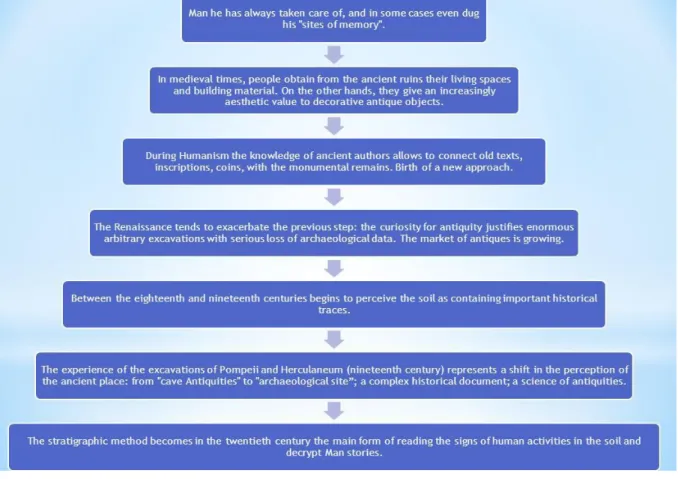
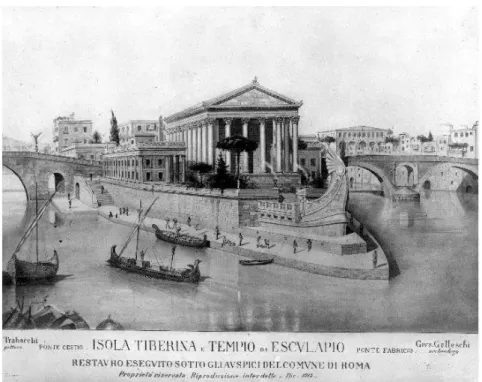
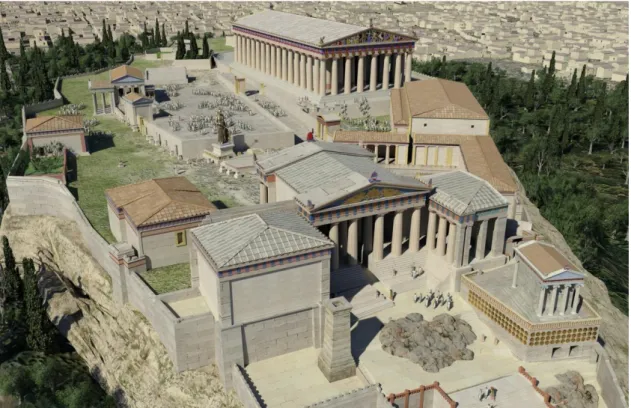
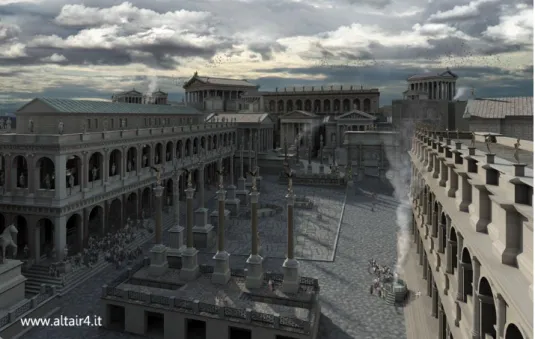
Figure 1.1: Contemporary social role of cultural heritage. Source: adapted from UNESCO et al. (2013)………..………..……10 Figure 1.2: The Evolution of Archaeology. Source: adapted from Manacorda, 2007……….……19 Figure 1.3: Guido Trabacchi (painter) and Giuseppe Gatteschi (archaeologist), 1913. Reconstructive drawing of the Tiber Island (Rome, Italy)……….………..…32 Figure 1.4: Tiber Island, Rome (Italy). Copy of a photograph of the late nineteenth century………....33 Figure 1.5: Ambrosini (painter) and Giuseppe Gatteschi (archaeologist), 1911. “Temple of Castores, and Temple of Divus Augustus (Augusteo) in the year 310 AD according to the visible ruins“……….…34 Figure 1.6: Ruins of the Temple of Divus Augustus, Rome (Italy). Photograph of the photograph of the late nineteenth……….……. 34 Figure 1.7: Graphic reconstruction of the ancient Acropolis in Athens, developed by Altair4 Multimedia………..35 Figure 1.8: Graphic reconstruction (watercolour) of the northern exedra of the Forum of Augustus with the scene of a process……….………...36 Figure 1.9a: Monumental rests of the Roman Forum (Rome, Italy). View from the southeast………37 Figure 1.9b: G.B. Milani (architect) and Giuseppe Gatteschi (archaeologist), 1910. Reconstructive drawing of the Roman Forum………..37 Figure 1.10: Digital Graphic reconstruction of the ancient Roman Forum (Rome) developed by Altair4 Multimedia……….38 Figure 1.11: Detail of the Gismondi's Model of Ancient Rome. Museo della Civiltá Romana, Roma (Italy)…………...39 Figure 1.12: A view of the valley of the Flavian Amphitheater. Frame from the 3D digital model “Rome Reborne”………40 Figure 1.13: Frame from the movie “Gladiator” (2000), by Ridley Scott………....41 Figure 2.1: Sequence of the phases of an archaeological research. Source: adapted from Carandini (1981: 136)……….……….….65 Figure 2.2: Levels of qualification of staff employed in tourism………....….79 Figure 3.1: The PDCA cycle of Deming……….…. ...99 Figure 3.2: The EFQM Excellence Model……….. 103
XI Figure 3.3: Multiple aspects associated to heritage and its management, nowadays……….…108 Figure 3.4: The HGES Assessment Process ……….……….. 119 Figure 3.5: The HERITY Target of the Napoleonic Museum in Rome ………..120 Figure 4.1: Evolution of the concept of interpretivism trough the XIX and XX century………...…….. 137 Figure 4.2: Deductive and inductive approach in scientific research ……….……141 Figure 4.3: The main areas studied during the literature review ………..…..151 Figure 4.4: The macro-dimensions of the study ………152 Figure 4.5: Positioning our study through the gap founded from literature ……….… 154 Figure 4.6: “Paideia Approach to heritage management” ………...157 Figure 4.7: Questions at the basis of the problematisation ………..………...161 Figure 4.8a: Association between the macro dimension and the micro dimension of the study ………..……….………. 163 Figure 4.8b: Overall relationships between the dimensions of the study ……….….…164 Figure 4.9: Theoretical framework ……….…. 165 Figure 4.10: Graphic presentation of the Research Design ………..……….….170 Figure 4.11: Additional attributes of our multiple case study ……….. 173 Figure 4.12: Territory of the Comunidade Intermunicipal do Medio Tejo………….…..183 Figure 4.13: “The Island of Research”, an allegory of the research process………..…193 Figure: 5.1: The interior of the museum. Picture taken during the direct observation...202 Figure 5.2: Model of the Roman theatre inside the museum. Picture taken during the direct observation………203 Figure 5.3: One of the main halls of the museum. Picture taken during the direct observation………...204 Figure 5.4: Outside the museum, the Roman theatre. Picture taken during the direct observation………..205 Figure 5.5: Panel used along the Roman theatre. Picture taken during the direct observation………..…205 Figure 5.6: One of the showcases of the museum with replicas of objects related to daily life in the theatre. Picture taken during the direct observation………...206
XII
Figure 5.7: One of the showcases of the museum with replicas of objects related to the daily life of the Jews. Picture taken during the direct observation……….…..207 Figure 5.8: Graphic rendering (The “target”) of the HGES assessment of the Museo del Teatro………209 Figure 5.9: Interior of the site/museum, where also the video is played………...………210 Figure 5.10a: Diorama with virtual reconstructions of the architectural remains……..211 Figure 5.10b: Diorama with virtual reconstructions of the architectural remains (detail)………...211 Figure 5.11: Showcase containing reproductions of instruments and tools used by the ancient users of the baths……….…….212 Figure 5.12: Graphic rendering (The “target”) of the HGES assessment of the Museo de la Termas Publicas………..…213 Figure 5.13: Certification and assessment HERITY exhibited at the entrance of the site / museum………..…..214 Figure 5.14: The educational material delivered to children and students for the activities of scientific dissemination………..215 Figure 5.15: AULA DIDÁCTICA, the didactic room. Picture taken during the direct observation………..…………216 Figure 5.16: Graphic rendering (The “target”) of the HGES assessment of the Museo del Puerto Fluvial………..…217 Figure 5.17: The target HERITY exposed at the entrance of the museum…………...217 Figure 5.18: Exterior view of the Museum of the Forum. Picture taken during the direct observation………..218 Figure 5.19: Showcases containing, through an effective combination of archaeological remains and drawings………220 Figure 5.20: Model recreating the forum porticoes and the adjoining commercial establishments……….221 Figure 5.21: Model with audio information that recreates the market in the time of Augustus………..221 Figure 5.22: Graphical solution used to explain to the visitor where the walking surface was in Roman times………...222 Figure 5.23: Graphic rendering (The “target”) of the HGES assessment of the Museo del Foro………...223 Figure 5.24: The plaque HERITY exhibited at the entrance of the Museum of the Forum of Caesaraugusta………....224
XIII Figure 5.25a: Public attendance (number of visitors) within the museums of the Ruta Caesaraugusta (Zaragoza, Spain) between 2008 and 2012………...233 Figure 5.25b: Public attendance (number of visitors) within the museums of the Ruta Caesaraugusta (Zaragoza, Spain) between 2008 and 2012………...233 Figure 5.26: Poster of the Evening Show: "The theatre of Caesaraugusta. 20 centuries of history" (July and August 2012)………234 Figure 5.27: The model of cultural heritage management applied for the Ruta Caesaraugusta………236 Figure 5.28: Ratio between local visitors and international/domestic tourists ….…… 237 Figure 5.29a: Logo of the Municipal Network of Museums………..244 Figure 5.29b: Logo of the Municipal Superintendence……….244 Figure 5.30: Graphic rendering (The “target”) of the HGES assessment of the Museo della Civiltá Romana……….. 246 Figure 5.31: Announcement of the closure of the Museum of Roman Civilisation…...257 Figure 5.32: Graphic rendering (The “target”) of the HGES assessment of the Museo dei Fori Imperiali e Mercati di Traiano……….259 Figure 5.33: Room of the Museum of Imperial Forums dedicated to the explication of the Forum of Augustus………...……...…260 Figure 5.34: Graphic Reconstruction of the Forum of Caesar during the Trajan era (Museum of the Imperial Forums)……….……260 Figure 5.35: Graphic reconstruction of the Via Biberatica the Trajan Markets (Museum of the Imperial Forums)………..261 Figure 5.36: Results of the monitoring carried in 2008 on the visitors’ perception of the usefulness of multimedia installations in the Museum of the Imperial Forums……….262 Figure 5.37: The reconstruction (1:1 scale) of an underwater archaeological excavation site on the wreck of a Roman cargo ship………..268 Figure 5.38: Reconstruction (1:1 scale) of the hold of a roman ship in the Room VI of the Museo del Mare e della Navigazione Antica, Santa Marinella, (Rome)……….…..269 Figure 5.39: The flyer / invitation to the multimedia exhibition "The Etruscans in 3D"……….270 Figure 5.40: Graphic rendering (The “target”) of the HGES assessment of the Museo del Mare e della Navigazione Antica………...…271 Figure 5.41a: The Director of the Museum and the Mayor of Santa Marinella received the certification by HERITY General Secretary………..272 Figure 5.41b: The "target" exhibited by Maurizio Quagliuolo during the ceremony….272
XIV
Figure 5.42: Graphic rendering (The “target”) of the HGES assessment of the Sinagoga de Tomar……….. 282 Figure 5.43: Graphic rendering (The “target”) of the HGES assessment of the Castle of Abrantes (Portugal)……….290 Figure 5.44: Graphic rendering (The “target”) of the HGES assessment of the Centro de interpretação de Arqueologia do Alto Ribatejo (Portugal)………..….. 302 Figure 5.45: The newspaper Novo Almoroul, edited by CIAAR……….. 310 Figure 5.46a: Graphic rendering (The “target”) of the HGES assessment (2010-2012) of Museu de Arte Pré-Histórica e do Sagrado do Vale do Tejo………..…………..313 Figure 5.46b: Graphic rendering (The “target”) of the HGES assessment (2014-2016) of Museu de Arte Pré-Histórica e do Sagrado do Vale do Tejo……….... 313 Figure: 5.47: Partcipants of the International Programme (IP) on “Integrated Landscape Management for Sustainable Development”. Museum of Mação (Portugal)………..…320 Figure 6.1: Official invitation to the ceremony of delivery of the 26 HERITY certifications for the sites and museums of Medio Tejo region………... 347 Figure 6.2: Institutional photo at the end of the ceremony for the certification of the 26sites Picture taken during our direct observation, Tomar (Portugal)………….……. 348 Figure 6.3: Algorithm of the empirical model of the study………... 358
XV
List of Tables
Table 3.1: Dimensions considered and examined by HGES………..………….117 Table 3.2: Information provided by the HERITY Target……….………..120 Table 4.1: Comparison between the two main paradigms………..….139 Table 4.2: Traditional stages of scientific research………..…..…142 Table 4.3: Exploratory Research………..149 Table 4.4: Museums visited in Lazio region in order to choose the third case study in Italy………..…..150 Table 4.5: Dimensions of the theoretical model………..…163 Table 4.6: Typical procedures of a case study……….…..174 Table 4.7: Typical sources of qualitative data……….……176 Table 4.8: Benefits and limitations of the three different data collection techniques considered………..….… 178 Table 4.9: List of the 26 sites and museums certified in Portugal by HERITY……... 184 Table 4.10: List of the sites and museums certified by HERITY in the Medio Tejo region (Portugal)………..185 Table 4.11: Portuguese sample frame………. 186 Table 4.12: List of the Museums belonging to the Museum System of the Municipality of Rome……….187 Table 4.13: List of analysed cases……… 188 Table 4.14a: List of the exploratory interviews conducted during empirical phase….. 190 Table 4.14b: List of the exploratory interviews……….191 Table 5.1: Quantitative outcome (on a scale from one to five) of the evaluation HERITY……….208 Table 5.2: Quantitative outcome (on a scale from one to five) of the evaluation HERITY……….213 Table 5.3: Quantitative outcome (on a scale from one to five) of the evaluation HERITY……….216 Table 5.4: Quantitative outcome (on a scale from one to five) of the evaluation HERITY……….223 Table 5.5: Results of the “customer satisfaction survey”………245 Table 6.1a: assessments made and results………...……… 337
XVI
Table 6.1b: assessments made and results……… 337 Table 6.1c: assessments made and results………...……… 337 Table 6.2: Questions contained in the HERITY self-evaluation form and related with the involvement of local population………. 342 Table 6.3: HERITY Question evaluation form for public and related with the involvement of local population………343 Table 6.4: Heritage managers’ Weberian Types towards Quality…………..…………..351
1
Introduction
Quidquid sub terra est, in apricum proferet aetas (Everything that is hidden under ground,
time will return to light). It was what Quinto Horatius Flaccus stated in Epistolae, I, 6, 24. And, as well as an obstetrician helps mothers giving birth, in the same way the "birth" of these treasures from the earth is aided and assisted by specialists such as archaeologists, in a task of (re)construction of the truth that we could define Socratic. But, as well as the obstetrician’s duty does not end with the birth of a baby, but continues with the accompaniment of the dynamics produced by the advent of the unborn to the world (at least for the first few months), in the same way the task of the archaeologist does not end (or, at least, should not end) with the discovery of new remains, but rather should continue with the care and preparation of the "future" of these evidences of the past.
This is a concern that technicians and operators were taking in mind, in the course of time. More and more, the issues associated with the management of cultural heritage and archaeology have been included in the agendas for development. The meaning of the latter has recently been challenged as “the socio-economic situation that the human race is going through on a global scale” which in recent years has forced the revision of the traditional socio-economic beliefs. The succession of paradigms in the field of public planning and development is a normal phenomenon. Reflections about development began with the Age of Enlightenment (XVIII century) and positivism (XIX century), and accompanied the Human Being (as well as Social Sciences) until the present day, with questions such as: how (and why) a country develops more than another? What is, finally, development? What differentiates “development” from “growth”? (Pinheiro do Nascimento, 2001: 97)
The economic and social turmoil of recent years have contributed to the need of deep reflections on public management, governance and the new responsibilities of the players involved in development process (Bursztyn, 2001; Pinheiro do Nascimento, 2001: 97; Svara, 2009). This situation is acutely resumed by Bursztyn (2001), according to whom the current crisis of paradigms that move the progress until now, authorizes the “temerity” to think on new ways for human development. With examining this issue from a global perspective, we can easily agree with Bounfour (2005) and affirm that the dominant system, under which we are living, is undergoing a deep transformation. Capitalism as a socioeconomic system is undergoing modification towards a set of new
2
organisational forms, in which drivers are mainly Information technology (IT) and culture (Bounfour, 2005: 4).
The “desired change” is deep and involves different sectors. Svara (2009) observes, for example, that as cities face the challenge of adapting to new approaches to governance, all mayors need to lead with vision and facilitation. In the same way, Von Mutius (2005: 153) points out that immaterial and material assets should be regarded in the future as being of equal weight and essential to be balanced in new ways in all areas of leadership and management activity that is a comprehensive and interdisciplinary leadership task that presents itself as an extension of integrated management developed in the 80’s by the Berliner Bleicher (2011).
With our work we want to analyse the reflections of these paradigm shifts, in the field of heritage management and its contribution in the creation of wealth in terms of knowledge for local communities and visitors. The field of the cultural and intellectual capital for communities was deeply approached by authors like Bounfour and Edvinsson (2005). According with their general conclusions, this field could represent an original and cutting-edge area of research which could potentially change the modalities of public sector planning and development, since it is demonstrated that intellectual capital is valuable to create wealth in a given city, region, nation - as well as in a given company, in private sector (Bounfour & Edvinsson, 2005: xi).
So, if the intellectual and cultural capital is considered a significant value in the development, it is necessary to reflect on the source of this wealth and its management. The development of powerful intangible resources is an essential issue for companies and for public organisations, too. The latter should develop innovative approaches, particularly in specific horizontal fields of action like research programs, fiscal policies, competition policies and system of education (Bounfour & Edvinsson, 2005: xiii). In the case of our interest, the cultural heritage of a given territory, particularly archaeological, is one of these sources of knowledge and enrichment. The ability (and responsibility) to communicate the cultural content of archaeological resources has not always been considered as a function of archaeology, as clearly showed in the works of Carandini (1981) and Manacorda (2007), on the evolution of this discipline. Therefore, we must pass through different stages of maturity of this "Science of Antiquity" (Manacorda, 2007: 29) in order to finally reach a methodological autonomy as well as the awareness of the social responsibility of archaeological research.
3 The ability to stimulate the collective interest towards the research of its historical identity, through the development and dissemination of archaeological knowledge becomes important for two reasons. Firstly, it becomes an indispensable tool for the preservation of its assets, and secondly, it stimulates the curiosity and openness to new cultures in a global context of commitment to the building of peace, because as Settis (2002: 12) states, "The historical self-consciousness of the peoples and nations is the best antidote to nationalism". So in this worldwide compromise to aim local development in a perspective of global socio-economic stability and peace, the role of cultural heritage and its enhancement for social and economic purposes is crucial. The powerful statement of famous architect and planner Aldo Cazzullo, “peace is like a city: does not exist in nature, so we have to build it” (Cazzullo, 2013), leads us to affirm that cultural heritage should serve as foundation for this “wonderful city”.
The present work fits in this debate. Despite starting from the issue of the quality management of heritage as an instrument of regional planning and development and for the improvement of tourism offer and competitiveness (not only from the point of view of services, but also from the point of view of the authenticity of the destination, as we shall see), in reality the scope and contribution of the study fit into the largest search for new paradigms of global development, confident that the archaeological heritage (and cultural heritage in general) can be a vehicle for social and sustainable economic growth, through the involvement of residents and tourists, and that this concern should be formally incorporate between the minimum standards, internationally shared, of quality of archaeological and other cultural heritage management.
Structure of the thesis
The thesis is structured into five chapters, preceded by a general introduction to the work and followed by the general conclusions. The first part of the thesis is designed to create a solid base of knowledge and preliminary considerations about archaeology and
archaeological heritage management (Chapter 1), the links between heritage and tourism (Chapter 2) from several points of views. Finally, we analyse in depth the concept
of quality (Chapter 3) that now is applied to the management of cultural heritage, but it was actually born already several decades ago in the industrial sector. This chapter contains the entire evolution of the concept and the way in which finally it converged towards the services sector and heritage management.
4
The second part of the thesis, the empiric part, begins with the Chapter 5. The latter is dedicated to the methodology: the “keystone” of the entire work, this chapter contains a detailed discussion on the theory of knowledge, on scientific revolutions and the “theory of complexity", as we adopted a “complex approach” in making this investigation. Still in chapter 5 we clarify the proposed paradigm that is underlying the work. Furthermore, the theoretical model, as well as the theoretical contribution, is exposed in this same chapter. The fifth chapter will present the cases analysed, firstly separately and then through a cross-cases analysis. Finally, we outline the findings resulting from the empirical work. The thesis ends outlining general conclusions and suggestions.
The thesis contains several figures, charts and explanatory tables supporting the text. These are numbered sequentially within each chapter (numbering indexed to chapter as proposed by A. Pereira & Poupa, 2003). For example, the figure 1.3 will correspond to the third figure in the first chapter. We opted for this type of numbering because it seems to allow a more rapid access to the figures which are quickly attributable to a well-defined chapter, thus, to a well-defined topic of the thesis.
5
Chapter 1
Archaeology and
6
Introduction
This chapter is devoted to the central theme of this study: the management of the archaeological heritage and the role of archaeology in the new paradigms of development. The architecture of the chapter is designed in order to provide the reader with the tools necessary to address the issue, and to introduce him in the following chapters. The chapter opens with a clarification of the cultural heritage and its value within the society, in the past and the present day. The increasing attention and epistemological analysis, about the boundaries and contents of cultural heritage has led to new approaches in the guidelines of its conservation and management. The clear and unequivocal definition of "intangible cultural heritage" is a clear example of the result of these technical-scientific reflections. In most cases, these guidelines have been established by eminent supranational structures such as the United Nations bodies including UNESCO. The content of this chapter is largely based on the analysis of these guidelines, as well as the formulation of reflections, constructed on the existing theories about the cultural heritage. After reporting these issues, and to gradually approach the main object of study, the difference between tangible and intangible heritage, from the perspective of their function in the development and social dynamics will be discussed.
This digression on the subject of cultural heritage will serve to define the evolution of its policy of management and its role in society over time. After defining this, we will focus on that part of the cultural heritage which, by definition, represents the remains of the material culture of a community, that is, the archaeological heritage. Furthermore, we’ll focus on the discipline that studies the material remains of the cultural heritage, the archaeology, and the analysis of its role within the paradigmatic changes regarding the processes of socio-economic development. To do so, this part of the chapter will address key issues, such as:
the definition of the scope of archaeology;
the technical and ethical responsibilities of an archaeologist;
what is defined as an archaeological site (and what is defined as a non-site);
what kind of social, historical and archaeological processes are responsible for the creation of archaeological sites;
the historical, social, identity contents of the archaeological heritage, nowadays and in the past, and their values within communities;
7
the relevance of its contents to the contemporary society, and how they are communicated to the public, and enhanced on behalf of communities’ development.
Summarizing, the first part of the chapter will represent the excursus which introduce more complex questions, about the role of archaeology, archaeologist and archaeological heritage within regional planning and development, and the opportunity to manage archaeological knowledge and heritage in order to create a social benefit. Complex process of regional planning that comes completed by the tourist enhancement of these spaces and knowledge.
8
1.1 Cultural Heritage: meaning and values
Culture is an intricate and inclusive concept, as evidenced by the large existing debate about this term in several scientific fields. Originally, anthropology was conceived for the study of different cultures, which were considered to be static. Recently, a vibrant debate within anthropology has criticized this notion of culture as a bounded, rigid entity. A new approach showing that cultures are in constant contact with one another, and they have been for centuries; due to these meetings, cultures are constantly changing, leaving tangible and intangible vestiges of such everlasting process: what is left is what we use to call cultural heritage.
The English word heritage comes from the French héritage. The latter derives from Latin
hereditas, that means inheritance, and which is a synonymous for patrimony. In Latin
language the term patrimonium designated the property of the father, a family legacy (Castglione & Mariotti, 1990) or else, a family “heritage”. This was its meaning until the XVIII century. According to Amado Mendes (2009: 188), with the French Revolution the term "heritage" purchased a collective meaning, namely, testimony of national history. It was indeed in this same period (1790) which comes the term "historical monument", as advocated by the same author. In this sense, it is nevertheless appropriate to report that, with a more current reflection, Dolff-Bonekämper (2009: 71) alerts us to the weakness of this model, that “defines identity and heritage circles, highlighting, and sometimes even strengthening, the boundaries between them; it is both inclusive and exclusive, defining an inside and an outside, entailing a risk of cultural and political partitioning, both internally, for the groups defined as minorities, and externally, vis-à-vis neighbouring states”.
Cultural heritage indicates the "goods of a community" or, rather, an “intergenerational legacy" (Umbelino, 2004: 22). Several factors influenced, according to Amado Mendes (2009: 189), the evolution of the meaning of heritage and the reasons that led to the hegemony of the connotation of cultural heritage:
1) The democratisation of society, culture and history;
2) Extension of the concept of cultural heritage from fine arts to science;
3) The rapid changes introduced by the 3rd industrial revolution (XX century), which led to the urgent need to preserve the cultural traits that, otherwise, the rapid progress would cancel forever.
9 The meaning of heritage is clearly defined by the Oxford Dictionary, as a word with an ancient French origin, referred to “valued objects and qualities such as historic buildings and cultural traditions that have been passed down from previous generations”, something "denoting special architectural, historical, or natural value and that are preserved for the nation”. Finally, the Faro Convention defines (Art. 2) cultural heritage as “a group of resources inherited from the past which people identify, independently of ownership, as a reflection and expression of their constantly evolving values, beliefs, knowledge and traditions. It includes all aspects of the environment resulting from the interaction between people and places through time” (Council of Council-of-Europe, 2005).
One can therefore say that heritage is represented by all those rests which talk about the past, the ancient tradition of a particular geographical and cultural area, whose "key factor is its ability to symbolically represent an identity " (Peralta, 2003). Today heritage has become one of the guiding words of contemporary historical knowledge. This term goes from a "notarial" meaning (still used in the late sixties and seventies) to a definition much more compelling and pervasive: it indicates no more goods that are inherited, but the assets constituting the collective consciousness of a group. In this sense, words like 'memory' and 'identity' become almost synonymous (Audrerie, 2003: 23-24).
In this context, one of the key elements that constitute the cultural heritage of a community is the archaeological heritage, that is, the material traces of any human activity over time (Hardesty, 2008; Manacorda, 2007).
1.1.1 The role of cultural heritage within society and development
The Universal Declaration of Human Rights encompasses cultural rights, which invites participation in cultural life in all societies. Such participation fosters the exercise of active citizenship and promotes social cohesion. Many ancient texts demonstrate that the Universality attributed to the message of the cultural heritage, generally, and ancient monuments, in particular, are not the product of a sensibility of our time, translated by the Convention of UNESCO (1972). This sense already pervaded the classical world: very interesting from this point of view the analyses of the letter written by the Byzantine general Flavius Belisarius to his enemy, Totila, when the latter was about to destroy Rome after the siege to the city (VI century). The epistle of Belisarius - as remembered by the principal historian of that period, Procopius of Caesarea (Wars of Justinian,
10
8.22.8-17) was to admonish Totila about the mistake that he would make by razing a city like Rome and its monumental richness, to which Belisarius attributes an ecumenical value. This document is a demonstration of the “lively awareness of urban heritage, perceived as cultural stratification and collective heritage to be transferred to posterity" (Manacorda, 2007: 51).
In our days, a very fast process of modernisation and the scale of change in society confer to heritage an increasing significance. In such circumstances, indeed, evidences of past societies can provide a sense of belonging and security, and define identities, as highlighted by UNESCO, ICCROM, ICOMOS, and IUCN (2013). We also must consider that understanding the past can be of great help for managing the problems of the present and the future (UNESCO et al., 2013).
Figure 1.1: Contemporary social role of cultural heritage. Source: adapted from UNESCO et al. (2013)
Fairly recently the international community begun to appreciate the importance of conserving cultural heritage as places where social and cultural factors have been and continue to be important in shaping them, rather than as a series of monuments offering
Cultural
Hertitage
Defining identities
Providing a sense of
belonging and
security
Providing great help
for managing the
problems of the
present and the
11 physical evidence of the past (UNESCO et al., 2013). At European level, the so called Valletta Treaty (Council-of-Europe, 1992) defines the guiding principles for the protection and integrated management of the archaeological heritage as a source of European
collective memory and as an instrument for historical and scientific study. All remains and objects and any other traces of humankind from past times are considered to be elements of the archaeological heritage. The archaeological heritage shall include structures, constructions, groups of buildings, developed sites, moveable objects, monuments of other kinds as well as their context, whether situated on land or under water (Art. 1). The Treaty defines the participation of communities in the management of
archaeological heritage as well as the inclusion of the issues linked to the conservation and enhancement of archaeological heritage within the development projects. Few years before the elaboration of the Valletta Treaty, ICOMOS (1990) declared that a knowledge and understanding of the origins and development of human societies is of fundamental importance to humanity in identifying its cultural and social roots.
The notion of cultural heritage and its values may be viewed from a number of standpoints. Amado Mendes (2009: 190) defines several values of cultural heritage:
Artistic; Aesthetic; National; Cognitive; Symbolic; Social; Economic; Educational; Touristic.
However, he defends that the heritage itself is a “cultural construction” (Amado Mendes, 2009: 190). Culture is a fluid and problematic concept to deal with. In the approach of UNESCO (2006) it is summarily taken to mean both ‘ways of life’ (beliefs, values, social practices, rituals and traditions etc.) and the tangible (buildings, monuments, objects etc.) and intangible (language, performances and festivals, craftsmanship etc.) expressions and manifestations of society’s values and beliefs. Although the notion of ‘cultural heritage’ was originally conceived within the industrialised and developed world and thus reflected the values inherent in such societies, today the idea has been widened to cover
12
the role of cultural heritage even in the lesser-developed world where there is less emphasis upon grand and permanent structures and recorded narratives.
Generally speaking, scholars like Manacorda (2007: 80) alert on the consequences of a society without history, considering the negative results of some recent examples of denial of history promoted by some sectors of the "technological West". Indeed, the role of cultural heritage and its intrinsic valuesit must also be contextualized in the current necessity to recover a “world of values” justified by what the polish sociologist Bauman (2000) defines liquidity of the society today, in which the idea of community, the feeling membership and the presence of solid values is perceived as definitively lost.
On the other hand, the "identity” and the “social” value of cultural heritage is indirectly demonstrated by its manipulation in certain historical periods, for political purposes and propaganda. Carocci (1993) and, after him, Manacorda (2007) observe, indeed, that during and after the Middle Ages some Roman families occupied, unfairly, ancient buildings in order to demonstrate the authenticity and validity of their nobility: the possession of physical rests of the past (the ancient roman structures) and its reoccupation, it symbolically represented a supposed link with the antiqua nobilitas, legitimizing the power of these families. Again, in the modern ages, Rome became the Italian capital, according to Vidotto (2006), due to the power of its symbolic dimension, capable of silencing all opposition. Thus, according to the latter author, archaeology -
understood here as the conservation and management of the memory of ancient history - contributed to defining the use, the characteristics and the styles of new public spaces.
Still, some years later, Mussolini based his propaganda (and his search for legitimacy) on the same principle, enhancing (and often misrepresenting) the values of the Roman Empire mainly through the symbolic component of the monumental ruins of the past. The same symbolic and ideological purposes were intended to the Pergamon Museum in Berlin, and the whole Museumisnel, created since 1824 with the aim to bring together the best monumental manifestations of Western culture, symbolically converging in German culture (Melotti, 2008: 14).
1.1.2 Bridging cultural heritage values with new paradigms of development
The recognition of intangible and ‘movable’ cultural heritage in the Convention for the Safeguarding for the Intangible Heritage (UNESCO, 2003) significantly recognised other forms of heritage that has meaning beyond material manifestations, is transmitted13 through the generations and which is also central in shaping identity. The latter is one of the most important issues related to the value of cultural heritage: in an increasingly globalised world, characterized by the sharing of ideas and people’s mobility, the constant search for connections and roots reflects the individual’s need to belong and to know who he/she is.
In this sense, tourism itself is cultural, and its practices and structures are an extension of the normative cultural framing from which it emerges. Consequently, tourism becomes very important to understand ourselves, our cultural values, and the multi-layered relationships between humanity and the material and non-material world we occupy and journey through (Robinson & Phipps, 2004). Often communities only become aware of particular cultural elements of their own heritage through the interaction with tourists: the mobilisation of cultural elements – or ‘resources’ – may only make sense in relation to the “touristic other”, as a symbolic vehicle to define and distinguish the self from the other (D. Picard & Robinson, 2005).
The heritage management assumes an important, unexplored role (as we see in subsection 1.1, in this chapter), by potentially influencing the capacity of development at the local level. Is amply demonstrated the influence of the level of self-knowledge of the regions and their projected image on its openness or resistance to change and to develop: the way you perceive yourself and how others look upon you can become a key asset but under other circumstances it can became a liability (Karlsson & Martinez, 2005: 283). If one considers himself “backwards” or “advanced”, he will behave accordingly; in the same way, in the process of building a regional identity and image, the focus on certain characteristics or natural resources rather than others, influences the choice of strategies for the future of that territory (Karlsson & Martinez, 2005: 283). Yet we cannot fall into the temptation to adopt the simplistic idea of the promotion of cultural heritage as the only recipe for development: as Karlsson and Martinez (2005: 283) alert, even a region with strong self-esteem and image based on the glory of its past as well as on strong traditions, if not combines these elements with an effective openness to change, risks losing many opportunities of development.
With regard to the latter issue, Bounfour (2005: 3) alerts that when we discuss the topic of intangibles, we often do not consider the major issue of its underlying socioeconomic system, nor do we sufficiently the real implications of the emergent reality of “knowledge economy”. Conceptually, according to this emerging paradigm players and communities
14
are supposed to behave according to certain criteria linking knowledge (in a broad sense) and technology. The knowledge ecology approach (North & Kares, 2005: 255) holds that one cannot manage knowledge, but can create conditions that enhance the knowledge flows. On this bases, North and Kares (2005: 254) speak about the metaphor of regions as knowledge markets, and propose ten pars of criteria to define the capacity of a region, to capture new ideas, trends and developments (North & Kares, 2005: 256-257). Furthermore, eminent institutions like the Council of Europe (2009: 125) insist on the importance of the cultural context of sustainability, linking new paradigm of development to cultural issues. Even the role of culture and heritage in economy is deeply approached, by scholars such as Rypkema (2009: 113) and supranational organisations, like UNESCO (2000b).
It is also important to be aware of the fact that even if the conservation and enhancement of cultural heritage has, in operational terms, a local scale, it implies positive impact on a global scale. The commitment to the protection and enhancement of the cultural aspects of a region/community play a double function, when considered in the context of the new paradigms of development and as part of the on-going globalisation process, and new: local cultural heritage preservation and promotion and global preservation of cultural diversity. As noted by UNESCO (2000b: 39): “just as policies of biodiversity preservation are needed to guarantee the protection of natural ecosystems and the diversity of species, only adequate cultural policies can ensure the preservation of the creative diversity against the risks of a single homogenizing culture. (…) Cultural diversity is the positive expression of the overarching objective to prevent the development of a uniform world by promoting and supporting all world cultures”.
Summarizing, today heritage has become one of the guiding words of contemporary historical knowledge. This term goes from a "notarial" meaning (still used in the late sixties and seventies) to a definition much more compelling and pervasive: it indicates no more goods that are inherited, but the assets constituting the collective consciousness of a group. In this sense, words like 'memory' and 'identity' become almost synonymous (Audrerie, 2003: 23-24).
There is no doubt that in the field of culture and cultural heritage, an important role is played by archaeology and archaeological heritage (we include in the concept of “archaeological heritage” also the “archaeological knowledge” constructed through the archaeological investigation on the material remains of the past). The archaeological