Proton induced dielectron radiation off Nb: P
tand Y
distributions
M. Lorenz7, M. Weber9, G. Agakishiev6, C. Behnke7, D. Belver16, A. Belyaev6, J.C. Berger-Chen8, A. Blanco1, C. Blume7,
M. B¨ohmer9, P. Cabanelas16, S. Chernenko6, C. Dritsa10, A. Dybczak2, E. Epple8, L. Fabbietti8, O. Fateev6, P. Fonte1,a, J. Friese9, I. Fr¨ohlich7, T. Galatyuk4,b, J. A. Garz´on16, K. Gill7, M. Golubeva11, D. Gonz´alez-D´ıaz4, F. Guber11, M. Gumberidze14,
S. Harabasz4, T. Hennino14, R. Holzmann3, P. Huck9, C. Hhne10, A. Ierusalimov6, A. Ivashkin11, M. Jurkovic9, B. K¨ampfer5,c,
T. Karavicheva11, I. Koenig3, W. Koenig3, B. W. Kolb3, G. Korcyl2, G. Kornakov16, R. Kotte5, A. Kr´asa15, E. Krebs7, F. Krizek15,
H. Kuc2,14, A. Kugler15, A. Kurepin11, A. Kurilkin6, P. Kurilkin6, V. Ladygin6, R. Lalik8, S. Lang3, K. Lapidus8, A. Lebedev12, L. Lopes1, L. Maier9, A. Mangiarotti1, J. Markert7, V. Metag10,
J. Michel7, C. M¨untz7, R. M¨unzer8, L. Naumann5, M. Palka2, Y. Parpottas13,d, V. Pechenov3, O. Pechenova7, J. Pietraszko7, W. Przygoda2, B. Ramstein14, L. Rehnisch7, A. Reshetin11,
A. Rustamov7, A. Sadovsky11, P. Salabura2, T. Scheib7, H. Schuldes7, J. Siebenson8, Yu.G. Sobolev15, S. Spataroe, H. Str¨obele7, J. Stroth7,3, P Strzempek2, C. Sturm3, O. Svoboda15, A. Tarantola7, K. Teilab7, P. Tlusty15, M. Traxler3, H. Tsertos13, T. Vasiliev6, V. Wagner15,
C. Wendisch5,c, J. W¨ustenfeld5, S. Yurevich3, Y. Zanevsky6
(HADES collaboration)
1LIP-Laborat´orio de Instrumenta¸c˜ao e F´ısica Experimental de Part´ıculas , 3004-516 Coimbra, Portugal 2
Smoluchowski Institute of Physics, Jagiellonian University of Cracow, 30-059 Krak´ow, Poland 3
GSI Helmholtzzentrum f¨ur Schwerionenforschung GmbH, 64291 Darmstadt, Germany 4
Technische Universit¨at Darmstadt, 64289 Darmstadt, Germany 5
Institut f¨ur Strahlenphysik, Helmholtz-Zentrum Dresden-Rossendorf, 01314 Dresden, Germany 6Joint Institute of Nuclear Research, 141980 Dubna, Russia
7
Institut f¨ur Kernphysik, Goethe-Universit¨at, 60438 Frankfurt, Germany
8Excellence Cluster ’Origin and Structure of the Universe’ , 85748 Garching, Germany 9
Physik Department E12, Technische Universit¨at M¨unchen, 85748 Garching, Germany 10II.Physikalisches Institut, Justus Liebig Universit¨at Giessen, 35392 Giessen, Germany 11
Institute for Nuclear Research, Russian Academy of Science, 117312 Moscow, Russia 12
Institute of Theoretical and Experimental Physics, 117218 Moscow, Russia 13Department of Physics, University of Cyprus, 1678 Nicosia, Cyprus 14
Institut de Physique Nucl´eaire-Universit´e Paris Sud, F-91406 Orsay Cedex, France
15Nuclear Physics Institute, Academy of Sciences of Czech Republic, 25068 Rez, Czech Republic 16
LabCAF. Dpto. F´ısica de Part´ıculas, 15706 Santiago de Compostela, Spain aalso at ISEC Coimbra, Coimbra, Portugal
b
also at ExtreMe Matter Institute EMMI, 64291 Darmstadt, Germany calso at Technische Universit¨at Dresden, 01062 Dresden, Germany d
e
also at Dipartimento di Fisica Generale and INFN, Universit`a di Torino, 10125 Torino, Italy E-mail: [email protected]
Abstract. Following our recent letter [1] on inclusive e+e−pair production in proton induced reactions at Ekin= 3.5 GeV on the nucleus Nb, we present here in addition the transverse and rapidity distributions for various e+e−invariant mass bins and compare them to reference data measured in p+p reactions.
1. Introduction
The prospect to relate hadron properties inside a strongly interacting medium with chiral sym-metry restoration has motivated plenty of work, both in theoretical and experimental physics. The spontaneous breaking of chiral symmetry leads to a non vanishing value of the two-quark condensate, which is related to the dynamical generation of hadron masses. Focussing mainly on vector mesons, various models predict relatively strong changes of particle masses and/or widths already at normal nuclear matter density ρ0 [2, 3, 4, 5]. However a consistent picture
of in-medium hadron properties has not yet emerged and more experimental input is needed. Moreover such modifications are expected to be most pronounced for particles with small rela-tive momenta to the surrounding medium according to hadronic models [6], a region which is challenging to access in experiment.
Experimentally, in-medium properties can be directly studied using the decay of vector mesons into an e+e−pair, since electrons and positrons are not affected by strong final state interactions. Although medium modifications are expected to be stronger in heavy-ion collisions, compared proton-, pion- or photon- induced reactions on nuclei, measured observables represent an average over the complete space-time evolution of the temperature and the density of the system and are hence more complicated to model. On the other hand, in induced reactions on nuclei the system does not undergo a noticeable density and temperature evolution in time, hence conditions of the system are better defined. The experimental drawback is that, for a measurement sensitive to the in-medium spectral shape, the decay to an e+e− pair has to take place inside the nucleus. Therefore good acceptance for decays of low momentum vector mesons is of crucial importance, in particular, for the relatively long living ω and φ mesons.
] 2 [GeV/c ee M 0 0.2 0.4 0.6 0.8 1 1.2 )] 2 [mb/(GeV/c ee /dM σ d -7 10 -6 10 -5 10 -4 10 -3 10 -2 10 -1 10 1 γ -e + e → o π γ -e + e → η N -e + e → ∆ -e + e o π → ω -e + e → ρ -e + e → ω sum p+Nb 3.5 GeV p+p 3.5 GeV o > 9 ee α <2.0 GeV/c e 0.1<P
Figure 1. Dielectron cross sec-tions measured in p+Nb and p+p reactions at a kinetic beam energy of 3.5 GeV. In case of the p+p data a comparison to a calculated PYTHIA/PLUTO dielectron cock-tail is shown in addition (the differ-ent sources are listed in the legend).
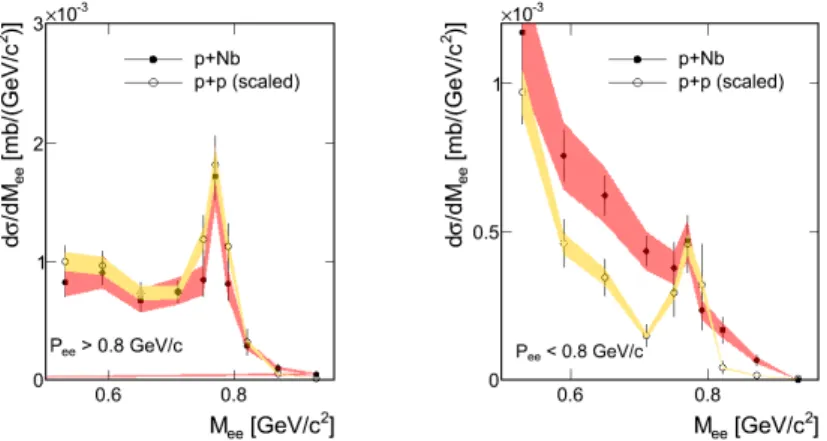
Figure 2. Left: Comparison of the dielectron invariant mass spectra in the vector meson mass region for pairs with Pee > 0.8 GeV/c from p+p (scaled) and p+Nb at a kinetic
beam energy of 3.5 GeV. Right: For pairs with Pee< 0.8 GeV/c.
In fact, most experiments focusing on the spectral distribution of dielectrons produced off nuclei in photon and proton induced reactions are restricted to relatively high momenta (Pee > 0.8
GeV/c) and are not conclusive yet. For the ρ meson, the CLAS experiment at JLab [7] reports a slight broadening and no shift of the ρ pole postion in photon induced reactions, while the E325 experiment at KEK [8] deduced a shift but no broadening in proton induced reactions. In this paper we follow our recent letter [1] on inclusive e+e−pair production in proton induced
reactions at Ekin = 3.5 GeV on the nucleus Nb, representing the first high statistics
measure-ment with small momeasure-menta of e+e− pairs relative to the medium (Pee< 0.8 GeV/c). We present
here in addition the transverse momentum and rapidity distributions for various e+e−invariant mass bins. These data are compared to our reference data measured in p+p reactions at the same incident beam energy [9] 1.
2. Experimental data
The efficiency corrected invariant mass distributions of e+e−pairs within the HADES acceptance are displayed in Fig. 1. The systematic uncertainties are represented by colored horizontal, which are the quadratic sum of errors estimated from different particle identification methods (10%), from consistency checks of the efficiency correction (10%), including the uncertainty due to combinatorial background subtraction, and from the normalization to cross sections (15%). The total systematic error amounts to 21% in case of the p+Nb data, and to 20% for the p+p data. Only the systematic errors of the normalization are taken into account for the comparison of the shape of the invariant mass spectra as the other systematic errors should cancel at first order. For the p+p data, a dielectron cocktail, generated using an adapted version of the event generator PYTHIA (see [9] for details) is displayed in addition. We distinct between four different mass regions: Mee [GeV/c2] < 0.15 (dominated by neutral pion decays), 0.15 < Mee [GeV/c2]
< 0.47 (η Dalitz decay dominated), 0.47 < Mee [GeV/c2] < 0.7 (dominated by direct ρ decays
and Dalitz decays of baryonic resonances and ω mesons) and 0.7 < Mee [GeV/c2] (ρ and ω
dominated) as can be seen from the cocktail. Around 1 GeV/c2 a low statistics φ signal is
1 Note that, according to the systematics on dielectron emission obtained in p+p and d+p collisions at various beam energies by the DLS collaboration [10], it is save to conclude that at the kinetic beam energy of 3.5 GeV isospin effects play only a secondary role. Therefore, in order to extract medium effects in p+Nb, the above discussed p+p data at the same kinetic beam energy of 3.5 GeV/c is a valuable reference.
[GeV/c] t P 0 0.2 0.4 0.6 0.8 1 1.2 [mb/(GeV/c)]t /dP σ d -7 10 -6 10 -5 10 -4 10 -3 10 -2 10 -1 10 2 <0.15 GeV/c ee M [GeV/c] t P 0 0.2 0.4 0.6 0.8 1 1.2 [mb/(GeV/c)]t /dP σ d -7 10 -6 10 -5 10 -4 10 -3 10 -2 10 -1 10 2 <0.47 GeV/c ee 0.15 <M [GeV/c] t P 0 0.2 0.4 0.6 0.8 1 1.2 [mb/(GeV/c)]t /dP σ d -7 10 -6 10 -5 10 -4 10 -3 10 -2 10 -1 10 2 <0.7 GeV/c ee 0.47 <M [GeV/c] t P 0 0.2 0.4 0.6 0.8 1 1.2 [mb/(GeV/c)]t /dP σ d -7 10 -6 10 -5 10 -4 10 -3 10 -2 10 -1 10 2 >0.7 GeV/c ee M p+Nb p+p (scaled)
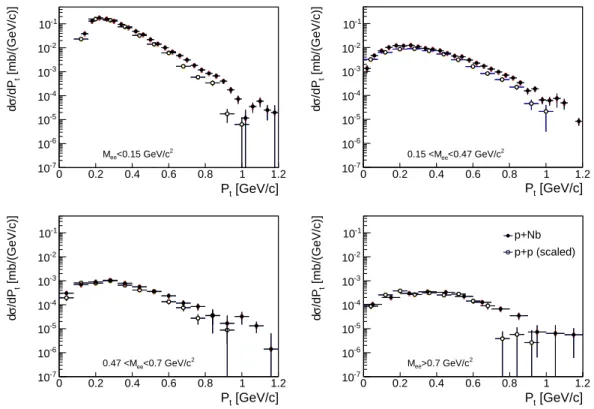
Figure 3. Transverse momentum distributions of dielectrons in p+p (scaled) and p+Nb collisions.
visible, which will be further discussed in future, making use of additional information from its hadronic decay channel to charged kaons. The underestimation of the dielectron yield in the mass region from 0.47 < Mee [GeV /c2] < 0.7 is addressed in e.g. [12, 13], where the authors improve
the description by the introduction of a coupling between ρ mesons and baryonic resonances. Comparing the shape of the invariant mass spectra separately for pairs with momenta larger and smaller 0.8 GeV/c to pairs from p+p, scaled to the number of participants and the total reaction cross section, we observe a strong e+e− excess yield below the ω pole mass in the small momentum sample displayed in the right panel of Fig. 2, while for pairs with Pee> 0.8 GeV/c
no significant difference in the vector meson mass region within the systematic uncertainties indicated by the colored bands in the panel of Fig. 2, is visible. For pairs with Pee< 0.8 GeV/c
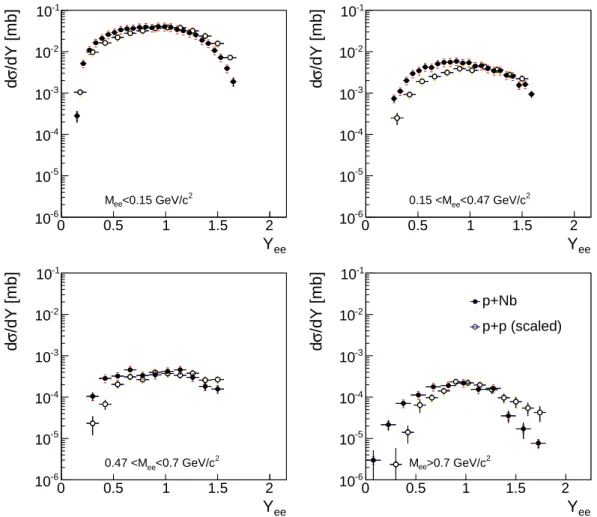
(right panel of Fig. 2) the e+e− yield at the ω pole mass is not reduced, but as the underlying smooth distribution is enhanced, the yield in the peak is reduced to almost zero within errors. This additional yield we attribute to ρ-like channels as it is supposed to be the dominating source for radiation from the medium due to its large total width. For more details, see [1]. Comparing the Pt and Y distributions for the four previously discussed invariant mass regions
the very same pattern is observed: In the p+Nb system the distributions reach out to slightly higher transverse momentum and the rapidity distributions shift towards target rapidity, see Fig. 3 and Fig. 4. The latter one is much stronger pronounced and corresponds to second generation particles produced from a slower source compared to the initial one. Although this behavior is to some extent expected (stronger transformation of longitudinal energy to transverse degrees of freedom in p+Nb) the defined values are important constraints to phenomenological models in order to correctly model the experimental conditions.
ee Y 0 0.5 1 1.5 2 /d Y [ m b ] σ d -6 10 -5 10 -4 10 -3 10 -2 10 -1 10 2 <0.15 GeV/c ee M ee Y 0 0.5 1 1.5 2 /d Y [ m b ] σ d -6 10 -5 10 -4 10 -3 10 -2 10 -1 10 2 <0.47 GeV/c ee 0.15 <M ee Y 0 0.5 1 1.5 2 /d Y [ m b ] σ d -6 10 -5 10 -4 10 -3 10 -2 10 -1 10 2 <0.7 GeV/c ee 0.47 <M ee Y 0 0.5 1 1.5 2 /d Y [ m b ] σ d -6 10 -5 10 -4 10 -3 10 -2 10 -1 10 2 >0.7 GeV/c ee M p+Nb p+p (scaled)
Figure 4. Rapidity distributions of dielectrons in p+p (scaled) and p+Nb collisions.
3. Summary
In addition to our recent letter [1] on inclusive e+e−pair production in proton induced reactions at Ekin= 3.5 GeV on the nucleus Nb, we presented the transverse and rapidity distributions for
various e+e− invariant mass bins. Comparing these distributions to reference data from p+p
collisions, the following pattern is observed: In the p+Nb system the distributions reach out to slightly higher transverse momentum and the rapidity distributions are shifted towards target rapidity. Especially the defined shift in rapidity gives important constraints to phenomenological models.
[1] G. Agakishiev et al. (HADES Collaboration]), Phys. Lett. B 715 304 (2012). [2] R. Brockmann and W. Weise, Phys. Lett. B 367, 40 (1996).
[3] G. E. Brown and M. Rho, Phys. Rev. Lett. 66, 2720 (1991). [4] T. Hatsuda and S. H. Lee, Phys. Rev. C 46, R34 (1992). [5] R. Rapp et al., Nucl. Phys. A 617, 472 (1997).
[6] S. Leupold, V. Metag, and U. Mosel, Int. J. Mod. Phys. E 19, 147 (2010). [7] R. Nasseripour et al. (CLAS Collaboration), Phys. Rev. Lett. 99, 262302 (2007). [8] M. Naruki et al., Phys. Rev. Lett. 96, 092301 (2006).
[9] G. Agakishiev et al. (HADES Collaboration), Eur. Phys.J. A 48 64 (2012). [10] W.K. Wilson et al. (DLS Collaboration), Phys. Rev. C57 1865 (1998). [11] G. Agakishiev et al. (HADES Collaboration), Eur. Phys. J. A 41, 243 (2009). [12] J. Weil, K. Gallmeister and U. Mosel, arXiv:1105.0314 [nucl-th].