Creation of a Vehicular Delay-Tolerant Network Prototype
João A. Dias
1, João N. Isento
1, Bruno M. Silva
1,2, Vasco N. G. J. Soares
1,2,
Paulo S. Ferreira
3, António M. D. Nogueira
3, and Joel J. P. C. Rodrigues
1,2 1Department of Informatics, University of Beira Interior
2
Instituto de Telecomunicações, NetGNA Group
Rua Marques D’Ávila e Bolama – Covilhã, Portugal
Telf.: +351 275 319 891; Fax: +351 275 319 899; e-mail:
[email protected]
,
[email protected]
,
[email protected]
,
[email protected]
,
[email protected]
3
Instituto de Telecomunicações, University of Aveiro
Campus de Santiago – Aveiro, Portugal
Telf.: +351 234 377 900; Fax: +351 234 377 901; e-mail:
[email protected]
,
[email protected]
Abstract
— Vehicular Delay-Tolerant Network(VDTN) is a new disruptive network architecture where vehicles act as the communication infrastructure. VDTN follows a layered architecture based on control and data planes separation, and positioning the bundle layer under the network layer. VDTN furnishes low-cost asynchronous communications coping with intermittent and sparse connectivity, variable delays and even no end-to-end connection. This paper presents a VDTN prototype (testbed) proposal, which implements and validates the VDTN layered architecture considering the proposed out-of-band signaling. The main goals of the prototype are emulation, demonstration, performance evaluation, and diagnose of protocol stacks and services, proving the applicability of VDTNs over a wide range of environments.
1. Introduction
In spite of its amazing growth around the globe, the Internet is still far from becoming universal. Conventional Internet access is usually not available in remote and sparsely populated areas or undeveloped regions. Internet access may also be unavailable due to natural disasters (earthquakes, floods, etc.) or war territories, where network infrastructures are destroyed.
The Delay Tolerant Network (DTN) [1] architecture appears as a possible solution to provide communication in such challenged environments characterized by sparse intermittent connectivity, long or variable delays, asymmetric data rates, high loss rates, and with limited expectation in end-to-end connectivity. DTN concept can be extended to vehicular networks, where vehicles are exploited to provide a low cost message relaying service where a telecommunications infrastructure is not available.
Vehicular networks are an example of opportunistic networks where vehicles communicate with each other in order to disseminate messages. Some of the potential applications for these networks are the following: notification of traffic conditions (unexpected jams), accident warnings, free parking spots, advertisements [2], cooperative vehicle collision avoidance [3], and may also be used to gather information collected by vehicles such
as road pavement defects [4]. Vehicular networks have also been proposed to implement transient networks to benefit developing communities and disaster recovery networks [5-7].
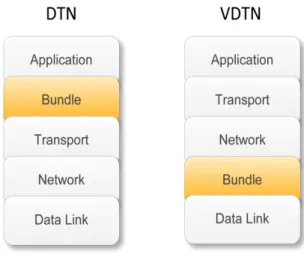
Vehicular Delay-Tolerant Networking (VDTN) [8] appears as novel network architecture based on the concept of DTN, gathering also contributions from the above-mentioned vehicular networks. However, VDTN architecture proposes the bundle layer placement under the network layer in order to aggregate incoming IP packets into large IP packets, called data bundles [8]. This approach decreases the number of routing decisions, resulting in less processing and in energy savings [8]. DTN and VDTN layered architectures are illustrated in Figure 1.
Fig. 1. DTN and VDTN layered architectures.
The separation between control and data planes is also a key contribution of the VDTN layered architecture. Signaling messages are used to setup a data plane connection and carry information about node type and its speed, physical link data rate and range, energy constraints, storage capacity constraints, delivery options, security requirements, among others.
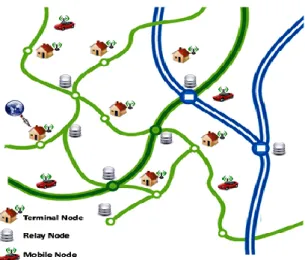
VDTN networks usually consider a network model with three node types: terminal nodes, relay nodes and mobile nodes. Terminal nodes act as access points to the VDTN network providing connection to end-users, allowing
the use of non real-time services related to the application scenario. In rural and sparsely populated scenarios (illustrated in Figure 2) users will be able to use electronic mail (eMail), file transfer, and distance learning asynchronous services. It is assumed that one or more of these terminal nodes have direct access to the Internet. Mobile nodes (e.g., vehicles) are responsible for physically carrying and delivering data between the terminal nodes. Relay nodes are devices with store-and-forward capability, located at road intersections, that allow bypassing mobile nodes to drop and pickup data. In sparse networks with low density, relay nodes increase the number of contact opportunities and therefore contribute to increase the bundles delivery ratio and decrease the delivery delay [8-10].
Fig. 2. Illustration of a VDTN network.
The proposed VDTN prototype demonstrates, validates, and evaluates the performance of the VDTN architecture. It allows the design, implementation, performance evaluation, and diagnose of VDTN protocol stacks and services. The proposed testbed also evaluates the complexity of the interaction between network nodes, and the impact of several parameters on the network performance, such as buffer capacity, energy constraints, among others. In addition, it will demonstrate the applicability of VDTNs to interconnect isolated regions (as presented in the above-mentioned example).
The rest of the paper is organized as follows. Section II addresses related works focusing on several projects and testbeds over vehicular networks and DTNs. These projects and testbeds have given important and significant contributions for the construction of the proposed testbed. The VDTN prototype architecture is described in Section III, while Section IV presents the VDTN testbed. This section describes the conceptual design of the prototype, the involved technologies and presents a testbed scenario. Finally, Section V concludes the paper and points directions for future work.
2. Related Work
Several testbeds have recently studied different challenges offer contributions to the proposed VDTN prototype.
The testbed for advanced transport protocols and architecture (TATPA) is dedicated to evaluate performance of new TCP variants and new transport layer architecture (performance enhancing proxy and delay tolerant networks) in heterogeneous networks with at least one wireless section including satellite links. This testbed architecture uses a cluster of Linux PC and a remote web interface. This network architecture allows an easy and efficient way to configure and conduct experiments. The TATPA testbed is remotely controlled through a web interface that provides to the user an easy access to the testbed features. This testbed controller is a dedicated PC that hosts the web server and the control engine. TATPA implements two transport layer architectures namely performance enhancing proxy and delay tolerant networks [11].
The network awareness and the Philadelphia area urban wireless network (PA-UWNT) testbed consists in mobile ad-hoc networks (MANETs), using PDAs, tablet computers and laptops in order to conduct experiments in the real-world. PA-UWNT focuses on communication and collaboration between first responders and other emergency personnel with the main objective of improving homeland security personnel [12].
A DTN prototype that uses mobile phones as experimentation platform is proposed in [13]. This testbed shows an application that allows bypassing cellular operator infrastructure with a backup option in case DTN fails to deliver the information in time wireless information. This prototype uses Bluetooth and WLAN interfaces to enable ad-hoc communication. This function allows a completely independent wireless operator infrastructure.
Another approach, called IBR-DTN testbed demonstrates the transformation of a WLAN access point into a stand-alone DTN-node for mobile applications. The objective is the evaluation of a vehicle-mounted node passing through a stationary node. This testbed uses four mobile nodes: three laptops computers and one WLAN routers. The communication between mobile nodes is based on 802.11b/gWLAN [14].
The UMassDieselNet testbed was developed by PRISM research group of the Computer Science Department at the University of Massachusetts. This testbed consists in 30 buses with Wi-Fi – mobile nodes attached to the buses. When a bus that travels through a route, encounter other buses, if it is possible and necessary, they exchange data between them. This network also offers throwboxes that act like stationary routers and they are essential to enhance connectivity between mobile nodes [15].
These projects and testbeds share some of the same network problems. The common routing problems in such environments are the little information of the partitioned network and limited duration of the few transfer opportunities between peers. The above-mentioned testbeds have significant contributions to the proposed VDTN prototype mainly due to the similarity of network architectures and some of the used technologies.
3. VDTN Prototype Model
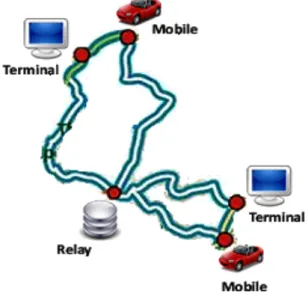
The VDTN prototype model presented in Figure 3 is based on the following three node types: terminal nodes, relay nodes, and mobile nodes. Currently, the proposed testbed implements two terminal nodes that act as access points to the VDTN network, two mobile nodes responsible for physically transporting the data between the terminal nodes, and one relay node that increases the number of contact opportunities between mobile nodes. The relay node is placed in the paths intersection helping the mobile nodes to bypass data along the network.
Fig. 3. VDTN prototype model.
The main goal of the proposed prototype is to transfer data between terminal nodes using the VDTN network infrastructure nodes (mobile nodes and relay nodes). Since mobile nodes are responsible for physically carrying data between the terminal nodes, it is necessary to simulate vehicles that follow paths. Mobile nodes will move around the network collecting data from other nodes and exchanging data with one another. When mobile nodes complete their paths they return to terminal nodes updating the stored data from each another.
4. VDTN Testbed
This section presents the VDTN network prototype. Next sub-section specifies the technologies used to create the prototype. The second sub-section describes the conceptual view of the testbed implementation. The testbed demonstration sub-section shows the interactions between nodes. Finally, the development findings sub-section discusses the main assets and difficulties on the creation of the proposed VDTN testbed.
A. Used Technologies
The proposed prototype is a platform that consists in the following three types of equipments: i) Desktops or
Laptops, ii) LEGO MINDSTORMS NXT [16], and iii) Asus PDA Phone P527.
Computers are used to emulate terminal and relay nodes. The LEGO MINDSTORMS NXT devices will be used to implement the mobile nodes. To transport data between the terminal nodes, LEGO MINDSTORMS NXT devices need a Personal Digital Assistant (PDA) device coupled on it. Authors used the Asus PDA Phone P527 device that supports Bluetooth and IEEE 802.11 technologies. These technologies allow the referred implementation of the VDTN architecture with the separation of control and data planes. Signaling information (at control plane) is exchanged using a Bluetooth connection. In order to transfer data bundles (at data plane), network nodes create a Wi-Fi ad-hoc wireless network by activating their wireless network interface.
The mobile devices (PDAs) operating system is Windows Mobile V6.1 (WM V6.1). As a result .Net platform is the only development platform with an available framework (.Net Compact Framework V3.5) that runs on WM V6.1. Thus, all applications software created for the proposed VDTN prototype were developed using .Net platform and the programming language C#. The development software used was the Microsoft Visual Studio 2008 PRO IDE (Integrated Development Environment) and Microsoft Windows SDK (Software Development Kit) V6.0 Professional Edition.
B. Conceptual design
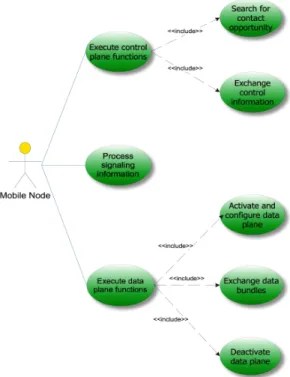
The use case diagram of a VDTN mobile node is shown in Figure 4. While traveling along its path, a mobile node searches for other network nodes using its control plane functions. This Bluetooth connection is always active and its operations are always under execution. When a mobile node finds another node, these nodes exchange control information, for example, about messages they are carrying and their storage and energy constraints. In this process the mobile node will also exchange to the other node, its coordinates, velocity and destination. With this information the nodes calculate the period of time, which their data plane should be connected, and if it is worth to activate it. This control information is used to decide whether a contact opportunity should be considered or ignored, and to activate and configure the data plane connection. The mobile node will only activate its Wi-Fi (data plane) connection to exchange data bundles, if the period that lasts the contact opportunity is in range with the period of time previously calculated. This procedure contributes to save energy and it is an important contribution and feature of the presented VDTN architecture.
This use case diagram and its actions are common to all the network nodes. It differs only in a particular action of the terminal node. A terminal node acts as traffic sink when it receives network traffic or acts as traffic source when it generates network traffic. In the proposed VDTN testbed, terminal nodes are constantly generating traffic. This is the only different action between nodes. All the control and data plane actions of the terminal node are the same as the mobile and relay nodes.
Fig. 4. Use case diagram of a VDTN mobile node.
The activity diagram of a VDTN mobile node is shown in Figure 5. This diagram presents the different activities and actions of a VDTN mobile node in a stepwise workflow. Each node autonomously activates and configures his control plane (Bluetooth) and connects, manages and disconnects his data plane (Wi-Fi).
Fig. 5. Activity diagram of a VDTN mobile node.
C. Testbed interactions
The testbed scenario, presented in Figure 6 is based on the VDTN prototype model presented in Section 3. While traveling along their paths mobile nodes collect the CPU temperature generated at each terminal node. CPU temperature is used as network data merely for demonstrative purposes. When a mobile node encounters the relay node, exchanges his stored data and collect all the updated data previously stored by the other mobile node. Finally, both mobile nodes return to the terminal nodes updating both stored data.
Fig. 6. Photo of the VDTN testbed.
As may be seen in Figure 6, one of the mobile devices follows the white route while the other follows the black route. The mobile node 1 will be in range of terminal node 1 and mobile node 2 will be in range of terminal node 2. Both terminal nodes have collected CPU temperature that is sent to the mobile nodes (Figure 7).
Fig. 7. VDTN mobile and terminal node exchanging data.
The mobile node 1 will arrive to the coverage radius of the relay node. This relay node has its buffers empty, and it is ready to receive any information from the mobile nodes. However, it has a control data mechanism that will always determine if the data is already stored in its buffer or not. When the mobile nodes complete the data exchange with
the relay node, they must have updated data from both terminal nodes. Finally, both mobile nodes complete their paths returning to the terminal nodes and exchange the updated data from each other.
D. Development findings
Some aspects such as the creation of the mobile node and its ad-hoc connection to the network were measured and refined along the tests. The main obstacle to evaluate the performance of the VDTN testbed was the large range of the Bluetooth signal on the mobile nodes, with coverage of approximately 6 meters. With this signal range and the testbed area confined to 20 m2, the devices
would constantly detect one another. Taking into account that solution to solve this problem was not available through software programming, an aluminum-foll was placed around the mobile devices to reduce the signal coverage. This “handicraft” solution resulted in reducing 75% of the original signal transmission range.
5. Conclusions and Future Work
This paper presented a VDTN network prototype that emulates the VDTN network architecture and network model proposed in [8]. VDTN is a new disruptive network architecture where vehicles act as the communication infrastructure. Through this prototype it was possible to successfully demonstrate, observe, refine, and evaluate the network behavior.The proposed VDNT prototype allows the study and evaluation of the different nodes behavior and their corresponding caching, carrying and forward/routing mechanisms. This testbed also allows the development of new protocol services and the comparison of results obtained by simulation.
New challenges may be considered for future work on this VDTN prototype, such as the implementation and evaluation of scheduling and dropping policies, new routing protocols, intelligent caching mechanisms, and introducing support for traffic differentiation. In addition, an evaluation in a larger scale with more testbed nodes, and a demonstration with real vehicles are also part of our future research interests.
Acknowledgments
Part of this work has been supported by the Instituto
de Telecomunicações, Next Generation Networks and
Applications Group (NetGNA), Covilhã Delegation, Portugal in the framework of the VDTN@Lab Project, and by the Euro-NF Network of Excellence from the Seventh Framework Programme of EU.
References
[1] K. Fall, “A Delay-Tolerant Network Architecture for Challenged Internet”, SIGCOMM, August 2003.
[2] I. Leontiadis and C. Mascolo, “GeOpps: Geographical Opportunistic Routing for Vehicular Networks”, in IEEE International Symposium on a World of Wireless, Mobile and Multimedia Networks (WoWMoM 2007), Espoo, Finland, pp. 1-6, June 2007.
[3] R. Tatchikou, S. Biswas and F. Dion, “Cooperative Vehicle
Collision Avoidance using Inter-vehicle Packet
Forwarding”, in IEEE GLOBECOM 2005, pp. 2766, Dec. 2005.
[4] L. Franck and F. Gil-Castineira, “Using Delay Tolerant Networks for Car2Car communications”, in IEEE International Symposium on Industrial Electronics, 2007, (ISIE 2007), pp. 2573- 2578, Vigo, Spain, 2007.
[5] W. Zhao and M. H. Ammar, “Message ferrying: proactive routing in highly-partitioned wireless ad hoc networks”, in The Ninth IEEE Workshop on Future Trends of Distributed Computing System, pp 308-314, 2003.
[6] F. Farahmand, A. N. Patel, J. P. Jue, V. N. G. J. Soares, and J. J. P. C. Rodrigues, “Vehicular Wireless Burst Swiching Network: Enhancing Rural Connectivity”, 3rd IEEE
Workshop on Automotive Networking and Applications (Autonet 2008), collocated with IEEE GLOBECOM 2008, New Orleans, LA, USA, December 2008.
[7] A. Pentland, R. Fletcher, and A. Hasson, “DakNet: Rethinking Connectivity in Developing Nations”, in IEEE Computer, vol. 37, pp. 78-83, January 2004.
[8] V. N. G. J. Soares, F. Farahmand and J. J. P. C. Rodrigues, “A Layered Architecture for Vehicular Delay-Tolerant Networks”, IEEE Symposium on Computers and Communications (ISCC 2009), Sousse, Tunisia, July 2009. [9] V. N. G. J. Soares, F. Farahmand, and J. J. P. C. Rodrigues,
”Improving Vehicular Delay-Tolerant Network Performance with Relay Nodes”, 5th Euro NGI Conference on Next Generation Internet Networks (NGI 2009), Aveiro, Portugal, July 01 - 03, 2009.
[10] V. N. G. J. Soares, J. J. P. C. Rodrigues, P. Salvador, and A. N. Nogueira, “Improvement of Messages Delivery Time on Vehicular Delay-Tolerant Networks”, Proc. of International Workshop on Next Generation of Wireless and Mobile Networks – NGWMN 2009, Vienna, Austria, September, 2009.
[11] C. Caini, R. Firrincieli, D. Lacamera, S. Tamagnini, D. Tiraferri, “The TATPA testbed”, in Proc. IEEE Testbeds and Research Infrastructures for the Development of Networks and Communities TRIDENTCOM 2007, Orlando, US, May 2007.
[12] Joseph B. Kopena and Kris Malfettone and Evan Sultanik, “Network Awareness and the Philadelphia Area Urban
Wireless Network Testbed”,
http://www.scientificcommons.org/43471709, accessed at September 2009.
[13] Omar Mukhtar, Jörg Ott, “Backup and Bypass: Introducing DTN-based Ad-hoc Networking to Mobile Phones”, (REALMAN’06), Florence, Italy, May 2006.
[14] M. Doering, S. Lahde, J.Morgenroth, and L. Wolf, “IBR-DTN: An Efficient Implementation for Embedded Systems”, (CHANTS’08), San Francisco, CA, USA, September 2008. [15] X. Zhang, J. Kurose, B. Neil Levine, D. Towsley, H. Zhang,
“Study of a Bus-based Disruption-Tolerant Network: Mobility Modeling and Impact on Routing”, ACM International Conference on Mobile Computing and Networking (Mobicom), pp.195–206, September 2007. [16] "Lego Mindstorms NXT", http://mindstorms.lego.com/