EXPERIMENTAL CHARACTERIZATION OF HYBRID
VENTILATION SYSTEMS IN RESIDENTIAL
BUILDINGS
Manuel Pinto
1, Vasco Peixoto de Freitas
2, João Carlos Viegas
31
Department of Civil Engineering, Viseu Polytechnic Institute, Repeses Campus, 3504-510 VISEU, PORTUGAL
2Department of Civil Engineering , Faculty of Engineering - University of Porto
Rua Dr. Roberto Frias, 4200-465 PORTO, PORTUGAL
3
National Laboratory of Civil Engineering, Av. do Brasil, 101, P-1700-066 LISBOA, PORTUGAL
ABSTRACT
In the recent past, residential buildings in temperate climates were ventilated by the daily opening of windows and by exaggerated window and door permeability. Energy conservation concerns have led to better quality windows and lower air permeability that consequently increased the risk of condensation whilst decreasing indoor air quality.
Because of the variation in natural factors, such as wind speed and the stack effect, natural ventilation systems are unlikely to permanently provide ideal ventilation rates. As such, we will characterize the performance of hybrid ventilation systems (air intake through automatically regulated louvers in bedrooms and living rooms, natural exhaust in bathrooms and fan exhaust systems in kitchens) that are a possible solution to this drawback. In March of 2002 and January of 2003, we measured air change rates in a 2-bedroom apartment using the PFT technique. This method has the advantage of measuring air renewal rates in inhabited apartments during a reasonable period and thereby reveals air renewal rates in the dwelling and also in each compartment.
This article will demonstrate the results obtained at a standard apartment and will present the experimental study characterising the hybrid ventilation system in a 100-apartment residential complex in the Porto area. The study evaluates the façade’s permeability and the respective air exchange rates per compartment using the PFT and the constant concentration techniques.
KEY WORDS: ventilation, dwellings, air change rate (ACH), PFT, constant concentration
technique.
INTRODUCTION
Following the 1970s energy crisis, the need to cut down on energy consumption led to lower air change rates (ACH) in residential buildings with an impact on air quality and relative indoor humidity levels. Moreover, the use of window frames with improved sealing properties decreased permeability to outside air and resulted in the risk of condensation and the consequent deterioration of building materials, Piedade and Rodrigues (2001), Freitas (2002). The National Laboratory of Civil Engineering, Viegas (1995), and the Portuguese standard, IPQ (2002) for the natural ventilation of residential buildings recommend an average of one ACH in main rooms (bedrooms and living/dining rooms) and four ACHs in service rooms (kitchens and bathrooms).
Most recently built residential buildings might not comply with these rates. It is necessary to implement “general and permanent ventilation” systems with continuous air admission through the main rooms and air exhaust in the service rooms, Viegas (2002), Viegas (2004), Ferreira (2004).
SURVEY
In the spring of 2000, a survey of approximately 6,700 construction companies (Association of the Northern Industrialists of Civil Construction and Public Works, AICCOPN) was conducted in order to characterize the ventilation systems of residential buildings under construction in the northern region.
One hundred and forty valid replies were obtained covering 2,693 dwellings. The vast majority of the dwellings (2651) are located in the northern region. The survey includes approximately 6% of the dwellings built in the northern region in 2000, INE (2001).
The buildings under study presented the following characteristics, Pinto (2002): − flats (93%) made up the vast majority of the surveys;
− the most widely represented typologies were two- and three-bedroom dwellings (31 and 46%, respectively);
− a large part of the dwellings were four (22.5%), five (18.8%) and six (22.9%) storey buildings.
The systems under study generally had the following main characteristics, Pinto (2002): − no measures were taken to provide the dwellings with specific devices for the intake
of air in the main rooms (bedrooms and living/dining rooms), only about 8% have fixed air inlets;
− mainly in the bathrooms (59%), or kitchens (77%), air exhaust is carried out through mechanical extraction, continuous or discontinuous;
− static ventilators are rarely used.
Under these circumstances, one can say that “general and permanent ventilation” is not a current practice in Portugal. We consider the implementation of these ventilation systems of great importance.
MEASUREMENT IN A STANDARD FLAT
Two trials were conducted over an extended period (2 weeks each) in order to estimate the ventilation rates (May 2002 and January 2003; Location: near Porto) using the PFT technique (more precisely, the homogeneous emission technique - Stymne and Boman (1994)), in a two-bedroom flat, Pinto (2003).
In the homogeneous emission techniques, the tracer gas emission rates from the sources are arranged to yield equal emission rates per volume unit in the measurement object. The local tracer concentration will be proportional to the “local mean age of air (τp[h])” (see Eq. 1).
) V / s ( kt Mp p = τ (1)
Where (s/V) is the constant tracer gas emission rate per volume [g/(h-1⋅m-3)], M
p [g] is the mass of tracer gas collected in an adsorption sampling during a time period t [h] and k is the sampling rate for a passive sampling [m3/h]. Therefore, this particular technique can be used to map the air distribution in a building. The inverted value of the local mean age of air can be interpreted as a “local air change rate” (ACHlocal).
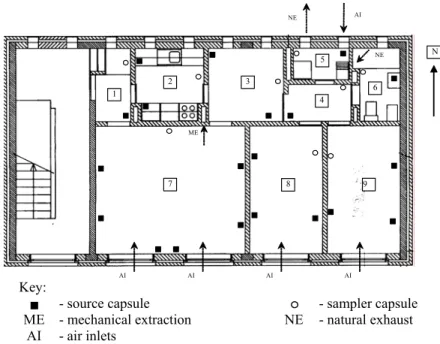
The flat’s ventilation system admitted air via self-adjustable inlets (one inlet per room and two inlets in the living room) with a flow rate of 30 m3/h under a 20 Pa pressure differential; natural exhaust in bathroom (φ125); individual discontinuous mechanical extraction in the kitchen; self-ventilated laundry (admission/exhaust via fixed inlets). The following is a layout of the flat showing the location of the respective instruments (Figure 1).
1 2 4 6 7 8 9 5 N 3 NE AI ME AI AI AI AI NE Key:
- source capsule - sampler capsule
ME - mechanical extraction NE - natural exhaust
AI - air inlets
Figure 1: Layout of the flat showing the position of equipment used
Results and discussion
Knowing that the inlets guarantee an admission rate of 120 m3/h, and considering that the flat has a volume of 160 m3, the expected ACH rate should be 0.75 h–1 (on average for the whole flat). The low rates obtained (Table 1) can be explained by the relative lack of cross-ventilation, the windows are practically all on one side, facing south, while prevailing winds vary from the northwest and east. The lack of stack effect due to the small indoor/outdoor temperature difference and to the discontinuous mechanical extraction in the kitchen may also explain the low rate obtained. The habits of the residents, who kept their windows open for long periods during the May trial, may also explain the higher ACH rate during this period. Local variation in each room’s renewal rate, ACHlocal, can be found in Table 1, where the rooms with the greatest ACH rate are the laundry and kitchen. It was found that the bathroom had a slightly higher ACH rate, probably caused by a slightly higher stack effect rate.
TABLE 1
ACH in each room and in the flat
ACHlocal (h–1) Room No. May January Hall 1 0.42 0.42 Kitchen 2 0.49 0.41 Hall A (bedroom C) 3 0.40 0.35 Hall B 4 0.37 0.33 Laundry 5 0.85 0.68 Bathroom 6 0.37 0.38 Living room 7 0.40 0.35 Bedroom A 8 0.46 0.28 Bedroom B 9 0.33 0.26
Prevailing wind direction NW-26.8% E-34.9%
Average wind speed (km/h) 19.8 14.4
Average indoor temperature (ºC) 16.0 12.2
Average outdoor temperature (ºC) 14.6 9.4
ACHtotal (h–1) 0.41 0.33
MEASUREMENTS IN A GROUP OF MODIFIED STANDARD FLATS
Continuing previous tests, the study will analyse seven flats, six of which have a hybrid ventilation system (continuous exhaust system in the kitchen and natural exhaust in the bathroom). The seventh flat has a natural ventilation system in order to compare the performance of the two systems. The flats were selected to represent different orientations and different heights above ground (see Figure 2).
5th and 6th flat:
1st + 4th floor (hybrid system)
1st and 2nd flat:
1st + 4th floor (hybrid system)
7th flat:
2nd floor (natural system)
3rd and 4th flat:
1st + 4th floor (hybrid system)
Figure 2: Residential building containing the seven flats to be tested
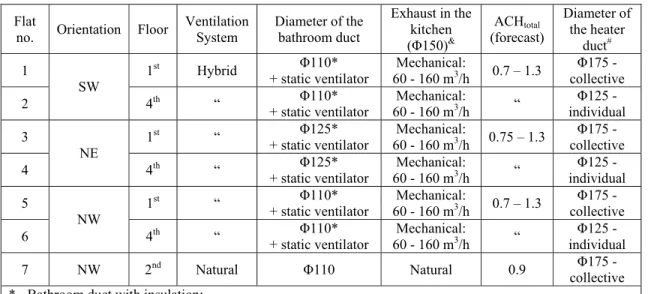
Table 2 describes the ventilation system implemented in each flat and the expected air renewal rates.
TABLE 2
Ventilation system in the flats Flat
no. Orientation Floor Ventilation System Diameter of the bathroom duct
Exhaust in the kitchen (Φ150)& ACHtotal (forecast) Diameter of the heater duct# 1 1st Hybrid Φ110*
+ static ventilator 60 - 160 mMechanical: 3/h 0.7 – 1.3 collective Φ175 -
2
SW
4th “ Φ110*
+ static ventilator 60 - 160 mMechanical: 3/h “ individual Φ125 -
3 1st “ Φ125*
+ static ventilator 60 - 160 mMechanical: 3/h 0.75 – 1.3 collective Φ175 -
4 NE 4th “ Φ125* + static ventilator Mechanical: 60 - 160 m3/h “ individual Φ125 - 5 1st “ Φ110*
+ static ventilator 60 - 160 mMechanical: 3/h 0.7 – 1.3 collective Φ175 -
6
NW
4th “ Φ110*
+ static ventilator 60 - 160 mMechanical: 3/h “ individual Φ125 -
7 NW 2nd Natural Φ110 Natural 0.9 Φ175 -
collective * - Bathroom duct with insulation;
& - The schedule is: 12h-14h and 18h30-21h30 with 160 m3/h and in the remaining hours with 60 m3/h;
# - The need for fresh air for the heater is of about 4.3*heating power ≈ 100 m3/h.
Figure 3 shows a standard apartment and the location of the various ventilation system devices.
Bathroom : Natural exhaust
Air inlet (60 m3/h)
Air inlets (30 m3/h)
Fixed air inlet
Kitchen : Mechanical exhaust Bed1 Bed2 Liv Kit Bath
Figure 3: Standard flat to be tested
PLANNED TESTS
The following tests will be performed:
− to determine the pressure coefficients in the building’s surrounding area; − to determine window permeability – in laboratory;
− to determine the load loss and depression coefficient of the static ventilators;
− to determine the possibility of inverting the flow in the bathroom’s duct and of stopping the boiler’s exhaust;
− to determine the permeability of the surrounding components (e.g. windows, window-blind cases and air intake grates) – “in situ”;
− to determine the overall permeability of the apartments;
− PFT test (one week) simultaneously in the seven apartments when uninhabited (summer of 2005) and inhabited (winter of 2007);
− PFT test in the seven apartments, uninhabited, simultaneously and applying the constant concentration technique (one week at each apartment; winter of 2006);
− to determine the comfort conditions: PMV - Predicted mean vote; PPD - Predicted percentage of dissatisfied).
Figure 4 shows some of the devices implemented at the apartments.
a) b) Figure 4: Air intake devices, a) fixed inlets for air intake in the kitchen, b) self-adjustable inlets for the air intake
in rooms and living room
In addition to the previously announced tests, the study also aims to examine the effects of alterations to the ventilation system, in particular the following: the efficiency of the thermal insulation in the bathroom ducts; the efficiency of using wider diameter ducts in bathrooms; the effect of ventilation with localised exhaust when the exhaust is stopped and the effect of an air transfer device on kitchen and bathroom doors.
CONCLUSION
Previous test results show that the ventilation rates of dwellings may be too low. Not using heating devices in dwellings results in a poor stack effect that consequently reduces ventilation rates. Wind did not increase ventilation rates to the level required in the previously studied building. Hybrid systems may be the solution for providing adequate ventilation rates. This experimental programme will provide the means to examine the performance of a system alternative to the natural ventilation. This system will equip apartment buildings with hourly renewal rates compatible with current regulations. Since hybrid ventilation systems are now being used in Portugal, there is an interest in determining the utilisation conditions under which they will provide adequate ventilation. This study is expected to reveal the performance of hybrid ventilation and any opportunities to improve its use.
ACKNOWLEDGEMENTES
The authors would like to acknowledge the support of FCT (POCTI/ECM 45555/2002).
REFERENCES
Ferreira, M., Corvacho, H. and Alexandre, J. L. (2004). Natural ventilation of residential buildings in Portuguese winter climatic conditions.
25th AIVC Conference, Prague, Czech Republic.
Freitas, V. P. (2002). Building condensation. How to solve the problem in Portugal. XXX IAHS Congress, Coimbra, Portugal. INE - National Institute of Statistics (2001). Monthly Statistics Bulletin [in Portuguese], November. Portugal.
IPQ - Instituto Português da Qualidade [Portuguese Institute of Quality] (2002). NP 1037-1. Ventilation and evacuation of combustion products from places with gas appliances. Part 1: Dwellings. Natural ventilation [in Portuguese], Lisbon, Portugal.
Piedade, A. C. and Rodrigues, A. M. (2001). Ventilation deficiencies in the origin of the signs of dampness in buildings: a case study [in Portuguese]. Congresso Nacional da Construção, Lisbon. Portugal.
Pinto, M. and Freitas, V. P. (2002). Characterization of natural ventilation systems in residential buildings in Portugal. The importance of standardization. XXX IAHS Congress, Coimbra, Portugal.
Pinto, M. et al (2003). Air change rates in multi-family residential buildings in northern Portugal, 7th
Healthy Buildings Conference, National
University of Singapore, Singapore.
Stymne, H. and Boman, C. A. (1994). Measurement of ventilation and air distribution using the homogeneous emission technique. A validation. 4th Healthy Buildings Conference, Budapest, Hungary.
Viegas, J. C. (1995). Natural ventilation of residential buildings [in Portuguese]. National Laboratory of Civil Engineering, Lisbon. Portugal. Viegas, J. C. et al (2002). Assessment of the performance of natural ventilation in an apartment building. 8th
Roomvent Conference,
Copenhagen, Denmark.
Viegas, J. C., Matias, L. and Pinto, A. (2004). Natural ventilation of an apartment: a case study. 9th