depiction of movement in the Upper Palaeolithic Côa Valley rock art (Portugal). In Congresso Internacional da IFRAO 2009, Piauí, Brasil. IFRAO, p. 1304-1318
“ON ENDLESS MOTION”: DEPICTION OF MOVEMENT IN THE UPPER Luís LUÍS*
António Pedro BATARDA FERNANDES** *Côa Valley Archaeological Park
Av. Gago Coutinho, 19A, 5150-610 Vila Nova de Foz Côa, Portugal
**António Pedro Batarda Fernandes, School of Conservation Sciences, Bournemouth University, Christchurch House, Talbot Campus, Fern Barrow, Poole, Dorset BH12 5BB, United Kingdom
Abstract: The Upper Palaeolithic Côa Valley rock art complex is home to an extraordinary collection of motion-depiction motifs. The authors propose the Côa art gives testimony to the prehistoric invention of motion depiction, a fact that has been largely ignored by History of Art academics and by mainstream culture. Despite animated motifs in European Upper Paleolithic rock art have been identified in several sites, the Côa possesses one of the known highest concentrations of such figures and an interesting variety of graphic techniques used to portray motion. Drawing on previous work done by André Leroi-Gourhan, Michelle Crémadès and Marc Azéma, but also on research being conducted in these last few years, a characterization and typological attempt to categorize motion-depiction in the Côa will be presented together with an interpretation hypothesis. It will be concluded that animation in rock art has highly modern and original aspects further confirming our ancestors created narratives and were completely aware of the passage of time.
Keywords: Animation in rock art; Côa Valley rock art
24/ Pictures as pictures: subject, depiction, movement, composition in world rock-art 1304
“The appealing about Lascaux, is that it moves. A feeling of spiritual dance lifts us when facing these works of art where, without any routine, beauty transpires from feverish movements: there we find true freedom, a place where man encounters and finds the world that surrounds him in all its richness. (...) This inebriated dance motion had always the power to elevate art above the subordinated tasks that man embraces, or that are dictated by religion or magic.” BATAILLE, G. Lascaux ou la naissance de l'art. Ouevres complètes IX. Paris: Gallimard, 80-81, 1979.
“Behind the exquisite rendering of movement (...) lies a deep feeling of kinship between man and animal, expressed by Palaeolithic man‟s intimate awareness of every aspect of their form and behaviour.”
GIEDION, S. The eternal present: A contribution on constancy and change. The beginnings of art. London: Oxford University Press, 68, 1962.
Introduction
A straightforward definition to be found in most Dictionaries will state that animation can be understood not only has the act of giving life to but also of making the lifeless move. This two-folded definition suggests that animation is the creation of an illusion of life (CHOLODENKO 1991). A cinema theorist, when trying to define animation, reached the following compromise: “1) the imagery is recorded frame-by-frame and 2) the illusion of movement is created, rather than recorded” albeit noting that cinema techniques are becoming so increasingly complex that definitions may turn obsolete quite rapidly (SOLOMON 1987: 6). The acclaimed animation director Norman McLaren, founder of the animation section of the National Film Board of Canada, provides an insightful characterization:
“Animation is not the art of drawings that move but the art of movements that are drawn; What happens between each frame is much more important than what exists on each frame; Animation is therefore the art of manipulating the invisible interstices that lie between the frames.” (MCLAREN, quoted in FURNISS 1998: 5)
From the above definitions, we can conclude that two overlapping but not opposing
notions arise: animation is the attempt to replicate reality and, at the same time, an aspiration to create an abstraction of reality (FURNISS 1998: 5). We should also note that the „static‟ depiction of movement (in a single frame) is the essential component of any motion picture creation process. More than being just one in the long succession of images that synchronized together create a „movie‟, each single frame alone suggests movement of the (afterwards „moving‟) pictured object, as static as it might appear in just one frame. A simple pose or privileged instant (as we will see below) can already convey movement. Therefore, animation (either drawn or computer generated frames) belongs within the wider category of „motion pictures‟ (i. e. the rapid succession of photograms so to produce the optical effect of a continuous picture in which objects move), together with the moving depiction of „real‟ objects (i. e. cinema).
In his second thesis on movement, the French philosopher Henri Bergson distinguishes between two types of illusion. The first is an ancient one in which movement is the regulated change from one form to another, that is, an order of poses or privileged instants related with the concept of beauty or the quintessence of the object. The modern (or scientific) one is regulated by the succession of frames (i.e., the repetition of cuts). An example of this second type is cinema in which a succession of any moments is reproduced as movement. That is, a figure is described by the continuity of movement and not by an unique moment or frame. Animated cartoons are perhaps the form of cinema that best substantiates this Image-Motion concept (DELEUZE 2004: 14-16).
Animation in Upper Palaeolithic rock art
What can be described as the invention of animation (and therefore „motion pictures‟) and cartoon like techniques in prehistoric times has vast implications for Art History in general and for the History of Cinema in particular. Nevertheless, it has been largely
Congresso Internacional da IFRAO 2009 – Piauí / BRASIL
1305
ignored1 by art, cinema and animation historians2. Besides the odd reference that might surface in the most curious of contexts (for instance THOMAS 1997: 20) or the very general account of early art forms that may appear in the introduction chapter of supposedly comprehensive Histories of Art3, in general art historians gladly leave the analysis of prehistoric art to archaeologists. The later, perhaps more interested in understanding the social, cultural and economic contexts of rock art production, in attaining the mere monographic description of motifs or in postulating the all encompassing rock art explanation theory (BAHN 2002), do not devote much attention to the highly relevant and original characteristics of prehistoric rock art. For that reason, these typically pass unnoticed in mainstream Humanities.
Within cinema studies, awareness of prehistoric moving pictures is even poorer. Usually, the „prehistory of cinema‟ is characterized as the period between the creation of the first „camera obscura‟ in Roman times (HECHT 1993: 1) and the 28th of December 1895 when the Lumière Brothers held the first public motion pictures screening (HECHT 1993, HERBERT 2000, ROBINSON 1981, SOLOMON 1994). Although some authors mention that the depiction of movement in prehistoric art may indeed have been the invention of cinema (HOFFER 1981), these are mere suggestions that lack further description and analysis thus
1
As well as other striking characteristics of prehistoric rock art such as the creation of the ‘scene’ or the discovery of perspective (LEROI-GOURHAN 1992).
2
With some exceptions like GIEDION, that nevertheless believes that no “direct parallel could be drawn between representations of movement in primeval art and our contemporary interest in movement”. He considered that in prehistoric times “the dominant role was occupied by the animal (...) (that) governed all representations of movement” while in contemporary art, human beings are the main focus of attention” (1962: 75).
Another noteworthy exception is CHARLOT (1939). He believed prehistoric animation predates cinematography giving as an example a painting from Altamira in which a wild boar was depicted as having four pairs of legs in a clear attempt to portray movement.
3
See, for instance, GOMBRICH’s highly acclaimed “The story of art” (1995). JANSON and JANSON (1997) or HONOUR and FLEMING (1999) also provide such examples.
never going beyond the pure anecdotal account. Despite the originality and implications of such scenes, truth is that prehistoric animation continues to be largely ignored not having been given its rightful place in Human (Art) History.
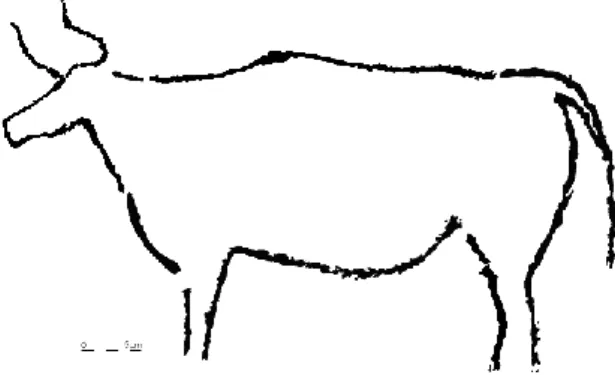
Nevertheless, since the discovery of prehistoric decorated caves in Western Europe, the depiction of movement has not passed completely unnoticed, sometimes for the most curious of reasons. A French cavalry officer published in 1907 a book in which he believes that the representation of more than fifty equine gaits can be found in Upper Palaeolithic art (APUD. GIEDION 1962). However, it was only with the creation of a rock art discipline of studies (that can be credited to the Abbé Breuil) that the issue was further pursued, although also treated as just a curiosity4. We had to wait until another great French prehistorian (André Leroi-Gourhan) devoted his attention to all facets of Western European Upper Palaeolithic rock art to have available the first systematic categorization of the depiction of movement in the artistic manifestations of the era. LEROI-GOURHAN defines animation as the visual translation of an action by a figure in a meaningful attitude (1992: 353), a pose or privileged moment. Therefore, he divides animation in rock art in the following categories: no animation, symmetrical animation, segmentary animation and coordinated animation (IBIDEM: 265-270). His typology is based in the opposite of the Palaeolithic artistic canon (no animation) (Fig.1) from where all animation departs.
Fig. 1. An example of the motionless canon of Palaeolithic art. Canada do Inferno 1 (BAPTISTA AND
GOMES 1998: 264)
4
24/ Pictures as pictures: subject, depiction, movement, composition in world rock-art 1306
Symmetrical animation corresponds to the extension or flexion of the legs (of either hind limbs or all four members) of the portrayed animals. Segmentary animation relates to just a section of the figure, „simulating‟, by synecdoche, the overall behaviour of the animal. The sections may correspond to the limbs (elevation of any leg), head and neck, mammoth‟s trunk, grazing tongue, open mouth or bodily excretions. This last subgroup comprises what LEROI-GOURHAN calls „vital breath‟, pictured by parallel or divergent lines coming from the snout, figures vomiting blood (like the Trois-Frères bear) and urinating (as the feline in Lascaux). Finally he also mentions the body where he specifies wounded figures and the tail.
In a more multifarious plane, LEROI-GOURHAN defines coordinated animation as the cases, which he considers rare, when animals are portrayed with more than one animated segment. Within this category, the French prehistorian distinguishes between coordinated animation of the legs, either lateral or diagonal, and complex coordinated animation when, besides the members, head and/or tail intervene.
Not many monographs have included or exclusively studied the depiction of movement in the rock art of particular sites, regions or even periods5. One such exception is RUSINOWSKI‟s methodical study of movement depiction in the cave of Lascaux (1990). In her analysis, she concluded that 165 motifs or ensemble of motifs (i.e., scenes) attempt to represent the natural motion of different animals (amid other, horses, deer, aurochs and goats). Amongst the later, we have the famous scene in which five deer appear to be swimming. In this scene, while every head, individually considered, seeks to portray motion, the whole ensemble also conveys the impression of movement
5
Although Leroi-Gourhan tried to systematize the depiction of movement in Upper Palaeolithic rock art, he did so as a part of his grand attempt to explain the artistic phenomena and also as a means of distinguishing different artistic styles (RUSINOWSKI 1990: 14).
(RUSINOWSKI 1990: 138, 184). At the same time the heads may be interpreted as not representing five different animals but just one that is moving through five distinct positions in time and space. Likewise, as RUSINOWSKI appears to suggest (IBIDEM: 139, 149), a three-horse composition in the Great Hall can be seen as a „primitive‟ type of Zoopraxography „study‟, akin to the techniques made popular in the late 1800‟s by MUYBRIDGE (1983)6.
CRÉMADÈS (1993), albeit generally concurring with LEROI-GOURHAN‟s typology, speaks of a new category that she calls suggested animation. It includes multiple contours, narrative scenes and the expression of vital functions. This new category is closely related to BERGON‟s second thesis of movement, the depiction of movement by decomposition, the motion-picture. On the other hand, AZÉMA (1992a, b) further develops the characterization of animation in rock art by introducing decomposition of movement by superposition and by juxtaposition of images. In his study of Pyrenean Palaeolithic art, AZÉMA identifies figures that present multiple depictions of body parts, namely limbs, tail and head. To the author, these segments represent different moments in the motion of the portrayed animals (decomposition by segmentary superposition).
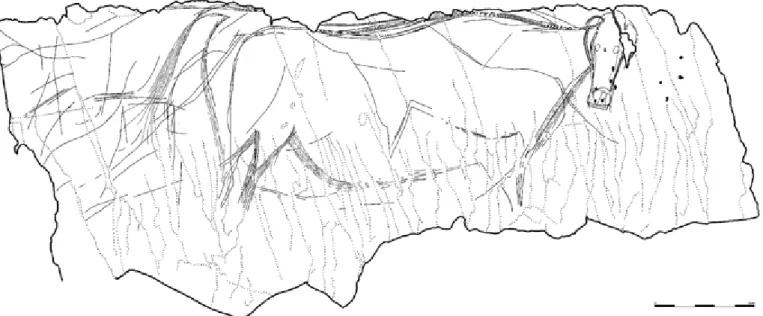
Most significantly, AZÉMA defines decomposition by juxtaposition not only as the representation of multiple segments of the same figure, but also as different figures of the same individual that appear juxtaposed. His most convincing example is the well-known lion‟s frieze of La Vache cave, where, in a bone fragment, three felines were depicted, one after the other (IBIDEM 1992b: 68). The animals, with limbs in distinct positions, were
6
We are referring to a scene in which three horses painted in black appear to be an attempt to depict, in a circular fashion ‘similar’ to the discs used by Muybridge in his Zoopraxiscope (HERBERT 2000: xvii; MUYBRIDGE 1893), natural equine throttle motion. We should also remember that the photographic experiences of MAREY and of MUYBRIDGE in the XIX century were the base of all modern forms of movement depiction, namely in cinema, painting and comics (or bande dessinée).
Congresso Internacional da IFRAO 2009 – Piauí / BRASIL
1307
portrayed in a fashion that resembles the images produced many millennia later by MUYBRIDGE (1893). It is this sequence that leads the French author to interpret the three figures as different moments in the locomotion of the same individual and not the representation of three dissimilar animals following each other, as the scene is usually understood. It should be noted that RUSINOWSKI had already somewhat hinted this interpretation in the case of the Lascaux swimming deer, or the Great Hall three horses scene, mentioned above.
The Côa Valley rock art
The Côa Valley rock art complex is located in Northern Portugal and comprises motifs from several distinct ages (Upper Palaeolithic, Neolithic, Iron Age, and Historical and Contemporary periods). Some 40 different sites exist scattered along both margins of the Côa Valley consisting of nearly 1000 outcrops featuring around 6000 individual motifs (BAPTISTA AND REIS 2008). In 1998, UNESCO, culminating a turbulent discovery and preservation process, classified the pre-historic sites as World Heritage (UNESCO 1999, BAPTISTA AND FERNANDES 2007). Motifs from the period that interest us the most, the Upper Palaeolithic, account for some 40% of the total rock art. The primary artistic technique is the engraving (either by pecking, abrading or fine line incision and sometimes a combination of methods). Paintings still survive in one natural shelter. Alongside the great Western Europe Upper Palaeolithic rock art tradition, the main theme is the depiction of large
herbivores. Aurochs, deer, goat and horse make up the vast majority of portrayed animals. Other (and rarer) representations include fish, chamois, signs and human beings. Besides the depiction of movement, other significant characteristics of the Côa Valley rock art are the portrayal of scenes (such as animals interacting), highly
superimposed panels and incorporation of natural features of the rock in represented motifs (either giving 3D depth to or „completing‟ inscribed animals) (BAPTISTA 1999, 2009; FERNANDES 2008; LUÍS 2008). Animation in the Côa Valley rock art
Right from the first publications on the Côa Valley Upper Palaeolithic motifs, animation through the representation of figures with multiple heads was considered as one of the originalities of this rock art complex (BAPTISTA AND GOMES 1995: 377). Albeit this form of representation of movement by means of decomposition was regarded as meaningful, the Côa rock art possesses great variety of techniques in movement depiction. In fact, the vast majority of movement portrayal in the Côa belongs to the category that LEROI-GOURHAN defines in his typology as the representation of significant attitudes: poses, privileged moments or „snapshots”.
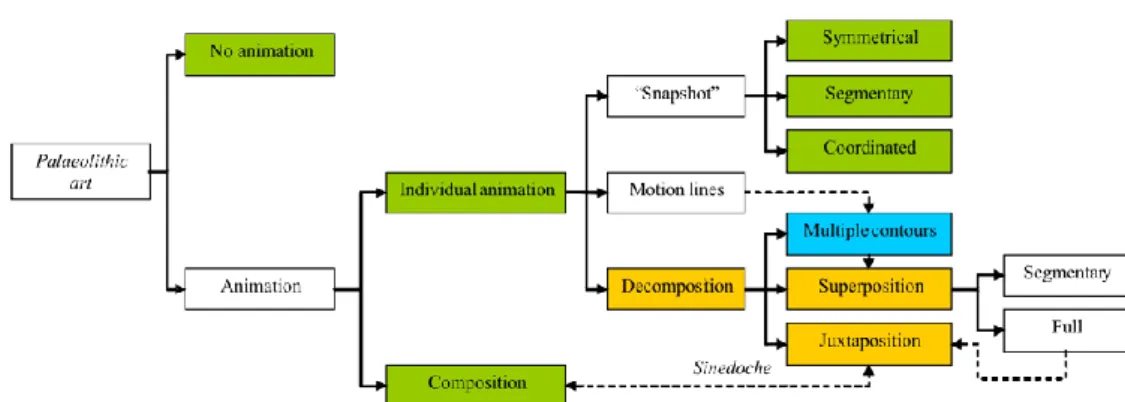
We shall briefly present an overview of animation in the Côa Valley rock art, based on the current stage of research that one of the authors (LUÍS) is undertaking by analyzing the motives published so far. We shall distinguish between animation by privileged moments or „snapshots‟ (LEROI-GOURHAN typology) and through decomposition (AZÉMA typology) (Fig. 2).
Fig. 2. Typology for Upper Palaeolithic animation, including contributes by LEROI-GOURHAN (green),
24/ Pictures as pictures: subject, depiction, movement, composition in world rock-art 1308
Within animation through pose, symmetrical animation is dominant (over 50%). In this category, also known as „flying gallop‟ (Fig. 3), symmetrical animation in extension is largely prevailing. Usually, this is the more ancient form of movement representation recognized by Art History books and it is present, for instance, in Assyrian friezes of Niniveh (for example JANSON AND JANSON 1997).
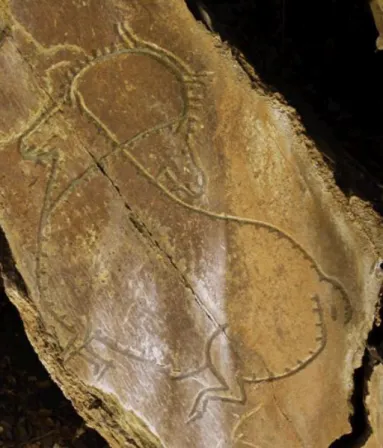
Fig. 3. “Flying gallop” deer (width: 4 cm). Fariseu, plaque 4a (GARCIA DIEZ AND AUBRY 2003). The number of motifs featuring symmetrical animation in flexion is residual, as in all Upper Palaeolithic European art. Nonetheless, the Côa Valley preserves some of the most remarkable examples of this type of animation, as one can observe in the scene engraved in Ribeira de Piscos 7 (Fig. 4).
Fig. 4. Scene with three goats in symmetrical animation by
flexion. Ribeira de Piscos 7 (BAPTISTA AND GOMES 1998: 326).
Besides these two categories, we suggest the Côa contains a novel variety of movement depiction, which we will call asymmetrical animation totalling some thirty representations. We are referring to figures in which the limbs have distinct lengths with the fore legs shorter and the hind legs frequently depicted moving backwards, as if the animal was jumping or perching (Fig. 5). Within this category we also include some figures that while presenting members in extension with the same length, have an oblique back line, in what could correspond also to a perching position (Fig.6).
Fig. 6. Perching chamois goat (figure enhanced).
Fariseu 1 (authors‟ photo)
Following the dominant symmetrical animation category, we have segmentary animation that roughly accounts for 30% of the total of Côa motifs depicting movement. The most animated segment is the head (some 50 examples), in an assortment of positions: up, down, backwards, stretched towards the front and confronting the observer (Fig. 7). Other animated sections include the tail (Fig. 8), the mouth (Fig. 9) and tongue and the ears (Fig. 10).
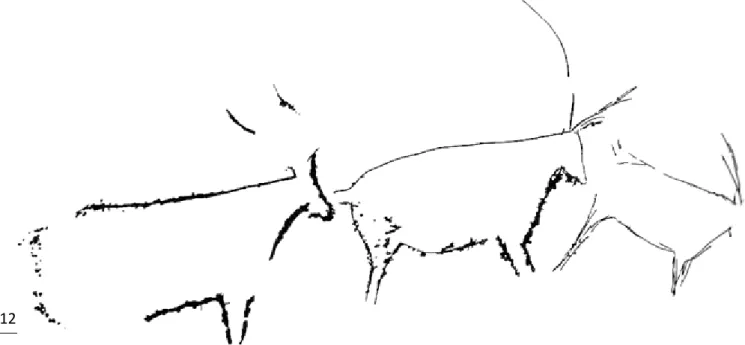
Coordinated animation can be seen in about 10% of the figures animated through pose or privileged moment. In spite of some cases of coordinated legs, either laterally (Fig. 11) or
Congresso Internacional da IFRAO 2009 – Piauí / BRASIL
1309
Fig. 7. Aurochs looking towards the viewer. Note the
multiple contours along the back and hindquarters. Ribeira de Piscos 24 (BAPTISTA 2009: 157).
Fig. 8. Tail swatting aurochs (figure enhanced).
Fariseu 1 (authors‟ photo)
Fig. 9 Deer with open mouth. Tudão 1 (authors‟
photo).
Fig. 10. Horse with raised ears. Canada do Inferno 14
(photo by JOSÉ PAULO RUAS).
Fig. 11. Goat with lateral coordinated leg animation (no
24/ Pictures as pictures: subject, depiction, movement, composition in world rock-art 1310
diagonally (Fig. 12), most representations in this category constitute themselves as complex coordinated animations, involving primarily the position of legs and legs and head or tail (Fig. 13).
Fig. 12. Goat with diagonal coordinated leg animation.
Fariseu 8 (BAPTISTA 2009: 107).
Fig. 13. Deer looking backwards and with legs in
extension. Vale de Cabrões 1 (authors‟ photo). The depiction of motion lines is yet another way of giving dynamism to graphical representations, well-known, for instance, to cartoon authors, namely to convey speed. In Palaeolithic art, LEROI-GOURHAN characterizes these lines as „vital breath‟. In the Côa four examples were recognized that belong to this category. We believe it may be interpreted as the representation of sound emission, food (leafs, for instance) being chewed, fluids dripping from the mouth or even tongue exposing (SACCHI 2008) (Fig.
14). Representation by multiple contours, mentioned by CRÉMADÈS as belonging to the suggested animation category, is another form of graphical animation, situated between the motion line and movement decomposition. Known in all Upper Palaeolithic art (see, for example, the Chauvet rhinoceros), representation by multiple contours is infrequent in the Côa. One figure that eventually might have been represented resorting to the technique is one of the aurochs in Ribeira de Piscos 24 (see Fig. 7).
Fig. 14. Goat featured with lines coming out of its
mouth. Fariseu 8 (BAPTISTA 2009: 107). Of the total of animated figures in the Côa Valley, just over 10% fit in the movement decomposition category. Among these, over 90% present decomposition by superposition. This is the case of two or even three headed animals in which the heads are moving upwards/downwards (Fig.15), or backwards (Fig.16). In only three instances the representation of multiple feet (GUY 1999) was identified (Fig. 17). AZÉMA only considered decomposition by superposition of animal segments (i.e. legs, heads and tails). Nevertheless, in the Côa Valley we recognize some examples of full superposition of images, which might be interpreted as an example of animation. These motifs consist in the full representation of two animals from the same species, that are superimposes in such a way that it is justifiable to interpret them as two distinct moments in the movement of the same animal (Fig. 18).
Congresso Internacional da IFRAO 2009 – Piauí / BRASIL
1311
Fig. 15. Horse with upwards/downwards movement
divided in three phases (figure enhanced). Penascosa 4 (authors‟ photo).
Fig. 16. Ibex looking backwards (figure enhanced).
Quinta da Barca 3 (authors‟ photo).
Fig. 17. Ibex with multiple legs. Rego de Vide 1
(BAPTISTA AND GOMES 1998: 298)
Fig. 18. Two aurochs overlapping in different positions,
exemplifying decomposition by full superposition (no scale). Quinta da Barca 1 (SANTOS 2009: fig. 2).
24/ Pictures as pictures: subject, depiction, movement, composition in world rock-art 1312
Decomposition by juxtaposition is more difficult to recognize in the Côa Valley, as in all Upper Palaeolithic art. We have identified three doubtful cases of two to four figures that might form a sequence. The single images can be interpreted as different locomotion positions of the same individual (Fig. 19).7
Fig. 19. Three goats in sequence or three phases of a
same goat‟s movement? Note that the use of two different engraving techniques (the first figure was fully
pecked into the rock whilst the last was only finely incised) together with the sequential diminishing size of each motif appears to suggest the animal is moving (and
fading) away from the observer‟s viewpoint. (scene width: 60 cm). Canada do Inferno 30 (BAPTISTA
AND GOMES 1998: 292).
It is noteworthy to conclude that animation by pose (or „snapshot‟ moments) constitutes the vast majority (some 80%) of animated figures in the Côa Valley. Decomposition accounts for just over 10% and the representation of motion lines is merely residual. In spite of the expected overwhelming majority of pose animation, it is interesting to verify that animation by
7
Besides individual animation, composition or scenes may also be a form to portray motion depiction. The Côa Valley rock art also presents such examples, notably the two grooming horses from Ribeira de Piscos 1. Nevertheless, we are not considering this group of representation in the present analysis.
decomposition values in the Côa are the double when compared to the Upper Palaeolitic art in the Pyrenees where this category totals only 5% (AZÉMA 1992a, b). Another distinction between these two regions lies in the fact that in the Côa decomposition by segmentary superposition focuses mostly in depicting the
motion of the head whilst in the Pyrenees it is foremost the feet that receive greater attention.
Chronologically speaking, animation in the Côa rock art also presents some originality. Since LEROI-GOURHAN, this feature of Upper Palaeolithic art has been mostly ascribed to the final stage of the Magdalenian. Existing data regarding the chronology of the Côa art indicates that most animated motifs, notably the remarkable head motion representations by means of decomposition by superposition, belong to its early stage.
Available data divides the Côa Valley Palaeolithic rock art in two major phases, Gravettian-Solutrean and Magdalenian. Besides stylistic comparison, this was determined by archaeological excavation in the Fariseu rock art site. The early phase, present in this site‟s Rock 1, was dated to more than 18.500 BP by sealed layers identified in front of the panel containing an engraved panel‟s fragment. Besides that, more
Congresso Internacional da IFRAO 2009 – Piauí / BRASIL
1313
than 70 schist slabs containing artistic representations were found in more recent layers, dating from 11.000 to 10.000 BP. These slabs possess representations that are comparable to others present in the Côa panels (AUBRY ET AL 2007; AUBRY 2008; AUBRY AND SAMPAIO 2008). Animated representations are present in both Côa phases, but decomposition is much more frequent in the Gravettian-Solutrean phase. The current state of knowledge does not allow having a full perception of animation in the Côa Valley Palaleolithic rock art. We can nonetheless count more than 260 animated figures, scattered over more than 70 outcrops. Analysis of three particular engraved outcrops, all with a reasonably high number of superimposing motifs, will give an idea of the relative weight between animated and non-animated figures in the Gravettian-Solutrean phase. Therefore, in Canada do Inferno 1 half of its twelve motifs present animations while in Quinta da Barca 1 60% of its 32 motifs possess animation traits. In Fariseu 1, despite of the fact that 25 of its 94 figures portray animation, the percentage of motion-depicting motifs drops to 27%.
The Côa Valley rock art belongs to a long tradition of European Upper Palaeolithic graphic representation that has in animation one of its most striking characteristics. Nevertheless, regarding animation, the Côa brings forward interesting novelties. On one hand, the chronology of most animated representations in the Côa points to a period well before the Magdalenian. This fact contrasts with existing European figures, where, with the exception of the problematic Chauvet cave, the available data regarding animation in Pleistocene art mostly points to the Middle and Late Magdalenian (AZÉMA 1992b: 69). On the other hand, one of the originalities of animation in the Côa resides in the relatively high percentage of motion depiction through decomposition.
Discussion
How can we interpret the depiction of movement and animation in the context of Upper Palaeolithic rock art? Why was it
important to depict animals as if they were moving? Without plunging in the speculative theoretical debate on the more general interpretation of rock art, we can answer those questions quite resolutely: because it was meaningful, in its overall context of creation, to do so. This is the simplest answer and, at the same time, a very insufficient one. Nevertheless, it can be inferred that depicting movement played a vital part in the precise role engraved figures were supposed to accomplish (FERNANDES 2008).
We consider (as others have pointed out8) that rock art, as any other product on human activity, anywhere and at any given moment, has manifold overlapping meanings. In today‟s world of „Homo globalis‟, it is common sense, perhaps a truism, to state that explanations are complex before they become simple and vice-versa. Nevertheless, many times in science, new (or „recycled‟) theories are presented as the „new-all-explaining-mantra‟ since they were produced (also) with the intent of disproving older ones. Rock art studies are no exception and often competing interpretation theories appear irreconcilable in their eagerness to explain. So, for us, existing interpretation proposals may be used together (depending on the specific circumstances of each case, evidently) to try to build and enhance our contemporary understanding of prehistoric rock art, since precise original meaning is forever lost in the depths of time. As Upper Palaeolithic artists, we are also human, so we believe that we can trying to answer the why regarding rock art and not stop once „statistical‟ data has been sufficiently collected from sites. We need only to bear in mind that interpretation models will forever be hypothesis, regardless of the precise „taste‟ of the epoch.
At this point, we will draw on the depiction of movement phenomena to suggest another interpretation model for rock art that might complement and combine existing ones: that rock art can also be just a pure form of Entertainment. Entertainment in a similar manner as today we understand the
8
24/ Pictures as pictures: subject, depiction, movement, composition in world rock-art 1314
concept9 but also beyond, as an
ontological, cultural, socio-economic tool to indoctrinate society or individuals within a society: an appealing way of conveying meaning is the most effective fashion to assure its deliverance and comprehension. Our argument is that human beings, regardless of precise circumstances, always had need for ways of alleviating the harsh truth about existence (in an escapist fashion, if you will), the finite nature of life. Thus religious or spiritual beliefs, with all the attached paraphernalia of all explaining myths, coded signs or magical rites (BOYER 1992), can also be seen as a form of entertainment10. The use of entertainment devices will assure that the intended, but not always transparent or entirely conscious, social cohesion message or „command‟ (CULOTTA 2009) is delivered and complied with in a more successful way11. Depending of each precise context of creation, we can see much rock art as a way of materialising in visible and perennial fashion aspects of such paraphernalia. We might recall here the use of the word mythogram by LEROI-GOURHAN when referring to rock art motifs. Paradoxically, as BATAILLE points out, its very act of creation “had always the power to elevate art above the subordinated tasks that man embraces, or that
9
We are not suggesting that an Entertainment industry as we know today existed in the European Upper Palaeolithic or that the one that exists nowadays evolved from how ever Pleistocene individuals and society enjoyed their ‘leisure moments’. We are suggesting that individuals must have had (also) great pleasure and amusement in creating rock art; that it would have been (again, also) an
entertaining activity. We are aware of the possible pitfalls
of using contemporary concepts when analyzing the cultural manifestations of other non-contemporary societies. The issue has been hotly debated, namely with the concrete use of the word and concept ‘art’ when referring to rock art (see, for instance, MORO-ABADÍA AND GONZÁLEZ MORALES 2007). We do believe that it is impossible to completely become the Other (especially when this Other is parted from us a few tens of millennia) and therefore we have to use the concepts (and corresponding words) available to us today, without losing sight, again, of the fact that in History only interpretation
hypothesis can be formulated.
10
As, for instance, TV evangelists know all too well (see RAYBON 2008).
11
See ANONYMOUS (2006) or GREEN ET AL. (2003).
are dictated by religion or magic” (1979, authors‟ emphasis). Therefore, (rock) art played (and plays) a major part in the very fabric of social regulating processes and, at the same time, is a truly spiritual yet tangible liberating experience (BINDMAN 2006). Thus, at the same time, art transcends, overcoming, reality but also creates realities while still being a reflection of reality (as „twisted‟ as the reflection might be...).
Regarding the way people of the time might have perceived movement and its representation we might take into account the famous philosophical paradox attributed to Zeno and noted by Aristotle in his Physics:
“If everything when it occupies an equal space is at rest, and if that which is in locomotion is always occupying such a space at any moment, the flying arrow is therefore motionless.” Aristotle, Physics VI: 9, 239b5.
Prehistoric artists might also have had similar thoughts: albeit the world that surrounded them was in continuous motion, the techniques available to illustrate it in rock surfaces meant the creation of instant „motionless‟ snapshots that only moved with suggestion or, perhaps, with the night-time help of torches or other lightning devices. In itself, the depiction of movement strongly suggests that trying to represent the „ruthless‟ passing of time and its effects on the their surrounding world was an important tool for prehistoric human beings to place themselves in and make sense of this perpetual motion. Hence, it has been meaningful to human beings since prehistory to give life to inanimate matter, to create illusions of life, thus to start constructing the strongest of myths and leitmotif of our species: the ingenious beast that seeks to abandon bodily restraints whilst always returning, before complete oblivion, to the womb where it came from. In a way, they were able to postpone this complete oblivion and succeed in temporarily overcoming the callous passage of time, as the rock art they left behind has considerably outlived their creators.
Congresso Internacional da IFRAO 2009 – Piauí / BRASIL
1315
The depiction of movement also gives evidence that prehistoric societies had an unambiguous perception of the passage of time. It can obviously be suggested that the continuous succession of human generations, of seasons and of night and day or the movement of celestial bodies12 would have been noticed and contributed to the design of some sort of (culturally constructed) time passing measuring scales. Nevertheless, the depiction of movement implies full realization of the fluidity of (animal) life moments through the creation of a „conceptual‟ timeline (or narrative) comprising ordered events later immortalized in rock surfaces. Therefore, beyond mere suggestion, prehistoric animation constitutes (the first?) unequivocal proof that human beings began to be aware of (and recording) the passage of time since the Upper Palaeolithic. Moreover, it provides indication of the invention of an „abstract‟ human time, originating from events taking place in time and space, but pulled apart from those „constraints‟ of reality into another dimension: that of the spiritual (or cerebral) life of human beings.
We still have a long way ahead before we are able to fully understand and interpret this form of representation. However, a given group of Pleistocene animated figures, namely in the Côa Valley, are in motion. We can state they refer to a particular action: a running horse, a roaring deer, a goat looking backwards, an aurochs shaking its tail or a chamois goat lifting its head… Behind action lies a narrative, a speech that most certainly sustained those artistic manifestations. Thus, Upper Palaeolithic representations might equally be evidence of a narrative suggested by animation but unknown today. LEROI-GOURHAN affirmed that “it most certainly existed an oral context connected and coordinated with the symbolic signification of (rock art) images” (1990: 197, authors‟ translation). Animation is all we have left from that oral tradition.
12
While solar and lunar representations are known in rock art (for instance, WARNER 1986), claims of the existence of lunar calendars in the prehistoric record, notably in Lascaux (WHITEHOUSE 2000), should be seen with some caution (ELKINS 2000).
We should stress that scenes portraying motion depiction (such as the two or three-headed scenes of Penascosa 4 and Quinta da Barca 3) have inbuilt timelines of, even if in an endless loop, previous and subsequent moments. If a timeline exists then it is implicit that a narrative unfolds. Therefore, we can also talk of the invention of narrative. It is a common idea to imagine that storytelling is as old as humankind (for instance, WOLF 1999: 296). Equally, rock art can (also) be understood as the visual translation of ethical teachings, social constraints or practical knowledge that were embedded in the „immaterial‟ oral narratives, tales and myths of the societies that produced it.
Conclusion
Animation in rock art portrays motion in a rather original and even modern fashion that can be directly linked to the present means of movement depiction, recipients of the photographic experiences of MUYBRIDGE and MAREY. Upper Palaeolithic artists invented (or discovered), over 20.000 years ago, methods and techniques akin to those used in today‟s motion depiction art and characterized by BERGSON in his second thesis on movement. Our forefathers arrived independently to image-action and to MACLAREN‟s definition of animation by being able to capture and reproduce movement. McLaren pointed out: “What happens between each frame is much more important than what exists on each frame” (MCLAREN quoted in FURNISS 1998: 5). What happens between frames is the life of our ancestors of which we paradoxically only envisage a few glimpses by observing the succession of frames that viewed together render the movement of the chosen motifs of depiction.
We believe to have demonstrated with the examples drawn from the Côa Valley rock art complex (to which more examples can be added from sites of similar chronology, animation typology and close geographic
24/ Pictures as pictures: subject, depiction, movement, composition in world rock-art 1316
context13) that the depiction of movement and subsequent invention of motion pictures in the Upper Palaeolithic deserves, in its own right, to be inscribed as a momentous occasion in the History of Art. It is truly a testimony of the universality of art the fact that during the 1900‟s, in its so-called prehistoric period, animation gave its first steps by using very similar figurative techniques to those used by Upper Palaeolithic artists. It also disproves, once and for all, the popular image of prehistoric humans as beings not provided with the capability to abstract from reality and to create highly sophisticated concepts. Maybe, as INGOLD (2000) points out, they were not the same human beings as humans in the 1900‟s or today (as, for instance, between today and a century ago there are also differences). Prehistoric humans, however, by intermingling with their specific environment, were capable of creating sophisticated yet subtle forms of interaction, immersion and comprehension of the world thus creating their own „reality‟ in a fashion that only many centuries after was rediscovered when available technological capacities made it possible. That is, Upper Palaeolithic humans did not have cameras (outside their minds) but by no means that prevent them to invent motion pictures; for „civilized‟ humans only when the first prototypes of cameras were available did animation and the depiction of „real‟ moving objects began to be regarded as „art‟, in fact as the 7th art.
Within the wider context of Western Europe Upper Palaeolithic art, the Côa Valley possesses one of the highest concentrations of figures depicting movement anywhere in prehistoric art. Although possessing other striking characteristics, in tune with features of other sites of the same chronology, motion depiction is perhaps the most important artistic legacy kept in the Côa Valley rock art, due to the mastery of the unknown „animators‟ of yore, the wide range of techniques used to suggest motion and the age of the most ancient examples of animation.
13
See, again, LEROI-GOURHAN (1992), AZÉMA (1992 a, b) or CRÉMADÈS (1993).
References:
ANONYMOUS Harmless entertainment, an economic tool, or government brainwashing: Even children's cartoons are political in China. Angry Chinese Blogger (20 of March 2006).
Available from
http://angrychineseblogger.blog-city.com/harmless_entertainment_an_economic_t ool_or_government_brainw.htm [Accessed: 11 of November 2009].
ARISTOTLE Physics VI. (Translated by Hardie, R. P. and Gaye, R. K.).
Available from
http://classics.mit.edu/Aristotle/physics.6.vi.html
[Accessed: 14 of April 2010].
AUBRY, T. Fariseu: Cronologia e interpretação funcional do sítio. In SAMPAIO, J. AND SANTOS, A. T. (eds.) Pré-história: Gestos intemporais. (III Congresso de Arqueologia de Trás-os-Montes, Alto Douro e Beira Interior: Actas das sessões; Vol. 1). Porto: ACDR de Freixo de Numão, 7-30, 2008.
AUBRY, T.; LUÍS, L.; SAMPAIO, J.D. Primeira datação absoluta para a arte paleolítica ao ar livre: os dados do Fariseu (Vila Nova de Foz Côa). Al-Madan, 14, 48-52, 2007.
AUBRY, T.; SAMPAIO, J. D. Fariseu: New chronological evidence for open-air Palaeolithic art in the Côa valley (Portugal). Antiquity, 82 (312), 2008.
Available from
http://www.antiquity.ac.uk/ProjGall/aubry/index .html [Accessed: 3 of June 2008].
AZÉMA, M. La décomposition du mouvement dans l'art animalier Paléolithique des Pyrénées. Préhistoire et Anthropologie Méditerranéennse, 1, 17-31, 1992a.
AZÉMA, M. La représentation du mouvement dans l‟art animalier Paléolithique des Pyrénées, Préhistoire Ariégoise, 47, 19-76, 1992b.
BAHN, P. Ways of looking at Prehistoric rock art. Diogenes, 49 (193), 88-93, 2002.
Congresso Internacional da IFRAO 2009 – Piauí / BRASIL
1317 BAPTISTA, A. M. No tempo sem tempo. A arte dos
caçadores paleolíticos do Vale do Côa: Com uma perspectiva dos ciclos rupestres pós-glaciares. Vila Nova de Foz Côa: Parque Arqueológico do Vale do Côa/Centro Nacional de Arte Rupestre, 1999. O paradigma perdido. O Vale do Côa e a arte paleolítica de ar livre em Portugal. Vila Nova de Foz Côa: Edições Afrontamento/Parque Arqueológico do Vale do Côa, 2009.
BAPTISTA, A. M.; FERNANDES, A. P. B. Rock art and the Côa Valley Archaeological Park: A case study in the preservation of Portugal's prehistoric parietal heritage. In PETTITT, P.; BAHN, P.; RIPOLL, S. (eds.) Palaeolithic cave art at Creswell Crags in European context. Oxford: Oxford University Press, 263-279, 2007.
BAPTISTA, A. M.; GOMES, M. V. Arte Rupestre do Vale do Côa: 1: Canada do Inferno: Primeiras Impressões. Trabalhos de Antropologia e Etnologia, 35 (4), 349-422, 1995.
Arte Rupestre. In ZILHÃO, J. (ed.) Arte Rupestre e Pré-História do Vale do Côa: Trabalhos de 1995-1996. Lisboa: Ministério da Cultura, 211-409, 1998.
BAPTISTA, A. M.; REIS, M. Prospecção da arte rupestre na Foz do Côa: Da iconografia do Paleolítico à do nosso tempo, com passagem pela II Idade do Ferro. In SANTOS, A. T.; SAMPAIO, J. (eds.) Pré-história: Gestos intemporais. (III Congresso de Arqueologia de Trás-os-Montes, Alto Douro e Beira Interior: Actas das Sessões; Vol. 1). Porto: ACDR de Freixo de Numão, 62-95, 2008. BATAILLE, G. Lascaux ou la naissance de l'art. Ouevres completes IX. Paris: Gallimard, 1979. BINDMAN, D.. Art as social consciousness: Francis Klingender and British art. In: HEMINGWAY, A. ed. Marxism and the history of art. London, Ann Arbor, MI: Pluto Press, 2006, 67-88.
BOYER, P. Explaining religious ideas: Elements of a cognitive approach. Numen, 39, 27-57, 1992.
CHARLOT, J. Art from the Mayans to Disney. New York and London: Sheed and Ward, 1939.
CHODOLENKO, A. Introduction. In
CHOLODENKO, A. (ed.) The illusion of life: Essays on animation. Sidney: Power Publications, 1991, 9-36.
CRÉMADÈS, M. L'animation. In L'art pariétal paléolithique: Techniques et méthodes d'étude (Groupe de réflexion sur l‟art pariétal Paléolithique. Paris: Comite
des Travaux Historiques et Scientifiques (Documents préhistoriques 5),1993, 289-296. CULOTTA, E. On the origin of religion. Science, 326 (5954), 784-787, 2009.
DELEUZE, G. A imagem-movimento: Cinema 1. Lisbon: Assírio & Alvim. 2004.
ELKINS, J. Our beautiful, dry and distant texts: Art history as writing. London: Routledge, 2000.
FERNANDES, A. P. B. Aesthetics, ethics, and rock art conservation: How far can we go? The case of recent conservation tests carried out in un-engraved outcrops in the Côa Valley, Portugal. In: HEYD, T.; CLEGG, J. (eds.) Aesthetics and Rock Art III Symposium. Proceedings of the XV UISPP World Congress (Lisbonne, 4-9 Septembre 2006) Vol. 10, Session C73. Oxford: Archaeopress, 2008, 85-92.
FURNISS, M. Art in motion: Animation aesthetics. London: John Libey, 1998.
GARCÍA DÍEZ, M.; AUBRY, T. Grafismo mueble en el Valle del Côa (Vila Nova de Foz Côa, Portugal): la estación arqueológica de Fariseu. Zephyrus, 55, 2002, 157-182.
GIEDION, S. The eternal present: A contribution on constancy and change. The beginnings of art. London: Oxford University Press, 1962.
GOMBRICH, E. H. The story of art. London: Phaidon Press, 1995.
GREEN, M.; GARST, J.; BROCK, T. The power of fiction: Determinants and boundaries. In: SHRUM, L. (ed.) The psychology of entertainment media: Blurring the lines between entertainment and
24/ Pictures as pictures: subject, depiction, movement, composition in world rock-art 1318
persuasion. Mahwah, N.J; London: Lawrence Erlbaum, 2003, 161-176.
GUY, E. Note sur quelques différences stylistiques entre les piquetages paléolithiques de plein air de la Vallée du Côa (Portugal) et les piquetages de la grotte du Parpalló (Espagne). Préhistoire Européenne, 14, 1999, 107-113.
HECHT, H. Pre-cinema history: Encyclopaedia and annotated bibliography of the moving image before 1896. London: Bowker-Saur, 1993.
HERBERT, S. A history of pre-cinema. London: Routledge, 2000.
HOFFER, T. Animation: A reference guide. London: Greenwood, 1981.
HONOUR, H.; FLEMING, J. A world history of art. London: Laurence King, 1999.
INGOLD, T. „People like us‟: the concept of the anatomically modern human. In INGOLD, T. The Perception of the environment: Essays in livelihood, dwelling and skill. London and New York: Routledge, 2000, 373-391.
JANSON, H. W.; JANSON, A. F. History of art. London: Thames and Hudson, 1997.
LEROI-GOURHAN, A. O gesto e a palavra: 1 – Técnica e linguagem. Lisboa: Edições 70, 1990. LEROI-GOURHAN, A. L'art pariétal: Langage da la Préhistoire. Grenoble: Jérome Millon, 1992. LUÍS, L. A arte e os artistas do Vale do Côa. Vila Nova de Foz Côa: Parque Arqueológico do Vale do Côa, 2008.
MUYBRIDGE, E. Descriptive zoopraxography or the science of animal locomotion made popular. Philadelphia: University of Pennsylvania, 1893.
RAYBON, S. Diverse Christian entertainment industry serves as tool to reach unchurched. The Alabama Baptist, 11 of September 2008, 9-11, 2008. ROBINSON, D. World cinema: A short history. London: Eyre Methuen, 1981.
RUSINOWSKI, F. Étude de la représentation du mouvement dans les figures animales peintes et gravées de la grotte de Lascaux. Liège: Préhistoire Liégeoise, 1990. SACCHI, D. Un thème de l‟iconographie magdalénienne: le bouquetin dardant la langue. Espacio, Tiempo y Forma. Serie 1: Prehistoria y Arqueología, 1 (Nueva época), 2008, 93-104. SANTOS, A. T. O Vale do Côa, o Homem que o criou e o outro que ainda o vive. In SANTOS, A. T.; LUÍS, L. (eds.) Do Paleolítico à contemporaneidade: estudos sobre a história da ocupação humana em Trás-os-Montes, Alto Douro e Beira Interior. (Fórum Valorização e Promoção do património regional: Actas das Sessões; Vol. 3.) Porto: ACDR de Freixo de Numão, 8-13, 2008.
SOLOMON, C. Animation: Notes on a definition. In: SOLOMON, C. (ed.) The art of the animated image: An anthology. Los Angeles: American Film Institute, 1987.
SOLOMON, C. Enchanted drawings: The history of animation. New York: Wings Books, 1994.
THOMAS, B. Disney's art of animation: From Mickey Mouse to Beauty and the Beast. Leicester: Hyperion, 1997.
UNESCO Report on the twenty-second session of the world heritage commission. Kyoto, Japan. 30 November – 5 December 1998. 1999.
Available from:
http://whc.unesco.org/en/list/866 [Accessed: 26 of November 2008].
WARNER, J. E. Assessing the significance of rock art. In: BOCK, A. J.; BOCK, F. G. eds. American Indian Rock Art Volume 10: Price. Price: American Rock Art Research Association, 1986, 125-129. WHITEHOUSE, D. Oldest lunar calendar identified. BBC, 2000. Available from: http://news.bbc.co.uk/1/hi/sci/tech/975360.stm [Accessed: 2 of December 2009].
WOLF, M. The entertainment economy: How mega-media forces are transforming our lives. London: Penguin, 1999.