Pedro Tavares Barata Bastos
EASY FACIAL RIGGING AND
ANIMATION APPROACHES
A dissertation in Computer Graphics and Human-Computer Interaction
Presented to the Faculty of Engineering of the University of Porto in Partial Fulfillment of the Requirements for the Degree of Doctor of Philosophy in Digital Media
Supervisor: Prof. Verónica Costa Orvalho
This work is financially supported by Fundação para a Ciência e a Tecnologia (FCT) via grant SFRH/BD/69878/2010, by Fundo Social Europeu (FSE), by Ministério da Educação e Ciência (MEC), by Programa Operacional Potencial Humano (POPH), by the European Union (EU) and partially by the UT Austin | Portugal program.
Abstract
Digital artists working in character production pipelines need optimized facial animation solutions to more easily create appealing character facial expressions for off-line and real-time applications (e.g. films and videogames). But the complexity of facial animation has grown exponentially since it first emerged during the production of Toy Story (Pixar, 1995), due to the increasing demand of audiences for better quality character facial animation. Over the last 15 to 20 years, companies and artists developed various character facial animation techniques in terms of deformation and control, which represent a fragmented state of the art in character facial rigging. Facial rigging is the act of planning and building the mechanical and control structures to animate a character's face. These structures are the articulations built by riggers and used by animators to bring life to a character. Due to the increasing demand of audiences for better quality facial animation in films and videogames, rigging faces became a complex field of expertise within character production pipelines. The demand for more quality has contributed to increase the productivity in this field but also to disperse it and deprive it of a consensus on how to build and provide the mechanics and controls of a facial rig. Today, facial rigging can be considered fragmented because it is an extremely laborious, time-consuming, disparate and sometimes frustrating process for both riggers and animators.
Aware of the problems described previously, the author presents in this thesis optimized rig approaches for facial animation that help facilitate and empower the artists workflow, by presenting a guide to place and configure the rig mechanical components and a flexible rig interface to control a character's face. The optimization is oriented to decrease the complexity of the facial rigging process for a human subject facial model as a basis for other facial styles and also for key frame facial animation, a technique which is in its peak of development
because it continues to be popular, despite the existence of more recent techniques like motion capture, therefore key frame is highly prone to be optimized. The research steps carried out by the author include an extensive study of the facial rigging techniques used by several artists worldwide in this field, through literary as well as approaches posted in the web, and then the definition of facial rigging and animation approaches to help ease the job of the rigger and the animator. The approaches presented are based on generic and validated guideline proposals to build facial rig mechanics and on a flexible facial rig control system based on a multimodal interface. The approaches developed were validated initially in a pilot study with three users, followed by four detailed user experiments, respectively involving five, fifteen, twenty and twenty two users. The facial rig approaches have been approved and considered by the users to (i) ease the construction process of the mechanisms that deform a facial model and (ii) ease the use of the control interfaces that allow animators to trigger facial expressions. The results have been published in a sequence of papers which provide a coherent storyline to this dissertation, a storyline which is meant to help bring a consensus to the state of the art in facial rigging and animation and, hopefully, decrease the fragmentation found in this research and production field.
Resumo
Os artistas digitais que trabalham em desenvolvimento de personagens precisam de soluções otimizadas de animação facial para mais facilmente criar expressões faciais apelativas para aplicações em off-line e em tempo-real (i.e. filmes e jogos). Mas a complexidade da animação facial cresceu exponencialmente desde que surgiu na produção de Toy Story (Pixar, 1995), devido à maior exigência do público por animação facial com mais qualidade. Nos últimos 15 a 20 anos, empresas e artistas desenvolveram uma diversidade de técnicas de animação facial em termos de deformação e de controlo, que representam um estado da arte fragmentado em rigging facial de personagens. O rigging facial é o ato de construir as estruturas mecânicas e de controlo para animar a cara de uma personagem. Estas estruturas são as articulações construídas por riggers e usadas por animadores para dar vida às personagens. Devido a uma maior procura por animação facial de qualidade, o rigging de caras tornou-se gradualmente mais complexo nas produções profissionais de personagens. A procura por mais qualidade contribuiu para aumentar a produtividade nesta área mas, também, para a dispersar e privar de um consenso sobre como construir e disponibilizar as mecânicas e controlos de um rig facial. Atualmente, o processo de rigging facial pode-se considerar fragmentado porque é trabalhoso, demorado, disperso e, por vezes, frustrante para riggers e animadores.
Consciente das questões descritas, o autor apresenta, nesta tese, abordagens otimizadas de rigs faciais que ajudam a facilitar e fortalecer o trabalho dos artistas, através de um guia para colocação e configuração das mecânicas de um rig facial e de uma interface flexível de rig para controlar a cara de uma personagem. Esta otimização pretende diminuir a complexidade do processo de rigging facial de um modelo 3D humano enquanto base para outros estilos faciais e está orientada à animação facial por key frames, uma técnica de animação que está no
seu auge de desenvolvimento por continuar a ser popular e muito recetiva a ser otimizada, apesar da existência de técnicas mais recentes como o motion capture. As etapas de investigação realizadas incluem um estudo extensivo das técnicas de rigging facial desenvolvidas por artistas de todo o mundo, através de referências literárias e de abordagens disponíveis na internet, e a definição das abordagens de rigging e animação facial facilitadoras do trabalho do rigger e do animador. As abordagens apresentadas baseiam-se em propostas de instruções genéricas e validadas para construir as mecânicas de um rig facial e ainda numa interface multimodal para controlo da animação facial. As abordagens desenvolvidas foram validadas inicialmente através de um estudo piloto com três utilizadores seguido por quatro experiências, respetivamente com cinco, quinze, vinte e vinte e dois utilizadores. Os utilizadores aprovaram e consideraram as abordagens como (i) facilitadoras do processo de construção das mecânicas que deformam um modelo facial e (ii) facilitadoras da construção e uso das interfaces de controlo para os animadores manipularem expressões faciais. Os resultados foram publicados numa sequência de artigos que proporcionam uma história coerente a esta dissertação, concebida para ajudar a providenciar um consenso ao estado da arte na área de rigging e animação facial e, esperançosamente, ajudar a diminuir a dispersão encontrada neste campo de investigação e produção.
Acknowledgments
The course of this investigation was demanding but also gratifying. It was only thanks to the support of several people that I was able to produce this thesis, of which I am proud and also recognize that I owe it not just to me but to everyone mentioned following.
To my supervisor, Professor Verónica Costa Orvalho, for accepting me as a doctoral student, for guiding me during my research and for always having a critical sense over my research progress.
To the friend and research colleague Xenxo Alvarez Blanco, Technical Director at the research group Porto Interactive Center, for sharing his knowledge in rigging and for his moral support.
To my other colleagues who I met in Porto Interactive Center for their fellowship.
I thank the president and the juries of my research proposal defense, Professors Eurico Manuel Carrapatoso, Karin Gwinn Wilkins and Rui Pedro Rodrigues, for presenting pertinent questions which were fundamental for the evolution of the research.
To Karen Gustafson for her support during my exploratory visit to Austin and to College Station in Texas in late 2011, where I met with Professors Frederic Parke and Tim McLaughlin, who contributed to help define the research pathway.
To Pedro Vieira, of the Center of Events of Faculdade de Engenharia da Universidade do Porto, for his help in requesting and configuring the equipments used in the recording of my facial expressions in late 2012.
To Professor Paulo Baeta Mendes for his vast experience in photography and for his equipment which he made available to photograph my face so that I could build and texture my 3D facial model.
To Luís Álvaro Fernandes and Sharon Lee Strover for their collaboration in the final results of this research.
To the Blender Foundation and the community of Blender digital artists for their continuous work in improving this digital tool.
To the digital artists who validated the solutions developed in this thesis: Benjamin Bays, Carlos Cidrais, Carmen Pereira, Eduardo Teixeira, Filipe Feijó, Francesco Siddi, Frutuoso Silva, Gustavo Rosa, Helder Lopes, João Alves, João Cesário, João Seabra, Jorge Ribeiro, José Maria Andrade, José Pedro Teixeira, José Ricardo Silva, Júlio Ramos, Leandro Monteiro, Luís Pereira, Nelson Gonçalves, Nuno André, Nuno Estanqueiro, Nuno Matos, Nuno Vasco, Paulo Cristóvão, Paulo Martins, Paulo Moreira, Pedro Ângelo, Pedro Mota Teixeira, Pedro Pereira, Quentin Geluyckens, Ricardo Megre, Rogério Perdiz, Rui Campos, Rui Guimarães, Rui Louro and Sarah Laufer.
To the Professors António Fernando Coelho, Artur Pimenta Alves, José Manuel Azevedo, José Torres Farinha and Maria do Amparo Monteiro for their moral support.
To my parents, Zélia Conceição and Augusto Manuel and to my brother Luís Filipe, for their unconditional and constant support.
The greatest of thanks goes to my wife, Denisa Mateus, for always advising me as only she knows how.
Agradecimentos
O percurso desta investigação foi exigente mas também muito gratificante. Foi apenas graças ao apoio de várias pessoas que me foi possível produzir esta dissertação, da qual me orgulho e também reconheço que a devo não só a mim mas a todos aqueles que menciono a seguir.
À minha orientadora, a Professora Verónica Costa Orvalho, por me ter aceite como seu doutorando, por me ter guiado durante a minha investigação e por ter tido sempre um sentido crítico sobre o meu progresso.
Ao amigo e colega de investigação Xenxo Alvarez Blanco, Diretor Técnico no grupo de investigação Porto Interactive Center, pela sua partilha de conhecimento em rigging e pelo seu apoio moral.
Aos meus outros colegas que conheci no Porto Interactive Center pelo companheirismo. Agradeço ao presidente e arguentes da minha defesa da proposta de tese, os Professores Eurico Manuel Carrapatoso, Karin Gwinn Wilkins e Rui Pedro Rodrigues, pelas questões pertinentes que colocaram e que foram fundamentais para a evolução da investigação.
À Karen Gustafson pelo apoio prestado aquando da minha visita a Austin e a College Station no Texas no final de 2011, onde conheci os Professores Frederic Parke e Tim McLaughlin, que contribuiram para ajudar a definir a direção da investigação.
A Pedro Vieira, do Centro de Eventos da Faculdade de Engenharia da Universidade do Porto, pela sua ajuda na requisição e configuração dos equipamentos usados na gravação das minhas expressões faciais no final de 2012.
Ao Professor Paulo Baeta Mendes pela sua vasta experiência de fotografia e equipamento que disponibilizou para fotografar a minha cara para que eu pudesse construir e texturizar o meu modelo facial 3D.
A Luís Álvaro Fernandes e à Professora Sharon Lee Strover pela colaboração nos resultados finais desta investigação.
À Blender Foundation e à comunidade de artistas digitais de Blender pelo seu contínuo trabalho de melhoria desta ferramenta digital.
Aos artistas digitais que validaram as soluções desenvolvidas nesta tese: Benjamin Bays, Carlos Cidrais, Carmen Pereira, Eduardo Teixeira, Filipe Feijó, Francesco Siddi, Frutuoso Silva, Gustavo Rosa, Helder Lopes, João Alves, João Cesário, João Seabra, Jorge Ribeiro, José Maria Andrade, José Pedro Teixeira, José Ricardo Silva, Júlio Ramos, Leandro Monteiro, Luís Pereira, Nelson Gonçalves, Nuno André, Nuno Estanqueiro, Nuno Matos, Nuno Vasco, Paulo Cristóvão, Paulo Martins, Paulo Moreira, Pedro Ângelo, Pedro Mota Teixeira, Pedro Pereira, Quentin Geluyckens, Ricardo Megre, Rogério Perdiz, Rui Campos, Rui Guimarães, Rui Louro e Sarah Laufer.
Aos Professores António Fernando Coelho, Artur Pimenta Alves, José Manuel Azevedo, José Torres Farinha e Maria do Amparo Monteiro por todo o seu apoio moral.
Aos meus pais, Zélia Conceição e Augusto Manuel e ao meu irmão Luís Filipe, pelo apoio incondicional e constante.
O maior dos agradecimentos dirige-se à minha esposa, Denisa Mateus, por sempre me ter aconselhado como só ela sabe fazer.
Contents
Abstract iii Resumo v Acknowledgments vii Agradecimentos ix List of Figures xv List of Tables xxv 1 Introduction 11.1 Problem and Opportunity . . . 2
1.2 Solution and Strategy . . . 5
1.3 Motivation and Contribution . . . 9
1.4 Structure of the Dissertation . . . 12
2 State of the Art 15 2.1 Character Rig Analogy . . . 16
2.2 Application Domain . . . 16
2.3 The Facial Rigging Process . . . 20
2.3.1 Morphologies . . . 25
2.3.2 Behaviors . . . 30
2.3.3 Animation Technologies . . . 34
2.3.4 Rigging and Animation Software . . . 35
2.4 Facial Rigging for Key Frame Animation: Concepts . . . 37
2.4.1 Hierarchies, Transformations, Scale and Pose . . . 37
2.4.2 Naming Conventions . . . 39
2.5 Facial Rigging for Key Frame Animation: Techniques . . . 40
2.5.2 Facial Rig Controls . . . 46
2.6 Facial Rigging for Key Frame Animation: Literary Approaches . . . 52
2.6.1 General Anatomy . . . 52
2.6.2 Eyebrows . . . 56
2.6.3 Eyelids . . . 57
2.6.4 Eyeballs and Pupils . . . 59
2.6.5 Nose . . . 62 2.6.6 Ears . . . 63 2.6.7 Cheeks . . . 64 2.6.8 Jaw . . . 65 2.6.9 Lips . . . 66 2.6.10 Tongue . . . 68
2.7 Facial Rigging for Key Frame Animation: Web Approaches . . . 70
2.7.1 Human . . . 71
2.7.2 Anthropomorphic . . . 75
2.8 Discussion and Open Issues . . . 78
3 Proof of Concept 83 3.1 Problem Statement . . . 83
3.2 Easy Facial Rigging and Animation Approaches . . . 85
3.3 Framework Results . . . 88
3.3.1 A Demo of a Dynamic Facial UI for Digital Artists . . . 89
3.3.2 A Demo of a Facial UI Design Approach for Digital Artists . . . 92
3.4 Human Face Behavioral Study and Modeling of a Subject's Face. . . 96
3.4.1 Neck and Head . . . 99
3.4.2 Eyebrows . . . 100
3.4.3 Eyelids . . . 100
3.4.4 Eyeballs . . . 101
3.4.6 Cheeks . . . 103
3.4.7 Jaw . . . 104
3.4.8 Lips . . . 104
3.4.9 Tongue . . . 106
4 Easy Facial Rig Mechanics 108 4.1 Generic and Validated Facial Rig Mechanical Approaches for Key Frame Character Animation . . . 109
4.1.1 Neck and Head . . . 111
4.1.2 Eyebrows . . . 114 4.1.3 Eyelids . . . 116 4.1.4 Eyeballs . . . 118 4.1.5 Nose . . . 119 4.1.6 Cheeks . . . 120 4.1.7 Jaw . . . 122 4.1.8 Lips . . . 124 4.1.9 Tongue . . . 127
4.1.10 Facial Deformation Overview . . . 129
4.2 Easy Character Facial Rig Mechanical Approaches to Animate Zipper and Sticky Lips Effects . . . 133
4.2.1 Validation of the Easy Zipper and Sticky Lips Approaches . . . 134
4.2.2 The Zipper Lips Rig Mechanical Approach . . . 136
4.2.3 The Sticky Lips Rig Mechanical Approach . . . 137
4.2.4 User Evaluation: A Qualitative Experiment . . . 141
4.2.5 Evaluation Parameters and Experiment Results . . . 142
5 Easy Facial Rig Controls 146 5.1 FAC2RIG: A Complete and Customizable Rig Interface System Approach for Facial Animation . . . 147
5.1.1 System Overview and User Interaction Framework. . . 148
5.1.2 System Definition . . . 150
5.1.3 System Interface Design . . . 152
5.1.4 System Interface Customization . . . 155
5.1.5 Facial Control Customization: A User Experiment . . . 156
5.1.6 FAC2RIG Benefits and Limitations . . . 163
5.2 Towards a User-Adapted Animation Interface via Multimodal Facial Rigging. 164 5.2.1 A User-Adapted FAC2RIG System . . . 165
5.2.2 Algorithm Method for Drawing Menus in the Blender Interface . . . 169
5.2.3 Algorithm Method for Synchronized and Scalable Deformation Control . 171 5.2.4 Algorithm Method for Automatic Modal Operation . . . 172
5.2.5 Algorithm Method for Multimodal Interaction Extension Management . . 173
5.2.6 Multimodal Facial Rig Control: An International User Experiment . . . 174
6 Trends in Facial Rig Control Design 190 6.1 User Experiment . . . 190
6.2 Experiment Results . . . 193
7 Conclusions and Future Perspectives 204 7.1 Conclusions . . . 204 7.2 Future Perspectives . . . 208 References 211 Appendix 230 A) Publications . . . 230 B) Consent Sheets . . . 236 C) Questionnaires . . . 239
D) Python Implementation Codes . . . 245
List of Figures
1.1 Examples of facial expressions in films and videogames; left: the face of the character Hulk in the film The Avengers (Copyright 2012 Marvel Studios); right: the face of the character Joel in the videogame The Last of Us (Copyright 2013 Naughty Dog). . . 2 1.2 Examples of several disparate character facial rigging approaches developed
recently by 3D digital artists (from 2007 until 2013); top row left to right: [Georgiev 2007, Avendra 2008, Cheung 2009, Labs 2010]; middle row left to right: [Vegdahl 2010, Neuffer 2011, Best 2011, Eren 2011]; bottom row left to right: [Vaucher 2011, Marmor 2011, Torres 2012, Kumar 2013]. . . 4 2.1 The evolution of character facial rigs and animations since the 70s until today;
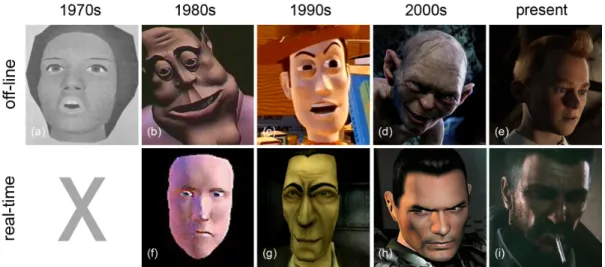
off-line: (a) first facial parametric model by Frederic Parke [Parke 1972], (b) Tony de Peltrie [Bergeron and Lachapelle 1985], the first animated short film to use a parameterized facial model, (c) Toy Story [Porter 1997], the first full length feature film produced entirely using the technology of computer animation [Henne et al. 1996] and the first computer animated film introducing the twelve principles of animation, (d) Gollum [Raitt 2004], a highly realistic computer animated character in a leading role in a live action film, (e) The Adventures of Tintin (2011), recent state of the art in character rigging with performance capture in an animation film; real-time: (f) Mike the Talking Head [Degraf 1988], the first real-time virtual puppetry, (g) Half-Life (1998), early facial animation on 3D videogames, (h) Doom 3 (2004), bone-based facial rigs for videogames, (i) The Samaritan Demo [Oliver et al. 2011], recent state of the art in facial rigging and animation in real-time (image retrieved from [Orvalho et al. 2012]). . . 18
2.2 The character setup cycle used within professional 3D production pipelines (image retrieved from [Schleifer et al. 2002]). . . 21 2.3 The Pictorial Vocabulary created by [McCloud 1993] to describe a wide number
of facial styles divided into (i) reality, (ii) language and (iii) the picture plane (image retrieved from [Orvalho et al. 2012]). . . 27 2.4 Classifications proposed for different character facial styles in groups of
taxonomic morphologies; top row: set of early concepts by [McCloud 1993], left to right: representations for reality, language and the picture plane; middle row: set of more recent concepts by [Ritchie et al. 2005], left to right: Benjamin Button, Toy Story and Hulk; bottom row: most recent concepts by [McLaughlin 2006], left to right: Tron Legacy, Rango and Transformers (image retrieved from [Orvalho et al. 2012]). . . 27 2.5 The three types of geometries used for facial modeling; top row: 3D
representations of (a) polygonal, (b) NURBS and (c) subdivision; bottom row: image representations of (d) a polygonal human face by [Osipa 2010], (e) the Balloon girl face from the short film Bingo the Clown modeled using NURBS patches (Chris Landreth 1998) and (f) the main character in Pixar’s Geri’s Game (Jan Pinkava, 1997) modeled with subdivision surface (image retrieved from [Orvalho et al. 2012]). . . 29 2.6 Evolution of the distribution of facial geometric topology; left: first edge loop
representation by [Waters 1987]; right: current state of the art on edge loop representation by [Unay and Grossman 2005] (image retrieved from [Orvalho et al. 2012]). . . 30 2.7 Examples of human facial behaviors and expressions studied in FACS; top table:
examples of Action Units; bottom table: the basic facial expressions represented by their corresponding Action Units [Deng and Noh 2007]. . . 32 2.8 A group of generic tongue positions presented by [Fleming and Dobbs 1998]. . . . 32 2.9 Gradual mouth opening; left: a neutral stance with the upper and lower lips
slightly separated from each other; middle: the mouth slightly opened with the lower lip gradually gaining a greater distance from the center lips line; right: the mouth wide opened with the lower lip having a much greater distance from the center lips line [Faigin 1990]. . . 33 2.10 MPEG-4 Facial Animation; left: the facial feature points identified in a per facial
region basis for a human face; right: different face groups each represented by a specific number of facial animation parameters (FAPs) by [Pandzic and Forchheimer 2002]. . . 33 2.11 A skeleton composed of bones and their joints (colored in purple) placed inside
the face of the character Nene in Maya (facial model is copyright of FaceInMotion). . . 41 2.12 Examples of blendshapes for the face of the character Nene in Blender; left: a
neutral pose to represent an idle state for the character as a starting point for both rig and animation debugging; right: a blendshape pose sculpted to simulate a smile (facial model is copyright of FaceInMotion). . . 43 2.13 An example of a driver setup in Blender that causes the translation of a cube to
affect the translation of the other cube via the use of a variable, a variable target and a modifier with a coefficient to control the influence of the driver. . . 47 2.14 An example of a window-based UI by [Schleifer et al. 2002] with slider controls
located in a window of the 3D tool. . . 49 2.15 An example of a camera-based UI by [Alexander et al. 2009] with 2D controls
located side-by-side to the facial model in the viewport. . . 50 2.16 Examples of viewport-based UIs; left: gizmos located over the skin of a character
by [Komorowski et al. 2010]; right: gizmos and curves located over the skin of a character by [Grubb 2009]. . . 51 2.17 Approach using bones and blendshapes by [Harkins 2005]; left and right:
respectively bones placed in the character's face and multiple blendshape heads. . 52 2.18 Web-shaped facial bone structure approach by [Neale 2008]; left: x-ray view of
the underlying bones; right: the viewport control gizmos. . . 53 2.19 Approach using global and local deformations by [Kazuo and Pinheiro 2011];
left: BTMs for global deformations; right: joints for local deformations. . . 54 2.20 Camera-based UI approaches located side-by-side to the characters' faces; left:
the Zuckafa 2D control interface by [Ritchie et al. 2005]; right: a 2D-based interface by [Athias 2006]. . . 54 2.21 Window-based user interface approach by [Holly 2006]; left: buttons for display
of controls; right: slider control knobs to handle facial behaviors. . . 55 2.22 Camera-based approaches based on sliders and osipas; left: the Ogre facial UI by
[Neale 2008]; right: a 2D rig interface for videogame animation by [Skonicki 2008]. . . 55 2.23 Blendshape examples for eyebrow control in a stylized character by [Schleifer et
al. 2002]. . . 56 2.24 Blendshape examples for eyebrow control in a realistic character by [Osipa
2010]. . . 57 2.25 The air-suspended eyebrows of a stylized character rigged using a distribution of
joints by [Athias 2010a]. . . 57 2.26 An early approach to control the upper and lower parts of the eyelids using bones
by [Maraffi 2003]. . . 58 2.27 Approaches to control the eyelids by [Schleifer et al. 2002]; left: eyeball sight
vectors; top right: realistic eyelid movements driven by the direction of the eyeball vectors; bottom right: stylized eyelid movements around spherical-shaped eyeballs. . . 58 2.28 Arrow-shaped gizmo control knobs for the eyeballs and their respective lines of
sight by [Harkins 2005]. . . 60 2.29 Viewport text curves placed in front of the facial model to control the orientation
of the character's eyeballs by [Neale 2008]. . . 61 2.30 Approaches to control the nose by [Holly 2006]; top left: crossed bones to
control the nostrils; top right: nostril handle constrained to a square-shaped
delimiter; bottom: BTMs for the character's nostrils. . . 62
2.31 Approach to control a protruded nose by [Holly 2006]; left: bones and control curve of the protruded nose rig; middle and right: resulting flexible deformations. 63 2.32 Approach to control a human nose by [Athias 2011]; left: bones positioned to deform the nostrils; right: gizmo curves positioned to manipulate the nostrils' bones. . . .. . . 63
2.33 Bone hierarchies positioned along the ears by [Gorden 2005b]; left: morphology of the character's ears; right: bone hierarchies to deform and control the ears. . . . 64
2.34 Different poses for the jaw bone by [Vasconcelos 2011]; left to right poses: neutral, drop, clench, sideways, thrust and backwards. . . 66
2.35 Examples of BTMs to simulate the main vowels and consonants in the English language by [Graft et al. 2002]. . . 67
2.36 Examples of BTMs to simulate realistic looking lips by [Athias 2006]. . . 67
2.37 The Disney's archetypes-based visemes by [Granberg 2009]. . . 68
2.38 The deformation sequence of the sticky lips approach by [Osipa 2010]. . . 68
2.39 Approach to rig a human tongue by [Bibliowicz 2005]; left: tongue bone hierarchy located along the center of the tongue; middle and right: respectively a tongue curl behavior and a tongue outwards behavior. . . 69
2.40 Approach by [Holly 2006] to rig a stylized tongue using a main bone hierarchy along the length of the model with lateral bones straying to the sides from the main bones. . . 70
2.41 Screenshots of the 24 human-like approaches built in-between 2007 and today by [Georgiev 2007, Lim 2007, Avendra 2008, Camilo 2009, Au 2009, Cheung 2009, Schiller 2009, Hammond 2009, Vegdahl 2010, Labs 2010, Neuffer 2011, Marmor 2011, Best 2011, Chen 2011, Rosa 2011, Eren 2011, Hewitt 2011, Vaucher 2011, Montesarchio 2012, Torres 2012, Kumar 2013, Nebula 2013, Lally 2013, Komban 2013]. . . 73
2.42 Screenshots of the 24 anthropomorphic approaches built in-between 2007 and 2013 by [Ozturk 2007, Nitti 2009, Aquaro 2009, Zheng 2009, Marte 2009, Pagoria 2009, Sawalha 2010, Klein 2010, Nogueira 2010, Santander 2010, Abonitalla 2010, Mahler 2010, Sanguigni 2010, Straten 2011, Burton 2011, Brooks 2012, Soto 2012, Trazos 2012, Sepulveda 2012, Sterling 2012, Dike 2013, Seng 2013, Suissa 2013, Lombard 2013]. . . 77 3.1 Screenshots of the dynamic facial interface; a) the initial static interface with a
few manipulators moved; b) a new interface layout created by re-positioning the panels; c) and d) respectively the control panels of the eyeballs and jaw re-dimensioned and re-positioned (facial model is copyright of FaceInMotion). . . 90 3.2 A six bone setup to dynamically control the jaw panel and manipulator handle. . . 91 3.3 The straightforward design approach of the camera-based facial UI. . . 93 3.4 Comparison of the animators’ performance results obtained using the facial UI
design approach seen previously in Figure 3.3. . . 95 3.5 Experiment setup in room I-104 in FEUP. . . 97 3.6 Front and profile views of the subject performing a facial expression simulated at
the time of the capture which involved simulating the outer brow raiser (AU 2). . 98 3.7 Front and profile views of the neck and head of the human subject facial model. . 99 3.8 Front and profile views of the left eyebrow of the human subject facial model. . . 100 3.9 Front and profile views of the left eyelids of the human subject facial model. . . . 101 3.10 Front and profile views of one of the eyeballs of the human subject facial model. 102 3.11 Front, side, top and bottom views of the nose of the human subject facial model. 102 3.12 Front and profile views of the left cheek of the human subject facial model. . . 103 3.13 Front and profile views of the jaw of the human subject facial model. . . 104 3.14 Front and profile views of the lips region of the human subject facial model. . . 105 3.15 Front, profile and perspective views of the tongue of the human facial model. . . . 106 4.1 Behaviors of the neck and head and corresponding rig approach; left: muscular
and profile views of the neck and head bones, respectively A and B. . . 112 4.2 Skinning paints for the neck; left and right: frontwards and backwards views. . . . 114 4.3 Behaviors of the eyebrows and corresponding rig approach; left: eyebrows
muscular activity examples by [Ekman and Friesen 1978]; right: eyebrows bone mechanics. . . 115 4.4 Left eyebrow skinning paints; left to right: inner, mid and outer eyebrow regions. 116 4.5 Behaviors of the eyelids and corresponding rig approach; left: eyelids muscular
activity examples by [Ekman and Friesen 1978]; right: eyelids bone mechanics. . 116 4.6 Skinning paints for the left eyelids; top and bottom: the upper and lower eyelids
regions. . . 117 4.7 Behaviors of the eyeballs and corresponding rig approach; left: eyeballs muscular
activity examples by [Ekman and Friesen 1978]; right: eyeballs bone mechanics. 118 4.8 Skinning paints for the left eyeball. . . 119 4.9 Behaviors of the nose and corresponding rig approach; left: nose muscular
activity examples by [Ekman and Friesen 1978]; right: BTMs for the nose snarl behavior. . . 120 4.10 Behaviors of the cheeks and corresponding rig approach; left: cheeks muscular
activity examples by [Ekman and Friesen 1978]; right: BTMs for the cheeks suck behavior. . . 121 4.11 Behaviors of the jaw and corresponding rig approach; left: jaw muscular activity
examples by [Ekman and Friesen 1978]; right: a deformation caused by the upper and lower jaw bones. . . 123 4.12 Skinning paints for the jaw; left: upper jaw; right: lower jaw. . . 124 4.13 Behaviors of the lips and corresponding rig approach; left: lips muscular activity
examples by [Ekman and Friesen 1978]; right: lips bones and BTMs. . . 125 4.14 Skinning paints for the left corner area of the lips region. . . 127 4.15 Rig approach for the tongue; left: tongue skeleton with a main hierarchy placed
main bone hierarchy; right: skinning paints seen in the model that correspond to the highlighted lateral bone in the right side of the tongue skeleton. . . 128 4.16 Final look of the human subject facial model in a neutral pose (top row) and in an
expressive pose (bottom row); left: shading with wireframe; middle left: shading with wireframe and textures; middle right: shading with textures; right: shading with textures and subdivision surface to smooth the model. . . 129 4.17 Views of the facial model and base rig mechanical structure for the lips; left:
front view with eight control points for the lips; middle and right: profile views showing the two layers of the base rig mechanical structure. . . 135 4.18 Rig mechanical setup for the zipper lips effect; left: layer with base rig
mechanical structure (the lips deformation bones); middle: layer with the zipper bones; right: the zipper effect applied to half strength. . . 136 4.19 Rig mechanical setup for the sticky lips effect; left: bones layer for the lips;
middle: layer with bones to control the most inner edge of the lips; right: layer with static bones that act as references for the inner edge deformation bones (effect applied to 2/3). . . 138 4.20 The setup of the constraints and drivers for the deformation bone K. . . 139 5.1 Overview of the FAC2RIG multimodal user interaction framework including the
window, camera and viewport-based modes. . . 149 5.2 Visual representation of the user interaction framework of FAC2RIG; left, middle
and right: respectively the positions on the screen of examples of the camera, viewport and window-based control handles. . . 149 5.3 The FAC2RIG control system approach implemented in Blender; left: camera
mode; middle: viewport mode; right: window mode with a customization panel in the top. . . 152 5.4 The design of the inner eyebrow control modes of the FAC2RIG system approach
in Blender; left: window mode based on sliders and buttons; middle: camera mode based on manipulators limited to square-shaped delimiters; right: gizmo-
based viewport mode. . . 153 5.5 Options panel in the window mode for customization of the control interaction. . 155 5.6 Training stage of the FAC2RIG system approach; left: digital artists training the
system in the training room; right: 3D digital artist José Ricardo Silva performing tasks with the system. . . 157 5.7 Visual accuracy of the facial poses produced by a basic, a skilled and an expert
user selected amongst the group of 15 users and in comparison to the original poses required for users to simulate; top to bottom rows: respectively the original poses and the poses obtained by the basic, the skilled and the expert user per each facial region. . . 159 5.8 Graphical representation of the number of clicks performed by the group of 15
digital artists in each interaction mode and in each moment of the task stage. . . . 160 5.9 Flowchart of the user-adapted interaction for the FAC2RIG system approach; left
to right: user inputs are permanently accepted in one of the 3 interaction modes to deform the facial model, in case a control is manipulated the other controls mimic the one being handled, upon release of the current control the system restarts the acceptance of input. . . 166 5.10 Workflow of the user-adapted algorithm for the inner eyebrow controls; left to
right: A) camera, B) viewport, C) spatial selectors, D) window mode. . . 167 5.11 The human facial expressions to simulate in the user experiment; left, middle and
right: respectively the anger, fear and surprise expressions applied to the human subject facial model. . . 175 5.12 The cartoon facial expressions to simulate in the user experiment; left, middle
and right: respectively the anger, fear and surprise expressions of feature film characters Sulley (Monsters Inc., Pixar 2001), Woody (Toy Story, Pixar 1995) and Shrek (Shrek, DreamWorks 2001). . . 175 5.13 Comparison of the sum of the bandwidth values between the TGUs and CGUs
5.14 Average times comparison in seconds between the CGU and TGU groups with standard deviation error bars. . . 181 5.15 Usage variation in each interaction mode made by the TGUs for the human facial
expressions of anger, fear and surprise, respectively illustrated in red, blue and green. . . 183 5.16 Usage variation in each interaction mode made by the TGUs for the cartoon
facial expressions of anger, fear and surprise, respectively illustrated in red, blue and green. . . 184 5.17 Variation in the usage of the extra deformation feature of the system for the
anger, fear and surprise expressions. . . 186 5.18 Examples of the human and cartoon facial expressions obtained by three TGUs
for the facial expressions of anger, fear and surprise. . . 187 6.1 Users average number of valid and invalid clicks in each interaction mode to
complete tasks 1, 2 and 3 with standard error of the mean (left) and over than necessary valid clicks made by the users in each interaction mode (right). . . 195 6.2 Percentage of users typing values in window mode for task 1 (left) and orbiting
in viewport mode for task 2 (right). . . 196 6.3 Average time taken in seconds by the users in each interaction mode to complete
tasks 1, 2 and 3 with standard error of the mean. . . 196 6.4 Users average scores for each interaction mode to complete tasks 1, 2 and 3 with
standard error of the mean (left) and percentage of users who agree with the qualities of each mode (right). . . 198 6.5 Users preferences for different simulations in each interaction mode: transfer
values, perform specific deformations and quick posing. . . 199 6.6 Users preferred interaction mode (left) and users frustration when using one
List of Tables
2.1 The names used by major 3D tools to identify the two primary rig mechanical techniques; top and bottom rows: respectively the names for skeletons and blendshapes. . . 44 2.2 Listing of human-like facial rigging approaches from 2007 until today as
consulted in YouTube and Vimeo [Georgiev 2007, Lim 2007, Avendra 2008, Camilo 2009, Au 2009, Cheung 2009, Schiller 2009, Hammond 2009, Vegdahl 2010, Labs 2010, Neuffer 2011, Marmor 2011, Best 2011, Chen 2011, Rosa 2011, Eren 2011, Hewitt 2011, Vaucher 2011, Montesarchio 2012, Torres 2012, Kumar 2013, Nebula 2013, Lally 2013, Komban 2013]. . . 71 2.3 Listing of anthropomorphic facial rigging approaches from 2007 until today as
consulted in YouTube and Vimeo [Ozturk 2007, Nitti 2009, Aquaro 2009, Zheng 2009, Marte 2009, Pagoria 2009, Sawalha 2010, Klein 2010, Nogueira 2010, Santander 2010, Abonitalla 2010, Mahler 2010, Sanguigni 2010, Straten 2011, Burton 2011, Brooks 2012, Soto 2012, Trazos 2012, Sepulveda 2012, Sterling 2012, Dike 2013, Seng 2013, Suissa 2013, Lombard 2013]. . . 75 3.1 Statistics of the animators’ interaction with the facial UI seen in Figure 3.3. . . 94 4.1 Identification of the neck and the head behaviors from FACS [Ekman and
Friesen 1978]. . . 112 4.2 The rig mechanics validation approach for the neck and head regions. . . 113 4.3 Identification of the eyebrows behaviors from FACS [Ekman and Friesen 1978]. 114 4.4 The rig mechanics validation approach for the eyebrows regions. . . 115 4.5 Identification of the eyelids behaviors from FACS [Ekman and Friesen 1978]. . . 116 4.6 The rig mechanics validation approach for the eyelids regions. . . 117 4.7 Identification of the eyeballs behaviors from FACS [Ekman and Friesen 1978]. . . 118
4.8 The rig mechanics validation approach for the eyeballs. . . 118 4.9 Identification of the nose behaviors from FACS [Ekman and Friesen 1978]. . . 119 4.10 The rig mechanics validation approach for the nose. . . 120 4.11 Identification of the cheeks behaviors from FACS [Ekman and Friesen 1978]. . . . 121 4.12 The rig mechanics validation approach for the cheeks regions. . . 121 4.13 Identification of the jaw behaviors from FACS [Ekman and Friesen 1978]. . . 122 4.14 The rig mechanics validation approach for the jaw region. . . 123 4.15 Identification of the lips behaviors from FACS [Ekman and Friesen 1978]. . . 125 4.16 The rig mechanics validation approach for the lips. . . 126 4.17 Resume of the behaviors of the human face per each facial region based on
FACS [Ekman and Friesen 1978]. . . 131 4.18 Resume of the fundamental rig mechanics definition per each facial region of the
human subject facial model. . . 132 4.19 Users self assessment criteria of the zipper and sticky lips rig approaches in a
scale 0 to 10; left to right: column with evaluation parameters; columns with scores by each user; column with averages of the scores per each parameter; bottom row: average scores per user. . . 144 5.1 Users self assessment criteria of the FAC2RIG system approach in a scale 0 to
10; left to right: column with the evaluation criteria; columns with scores by a basic, a skilled and an expert user selected amongst the group of 15 users; column with the average of the scores by the former 3 users; column with the average of the scores by the group of 15 users. . . 162 5.2 Algorithm method 1: drawing menus in the Blender interface. . . 170 5.3 Algorithm method 2: synchronized and scalable deformation control. . . 171 5.4 Algorithm method 3: automatic modal operation. . . 173 5.5 Algorithm method 4: multimodal interaction extension management. . . 174 5.6 Tasks relative to the facial expressions of anger, fear and surprise. . . 177
5.7 Adequacy of the interaction mode usage for tasks 2, 4 and 6 by the TGUs for the human facial expressions of anger, fear and surprise. . . 185 5.8 Individual scores and final average of the individual scores provided by the
TGUs to the conventional modes and to the user-adapted multimodal system for each parameter on a scale 0 to 10; columns with the scoring of the isolated conventional modes WIN, CAM and VIP; columns with the scoring of the multimodal system in terms of capability, learning, error tolerance, synchronization utility, deformation utility and cross platform. . . 188 6.1 Tasks to achieve a basic facial expression of anger. . . 193
Chapter 1
Introduction
Character facial animation has been a subject of research and production for the last four
decades, since the pioneering work of Frederic Parke [Parke 1972], who built the first digital
facial parametric model. Today, the entertainment industry of films and videogames thrives
for greater quality facial animation for 3D characters, because the face plays a key role in
transmitting a character's emotions to an audience [Orvalho 2007]. This dissertation is
meant to help improve the jobs of the 3D digital artists who are responsible for preparing a
face for animation and for actually animating a character's face within a character
production pipeline in the entertainment industry – a process which is known in research and
in the industry as facial rigging, the act of planning and building the mechanical and control
structures to animate a character's face. The approaches presented in this thesis help provide
a consensus to the fragmented state of the art in this field because they include (i) generic and
validated guideline proposals to place and configure the mechanical components in a facial
rig and (ii) a personalized rig interface to trigger facial expressions according to the user
control preference. Together, these approaches help ease the laborious, time-consuming and
startling process of creating, maintaining and using facial animation structures. This chapter
begins by describing the problem and opportunity in this research, then it presents the
solution and strategy used to overcome the problem, after that it presents the author's
motivation and the contribution of this thesis to the fields of computer graphics and
1.1 Problem and Opportunity
1.1 Problem and Opportunity
1.1 Problem and Opportunity
1.1 Problem and Opportunity
Digital media such as films and videogames have a growing demand for better looking character facial animation. To manage the increasing demand, the character production pipelines in the entertainment industry worldwide have suffered a complexity boost in their animation setup processes in the last 15 to 20 years, since the film Toy Story (Pixar, 1995). Today, the goal of the 3D digital entertainment industry is to induce emotions to an audience through subtle and appealing character facial movements, because the face can “twist and pull into 5000 expressions” [Blum 1998]. But despite facial animation is now being further explored, an advent remains: the many hours of intensive labor carried out in a daily basis by digital artists to produce the quality facial animation seen in films and videogames like The Avengers (Joss Whedon, 2012) and The Last of Us (Naughty Dog, 2013), seen in Figure 1.1.
Figure 1.1: Examples of facial expressions in films and videogames; left: the face of the
character Hulk in the film The Avengers (Copyright 2012 Marvel Studios); right: the face of
the character Joel in the videogame The Last of Us (Copyright 2013 Naughty Dog).
The facial animation seen in the digital media illustrated in Figure 1.1 is only possible due to a labor-intensive and time-consuming process called facial rigging. Facial rigging is the act of planning and building the deformation mechanics and the interactive control interfaces to animate the face of a 3D character. The process of planning and building these structures is carried out by riggers, who are the artists responsible for providing to the animators with an
articulated facial rig. Then the animator makes use of the controls in the facial rig to trigger the deformations in the character's face and cause it to reveal facial expressions and emotions. The job of rigging first emerged in the successful company Pixar [Price 2008] in the film Toy Story (Pixar, 1995), which is considered “the first full length feature film produced entirely using the technology of computer animation” [Henne et al. 1996]. At that time, the rigger was known as the builder, or the person who “decided on the set of controls over a character's articulation” [Henne et al. 1996]. Usually, there are only a few riggers in a character production pipeline of a film or videogame. The reason for this is that rigging is a complex job, because it involves preparing a character for animation, and only few artists have the required experience to provide to the animators with efficient interactive user interfaces to handle the diversity of facial deformations for a character. But because faces can have different morphologies and withstand a wide range of behaviors, rigging has become a labor-intensive, time-consuming and sometimes strenuous process, which is why it is only carried out by the most experienced artists. Paul Meyer, Managing Director at Luma Arcade, said recently: “producing quality animation does not happen overnight. It takes time, skill, experience” [Meyer 2013]. The fact is that the jobs of the rigging artists keep growing in complexity due to the increasing demand for better quality facial animation in films and videogames. Moreover, the constraints of short time and low budget common to these productions contribute for riggers to often produce a limited or feasible rig solution rather than an ideal one. In addition, this field lacks advanced and complete documentation and the references available do not provide validation on how to build a facial rig. Instead, they are limited to isolated cases, which generally do not encompass dealing with more complex facial behaviors. The former facts have plunged the facial rigging job into a disparate and fragmented process within character production pipelines. In fact, since Toy Story (Pixar, 1995), different facial rigging approaches have been developed by 3D digital artists
worldwide for a diversity of characters. Figure 1.2 illustrates a few examples of facial rigging approaches developed by artists who have posted their facial rigs online in YouTube and Vimeo to show off their work in this field (see Sections 2.6 and 2.7 of Chapter 2 for an in-depth overview of the state of the art in facial rigging).
Figure 1.2: Examples of several disparate character facial rigging approaches developed
recently by 3D digital artists (from 2007 until 2013); top row left to right: [Georgiev 2007,
Avendra 2008, Cheung 2009, Labs 2010]; middle row left to right: [Vegdahl 2010, Neuffer
2011, Best 2011, Eren 2011]; bottom row left to right: [Vaucher 2011, Marmor 2011, Torres
2012, Kumar 2013].
The problem of the complexity and dispersion of facial rigging and animation opened up the opportunity to investigate in this research new ways to improve this field. But, this opportunity revealed difficult to make clear for the author, because facial rigging is complex and “open to significant improvements”, as mentioned by computer facial animation pioneer
Professor Frederic Parke, of the Texas A&M University at College Station, during the author's exploratory visit to Austin in December 2011 under the UT Austin | Portugal program. Therefore, solutions for the facial rigging and animation process are indeed necessary, but they are also hard to uncover and to carry out efficiently. The solution and strategy devised by the author is described following.
1.2 Solution and Strategy
1.2 Solution and Strategy
1.2 Solution and Strategy
1.2 Solution and Strategy
The initial goal of this thesis was to define a facial rigging standard, with the original title being Easy Facial Rigging: A Dynamic Industry Standard. In time, a major obstacle to this goal was identified in the review of the state of the art, which revealed that facial rigging is a vast and disparate field of expertise [Orvalho et al. 2012, Bastos et al. 2012b] (see Sections 2.6 to 2.8). Defining a facial rigging standard became impractical, because it would mean conducting dawning efforts with professional artists worldwide, when most of these artists are prevented by copyright from exposing their work and other artists are not willing to respond to research requests. Therefore, this research had to have a shift, and according to Tim McLaughlin, former Front End Supervisor at Lucasfilm Animation and Associate Professor of the Texas A&M University at College Station, it required “a focus in a particular facial style”, Tim McLaughlin mentioned during the author's exploratory visit to Austin in December 2011 under the UT Austin | Portugal program. Aware of this advice, the author devised the definitive goal: define optimized character facial rigging and animation approaches that ease the complex jobs of the rigger and the animator, with a focus in the human face as a basis for other facial styles and also oriented to key frame facial animation. The reason to focus in the human face is that every facial behavior, be it of a creature or a cartoon character, can be realized as a variation of the behaviors originally found in the human face, as seen in the cartoon character created by [Harkins 2005]. The reason to focus in the technique of key
frame facial animation is the fact that this technique is at its peak of growth, due to emerging recent techniques like motion capture. Still, key frame is the oldest and likely most used technique by digital artists, which makes key frame highly prone to the approaches proposed in this research. As a result, the following title was devised.
Easy Facial Rigging and Animation Approaches
The easy rig approaches are realized as scientifically validated optimized setups in facial rigging and animation carried out in a reliable and enjoyable way for riggers and animators. The purpose of the approaches is to improve the time-consuming and strenuous job of these artists in building and using a facial rig to produce subtle and appealing character facial expressions. The rig approaches are not meant to be mandatory and should not be realized as such, but rather act as scientifically validated suggestions, which are applicable to the entertainment industry of films and videogames. The advances of the suggested approaches over the state of the art occur in terms of providing objective guideline proposals to build the rig mechanics and provide flexible rig controls that together compose a facial rig. The mechanics are the underlying structures built by riggers to deform a facial model. The controls are the user interface structures built by riggers to allow the animators to trigger the rig mechanics to deform the character's face. The rig mechanical and control approaches suggested shape the method of this research, which is divided into a rig mechanical definition approach, presented in Chapter 4, and a rig control definition approach presented in Chapter 5. In terms of the facial rig mechanics, the question that is answered in the method is the following.
What if there are optimized approaches to build facial rig mechanics?
Based on the fact that the facial rig mechanical approaches found in the state of the art are disparate, the research for the optimized rig mechanics was set as the definition of generic and
validated guideline proposals to place and configure the mechanical components in a facial rig to correctly deform a facial model. The proposals are considered generic due to their focus in the human face as a basis for other facial styles and validated because they are based in a set of rig construction and deformation conditions proposed and described in Section 4.1. The optimized rig mechanics are intended to help bring a consensus to the fragmented state of the art because they act as a guide to ease the job of the rigger in placing and configuring the rig mechanical components to deform a facial model. The set of rig construction and deformation conditions proposed were defined for the different facial regions of a human subject facial model. The deployment of the optimized mechanics involved studying the pre-established universal human facial behaviors in a per facial region basis using the book The Facial Action Coding System by [Ekman and Friesen 1978] and then define the rig mechanics responsible for triggering the required deformations (see Section 4.1). After the initial overall rig mechanical facial definition, a user experiment was carried out with five expert digital artists in character animation who are also college professors in the field. These users validated optimized rig mechanical approaches oriented specifically to help shed light on the rig setup of the facial behaviors known as the zipper and sticky lips effects (see Section 4.2). Zipper lips is a voluntary behavior realized as the action in effort of closing the lips together while keeping the jaw open, as in zipping the lips [Osipa 2007]. Sticky lips is the natural tendency that real-world lips have to adhere to each other toward their corners while opening the jaw [Osipa 2010]. Rig setups for the zipper and sticky lips behaviors are less common to be developed by digital artists because they are more complex to simulate. The reason for being more complex is that these behaviors occur in the lips, which is the facial region that holds the largest number of muscular activity, as categorized by [Ekman and Friesen 1978]. In terms of the facial rig controls, the question that is answered in the method is the following.
What if there is a personalized approach to use facial rig controls?
Based on the fact that the facial rig control approaches found in the state of the art are disparate, the research for the personalized controls was set as the definition of a multimodal rig interface system approach with a user-adapted interaction. The user-adapted interaction approach is meant to help provide a consensus to the fragmented rig interface controls found in the state of the art, because the common user interfaces (UIs) are unable to adapt to the preferences of animators. The reason for the lack of adaptability of the common UIs is that there is generally not enough time and budget in a production to allow the most experienced riggers to develop more advanced rigs. As a result, the animators are often presented with a feasible rather than an ideal facial rig control UI. Moreover, riggers often have to change or rebuild the control interfaces to adjust them to the requests of the animators, which is a harsh process for both riggers and animators, because these artists have to put extra effort and time to discuss modifications to the rig. It is also a difficult process for each artist individually because the rigger cannot predict or pre-define the manipulation of the rig controls and the animators often end up constrained to user interfaces with a limited control. Therefore, the option of having controls that allow for a personalized interaction is oriented to help reduce the repetitive process of rebuilding the control interfaces and make the facial animation process more efficient and enjoyable, because the interaction with the controls becomes more dependent on the preference of the animator. The personalized facial rig control approach was defined and validated in (i) an initial pilot study with three animators (see Section 3.3.2), followed by (ii) a user experiment with fifteen basic, skilled and expert 3D digital artists (see Section 5.1) and lastly in (iii) an online international user experiment with twenty long-term professional expert digital artists in character rigging and animation (see Section 5.2).
1.3 Motivation and Contribution
1.3 Motivation and Contribution
1.3 Motivation and Contribution
1.3 Motivation and Contribution
Character facial rigging and animation is a field which continues to be enclosed since it first emerged in the mid 90s in Toy Story (Pixar, 1995). The main reason is that, in the last 15 to 20 years, digital media of high impact has been generated primarily using commercial software such as 3dsMax or Maya. But, in the last 10 years, there has been a gradual increase in the use of Blender, an open-source 3D tool available at no financial cost and which can be further developed by any user. In the last decade, both freelance artists and companies worldwide have added Blender to their character production pipelines (e.g. Character Mill, Vivify Animation and Film Studio, Insizium, Schokolade Filmproduktion, Mox Studios, Fab Design)1. In March 2013, Pixar senior scientist Tony DeRose mentioned that “open-source software like Blender can do almost everything Pixar's software can do. We had a competitive advantage for ten years, but now we get more value by letting everyone contribute” [DeRose 2013]. The former facts, together with the fact that the author is an active Blender adept and entrepreneur for over five years, have led the author to implement this research in Blender as (i) a continuous investment in what the author believes, as DeRose does, is the future of the entertainment industry, (ii) the opportunity to cause a significant impact in the growing community of Blender digital artists, to help excel and sustain the community as well as leverage the use of Blender in the industry, (iii) a likely higher predisposal for validation from the Blender community, since Blender artists are not restricted to commercial constraints, (iv) the strong connection of the author with the Blender artists community, as author of Blender books and main chair of the first Blender PT Conference2 [Bastos et al. 2014b] and (v) to help bring a consensus to the facial rigging and animation process, one of the most demanding research and production topics in the field of 3D character development, through a tool which
1 http://charactermill.com/, http://www.vivify.co.in/, http://www.insizium.com/, http://www.schokolade.tv/,
http://www.moxstudios.com/, http://www.fabdesign.info/
2
is accessible by any artist. Nevertheless, the implementation carried out in Blender is not meant as an alternative to commercial tools but rather as an added value to the industry. The purpose is not to replace but rather to enrich the professional character production pipelines with reliable and open character facial rigging and animation approaches. The open-source philosophy was perhaps more of an utopia in the past, but today it seems more feasible since it allows (i) a constantly growing and sustainable research and development (R&D) in this field and (ii) a worldwide sharing of knowledge that reaches more people more rapidly. Furthermore, although the implementation of the research was carried out in Blender, the approaches developed are likely to be applicable to other 3D tools, because they are based on (i) rigging techniques which are available in the major 3D tools and (ii) in the entire spectrum of the state of the art in this field [Orvalho et al. 2012, Bastos et al. 2012b]. The main contributions of this thesis for the fields of computer graphics and human-computer interaction are presented following.
• optimized approaches to build the mechanics of a facial rig – realized as generic and validated guideline proposals to build the fundamental facial rig mechanics based on a set of rig construction and deformation conditions (see Section 4.1) and on user validation of optimized rig approaches developed to animate the zipper and sticky lips behaviors (see Section 4.2). The purpose of the guidelines and of the lips approaches is to help the digital artist who is a character rigger build the deformation structures in a facial rig more clearly and with less frustration. The results of the user validation of the zipper and sticky lips rig approaches show an average score of 8,8 in a scale 0 to 10, with 43 in a total of 50 scoring slots (86%) holding scores equal or higher than 8 (see Section 4.2.5);
• a personalized approach to use the controls of a facial rig – realized as an initial user validation of a complete and customizable rig control interface approach based on
multiple control options provided to the animator (see Section 5.1) and on a final user validation of a user-adapted multimodal rig interface system approach based on multiple control options which are synchronized and scalable to provide a more flexible and enjoyable interaction when compared to the conventional rig interaction modes (see Section 5.2). The purpose of the multimodal interface approach is to help the rigger build a more reliable rig control interface and also help the animator to manipulate the controls in the rig UI with less frustration. The results obtained in the initial user validation of the multimodal rig approach show an average score of 8 in a scale 0 to 10 given by the 15 basic, skilled and expert users (see end of Section 5.1.5). The results of the final user validation of the improved user-adapted multimodal rig approach show an average score of 9,3 in a scale 0 to 10 given solely by the 10 long-term expert professional users of the test group of this comparative user experiment (see end of Section 5.2.6);
• a basis for the creation of an automatic facial rig – the rig mechanical and control approaches presented in this thesis are a basis to help deploy an add-on for Blender or a plug-in for other 3D tools to automatically generate a more friendly animation-ready facial rig.
Both the optimization process of the rig mechanics and the personalization of the rig controls are implemented in the 3D tool Blender for a human subject facial model as a basis for other facial styles. The target users of these approaches are the digital artists who are riggers and animators. The contribution for riggers is the deployment of a guide to build the mechanics and controls in a facial rig. The contribution for animators is the deployment of a user-adapted interaction to manipulate the animation of a character's face in an accessible and enjoyable way.
1.4 Structure of the Dissertation
1.4 Structure of the Dissertation
1.4 Structure of the Dissertation
1.4 Structure of the Dissertation
The remaining chapters of this dissertation are outlined as follows.
Chapter 2. State of the Art
This chapter begins with brief explanations of (i) the origins and the application domain of rigging, (ii) the jobs of the rigging and animation artists within a character production pipeline, (iii) the importance for the rigger of studying the morphologies and behaviors of a character's face in order to plan and set the rig in accordance to the features of the character, (iv) the key frame animation technique as the scope of the rig methods presented and (v) the software artists use for facial rigging with a special highlight of the Blender tool, which is used to implement the method. After that, the chapter identifies and describes (i) a number of concepts planned by the rigger before and during the construction of a facial rig, (ii) the facial rig mechanical techniques and (iii) the facial rig control techniques. The chapter then presents an in-depth overview and illustration of several facial rigging approaches built by digital artists worldwide in the last 15 to 20 years for the purpose of key frame animation, including literary and web references. Lastly, it discusses the challenges of facial rigging, a field which is open to significant improvements. In this chapter, the results presented in Sections 2.1 to 2.3, 2.3.1 to 2.3.4 and 2.8 are published in A Facial Rigging Survey [Orvalho et al. 2012] (see Appendix A-2012-3) and the results presented in Sections 2.4, 2.4.1, 2.4.2, 2.5, 2.5.1 and 2.5.2 are published in Facial Rigging for Key Frame Animation [Bastos et al. 2012b] (see Appendix A-2012-2).
Chapter 3. Proof of Concept
This chapter begins by briefly stating the research problem and describing the solutions. It identifies the obstacles to overcome during (i) the optimization of the construction process of the facial rig mechanics and (ii) the personalization of the facial rig controls. It then presents
two preliminary results as the framework that helped define the research pathway. A detailed behavioral study of the human face follows with a detailed construction of a human subject facial model to serve as the base to implement the easy facial rigging approaches described in Chapters 4 and 5, respectively in terms of the rig mechanics and rig controls. In this chapter, the framework results presented in Section 3.3.1 are published in A Demo of a Dynamic Facial UI for Digital Artists [Bastos et al. 2011] (see Appendix A-2011) and the results presented in Section 3.3.2 are published in A Demo of a Facial UI Design Approach for Digital Artists [Bastos et al. 2012a] (see Appendix A-2012-4).
Chapter 4. Easy Facial Rig Mechanics
This chapter presents the optimization process of the rig mechanics as generic and validated guideline proposals on how to build the rig mechanical components for the several facial regions of the human face as a basis for other facial styles. The optimized rig mechanics are deployed for the human subject facial model built and described in Chapter 3. This chapter goes into detail on how to place and configure the several mechanical components of a facial rig for a human subject facial model based on a set of construction and deformation conditions that help define how to accurately build the fundamental facial rig mechanics. Lastly, this chapter presents an optimization of the rig mechanics for the zipper and sticky lips effects, which are two complex facial behaviors essential for realistic facial animation. These were validated in a study with five expert digital artists, which is considered a relevant validation because of the users' expertise and the extensiveness of the user experiment details. In this chapter, the results presented in Section 4.1 are published in Generic and Certified Facial Rig Mechanical Approaches for Key Frame Character Animation [Bastos 2012] (see Appendix A-2012-1) and the results presented in Section 4.2 are published in Easy Character Facial Rig Mechanical Approaches to Animate Zipper and Sticky Lips Effects [Bastos 2013] (see Appendix A-2013-1).
![Figure 1.2: Examples of several disparate character facial rigging approaches developed recently by 3D digital artists (from 2007 until 2013); top row left to right: [Georgiev 2007, Avendra 2008, Cheung 2009, Labs 2010]; mid](https://thumb-eu.123doks.com/thumbv2/123dok_br/15859203.1086646/32.918.167.712.277.686/examples-disparate-character-approaches-developed-recently-georgiev-avendra.webp)

![Figure 2.5: The three types of geometries used for facial modeling; top row: 3D representations of (a) polygonal, (b) NURBS and (c) subdivision; bottom row: image representations of (d) a polygonal human face by [Osipa 2010], (e)](https://thumb-eu.123doks.com/thumbv2/123dok_br/15859203.1086646/57.918.294.660.107.374/figure-geometries-modeling-representations-polygonal-subdivision-representations-polygonal.webp)

![Figure 2.18: Web-shaped facial bone structure approach by [Neale 2008]; left: x-ray view of the underlying bones; right: the viewport control gizmos](https://thumb-eu.123doks.com/thumbv2/123dok_br/15859203.1086646/81.918.235.726.106.303/figure-shaped-facial-structure-approach-underlying-viewport-control.webp)