VÂNIA ÁGUAS CABRITA
THE ROLE OF THE INTELLIGENCE SERVICE IN PREVENTING AND COMBATING TRANSNATIONAL TERRORISM: THE RISING OF THE
PARTY OF GOD, HEZBOLLAH
Dissertation to obtain a Master’s degree in: Law and Security
Mentor:
Ph.D. Heitor Barras Romana, Full Professor at the Higher Institute of Social and Political Sciences (Instituto Superior de Ciências Sociais e Políticas) -
University of Lisbon
I
Declarations
I, Vânia Cristina Águas Cabrita, hereby certify that this dissertation, with 116,596 characters (including notes and spaces), it is the record of work carried out by me and all the literature used it is properly referenced according to the article 20 – A of the 2. º Cycle of Studies of the Law Faculty of the Nova University of Lisbon.
Date: ____________ Signature of candidate: ______________________
Declaração Antiplágio
Eu, Vânia Cristina Águas Cabrita, declaro que o texto apresentado nesta dissertação, com um total de 116,596 caracteres (incluído espaços e notas), é da minha exclusiva autoria e que toda a utilização de contribuições ou textos alheios estão devidamente referenciados segundo o art.20 - A do Regulamento do 2.º Ciclo da Faculdade de Direito da Universidade Nova de Lisboa.
II
“One looks back with appreciation to the brilliant teachers but with gratitude to those who touched our human feelings. The curriculum is so much necessary raw material but warmth is the vital element for the growing plant and for the soul of the child.”
III
Acknowledgements
The writing process of a dissertation is a required evaluation element to obtain a Master’s degree in Law and Security of the prestigious University Nova of Lisbon.
I would like to express my gratitude to my mentor, Professor Heitor Barras Romana (ISCSP - University of Lisbon) for the valuable comments, remarks and guidance, to Professor Jorge Bacelar Gouveia (Faculty of Law – University Nova of Lisbon), to University of Évora, where I've started my path as a student of International Relations and furthermore to my Professors and colleagues.
The Diplomatic Institute (Ministry of Foreign Affairs – Portugal) for providing a valuable internship plus a special thanks to everyone at the MENA Department, were I have gained high valuable skills and esteemed friends. The last but not the least, I am grateful to my dear family and my lovely friends. Thank you for being there for me, particularly for the support through the highs and lows of this process of researching, writing and editing.
To the charming cities of Lisbon and Edinburgh, thank you for the inspiration.
IV Table of Contents Acknowledgements III Abstract VII Resumo VIII Table of Figures IX List of Tables X Glossary XI Methodology XII Introduction 1
Chapter 1 - Transnational Threats: Terrorism
1.1. The evolution of terrorism 5
1.1.1. Reign of Terror 6
1.1.2. Ancient phenomenon 7
1.1.3. Categorisation 9
1.2. Terrorism concept: Attempt of a definition 13
1.3. Terrorism pathway: From national to transnational 19
Chapter 2 – Case Study: Hezbollah, a ‘Glocal’ Group
2.1. Hezbollah’s inception 23
2.1.1. Lebanon Political Background 25
V
2.3. Hezbollah’s (In) Visible Structure and Modus Operandi 31
2.3.1. (In) Visible Structure 32
2.3.2. Recruitment 36
2.3.2.1. The Vital role of Communication 37
2.3.3. Targets 39
2.3.4. Weaponry 39
2.4. Hezbollah Transnational Network: ‘Routes’ of Self-funding 40
2.4.1. South America 42
2.4.2. Africa 45
2.4.3. Europe 47
2.5. Success 53
2.6. Weaknesses and Vulnerabilities 54
Chapter 3 – Intelligence Services: Preventing and Combating Transnational Terrorism – Portugal Internal Security
3.1. Intelligence: Origin and cycle 55
3.1.1. Security Intelligence and Strategic Intelligence 63
3.2. Portugal’s place in the world 68
3.2.1. Country Profile 69
3.3. Historic evolution of Intelligence in Portugal 74
VI
3.4.1. Portuguese Internal Security System 88
3.5. Future of Intelligence: Challenges and dilemmas 89
Conclusions 93
Bibliography 100
Annexes 107
VII Abstract
Once dominated by threats from nation-states, the current global scenario is dominated by a fast shift of powers that present us an intricate interaction between multiple actors, where faceless, unknown enemies, once well known to us, is currently dominated by well-organised, well-prepared terrorist groups.
Hezbollah is recognised as one of the most capable terrorist groups with an extensive network outside Lebanon dedicated to drug, weapons and human trafficking, as well as money laundering to finance terrorism, posing as a vast source of security instability.
As a State instrument, the Intelligence services hold the ability to be on the frontline of preventing and combating terrorism. Nonetheless, to comprehend this phenomenon it is necessary to analyse the actors of this menace.
In light of this conjuncture, this dissertation is divided in three main chapters aiming to answer the following key issues: What is terrorism? How does a transnational terrorist group function? Do the Portuguese intelligence services have the necessary tools to prevent and combat transnational these threats?
Key words
VIII Resumo
Outrora dominado por ameaças provenientes de Estados-nação, o cenário global actual, dominado por uma rápida mudança de poderes que nos apresenta uma interacção complexa entre múltiplos actores, onde inimigos desconhecidos, anteriormente bem identificados, é actualmente controlado por grupos terroristas bem preparados e bem organizados.
Hezbollah é reconhecido como um dos grupos terroristas mais capazes, com uma extensa rede fora do Líbano dedicada a tráfico de droga, armas e seres humanos, tal como o branqueamento de capitais para financiar o terrorismo, representando um grande foco de instabilidade à segurança. Como instrumento de Estado, os serviços de informações detêm a capacidade de estar na linha da frente na prevenção e combate ao terrorismo. Todavia, para compreender este fenómeno é necessário analisar os actores desta ameaça.
À luz desta conjuntura, esta dissertação está dividida em três capítulos principais que visam responder às seguintes questões fundamentais: O que é o terrorismo? Como opera um grupo terrorista transnacional? Será que os serviços de informações têm as ferramentas necessárias para prevenir e combater estas ameaças?
Palavras-chave
IX
Table of Figures
Figure 1: Rapoport’s Four Waves 9
Figure 2: Difference between terrorist and organised crime activities 20
Figure 3: Key events of the evolution of terrorism 21
Figure 4: Hezbollah’s relations 24
Figure 5: Shia dominant political trends 26
Figure 6: Key pillars of Hezbollah ideology 29
Figure 7: Hezbollah operational contingent’s 37
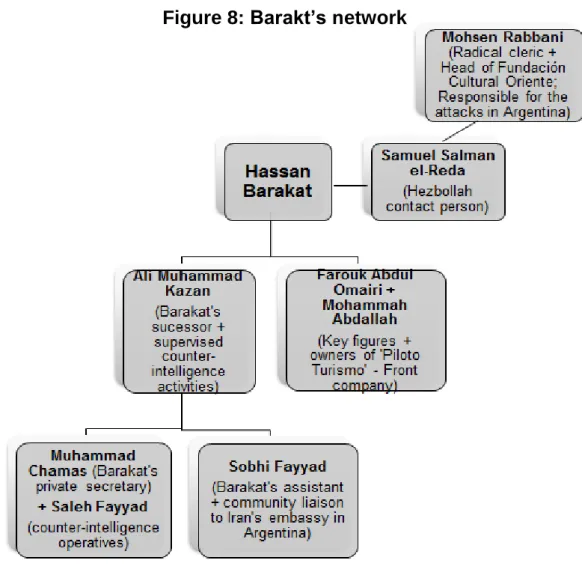
Figure 8: Barakt’s network 44
Figure 9: Hezbollah’s use of European countries 48
Figure 10: Intelligence production cycle 58
Figure 11: Treverton’s “Real” Cycle 60
Figure 12: Lowenthal’s multi-layered intelligence cycle 61
Figure 13: Threat and Risk 64
Figure 14: Evolution of intelligence in Portugal until 1974 75
Figure 15: SIRP Organisational Chart 79
Figure 16: SIS work sources 82
Figure 17: SIS duties 82
Figure 18: SIS cooperation policy 84
X
Figure 20: Schmid’s lessons to combat terrorism 92
List of Tables:
Table 1: Threat Assessment Chart in Terrorism context example 65
Table 2: ‘Hezbollah in Portugal’ - Example of an overall Risk Assessment
XI Glossary
Amal Movement: Afwaj al Muqawamah al Lubnaniyyah, Shia Muslim militia formed c. 1975.
Ayatollah: Highest hierarchal title for the Twelver Shia, used as a title of
respect especially for one who is not an imam title in the religious hierarchy achieved by scholars who have demonstrated highly advanced knowledge of Islamic law and religion.
Jihad: holy war waged on behalf of Islam as a religious duty; also a
personal struggle in devotion to Islam especially involving spiritual discipline
Sheik: Arab chief/a leader of a Muslim group
Shia: the Muslims of the branch of Islam comprising sects believing in Ali
and the Imams as the only rightful successors of Muhammad and disregards the three caliphs who succeeded him.
SIED: Defence and Strategic Intelligence Service SIRP: Intelligence System of the Portuguese Republic SIS: Intelligence Security Service
Sunni: the Muslims of the branch of Islam that adheres to the orthodox
tradition and acknowledges the first four caliphs as rightful successors of Muhammad
Ulama: From the ʿulamāʾ, who are versed theoretically and practically in the
Muslim sciences, come the religious teachers of the Islamic community— theologians (mutakallimun), canon lawyers (muftis), judges (qadis), professors—and high state religious officials like the shaikh al-Islām. In a narrower sense, ʿulamāʾ may refer to a council of learned men holding government appointments in a Muslim state.
XII
Methodology
Following a phase of numerous ideas, debates and considerations, the approach of this topic was born envisioning several factors. Therefore, to carry on this dissertation, the subsequent methodology was applied:
This research includes data collected from a diverse, national and international expert literature, as well as open sources.
In terms of literature, we focused on a vast collection with predominance on Security, Intelligence, Law, International Relations and Political Science subjects. On the open sources, the selection of legal documents available at the official government websites, such as the Ministry of Internal Administration, Intelligence and Security Service, some articles from prestigious Non-Governmental Organisations (NGOs) and Media was preferred.
Subsequently we synthesized, organised, in a coherent form, and analysed it in a light of the questions that we will attempt to answer during this exercise.
In terms of referencing, by norm, it is preferable to use the Portuguese NP 405 bibliography system in this faculty. Nonetheless, since the selected language is English, the Harvard System seemed more appropriate.
1 Introduction
With the end of the Cold War and the ‘Iron Curtain’, we watched an end of an era, the era of a bipolar world. A divided world was crumbling under the pressure between two superpowers, the United States of America and the USSR.
The shift of powers, because of the end of the Cold War, introduced us to a conjuncture of nationalist, ethnical matters, plus organised crime and terrorism. Ideology of that period was an essential pillar to define a certain type of terrorism, terrorist groups whiling to survive initiated a hazardous association with organised crime, converting international terrorism to transnational terrorism.
A new set of threats began, as well as a new configuration of power, where interdependence and cooperation are key elements, sovereignty along with security cannot be analysed as before. We cannot simply analyse a country, in this case in terms of security, excluding it from an international community, particularly with the conjuncture of blurred borders and a faceless, unknown enemy.
These enemies, once well known to us, currently do not have a flag (or the opposite - use of a ‘false flag’), a uniform, nonetheless are well-organised, well-prepared groups. The world is undoubtedly a more volatile place now than in the past.
2
Security is a vital piece of a structured society. Hence, by law, the State have the duty to protect all individuals, their physical integrity, fundamental freedoms, and the most precious right of them all, the right to life.
As a State instrument, the Intelligence services hold the ability to be on the frontline of preventing and combating terrorism, since its purpose is to analyse, anticipate and forecast risk and threats. The distinctive methods of these services, provides them a unique position of being the utmost effective on defensive and offensive forefront of the rule of law.
The aim of this dissertation is to answer to some of the issues raised above. Key issues:
What is terrorism?
How does a transnational terrorist group function?
Do the Portuguese intelligence services have the necessary tools to prevent and combat transnational terrorist groups?
In the light of these key issues, this dissertation is divided in three main chapters.
The first chapter serves as the basis to develop the dissertation. Predominantly focused on answering what is terrorism, what its evolution, origin and definitions.
3
world stability, we decided to use the tactical analysis method (organisational charts, connections, modus operandi - in particular logistic support, money laundering and fundraising schemes), i.e. the dynamics and capabilities of a terrorist group. For this purpose, we selected Hezbollah, not only because it is acknowledged as one of the most capable terrorist groups, but also because of its power of action and mobilisation through its extensive network present across the five continents. There is vast literature analysing Hezbollah origins and their regional impact however, there a lack of research focused on profiling Hezbollah network and activities outside Lebanon. However, apart from Matthew Levitt’s work, there is a lack of research focused on profiling Hezbollah’s network outside Lebanon and for this reason and the reasons mentioned above, our choice was to focus on its action at an international level, particularly in Europe – geographical proximity to the Middle East (especially Southern Europe). In addition, apart from being a place where attacks are perpetuated, it can be used as launch pad of terrorists or as a logistics platform or even as a safe haven – and the Hezbollah activities in the Portuguese-speaking countries.
In light of Hezbollah’s analysis and considering Portugal as a responsible actor of the international community, the third chapter will explore if Portugal intelligence services have the necessary tools to prevent and combat groups with these characteristics by introducing the intelligence concept, origins and cycle. Moreover, this research selected to analyse the country
4
profile, followed by an analysis of the Portuguese intelligence services structure, purpose and cooperation mechanisms. Finally, we will present some of the major challenges and dilemmas that the intelligence community is presented with.
To complete, the last part of this dissertation is dedicated to present the conclusions.
5 CHAPTER 1:
TRANSNATIONAL THREATS: TERRORISM
“For me the best way to fight against terrorism and extremism is just a simple thing: educate the next generation.” Malala Yousafzai
1.1. The evolution of terrorism:
The use of terrorism is nothing new, there is literature utterly dedicated to describe its evolution or its definition. It is a term approached by a variety of
disciplines such as political science, international relations,
security/intelligence studies, military studies, etc.
Constantly confronted with the media broadcasting news related to terrorism on a daily basis we are however, most of the times, unacquainted with its ancient and complex roots.
To understand the causes and circumstances of its evolutionary progress it is necessary to find its origin, its etymology.
Terrorism, as a word, it is believed to have its origin in the Latin word Terror1, from the verb terrere to frighten, put in fear, terrify, scare, alarm and
1
According to several dictionaries such as Merriam-Webster - "Terror." Merriam-Webster.com. Merriam-Webster, n.d. Web.. Available from: http://www.merriam-webster.com/dictionary/terror [Accessed: 20th January 2015] or “Terrere” Perseus Digital Library –Tufts University, n.d. Web.
The role of the intelligence service in preventing and combating transnational terrorism: The rising of the Party of God, Hezbollah
6
from the Greek trein to be afraid, tremein to tremble.
The political connotation similar to the one used nowadays (besides its ancient roots), started merely during the French Revolution2.
The suffix –ism, from the Latin –ismus and the Greek – ismos3 is used in a
political, theoretical level or to refer to an attitude, a form of acting. As noted by Schmid (2011) the historic use of the suffix –ism was added to ‘terror’ after the reign of terror of 1793 – 1794 (France), however it is not clear that it is related with the examples above-mentioned.
1.1.1. Reign of Terror
‘Terror’ was declared as a legal instrument of state violence after the 5th of September 1793. Subsequently, in June 1794, since Maximilen François Marie Isidore de Robespierre4 had publicly declared a new list of traitors, the
Available online at: http://www.perseus.tufts.edu [Last Viewed: 20th January 2015]
2
This word was introduced in the French language in the XIV Century.
3 Suffix of abstract substantives. ”-ismo". 2008-2013. Dicionário Priberam da Língua Portuguesa,
n.d., Available online at: http://www.priberam.pt/dlpo/-ismo. [Last Viewed: 19th October 2014]
4 (Born on 6th of May 1758, Arras, France – Died on the 28th of July 1794, Paris, France) Jurist and
one of the key elements in the French Revolution, he was a radical Jacobin leader. He fought for universal suffrage and the abolishment of slavery. Robiespierre controlled the Committee of Public Safety, the principal organ of the Revolutionary government during the Reign of Terror. Adapted from: Maximilien de Robespierre. 2015. Encyclopædia Britannica Online, n.d., Available online at:
http://www.britannica.com/EBchecked/topic/505619/Maximilien-de-Robespierre. [Last Viewed: 13th of January 2015]
Chapter 1: Transnational Threats: Terrorism
7
fear increased among the delegates of the French National Conservative Convention who have once supported him.
Overthrown from the Committee of Public Safety on the 27th of June 1794, Robiespierre and his collaborators, as Schmid (2011) argues, could not indict Robiespierre of ‘terror’ without incriminating themselves, they had to find a way to exonerate them. The solution was to prosecute Robiespierre of terrorism5 and after his imprisonment, without any trial, he and his
companions were beheaded by the guillotine.
It is estimated that 40.000 people, including the King Louis XVI of France, the Queen Marie Antoinette of France and Dr. Guilhotin (creator of the guillotine), were beheaded between 1783 until 1795.
1.1.2. Ancient phenomenon
As previously mentioned, terrorism it is nothing new. The existence of ‘holly warriors’ dates back to the Ancient Greece and the Roman Empire, their mission was to kill in the name of freedom. Nevertheless, it was during the XI to the XII centuries, in the Middle East, that a group of Shia Nizari Ismaili6
(1090 - 1256) emerged known within the Crusades culture as the
5 At that time the word terrorism was associated with a criminal abuse of power through a
dictatorial, indiscriminate and disproportionate violence.
6
The Nizari has its origin with Nîzar (Mustanir’s firstborn). The highest point of this group was reached with the Alamût Reform in 1164. Thenceforth, there was a gradual unification between the Ismaili and the esoteric Sufism.
The role of the intelligence service in preventing and combating transnational terrorism: The rising of the Party of God, Hezbollah
8
Assassins7.
Led by the Persian al-Hassan ibn-al-Sabbah, this group had a political and religious agenda. According to Lewis (2003)8 the group modus operandi was
almost ceremonial as they could invoke an ancient Islamic tradition: the religious obligation to free the world of tyrants. The target was carefully selected, usually important predominant political, military or religious leaders. Their weapon was a dagger and the assassin should not return to the Alamut Castle, it was his duty to wait on the crime scene for popular justice, since returning would be interpreted as an insult, an outrage.
Silva (2010) underlines that Hassan ibn-al-Sabbah used this behaviour as a political weapon, to terrorise. This movement is set to be the initiators of the present suicide-bombers (the binomial die-kill).
Although some scholars highlight the 9/11 as a shifting point, terrorism through time is present with different agendas, from left to right, acting local or global.
7 From the Arabic Hashishyyin meaning ‘hashish user’. There are conflicting facts/sources about its
origin. One is that the origin was distorted from aschishin meaning ‘follower of Hasan’.
8
In Silva, Teresa de Almeida e (2010) Sociedade e Cultura na Área Islâmica. Lisboa: Edição Instituto Superior de Ciências Sociais e Políticas.
Chapter 1: Transnational Threats: Terrorism
9 1.1.3. Categorisation
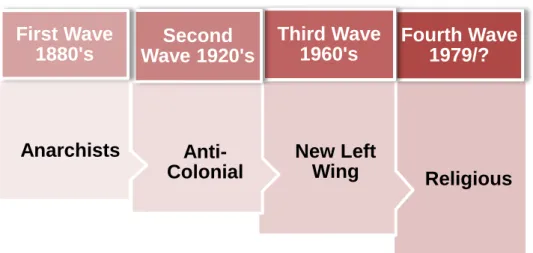
David Rapoport was a pioneer outlining a system of four waves categorising terrorism - different phases albeit with the same characteristics.
The waves are defined as “cycle of activity in a given time period… characterised by expansion and contraction phases” (Rapoport, 2004, p.47). He argues that the legitimacy of these uprisings is diverse through the waves, and most of the groups with particular characteristics that contribute for the construction of the waves generally perish before the wave is predominant. As a final point Rapoport claims that the ideologies can cross countries, regions and continents therefore the waves are transnational in character.
Figure 1: Rapoport’s Four Waves
The First Wave began after the Napoleon wars and the Congress of Vienna in 1815. The revolutionary ideas started to spread particularly in the South European countries. Portugal, was not immune and anarchist terrorism
Religious Fourth Wave 1979/? New Left Wing Third Wave 1960's Anti-Colonial Second Wave 1920's Anarchists First Wave 1880's
The role of the intelligence service in preventing and combating transnational terrorism: The rising of the Party of God, Hezbollah
10
fomented the fall of the Portuguese monarchy, starting with the regicide of the King Carlos I and the heir to the crown prince Luís Filipe (1st of February 1908). Subsequently a coup d’état occurred, organised by the Portuguese Republican Party, with the aim of taking the power from the constitutional monarchy and afterwards establishing the Portuguese Republic (5th of October 1910). Nonetheless, it started with the assassination of Tsar Alexander II (13th of March 1881), the group who perpetrated the crime was Narodnaya Volya (The People’s Will). This wave includes, among others, the Civil War in the United States, the Ku Klux Klan9.
The Anti-Colonial Wave is the Second Wave. It began after the end of the World War I with the aim of self-determination, to liberate themselves from the French, British, Portuguese (and others) colonial rule by breaking up these empires. All in all groups such as the Algerian Front de Libération Nationale (FLN), Irish Republican Army (IRA) and Irgun10 (Zionist group in
Israel) fought as guerrillas through ‘hit and run’ tactics.
With the start of the Vietnam War plus the Cold War framework, the Third Wave known as ‘New Left Wave’ emerged. The internationalisation of terrorism started under the influence of the Marxist revolution with actions
9
A secret right-wing extremist organisation founded, after the Civil War, in 1865 in Tennessee, United States. Their main purpose was to maintain the white supremacy, the purification of the United States through violent actions.
10 They introduced the term “freedom fighters” to describe their struggle against government,
Chapter 1: Transnational Threats: Terrorism
11
guided by the strong urge of the West World groups to help the Third World. Some notorious actions/tactics were high jacking and hostage takings, such as the ‘Black September’ (1972) performed by the Palestinian Liberation Organisation (PLO), frequently broadcasted by the media spreading fear to a vast number of people. The Japanese Red Army, the Italian Red Brigades, the German Baader-Meinhof, West German Red Army Faction (RAF) and the Basque Euskadi Ta Askatasuna (ETA) were also amid this type of terrorist groups.
Finally, the Fourth Wave, identified as ‘Religious Wave’, began with the Islamic Revolution in Iran (1979), the invasion of Afghanistan by the Soviet Union (1979) and the occupation of the Grand Mosque in Mecca. The religious political agenda was more appealing and congregating compared to Nationalist groups. Furthermore, the Soviet Union withdraw from Afghanistan, displayed a powerful message of religion eliminating a superpower from their land and after that, the United States became the next enemy to annihilate.
Aum Shinrikyo from Japan, Tamil Tigers from Sri Lanka, Hamas from Palestine, the well-known Al-Qaeda and Hezbollah from Lebanon are groups that belong in this categorisation.
Observing Rapoport’s Fourth Wave, we are inclined to think that a fifth wave it is starting soon. Nevertheless, it seems that this one in particular it is not fading and apart from his terrorism categorisation, several authors and
The role of the intelligence service in preventing and combating transnational terrorism: The rising of the Party of God, Hezbollah
12
organisations attempt to organise or/and define it.
1.2. Terrorism concept: Attempt of a definition
The use of the term terrorism varies in different cultures and languages. Still a controversial topic, through time the same actions were on occasion, not considered an act of terrorism.
We will briefly enumerate some of the most prominent and accepted definitions in a chronological manner (adapted from Schmid, 2011, p.99 FF).
Robespierre (1794):
“Terror is nothing else than immediate justice, sever, inflexible; it is
therefore an outflow of virtue, it is not so much a specific principle than a consequence of the general principle of democracy applied to the most pressing needs of the motherland.”
League of Nations Convention for the prevention and Repression of Terrorism (1937)
“In the present Convention, the expression 'acts of terrorism' means
criminal acts directed against a State an intended or calculated to create a state of terror in the minds of particular persons, or a group of persons or the general public.”
Wilkinson (1974):
“Our main concern is with political terror: that is to say with the use of coercive intimidation by revolutionary movements, regimes or individuals. … We have thus identified some of the key characteristics common to all forms of political terror: indiscriminateness, unpredictability, arbitrariness, ruthless destructiveness and the implicitly amoral antinomian nature of a terrorist’s challenge. … Political terrorism, properly speaking, is a sustained policy involving
Chapter 1: Transnational Threats: Terrorism
13
the waging of organized terror either on the part of the state, a movement or faction, or by a small group of individuals. Systematic terrorism invariably entails some organizational structure, however rudimentary, and some kind of theory or ideology of terror.” Laqueur (1977):
“Terrorism, interpreted here as the use of covert violence by a group for political ends, is usually directed against a government, less frequently against another group, class or party. The ends may vary from the redress of specific ‘grievances’ to the overthrow of a government and the taking of power, or to the liberation of a country from foreign rule. Terrorists seek to cause political, social and economic disruption, and for this purpose frequently engage in planned or indiscriminate murder… .Note: Any definition of political terrorism venturing beyond noting the systematic use of murder, injury and destruction or the threats of such acts toward achieving political ends is bound to lead to endless controversies.”
Apart from the previous definitions, Alex Schimd and Albert Jongman (1988), in pursuit of a clearer definition proposed themselves to find an academic consensus by asking their colleagues to define terrorism through the ‘Research Guide’. After analysing those solutions from 109 definitions, the conclusion was that twenty-two elements were matching. Consequently, Schmid and Jongman attempted to define terrorism:
"Terrorism is an anxiety-inspiring method of repeated violent action, employed by (semi-) clandestine individual, group or state actors, for idiosyncratic, criminal or political reasons, whereby - in contrast to assassination - the direct targets of violence are not the main targets.
The role of the intelligence service in preventing and combating transnational terrorism: The rising of the Party of God, Hezbollah
14
The immediate human victims of violence are generally chosen randomly (targets of opportunity) or selectively (representative or symbolic targets) from a target population, and serve as message generators. Threat- and violence-based communication processes between terrorist (organization), (imperilled) victims, and main targets are used to manipulate the main target (audience(s)), turning it into a target of terror, a target of demands, or a target of attention, depending on whether intimidation, coercion, or propaganda is primarily sought" (Scmid, 1988, p. 28)
The 9/11 event prompted the need to an effective and capable answer to prevent another similar act, a definition was urgent and necessary consequently most of the definitions were reconsidered, adjusted.
EU Definition of Terrorism (2001):
“Offences intentionally committed by an individual or a group against
one or more countries, their institutions or people, with the aim of intimidating them and seriously altering or destroying the political, economic, or social structures of a country.”
UN Ad Hoc Committee on Terrorism (draft -2001):
“UN Ad Hoc Committee on Terrorism: Informal Texts of Art. 2 of the
draft Comprehensive Convention on International Terrorism, prepared by the Coordinator:
1. Any person commits an offence within the meaning of this Convention if that person, by any means, unlawfully and intentionally, causes:
Chapter 1: Transnational Threats: Terrorism
15
• Serious damage to public or private property, including a place of public use, a State or Government facility, a public transportation system, an infrastructure facility or the environment; or
• Damage to property, places, facilities, or systems referred to in paragraph 1 (b) of this article, resulting or likely to result in major economic loss, when the purpose of the conduct, by its nature or context, is to intimidate a population, or to compel a Government or an international organization to do or abstain from doing any act.”
European Union (2002):
“An intentional act which may seriously damage a country or an international organisation, committed with the aim of seriously intimidating a population, unduly compelling a Government or a international organisation to perform or abstain from performing any act, seriously destabilizing or destroying fundamental political, constitutional, economic or social structures by means of attacks upon a person's life, attacks upon the physical integrity of a person, kidnapping, hostage-taking, seizure of an aircraft or ships, or the manufacture, possession or transport of weapons or explosives.” Chomsky (2003):
“Terrorism is the calculated use of violence or threat of violence to attain goals that are political, religious, or ideological in nature... through intimidation, coercion, or instilling fear.”
NATO (2003):
“The unlawful use or threatened use of force or violence against individuals or property in an attempt to coerce or intimidate governments or societies to achieve political, religious or ideological objectives.”
Lei n.º 52/2003 de 22 de Agosto - Portuguese Law to Combat Terrorism (2003)
The role of the intelligence service in preventing and combating transnational terrorism: The rising of the Party of God, Hezbollah
16
1 - Considera-se grupo, organização ou associação terrorista todo o agrupamento de duas ou mais pessoas que, actuando concertadamente, visem prejudicar a integridade e a independência nacionais, impedir, alterar ou subverter o funcionamento das instituições do Estado previstas na Constituição, forçar a autoridade pública a praticar um acto, a abster-se de o praticar ou a tolerar que se pratique, ou ainda intimidar certas pessoas, grupos de pessoas ou a população em geral, mediante:
a) Crime contra a vida, a integridade física ou a liberdade das pessoas;
b) Crime contra a segurança dos transportes e das comunicações, incluindo as informáticas, telegráficas, telefónicas, de rádio ou de televisão;
c) Crime de produção dolosa de perigo comum, através de incêndio, explosão, libertação de substâncias radioactivas ou de gases tóxicos ou asfixiantes, de inundação ou avalancha, desmoronamento de construção, contaminação de alimentos e águas destinadas a consumo humano ou difusão de doença, praga, planta ou animal nocivos;
d) Actos que destruam ou que impossibilitem o funcionamento ou desviem dos seus fins normais, definitiva ou temporariamente, total ou parcialmente, meios ou vias de comunicação, instalações de serviços públicos ou destinadas ao abastecimento e satisfação de necessidades vitais da população;
e) Investigação e desenvolvimento de armas biológicas ou químicas; «f) Crimes que impliquem o emprego de energia nuclear, armas de fogo, biológicas ou químicas, substâncias ou engenhos explosivos, meios incendiários de qualquer natureza, encomendas ou cartas armadilhadas;
sempre que, pela sua natureza ou pelo contexto em que são cometidos, estes crimes sejam susceptíveis de afectar gravemente o Estado ou a população que se visa intimidar.”
Chapter 1: Transnational Threats: Terrorism
17
Stepanova (2006) “...the intentional use or threat of violence against
civilians and non-combatants by a non-state (sub-national or transnational) actor in an asymmetrical confrontation, in order to achieve political goals.”
Richardson (2006) “Terrorism simply means deliberately and
violently targeting civilians for political purposes. It has seven crucial characteristics... [F]irst, a terrorist act is politically inspired... Second, if an act does not involve violence or the threat of violence, it is not terrorism. ...Third, the point of terrorism is not to defeat the enemy but to send a message... Fourth, the act and the victim usually have symbolic significance... Fifth – and this is a controversial point – terrorism is the act of sub-state groups, not states... A sixth characteristic of terrorism is that the victim of the violence and the audiences the terrorists are trying to reach are not the same. ...The final and most important defining characteristic of terrorism is the deliberated targeting of civilians.”
Rapoport (2008):
“'Terror' is violence with distinctive properties used for political purposes both by private parties and states. That violence is unregulated by publicly accepted norms to contain violence, the rules of war, and the rules of punishment. Private groups using terror generally disregard rules of punishment, i.e. those enabling us to distinguish guilt from innocence. But both states and non-state groups can ignore either set of rules.
Schmid (2011):
“Terror' is a state of mind characterized by intense fear of a threatening danger on an individual level and by a climate of fear on the collective level. ’Terrorism', on the other hand, is an activity, method or tactic which, as a psychological outcome, aims to produce 'terror'.”
The role of the intelligence service in preventing and combating transnational terrorism: The rising of the Party of God, Hezbollah
18
In general, most of the definitions abovementioned fail to include the State as an actor capable of terrorism actions or the aim/purpose of those actions. From our perspective the combination of Wilkinson’s, Shmid’s, Chomsky’s, Richardson’s first three characteristics and particularly Rapoport’s have the elements of a proper definition:
- Act perpetuated by and individual, group, organisation, State + Intentional acts that disrupt/destroy (political, social and economic) structured society + Direct victims (random or representative /symbolic) with the intention of provoking intense fear through their actions + With predominantly political, (religious, ideology) aim.
Nonetheless, yet again the term terrorism varies in different cultures and languages plus there are vast regional differences. Most prominent and universal accepted definitions continue to be predominantly from male, western authors.
Even without a clear definition, every State has the responsibility within their rule of law to safeguard their people. We cannot allow our society, our security to be threatened by terrorist groups or other destabilising agents. Although making an immense effort, scholars and the international community still have not reach a universal definition and may perhaps never find it. Most of the definitions are vague or to strict and that can offer a place for wrong interpretation.
Chapter 1: Transnational Threats: Terrorism
19
Terrorism is continuously evolving. What were the main factors that led terrorism to achieve its transnational character?
1.3. Terrorism pathway: From national to transnational
The Rapoport’s categorisation of terrorism highlights that, terrorism actions were predominantly characterised with a nationalistic ideology. Nonetheless, although still present, that was about to change.
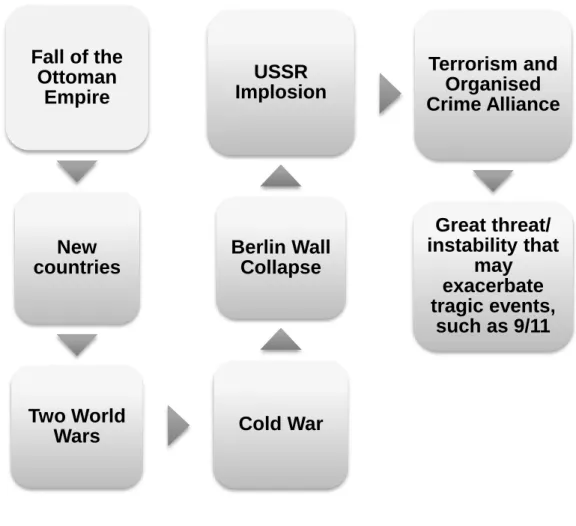
With the collapse of the Ottoman Empire between 1800 until 1923 new States emerged. In addition, according to Costa (2000, p. 195), the British and Russian expansionist tendencies, particularly in the Middle East, and the fall of the Qadjar11 dynasty left Iran fragmented. The combination of those factors placed the Middle East into a delicate position.
After World War I Palestine once administrate by the Ottoman Empire, was now administrated by the British. With a post-World War II scenario, considering the cost of their participation and the previous commitment with the Jew community through ‘The Balfour Declaration’ (1917), Britain was placed in an economic and political fragile situation. Consequently, they had no choice but to deliver the administration to the United Nations in 1948. A turbulent period ended, nonetheless a clash of ideologies and agendas between the United States and USSR, would submerge the world into a new crisis acknowledge as the Cold War. Therefore, this new bipolar
11
The role of the intelligence service in preventing and combating transnational terrorism: The rising of the Party of God, Hezbollah
20
TERRORISM: POLITICAL
(purpose) ORGANISED CRIME: LUCRATIVE (purpose)
environment would set the Middle East and some African countries into a battlefield, though there was never a direct physical confrontation between the two superpowers. The conflicts increase then again they were also ‘controlled’ by the US/USSR.
Afterward with the end of the Cold and the collapse of the Berlin Wall, the USSR ‘imploded’ and all the internal problems emerged. With the change of circumstances, terrorist groups willing to survive made the choice to ally with organised crime groups.
The association of terrorism with organised crime is undoubtedly one of the key elements of the metamorphosis of international terrorism into transnational.
Although, the majority of academics accept that there is a difference between terrorist and organised crime activities:
Chapter 1: Transnational Threats: Terrorism
21
To summarise the shifting points were:
Figure 3: Key events of the evolution of terrorism
To understand better the dynamics of a terrorist group capability, the next chapter is an analysis of Hezbollah, known as one of the most capable terrorist groups to thrive.
Fall of the Ottoman Empire New countries Two World
Wars Cold War
Berlin Wall Collapse USSR Implosion Terrorism and Organised Crime Alliance Great threat/ instability that may exacerbate tragic events, such as 9/11
22 CHAPTER 2:
CASE STUDY: HEZBOLLAH, A ‘GLOCAL’ GROUP
“If you know the enemy and know yourself, you need not to fear the result of a hundred battles. If you know yourself but not the enemy, for every victory gained you will also suffer a defeat. If you know neither the enemy nor yourself, you will succumb in every battle.” Sun Tzu
Since its formation in Lebanon12, Hezbollah has carried out several terrorist
attacks, nonetheless their actions are not exclusive of a national or regional scenario they are global.
As noted by some authors Al-Qaeda and recently groups like self-proclaimed ‘Islamic State’ Group (Daesh) aka ISIL aka ISIS, Boko Haram, Al-Shabab and so on, take hold of all the headlines as Hezbollah, considered by Richard Armitage as the “A-team of terrorism”, grows dangerously ‘quiet’ in the shadows.
Acknowledged as a resistance group Hezbollah is also a social movement and a political party. However, in this chapter we will focus on comprehending how a transnational terrorism group works. Hence, we propose a modest analysis with emphasis on Hezbollah’s activities outside
12
Chapter 2: Case Study: Hezbollah, a ‘Glocal’ group
23
Lebanon, as Levitt (2013) highlights “there is a gap between the organization’s activities in Lebanon and its global infrastructure”. We will focus particularly their ‘self-financing network’, as traditionally understood as separate phenomenon, organised crime and terrorism are not often linked by security and law enforcement agencies.
“Understanding Hizbullah requires a multifaceted conceptual framework that combines theories of crisis, revolution, leadership, personality, social class, and political parties.” (Hamzeh, 2004, p.2)
2.1. Hezbollah’s inception
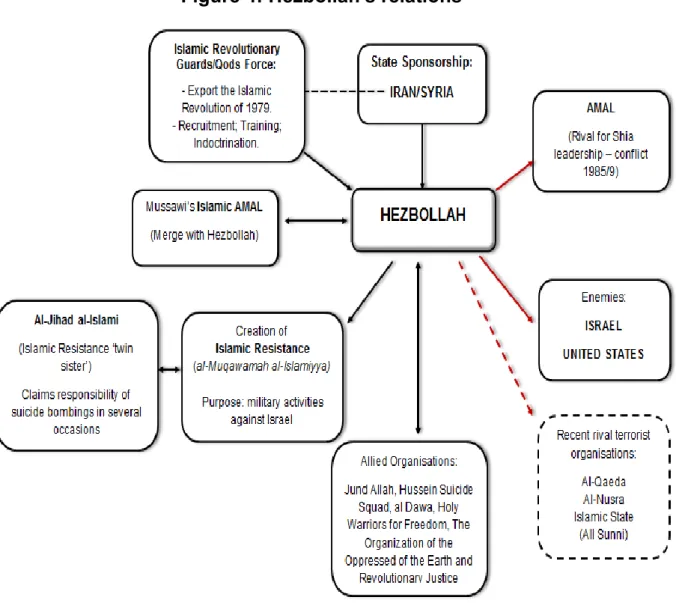
The Ayatollah Mahmoud Ghaffari originally created the Party of God, Hezbollah, in Iran in 1973. Silva (2010), notes that Hadi, Ghaffari’s son, became the leader of the party although with no relevance. On the other hand, the militants of the Party of God became the armed proxy for the Islamic Republican Party, the Party of the Ayatollah Khomeini, Ayatollah Beheshti, Ayatollah Khameni and Ali Rafsanjani13. Also in 1982, twenty-five
radical Islamic organisations, ordered by the Iranian regime, were included in a restructure of the Party of God.
June 1982, with the Israel incursion of southern Lebanon, Iran finds a pretext to deploy, according to Hamzeh (1993), around 1,500 Iranian Revolutionary Guards to Bekaa (Biqua) region and the opportunity to export
13
The role of the intelligence service in preventing and combating transnational terrorism: The rising of the Party of God, Hezbollah
24
its revolution. The Lebanese Hezbollah14 is born.
Sayyd Husayn al-Musawi, former Amal member, became its official leader until is assassination in 1992. According to Avon and Khatchadourian (2012), Hassan Nasrallah, follower of Musa al-Sadr and identified as a “member of the Baseq Force of the Resistance”, leader of the Baalbek region, left Amal in June 1982. Nasrallah became Mussawi’s recognised successor and it was elected as Secretary General since then.
Figure 4: Hezbollah’s relations
Chapter 2: Case Study: Hezbollah, a ‘Glocal’ group
25
October 1983, the US embassy and Marine Corps in Beirut were brutally destroyed by a suicide attack that claimed the life of hundreds. This attack consolidated the group’s image as leader of the Shia.
2.1.1. Lebanon Political Background
Lebanon political division is deep-rooted dating back to civil war (1860),
par-ticularly after the downfall of the Ottoman Empire plus the French League of
Nations Mandate.
The National Pact (1943), an agreement between Lebanese leaders,
intro-duced a ‘fair’ political system of a 6:5 formula that would distribute repre-sentatives according to their sect.
Norton (2007) highlights that Christian Maronite’s were in charge of the presidency, the Sunnis premiership and the Shia speakership, a position
with minor influence on the political system. As a result, Christians and
Sun-ni were privileged with access to strategic economic sectors, on the other
hand the Shia, the fastest growing community at the time, remained
dedi-cated to agriculture. The development of this situation had a damaging
im-pact on the Shia people subsequently the Lebanese Diaspora started once
again, with Africa, South America and the Gulf on the top of the list.
With the decay of the Shia community conditions, Harakat Amal (The
Movement of Hope) in the early 1970’s, an organised Shia party led by the Imam Musa al-Sadr, was born.
The role of the intelligence service in preventing and combating transnational terrorism: The rising of the Party of God, Hezbollah
26
The Palestine war (1948/49), as Norton (2007) underlines, pushed
thou-sands of Palestinians to South Lebanon, were most of the Shia live(d),
stressing the existing precarious work conditions. Adding to that the
Jorda-nian civil war of 1970/71 presented Lebanon with a new challenge, not only
with the increasing numbers of Palestinians on Lebanese soil, but also with
Palestinian guerrillas, such as Palestinian Liberation Organisation (PLO),
that would threat the government authority.
In the 1960’s, concerning the Shia community, the four dominant political trends were:
Figure 5: Shia dominant political trends
“Amal challenged the stifling and often brutal domination of the Palestinian guerrillas whose public support plummeted in the late 1970s and early
1980s for bringing southern Lebanon into crossfire with Israel. Israel's
inva-sion of the 1978, the “Litani Operation”, (…) displaced hundreds of thou-sands of Lebanese from the southern region.” (Norton, 2007, p.22)
Secularism Liberation
Chapter 2: Case Study: Hezbollah, a ‘Glocal’ group
27
During the “Litani Operation” the United Nations Security Council (UNSC) established the Resolutions 425 and 42615 - specifying Israel withdraw from
Lebanon as well as a United Nations Interim Force in Lebanon (UNIFIL) to intercede as a peace keeping force. Yet before the Israeli invasion the panorama in Lebanon was critical with the outbreak of the civil war (1975/89).
A restructure of the parliament recognised as ‘The Ta’if Agreement’ (1989), signed in the Saudi city of Tai’f, ended the civil war. One of Ta’if corner-stones was to call all militias to disarm, Hezbollah was now on the spotlight
and it was confronted with a challenging situation that was solved astutely.
Hezbollah’s choice was to participate in the Lebanese system via politics and at the same time, preserve the right of resistance.
Rafiq Hariri, a former Lebanese Prime Minister, died in a terrorist attack
(14/02/2005) in the Beirut, along with several others. His death had deep
implications in the country, opening the way for the Cedar Revolution and
the withdrawal, after twenty-nine years of permanence, of the Syrian troops.
The Special Tribunal for Lebanon (UN) was set to investigate Hariri’s death and it has allegedly found enough evidence to link the attack back to
Hez-bollah.
15
To read the full Resolutions please consult: The Official Document System of the United Nations. Available online at: http://documents.un.org/default.asp
The role of the intelligence service in preventing and combating transnational terrorism: The rising of the Party of God, Hezbollah
28
2.2. Ideology
Resistance in the Shia context is a deeply rooted concept. Hezbollah is
pointed by many as the introductory of suicide16 bombing as a cost/effective
weapon. Nasrallah speeches are full of the Battle of Karbala17 and the
mar-tyrdom of Husain, the son of Fatima (Prophet Mohammed’s daughter) and Ali ibn Abu Talib (cousin and son-in law of the Prophet Mohammed),
refer-ences to instigate the Shia to fulfil their duty through jihad. Husain’s action was vital to transmit that the Shia community must resist against the
op-pressors and abusive power, it is a fundamental pillar of the Shia narrative
as well as the link to the present-day Shia activism and collective identity.
Pointed as a founding text by most scholars, the group ideology can be
bet-ter understood by analysing the ‘Open Letbet-ter’18
(16th of February 1985).
The ‘Open Letter’ states, amid other matters, that:
"Our primary assumption in our fight against Israel states that the Zionist entity is aggressive from its inception, and built on lands wrested from their
16 Istishhad: Sacrifice of one’s own life for the sanctification of Allah’s name, in the context of an
Islamic military campaign against the enemy.
17
680 A.D. as the Shia refused the authority of a Caliph that was non-descendent of Prophet Mohammed, Husain and his followers marched into Damascus to destitute Yazidi’s illegitimate power. The result of this incursion was the brutal massacre of Husain’s faction and himself.
18 To read the full letter please consult: Avon, Dominique and Khatchadourian, Anaïs-T.(2012) Hezbollah: a history of the "party of God". Translated from French by Jane Marie Todd. London:
Chapter 2: Case Study: Hezbollah, a ‘Glocal’ group
29
owners, at the expense of the rights of the Muslim people. Therefore our struggle will end only when this entity is obliterated. We recognize no treaty with it, no cease-fire, and no peace agreements, whether separate or consolidated." (Avon and Khatchadourian, 2012, pp.103-120)
The main ideas are:
Figure 6: Key pillars of Hezbollah ideology
The first pillar and the third are vital since the group use of violence and terror are central to its ideology. During 1984/85, as highlighted by Norton (2007), dozens/hundreds members of the Communist Party were assassinated simply because Hezbollah decided to free the world from the oppressors, like US and the Soviet Union.
FIR ST SECOND THIRD Opressors vs Opressed Islamic Government Sharia application = Justice guaranteed Jihad to free “Muslim territories” = Armed struggle to extinguish Israel, the “Zionist entity”.Plus Israel's allies, primarly the United States
.
The role of the intelligence service in preventing and combating transnational terrorism: The rising of the Party of God, Hezbollah
30
During 2009, Hezbollah published the ‘Political Charter’19, the second letter
since the ‘Open Letter’ of 1985. The purpose of this release was to highlight their current political vision/position, ambitions, so on and so forth, to ‘complement’ the first document that was neglecting Hezbollah’s political strategy.
Hamzeh (1993) adds that the ideology is:
Formulated by the political writings of Ayatollahs Muhammad Baqir al-Sadr and Ruhollah Khomeini + Experience of the Iranian revolution;
Obeys to the Governance of the Religious Jurist (Wilayat al-Faqih) in the absenteeism of the Twelfth Imam;
Silva (2010) points out that, apart from being simplistic in their ideology, they highlight some dichotomies, for instance Good/Bad, Justice/Injustice, Truth/Untruthful…
19 To read the full letter please consult: Avon, Dominique and Khatchadourian, Anaïs-T.(2012)
Hezbollah: a history of the "party of God". Translated from French by Jane Marie Todd. London:
Chapter 2: Case Study: Hezbollah, a ‘Glocal’ group
31 2.3. Hezbollah’s (In) Visible Structure and Modus Operandi
During the decades of 1960s until 1980s, the organisational structures of terrorist groups were predominantly ‘star shaped’. It was easier to identify it with the capture of its leaders.
Presently, with the evolution of the structures, we no longer can make the assumption of a network dependable on an exclusive leader (although the group may have a ‘public’ leader like Hassan Nasrallah in Hezbollah). Groups are now decentralised, organised in independent cells with the power of acting alone and sometimes without the knowledge of other ‘twin’ cells. Therefore, if discovered and dismantled the other cell(s) can still pursue their mission/act. Eventually it makes it harder for the intelligence services to penetrate this kind of structure.
Hezbollah acts in different arenas:
National (politics – sometimes employing violence against opposition;
social movement; militia/resistance);
Regional (particularly in Israel/Palestine arena + Syria, Yemen;
Bahrain);
Global (five continents – intricate network: intelligence gathering;
sleeper cells; attacks; logistical support; fundraising; money laundering; money and documents counterfeit; trafficking)
The role of the intelligence service in preventing and combating transnational terrorism: The rising of the Party of God, Hezbollah
32
2.3.1. (In) Visible Structure
As Hezbollah evolves into a more legitimate group, in part because of its involvement in politics and welfare, the demand for a more transparent structure grows. Nonetheless, there is ‘still place’ for a secretive structure20
within the group.
According to Hamzeh (1993), a consultative council (Supreme Shura Council), plus several committees composes the Hezbollah structure. After the National Pact the group started a political life, hence a public structure was necessary to legitimise it. In terms of leadership, Hezbollah presents a collective leadership instead of the usual one charismatic leader. In addition, the Ulama is vital on its structure.
Following Hamzeh’s (1993) opinion, seven members21, majority clerics,
constitute Hezbollah’s Shura Council. With executive, political, legislative, judicial and military power, this Council is the highest authority inside the structure. All decisions must pass through the Shura Council and require a majority vote, in circumstance of impasse the Supreme Leader, the Ayatollah in Iran will decide, as he is the supreme Juris consult.
Additionally, the summarized explanation of Hezbollah’s organisation
20 Please consult Hezbollah’s structure charts, pp. 109-112 21
Sayyid Ibrahim al-Amin, Sayyid Hasan Nasrallah, Shaykh Naim Kassim, Shaykh Subhi al-Tufayli and Shaykh Abu Salem Yaghi (Musawi’s place was not filled).
Chapter 2: Case Study: Hezbollah, a ‘Glocal’ group
33
structure described by Hamzeh consists in:
Secretary General: Ex-officio chairman of the Executive Council
Composed by several heads of districts + 5 members (named/appointated by the Shura Cuncil) Politburo: Constituted by 15 members; Coordinates the work of the
committees + directs the activity of three organs:
1) Enforcement Recruitment and Propaganda: Supervises three sections: Network of preachers + Al-Hawzat (circles of learning) – important as the preachers + research and propaganda section: manages the media.
2) Holy Reconstruction Organ: Divided in eight committees; Supervised by a committee of the Holy Reconstruction Organ; Provides support to Hezbollah members, new recruits and followers via medical care, financial aid, housing, public utilities; Reliefs underprivileged regions of Lebanon.
3) Security Organ: Divided into three sections: Party Security section: Protection of the leaders/members + Central Security section: network of surveillance and Intelligence gathering (internal and external) + Operational Security section: carries decisions of the overall Security Organ.
The role of the intelligence service in preventing and combating transnational terrorism: The rising of the Party of God, Hezbollah
34
Combat Organ: Controlled directly by the Shura Council; Organised
in two groups: the Islamic Resistance, responsible for suicide attacks against Israeli/Western targets and Islamic Holy War, accountable for conventional attacks against Israeli troops.
Levitt (2013) with an updated version also explains that the Secretary General, presently Hassan Nasrallah, presides the Shura Council, which is the entity that deliberates all elements of the group’s activities. In addition, explains that there are five administrative bodies:
Executive Council role: Management of daily operations +
supervises all education, cultural, political, social affairs;
Political Council role: Management of Hezbollah’s external
relations + Group’s political relations inside Lebanon + organisation of public information/propaganda through several subcommittees; Parliamentary Council role: Organisation of the party’s
parliamentarians activities + studies proposed legislation brought before the government;
Judicial Council role: Management of disputes in regulatory matters
(between members or between the organisation and non-members) Jihad (military) Council role: (Headed by Mustapha Badreddine)
Chapter 2: Case Study: Hezbollah, a ‘Glocal’ group
35
actions through the Islamic Jihad Organisation (IJO)22, headed by
Talal Hamiyeh; Divided into smaller units to protect the structure; Three subgroups: central, preventive and overseas security – Terrorist/Militia wing plus security organ report to it.
The nature of the last council above mentioned, apart from the others, it is maintained ‘private’ as most of the parliamentarians and officials are not acquainted with their activities. Nonetheless, as it happens with all the other matters, the senior leaders of the Shura Council supervise them.
On the other hand Abboud and Muller (2012) highlight that the decision-making within the structure might not be as we know. Also adds that Nasrallah took the Secretary General position for life abolishing the three-year mandate rule. Nonetheless, the election of other member occurs in the General Conference through an Electoral College system.
Abboud and Muller (2012) clarify as well, that no one inside the Party intentionally knows about the location, weaponry or military activities of the Resistance Council (Levitt’s Jihad Council) allowing strategic ambiguity. Apart from that, Hezbollah’s structure description is quite similar to Levitt’s.
22
The role of the intelligence service in preventing and combating transnational terrorism: The rising of the Party of God, Hezbollah
36
2.3.2. Recruitment
Since its inception, Hezbollah managed to establish a powerful transnational network particularly backed by the Lebanese Shia emigrant communities. Providing a network of social services that includes financial aid, medical care, housing, education, cultural activities and religious services Hezbollah exploits this as excellent tactic on the battle of “winning hearts and minds”. The population, as a form of expressing gratitude, may effortlessly get into the process of enlistment.
Although efficient there are other methods of recruitment, particularly in the Mosques, where Hezbollah can reinforce their doctrine and “Al-Hawzat al-'ilmiyyah (circles of learning) (…) they represent the basic element in Hizbullah's recruitment process and its slow infiltration policy among the people. The most important of these Hawzat are: the Religious Hawzat of Siddikin in South Lebanon, the Centre for Youth Education in Jibsheet (South Lebanon), the Educational Hawzat in Brital (Biqa'), the Iranian Religious Centre in Tyre, and the Centre for Islamic Martial Arts in Kabrikha (South Lebanon).” (Hamzeh, 1993)
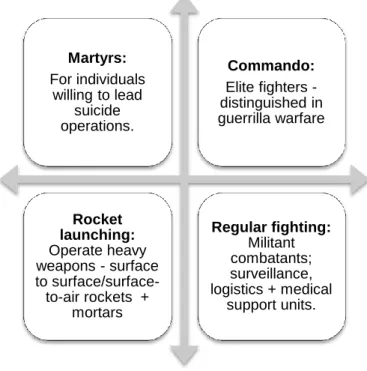
Based on Rudner (2010) explanation, each element of recruit is trained in numerous skills, after assessment the new recruits are assigned to different contingents according to their performance.
Chapter 2: Case Study: Hezbollah, a ‘Glocal’ group
37
There are four operational contingents in the combat division:
Figure 7: Hezbollah operational contingents
2.3.2.1. The Vital role of Communication
It is argued that Hezbollah’s has sophisticated and complex communications system. “That system included radio networks, copper wire phone systems, cellular and fiber optic networks, and VoIP networks which now extend into the global cyber domain. The individual elements of Hezbollah’s communications system were neither novel nor exotic. Hezbollah communication was set apart by the scaled, disciplined, and systematic deployment of a layered communications architecture, from copper land lines to encrypted VoIPs” (Wege, 2014, p.248).
Martyrs: For individuals willing to lead suicide operations. Commando: Elite fighters - distinguished in guerrilla warfare Rocket launching: Operate heavy weapons - surface to surface/surface-to-air rockets + mortars Regular fighting: Militant combatants; surveillance, logistics + medical support units.
The role of the intelligence service in preventing and combating transnational terrorism: The rising of the Party of God, Hezbollah
38
In fact, the communication apparatus that Hezbollah owns23 it is, not only
lucrative, but also basilar for heavy propaganda and recruitment campaigns. Al-Manār television, radio stations such as al-Nour, Baqiyyat allāh or the press as the al-'Ahd which became al-Intiqād (based on Avon’s Organisational Chart of 2012) are used as a tool, also “The research and propaganda section runs two radio stations, Sawt al-Iman (Voice of Faith) and Sawt al Nidal (Voice of Struggle), and one television station called al-Manar (the Beacon). In addition, there are two publications: al-Ahed (the party's main mouthpiece), which appears weekly, and the al-Bilad, which appears monthly.” (Hamzeh, 1993). There is a general acceptance that Hezbollah is the first group to use a camera as a weapon and clearly, they take advantage of their widespread communications network to promote their ideology and strategic goals.
The internet is also a powerful propaganda/recruitment tool for Hezbollah, the use of official websites such as www.hizbollah.tv and the personal page of Hassan Nasrallah www.nasrollah.org are proof of that. Nevertheless, the use of social media by other groups, for instance ‘Islamic State’ (Daesh), is heavily used as method of recruitment however, there is no public evidence of its utilisation by Hezbollah.
Rudner (2010) points out that this media outlet is used as a mechanism of
23