The power of individual differences on cultural intelligence dimensions and
the moderating role of international experience
Elisa Delforge
Degree: MSc. International Management Maastricht University – Nova SBE
Supervisors: Dr. Ad van Iterson and Youtha Cuypers
Lisbon, 4
thof January 2018
Keywords: cultural intelligence, personality traits, traits interaction, openness to experience,
extraversion, language proficiency, international experience
ABSTRACT
In recent years, cultural intelligence (CQ) or the ability to manage and function effectively across cultures has been regarded as a crucial area of strategic management. In quest of reaping the positive individual and organizational benefits associated with intercultural competencies, the academic literature has delved into the CQ antecedents. Research has shed light on four categories of cultural intelligence predictors. The objective of the present study is to examine two of these types by selecting a set of relevant antecedents derived from previous research. Namely, this study looks at the role of individual differences (openness, extraversion and language skills) and international experience on CQ, as well as on its expanded definition (four facets). Additionally, as antecedent interaction analyses have largely been ignored in the academic literature, this thesis investigates the interrelationships between the personality traits (openness and extraversion) and CQ. Next, this paper examines the potential mediating role of international experience on the relationship between the antecedents (individual differences) and cultural intelligence. The study tests the explanatory power of each predictor on CQ and expanded definition through the analysis of data gathered by a survey including 684 respondents. Results show that individual differences positively affect one’s level of CQ, four facets and subdimensions. These effects are indeed partially mediated through international experience. However, the interaction effect of the traits is not supported. Significant relationships are further investigated in additional exploratory research to assess the power of each antecedent on the eleven CQ subdimensions. These analyses reveal which process dimensions are the most critical for the studied set of antecedents. These analyses also confirm the great role of openness but also that of language skills and international experience in enhancing individuals’ CQ level. It is concluded that managerial implications can be derived from this study, namely by better selecting, training or developing employees to face the great challenges of globalization.
TABLE OF CONTENTS
1. Introduction 4
2. Literature Review and Hypotheses Development 7
2.1 Cultural Intelligence 7
2.2 Individual Differences and Cultural Intelligence 11
2.3 Individual differences and International Experience 14
2.4 Individual differences, International Experience and Cultural Intelligence 16
2.5 Research Model 19
3. Research design 20
3.1 Context 20
3.2 Sampling Procedure and Sampling Frame 21
3.3 Measures and Scaling 21
3.4 Mediation and Moderated Mediation Analyses 24
3.5 Analytical Strategy 26
4. Data Analysis & Results 27
4.1 Descriptive Statistics and Bivariate Correlations 27
4.2 Test of hypotheses through regression analyses 30
4.3 Additional exploratory research 33
5. Discussion 35
5.1 Summary of overall research gaps 35
5.2 Findings 36
5.3 Limitations and Directions for Future Research 38
6. Theoretical Contributions, Practical Implications and Conclusion 41
7. References 43
8. Tables: linear regression analyses 46
9. List of Figures 55
‘‘Every human is like all other humans, some other humans, and no other human’’ Murray and Kluckhohn (1953)
1. Introduction
For most business organizations, the greatest growth opportunities lie in expanding to foreign markets. As much as organizations can benefit from it, the process of globalization involves great challenges. Characterized by an emergence of international networks, operations (Van Dyne, Ang, Ng, Rockstuhl, Tan & Koh, 2012), voluntary or involuntary migration (Sharma & Hussain, 2017), globalization has transformed the traditional business dynamics into something far more complex. As this phenomenon brings crucial effects such as competitive intensity, job mobility and workforce diversity, well-managed internal resources are more than ever crucial to catalyze a firm’s competitive position. As such, businesses have recognized the need to manage individuals, encourage diversity, promote openness and emphasize training. In this regard, cultural intelligence (CQ), the capacity to function effectively in intercultural settings (Van Dyne et al., 2012), has become a crucial approach to lead operations in today’s culturally diverse environment.
Shifting from a focus of homogeneous corporate cultures to heterogeneous workforce perspectives, companies around the world are embracing diversity to reach higher levels of performance. Understanding why some people are more successful than others in cross-cultural situations is thus compelling. Early and Ang’s work (2003) outlined the different dimensions that compose cultural intelligence, namely: Metacognitive CQ, Cognitive CQ, Motivational CQ and Behavioral CQ. These dimensions constitute a framework of multi-loci intelligence, each derived from cultural intelligence (Ott & Michailova, 2016). This four-factor model was later expanded into an eleven-dimension structure, providing a deeper understanding of each of the four dimensions of CQ (Van Dyne et al., 2012). Studies on CQ have flourished, identifying the diverse antecedents, outcomes and roles of intercultural intelligence development (Ott &
Michailova, 2016). Many promising personal and organizational benefits have been outlined and associated with intercultural competence. Next to the positive individual outcomes such as better communication and decision-making, higher job satisfaction, and even task performance, CQ also brings positive outcomes for companies such as success in foreign markets, team effectiveness or successful short and long-term assignments (Ang et al., 2007; Chen et al., 2010; Lee & Sukoco, 2010; Kodwani, 2011; Firth et al., 2014; Lee et al., 2014; Huff et al., 2014; Bucker et al., 2014; Peng et al., 2015). For these reasons, the origins of such an ability are as interesting as its results. From a strategic perspective, understanding the determinants of greater cultural intelligence is essential for companies in order to remain competitive. It can help managers source the right talent, identify the right type of training and offer their employees the right working and leadership approach. The following paragraph highlights how the academic literature has studied predictors of CQ and their relative importance, as well as their interaction.
To date, the most commonly studied determinants of CQ include individual differences, cross-cultural training, education and international experience (Early & Peterson, 2004; Ng, Van Dyne & Ang, 2009; Ott & Michailova, 2016). The scope of this paper is limited to individual differences and international experiences, as they represent accessible and feasible predictors to measure. Individual differences encompass both personal characteristics and capabilities. When studying personal characteristics, the scholarly conversation most frequently refers to the Big Five model of relatively stable personality traits (Ang, Van Dyne & Koh, 2006; Ang & Van Dyne, 2008; Van der Zee & Van Oudenhoven, 2013; Li, Mobley & Kelly, 2016). For personal capabilities, constructs such as self-efficacy (MacNab & Worthley, 2012) and language proficiency (Khodadady & Ghahari, 2012; Huff, 2013) are also supported as antecedents of CQ. However, to date, most of these predictors have been studied in isolation rather than in the more appropriate and complete interactive context. The major limitation of studying predictors independently of each other is that it does not reflect the dynamic
complexity of CQ. It is especially true in the case of personality traits, which do not exist in a vacuum, but rather co-exist along other traits (Li, Mobley & Kelly, 2016). Additionally, we are lacking understanding on the relative impact these predictors have on cultural intelligence overall, and more specifically on each of its four dimensions (metacognitive, cognitive, motivational and behavioral) and sub-dimensions (eleven-factor structure). Finally, although international experience has been supported as one of the four types of CQ antecedents, there is no research assessing the possible mediating role of international experience on the relationship between individual differences and CQ. It is reasonable to suspect that individual differences can serve as a catalyst for one’s engagement in international experiences, which in turn may lead to higher cultural intelligence.
To address these gaps, this study contributes to the existing literature by deepening the understanding of the CQ determinants through examining a set of relevant individual differences (personality traits and personal capabilities) as well as the possible mediating role of international experience on the relationship between individual differences and CQ. It is hypothesized that openness, extraversion and language proficiency independently lead to more international experience, which eventually leads to higher levels of cultural intelligence. Responding to calls for interactive effects of predictors, this study integrates a two-way interaction effect between the personality traits of openness and extraversion. Moreover, this study assesses the relative impact each variable (openness, extraversion, language proficiency and international experience) has on CQ development in general, and more specifically when splitting up the CQ into the four factors and eleven-dimensions structure proposed by Van Dyne et al. (2012). Hence, in Chapter 2 of this research, the constructs of cultural intelligence, openness to new experience, extraversion, language skills and international experience will be presented through a comprehensive literature review outlining the logic of the hypothesis proposed. This will support the study in order to answer the problem statement of this thesis:
What is the impact of individual differences and international experience on the cultural intelligence dimensions through the mediation effect of international experience?
Following this, the study examines the independent relationships between individual differences (openness, extraversion, language skills) and CQ, the interrelationship between personality traits and CQ, as well as the relationship between individual differences and international experience. This will allow us to examine the mediation effect of international experience on the relationship between individual differences on CQ. Chapter 3 presents the research design, encompassing the sample and the procedure used as well as the different measures to assess the constructs in the questionnaire. Chapter 4 provides an analysis of the data and a summary of the results. Chapter 5 discusses the results by assessing whether they answer the research question and provide empirical support for the hypotheses and addresses the limitations of the study. Finally, Chapter 6 concludes this research with key insights and proposes practical implications for managers.
2. Literature Review and Hypotheses Development
2.1 Cultural Intelligence
Business leadership today is a multicultural challenge. For most organizations, the greatest opportunities lie in expanding to foreign markets. By 2025, Fortune Global 500 companies expect their biggest revenue streams to be coming from emerging markets, profoundly disturbing the traditional competitive dynamics (Dobbs, Remes, Smit, Manyika, Woetzel & Agyenim-Boateng, 2013). It follows that corporate leaders have to adapt their internal operations to this new reality of global diversity if they want to reach both personal and organizational success (Livermore, 2010; Ang, Soon, Van Dyne & Tan, 2011). Understanding how some people cope better than others with such culturally diverse situations
higher levels of organizational performance by looking into the benefits of diversity and intercultural exchanges. All together, these facts outline the relevance of cultural intelligence. Cultural intelligence (CQ), first introduced by Early and Ang in 2003, refers to the ability to interact effectively in culturally diverse contexts and new environments. The ‘cultural chameleon’ term introduced by Earley and Peterson in 2004 illustrates this type of intelligence adroitly. Indeed, only the individuals who understand the importance of changing their own behavior to be adaptive across intercultural interactions are culturally intelligent people. Since then, empirical research has been spotlighting different facets of CQ as well as sub-dimensions. In order to understand why some people respond better to culturally diverse environments and eventually perform better than others, Earley and Ang (2003) conceptualized a multi-factor model of cultural intelligence. Going beyond the general concept of CQ, the authors propose a four-factor model addressing sub-categories of cultural intelligence. The authors adapted the four facets of intelligence previously elaborated by Sternberg and Detterman in 1986 and applied them to cultural intelligence. These facets comprise metacognitive, cognitive, motivational and behavioral intelligence. This multidimensional construct offers a comprehensive framework describing the domain of intercultural capabilities. In other words, cultural intelligence results from the interaction of these four different facets, each of them having a certain power depending on the individual’s intelligence (Ang, Van Dyne & Koh, 2006). Metacognitive CQ refers to an individual's knowledge about, and control over, cognition. This allows for higher-order thinking, such as gaining awareness and questioning assumptions (Sharma & Hussain, 2017). Base requirements of metacognition include the flexible integration of self-concepts according to Earley and Ang (2003). Cognitive CQ refers to an awareness of the cultural setting, and how individuals should act within new cultural settings (Ang & Van Dyne, 2008). Cognition can be primed through practice, experience and education (Ang et al., 2004). Motivational CQ refers to a desire to, and an interest in, learning and operating in a cross-cultural environment (Ang et al., 2006). Some
contributing factors to increase the motivation of experiencing other cultures are self-efficacy (Sharma & Hussain, 2017), consistency (Earley & Ang, 2003), enhancement, growth and continuality (Earley et al., 2016). Behavioral CQ refers to the verbal and non-verbal activation of cultural knowledge (Crowne, 2008) or rather refraining from showcasing particular attitudes (Earley & Ang, 2003). This, according to Sharma and Hussain (2017) is visible in individuals with high cultural intelligence.
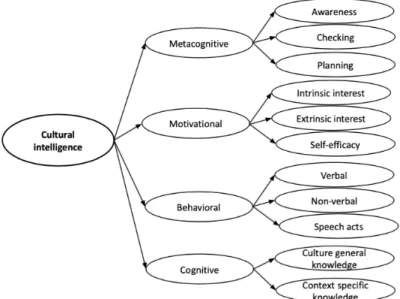
Extending the prior work of Earley and Ang (2003), Van Dyne et al. (2012) introduced a refined model of cultural intelligence consisting of eleven dimensions. Going beyond the four-factor model, the authors proposed several sub-dimensions for each factor (metacognitive, cognitive, motivational and behavioral CQ). This new conceptualization addresses the underlying processes of each factor, thus facilitates the understanding and the nuancing of each aspect of CQ (Figure A). Shedding light on their capabilities, it allows individuals to reflect on their strengths, weaknesses and even develop specific self-improvement objectives (Van Dyne et al., 2012). Metacognitive CQ consists of three distinct processes: planning, awareness and checking. Planning is to strategically prepare for a situation which will require a culturally diverse mindset (Van Dyne et al., 2012). Part of this preparation is a contingency analysis (e.g. what should the individual do in different specific situations), which allows for more mutual understanding (Schmidt & Ford, 2003). Awareness is to be conscious of the real-time influence of culture. This influence is threefold: firstly, on themselves, secondly, on others and thirdly, the situation (Van Dyne et al., 2012). Then, checking is the ability to review assumptions and adjust mental minds to actual experiences in a cultural setting. The second facet, cognitive CQ refers to an individual’s knowledge structure about cultural practices, conventions, norms and values (Van Dyne et al., 2012). It contains culture-general knowledge and context-specific knowledge. The former describes how cultural values affect general behaviors. These behaviors can be objective, exemplified by the economic or political system, or subjective as is the basis for Hofstede’s cultural dimension (1980). The latter refers to manifestations of expertise in
specific contexts, which fosters “insider understanding” (Van Dyne et al., 2010, p. 302). Next, motivational CQ is divided into intrinsic interest, extrinsic interest and self-efficacy. Intrinsic interest stems from an internal desire to interact with different cultures whereas extrinsic interest is about the extraneous status gained by individuals living in a foreign culture (Van Dyne et al., 2010). Self-efficacy is one’s ability to continuously cope with different cultures. Finally, behavioral CQ counts three dimensions: verbal behavior, nonverbal behavior and speech acts. Verbal behavior measures one’s ability to alter their tone, accent, pace, volume and style of speech (Victor, 1992). Nonverbal behavior refers to the ability to the capacity to communicate through body language, gestures and facial expressions (Knapp & Hall, 2010). Speech acts measure the aptness and flexibility of communicating various messages according to the cultural setting (Bowe & Martin, 2007).
Intercultural competency is a rather new concept in the academic conversation. Its empirical base is limited, but continuously growing in order to identify its diverse antecedents, outcomes and roles (Sharma & Hussain, 2017). Antecedents of CQ can be categorized into four broad categories, namely: individual differences (Ang et al., 2006; Harrisson, 2012; Li, Mobley & Kelly, 2016), cross-cultural training (Fisher, 2011; Eisenberg et al., 2013), education (MacNab, 2012) and international experience (Crowne, 2008; MacNab & Worthley, 2012; Moon et al, 2012; Engle & Crowne, 2014). Fewer researchers focused on the possible mediation or moderation roles of CQ, resulting in much fewer insights on that matter. To date, most of the literature has focused on the outcomes associated with cultural intelligence, outlining positive outcomes both for the individuals and for the organization. The most studied outcomes include performance and effectiveness (Ang et al., 2007; Lee & Sukoco, 2010; Lee et al., 2014; Peng et al., 2015) as well as adjustment and adaptation (Ang et al., 2007; Chen et al., 2010; Lee & Sukoco, 2010; Firth et al., 2014; Huff et al., 2014). However, as beneficial as the CQ outcomes might be, it is not possible to reach them without fully understanding the roots of cultural intelligence. The novel research on the antecedents of CQ can benefit
organizations by leading to better employee assessment, training, development and thus better individual and company performance (Van der Zee & Van Oudenhoven, 2013; Sharma & Hussain, 2017). The aim of the current study is therefore to tackle a set of predictors, study their interaction and examine their impact on the different facets and sub-dimensions of cultural competence. This will help employees, managers and eventually the whole organization identify what can be done to reach higher levels of CQ, and eventually reap the multiple benefits associated with it.
2.2 Individual Differences and Cultural Intelligence
In quest of understanding how to derive the most value from cultural competence, the literature delved into its potential predictors. As introduced in Section 2.1, cultural intelligence is based on capabilities that are developed through individual differences, cross-cultural training, education and international experience (Earley & Peterson, 2004; Ng, Van Dyne & Ang, 2009; Ott & Michailova, 2016). This part will tackle the first category, namely individual differences.
Research distinguished two types of individual differences: personality characteristics and personal capabilities (Ang, Van Dyne & Koh, 2006). Personality characteristics have most often been associated with the Big Five taxonomy: openness to experience, extraversion, agreeableness, conscientiousness and emotional stability. In their study, Ang, Van Dyne and Koh (2006) found strong empirical evidence on the value of using personality, and most specifically the Big Five taxonomy, as predictor of CQ development. Indeed, significant links were made between the five personality traits and the four-factor model of CQ development. Interestingly, the authors found that openness to experience is the most relevant trait as it is positively related to all four aspects of CQ. Extraversion is the second trait explaining the most variance in CQ as it is related to three factors: cognitive, motivational and behavioral CQ. The three remaining traits are only related to one factor: conscientiousness was related to
metacognitive CQ, and agreeableness and emotional stability were related to behavioral CQ (Ang, Van Dyne and Koh, 2006). In a nutshell, according to the authors, individuals who score high in openness to experience or high in extraversion are more likely to reach higher levels of intercultural intelligence. The focus of this study is therefore put on the traits of openness and extraversion. Furthermore, responding to calls for interactive effects of personality traits (Li, Mobley & Kelly, 2016), this thesis investigates the interaction between the traits of openness and extraversion. Although individuals generally exhibit a predisposition to one of the Big Five personality traits, traits do not exist separately but rather coexist alongside other traits (Li, Mobley & Kelly, 2016). Therefore, the interactive effect of openness and extraversion is expected to impact CQ beyond the additive effect of the two traits independently. In other words, it is expected that individuals who exhibit both of these traits will present higher levels of CQ than individuals scoring high in only one of these traits.
Next to personality characteristics, a number of personal capabilities have also been studied as CQ antecedents. One specifically interesting area of research is the issue of language proficiency. The rationale behind it is that when individuals speak a foreign language, they can relate and connect better to the people from that foreign culture. As much as the relationship between language skills and cultural intelligence has an intuitive appeal, there is little empirical support. In the literature, there is controversial evidence that language proficiency has any impact on cultural intelligence (Ang & Van Dyne, 2008; Khorakiwala, 2008; Shannon & Begley, 2008; Khodadady & Ghahari, 2012; Huff, 2013). The underlying reason might be that in most of these studies, only the English language is assessed. The fact that the English language is often considered as being the international language might explain why English proficiency did not systematically translate into greater cultural intelligence. The study of Shannon and Begley (2008) however did reveal a positive relationship between foreign language fluency and all four facets of CQ. The current study proposes to study the language
construct by looking at the number of languages spoken and by assessing its impact on overall CQ, and on the four-factor model. The next paragraph illustrates the hypothesized effects.
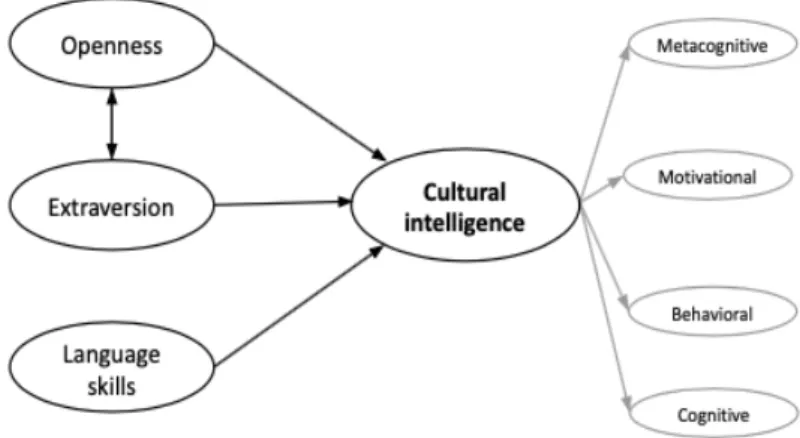
In short, individual differences hold a great potential when studying the roots of cultural intelligence. As outlined above, openness to experience and extraversion explain most of the variance in CQ development by having a positive direct effect on respectively 4 or on 3 of the four facets (Ang, Van Dyne & Koh, 2006). This study expects the same relationships, that is the positive impact of openness on metacognitive, motivational, behavioral and cognitive CQ as well as the positive impact of extraversion on metacognitive, motivational and behavioral CQ. Next, although the study of language proficiency as a predictor CQ led to contrasting results, we expect a positive effect of the number of languages spoken on CQ. Moreover, it is hypothesized that language proficiency is related to motivational and behavioral facets of CQ. Motivational CQ refers to an individual’s drive and interest to adapt in diverse environments (Earley & Ang, 2003). Displaying fluency in a foreign language is expected to encourage and motivate individuals to communicate in unfamiliar environments. Next, language proficiency should also relate to behavioral CQ, considering that it refers to the ability of individuals to adapt their verbal and non-verbal actions when interacting in diverse cultural settings (Earley & Ang, 2003). Verbal behaviors are thus highly relevant to one’s language proficiency.
Based on the previously discussed literature, this study expects positive independent relationships between the variables of individual differences (openness, extraversion and language) and cultural intelligence. As such, the first hypothesis is:
H1: There is a positive relationship between the individual differences of openness,
extraversion, languages skills and CQ
Next, by delving into the expanded scale of cultural intelligence and into the academic literature addressed above, the following hypotheses are further examined.
H1a: openness to experience is positively associated with overall CQ, namely to metacognitive,
motivational, behavioral and cognitive CQ
H1b: extraversion is positively associated with overall CQ, namely to metacognitive,
motivational and behavioral CQ
H1c: language proficiency is positively associated with overall CQ, namely to motivational
and behavioral CQ
Finally, this research expects that the combination of the personality traits of openness and extraversion impacts positively the cultural intelligence level of individuals. Therefore:
H1d: the combined effect of openness and extraversion is positively associated with CQ
Figure 1. Hypothesis 1: the relationship between individual differences, CQ and four facets
2.3 Individual differences and International Experience
It is believed that individual differences will influence how individuals perceive cross-cultural experiences. We expect that specific personal characteristics and capabilities make individuals more likely to engage in international experiences. Cross-cultural researchers who study topics of international experience have long recognized the importance of personality factors in international assignment performance (Caliguri, 2000; Ang, Van Dyne & Koh, 2006). According to these authors, the Big Five personality traits represent universal
mechanisms predisposing individuals to behave in certain ways in order to reach their goals. For this reason, it is hypothesized that individuals with higher levels of openness to experience and extraversion will engage in more international experience. Indeed, people who score high in openness to experience tend to be curious, creative, broad-minded and adopt metacognitive strategies when thinking about and interacting across cultures (Ang et al., 2006). On the other hand, people who score high in extraversion are generally energetic, sociable and adventuresome (Barrick, Mount & Piotrowski, 2002).
Language skills is also hypothesized to be positively related to international experience. It can be argued that individuals speaking one or more foreign language(s) engage more into international experiences, either voluntarily (e.g. travelling) or involuntarily (e.g. international assignment). Higher language abilities can contribute to the individual’s perception of psychological safety and further motivate people to engage in international experiences.
Therefore, the present study expects a positive relationship between the variables of openness, extraversion and language proficiency and cultural intelligence.
H2: There is a positive relationship between the individual differences of openness,
extraversion, languages skills and international experience
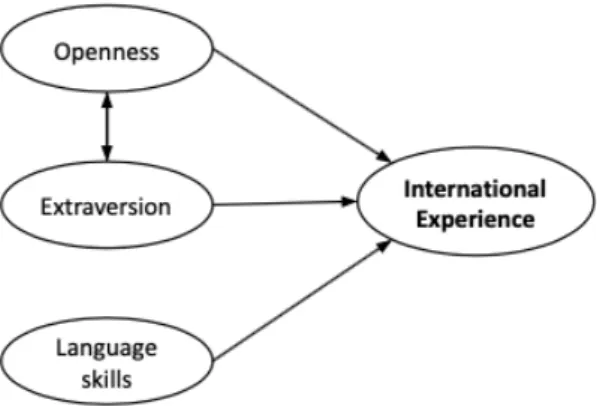
To assess this hypothesis, this study expects independent effects of each individual difference as well as an interaction effect of openness and extraversion:
H2a: openness to experience is positively associated with international experience H2b: extraversion is positively associated with international experience
H2c: language proficiency is positively associated with international experience
H2d: the combined effect of openness and extraversion is positively associated with
Figure 2. Hypothesis 2: the relationship between individual differences and international experience
2.4 Individual differences, International Experience and Cultural Intelligence
As presented in Section 2.3, many scholars have proposed and demonstrated that individual differences are predictors of international assignments. International experience has also been outlined as one of the four most common antecedents to cultural intelligence development (Crowne, 2008; Moon, Choi & Jung, 2012, MacNab & Worthley, 2012; Eisenberg et al., 2013; Engle & Crowne, 2014; Ott & Michailova, 2018). This part of the theoretical development first outlines the relationship between international experience and cultural intelligence. Second, building on the current literature and addressing its gaps, it proposes a mediating effect of international experience on the relationship between individual differences and cultural intelligence.
International experience refers to the exposure to different cultural environments one individual might engage into for work or non-work purposes (Crowne, 2008; Moon, Choi & Jung, 2012). Research has outlined the importance of the social learning theory (Bandura, 1977) to support international experience as an antecedent of cultural competence. According to this theory, one can benefit from learning through the observation or direct instructions taking place in a social context. Interacting and communication with individuals from a foreign culture would therefore trigger this cognitive process and result in acquiring new knowledge,
skills and information on a different culture (Black et al., 1991). Drawing from this rationale, it implies that previous international experience provides background exposure to a specific culture and thus facilitates the learning processes.
Different studies found significant evidence that individuals with previous international experience developed overall higher levels of CQ (Crowne, 2008; Moon, Choi & Jung, 2012, MacNab & Worthley, 2012; Eisenberg et al., 2013; Engle & Crowne, 2014; Ott & Michailova, 2018). However, the academic literature suggests inconclusive, inconsistent and often contradictory findings when it comes to the explanatory power of the type, length and breadth of the international experience on CQ development. To date, no consensus was reached regarding which facets of the four-factor model were most impacted by international experience (i.e. metacognitive, cognitive, motivational and behavioral). Regarding the length of the exposure, both short and long-term exposure suggest development of intercultural competencies (MacNab, Brislin & Worthley, 2012; Engle & Crowne, 2013). Finally, regarding the breadth of the exposure, the literature suggested that the breadth alone (number of countries visited) had no impact on the development of CQ (Crowne, 2008).
In a nutshell, although international experience has been supported by the vast majority of studies as a strong CQ antecedent, the evidence provided across studies seems to be inconclusive. The current study proposed to confirm the relevance of international experience as predictor of CQ by looking into the breadth perspective of international experience (the number of countries visited). Most importantly, the aim of the study is to outline its relative impact of international experience on the four-factor model and eleven subdimensions of CQ. Therefore, this thesis expects international experience to further develop individuals’ cultural intelligence facets. It is believed that individuals who have acquired more experience abroad have developed higher levels of awareness (metacognitive CQ), interest (motivational CQ), understanding (cognitive CQ), and can therefore better adapt (behavioral CQ) to culturally diverse environments. For this reason and to further address the expanded CQ dimensions, this
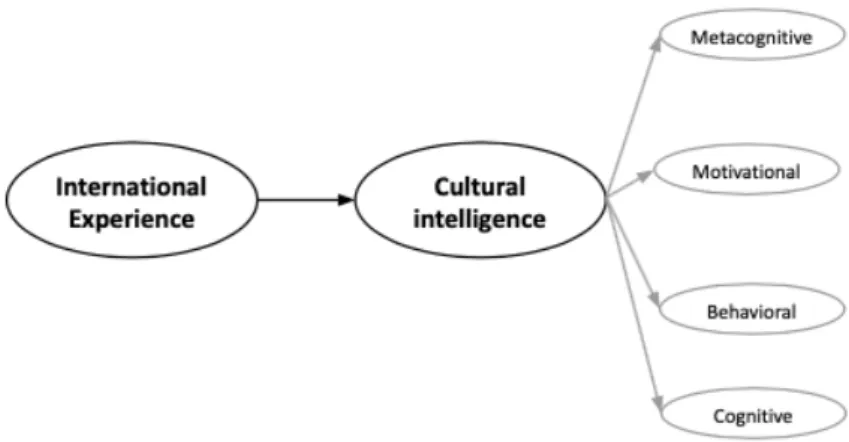
study expects that international experience impacts positively every facet of cultural intelligence. Therefore, the following hypothesis is proposed:
H3: international experience is positively associated with CQ, namely with metacognitive,
motivational, behavioral and cognitive CQ
Figure 3: the relationship between international experience, CQ and four facets
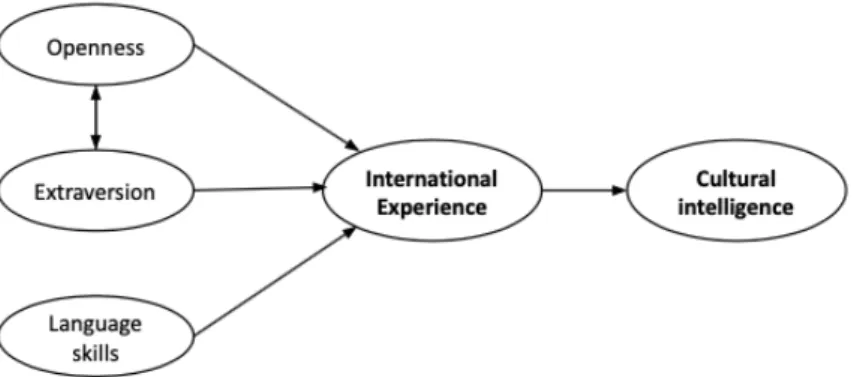
As the vast majority of studies support the relationship between individual differences and international experience, as well as the relationship between international experience and CQ development, this study hypothesizes the potential mediating role of international experience on the relationship between individual differences and CQ development. Therefore:
H4: International experience mediates the relationship between individual differences and CQ
Further, this study expects independent effects of each individual difference as well as an interaction effect of openness and extraversion:
H4a: International experience mediates the relationship between openness and CQ H4b: International experience mediates the relationship between extraversion and CQ
H4c: International experience mediates the relationship between language proficiency and CQ H4d: International experience mediates the relationship between the combined effect of
Figure 4. Hypothesis 4: the mediating effect of international experience on the relationship between individual differences and CQ
2.5 Research Model
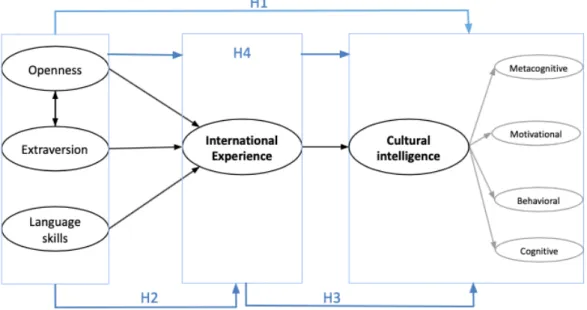
In sum, the above literature review along with the derived hypotheses aim to fill the research gaps in the field of cultural intelligence. As a reminder, Hypothesis 1 investigates the independent effect of each individual difference (openness, extraversion, language proficiency) on CQ and its four facts (H1a,b,c), as well as the combined effect of openness and extraversion on CQ (H1d). Hypothesis 2 tackles the independent effect of each individual difference (H2a,b,c), as well as the combined effect of openness and extraversion on international experience (H2d). Then, Hypothesis 3 investigates the direct effect between international experience, CQ and its four facets. Finally, Hypothesis 4 examines the mediating role of international experience on the relationship between each individual difference and CQ (H4a,b,c), the moderation effect of openness and extraversion on the mediation of international experience (H4d). These hypotheses are presented in the below research model.
Figure 5. Research model
3. Research design
3.1 Context
This study, conducted by the author, a Master student of International Business at the School of Business and Economics of Maastricht University, alone is based on data collected jointly with other students doing research in the field of Cultural Intelligence. Data were collected through an online questionnaire (Appendix A) for the advantages of representativeness and individualization. As multiple students were doing research on the topic of CQ, the possibility of collecting data together increased the number of usable responses, and thus, representativeness of the sample. Additionally, online questionnaires have the possibility to tackle multiple areas of interest, and can be later on tailored towards the specific needs of the researcher. For this reason, the survey included a set of questions on the variables studies in this thesis (individual differences, international experience, expanded CQ scale) as well as other constructs relevant to the other researchers.
3.2 Sampling Procedure and Sampling Frame
Data were collected over a period of two weeks, via an online survey made on Qualtrics. As mentioned previously, one objective of the data collection was to gather as many responses as possible, to increase the representativeness of the sample. In order to be eligible, participants had to be students. Moreover, the participation in the survey was made on a voluntary basis. Respondents were approached using convenience sampling (via e-mail and social media), as each student contacted their own network. Respondents were then asked to complete the survey by evaluating themselves on several assumptions.
3.3 Measures and Scaling
In order to test the model of this study, data were collected on the dependent variable CQ, its four facets and eleven subdimensions, as well on the independent variables of openness to experience, extraversion, language proficiency and international experience. Data were collected at the individual level and aggregated with the use of established scales proposed in the academic literature. In this section, each scale will be presented as well as the relative reliability coefficient alpha (Cronbach alpha).
3.3.1 Dependent variable
Cultural intelligence. Participants completed questionnaires by assessing their own cultural intelligence. The CQ construct used to test the different hypotheses was evaluated on a 7 point Likert-scale, ranging from 1= strongly disagree to 7= strongly agree. Therefore, participants were presented with statements regarding the topic of intercultural adaptation and had to rate themselves on a 7 point scale. To analyze the CQ level of participants, items were adapted from a 5-item cultural intelligence measure developed by Ang and Van Dyne (2008). A sample item used in the survey is: “I can describe the different cultural value frameworks
that explain behaviors around the world” (α = .89). Yielding a high Cronbach alpha of .89, the internal consistency of the CQ construct scale is further supported.
Going beyond the general concept of cultural intelligence, this study expands into the four facets of CQ: metacognitive CQ (α = .72), motivational CQ (α = .74), behavioral CQ (α = .82) and cognitive CQ (α = .79). The latter facets are therefore tested as dependent variables. Items were adapted from the extended Cultural Intelligence Scale of Van Dyne, Ang, Ng, Rockstuhl, Tan and Koh (2012) (Appendix B). These Cronbach alpha’s provide evidence for high internal consistency of the scale.
When significant linear regressions results are found, the dependent variables are once again changed into the associated sub-dimensions of CQ (awareness, planning, checking, intrinsic interest, extrinsic interest, self-efficacy, verbal behavior, nonverbal behavior, speech acts, culture-general knowledge and context-specific knowledge). To analyze each sub-dimension strength, items were adapted from the extended Cultural Intelligence Scale of Van Dyne, Ang, Ng, Rockstuhl, Tan and Koh (2012) as well as from the Cultural Intelligence Center (2014) (Appendix A). A sample item used in the survey is: “I can describe effective negotiation strategies across different cultures” (α = .77).
3.3.2 Independent variables
Openness to experience and extraversion. Participants completed questionnaires by assessing their own personality based on the Big Five model (openness to experience, extraversion, agreeableness, conscientiousness and emotional stability). The personality construct used to test the different hypotheses was evaluated on a 7 point Likert-scale, ranging from 1= strongly disagree to 7= strongly agree. To analyze the personality traits of participants, 1 item was adapted from a 5-item personality measure developed by Donnellan, Oswald, Baird and Lucas (2006). A sample item used in the survey was: “I talk to a lot of different people at parties” (α = .78). The current study investigates more specifically the traits of openness to
experience and extraversion, both independently of each other as well as in interaction (Openness*Extraversion).
Language proficiency. To assess the construct of language proficiency, participants had to indicate the number of languages they were moderately to very skilled at reading, speaking and writing. They could also specify which language they can read, speak and write. However, as mentioned in Chapter 2, for the purpose of this study only the number of languages spoken is studied to assess language proficiency.
International experience. In the case of international experience, several perspectives are possible: one could look at the type of experience (work or non-work related), the depth of the experience (time spent abroad) or breadth of the experience (number of countries visited). The present paper investigates the role of international in the development of cultural intelligence by taking a breadth perspective. Indeed, this study expects that the more individuals visit different countries, the more they encounter different cultures and thus the more they recognize behaviors, understand cultural differences and adapt their own attitudes.
3.3.3 Control variables
Following previous studies about CQ (Ang et al, 2006; Li et al, 2013; MacNab & Worthley, 2016) the controls of age (aggregated to the mean), gender (dummy variable, female = 1 and male = 0) and education (high school, bachelor, master or doctorate level) are introduced as they are expected to influence the relationships studied in the conceptual model. Age is considered as a very relevant and strong control variable as, together with education, it is the most powerful demographic factor that is influencing individuals, in terms of attitudes and attitudinal processes (Sears, 1986). Similarly, gender is also controlled for as it is a factor that influences the attitudes through traits differences (Budaev, 1995).
3.4 Mediation and Moderated Mediation Analyses
In the current study, the traits of openness to experience and extraversion are studied independently of each other as well as in interaction. The current study suggests that cultural intelligence development would benefit from an interaction between the two personality traits at hand, namely openness and extraversion, through international experience. The below paragraph describes the underlying mechanics and implications of a moderated mediation.
Moderation analyses study how the relationship between two variables X and Y varies depending on a third variable, M (Hayes, 2013). Hypotheses H1d and H2d illustrate this concept by investigating the moderation of extraversion on the relationship between openness and cultural intelligence (H1d) or between openness and international experience (H2d). In contrast, mediation analyses suggest that, instead of studying direct relationship between two variables such as X and Y, one could take into account a third mediating variable M. In this case, X would cause variation on the M variable, and M would cause variation on Y (Hayes, 2013). Hypotheses H4a, H4b and H4c investigate the mediating role of international experience on the relationship between openness, extraversion and language (independently) and CQ.
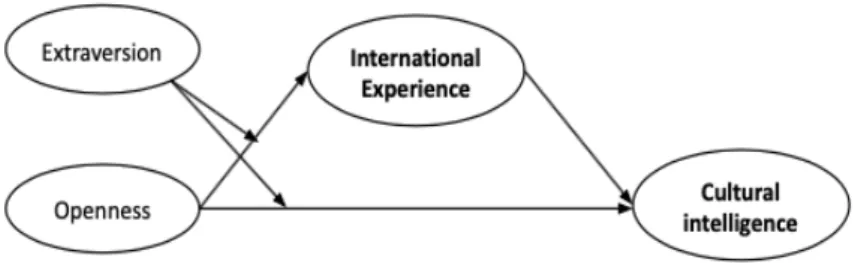
The concept of a moderated moderation integrates both types of analyses, to benefit from the combination of both approaches. Hypothesis H4d (Chapter 2) tackles the idea of a moderated mediation by looking at of the moderation of extraversion on the relationship between openness and international experience and that of openness and cultural intelligence, that is, through the mediation of international experience (Figure 5). The statistical procedure to address the mediation and the moderated mediation is explained below.
Figure 5. Hypothesis H4d: extraversion moderates the positive relationship between openness and international experience and between openness and CQ
To test for the mediation effect of international experience on the relationship between individual differences and cultural intelligence, the procedure of Baron and Kenny (1986) is applied. According to the authors, a mediation analysis consists of a four-step approach. The first step addresses the direct relationship between the causal variable (individual differences) and the outcome variable (CQ). The second step studies the direct effect between the causal variable (individual differences) and the mediator (international experience). Then, the third step examines the direct effect between the mediator (international experience) and the outcome variable (CQ). For this step, it is important to control for the causal variable (individual differences) because both international experience and CQ may be only correlated because they are both caused by individual differences. The fourth step consists of establishing whether international experience fully mediates the relationship between individual differences and CQ. This is done by assessing the effect of individual differences on CQ controlling for international experience. It is possible to test this effect by using the PROCESS macro designed by Hayes (2013). If all four steps are met, then international experience is supported as fully mediating the relationship between individual differences and CQ. If only the first 3 steps are met, it indicates a partial mediation of international experience.
The first three steps are addressed and tested in hypotheses H1, H2 and H3. Finally, step 4 is performed by using the PROCESS macro developed by Hayes (2013). This step
consists of using a bootstrap estimation approach with 5000 samples using a 95% confidence interval. Chapter 4 provides the results of these tests.
3.5 Analytical Strategy
The first step of the analytical procedure is to clean the data by suppressing the entries with missing data as well as reversing the negative statements items from the questionnaire. The second step is to perform a reliability analysis of each of the measures studied in the conceptual model. To evaluate the internal consistency of each construct, the Cronbach alpha is assessed through the set of survey items constituting each construct. The third step is to transform and code the items of the survey into the variables that are studied in the conceptual model. Next, the descriptive statistics (means, standard deviations) and bivariate correlations between the variables are assessed to give relevant information about the data and outline the relations between the constructs.
The fifth step is to perform the regression analyses. For this part, a stepwise regression method is used. As most of the hypotheses investigate the direct relationships between two variables, two blocks are created: model 1 for the control variables and model 2 for the direct effect of the independent variable. However, some hypotheses (H1d, H2d and H4d) investigate moderation analyses. For these regressions, a new variable is created (Openness*Extraversion) by standardizing openness (ZOpenness), extraversion (ZExtraversion) and by computing the interaction effect of the two. The standardization of the personality traits of openness and extraversion helps to prevent from multicollinearity. In this case, three models are created: model 1 for the control variables, model 2 for the direct effect of the independent variable, and model 3 for the two-way interaction.
Finally, all these linear regression tests are repeated by changing the dependent variable (CQ) by each of the four facets of cultural intelligence (metacognitive, motivational, behavioral
and cognitive CQ). Insignificant regressions results are not further analyzed. However, if the regression shows a significant result, the dependent variable (metacognitive, motivational, behavioral or cognitive CQ) is once again replaced with its associated sub-dimensions (awareness, planning, checking, intrinsic interest, extrinsic interest, self-efficacy, verbal behavior, nonverbal behavior, speech acts, culture-general knowledge and context-specific knowledge).
4. Data Analysis & Results
Following the data collection conducted on Qualtrics, the data is processed using SPSS. This chapter provides a statistical analysis of the collected data. First, the descriptive statistics and bivariate correlations are presented. Although this part does not provide direct evidence on the support or rejection of the hypotheses, it shows how constructs relate together and to the hypotheses. The second part of this chapter presents the tests of the hypotheses through hierarchical regression analyses and indicates whether the hypotheses are supported or not. The Variance Inflation Factor (VIF) values of the variables are also investigated in all regression tables. Overall, the VIF values were between 1.007 and 1.706, which indicates that multicollinearity is not a concern in the study.
4.1 Descriptive Statistics and Bivariate Correlations
The results displayed in Table 1 depict the descriptive statistics (means and standard deviations), bivariate correlations and Cronbach alpha’s of the control variables and main variables used in the study. In total, the survey gathered 684 usable responses. The participants of the study are on average 22 years old (μ = 22.22, σ = 2.85) and consist of 53.8% of females and 46.2% of males. Moreover, the three most represented nationalities of the participants are German (31.3%), Dutch (14.1%) and Belgian (12.1%). Regarding the language proficiency
construct, descriptive statistics report that participants speak on average three languages including their native language (μ = 2.68, σ = 1.1). The average CQ score of the participants resulting from the survey is 4.75 (from a 7 point scale, μ = 4.75, σ = .57). Finally, the most common levels of education represented in this study were bachelor students (59.9%), as well as master students (27%).
As per the correlation results of the control variables with the different constructs studied, it can be concluded that age and education are related to most of the variables and therefore are relevant in the analyses. For example, age is related to CQ (r = .09, p < .05), and education is related to CQ (r = .14, p < .01). However, contrary to the expectations of the study, gender is not related to any of the variables studied. In other words, it implies that the gender of the individuals taking part in the survey does not influence the relationships studied.
In this table, significant positive relationships between CQ, its four facets and its eleven subdimensions are illustrated. The vast majority of these correlations are significant at the 1% level (p < .01), which reinforces the overall strength of the model. Moreover, we find that openness, extraversion, language proficiency and international experience are positively correlated with most CQ dependent variables (overall CQ, four facets and eleven subdimensions). Contrary to the expectations of the paper, the interaction term of Openness*Extraversion is not significantly related to any of the CQ variables at the 99% or 95% confidence interval.
Additionally, a model integrating all five personality traits (openness, extraversion, agreeableness, conscientiousness and neuroticism) indicating the bivariate correlations between the variables is examined. It indicates that there are positive significant correlations among the personality traits. However, these correlations are rather low, as they range below the critical point of .5 (Appendix C). This implies that, overall, specific personality traits are poor predictors of other traits.
Table 1
Descriptive statistics and bivariate correlations
Variable Mean SD 1 2 3 4 5 6 7 8 9 10 11 12 13 14 15 16 17 18 19 20 21 22 23 24 1. Age 22.22 2.85 1 2. Gender .54 .49 -.05 1 3. Education 4.92 1.95 .62** .07 - 1 4. Openness to experience 5.16 1.02 .15** .01 - .06 (.69) 5. Extraversion 4.71 1.19 -.07 .01 - .01 .14** (.78) 6. Openness* Extraversion .14 1.00 .00 -.03 .03 -.06 .06 1 7. Language Skills 2.68 1.074 .00 .03 - .07 .03 .10** .04 1 8. International Experience 16.74 8.49 .17** .01 .13** .10** .10** .02 .20** 1 9. CQ 4.97 .57 .09* .03 - .14** .21** .12** .03 .20** .19** (.89) 10. Metacognitive CQ 5.04 .66 .08* .01 - .18** .16** .06 .03 .08* .14** .80** (.72) 11. Motivational CQ 5.50 .66 .23 .01 .09* .27** .20** .03 .15** .17** .69** .47** (.74) 12. Behavioral CQ 4.61 .90 .12** .03 - .13** .08* -.02 .01 .13** .10* .80** .55** .31** (.82) 13. Cognitive CQ 4.75 .75 .04 .04 - .05 .16** .17** .03 .25** .19** .80** .50** .44** .49** (.79) 14. Awareness 5.64 .78 .07 .04 .15** .21** .06 .01 - .12** .11** .69** .74** .51** .43** .48** (.66) 15. Planning 4.15 1.08 .03 .03 - .09* -.02 .02 .04 -.02 .06 .54** .77** .19** .42** .32** .28** (.59) 16. Checking 5.32 .77 .10* .01 - .17** .22** .06 .03 .13** .14** .61** .75** .44** .40** .34** .49** .32** (.56) 17. Intrinsic Interest 5.51 .91 .06 .01 .10** .24** .13** .01 .11** .12** .51** .34** .79** .25** .27** .36** .13** .34** (.65) 18. Extrinsic Interest 5.44 .89 -.02 .01 - .04 .14* .06 .05 .04 .06 .56** .45** .73** .29** .36** .44** .26** .34** .34** (.62) 19. Self-Efficacy 5.56 .84 .02 .01 .05 .23** .27** .02 .20** .21** .48** .27** .74** .17** .37** .34** .02 .31** .42** .29** (.64) 20. Non-Verbal Behavior 4.59 1.15 .05 -.02 .12** .02 -.01 .00 .14** .07 .68** .48** .25** .87** .41** .39** .38** .33** .22** .26** .10* (.67) 21. Verbal Behavior 4.59 1.04 .13** .06 - .08* .13** -.5 .01 .09* .08* .65** .42** .28** .82** .40** .31** .31** .33** .23** .22** .18** .56** (.58) 22. Speech Acts 4.65 1.02 .12** .00 .13** .07 .01 .01 .09* .09* .68** .49** .26** .83** .43** .39** .36** .36** .18** .24** .15** .60** .53** (.67) 23. Context-Specific Knowledge 4.50 .92 .06 .05 - .03 .10** .16** .04 .14** .15** .71** .41** .35** .47** .89** .38** .29** .28** .21** .28** .31** .37** .40** .43** (.77) 24. Culture-General Knowledge 5.00 .79 .01 .01 - .06 .18** .13** .01 .31** .18** .70** .46** .42** .38** .85** .47** .27** .33** .27** .35** .34** .35** .29** .31** .53** (.60)
Note: N = 684. Gender is coded as female = 1 and male = 0. Reliability estimates are presented in brackets. * p < .05
4.2 Test of hypotheses through regression analyses
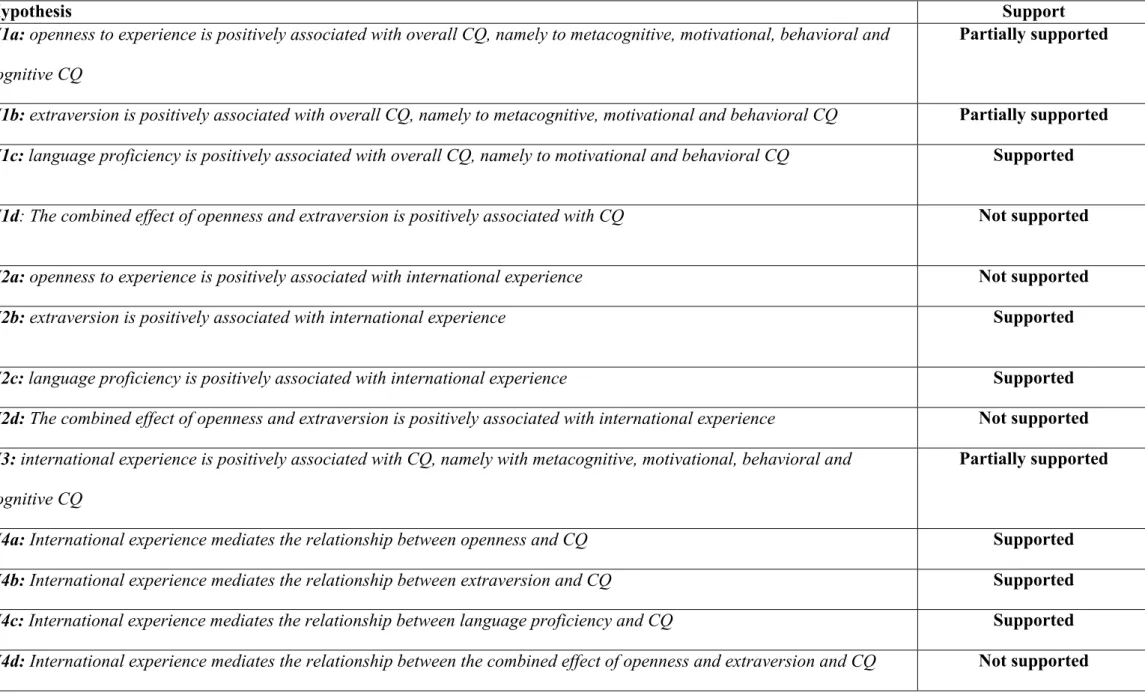
Linear regression analyses allow to summarize and to study the relationships between the constructs at hand. Tables 2 to 5 report the results of the simple regression analyses performed to address the three hypotheses. Table 6 summarizes whether the hypotheses are supported or not.
4.2.1 Hypothesis 1: the positive relationship between the individual differences of openness, extraversion, language skills and cultural intelligence
Hypothesis 1 suggests that there is a positive relationship between individual differences (openness, extraversion, language proficiency and the interaction between openness and extraversion) and CQ. The results of the independent linear regressions can be found in Table 2a. They provide supporting evidence that openness, extraversion and language impact directly cultural intelligence. This provides partial support for hypotheses H1a, H1b and H1c.
More specifically, a positive relationship between openness and CQ is supported (β = .112, p < .01). As expected in the hypothesis H1a, the results also indicate a positive relationship between openness the four facets of CQ, namely metacognitive CQ (β = .097, p < .01), motivational CQ (β = .175, p < .01), behavioral CQ (β = .058, p < .1) and cognitive CQ (β = .115, p < .01) (Table 4a). The trait openness to experience is thus supported to be related to three facets of cultural intelligence at the 1% level, and to one facet (behavioral) at the 10% level.
Next, a positive relationship between extraversion and overall CQ is also supported (β = .069, p < .01). As hypothesized in H1b, there is a positive impact of extraversion on motivational CQ (β = .130, p < .01). Contrary to the statement of H1b, no relationship between metacognitive CQ or behavioral CQ is supported (Table 4b). As opposed to the research of
Ang, Van Dyne and Koh (2006), the regression analyses of this study report that extraversion is positively related to cognitive CQ (β = .124, p < .01).
Regarding H1c, the positive relationship between language proficiency and CQ is supported at the 1% level (β = .111, p < .01). When expanding to the four facets of cultural intelligence, there is supporting evidence that language impacts positively motivational CQ (β = .090, p < .01) and behavioral CQ (β = .113, p < .01), which validates the hypothesis H1c. In addition, a significant positive relationship between language and cognitive CQ is supported (β = .189, p < .01). This indicates that one’s language abilities are relevant to the knowledge of practices, norms and values in different cultural settings. This may relate to the fact that language conveys many aspects of an individual’s culture. The results are displayed in Table 4c.
Finally, H1d suggests that extraversion moderates the relationship between openness and CQ. As presented in the bivariate correlation table (Table 1), the interaction term does not relate to any of the variables. This hypothesis is not supported in the regression analysis either as no significant relationship between the interaction term and CQ is found (β = .02, p > .05). In other words, the results show that while openness and extraversion have independently significant direct effects on CQ, the interaction effect between openness and extraversion has no significant effect on CQ (Table 2a).
4.2.2 Hypothesis 2: the positive relationship between individual differences and international experience
Hypothesis 2 suggests that there is a positive relationship between individual differences (openness, extraversion, language proficiency and the interaction between openness and extraversion) and international experience. The results of the independent linear regressions provide evidence that openness (β = .06, p < .15) has a positive impact on international experience at the 15% level. Therefore, the hypothesis is rejected at the 10% level.
extraversion (β = .10, p < .01) and language (β = .172, p < .01) have a positive impact on international experience (Table 2a). This provides full support for hypotheses H2a, H2b and H2c.
However, hypothesis H2d is not supported as no positive significant relationship is supported between the interaction term and international experience (Table 2a). This result implies that the combination of openness and extraversion cannot be said to impact the international experience level of individuals.
4.2.3 Hypothesis 3: the relationship between international experience and cultural intelligence The third hypothesis investigates the positive relationship between international experience and CQ, namely with metacognitive, motivational, behavioral and cognitive CQ. The linear regression results are displayed in Table 3. They provide significant support that international experience impacts positively CQ (β = .098, p < .01). Further analyses (Table 4d) also indicate a positive relationship between international experience and several facets of CQ. Like expected in the hypothesis H3, international experience is related to metacognitive CQ (β = .077, p < .01), motivational CQ (β = .107, p < .01) and cognitive CQ (β = .145, p < .01). However, contrary to what was expected, no significant relationship between international experience and behavioral CQ is supported through the linear regression analysis.
4.2.4 Hypothesis 4: the mediating effect of international experience
The fourth hypothesis investigated in this thesis relates to the mediation effect of international experience on the relationship between individual differences and cultural intelligence. As explained in the methodology chapter, the four-steps procedure of Baron and Kenny (1986) is applied to investigate the mediating effect of international experience on the different relationships. Below lay the results associated with the statistical analyses.
The first three steps are addressed and supported above in the linear regression analyses presented above. Positive significant relationships have been found between the predictor variables of openness, extraversion, language proficiency and the outcome variable international experience. Moreover, positive significant relationships are drawn between the predictor variables of openness, extraversion, language proficiency, international experience and the outcome variable cultural intelligence. Only the interaction of openness and extraversion was not supported as a predictor of international experience or of cultural intelligence.
Finally, the last step is performed by using the PROCESS macro developed by Hayes (2013). This step allows to evaluate whether there is a partial mediation by referring to the indirect effect result. In this case, the output of the indirect effect of openness is positive (.01), and so are those of extraversion (.01) and language skills (0.2) (Appendix D). This indicates a rather low, but positive mediating effect. Additionally, the 95% confidence intervals are [.0020, .0200] for openness, [.0021, .0195] for extraversion and [.0078, .0297] for language skills. As the three confidence ranges do not incorporate zero, it indicates a partial mediating relationship between each of the individual differences and cultural intelligence through international experience.
4.3 Additional exploratory research
The main analysis resulted in many significant results for the hypothesized effects of individual differences and international experience on cultural intelligence and its derived four facets. The aim of this section is to further investigate the variance explained by the predictors on the underlying processes of the four facets. It is compelling to consider which sub-dimensions are most strongly related to individual differences and international experience. Therefore, each significant relationship raised in the previous hypotheses is investigated in
more depth by assessing the strength of each of the eleven subdimensions of CQ (awareness, planning, checking, intrinsic interest, extrinsic interest, self-efficacy, verbal behavior, nonverbal behavior, speech acts, culture-general knowledge and context-specific knowledge) relative to each antecedent (openness, extraversion, language proficiency and international experience). As a reminder, positive relationships are established between openness and metacognitive, motivational, behavioral and cognitive CQ (Table 4a). Next, positive relationships are established between extraversion and motivational, and cognitive CQ (Table 4b). Positive relationships are supported between language proficiency and motivational, behavioral and cognitive CQ (Table 4c). Finally, positive relationships are established between international experience and metacognitive, motivational and cognitive CQ (Table 4d).
The results of the new regressions are displayed in Table 5a for openness, Table 5b for extraversion, Table 5c for language proficiency and in Table 5d for international experience. These tables report the explanatory power of each process factors (i.e. sub-dimension) depending on the antecedent variable (i.e. openness, extraversion, language proficiency and international experience). Most importantly, these regressions outline which of process dimension explains the most variance of the facet for a given predictor.
Specifically, the results indicate that openness is the strongest and most relevant antecedent of cultural intelligence. Beyond cultural intelligence lay four facets and eleven sub-dimensions. Openness has a significant relationship with all four facets and with eight of the eleven subdimensions: awareness, checking, intrinsic interest, extrinsic interest, self-efficacy, verbal behavior, context-specific and culture-general knowledge (Table 5a). In addition, it is also the strongest predictor in comparison to extraversion, language and international experience for seven of these eight sub-dimensions (all but context-specific knowledge). Extraversion has a significant relationship with intrinsic interest, self-efficacy, context-specific and culture-general knowledge (Table 5b). Then, language proficiency has a significant relationship with awareness, checking, intrinsic interest, self-efficacy, verbal behavior,
nonverbal behavior, speech acts, culture-general knowledge and context-specific knowledge (Table 5c). Finally, international experience significantly impacts awareness, checking, intrinsic interest, self-efficacy, culture-general knowledge and context-specific knowledge (Table 5d).
5. Discussion
5.1 Summary of overall research gaps
Prior research on the topic of cultural intelligence has focused on its different antecedents, outcomes and possible mediating or moderating roles. Since its introduction by Earley in 2002, the concept of CQ has become a flourishing area of multidisciplinary research. Indeed, many different fields such as business, management, education, sociology, anthropology or even political sciences have delved into the potential and explanatory power of cultural intelligence (Ott & Michailova, 2016). However, it is only recently that CQ has been considered as a dependent variable. The current study contributes to this field of research and confirms the impact of personality traits, personal abilities and international experience on cultural intelligence. Moreover, following the call of Li, Mobley and Kelly (2016) for studying personality characteristics in interaction, this study investigates a two-way interaction analysis between the two most relevant traits impacting cultural intelligence, namely openness and extraversion. This study also integrates, for the first time, international experience as a mediator of the relationship between individual differences and cultural intelligence. Finally, going beyond the scope of the majority of the studies on the topic of CQ, this paper investigates the power of the determinants studied on the eleven sub-dimensions of CQ.
5.2 Findings
This study confirms the relevance of individual differences and international experience on one’s level of intercultural competencies. More specifically, it examines the expanded CQ scale as well as the nomological network of the sub-dimensions. This section includes the different findings of the thesis and includes a comparison between those and the published findings. Table 6 (p.53) summarizes whether hypotheses are supported or not.
First, this paper confirms the relevance and strong relationship between personality traits in intercultural competencies. Based on the study of Ang, Van Dyne and Koh (2006), the current paper selected the two most relevant traits associated with CQ and its expanded definition, namely openness and extraversion. In the literature, these traits are also referred to as “social-perceptual traits” (Van der Zee & Van Oudenhoven, 2013), enabling individuals to perceive differences and challenging aspects of intercultural situations and to respond to them with positive affect. In fact, individuals who score high in either openness or extraversion tend to understand better the opportunities linked to such contexts and thus approach these situations with interest and creativity (Van der Zee & Van Oudenhoven, 2013). On the one hand, the findings of the current study partially support the argument of Ang, Van Dyne and Koh (2006), stating that openness significantly impacts the four facets of CQ. In this study, openness was related to metacognitive, motivational and cognitive CQ at the 1% level and behavioral CQ at the 10% level. There is thus less supporting evidence that openness impacts behavioral CQ. The study further outlines the statistical impact of openness on eight of the eleven dimensions. On the other hand, inferential statistics also confirm the relevance of extraversion, but not to the extent that was expected. Although extraversion was also positively related to CQ, only two facets were significantly related to this trait. Contrary to the personality study of Ang, Van Dyne and Koh (2006) extraversion did not relate to behavioral CQ, but only to motivational and cognitive CQ. This implies that the extraversion trait is not supported to have an impact on someone’s verbal, non-verbal and speech acts behavior. In a nutshell, the results of this study