C O N F E R E N C E
P R O C E E D I N G S
Published by IATED Academy iated.org
INTED2020 Proceedings
14th International Technology, Education and Development Conference March 2nd-4th, 2020 — Valencia, Spain
Edited by
L. Gómez Chova, A. López Martínez, I. Candel Torres IATED Academy
ISBN: 978-84-09-17939-8 ISSN: 2340-1079
V-153-2020
Book cover designed by J.L. Bernat
All rights reserved. Copyright© 2020, IATED
The papers published in these proceedings reflect the views only of the authors. The publisher cannot be held responsible for the validity or use of the information therein contained.
INTED2020 14th International Technology, Education and Development Conference
INTED2020 COMMITTEE AND ADVISORY BOARD
Agustín López SPAIN Luis Gómez Chova SPAIN
Alan Carlson SWEDEN Luís Torres Moreira PORTUGAL
Alessandro Brawerman BRAZIL Łukasz Wiechetek POLAND
Alessia Bevilacqua ITALY Mª Jesús Suesta SPAIN
Allison Spring UNITED STATES Marcelo Gaspar PORTUGAL
Amparo Girós SPAIN Marek Medrek POLAND
Ana Paula Lopes PORTUGAL Maria Cutajar MALTA
Ana Tomás SPAIN Maria Porcel SPAIN
Antonio García SPAIN Martina Windisch-Koenig AUSTRIA
Asako Ohno JAPAN Mary Dempsey IRELAND
Beatriz Martinez SPAIN Matthias Baume GERMANY
Charles Weiss UNITED STATES Michael Collins IRELAND
Chelo González SPAIN Michela Tramonti ITALY
Christine Wilson UNITED STATES Miguel Peiró SPAIN
David Martí SPAIN Mohd Hassan Abdullah MALAYSIA
Dina Nader UNITED ARAB EMIRATES Monika Banas POLAND
Dragutin Kermek CROATIA Nakisa (Niki) Alborz UNITED STATES
Eladio Duque SPAIN Norma Barrachina SPAIN
Elena Grunt RUSSIAN FEDERATION Päivi Tossavainen FINLAND
Eva Ponick GERMANY Pasi Puranen FINLAND
Farhad Eftekhari FINLAND Peter Haber AUSTRIA
Felia Wong SINGAPORE Petr Beremlijski CZECH REPUBLIC
Filomena Soares PORTUGAL Pisut Koomsap THAILAND
Guilherme Temporão BRAZIL Priscila Berger GERMANY
Heike Wiesner GERMANY Remigijus Bubnys LITHUANIA
Ignacio Ballester SPAIN Samuel Awuku UNITED KINGDOM
Ignacio Candel SPAIN Sandra Stein KUWAIT
Ilias Batzogiannis GREECE Sarah Hord UNITED STATES
Iván Martínez SPAIN Sergio Pérez SPAIN
Javier Domenech SPAIN Sheri Bias UNITED STATES
Javier Martí SPAIN Stefania Cassar UNITED KINGDOM
Joanna Lees FRANCE Stellan Sundh SWEDEN
John Gordon UNITED KINGDOM Tânia Carraquico PORTUGAL
Jose F. Cabeza SPAIN Tessai Hayama JAPAN
Jose Luis Bernat SPAIN Tracy Hoot CANADA
Juanan Herrero SPAIN Vasudeva Aravind UNITED STATES
Judith Szerdahelyi UNITED STATES Victor Fester NEW ZEALAND
Kadiri Abdul-Karim GHANA Wendy Gorton UNITED STATES
Karl Jordell NORWAY Xavier Lefranc FRANCE
Kimberly Hoggatt Krumwiede UNITED STATES Xema Pedrós SPAIN
GROUP WORK METHODOLOGY IN THE DIFFERENT SUBJECT
AREAS OF PRIMARY EDUCATION FROM TEACHERS AND
STUDENTS’ PERSPECTIVE
J. Santos
1, J. Rocha
2, A.P. Cardoso
2, A. Lopes
21Comossela – Comissão de Melhoramentos de Ossela (PORTUGAL) 2 Escola Superior de Educação, CI&DETS / CI&DEI, Instituto Politécnico de Viseu
(PORTUGAL)
Abstract
Group work is a methodology that allows the student to learn in interaction with his/her peers, through active involvement and participation in the teaching-learning process. However, this teaching practice isn’t always welcome by all teachers, as it implies a pedagogical organization that contrasts in many ways to the traditional teaching model. In addition, there is still no common understanding of the age at which it should be implemented or of the actual benefits it can provide to students.
Bearing this assumption in mind, our goal was to find out more about teachers and students’ perspectives on group work methodology and how it should be used in the different subject areas of primary education. Our main research objectives were to understand the importance attached to this methodology, the subjects in which this methodology is most frequently implemented, the subjects where students work better in group, and the kind of training in group work methodology received by teachers.
A questionnaire was applied in three School Groupings located in Viseu (centre region of Portugal) to a sample composed of 42 primary teachers and to their 4th grade students (218 students). 4th grade was the school year selected because students had already developed group work assignments before. Consequently, they were able to reflect on that past practice.
The data obtained showed that group work is felt to be particularly important, both to teachers and students. Differences are quite significant when it comes to express how often that methodology is implemented in the classroom, though. Environmental Studies, Physical Education, and Dramatic Expression are the subject areas where teachers claim to use this methodology on a more regular basis. It should also be noted that more than half of the teachers admit they had no training whatsoever in the field of group work.
The conclusions of this study indicate that a more frequent use of this methodology in primary education is beneficial, and highlight the clear need to invest in teacher training, namely in a training plan that focuses on the organization and development of group work in the classroom as a means to improve pedagogical action.
Keywords: Group work, subject areas, primary education, teachers, students.
1 INTRODUCTION
Basic education, and more precisely the 1st Cycle of Basic Education (Grades 1 to 4), is "universal, compulsory and free of charge" (LBSE, 1986, art. 6, point 1). This designation was acknowledged after the publication of the "Lei de Bases do Sistema Educativo” (Law n.º 46/86, dated October 14), the Portuguese Education System Act. This schooling level is characterized by a globalizing education whose aim is to provide students with some basic skills, namely, in Portuguese, Mathematics, Social Environment Studies, Artistic Expressions and Physical Skills (Decree-Law n.º 139/2012, dated July 5). In the 1st CEB, one teacher is in charge of only one grade (although he may be assisted by others
in specialized areas). Mono-grade teaching facilitates curricular integration and makes it easier for children to embrace learning in its different aspects in a school context. On the other hand, in this kind of teaching the greatest responsibility is placed on the teacher who is responsible accountable for the general education of the children he works with at school (Marchão, 2012).
The teacher is an indispensable element in the teaching-learning process. (S)he is responsible for the organization, monitoring and assessment of the activities (s)he will develop with his students (Decree-Law n.º 75/2008, art. 44, point 1, paragraph b). As previously mentioned, mono-grade teaching is used
Proceedings of INTED2020 Conference
in the 1st CEB (1st Cycle of Basic Education). This kind of teaching allows the teacher to make decisions about the methodologies (s)he intends to use in his/her classes. According to Nérici (1973), teaching methods and techniques are essential parts of the methodology that the teacher uses to help his/her students integrate knowledge, techniques, skills, habits and attitudes that will enrich their personality. That way, there are several methods that teachers can choose from. In this study we will focus essentially on group work.
Group work allows for a dynamic relationship between the student and a wide range of distinct and complementary knowledge and other techniques, other ways of thinking, other opinions, other ways of acting and reacting (Pato, 1995). A teacher who follows this teaching-learning model must be aware that his functions are quite different from those required by other methodologies, because he will play the role of facilitator of learning and of his students’ guide and monitor, while the student is the center and the driving force of his own learning. The classroom is a space that belongs to the student, where he can build his learning with his own ideas and effort. In this kind of methodology, the teacher has other concerns and responsibilities that go far beyond the formation of the groups and the monitoring of the work produced. Organizing his students’ learning requires a great deal of effort and imagination. The implementation of everything he had planned forces him to assume different roles and the assessment process becomes suddenly wider and deeper (Pato, 1995).
Niza (1998) also refers that the teacher has to guide and monitor his students’ learning, allowing them to develop their autonomy, responsibility and organization skills. His role is to set the objectives he wants to achieve with his work and all the preparatory work he needs to implement so that the students’ learning is as fruitful as possible. Another of his responsibilities is to motivate them to perform the tasks assigned the best they can.
The teacher’s role is especially relevant when it comes to choose and implement cooperative methodologies. As Lopes and Silva (2011) point out, what teachers do in the classroom is a key factor in determining the student's learning success. When the teacher plans on implementing group work, he should take into account that there are several tasks that can be performed. According to Johnson, Johnson and Smith (1991), the three distinct phases of the process are: i) pre-implementation; ii) implementation; and iii) post-implementation.
Group work is implicit in the cooperative learning philosophy. According to Fathman and Kessler (1993, p.128), "cooperative learning refers to group work which is carefully structured so that all learners interact, exchange information, and are held accountable for learning".
Johnson, Johnson and Holubec (1999) also point out that cooperative learning is the pedagogical use of small groups in which students will work to maximize their own learning and that of their peers, i.e. each student has different abilities and, in this kind of methodology, each group member has the responsibility not only to learn but also to help his peers.
Group work methodology, according to Lopes and Silva (2008), arises because school feels responsible for teaching social skills and providing opportunities for peer interaction. The student, in collaboration/cooperation with his colleagues and teachers, achieves learning while performing tasks in which his current knowledge interacts with the new knowledge he has to acquire (Barreira & Moreira, 2004).
To sum up, "cooperative, small-group learning is widely recognized as a pedagogical practice that promotes learning and socialization across a range of curriculum areas from primary school through to high school and college" (Gillies, 2003, p. 35). However, group work is not a generally accepted practice, because it requires an organization of the teaching-learning process that is quite distinct from that used in traditional models. According to Pato (1995), the teacher’s functions are different from those performed when he implements other methodological practices where the tasks and activities presented to the students require a different kind of planning. Besides, opinions differ as to when this methodology should be implemented for the first time or what would be the right age for students to start working in group. There are also some differences of opinion on the benefits that it can actually provide to students (Guedes, Cardoso, & Rocha, 2014).
We felt that more awareness and thought were necessary, mostly because there was little or no evidence, during the period of observation carried out in the 1st CEB classes, of the implementation of learning processes involving group work. This finding arose our curiosity and made us want to know more about this particular pedagogical approach.
Taking into account that group work methodology should be provided in a classroom context, and that it has to focus on the perspective of teachers and students attending the 1st cycle of basic education,
we defined our main research question: What are the teachers and students’ perspectives on group
work and how should it be used in the different subject areas of the 1st cycle of basic education?
Our main objectives were: i) to analyze the way group work is developed by 1st cycle or primary teachers (how often they use it; the type of activities they use to develop this kind of methodology, the main tasks they use to assign to implement group work); ii) to find out the type of training received by teachers on how to organize and develop group work; iii) to identify the subject areas in which primary teachers implement group work on a more regular basis (iv) to understand the reasons why group work is more frequently implemented in some subject areas than in others; (v) to acknowledge how important group work is for teachers and 1st CEB students; (vi) to identify the subject areas where students prefer to work in group; (vii) to understand the type of group work that students prefer to develop.
2 METHOD
In order to understand the teachers and 1st cycle students’ perspectives on group work, a cross-sectional descriptive research was conducted, with the help of a questionnaire survey.
2.1 Samples and their characterization
Primary teachers and their 4th grade students from three school groupings located in the municipality of Viseu were the target population for this research study. They were inquired so we could collect information thought to be essential to carry out an empirical approach.
This school group was selected because our Supervised Teaching Practice I and II, which the plan of studies of the Masters in Education comprises, took place in some 1st CEB schools of Viseu and, therefore, we had easier access to this schooling context. We chose 4th graders because they were older and consequently more able to provide coherent answers. Another relevant aspect had to do with the students' experience with this type of approach, because, presumably, they had already worked in pairs/ group before and were more likely able to reflect on their practice.
At first, 55 questionnaires were distributed to teachers and 269 others to pupils. Some of the teachers and students didn’t return the questionnaires, so the final sample was composed of 42 teachers and 218 students. This is therefore a non-probability convenience sampling.
Most of the teachers surveyed were female (83.3%), male teachers representing only 16.7% of total sample. 54.8% of the teachers were 51 years old or older, a variable which naturally reflects a greater teaching experience. The vast majority of teachers hold a Bachelor’s degree (71.4%); however, five (11.9%) only hold a Higher Education, non-Bachelor degree. It should be noted also that seven teachers (16.7%) hold a Master's degree. As for the students, gender distribution was balanced, 50.5% were female and 49.5% were male, and they were aged between 8 and 12. Most of them were 9 years old (78.9%).
2.2 Data collection instruments
In order to collect the data for this research, taking into account the goals previously defined, two questionnaires were prepared: one would be applied to primary teachers and the other to 4th graders. The instruments include mainly closed-ended questions, although they also have some open-ended questions in order to obtain more detailed information on some items.
The teachers’ questionnaire is divided into two parts: the first part is composed of four closed-ended questions related to the participants’ socio-demographic background; the second part includes eleven closed-ended questions and two open-ended questions, in which the teacher is asked to indicate the reasons why he uses group work more often in some subject areas than in others and to describe the positive and negative aspects inherent to this methodology.
The students' questionnaire is also divided into two parts: the first part that has to do with their socio-demographic background, and that is composed of two closed-ended questions, and the second part that aims to inquire into the students' interest and perspectives on group work. This second section consists of sixteen questions, fifteen of which are closed-ended and the other is an open-ended question where the student is asked to give an example of a group assignment that he or she has done recently and that he or she has particularly enjoyed.
A pre-test was carried out with a restricted sample of 4th grade teachers and students belonging to a Grouping of Schools from a nearby municipality, in order to make sure that the questions had the quality required and that the answers would provide us with the desired information. As a result, one of the questions was rephrased and some answer options were clarified in four different items.
2.3 Procedure
The questionnaires were submitted to the Directorate General for Education (DGE) requesting permission to apply the questionnaires in schools. The request was granted since, as pointed out above, it met the essential requirements to be implemented.
Subsequently, we requested permission from the Directors of three School Groupings located in Viseu to conduct the study. The context of the research and the requirements for applying the questionnaires were clarified. A permission letter was also sent to parents/guardians so they could allow their children to take part in the research.
As soon as we obtained the necessary permissions, we could start our work in the schools selected. The process of handing out and collecting the questionnaires took about three months, since the schools were located at a considerable distance from one another. The teachers were very receptive; however, in order to facilitate the completion of the questionnaires, they were handed over and collected two weeks later.
2.4 Data analysis and processing
To carry out the analysis of the quantitative data collected, we performed a descriptive statistical analysis, using IBM SPSS Statistics 24. As for the data obtained from open-ended questions, we used content analysis, a set of systematic and objective procedures employed to describe the content of messages, through the division of the text into registration units (indicators) and their subsequent coding according to analogical categories (Bardin, 2004).
3 DATA PRESENTATION
3.1 Data on teachers
In this section, we present the teachers' perspectives on the way they view and implement group work, through the analysis of aspects like: the kind of relevance they attach to that given methodology, how often they use it, the way the groups are formed, the positive and negative aspects of its use, the tasks they usually suggest when they use this methodology, the type of activities they develop, and the subject areas in which group work is more frequently used.
Teachers’ answers showed that they believe that group work is a very important methodological tool: about two thirds considered it to be “quite important” (50.0%), or even “very important” (21.4%) and there was no reference to the options “not very important” or “not important at all”.
The participants claimed they used group work once a week (34.1%), or even two to four times a week (26.8%); they also referred that group work tasks were carried out to develop social/cooperative skills (97.6%), but cognitive skills (80.5%) as well.
The overwhelming majority of teachers (78%) claimed that they were responsible for the way the groups are organised and that all groups were expected to be comprised of four students. According to about half of the teachers (48.8%), the 1st grade is the most appropriate school year to start using this methodology.
The positive aspects of group work that are most frequently mentioned are mainly aspects related to learning (58.5%), namely the fact that students can share their knowledge/accept their peers’ ideas even though they are different from theirs, that they are more motivated, can develop cognitive skills and have the opportunity to collectively build knowledge. The negative aspects that were most frequently mentioned are related to students' behaviour management, i.e., the lack of attention, student absent-mindedness while they are carrying out the tasks and the passive attitude of some group members.
The tasks that teachers most often perform when they use this methodology are: setting the rules (85.4%); stepping in when they realise there is disagreement/misunderstandings going on between the members of a group or when they notice that students are distracted (78%); providing help
(75.6%); adapting/managing the classroom’s physical environment (73.2%); and assessing the work done by each group (73.2%). About half of the respondents mentioned that they give instructions to the groups about the objectives and goals they will assess (61.0%), use positive reinforcement (61.0%), determine the size of the groups (56.1%), reflect on the most important aspects of the work (to be/being) developed (56.1%), watch over student behavior (51.2%), specify the objectives (48.8%) and place students in the different groups (48.8%). Only about one third (31.7%) of the teachers admit that they usually assign roles to group members.
As for the type of activities/tasks that teachers usually ask students to develop in groups, those most frequently referred are the elaboration of posters (85.4%), story dramatisation/role play (82.9%) and other tasks that involve the search for information (75.6%). Written assignments (24.4%) and text creation were the least referred tasks (41.5%).
When they were asked about teacher training in how to organize and develop group work, less than half of the respondents (41.5%) admitted that they had received adequate training and referred they have acquired those skills mainly through continuous training actions (52.9%).
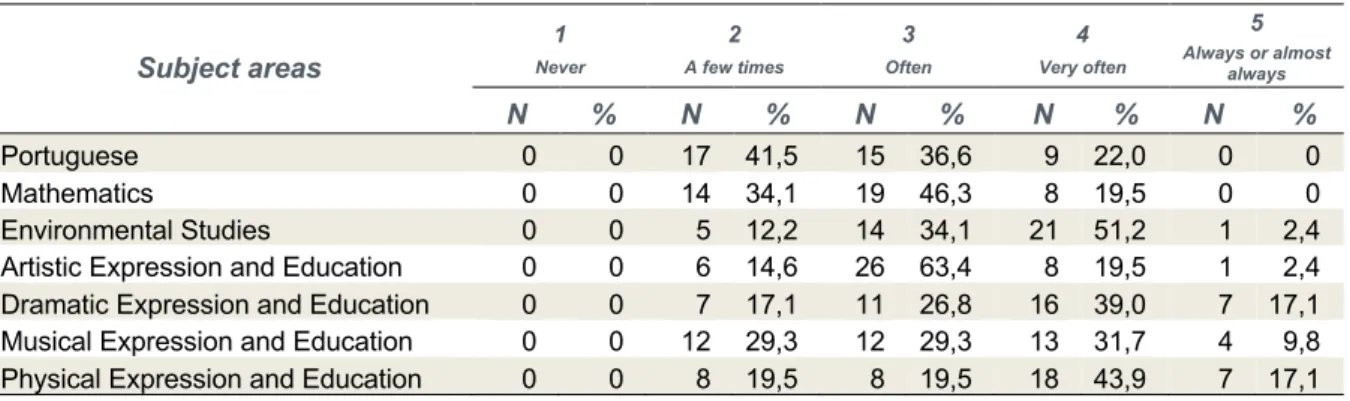
Table 1. Uses of group work in the different subject areas Subject areas 1 Never 2 A few times 3 Often 4 Very often 5 Always or almost always N % N % N % N % N % Portuguese 0 0 17 41,5 15 36,6 9 22,0 0 0 Mathematics 0 0 14 34,1 19 46,3 8 19,5 0 0 Environmental Studies 0 0 5 12,2 14 34,1 21 51,2 1 2,4
Artistic Expression and Education 0 0 6 14,6 26 63,4 8 19,5 1 2,4 Dramatic Expression and Education 0 0 7 17,1 11 26,8 16 39,0 7 17,1 Musical Expression and Education 0 0 12 29,3 12 29,3 13 31,7 4 9,8 Physical Expression and Education 0 0 8 19,5 8 19,5 18 43,9 7 17,1
n=41
Teachers stated that they have used this methodology most frequently in subject areas such as: Environmental Studies, Physical Expression and Dramatic Expression. Mathematics and Portuguese are the subject areas where this methodology is seldom used (Table 1).
The vast majority of respondents stated that they often (34.1%) or very often (51.2%) use group work in their Environmental Studies classes and evidence showed that this methodology was used only a few times by no more than 12.2%.
Physical Expression has a prominent role in this reflection: most of the respondents stated that they often (19.5%), very often (43.9%), or always or almost always (17.1%), use group work in this subject area.
The majority of teachers stated that they use group work in their Dramatic Expression classes very often (39.0%), or often (26.8%). 17.1% of the teachers said that they always or almost always use group work and the same percentage of respondents state they do use group work, but only a few times.
When they referred to their Portuguese classes, most of the respondents said that they use group work only a few times (41.5%). A smaller percentage stated that they use this methodology often (36.6%), or very often (22.0%).
A considerable percentage of teachers (46.3%) stated that group work was often (46.3%), or very often (19.5%) used in their Mathematics classes. On the other hand, 34.1% of the respondents admitted that they use this methodology to carry out their Mathematics activities, but only a few times. The reasons given by teachers to justify the fact that in some subject areas the use of group work is more frequent than in others could be divided into three categories: the first is related to the subject contents (e.g., "because the content is more suitable for this type of approach", or "due to the topics we have to work with"), the second has to do with the type of activities that can be performed (e.g., in Physical Expression, Dramatic Expression, Environmental Studies...) and the third takes into consideration the assumption that some subjects are easier to teach than others
3.2 Data on students
In this section, we describe the students' perspectives on group work and on the way it is used in the classroom, analyzing aspects such as how important this methodology is to them, their degree of satisfaction, the constitution of the groups, the way students behave when they are working in groups, and their favorite subject area to develop group work.
The students showed a very positive perception of group work. They considered this type of methodology very important (59.6%), fairly important (22.0%), or important (18.3%). Students didn’t use the options not important at all or not very important.
Their level of satisfaction with this methodology is high, since the options "I like it a lot" (67.4%) or "I quite like it" (17.0%) were the most frequently used to answer the questions asked. Students didn’t use the option "I don't like it" and only two respondents said they "don’t like it much". It should be noted that the vast majority of students (83.9%) claimed they learn better when they work in group. As for the way groups are formed, most students stated that the teacher forms the groups (50.9%) and also admitted that four is the ideal number of members in a group (46.8%).
The majority of the students admitted that they always (38.1%) or often (31.2%) respect the period of time given by the teacher to carry out the tasks/activities and that they always (28.9%), most of the times (30.7%) or sometimes (30.7%) speak in a low tone of voice so as not to disturb the other members. They also considered that they often (37.6%), or always (33.5%) support/encourage their colleagues. Yet 10.6% of them reported that they never or rarely support/encourage their colleagues. They claimed that they always bring and share ideas and opinions that are relevant to the group work (43.6%) or that they do so many times (33.0%). Yet, some of them admitted that they only do it once in a while (18.8%) or rarely (4.6%).
Students also stated that they always (42.7%) or most of the times (31.7%) wait for their turn to speak and that they are always (46.3%), often (29.4%), or sometimes (18.3%) able to respect their colleagues' opinions.
The majority of the students claimed that they have already acted as the group’s spokesperson, although the frequency with which they have played that role varies considerably: sometimes (38.1%), often (16.5%), or always (4.6%). It should be noted that there is a reasonable percentage of students who claimed they have rarely (25.7%) or never (15.1%) played the role of spokesperson for the group. The group itself is responsible for the choice of its spokesperson, Different methods are used to reach that decision: the whole group decides democratically (61.5%), a member of the group volunteers (11.9%), or the decision is taken by the group leader (9.2%); only 17.4% of them claimed that this choice is made by the teacher.
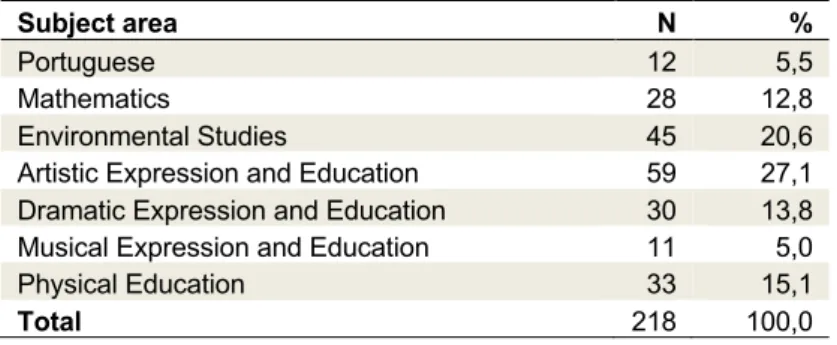
Table 2. Favourite subject area to develop group work activities
Subject area N %
Portuguese 12 5,5
Mathematics 28 12,8
Environmental Studies 45 20,6
Artistic Expression and Education 59 27,1 Dramatic Expression and Education 30 13,8 Musical Expression and Education 11 5,0
Physical Education 33 15,1
Total 218 100,0
The subject areas where students really enjoy doing group work activities are Artistic Expression (27.1%) and Environmental Studies (20.0%). They also refer Physical Education (15.1%), Dramatic Expression (13.8%) and Mathematics (12.8%). Portuguese was, in their opinion, one of the subjects where group work is harder to implement (Table 2).
Students were then asked to give an example of a group assignment they had recently carried out and particularly enjoyed. The content analysis of the students' answers allowed us to identify and highlight some examples of tasks undertaken in the different subject areas: in Portuguese, students created collective texts, in Mathematics, they did several exercises, in Environmental Studies, they carried out experiments/science activities, in Artistic Expression, they did some activities that involved painting
and the use of colors; in Dramatic Expression, they perform some role plays/text dramatizations; in Physical Education, they played different games and in Musical Expression they did some singing activities.
4 DATA DISCUSSION AND CONCLUSIONS
With all the data collected, we were able to achieve the objectives outlined and draw some conclusions.
Primary teachers who took part in this study have a very favourable opinion on the importance of group work, since they didn’t choose the options “not very important” or “not important at all” to answer their questions. Even though more than half of the teachers considered group work to be quite, if not very important, one of the teachers stated that he did not use this methodology in his teaching practice. According to Fontes and Freixo (2004), this teacher may feel he is not adequately prepared, or not motivated enough to implement this methodology.
When they were asked how often they use group work in their classes, a reasonable percentage of teachers stated that they do so once a week or even two to four times a week. These answers are in line with the results obtained in another study carried out with primary teachers (Pereira, Cardoso & Rocha, 2015). That particular study also showed a systematic use of this methodology in the classroom.
Group work should be developed throughout the students' school and academic career. The teachers surveyed stated that this aspect is always in their minds. In fact, most of them considered that 1st grade is the best moment to start using this methodology. This concern is in clear accordance with one of the objectives of Pre-School Education that states that group work should be implemented at this schooling level. This can be seen in article 10 of Law n.º 4/97, dated February 10, where educational actors are advised to integrate children in social groups as soon as possible.
When asked about the number of students per group, the vast majority of teachers said that four is the ideal number. This opinion is in accordance with the students’ answers. These results are in line with Kagan’s thoughts (1989, cited in Freitas & Freitas, 2002). That author considers that in a group composed of four students, one can find development differences that will trigger and encourage a type of progress based on interaction. For a group to function, it is necessary to respect the so-called face-to-face interaction principle, i.e. all members of the group must have the possibility to look at each other (Freitas & Freitas, 2002).
When they were inquired about group organisation, more than half of the teachers stated that they are responsible for the creation of all the groups. According to Freitas and Freitas (2002), this is the most appropriate choice because teachers are familiar with their students. That way, they can provide the right conditions and find ways to make the group work better by promoting the heterogeneity of each group. More than half of the students claimed that the constitution of the group is a decision taken by the teachers. The results are thus in agreement. There is a second possibility in which students can be held responsible for the creation of their groups. According to Cochito (2004), this second option can cause some trouble because the groups might become groups of friends instead of workgroups. This option can be an alternative, but only for short-term assignments.
Evidence shows that in teachers’ opinion group work can greatly benefit students’ learning skills. They referred that when they engage in group work students share their knowledge, accept different ideas, and develop peer cooperation and collaboration. Respect for others was another of the most commonly stated social benefits indicators. These answers are in line with Lopes and Silva’s findings (2009).
However, according to Mir (1998), this type of work has some disadvantages as well. There are a few difficulties that have to be overcome and that are mainly related to student behavior and to the best way to monitor group interaction. The most commonly referred constraints are, for instance, the students’ lack of attention/focus, the fact that it’s easy for children to get carried away and adopt a passive attitude during the implementation of the group work knowing that the other members will do the work for them. For this methodology to work, the teacher has to play a decisive role, i.e., the teacher must have other concerns and responsibilities that go beyond group formation and work supervision (Pato, 1995).
When the teacher wants to implement group work, he or she should take into account that there are several tasks that can and have to be performed. According to Johnson et al. (1991), there are
thirteen fundamental tasks. When asked about which tasks they usually undertake, almost all teachers said that they set the work rules, that they act when they perceive possible disagreement / misunderstandings among students or when they realise that some students are distracted or not working as hard as they should be, that they provide help, manage the classroom physical environment and assess the work done by each group. In addition to the tasks that they perform before, during and after their group work activities, teachers also stated that they thoroughly define the goals for each group work activity. For most of them, the main goal of these assignments is the development and improvement of social/cooperative skills.
Less than half of the respondents had training in issues related to organisation and development of group work in the classroom. They also stated that the knowledge they had in that field was achieved in continuous training sessions/seminars. This fact shows that this kind of topic and concerns have to become part of the teachers’ early training so that they may feel prepared to deal with the obstacles they know they will face when they choose to implement that methodology in their classrooms,
When asked about the subject areas where they use group work on a more regular basis, most of them chose Environmental Studies, for this is an experimental area where the students' experience and expectations are a fundamental starting point and where it is easier to mobilize different kinds of knowledge, as shown by Guedes et al. (2014) in their research study.
Physical Education is another subject area where group work is particularly important. This finding shows that the work carried out by the teachers is in accordance with the guiding principles for the 1st CEB curriculum that states that the students’ physical qualities, as well as their psychomotor skills have to be fully developed by the end of that given schooling cycle and that the absence of regular physical activity may cause irreparable harm.
Dramatic Expression and Musical Expression are other subject areas in which group work is often used by teachers, perhaps because they are areas in which students can resort to their body, their voice, the space and the objects that surround them. These moments are crucial to enrich the students’ learning and social experiences and to provide them with a sense of well-being and happiness (Ministério da Educação, 2004).
In the aforementioned subject areas, group work is used more frequently. Teachers argue that it has to do with the kind of contents addressed in each one of them, i.e., the contents they have to work in those areas have specificities that make group work easier to develop. They also claim that these contents are much better explored using group work methodology than when they adopt an expository approach. The use of different methodologies/the type of activities and the fact that some subject areas are easier to teach are some other arguments put forward.
The type of activities that most teachers suggest their students carry out are the elaboration of posters, short stories dramatization/role plays, they want them to search for and select information, play different games and they also plan the fulfilment of experimental activities. These are activities that are much more rewarding to students when they are developed in groups rather than individually, because they allow them to share knowledge, foster their reciprocal collaborative wish, learn to respect others, and develop relational skills and social competences. Looking at these activities and at the subject areas in which group work is most frequently used, we can see that there is a clear relation between the said activities and the skills developed.
Teachers and students’ answers are in agreement. Most of the students surveyed claim that this methodology is very important and that they like to take part in group work, since they consider that they learn best that way.
Students’ favourite subject areas to develop group work are Artistic Expression and Environmental Studies. Their favourite activities seem to be experimental activities, games, role-plays and the elaboration of creative texts. Evidence also shows that students do not develop group work in their favourite subjects but rather in the ones within which teachers think that it will be more effective. When they were asked to comment on some of the most important aspects that may influence group work, the majority of the students stated that they were always, or most of the time, capable of performing the tasks/activities planned within the time limits set by the teacher; that they were , most of the time, or at least sometimes, able to speak in a low tone of voice so as not to disturb their colleagues and that they support/encourage their colleagues most of the time; most of the students claimed that they, always or most of the time, were capable of bringing relevant ideas and opinions to the group and that they have always, or most of the time, respected the opinions shared by other colleagues, listened to what their fellow students had to say and waited for their turn to speak.
As for the possibility of playing the role of spokesperson for the group, a considerable percentage of students said that they had played that role a couple of times and that the choice of who will represent the group was usually a decision made by the whole group. The group members can vote to choose their representative, this role can rotate among all group members, the group can choose the most responsible student or the student who feels more comfortable to talk about the work performed or the student with the best reading skills.
However, some things remain to be done before group work becomes a highly effective and widespread methodology: more than a third of the students inquired claimed they have never, or rarely, acted as their group spokesperson; others stated that they have never or rarely supported/encouraged their peers. Admittedly, this might happen because some students are shyer than others and find it harder to interact with the other members of the group. The teachers’ role is critical to developing cooperative skills that will be crucial to achieve good group work. Pereira, Cardoso and Rocha (2017) have carried out a study in which they claim that, in the 1st CEB, the aforementioned skills can be improved through self-evaluation and through the evaluation made by others.
In short, we realised that group work is implemented in most of the classrooms of the three School Groupings located in the municipality of Viseu where we conducted our study, and that this is a recurring methodology that enables students to develop school and social skills. In addition to these benefits, the teachers revealed that they usually face considerable difficulties when they have to deal with the behaviour adopted by some of the students while working in group. They are aware that just because they have to rearrange the classroom disposition to implement group work, the environment changes and it’s harder for them to manage the students’ attitudes and interactions.
Even though most teachers admit that they didn’t get any group work training, they continue to develop and implement that methodology, because they realise that the academic and social benefits are more significant than the difficulties they will have to overcome and that those have mostly to do with student behaviour management. The allocation of roles and duties within the group is an activity that very few teachers seem to use. This would clearly help them develop their work because this strategy is one of the most effective ways of ensuring that group members work together, i.e., that way, everyone has an important role in the group and there is no room for distraction or a passive attitude.
Another aspect highlighted by data analysis is the fact that teachers use this methodology very often in their Environmental Studies classes and rarely choose their Portuguese classes to perform group work assignments. Although this subject is commonly seen as a transversal area, Portuguese classes are used but by a few teachers to implement that teaching methodology. This is likely to happen because this subject area is considered a "priority" area in which students have to take a national assessment test at the end of this schooling cycle. That way, teachers choose to approach Portuguese in a more traditional way and the expository model is the most popular method. As a result, students are expected to listen to the teacher’s explanations, take notes and wait for their teacher to ask them to participate or to answer a question. There is no room in those classes for more complex and creative mental operations.
ACKNOWLEDGEMENTS
This work is financed by national funds through FCT - Fundação para a Ciência e Tecnologia, I.P., under the project UID/Multi/04016/2016. Furthermore, we would like to thank the Instituto Politécnico de Viseu and CI&DETS for their support.
REFERENCES
[1] Bardin, L. (2004). Análise de conteúdo (3ª ed.). Lisboa: Edições 70.
[2] Barreira, A., & Moreira, M. (2004). Pedagogia das competências: Da teoria à prática. Porto: ASA. [3] Cochito, M. I. (2004). Cooperação e aprendizagem: Educação intercultural. Lisboa: ACIME. [4] Decreto-Lei n.º 139/2012, de 5 de julho.
[5] Decreto-Lei n.º 75/2008, de 22 de abril.
[6] Fathman, A. K., & Kessler, C. (1993). Cooperative language learning in school contexts. Annual
Review of Applied Linguistics, 13, 127-140.
[7] Fontes, A., & Freixo, O. (2004). Vygotsky e a aprendizagem cooperativa. Lisboa: Livros Horizonte.
[8] Freitas, L. V., & Freitas, C. V. (2002). Aprendizagem cooperativa. Porto: ASA Edições.
[9] Gillies, R. M. (2003). Structuring cooperative group work in classrooms. International Journal of
Educational Research, 39, 35-49.
[10] Guedes, C., Cardoso, A. P., & Rocha, J. M. (2014). A metodologia de trabalho de grupo em Estudo do Meio: Perceções e práticas de professores e alunos do 4.º ano do Ensino Básico. Atas
do I Congresso Internacional Envolvimento dos Alunos na Escola: Perspetivas da Psicologia e Educação (pp. 1161-1170). Lisboa: Instituto de Educação da Universidade de Lisboa.
[11] Johnson, D.W., Johnson, R.T., & Holubec, E.J. (1999). El aprendizaje cooperativo en el aula. Barcelona: Editorial Paidós.
[12] Johnson, D. W., Johnson, R. T., & Smith, K. A. (1991). Active learning: cooperation in the college classroom. Edina, MN: Interaction Book Company.
[13] Lei de Bases do Sistema Educativo (LBSE). Lei n.º 46/86 de 14 de outubro. [14] Lei n.º 4/97, de 10 de fevereiro.
[15] Lopes, J., & Silva, H. S. (2008). Métodos de aprendizagem cooperativa para o jardim-de-infância. Lisboa: Areal Editores.
[16] Lopes, J., & Silva, H. S. (2009). A aprendizagem cooperativa na sala de aula: Um guia prático
para o professor. Lisboa: Lidel.
[17] Lopes, J., & Silva, H. S. (2011). O professor faz a diferença. Lisboa: Lidel.
[18] Marchão, A. J. (2012). No jardim de infância e na escola do 1.º Ciclo do Ensino Básico: Gerir o
currículo e criar oportunidades para construir o pensamento crítico. Lisboa: Edições Colibri.
[19] Ministério da Educação (2004). Organização Curricular e Programas Ensino Básico - 1.º Ciclo. Lisboa: Ministério da Educação.
[20] Mir, C. (Coord.) (1998). Cooperar en la escuela: La responsabilidad de educar para la
democracia. Barcelona: Graó.
[21] Nérici, I. G. (1973). Metodologia do Ensino Superior (2ª ed.). Rio de Janeiro: Editora Fundo de Cultura.
[22] Niza, S. (1998). A organização social do trabalho de aprendizagem no 1.º Ciclo do Ensino Básico.
Inovação, 11, 77-88.
[23] Pato, M. H. (1995). Trabalho de grupo no Ensino Básico: Guia prático para professores. Lisboa: Texto Editora.
[24] Pereira, B., Cardoso, A. P., & Rocha, J. (2017). Avaliação de competências cooperativas e trabalho de grupo no 1.º Ciclo do Ensino Básico. Revista de Estudios e Investigación en
Psicología e Educación, Extr. (6), A6-106-110.
[25] Pereira, C., Cardoso, A. P., & Rocha, J. (2015). O trabalho de grupo como fator potenciador da investigação curricular no 1.º Ciclo do Ensino Básico. Saber & Educar, 20, 224-233.