http://dx.doi.org/10.5424/fs/2012213-02951 eISSN: 2171-9845
Resource communication. sIMfLOR – platform
for portuguese forest simulators
S. P. Faias*, J. H. N. Palma, S. Barreiro, J. A. Paulo and M. Tome
Forest Ecosystem Management under Global Change (ForChange), Forest Research Centre (CEF), School of Agriculture (ISA), Technical University of Lisbon (UTL)
Abstract
In the last decades there has been an increasing number of forest models developed for the main species of the Portuguese forest. Forest models support management decisions by predicting long term stand development under alternative scenarios and taking into account all the components of the ecosystem. However, in most cases, there is a gap between the models developed and their application by decision-makers.
The platform for Portuguese Forest Simulators (sIMfLOR) tries to overcome this gap integrating a wide variety of forest models into simulators and providing a baseline tool for forest managers in Portugal. As an integrated modular platform, sIMfLOR makes available forest simulators for the Portuguese forest with user-friendly interfaces to facilitate the introduction of the in-formation for the simulators. The platform displays stand and regional simulators, interfaces to generate required inputs and also auxiliary tools. As the platform focus on end-users, it allows visualization of the simulators outputs in default graphics which can easily be edited by users. The sIMfLOR platform can be permanently accessed at http://www.isa.utl.pt/cef/forchange/fctools.
Key words: forest models; forest management alternatives; tool; GLOBULUS; SUBER; SIMPLOT; SIMYT.
Resumen
Comunicación de recurso. sIMfLOR – plataforma portuguesa de modelos forestales
En las últimas décadas ha habido un número creciente de modelos forestales desarrollados para las principales espe-cies forestales portuguesas. Los modelos forestales apoyan la toma de decisiones de gestión mediante la predicción del desarrollo a largo plazo de los rodales bajo escenarios alternativos y teniendo en cuenta todos los componentes del ecosistema. Sin embargo, en la mayoría de los casos, existe una brecha entre los modelos desarrollados y su aplicación por los que toman las decisiones. La plataforma portuguesa de simuladores forestales (sIMfLOR) intenta salvar esta brecha integrando una amplia variedad de modelos forestales en simuladores y proporcionando una herramienta de referencia para los gestores forestales en Portugal. Como plataforma modular integrada, sIMfLOR hace accesibles si-muladores forestales para los bosques portugueses utilizando interfaces de fácil uso para facilitar la introducción de la información para los simuladores. La plataforma muestra simuladores de rodales y regionales, interfaces para generar insumos necesarios y también herramientas auxiliares. Como el enfoque de la plataforma es en los usuarios finales, permite la visualización de las salidas de los simuladores en gráficos por defecto que pueden ser modificados por los usuarios. A la plataforma sIMfLOR se puede acceder de forma permanente en http://www.isa.utl.pt/cef/forchange/fctools.
Palabras clave: modelos forestales; alternativas de gestion forestal; herramienta; GLOBULUS; SUBER; SIMPLOT; SIMYT.
* Corresponding author: [email protected] Received: 29-03-12. Accepted: 15-07-12.
Abbreviations used: FMA (Forest Management Alternatives); SFMA (Sequences of FMAs); MSFMA (Multiple Sequences of FMAs).
Introduction
A forest model should provide information on forest growth useful for forest managers and decision makers. Growth and yield models can be developed using dif-ferent approaches from stand models with or without
a diameter distribution simulation (Bailey, 1980; Bur-khart et al., 1981) to individual tree models, depending or not on tree coordinates (Munro, 1974).
The definition of forest models and forest simulators is somehow puzzled in the literature and different opin-ions feed this puzzle. Therefore we differentiate them
to avoid misleading the reader: a forest model is a dynamic representation of a forest at any complexity level, based on a set of sub-models that estimates the forest evolution as a whole; and a forest simulator is a computer tool based on a collection of forest models that allows long term predictions under a postulated climate, forest policies and/or management scenarios, and in some cases taking into account the occurrence of disturbances, for instance fire or pests and diseases. Forest simulators usually predict wood and non-wood products originated by the forest at a sequence of points in time. Simulators can be relevant for forest management at different levels of decision, from land-owners to policymakers, and for different temporal and/ or spatial scales, from a single stand managed for the next years to a national strategic plan considering the next decades. However, in order to support these long term decisions, exploratory tools enabling the interpretation of the results of different management alternatives, need to be made available in user-friendly interfaces.
The most common approach to implement a forest model consists of building a specific computer tool providing visual attractive outputs. More complex tools integrating decision support models are available such as: CAPSIS, a framework designed to address all kinds of forest models resulting from collaborations within a community of forest modelers (Dufour-Kowalski et al., 2012); SIMANFOR, a freely available web-based platform allowing to simulate forest management al-ternatives (Bravo et al., 2010, Bravo et al., 2012), or HEUREKA, a set of tools to support analysis and plan-ning of multi-purpose forestry (Wikström et al., 2011). However, most of these tools imply reprogramming the model rather than allow access the models in their original language. For the Portuguese context, forest models’ interfaces were made available separately for the main tree species, namely Eucalyptus globulus (FPFP, 2001a), Pinus pinaster (FPFP, 2001b) and Quer-cus suber (FPFP, 2001c). However, the growth models comprised in these stand simulators were programmed in a hard-updatable way and became outdated over the years.
Further developments, under the ForChange research group, on tree and stand level models and the need to integrate the new models into forest simulators that could allow a more complete set of choices concerning forest management alternatives, made clear the need to develop user-friendly interfaces to interact with the different new models and/or models updates. sIMfLOR,
as a platform for Portuguese forest simulators, is pro-moting the use of these simulators in Portugal, provid-ing a way to systematically supply the required input information for forest simulators which otherwise would be complex and time demanding. sIMfLOR, is based on a visual interface programmed in VB.net©,
but its modular approach focus on the interaction with nuclear simulators usually programmed in more scien-tific and efficient languages, such as FORTRAN, JAVA or C++ and therefore taking advantage of well estab-lished models without a full reprogramming effort. Thus, sIMfLOR tries to tackle the challenge of reduc-ing the gap between the end-users and the scientific products, which is relevant for the sustainable, strategic and tactical forest management activities.
Structure of the sIMfLOR platform
The sIMfLOR platform integrates simulators for the Portuguese forest and tools to generate some of the required simulation input files. There is input informa-tion that needs to be prepared in MSExcel© files outside
the platform, namely the stand(s) characterization for the base year of simulation as well as the scenario(s) description, for which default files are provided as examples.
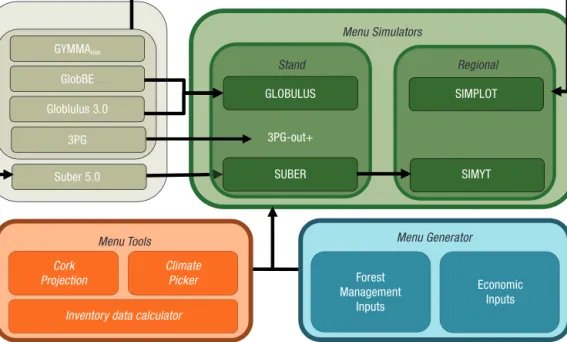
The platform structure is built on three main menus: Simulators, Generator and Tools (Figure 1). In addition, manuals and tutorials can be accessed under the Help menu. The modular basis of the platform, programmed in VB.NET©, allows the activation/deactivation of the
menus depending on the tools present in the platform by dynamic link libraries files (DLLs). The following sections describe the contents of each menu with the currently available tools.
Menu Simulators
The menu Simulators includes different simula-tor types according to the spatial scale level, which can address one or several growth and yield models (Figure 1).
At the stand level the available simulators, selected by forest species, can project new individual pure stands, creating yield tables, or projecting single or multiple existing stands.
SUBER stand simulator projects the evolution of pure cork oak stands for a user defined planning
hori-zon, considering cork as the main product resulting from forest management, but also providing esti-mates for the stand biomass. Stand growth is simu-lated with the individual tree distance independent growth and yield model Suber v.5.0 (Almeida et al., 2010; Paulo et al., 2010; Paulo et al., 2011; Paulo, 2011).
GLOBULUS stand simulator was conceived to project the evolution of eucalyptus even-aged stands for a user defined planning horizon having forest man-agement as its main driver. Stand growth can be simu-lated with two different stand level models according to the management purpose. Stands managed for wood meant for pulp production are simulated with the Globulus v.3.0 stand growth and yield model (Oliveira, 2008; Barreiro and Tomé, 2011), although if the objec-tive is to obtain biomass for bio-energy production in highly stocked stands, GlobBE model is used (Bar-reiro, 2012).
For a regional level, two simulators – SIMPLOT and SIMYT – can be chosen and applied to several types of stands, allowing assess the impact of different sce-narios depending on drivers and different forest man-agement alternatives.
SIMPLOT is a non-spatialized regional simulator based on inventory plots (Barreiro and Tomé, 2011; Barreiro and Tomé, 2012), designed to predict long-term development of all stands in a region taking into
account the following external drivers: wood and bio-mass demands, burned area, afforestation and defor-estation and forest management. Different forest mod-els are applied depending on the existing stand, but at present it applies just to eucalyptus stands. Pure even-aged stands’ growth is projected with the models inte-grated into GLOBULUS, while uneven-aged stands or even-aged stands of unknown age are simulated with the GYMMAnlin model (Barreiro et al., 2004).
SIMYT is a regional simulator that uses yield tables as input. These yield tables can be built by projecting a new stand with the previously mentioned stand simulators depending on the species to simulate. The yield table must represent pure even-aged stands for the national average site index by one year age class, including a class for uneven-aged and another for non industrial stands. The simulator also needs, as SIM-PLOT, for each year along a rotation a set of annual values of the drivers for wood demand, burned area, new plantations area, and percentage of abandoned land (Coelho et al., 2012; Tomé et al., 2010).
Menu Generator
The menu Generator allows the user to produce dif-ferent inputs for the previously described simulators, as illustrated in Figure 1.
Models
Figure 1. sIMfLOR platform design.
Stand Menu Generator Regional Menu Simulators Menu Tools GYMMAnlin GlobBE GLOBULUS 3PG-out+ SUBER Forest Management Inputs Economic Inputs SIMPLOT SIMYT Globlulus 3.0 3PG Suber 5.0 Cork Projection
Inventory data calculator Climate
The Forest Management Alternative (FMA) gen-erator is used to create a file characterizing the forest management, maintaining the same structure inde-pendently of the forest tree species. In even-aged stands the FMA describes the operations from stand regeneration, including coppice, until some age that is older than the possible harvesting ages. In uneven-aged stands, the FMA characterizes a rotation which means the series of operations during a certain period of time that are repeated over time. The silvicultural operations are selected out of a list of operations for the Portuguese context (ANEFA, 2011) and defined when and how often each operation takes place during a rotation period. Additionally, more detailed informa-tion has to be provided for some operainforma-tions, such as planting, thinning or cork debarking. As a result, a matrix of operations and its corresponding details is generated. The result of the FMA generator is most suitable for creating the forest management input for a stand and can later on be used by the subsequent generators.
The Sequential FMA generator (SFMA) concept was created to allow a greater flexibility when defin-ing forest management throughout a planndefin-ing horizon by building sequences of different FMA matrices. This generator is particularly useful for preparing the management inputs for a whole planning horizon to be used by stand/forest and regional simulators.
The Multiple Sequences Forest Management input generator (MSFMA) was conceived to create different possible combination sequences of FMAs for each stand. The MSFMA generator creates a set of optional Sequential Forest Management (SFM) within a user-defined interval for the main management driving variables depending on the species selected. The results obtained with this generator are several SFMA which can drive the forest/stand simulators to project different outputs for further assessments on strategic landscape management optimization.
The Economic Inputs generator enables the user to supply, throughout several tabs, economic informa-tion needed to run the simulators. A list of costs as-sociated to operations, labour and consumed products are provided for the user to analyze and eventually modify. A set of non-wood and wood product assort-ments prices are also predefined. The user can either use default values based on economic statistics up-dated by the Portuguese forest authority (ANEFA, 2011) or insert new values by changing the average costs.
Menu Tools
Under the Tools menu several auxiliary tools are made available to generate practical information. These may serve as input to the simulators or run independ-ently.
The Cork Sample Projection is a tool that allows the estimation of cork caliber evolution from different cork samples. The tool uses the caliber measurements made in each cork sample (before or after cork boil-ing) and the respective cork sample age for the projec-tion of the caliber evoluprojec-tion of each cork sample along a user defined number of years, based on specific equations from the forest model Suber v5.0 (Almeida et al., 2010; Paulo et al., 2010; Paulo et al., 2011; Paulo, 2011).
The Climate Picker allows to obtain monthly cli-matic variables commonly needed in process based models (minimum and maximum temperature, pre-cipitation, solar radiation, rain days greater than 1 mm and 0.1 mm, frost days, vapor pressure deficit, pan evapora-tion, relative humidity) from the HadRM3Q0_A1B climatic dataset (Collins et al., 2006) which is con-sidered the most adapted for the Portuguese context (Soares et al., 2012). The tool allows the retrieval of current and future climate projections and the user can select a location of interest, where the interface will search for the nearest point climatic station of the re-gional climate model (25 km grid).
The Tree Variables Calculator computes tree varia-bles for the main Portuguese species, with required tree inputs that can be directly inserted into the interface. It displays results for total height (m), basal area (m2),
volume (m3) and biomass (kg) by components with the
equations used in the last national forest inventory (AFN, 2010).
Final considerations
sIMfLOR integrates simulators that use several models, written in different programming languages, simplifying their use by helping in the construction of simulations’ input needs. The information required as input for the simulators can be directly filled in and selected in visual interfaces or created in the generator menu, e.g. economic inputs, wood and non-wood prod-ucts assortments and characterization of the silvicul-tural system. The simulators’ outputs can be visualized as tabular results, in CSV (comma-separated values)
files, and as graphical results in Excel files which can be edited to build new ones.
Efforts were carried out to make the simulators’ in-terface user-friendly, maintaining the structure of the menus as similar as possible among the different simu-lators with “comments” providing brief explanations on the information requested in the forms. Additionally, manual and tutorials are made available under the Help menu and the interface can be displayed either in Por-tuguese or in English to broaden the platform potential users. sIMfLOR may be used by students, professors, researchers and forest managers from public services, forest associations, forest owners, and forest consultants.
The platform is expected to be in continuous evolu-tion as science demands through new updates, provid-ing the state-of-the-art of available models applicable to Portugal into the existing forest simulators or through the conception of new ones. Simultaneously, the platform may receive add-ins to complement the tool either by development of new generator instru-ments, or other auxiliary tools.
Acknowlegments
The sIMfLOR platform developed by the ForChange research group was initiated under the EFORWOOD project – Tools for Sustainability Impact Assessment of the Forestry-Wood Chain, financed by EU (FP6-2004- 518128-2), and its development has been con-tinued under the MOTIVE project – Models for Adap-tive Forest Management, also financed by EU (FP7-ENV-2008-1- 226544). The authors wish to thank all contributions of colleagues that on the day-to-day activities helped improving the platform with their opinions and experience.
References
AFN. 2010. Inventário Florestal Nacional. Portugal Conti-nental. IFN5, 2005-2006. Autoridade Florestal Nacional. Lisboa, Portugal. 209 pp. [In Portuguese].
Almeida A, Tomé J, Tomé M. 2010. Development of a system to predict the evolution of individual tree mature cork caliber over time. Forest Ecology and Management 260, 1303-1314. Available in http://dx.doi.org/10.1016/j. foreco.2010.07.017.
ANEFA. 2011. Matriz de Referência com Custos Mínimos e Máximos para as Principais Operações (Re)Arborização
e Execução de Infraestruturas para 2011. Comissão de Acompanhamento de Operações florestais (CAOF). Avail-able in http//www.anefa.pt [7 Dec 2011] [In Portuguese]. Bailey RL. 1980. Individual tree growth derived from
diam-eter distribution models. Forest Science 26, 626-632. Barreiro S, Tomé M, Tomé J. 2004. Modeling growth of
unknown age even-aged eucalyptus stands. Proceedings of the International Conference on “Modeling Forest Production. Scientific Tools - Data Needs and Sources. Validation and Application” (Hasenauer H, Makela A, eds), Vienna (Austria), 19-22 April, pp. 34-43.
Barreiro S, Tomé M. 2011. SIMPLOT: Simulating the im-pacts of fire severity on sustainability of eucalyptus forests in Portugal. Ecological Indicators 11, 36-45. Available in http://dx.doi.org/10.1016/j.ecolind.2009.06.015.
Barreiro S, Tomé M. 2012. Analysis of the impact of the use of eucalyptus biomass for energy on wood available for eucalyptus forests in Portugal. A simulation study. Ecol-ogy and Society 17(2):14. Available in http://dx.doi. org/10.5751/ES-04642-170214
Barreiro S. 2012. Development of forest simulation tools for assessing the impact of different management strategies and climatic changes on wood production and carbon sequestration for Eucalyptus in Portugal. PhD thesis. Universidade Técnica de Lisboa, Instituto Superior de Agronomia, Lisboa, Portugal.
Bravo F, Rodríguez F, Ordóñez AC, Broto M, Lizarralde I, Ruano I, del Río M, Calama R, Diéguez U, Álvarez JG, Vázquez J, Bravo A, Ruiz-Peinado R, Montero G. 2010. Simanfor: aplicación web para la simulación de alterna-tivas selvícolas Montes 100:22-26. [In Spanish]. Bravo F, Rodríguez F, Ordóñez CF. 2012. A web-based
application to simulate alternatives for sustainable for-est management: SIMANFOR. Forfor-est Systems 21(1):4-8. Available in http://dx.doi.org/ 10.5424/fs/2112211-01953.
Burkhart HE, Cao QV, Ware KD. 1981. A comparison of growth and yield prediction models for loblolly pine. FWS-2, Virginia Polytechnic Institute and State Univer-sity, School of Forestry and Wildlife Resources. Blacksburg,Coelho MB, Paulo JA, Palma JHN, Tomé M, 2012. Contribution of cork oak plantations installed after 1990 in Portugal to the Kyoto commitments and to the landowners economy. Forest Policy and Economics 17, 59-68. Available in http://dx.doi.org/10.1016/j.for-pol.2011.10.005.
Collins M, Booth B, Harris G, Murphy J, Sexton D, Webb M. 2006. Towards quantifying uncertainty in transient climate change. Climate Dynamics 27, 127-147. Available in http://dx.doi.org/10.1007/s00382-006-0121-0. Dufour-Kowalski S, Courbaud B, Dreyfus P, Meredieu C, de
Coligny F. 2012. Capsis: an open software framework and community for forest growth modelling. Annals of Forest Science (2012) 69, 221–233. Available in http://dx.doi. org/10.1007/s13595-011-0140-9.
FPFP. 2001a. Globulus v2.0 Modelo de produção para o Eucalipto. Manual do utilizador. Edição da Federação dos Produtores Florestais de Portugal. 35 pp. [In Portuguese]. FPFP. 2001b. Pbravo v2.0 Modelo de produção para o Pin-heiro bravo. Manual do utilizador. Edição da Federação dos Produtores Florestais de Portugal. 47 pp. [In Portuguese]. FPFP. 2001c. SUBER v3.0 Modelo de produção para o So-breiro. Manual do utilizador. Edição da Federação dos Produtores Florestais de Portugal. 43 pp. [In Portuguese]. Munro DD. 1974. Forest Growth Models - A Prognosis. In:
Growth Models for Tree and Stand Simulation (Fries J, Ed.). Royal College of Forestry of Sweden, Research Note Number 30, 7 - 21.
Oliveira T. 2008. System for predicting total and components biomass in Eucalyptus globulus Labill. Stands, Masters thesis. Universidade Técnica de Lisboa, Instituto Supe-rior de Agronomia, Lisboa, Portugal. Available in http:// hdl.handle.net/10400.5/1056. [In Portuguese].
Paulo JA, Tomé M. 2010. Predicting mature cork biomass with t years of growth from one measurement taken at any other age. Forest Ecology and Management 259, 1993-2005. Available in http://dx.doi.org/10.1016/j.foreco.2010.02.010. Paulo JA, Tomé J, Tomé M. 2011. Nonlinear fixed and ran-dom generalized height-diameter models for Portuguese
cork oak stands. Annals of Forest Science 68, 295 – 309. Available in http://dx.doi.org/10.1007/s13595-011-0041-y. Paulo JA. 2011. Desenvolvimento de um sistema para apoio
à gestão sustentável de montados de sobro. PhD thesis. Universidade Técnica de Lisboa, Instituto Superior de Agronomia, Lisboa, Portugal. Available in http://hdl. handle.net/10400.5/3850 [In Portuguese].
Soares PMM, Cardoso RM, Miranda PMA, Medeiros J, Belo-Pereira M, Espírito-Santo F. 2012. WRF high reso-lution dynamical downscaling of ERA-Interim for Portu-gal. Climate Dynamics. Available in http://dx.doi. org/10.1007/s00382-012-1315-2.
Tomé M, Coelho M, Soares P. 2010. KP-LULUCF. In: Por-tuguese National Inventory Report on Greenhouse Gases, 1990-2008 – Submitted under the UNFCC and the Kyoto Protocol. (Pereira TC, Seabra T, Maciel H, Torres P, eds). Portuguese Environmental Agency. Amadora, Portugal. pp. 10-27. Available in http://www.apambiente.pt/ [12Jan, 2012].
Wikström P, Edenius L, Elfving B, Eriksson LO, Lämås T, Sonesson J, et al.. 2011. The Heureka Forestry Decision Support System: An Overview. Mathematical and Com-putational Forestry & Natural-Resource Sciences 3(2), 87-94.