iii TABLE OF CONTENTS ACKNOWLEDGEMENTS ... VII RESUMO ... XI SUMMARY ... XIII LIST OF PUBLICATIONS ... XV
LIST OF ABBREVIATIONS ... XVII
CHAPTER 1: INTRODUCTION AND OBJECTIVES ... 19
1.1 Carbenes ………. 21
1.1.1 Fischer type carbenes ... 21
1.1.2 Schrock type carbenes ... 22
1.1.3 N-Heterocyclic carbenes (NHCs) ... 22
1.2 Manganese and iron NHC complexes in catalysis ... 24
1.3 Manganese N-Heterocyclic carbene complexes ... 24
1.3.1 Synthesis and characterization ... 24
1.3.1.1 Manganese(I) NHC complexes ... 24
1.3.1.2 Manganese(II) NHC complexes ... 32
1.3.1.3 Manganese(III) NHC complexes ... 37
1.3.1.4 Manganese(IV) and Mn(V) NHC complexes ... 39
1.3.2 Catalytic applications of Mn NHC complexes ... 40
1.4 Fe NHC complexes: synthesis and catalytic applications ... 43
1.4.1 Fe bis-NHC complexes ... 44
1.4.1.1 Synthesis and characterization ... 44
1.4.1.2 Catalytic applications of Fe bis-NHC complexes ... 56
1.5 Objectives of this work ……….. ... 60
1.6 References.. ... 61
CHAPTER 2: A HIGHLY ACTIVE N-HETEROCYCLIC CARBENE MANGANESE(I) COMPLEX FOR SELECTIVE ELECTROCATALYTIC CO2 REDUCTION TO CO ... 69
iv
2.2. Introduction ... 72
2.3. Results and discussion ... 73
2.3.1 Synthesis and characterization of Mn complex 1 ... 73
2.3.2 Cyclic voltammetry analysis of 1 and electrocatalytic reduction of CO2 to CO mediated by 1 ... 74
2.3.3 Mechanistic studies of the catalytic reduction of CO2 to CO .... 77
2.4. Conclusions ... 81
2.5. Experimental section ... 82
2.5.1 General methods and materials ... 82
2.5.2 Synthesis and characterization of 1 and 2 ... 84
2.6. Acknowledgements ... 86
2.7. References ... 86
CHAPTER 3:MANGANESE N-HETEROCYCLIC CARBENE COMPLEXES FOR CATALYTIC REDUCTION OF KETONES WITH SILANES ... 91
3.1. Summary…… ... 93
3.2. Introduction ... 94
3.3. Results and discussion ... 95
3.3.1 Synthesis and characterization of Mn bis-NHC complexes 1 and 2………95
3.3.2 Hydrosilylation of benzaldehyde and ketones catalyzed by complexes 1–5… ... 97
3.3.3 Mechanistic studies ... 104
3.4. Conclusions ... 109
3.5. Experimental section ... 109
3.5.1 General methods ... 109
3.5.2 Synthesis and characterization of complexes 2 and 5 ... 110
3.5.3 Typical procedure for the hydrosilylation of benzaldehyde and ketones catalyzed by complexes 1–5 ... 111
3.6. Acknowledgements ... 112
v CHAPTER 4: (DI)TRIAZOLYLIDENE MANGANESE COMPLEXES IN
CATALYTIC OXIDATION OF ALCOHOLS ... 117
4.1. Summary .. ... 119
4.2. Introduction ... 120
4.3. Results and discussion ... 121
4.3.1 Synthesis and characterization of Mn complexes 2 and 3 ……… ... 121
4.3.2 Catalytic activity in the oxidation of alcohols………… ... 124
4.3.3 Electrochemical analysis of complexes 2-5 ... 131
4.3.4 Mechanistic insights into the catalytic reaction ... 133
4.4. Conclusions ... 138
4.5. Experimental section ... 138
4.5.1 General considerations ... 138
4.5.2 Synthesis and characterization of complexes 2 and 3 ... 139
4.5.3 Catalytic procedures ... 140
4.5.4 Electrochemical analysis of complexes 2–5 ... 141
4.5.5 In operando IR analysis of alcohol oxidation ... 141
4.5.6 Crystallographic details of complex 3 ... 142
4.6. Acknowledgements ... 143
4.7. References ... 143
CHAPTER 5:CHELATING BIS-N-HETEROCYCLIC CARBENE COMPLEXES OF IRON(II) CONTAINING BIPYRIDYL LIGANDS AS CATALYST PRECURSORS FOR OXIDATION OF ALCOHOLS ... 149
5.1. Summary………151
5.2. Introduction ... 152
5.3. Results and discussion ... 153
5.3.1 Synthesis and characterization of Fe complexes 1 and 2 ... 153
5.3.2 Catalytic activity in the oxidation of alcohols ... 154
5.3.3 Mechanistic insights into the catalytic reaction ... 156
vi
5.5. Experimental section ... 159
5.5.1 General methods ... 159
5.5.2 Synthesis and characterization of Fe complexes 1 and 2 ... 160
5.5.3 Typical procedure for the oxidation of alcohols... 162
5.6. Acknowledgements ... 163
5.7. References ... 163
CHAPTER 6:CONCLUSIONS AND OUTLOOK ... 167
vii
Acknowledgements
Many people and institutions contributed in one way or another to my PhD thesis, all of whom are acknowledged here:
Firstly, I would like to express my special appreciation and thanks to my PhD supervisor, Drª. Beatriz Royo for all the scientific knowledge transmitted, support and above all for her dedication and continuous guidance during of my PhD. Her guidance helped me in all the time of research and writing of this thesis.
I would like to thank my PhD co-supervisor Prof. Ana Margarida Martins for their guidance, interest, and helpful comments.
Besides my supervisors, I would like to thank the committee members of my PhD, Luis Branco and Ana Petronilho for their insightful comments, motivation and encouragement during the thesis committee meetings.
I would like to thank CATSUS (Catalysis and Sustainability) PhD program and FCT (Fundação para a Ciência e Tecnologia) for my PhD fellowship SFRH/BD/105994/2014.
To my laboratory colleagues, current and former, Sofia Friães, Ana Fernandes, Carlos Carrasco, Carlos Teixeira, Rita Lopes, Naiára Fernandez and Bernardo Cardoso, thank you for the good work moments we shared, always with good disposition, the enjoyable discussions about scientific and mostly non-scientific subjects, and for all the fun we have had in the last four years. I am also grateful to Joana Marques, Inês Leitão, Patricia Reis and Arturo Batista not only for the moments we share inside and outside ITQB. Some of you have been a source of friendships and well as good advice, they know who they are!
At ITQB, I would like to acknowledge Helena Matias for all the availability and help on the NMR service, Conceição Almeida, not only
viii
for the elemental analysis service, but also thank you for the support and dedication. Thanks also to João Rodrigues for always being available to help and the staff of the economato, for the spectacular environment always on that 1st floor of ITQB, as well as the maintenance staff. A general thank you to all staff of ITQB because in one way or another were always ready to help.
At IST, I am grateful to all the members of Prof Ana Margarida Martins and Prof Pedro Teixeira Gomes groups that have contributed immensely to my personal and professional time at IST, and because they were always ready to help me. Also thanks for the wonderful moments we share outside of IST. Thank you for never "forgetting" me! I would also like to acknowledge the Julio LLoret group at ICIQ, who gave me the opportunity to join his team as intern, and for giving me access to his laboratory and ICIQ research facilities. In addition, I would like to thank all the members of his group for their help during my stay at ICIQ and for the good disposition.
My time at ITQB and also at IST was made enjoyable in large part due to many friends that became part of my life. I am grateful!
To my friends, who are outside the research world, I am very grateful for incenting me to strive towards my goal, for believing in me and showing interest in my research even when they may not always have clearly understood my day-to-day work.
And finally, but not the least, a special thanks to my family:
The words cannot express how grateful I am to Bruno, my husband, who always has been by my side throughout and has helped me to find motivation and energy to overcome problems. For all the support, friendship, affection and patience and of course for all the love, this thesis is dedicated to you, thank you for being who you are.
In addition, I would like to thank my parents Jorge and Isabel for my education, for the values they instilled in me. All of these have molded
ix me into the person that I am today. I also would like to thank my sister Catarina for the support. Without you it would not have been possible; this thesis is also dedicated to you, thanks for everything!
The rest of my family, especially my uncles, Susana and Artur, and cousins who gave me accommodation during these four years and Bruno’s family, for their support and their continuous interest in my research.
Finally, I wish to thank the memory to my "stars", they know who they are!
A PhD thesis is never done alone; I'll always be aware of that. Thank you, everyone, from the bottom of my heart.
xi
Resumo
Esta tese descreve a síntese de novos complexos de manganês e ferro contendo ligandos carbenos N-heterocíclicos (NHC) e a sua aplicação em catálise. Em particular, exploramos a atividade catalítica dos novos complexos na oxidação de álcoois e na redução de grupos carbonilo.
A tese é composta por seis capítulos, cada um deles abordando aspectos diferentes. O capítulo 1 é introdutório e analisa o estado de arte dos complexos N-heterocíclicos de manganês e ferro em catálise. Em particular, a discussão concentra-se na síntese, caracterização e nas aplicações catalíticas dos complexos N-heterocíclicos de manganês e bis- N-heterocíclicos de ferro. O principal objetivo da tese e os objetivos específicos também são apresentados no capítulo 1.
O capítulo 2 descreve a síntese e caracterização dos complexos fac- [Mn(bis-NHCR)(CO)3Br] (R = Me, Mes) e a sua aplicação na redução eletrocatalítica de CO2 em CO. Além disso, estes complexos foram aplicados como catalisadores para a redução de grupos carbonilo através de reações de hidrosililação. Estes resultados são descritos no Capítulo 3. A síntese e caracterização de uma nova família de complexos de manganês carbonilo contendo ligandos di(1,2,3-triazolilidenos) quelantes ou em ponte e a sua aplicação como catalisadores para a oxidação de álcoois em cetonas e aldeídos são apresentados no capítulo 4. O capítulo 5 descreve a preparação de complexos quelantes de carbenos bis-N-heterocíclicos de ferro (II) contendo ligandos piridilo. Os complexos [Fe(bis-NHC) (I)2] (L = bipiridina, fenantrolina) foram completamente caracterizados e a sua atividade catalítica na oxidação de álcoois foi explorada.
xiii
Summary
This thesis describes the synthesis of new manganese and iron complexes bearing N-heterocyclic carbene (NHC) ligands and their application in catalysis. In particular, we have explored the catalytic activity of the new metal complexes in the oxidation of alcohols and in the reduction of carbonyl groups.
The thesis is composed of six chapters, each of them dealing with different aspects. Chapter 1 is introductory and reviews the state-of-the-art of manganse and iron N-heterocyclic carbene complexes in catalysis. In particular, the discussion focuses on the synthesis, characterization and catalytic applications of manganese NHC and iron bis-NHC complexes. The main goal of the thesis and the specific objectives are also presented in Chapter 1.
Chapter 2 describes the synthesis and characterization of fac-[Mn (bis-NHCR)(CO)3Br] (R = Me, Mes) complexes and their application in the electrocatalytic reduction of CO2 to CO. In addition, these complexes have been applied as catalysts for the reduction of carbonyl groups through hydrosilylation reactions. These results are described in Chapter 3. The synthesis and characterization of a new family of carbonyl manganese complexes bearing chelating or bridging mesoionic di(1,2,3-triazolylidene) ligands, and their application as catalysts for the oxidation of alcohols to ketones and aldehydes are presented in Chapter 4. Chapter 5 describes the preparation of chelating bis-N-heterocyclic carbene complexes of iron(II) containing pyridyl ligands. Complexes [Fe(bis-NHC)L(I)2] (L = bipy, phen) were fully characterized and their catalytic activity in the oxidation of alcohols was explored.
xv
List of Publications
- (Di)Triazolylidene Manganese Complexes in Catalytic Oxidation of Alcohols to Ketones and Aldehydes, M. F. Pinto, M. Olivares, A. Vivancos, G. Guisado-Barrios, M. Albrecht and B. Royo, Catal.Sci.Technol., 2019, 9, 2421-242, DOI: 10.1039/C9CY00685K.
- A Manganese N-Heterocyclic Carbene Catalyst for Reduction of Sulfoxides with Silanes, S. C. A. Sousa,C. J. Carrasco,M. F. Pinto, and B. Royo, ChemCatChem., 2019, 11, 3839-3843, DOI: 10.1002/cctc.201900662. Selected as Very Important Paper and Highlighted in the Cover of the Special Issue “Women of Catalysis”
- A Highly Active N-Heterocyclic Carbene Manganese(I) Complex for Selective Electrocatalytic CO2 Reduction to CO, F. Franco, M. F. Pinto, B. Royo, and J. Lloret-Fillol, Angew. Chem. Int. Ed. 2018, 57, 4603-4606, DOI: 10.1002/anie.201800705
- Manganese N-Heterocyclic Carbene Complexes for Catalytic Reduction of Ketones with Silanes, M. F. Pinto, S. Friães, F. Franco, J. Lloret-Fillol and B. Royo, ChemCatChem 2018, 10, 2734-2740, DOI:10.1002/cctc.201800241. Selected as a Very Important Paper and Highlighted in the Cover Journal.
- Chelating bis-N-Heterocyclic Carbene Complexes of Iron(II) Containing Bipyridyl Ligands as Catalyst Precursors for Oxidation of Alcohols, M. F. Pinto, B. P. Cardoso, S. Barroso, A. M. Martins and B. Royo, Dalton Trans., 2016, 45, 13541-13546, DOI: 10.1039/c6dt02718k.
xvii
List of abbreviations
NHCs N-Heterocyclic carbenes Trz 1,2,3-Triazolylidenes Cp Cyclopentadienyl t tert KHMDS Potassium bis(trimethylsilyl)amideNMR Nuclear Magnetic Resonance
IR Infrared Spectroscopy
THF Tetrahydrofurane
EPR Electron Paramagnetic Resonance
i iso Pr Propyl Mes Mesityl Ph Phenyl Me Methyl Ad Adamantyl Imid Imidazol Bu Buthyl TIMEN Tris[2-(3-R-imidazol-2-ylidene)ethyl]amine KIE Kinetic isotope effect
TON Turnover number
TOF Turnover frequency
Et Ethyl
Bn Benzyl
CV Cyclic voltammetry
FTIR-SEC Fourier transform infrared- Spectro- electrochemistry
xviii FTIR Fourier transform infrared
NCMe Acetonitrile
TBHP Tert-Butyl hydroperoxide PMHS Polymethylhydrosiloxane
ESI-MS Electron-spray ionization- Mass spectrometry
EA Elemental Analysis
C
HAPTER1:
INTRODUCTION AND OBJECTIVES1.1. Carbenes
1.1.1 Fischer type carbenes 1.1.2 Schrock type carbenes
1.1.3 N-Heterocyclic carbenes complexes (NHCs) 1.2. Manganese and iron NHC complexes in catalysis 1.3. Manganese N-Heterocyclic carbenes complexes
1.3.1 Synthesis and characterisation 1.3.1.1 Manganese(I) NHC complexes 1.3.1.2 Manganese(II) NHC complexes 1.3.1.3 Manganese(III) NHC complexes
1.3.1.4 Manganese(IV) and Mn(V) NHC complexes 1.3.2 Catalytic applications of Mn NHC complexes
1.4. Fe NHC complexes: synthesis and catalytic aplications 1.4.1 Fe bis-NHC complexes
1.4.1.1 Synthesis and characterisation
1.4.1.2 Catalytic applications of Fe bis-NHC complexes 1.5. Objectives
21 1.1 Carbenes
Carbenes are neutral molecules containing a divalent carbon atom. In the groud state, the two nonbonding electrons of the carbon atom can have either antiparallel spins, where the sp2 orbital is doubly occupied and the pz orbital is unoccupied (singlet state) or parallel spins, where the sp2 and pz orbitals are singly occupied (triplet state) (Figure 1.1). The different spin configuration of the carbene, which depends on the relative energy values between sp2 and p orbitals, and its overlapping with the orbitals of the metal, determines the nature of the metal carbene complex.
Figure 1.1 Representation of the singlet and triplet state of the carbene.
There are different types of carbenes stabilized by a metal, each of them with very different electronic properties of the M-C bond. They can be classified in three main types:
1.1.1 Fischer type carbenes
These type of carbenes are found in low oxidation state metal centers in combination with singlet carbenes. The M-C bond in Fischer carbenes is based on σ-electron donation from the filled lone pair orbital of the carbene atom to an empty metal d-orbital, and π back bonding of a filled metal d-orbital to the empty p-orbital on carbon (Scheme 1.1). This polarization generates a carbon that is electrophilic in nature; they are stabilized by substituents on the carbene atom such as alkoxy and alkylated amino groups.
22
1.1.2 Schrock type carbenes
Schrock carbenes, named later by Richard R. Schrock, are characterized by nucleophilic carbene carbon centers. The π electrons are equally distributed between the M-C bond, generating a real double bond. They are typically found with high oxidation state metal centers.[1]
1.1.3 N-Heterocyclic carbenes (NHCs)
NHCs are considered as a type of Fischer carbenes because they form a single metal-carbon bond. However, their particular properties motivate their study separately from other carbenes. NHCs are defined as singlet carbenes in which the divalent carbenic center is connected directly to at least one nitrogen atom in the heterocycle. NHCs were first discovered in 1968 by Ofele[2] and Wanzlick,[3] almost simultaneously. However, the use of NHCs as ligands in organometallic chemistry started 20 years later, when Arduengo isolated for the first time a stable free carbene.[4] The isolation of stable NHCs promoted an intense research in organometallic chemistry.[5] NHCs are electron rich nucleophilic species in which the carbene center benefits from the stabilization associated with both the σ-electron-withdrawing and π -electron donating character of the nitrogen atoms. Due to their strong σ-electron donating properties, NHC ligands form strong bonds with metal centers, affording metal complexes that are generally resistant to decomposition.[6–9]
23 Scheme 1.1 Bonding scheme of Schrock and Fischer-type carbene complexes.
NHCs have experienced a remarkable development due to their facile synthesis, their unique properties as ligands, and the application in catalysis of their metal complexes. The catalytic applications include hydrogenations, C–H bond activation, oxidation catalysis, cross-coupling, cyclization, and metathesis reactions among others.[10–12]
1,2,3-Triazolylidenes (Trz) (Figure 1.2) are a subclass of NHCs disclosed by Albrecht and co-workers in 2008.[13] Trz result from the substitution of the C(2)-R unit in imidazolylidenes by nitrogen. These type of NHCs are mesoionic carbenes, dipolar five membered heterocyclic compounds in which both the negative and the positive charge are delocalized. Trz have attracted much interest in the last years due to their facile and versatile synthesis, and their strong σ-electron donating properties, stronger than classical NHC ligands.
24
1.2 Manganese and iron NHC complexes in catalysis
In recent years, the development of catalysts based on abundant first-row transition metals has become a central topic in catalysis.[14–16] Among 3d metals, manganese and iron are particularly attractive candidates for catalysis owing to their natural abundance and their useful features of being non-toxic and biocompatible metals. In comparison with the spectacular development of catalysis with Fe[17– 25], Mn has remained relatively unexploited. However, this area of research has recently emerged as an important field with the discovery of manganese pincer complexes as efficient catalysts for hydrogenation and dehydrogenation reactions.[14,15,25–33,16–19,21–24]
1.3 Manganese N-Heterocyclic carbene complexes 1.3.1 Synthesis and characterization
The majority of the Mn NHC complexes described in the literature contain Mn in the oxidation states +1 and +2. This Section will provide an overview of the Mn NHC complexes described in the literature. It covers from the preparation of the first Mn NHC complex to 2019. Section 1.3.1 comprises several subsections, each dedicated to specific oxidation states of the metal.
1.3.1.1 Manganese(I) NHC complexes
Most of the Mn(I) NHC complexes described in the literature contain carbonyl and/or cyclopentadienyl as co-ligands in their coordination sphere. The first Mn(I) NHC complexes were reported by Lappert and Pye in 1977 (complexes 1 and 2, Figure 1.3).[34] However, both 1 and 2 complexes were obtained in very low yield and were poorly characterized.
25 Figure 1.3 The first Mn(I) NHC complexes 1 and 2 described by Lappert and
Pye.
In 1989, Aumann and Heinen reported the synthesis of half-sandwich Mn NHC complexes via ketenimine Mn intermediates. The synthetic pathway is depicted in Scheme 1.2. The synthesis starts by preparing the ketenimine metal complex 3 as an intermediate and then a polarized RC=X bond went through a 1,3-addition to form 4.[35]
Scheme 1.2 Synthesis of Mn(I) NHC complex 4.
More recently, related half-sandwich complexes have been prepared by Whitessley and co-workers in higher yield by UV irradiation of Cp′Mn(CO)3 (Cp′ = η5-C5H4Me) in the presence of the
26
corresponding free NHC (Figure 1.4). This synthetic pathway allows to obtain the desired compounds in moderate yields (37−51%). Complexes 5−8 have been synthesized and fully characterized in solution and in the solid state. Photochemistry studies of 5−8, through time-resolved infrared spectroscopy in alkane solutions, showed that 5−8 photodissociate CO to generate the monocarbonyl species Cp′Mn(CO)(NHC).[36]
Figure 1.4 Cp′Mn(CO)2(NHC) complexes 5-8.
Lugan, Sortais, and co-workers, prepared in 2014, related Mn(I) complexes containing different wingtips (complexes 9–14, Figure 1.5) by photoinduced CO substitution in CpMn(CO)3 in the presence of the appropriate free NHC, which was generated in situ from the corresponding imidazolium salts and potassium tert-butoxide.[37]
27 Figure 1.5 Mn(I) NHC complexes 9-14.
Two years later, Lugan, Sortais, and co-workers in continuation of their work reported the synthesis of complexes 15 and 16 (Figure 1.6). These complexes were prepared from [CpMn(CO)3] and N-mesitylimidazole, using a novel synthetic strategy based on the anchoring of an imidazolium moiety to the coordinated Cp ligand, followed by an intramolecular photochemical CO substitution for the pendant NHC moiety generated in situ upon addition of a base. Complexes 15 and 16 were isolated in 73% and 61% yield, respectively, after purification by column chromatography and crystallization. They were fully characterized by spectroscopic methods and single-crystal X-ray diffraction analyses.[38]
Figure 1.6 Half-sandwich Mn(I) NHC complexes 15 and 16.
Edwards, Hahn and coworkers reported the synthesis of carbene coordinated [11]ane-P2CNHC macrocycle-substituted transition metal complexes 18-20 (Figure 1.7). Complex 18 was prepared from the reaction of 17 with 1,2-bis(di(o-fluorophenyl)phosphino)benzene in THF. The addition of two equivalents of KOtBu to 18 led to the
28
formation of 19. Next, one carbonyl group can be removed from 19 by reaction with Me3NO, giving 20 as bright red solid in 65% yield. All complexes have been characterized by spectroscopic and analytical methods.[39]
Figure 1.7 Carbene coordinated [11]ane-P2CNHC macrocycle-substituted
transition metal complexes 17-20.
Later, Ruiz et al. reported the synthesis of Mn(I) NHC complexes 21 and 22 (Figure 1.8). Complexes 21 and 22 were characterized by spectroscopic and analytical methods; besides this, complex 22 with R= 2,6-difluorophenyl was also characterized by X-ray diffraction methods. The structure of 22 reveals that the different bond lengths within the heterocycle of this complex are, in variable degree, intermediate between single and double bond, reflecting the existence of electronic delocalization in the heterocycle.[40]
29 Figure 1.8 NHC-substituted Mn(I) carbene complexes 21 and 22.
In 2007, Smith and co-workers reported the synthesis of a tricarbonyl Mn complex bearing the (tris-NHC)borate ligand PhB(MeIm)3Mn(CO)3 (23). Complex 23 was prepared by reacting [MnBr(CO)3(tBuCN)]2 with the (tris-NHC)borate ligand. IR and cyclic voltammetry measurements of complex 23 established the exceptionally strong donating nature of the tris(carbene)borate ligand.[41] In continuation of their studies, the same authors reported the only Mn mesoionic carbene complex described so far in the literature (complex 24, Figure 1.9).[42]
Figure 1.9 Carbonyl tri-NHC Mn(I) complex 24.
Agarwal and co-workers reported the synthesis of the Mn(I) tricarbonyl complexes 25 and 26 (Figure 1.10). These complexes were
30
prepared from the reaction of the mixed NHC-pyridyl ligand with Mn(CO)5Br in THF, under argon and in the presence an excess of KOtBu. Both new species mediated the reduction of CO2 to CO following two-electron electrocatalytic reduction of the Mn(I) center. Their catalytic activies will be discussed in Section 1.3.2.[43]
Figure 1.10 Mn(I) NHC complexes 25 and 26.
Tricarbonyl Mn(I) complexes bearing a mixed NHC-phosphine ligand have been reported by Sortais and coworkers in 2019. Complex 27 was readily obtained from the sequential reaction of the corresponding phosphine-imidazolium salt treated with KHMDS and reacted with Mn(CO)5Br (Scheme 1.3). According to IR and NMR spectroscopy, the air stable complex 27 was formed as a single isomer, presenting a facial arrangement of the three carbonyl ligands as confirmed by the X-ray diffraction studies.[44]
Scheme 1.3 Synthesis of NHC-phosphine Mn(I) complex 27.
The group of Pidko reported also in 2019 the Mn(I) tricarbonyl complexes 28 and 29 (Scheme 1.4). Complexes 28 and 29 were
31 obtained from the reaction of the in situ generated free carbene with Mn(CO)5Br in THF, in 67% and 89% yield, respectively. Their IR spectra feature three sharp resonances indicative of an octahedral geometry in which the three ligands are bound in a cis-fashion. Their molecular stuctures have been determined by X-ray diffraction studies, confirming the octahedral geometry.[45]
Scheme 1.4 Synthetic procedure for Mn(I) NHCs 28 and 29.
With the goal to obtain new substitution patterns on heterocycles such as oxazoles and imidazoles (30 and 31,Scheme 1.5), the group of Fehlhammer reported multicomponent reactions of Mn(I) complexes. The synthesis of complexes 30 and 31 is depicted in Scheme 1.5.[46,47]
Scheme 1.5 Mn(I) oxazole and imidazole complexes 30 and 31 generated by multi-component reactions.
Hahn and coworkers based in the procedure previously described by Liu et al.[48], reported the synthesis of complex 32 from the reaction of
32
Mn(CO)5Br with the aminophosphineimine ligand (H2N(CH2)2NPPh3). The reaction occurred with elimination of triphenylphosphine oxide.[49,50] As we can see in Figure 1.11, the saturated NHC ligand in 32 is not substituted at the NH positions, opening up a variety of substitution patterns by replacing the hydrogen atom of the NHC wingtip with organic residues.
Figure 1.11 Mn(I) NHC complex 32.
1.3.1.2 Manganese(II) NHC Complexes
In 2001, Cowley, Jones and coworkers reported the synthesis of the first Mn(II) NHC complexes 33-35 (Figure 1.12). These complexes were prepared in good yield (70%) by reaction of the corresponding free carbenes with manganocene in toluene. The X-ray diffraction studies of 34 and 35 showed a distorted tetrahedral geometry, with one of the Cp rings bonded to Mn in an 1-fashion, and the second Cp was disordered over two orientations, an 2-fashion mode, and an 1 and 2 intermediate orientation. Magnetic susceptibility measurements indicated that 35 is paramagnetic with two unpaired electrons.[51]
33 In 2004, Roesky et al. reported the monomeric Mn(II) NHC complexes 36-38 (Figure 1.13), prepared by reaction of MnCl2(THF)1.5, MnI2, or Mn(MeCOO)2 with two equivalents of the corresponding free NHC in THF. The solid structures of complexes 36 and 37 revealed a four coordinate central Mn atoms with a distorted tetrahedral geometry. Complex 38 showed a distorted octahedral geometry with the central Mn atom surrounded by four oxygen atoms from the two chelating carboxy groups and two carbene carbon atoms. All complexes were characterized by EPR, as expected, complexes 36 and 37 displayed a strong resonance at geff = 4.3 due to their tetrahedral environment, while complex 38 exhibited a strong band at geff = 2 and a weaker band at geff = 4.3 consistent with its symmetric structure and the cis arrangement of the NHC ligands.[52]
Figure 1.13 Monomeric Mn(II) NHC complexes 36-38.
The first Mn complex bearing a bis-NHC pincer ligand (39, Figure 1.14) was reported in 2006 by Danopoulos and co-workers. Complex 39 was isolated from the reaction of MnBr2 with the C–N–C pincer ligand as yellow powder in 93% yield, and was characterized by elemental analysis, magnetic susceptibility, and single-crystal X-ray diffraction. The molecular structure of 39 feature a five-coordinate metal centre in distorted square-pyramidal geometry.[53]
34
Figure 1.14 Mn(II) complex 39 bearing a bis-NHC pincer ligand.
In 2009, the group of Chen described two possible syntheses for the preparation of the Mn(II) complex 40 bearing a bis-NHC tetradentate ligand (Figure 1.15). The first synthesis consisted in the in situ formation of the corresponding silver NHC complex, followed by its reaction with Mn metal. An alternative pathway for the synthesis of 40 was the direct reaction of the corresponding imidazolium salt with Mn metal under air.[54]
Figure 1.15 Mn(II) complex 40 bearing a bis-NHC tetradentate ligand.
In 2011, Mulvey, Robertson and coworkers were the first to describe three coordinate Mn(II) NHC complexes. Compounds [Mn(CH2SiMe3)2]·iPr (41) and Mn[CH(SiMe3)2]2·iPr (42) were synthetized from the reaction of trimethylsilyl Mn(II) precursors with the ligand 1,3-bis(2,6-diisopropylphenyl)-imidazol-2-yliden (iPr) in hexane, in 77% and 71% yield, respectively.[55]
Later, Goicoechea and co-workers reported the Mn(II) complexes bearing anionic N-heterocyclic dicarbene ligands 43-45 (Figure 1.16). The direct reaction of Mn3(Mes)6 with the corresponding imidazolium salt led to the formation of complex 43. Treatment of 43 with KC8,
35 resulted in the formation of the Mn(II) bis(carbene) NHC complex 44. Lastly, compound 45 was synthesized by reaction of 44 with AlEt3. All complexes 43-45 were characterized by single-crystal X-ray diffraction. The bond angles of the structure of 43 are 116.49(6)0, 122.57(7)0, and 120.94(7)0, values very close to the value of 1200 expected for a trigonal planar complex. The structure of 44 shows a coordination pseudo-tetrahedral about the Mn(II) metal center, with a weakly bonded THF molecule distorting an otherwise trigonal planar structure. Single crystals of 45 reveals an anionic metal complex where the two dicarbene ligands are coordinated to the metal center in an abnormal fashion, as with 44.[56]
Figure 1.16Mn(II) complexes 43-45 with two anionic NHC ligands.
Karsten Meyer et al., in 2014, reported the four-coordinate Mn(II) complexes 46 and 47 (Figure 1.17) containing a bis-NHC mono(phenolate) ligand (BIMPN). These complexes were prepared by reaction of the corresponding proligands with MnCl2 in an ether/pyridine mixture. In turn, the reaction of 46 with NaN3 afforded complex 47, which was easily identified by the intense and very characteristic ṽ(N3) IR vibrational bands (at 2077 and 2056 cm-1). Both Mn(II) compounds are NMR silent. Their UV-vis spectra feature bands with a maxima at 257 and 309 nm of similar intensity that were assigned to a - * transition in the phenolate and a charge-transfer (CT) transition, respectively.The molecular structures of 46 and 47
36
revealed the different steric demand of the ligands. The molecular structure of 46, in which a pyridine molecule is situated next to the Mn−Cl bond, and those of azida complex 47 demonstrated the mixed ligand’s flexibility.[57]
Figure 1.17 Mn(II) complexes 46 and 47 bearing a (bis-NHC)phenolate ligand.
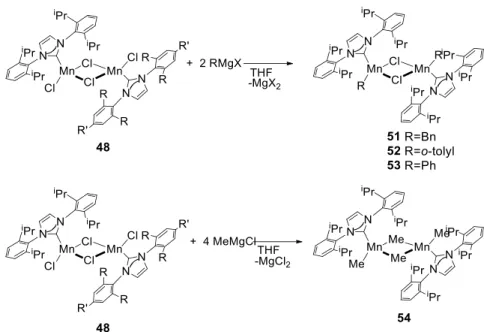
Tonzetich and co-workers reported in 2015 several Mn(II)
complexes (48-54) containing aryl substituted NHCs. The synthesis of these complexes is depicted in Scheme 1.6. Complexes 48-54 were characterized and the solid-state structures and aggregation behavior of Mn chloride complexes containing iPr and iMes ligands are similar to
37 Scheme 1.6 Synthesis Mn(II) Complexes 48-54 Containing NHC Ligands.
In 2016, the group of Smith prepared the Mn(II) complex 55 (Figure 1.18) in 71% yield, with the aim of preparing, from this, a Mn(IV) complex, which will be mentioned later (section 1.3.1.4).[59]
Figure 1.18 Mn(II) complex 55.
1.3.1.3 Manganese(III) NHC Complexes
In 2009, a Mn(III) complex bearing a tetradentate dicarbene ligand (complex 56, Scheme 1.7) was reported by Jitsukawa. It was prepared through of the reaction of the corresponding imidazolium proligand with Mn(OAc)2.4H2O. The crystal structure of 56 showed a distorted square
38
pyramidal structure, in which two carbene atoms and two aryloxy oxygen atoms of the tetradentate ligand occupied the basal plane. Complex 56 resulted to be air stable, probably due to the rigid structure of the tetradentate NHC ligand which might stabilize the complex.[60]
Scheme 1.7 Mn(III) complex 56 bearing a bis-NHC tetradentate ligand.
Same year, Bellemin-Laponnaz and co-workers reported a square pyramidal Mn(III) complex with a tridentate NHC and an acetylacetonate ligand [tBu(OCO)]Mn(acac)) (57). The direct synthesis
of the corresponding imidazolium salt with Mn(acac)3 allowed to isolate complex 57 in 55% yield.[61]
Additionally, two more examples of Mn(III) complexes bearing tri-NHC ligands: [{PhB(MeImid)3}2Mn]Cl (58) and {PhB(MeImid)3}2Mn] (CF3SO3)2 (59) were described by Smith and co-workers in 2013. Complex 58 was prepared in excellent yield by reaction of free carbene with MnBr2, followed by oxidation with NOSbF6, in dichloromethane. Treatment of 58 with KOTf led to the mononuclear Mn(III) complex 59. Compound 58 resulted to be air-sensitive, rapidly developing a purple color, indicative of Mn(IV) species, when exposed to air and displayed a paramagnetically shifted 1H NMR. In addition, complex 59 was characterized by single-crystal X-ray diffraction, revealing a Mn(III) center with a slightly distorded octahedral environment made of two capping (tris-NHC) borate ligands.[62]
39 1.3.1.4 Manganese(IV) and Mn(V) NHC Complexes
Examples of Mn(IV) and Mn(V) complexes are very rare. The first Mn(IV) NHC complex,
[
[PhB(MeImid)3]2Mn]
(OTf)2 (60) was described in 2007 by Smith and coworkers using the tris(carbene)borate PhB(MeImid)3ligand
. Complex 60 resulted from the air oxidation of 23, being later isolated as the triflate salt following metathesis with KOTf. This complex can also be prepared by reaction of 23 with MnBr2, followed by oxidation with AgOTf. The X-ray crystal structure of 60 reveals it to be a rare example of an homoleptic organometallic Mn(IV) complex, displaying a slightly distorted octahedral geometry. The magnetic moment of 60 was calculated using the Evans method, getting the value [µeff =3.1(3)µB], which is in line with the expected S = 3/2 spin state[41]. Same author reported the Mn(IV) nitride complex PhB(MesImid)3MnΞN (61), which was prepared from the reaction 55 with NaN3 under UV irradiation.[59]The tris(carbene) ligand TIMEN is also able to stabilize Mn(III,IV,V) complexes. In 2012, Meyer and co-workers prepared several Mn nitride complexes containing the tripodal chelating tris(carbene) ligand 62-66. Complex [TIMENxylMn(Cl)]Cl (62) was prepared by the addition of anhydrous Mn(II) chloride to solutions of the tris(carbene) ligand TIMENxyl in pyridine. The reaction of 62 with an excess of sodium azide in the presence of NaPF6 led to the formation of [(TIMENxyl)Mn(N3)]PF6 (63) with 93% yield. When a solution of 63 in acetonitrile was irradiated with UV light, the complex [(TIMENxyl)Mn(N)]PF6 (64) was formed. Subsequent reaction of 64 with NOBF4 and NaPF6 in acetonitrile afforded orange solutions of [(TIMENxyl)Mn(N)](PF6)2 (65) (56 %, yield) with loss of NO. Lastly, the reduced nitride species [(TIMENxyl)Mn(N)] (66) resulted of the stirring of suspensions of 66 in benzene over potassium graphite. All these complexes were fully characterized. The crystal structure of 63 revealed a four-coordinate Mn(II) center that is
40
located 0.52 Å above the trigonal plane of the three carbene carbon atoms. In complex 64, the four-coordinate Mn(IV) center is located in a trigonal pyramidal ligand environment and resides only 0.42 Å above the trigonal plane of the carbene centers. EPR spectroscopy showed that 63 features a high-spin, d5 Mn(II) species.[63]
1.3.2 Catalytic Applications of Mn NHC complexes
Catalysis with Mn NHC has been poorly studied.[44,64,65] To the best of our knowledge, only seven reports on Mn NHC complexes in catalysis can be found in the literature. In 2009, Jitsukawa and co-workers reported the first application of a Mn NHC complex in catalysis. The Mn(III) complex 56 (Scheme 1.7) bearing a bis-NHC tetradentate ligand was applied in the oxidation of styrene with PhIO.[60] Despite low yield of styrene oxide (38%) was obtained, it was probed that high oxidation Mn(IV) and Mn(V) species were generated during the oxygen transfer reactions.
Next catalytic application was reported in 2014 by Agarwal and coworkers, who described the electrocatalytic reduction of CO2 by complexes 25 and 26 presented in Figure 1.10.[43] Both complexes 25 and 26 mediated the electrocatalytic reduction of CO2 to CO following two-electron reduction of the Mn(I) center. The two-electron reduction of these species occurred at a single potential, which contrast with the behavior observed in Mn(2,2-bipyridine)(CO)3Br complexes where a two-electron reduction process occurred in two sequential steps. Interestingly, catalytic current enhancement with complexes 25 and 26 was observed at voltages similar to Mn(2,2-bipyridine)(CO)3Br.[66,67]
In the same year, Lugan and Sortais disclosed the hydrosilylation of aldehydes and ketones under UV irradiation using Mn(I) NHC complexes derived from cymantrene 9-14 (Figure 1.5).[37] The half-sandwich Mn(I) complex 13 showed excellent activity in the reduction
41 of a variety of aldehydes (Scheme 1.8 A) and ketones (Scheme 1.8 B) using 1.5 equiv. of Ph2SiH2 as reducing agent.
Scheme 1.8 Scope of aldehyde (A) and ketone (B) hydrosilylation catalyzed by Mn(I) NHC complex 13.
Related Mn complexes bearing Cp tethered NHC ligands (complexes 15 and 16, Figure 1.6) displayed lower catalytic activity (Scheme 1.9) than that observed for 13. Interestingly, it was possible to isolate the corresponding silane σ-complexes 67 and 68 (Scheme 1.10), which are proposed to be the primary products of the photochemical CO substitution for diphenylsilane in 15 and 16.[38]
Scheme 1.9 Catalytic Ketone Hydrosilylation.
42
Very recently and already during the writing of my PhD thesis, three new reports appeared in the literature describing catalytic applications with Mn NHC complexes as catalysts.[44,45,68]
Ke[68] et al. reported the selective N-alkylation of anilines with alcohols (Scheme 1.11) using the bis-NHC Mn complex [Mn(bis-NHC)Br(CO)3] (69) reported by us in 2018, which is described in Chapter 2 of this thesis. A large variety of aromatic amines and primary alcohols,
including biologically relevant motifs were efficiently converted at room temperature into mono N-alkylated amines using complex 69 as catalyst.
Scheme 1.11 A) N-alkylation of anilines with alcohols and B) N-alkylation with metanol).
Experimental and computational studies suggested an outer-sphere mechanism without the dissociation of the CO ligand for the Mn NHC system. The outer-sphere mechanism was also verified by IR spectroscopic study, in which no CO dissociated Mn intermediate was observed during the catalytic cycle. The high activity of Mn NHC in the outer-sphere mechanism can be can be the reason of the success of this system at room temperature.
A bidentate Mn complex with NHC bearing an amine donor functionality was reported in 2019 by Pidko[45] and co-workers. Complexes 28 and 29 are highly active catalysts for the transfer hydrogenation of a large variety of ketones, affording quantitative
43 reduction of ketones with low catalyst loading (0.0075 mol%) (Scheme 1.12). Interestingly, catalyst deactivation was found to be temperature dependent and became especially prominent at elevated temperatures (70ºC). It was proposed that complex 28 operates via the well-established bifunctional protonation/ deprotonation mechanism.
Scheme 1.12 Transfer hydrogenation of ketones with 28.
Reduction of ketones through hydrogenation processes has also recently been described using the bidentate NHC-phosphine Mn(I) complex 27 (Scheme 1.3) as catalyst. Complex 27 resulted to be one of the most efficient pre-catalysts for ketone hydrogenation, reaching TON values up to 6200.[44]
1.4 Fe NHC complexes: synthesis and catalytic applications Development of iron catalysis has experienced spectacular growth in the last decade. The intensive research in this area is well reflected by the number of review articles that have appeared in the literature.[14,17–19,22–25,28,70–72] In the particular field of Fe NHC chemistry, the first catalytic application was described by Grubbs and co-workers in 2000. They disclosed that Fe(II) halides possessing highly donating imidazolylidene ligands were efficient catalysts for the atom transfer radical polymerization of styrene and methyl methacrylate.[73] Surprisingly, scarce development of this area occurred after that discovery. In fact, in a review published by Nolan in 2009, only 10 publications dealing with catalytic applications of Fe NHCs were reported.[72] Nowadays the situation is rather different, and a number of
44
groups have largely contributed to the development of this area of research. Several reviews on this topic are available in the literature.[17,19,74–88]
Iron compounds display a broad range of geometric and electronic variations. The oxidation states of Fe NHC compounds range from low-valent to high low-valent, being Fe(0), Fe(I) and Fe(II) complexes the most common. Regarding the geometry, most reports describe tetrahedral or octahedral coordination at the iron center, however, some trigonal bipyramidal or square planar Fe NHC complexes have also been described. Additionally, three-coordinate Fe NHC complexes are also reported in the literature.
Part of the work of this thesis has focused on the development of catalytic applications using Fe bis-NHC complexes. In this Section, an overview of the chemistry of these type of complexes is described.
1.4.1 Iron bis-NHC complexes
1.4.1.1 Synthesis and characterization
Surprisingly, iron complexes supported by simple bidentate bis(NHC) ligands, which are not part of a multidentate framework are scarce. The first examples appeared in 2007, reported by the group of Kervanic. The dinuclear bis-NHC Fe(I) complexes [{Fe2(µ-S(CH2)3S)- (CO)5}2{µ-(IMe-IMe)}](70) and [Fe2{µ-S(CH2)3S}(CO)4{IMe- CH2-IMe}](71) were prepared by reaction of the corresponding free carbene with [Fe2{l-S(CH2)3S)}(CO)6]. This reaction led to formation of the dimer 70 along with the chelated bis-NHC complex 71, which was the major product.[89]
Related Fe complexes [(μ-SCH2)2NBu-t]Fe2(CO)5[I*Mes(CH2)3I* Mes].HBr (72) and [(μ-SCH2)2-CH2Fe2(CO)5]2[μ-I*Mes(CH2)3I*Mes](73, I*Mes= 1-(mesityl)imidazol-2-ylidene) were described by Song and co-workers in 2009. They showed that the tether length of the bis-NHC
45 ligand has a direct implication in the coordination mode, bridging or chelating, of the ligand to the iron center. Long tether lengths (3-C chain) favored the formation of dimetallic complexes bearing bridging bis-NHC complexes.[90]
The group of Albrecht reported in 2009 their studies on the coordination of bis-NHC ligands containing a flexible methylene and a rigid phenylene linker to the “CpFe(CO)I” fragment. For both ligands, the bimetallic Fe(II) complexes 74-77 (Scheme 1.13) containing bridging NHC ligands were obtained. The bridging coordination mode of the dicarbene ligand was unequivocally confirmed by X-ray diffraction studies.[91]
Scheme 1.13 Synthesis of dinuclear Fe(II) complexes 74-77.
Same year, the group of Chen developed a novel procedure for the preparation of Fe NHC complexes using imidazolium salts (Scheme
46
1.14 A) or the corresponding silver-NHC complexes (Scheme 1.14 B) as carbene sources and Fe powder. Using this simple and practical procedure, the authors described the preparation of the tetradentate Fe complexes 78 and 79 (Scheme 1.14) bearing bis-NHC functionalized with pyridine rings.[92] These complexes represented the first square-planar 14-electron complexes containing NHC ligands.
Scheme 1.14 Synthesis of complexes 78 and 79: via A) from imidazolium salts and Fe powder and B) transmetalation with Ag–NHC complex and Fe power.
In 2011, Meyer and co-workers published the Fe complexes bearing chelating bis-carbene ligands 80-93 depicted in Scheme 1.15. A series of new and known bis(imidazolium) chloride and bromide salts bridged by either a methylene group (L9-L19, L21 and L22) or an ethylene group (L20), and bearing different N substituents (Me, Et, Bn, tBu, Mes) reacted with [Fe{N(SiMe3)2}2] to yield the four-coordinate Fe(II) complexes [(L-L)FeX2] (80−93; X = Cl, Br; L-L = chelating bis(imidazolylidene) ligand). When the N-wingtips of the NHC ligand were small (Me, Et) or flexible (Bn), the corresponding dicarbene [(L-L)FeX2] species were formed together with ferrous tetracarbene species [(L-L)2FeX2], which were difficult to separate and could not be isolated in pure form. Complexes [(L-L)2FeX2] (94-96) transformed into [(L-L)2Fe(MeCN)2][FeBr4] (97-99) in acetonitrile when residual FeBr2(THF)x was present (Scheme 1.16). Complexes [(L-L)FeX2] featured high spin Fe(II) in a distorted tetrahedral environment, while complexes 97-99 presented low spin Fe(II) and distorted octahedral
47 structures with two acetonitrile ligands in a cis configuration.[93]
Scheme 1.15 Synthesis of dicarbene Fe(II) dihalide complexes 80-93.
Scheme 1.16 Synthesis of tetracarbene Fe(II) complexes 94-99.
Similar results were reported by Evans and Ingleson on chelating (bis-NHC)FeX2 complexes containing CH2 or phenyl linkers between the NHC ligands. Complexes 100-102 (Figure 1.19) were isolated in 44, 57 and 97 % yield, respectively. All complexes are high-spin in distorted tetrahedral structures, such as observed earlier in Meyer's work for complexes 80-93. The average Fe−C distances of complexes 100-102 (in the range 2.08 to 2.11 Å) consistent with other high spin four-coordinate Fe(II) carbene complexes, including complexes 80-93 (average of around 2.10 Å).[94]
48
Figure 1.19 Fe complexes 100-102 bearing chelating bis-carbene ligands.
Ohki, Tatsumi, Glorius reported, in 2012, the Fe(II) complex 103 with a diamine-bridged bis-NHC, which was prepared from the corresponding imidazolium salt (L23 or L24) and [Fe{N(SiMe3)2}2] or by reaction of the free carbene (L25) with FeCl2 as shown in Scheme 1.17. The X-ray difraction studies of 103 showed a highly distorted geometry for Fe between octahedral and tetrahedral with weak Fe-N interactions, which is in agreement with a high spin d6 configuration.[95]
Scheme 1.17 Synthesis of complex 103.
Later, the group of Herrmann and Kühn described tetradentate Fe(II) NHC complexes similar to those earlier reported by Chen (Scheme 1.14) with tetradentate NCCN ligands with different alkylene bridges. As shown in Scheme 1.18, the Fe(II) complexes 104-106 were prepared by the reaction of [Fe{N(SiMe3)2}2] with the appropriate imidazolium hexafluorophosphate salts. These complexes were quantitatively converted in the presence of CO to complexes 107 – 109 (Scheme 1.19).[96] The authors demonstrated that the alkylene bridge connecting the two NHCs has an influence on the coordination mode
49 of the NCCN ligands. Whereas the methylene- and ethylene-bridged NHC moieties lead to a nearly planar geometry of the NCCN ligand and two trans-positioned acetonitrile ligands, the propylene-bridged complex 106 exhibited a sawhorse-type coordination mode, with two cis-oriented acetonitrile ligands.
Scheme 1.18 Synthesis of complexes 104-106.
Scheme 1.19 Carbonylation of compounds 107-109.
Two years later, the Fe(II) complexes bearing new heteroatom- functionalized methylene-bridged bis-NHC ligands were reported (Scheme 1.20). The complexes 110 and 111 were obtained by
50
aminolysis of [Fe{N(SiMe3)2}2(THF)] with furan- and thiophene-functionalized bis(imidazolium) salts L29 and L30 in acetonitrile. The complex 112 was obtained by the crystallization of 110 from acetone.[97]
Scheme 1.20 Synthesis of complexes 110 and 111.
In the same year, Kühn and co-workers prepared complex 113 (Scheme 1.21) with one PMe3 ligand in the axial position that resulted from the addition of PMe3 to a solution of complex 104 (Scheme 1.18) in acetonitrile. With the goal of analysing the impact of axially coordinating additives on the electronic structure of 104 (Scheme 1.18), complex 104 was reacted with one equivalent of trimethyl phosphine (Scheme 1.22); substitution of the acetonitrile ligand by trimethyl phosphine was observed.[98]
51 Scheme 1.22 Reactions of complex 104 with phosphines.
Continuing with their work, in 2015, the same authors prepared complex 119 from complex 104 by addition of tert-butyl isocyanide (CNtBu) to a solution of 104 in acetonitrile(Scheme 1.23).[99]
Scheme 1.23 Synthesis of complex 119 with CNtBu as the axial ligand.
Still in 2015, a variety of isocyanide-substituted Fe(II) NHC complexes were reported by Kühn. As shown in Scheme 1.24, complexes 120-123 were prepared from the reaction of the Fe(II) NHC complex 104 with a tetradentate bis(pyridyl-NHC) ligand. Complexes 124-126 were prepared using the same synthetic procedure.[100]
52
Scheme 1.24 Synthesis of tri(isocyanide)-substituted complexes 120-123 and mono(isocyanide)-substituted complexes 124-126 starting from 104.
Related tetradentate Fe(II) complexes, containing NHC-amide hybrid ligands were described by Meyer in 2013. Complex 127 was prepared from the reaction of the amido-imidazolium hexafluorophosphate (L31) with KHMDS and [Fe{N(SiMe3)2}2] (Scheme 1.25). Complex 127 exhibited a six-coordinated geometry, where one amide arm of each tridentate ligand remains protonated and dangling. Complex 127 undergoes a metal-center oxidation to Fe(II) species, while the NHC/amide hybrid ligands remain innocent, as confirmed by EPR and Mössbauer spectroscopy.[101]
53 Unprecedented Fe(0) NHC stabilized 6-arene complexes were reported in 2013 by the group of Driess. Complexes 129-131 (Figure 1.20) were prepared by a simple route involving the reduction of 128 in the presence of benzene or toluene. The arene complexes demonstrated to be good precursors for the preparation of Fe(0) NHC complexes. For example, the addition of CO to 131 led to complex 132 by arene elimination.[102]
Figure 1.20 Fe(0) arene complexes 128-132.
Papish and co-workers, in 2013 reported the Fe(II) half-sandwich with the bulky t-butyl substituted bis-NHC ligand [CpFe(CO) (CH2(ImidtBu)2)]I (where ImidtBu =3-tert-butyl-1H-imidazol- 1-yl-2(3H)-ylidene) (133). Complex 133 was prepared from the in situ free NHC generation and coordination to Fe using CpFe(CO)2I in 73% yield. The crystal structure of this complex was studied by X-ray diffraction, revealing a piano-stool geometry with binding of the Cp ring in three coordination sites, the chelating bis NHC ligand in two sites, and the CO ligand.[103]
The bis-NHC Fe(II) halide complexes 134-137 depicted in Scheme 1.26 with flexible amine-spacers were published by group of Hazari in
54
2013. The reaction of the corresponding imidazolium chlorides (L32) with [Fe{N(SiMe3)2}2] afforded complexes 134-137 in high yields (86-93%). Their molecular strucures showed a distorted tetrahedral geometry with high spin Fe(II) centers.[104]
Scheme 1.26 Synthesis of complexes 134-137 bearing bis-NHC ligands.
The semirigidity of the biphenyl linked bis-NHC ligand reported by Shi and Deng in 2014, allowed the successful preparation of the Fe(II) diaryl and diallyl complexes: biphenyl- linked ylidene)Fe(II) dichloride (138) and biphenyl- linked bis(benzimidazol-2-ylidene)Fe(II) dihydrocarbyls, denoted as bis(NHC)FeR2 (R = CH2TMS (139), CH2Ph (140), Ph (141), C6H3-3,5-(CF3)2 (142) in good yields (73-98%yield). All complexes were fully characterized and showed a distorted tetrahedral geometries of the Fe(II) centers with high spin.[105]
Chen and co-workers, also in 2015, reported the (bis-NHC)borane Fe(II) complex 143 (Scheme 1.27). Complex 143 was obtained by the reaction of the corresponding (bis-NHC)borane (L33) with LDA and (FeCl2)1.5THF.[106]
55 Scheme 1.27 Synthesis of complex 143.
More recently, Kühn reported a novel hydroxyl-functionalized tetradentate NHC/pyridine hybrid ligand and the Fe(II) complexes 144 and 145 (Figure 1.21). The transmetalation of the corresponding silver bis-NHC complex bearing a pendant hydroxyl group with FeBr2(THF)2 afforded a mixture of the expected mononuclear Fe(II) complex 144 and a dinuclear Fe(II) complex 145. Both complexes were analyzed by ESI-MS, which proved a monomeric structure of 144 and a dinuclear structure of 145. The X-ray diffraction of single crystals of 144 and 145 showed a distorted octahedral coordination geometry.[107]
Figure 1.21 Fe bis(NHC) complexes 144 and 145 bearing a pendant hydroxyl group.
56
1.4.1.2 Catalytic applications of Fe bis-NHC complexes
Despite the large number of Fe bis-NHC complexes that have been reported in the literature, few catalytic applications with this type of complexes have been described. In 2014, Herrmann and Kühn described the catalytic activity of Fe(II) complexes bearing tetradentate NHC–pyridine ligands in the epoxidation of olefins[108] and in the hydroxylation of toluene and benzene with hydrogen peroxide (H2O2).[109] Complex 104 (Scheme 1.18) was found to efficiently
catalyze the epoxidation of terminal and cyclic olefins to their corresponding epoxides using H2O2 as oxidant, and without the need of acids or other additives. Alkyl-substituted olefins were epoxidized in high yields, but best yields were obtained for cyclic olefins such as cis-cyclooctene, whereas the aromatic olefins styrene and methyl styrene were less prone to epoxidation.[108]
Scheme 1.28 Catalytic epoxidation of olefins using H2O2 and complex 104.
The catalytic activity of complex 104 towards the hydroxylation of benzene and toluene with H2O2 was also investigated (Scheme 1.29). Benzene was hydroxylated with a high selectivity to phenol, whereas the toluene was hydroxylated to cresols with a high selectivity for the ortho- and para-position. The inverse KIE and the high regio- and chemoselectivity suggest that the mechanism of aromatic hydroxylation consisted in an electrophilic attack by an intermediate high valent Fe=O species.[109]
57 Scheme 1.29 Oxidation of benzene to phenol catalysed by complex 104.
Apart from these studies, the catalytic activity of 104 and related Fe complexes 113 and 119 has been investigated for the oxidation of unreactive C-H bonds.
Scheme 1.30 Catalytic oxidation of cyclohexane using complexes 104, 113 and 119 as catalysts.
Complexes 104, 113 and 119 were able to oxidizing cyclohexane with a high selectivity toward cyclohexanol and cyclohexyl hydroperoxide, with the latter being easily reduced to the alcohol by addition of triphenylphosphine. Based on the data obtained for cyclohexane, 119 was chosen as catalyst for studying the scope of the reaction, showing the broad applicability of 119 as C-H oxidation catalyst (Figure 1.22).[99]
58
Figure 1.22 Catalytic C-H bond oxidation using 119 as catalyst.
The catalytic activity of 104 for aldehyde olefination has also been investigated. Complex 104 was applied as catalyst for olefination of benzaldehyde with ethyl diazoacetate (EDA) in the presence of triphenylphosphine. The Fe complex 104 displayed a remarkable catalytic activity affording yields up to 90% with very good selectivity (> 94%)of E-olefin[110]. The same group reported the oxidation of the non-activated arene substrates p-xylene and pseudo-cumene using H2O2 as the oxidant and 104 as catalyst (Scheme 1.31). Interestingly, p-xylene and pseudo-cumene were efficiently converted to the corresponding phenols and benzoquinones with high selectivity.[111]
Scheme 1.31 Reaction products of the catalytic oxidation of p-xylene with 104/H2O2.
Apart from the oxidation reactions described with tetradentate bis-NHC Fe(II) complexes, other catalytic applications reported to date
59 with Fe bis-NHC complexes deal with reduction reactions of carbonyl groups, in particular through hydrosilylation processes. The group of Glorius described in 2012 the use of the bis-NHC Fe(II) complex 103 (Scheme 1.17) for the hydrosilylation of acetophenone (Scheme 1.32). Complex 103 displayed moderate activity (56–38%) in the reduction of acetophenone with diphenylsilane (Ph2SiH2). When methyllithium was added to generate an iron-methyl species, the catalytic activity increased (95–78%). However, no conversion was observed using triethylsilane as reducing agent in the presence of 103 with or without methyllithium.[80]
Scheme 1.32 Reduction of acetophenone via hydrosilylation with 103.
In 2014, Driess disclosed the excellent catalytic activity of the Fe(0) Fe(η6-arene)(bis-NHC) complex 131 (Figure 1.20) in the reduction of amides to amines with silanes (Scheme 1.33). A number of organic amides bearing different steric and electronic properties were converted into the corresponding amines in good to excellent yields (83–99%) (Scheme 1.33). Interestingly, the results obtained using 131 as catalyst were superior in some cases than some modern benchmark systems for other Fe-based amide reduction systems.[102]
60
Scheme 1.33 Reduction of amides catalyzed by 131.
Finally, the group of Hazari reported in 2013 the activity of a family of well-defined Fe(II) complexes of the general type Fe(bis-NHC)X2 in homo-coupling of Grignard reagents (Scheme 1.26). All complexes exhibited high activity as pre-catalysts for the homo-coupling of Grignard reagents (Scheme 1.34). The substrate scope studies for aryl-aryl homo-coupling showed good results except when the electron withdrawing CF3 group is in para position and using a sp hybridized alkynyl substrates in which no reaction was observed.[112]
Scheme 1.34 Aryl-aryl homo-coupling reaction catalyzed by 137.
1.5 Objectives of this work
The main goal of this thesis is the development of new organometallic complexes of Mn and Fe bearing NHC ligands and their application in catalysis. Specifically, we target the synthesis of Mn and Fe complexes bearing bis-NHC ligands and their application in three catalytic processes:
61 (ii) reduction of carbonyl groups with silanes
(iii) oxidation of alcohols
1.6 References
[1] R. H. Crabtree, The Organometallic Chemistry of the Transition Metals:Fourth Edition, 2014, John Wiley & Sons, Inc.
[2] M. N. Hopkinson, C. Richter, M. Schedler, F. Glorius, Nature 2014, 510, 485–496.
[3] H. ‐W Wanzlick, H. ‐J Schönherr, Angew. Chemie Int. Ed. English 1968, 7, 141–142.
[4] A. J. Arduengo, R. L. Harlow, M. Kline, J. Am. Chem. Soc. 1991, 113, 361–363.
[5] M. N. Hopkinson, C. Richter, M. Schedler, F. Glorius, Nature 2014, 510, 485–496.
[6] K. L. Fillman, J. A. Przyojski, M. H. Al-Afyouni, Z. J. Tonzetich, M. L. Neidig, Chem. Sci. 2015, 6, 1178–1188.
[7] N. Marion, S. Díez-González, S. P. Nolan, Angew. Chemie - Int. Ed. 2007, 46, 2988–3000.
[8] J. A. Przyojski, H. D. Arman, Z. J. Tonzetich, Organometallics 2013, 32, 723–732.
[9] J. A. Przyojski, K. P. Veggeberg, H. D. Arman, Z. J. Tonzetich, ACS Catal. 2015, 5, 5938–5946.
[10] Arduengo, A. J.; Bertrand, G. Chem. Rev. 2009, 109, 3209 3210. [11] C. Samojłowicz, M. Bieniek, K. Grela, Chem. Rev. 2009, 109, 3708–3742.
[12] S. P. Nolan, N-Heterocyclic Carbenes Eff. Tools Organomet. Synth. 2014, 9783527334, 1–543.
[13] P. Mathew, A. Neels, M. Albrecht. J. Am. Chem. Soc. 2008, 130, 13534-13535.
62
5619–5621.
[15] P. J. Chirik, T. B. Gunnoe, ACS Catal. 2015, 5, 5584–5585. [16] V. Charra, P. de Frémont, P. Braunstein, Coord. Chem. Rev. 2017, 341, 53–176.
[17] M. J. Ingleson, R. A. Layfield, Chem. Commun. 2012, 48, 3579– 3589.
[18] R. Lopes, B. Royo, Isr. J. Chem. 2017, 57, 1151–1159.
[19] D. Bézier, J. B. Sortais, C. Darcel, Adv. Synth. Catal. 2013, 355, 19–33.
[20] K. Riener, S. Haslinger, A. Raba, M. P. Högerl, M. Cokoja, W. A. Herrmann, F. E. Kühn, Chem. Rev. 2014, 114, 5215–5272.
[21] S. Z. Tasker, E. A. Standley, T. F. Jamison, Nature 2014, 509, 299–309.
[22] I. Bauer, H.-J. Knoelker, Chem. Rev. 2015, 115, 3170–3387. [23] A. Fürstner, ACS Cent. Sci. 2016, 2, 778–789.
[24] C. Johnson, M. Albrecht, Coord. Chem. Rev. 2017, 352, 1–14. [25] R. Shang, L. Ilies, E. Nakamura, Chem. Rev. 2017, 117, 9086– 9139.
[26] R. A. Layfield, Chem. Soc. Rev. 2008, 37, 1098–1107.
[27] R. I. Khusnutdinov, A. R. Bayguzina, U. M. Dzhemilev, Russ. J. Org. Chem. 2012, 48, 309–348.
[28] K. Riener, S. Haslinger, A. Raba, M. P. Högerl, M. Cokoja, W. A. Herrmann, F. E. Kühn, Chem. Rev. 2014, 114, 5215–5272.
[29] R. J. Trovitch, Synlett 2014, 25, 1638–1642.
[30] W. Liu, L. Ackermann, ACS Catal. 2016, 6, 3743–3752.
[31] J. R. Carney, B. R. Dillon, S. P. Thomas, European J. Org. Chem. 2016, 3912–3929.
[32] B. Maji, M. K. Barman, Synth. 2017, 49, 3377–3393. [33] R. J. Trovitch, Acc. Chem. Res. 2017, 50, 2842–2852.
![Figure 1.7 Carbene coordinated [11]ane-P 2 C NHC macrocycle-substituted transition metal complexes 17-20](https://thumb-eu.123doks.com/thumbv2/123dok_br/15256143.1024870/28.765.182.606.219.551/figure-carbene-coordinated-macrocycle-substituted-transition-metal-complexes.webp)