Athens Institute for Education and Research
ATINER
ATINER's Conference Paper Series
LIB2015-1812
Paula Ochoa
Professor
CHAM - Portuguese Centre for Global History
New University of Lisbon / University of Azores
Portugal
Leonor Gaspar Pinto
Researcher
CHAM - Portuguese Centre for Global History
New University of Lisbon / University of Azores
Portugal
Models and Strategies for Information
Management: Convergence of Impacts
An Introduction to
ATINER's Conference Paper Series
ATINER started to publish this conference papers series in 2012. It includes only the papers submitted for publication after they were presented at one of the conferences organized by our Institute every year. This paper has been peer reviewed by at least two academic members of ATINER.
Dr. Gregory T. Papanikos President
Athens Institute for Education and Research
This paper should be cited as follows:
Ochoa, P. and Gaspar Pinto, L. (2016). "Models and Strategies for Information Management: Convergence of Impacts", Athens: ATINER'S
Conference Paper Series, No: LIB2015-1812.
Athens Institute for Education and Research
8 Valaoritou Street, Kolonaki, 10671 Athens, Greece
Tel: + 30 210 3634210 Fax: + 30 210 3634209 Email: [email protected] URL: www.atiner.gr
URL Conference Papers Series: www.atiner.gr/papers.htm
Printed in Athens, Greece by the Athens Institute for Education and Research. All rights reserved. Reproduction is allowed for non-commercial purposes if the source is fully acknowledged.
ISSN: 2241-2891 02/02/2016
Models and Strategies for Information Management:
Convergence of Impacts
Paula Ochoa Leonor Gaspar Pinto
Abstract
The current discussion around models and strategies for information management in the era of digital transition point to two dynamics, which follow the lifestyles, consumer habits and information behaviour of citizens: diversity of services and content, on one side; and convergence not only in media, but also in management modes, on the other. The purpose of this paper is to discuss the use of convergent information management models, strategies and impacts in Library, Archives and other Information Services (LAIS), in academic and practical/professional environments in Portugal.
Three management areas - e-skills, e-consumption and sustainability – are discussed, providing details and a basis for the convergence analysis. Using two dimensions - the operationalization of strategy and the approach to group development of LAIS skills -the usage of convergent information management models and strategies in LAIS is then examined through three cases / examples.
The first model / strategy identified provides an example of assessment and it is widely explained:
(1) Co-creation workshops on Building a sustainability assessment
framework: this interdisciplinary experience with students of Information
and Documentation master courses in the Faculty of Social Sciences and Humanities of Universidade NOVA de Lisboa (FCSH/UNL) (December 2013-February 2014) and students of the Archives Post-graduation course at Universidade Lusófona de Humanidades e Tecnologias (July 2014), led to the (co)definition of a conceptual framework for assessing the sustainability and impacts of LAIS as cultural organizations.
Two other examples of information management models and strategies complemented this approach to convergence:
(2) CIG’s Information and Documentation Centre (IDC) integrated the information management model (October 2013): the development of a new management model for the Commission for Citizenship and Gender Equality (CIG)’s LAIS was anchored on the implementation of a modern Library Management System, which boosted the creation/improvement and integration under the conceptual umbrella of a holistic new brand – IDC - of other information areas, like publishing inventory management,
archives and records management, digitalization of CIG’s historical archive and digitalization of special collections.
(3) Information Management and Curation Post-graduation and Master courses: creation of a graduate (and Master) degree in Information Management and Curation (FCSH/UNL), proposing a model for studies in which information management assumes a prominent transverse position and developing an integrated model of skills enabling simultaneously managing diversity and the hybrid culture of services convergence needs of the information market (June 2014).
When taking an overarching approach to the study of these models and strategies, attention should be paid to new operating models impacts and needed management skills, focusing on thinking strategies in the cultural and creative industries and considering culture as the fourth pillar of sustainable development. This focus opens new horizons for action by allowing the creation of new performance indicators, unifying the area of culture, aggregating data from libraries, archives, museums and other information services and, thereby, allowing an integrated strategic vision of the results and impacts. In the near future, management of integrated impacts seems to be the next step of the differentiation of quality.
Keywords: archives and other information services, convergence models,
Introduction
There is a general sense of urgency to study major management transitions in Library, Archive and other Information Services (LAIS). Technological and innovation studies have received increasing attention over the past 10 years, identifying emerging fields and new conceptual developments. In particular, a
new field dealing with sustainability transitions and impacts management has made a considerable contribution to the understanding of multidimensional models and dynamics within which digital transition evolves, addressing the role of academic theories and advice regarding governance of information management transition processes. In a field in flux, it is also important to study institutions in arenas of development, as well as the ways they interpret transitions in action, providing a background of information about how different actors can navigate and perform strategic intervention that support sustainable services.
According to this view, organizational maturity and sustainability of results pose new issues related to quality: integrated, balanced, multidimensional, comprehensive and holistic models are frameworks used as tools to reach an excellence stage. Based on recent literature, it seems that it is in the interface between measurement, quality management and impacts that is crucial to ensure the value of performance measures, reconnecting long term and short term perspectives. New measures linked to institutional objectives are needed and must be communicated: long term holistic and coherent measures that assess societal benefit, educational impact and intangible assets, like relational capital, organizational capital and human and intellectual capital, multiliteracy skills, transferable skills, meta contentor user-defined value metrics of electronic resources.
In contrast with previous decades, Excellence is now a new and emerging phenomenon, not only with organizational impacts, but also with strong emphases on several transition moments on the life course of people. This is an interdisciplinary trend that studies the confluence of different variables refocusing on boundaries. One of those boundaries is concerned with convergence culture (Jenkins, 2006) and information environments thinking hybridization as a process of integration and fragmentation, particularly during periods of unusual transition (Ochôa and Pinto, 2015). These periods or cycles require a different understanding of impacts that must consider customer experience of quality and consumer behaviors in informational contexts.
Customer value in experience (customer’s perception of value over the entire course of the customer experience) is a concept that must receive more attention when studying informational resource dynamics. The notion of the customer journey is important to evaluate the quality of resources as user perception may vary as the journey is made, preceding the service and contining after it in a set of interactions and experiences at different levels (rational, emotional, sensorial, physical and ethical). Can convergence of information resources encompass the total experience? The literature about service quality makes the point that this response may be multifaceted:
comparing performance on product/service quality dimensions against expectations is one of the answers, the other one being, quality as a value perception, both arising due to multiple contextual factors.
The customer experience qualitycategories (Lemke et al., 2011) identifies 17 experiences related to information, business and entertainment needs, grouped in six areas: communication encounter; service encounter (product quality, service quality, network quality); usage encounter (relationship with other customers; social impact); experience context (hedonism, involvement, product complexity, relationality), value-in-use (utilitarian, hedonic, relational, cost/sacrifice); and relationship outcomes (commitment, purchase, retention, word of mouth). LAIS’ users want to access e-resources (bibliographical resources, full-text e-resources and portals/aggregator products) from home, the office or anywhere they need information and expect quality in their experiences.
A fundamental contribution of the quality movement to the study of impacts was to recognize the dynamics of satisfaction linked to the quality of information products, services, user experiences and its effects in life and in a global community of stakeholders. Whenever an information service collection is presented as a product or a service, it employs, either explicitly or implicitly, a service model and a value creation model. The significance of Excellence demonstrates how value is created and delivered to customers. As a consequence, many information services have responded to market competition primarily by emphasizing the value of products (resources), the value of processes (digitalization, portals, digital libraries or digital archives, licensing, and legal issues) and the value of the impact on society. These movements can be classified as convergent. However, the aspects of diversity (consumer’s usages, perceptions and needs; personalization of information behavior) are less discussed and the relationship between these dynamics must be managed (Ochôa and Pinto, 2015).
Various aspects of the information resources life cycle and management (policies, discovery, trial, selection, acquisition, ownership and licensing, access, usage, data curation and preservation, guidelines and best practices) are linked to information environment variables: information life cycle (creation, distribution, seeking, utilization); competences life cycle (assess, plan, acquire, validate); knowledge management life cycle (creation, securing, distribution, retrieval) and performance management life cycle (ad hoc, basic, emerging, managed, excellence).
Performance management related to e-resources expenditures expressed in cost and usage entities is another important aspect in the global market place, assuring long-term access to e-resources and practices of iterative development between users, producers and stakeholders. Access and usage are essential for resources investment, being relevant to the development of skills for e-consumption processes and e-value propositions, facilitation and co-creation services. The result of these dynamics will be Excellence explicitly portraying impacts.
The focus then turned to understanding the emergent dynamics: skills, e-consumption and sustainability in a convergence value transfer.
E-Flows and Convergence E-Skills
In order to take advantage of these policies and engage in fortuitous explorations, individuals must develop e-skills to deal with EQF – the European Qualifications Framework (2008), another instrument of convergent actions in education and training fields or the European e-Competence Framework (e-CF) The EQF is a common European reference framework which links countries’ qualification systems together, acting as a translation device to make qualifications more readable and understandable across different countries in Europe. It has two principal aims: to promote a citizen’s mobility between countries and to facilitate their lifelong learning. It uses learning outcomes as a common reference point in eight levels of proficiency.
In the context of education and employability, it is interesting to see the importance that the notion of an ICT proficient workforce has gained in the EU agenda. The 8 competencies are: Communication in the mother tongue; Communication in foreign languages; Mathematical competence and basic competences in science and technology; Digital competence; Learning to learn; Social and civic competences; Sense of initiative and entrepreneurship; and Cultural awareness and expression (European Commission, 2007). To move from the technical use of ICT to the development of e-literacies/e-skills is a manifest challenge that has to be faced. This trend reflects a shift in focus from the tool to the content, from computer user to e-competent user. This means that the technology is not as relevant as the knowledge and the information that can be accessed, understood, created and communicated. Relatedly, the Key Competences for Lifelong Learning and European Framework (2007) identifies digital competence as one of the key competences described in the programme Education and Training 2010.
The concept of digital skills was introduced by Van Dijk (1999) as a succession of three types of skills: operational skills (the capacities to work with hardware and software); information skills (skills to information management cycles that can be formal or substantial) and strategic skills (capacities to use computer and network sources as means for particular goals and for the general goal of improving one’s position in society). In Europe, the only data studied is about operational skills, crossing three social demographics data: age (considered the most important), educational level and gender. Recently, Van Dijk (2012) refined the concept into six types of digital skills, considering medium related skills (operational skills and formal skills) and
related skills (information skills, communication skills,
content-creation skills and strategic skills).
Concepts as e-awareness, technological literacy, informational literacy, digital literacy and media literacy are components of e-skills, linked to
life-long learning, digital citizenship, formal and informal environments, assess, connect and critically use the information in different formats depending on the context, create, adapt and share information and knowledge in multiple formats. Therefore, e-skill is a meta-competence evolving with the new technologies and the labor market.
The identification of emerging skills is enhancing and amplifying the combination of human capital and digital technologies as a solution to the needs on value creation through innovation and e-talent applied to each link in the e-resources value chain. In the case of digitization, there was a general trend towards developing projects to investigate best practices and how to share solutions with other stakeholders in a joint effort to formulate agreements upon standards and recommendations for technical formats and work practices. This opportunity of sharing information creates convergence flows in skills domains.
E-Consumption
Contemporary changes in the realm of consumption highlight some of the ongoing transitions occurring in the consumption of personal digital devices and in the use of digital cultural content. Special attention is being given to three tendencies in self-consumption and how knowledge and practices are involved in these uses: 1) active manipulation of commodities by consumers, culturally and materially integrated in several contexts of consumption; 2) engagement in device modification, acquiring competences and knowledge to manipulate data using web tools (Beer and Burrows, 2010); 3) increasing significance in consumer culture of forms of symbolic manipulation and criticism by consumers, mobilizing ideas, values and identities around this practice.
Another research line with important contributes to this discussion is on marketing evolution and convergence, analysing production, consumption and prosumption forms in the age of the digital prosumer1 (Ritzer and Jurgenson, 2010). New prosumers are proactive and are different from early adopters by attitudes through information and social media, representing one of the pillars of innovation and one of the agents of consumption culture 2 (Langer, 2007).
Conceptual tools that aim to comprehend digital consumer practices are yet to emerge, studying new consumer subjectivities, cultures and new markets, audience development and evaluation and impact assessment (Tanner and Deegan, 2012). Two theoretical perspectives are identified: consumption
1Prosumer is a concept introduced by Alvin Toffler (1980) in his book The third wave,
combining co-production of products, meanings and identities. Given the recent explosion of user-generated content online, prosumption involves both production and consumption, rather than focusing on either one (production) or the other (consumption).
2 The history of the digitalization of consumer culture (online shopping wave, participatory
consumption wave and virtual consumption wave) shows how information society interacts with consumer society (sites, processes, subjects and objects of consumption) in what Lehdonvirta (2012) calls digitalization of consumption, where the subjects of consumption are
as social signification (structural approach focused on the use of tools for communicating and constructing social bonds and distinctions) and consumption as a hedonistic project (hedonistic approach explaining where preferences come from). Technologies (Web2.0; social media, open source software) and design techniques (blogs, RSS feeds, tags, social networking, web networking and mobile communication technologies) have permitted individual consumers to self-organise and to have a more active role, participating in the experience, appropriating the goods to new uses and combining and altering the goods to create entirely new experiences (Lehdonvirta, 2012).
The value is based on information contents, structuring social relationships and creating virtual communities. Information goods are linked to virtual goods, a new marketing concept, suggesting that consumers use virtual goods seek fulfillment to needs, to communicate and construct social distinctions, and identity positions.
Experience and the concept of quality in total service experience remain nuclear on studying consumption experiences, perceived value and satisfaction outcomes, evaluation and service performance. We all remember the importance of the “moments of truth”. Nowadays, the notion of appropriation has been introduced to clarify the mark of psychological action within the context of experience, which transforms and personalizes it. Therefore, immersion and transformation are privileged outcomes of consuming experience and important managers of discovery, access and delivery in information services.
With the technologically enabled broad movement of individuals into productive activities, it is worthwhile to study the strategies, methods and technologies of co-creation in an integrated manner. Digital information and the collective processes of sharing data, information and knowledge vastly contribute to the growth of activities.
The relevance of information services performance measurement, on one hand, and the growing interest in sustainability of information resources and services, on the other hand, show the amount of interest aroused by the design of evaluation frameworks that attempt to demonstrate convergence evidences. Thus, this paper’s main focus is to discuss the use of convergent information management models and strategies in LAIS, in academic and practical/professional environments in Portugal, using two dimensions in the three cases presented: the operationalization of strategy; and the approach to
the group development of LAIS skills.
Models, Strategies and Sustainability
Cocreation Workshops on Building a Sustainable Assessment Framework
For researchers in the field of Information Science, the year 2015 has highlighted the importance of studying the dynamics and impacts of strategic alignment in terms of proposals for the governance of the pillars of sustainable
development, opening new perspectives of analysis in the areas of convergence. Of these, three dynamics, the ones worth mentioning are:
The alignment of strategies anchored on the concept of Information Multiliteracy (UNESCO, 2012) with the positioning of various stakeholders in the information-documentation Agenda post 2015 (IFLA, 2014), strengthening the role of information management and information services.
The strategic alignment with the cultural sector and the role of its evidences in assessing the impacts of cultural organizations.
The debate about strategies on the importance of measurement and impact assessment, with particular relevance in the area of libraries. This transition phase has been dubbed an existential debate "about what libraries are and what they might and shouldn’t be during times of fundamental change in forms of information and communication"(Town and Stein, 2014, p. 335).
After years of debate (UNESCO, 2014a; 2014b; Schindler, 2012; United Nations, 2007; Boulanger, 2008), Cultural Sustainability Indicators (CSI) are becoming increasingly relevant as they provide several opportunities for policy and decision making processes. As highlighted by IFLA in the Lyon Declaration (2014), information is useful in complementing sustainability approaches by including all driving forces associated with the Post 2015 Agenda. CSI can provide complementary information for the formulation of the information services policy frameworks, namely impacts assessment. Finally, CSI can be used to monitor and design strategies on sustainable information at the national, regional and local levels.
Experiences of integration of sustainability management into Library and Information Science courses require different approaches, as Turner (2014) and Nolin (2010) pointed out when talking about some uncertainty about the nature of sustainability. After questioning if it is a management trend, a guiding framework, a philosophy or a set of principles, Turner (2014) concludes that “however abstract the nature of sustainability, one task of managing information organizations includes keeping pace with new ways of articulating challenges and opportunities. Integrating the concept into a management course in a way that highlights parallels between managing sustainability and managing information organizations can encourage critical thinking”.
Nolin (2010) considers that integrating sustainability is essential to Information Science, since this connects education programs to global challenges and to the recognition that sustainable development can be translated into an imperative of social and ethical issues1.
Aiming to participate in this debate and present contributions to the research of these issues in Portugal, an interdisciplinary workshop on impact
1
Nolin (2010) argues the fruitfulness of seeing sustainable development as part of information ethics and that our field would be more successful in educating professionals for sustainable
assessment skills development in the Master of Information and Documentation
–Faculty of Social Sciences and Humanities of Universidade NOVA de Lisboa (FSCH/UNL) was developed (January-June 2014). The activities were developed in 3 phases: 1) Review of national and international policies and literature on the subject; 2) Mapping of sustainability areas by identifying the key concepts and assessment dimensions of impacts applicable to the Information Science context; 3) Building a framework for evaluation, based on the proposal (then, still in testing phase) of UNESCO for Culture for Development Indicators – CDIS (UNESCO, 2011), the approach presented by Anheier (2007) and a holistic view of value proposition applied to the field of Information Science.
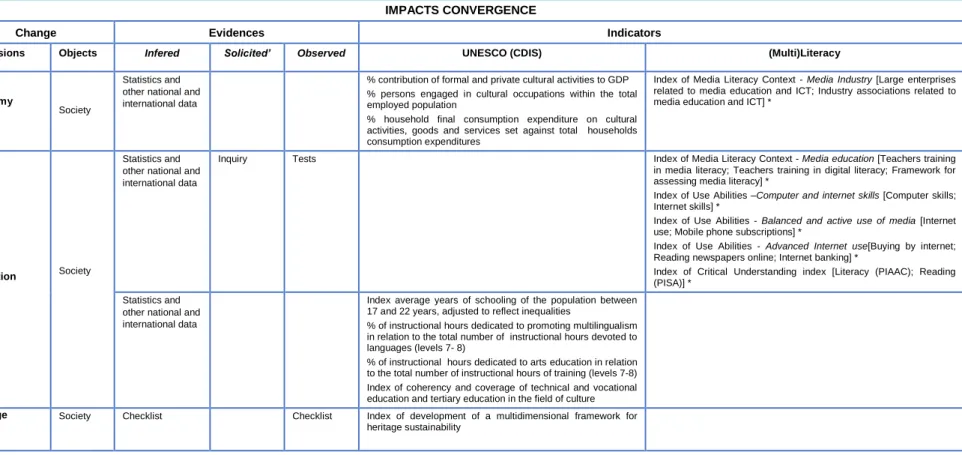
This reflection and its results were later developed with another group of LAIS students (archival studies) at Universidade Lusófona de Humanidades e Tecnologias and presented internationally (Ochôa and Pinto, 2014), integrating a line of research that values the evaluation of cultural sector dynamics (Carnwath and Brown, 2014) as another form of convergence in a sustainability assessment framework (Table 1). The usefulness of the presented model for information management can be highlighted, as it can contribute to rooting out and managing the set of impact evidences of cultural indicators and literacy indicators (UNESCO, 2014a; 2014b; Torres Calvo, 2014; Perez Tornero, 2014). This focus opens new horizons for action by allowing the creation of new performance indicators unifying the area of culture, aggregating data from libraries, archives, museums and other information services and, thereby, allowing an integrated strategic vision of the results and impacts.
CIG’s Information and Documentation Centre Integrated Model
Another form of impacts strategy operationalization can be seen in the case of CIG - the Commission for Citizenship and Gender Equality -, which is an official department of the Presidency of the Council of Ministers and constitutes the Government’s mechanism for the promotion of citizenship and gender equality in Portugal.
Since its early days, one of CIG’s leading strategies has relied upon making information available to the public, not only by publishing and distributing books, journals, leaflets, posters and other materials, but also by creating, managing and cherishing a specialized library on gender equality and citizenship issues. In October 2013, the pressure of e-skills and e-consumption dynamics, combined with a disintegrated model of service delivery in the information, publishing and communication areas and an obsolescence library management system, instigated CIG’s Information and Documentation Centre (IDC) to outline a new management model.
The implementation of a modern Library Management System boosted the creation/improvement and integration under the conceptual umbrella of a holistic new brand – IDC - of other information areas, like publishing inventory management, archives and records management, digitalization of
CIG’s historical archive, digitalization of special collections and user interface(s).
In this case, it is also distinctive the use of the strategic groups concept for strategic information management targeting, in the expectation that changes in such areas will have social impact and, thereby, will contribute to finish access inequality between the citizen and Information services.
Table 1. Sustainability Assessment Framework
IMPACTS CONVERGENCE
Change Evidences Indicators
Dimensions Objects Infered Solicited’ Observed UNESCO (CDIS) (Multi)Literacy
S U S TA IN A B ILI TY Economy Society Statistics and other national and international data
% contribution of formal and private cultural activities to GDP % persons engaged in cultural occupations within the total employed population
% household final consumption expenditure on cultural activities, goods and services set against total households consumption expenditures
Index of Media Literacy Context - Media Industry [Large enterprises related to media education and ICT; Industry associations related to media education and ICT] *
Education Society
Statistics and other national and international data
Inquiry Tests Index of Media Literacy Context - Media education [Teachers training in media literacy; Teachers training in digital literacy; Framework for assessing media literacy] *
Index of Use Abilities –Computer and internet skills [Computer skills; Internet skills] *
Index of Use Abilities - Balanced and active use of media [Internet use; Mobile phone subscriptions] *
Index of Use Abilities - Advanced Internet use[Buying by internet; Reading newspapers online; Internet banking] *
Index of Critical Understanding index [Literacy (PIAAC); Reading (PISA)] *
Statistics and other national and international data
Index average years of schooling of the population between 17 and 22 years, adjusted to reflect inequalities
% of instructional hours dedicated to promoting multilingualism in relation to the total number of instructional hours devoted to languages (levels 7- 8)
% of instructional hours dedicated to arts education in relation to the total number of instructional hours of training (levels 7-8) Index of coherency and coverage of technical and vocational education and tertiary education in the field of culture
Heritage Society Checklist Checklist Index of development of a multidimensional framework for
heritage sustainability
…/… Adap. from: UNESCO, 2014a, 2014b; Perez-Tornero, 2014*; Technical Advisory Group, 2014**
IMPACTS CONVERGENCE
Change Evidences Indicators
Dimensions Objects Infered Solicited’ Observed UNESCO (CDIS) (Multi)Literacy
Comunication Society
National statistics Inquiry % individuals using the Internet Index of Media Availability [Mobile phones per inhabitants; Broadband penetration rate; Colour TV] *
Index of Communicative Abilities - Social relations [Posted messages to chat rooms] *
Index of Communicative Abilities - Content Creation [Uploading self-created content; Posting messages to chat sites; creating a web page] * Questionnaire
(Freedom of
the press survey)
Index of print, broadcast and internet-based media freedom
National statistics Ratio of annual broadcasting time of domestic television fiction programs out of total annual broadcasting time of television fiction programs onfree-to-air TV channels
S U S TA IN A B ILI TY Governance Society
Checklist Checklist Index of development of the standard-setting framework for the protection and promotion of culture, cultural rights and cultural diversity
Index the development of the policy and institutional framework for the protection and promotion of culture, cultural rights and cultural diversity
Index of the promotion of the participation of cultural professionals and minorities in the formulation and implementation of cultural policies, measures and programs that concern them
Index of Media Literacy Context - Media literacy policy [Laws; Legislative updates; ICT plan; Media plan; Public media agencies] *
Statistics and national directory
Distribution of selected cultural infrastructure relative to the distribution of the country’s population in administrative divisions immediately below state level
Social Participation
Society Statistics and other national and international data
Inquiry % the population who have participated at least once in a going-out cultural activity, in the last 12 months
% the population who have participated at least once in an identity-building cultural activity in the last 12 months
Degree of tolerance within a society towards people from different cultural backgrounds
Degree of interpersonal trust
Median score of perceived freedom of self-determination
Index of Media Literacy Context - Civil society [Media education associations; Film festivals; Media education initiatives; Media literacy prizes] *
Index of Communicative Abilities - Participation [Interaction with public authorities
Gender Equality
Society Statistics and other national and international data
Index of gaps between women and men in political, education and labour domains and in gender-equity legislative frameworks (objective outputs)
Information Management and Curation Course
The role and impact of new skills in the digital market need a better understanding, namely by identifying the various practices and spectrum of skill sets that comprise convergence management. Information Management and Curation Post-graduation and Master Courses in FCSH/UNL, propose a model for studies in which information management assumes a prominent transverse position, developing an integrated model of skills, which simultaneously enables managing the diversity and hybrid culture of services’ convergence needs within the information market.
LAIS to be competitive and sustainable on a long- term basis are depending on the capacity to integrate, manage and build information resources and digital curation4. Universities are depending on the examination of possible career path demands and options for professionals working in digital curation activities and convergence informational models, and their economic and social importance over time; the identification and assessment of existing and future models for education and training in various domains and their impacts are also indispensable.
Conclusions
In an era of digital transition, where emerging trends anchored on e-skills, e-consumption and sustainability dynamics equate with pervading themes of quality, excellence and impact assessment, studying convergence in information management models and strategies can provide valuable contribution to the advance of Information Science.
The convergence models and strategies that were brought to light by the examination of the three cases are examples of different (organizational and academic) responses to current lifestyles, consumer habits and information behaviour of citizens.
The study of these models and strategies also shows that attention should be paid to new operating models impacts and needed management skills, focusing on thinking strategies in the cultural and creative industries and viewing culture as the fourth pillar of sustainability.This focus opens new horizons for action by allowing the creation of new performance indicators, unifying the area of culture, aggregating data from libraries, archives, museums and other information services and, thereby, allowing an integrated strategic
4
Digital Curation is defined by the Digital Curation study (2015), as the active management and enhancement of digital information for current and future use. Active management implies that curation requires planning and action. Enhancement implies that curation adds value to digital information. Current and future use implies that curation is not limited to immediate use or current information. This study also question what knowledge and which skills are relevant to digital curation across domains, and which are specific to domains, types of data, uses, and users? Which aspects of digital curation are amenable to automation and which require human judgment and effort? Is digital curation a career? – a job? – or a task for everyone engaged with digital information?
vision of the results and impacts. In the near future, the management of integrated impacts seems to be the next step of differentiation of quality.
An important area for further theorizing pertains to the development of an analysis of different impacts of convergence models in skills and e-consumption. Another research field appears in sustainability education in LAIS courses, demonstrating its heterogeneous benefits for information services and other cultural organizations. In fact, sustainability is gradually being translated into a convergence paradigm with the potential of transforming quality management frameworks.
References
Anheier, H. 2007. Introducing ‘Cultural Indicator’ Suites. In Anheier, H.,andIsar,H. (Eds).Conflict and tensions, culture and globalization series.SAGE,London, 1, 335-347.
Beer, D., and Burrows, R. 2010. Consumption, presumption and participatory web cultures. Journal of Consumer Culture. 10 (1), 3-12.
Boulanger, P-M. 2008. Sustainable development indicators: a scientific challenge, a democratic issue. S.A.P.I.EN.S.1(1), 45-59.
Crawford, J., and Irving, C. 2014. Information literacy, policy issues and employability.International Journal of Multidisciplinary Comparative Studies.1(2) (2014), 8-25.
European Commision. 2007. Key competences for lifelong learning – European
reference framework. Brussels: Commission of the European Communities.
European Commission. 2008. The European qualifications framework for lifelong
learning (EQF). Luxembourg: Office for Official Publications of the European
Communities.
IFLA 2014.Toolkit: libraries and the UN post-2015 development agenda. IFLA: The Hague.
Jenkins, H. 2006. Convergence culture: where old and new media collide. University Press, New York.
Langer, R. 2007. Marketing, presumption and innovation in the fetish community. In
Consumer tribes.Butherworth- Heinemman, Oxford, 243-259.
Lehdonvirta, V. 2012. A history of the digitalization of consumer culture: from Amazon through Pirate Bay to Farm Ville. In Digital Virtual Consumption. New York: Routledge, 11-28.
Lemke, F. [et al.] 2011. Customer experiences quality: an exploration in business and consumer contexts using repertory grid technique. Journal of Academy of
Marketing Science, 39, 848-869.
Nolin, J. 2010. Sustainable information and information science.Information
Research. Paper 431. 15, 2 (June). Available at:
http://InformationR.net/ir/15-2/paper431.html.
Ochôa, P., and Pinto, L.G 2014. Sustainability metrics in library and information services: a quality management framework. In Proceedings of the IATUL
conferences.Paper 5.Avaliable at: http://bit.ly/1KnzYB3.
Ochôa, P., and Pinto, L. G. 2015. Convergence towards excellence diversity: mapping the field of e-resources emerging dynamics. InMarketing and consumer behavior:
concepts, methodologies, tools, and applications. Business Science Reference,
Perez-Tornero, J. M., dir. 2014. Media literacy indicators in Spain 2014. Faculdad Ciencias de la Comunicación-Universidad Autónoma de Barcelona, Barcelona. Schindler, J. M. 2012.Culture, politics and Europe: en route to culture-relatedimpact
assessment. Available at: http://bit.ly/1QXmmxN.
Tanner, S. and Deegan, M. 2012.Inspiring research inspiring scholarship. London: JISC.
Technical Advisory Group of EFA Steering Commitee 2014. Towards indicators for a
post-2015 education framework. Version 2. UNESCO-UIS, Montreal.
Toffler, A. 1980. The third wave. William Morrow and Company, New York.
Torras‐Calvo, M-C 2014. MIL in the post‐2015 development framework: libraries furthering development.In ECIL 2014. Available at: http://bit.ly/1RXZ2B9. Town, S., and Stein, J. 2014. Ten Northumbria Conferences: a reflection on themes,
trends and contributions. In Hall,I.,Thornton,S., and Town, S. (Ed.) Proceedings
of the 10th Northumbria International Conference on Performance Measurement in Libraries and Information Services. University of York, York, 335-338.
Turner, D.2014. Sustainability and library management education.Journal of
sustainability education. 7 (December 2014).
UNESCO 2010. Towards Media and Information Literacy Indicators. UNESCO, Paris.
UNESCO 2011. Towards a UNESCO culture and development indicators suite. Available at: http://bit.ly/20E86fW.
UNESCO 2014a. UNESCO Culture for Development Indicators: methodology
manual. UNESCO: Paris.
UNESCO 2014b. UNESCO Culture for Development Indicators: implementation
toolkit. UNESCO: Paris.
United Nations 2007. Indicators of Sustainable Development: guidelines and
methodologies.United Nations Publications, New York.
United Nations 2013Governance, public administration and information technology
for post-2015 development. UN, New York.
Van Dijk, J.A.G.M. 1999. The network society, social aspects of new media. Sage, London.
Van Dijk, J.A.G.M. 2012. The evolution of the digital divide: the digital divide turns to inequality of skills and usage. In Digital enlighttment yearbook 2012. Routledge, London, 288-304.