“Heaven or Las Vegas”: Competing
institutional logics and individual experience*
M
IGUELP
INA EC
UNHA,
1L
UCAG
IUSTINIANO,
2A
RMÉNIOR
EGO3and S
TEWARTC
LEGG4,5,61Nova School of Business and Economics, Universidade Nova de Lisboa, Lisbon, Portugal 2LUISS Guido Carli University, Rome, Italy
3Católica Porto Business School, Universidade Católica Portuguesa, Porto, Portugal and BRU, ISCTE-IUL, Lisbon, Portugal 4University of Technology Sydney, Australia
5Nova School of Business and Economics, Lisbon, Portugal 6Newcastle University Business School, UK
Significant research has been dedicated to the study of the dual constitutive core at the field and organizational levels but less attention has been paid to the micro-dimensions of the collision of competing logics, namely in terms of how individuals experience and navigate through them and how that influences organizational ethos and strategy. We study how one individual, founder of the organization behind the independent music label 4AD, made sense and lived through the fundamental clash of two logics:‘music as art’ and ‘music as business’. We analyse how the personal struggles of the founder allowed the construction and maintenance of a strong, solid and continued organizational identity for 4AD. We uncover four factors accounting for the protection of 4AD’s sustained artistic integrity in face of a transforming industry.
Introduction
Run by mavericks with little or no business sense, independent record labels turned the music industry on its head in the 80s. And their sound and aesthetic remains a huge influence to this day. (King, 2012a. Institutional logics are ‘the organizing principles that shape the behaviour of field participants. Because they refer to a set of belief systems and associated practices, they define the content and meaning of institutions’ (Reay and Hinings, 2009: 631). The fact that organizations are confronted with different and sometimes competing institutional logics has attracted significant scholarly attention (e.g., Pache and Santos, 2010). Many fields, perhaps most, are characterized by institutional complexity (e.g., Greenwood et al., 2011; McPherson and Sauder, 2013; Besharov and Smith, 2014; Baumann-Pauly et al., 2016; Bertels and Lawrence, 2016). The presence of rival logics or belief systems
creates organizational tensions and contradictions (Pache and Santos, 2013; Hargrave and Van de Ven, 2017) potentially enacting a ‘sense of dissonance’ (Stark, 2009) for those who manage them.
Dissonance can be used as a source of innovation and change (Jay, 2013) as well as be a powerful source of tension at the individual level (Festinger, 1962), in terms of ‘stress, anxiety, discomfort, or tightness in making choices and moving forward in organizational situations’ (Putnam et al., 2016, p. 4). The theme of the competition between logics has been approached mostly at a macro level, that is, in fields and organizations (Pache and Santos, 2010; Jay, 2013). Although some work has been conducted on the agency of individuals (e.g., Battilana, 2006), how individuals experience, make sense of, and respond to conflicting institutional logics is still in need of further exploration (Kraatz and Block, 2008; Bishop and Waring, 2016; Hargrave and Van de Ven, 2017). In fact, individual experience of competing logics, as well as how trade-offs are managed with associated emotional demands, has attracted relatively little attention (Good and Michel, 2013). More needs to be known about how the
*The title is from a masterpiece by the Cocteau Twins.
DOI: 10.1111/emre.12156
© 2017 European Academy of Management
micro-level mechanisms through which individuals, especially leaders, deal with competing logics.
In this paper we address the literatures on institutional logics, paradox, and identity, following cues from researchers such as Petriglieri (2011), that identity issues at the boundary between individuals and organizations require further exploration. Self, social and organizational identity can be nested and more research is necessary to understand how identity issues articulate levels of analysis (Ashkanasy et al., 2017). Organizational life, as an intersubjective experience, is a phenomenon that is emergent from the dynamic sharing of projected emotions between individuals in and around organizations: leaders and followers, bosses and workers, employees and outsiders of various kinds – customers, suppliers, communities, etc. These emotions may be projected on to and by various phenomena; not only human actors but also various materialities that constitute actants in the scenes of everyday life, particularly artefacts, whose power‘to communicate about organizational identity lies in the emotional and aesthetic foundations of cultural expression’ (Hatch and Schultz, 2002, p. 1002).
The research question that organizes this paper asks: how do individual actors navigate the contradiction between rival institutional logics and how do they turn contradictions into action? We provide an answer to this question by considering how specific managers and entrepreneurs act as decision makers in a given institutional setting when confronted by diverse institutional logics that define or challenge their sense of identity, namely because they incorporate a paradoxical component. The paper focuses on a celebrated case, in certain circles of appreciation, of an organization whose entrepreneurship in navigating competing institutional logics while crafting an identity around these dynamics had identity consequences that were both organizational and individual. We next explain the research setting and the methods employed to address the research question.
Our contribution, first, is to discuss and make concrete the process of facing institutionally generated contradiction. Second, we highlight the role of materiality in the definition, stabilization and expression of institutional identity. Third, we address the conceptual dynamics of individual-organizational identity coevolution. We begin with an account of competing logics before moving to consideration of the organizational actor and entrepreneur at the centre of our account.
The organizational actor
The organizational actor at the centre of our account is 4AD, an iconic name in alternative music.1 4AD is a British independent record label founded in 1980 by Ivo Watts-Russell and Peter Kent, financially supported by the Beggars Banquet group. Axis Records, started in 1979, preceded the company, but its name was changed to 4AD (a chronology of 4AD’s defining moments is presented in Table 1). The 4AD label was launched as a testing laboratory for Beggars Banquet. Martin Mills of Beggars Banquet owned the label outright until he gave half his shares to Ivo. At the end of 1981, Kent stopped working with Ivo at 4AD and started Situation Two.
4AD produced some of the most representative records of indie rock music of our times. Its roster features names such as Bauhaus, Cocteau Twins, This Mortal Coil, Deerhunter, Scott Walker, St Vincent, The National, and Pixies, to name just a few. Over the years, the label was able to launch a unique‘4AD sound’, an aural aesthetic signature rendering 4AD distinct from other labels. With this, 4AD expressed its commitment to art and answered the primordial question faced by music entrepreneurs: ‘all the record men instinctively choose one: the music or the money’ (Murphy, 2015: xii).
Ivo Watts-Russell was cofounder of this independent (‘indie’) music label 4AD, well recognized as one of the ‘madmen and mavericks who made independent music’ (King, 2012b). We will explore how Ivo dealt with the inherent conflict between art and business (Mainemelis et al., 2015) by asking how the tension between‘music as art’ and ‘music as business’ was felt and articulated at the individual level. In so doing, we also study how a business founder and venturer constituted different logics over time and struggled in trying to manage them. In terms of institutional logics, music can be perceived as art and/ or business, a tension very present at 4AD, one that is
1
The paper was triggered by two motives: a conceptual gap at the level of individual experiences of competing logics, and a personal interest for this particular case. This second motivation can be as important as the first (Alvesson and Sandberg, 2011; Spisak et al., 2015): in fact, as pointed out by Kilduff (2006: 252)‘the route to good theory leads not through gaps in the literature but through an engagement with problems in the world that you find personally interesting’. One of the authors is a long-lasting fan of 4AD and found this case personally interesting and conceptually engaging.
Table 1 Timeline of relevant events in the life of 4AD
Date Event
1979 The Axis label, 4AD’s predecessor, is created. 1980 Axis launches four singles in early 1980.
1980 Founded in London by Ivo Watts-Russell and Peter Kent. 1982 Recruits designer Vaughan Oliver.
1983 Minor US hit with“I melt with you” by Modern English. 1987 M/A/R/R/S single Pump Up the Volume hits No 1. 1987 Pixies sign: first American band in the label. 1990 Flagship band, Cocteau Twins, departs. 1991 Licensing agreement with Warner Bros.
1999 Ivo sells his 50% share to Martin Mills, head of the Beggars Banquet group.
No 1 in Altmusic’s list of the indie labels of all time. 2006 Scott Walker signs for 4AD.
2016 Two 4AD albums make the list of the best albums ever by the Uncut magazine.
sometimes used by indie labels to affirm themselves in contrast to the majors.2 The tension between art and business has been framed by Ruud (2000) in the following way: from an artistic perspective, the quality and integrity of the artists should be preserved; musicians should be artistically challenged; the music should produce some form of spiritual or emotional impact. Business-wise, a record company should be perceived as any other business; it should, therefore, make decisions on the basis of economic rationality; it necessarily must be market-oriented with music being treated as a product. In the case of 4AD it positioned itself as an‘arty label’ (Aston, 2013a: 104) but as will be discussed, the relation between art pour l’art (Bourdieu, 1993) and the business side of the label created tension as the company’s life cycle progressed. The case is particularly intriguing because, since being founded in 1980, the aesthetically arty identity of 4AD coexisted with commercial viability, an identity that survived even the departure of its founder in 1999. The label retains its identity to this day even in the face of disruptive changes in the music industry as a whole (Witt, 2015).
This case of organizational sustainability, as measured by survival over more than three decades will be explored by an inductive, in-depth study based on archival materials. The focus is on the key actor in the life of this organization: by studying the way he dealt with the tension between art and business, we learn about the individual experience of competing logics and how an organization can articulate logics in a balanced way. The case of 4AD can be considered conceptually exemplary for several reasons. It is a singular music label, perhaps the epitome of the indie label – it was voted the #1 exemplar of the field (Aston, 2013a). Indie labels, in turn, are distinctive for their divergence from ‘majors’, the music business incumbents that dominate the industry. Indies normally espouse an aesthetic identity deliberately peripheral to and in contradistinction to the majors, signalling that they adopt a more purist approach to music. We aim to explore, in particular, how founder Ivo Watts-Russell managed to create a distinctive and enduring brand while confronted with significant challenges. In other words, we see in the case of Ivo-4AD an appropriate conceptual window on the phenomenology entailed in navigating the potentially troubled waters of clashing institutional logics. Ivo3 chose music management as a
career, in the process aligning with the profile expected of an ‘indie’ boss: ‘the indie founders are serious, secretive, sober, immune to stargazing, wary of money and motivated by something higher’ (Murphy, 2015: xii). Paradoxically, such ‘wariness to money’ did not prevent but rather contributed obliquely (Kay, 2011) to 4AD’s sustainability. In the process, Ivo responded to and shaped (although experiencing some identity ‘suffering’) the institutional complexity and contradictions of the business of music through choosing the logic of music instead the logic of business.
The
lived experience of competing
institutional logics
Individuals in organizations shape responses to institutional complexity. Such dynamics reinforce the commonality of fate between individual and organizational stories and biographies. Bertels and Lawrence (2016) show that the role of individuals in managing organizational responses to conflicting logics is grounded in sensemaking (Maitlis and Lawrence, 2007) and institutional biographies (Lawrence et al., 2011). On the one hand, ‘individuals construct the meaning of those logics in ways that reflect and facilitate the aims and resources of individuals and their organizations’ (Bertels and Lawrence, 2016: 368). On the other hand, the institutional biography provides a ‘concrete and cohesive conceptualization of the relationship between individuals and institutional logics’. Situated, embedded and boundedly rational actors (Thornton et al., 2012: 102) understand identity as they construct plot lines for life lived through narrative and other symbolic means. It is through these narratives of identity that individuals ‘manage the degree to which institutional logics are accessible and active’ (Bertels and Lawrence, 2016: 368).
Entrepreneurial projects typically have multiple motivations, with the pursuit of wealth not the only motivation. In the case of Ivo and 4AD, the motivation was, first and foremost, artistic: 4AD would find and bring to the public music as art rather than commerce with the most commercially promising acts being transferred from 4AD to Beggars Banquet, part of the same group, as happened with the artists known as Bauhaus. As the project evolved through its life cycle (Quinn and Cameron, 1983), however, 4AD became a full-fledged and successful record label, with its own roster. Such an evolution triggered an identity dilemma, spanning both the individual and organizational level. Individual identity refers to ‘the internalized and evolving story that results from a person’s selective appropriation of past, present and future’ (McAdams, 1999, p486) while the main characteristics of organizational identity have been
2We believe that the title of a landmark album by the Cocteau Twins, Heaven or
Las Vegas, best reflects the contradiction (being the second commonly addressed as a‘sin city’ in the popular imagination). We recognize, however, that the distinction is dualistic and that reality is more complex than claimed by the separation between aesthetically arty indies and money-hungry majors. We problematize this in the paper.
3‘Ivo’ is a kind of ‘label’ itself in the music industry, with a clear and implicit
reference to Watts-Russell. The name is so iconic that it does not need any further details.
identified as distinctiveness, endurance and centrality by Albert and Whetten (1985).
In 4AD, organizational growth raised formidable identity threats for the founder: in a familiar story the artistic entrepreneur became a reluctant businessman. As both the history of 4AD (to be explored below) and the literature on identity and identity work suggest, such a change can confront organizational leaders with important intrapersonal conflicts, related to their personal sense of identity. For any entrepreneur the evolution of their projects can raise challenges and issues that prompt significant identity work, making them, unwittingly in some cases, entrepreneurs of identity (Petriglieri and Stein, 2012). For some, the transition from one identity to another may be smooth and natural. For others it can be problematic, painful, or even undesirable. The present and the future may imply a breach with one’s deep sense of past identity, strongly rooted in biography and in the self-image one constructs over a lifetime. For instance, some idealistic entrepreneurs become reluctant managers (e.g., Chouinard, 2006 discussing the case of Patagonia). The evolution of organizations throughout their life cycles may confront founders and leaders’ identities with unanticipated and unwanted mutations of the self’s identity. Competing institutional logics can translate into competing definitions of the self, with one possible consequence being the development of a sense of identity threat and negative emotions (Breakwell, 1986; Critcher and Dunning, 2015; Winkler, 2016; Epitropaki et al., 2017).
How leaders make sense of and embody the friction between competing logics is an important problem both for theory and practice. Theoretically, the micro-macro tension may help understanding of how a more stable or a more dynamic sense of individual identity on the part of top managers helps an organization to deal with the tensions and paradoxes unleashed by the manifestation of competing logics. Practically, it can provide useful knowledge of how leaders tackle contradictions and make conscious and balanced choices. Hargrave and Van de Ven (2017: 328) suggest that individual managers‘accept the co-presence of these [contradictory] elements and seek ways to cope with the tension between them and simultaneously accomplish both’. Contradictions can be emotionally distressing (Putnam et al., 2016) and persistent contradictions can be personally damaging. As such, knowing more about how individuals in leadership positions deal with institutional contradictions can enrich knowledge of both of institutional logics and how they are tackled by individual managers who have to make sense of them and relate to them. To construct our theoretical interpretation inductively, we now move to the methods that we used to gather data about our research setting of Ivo Watts-Russell and the 4AD record company.
Method
Research approach
As we have noted, it was because of a mix of personal interest as well as gaps in the existing literature on institutional logics at the individual level (Smith and Tracey, 2016) that we approached 4AD as an inductive, in-depth case study, as a source of novel insights. In addition, we selected the setting by following a theoretical logic (Miles and Huberman, 1994; Petriglieri, 2015). Business-wise 4AD is a record company; it sells music. But in doing so it offers a complex aesthetic program carefully blending the immaterial (sound) with the material (image, the record as material artefact) in a commercially viable way, with Ivo as the agent who balanced the logics. How he did so as an individual actor navigating the contradiction between rival institutional logics and how these contradictions were turned into action is the object of our analysis.
Inductive qualitative research was considered appropriate for this study because the approach is particularly suited for the study of processes or how types of questions (Harrison and Rouse, 2015). We consider the case of 4AD as conceptually exemplary. Decades-long familiarity with the case and admiration for the ethos of the label allowed us to see it as an‘extreme’ (Siggelkow, 2007) case in which the tension between music as art and music as business is highly visible over a considerable time, allowing study of ‘real-world experiences of tensions’ (Smith and Tracey, 2016: 461). The case presents a careful interweaving of the material and the immaterial, the artistic and the commercial, the desire to grow and the inclination to conserve. In line with research aiming to develop a deep understanding of a particular case, we used text and other forms of decodable knowledge (i.e. YouTube videos) as our empirical base (e.g., Stein, 2016). Following habitual practices in text-based inductive research (e.g., Jarzabkowski and Lê, 2017), we start by contextualizing the case through the description of the setting, review data sources and outline the process of data analysis that grounds the findings. We seek to open up theoretical themes for discussion and nuanced understanding. One implication of the interpretive logic applied to the case is that the same data could have led to different interpretations if other research questions had been asked; hence, because we used public sources, other scholars can easily disconfirm or contest our interpretations.
Data sources
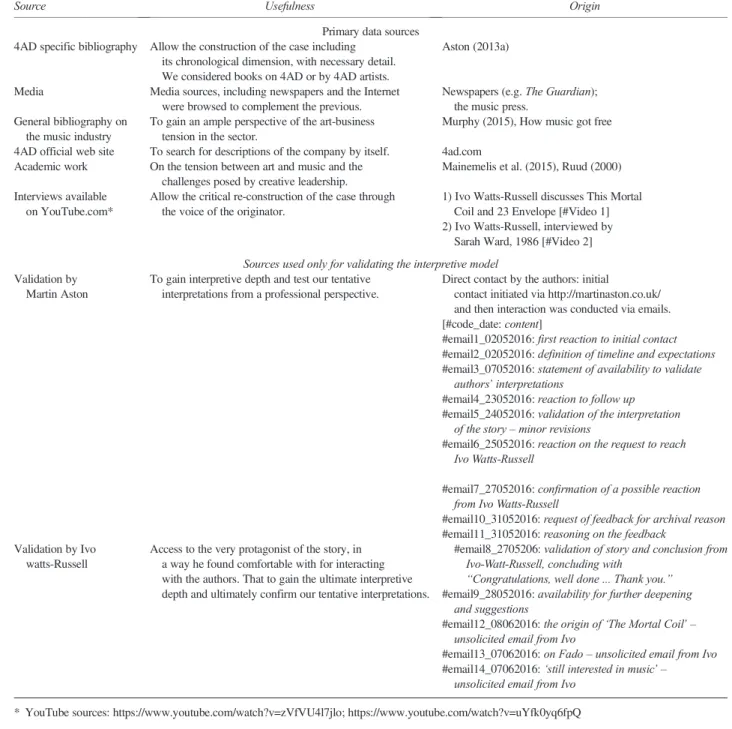
In line with research aiming to develop an in-depth understanding of a specific case, we used texts that allow the case to be approached from multiple perspectives (e.g.,
Petriglieri and Stein, 2012). We use several types of sources (Table 2) that were publicly available to develop a comprehensive narrative of the case of this organization widely regarded in indie circles as iconic. We treat the case as presented by some of its key actors, accepting their narrative formulation as phenomenologically valid, in line with previous work (Cohen and Duberley, 2013).‘Theory free’ texts that are written sources that did not try to substantiate any particular theoretical lens were prioritized (Miller, 2017) in the research. Of course, from an ethnomethodological perspective such texts should be seen as the product of‘lay theories’ that are not immune
to the personal biases, interests and retrospective justifications of their narrators. Aston’s (2013a) comprehensive and detailed account of 4AD was a core source, given that it builds on primary data, including interviews with the main actors over 4AD’s history, featuring Ivo. We complemented Aston’s work with a search for references in the media, including the Internet and the blogosphere. 4AD’s website was also consulted but its utility was relatively light, in line with the dearth of information about the company given its explicit ‘no explanation’ culture. Interestingly, the lack of corporate communication texts and investment in image may
Table 2 Data sources
Source Usefulness Origin
Primary data sources 4AD specific bibliography Allow the construction of the case including
its chronological dimension, with necessary detail. We considered books on 4AD or by 4AD artists.
Aston (2013a)
Media Media sources, including newspapers and the Internet were browsed to complement the previous.
Newspapers (e.g. The Guardian); the music press.
General bibliography on the music industry
To gain an ample perspective of the art-business tension in the sector.
Murphy (2015), How music got free 4AD official web site To search for descriptions of the company by itself. 4ad.com
Academic work On the tension between art and music and the challenges posed by creative leadership.
Mainemelis et al. (2015), Ruud (2000) Interviews available
on YouTube.com*
Allow the critical re-construction of the case through the voice of the originator.
1) Ivo Watts-Russell discusses This Mortal Coil and 23 Envelope [#Video 1] 2) Ivo Watts-Russell, interviewed by
Sarah Ward, 1986 [#Video 2] Sources used only for validating the interpretive model
Validation by Martin Aston
To gain interpretive depth and test our tentative interpretations from a professional perspective.
Direct contact by the authors: initial
contact initiated via http://martinaston.co.uk/ and then interaction was conducted via emails. [#code_date: content]
#email1_02052016: first reaction to initial contact #email2_02052016: definition of timeline and expectations #email3_07052016: statement of availability to validate
authors’ interpretations
#email4_23052016: reaction to follow up #email5_24052016: validation of the interpretation
of the story– minor revisions
#email6_25052016: reaction on the request to reach Ivo Watts-Russell
#email7_27052016: confirmation of a possible reaction from Ivo Watts-Russell
#email10_31052016: request of feedback for archival reason #email11_31052016: reasoning on the feedback
Validation by Ivo watts-Russell
Access to the very protagonist of the story, in a way he found comfortable with for interacting with the authors. That to gain the ultimate interpretive depth and ultimately confirm our tentative interpretations.
#email8_2705206: validation of story and conclusion from Ivo-Watt-Russell, concluding with
“Congratulations, well done ... Thank you.” #email9_28052016: availability for further deepening
and suggestions
#email12_08062016: the origin of‘The Mortal Coil’ – unsolicited email from Ivo
#email13_07062016: on Fado– unsolicited email from Ivo #email14_07062016:‘still interested in music’ –
unsolicited email from Ivo * YouTube sources: https://www.youtube.com/watch?v=zVfVU4l7jlo; https://www.youtube.com/watch?v=uYfk0yq6fpQ
compose a communicative form more powerful in building identity than what is often perceived as ‘corporate bullshit’ (Llewelyn and Harrison, 2006: 588).
The author of the main book on the case, Martin Aston, was consulted to discuss the adequacy of our interpretations (Smets et al., 2015), reading and commenting on our interpretations as formalized in previous drafts of this article. The interactions were conducted via emails (details in Table 2) in order to verify specific aspects of the case. After reading a very advanced version of the paper, Martin Aston stated ‘the interpretation of the case is valid, and corresponds with the themes of my book; congratulations’ [#email5_240516]. The interaction with Ivo Watts-Russell was initiated with the help of Martin Aston and then conducted via email [#email8_27052016]. Ivo also validated our findings and confirmed the plausibility of the analysis.4
Analytical strategy
We employed a grounded theory approach, analysing our data inductively. As is habitual in longitudinal research that is in-depth, we started by compiling an event history, charting a chronological representation of the case with special consideration of Ivo, as the central actor in 4AD. Next, we temporally bracketed the main phases in the life of 4AD and the themes that crossed the organization’s life (e.g., Langley, 1999). The chronology and the bracketing were subsequently used to establish factors that help to account for the consistency of key themes across the different phases of the organization’s life cycle. A theme is a unit of meaning that contributes to explaining the phenomenon and these themes are summarized in Table 3. Identified themes were compared with the existing literature on competing logics between art and business through repeated iterations, which supported a dialogue between data and the theory, revealing occasional needs to search for additional data (e.g., Delmestri and Greenwood, 2016). In the process, we moved back and forth between sources and interpretations, via constant comparison (Strauss and Corbin, 1998), until we reached a stable interpretation that was sustained rather than destabilized by new sources.
We followed habitual measures of trustworthiness (Lincoln and Guba, 1985), including personal prolonged exposure to the case by one member of the team, the aforesaid conversations with experts, repeated triangulation between data and theory, as well as composing a team with diverse degrees of proximity to the case, affording both closeness and distance (Langley
et al., 2013). These measures assured us that the interpretation is plausible and reliable for the purpose of theory elaboration (Lee et al., 1999).
Three major stages
The above-mentioned analytical steps led to the identification of three major stages in the life of 4AD: (I) as a London-based indie label, (II) its entry into America, and (III) the post-Ivo period. We then built on these phases to extract factors that run across the phases and help to explain why 4AD was able to maintain its image of artistic integrity in face of a music industry that was increasingly being ravaged and strained by changing business models brought by digitalization. These themes will be discussed in the findings section, after we present the main phases in the organization’s chronology.
Phase I: a London-based indie label
The first stage in the life of 4AD corresponds to its London years. During this stage, the label built a unique reputation around a roster formed by bands including the Cocteau Twins, Dead Can Dance, and the multi-artist project This Mortal Coil. These were preceded by other projects whose links to the company remained ephemeral. Some of these projects, however, contributed to the label’s initial artistic prestige, including Nick Cave’s The Birthday Party, and the theatrically avant garde Bauhaus. At some point in its early history, album artwork became a critical identity signifier, resulting from artistic collaboration with Vaughan Oliver and the v23 (23Envelope) design studio. This is how Ivo comments on the importance of 23Envelope to his personal musical project, This Mortal Coil:5
[about the choice of the sleeve for the LP records]… they were existing photographs … The design, the photograph on the outside of the LP cover was actually done for another group but it was considered inappropriate, which I was very pleased about because we just started working on the LP … I think it was one of the most successful sleeves that he’d done and helped to enhance, to my personal feelings of that record, because he [Vaughan Oliver] was here doing it … of course I took his guidance all the way … because I was involved with the record I didn’t want to stop him like an artist’ (Ivo Watts-Russell #Video2, Table 2, our italics].
Covers for artists such as the Cocteau Twins were inspired by the work of avant-gardist auteurs, such as
4In addition to the previous sources, at some point in his life, the first author of
this paper worked part-time in an indie record company, gaining first hand contact with the industry.
5As Ivo interestingly pointed out‘the name This Mortal Coil comes from the
Hamlet soliloquy and not, as Robin Guthrie liked to joke, Monty Python!’ [#email12_08062106].
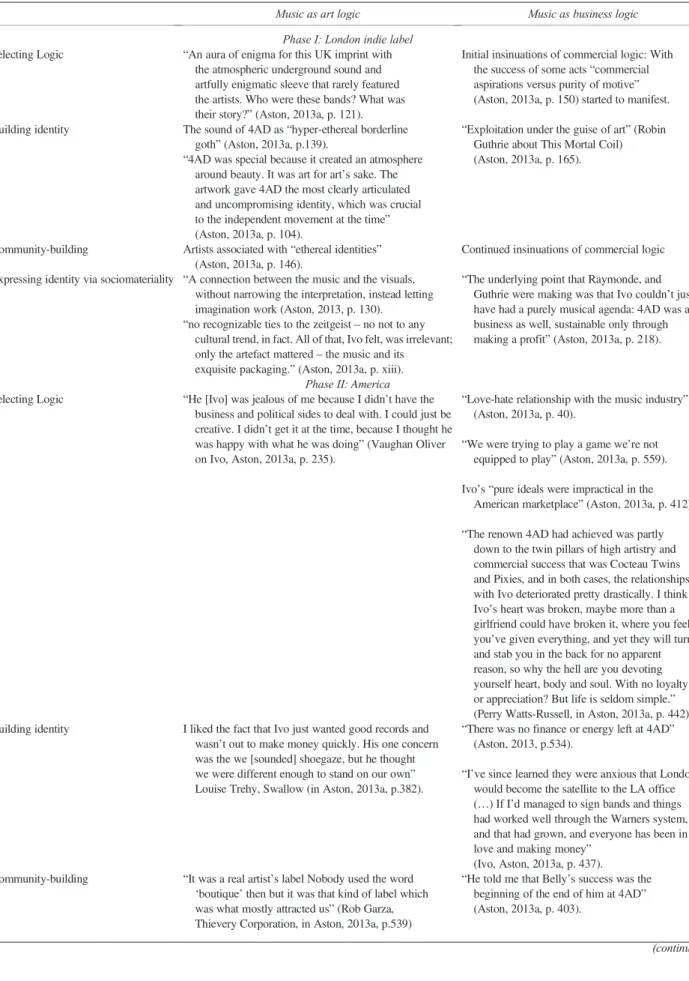
Table 3 Representative examples of statements of logics, by phase
Music as art logic Music as business logic Phase I: London indie label
Selecting Logic “An aura of enigma for this UK imprint with the atmospheric underground sound and artfully enigmatic sleeve that rarely featured the artists. Who were these bands? What was their story?” (Aston, 2013a, p. 121).
Initial insinuations of commercial logic: With the success of some acts“commercial aspirations versus purity of motive” (Aston, 2013a, p. 150) started to manifest. Building identity The sound of 4AD as“hyper-ethereal borderline
goth” (Aston, 2013a, p.139).
“4AD was special because it created an atmosphere around beauty. It was art for art’s sake. The artwork gave 4AD the most clearly articulated and uncompromising identity, which was crucial to the independent movement at the time” (Aston, 2013a, p. 104).
“Exploitation under the guise of art” (Robin Guthrie about This Mortal Coil) (Aston, 2013a, p. 165).
Community-building Artists associated with“ethereal identities” (Aston, 2013a, p. 146).
Continued insinuations of commercial logic Expressing identity via sociomateriality “A connection between the music and the visuals,
without narrowing the interpretation, instead letting imagination work (Aston, 2013, p. 130).
“no recognizable ties to the zeitgeist – no not to any cultural trend, in fact. All of that, Ivo felt, was irrelevant; only the artefact mattered– the music and its exquisite packaging.” (Aston, 2013a, p. xiii).
“The underlying point that Raymonde, and Guthrie were making was that Ivo couldn’t just have had a purely musical agenda: 4AD was a business as well, sustainable only through making a profit” (Aston, 2013a, p. 218).
Phase II: America Selecting Logic “He [Ivo] was jealous of me because I didn’t have the
business and political sides to deal with. I could just be creative. I didn’t get it at the time, because I thought he was happy with what he was doing” (Vaughan Oliver on Ivo, Aston, 2013a, p. 235).
“Love-hate relationship with the music industry” (Aston, 2013a, p. 40).
“We were trying to play a game we’re not equipped to play” (Aston, 2013a, p. 559). Ivo’s “pure ideals were impractical in the
American marketplace” (Aston, 2013a, p. 412). “The renown 4AD had achieved was partly
down to the twin pillars of high artistry and commercial success that was Cocteau Twins and Pixies, and in both cases, the relationships with Ivo deteriorated pretty drastically. I think Ivo’s heart was broken, maybe more than a girlfriend could have broken it, where you feel you’ve given everything, and yet they will turn and stab you in the back for no apparent reason, so why the hell are you devoting yourself heart, body and soul. With no loyalty or appreciation? But life is seldom simple.” (Perry Watts-Russell, in Aston, 2013a, p. 442). Building identity I liked the fact that Ivo just wanted good records and
wasn’t out to make money quickly. His one concern was the we [sounded] shoegaze, but he thought we were different enough to stand on our own” Louise Trehy, Swallow (in Aston, 2013a, p.382).
“There was no finance or energy left at 4AD” (Aston, 2013, p.534).
“I’ve since learned they were anxious that London would become the satellite to the LA office (…) If I’d managed to sign bands and things had worked well through the Warners system, and that had grown, and everyone has been in love and making money”
(Ivo, Aston, 2013a, p. 437). Community-building “It was a real artist’s label Nobody used the word
‘boutique’ then but it was that kind of label which was what mostly attracted us” (Rob Garza, Thievery Corporation, in Aston, 2013a, p.539)
“He told me that Belly’s success was the beginning of the end of him at 4AD” (Aston, 2013a, p. 403).
Andrei Tarkovky and his film Stalker. This phase established 4AD as an important presence in the 1980s urban culture landscape. In the late 1980s, an important shift occurred: 4AD started recruiting its first American artists, namely Pixies and Throwing Muses. America was about to change 4AD.
Phase II: America
The new names on the catalogue not only altered the sound of 4AD, from its previous ethereal/atmospheric landscapes in the direction of a more directly rock
approach but also changed the company’s ambitions. With an increasing attention to the American music scene, 4AD established a second office in Los Angeles and started direct operations in the United States. Ivo spent increasing amounts of time in the American site with the number of UK signings reduced to a handful. The formerly British label became more American – in musical imagination as well as in managerial practice. Its major acts at this phase included the Red House Painters and Heidi Berry among other predominantly American names. The recruitment of American bands started to shake the culture:
Table 3 (Continued)
Music as art logic Music as business logic
“If Ivo was the father figure, he had lots of children, and he couldn’t give all of them the same amount of attention” (Aston, 2013a, p. 405).
Expressing identity via sociomateriality “I’ve heard people say 4AD was slightly more style over content but it was all integrated to me. The artwork drew you further into this world, but in a slightly elusive way, presenting you with a different way of looking at something. Only major labels were doing what 4AD did, printing inner sleeves, embossing and trying out different
inks and typography” (Tony Morley, in Aston, 2013a, p.395)
“It [success] threw everything into turmoil, because Belly was still coming from this position of integrity. Like what is pure, and what is cool? Do we appear on magazine covers? That stuff fell by the wayside years ago, but back then people still obsessed over doing the right thing– no ads, no corporate sponsorship… we constantly and agonizingly soul-searched every decision”
(Tanya Donnelly, in Aston, 2013a, p.403). “They still had the attitude that videos, and
merchandising too, was obscene. Otherwise, they could have taken things to another level.” (Brendan Perry, in Aston, 2013a, p.423). Phase III: Post-Ivo
Selecting Logic “reestablish 4AD as a home for uncompromised creativity” (Aston, 2013a, p. 576).
“He thought 4AD would benefit from somebody who was less of a soft touch than he was financially, who could control it better than he had” (Aston, 2013a, p.401).
“Ivo’s approach was totally ethical. He had this label that was still operating in a world where purity was no longer valued. But times had changed and it was now less about 4AD and more about the artists– or less about the artists and more about single tracks”
(Aston, 2013a, p. 532). Building identity “I still think of 4AD as music lovers running a
business that was more than a record business” (Christopher Andrews, from band Cuba, in Aston, 2013a, p. 567).
“It wasn’t the easiest place to work as people so identified with Ivo, and he wasn’t there. We just had to get on with it” (Colleen Maloney, in Aston, 2013a, p. 564).
Community-building “Compared to our experiences since, 4AD was a caring label that wasn’t just out to make money (…) They did have genuine belief in the music and the bands” (Neal Calderwood, in Aston 2013a, p. 567).
“the turnaround of artists was that much faster, and more mercenary, than it had been in the Eighties when the likes of Dead Can Dance could be supported” (Aston, 2013a, p. 502). Expressing identity via sociomateriality “Same joyful feeling of imagining what lies
inside the enigma of a 4AD album cover” (Aston, 2013a, p. 602).
“Leap of faith was the first sleeve since Vaughan Oliver’s arrival not to be even laid out by v23, and the simplistic logo, jazzed up with spotlight effects, showed what one-dimensional blandness could look like without a unique overview by a visionary designer.” (Aston, 2013a, p. 564).
Everything else [on 4AD] was so smooth and wispy and gauzy and pretty (…) Poor Vaughan [Oliver], he wanted us to be beautiful, but we said we’re not beautiful, we’re not nice! He said ‘Why would you fuck it up on purpose?’ That’s what being the first American band on 4AD was about. It was certainly a shift’ (Kristin Hersh from the band Throwing Muses, in Aston, 2013a: 211).
America defied 4AD’s established strategic approach as a small indie label from south London: it was now competing in a big continental market. As other indies experienced, it takes a‘certain critical mass’ to compete in the US (Murphy, 2015: 321). To gain critical mass, 4AD joined forces with Warner, which constituted a major strategic move, forming an alliance with an established big business. The two-office structure that resulted was complicated and costly, with more structure representing more responsibility, as well as emergent changes that resulted from growth (Greiner, 1972), which was positive but posed significant organizational challenges (Probst and Raisch, 2005). In the case of 4AD, artistic integrity was established by the organization’s identity; however, for organizational survival commercially, success became vital to sustain viability and therefore to preserve artistic integrity. A big structure demanded bigger resources and the challenge was taken by the management. Rather than resulting from a deliberate choice, commercial pressure imposed itself as an emergent intruder. Commercialization happened to the label but it resulted, in the first place, from managerial choice: when managers make choices they have to live with the consequences. In this case, an important consequence was the company’s exposure to a different institutional environment that brought about major challenges.
In its American phase, 4AD started to feel the competition between logics intensely: in the independent music sector,‘principles were treated as part of the art, and the business, money was often a corrupting force’ (Aston, 2013a: 339). But money, the corrupting force, was becoming more salient and as the organization grew more it became ever more salient, creating disillusionment in the founder, leading to dis-identification (Costas and Fleming, 2009):
In Ivo’s mind, the turning point of his disillusionment was discovering that running a record label had evolved into running a record company (Aston, 2013a: 339; our italics).
The logic of a pure and purist community of artists became difficult to balance, as artists themselves became more ambitious:‘the more important an artist felt seemed to mean a bigger ego to be dashed’ (Aston, 2013a: 405). 4AD, the label becoming a record company, increasingly
adopted the standard business practices of the music industry:
‘with The Wolfgang Press, we clearly went with the method of launching a band with two singles and an expectation of hits’, says Ivo, ‘At that point, the route to success was the Indie charts, and the chart show, which could get you into the real charts (…) I was in charge, so it was my fault.
Aston (2013a: 381) summarized the new phase ironically: ‘Welcome to the machine’. Yet, even at this stage, artistic identity remained vital. Commercial viability did not override artistic merit and the company supported acts with limited commercial promise:
The 4AD that was not thinking of budgets, formats, remixes and pop videos returned with an album by ambient guitarist Michael Brook (Aston, 2013a: 381). Ivo and the company developed a ‘love-hate relationship with the music industry’ (Aston, 2013a: 400). For the founder, the situation was increasingly difficult to balance: ‘success by playing the game was no success for Ivo’ (Aston, 2013a: 403). At this stage the founder recognized the need to recruit a professional manager,‘someone who was less of a soft touch than he was financially, who could control it better’ (Aston, 2013a: 401). When ‘4AD started, a record was made, given a catalogue number and released (…) whether it sold five copies or a million was irrelevant’ (Aston, 2013a: 386).
Research on identity indicates that exiting an identity that entails‘physically disengaging from any role or group associated with it’ (Petriglieri, 2011: 643) becomes a viable solution when identity is under threat (Breakwell, 1986). Trying to preserve the ethos of an art house, Ivo launched a new label, Guernica, in 1992. The Guernica label explicitly discouraged the possibility of growth by presenting itself as a one-record label, that is, it would launch only one record per project; it was not intended to create hits or to launch or support careers.
Phase III: post-Ivo
Ivo’s Guernica foreshadowed even more dramatic changes in his role as an institutional entrepreneur: he ‘had a nervous breakdown in 1994, triggered by depression, fallouts with key artists and a disdain for an industry that valued videos and remixes over‘pure’ and ‘unique’ ideals’ (Aston, 2013b). In 1999 he left 4AD, finding refuge in New Mexico, apparently to protect his self-integrity by adopting a self-affirmation strategy (Steele, 1988; Critcher and Dunning, 2015). After he had left, 4AD’s roster grew to include names such as Bon Iver, The National, Scott Walker and Grimes.
Ivo explained that after leaving 4AD‘I felt relaxed and off the hook, and no longer guilty about not being available to people whose future depended on me’ (Aston, 2013a: 569). Retrospectively, he pointed out, in reference to the band That Dog, that‘management was the last thing on earth I should ever have considered doing’ (Aston, 2013a: 426). For a man that saw the commercial side of the business as obscene (Aston, 2013a: 423), it was difficult to digest changes in the music industry that followed in the wake of digitalization. The new forms of music distribution were remaking the industry, altering production and consumption. While the organization continued to produce well-curated material artefacts the substitution of the LP by the CD and subsequent digital distribution meant that the visual component of music was being progressively threatened, challenging the company’s identity at the interface of ‘sound + vision’, as David Bowie put it.
Findings
Coping with competing institutional logics: four factors Four central insights from the case offer rich evidence on the micro-experience of facing competing logics and how these influence managers and organizations. These four factors/themes help us to understand how individual entrepreneurs, in this case Ivo Watts-Russell, experience and respond to competing logics. They cut across Ivo’s work as a record man. First, there was a clear choice of the predominant logic. Even while acknowledging that there was a business component, Ivo privileged the music (art). Second, identity was built consistently around this choice. 4AD was about the aesthetics of the artefact as an integrated piece of art, rather than about the musical product per se, something explicitly mentioned by Ivo in an interview (Murphy, 2015: 331). Third, this identity based on the aesthetics of the artefact helped to construct a community of musicians around a vision. Fourth, cultivating an artistic ethos was sustained via a view of 4AD as socio-materially contributing to urban culture. These four factors help to understand the story of 4AD. Their occurrence was simultaneous rather than sequential. Each dimension reinforced the other. We now discuss the four core processes that articulated competing logics in such a way that the company preserved its artistic integrity in the face of a widespread industry creative disruption and destruction by technological innovations. Table 3 samples evidence on each factor, substantiating our theoretical claims.
Factor I: selecting a predominant logic
The Beggars Banquet music group spawned 4AD. The mission of the label, initially, was purely artistic. In fact,
its commercially viable and most promising acts, it was intended, would be promoted to the Beggars Banquet catalogue. To the founders, this was not a problem: the project was an opportunity to respond to Ivo’s passion for music: ‘Ivo was eccentric in the best way, with a passion for all things creative’ (Aston, 2013a: 197). Creativity ‘would always trump business strategy’ (O’sullivan, 2012) and the management side was only secondary: ‘commerciality meant selling out; integrity and authenticity were the presiding philosophies’ (Aston, 2013a: 84). 4AD, above all, dealt in artistic integrity:
Watts-Russell was himself a thin-skinned artist, fearful of commerce and compromise. When the second album by his own project This Mortal Coil was savaged by the music papers, he wept openly. When an artist he craved chose a rival label, he was personally wounded (Lynskey, 2013: 1–2).
The ‘money-hungry’ Motown, an ‘emblem of black capitalism’ (Hunter-Tilney, 2016: 10), led by Berry Gordy, provides a contrasting approach to such philosophy. Motown was a company focused on the charts and productivity that applied Fordism and competition between internal markets to music production, represented by producers and artists working on different interpretations of the same songs written by house songwriters such as Holland-Dozier-Holland. Gordy, based in Detroit and an ex-production line worker at Ford realized that when‘it came to managing a complex operation growing at the rate Motown was, I could see my personal methods weren’t geared for that (…) So I tried to set up a management hierarchy to do it for me– like other big companies’ (in Hunter-Tilney, 2016: 10). Ivo was not playing by the same rulebook.
Factor II: building identity and identification around a prevailing logic
The creation of a 4AD identity seemed to have occurred in an emergent fashion, based on a personal vision and an aesthetic project. As‘4AD became 4AD’, ‘none of the bands seemed to have some big idea about themselves or what 4AD was’ (Aston, 2013a: 166). As the label attracted attention, however, the ‘cult of Ivo’ (Aston, 2013a: 167) started to emerge. Ivo was the centre of a creative network that attracted non-conventional artists, leading to ‘4AD’s identity as a repository for sensitive, rarefied, idealistic and introverted souls’ (Aston, 2013a: 189). One journalist observed that the core values of the label were supposedly those expressed in Tim Buckley’s Song to the Siren, as interpreted by This Mortal Coil: beauty, mystery, dream logic and emotional fragility (Lynskey, 2013: 1).
These characteristics created an aura of purity around 4AD (Aston, 2013b). A significant contributor to this
identity was the visual element that was purposefully managed to create a visual impression: one consequence of this aesthetic consideration was that ‘a particularly perfectionist graphic designer dictated the rather slow speed of the label’s release schedule’ (O’sullivan, 2012; see also King, 2012b). As one fan observed,‘The music entered through your eyes and then the music got into your ears’ (Lynskey, 2013: 1). As pointed out above, Vaughan Oliver was the designer behind this visual identity. Organizationally, this clear sense of visual identity helped to build organizational identification (Rousseau, 1998), a psychological state in which individuals perceive themselves as associated with an organization rather than simply working for it. It is in this sense that we consider 4AD to have been more similar to an artistic community than a roster of independent projects, as discussed next.
Factor III: creating an artistic community aligned with the logic
Ivo’s vision of music attracted ‘a club of fragile creatures’ (Aston, 2013a: 403). This‘club’ consisted of individuals and collectives with diverse identities sharing a strong artistic ethos. To these artists, the evolution of the label and its strong visual appeal represented more than a commercial relationship. Some were fans before becoming contributors. As Emma Anderson, of Lush, observed, ‘I really related to 4AD’s artwork – it had such a strong imagery. I’d buy records without hearing them’ (Aston, 2013a: 302). Within such logic, music is‘something to hold (…) to put on your shelf and be proud of and have for years to come’ (Bradley, 2009). Heidi Berry explained, ‘I felt understood and nurtured, at 4AD. Ivo put me in touch with the right people’ (Aston, 2013a: 362).
Factor IV: maintaining identity through sociomateriality The fact that no other indie label put so much emphasis on the visual component (Aston, 2013a: 308) symbolized the lack of artistic compromise and the degree of cultural distinction. Meaning is conveyed in symbolic and material ways (Schoeneborn et al., 2016) and materiality played a crucial role in the creation and maintenance of the 4AD identity.
The identity of 4AD was crucially defined via the combination of artistic vision and visual consistency. The dynamic duo behind 4AD was Ivo and Vaughan. Marc Geiger, from American Recordings, observed that: ‘4AD not only had the world’s best A&R man, they had the best graphic artist in Vaughan’ (Aston, 2013a: 348).6 The leadership gave the label itself an identity that was independent of the identity of its artists and that
transcended and situated them under a collective symbolic system. Being a 4AD artist already said something about the acts themselves.‘4AD itself had fans, its own concept and sub-culture’ (Aston, 2013a: 253). As a journalist noted, the most iconic indie labels felt almost like physical spaces:‘if Factory felt like an art gallery-cum-nightclub, and Rough Trade a left-leaning college campus, then 4AD was a church’ (Lynskey, 2013: 1).
In the post-Ivo period,‘people continued to trust our releases because they were 4AD’ (Aston, 2013a: 325). The sense that 4AD was more an artistic community than a mere record company was cultivated.‘4AD began as a cult; when Ivo departed, it was still a cult, and that’s what its descendants are too – something to be treasured whether a hit or not. Something worth hearing because it was made. The artefact.’ (Aston, 2013a: 614). By the beginning of the 1990s perceptions of 4AD’s niche positioned it as‘super-cool’ (Aston, 2013a: 364). It was this artistic vision that was eventually sustained and restored after a period of transition: ‘4AD’s personality was so big that it would have been hard not to be reverential, to prop up the legacy, and to make Ivo happy’ (Aston, 2013a: 599). With a new roster comprising artists such as The National, Beirut, St Vincent, and Blonde Redhead, 4AD ‘regained its artistic vision after the dead years after Ivo (…). 4AD is again very cool with twenty-year old journalists’ (Aston, 2013a: 600). In the second half of the 2010s, 4AD is still a viable and respected artistic project at the confluence of‘sound + vision’.
Discussion
Theoretical implications
The extant literature on paradox suggests that competing logics represent a source of tension that can be generative or debilitating (Vince and Broussine, 1996; Hargrave and Van de Ven, 2017). Less is known about how and when individuals make sense of and tackle the competition between such‘rules of the game’ (Jackall, 1988; Thornton and Ocasio, 1999). Smith and Tracey (2016: 460) called for more research on‘how environmental conditions and individual sensemaking work together to make salient the underlying tensions’. Hargrave and Van de Ven (2017: 5) underline how, according to the paradox perspective, managers exercise sensemaking when exposed to contradictions as they ‘initially perceive contradictory elements to be irreconcilable but come to accept their coexistence as they recognize their importance and interdependence’. McPherson and Sauder (2013: 168) explain that research on how actors manage identities in the face of institutional contradictions is ‘rudimentary’. Extant research, albeit sparse, indicates that managing tradeoffs may be more complicated at the
6
A&R stands for Artists and Repertoire,‘that part of a record company that scouts talent and oversees its development’ (Murphy, 2015: 13)
individual than at the organizational level of analysis (Gupta et al., 2006; Thornton et al., 2011; Kauppila and Tempelaar, 2016). The literature on paradox and contradiction accepts that emotion and defensiveness participate in the paradoxical process but tends to assume, implicitly rather than explicitly, that handling and managing paradox is, above all, a cognitive endeavour.
The case of Ivo Watts-Russell and 4AD illustrates the complexity and difficulties of handling contradictions posed by competing institutional logics, the‘inspirational and challenging dilemmas I struggled with all those years ago’, as Ivo said [#email8_27052016]. We answered our research question by identifying four actions that Ivo used to navigate through paradox and contradiction unleashed by competing logics. First, he selected one predominant pole to avoid balance as a half-half proportion between poles. Second, he built identity around the selected pole. This identity was coherent with his sense of self. Third, he used this identity to create a community of musicians aligned with this identity. Fourth, he projected the identity via sociomaterial cues. Therefore, contradictions were used as a source of organizational identity construction, in line with personal identity. Our analysis also suggests that the navigation can be difficult. The emotions unleashed by contradiction can be overwhelming for some entrepreneurs, including visionaries passionate about the purpose and the symbolic elements of their companies. Contradictions can threaten their individual identities, and diminish their desire to lead and to remain associated with an organization (Petriglieri, 2011). This observation prompts several relevant conclusions stemming from the findings. As Ivo put it:
It’s nothing new, really, the conflict between an environment that nurtures artists but is also capable of supporting them. I think, for a while, we did well. I don’t hold any grudges against those that became successful or those that blamed me for their lack of success. All memory is fiction and we are each the hero in our own story [#email8_27052016, Table 2, our italics]. The four emerging factors constitute relevant contributions to the literature on the micro-foundations of hybridization. When one is articulating two competing institutional logics, privileging one pole instead of creating a balance between poles, can prove sustainable over time where that pole assumes uniqueness that is rare, inimitable, valued and for which no ready substitutes exist.7In such a case, the alternative pole is not ignored but voluntarily rendered secondary in a dynamic relation with its opposite pole, an indication that unbalanced hybridization based on such VRIN qualities can be superior to other forms of articulation, such as synthesis. Relational dynamism between poles is necessary to engage productively with
paradox (Clegg et al., 2002) without one being tempted to‘solve’ the tension.
Second, a clear choice of pole articulation can be used to attract talent aligned with the preferred pole. Ivo’s favouring of one pole communicated clarity about the organization’s identity. Un-balancing can thus be viable and constructive. The lack of ambiguity it represents can provide clear indications to stakeholders compared to more ambiguous choices that intend to find balance, especially if they come to be perceived as ‘bland halfways’ (Eisenhardt, 2000).
A sense of community was sustained and expressed via sociomaterial means anchored in the identity and the values unambiguously communicated. The artefactual component of identity can solidify an organization’s ethos, rendering it clear and less contested than would happen in the case of identity built around more ambiguous sources if only because images can speak louder than words. The sociomaterial expression of logic articulation can be a target of exploration for future researchers. We consider that the world of music and of aesthetics constitutes a privileged window for the observation of sociomateriality, as well as other organizational phenomena, in conceptually illuminating ways (see also Cohen and Duberley, 2013).
Other findings are worth considering. For any organization founded as an expression of an ethos, founders and managers should start thinking as soon as possible about the competing logics that their organizations will possibly face. Creating a successful ethos that challenges industry norms is a claim to distinction, a positing of uniqueness. When claims to distinction evoke legitimacy in audiences, making them commercially successful, a conundrum follows: if artistic and aesthetic success creates an ethos that leads to successful business, how to manage the ethos in the face of commercial success becomes problematic. In the past, competing logics have been treated preferentially at a macro level and as an identity issues at a micro level. Our findings reveal that articulating these two levels is conceptually relevant and practically oriented. Leaders’ experience clashes of institutional logics as very concrete events rather than as abstractions. Knowing how competing logics pose emotional and identity challenges can contribute to a better understanding of the micro-dynamics of the coexistence of different institutional logics.
Third, leaders and managers should be wary that decisions have consequences regarding the viability of their preferred logic. In the case under consideration, the decision to go to the US precipitated several changes that were not and could possibly not have been anticipated. These triggered other changes that disturbed the equilibrium between logics. When 4AD decided to enter the American market, it unintentionally ignited a sequence of expectations of managerial needs incompatible with the
maintenance of the purist ethos that characterized the label’s identity. This, in turn, raised new issues for those agents, such as Ivo, whose roles operated at the boundary between personal and organizational identity, that is, those for whom changes in the organization’s identity brought about challenges for conserving one’s desired and preferred self.
Fourth, managers should be self-aware to identify how to navigate competing logics, including the identity and emotional consequences of this process (Diamond, 1993). The tensions resulting from conflict between logics can threaten the sense of self and thus be emotionally taxing and raise significant psychological discomfort (Breakwell, 1986; Vince and Broussine, 1996; Critcher and Dunning, 2015). Previous research indicated that logics can be used as tools (McPherson and Sauder, 2013) but our work suggests that the identity dimension may reduce the plasticity of‘tools’. In cases where logics become too conflictual, leaders may simply avoid one pole– therefore constraining the uses of logics in practice. Choices are not necessarily repressed but can be avoided. Preparing managers for the dissonance and emotional costs of contradiction can be a valuable terrain for leadership development.
Fifth, developing a sense of competence around the two poles of a contradiction is essential to put in place a productive cognitive and emotional frame. The perception of a lack of operational skill may undermine the capacity to articulate competing logics (Guo et al., 2016). The literature still has to explore whether personal dispositions influence individual responses to conflicting logics. These can include, for example, individual tolerance of contradiction, a‘mode of thinking that accepts and even thrives on apparent bivalent logical contradictions’ (Chan, 2004: 297) or the individual importance attached to money (Mitchell and Mickel, 1999). Individuals more sensitive to money may more willingly accept the articulation between monetary and non-monetary logics than those for whom money is less relevant or even artistically corruptive. It is now common among paradox scholars to defend the need to‘live with’ paradox (Clegg et al., 2002; Smith et al., 2016) and to express‘consistent inconsistency’ (Smith and Lewis, 2012: 228) but living with paradox can be disadvantageous. The tensions implied may not be emotionally sustainable. In some cases, managers may prefer to avoid exposing themselves to institutional conflicts that threaten their sense of self and to escape the need to express consistent inconsistency or inconsistent consistency. This is coherent with the notion that leaders are more effective‘when their message is deeply personal and yet touches shared concerns’ (Petriglieri, 2011: 6).
4AD is a case in point. By protecting his identity as an artist running a music label, Ivo might have protected the identity of 4AD’s artistic core. This does not mean that he
denied the poles or evaded the paradox but that his leadership was deliberately un-balanced although considerate about the poles, rather than of the‘both/and’ type of synthesis (Smith et al., 2016). This suggests that there can be nuances within the ‘both/and’ forms of leadership. However, even the enactment of this unbalanced logic made him suffer as the managerial demands of running a record company escalated. Identity work involves not only crafting identity in ways geared to adjusting to new challenges but also avoiding identity associations perceived as undesirable. The process is complex, however, and as noted by Petriglieri and Stein (2012: 1218), it involves a‘hidden price to pay’. In this case, the price for Ivo was a personal sense of misfit and a depressive condition that ultimately involved splitting with the music business (Aston, 2013a).
Sixth, the coherence of organizational identity over time is possible even under conflicting struggles at the level of the self and personal identity. Contradictions are dynamic and can be persistent (Schad et al., 2016) but our case suggests that it is possible to maintain a coherent collective identity (Jay, 2013) even in face of unstable choices and individual dilemmas around identity. A consistent identity resulted from dynamic adjustments between the business and artistic components of the organization. Dynamism evolved through different forms of balance but ultimately one pole never completely suffocated the other.
We selected an extreme case appropriate for theory building purposes (Bamberger and Pratt, 2010; Harvey and Kou, 2013) but limiting in terms of generalizability. Most companies may be less purist and hence less in alignment with our findings. For example, Rick Rubin, another important ‘record man’, pointed out ‘From the nineties onwards (…) record labels were all being run by accountants and attorneys. It was becoming a less pleasant business’ (Murphy, 2015: 339). In this sense, we may have studied the last rites of a particular professional ethos as it was threatened by technological change. Recent developments in the record industry have de-materialized music and revolutionized the patterns of consumption to a point that threatens the very survival of the whole industry (Witt, 2015). 4AD’s investment in the aesthetics of the artefact may be more a relic of the past than a viable representation for the future. Or perhaps the current shake up is just another phase in the abrupt transformation that has characterized the industry throughout its entire existence, according to some analysts (Murphy, 2015). It is possible, however, but only time will tell, if 4AD’s consistency through identity will remain a competitive advantage.8
8An interesting case for comparison would be the European jazz label ECM, a
similar blend of genre and sociomaterial identity captured in a design and musical ethic.
The study is interpretive, with our interpretation not excluding other interpretive possibilities, such as emphasizing other motives for Ivo’s departure, namely economic motives. According to Aston, Ivo sold his share for a seven-figure sum (Aston, 2013a: 362). No matter how romantic a creator may be, it is an indisputable truth that business organization involves an economic component. It is therefore admissible that Ivo sold when the occasion was propitious. Robin Guthrie of the Cocteau Twins accused Ivo of‘commercial exploitation’ and noted that he drove a Mercedes while the band was making the cover of NME9 but still taking the bus (Aston, 2013a: 165); however, these arguments seem weak in the face of most of the supportive comments coming from the majority artists that worked with Ivo.
According to work on identity, individuals typically tend to be strongly motivated to maintain their identities, not to revise them (Shamir, 1991). As Petriglieri (2011: 651) pointed out ‘identity-exit is very costly.’ Leaving an organization so closely associated with his persona must therefore have been a difficult process for Ivo (see how Steve Jobs suffered for leaving his Apple: ‘What had been the focus of my entire adult life was gone, and it was devastating’10). In this case, exit co-occurred with a depressive condition and the escape to the desert, which suggests deeply personal rather than material reasons. In addition, traits and signs of bodily discomfort with the path the company was taking were expressive and corroborated the interpretation that Ivo’s ‘purist ethos’ and ‘ascetic’ propensity (Vaughan 2013a: 596, 595) did not accommodate the company’s evolution. For these reasons, identity threat seems to provide a more robust interpretation of the relationship than alternative explanations. Concurrently, the adventure of the Guernica label and Ivo’s difficulties with accepting the business side of the venture suggest that the interpretation proposed here seems more plausible than other explanatory possibilities. Competition and tension between logics are common to many organizations and fields and have implications for individuals. Clashes of logics affect individuals’ professional, and sometimes also their private lives. Art vs. sales, sport vs. sponsorships, drugs in sport vs. pure performance, deals vs. ethics, customer satisfaction vs. deontology, thinking vs. tinkering, are just some of the most common ones.
Practical implications
With that in mind, the study advances several practical implications for management and organization. We highlight three. First, self-awareness, a‘metacompetency’ that enables the acquisition of other competencies (Briscoe
and Hall, 1999), should be cultivated by organizations in their leading individuals in order to support identity work (Obodaru, 2012). Providing managers with tools that allow them to increase self-awareness and to develop a clear self-concept are important tools to help navigate the competition between logics in a fruitful way. Identity issues were a source of pain for Ivo.
Second, the cultivation of self-awareness may help individuals understand who they are and what they want in terms of profession and career, which may be important to avoid tension resulting from ambiguous motives and preferences. Clarifying motives may help compose genuinely diverse and integrated leadership teams. A person with inclinations to an artistic logic may find advantage in working with someone with a business orientation. Co-leadership or shared leadership (Kozlowski et al., 2016) may be a way of dealing with dissonance and tension, and this may be especially relevant in the arts business, in which a leader is ‘predominantly responsible for the artistic’ and the other for the‘commercial aspects’ of the artistic product (Ebbers and Wijenberg, 2017).
Third, as discussed, tackling contradiction can be more difficult for individuals than for collectives because collectives can compose teams formed by people with different preferences, whereas individuals may have difficulties struggling with adjustment to contradictory requirements. One problem at 4AD was the fact that the two leading minds, Ivo and Vaughan, expressed an equivalent artistic orientation, without the team having a correlative managerial motivation and dynamic capability (dual leadership is more effective when skills, emotional orientations, contributions, and roles of each element of the duo are complementary; O’Toole et al., 2002). In the same vein, the other co-founder, Peter Kent, left to become a Buddhist (Aston, 2013b), confirming the other-worldly rather than commercial aspirations of the founders of the label. Other cases in the music industry, such as Simon Draper and Richard Branson at Virgin (Murphy, 2015) as well as in other artistic industries (e.g., Guy Laliberté and Daniel Lamarre, as co-leaders of Cirque du Soleil, as described by Kets de Vries, 2007; see also Ebbers and Wijenberg, 2017, for the film industry) and beyond (Pascale, 1996), suggest that dual, complementary leadership team can constitute a viable solution for dealing with contradiction. These are important issues, as contradictions between logics may constitute formidable obstacles to organizational development, especially for individual action (Gupta et al., 2006).
Conclusion
Previous research revealed that logics could be used as resources (McPherson and Sauder, 2013; Smets et al.,
9
New Musical Express, a British music publication championing indie music.