The Impact of Health Consciousness on
the Purchase Intention of Organic Food:
The Moderating Effect of Perceived Store Image
Patrícia Meireles
Dissertation written under the supervision of
Prof. Paulo Romeiro
Dissertation submitted in partial fulfilment of requirements for the MSc in
Management with specialization in Strategic Marketing, at the Universidade
ABSTRACT
Title: The Impact of Health Consciousness on the Purchase Intention of Organic Food: The Moderating Effect of Perceived Store Image
Author: Patrícia de Oliveira Meireles
Consumers’ interest for organic products is increasing every day and several industries have been witnessing a growing demand for this type of products. Continente being the most prominent chain of hypermarkets in Portugal, is creating value by acquiring a chain of organic food specialized stores, Go Natural.
The focus of this study is to better understand how an individual’s degree of health consciousness affects the purchase intention of organic food and how this relationship is mediated by the attitudes one holds towards organic food. Moreover, it intends to determine if perceived store image acts as a moderator both of the direct and indirect effect. Ultimately, it aims to understand if, depending on the store – Continente or Go Natural - there would be a difference in the consumers’ purchase intention.
A self-administered online questionnaire was used to obtain the data. The main conclusions taken from the statistical analysis are that the degree of health consciousness has a direct impact on the purchase intention of organic food. However, this relationship is not moderated by perceived store image. Also, the degree of health consciousness has an indirect impact on the purchase intention through the attitudes towards organic food. The relationship between attitudes and the purchase intention is moderated by perceived store image. Lastly, the intention to buy organic food was found to be higher in Go Natural.
SUMÁRIO
Título: The Impact of Health Consciousness on the Purchase Intention of Organic Food: The Moderating Effect of Perceived Store Image
Autor: Patrícia de Oliveira Meireles
O interesse em relação aos produtos biológicos tem vindo a crescer cada vez mais e já são várias as indústrias que testemunham um crescimento na procura de produtos biológicos. O Continente, sendo a cadeia de hipermercados mais proeminente em Portugal, comprou uma cadeia de lojas especializadas em comida biológica, Go Natural.
O foco deste estudo é determinar como é que o grau de preocupação com a saúde demonstrado impacta a intenção de compra de comida biológica, assim como perceber se essa relação é mediada pelas atitudes em relação à comida biológica. Além disso, pretende determinar se a perceção que os consumidores têm sobre a imagem da loja desempenha um efeito moderador. Por último, o objetivo é perceber se existe uma diferença na intenção de compra de comida biológica, dependendo da loja onde é vendida.
Um questionário online foi utilizado para obter os dados necessários. Foi concluído que o grau de preocupação com a saúde impacta a intenção de compra, tanto direta como indiretamente, através das atitudes em relação à comida biológica. Contudo, esta relação direta não é moderada pela perceção da imagem da loja. Já a relação entre as atitudes e a intenção de compra é moderada pela perceção em relação à imagem da loja. Por último, a intenção de compra nas lojas Go Natural é superior em relação ao Continente.
ACKNOWLEDGEMENTS
Everything that exits in life comes with an end but the most important is the path that is taken to reach that moment. At the end of my thesis I finally can put on perspective all the ups and downs that occurred and understand how much I’ve learned. Throughout this journey I have to thank my family and my friends for all the support and encouragement they gave me. I also would like to take the opportunity to thank professor Paulo Romeiro for constantly advising me and guiding me through this process.
TABLE OF CONTENTS
ABSTRACT ... II SUMÁRIO ...III ACKNOWLEDGEMENTS ... IV TABLE OF CONTENTS ... V TABLE OF FIGURES ... VII TABLE OF TABLES ... VII TABLE OF APPENDICES ... VII GLOSSARY ... VIII
CHAPTER 1: INTRODUCTION ... 1
1.1BACKGROUND AND PROBLEM STATEMENT ... 1
1.2PROBLEM STATEMENT ... 2
1.3RELEVANCE ... 3
1.4RESEARCH METHODS ... 4
1.5DISSERTATION OUTLINE ... 4
CHAPTER 2: LITERATURE REVIEW AND CONCEPTUAL FRAMEWORK ... 5
2.1ATTITUDES TOWARDS ORGANIC FOOD ... 5
2.2HEALTH CONSCIOUSNESS ... 6
2.2.1 Health Consciousness Scale ... 7
2.3STORE CHOICE ... 9 2.3.1 Perceived Store-Image ... 9 2.3.2 Distribution Intensity ... 10 2.4PURCHASE INTENTION ... 11 CONCEPTUAL FRAMEWORK ... 13 CHAPTER 3: METHODOLOGY... 14 3.1RESEARCH APPROACH ... 14 3.2QUESTIONNAIRE DEVELOPMENT ... 14 3.3DATA COLLECTION ... 16 3.4DATA ANALYSIS ... 16 CHAPTER 4: RESULTS ... 18 4.1 SAMPLE CHARACTERIZATION ... 18 4.1.1DEMOGRAPHICS ... 18
4.1.2CONSUMPTION HABITS OF ORGANIC FOOD ... 19
4.2SCALES’RELIABILITY ... 20
4.3MEASURES OF ASSOCIATION ... 21
4.4CONDITIONAL PROCESS MODEL ... 22
4.5STATISTICAL ANALYSIS OF THE MODERATED MEDIATION MECHANISM ... 24
4.5.1 Hypothesis 1: Positive attitudes towards organic food will positively affect the intention to purchase them. ... 25
4.5.2 Hypothesis 2: Health consciousness will positively affect attitudes towards organic food... 25
4.5.3 Hypothesis 3: Health consciousness will positively affect purchase intention of organic food. ... 25
4.5.4 Hypothesis 4: Perceived store image will impact the relation between the attitudes consumers hold towards organic food and their purchase intention of organic food. ... 26
4.5.5. Hypothesis 5: Perceived store image will impact the relation between the degree of health
consciousness and purchase intention of organic food. ... 26
4.5.6 Hypothesis 6: Attitude towards organic food mediates the relationship between Health consciousness and purchase intention of organic food (indirect effect). ... 27
4.6ANALYSIS OF THE DIFFERENT COMPONENTS OF THE DEGREE OF HEALTH CONSCIOUSNESS VARIABLE... 28
4.6.1 Health Self-Consciousness ... 29
4.6.2 Health Knowledge ... 29
4.6.3 Health Motivation ... 30
4.6.4 Health Maintenance ... 30
4.7AN ANALYSIS OF THE LEVEL OF PURCHASE INTENTION AND THE DEMOGRAPHIC VARIABLES ... 31
4.8THE RETAILER’S INFLUENCE ON PURCHASE INTENTION ... 31
CHAPTER 5: CONCLUSIONS, LIMITATIONS AND FUTURE RESEARCH ... 33
5.1MAIN FINDINGS &CONCLUSIONS ... 33
5.2LIMITATIONS AND FURTHER RESEARCH ... 37
REFERENCE LIST ...I APPENDICES ... V
TABLE OF FIGURES
FIGURE 1–CONCEPTUAL FRAMEWORK ... 13
FIGURE 2- HAYES’S PROCESSMODEL 15: MODERATED MEDIATION ... 23
FIGURE 3–THE IMPACT OF ATTITUDES ON PURCHASE INTENTION... 25
FIGURE 4–THE IMPACT OF THE DEGREE OF HEALTH CONSCIOUSNESS ON ATTITUDES ... 25
FIGURE 5- THE IMPACT OF THE DEGREE OF HEALTH CONSCIOUSNESS ON PURCHASE INTENTION ... 26
FIGURE 6- THE IMPACT OF ATTITUDES ON PURCHASE INTENTION MODERATED BY PERCEIVED STORE IMAGE 26 FIGURE 7–THE IMPACT OF THE DEGREE OF HEALTH CONSCIOUSNESS ON PURCHASE INTENTION MODERATED BY PERCEIVED STORE IMAGE ... 27
FIGURE 8–THE IMPACT OF THE DIFFERENT VARIABLES ON PURCHASE ... 28
TABLE OF TABLES TABLE 1–CRONBACH’S ALPHA VALUES ... 21
TABLE 2- SUMMARY OF THE RESULTS ... 24VII
TABLE OF APPENDICES
APPENDIX I–DEGREE OF HEALTH CONSCIOUSNESS CONSTRUCT ... V APPENDIX II- PERCEIVED STORE IMAGE CONSTRUCT ... VII
APPENDIX III- PURCHASE INTENTION OF ORGANIC FOOD CONSTRUCT ... VII
APPENDIX IV- ATTITUDES TOWARDS ORGANIC FOOD CONSTRUCT ... VIII
APPENDIX V–QUESTIONNAIRE ... VIII APPENDIX VI–RESPONDENTS’ STORE PREFERENCE ... XV APPENDIX VII–PEARSON CORRELATION (ATTITUDES*DHC) ... XVI
APPENDIX VIII–POINT-BISERIAL CORRELATION (ATTITUDES*PI AND ATTITUDES*PSI)... XVI
APPENDIX IX–POINT-BISERIAL CORRELATION (DHC*PSI)... XVII
APPENDIX X–POINT-BISERIAL CORRELATION (DHC*PI) ... XVII
APPENDIX XI–PEARSON CORRELATIONS (PSI_GN*ATTITUDES AND PSI_C*ATTITUDES) ... XVII
APPENDIX XII–CROSSTABULATION (PI*PSI) ... XVIII APPENDIX XIII–PROCESSOUTPUT,Y=DEGREE OF HEALTH CONSCIOUSNESS ... XVIII
APPENDIX XIV–PROCESSOUTPUT,Y=HEALTH SELF-CONSCIOUSNESS ... XX
APPENDIX XV–PROCESSOUTPUT,Y=HEALTH KNOWLEDGE ... XXI
APPENDIX XVI–PROCESSOUTPUT,Y=HEALTH MOTIVATION ... XXIII
APPENDIX XVII–PROCESSOUTPUT,Y=HEALTH MAINTENANCE... XXIV APPENDIX XVIII–CROSSTABULATION (PI*GENDER) ... XXVI
APPENDIX XIX–POINT-BISERIAL CORRELATION (PI(METRIC)*STORE) ... XXVII APPENDIX XX–POINT-BISERIAL CORRELATION (PSI(METRIC)*STORE) ... XXVII
APPENDIX XXI–INDEPENDENT SAMPLE T-TEST (PI(METRIC)*STORE) ... XXVII
GLOSSARY
TPB – Theory of Planned Behaviour DHC – Degree of Health Consciousness HSC – Health Self-Consciousness HKnow – Health Knowledge HMainten – Health Maintenance HMotivat – Health Motivation
Att – Attitudes towards Organic Food PSI – Perceived Store Image
PI – Purchase Intention of Organic Food (dichotomized variable)
PI_C – Purchase Intention of Organic Food, for Continente (metric variable) PI_GN - Purchase Intention of Organic Food for Go Natural (metric variable) PI_met - Purchase Intention of Organic Food (metric variable)
PSI_C – Perceived Store Image for Continente (metric variable) PSI_GN – Perceived Store Image for Go Natural (metric variable)
CHAPTER 1: INTRODUCTION
1.1 Background and problem statement
Consumption of organic food is rapidly becoming one of the most prominent food trends of the 21st century. Follows and Jobber (2000) defend that the demand for products that can, simultaneously, satisfy consumers’ needs and have an ethical component is increasing significantly due to the fact that consumers are becoming more socially responsible.
This demand for organic products has led many brands, food and non-food related, such as Ben&Jerry’s and BodyShop to venture into the organic market (Crane 2001, Prasad, Strijnev, and Zhang 2008).
Several studies show that health consciousness (Chryssochoidis 2000, Rana and Paul 2017, Tarkiainen and Sundqvist 2009), concern for the environment (Alwitt and Pitts 1996, Doorn and Verhoef 2015, Huang 1995, Leeflang and Raaij 1995) and food quality and safety (Huang 1995) are the most relevant factors in explaining consumers’ purchase intention towards organic food. However, some studies oppose to these findings. Thøgersen (2011) found that health and safety are not important drivers for organic food purchasing, while Chryssochoidis (2000) concluded that environment consciousness is likewise not relevant.
On a worldwide perspective, the country with the largest organic food market is United States of America (€35.8bn), followed by Germany (€8.6bn), France (€5.5bn) and China (€4.7bn) (Willer and Lernoud, 2017). In Europe, the demand for organic food has been steadily increasing. From 2012 to 2016 the organic food market in Europe revealed a compound growth rate of 9.5% and in the year 2016 total revenues in this market reached the amount of $36.8bn (~€30bn). Despite the continued growth, specialized entities expect it to slow down, due to the fact that strict regulations on the government side will cause restrictions for suppliers and soon they will not be able to meet total demand. By 2021, the market is forecasted to have a value of $52.6bn (~€44.1bn) (Marketline, 2016).
A Deloitte study concluded that the Portuguese population is increasingly concerned with their eating habits, searching for a healthier and more balanced diet (Silva 2017). In Portugal, the organic food market is still small, but it shows evidence of growth. In 2011, retail sales reached 21 million euros (Willer and Lernoud 2017). In fact, the demand has been growing at such a fast pace, increasing the number of specialized organic stores and markets, as well as increasing sales of organic products in conventional supermarkets and in organic food stores. (Crisistomo).
In the beginning of 2017, Sonae MC acquired the organic supermarket chain Brio and 51% of the company that owns Go Natural, a chain of healthy and organic oriented (not entirely) food restaurants. By doing so, Sonae is betting in the health and wellness industry, namely in the healthy food area. This is a clear response to the growing consumer demand for solutions that empower a healthier lifestyle. Sonae MC now owns a very successful chain of mainstream super/hypermarkets spread across Portugal, Continente, and seven organic supermarkets, renamed Go Natural (previously Brio), with a high degree of specialization in organic and health and wellness produces. Furthermore, to complement this offer, they also benefit from owning restaurants focused on organic and healthy meals.
Since the company now benefits from a deeper know how regarding the organic industry, they aim to introduce more developed spaces dedicated to the health and wellness lifestyle in their mainstream chains of food retail, Continente (Sonae, 2017). Strategically, it could potentially be a good opportunity for Sonae to introduce Go Natural’s products in Continente’s healthier section in order to benefit from economies of scale by producing and selling bigger quantities while at the same time, breeching into a continuously growing market and increasing their client base by further satisfying consumer demands.
1.2 Problem Statement
In the Portuguese market, Sonae MC is currently the leader in the food retail business. They own several formats of retail chains where they sell different types of products. The most recognized chain by consumers is Continente, their mainstream hypermarkets, spread throughout the country. Furthermore, they own Continente Modelo and Continente Bom Dia that are convenience neighborhood supermarkets; Meu Super, neighborhood stores to complement their offer, in a franchising format; Bom Bocado, coffee shops and restaurants; Go Natural, an organic chain that includes specialty groceries stores and restaurants; Note!, a book and stationary chain; ZU, products and services for cats and dogs; Well’s, a parapharmacy and optical center as well as Dr. Well’s that include dental clinics.
Each hypermarket Continente includes an area dedicated to the health and wellness lifestyle. Displayed in that area are products with specific characteristics such as gluten free, lactose free, organic or weight loss. However, the organic products sold in these areas represent a very small portion of the organic products Sonae MC sells in Go Natural, their organic supermarket chain.
If Sonae decides to sell Go Natural’s organic food produces in their mainstream hypermarkets, Continente, would consumers react positively to this introduction?
Providing an answer to the question presented above is the main objective of this thesis. To do so, it aims to better understand how consumers’ degree of health consciousness affect their purchase intention of organic food. Furthermore, it intends to obtain a deeper knowledge on how this interaction between health consciousness and purchase intention is mediated by consumers’ attitudes and how perceived store image (focusing only on Continente and Go Natural) moderates the relationship between attitudes and purchase intention as well as health consciousness and purchase intention.
In order to achieve the purpose of this study, the following research questions were formulated: • RQ1: To what extent does the degree of health consciousness affect consumers’
attitudes?
• RQ2: To what extent do attitudes affect consumers’ intention to purchase organic food? Does the consumer’s perceived store image moderate this interaction?
• RQ3: To what extent does the degree of health consciousness affect consumers’ purchase intention of organic food? Does the consumer’s perceived store image moderate this interaction?
1.3 Relevance
Consumers’ demands for organic products is increasing every year. This on-going shift and the way it is modelling and transforming society is creating several opportunities in the market, namely for the food industry. Businesses are already altering their ways in order to adapt and take full advantage of the new opportunities. However, even though there is some research on the organic food topic, it is not very extensive regarding the Portuguese market.
This dissertation intends to give a better understanding on the degree of health consciousness influencing purchase intentions regarding organic food in the Portuguese market and also, to shed a light on how consumers’ attitudes as well as the perceived store image influence this interaction.
Moreover, it should yield results that will give insights on how Sonae should proceed onwards in relation to the organic food sector.
1.4 Research methods
For the purpose of this thesis, both primary and secondary data were used. Firstly, secondary research was conducted in order to gather relevant knowledge and information that enabled a thorough literature review and consequently the conception of a cohesive conceptual framework. Secondary research was conducted mostly under the topics of organic food, attitudes towards organic food, health consciousness, perceived store-image and purchase intention of organic food.
Additionally, primary data was collected through an online self-administered survey. The answers received were later analyzed using SPSS.
1.5 Dissertation outline
The second chapter features a literature review referent to each variable of the designed conceptual model, explaining the relevant role they play in explaining the purchase intention of organic food. Furthermore, it includes the hypothesis developed that will act as the guiding lines throughout this dissertation. The third chapter describes the methodology followed. The fourth chapter comprises a detailed analysis of the results obtained as well as an assessment of the legitimacy of the hypothesis developed. Lastly, a summary of the main findings and conclusions will be presented in the fifth chapter, including study limitations and indications for future research under this topic.
CHAPTER 2: LITERATURE REVIEW AND CONCEPTUAL FRAMEWORK
This chapter sustains a literature review on the topics related to the problem statement and research questions of this dissertation. The purpose is to take on previous research and collect in-depth and relevant knowledge that will support the importance of the topic chosen and the development of hypothesis, based on empirical evidence. The literature review will reflect an extensive and detailed exploratory search on the matters of attitudes, health consciousness, store-image and purchase intention. To close this chapter, a conceptual framework of the focus of this study will be presented.
2.1 Attitudes towards organic food
It has been proved that attitudes towards organic foods has an impact on consumers’ organic food purchasing behavior (Çabuk, Tanrikulu and Gelibolu 2014). Michaelidou and Hassan (2008) show that there is a positive relationship between the attitudes towards organic foods and the intention to buy them. On a contradictory note, Tarkiainen and Sundqvist (2009) argue that attitudes do not translate into purchasing behavior due to the fact that ideological positive attitudes towards organic food are not present in low-involvement, habitual shopping decisions that require no more than a limited problem-solving behavior.
The Theory of Planned Behavior (TPB) (Ajzen 1991) tries to explain human behaviors in specific contexts. Ajzen argues that intentions to perform certain behavior can be predicted through perceived behavioral control, subjective norms and attitudes towards the behavior. The degree of perceived behavioral control refers to the perceived easiness and/or difficulty of performing the intended behavior, taking into consideration past experience. Subjective norms relate to the perceived social pressure to behave or not in a certain way. Lastly, attitude toward the behavior is the extent to which an individual has a favorable or unfavorable evaluation of the behavior. As a rule of thumb, the higher the perceived behavioral control and the more favorable the attitude and subjective norm regarding a behavior, the stronger one’s intention to perform the behavior.
The author also states that the importance of these three attributes in predicting intention may vary depending on the context. Hence, sometimes attitudes might be the only relevant factor to explain one’s intention or, on the other hand, it might be that the three attributes are necessary to explain the intention of performing a behavior. Having studied other authors’ research on TPB, Ajzen notes that attitudes were usually relevant in predicting intentions while subjective
norms were only relevant in some of the contexts. Concluding that, most likely, personal reflections tend to surpass the impact of perceived social pressure.
The expectancy-value model (Fishbein and Ajzen’s 1975) infers that attitudes are a function of the salient beliefs held regarding the object of the attitude. Furthermore, we tend to favor behaviors that we perceive as having a large desirable consequence and we form unfavorable attitudes towards behaviors that are perceived with undesirable consequences (Ajzen’s 1991). Taking into consideration the extant literature, and also the purpose of this study, only the impact of attitudes towards the intention of purchasing organic food will be studied.
Hypothesis 1
Positive attitude towards organic food will positively affect the intention to purchase them.
2.2 Health Consciousness
Health consciousness can be defined as a measure that assesses the degree of an individual’s readiness to make healthy choices and to maintain them (Gould 1988, Lee et al. 2014). Drawing on Kraft and Goodell (1993), individuals who have a high degree of health consciousness and lead a wellness-oriented lifestyle are more likely to engage on preventive health behaviors, such as exercising regularly and eating healthy food, than those who have a low degree of health consciousness (Jayanti and Burns 1998).
Health conscious consumers lean towards the long-term utilitarian aspect of health food consumption instead of the short-term hedonic aspect (Mai and Hoffmann 2015). When faced with a food decision, they value more the attributes related to health care, whereas low health-conscious consumers value taste and other attributes not associated to health (Mai and Hoffmann 2012). Additionally, high health-conscious consumers react more strongly to the availability of healthy food options, when compared to low health-conscious consumers (Lee et al. 2014).
Prasad, Strijnev and Zhang (2008) found that a household with a higher income and/or a household that owns a residence is more health conscious. Moreover, households with a working male household head are less health conscious. However, the more educated he is, the more health conscious the household is. Households with young children are also more health
conscious. Lastly, households with a higher degree of health consciousness are less price sensitive when compared to households with low degree of health consciousness.
Studies have proven that health consciousness is one of the main factors influencing the purchase of organic food (Chryssochoidis 2000, Gould 1988). However, Michaelidou and Hassan (2008) contradict that claim, showing that health consciousness might, at most, only have an indirect impact on purchase intention. Moreover, some authors also prove that the degree of health consciousness affects attitudes towards food (Michaelidou and Hassan 2008; Tarkiainen and Sundqvist 2009). Thus, this study will consider the impact of health consciousness on both attitudes and purchase intentions.
2.2.1 Health Consciousness Scale
Gould (1988) developed a health consciousness scale that includes four dimensions that assess an individual’s health perception: health consciousness, health alertness, health self-monitoring and health involvement. This scale focuses entirely on cognitive behaviors and bases the degree of health consciousness on consumers’ psychological orientation towards alertness, involvement, and self-monitoring of one’s health.
Adding to this point of view, some researchers suggest that health consciousness should also be measured by real health-related activities because it translates to one’s life as a combination of actual health behaviors. A wellness scale developed by Kraft and Goodell (1993) evaluates not only an individual’s interest in one’s health but also, one’s actions towards the maintenance and/or improvement of one’s health. The scale includes four dimensions: physical fitness (behavior), health environment sensitivity (attitudes and behavior), personal health responsibility (attitudes), and nutrition and stress management (behavior).
Moorman and Matulich (1993) propose two distinct sets of behaviors of preventive health. The first one, health information acquisition behavior, is related to the extent to which consumers gather health information. Secondly, health maintenance behavior, is related to the extent to which consumers engage on behaviors that enhance their health (medical check-ups, improving diet, moderating alcohol intake). Furthermore, they define two sets of characteristics as predictors of behavior. Firstly, health motivation, refers to an individual’s interest and willingness to engage in health behaviors. Secondly, health ability, refers to the set of skills and resources one has in order to perform preventive health behaviors. To access the degree of an individual’s health ability they propose to investigate seven consumer characteristics: health
knowledge, health behavioral control, health locus of control, health status, income, education and age.
Overall, individuals with a high level of health consciousness are thought to be more wellness-oriented. They are believed to pay more attention to their health, to know more about health issues and to behave in such a way as to improve their health status and quality of life. Hence, and taking into consideration past research on this topic, a health consciousness scale should include the following constructs:
• Health Self-Consciousness (Gould 1988).
It refers to the degree of awareness an individual exhibits regarding his own health. The more an individual reflects and examines his health, the higher his degree of health self-consciousness.
• Health Knowledge
Health Knowledge is regarded as the information an individual storages about health-related behaviors. Moorman and Matulich (1993) studied the objective nature of the health knowledge construct and found a relationship between the construct and preventive behaviors (e.g. Sodium might cause blood pressure). On the other hand, Jayanti and Burns (1998) studied the subjective aspect of the construct and found a lack of significance (e.g. degree of familiarity a consumer perceives to have in preventing major and chronic problems). Therefore, for the purpose of this study, the focus will be on the objective nature of the health knowledge component.
• Inclination to Perform Health Behaviors – Health Motivation
An individual’s willingness to perform healthy behaviours. It is a relative constant trait that is ingrained in one’s disposition (Jayanti and Burns 1998, Moorman and Matulich 1993). The higher the health motivation an individual shows, the more he will engage in preventive health care behaviours.
• Health Maintenance behaviours
The extent to which one behaves in a way that enables health-enhancement. It includes behaviours that improve physical health such as improving one’s diet and also, behaviours that improve mental health such as minimizing stress (Moorman and Matulich 1993). Individuals
with higher levels of health maintenance behaviours will perform more preventive health care behaviours than individuals with lower levels.
Hypothesis 2
Health consciousness will positively affect attitudes towards organic products.
Hypothesis 3
Health consciousness will positively affect purchase intention of organic products. 2.3 Store Choice
Back in the l980s, as a way to address consumers’ concerns regarding pesticide residues, some supermarket chains brought into their stores organically grown produces. However, the expected growth in the organic market did not occur, showcasing that consumers concerns did not necessarily implied a change in their purchase behavior. Most supermarket chains stopped carrying organic produces in their stores whereas health food stores and natural food chains emerged as the go-to stores for organic products (Thompson and Kidwell 1998). Nowadays, the current on-going shift in consumers’ attitudes and behavior towards organic food has been causing yet again a change in retailers’ actions.
Recently, organic food has become an important section of food retailing (Hsieh and Stiegert 2011). The majority of organic food in North America and Europe is sold through conventional retailers and all leading supermarkets offer organic food through their private labels. (Willer and Lernoud 2017).
A study by Thompson and Kidwell (1998) revealed that store choice impacts significantly the probability of purchasing organic products. Moreover, the other way around has also proven to be true – the probability of purchasing organic products impacts the choice of store format (Thompson 1998). Overall, he concludes that store choice critically explains the purchases of organic food, given that this type of food is not available in most supermarkets.
2.3.1 Perceived Store-Image
Store image is a marketing element of significant importance that can affect either positive or negatively a brand’s equity. A retailer’s image is a main component of store equity (Ailawadi and Keller 2004). Therefore, it is most relevant for retail managers to understand how the image of their stores is perceived by consumers since it might influence patronage behaviours (Zimmer and Golden 1988).
Selling its products through stores with a positive image conveys the message that the brand is of high-quality, creating more positive brand associations in the consumer’s mind. Hence, the quality of a brand and/or product will be assessed differently depending on the retailers that offer it (Yoo, Donthu and Lee 2000). This implies that store name is an important cue to perceived quality (Dodds, Monroe and Grewal 1991; Yoo, Donthu and Lee 2000). Contradicting this finding, Rao and Monroe’s (1989) study revealed that store name was not statistically significant in explaining perceived quality.
Overall store-image is the sum of two concepts: symbolic and functional store-image. Symbolic store-image refers to the “personality-stereotype” people have regarding a specific retail store (e.g. traditional or modern, high status or low status). Functional store-image reflects the tangible characteristics of the retailer that are encoded in the consumer’s mental framework (e.g. quite or noisy, clean or dirty) as well as the functional attributes of the store (e.g. product variety, pricing) (Sirgy and Samli 1985).
A consumer’s assessment of store-image is said to be influenced by the congruity between their self-image and the store-image (Martineau 1958, Sirgy and Samli 1985). Self-image/store-image congruity is the degree of compatibility between consumer’s actual self-Self-image/store-image and the personality-image of a specific store. In other words, consumers will evaluate the image of a store as positive when their self-perception matches their perceived store image.
Hypothesis 4
Perceived store image will impact the relation between the attitudes consumers hold towards organic food and their purchase intention of organic food.
Hypothesis 5
Perceived store image will impact the relation between the degree of health consciousness and purchase intention of organic food.
2.3.2 Distribution Intensity
Regarding brand distribution breath, it has been studied that the level of consumer satisfaction increases when products are available in more stores because of the convenience factor. When products are widely spread, consumers are able to purchase them where and when they want it. They have to sacrifice less in order to purchase the product and thus, their level of satisfaction
increases. Accordingly, an increase in distribution intensity will lead to an increase in brand equity, regardless of the product. However, this effect might vary in accordance to the type of product (Yoo, Donthu and Lee 2000).
It can also be argued that some types of products fit certain types of distribution (Martineau 1958; Yoo, Donthu and Lee 2000). Intensive distribution is a good fit for convenience goods while speciality goods (e.g. organic food) are the type of products that might benefit more from a selective distribution (Yoo, Donthu and Lee 2000). Furthermore, product signatureness also influences the perceived quality of a store. It refers to the extent to which a retail store is associated to a specific product category. Usually, each retailer is strongly associated with specific product categories (Inman, Shankar and Ferraro 2004). Bao, Bao and Sheng (2011) argue that this association between a retailer and a product category is well established in the mind of the consumers. Including a new category with a different signatureness would interfere with the fit of that association.
Ngobo (2011) found that consumers are less willing to purchase broadly distributed organic brands. In France, consumers do not associate organic produces with supermarkets but with speciality stores. They perceived supermarkets as good-value stores but not necessarily high-quality. Therefore, if a brand is present in many mainstream supermarkets, they perceive it as a poor-quality product, including organic products. Thus, according to his findings, an organic product should not be as available as a conventional brand.
2.4 Purchase Intention
The extent to which purchase intention translates into an actual buying behaviour is not a subject that is agreed on by all researchers.
Some researchers stress that purchase intentions are considered to be a crucial indicator of actual purchases (Chang and Wildt 1994), and so this concept can be used to forecast actual sales. Intentions towards a behaviour indicate the degree of willingness to actually perform that behaviour and how much effort one plans on exerting in order to do so. They are presumed to gather the motivational factors that impact a certain behaviour. As a rule of thumb, the stronger the intention towards a behaviour, the higher the likelihood of performing it (Ajzen 1991). Even though this may be true in general, performance of a behaviour also depends, to a certain extent, on nonmotivational considerations such as skills and resources to accomplish it (Ajzen 1991, Baker, Donthu and Kumar 2016). Therefore, one could argue that behavioural engagement
depends both on motivation (intention) and ability (behavioural control). Hence, intentions are expected to influence behaviour performance given that the person benefits from behavioural control. Having no issues of behavioural control, intentions can predict behaviours quite accurately.
The Theory of Planned Behaviour suggests that behaviour is a function of beliefs related to that specific behaviour. People can have an infinite number of beliefs towards a behaviour but can only turn their attention to a few of them and those are the salient beliefs. There are three categories of salient behaviour: behavioural beliefs that impact attitudes towards the behaviour; normative beliefs that determine subjective norms; and control beliefs that build up the perceptions of behavioural control (Ajzen 1991).
On a different note, Prasad, Strijnev and Zhang (2008) suggest that even if the attitudes towards food products are positive, it does not imply that it will translate into actual purchases. As stated by Carrington et al. (2010) a great deal of consumers does not “walk the talk”, meaning that even though consumers are concerned with issues such as health or the environment, they still buy products that are not healthy or pro-environment. Johnstone and Tan (2015) concluded that there is an attitude-behaviour gap concerning the purchase of green products. Furthermore, they stress that this gap can be explained by consumers’ unfavourable perceptions towards green consumption behaviours, green consumers and products and green communications.
For the purpose of this dissertation purchase intention will be considered as a key indicator of actual purchases.
Conceptual Framework
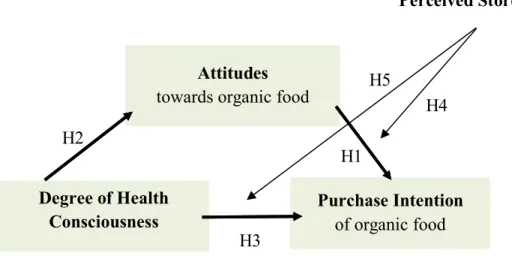
Figure 1: Conceptual Framework
Hypothesis 6
Attitude towards organic food mediates the relationship between Health consciousness and purchase intention of organic food (indirect effect).
Attitudes towards organic food
Purchase Intention of organic food Degree of Health
Consciousness
Perceived Store Image
H5
H4
H3 H2
CHAPTER 3: METHODOLOGY
The methodology used to address the proposed research questions and to test the formulated hypothesis will be presented in this chapter.
3.1 Research Approach
The purpose of this dissertation is to determine if consumers’ degree of health consciousness affects their intention to purchase organic food, taking into consideration the mediating effect of attitudes and the moderating effect of perceived store image.
To address the problem at hand both exploratory and descriptive research will be employed. The former will be needed to discover insights and all the relevant variables that should be considered for the stated problem. The latter will be used to gather information on the current market environment such as how consumers evaluate organic products and how they perceive Continente’s and Go Natural’s image.
Secondary data was used as a method of exploratory research, mainly in the literature review chapter. It consists mostly of academic papers and statistical figures. This data was crucial to define the problem more clearly and to develop the hypothesis that will guide this study. Additionally, it was also essential to design the primary data collection process since it provided the necessary information to build the constructs of attitude, degree of health consciousness, perceived store image and purchase intention.
A self-administered online questionnaire will be used to gather primary data for this study. With this quantitative research method, it is possible to collect data, generalize it from the sample to the population and ultimately recommend a course of action. A questionnaire is a suitable method in this situation since the aim of the dissertation is to capture information regarding attitudes, lifestyles, decisions and actions as well as demographics. Furthermore, due to budget and time constrains the online route is appropriate because it allows for a rapid turnaround in data collection with little to no costs.
3.2 Questionnaire Development
The online questionnaire will be divided into seven sections. The first section will feature a qualifying question – “Do you currently live in Portugal?”. Although Go Natural’s supermarkets only exist in the great area of Lisbon, the brand is spread throughout the whole
country due to the restaurant chain. Therefore, even if people don’t live close by to one of Go Natural’s seven supermarkets, that does not imply that they have not been there and/or that they do not hold a specific perceived image of the store in their minds. Both Continente and Go Natural only exist in Portugal. Thus, only people who are currently living in Portugal will proceed to answer the rest of the questionnaire. Furthermore, it includes a question to determine where in Portugal the respondent is currently living. The purpose is to understand if people who live in Lisbon have in general a different perceived store image of the supermarkets since it is the only part of the country where Go Natural supermarkets exist.
The items included in section II of the questionnaire are meant to measure the respondent’s degree of health consciousness. The scale of health consciousness, as developed in chapter 2.2.1, was created by mixing different previously studied approaches from Moorman and Matulich (1993), Gould (1988), Jayanti and Burns (1998) and Kraft and Goodell (1993). Thus, all the items comprised in the questionnaires were integrally extracted from those previous researches (appendix I). The first item, “health self-consciousness” was originally measured on a five-point scale, ranging from 0 to 4. In order to standardize the scales, it was changed to a scale ranging from 1 to 5. Additionally, the “health maintenance behaviour” construct is a combination of two factors of Kraft and Goodell’s wellness scale - physical fitness and nutrition and stress management.
Section III is related to the respondents’ habits regarding organic food. It includes broad questions to assess whether or not the respondent consumes and buys organic food as well as how much is spent per month in such products and where they buy it.
Respondents’ perceived store image of Continente and Go Natural is measured in section IV. The items used to assess the level of perceived store image were extracted from Bao, Bao and Sheng (2011) study (appendix II). Each respondent will be asked questions about only one store, either Continente or Go Natural. Filter questions will be employed to assess respondents’ level of brand recognition for each store in order to guarantee that they can answer accurately. Section IV consists of measures to assess respondents’ purchase intentions, based on Michaelidou and Hassan (2008) study (appendix III). The original scale in their study was a seven-point scale ranging from 0 to 6, where the higher the value, the higher the intention of purchasing the item. In order to have homogeneous scales for statistically purposes, the scale was reconfigured into a five-point likert scale. If in the previous section the respondent was asked about Continente, then he/she will answer the purchase intention questions regarding
organic food sold at Continente. Similarly, if he/she was asked about Go Natural in section IV then then he/she will answer the purchase intention questions regarding organic food sold at Go Natural.
Section V focuses on measuring consumers’ attitudes towards organic food. The items used in this measurement were adapted from a previous study by Tarkiainen and Sundqvist (2009) (appendix IV).
Lastly, the sixth section will feature some general demographic questions. The complete questionnaire can be found in the appendices section (appendix V).
3.3 Data Collection
Data will be collected from a non-probability convenience sample from people living in Portugal. A convenience sample will allow to get responses quickly and inexpensively. To overcome, in part, respondents’ inability to answer the self-administered questionnaire will be launch in both Portuguese and English. Additionally, the questionnaire was pre-tested so to address and fix any semantic or measurement issues as well as to assure respondents fully understand the questions.
3.4 Data Analysis
The data from the survey will be analyzed using SPSS software. Descriptive statistics will be employed to describe the sample both demographically as well as in regard to the consumption habits of organic food.
À priori, it was conceptualized in chapter 2, that the degree of health consciousness will have a direct effect on purchase intention and also, an indirect effect through the mediating effect of attitudes. Furthermore, both the direct and indirect effect are moderated by the variable perceived store image.
Keeping in mind the conceptual framework presented at the end of chapter 2, in order to analyze if attitudes towards organic meals play the role of a mediator while perceived store image plays the role of a moderator, a moderated mediation model will be analyzed (Hayes’ model 15), using PROCESS for SPSS. Before running this test, Cronbach’s alpha will be computed to assure reliability of the scales used. A correlation analysis will also be employed to check for associations between the variables. This is important since a moderated mediation analysis is based on the premise that there is some sort of relationship between the variables.
Additionally, a test will be conducted to determine whether there is a significant difference in the purchase intention between the two groups: those who answered questions regarding Go Natural, and those who answered regarding Continente.
CHAPTER 4: RESULTS
This chapter provides an analysis of the responses obtained and a discussion and interpretation of the results of the analysis.
4.1 Sample Characterization
The online questionnaire received a total of 1,186 responses. However, 138 had missing values and therefore they were excluded from the sample. Furthermore, the exclusion of respondents who stated, in the first question, that they were not living in Portugal (46) brought the number down to 1,002 responses.
The questionnaire was designed in a way so that respondents would answer the set of questions presented in the sections IV and V related to only one of the stores – Continente or Go Natural – given their self-assessed degree of knowledge about the store (30% or more). Because there were 89 respondents that claimed to have a low knowledge of the two stores, they were unable of answering those questions. Therefore, 76.12% (695 answers) of respondents answered the questions regarding Continente and the remaining 23.88% (218 answers) about Go Natural. Regarding the distribution of the sample, according to the Central Limit Theorem, when the sample is above 30, the sampling distribution is normally distributed.
4.1.1 Demographics
The demographic characterization of the sample goes as follows: 28.5% of the respondents are male and 71.5% are female. The majority of the sample is aged between 18 and 24 (55.8%) while 22.1% are aged between 25 and 34 and 10% between 35 and 44. Concerning the area of residence, 43% of the respondents currently lives in the great area of Oporto and 36.6% in the great area of Lisbon. On the subject of education, 36.7% of respondents stated that the highest degree of education they completed was a bachelor’s degree, 34.5% answered high school, and 17.9% claimed they have a master’s degree. Moreover, students constitute 52.8% of the sample while 24.3% are employed and 17% are working-students. Lastly, concerning the respondents’ household characterization, 36.2% are part of a four-member household, 26.7% are part of a three-member household and 17.1% of a two-member household. Furthermore, 70.9% of the respondents have no children in their household while 19.7% have one child and 7.7% have two. In what concerns the household’s monthly income, the sample is quite evenly distributed.
23.7% of respondents have an overall household monthly income between 1000€ and 1499€ while 19.2% and 19.1% are between 500€ and 999€ and between 1500€ and 1999€ respectively.
4.1.2 Consumption habits of Organic Food
69.4% of the respondents stated they have consumed organic food in the three previous months before answering the questionnaire. Furthermore, out of those who consumed organic food, 37% claimed that their organic food consumption constitutes 20% or less of their total food intake (sporadic organic food consumers); for 32.2% of the respondents, between 20% and 40% of their food intake is organic food (occasional organic food consumers); for 15%, their organic food intake rises to between 40% and 60% (frequent organic food consumers); the organic food consumption for 10.9% of the respondents represents between 60% and 80% of their total food intake (regular organic food consumers); and lastly, the remaining 4.9% respondents eat organic food has the main part of their diet, between 80% and 100% (heavy organic food consumers). Adding to the question “Did you consume organic food in the last three months?”, it was also required that the respondents answered the question “Have you bought organic food in the last three months?”, since there is a big distinction between purchasing and consuming a product. Hence, to this last question, 475 stated that they have bought organic food in the past three months. Furthermore, 98.8% out of those 475 respondents also stated they consumed organic food in the past three months, implying that the majority of those who buy it also consume it. In an interesting note, 46.2% of the respondents who answered questions about Continente claimed to have had bought organic food in the past three months, while for the respondents who answered questions about Go Natural this percentage increases to 70.6%.
Regarding average monthly expenditure on organic food, 48.8% of respondents spend less than 20€, 28.2% spend between 20€ and 39€, 12.4% spend between 40€ and 59€, 3.8% spend between 60€ and 79€ and lastly, 6.7% spend 80€ or more.
In what concerns the type of retailer respondents go to (appendix VI), in order to buy organic food, 74.2% of the sample goes to hyper or supermarkets (345 out of 475) – 74.2% of those who shop at hyper/supermarkets go to Continente, 51.6% go to Pingo Doce, 24.6% go to Lidl, 20.6% go to Jumbo and 13.6% go to other supermarkets such as E.leclerc, Mini Preço and/or El Corte Inglês. Additionally, 35.3% of the sample shops in specialized stores (169 out of 475) – 77.5% of those who shop at specialized stores go to Celeiro, 30.77% go to Go Natural and
50% of the sample goes to other stores such as AmorBio and Quintal Bioshop. Lastly, 16.4% of the respondents selected the answer “other” (75 out of 475) – 41.3% buy the organic products in the existing markets, 21.3% grow their own products, 17.3% get the products from acquaintances (family, friends, neighbours etc.), 13.3% acquire it directly from the producers (mainly farmers), 5.3% buy it in local stores and 1% from a delivery store, Bio em Casa.
4.2 Scales’ Reliability
It is important to test the scales’ reliability to guarantee that all the items in a construct are measuring the same concept, in a consistent manner. The higher the reliability, the smaller the fraction of error in a test (Tavakol & Dennick, 2011). Cortina (1993) further explain that there are different reliability tests that are appropriate depending on the sources of variance considered relevant. In order to test the reliability of the scales used in the questionnaire, the Cronbach’s alpha will be measured individually for each of the scales. The choice of this measure lies on the fact that the error factors are related to the use of different items, which is a matter of internal consistency. Tavakol and Dennick (2011) state that the acceptable values of Cronbach’s alpha reported in several studies fall between 0.70 and 0.95. However, a very high alpha may suggest redundancy of the items used and therefore they recommend a maximum value of 0.90.
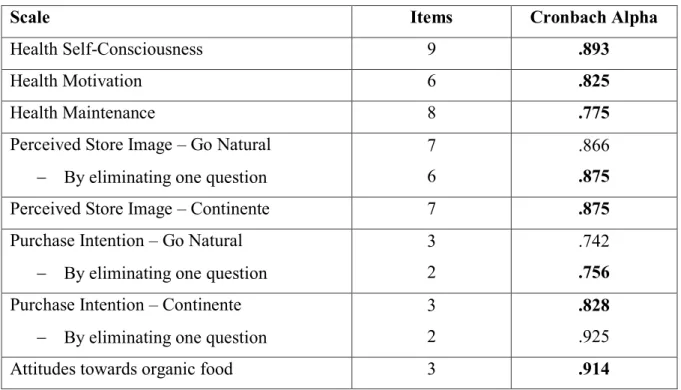
Regarding the scales used in the questionnaire, the health self-consciousness, health motivation and health maintenance scales have an alpha of 0.893, 0.825 and 0.775, respectively. The scale that measures the perceived store image of Go Natural has an alpha of 0.866. However, by eliminating one question the value of alpha increases to 0.875. Therefore, the third question of the scale will be eliminated, and it won’t take part of any further statistical analysis. The perceived store image scale regarding Continente has an alpha of 0.875. The scale of purchase intention concerning Go Natural has an alpha of 0.742 but by eliminating one of the items that value increases to 0.756. The same happens to the scale of purchase intention concerning Continente. With all the items the alpha is 0.828 but by eliminating one item it increases to 0.925. However, because it is higher than 0.90, all the items will be kept.
Table 1 – Cronbach’s Alpha Values
Scale Items Cronbach Alpha
Health Self-Consciousness 9 .893
Health Motivation 6 .825
Health Maintenance 8 .775
Perceived Store Image – Go Natural By eliminating one question
7 6
.866 .875
Perceived Store Image – Continente 7 .875
Purchase Intention – Go Natural By eliminating one question
3 2
.742 .756 Purchase Intention – Continente
By eliminating one question
3 2
.828 .925
Attitudes towards organic food 3 .914
4.3 Measures of Association
Before running the regressions necessary to test the proposed model, it is important to determine if there is an association between the variables. Given the mediation and moderation process it should be anticipated that in fact, there is a statistically significant relationship between the variables.
A Pearson correlation was run to determine the relationship between ‘Attitudes’ and the ‘Degree of Health Consciousness’ (appendix VII). The correlation was found to be positive and statistically significant (r=0,236, p <.001, N=913). Furthermore, the correlations between the variable ‘Attitudes’ and each of the four individual components of the degree of health consciousness’ scale are all statistically significant and all positive, except for the correlation between ‘Health Knowledge’ and ‘Attitudes’ (r= -0,70, p=0,035, N=913).
A point-biserial correlation was run to compute the relation between ‘Attitudes’ and ‘Purchase Intention’. The correlation is positive and statistically significant (r=0,420, p <.001, N=913) (appendix VIII). The same measure was used to determine the correlation between ‘Degree of Health Consciousness’ and ‘Perceived Store Image’. In this case, the value obtained is not significant and therefore, one cannot conclude that there is an association between these variables (appendix IX). On another note, the relationship between ‘Degree of Health
Consciousness’ and ‘Purchase Intention’ is positive and statistically significant (r=0,169, p
<.001, N=913) (appendix X).
As for the correlation between ‘Attitudes’ and ‘Perceived Store Image’, a point-biserial correlation test showed that there is no significant correlation between the variables (appendix VIII). For a more exhaustive analysis, a pearson correlation between the metric variable ‘PSI_GN’ and ‘Att’ and another correlation between ‘PSI_C’ and ‘Att’ allowed for the clarification that the correlation between attitudes and perceived store image for respondents that answered questions regarding Go Natural is positive and statistically significant (r=0,306,
p <.001, N=218). Contrarily, for those who answered questions regarding Continente, the
correlation between attitudes and perceived store image was not statistically significant (appendix XI).
In order to study the association between the two dichotomous variables ‘Perceived Store Image’ and ‘Purchase Intention’ a chi-square test was employed (appendix XII). For those who have a low perceived store image (N=419), nearly half has a high level of purchase intention (N=205). Amongst those with a high level of perceived store image, the majority (69.8%) also has a high level of purchase intention. Since, χ(1) = 41,394, p <.001, one can reject the null hypothesis that the level of purchase intention is independent of the level of perceived store image and therefore, there is a statistically significant association between these two variables. Moreover, by analyzing Cramer’s V, one can observe that the association between the variables is moderated, φc = 0,213, p <.001.
4.4 Conditional Process Model
The conceptual framework developed in the literature review chapter illustrates the relationships between different variables that, in this subchapter, through statistical analysis, one will be able to support them or not.
In previous chapters it was concluded that, taking into consideration past research, the ‘degree of health consciousness’ was a good predictor of ‘purchase intention of organic food’. Also, there was evidence that to a certain extent this relationship was mediated by a third variable – ‘consumers’ attitudes towards organic food’. Moreover, it was found that ‘consumers’ perceived store image’ can have an impact on the size or sign of the effect of the independent variable ‘degree of health consciousness’ on the dependent variable ‘purchase intention of
organic food’ while also impacting the effect of the mediator ‘attitudes’ on the dependent variable ‘purchase intention of organic food’.
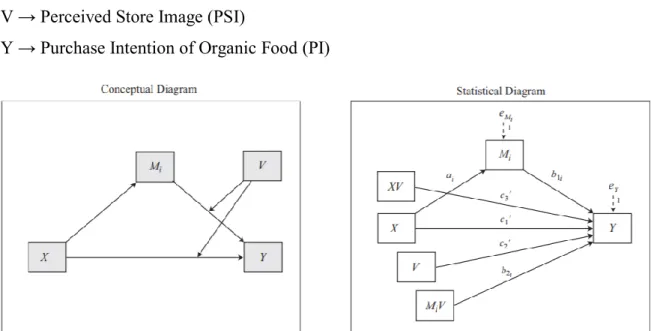
X → Degree of Health Consciousness (DHC) M → Attitudes towards Organic Food (Att) V → Perceived Store Image (PSI)
Y → Purchase Intention of Organic Food (PI)
Figure 2: Hayes's PROCESS Model 15: moderated mediation
This combination of both mediation and moderation is what Hayes (2012) defines as conditional process modelling or moderated mediation. In the situation described above, where the second stage of the mediation process (M → Y) and the direct effect (X → Y) are being moderated is called ‘second-stage and direct effect moderation model’. The purpose of the statistical analysis that will follow aims at testing hypothesis about the conditional nature of the various ways the variable ‘DHC’ influences the dependent variable ‘PI’, as well as to quantify those results. By using PROCESS for SPSS, one can put together parameter estimates of a mediation analysis with the ones of a moderated analysis in ways that quantify the conditionality of the several paths of influence from X to Y (Hayes 2012).
In equation form, the model presented above splits in two linear equations:
M = iM + ai + eM (1)
Furthermore, the conditional indirect effect of X on Y through M is ai(b1i + b2i V) (3) and the conditional direct effect of X on Y is c1' + c3'V (4).
As Hayes (2015) explains, if the putative moderator variable has a nonzero weight in the function linking the indirect effect of X on Y through M to the moderator (ab2, equation 3) then, the mediation mechanism can be supposed to be moderated. This weight is the Index of Moderated Mediation, a quantification of the linear relationship between the putative moderator and the indirect effect. This test is rather important since establishing that one of the paths of the indirect effect is moderated does not necessarily translates into a moderation of the indirect effect (Hayes, 2015).
4.5 Statistical Analysis of the Moderated Mediation Mechanism
The following results were obtained using the statistical software SPSS and the add-on PROCESS, model 15. The table below renders a summary of the results obtained (appendix XIII).
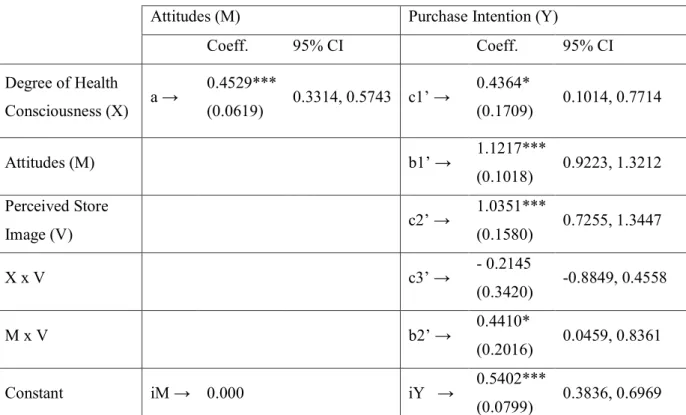
Table 2 – Summary of the Results
Attitudes (M) Purchase Intention (Y)
Coeff. 95% CI Coeff. 95% CI Degree of Health Consciousness (X) a → 0.4529*** (0.0619) 0.3314, 0.5743 c1’ → 0.4364* (0.1709) 0.1014, 0.7714 Attitudes (M) b1’ → 1.1217*** (0.1018) 0.9223, 1.3212 Perceived Store Image (V) c2’ → 1.0351*** (0.1580) 0.7255, 1.3447 X x V c3’ → - 0.2145 (0.3420) -0.8849, 0.4558 M x V b2’ → 0.4410* (0.2016) 0.0459, 0.8361 Constant iM → 0.000 iY → 0.5402*** (0.0799) 0.3836, 0.6969 Unstandardized OLS Regression Coefficients with Confidence Intervals (Standard Errors in Parentheses). Estimating Attitudes and Purchase Intention of organic food. The variables DHC, Att and PSI are Mean Centered.
4.5.1 Hypothesis 1: Positive attitudes towards organic food will positively affect the intention to purchase them.
The first hypothesis drawn from the literature review claims that the higher the attitudes towards organic food, the higher the purchase intention. The results from the logistic regression show that the unmoderated effect of ‘Att’ on ‘PI’ is positive and statistically significant, b1=1.1217, p <.001, CI= 0.9223,1.3212. Thus, it supports the hypothesis that positive attitudes towards
organic food positively affect the intention to purchase organic food.
*** p < .001, ** p < .01, * p < .05 Significant Non-significant
Figure 3: The impact of Attitudes on Purchase Intention
4.5.2 Hypothesis 2: Health consciousness will positively affect attitudes towards organic food.
People with a higher degree of health consciousness expressed a higher level of attitudes towards organic food, a=0.4529, p <.001, CI=0.3314, 0.5743. This result supports the second hypothesis that the degree of health consciousness positively affects one’s attitudes towards organic food, since the effect is positive and statistically significant.
*** p < .001, ** p < .01, * p < .05 Significant Non-significant
Figure 4: The impact of the Degree of Health Consciousness on Attitudes
4.5.3 Hypothesis 3: Health consciousness will positively affect purchase intention of organic food.
The direct effect of ‘DHC’ on ‘PI’ (c1) is positive and statistically significant, c1=0.4364, p=0.0107, CI=0.1014, 0.7714. This result supports the third hypothesis that the degree of health
consciousness positively affects the purchase intention of organic food. Attitudes 1.1217*** Purchase Intention
*** p < .001, ** p < .01, * p < .05 Significant Non-significant
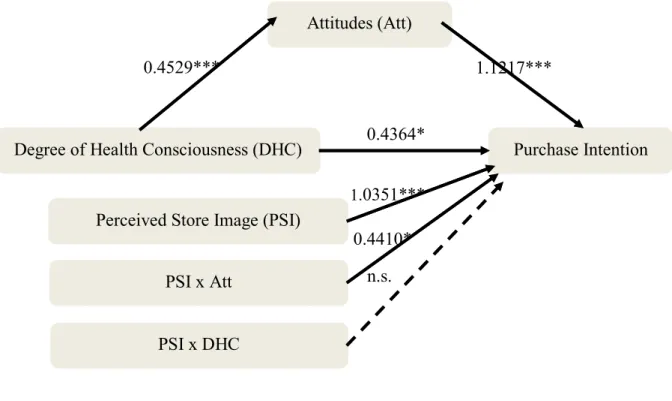
Figure 5: The impact of the Degree of Health Consciousness on Purchase Intention
4.5.4 Hypothesis 4: Perceived store image will impact the relation between the attitudes consumers hold towards organic food and their purchase intention of organic food. Holding ‘DHC’ constant, the effect of consumers’ attitudes towards organic food on purchase intention depends on the moderator perceived store image, b2=0.4410, p=0.0287, CI=0.0459, 0.8361. Therefore, the data supports hypothesis four: perceived store image will impact the
relationship between attitudes towards organic food and purchase intention of organic food. Furthermore, the variable ‘PSI’ on its own has a positive and statistically significant effect on purchase intention, c2=1.0351, p <.001, CI=0.7255, 1.3447.
*** p < .001, ** p < .01, * p < .05 Significant Non-significant
Figure 6: The impact of Attitudes on Purchase Intention moderated by Perceived Store Image
4.5.5. Hypothesis 5: Perceived store image will impact the relation between the degree of health consciousness and purchase intention of organic food.
In the model being studied, and with the data available, the interaction between ‘DHC’ and the moderator ‘PSI’ (c3) for predicting ‘PI’ has a p-value of 0.5305 and, therefore, is not statistically significant. To probe this interaction, one can resort to the results of the test ‘conditional direct effect of X on Y at values of the moderator’. It is estimated that when the value for ‘PSI’ is low, the conditional direct effect (DHC → PI moderated by PSI) is positive and statistically significant, c3low=0.5525, p=0.0258, CI=0.0676, 1.0374. On the other hand, when the value for
‘PSI’ is high the conditional direct effect is not statistically significant, p=0.1528, CI=-0.1249, Degree of Health Consciousness (DHC) 0.4364* Purchase Intention
Purchase Intention PSI x Attitudes
Perceived Store Image (PSI)
0.4410* 1.0351***
0.8008. Thus, the effect of the variable degree of health consciousness on purchase intention is moderated by ‘PSI’, supporting hypothesis five, but only for people who have a low perceived
store image.
*** p < .001, ** p < .01, * p < .05 Significant Non-significant
Figure 7: The impact of the Degree of Health Consciousness on Purchase Intention moderated by Perceived Store Image
4.5.6 Hypothesis 6: Attitude towards organic food mediates the relationship between Health consciousness and purchase intention of organic food (indirect effect).
The indirect effect in this model is given by the product of the effect of ‘DHC’ on ‘Att’ (equation 1) and the conditional effect of ‘Att’ on ‘PI’ (equation 2). Considering θ to be the indirect effect:
θ = 0.4529 * (1.1217 + 0.4410V) = 0.5080 + 0.1997PSI
The equation above is a linear function of V, with intercept 0.5080 and slope of 0.1997. The slope is the index of moderated mediation and its positive number implies that the indirect effect of the independent variable ‘DHC’ on the dependent variable ‘PI’ through ‘Att’ is an increasing function of ‘PSI’. As represented in the table above, the bootstrap confidence interval for the index does not include zero, being statistically significant. Hence, results show that in fact there is a mediation effect of the degree of health consciousness on purchase intention through attitudes.
4.5.7. Overall Model
The overall model estimated by Process, through a logistic regression, has a p-value < 0.001 meaning that the model is statistically significant. Moreover, all the variables in the model are
PSI x DHC
Perceived Store Image (PSI)
Purchase Intention n.s.
significant, with a p-value < 0.05 except for the interaction between the dependent variable ‘DHC’ and the moderator ‘PSI’ that has a p-value of 0.5305, CI= -0.8849, 0.4558.
To sum up, the degree of health consciousness does indeed affect the purchase intention of organic food. Also, this effect is mediated by attitudes towards organic food. The second path of this mediation (Att → PI) was found to be moderated by the variable perceived store image. On the other hand, the direct effect of the degree of health consciousness on purchase intention is not moderated by the perceived store image variable, except when the latter is ‘low’.
The equation of the model is presented below:
PI = 0.5402 + 1.1217 Att + 0.4364 DHC + 1.0351 PSI + 0.4410 Att*PSI – 0.2145 DHC*PSI
*** p < .001, ** p < .01, * p < .05 Significant Non-significant
Figure 8: The impact of the different variables on Purchase Intention
4.6 Analysis of the different components of the Degree of Health Consciousness variable As defined in the literature review chapter, the variable ‘Degree of Health Consciousness’ is formed by four different scales. Given that the overall variable was proven to be statistically significant in predicting ‘Purchase Intention’, the following analysis aims at understanding if the components that constitute this variable are, independently, statistically significant.
Attitudes (Att)
PSI x DHC
Purchase Intention
n.s. 1.0351*** Perceived Store Image (PSI)
PSI x Att
Degree of Health Consciousness (DHC) 0.4364*
1.1217***
0.4410* 0.4529***
4.6.1 Health Self-Consciousness
Running the same model has previously but changing the independent variable to ‘Health Self-Consciousness (HSC)’ the results are quite different (appendix XIV).
The overall model is statistically significant, p <.001. However, two of the variables are not: the independent variable ‘HSC’ (p=0.3995, CI= -0.1472, 0.3693) and the interaction between ‘HSC’ and ‘PSI’ (p=0.9491, CI= -0.5294, 0.4959).
Regardless of the level of the moderator, the conditional direct effect of ‘HSC’ on ‘PI’ is always non-significant since the p-values are higher than the significance level of 5% and the confidence intervals cross zero.
‘HSC’ is a significant predictor of ‘Att’, aHSC=0.3717, p <.001, CI= 0.2799, 0.4636. Moreover,
for both levels of the moderator, high and low, the conditional indirect effect is positive and statistically significant (bootstrap confidence intervals do not cross zero). The effect of ‘HSC’ on ‘PI’ through ‘Att’ increases when the moderator ‘PSI’ is high. Lastly, the index of moderated mediation is positive (0.1605) and statistically significant, BootCI=. 0.0033, 0.3410.
4.6.2 Health Knowledge
In the overall model with ‘Health Knowledge (HKnow)’ as the independent variable (appendix XV), all variables are statistically significant with the exception of ‘HKnow’ (p=0.1092, CI=-
0.0323, 0.3214) and the interaction between ‘HKnow’ and the moderator ‘PSI’ (p=0.5094, CI= -0.4710, 0.2338).
In what concerns the indirect effect of ‘HKnow’ on ‘PI’, the results show that there is statistically significance that supports the evidence of such effect although they contradict the results obtained with the variable ‘Degree of Health Consciousness’. Firstly, ‘HKnow’ is a significant predictor of mediator ‘Att’. However, the effect is negative, aHK=-0.0732, p=0.0348, CI=-0.1412, -0.0052. This implies that the higher the knowledge a person has about health, the
lower the attitudes towards organic food. Secondly, the indirect effect of ‘HKnow’ on ‘PI’ through ‘Att’ at different values of the moderator is negative and statistically significant since both bootstrap confidence intervals are negative and do not cross zero. In addition, the index of moderated mediation is negative (-0.0303) but statistically significant, BootCI= -0.0971,