Collaborative Learning supported by mobile devices:
A case study in Portuguese High Education Institutions
Fernando Moreira1,2, Maria João Ferreira1,3, Carla Santos Pereira1, Natércia Durão1,1 Universidade Portucalense, DEGI, Rua Dr. António Bernardino de Almeida, 541, 4200-070 Porto, Portugal
2 IJP, Universidade Portucalense, IEETA, Universidade de Aveiro, Portugal 3Centro Algoritmi, Universidade do Minho, Portugal
{fmoreira, mjoao, arlasantos, natercia}@upt.pt
Abstract. Collaborative learning has been getting more importance in educational environment as one type of mobile learning application. In this learning environment there are a shift of learning approach, i.e. in a traditional approach the focus is on the teacher and in static and repetitive contents, oppositely with a collaborative learning the learn is centered in the students where they have a critical apprehension of contents that goes beyond the classroom, students could learning in different places. Learning supported by mobile technologies is becoming a new approach towards education, and it is single in the way that offers opportunities to learn anywhere and anytime. This paper introduces the foundations of collaborative learning supported by mobile technologies as well as presenting and analysing the evolution of collaborative learning supported by mobile devices in Portuguese (North region) Higher Education Institutions between 2009/2010 and 2014/2015.
Keywords: Mobile learning, Collaborative learning, mobile devices, anywhere, anytime.
1 Introduction
Mobile technologies, particularly Tablets and Smartphones, are quickly becoming powerful technologies enough to override personal computers in several tasks with the advancement of wireless and mobile technology. While these technologies has dramatically transformed our society in the way we communicate, create, retrieve and share information, collaborate and socialize each other, the application of these technologies is still relatively young [1].
Mobile learning has become a research field of interest of practitioners in the different phases of education to facilitate learning in different contexts [2]. The key aspects of this interest are the growing importance and their use, in the day-by-day, of students in the most several activities, and the increasing portability of these technologies, as well as the reduction in their cost and services [3].
Learning supported by mobile technologies is becoming a new approach towards education, and it is single in the way that offers opportunities to learn anywhere and
anytime [4], [5]. On the other hand, collaborative learning has long been believed to hold great value for education, but creating a collaborative learning experience inside and outside of the classroom is a challenge with which teachers continue to struggle, since there are several obstacles e.g. their own preparation for the introduction of this learning approach [6]. Additionally, there are no consensuses in interpreting collaborative learning. Since, it varies in focus according to the literature (see section 2.1). However, new educational application - educational apps [7] have, at least in some contexts, begun to transform the way teachers teach, students learn, and teachers and students interact.
This work analyses the evolution of mobile technologies in Higher Education Institutions (HEI) in Portugal (North region) between 2009/2010 and 2014/2015, being an evolution of the work [8] analyses and discusses more general results.
The paper is structured as follows. Section 2 critically examines previous definitions of collaborative learning and mLearning and comes up with a definition that seems best to serve the learning of individual and collaborative mLearning. Section 3 presents the state of the art in collaborative learning with mobile devices in Portugal in HEI. Section 4 presents the methodology. Section 5 summarizes the results and discussion of the research and lastly, section 6 presents the study conclusions.
2 Background
In this section, are considered some of the current pedagogical paradigms that support learning, with particular emphasis on collaborative learning, whose aim is to demonstrate the potential that this paradigm has in the use of mobile devices.
2.1 Collaborative learning
The current educational paradigms aim to motivate students to learn, with the help of teachers, technology and other students, which would potentially contributed to the effective development of their academic and/or professional activities [9]. These new educational views are closely related to the pedagogical theories [10], [11], such as the constructivism [12], the behaviorism [13], the situated learning [14], the problem-based learning [15], the learning-oriented context [16], the social learning [17] and the collaborative learning [18].
According to Panitz [19] collaboration is an interaction philosophy and a personal lifestyle. In this context, it is possible to state that the collaborative learning is more than a classroom approach; it is a way to deal with people that respect and emphasizes individual skills and contributions of each member of a group. All group members share responsibilities and authority, thus giving a more active role to stakeholders in the learning process.
According to Harasim, Calvert, and Groeneber [20] collaborative learning is an oriented approach that promotes a dynamic and collaborative participation, promoting a greater cognitive development when compared to individual activities. The great challenge is to develop a culture of participation and responsibility of those involved
in learning. That involvement is established through the formation of groups or learning communities.
Additionally, Wiersema [21] points out that a more efficient learning, as well as a more efficient work, is collaborative and social rather than competitive and isolated.
To Stahl [22], the process of social sharing on what is understood by the group, central phenomenon of collaboration, could be studied through collaborative negotiation sequences, during the interactions between the participants of the working group.
Group learning can be interpreted in several ways: (i) presential or virtual learning; (ii) synchronous or asynchronous. This type of learning allows the effort made by learners can be fully together or through the division of tasks. Therefore, the practice of collaborative learning may assume multiple characterizations, although there might be dynamics and results of learning to each specific context, namely when the means used are diverse, from the personal computer to the mobile devices.
The collaborative learning [23] is part of a set of pedagogical trends: (i) Movement of the New School; (ii) Theories of Genetic Epistemology of Piaget; (iv) Socio-cultural Theory of Vygotsky and; (v) Progressive pedagogy.
According to the same authors the pedagogy of the New School the Progressive, together with cognitive theories formulated by Piaget and Vygotsky, generate the foundations of collaborative learning, which have led to the movement of classes focused on the teacher, with static and repetitive contents for classes focused on the students and a critical apprehension of contents.
2.2 mLearning
Mobile Learning (mLearning) concept is not new and, it is important to understand/analyze its evolution. For example, Viteli [24] finished his article, written 15 years ago, with the following statement: “The concept of mLearning is yet very
unknown. On 15th of September 2000 the Google provided 40 links to mLearning and 29.900 to eLearning.”, while Costa and Xavier [25] by performing a search on
Google in July 2014 found approximately 252 million links to eLearning and 231 million links to mLearning.
mLearning can be defined as a way of learning that makes use of mobile communication technologies and gives to the students the capacity to learn anywhere and anytime. This definition is based on the definition presented by [26] “Any sort of learning that happens when the learner is not at a fixed, predetermined location, or learning that happens when the learner takes advantage of the learning opportunities offered by mobile technologies.” Mobile learning can be defined as the learning that occurs linked to mobile devices [27]. Mobile devices include mobile equipment (Laptops, Tablets and Smartphones) which have been undergoing a very strong evolution from the point of view of capacity, reliability and, at a more economic perspective, a great reduction in prices. They have come to endow their installations with wifi networks, which by on the one hand, promoting and fostering the use of those devices and, on the other hand, allow the evolution of the teaching-learning process (TLP).
mLearning, according to Traxler [28], offers five features that potentiate new learning opportunities: (i) contextual learning allows students to respond and react to experiences lived in different contexts; (ii) located learning, learning occurs in the applicable environments; (iii) the authentic learning, with tasks directly related to the objectives that want to reach; (iv) the conscious learning of the context in which is informed by the history and objectives; and (v) personalized learning, that is, directed to the preferences of each student.
Contrary to other kind of learning activities, the TLP with mobile devices began with the assumption that students are always on the go and have activities in line with the context in which they are. In this context, Looi, et al. [29] argue that mobile devices provide the integration of education in school and beyond, with continued learning experience. In the same direction UNESCO [30] has prepared its guidance projects for mLearning and recognizes the value of mobile technology is significantly higher when students continually learn from their mobile devices (BYOD - Bring Your Own Device) as ubiquitous mediators between types of learning, for example collaborative learning.
3 State of the art
According to the literature the use of mobile devices for educational purposes using different methods and devices has been conducted around the world. All across the globe, students from elementary school through high school are increasingly engaging with advanced wireless devices to collaborate with peers, access rich digital content, and personalize their learning experiences. Always-on, always-connected, Smartphones and Tablets provide today’s students with a ubiquitous gateway to a new ecosystem of information, experts, and experiences, regardless of the physical assets and resources in their own communities.
Baran [31] presents a study with a review of research on mobile learning in teacher education where 37 papers were analyzed. In the analysis the following categories were considered: subject domain, type, method, data sources, reliability, validity and trustworthiness report, mobile technology used and country context. From this study it was possible to conclude that there is no study on mobile technologies in education, particularly in Higher Education Institutions in Portugal (North region), thus making it relevant and justified.
4 Research methodology
The purpose of this section is to describe the procedures used to collect data that are the basis for this research. The main feature of the scientific method is an organized research, strict control of the use of observations and theoretical knowledge. The present study was based on quantitative research methodology.
For the present study, we used the methodology of quantitative research, since it is more appropriate to determine the opinions and attitudes of the respondent based on structured questionnaires. In this approach, data is collected through structured
questionnaires, and clear goals in order to ensure uniform compression of the respondents and a consequent standardization of results.
The method of the questionnaire, according to [32], is recommended when you want to know a population, to analyze social phenomena and, in cases where it is necessary to inquire a great number of people about a certain subject. The questionnaire before being delivered was subjected to the evaluation of four experts in the field. The objective of this study was to obtain answers that will measure the influence of the utilization of mobile devices in HEI. The quantitative study was based on a questionnaire with 16 questions (Q1-Q16). As a matter of space we will just present the analysis of the comparison between two questions (Q15 and Q16) and these results crossed with questions Q1, Q2 and Q3.
5 Analysis and discussion of results
The surveys presented to the students had a few changes depending on the academic year (2009/10 and 2014/15), since there are some equipment and technologies that were important in 2009/10 and today are no longer used, for example PDA, or technologies that are now part of the daily lives of students.
In the survey conducted in the academic year 2014/15 were included questions related to Tablets and new technological solutions. In this context, the section will be divided into three subsections, the first one with the sample characterization information [8], the second dedicated to the use of mobile devices to support learning (Q15) and the third subsection dedicated to the use of mobile devices supporting collaborative learning (Q16) through the analysis and discussion of the comparative study of the common questions of the academic years 2009/10 and 2014/15, as well as the intersection of these issues with the course (Q1), age (Q2) and gender (Q3). Data were collected and treated with the use of IBM SPSS Statistics 20.0 software. In this paper will not show all the results obtained due to the number of pages limitation. Thus, the results of Q15 and Q16 questions will be presented as well as its intersection with the characterization questions (Q1, Q2 and Q3).
5.1 General characterization
The study sample consists of 151 students in the 2009/10 academic year and 273 students in the academic year 2014/15, distributed among the courses Electrical and Computer Engineering (from now on will be referred to throughout the text as Engineering), Economics/Management and Law in HEI in the north of Portugal. Age-related question (Q2) revealed some differences between the two academic years of study (20109/10 and 2014/15). For example, while in 2009/10, the percentage of students aged 18 years was 4.6% in 2014/15, the percentage passing to 25.3%. In contrast, the trend in higher class (> 20 years) has a reversal of the proportions, i.e., 45.7% and 28.9%, respectively. In both academic years the percentage of female students is approximately 60% (Q3).
The distribution of students attending the courses (Q1) is as follows: in the academic year 2009/10 responded to the survey 21.85% of law students, 40.40% of
students of Economics/Management and 37.75% of students engineering; while in the academic year 2014/15 responded to the survey 28.94% of law students, 34.80% of students in courses Economics/Management and 36.26% of engineering students, with a clear trend of using mobile devices in TLP.
5.2 Mobile devices to support learning
Evaluating the answers to the question "Do you consider come to use mobile devices
to support learning?" (Q15) is prevalent in both academic periods, the percentage of
students who responded positively. Should be highlighted that is even more apparent the percentage of positive responses in the period 2014/15 to 93.4% of "Yes" against 87.3% in the previous period (2009/10). The positive prevalence is relevant whatever the frequented degree (with particular regard to the period 2014/15). Therefore, when we perform Chi-square test to assess whether there is association between the questions and the course we conclude that there is no significant association (p-value
= 0.343 and p-value = 0.912, respectively). It seemed so interesting to analyze
whether there are differences of opinion on this question by student course area. Considering the areas - Science and Humanities Courses, the results are in Tables 1-2.
Table 1. Frequency of use of mobile device by Course area (year 2009/2010). Science courses Humanities courses Total No 13 6 19 68,4% 31,6% 100,0% 11,1% 18,2% 12,7% Yes 104 27 131 79,4% 20,6% 100,0% 88,9% 81,8% 87,3% Total 117 33 150 78,0% 22,0% 100,0% 100,0% 100,0% 100,0% Table 2. Frequency of use of mobile device by Course area (year 2014/2015).
Science courses Humanities courses Total No 13 5 18 72,2% 27,8% 100,0% 6,8% 6,3% 6,6% Yes 179 74 253 70,8% 29,2% 100,0% 93,2% 93,7% 93,4% Total 192 79 271 70,8% 29,2% 100,0% 100,0% 100,0% 100,0%
By observing the two tables above and performing Pearson Chi-square associations with continuity correction (p-value = 0.434> 0.05 and p-value = 1.000> 0.05, respectively) found that there are no differences of opinion by areas of knowledge.
We also performed an analysis in order to assess whether there were differences in the opinion of students according to their gender concluding that in both periods are predominant positive responses, regardless of gender. Finally, we find it of interest to assess whether age (group 1 - 18/19, and group 2 - 20 years or more) had influence on the opinion of students on the use of mobile devices to support learning. In both periods, we conclude that there are no significant differences with values obtained for the p-value exceeding 0.9, since the predominant "Yes" regardless of age group.
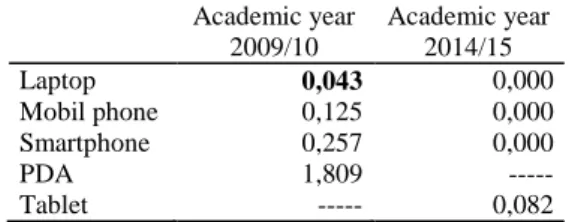
Among the mobile devices we were also assess, for the two periods, if there was an association between the frequency of use of each of the mobile devices (PDA, Laptop, Mobile Phone, Smartphone and Tablet) and the Course, using for this the association test Pearson chi-square (Table 3).
Noted that, regarding the PDA device, this was only assessed in 2009/10 because it was replaced with more modern technologies, such as the Tablet (only emerged for evaluating the period 2014/15).
Table 3. Values of the p-value for the crossing of the devices that are more used for the Course. Academic year 2009/10 Academic year 2014/15 Laptop 0,043 0,000 Mobil phone 0,125 0,000 Smartphone 0,257 0,000 PDA 1,809 --- Tablet --- 0,082
For the school year 2009/10, it is only significant association between the use of the Laptop and the course, this is because we find that although predominate positive responses to any course, from among negative responses, is very relevant the value obtained for the Law degree (21.2% of "No" against the 8.2% and 5.3% for other courses).
As for the most recent period, we highlight some findings of interest only to the intersections that revealed the existence of a significant association. In the course of Engineering, nearly all students use the Notebook (97%) and the Smartphone (87.9%) and only 26.3% use the Mobile Phone. In the Economics/Management course, Laptop and Smartphone are also the most used devices though a lesser extent (about 65%). Already in Law course, the most widely used device is the Laptop (81%), and the Mobile Phone and Smartphone used respectively by 57% and 55.7% of students.
Finally, comparing the evolution of the use of mobile devices in the two periods, the verified transition is evident, regardless of course, for the use of a technologically more advanced device. While the first period was more frequent Mobile Phone use, the most recent period, the Mobile Phone has been exceeded by the use of Smartphone (Fig. 1).
Fig. 1. (a) Evolution of the use of Mobile Phone in the three courses for both academic years and (b) Evolution of the use of Smartphone in the three courses for both academic years.
5.3 Mobile devices in supporting collaborative learning
Evaluating the answers to the question "Do you consider come to use mobile devices
in collaborative learning environments?" (Q16) predominance of positive responses
("Yes") in any of the periods and whatever the course attended. However, while that for the school year 2009/10 we conclude that there is a statistically significant association (p-value = 0.040 <0.05) between the course and the responses to question Q16, this situation no longer holds for the period 2014 / 15 (p-value = 0.307> 0.05). The existence of an association in the period 2009/10, was due to the fact that the percentage of positive responses in the course of Law, though high, (69.7%) was significantly lower than those obtained for the Engineering (83.6%) and Economics/Management (90.2%) courses.
Then examined whether there are differences in the use, or not, of mobile devices in collaborative learning environments depending on the gender of the students. We conclude that, as to the question Q15 (analyzed above), are prevalent positive responses, regardless of gender, for both periods. Similarly, we evaluated also to this question (Q16), whether age influences the opinion of students. Once again, we find similar behavior to that obtained for the Q15 question, i.e., no significant differences in both periods (predominance of "Yes" to the two age groups).
So we think it would make sense to evaluate if the answers to both Q15 and Q16 questions were related or not (Table 4). By carefully observing the Table 4 and having regard to the values obtained for the respective p-value (p-value = 0.000 <0.05 in both periods), we conclude that these two questions are related in the sense in that students most consider come to use mobile devices in learning are also the most likely to consider using these devices in the collaborative learning (the same kind of behavior is found for those who do not consider come to use).
Table 4. Crossing of the questions Q15 and Q16 for both academic years.
2009/10 2014/15
Q16 Q16
No Yes Total No Yes Total
84,2% 15,8% 100% 72,2% 27,8% 100% 64% 2,4% 12,8% 52,% 2,0% 6,6% Yes 9 121 130 12 241 253 6,9% 93,1% 100% 4,7% 95,3% 100% 36% 97,6% 87,2% 48% 98% 93,4% Total 25 124 149 25% 246 271 16,8% 83,2% 100% 9,2% 90,8% 100% 100% 100% 100% 100% 100% 100,04%
6 Conclusions
Collaborative learning seems to be a learning innovation whose time has come. It will make a student actively engage in building their own knowledge. Basically, collaborative learning supported by mobile technology allows that on one hand the students have access and share materials and acquire skills that promote working in group and sharing ideas and knowledge.
In a collaborative learning environment there are a shift of learning approach, i.e. in a traditional approach the focus is on the teacher and in static and repetitive contents, oppositely with a collaborative learning the learn is centered in the students where they have a critical apprehension of contents that goes beyond the classroom, students could learning anywhere and anytime.
In order to understand the developments in the use of mobile devices in higher education in Portugal ((North region) a research was carried out in two separate academic years, separated by five years (2009/2010 and 2014/2015), in very heterogeneous courses (Law, Management/Economics and Engineering). As previously discussed the result clearly shows a high growth rate of the use of mobile technology and the collaborative learning supported by these technologies in higher education institutions in Portugal (North region) just like other countries already studied.
The goal of future work within the same target (higher education institutions in Portugal – North region) is to identify and analyze the introduction of mobile technologies and tools in the teaching/learning process and its advantages and disadvantages. Additionally, we will study how HEIs are promoting courses or course contents specifics for mobile learning.
References
1. West, D. M. Going Mobile: How Wireless Technology is Reshaping Our Lives, Brookings Institution Press, N.W., Washington, D.C., 2015.
2. Pachler, N., Bachmair, B. and Cook, J. Mobile Learning: Structures, Agency, Practices, Vol. 1 (2010). Springer, New York, Dordrecht, Heidelberg, London.
3. Vinu, P.V., Sherimon, P.C., & Krishnan, R. Towards pervasive mobile learning – the vision of 21st century. In Proceedings of the 3rd World Conference on Educational Sciences (2011). pp. 3067–3073. Istanbul, Turkey.
4. Lee, K. B. and Salman R. The Design and Development of Mobile Collaborative Learning Application Using Android, JITAE Vol.1 No. 1 (2012) pp.1-8.
5. Pachler, N., Pimmer, C., & Seipold, J. Work-based mobile learning: concepts and cases. A handbook for evidence-based practice. (2011). Oxford, Bern, Berlin, Bruxelles, Frankfurt am Main, New York, Wien: Peter-Lang.
6. DGEEC_E_DSEE. Perfil do Docente 2012/2013. In D.-G. d. E. d. E. e. C. (DGEEC) (Ed.), (2014). pp. 147. Lisboa: Direção-Geral de Estatísticas da Educação e Ciência (DGEEC). 7. GOOGLE. The Baldwin School Finds New Ways to Learn with Google’s Nexus Tablets. (2013). 8. Ferreira, M. J., Moreira, F., Pereira, C. S. & Durão, N. The role of mobile technologies in the
teaching/learning process improvement in Portugal. The 8th annual International Conference of Education, Research and Innovation (ICERI 2015). Sevilha, Espanha, 17th to 18th November (2015). – accepted for publication.
9. Simonson, M., Smaldino, S., Albright, M., Zvacek, S., Teaching and Learning at a Distance. Prentice Hall, Upper Saddle River, New Jersery, 2003.
10. Naismith, L., Lonsdale, P., Vavoula. G., Sharples. M., Literature review in mobile technologies and learning, Technical Report 11 (2004).
11. Vavoula, G., McAndrew, P. Pedagogical Methodologies and Paradigms. A Study of Mobile Learning Practices . Mobilearn Project, 2009.
12. Jonassen, D., Learning with media Restructuring the debate. Educational Technology Research and Development 42(2) (1994), pp.31-39.
13. Phillips, D., Soltis, J., Perspectives on learning. Teachers College Press New York, New York, 1998.
14. Lave, J., Situated Learning in Communities of Practice, in: L. Resnick, J. Levine and S. Teasley ed., Perspectives on Socially Shared Cognition, American Psychological Association, Washington, DC, 1991, pp. 63-82.
15. T. Koschmann, Paradigm shifts and instructional technology, in: CSCL: Theory and Practice of an EmergingParadigm, T. Koschmann, ed., Lawrence Erlbaum Associates, Mahwah, New Jersey, 1998, pp. 1-23.
16. Krause, A., Smailagic, A., Siewiorek, D., Aware Mobile Computing: Learning Context-Dependent Personal Preferences from a Wearable Sensor Array, IEEE Transactions on Mobile Computing 5(2) (2006), pp.113-127.
17. Wenger, E. (2006). Communities of practice: a brief introduction. Institute for research on
learning.
http://wenger-trayner.com/wp-content/uploads/2012/01/06-Brief-introduction-to-communities-of-practice.pdf.
18. Dillenbourg P., Collaborative learning: cognitive and computational approaches. In Dillenbourg, P. ed. Pergamon, Elsevier Science, 1999.
19.Panitz, T. A definition of collaborative vs cooperative learning.
http://www.lgu.ac.uk/deliberations/collab.learning/panitz2.html.
20.Harasim, L., Calvert, T. & Groeneber, C. Virtual-U: a Web-Based System to Support Collaborative Learning. In B. H. Khan (Ed.) Web-Based Instruction. Englewood Cliffs, N.J.:Educational Technology Publications. (1997).
21.Wiersema, N. How does Collaborative Learning actually work in a classroom and how do
students react to it? A Brief Reflection.
http://www.lgu.ac.uk/deliberations/collab.learning/wiersema.html.
22.Stahl, G., Koschmann, T., Suthiers, D. Computer-supported collaborative learning: An historical perspective. En Stahl, Gerry (Ed.): Global Introduction to CSCL Global Introduction to CSCL.
(2010). http://gerrystahl.net/
23.Torres, P., Irala, E. Aprendizagem Colaborativa: Teoria e Prática. (2014). pp. 61-93.
http://www.agrinho.com.br/site/wp-content/uploads/2014/09/2_03_Aprendizagem-colaborativa.pdf
24.Viteli, J. Finnish Future: From eLearning to mLearning? (2000).
http://www.ascilite.org.au/conferences/coffs00/papers/jarmo_viteli.pdf.
25.Costa, G., Xavier, A. Aprendizagem formal, não-formal e informal com a tecnologia móvel: um processo rizomático. III Congresso Internacional das TIC na Educação. (2014). pp. 642-647. 26.O’Malley, C., Vavoula, G., Glew, J., Taylor, J., Sharples, M., and Lefrere, P., “WP4—guidelines
for learning/teaching/tutoring in a mobile environment,” MOBIlearn/UoN, UoB, OU, Tech. Rep.,2003.
27.Winters, N. What is mobile learning? In: SHARPLES, Mike. Big Issues in Mobile Learning. University of Nottinham, 2006.pp. 5-9.
28.Traxler, J. Introduction. In J. Traxler & J. Wishat (Eds.), Making mobile learning work: case estudies of practice. (2013). pp. 4-12. Bristol, UK: Escalate Education Subject Centre: advanced learning and teaching in education.
29. Looi,C-K., Seaw, P., Zhang, B.,So,H-J.,Chen,W & Wong, L-H. Leveraging mobile technology for sustainable seamless learning: A research agenda. British Journal of Educational Technology, 2010, pp.154-169.
30.Unesco (2012). Policy guidelines for mobile learning.
http://unesdoc.unesco.org/images/0021/002196/219641e.pdf
31.Baran, E. A Review of Research on Mobile Learning in Teacher Education. Educational Technology & Society, 17 (4), 2014, pp.17–32.
32.Campenhoudt, L-V., Quivy, R. Manual de Investigação em Ciências Sociais, Gradiva Publicações, (2008). ISBN:9789726622758.