THE PORTUGUESE WATER SECTOR
PUBLIC PRIVATE PARTNERSHIPS: RISK
ALLOCATION ANALYSIS
Samuel Teixeira
Dissertation written under the supervision of Professor Ricardo
Reis
Dissertation submitted in partial fulfilment of requirements for the MSc in
Business Administration, at the UniversidadeCatólica Portuguesa, August
i
Abstract
This thesis investigates the risk allocation of the Portuguese water sector Public Private Partnerships. Its objective is to identify the risk matrix of several Portuguese water sector PPPs and analyze whether or not those risks were properly allocated.
Each risk category is compared with the literature view on efficient risk allocation. The conclusions are then tested on 3 case studies of ongoing Portuguese water PPPs.
The findings reflect the Portuguese PPP experience history. The water sector PPPs are characterized by a lack of risk transfer to the private party particularly demand risk, which guarantees the private operator a business with very few risks and considerable high rates of return, resulting in a lack of Value for Money generation. Notwithstanding these findings, the water sector does present specific characteristics that can justify a risk matrix where less risk is transferred to the private party.
Sumário
A tese investiga a alocação de risco das Parcerias Publico Privadas (PPPs) portuguesas no sector das águas, tendo como objetivo identificar e analisar a matriz de risco de várias PPPs do sector.
As matrizes de risco das PPPs analisadas são comparadas com a visão da literatura sobre alocação de risco eficiente, de forma a concluir-se para cada categoria de risco se a alocação gera ou não valor. As conclusões são depois testadas em três casos estudo sobre 3 PPPs do sector.
Os resultados refletem a história das PPP em Portugal. As PPPs do sector das águas caracterizam-se por uma insuficiente transferência de risco para o sector privado particularmente o risco da procura, o que garante ao operador privado retornos mínimos sem risco, que são sustentados pelo sector público. Não obstante estas conclusões, o sector das águas apresenta características que suportam matrizes de risco com menor transferência de risco para o sector privado.
ii
Index
Abstract………. i)
Table of Contents……….. ii)
Index of Abbreviations……….. iii)
Figures and Tables index………... iv)
Table of Contents 1. Introduction………... 1
2. Literature Review……….. 3
2.1 PPP definition……….... 3
2.2 Value for Money……….... 3
2.2.1 Value for Money and risk allocation………... 4
2.2.2 Factors that distort Value for Money………... 4
2.3 Optimal Risk Allocation ……… 5
2.3.1 Literature Risk Matrix………. 6
2.4 PPPs in Portugal……….... 8
2.4.1 Water Sector PPPs in Portugal………... 9
3. Methodology………... 11
3.1 Literature Review Comparison………. 11
3.2 Case Study………. 11
4. The Case of theWater PPPs in Portugal………... 12
4.1 Background………... 12
4.2 Risk Matrix………... 13
4.3 Comparison of PPPs risk matrix with literature view on risk allocation…….. 16
4.4 Final Remarks………... 21
5. Case Study………....23
5.1 Barcelos PPP ………....24
5.2 Carrazeda de Ansiães PPP ………....27
5.3 Paços de Ferreira PPP………... 30
5.4 Case Study Conclusions……….... 34
6. Conclusions………... 37
7. Appendix………... 38
iii
Index of Abbreviations
PPPs Public Private Partnerships
WACC Weighted Average Cost of Capital
Rf Risk Free Rate
VfM Value for Money
MoU Memorandum ofUnderstanding
CMB Câmara Municipal de Barcelos (Barcelos Municipality)
ADB Águas de Barcelos
CMCA Câmara Municipal de Carrazeda de Ansiães
ADC Águas de Carrazeda
CMPF Câmara Municipal de Paços de Ferreira
ADPF Águas de Paços de Ferreira Figures and Table Index
Table 1 Summary of the Literature on Risk Allocation in PPPs
Table 2 Portuguese Water Sector Public-Private Partnerships
Table 3 Water Sector PPPS Compiled Risk Matrix
Table 4 Risk Matrix for Barcelos Water PPP Case
Table 5 Summary of the Risk Matrix of the Carrazeda Case
1
1. Introduction
Over the last 25 years, Portugal has undergone a major infrastructure investment program. After the integration in the EU one of the country‟s prioritiesbecame to decrease the infrastructure deficit that was retaining economic growth (Cruz and Marques, 2011). Like many other countries the preferred procurement option for developing this investment plan was the PPP model (Cruz & Marques, 2010). The PPP option presents some advantages when compared to the traditional public procurement. The main ones are risk sharing, transference of responsibility, easier access to financing and a lower cost achieved by the efficiency gains and innovation brought by the private sector involvement which creates Value for Money (Marques & Silva, 2008).Value for money should be the main criteria by which a PPP model is chosen over a traditional public procurement. Value for money is created through optimal risk allocation, managerial and technical expertise and innovation; reduced life cycle cost; and improved service levels, efficiency and performance (Marques and Berg, 2011; Zheng and Tiong, 2010).
Even though the Portuguese government considered the efficiency benefits brought by PPPs, the option for the PPP model in the country emerged mainly because of budget constraints and not Value for Money generation (Sarmento, 2014).
The incentive to resort to PPPs to avoid budget constraints, the public sector lack of experience and poor regulatory framework together with the high concentration of PPPs led to several badly designed contracts. The risk allocation of a lot of these contracts was flawed because the private sector bore too little risk and payments from the public to the private sector were considerably above the investment cost (Sarmento&Renneboog, 2014).
The objective of this thesis is to analyze the risk allocation of the Portuguese water sector PPPs. The use of the expression “water sector” refers to the household water supply, and domestic wastewater and solid waste treatment is common in Portugal. This thesis will follow this terminology as well. More specificallythe follow questions are addressed:
i) How were risks allocated in the water PPPs selected? Consequently,
ii) Were the risks properly allocated? Was this risk allocation compatible with Value for Money generation?
In Portugal, the water sector is open to partnerships with the private sector since 1993. The PPP model has been used by a lot of municipalities since then, which allowed private operators to manage water supply and residual water services both at the operational and construction level (Marques & Silva, 2008). The use of PPPs allowed for a successful story as far as bridging the infrastructure gap in this sector. Upon adhesion to the European
2
Communities, Portugal lagged significantly in this field. Within a generation, the standards of service and coverage in potable water supply, sewage access and landfills for solid waste are up to par with the most developed nations of the EU(ERSAR report, 2013). This, in part, can be explained by the efficiency brought in by the private partners into many PPPs in this sector, but also by the incentives created by the contracts. Many times, these incentives trampled the risk allocation in ways that compromised the long term sustainability of some projects. This thesis documents and explains these particular issues.
The dissertation follows a theoretical discussion on risk allocation as applied to the Portuguese situation. In addition to this, several case studies are analyzed with particular emphasis on ongoing PPPs where the risk allocation become a critical issue.
The paper is organized as followed. Literature review will be presented in section 2 where the PPP concepts will be discussed.Section 3 outlines the research methodology.In section 4, a comprehensive background on the water PPP case is provided.In section 53 case studies about ongoing water sector PPP are developed.. Chapter 6 presents the final conclusions.
3
2. Literature review 2.1 PPP definition
There is no clear consensus on what constitutes a public-private partnership (PPP). OECD defines a public-private partnership as an agreement between the government and one or more private partners (which may include the operators and the financers) according to which the private partners deliver the service in such a manner that the service delivery objectives of the government are aligned with the profit objectives of the private partners and where the effectiveness of the alignment depends on a sufficient transfer of risk to the private partners (OECD, 2008).
PPPsfill a space between traditionally procured government projects and full privatization. PPPs are thus an alternative to public sector traditional procurement, where the Government specifies the design of the infrastructure, calls for bids and pays to a private-sector contractor for the construction of the facility, and once the construction is finished, the asset is transferred back and operated by the government (Grimsey and Lewis, 2005).
PPPs also differ from full privatization, and according to Vega (1997), the difference lies in the transferred risk. Privatization involves no strict alignment of objectives since it usually means that the government is not involved in the output specification of the privatized entity to pursue maximum profit (OECD, 2008). In a privatization all risks are transferred to the private sector.
The key distinction between PPPs and traditional procurement as well as privatization is the allocation of risk and the role of risk as an efficiency driver (Burger and Hawkesworth, 2011).
2.2 Value for money
The drive to use PPPs is increasingly premised on the pursuit of value for money (OECD, 2008).
In the context of a PPP, Value for Money essentially is created when the private sector provides the same quality and quantity of services at a lower cost than traditional public procurement. The cost effectiveness of the PPP comes from the greater efficiency achieved by the private company.
PPPs will only create Value for Money if there is private sector efficiency that sufficiently compensates the price difference between the project‟s weighted-average cost of capital (WACC) and the risk-free rate (Rf). The efficiency advantage stems from the allocation and management of risk. Transferred risk is better managed by the private sector therefore costs are lower than what they would be if managed by a public entity. Hence, the allocation of risk
4
and appropriate risk valuation models are critical issues for PPPs (Sarmento and Renneboog, 2014).
Ultimately, value-for-money (VfM) is created through optimal risk allocation, managerial and technical expertise and innovation; reduced life cycle cost; and improved service levels, efficiency and performance (Marques and Berg, 2011; Zheng and Tiong, 2010).
2.2.1 Value for Money and risk allocation
As it was mentioned, the efficiency advantage brought by a PPP stems from the allocation and management of risk. Risk management will involve tree main steps: Risk identification – identify critical risk factors of PPP projects; Risk evaluation – evaluate how the critical risks affect the success of PPP projects; Risk allocation – establish equitable risk sharing mechanism among stakeholders.
Risk transfer is one of the most important factors in the generation of VfM from PPPs. Merely having a private partner to deliver the service is not a sufficient condition to insure an improvement in service delivery. To achieve such an improvement there must be sufficient risk transfer to the private partner (Corner, 2006).
The major principle behind risk transfer is to allocate risk to the party best able to bear it. This implies that whoever assumes the risk must have the freedom to handle it as they think best. It is therefore appropriate for the Public Authority to retain risks which relate to matters which the private sector cannot control cost-effectively or which the private sector cannot be given freedom to handle (E.R. Yescombe, 2007).
Private parties accept most risks, provided the premium paid suffices. Therefore, the question for the government is whether the risk premium is good value for money or whether it is more cost-effective to accept the risk itself, taking into account the likelihood of a certain risk occurring and how government bodies may be able to mitigate the impacts. The government may therefore agree to assume some risks for which the private party would charge too much if the risk transfer to the private party were to remain complete(Grimsey & Lewis, 2005).
2.2.2 Factors that distort Value for money
The choice between using a PPP or a traditional procurement should be driven by Value for money; however in practice the notion of Value for Money is quite blur and factors other than value for money end up skewing the decision towards one of the options, which ends up distorting the real purpose of using PPPs.
5
One of the main criticisms of PPPs is precisely being an „off-budget temptation‟ for governments which clearly distorts Value for Money creation. PPPs can enable governments to make public investments and postpone the expenditures without compromising the current budget and debt (Sarmento, 2014). A UK survey (Li, 2005) found that risk allocation is the first priority for the private sector, whereas it is a secondary priority for the public sector following the overcoming of budgetary constraints.
Other criticisms on PPPs have been raised: (i) the real levels of enhanced efficiency (Glaister, 1999); (ii) the level of accountability of PPPs (Broadbent, 2003; Froud, 2003; Asenova& Beck, 2010); (iii) the efficient government management of the (unavoidable) problem of incomplete contracting (Blanc-Brude H. Goldsmith & T. Valila, 2006, 2009); and (iv) the level of VfM generation for the public sector (Grimsey & Lewis, 2002a, 2005b).
The use of PPPs also entails certain disadvantages for the public sector. PPPs reduce the public sector‟s power in addressing changing needs and circumstances (Quiggin, 2005) because there is limited opportunity for the renegotiation of contracts. Additionally, even in cases where a contract renegotiation is possible, the private sector has a significant advantage from information asymmetry.
According to Sarmento and Renneboog, most academic studies show that PPP projects do not generate VfM, which confirms that there are a lot of factors that distort VfM creation. This contrasts with the majority of government reports which conclude that PPPs create VfM. There is however evidence that a lot of this government reports are biased in favor of PPPs (Sarmento and , 2014).
2.3 Optimal risk Allocation
As it was already mentioned, one of the key factors to achieve Value for Money in public service provision via PPPs lies in allocating the risk to party best able to manage it (Lewis, 2001).
An optimal risk allocation reduces the economic cost, provides incentive for sound management, and reduces the need for future renegotiation (Asenova& Beck, 2010). Good risk allocation allocates the risk to the party best able to manage it. To best manage the risk means to manage it at least cost and thereby reduce the long term cost of the project (Corner, 2006).
Loosemore et al. (2006) recommends that risks should only be transferred to or retained by the entity possessing five qualities:
6
2. Mitigation and diversification opportunities: provides evidence of having the capacity to manage the risk effectively and efficiently
3. Technical skills and resources: has the capability and resources to assess and evaluate risk.
4. Risk tolerance: possesses an appetite to take the risk (it will affect the risk premium demanded).
Using economic theory terms, an efficient situation can be defined as one where the risk allocation cannot be varied without the total risk premium for the entire project being increased, an approach based on Pareto optimality. The Pareto optimal outcome would be one where each individual risk is allocated to the party which would charge the lowest risk premium for bearing that risk.
Risk allocation should therefore reflect how the private party „prices‟ the risk and whether it is reasonable for the government to pay that price, taking into account the likelihood of the risk eventuating, the cost to government if it retained that risk, and government‟s ability to mitigate any consequences if the risk materializes.If neither party is in a position of full control, both parties may share the risk through various risk-sharing mechanisms (Grimsey & Lewis, 2005).
2.3.1 Literature Risk Matrix
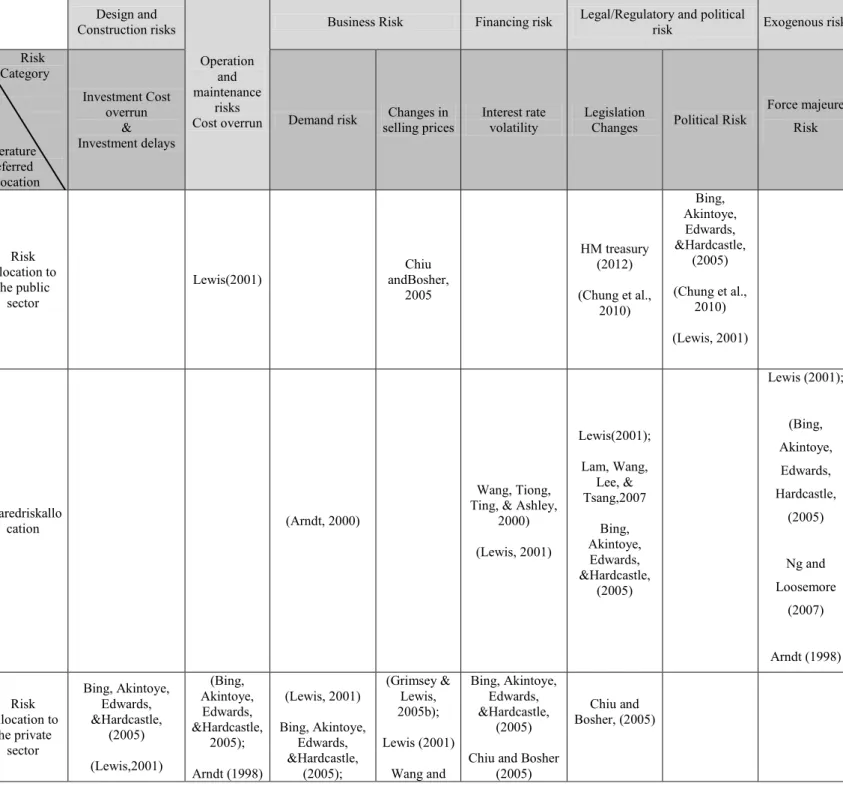
The table below presents a standardized risk matrix that summarizes the literature view on the optimal risk allocation of several risk categories relevant to the water sector PPPs.
Several author‟s opinions regarding how each risk category should be allocated are displayed in the table below. This risk matrix will be used as a benchmarking tool to analyzethe Portuguese water sector PPP contract‟s risk matrix.
7
Table 1 – Summary of the Literature on Risk Allocation in PPPs (source: author)
Design and Construction risks Operation and maintenance risks Cost overrun
Business Risk Financing risk Legal/Regulatory and political risk Exogenous risk Risk … Category Literature Preferred Allocation Investment Cost overrun & Investment delays
Demand risk selling prices Changes in Interest rate volatility Legislation Changes Political Risk Force majeure Risk
Risk allocation to
the public sector
Lewis(2001) andBosher, Chiu
2005 HM treasury (2012) (Chung et al., 2010) Bing, Akintoye, Edwards, &Hardcastle, (2005) (Chung et al., 2010) (Lewis, 2001) Sharedriskallo cation (Arndt, 2000) Wang, Tiong, Ting, & Ashley,
2000) (Lewis, 2001) Lewis(2001); Lam, Wang, Lee, & Tsang,2007 Bing, Akintoye, Edwards, &Hardcastle, (2005) Lewis (2001); (Bing, Akintoye, Edwards, Hardcastle, (2005) Ng and Loosemore (2007) Arndt (1998) Risk Allocation to the private sector Bing, Akintoye, Edwards, &Hardcastle, (2005) (Lewis,2001) (Bing, Akintoye, Edwards, &Hardcastle, 2005); Arndt (1998) (Lewis, 2001) Bing, Akintoye, Edwards, &Hardcastle, (2005); (Grimsey & Lewis, 2005b); Lewis (2001) Wang and Bing, Akintoye, Edwards, &Hardcastle, (2005) Chiu and Bosher
(2005)
Chiu and Bosher, (2005)
8
2.4 PPPs in Portugal
Over the last 25 years Portugal has undergone a major infrastructure investment program in many different areas. After the integration in the EU (and the following access to large capital funds), one of the country‟s priorities became to decrease the infrastructure deficit that was always regarded as a cause for lacking economic growth. In areas such as the highway construction, hospital construction and management, the water sector, energy (electricity and gas) supply, the preferred procurement option for developing this investment plan was the PPP model (Cruz and Marques, 2010).
Between the late 90s and early 2000s there was an intense period of PPP development in Portugal. However the lack of past experience and legislative framework together with the necessity of infrastructures and the absence of relevant costs during the first years of the contract has contributed to excessive PPPs, badly designed contracts and underestimation of future costs. After almost a decade, the prevailing challengewas how to bear the costsof the PPPs(Marques, 2008). Almost another decade later, this challenge was consummated in a massive public finances‟ crisis to which PPPs‟ obligations contributed significantly.
Specific legislation to regulate Public Private Partnerships was only launched in 2003, designing a common framework for all PPP projects, namely, the design and preparation of tender procedures, contract awarding and monitoring (Marques and Silva, 2008). The projects signed before the approval of this legislative package did not have any guidelines regarding risk sharing and renegotiations. The lack of specific legislation and also of a public body able to deal with the complexity of PPP projects resulted in the absence of accountability (Cruz and Marques, 2011).
The rationale for developing PPP arrangements was to allow the public sector to extract value from a profit oriented approach and design a financing scheme that would relieve the financial effort of investing in large sunk infrastructures. Experience suggested that the former was the main motive for PPP development, although most of the value of a PPP model relies on the ability to have a private management, profit-oriented, able to develop efficient solutions. The use of the PPP model as a financing scheme led to underestimating the future annual burden.
Lewis(2001) (Grimsey & Lewis, 2005b) (Chung et al., 2010) (Chiu and Bosher, 2005) Tiong (2000)
9
When governments were launching a project, there was no legal instrument to incorporate the annual rents for the duration of the contract into a “public balance sheet”. The annual payment was a long term concern, and was not accounted conveniently (Martins et al., 2011).
After the 2008 financial crisis, private capital lenders became less available to assume risks and the national debt crisis has forced the government to reduce public investment. As a result a lot of PPP projects were postponed or canceled. The difficulties however donot concern only the inability to launch future projects but also the payment of existing rents.
Around these years amassive financial effort on the Portuguese government part was demanded. Considering the projects launched, for the global contracting period of 2008 and 2050, the annual average burden wouldbe 1,122 million Euros, with a peak above 2,000 million Euros in the period between 2014 and 2019. These projects place Portugal as the largest PPP user in Europe, weighted by GDP (Sarmento, 2014).
In 2011, with the financial assistance program under the auspices of the European Commission, the European Central Bank and the International Monetary Fund (the so called “Troika”), Portugal was immediately asked in the signed MoU to take three different measures with respect to PPPs: 1- halt all new contracts; 2- assess existing ones, 3- renegotiate all contingent obligations arising from old contracts. These measures somewhat attenuated current and future financial impacts with PPPs in particular with the highway concessions. (Reis &Sarmento, 2016).
2.4.1 Water sector PPPs in Portugal
The water sector is composed of the water supply services (which includes all the activities involved in supplying water to the population in both urban and rural areas) and wastewater treatment (which includes all the activities related to the collection, treatment and final destiny of the waste products). These services are considered essential to the citizenswell-being, public health, economic activity and environmental protection. As a result they have to follow certain principles that include universality of access, service quality, efficiency and price equality (ERSAR, 2013).
The market structure associated with the water sector is a natural monopoly due to the high entrance costs associated with construction investments as well as the high maintenance costs. Due to the public nature of the service, the water system is mainly managed by the government (Lima, 2010).
In Portugal, the water sector was solely managed by the public sector until 1993. In that year legislation changes occurred that allowed the access of the private parties to this sector, which
10
was previously forbidden. More specifically it allowed the concession of the exploration and management of the water systems to private companies (Marques & Silva, 2008).
The PPP model is very relevant in the water sector, covering:
- 50% of the population in water supply services (“wholesale category”), - 18.19% of the population in water supply services (“retail category”)
- 70% of the population in residual water treatment services (“wholesale category) - 19% of the population in residual water treatment services (“retail category”) (ERSAR report, 2013).
Due to poor procurementlegislation, theseoriginal PPPs are characterized by bad planning and procedures. There is no proper analysis of the risk involved and the subsequent allocation; there is no calculation of the Public Sector Comparator and there are no second negotiation rounds to improve the contractual conditions. Furthermore the procurement rules do not allow the proper comparison of proposals and as result donot allow the best options to be chosen. Overall PPPs are not driven by Value for Money which ends up creating badly designed contracts that affect negatively the municipalities (Marques & Silva, 2008).
The major factors that contribute to the inefficiency of the PPP procedure in water sector are: Lack of competition in the water sector market, inefficient and lack of performance monitoring of the contracts, small dimension of the majority of the municipalities andpoor sector legislation (Marques, 2005).
11
3. Methodology
To answer the first research question (how were risks allocated in the Portuguese water sector PPPs?) 17Portuguese water PPPswill be analyzed and the respective risk matrix of each will beoutlined. The data on the risk matrix was drawn directly from the PPP contracts. The compiled risk matrix, which will be presented in chapter 4, is the basis for the analysis that follows the 2nd research question.
In order to evaluate if the risk allocation was optimal (2nd research question), two analyses
will be done:
- A comparison between the literature view on risk allocation and the risk matrix of the PPPs analyzed.
- 3 case studies about specific PPPs will be developed to test the conclusions of the analysis above.
3.1 Literature Review Comparison
In order to make the first assessment on whether the water sector PPPs risks were properly allocated, the contract‟s risk matrix will be compared with the literature view on optimal risk allocation.
Table 1 (Literature risk matrix) which summarizes the literature view on optimal risk allocation will be compared with the water sector PPPs risk matrix. Each risk category will be analyzed and the authors‟ arguments will be weighted considering the specific characteristics of the water sector.
3.2 Case Study
Finally, it will be developeda case study on 3 specific PPPs thatwere object of an economic-financial equilibrium reposition and a litigation process.
The case study will show the influence of the risk allocation on the negative outcome of those specific PPP, which will allow testing the conclusions made in the first analysisas well as giving more concrete answers to more ambiguous conclusions.
The case study‟s research design willinclude the definition of research questions, whichwill be translated into propositionsso that data collection can be structured in order to support or refute those research propositions. An approach based on Robert Yin rationale (Robert Yin,
12
4. The Case of theWater PPPsin Portugal 4.1 Background
The analysis will focus on 17 water PPPs whose scope includedboth the water supply and residual water treatment.In all contracts, the private party wasresponsible for both managing the activities as well as making infrastructure investments.All private operator revenues should come exclusively from asset management, meaning the tariffs charged should sustain the private operator profit margins.
The table below summarizes the characteristics of the PPPs that will be analyzed.
Table 2 – Portuguese Water Sector Public-Private Partnerships (source: author)
PPP Municipality Year Population Shareholder Major PPP company expected IRR Shareholder PPP private party investment amount
Campo Maior 2007 8.387
Aqualia, S.A. Águas de Campo Maior, S.A. 14,32% 4.031.822
Elvas 2008 15.308 Águas do Norte Alentejano -
Azambuja 2009 6.300
Aquapor, lda*
Águas da Azambuja, S.A.
12,65%
-
Setúbal 1997 113.934 Águas do Sado, S.A. -
Trancoso 1997 10.889 Águas da Teja, S.A 4.682.504
Cascais 2000 170.683 Aquapor,Lda.
& AGS, S.A.
Águas de Cascais S.A.
12,65%
-
Figueira da Foz 1999 62.601 Águas da Figueira, S.A. 33.500.753
Gondomar 2001 164.096 Águas de Gondomar, S.A. 60.943.355
Barcelos 2004 122.096
AGS,S.A. Águas de Barcelos, S.A. 11% 116.636.461
Paços de Ferreira 2004 52.985 AGS Paços de Ferreira,S.A. 71.839.772
Matosinhos 2007 167.026
Indaqua,S.A. Indáqua Matosinhos, S.A. 12,98% 83.207.180
Vila do Conde 2008 74.391 Indaqua Vila do Conde -
Ourém 1996 46.216
CGEP, S.A.
Veolia Água - Águas de Ourém, S.A.
-
16.832.267
Paredes 2001 83.376 Veolia Água – Águas de Paredes, S.A 58.197.000
Valongo 2000 88.005 Veolia Água – Águas de Valongo,
S.A. -
All private parties involved in the selected PPPs are “fully private”, and integrate the following 5 groups: Aqualia, Aquapor, AGS, Indaqua and CGEP.It is important to mention however that Aquapor belonged to Aguas de Portugal (state owned company) until 2008, when it was sold to DST and DBB.This implies that the PPPs of Setubal, Trancoso, Cascais, Figueira da Foz and Gondomar contracts were celebrated between two public entities which
13
could have influenced the negotiation rationale of the PPP. Nevertheless, it should be noticed that the institutional framework of the partnership is prepared for the subsequent privatization of Aguas de Portugal and its subsidiaries, which implies the contracts and their respective risk matrix were constructed so that the PPP would be attractive the private party.
Most contracts werenot subjected to any study of economic viability. There was no Public Sector Comparator calculation or any other assessment of Value for Money. Most of these contracts were signed without a clear regulatory framework. The major argument given by the municipalities for the lack of value for money assessment studies was the fact that legislation didnot previewed any regulatory frameworkto guide Public Private Partnerships.
This implies already that the reasoning behind this PPP deals was distorted. The choice of the PPP model over traditional public procurement was not based on the efficiency brought by the private sector, as already stated in the literature review.
4.2 Risk Matrix
The compiled risk matrix was gathered from the PPP contracts. The contracts establish how risks were allocated between the private and public partners and mentionhow the public partner has to compensate the private partner if the risks kept in the public sphere materialize. The compensations can be made using the following instruments: Direct compensation to the private partner; tariff increase to the consumers;reduced investment responsibilities to the private partner; extra revenues given to the private partner; measures to compensate operational costs and extension of the contract period.
The main risks involved in the water PPPs are the following:
- Design and Construction Risks: Include risks related to the investment phase namely investment cost overrun, delays and unilateral changes in the investment plan and technical risks (due to engineering and design failure).
- Operation and maintenance risks, whicharise when the assets are in place and can result from events such as cost overrun related to inefficient procedures, variation in the cost of water and asset obsolesce.
- Market risks include the risk of demand variation in relation to forecasts. The main factors influencing water demand are customer microeconomic behavior, population growth, water consumption patterns and the use of illegal connectors, namely use of private wheels and septic tanks, in alternative to connecting to the public water supply or sewage systems. - Tariff risks are usually considered as market risks. However due to the monopolistic nature of the water sector, tariff levels are regulated or politically determined. Tariffs risk
14
arises mainly from the mechanisms of tariff adjustment and methods of economic regulation applied by the regulator. In the Portuguese context the municipality is currently the entity empowered to set the water tariffs and not the water sector regulator.
- Financing risk which arisesfrom interest rate fluctuations and loan default risk from cash-flow shortage.
- Legal and regulatory risks relate to specific country or project set of law and rules. Typical risks include changes in regulatory framework that guides PPPs or the water sector and unstable national and regional laws.
- Political risks concern the society´s stability and social economic behavior, the trustworthiness of the government and general political environment, all of which are factors that can lead to contractual breaches. Political risks are particularly relevant to the water supply, since water is perceived as an essential good (Chiu and Boscher, 2005).
- Force Majeure risk includes unpredictable external events (usually natural unavoidable catastrophes) that can impact negatively the conditions of the project.
The table below presents the risk matrix of the 17PPPsthat will beanalyzed. The table summarizes the main risks involved in the PPP contract and how they were allocated.
15
Table 3 – Water Sector PPP´S Compiled Risk Matrix (source: author)
Design and Construction
risks
Operation and Maintenance
Risks Market Risks Financing Risk political risk Legal and Tariff risk Exogenous risk Risks
PPPs Cost overrun
Technical obsolesce-asset
risk Demand Risk Interest rate variation
Legislation and Political changes
Tariff variation
risk Force Majeure Azambuja private sector private sector private sector (Public sector >20% Shared
variation)
Shared (Public sector >20%
variation in EURIBOR) public sector public sector public sector Barcelos private sector private sector private sector (Public sector >20% Shared
variation)
Shared (Public sector >20%
variation in EURIBOR) public sector public sector public sector Campo
Maior public sector public sector private sector
Shared (Public sector >15%
variation) private sector public sector public sector public sector Cascais private sector private sector private sector (Public sector >10% Shared
variation)
Shared (Public sector >20%
variation in EURIBOR) public sector public sector private sector Elvas private sector private sector private sector (Public sector >15% Shared
variation)
Shared
(Public sector >5% variation
in EURIBOR) public sector public sector private sector Figueira da
Foz private sector private sector private sector
Shared (Public sector >15%
variation)
Shared (Public sector >20%
variation in EURIBOR) public sector public sector public sector Gondomar private sector private sector private sector (Public sector >10% Shared
variation)
Shared (Public sector >20%
variation in EURIBOR) public sector public sector public sector Canaveses private sector private sector private sector (Public sector >20% Shared
variation) private sector public sector public sector public sector Matosinhos private sector private sector private sector public sector (Public sector >30% Shared
variation in EURIBOR) public sector public sector public sector Ourém private sector private sector private sector (Public sector >10% Shared
variation) private sector public sector public sector public sector Paços de
Ferreira private sector private sector private sector
Shared (Public sector >20%
variation) private sector public sector Shared public sector Paredes private sector private sector private sector (Public sector >20% Shared
variation) private sector public sector private sector public sector Tirso/Trofa public sector public sector private sector public sector private sector public sector public sector public sector
Trancoso private sector private sector private sector (Public sector >20% Shared
variation) private sector public sector public sector public sector Setúbal private sector private sector private sector (Public sector >20% Shared
variation) private sector public sector public sector public sector Vila do
Conde private sector private sector private sector public sector
Shared (Public sector >50%
variation in EURIBOR) public sector public sector private sector Valongo private sector private sector private sector (Public sector >20% Shared
16
Most PPPs follow a similar risk allocation, which means a clear pattern can be identified. Construction and operational risks were the only risks completely transferred to the private party in all contracts. Interest rate fluctuation risk was shared in half of the PPPs and allocated to the private sector in the other half. Demandrisk wasmostly shared between both parties. Tariff, legislation change and force majeure risk were mostly allocated to the public sector.
4.3 Comparison of PPPsrisk matrix with literature view on risk allocation
In this chapter the risk allocation of the PPPs presented before will be compared with the literature view on how risks should be allocated. Each risk category will be analyzed individually, please see table 1 (literature risk matrix) and table 3 (water sector PPPscompiled risk matrix) for better context. The goal of this comparison is to understand if the pattern of risk allocation that was observed in the group of PPPs gathered is in line with the view of the literature onefficient risk allocation.
As already mentioned the main principle for optimal risk allocation is that risk must be allocated to the party best able to control and manage it. The party in better position to manage the probability or the impact of a certain risk materializing is the one better equipped to deal with the risk.
Each risk category will be individually analyzed considering the author‟s arguments on optimal risk allocation and taking into account the water sector context.
i) Design and Construction risk
According to Bing et all, construction risk should be assigned to contractors for all procurement methods. As the party responsible for making the investments, construction risk should be managed by the private operator.This allocation might be subject to exceptions if the public sector influences unilaterally the investment plan execution.
In the majority of the PPPs analyzed, design and construction risk were allocated to the private party. The public party has however to compensate the private party if there is a financial equilibrium loss of the PPP due to a unilateral change motivated by the public party. The allocation followed by the PPPsanalyzed is in line with the literature view.
ii) Operational Cost overrun
Cost overrun usually happensdue to inefficient procedures that are under the control of the party responsible for investment plan execution and asset management.
In thePPPs analyzed the private party was the one responsible for asset management and most of the investments. As the party better able to deal and manage those risks, the transference of those risks to the private party creates efficiency.
17
The majority of the contracts analyzed allocated the risks related to cost overrun to the private party, unless the cost overrun was motivated by changes in output specifications made by the public party. The risk is therefore allocated to the party responsible for the cost overrun which is in line with the literature arguments.
iii) Technical obsolesce asset risk
The risk of a certain asset becoming obsolete essentially means that the technology used in the provision of a certain service becomes less efficient when compared to newer technologies. This will translate into higher costs due to operational inefficiency that will reduce profit margins. The party better able to manage the risk is the private sector because it is the one in control of the operational procedures.
All PPPs allocated the risk of asset technical obsolesce to the private sector which is in accordance with the arguments of most literature.
iv) Demand risk
There is no consensus in the literature regarding demand risk allocation (see Table 1). Not only different authors pointed to different allocations, but some authors considered that it can be highly variable according to the type of project. Still the majority of the literature considers that in most situations market risks such as demand should be allocated to the private sector.In a PPP where apart from the public sector retaining the ownership of the assets almost everything else is transferred to the private sector, market risks should be transferred to the private sector (Chiu and Bosher, 2005).
The water sector however has particular characteristics. Ardnt‟s (2000) survey (to key participants in the Australian private infrastructure industry) has shown that when the private sector has no direct commercial linkwith end users (meaning it cannot control pricing and other variables to attract demand) the private party is less willing to fully accept demand risk. Given the monopolistic characteristics of the water sector and the consequent price regulation, as well as the inelasticity that characterizes water demand, the private operator has very little control in attracting additional demand.
The main issue is therefore faulty demand forecasting which depends a lot on present and projected demographics of the area, microeconomic behavior of customers, water consumption patterns and adherence to the water supply network (use of illegal connectors). The party better able to predict, analyze and deal with this variables should keep the risk. It is not clear which party is better able to predict demand. Nevertheless the level of demand for a project is an important investigation to be carried out in most PPP/PFI projects during the detailed feasibility study phase by the private consortium (Bing, et all, 2005).As far as the
18
use of illegal water connectors, the public sector is the party better able to supervise and enforce the connection to the public network by using the necessary legal mechanisms to penalize the users of illegal connectors and obligate them to adhere to the public water connectors. As such, it should be the public side to bear the demand risk resulting from the lack enforcement of the legislation concerning the connection to the public network.
Depending on the arguments used either an allocation to the private party or a shared allocation of demand risk would be acceptable.
Most Contracts shared demand risk which is acceptable given the following arguments: - Private sector has limited commercial link with end users, and water demand is highly
inelastic which limits any added benefits brought by the private sector to attract additional demand.
- The public sector is the party better able to deal with the use of illegal water connectors. - The private party is in no better position than the government to predict demand.
v) Tariff Changes
Most literature considers price risk to be a market risk that should be allocated to the private sector. In the context of the water sector however, where price is regulated, tariff risks should be considered separately from market risks.
Charging water tariffs is mainly a political decision as most governments determine how much a service provider is allowed to charge consumers. The risk of bad pricing can undermine service levels, resulting in revenue losses and increased hidden costs that partly explain the poor profitability and inadequate financing in the water sector (Ameyaw and Chan, 2014).
The strong influence of political motives behind water pricing can translate into a very big risk of bad pricing that can impact negatively the private operator‟s revenueby holding down justifiable tariff increases for water services. Therefore, allocating this risk to the public party creates VfM, as the municipality is the entity that controls tariff levels. This aligns incentives, so that the municipality setsprices based on economic principles instead of political ones. Most PPPs analyzed allocated tariff risk to the public party, which is optimal considering the monopolistic characteristics the water sector where price is regulated. In the Portuguese context, the municipalities are the entities regulating the tariffs, which favor even more this allocation, as the entity directly involved in the PPP is in control of setting the tariff levels. However, this allocation was set based on a pre-agreed tariff increase which might not generate efficiency as the municipalities are offering a guarantee on future tariff levels that might not be optimal. The ideal mechanism would be to allocate to the public sector the risk
19
of not setting tariffs in accordance to a certain economical rational regarding the right margin level for the private operator.
vi) Financing risk
a. Interest rate volatility
EURIBOR fluctuations depend mainly on macroeconomic behaviors, whichare outside the control of any of the parties.
Besides EURIBOR fluctuations, spreads can also change based on the financier‟s assessment of the project risk. The project‟s risk profile may change and consequently the interest rate can vary.
According to the World Bank, project finance debt tends to be fixed rate, which provides a foreseeable or at least somewhat stable, repayment profile over time to reduce fluctuations in the cost of infrastructure services. If lenders donot provide a fixed rate debt and none of the parties is willing to take the risk then hedging instruments should be implemented.
The literature is not unanimous regarding how interest rate volatility risk should be allocated. Interest rates fluctuations are economic risks associated with project financing and thus appropriately allocated to the private sector (Bing et all, 2005). Chiu and Bosher also reinforce this position by stating that the private party should be the one responsible for managing the financial needs of the project and face the fluctuations in the financial markets. However, according to Lewis interest rate fluctuations without sufficient hedging should be shared.
The PPPs analyzed didnot implement any hedging instruments. Contrary to Lewis opinion, the EIB considers that the private party should be responsible for incorporating hedging instruments. This implies that interest rate fluctuation risk should be allocated to the private party so that incentives aligned.
Half of the PPPsanalyzed shared the risk while the other half has allocated the risk to the private sector, which reflects the literature divided view.
b. Financial Structure an Default risk
The financing structure of thePPPsanalyzed is in the form of project finance where lenders and investors rely mainly on the cash-flow generated by the project to repay their loans. The financing structure is sustained on bank financing and credit support from sponsors, which is typical of a project finance structure where very little equity is involved.
The project finance structure should be designed to optimize the costs of finance for the project and should ensure that the interests of the main lenders to the project are aligned with those of sponsors and municipality – that is, that both need the project to succeed in order to
20
meet their objectives. Where this is the case, the public party can be confident that the lenders will take on much of the burden of assuring the ongoing performance of the project. This is a key element of the transfer of risk from the public to the private sector in PPPs (EPEC PPP Guide).
The fact that loan repayment depends mainly on the cash-flow generation of the project, aligns the incentives so that lenders understand the impact of their decisions on the viability of the project.
In most PPPs analyzed there were no state guarantees which would reduce the financial costs of the PPP. However by takingpart of the demand risk, the public party is guaranteeing a minimal cash-flow generation and therefore reducing the probability of default. So, by
assuming demand risk the public sector is indirectly assuming financial risks. On one hand, it is positive as it facilitates access to financial resources and reduces financial costs; on the other hand it increases the risk of the public party.
vii) Legal/Regulatory and Political Risk
a) Legislation Change Risk
This refers to changes in government policies regarding laws and regulations that can impact directly or indirectly the PPP contract conditions.
The private operator concern is that legislation changes, which are controlled by the public sector,affect the PPP conditions negatively.The private operator will try to ensure that it is compensated in the event that the rules upon which he relied when submitting his bid are changed and have adverse impacts on the ability to perform the activity or the financial return. The literature is divided regarding the right allocation of legislation risk (see Table 1).
Allocation to the public sector can be justified on the fact that the public sector is perceived as the party best able to manage risks related to assurance, certainty and consistency of legislation. Besides, as mentioned by the 2012HMTreasury report, additional capital expenditure arising from an unforeseeable general change in law occurs on a very occasional basis, which means the public sector can secure better value money by keeping the risk instead of transferring itto the private sector and pay a premium.On the other hand, a lot of authors (Lewis 2001;Lam, Wang, Lee, & Tsang 2007;Bing, Akintoye, Edwards, &Hardcastle, 2005)concluded that a shared allocation is the optimal one for legislation risk.Considering the fact that the municipalitydoes notcontrol satewide legislation, it seems valid that the private sector should keep part of legislation change risk. However as pointed by Ardnt the private party should be able to pass on any resulting additional costs to end users, as they would in any normal business.
21
All contracts have allocated the risk of legislation changes to the public sector, which is consistent with VfM generation according to some literature. However, a shared allocation was considered the optimal allocation by the majority of the literature analyzed.
b) Political Risk
When political risk is perceived as low, the private sector is more willing to join a PPP. In developed stable countries, political risks tend to have a minor impact in PPPs, therefore there is little to be gained in allocating them to the private party (Bing et all, 2005). Because political risks relate to the public parties commitment to the project, these risks should be dealt in the public sector sphere. The public party is the party better able to deal with that risk and because the private party as no control over this type of risk, it would not accept to take this kind risk (eg: the risk of a new public party revoking the contract without any type of compensation).
Other aspects of political risk were already addressed in the demand and tariff risks sections. viii) Force majeure
It is generally recognized that force majeure risk could be severe, but has a low probability of occurrence. The nature of external risk, such as force majeure, makes it outside the control of either party so that public and private parties may not be able to deal with it alone (Bing et all, 2005). Those exogenous risks which are not easily allocated should be shared so that both parties have an incentive to manage them (Ardnt,2000).
The agreement should provide the maximum incentive for both sides to avoid if possible, or else minimize any damage caused by these events. The risks that are known but impossible or too costly to manage should be covered by insurance contracts.
All literature analyzed considers force majeure risk to be best allocated when it is shared between public and private parties. According to the OECD, risks that cannot be controlled by definition will not be best managed by the private sector. On the other hand, as mentioned by Marques and Berg, allocating completely the risk to the public sector greatly reduces the risk to the private operator, reducing its incentives to mitigate such risks.
83% of the PPP contracts analyzed allocated force majeure risk to the public sector while the rest was allocated to the private sector. This constitutes a divergence from shared allocation proposed by most literature. This implies that in the majority of the contracts, the public sector assumed excessive risk on this particularly category.
22
In the cases analyzed above, very few risks were transferred to the private party. As already mentioned, without sufficient risk transfer, a PPP cannot generate efficiency to compensate the price difference between the project‟s weighted-average cost of capital (WACC) and the risk-free rate (Rf). The lack of a clear regulatory framework for the PPP project, the need for filling the gap on infrastructures, the lack of technical and managing expertise and personal/political interests are some of the variables that can explain the unbalanced risk matrix (as already stated in the Portuguese PPP experience literature review, and the analyzed PPPs background)
Despite all of this,severalof the arguments gathered support a risk matrix where less risk is transferred to the private party considering the characteristics of the water sector, which implies the risk matrixes analyzed are not necessarily unbalanced.This leads to question if the PPP modelisthe right option for the water sector.
23
5. Case Study
Based on the literature view on optimal risk allocation conclusions were taken regarding the Portuguese water sector PPPs risk allocation. However, the literature wasnot unanimous in relation to the allocation of certain risks and, in the author‟s view, the specificity of the water sector wasnot always considered.
In order to test the conclusions made in the previous chapter, 3 case studies will be developed.The case study will provide additional and more detailed information to answer the research question. However the basis of the analysis will no longer be the literature view on optimal risk allocation but instead the concrete outcome of the PPPs analyzed in the case study.
Three Portuguese water sectorPPPswill be analyzed. Both thesePPPs were object of an economic-financial equilibrium reposition process and object of a litigation process. In all of them the private party requested a financial compensation to restore the contract‟s economic equilibrium. Both parties never came to full agreement on the compensation terms which led to theintervention of the regulatory entities.
By choosing PPPs with these characteristics it will be easier to track the influence of the risk matrix on the outcome of the PPP.
The case study‟s research design will have the following structure: 1. Research Questions:
- What factors led to the outcomes of the PPP (financial disequilibrium and litigation process)? Notwithstanding the focus on risk allocation, it is important to have an overall picture of all factors that led the PPP in the direction it went.
- How the risk allocation didinfluenced the PPP outcome (which is a sub-question of the one above)?
The first research question cannot be translated into propositions. The second one however can be translated into hypothesis based on the conclusions taken in chapter 4.3.The following hypothesis will be constructed:
- Demand risk should be shared between both parties
- Price risk should be allocated to the public sector in the context of a water municipality - Financing risk (EURIBOR and spread variation) should be shared between both parties - Political Risk should be kept under the public sphere
24
The unit of analysis will be composed of theMatosinhos, Carrazeda de Ansiães e S. Maria da FeiraPPPs. Both this PPPs were object of an economic-financial equilibrium reposition process and object of a litigation process.
5.2.1 BarcelosPPP Context
In September 27th 2004, the municipality of Barcelos(CMB) celebrated a PPP contract with the private company Águas de Barcelos S.A. (ADB), whose main shareholder is AGS, for a 30 year period, which included the management of the water supply and residual water treatment activities as well as the execution of several infrastructure investments.
No study was made to evaluate the value for money of the project, which constitutes a problem right ahead as no objective criteria was used to choose the public private partnership over the traditional procurement.The base case constructed estimated a yearly 2.63% increase in water consumption. No study that supported these estimations was made.
The investment plan initially defined in the contract amounted to a total of 116.363.461€ and was solely of ADB’s responsibility. In 2008 however, following the contract‟s economic equilibrium repositionCMBhas assumed the responsibility of some investments. With this decision,ADB’s investment plan was reduced in a total of 55.349.211€.
ADB had to pay the municipality the following amounts over the years to explore the water
supply activities:
-Year 2005 - 1.483.827€; -Year 2006 - 1.620.039€; -Year 2007 - 415.006€;
-From 2008 until 2034 - 341.735€/year
Risk Matrix
25
Table 4 –Risk Matrix for Barcelos Water PPP Case (source: author)
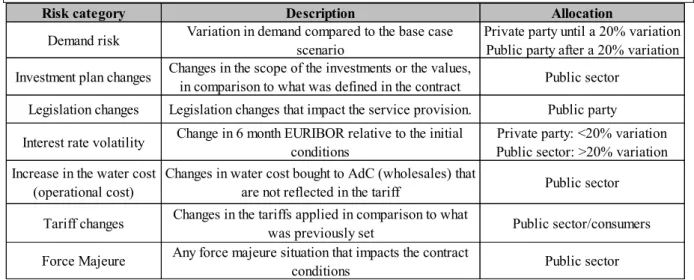
CMB assumes most risks, even those risks that are outside of its control like demand risk and
financial risk.
Economic Financial Equilibrium Restitution Request
In July 10th 2009, after the investment reduction that followed the first equilibrium reposition,
ADB started negotiations with CMB to restitute again the contract‟s economic financial
equilibrium. The motive was the lower water demand compared to the base case.
For the lower demand have contributed the non-verification of population growth expectations, lower water consumption per user and delays in construction works of the municipality responsibility, which impacted significantly the collection of new customers. The only factor that CMB could control was the construction works delay. Population growth and consumption per user are external factors outside the control of the municipality. This factor was however irrelevant as the risk matrix allocated demand risk to the public sector after a 20% variation, which meantADB could request a compensation to restitute the revenue loss caused by lower demand.
ADB added that the loss of Cash-Flow severely restricted the access to the financial resources
needed to pursue the investment plan. In 2012 there were already some deviations in the investment plan that ADB justified with lower project revenues.
After 1 year of negotiations, there was no agreement between both parties, and the case ended up in court.
Litigation Process
Risk category Description Allocation
Demand risk Variation in demand compared to the base case scenario Private party until a 20% variationPublic party after a 20% variation Investment plan changes Changes in the scope of the investments or the values, in comparison to what was defined in the contract Public sector
Legislation changes Legislation changes that impact the service provision. Public party Interest rate volatility Change in 6 month EURIBOR relative to the initial conditions Public sector: >20% variationPrivate party: <20% variation Increase in the water cost
(operational cost) Changes in water cost bought to AdC (wholesales) that are not reflected in the tariff Public sector Tariff changes Changes in the tariffs applied in comparison to what was previously set Public sector/consumers Force Majeure Any force majeure situation that impacts the contract conditions Public sector
26
In June 29th 2010, ADB took the case to court arguing the right to be compensated based on the risk matrix. 2 years laterCMBwas condemned to pay a direct compensation to ADB in the following terms:
- Payment for the lower demand between 2005 and 2009, in the value of 24.602.600€ - Annual payment of 5.897.179€ from 2010 to 2035.
The compensation mentioned above accounts for a total of 172.032.075€ over the years, which puts the municipality in a situation of possible bankruptcy. In 2012, at the time of the court‟s decision, the municipality had already a debt of 42.294.137€ to ADB, which corresponds to 77% of the municipalities revenues of that year.
On the other side,ADB’s financial situation without the compensation mentioned above is very fragile. In 2010 and 2011 the company presented negative results of 17.221€ and -2.982.255€ respectively and a very vulnerable financial autonomy. The company also incurs the risk of bankruptcy without the compensation.
The concession is not sustainable to any of the parties. CMB will be in a possible scenario of bankruptcy if they compensate ADB in value determined by the court. ADB on the other hand doeshave the conditions to develop the activity without the reposition of the concession‟s financial equilibrium.
Currently, the municipality is planning to exert its rescission right, by paying ADB a total amount of 87M€. The municipality is going to contract a loan to make this payment in order to terminate the contract.
Even though the cost is high, it‟s still half of the amount CMB was condemned to pay. With this decision the municipality is in control of the exploration of the water supply and residual treatments and considering that the investment plan of ADB’sresponsibility is almost completed, the decision will benefit the municipality.
Final Considerations
The non-verification of the water consumption estimations was the main factor driving the loss of the concession‟s financial equilibrium. Because demand risk was allocated to the municipality after a 20% variation, CMBended up being the entity responsible for restoring that equilibrium, by compensating ADB.
However,the main problem of the PPP so much the risk allocation, but insteadthe unrealistic base case scenario assumptions.The contract predicted a daily water consumption of 126 liters/habitant in 2005, when in reality the consumption was only 112 liters/day. For the following years it assumed a growth rate of 2.63%, when actually water consumption
27
decreased over the years. This estimations werenot object of any study that would support them, which means there wasnot any effort on the municipality‟s part to build a consistent and realistic scenario.
The audit court considered the risk allocation harmful to the public sector, highlighting that demand and interest rate volatility risks are operational risks that should be completely allocated to the private sector.
The case can be made that demand risk should be allocated to the private entity. The private entity should be the one predicting the base case scenario and assuming the risk for those assumptions. This would align the incentives to construct a reasonablebase case scenario. Allocating demand risk to the public sector opens the door to badly designed contracts, if the public entity is not choosing a PPP route based on efficiency criteria.
Finally, the project in itself is not financially sustainable, as the revenues generated by the activity (through water sale) werenot enough to cover the operational, investment and financial costs.
5.2.2 Carrazeda de Ansiães PPP Context
In June 2001 the municipality of Carrazeda de Ansiães (CMCA) signed a 30 year PPP contract with the company Águas de Carrazeda, S.A. (ADC), owned by AGS, to explore the services of catchment, treatment and distribution of water to public consumption. The investment plan attributed to the private operator over the 30 year period amounted to a total of 4.631.103€
No study was made to assess the economic viability of the partnership, as legislation didnot made it mandatory at the time.
Risk Matrix
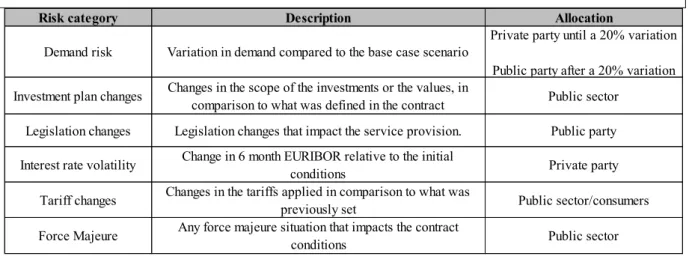
The only risks that were allocated to the public sector were force majeure risk, legislation risks and any unilateral change made by the municipality.This constitutes one of the few water PPP contracts where demand risk was completely allocated to the private sector.
The mechanisms of compensation defined in the contract were direct compensation, extension of the contract duration, tariff changes or any other agreed mechanism.
28
In 2010, ADCrequested the reposition of the contract‟s economic financial equilibrium based on the following events:
Unilateral imposition of a lower water tariff than what was predicted in the contract The water supply tariffs should have increased by 42% in the first year of the concession, however they have remained unchanged until July 2003. After that point they started to be updated according to the formula previewed in the contract.
The wastewater tariffs were only applied in 50% of the value predicted until 2006, from that point on they started being applied in their full value.
Lower Demand
Due to lower population growth and water consumption compared to what was estimated, demand was much lower than expected.
The levels of water consumption per habitant from 1995 to 1998 of the municipality varied between 78 liters/person/day and 85 liters/person/day. The water consumption predicted in the base case was 120 liters/person/day starting from 1999, which had no basis in reality.
Negative impact of the dry weather in the summer of 2005 and 2006. Unilateral Changes in the investment plan made by the public sector.
CMCA hasnot provided the land for the realization of the investments relative to 3 tanks,
which conditioned the fulfillment of the investment plan with negative consequences to the concession.
All this events impacted negatively ADC’sprofitability, asrevenues were around 50% of what was estimated in the base case.
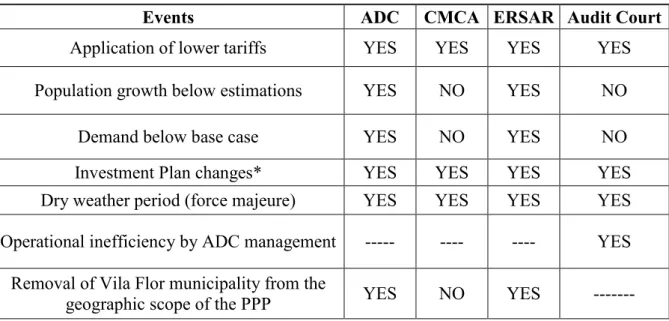
The municipality accepted all events susceptible of motivating a compensation, with the exception of the lower demand compared to the base case. The risk matrix allocated demand risk completely to the private operator which means contractually there is no obligation on
CMCA’spart to compensate ADC for demand variations in relation to the base case forecasts. ERSAR and audit court view
Both ERSAR (Water sector regulatory entity) and the audit court issued their view on the events discussed.
According to both entities, the municipality should compensate ADC based on the period of lower tariff setting (tariff risk), the dry weather period (force majeure risk) and unilateral investment plan change (construction risk) initiated by the municipality. All these events were clearly stated in the risk matrix as being allocated to the public sector.