UNIVERSIDADE DE TRÁS-OS-MONTES E ALTO DOURO
Analysis of DOMS indicators after performing a
sub-maximal repetition strength training protocol exercise:
Influence of exercise order
Análise de indicadores de dor muscular tardia após a
realização de um protocolo de exercícios de força com
repetições submáximas: Influência da ordem dos
exercícios
DOUTORAMENTO EM CIÊNCIAS DO DESPORTO
CHRISTIANNE PEREIRA GIESBRECHT CHAVES
Orientadores: Prof.ª Doutora Maria Paula Gonçalves Mota Prof. Doutor António José Rocha Martins da Silva
! !
!
Christianne Pereira Giesbrecht Chaves
Analysis of DOMS indicators after performing a sub-maximal
repetition strength training protocol exercise: Influence of exercise
order
Análise de indicadores de dor muscular tardia após a realização de
um protocolo de exercícios de força com repetições submáximas:
Influência da ordem dos exercícios
UNIVERSIDADE DE TRÁS-OS-MONTES E ALTO DOURO Vila Real, Portugal, Junho 2014
Dissertação apresentada com vista à obtenção do grau de Doutor em Ciências do Desporto de acordo com o Decreto-Lei Português 107/2008 de 25 de junho.
Aknowledgments
A concretização deste trabalho não seria possível sem o apoio, incentivo e colaboração de certas pessoas, pretendo aqui algumas palavras do meu agradecimento:
A Professora Doutora Maria Paula Mota, por todo o apoio, encorajamento e compreensão ao longo deste processo, muito obrigada.
Ao Amigo Roberto Simão por ter sempre uma palavra firme e encorajadora nos momentos acadêmicos difíceis, muito obrigada.
Ao amigo Jorge Soares do Departamento de Ciências do Desporto e Educação Física, por sempre estar presente quando eu precisei de ajuda mesmo do outro lado o oceano, Jorge, muito obrigada pela sua paciência, boa vontade e colaboração.
Aos meus pais por sempre terem me apoiado e pela confiança que depositam em mim.
Ao meu marido, Carlos Serrão, que sempre acreditou em mim e me apoiou neste processo.
Ao minha filha Iza, pela compreensão na minha ausência, todo o meu amor.
Abstract
Strength Training (ST) has been recommended as part of several physical training programs aimed to improve health and quality of life. The exercises’ order (EO) seems to have a great importance in the development of a ST program. ST and eccentric movements tend to produce more damage related to structural changes in skeletal muscle fibers especially due to the mechanical and metabolic stimulation. These damages can increase the metabolism associated with increased oxidative stress and/or damage to the vascular epithelium, inducing an increase of xanthine oxidase activity (XO). The sarcolemma damage may also increase the delivery of cytokine into blood stream that would augment inflammatory response, and consequently oxidative stress damage. Altogether these changes commonly induce delayed onset of muscle soreness (DOMS). The exercises execution order is a variable that has been addressed in the literature, but up to now, there are no studies relating muscle damage, oxidative stress and ST program with distinct orders. The objectives of this study were: (i) to investigate the role of exercise order on total number of repetitions and to evaluate the possible importance on muscle damage on the rating of perceived exertion; (ii) to investigate if one regular high intensity ST session performed to voluntary fatigue could cause muscle damage and similar DOMS responses at multiple time points and; (iii) to check if a session of ST with sub-maximal repetitions induces systemic oxidative stress, measured by lymphocytes DNA damage. Ten healthy trained men completed two sequences: sequence A (SEQA) - leg press (LP), leg extension (LE), leg curl (LC), bench press (BP), shoulder press (SP) and triceps extension (TE); and sequence B (SEQB) - was executed in reverse order. The strength training session consisted of 20 repetitions of the first exercise at 40% of 1RM to warm-up, followed by sequence training. All exercises were performed in three sets to volitional fatigue at 80% of 1RM with two minutes rest intervals of passive recovery between sets and exercises. All of the subjects had their capillary blood samples collected for the creatine kinase (CK) and lymphocytes DNA damage measure, and DOMS measured before, immediately after and 24, 48 and 72 hours after the exercise session. The subjective effort perception was measured by OMNI-RES scale before exercise and at the end of each exercise.
There were significant (p<0.05) differences between SEQA and SEQB in the total number of repetitions for TE, LE and LC. The highest CK concentrations were observed 24h after both sequences, but no differences were found at any time between them, revealing that muscle damage occurred independent of the exercise order. The CK concentration was highest at post and 24h after (p<0.05), when compared to pre exercise condition and decreased at 48h (p<0.05) and at 72h (p<0.05) post exercise compared to 24h. The RPE was higher in TE in SEQA, (p<0.05) and LP in SEQB (p<0.05). The DOMS values were higher 24h post exercise (p<0.05) in relation to pre exercise and decreased after 72h. Significant differences in DOMS were also found between 24h and 72h (p<0.05) and between 48h and 72h (p<0.05) after the exercise. DNA results revealed significant differences in the damage of DNA strand breaks (p<0.05) between 24h and 48h after the ST session, and also revealed significant differences in DNA FPG sites between 24h and 48h (p<0.05) and between 24h and 72h after exercise (p<0.05). We concluded that EO affects the number of repetitions and perceived exertion. These study results also indicate that whenever one exercise is the last of a sequence performed in a training session, its number of repetition could be negatively affected. This was confirmed whether it was a large or small-muscle group exercise and could not be explained by differences in muscle damage. Moderate intensity ST session performed to voluntary fatigue induced an increase in CK concentrations and it was not related to EO. DOMS scale could be used in training routines to appreciate skeletal muscle damage and the whole body response to ST at 24h after. There was a trend of increasing both CK and DNA at 24h after the ST session, revealing the existence of muscle damage as well as lymphocytes DNA damage possibly caused by oxidative stress.
KEYWORDS: strength training, exercise order, muscle damage, creatine kinase, OMNI-RES, DOMS scale, comet assay, oxidative stress.
Resumo
O treino de força tem sido recomendado como parte de um programa de treino com o objetivo de melhorar a saúde e a qualidade de vida. A ordem dos exercícios parece ter uma grande importância no desenvolvimento de um programa de treino de força. O treino de força e os movimentos excêntricos tendem a produzir mais danos relacionados às mudanças estruturais nas fibras musculares esqueléticas especialmente devido ao estimulo mecânico e metabólico. Esses danos podem elevar o metabolismo associado ao aumento de estresse oxidativo e/ou dano no epitélio vascular, incluindo um aumento da atividade da xantina oxidase. O dano no sarcolema também pode gerar um aumento das citocinas na corrente sanguínea o que pode acrescentar uma resposta inflamatória e consequentemente o dano por estresse oxidativo. De um modo, geral essas modificações frequentemente induzem a dor muscular tardia (DOMS). A ordem de execução dos exercícios é uma variável que tem sido estudada, mas até então não há estudos relacionando dano muscular, estresse oxidativo e treino de força com ordens distintas. Os objetivos deste estudo foram: (i) investigar o papel da ordem dos exercícios no número total de repetições e a possível importância no dano muscular e na percepção de esforço; (ii) investigar se uma sessão de treino de força de alta intensidade realizada até a fadiga voluntária poderia causar respostas similares nos danos musculares e DOMS e (iii) verificar se uma sessão de treino de força com repetições submáximas induz a um estresse oxidativo sistêmico, medido pelos danos de DNA de linfócitos. Dez homens treinados realizaram duas sequencias: sequencia A (SEQA) – pressão de pernas (LP), extensão de pernas (LE), flexão de pernas (LC), supino (BP), pressão de ombros (SP) e tríceps de pé (TE); e a sequencia B (SEQB) que foi realizada na ordem inversa, tendo inicio com os membro inferiores. A sessão de treino de força consistiu de 20 repetições do primeiro exercício com carga de 40% de 1RM para aquecimento, seguida da realização da sequencia dos exercícios. Todos os exercícios foram realizados em três séries com carga de 80% de 1RM até a fadiga voluntária, dois minutos de intervalo de recuperação passiva foi dado entre as séries e os exercícios. Foi feita a coleta de sangue capilar para todos os sujeitos para a análise da CK e dos danos de DNA de linfócitos, a DOMS foi
medida antes, imediatamente após e 24, 48 e 72 horas após a sessão de treino de força. A percepção de esforço foi avaliada pela escala de OMNI-RES antes do exercício e no final de cada exercício. Houve diferença significativa (p<0.05) entre a SEQA e a SEQB no número de repetições para TE, LE e LC. A maior concentração de CK foi observada às 24h após o exercício nas duas sequencias, contudo nenhuma diferença foi encontrada em qualquer um dos momentos, revelando que o dano muscular ocorreu independente da ordem dos exercícios. A concentração de CK foi maior imediatamente após e 24h após (p<0.05) a realização do protocolo, quando comparada com as condições pré-exercício e diminuiu nas 48h e 72h (p<0.05), após o protocolo quando comparada com 24h. A PSE foi maior para o exercicio de TE na SEQA, (p<0.05) e para o LP na SEQB (p<0.05). Os valores da DOMS foram maiores nas 24h após o exercício (p<0.05) em relação aos valores pré-exercício e diminuiram após 72h. Diferenças significativas na DOMS também foram encontradas entre 24h e 72h (p<0.05) e entre 48h e 72h (p<0.05) após o exercício. Os resultados de DNA revelaram diferenças significativas nos danos de DNA basais (p<0.05) entre 24h e 48h após o treino de força e também se constatou diferenças significativas nos danos de DNA FPG sites (por estresse oxidativo) entre 24h e 48h (p<0.05) e entre 24 e 72h após o exercício (p<0.05). Foi concluído que a ordem dos exercícios afeta o número de repetições e a percepção do esforço. Os resultados deste estudo sugerem que sempre que um exercício é o último a ser realizado em uma sessão de treino de força, o seu numero de repetições será negativamente afetado. Uma sessão de treino de força de intensidade moderada realizada até a fadiga voluntária induz a um aumento da CK independente da ordem dos exercícios. A escala de DOMS pode ser utilizada nas rotinas de treino para avaliar o dano muscular esquelético e a resposta geral ao treino de força nas 24h após a sessão. O aumento da CK e dos danos de DNA de linfócitos expressam a mesma tendencia de variação. Uma sessão de treino de força pode gerar danos no músculo esquelético e sistémicos causados pelo estresse oxidativo.
Palavras chave: treino de força, ordem dos exercícios, danos musculares, creatina quinase, OMNI-RES, escala de DOMS, ensaio do cometa, estresse oxidativo.
Table of Contents
Acknowledgment ______________________________________________ IX Abstract ______________________________________________________ X Resumo _____________________________________________________ XII Table of Contents ____________________________________________ XIV Index of Figures ______________________________________________ XV Index of Tables ______________________________________________ XVI List of abbreviations _________________________________________ XVII 1.General Introduction __________________________________________ 1 2. Influence of Exercise Order on Muscle Damage ___________________ 9 3. Is There a Relation Between Muscle Damage and DOMS After a Strength Training Session? ____________________________________________ 24 4. Modification of lymphocyte DNA damage after a session of strength training with sub-maximal repetitions ____________________________ 40 5.General Discussion __________________________________________ 56 6.General Conclusions ________________________________________ 60 7.References _________________________________________________ 62
Index of Figures
Figure 1.1. The experimental protocol design in a counterbalanced crossover design……...13 Figure 1.2. Serum CK concentrations for SEQA and SEQB at pre, post, 24, 48, and 72 hours ……...17
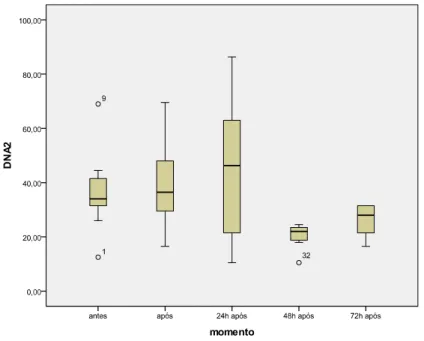
Figure 2.1. Serum CK concentrations (U.L-1) and DOMS values at pre, post, 24, 48, and 72 hours after exercise ... 31 Figure 3.1.. Serum Creatine Kinase Pre, Post, 24, 48, 72 hours after the completion of protocol……….………..47 Figure 3.2.DNA Strand Breaks (DNA2) Results……….48 Figure 3.3.DNA FPG Sites (DNAfpg2) Results………..………48
Index of Tables
Table 1.1. Total exercise repetitions for SEQA and SEQB (Mean ± SD)………...…………...16
Table 2.1. Number of total exercise repetitions (in three sets at 80% of 1RM) for LP, LE, LC, BP SP,TE……….………....30
List of Abbreviations
1RM test - one repetition maximum test BP - bench press
CK- creatine kinase
DNA FPG Sites - DNA oxidative stress damage DNA Strand Breaks - DNA basal damage DOMS – delayed onset muscle soreness LC - leg curl
LE -leg extension LP - leg press OS- oxidative stress PSE – perceived exertion RPE - rating perceived exertion SEQA - sequence A
SEQB - sequence B SP- shoulder press ST – strength training TE- triceps extension
1. General Introduction
Through different forms of activity, the American College of Sports Medicine (ACSM) recommends exercises guidelines for different types of population (ACSM, 1998, 2001, 2002, 2009). Among these activities is strength training (ST) whose first revision, addressing their methodological variables, was published in 2002 (ACSM, 2002). ST has been recommended as part of several physical training programs and has been considered in conditioning programs aimed to improve health and quality of life (ACSM, 2009). ST promotes numerous health benefits, improving capacities related with motor performance, such as speed, agility, balance, coordination and flexibility, favoring various sports (ACSM, 2002, Williams et al., 2007; ACSM, 2009). ST results in countless adaptations such as muscle hypertrophy, improvement in neural response, increases recruitment of motor units, increases and improves muscle power, gain lean mass, increases muscle strength, improves muscular endurance, decreases body fat and improves sports performance (ACSM, 2002, 2009; Carroll et al., 2001; Komi, 2003).
In 2009, the ACSM published its second review considering the variables that must be considered in a strength training program. These are: number of sets, number of repetitions, load intensity, rest period between sets and between training sessions, choice of exercises, muscle action, order of exercises, running speed, weekly training and recovery time (ACSM, 2009).
It is important to notice that the benefits of ST can only be attained if the manipulation of these variables occurs in an appropriate manner. The intensity and volume’ training should be equalized to provide stimuli according to the desired objective and to induce neuromuscular and morphology changes. The exercises’ order seems to have a great importance in the development of a ST program. The exercises sequence can significantly affect the total number of repetitions in a training session and consequently the strength and muscle hypertrophy (Sforzo y Touney, 1996, Simão et al., 2002, Simão et al., 2005, Spreuwenberg et al. 2006, Simão et al., 2007; Spineti, et al. 2010). There are evidences that when the exercises for larger muscle groups are ordered at the beginning of the session, a greater volume of training is produced (Sforzo y
Touney, 1996, Simão et al., 2005, Simão et al., 2007). According to the ACSM, in the positioning for ST (ACSM, 2002, 2009), the recommendation is that the ST program should start with exercises for the major muscle groups and continue within the same session with exercises for smaller groups. However, in the past 10 years there is no consensus about it.
In 1996, Sforzo and Touey showed that the exercises order generated a different response to ST. These authors compared two sessions of ST with different exercises orders. The ordering of the chosen exercises consisted of upper and lower limbs muscle groups involving uni and bi-articular exercises. The first session began with the larger muscle groups and give continuity to smaller groups while the second session was held in reverse order. This study showed that while exercising the smaller muscle groups before large, the total output power of the large ones was smaller. In relation to higher total output power, this would occur only in some exercises, when performed early in the ST session. This study was the first to demonstrate that in ST the order in which the exercises are performed showed different responses, and may have an influence on performance throughout the ST session. Since 2005, several studies (Simão et al., 2005; Spreuwenberg et al., 2006; Gentil et al., 2007, Simão et al. 2007; Farinatti et al., 2009, Rodrigues et al., 2010) on the order of the exercises were published showing the importance of exercise order in a training session, opening up as a result a new line of research, without scientific support, so far. The order of exercise began to be investigated in several ways, for example, order and perceived exertion (Simão et al., 2005; Spreuwenberg et al., 2006; Simão et al., 2007), order of exercises in women, (Simão et al., 2007), order and number of repetitions (Simão et al., 2007), order of exercises in upper limb exercises (Simão et al., 2005, Gentil et al., 2007 ), order of exercises and oxygen consumption (Farinatti et al., 2009), order of exercises and neuromuscular activity (Brennecke et al., 2009), order of exercises and blood lactate, perceived exertion and affective response to training (Bellezza et al., 2009), order of exercises and maximum force (Dias et al., 2010), order of exercises, maximum strength and muscle volume (Simão et al., 2010; Spineti et al., 2010) and exercise order and interval between sets (Miranda et al., 2010).
Simão et al. (2005) have verified the influence of the order of upper limb exercises and perceived exertion (PSE) in 14 men and four women trained in ST in two identical and reverse sequences with loads for 10RM in five exercises. Researchers have observed a decrease in the number of repetitions in the exercises that were conducted at the end of the program, showing that regardless of the size of the muscle group, the groups that are at the end are negatively affected in its total number of repetitions. The PSE between the sequences showed no significant difference, however, showed a tendency to be higher when the series was started by large muscle groups. In another study by Simão et al., (2007), with only trained females, using the PSE and an exercise protocol with loads for 80% 1RM for upper and lower limbs, it was observed that the performance of the exercises performed at the end of the series was also lower compared to the same exercise performed at the beginning of the program. However, the PSE showed no significant changes between the sequences. Studies of Sforzo and Touney (1996), Simão et al. (2005) and Simão et al. (2007), corroborate this conclusion showing results that exercises performed at the end of the program are more impaired in their performance, regardless of the size of the muscle group. They also provide evidence that a training session should be started with the exercises of the highest priority to the individual, regardless of the size of the muscle group. According to these authors, it appears that the performance decrease of exercise executed at the end of the session is due, in part, to muscle fatigue that accumulates along the session and results in lower performance. Despite the PSE did not differ significantly in the aforementioned studies, there is a tendency to be greater in exercise protocols that start with large muscle groups (Simão, et al., 2002). As already seen, the execution order of the exercises is a variable that has been addressed in the literature, but until now no study to our knowledge related muscle damage and a ST program with distinct orders. This is an important aspect that must be considered in practice and that may contribute to the development of more efficient and safe strength training programs.
Markers of muscle damage can be managed through the high activity of creatine kinase (CK) (Mc Hugh, et.al., 1999), increased myoglobin, increased hydroxyproline and creatinine elevation (Armstrong, 1984). These may also
result from metabolic overload, such as the formation of reactive oxygen species (ROS) (Bloomer et al. 2005), imbalance in the calcium release (Armstrong, 1984; Mc Hugh, et.al., 1999), hyperkalemia (Armstrong, 1984) as well as mechanical causes such as damage to the line Z with resulting rupture or damage the sarcolemma (Mc Hugh, et.al., 1999) and connective tissue injury (Armstrong, 1984). The products of oxidative damage tend to arise more frequently after prolonged exercise than after ST. The ST and eccentric movements tend to produce more damage related to structural changes in muscle fibers due to the mechanical traction (Mc Hugh, 1999). Besides the mechanical traction, some damage may also occur resulting from an increased metabolism associated with increased oxidative stress and / or damage to the vascular epithelium similar to those disclosed in situations of ischemia and reperfusion, inducing an increase of xanthine oxidase (XO) (Hellsen et al. 1997; Fisher-Wellman and Bloomer, 2009). This XO increase is associated with the inflammatory process, and can be induced by ischemia that occurs in these types of exercises and by leukocytes infiltration (Hellsen et al. 1997).
The increase of CK, lactate dehydrogenase (LDH), troponin can also be indicators of muscle damage caused by mechanical traction, more common in strength training, and may also arise in the prolonged and intense exercise (Fisher-Wellman and Bloomer, 2009).
Creatine Kinase is present in various tissues such as brain, cardiac muscle, skeletal muscle, prostate, intestine, uterus, placenta, thyroid, lung and bladder. In skeletal muscle and heart reveals an increase in membrane permeability and damage of these tissues (Nosaka & Clarkson, 1995; Lee, et al. 2002; Cheung et al. 2003). Some authors have used CK to quantify muscle damage after ST exercise protocols (Kleiner et al., 1996; Jamurtas et al., 2005; Paschalis, et al., 2005). Such protocols would generate a line Z rupture and a sarcolemma lesion allowing the diffusion of enzymes such as the CK into the interstitium (Cheung et al. 2003). The migration of CK from the cell can produce an increase in CK from 100 to 40,000 U/L characterizing muscle injury (Cheung et al. 2003). Whereas there is a tendency (Sforzo y Touney, 1996, Simão, 2005, Simão, 2007) to perform a higher strength volume when the major muscle groups are exercised at the beginning of the session, it is possible that the order of
exercises influence muscle damage associated with exercise. Being muscle damage an important part that occurs in training adaptation, exercise order may have, in fact, a decisive role in shaping the sessions of ST. Thus, we intend to study if the exercises order execution in a strength protocol with two different sequences alters the concentrations of blood CK and perceived exertion after different times of the exercises completion.
Whereas assessment of muscle damage using biochemical indicators is not accessible to most coaches, it becomes important to find other alternative methodologies for the purpose. Another way to assess muscle damage associated with ST is through the scale of delayed onset muscle soreness (DOMS), a visual analogue scale (VAS) of pain perception (Price et al., 1983; Clarkson et al., 1992; Cleather et al., 2007), from zero to 100, where zero indicates no pain and 100 the worst possible pain. DOMS is a type I muscle injury characterized by muscle pain and other symptoms that appears approximately 12 to 72 hours after workout or intense or unusual exercise and can still occur due to the mechanical stress that occurs in training of high magnitude (Armstrong, 1984; Szymanski, 2001; Cheung et al. 2003; Zainuddin et al. 2005; Cleary, et al. 2006; Nosaka et al., 2007) and may remain five to seven days (Szymanski, 2001). The signs and symptoms presented in DOMS are: diffuse pain, discomfort to the touch, stiffness, discomfort, reduced muscle power and peak torque, decrease or loss of muscle strength on muscle that was exercised, decreased range of motion, change on motor units recruitment pattern and decreased neuromuscular function (Proske & Morgan, 2001; Szymanski, 2001; Cheung et al., 2003; Zainuddin et al., 2005, Cleary et al., 2006; Nosaka et al., 2007).
Several theories have been proposed to explain the pain associated with DOMS, some of them are damage to muscle structure (Friden & Lieber, 1992), muscle spasm, connective tissue damage, muscle damage, inflammation, enzyme efflux, altered blood flow, infiltration of inflammatory factors such as neutrophils and monocytes (Armstrong, 1984; Friden & Lieber, 1992; Smith, 1991; Cheung et al. 2003), as well as the production of ROS, resulting in increased oxidative stress that can also produce muscle damage (Proske & Morgan, 2001). It is known that during the ST various aggressions muscle can
occur due to the mechanical stimulation. These attacks often become necessary to promote physiological responses expected from a ST program. Such damage can last for several hours and even days after the effort. However, in gymnasiums it becomes impracticable to quantify the damage through biochemical markers. Regarding subjective damage indicators, it becomes easier to use, since they have lower cost, are easy to use and don’t use invasive techniques. In this sense, there has been an attempt to associate DOMS to the modification of some blood markers such as CK (Brown et al. 1997, Dolezal et al. 2000, Lee et al. 2002; Cheug et al. 2003, Zainudin et al. 2005). However, the literature is poor showing studies that used subjective and biochemical markers of muscle damage after a ST protocol, as used in the daily life of gymnasiums. Another aspect that may also affect DOMS is the order of the exercises. As previously mentioned, the order of exercises has been studied in relation to several variables, but no study has addressed the order of exercises and subjective and biochemical damage markers.
Together, muscle and vascular damage induce an increased immune response that will aggravate muscle damage hours (days) after the workout. These immunological changes are accompanied by an increase in oxidative damage in various cells, in particular increased DNA damage. However, with regard to the ST, there are few studies of this nature. Thus, it seems appropriate to consider how far a session of strength training induces DNA damage in lymphocytes and how these injuries are related to muscle damage.
Thus, the objectives of this study are to investigate the influence of a session of strength training with sub-maximal repetitions in blood and subjective markers of muscle aggression, and verify the influence of muscle damage associated with ST in markers of oxidative DNA damage in lymphocytes. This study will be subdivided in the following three studies:
Influence of Exercise Order on Muscle Damage - The first study verifies if the execution order of the exercises in a strength protocol with two different sequences alter the concentrations of CK, perceived exertion and presence of DOMS after different times of the exercises.
Is there a relation between muscle damage and DOMS after a strength training session? - The second study sets out to investigate the relationship
between subjective indicators of DOMS and the presence of muscle damage after several moments of realization of a sub-maximal strength training protocol. Modification of lymphocyte DNA damage after a session of strength training with sub-maximal repetitions - The third study checks if a session of strength training with sub-maximal repetitions induces lymphocytes DNA damage and how these injuries are related with muscle damage.
Finally, general conclusions of the thesis and some implications for the strength training at gyms will be presented. There will also be some suggestions for future studies.
ABSTRACT
This study aimed to investigate the role of exercise order on total number of repetitions and to evaluate the possible importance on muscle damage on the rating of perceived exertion (RPE). Ten trained participants completed two sequences: sequence A (SEQA) was leg press (LP), leg extension (LE), leg curl (LC), bench press (BP), shoulder press (SP) and triceps extension (TE) and in sequence B (SEQB) the order of execution of the exercises was reversed. Highest creatine kinase (CK) concentrations were observed 24 hours following both sessions, but no differences were found at any time between them, revealing that muscle damage has occurred. There were significant differences between SEQA and SEQB in the total number of repetitions for TE, LE and LC. Our results suggest that differences in total strength production when exercise order is changed must be explained by some other mechanisms besides muscle damage and RPE.
KEYWORDS: strength training, physical activity, blood test, ratings of perceived exertion.
INTRODUCTION
Strength training can increase muscle size, increase strength and improving the functional performance (Fröhlich et al 2010, Marks 1996). One of the key variables in strength exercise prescription involves the order in which exercises are programmed during a workout. This can determine the effectiveness of a workout in accomplishing different training goals (Miranda et al 2010). The American College of Sports Medicine (ACSM) position stand on progression models in resistance training for healthy adults (ACSM 2009) recommends that large-muscle group exercises should be performed earlier in a training session. Sforzo and Touey (1996) reported greater total force production in some, but not all, single joint exercises when they were performed early in a training session composed of both upper and lower body large-muscle (multi-joint) and small-muscle (single-joint) group exercises. Therefore, the traditional recommendation regarding exercise order has been to perform multi-joint exercises prior to single joint exercises allowing a greater volume of work (load x repetitions) compared to when single-joint exercises are performed first (ACSM 2009, Sforzo and Touey 1996).
Recently, several studies (Bellezza et al 2009, Brennecke et al 2009, Dias et al 2010, Farinatti et al 2009, Gentil et al 2007, Simão et al 2005, Simão et al 2007, Simão et al 2010, Spineti et al 2010, Spreuwenberg et al 2006) observed that exercise order influences the number of repetitions independently of the muscle group size. In fact, when the exercise was performed at the beginning of the training session, additional repetitions were performed. Considering these results, several studies (Dias et al 2010, Gentil et al 2007, Simão et al 2005, Simão et al 2007, Simão et al 2010, Spineti et al 2010) recommended that exercises that demand maximal adaptation should be placed at the beginning of an exercise session despite the size of the muscle groups involved.
Although differences exist between the total numbers of repetitions when strength training exercise order is changed, to our knowledge, no plausible explanation has been pointed out. Considering that highly fatiguing strength training protocols, such as those that involve moderate intensity sets performed to voluntary exhaustion, may induce significant damage to muscle fibers (Clarkson et al 2006), we speculate that difference in total number of repetitions
could be explained by differences in muscle damage. The level of rating perceived exertion (RPE) at the end of a session could also explain this fact as in this moment any effort could be over assessed.
Serum Creatine Kinase (CK) concentrations have been used as a marker of muscle damage following strength training and may indicate the status of the muscle cell membranes (Clarkson et al 2006, Ferri et al 2006, Jamurtas et al 2006, Paschalis et al 2005, Rodrigues et al 2010). Therefore the purpose of the current study was to compare CK concentrations and RPE at multiple time points after strength exercises that incorporated different orders exercise. We have hypothesized that different exercise orders would evoke divergent CK and RPE responses.
METHODOLOGY
Experimental Approach to the Problem
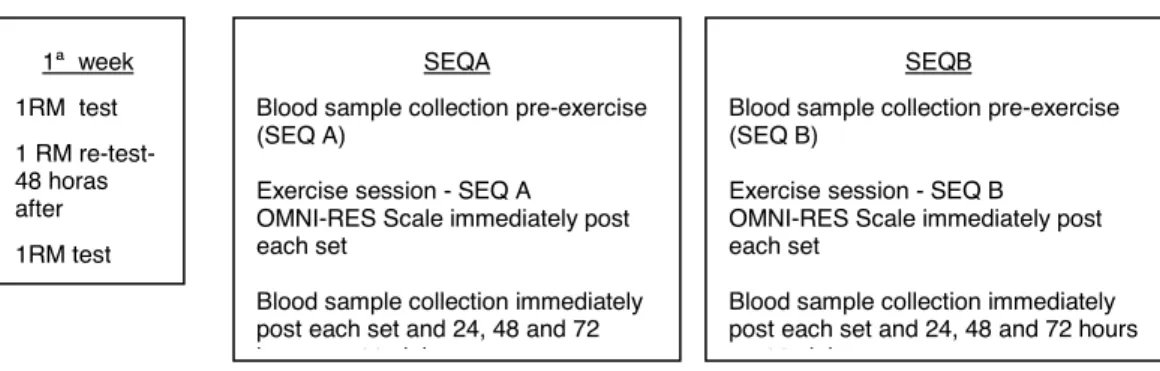
To investigate the effect of two different exercise orders on CK and RPE, the one repetition maximum test (1RM test) had to be assessed in order to determine 80% of 1RM load per subject and for each exercise. The figure 1.1 depicts experimental protocol design.
FIGURE 1.1 The experimental protocol design in a counterbalanced crossover design
The two sessions were composed by the same exercises performed in different orders. Sequence A (SEQA) began with large-muscle group exercises and progressed toward small-muscle group exercises. The exercise order for SEQA was leg press (LP), leg extension (LE), leg curl (LC), bench press (BP), seated machine shoulder press (SP), and triceps extension (TE). Sequence B (SEQB) began with small-muscle group exercises and progressed toward large-muscle group exercises. The exercise order for SEQ B was LC, LE, LP, TE, SP and
1ª week 1RM test 1 RM re-test-48 horas after 1RM test SEQA
Blood sample collection pre-exercise (SEQ A)
Exercise session - SEQ A OMNI-RES Scale immediately post each set
Blood sample collection immediately post each set and 24, 48 and 72 hours post training
SEQB
Blood sample collection pre-exercise (SEQ B)
Exercise session - SEQ B OMNI-RES Scale immediately post each set
Blood sample collection immediately post each set and 24, 48 and 72 hours post training
BP. All exercises in both sequences were performed in three sets to volitional fatigue with 80% of 1RM load per subject and for each exercise. Sets and exercises in both sequences were separated by two minutes rest intervals of passive recovery. The total number of repetitions performed was determined for each set of each exercise for both sequences.
Subjects
Ten trained men (24.50 ± 4.95 yrs; 74.20 ± 7.78 kg; 1.77± 0.09 cm; 23.75 ± 0.2 kg.m2, Mean± SD) participated in the study. Inclusion criteria consisted of the following: a) all subjects must have had at least two years of recreational strength training experience performing all selected exercises; b) did not have any medical conditions that might be aggravated by participation in the current study; and c) did not use any nutritional supplements or ergogenic aids. All subjects read and signed an informed consent document and were asked to avoid any kind of any strength training a week before and during the current study. Experimental procedures were in accordance to the Declaration of Helsinki and the study protocol was approved by the Research Ethics Committee of the Institution.
One Repetition Maximum Testing (1RM test)
The 1RM tests were performed on two nonconsecutive days (separated by 48 hours) from which test-retest reliability was calculated (Simão et al 2005). The 1RM was determined in fewer than five attempts with a rest interval of five minutes between attempts and 10 minutes between assessments for different exercises. The 1RM tests were performed in a counterbalanced order. The heaviest load achieved on either of the test days was considered the 1RM. To minimize possible errors in the 1RM tests, the following strategies were adopted (Simão et al 2005): a) all subjects received standard instructions on the general routine of data assessment and proper technique for each exercise before testing; b) the exercise technique of subjects during all testing sessions was monitored and corrected as needed; c) all subjects received verbal encouragement during testing. The mass of all weight plates and bars used for measuring 1RM was determined with a precision scale and all machine
exercises were performed on an Image Sport Machine® (Spain). The same range of motion was used to define a successful repetition for each exercise. Training Sessions
One week after the 1RM test had been determined the subjects performed one of the two exercise sequences (SEQA or SEQB) in a counterbalanced crossover design. In the following week subjects performed the other exercise sequence. Warm-up session before each exercise sequence consisted of 20 repetitions in the first exercise of the session (LP for SEQA and LC for SEQB) at 40% of the 1RM load. A two minutes rest interval was allowed after the warm-up set before subjects performed the assigned sequence. Both exercise sequences consisted of three sets of each exercise to failure with 80% of 1RM load with two minutes rest intervals between sets and exercises.
During exercise sessions, subjects were verbally encouraged to perform all sets to concentric failure. No pause between the eccentric and concentric phases of each repetition was allowed. The total number of repetitions for every set of every exercise was recorded. Strength training sessions of individual subjects were performed in the morning and approximately at the same time of the day. Creatine Kinase
To analyze blood CK activity (U/L) capillary blood samples were collected into 80 µL heparinized capillary tubes (Cat nº 955053202 Reflotron®). After the harvest, the blood samples were identified for subsequent use. Serum CK concentrations were determined with 32 µL of blood sample on the Reflotron® Plus – Roche, in which specific reagents (Cat nº 1126695 Reflotron®) were used to analyze the CK concentrations. All blood samples were collected at multiple time points that included: before the bout, immediately after the bout and at the 24th, 48th and 72nd hours after training.
Rating of Perceived Exertion
The RPE was determined using the OMNI-RES scale, which was design specifically for strength training (Lagally and Robertson 2006). All subjects performed a familiarization with the OMNI-RES Scale, two weeks before 1RM
tests sessions. Prior to the warm-up in the experimental sessions, the scaling instructions for the OMNI-RES Scale were reminded to each subject in order to assess perceived exertion. The OMNI-RES was showed to the subjects immediately after each set of each exercise.
Statistical Analyses
Intra-class correlation coefficients (ICC) were used to determine 1RM test-retest reliability. Two-way ANOVAs with repeated measures were used to compare differences in CK concentrations between SEQA and SEQB at multiple time points and the total number of repetitions completed for each exercise and each set individually between SEQA and SEQB. The Wilcoxon test was used to compare the RPE for each exercise between SEQA and SEQB. An alpha level of 0.05 was used to determine significance for all comparisons.
RESULTS
Excellent day-to-day 1RM reliability for each exercise was shown by this protocol. 1RM testing on the two occasions separated by 48 hours showed intra class correlation coefficients of LP r=0.92; LE r= 0.96; BP r=0.94; SP r=0.94; TE r=0.96; LC r=0.94. Additionally, a paired student t-test did not show significant differences between the 1-RM tests of any of the exercises.
There were significant differences between SEQA and SEQB in the total number of repetitions completed only for TE, LE and LC exercises (Table 1.1).
TABLE 1.1. Total exercise repetitions for SEQA and SEQB (Mean + SD).
Bench Press Shoulder Press Triceps extension Leg Press Leg Extension Leg Curl SEQA 19.40 ± 5.62 22.70 ± 9.48 37.50 ± 15.50 42.90 ± 16.00 30.20 ± 12.65 25.10 ± 7.29 SEQB 16.40 ± 10.02 27.30 ± 10.02 51.60 ± 17.07* 37.50 ± 10.82 43.80 ± 11.83* 32.90 ± 7.62*
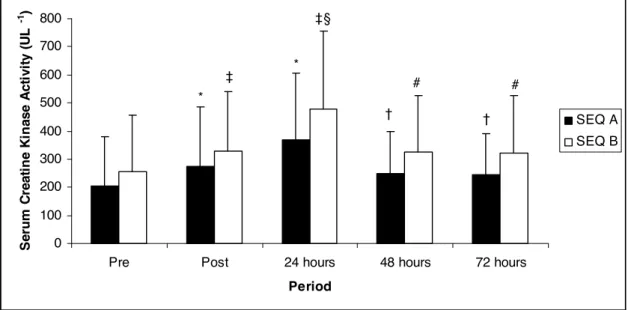
The CK concentrations for SEQA and SEQB at different points are shown in Figure 1.2. The CK concentrations were highest at 24 hours following both sessions. When the CK concentrations were compared between SEQA and SEQB, no significant differences were noted at any time point.
FIGURE 1.2Serum CK concentrations for SEQA and SEQB at pre, post, 24, 48, and 72 hours. * Significant difference to pre CK concentration at SEQA.
† Significant difference to CK concentration at SEQA 24 hours after. ‡ Significant difference to pre CK concentration at SEQB.
§ Significant difference to post CK concentration at SEQB.
# Significant difference to CK concentration after at SEQB 24 hours after
The RPE after each exercise was significantly higher in SEQA for TE (p < 0.04) and significantly higher in SEQB for LP (p<0.03), with no significant differences in BP (p=0.74), SP (p=0.76), LE (p=0.74) and LC (p= 0.48).
DISCUSSION
A key finding of the present study was that although some differences exist when the exercise sequence order is changed, those differences could not be explained by muscle damage contradicting our initial hypothesis. This indicates that exercise order did not result in different CK concentrations at multiple time points post training. However, our results also demonstrated that moderately intense sets performed to the point of voluntary exhaustion resulted in elevations in CK concentrations. It occurred in both sequences and did not
0 100 200 300 400 500 600 700 800
Pre Post 24 hours 48 hours 72 hours
Period Se ru m C re a ti n e K in a s e A c ti v it y ( U L -1 ) SEQ A SEQ B * * † † ‡ ‡§ # #
show differences between them despite the distinct orders of execution or the total number of repetitions performed in a particular exercise when the total volumes were equal. Similar significant CK elevation at post and 24 hours after both training demonstrates that muscle damage was incurred by both exercise order conditions. These could propose that, in spite of the order of exercises and different number of repetitions for an exercise, both sequences can induce muscle damage. These results are in accordance with previous studies (Clarkson et al 2006, Lee et al 2002, Rodrigues et al 2010) that found elevated blood CK concentration post high intensity strength exercise.
Another important conclusion of this study was that the total number of repetitions for an exercise is directly influenced by the sequence used in a strength training session (Bellezza et al 2009, Dias et al 2010, Farinatti et al 2009, Gentil et al 2007, Sforzo and Touey 1996, Simão et al 2005, Simão et al 2007, Simão et al 2010, Spineti et al 2010, Spreuwenberg et al 2006). In fact, when an upper or lower body exercise for a multi or single-joint was preceded by exercises for the same body part the total number of repetitions in the three sets decreased. This pattern was true for all of the exercises in both SEQA and SEQB. These results corroborate previous studies (Gentil et al 2007, Simão et al 2005, Simão et al 2007) and pointed out that the order of exercise performance should be taken in consideration. Moreover, notwithstanding some small differences in the methodology used, all the studies reviewed (Gentil et al 2007, Simão et al 2005, Simão et al 2007) concluded that the exercise order affects the total number of repetitions. However, no physiological parameters have been considered in order to identify possible mechanisms that would explain this event.
Only three studies that investigated the effect of exercise order and its chronic effects (Dias et al. 2010, Simão et al. 2010, Spineti et al. 2010). Dias et al. (2009) examined the influence of exercise order on strength in untrained young men after 8 weeks of strength training. The small muscle exercises revealed significantly higher strength gains when placed first, demonstrating that the exercise order to small muscle exercises may be particularly important during the initial stages of strength training in untrained young men. On the other hand, Simão et al. (2010) examined the influence of exercise order on strength
and muscle thickness in untrained men after 12 weeks of linear periodized strength training and demonstrated differences in strength and muscle thickness based on exercise order. Spineti et al. (2010) examined the influence of exercise order on strength and muscle volume in untrained men after 12 weeks of nonlinear periodized strength training. The results suggests that different exercise orders during strength training have a significant influence in strength and muscle volume during 12 weeks of nonlinear periodized strength training. In conclusion the three studies, if an exercise is important for individual training goals, it should be performed at the beginning of the training session, whether or not it is a large or a small muscle group exercise. But no study has investigated the influence of order and exercises damage muscle.
Bearing in mind that strength training may induce muscle damage (Clarkson et al 2006, Ferri et al 2006, Jamurtas et al 2006, Lee et al 2002, McBride et al 1998, Zembron-Lacny et al 2008, Rodrigues et al 2010), we have considered the hypothesis of this being one of the mechanisms that could generate differences in total strength production as exercise order changes. Though our results have also suggested that muscle damage has occurred as a consequence of strength training, no differences were found when exercise order changed. Therefore, some other mechanisms, aside from muscle damage, should explain differences in total strength production when exercise order is changed.
The other hypothesis considered refers to the cognitive perception of exercise effort. In the present study, the RPE was higher for TE in SEQA and for LP in SEQB. These exercises were executed in distinct moments of the sequences, TE was the last exercise in SEQA, and the LP was the last exercise for the lower body in SEQB. This suggests that when a small muscle group exercise is performed in the end of the session it presents more difficulties than in the middle. With respect to the decreased number of repetitions, the RPE in exercises performed in the middle of each sequence tended to be greater when compared with the same exercises executed earlier in the sequence. The number of repetitions had also been considered in this study. TE in SEQA had fewer repetitions than in SEQB, probably because in SEQB TE was performed after some rest. In respect to LP in SEQB, when it was executed, two exercises
for the same body part had already been done before and this may have caused fatigue in the lower limbs and evoke a higher RPE. Moreover, in some aspects these results corroborate previous studies (Gentil et al., 2007; Simão, et al., 2005; Simão et al., 2007) as the number of repetitions per exercise performed latter was fewer than when done earlier in the session although the RPE had not changed for different sequences.
CONCLUSION
Although muscle damage appears to be similar as indicated by the lack of differences in CK concentration between the different exercise orders, based on RPE and number of repetitions performed with the different order sequences in the current study, as well as previous studies examining this issue, it appears that exercises that are particularly important to the subject should be placed at the beginning of a training session. This seems to be true for large and small-muscle group exercises, techniques, and genders, levels of training and duration of the exercise for each subject. The study results suggest that whenever one exercise is the last of a sequence performed in a training session, its performance will be negatively affected. This is confirmed whether it is a large or small-muscle group exercise and cannot be explained by differences in muscle damage. The results also indicate that some other mechanisms besides muscle damage and perceived exertion should explain differences in total strength production when exercise order is changed. Therefore, future studies should consider other mechanisms that could be involved.
REFERENCES
Amadio. A. C., Serrão, J. (2009). Neuromuscular activity during bench press exercise performed with and without the preexhaustion method. Journal of
Strength and Conditioning Research, 23 (7), 1933–1940.
American College of Sports Medicine. (2009). Position stand: Progression models in resistance training for healthy adults. Ratamess, N. A. Alvar, B. A., Evetoch T. K., Housh,T. J. Kibler, W.B., et al. Medicine and Science Sports and
Exercise. 41 (3), 687-708.
Bellezza, P. A., Hall, E. E., Miller, P. C., Bixby, W. R. (2009) The influence of exercise order on blood lactate, perceptual, and affective responses. Journal of
Strength and Conditioning Research. 23 (1), 203-208
Brennecke, A., Guimarães, T. M., Leone, R., Cadarci, M., Mochizuki, L. et al. (2009). Neuromuscular activity during bench press exercise performed with and without the preexhaustion method. Journal of Strength and Conditioning
Research. 23, 1933–1940
Clarkson, P. M., Kearns, A. K., Rouzier, P., Rubin, R., & Thompson, P. D. (2006). Serum creatine kinase levels and renal function measures in exertional muscle damage. Medicine and Science Sports and Exercise. 38 (4), 623–627. Dias, I., Salles, B. F., Novaes, J., Costa, P., Simão, R. (2010). Influence of exercise order on maximum strength in untrained young men. Journal of Sports
Science and Medicine. 13 (1), 65-69.
Farinatti, P. T. V., Simão, R., Monteiro, W. D., Fleck, S. J. (2009). Influence of exercise order on oxygen uptake during strength training in young women.
Journal of Strength and Conditioning Research. 23 (3), 1037–1044.
Ferri, A., Narici, M., Grassi, B., Pousson, M. (2006). Neuromuscular recovery after a strength training session in elderly people. European Journal of Applied
Physiology. 97 (3), 272-279.
Fröhlich, M., Emrich, E., & Schmidtbleicher, D. (2010). Outcome effects of single-set versus multiple-set training. An Advanced Replication Study.
Research in Sports Medicine: An International Journal. 18(3), 157-175.
Gentil, P., Oliveira, E., Rocha Júnior, V. A., Carmo, J., & Bottaro, M. (2007). Effects of exercise order on upper-body muscle activation and exercise performance. Journal of Strength and Conditioning Research. 21, 1082–1086. Jamurtas, A. Z., Theocharis, V., Tofas, T., Tsiokanos, A., Yfanti, C., et al. (2005). Comparison between leg and arm eccentric exercises of the same relative intensity on indices of muscle damage. European Journal of Applied
Koutedakis, Y., Nosaka. K. (2006). Comparison between leg and arm eccentric exercises of the same relative intensity on indices of muscle damage. European
Journal of Applied Physiology. 95 (2-3), 179-185.
Lagally, K. M., Robertson, R. J. (2006). Construct validity of the OMNI Resistance Exercise Scale. Journal of Strength and Conditioning Research. 20 (2), 252–256.
Lee, J., Goldfarb, A. H., Rescino, M. H., Hegde, S., & Patrick, S., Apperson K. (2002). Eccentric exercise effect on blood oxidative stress markers and delayed onset of muscle soreness. Medicine and Science Sports and Exercise. 34 (3), 443–448.
Marks. R. (1996). Effects of strength training on the structural and functional properties of human muscle: A review. Research in Sports Medicine: An
International Journal. 7 (1), 49-60
Mcbride, J. M., Kraemer, W. J., Triplett-Mcbride, T., & Sebastianelli, W. (1998). Effect of resistance exercise on free radical production. Medicine and Science
in Sports and Exercise. 30 (1), 67-72.
Miranda, H., Simão, R., Vigário, P. S., Salles, B. F., Pacheco, M. T. T., et al. (2010). Exercise order interacts with rest interval during upper-body resistance exercise. Journal of Strength and Conditioning Research. 24 (6), 1573–1577. Paschalis, V., Koutedakis, Y., Jamurtas A. Z., Mougios, V., Baltzopoulos, V. (2005). Equal volumes of high and low intensity of eccentric exercise in relation to muscle damage and performance. Journal of Strength and Conditioning
Research. 19 (1), 184–188.
Rodrigues, B. M., Dantas, E., de Salles, B. F., Miranda, H., Koch A. J., et al. (2010). Creatine kinase and lactate dehydrogenase responses after upper-body resistance exercise with different rest intervals. Journal of Strength and
Conditioning Research. 24 (6),1657-1662.
Sforzo, G. A., & Touey, P. R. (1996). Manipulating exercise order affects muscular performance during a resistance exercise training session. Journal of
Strength and Conditioning Research. 10, 20-24.
Simão, R., Farinatti, P. T. V., Polito, M. D., Maior, A. S. & Fleck, S. J. (2005). Influence of exercise order on the number of repetitions performed and perceived exertion during resistance exercises. Journal of Strength and
Conditioning Research. 19 (1), 152-156
Simão, R., Farinatti, P. T. V., Polito, M. D., Viveiros ,L. & Fleck, S.J. (2007) Influence of exercise order on the number of repetitions performed and perceived exertion during resistance exercise in women. Journal of Strength
Simão, R., Spineti, J., Salles, B. F., Oliveira, L., Ribeiro, F. M., et al. (2010) Influence of exercise order on maximum strength and muscle volume in untrained men. Journal of Sports Science and Medicine. 9 (1), 1-7.
Rodrigues, B. M., Dantas, E., de Salles, B. F., Miranda, H., Koch A. J., et al. (2010). Creatine kinase and lactate dehydrogenase responses after upper-body resistance exercise with different rest intervals. Journal of Strength and
Conditioning Research. 24 (6),1657-1662.
Spineti, J., Salles, B. F., Rhea, M. R., Lavigne, D., Matta, T., et al. (2010). Influence of exercise order on maximum strength and muscle volume in nonlinear periodized resistance training. Journal of Strength and Conditioning
Research. 24, 2962–2969.
Spreuwenberg, L. P. B., Kraemer, W. J., Spiering, B.A., Volek, J.S., Hatfield, D.L., et al. (2006) Influence of exercise order in a resistance-training exercise session. Journal of Strength and Conditioning Research. 20 (1), 141–144.
Zembron-Lacny, A., Ostapiuk, J,, Slowinska-Lisowska, M., Witkowski, K., Szyszka, K. (2008). Pro-antioxidant ratio in healthy men exposed to muscle-damaging resistance exercise. Journal of Physiology and Biochemistry. 64 (1), 27-35.
3. IS THERE A RELATION BETWEEN MUSCLE DAMAGE AND
DOMS AFTER A STRENGTH TRAINING SESSION?
ABSTRACT
This study aimed to investigate if one regular high intensity strength training (ST) session performed to voluntary fatigue could induce muscle damage and similar DOMS responses at multiple time points. For this purpose, ten male subjects performed a session of ST to volitional fatigue and had their CK and DOMS measured before, immediately after and 24, 48 and 72 hours after the exercise session. The CK concentrations were significantly (p<0.05) highest at post and 24h following the session in relation to pre exercise. After 48h and 72h of exercise, CK concentrations were lower than at 24 hours after (p<0.05). The DOMS values were higher 24h post exercise (p=0.002) in relation to pre exercise and decreased after 72h. Significant differences in DOMS were also found between 24h and 72h (p=0.003) and 48h and 72h after the exercise (p=0.005). These results showed a similar pattern on CK and DOMS values 24 hours after exercise although the statistical analysis did not show a meaningful correlation between these variables. After 72h, the results of CK and DOMS decreased showing significant differences from values at 24h after the exercise. This study suggest that DOMS scale can be used in training routines to appreciate skeletal muscle damage at 24h and the whole body response to ST. KEYWORDS: strength training, physical activity, DOMS, creatine-kinase.
INTRODUCTION
Strength training (ST) has been studied for several years and is known to promote several benefits such as an increase in muscle hypertrophy, strength, power and local muscular endurance, improving functional abilities as well as quality of life in different types of population. ST has also relevance in sports applications that are related to motor performance improvement, vertical jump, sprint speed, and sport-specific activities associated to others specific techniques (ACSM, 2009). Still, high intensity ST is associated to muscle damage being perceived by the increase in serum creatine kinase (CK) levels after some hours of exercise (Güzel et al., 2007; Zaja et al., 2001).
Serum CK, concentrations may indicate the status of the muscle cell membranes (Clarkson et al., 1992; Jamurtas et al., 2005; Paschalis et al., 2005; Ferri et al., 2006) and can be used as marker of muscle membrane damage or changes in membrane permeability plasma after exercise (Lee et al., 2002; Cheung et al., 2003). It is known that CK activity is elevated for several days following intensive physical activity and that training induces positive adaptive changes that might be observed by a decreased CK levels under a standard load (Clarkson et al., 1986).
Muscle damage can also be present on delayed onset muscle soreness (DOMS). DOMS is a type I muscle injury characterized by muscle pain and other symptoms that occurs 8-10 hours after exercise, with peaks in 12-72 hours after unaccustomed or intense exercise, and mainly after eccentric contractions (Szymanski, 2001; Cheung et al., 2003; Zainuddin et al., 2005; Cleary et al., 2006; Nosaka et al., 2007). The signs and symptoms of DOMS are diffuse pain, discomfort to the touch, stiffness, discomfort, reduced muscle power and peak torque, decrease or loss of muscle strength of the muscle that was exercised, decreased range of motion (ROM), changes in the pattern of recruitment of motor units and decreased neuromuscular function (Szymanski, 2001; Proske, and Morgan, 2001; Cheung et al., 2003; Zainuddin et al., 2005; Cleary et al., 2006, Nosaka et al, 2007).
Although recommended, biochemically control of muscle damage in the exercise’s daily programs has many constrains due mainly to the high cost and
unpractical ways to do these tests, and because most of times it requires an invasive technique. Therefore, it became important to identify markers of muscle damage that can be used daily by professionals, in order to measure the individual recovery time after training sessions. The DOMS questionnaire gives an indication of muscle discomfort; however it is a subjective instrument. Thus, we hypothesize that DOMS is correlated with muscular damage evaluated by CK.
Considering that highly fatiguing strength training protocols, such as those that involve moderate intensity sets performed to voluntary exhaustion, may induce significant damage to muscle fibers (Clarkson et al., 1992), we aimed to study whether one regular high intensity strength training session performed to voluntary exhaustion could cause muscle damage and similar DOMS responses at multiple time points. For this purpose, male subjects performed a session of ST to volitional fatigue and had their CK measured before, immediately after and 24, 48 and 72 hours after the exercise and DOMS measured before, immediately after, 24, 48 and 72 hours after the training.
METHODS
Subjects
Ten men (24.50±4.95 yrs; 74.20±7.78 kg; 1.77±0.09 cm; 23.75±0.20 kg.m-2, Mean±SD) participated in the study. The following criteria was adopted: a) subjects must have had at least two years of recreational strength training experience; b) subjects couldn’t have any medical conditions that might be aggravated by participation in the current study; and c) subjects couldn’t be using any nutritional supplements or ergogenic aids. All subjects read and agreed to sign an informed consent document and were asked to avoid any kind of physical activity a week before and during the current study. Experimental procedures were in accordance to the Declaration of Helsinki and the study protocol was approved by the Research Ethics Committee of the Institution.
Delayed Onset Muscle Soreness (DOMS)
The DOMS was measured rated with a visual analog score (VAS 100 mm long) (Price et al., 1983; Clarkson et al., 1992; Cleather et al., 2007) that incorporated a 100-mm line, with zero indicating no pain and one hundred representing
extremely painful. Subjects were asked to mark their whole muscle body
perceived soreness on the 100-mm line. Distance from the left edge of the line (0) to the marked point was measured in millimeters, and this value was used for the analysis (Price et al., 1983; Clarkson et al., 1992; Zainudin et al, 2005; Cleather et al., 2007). The muscle soreness values (DOMS) were obtained before, immediately after, 24, 48 and 72 hours post exercise.
Creatine Kinase
To analyze blood CK activity (U/L), capillary blood samples were collected into 80 µL heparinized capillary tubes (Cat nº 955053202 Reflotron®). After the harvest, the blood samples were identified for subsequent use. Serum CK concentrations were determined with 32 µL of blood sample on the Reflotron® Plus – Roche, in which specific reagents (Cat nº 1126695 Reflotron®) were used to analyze the CK concentrations. All blood samples were collected at multiple time points that included: before the bout, immediately after the bout and at the 24th, 48th and 72nd hours after training.
One Repetition Maximum Testing (1RM test)
The 1RM tests were performed on two nonconsecutive days (separated by 48 hours) from which test-retest reliability was calculated (Simão et al., 2007). The 1RM was determined in fewer than five attempts with a rest interval of five minutes between them and 10 minutes between assessments for different exercises. The 1RM tests were performed in a counterbalanced order. The heaviest load achieved on each tests’ day was considered the 1RM. To minimize possible errors in the 1RM tests, the following strategies were adopted (Simão et al., 2007): a) all subjects received standard instructions on the general routine of data assessment and proper technique for each exercise before testing; b) the exercise technique of subjects during all testing sessions was monitored and corrected as needed; and c) all subjects received verbal encouragement during testing. The mass of all weight plates and bars used for
measuring 1RM was determined with a precision scale and all machine exercises were performed on Image Sport Machine® (Spain). The same range of motion was used to define a successful repetition for each exercise.
Training session
One week after the 1RM has been determined, subjects performed the exercise protocol. The exercise order was leg press (LP), leg extension (LE), leg curl (LC), bench press (BP), seated machine shoulder press (SP), and triceps extension (TE). The warm-up session consisted of 20 repetitions in the first exercise (LP) at 40% of the 1RM load. A two minutes rest interval was allowed after the warm-up set before subjects performed the sequence. All exercises were performed in three sets to volitional fatigue with 80% of 1RM load with two minutes rest intervals of passive recovery between sets and exercises.
During exercise session, subjects were verbally encouraged to perform all sets to concentric failure. No pause between the eccentric and concentric phases of each repetition was allowed. The total number of repetitions for every set of each exercise was recorded. Strength training session was performed in the morning for all subjects.
Statistical Analyses
Intra-class correlation coefficients (ICC) were used to determine 1RM test-retest reliability. Repeated measures ANOVA were used to compare differences in CK concentrations and DOMS at multiple time points.
Spearman correlation coefficient test (r) was used to evaluate correlation between CK and DOMS responses at multiple time points following the high intensity strength training session. The Statistical Package for the Social Sciences (SPAA version 19.0; Chicago IL) was used for all analyses. The level of significance was defined at p<0.05.
RESULTS
An excellent day-to-day 1RM reliability for each exercise was shown by this protocol. The 1RM testing on the two occasions separated by 48 hours showed intra class correlation coefficients of: LP r=0.92; LE r= 0.96; LC r=0.94; BP
r=0.94; SP r=0.94; TE r=0.96. Additionally, the paired student t-test did not show any significant differences between the 1-RM tests of all the exercises (Table 2.1).
TABLE 2.1. Number of total exercise repetitions (in three sets at 80% of 1RM) for Leg Press (LP), Leg Extension (LE), Leg Curl (LC), Bench Press (BP) Shoulder Press (SP), Triceps Extensio (TE) (Mean±SD).
Reps LP LE LC BP SP TE Mean ± SD 42.90 ±16.00 30.20 ± 12.65 25.10 ± 7.29 19.40 ± 5.62 22.70 ± 9.48 37.50 ± 15.50
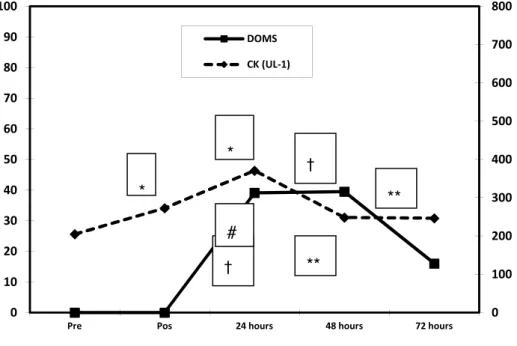
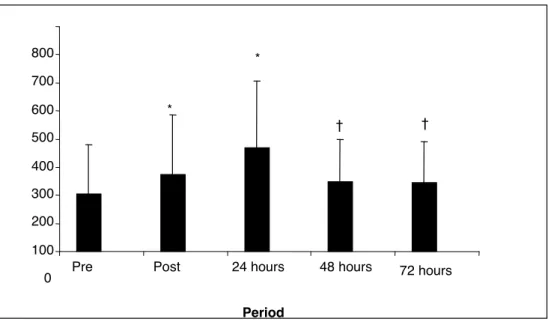
The CK concentrations and DOMS results at different points are shown in figure 2.1. The CK concentrations were highest at post (272.68 ± 211.64 U/L; Mean ± SD; p=0.002, related to pre) and 24 hours following the session (370.60 ± 235.45 U/L, Mean ± SD; p=0.054, related to pre). After 48h (248.13 ± 149.99 U/L, Mean ± SD); and 72 hours (246.44 ± 145.62, U/L, Mean ± SD) of exercise, CK concentrations were lower than at 24 hours after (p<0.05). Concerning to average values of DOMS obtained before training session, values were higher 24 hours post exercise (41.10 ± 29.87, Mean ± SD) and decreased after 72 hours, (12.40 ± 14.23, , Mean ± SD). Significant differences were also found between 24 and 72h (p=0.003) and 48 and 72h (p=0.005). No Significant correlations were found between CK and DOMS.