Innovations in Psychotherapy: Tracking
the Narrative Construction of Change
1This chapter presents a research program on narrative change processes that is under development at our research center. It developed from the study of narrative therapy, following White and Epston’s (1990) model of re-authoring narratives, in which the notion of “unique outcome” is central. Unique outcomes are defined as all the details that fall outside the domain of the dominant narrative, namely, episodes in which the person did, thought, imagined or felt something different, or related to others in a new way, from what the problematic narrative “prescribes” for his or her life (see also White, 2007).
We started studying how “unique outcomes” developed throughout the process of narrative therapy, and then wondered if developing these narrative details outside the main problematic story could be, in a sense, a common factor of all different kinds of psychotherapies, even if this is something that therapists outside the narrative tradition do not emphasize explicitly. If one assumes that all therapists wish to produce novelties in different forms (cognitive, affective, behavioral) it is not hard to 1 This chapter was supported by the Portuguese Foundation for Science and Technology (FCT), by the Grant PTDC/PSI/72846/2006 (Narrative Processes in Psychotherapy). We are grateful to Gena Rodrigues for the revision of the English and to Carla Machado for the suggestions done on the first draft of this chapter.
a
3
b
Miguel M. Gonçlaves, Anita Santos, Marlene
Matos, João Salgado, Inês Mendes, António Ribero,
Carla Cunha, and Juliana Gonçlaves
imagine that “unique outcomes” must emerge in every form of successful psychotherapy, independently of the means that are used to achieve them.
The target of this chapter is to provide an overall view of the studies on the role of these unique outcomes in psychotherapy change. We organized this chapter in four parts. We start by discussing the theoretical and methodological foundations of our research, highlighting its narrative frame. After presenting our current main findings, a heuristic model of change is presented. Working from this model, we reflect upon how change is prevented from occurring in poor-outcome cases. We then discuss the new paths of research that we are developing: namely intensive case-study research of these models of change and stability. This chapter ends with some provisional reflections about how this research can inform therapists, contributing in this way to the development of psychotherapy as a practice.
Theoretical Assumptions
Bateson (1979) once suggested that if we were able to ask a computer if it would one day be able to think as a human being (and if the computer could in fact model the way humans think), the output would begin, after some difficult processing, “That reminds me a story” (p. 22). Congruent with this idea from Bateson, our first assumption is that human beings organize reality in a narratively structured way (Bruner, 1986; McAdams, 1993; Polkinghorne, 1988; Sarbin, 1986). Emotions, feelings, relations and behaviors acquire meaning through their integration in stories that are narrated to the self and/ or to others. In the uninterrupted flow of our life we create meaning out of events by “cutting” the flow of timely experience into discrete pieces and by constructing meaning by elaborating narrative themes (Kelly, 1955). We have here two interrelated processes: the event, that is something that happened, and the action of narrating it to a meaningful audience (the self, the therapist, meaningful others). This means, as Hermans (1996)
said, that the self is simultaneously the content of the story and the act of telling it. Or, as suggested by Wortham (2001), the articulation between the narrative content and the act of telling is a powerful tool for self-construction. Moreover, narrative always has a dimension of enactment, since it is quite related with our action, as human agents, in the physical and social world. Narratives, in a way, are performative acts – not simply self-contained performances – and, as such, they produce relational results to which, in return, we adapt to. Through the use of these symbolic means we are thrown into a constant dynamic of narrative positioning and repositioning (Hermans & Dimaggio, 2004; Valsiner, 2002; Salgado & Gonçalves, 2007).
Congruently, therapists have been developing a diversity of techniques to allow the transformation of life-narratives, but it is our suggestion, inspired by the re-authoring therapy of White and Epston (1990), that at least part of this transformation occurs through the expansion of unique outcomes. New self-stories are constructed from the narration of novelties, since these innovative stories create new paths of further development and free the person to engage in new forms of authorship. To tell new viable stories means to live new narratives. Indeed, as we argued previously, new forms of narrative are intermingled with new forms of relating with (and within) our world.
However, as our research has developed, so too has our terminology. Instead of “unique outcomes,” we prefer to use the term “innovative moments” (or i-moments), for two main reasons. First, as we shall see, unique outcomes are not unique events; they occur frequently in psychotherapy, even in poor outcome cases. Of course, the idea of “unique” in White and Epston’s (1990) work does not refer literally to the frequency of the events, but to their exceptionality in relation to the problematic narrative. However, for the unfamiliar reader the idea of uniqueness may be misleading. Another problem has to do with the term “outcomes.” “Unique outcomes” are more than a result or an output, and as we will illustrate, they reflect a developmental
process. Hence, in this research we are truly concerned with the processes involved in narrative transformations and that is why we prefer the idea of innovative moments (or i-moments) over unique outcomes.
Before moving to a consideration of psychotherapy let us illustrate the concept of i-moment at a more elementary level, using for that purpose the developmental research of Fogel, Garvey, Hsu and West-Stroming (2006) on the relationship of mothers and babies in infancy. Fogel et al. study how a relationship develops by using the concept of frames, understood as “segments of co-action that have a coherent theme, that take place within a particular location (in space or in time), and that involve particular forms of mutual co-orientation between participants” (p. 3). These frames evolve in time, in particular forms of sequence of mutual action and response, creating a kind of lived narrative. By their turn, in our view, narratives themselves operate as basic guidelines of social coordination – in a sense, as frames. These frames can also be studied in their developmental dynamics, as it happens with narratives.
One typical frame in the first 6 months of life is the guided
object frame, in which the caregiver and child play with objects.
Let us imagine that in one situation the mother shows different objects to the child while the infant observes, but in another the mother attempts to put the toy in the infant’s hands or the infant tries to reach for the object. These last occurrences open the possibility for development to occur, given that it brings an innovation to the system. From here the child may start grabbing objects and playing with them, without the help of the mother, giving rise to a new frame, which Fogel et al. (2006) term
non-guided object frame.
We have in this simple example three types of change that are characterized by Fogel et al. (2006), namely:
•Level 1 change, which occurs when there is variability inside the same frame (e.g., mother shows different objects);
•Level 2 takes place when an innovation occurs (in our terminology, an i-moment), for instance when the infant for the first time reaches for the toy;
•Level 3, the final level, in which there is a clearly developmental change; for instance when the non-guided frame emerges and stabilizes out of level 2 (we equate this in psychotherapy with the expansion of i-moments into a new narrative).
To Fogel et al. (2006) although level 1 change is always present given the dynamic nature of open systems, level 2 innovations can lead to more enduring changes, through developmental change (i.e. level 3):
The successful innovations, the ones that get noticed, remain in the system, and ultimately provoke a level 3 change, must somehow be perceived as “interesting”, or “better”, or “exciting”, or “worthwhile”. This implies that there is an inherent valuation of changes that is, an emotional aspect to the information of what makes a difference. (p. 238)
The reality of therapy is far more complex than that of the early interaction between caregivers and infant, however it is our suggestion that the same kinds of changes are also present in therapy. Whenever the client tells a redundant story – let us take as an example a story of pain for not being valued and loved as a child – we notice the same themes present over and over2. White and Epston (1990) call this redundancy a
problem-saturated story and Neimeyer (2000), in his conceptualization of narrative disruption, equated this with narrative dominance. Whatever the term used to describe this, the process present in this kind of narrative organization is the repetition of the same theme, over and over again. With this client, independently of what we ask, we will hear stories of pain, shame, low self-esteem, loneliness and rejection and so on. In other words, we 2 This example is inspired in a psychotherapy conducted by the first author with a woman in her mid-thirties.
will hear variations under the same general theme or narrative pattern. This is akin to level 1 change. It is variability without any meaningful psychological change. From this variability is very difficult to construct a new self-narrative. In fact, clients and therapists hardly perceived this variability as “change.”
Sometimes in good outcome therapy, instead of this variability something different emerges. Let us say that the therapist invites the client to write an “unsent letter” to her parents telling what she feels about them. When reading the letter in the session a new idea and a strong feeling emerges: she was unable to figure out why her parents’ behavior was so rejecting. After all she is a mother herself and she feels oppressed by her inability to understand the rejection that she was a victim of. Until now she was unaware of this urge to understand, because she felt that she was the guilty one. Somehow she was not good enough to be loved. This was a very important innovation in the therapeutic process (a level 2 change in Fogel et al. (2006) model).
Taking level 2 changes as a starting point, therapist and client can work towards the construction of level 3 changes. A sign of this level of change is, for instance, the fact that the client started seeing her relation with her family in a different light. Instead of continuing fighting for her family’s attention, being nice and a “good girl”, she decided that she needed to let the past stay in the past and mourn for the lost family. She now faces a very difficult feeling: in fact she never had a family in the true sense of the word; she never had someone who really cared. As an adult, she also wouldn’t have the love of the family as she wished, but she started feeling the need to move forward with her life, and, perhaps more important, her present difficulties (e.g., raising a child alone) were not a sign of her inability in living. This feeling was liberating and initiated a cascade of other innovations (e.g., in her relationship with her own son, in her relationship with the rest of the family, and so on). As in the previous example with mother-infant interaction, from the expansion of level 2 changes the developmental change
emerges. Thus, i-moments are all the moments in which level 2 change emerges. We will discuss below how level 3 change can be constructed from these kinds of innovations or how they can be minimized or trivialized, maintaining in this way the problematic narrative. However, it is our hypothesis that level 3 change is constructed by the accumulation of level 2 change, creating a new gestalt, able to compete with the previous problematic narrative (see Gonçalves, Matos, & Santos, 2009).
The narrative background that supports our research inspired us to look at i-moments as processes in which level 2 change emerges and also allowed us to identify an empirical way of doing so. Given its complexity, it is harder to identify level 2 changes in psychotherapy (as was illustrated by the example above) than in more elementary interactions, such as those between a caregiver and an infant in which there is a restricted behavioral repertoire, without the intricacies of discursive interactions. Thus, we track i-moments by identifying the problematic narrative that shapes the life of the person and define i-moments as all those occurrences in which this narrative is implicitly or explicitly defied or rejected. While the problematic narrative is the “rule”, the i-moment is the “exception to the rule.”
In our research we began by studying a sample of narrative therapy and discovered 5 different types of i-moments (Matos & Gonçalves, 2004; Matos, Santos, Gonçalves, & Martins, 2009). From this first research we developed a coding system (Gonçalves, Matos, & Santos, 2009; Gonçalves, Ribeiro, Matos, Santos, & Mendes, in press) and checked if this system was applicable to different types of psychotherapy (e.g., experiential, client-centered, cognitive-behavioral). In individual therapy, this coding system seems applicable and reliable as we will discuss below. To this point the only difficulty we have encountered is related to its application to marital and family therapy given the multiplicity of authors involved (Batista, 2008).
The five different types of i-moments that emerge in psychotherapy are action, reflection, protest, re-conceptualization
and performing change (see Table 1). We will therefore present these five types as well as a clinical vignette illustrating each of them (Gonçalves et al., 2009; Gonçalves et al., in press).
Action i-moments refer to specific actions or behaviors that
challenge the dominance of the problematic narrative.
Clinical vignette (Problematic narrative: agoraphobia) Therapist: Was it difficult for you to take this step (not
accepting the rules of “fear” and going out)?
Client: Yes, it was a huge step. For the last several months
I barely went out. Even coming to therapy was a major challenge. I felt really powerless going out. I have to prepare myself really well to be able to do this.
Reflection i-moments involve the emergence of new
understandings or thoughts that are not congruent with the dominant plot. The cognitive challenge to the problem, envisioning new perspectives on the problem and defying cultural prescriptions that facilitate the development of the problematic narrative are examples of these i-moments. They involve cognitive outcomes that create a different landscape of consciousness, to paraphrase Bruner (1986), from the usual one associated with the problematic narrative.
Clinical vignette (Problematic narrative: depression)
Client: I’m starting to wonder about how my life will be
like if I keep feeding my depression.
Therapist: It’s becoming clear that depression has a
hidden agenda for your life?
Client: Yes, sure.
Therapist: What is it that depression wants from you? Client: It wants to rule my whole life and in the end it
wants to steal my life from me.
Protest i-moments are present when there is some sort of protest
against the problem, against its specifications and also against the persons who are somehow the problem’s supporters. It can take the form of an action or a reflection, but it necessarily involves an active form of resistance, repositioning the self towards the problematic narrative and through this, a more proactive process emerges (e.g., deciding something relevant about the problem that reduces its power over the client’s life). In these i-moments we can discern, implicitly or explicitly, two positions: one that supports the problematic narrative and another one that defies it. In a protest i-moment the latter position gains more power than the former.
Clinical vignette (Problematic narrative: feeling rejected and judged by her parents)
Client: I talked about it just to demonstrate what I’ve
been doing until now, fighting for it…
Therapist: Fighting against the idea that you should do
what your parents thought was good for you?
Client: I was trying to change myself all the time, to
please them. But now I’m getting tired, I am realizing that it doesn’t make any sense to make this effort.
Therapist: That effort keeps you in a position of changing
yourself all the time, the way you feel and think…
Client: Yes, sure. And I’m really tired of that, I can’t
stand it anymore. After all, parents are supposed to love their children and not judge them all the time.
Re-conceptualization i-moments involve a meta-reflective level,
meaning that the person not only understands what is different in her or him (which would be reflection or protest), but also is able to describe the processes involved in that transformation. These i-moments involve three components: the self in the past (problematic narrative), the self in the present and the
description of the processes that allowed the transformation from the past to the present. The client not only understands something new but he or she can also establish a distinction from a previous condition and has access to the processes by which the transformation took place.
Clinical vignette (Problematic narrative: partner’s abuse and its effects)
Client: I think I started enjoying myself again. I had
a time… I think I’ve stopped in time. I’ve always been a person that liked myself. There was a time… maybe because of my attitude, because of all that was happening, I think there was a time that I was not respecting myself… despite the effort to show that I wasn’t feeling… so well with myself… I couldn’t feel that joy of living, that I recovered now… and now I keep thinking “you have to move on and get your life back.”
Therapist: This position of “you have to move on” has
been decisive?
Client: That was important. I felt so weak at the
beginning! I hated feeling like that…. Today I think “I’m not weak.” In fact, maybe I am very strong, because of all that happened to me, I can still see the good side of people and I don’t think I’m being naïve… Now, when I look at myself, I think “no, you can really make a difference, and you have value as a person.” For a while I couldn’t have this dialogue with myself, I couldn’t say “you can do it” nor even think “I am good at this or that”…
Performing Change. The term i-moments refers to the
anticipation or planning of new experiences, projects or activities. In these i-moments the client may apply newly learned skills to daily life, performing new ways of acting, getting back
to former and abandoned projects and activities, or think about what she/he has learned with the problematic story that could make the next change in her/his life meaningful.
Clinical vignette (Problematic narrative: partner’s abuse and its effects)
Therapist: You seem to have so many projects for the
future now!
Client: Yes, you’re right. I want to do all the things that
were impossible for me to do while I was dominated by fear. I want to work again and to have the time to enjoy my life with my children. I want to have friends again. The loss of all the friendships of the past is something that still hurts me really deeply. I want to have friends again, to have people to talk to, to share experiences and to feel the complicity of others in my life again.
Bruner (1986) suggested that narratives are constructed in two landscapes, one of action and another one of consciousness. Landscape of action refers to the development of the plot, the actions taking place, the actors involved and the setting where action occurred. Landscape of consciousness refers to what actors know, feel and think, or what are their projects, values or intentions. Although one landscape can transform the other, “they are essential and distinct: it is the difference between Oedipus sharing Jocasta’s bed before and after he learns from the messenger that she is his mother.” (p. 14).
Action and reflection i-moments are “pure” representatives of action and consciousness landscapes. As we said before, protest can occur in one landscape or in the other, or can even have elements from both. Likewise, performing change can be situated in both landscapes, being a new way of feeling or thinking, or a new action. Re-conceptualization as a meta-level typically has elements of both landscapes, integrating them.
The coding system we constructed (Gonçalves et al., 2009; Gonçalves et al., in press) from this variety of i-moments allows the study of a diversity of psychotherapy cases, from small samples to single-cases. The results of our findings and the heuristic model of change that we have constructed from our data will be described below. Before we proceed, we need to clarify some methodological details. Readers who wish to learn more about this coding system may order it directly from the authors (free of charge).
Methodological Procedures
In order to systematize the procedures of i-moment coding we developed the Innovative Moments Coding System (IMCS, Gonçalves et al., 2009; Gonçalves et al., in press ). The IMCS is a qualitative method of data analysis applicable to studies where the aim is to understand change processes beneath different life situations; for instance, therapeutic and non-therapeutic change, specific life transitions and adaptations to new health situations. In this sense, it is applied to qualitative data, namely discourse or conversation, such as therapeutic sessions, qualitative in-depth interviews or biographies, predominantly through video/ audio systems or transcript support. We will further describe the procedures that are applied in such analyses.
After establishing the IMCS, we developed a training program for reliable coding of i-moments. Within this training, coders are first familiarized with the data collection and participants, but are not aware of the hypothesis being studied or the group (good or poor outcome) to which a particular case belongs. After this training, coders can engage in coding research material.
The codification procedure requires analysis by two coders. The first contact with materials (e.g., sessions, interviews transcripts) is reading/visualizing/listening to the data (e.g., one entire therapeutic case) to get familiar with the material under analysis. After this initial procedure, coders must gather
and discuss their views on participants’ problematic narrative, and the different facets of it (e.g., intrapersonal, interpersonal problems, work, family). After this discussion, the problems should be identified consensually and their definition must be as close as possible to the client’s/ interviewee’s narrative. This procedure sets the stage for i-moment identification, as they involve every moment when the participant engages in novel or different actions, thoughts or emotions, from the identified problem(s). For instance, the act of “walking away from the
problematic situation” can be coded as an action i-moment if the
problem is intimate abuse, even though an equivalent act can be part of the problem if it is viewed as avoidance behavior involved in an anxiety disorder. The next step of analysis is to assign all the material to one of the judges (Judge A), and at least 30% of it to the other (Judge B). This percentage of the material should include initial, middle and final data sessions of each participant. Then, the material is coded independently, which allows for reliability checks (percentage of agreement and Cohen’s Kappa).
The coding procedure is conducted by reviewing the material in a sequential fashion (session one, two, three and so forth). Each session is analyzed and coders have to identify each i-moment excerpt, categorize it and record its duration (the beginning and the end of each i-moment, to the nearest second).
In sum, i-moments coding involves the analysis of three main indexes:
The type of i-moment:
• Action, Reflection, Protest,
Re-conceptualization and Performing change.
The salience of i-moments,
• representing the percentage
of time occupied by each i-moment in the session. It is computed from the duration of telling the specific i-moment, related to the total duration time of the session. Alternatively, to code transcripts, the temporal salience could be measured by the quantity
of text occupied by each i-moment, in reference to the full text (measured in the number of words). In each session an index of temporal salience is computed for each of the five I-moments, as the percentage of time in which a specific i-moment was narrated in the session. We also computed an index of overall temporal salience of i-moments as the sum of the saliencies’ of the five i-moments for each session. The index of each case temporal salience is obtained through a mean score of temporal saliencies of all sessions.
Emergence of i-moments
• , indicating if an i-moment
is brought to the conversation by the therapist/ interviewer or the client/interviewed. Basically, there are three possibilities: (1) the i-moment is produced by the therapist (e.g., through a question or commentary), but is accepted and elaborated by the client; (2) the i-moment results from a therapist’s question which does not refer clearly the i-moment, facilitating its emergence (e.g., T: What can you learn from this experience?; C: I learned that…[a specific i-moment]); or (3) the i-moment is spontaneously produced by the client, not being triggered by any specific question made by the therapist. This topic should be addressed after the codification of the i-moments.
Thus, the coding process involves four steps: (1) identifying one i-moment, (2) deciding what type it is, (3) marking the beginning and the end of it, and (4) identifying if it was asked directly or indirectly by the therapist, or if it was spontaneously produced by the client.
For reliability purposes the coding requires, as we mentioned before, two trained coders. Interjudge percentage of agreement on overall temporal salience is calculated as the temporal salience of i-moments identified by both judges (agreement)
divided by the time identified by either judge (or, equivalently, twice the time spent on agreed i-moments divided by the sum of i-moments times independently identified by the two judges). After identifying the passages (through temporal salience agreement) where both coders agreed that it corresponded to an i-moment, the reliability for distinguishing i-moment categories is calculated by Cohen’s kappa. If kappa >.75 (strong agreement) the analyses are based on judge’s A ratings.
Major Findings
Given the fact that the coding of all sessions of a case, second by second, is so arduous we have been working with relatively small samples (e.g., N = 10 comparing good and poor outcome cases) or intensively analyzing case studies. To this point we have results from one sample of narrative therapy with victims of partner’s abuse (Matos et al., 2009) and another one of major depression treated with emotion-focused therapy (Mendes, Gonçalves, Angus, & Greenberg, 2008) from the York I Depression Study (Greenberg & Watson, 1998)3. Besides these
two main samples we have been conducting several intensive case-studies, which allow us to investigate change processes at a more microanalytic level. Summarizing the most important data from these two samples, several findings are particularly interesting and will be targeted in the models presented below.
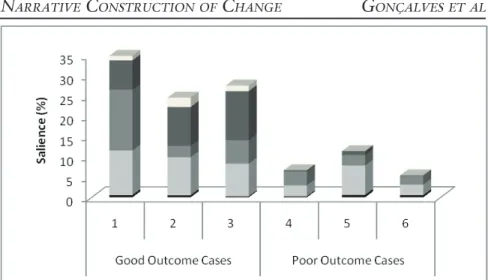
Good outcome cases are clearly different from poor outcome cases, as can be seen in Figures 1, 2 and 3. All these figures show the average of i-moments in each case, the first two from the sample of narrative therapy and the third one from the emotion-focused therapy sample. These findings are also congruent with the case-studies we have done to this point.
3 We are grateful to Lynne Angus and Leslie Greenberg for allowing us to work with their sample from EFT.
Figure 1. Good outcome cases in narrative therapy
Figure 2. Poor outcome cases in narrative therapy
Figure 3. Good and poor outcome cases in EFT
An initial examination of these fi gures shows that the temporal salience of i-moments is signifi cantly higher in good outcome cases, but curiously i-moments occurred also in poor outcome cases. This means that level 2 changes occur in psychotherapy even when the outcome is poor. We will discuss below what processes may be involved in preventing the development of a level 3 change.
A closer look makes it clear that in narrative therapy re-conceptualization and performing change are almost absent in the poor outcome sample. Something similar, although not so clear in the case of performing change, also occurs in the emotion-focused sample. Clearly, re-conceptualization is very infrequent in or absent from the poor outcome sample in both therapeutic models.
In order to have a more process-oriented view of the development of i-moments throughout therapy, Figures 4 and 5 show the evolution session by session of one good and one poor outcome case from the fi rst sample.
psychotherapy process in good outcome cases, appearing as a high diversity of types of i-moments almost from the beginning. For instance in session 2 there is already action, refl ection and protest i-moments; and after session 4 all i-moments are present, continuing to occur until the end of therapy (Santos, Gonçalves, Matos, & Salvatore, 2008).
In poor outcome cases the diversity of i-moments is usually much reduced. Along the therapy one can see action and protest, or protest and refl ection; but there are hardly any sessions in which the fi ve types occur. Thus, most of the times two or three types of i-moments appear in poor outcome cases (with a clear prominence for action, refl ection and protest). Also, as we said before re-conceptualization and performing change have a reduced presence, if they are not absent entirely (Matos et al., 2009). Re-conceptualization i-moments usually emerge in the middle of the psychotherapy process and increase until the end. The majority of new experience i-moments occur after the development of re-conceptualization.
Figure 4. A good outcome case in narrative therapy (11 sessions plus follow-up)
Figure 5. A poor outcome case in narrative therapy (15 sessions plus follow-up)
So, let us briefl y summarize what we have found in the two samples presented here, which are also congruent with several intensive case studies (e.g., Gonçalves, Mendes, Ribeiro, Angus, & Greenberg, 2008; Ribeiro, Gonçalves, & Fernandes, 2008).
The global picture of good-outcome cases is characterized by a progressive tendency toward the generation of i-moments from the beginning to the end of therapy; action, refl ection and protest being more salient at the beginning than at the end. Re-conceptualization emerges in the middle phase of therapy and increases until the end, seeming to be an important marker of successful psychotherapy. Performing change tend to appear after re-conceptualization, representing a performance of the change process.
The global picture of poor-outcome cases is characterized by a lower temporal salience of i-moments, taking the form of action, protest and refl ection without a clear increasing tendency. Re-conceptualization and performing change are absent or have a very low temporal salience.
An interesting communality between good and poor outcome cases, despite all the differences found, is the presence of i-moments from session 1 onward. This reinforces the idea that level 2 changes take place even when people are dominated by problematic narratives, and that potential openings to new narratives are present, even if they are later on dismissed, ignored or trivialized.
Curiously we have also results from a project that studied “spontaneous” change that reproduces these results. In an exploratory study (Cruz & Gonçalves, 2008) we asked the participants (N = 27) to identify three types of difficulties in their lives: past (and solved), present (at the moment of the interview) and persistent (present for more than 6 months). The interviews were coded for the presence of i-moments with the IMCS (Gonçalves et al., 2009; Gonçalves, et al., in press) and significant differences were found between solved and non-solved difficulties in re-conceptualization i-moments. This kind of i-moment was the only one that significantly differentiated solved from present difficulties. A similar study, but with a longitudinal design, replicated these findings concerning re-conceptualization (Meira, Gonçalves, Salgado, & Cunha, 2008).
The results presented here suggest that re-conceptualization seems to be a critical ingredient in the process of sustaining change. In the next section we will discuss not only a model of change based on these results, but also a model that explains the persistence of problematic narratives.
A Heuristic Model of Therapeutic Change
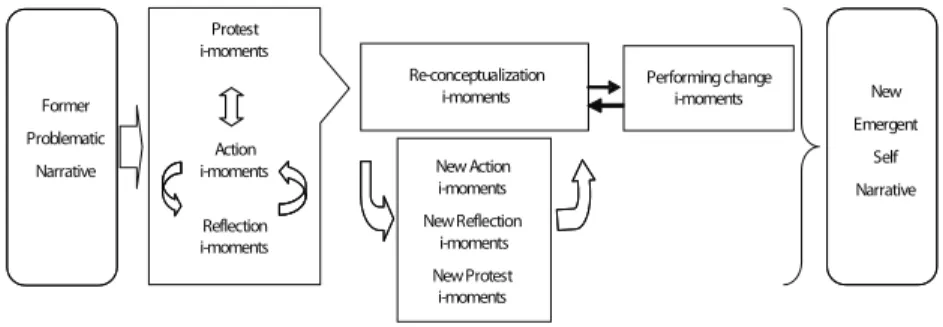
From the results briefly presented we have suggested a general model of narrative change (Gonçalves et al., 2008; Gonçalves et al., 2009; Matos et al., 2009), in which i-moments have a pivotal role.
Of course we know that there are several ways to abort this emergence of novelty. The person can implicitly or explicitly
refuse the meaningful nature of these events, as it happens frequently in clinical practice. The novelty can be turned into something similar to the old narrative. Cognitive therapists have described this process as a cognitive distortion (e.g., Beck, Rush, Shaw, & Emery, 1979) and constructivist theorists (e.g., Mahoney, 1991) have referred to this process as a form of protecting and maintaining the core-ordering processes within the person. We argue that this process is fed by several forms of narrative invalidation, in which the power of the problematic narrative is so strong that even what appears as novelties and exceptions to the rule are transformed accordingly to the problematic narrative. We will return to these forms of invalidation later in this chapter. Sometimes, even if the person is validating to him or herself the change that is taking place, significant others can have a powerful impact in deflecting the novelties, making them non-meaningful (e.g., “you’re better because of your medication”), false (e.g., “in reality you’re doing/thinking X (a novelty), but what you mean is Y (problematic narrative)”), or trivial (e.g., “you’re doing/thinking differently, but later you’ll do/think as usual”). Our life-narratives, as White (2007) recently emphasized, and as a long tradition of systemic thinking reinforces (e.g., Minuchin, 1974/1999; Watzlawick, Bavelas, & Jackson, 1967), have to be validated by significant others. Sometimes the others in our lives don’t really believe that we can change and this can be a very strong obstacle to attain that goal, becoming in this way a self-fulfilling prophecy (Watzlawick, Bavelas, & Jackson, 1967). Thus, our claim is that these novelties, to be sustained, need to be intrapersonally and interpersonally validated, meaning that self and significant others need to conceptualize somehow these novelties as personal changes, and not as the same story.
From our view action and reflection i-moments are the more elementary forms of innovation. As people start to act differently and think differently about the problematic narrative these i-moments can be signs to the self and others that something different from the “old story” is taking place. Cycles of action
and reflection (or the other way around from reflection to action) may be needed to assure the person and to others that something really different from the problematic narrative is occurring.
Curiously, in the cases studied so far, most of the times reflection has a stronger temporal salience than action. We do not know at this stage if the opposite scenario (action higher than reflection) is common. In any case, it seems that even if the beginning of the change process occurs with action i-moments, the reflection of the client about them, spontaneously produced or triggered by therapist questions, allows the elaboration of these action i-moments in the landscape of consciousness (triggering more reflection i-moments). The future study of cases with a theoretical orientation that favors action rather than meaning (e.g., early stages of cognitive-behavioral therapies) could be an interesting way to empirically address this issue.
In some cases several cycles of action-reflection i-moments occur before protest i-moments surface, whereas at other times protest appears from the beginning of therapy (see Gonçalves et al., 2008). We consider that protest i-moments are very important since they represent a strong attitudinal movement against the problematic narrative. They can occur as forms of action or as reflection, but they are more proactive, given the meaning implied in them, as the person strongly refuses the problematic narrative.
We have identified two different types of protest i-moments with two apparently different functions in the change process. Protest can address the problematic narrative and the people who support them (e.g., “my husband is responsible for his actions, he should not blame me all the time”) or protest can be directed to changes in the self (e.g., “I want to be loved, I need that”). It is our hypothesis that the first form of protest may be needed at the beginning, but if the person is not able to center in the self later on, protest becomes a mere opposition to the problematic narrative. The transition to protest centered on the self is a way to assert the needs that the person is feeling, and
from here a new position can emerge, different from the mere opposition towards the problem. We found that this second kind of protest (centered on the self) is sometimes deeply associated with the emergence of re-conceptualization (Gonçalves et al., 2008; Santos et al., in press).
In fact, we suspect that a new narrative of the self may be not sustained only by these three kinds of i-moments (action, reflection and protest) and perhaps one of the reasons is that they can be a mere opposition to the problem, which means that they can operate inside the same constructs that are responsible for the problematic narrative (more about this latter). That way the problem is present even in its absence, given that the client operates inside a dichotomy between the problem and its negation (e.g., “I’m depressed … I want to be happy”). Perhaps this is an important reason that makes re-conceptualization vital in the process of change: its ability to integrate old and new, the former problematic narrative and the emergent one. In fact, when coding re-conceptualization one needs to have some description of the process of change, and also the contrast between past and present self. Thus, re-conceptualization must be more than some form of negation of the problem, as it has to have new dimensions outside the dichotomy of “problem / negation of the problem.” We will return to this topic later when discussing the stability of the problematic narrative.
Another important reason for the inability of action, reflection and protest to produce stable narrative change is that they are most of the times episodic and unstructured, and hence, unable to create a structure that can organize the diversity of innovations. Re-conceptualization, emerging in the middle stage of successful psychotherapy, is in our view responsible precisely for this organization. Given its narrative structure it can give coherence to what otherwise would be disperse occurrences of novelties. That way, re-conceptualization acts like a gravitational narrative field, attracting and giving purpose and meaning to other i-moments.
Finally, with re-conceptualization i-moments the client posits herself or himself as the author of the change process. The client is not only an actor, but given his/her access to the way the plot is changing he or she is authoring it (to use a distinction from Sarbin, 1986).
After some elaboration of re-conceptualization i-moments, new cycles of novelty exploration occur again in the form of action, reflection and protest; this time, consolidating and being consolidated by re-conceptualization i-moments. Several cycles may be needed to sustain change. Finally, performing change i-moments expand the change process into the future since, as several authors suggested (Crites, 1986; Omer & Alon, 1997; Slusky, 1998), good new stories have to have a future.
Figure 6 shows the process of change that we have just described. Protest i-moments Action i-moments Reflection i-moments Re-conceptualization i-moments New Action i-moments New Reflection i-moments New Protest i-moments Performing change i-moments New Emergent Self Narrative Former Problematic Narrative Therapy evolution
Figure 6. Model of i-moment change in psychotherapy
We have previously suggested (Gonçalves et al., 2008; Gonçalves et al., 2009; Santos et al., in press) that several other models of change can help us make sense of the role that conceptualization plays in the change process. For instance, re-conceptualization has some overlap with the concept of insight (Castonguay & Hill, 2007), which has a central role in change
according to a diversity of therapeutic models. However, we argue that insight is related not only to re-conceptualization, but also to reflection and protest as these are defined in our model. Thus, it is interesting that reflection and protest as possible forms of insight do not discriminate good from poor outcome cases, while re-conceptualization does so.
The model of assimilation of voices proposed by Stiles can also highlight the role of re-conceptualization in therapeutic change. For Stiles and colleagues (Honos-Webb & Stiles, 1998; Stiles, 1999; Stiles et al., 1990; Stiles, Meshot, Anderson, & Sloan, 1992) the self can be conceptualized as a community of voices that represent former experiences of the person. Each experience leaves an active trait in the form of a voice. Most of the times these voices are resources for dealing with new experiences, but other times painful experiences make some voices difficult to accept by the community (that is, the self). Stiles and his team have been studying the assimilation of problematic experiences with this model and have developed a coding process to identify the status of the problematic voices in reference to the other voices of the self – the assimilation of problematic experiences scale (APES). The APES (see Honos-Webb & Stiles, 1998; Osatuke & Stiles, 2006) identifies voices from the level 0 (warded off dissociated), in which the person is unaware of the problem and the problematic voice is dissociated; to level 7 (integration – mastery), in which the client generalizes solutions to new problems and the previous poorly integrated experience so that the voice is now part of the community of voices. The intermediate level (4) seems very important and marks the level that is not attained in poor outcome cases (Detert et al., 2006). This level is precisely the one in which understanding and insight is possible. Although we have no empirical data confirming this, we can speculate that re-conceptualization operates at level 4 or higher in the APES scale. Empirical studies that use both the APES and the IMCS with the same cases can clarify this issue in the future.
Time
“I’m sad” “I want to be happy” “but I’m really sad” “I really deserve to be happy” “However I’m completely
sad”
“I really need to overcome
my sadness”
“B
ut it is too hard, because
I’m
really sad”
Voice B Voice A
development of re-conceptualization in poor outcome cases? Or in other words, what prevents level 3 change after some level 2 changes have occurred? We will address this topic in the next section.
A Heuristic Model for Therapeutic Stability
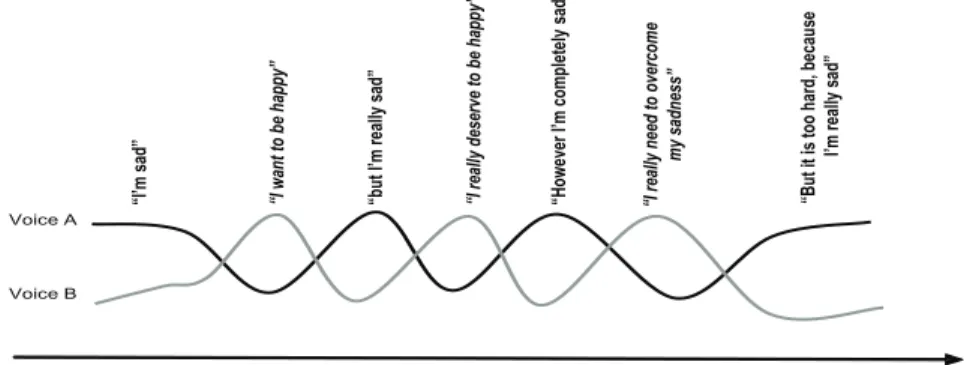
We suggest that one important way of impeding re-conceptualization is the process of mutual in-feeding (Valsiner, 2002). Valsiner described this as an ambivalent process in which two opposite voices (e.g., “life is good”, “life is bad”) feed each other, thus stabilizing the dialogical self from further change. Take the following hypothetical example, in which voice A is “I’m sad” and voice B is “I want to be happy.” According to IMCS voice A could be the problematic voice and voice B would be an i-moment (in this case a reflective one). Imagine that we have the sequence of voices depicted in Figure 7.
In this example, we have two opposite voices that feed each other virtually ad eternum. Actually, this is an extreme example of mutual in-feeding, because the two voices, as time goes by, are becoming more polarized, a process that Valsiner (2002) terms escalating of voices. The most interesting thing in this example is that what maintains stability is a dynamic process in the relationship between the initial voices.
Figure 7. Dynamic stability between two opposite voices through mutual in-feeding
From a different perspective, the therapeutic cycles mode from Mergenthaler (see Lepper & Mergenthaler, 2007; Mergenthaler, 1996) proposes that change takes place in cycles of reflection (abstraction) and emotional processing (emotional tone). According to this model of change, the following pattern of four stages can be identified: relaxing (low abstraction and low emotional tone), experiencing (high emotional tone and low abstraction), connecting (high abstraction, high emotional tone),
reflecting (high abstraction, low emotional tone). Each four stage
cycle gives place to another cycle, starting again with relaxing, and so on. In the i-moments system, we do not explicitly track emotional experience, although it is likely that what we call re-conceptualization may fall under connecting and reflecting modes. So what we suggested about the cross-fertilization between the IMCS and the APES may be applicable to the study of the IMCS with the therapeutic cycles model.
Finally, the narrative research from Angus and her team (Angus, Lewin, Bouffard, & Rotondi-Trevisan, 2004) also has some important connections with our program. Angus and colleagues have identified three different narrative modes: external, internal and reflexive. This model conceptualizes change “as entailing a process of dialectical shifts between narrative story-telling (external narrative mode), emotional differentiation (internal narrative mode), and reflexive meaning-making modes of inquiry” (Angus et al., 2004, p. 88). However, the narrative process model is very different from our IMCS, as the latter is a system of tracking novelties in the process of change. So, while the model proposed by Angus and colleagues addresses the way narratives are elaborated and assimilated in psychotherapy by integrating external, internal and reflective dimensions, the IMCS focuses on the way novelties emerge and are elaborated in psychotherapy.
From our perspective, and assuming as a solid result that re-conceptualization clearly discriminates good from poor outcome cases, an interesting question arises: what blocks the
From the perspective of IMCS the problematic narrative and the emergence of action, reflection and protest i-moments can be related in a way that they feed into each other, resulting in a stable feedback loop, similar to the one depicted in Figure 7. We suggested that this can only happen in these i-moments and not in re-conceptualization i-moments, because in this last one the contradiction between the problem and innovation is already dialectically integrated inside the i-moment (past and present self). The other i-moments can be a mere opposition of the problem, facilitating in this way the return to it.
Performing change, by their nature (generalization of the change process into several life domains) can hardly be involved in mutual in-feeding process. Also, they tend to occur later in the process of change and in principle mutual in-feeding in good outcome cases should occur more at early stages of therapy.
When mutual in-feeding occurs in action, reflection and protest i-moments they temporally free the person from the problem, but facilitate the return to it, given that the negation of the problem makes it present even when it is absent. If I want to be happy, and this is the contrary of feeling depressed, then if I can’t be happy as I dreamt, this means that I’m really miserable! Clinically this process is also clear in the counter phobic reactions of fearful clients: dreaming about freeing themselves from fear makes them be “courageous” to a point that they get paralyzed by fear again. Thus, novelties are created but soon are bypassed given the return to the problematic narrative.
The process of mutual in-feeding can be conceptualized from other theoretical perspectives. For instance, from a personal construct perspective the same process can be described as the dance between two poles of the same construct, which Kelly (1955) called “slot rattling.” In strategic therapy this is akin to what was termed an “ironic process” (Shoham & Rohrbaugh, 2002), in which the more the person tries to get free from the problem the more the problem stays strong (Watzlawick, Weakland, & Fish, 1974). Or in Stiles’ model of assimilation (Brinegar, Salvi,
Stiles, & Greenberg, 2006) these exchanges between voices can be theorized as a process of “rapid crossfire,” in which the person oscillates between two contradictory voices. Gustaffson (1992; see also Omer, 1994) refers to a similar process: “these [dominant] stories seem inescapable because what is viewed as the only alternative (the shadow story) turns out to be a loop that reintroduces the main line” (Omer, 1994, p. 47).
Whatever the theoretical perspective from which one conceptualizes this phenomenon, from a dialogical framework this is a dynamic process responsible for a monological, closed outcome (see Gonçalves & Guilfoyle, 2006). Figure 8 illustrates this process of mutual in-feeding. Thus, it is our hypothesis that re-conceptualization leads to the overcoming of the mutual in-feeding process, by integrating the two conflicting positions.
Former narrative Action IM Reflection IM Protest IM Protest IM Voice X Counter-voice X e.g., I can’t free myself from my fears
e.g., one day I will enjoy real freedom, but it seems
impossible to overcome my fears
Absence of re-conceptualization does not allow the transformation of
this duality
Figure 8. Mutual in-feeding in psychotherapy
We addressed this topic empirically by studying discursive markers of return to the problem, after the emergence of an i-moment. The results that we present below were obtained in the sample previously described of narrative therapy with women victims of partner abuse. However we currently have
only preliminary results from 6 cases: 3 good outcome and 3 poor outcome cases. The way we operationally defined the theoretical concept of mutual in-feeding was by identifying all the times an i-moment emerged and was immediately followed by a return to the problem. Let us illustrate this with two examples from our sample (poor outcome cases):
First Session
Therapist: You said that “in part” you have a voice that
says you don’t have to make any effort because you would never get anywhere. But is there another voice?
Client: Yes, there’s other part that seems that I can do
everything! (Reflection i-moment) But suddenly, it falls down! Like a house of cards that we build and then suddenly falls! (return to the problematic narrative)
Fourth Session
Therapist: What do you want to do to this “wave”
(externalized label for depressive symptoms)? Today you’ve defied it …
Client: End with it completely, (Protest i-moment) but it
seems very difficult to me… (Return to the problematic
narrative)
Therapist: End with it…! You´re ambitious!
In these examples the client describes the i-moment but immediately returns to the problematic narrative. Thus, these markers appear immediately after the i-moment or during its description. It is clear that the use of linguistic connectors (e.g., but, however, but still, it’s just that) represents opposition or denial of what has just been asserted.
In terms of procedures the coding of the return to the problem markers was made by two independent judges, unaware of the status of the case (poor or good outcome). For each session the judges coded the presence or absence of the return to the
problem for each i-moment previously identified in the former research (Cohen’s Kappa was .85). Over 20% of i-moments in poor outcome cases had markers of returning to the problem, whereas these markers occurred in only about 2% of good outcome cases.
If we now take a closer look at what type of i-moments had returned to the problem markers, it is clear that this only occurred in action, reflection and protest – as we have predicted. Another question is, of course, what is the possible causality between return to the problem markers and re-conceptualization i-moments. If the data obtained with this sample is replicated, it seems that the return to the problem (or mutual in-feeding) impedes the emergence of re-conceptualization, given the low occurrence of this dance between the problem and the innovations in good outcome cases4. However, if we take into
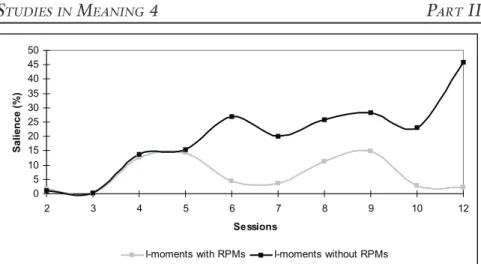
account intensive case-studies perhaps one could hypothesize that re-conceptualization may also prevent the return to the problem. Figure 9 below shows an evolution along 12 sessions of a constructivist therapy process. In the figure we have represented the evolution of i-moments with and without return to the problem markers. In this case, curiously, the amount of presence and absence of these markers is almost the same until session 5, after which the tendency is clearly different: the presence of the problem marker clearly diminishes, while i-moments without the markers clearly increase. Interestingly, it was precisely at session 6 that re-conceptualization emerges, which suggests some relationship in this case between these two processes.
4 Of course, we don’t know at this moment if other processes prevent both the resolution of mutual in-feeding and the emergence of re-conceptualiza-tion.
0 5 10 15 20 25 30 35 40 45 50 2 3 4 5 6 7 8 9 10 12 Sessions Salience (%)
I-moments with RPMs I-moments without RPMs
Figure 9. Return to problem markers in one case of good constructivist therapy
Of course, it is not possible at this time to infer any causal relationships between mutual in-feeding and re-conceptualization, but from these data it is clear that the return to the problem plays an important role in poor-outcome psychotherapy. Also, the absence of these indicators in re-conceptualization reinforces the idea that these i-moments may be pivotal in the process of change.
Some Implications for Practice
In our view it is too early to infer from our research program clear implications for psychotherapeutic practice. We need to study these processes in other samples and expand the research with more intensive cases studies. However, the results found until now suggest that i-moments can be a relevant strategy to track and analyze the therapeutic change.
Also, it is clear through the heterogeneous nature of i-moments that some can be more “potent” than others in the promotion of level 3 change. Therapists can dedicate some effort in the middle of therapeutic process to the elaboration and expansion of i-moments, mainly in the form of re-conceptualization. Of course, the other types, according to our model, may be needed
to achieve re-conceptualization.
It also may be important in therapy to elaborate novelties outside the dichotomy problem–opposition to the problem. In this context the attention of therapists can be focused in the processes of mutual in-feeding and conversational strategies to bypass it. Of course, we need to contrast poor and good outcome cases in what concerns mutual in-feeding to learn what conversational strategies prevent or facilitate getting out of this process. In this sense, we are starting to explore if there is a link between specific therapist response modes and client response modes preceding or associated with the appearance of i-moments in different kinds of therapeutic modalities. This might indicate some “preferred” client-therapist conversational interactions that are more associated with the amplification of i-moments into a new self-narrative.
References
Angus, L. E., Lewin, J., Bouffard, B., & Rotondi-Trevisan, D. (2004). “What’s the story?” Working with narratives in experiential psychotherapy. In L. E. Angus & J. McLeod (Eds.), The handbook of narrative psychotherapy:
Practice, theory and research (pp. 87-102). London: Sage
Bateson, G. (1979). Natureza e espírito. [Mind and nature: A necessary unity]. Lisboa: D. Quixote.
Beck, A. T., Rush, A. J., Shaw, B. F., & Emery, G. (1979). Cognitive therapy of
depression. New York: Guilford.
Brinegar, M. G., Salvi, L. M., Stiles, W. B., & Greenberg, L. S. (2006). Building a meaning bridge: Therapeutic progress from problem formulation to understanding. Journal of Counseling Psychology, 53, 165-180.
Bruner, J. (1986). Actual minds, possible worlds. Cambridge, MA: Harvard University Press.
Castonguay, L. G., & Hill, C. E. (Eds.) (2007). Insight in psychotherapy. Washington, DC: American Psychological Association.
Crites, F. (1986). Story time: Recollecting the past and projecting the future. In Sarbin, T. R. (Ed.), Narrative psychology: The storied nature of conduct (pp. 152-173). New York: Praeger.
Cruz, G., & Gonçalves, M. M. (2008). Mudança espontânea e momentos de inovação: Um estudo exploratório [Spontaneous change and innovative moments: A exploratory study]. Manuscript in preparation.
Detert, N. B., Llewellyn, S., Hardy, G. E., Barkham, M., & Stiles, W. B. (2006). Assimilation in good and poor-outcome cases of very brief psychotherapy for mild depression: An initial comparison. Psychotherapy
Research, 16, 393–407.
Fogel, A., Garvey, A., Hsu, H. C., & West-Stroming, D. (2006). Change
processes in relationships: A relational-historical approach. New York:
Cambridge University Press.
Gonçalves, M. M., & Guilfoyle, M. (2006). Therapy as a monological activity: Beliefs from therapists and their clients. Journal of Constructivist
Psychology, 19, 251-271.
Gonçalves, M. M., Matos, M., & Santos, A. (2008). Innovative Moments Coding System – Version 7.2. Unpublished manuscript. University of Minho at Braga.
Gonçalves, M.M., Matos, M., & Santos, A. (2009). Narrative therapy and the nature of “innovative moments” in the construction of change. Journal of
Constructivist Psychology, 22, 1–23.
Gonçalves, M. M., Mendes, I., Ribeiro, A., Angus, L., & Greenberg, L. (2008). Innovative moments and change in emotional focused therapy: The case of Lisa. Manuscript submitted for publication.
Gonçalves, M. M., Ribeiro, A., Matos, M., Santos, A., & Mendes, I. (in press). The Innovative Moments Coding System: A new coding procedure for tracking changes in psychotherapy. In S. Salvatore, J. Valsiner, S. Strout, & J. Clegg (Eds.), YIS: Yearbook of Idiographic Science 2009 - Volume 2. Rome: Firera Publishing Group.
Greenberg, L. S., & Watson, J. (1998). Experiential therapy of depression: Differential effects of client–centered relationship conditions and process interventions. Psychotherapy Research, 8, 210–224.
Gustafson, J. P. (1992). Self-delight in a harsh world. New York: Norton. Hermans, H. J. M., & Dimaggio, G. (eds.) (2004). The dialogical self in
psychotherapy. New York: Brunneer-Routledge.
Hermans, H. J. M. (1996). Voicing the self: From information processing to dialogical interchange. Psychological Bulletin, 119, 31-50.
Hill, C. E., & Lambert, M. J. (2004). Methodological issues in studying psychotherapy processes and outcomes. In M. J. Lambert (Ed.), Bergin
and Garfield’s Handbook of psychotherapy and behavior change (5th ed.) (pp.
84-135). New York: John Wiley & Sons.
Honos-Webb, L., & Stiles, W. B. (1998). Reformulation of assimilation analysis in terms of voices. Psychotherapy Research, 35, 23–33.
Kelly, G. (1955). The psychology of personal constructs. New York: Norton. Lepper, G., & Mergenthaler, E. (2007). Therapeutic collaboration: How does
it work? Psychotherapy Research, 17, 576–587.
Mahoney, M. (1991). Human change processes: The scientific foundations of
psychotherapy. New York: Basic Books
Matos, M., & Gonçalves, M. M. (2004). Narratives on marital violence: The construction of change through re-authoring. In R. Abrunhosa, R. Roesch, C. Machado, C. Soeiro, & F. Winkel (Eds.), Assessment,
intervention and legal issues with offenders and victims (pp. 137-154).
Bruxelas: Politea.
Matos, M., Santos, A., Gonçalves, M. M., & Martins, C. (2009). Innovative moments and change in narrative therapy. Psychotherapy Research, 19, 68-80.
McAdams, D. P. (1993). The stories we live by: Personal myths and the making of
the self. New York: William Morrow.
Meira, L., Gonçalves, M. M., Salgado, J., & Cunha, C. (2008, July). Everyday
life change: Contribution to the understanding of daily human change. Paper
presented and submitted for publication at the Proceedings of the 2nd International Conference on Psychology, Athens, Greece.
Mendes, I., Gonçalves, M. M., Angus, L., & Greenberg, L. (2008). Narrative change and innovative patterns in emotion-focused therapy. Manuscript in preparation.
Mergenthaler, E. (1996). Emotion-abstraction patterns: A new way of describing psychotherapeutic process. Journal of Consulting and Clinical
Psychology, 64, 1306–1315.
Minuchin, S. (1999). Families and family therapy (28th ed.). Cambridge, Massachusetts: Harvard University Press. (Originally work published 1974)
Neimeyer, R. (2000). Narrative disruptions in the construction of the self. In R. A. Neimeyer & J. D. Raskin, J. D. (Eds.), Constructions of disorder:
Meaning-making frameworks for psychotherapy (pp. 207-242). Washington:
American Psychological Association.
Neimeyer, R. A., & Raskin, J. D. (Eds.) (2000). Constructions of disorder:
Meaning-making frameworks for psychotherapy. Washington: American
Psychological Association.
Omer, H., & Alon, N. (1997). Constructing therapeutic narratives. Northvale, N. J.: Jason Aronson.
Omer, H. (1994). Critical interventions in psychotherapy: From impasse to turning
point. New York: Norton.
Osatuke, K., & Stiles, W. B. (2006). Problematic internal voices in clients with borderline features: an elaboration of the assimilation model.
Journal of Constructivist Psychology, 19, 287-319.
Polkinghorne, D. E. (1988). Narrative knowing and the human sciences. Albany: State University of New York Press.
a
4
b
Reconstructing the Continuing Bond: A
Constructivist Approach to
Grief Therapy
Robert A. Neimeyer
Kristen and Max texted each other on Friday afternoon, January 2nd, an everyday exchange about music and the boredom of a long drive through Oklahoma. Fifteen minutes after those texts, the Ford Explorer carrying Max, 19, and two of his college companions flipped three times and caught on fire along Interstate 35 near the Kansas border. Max was sitting in the back seat. A police report said he was not wearing a seatbelt, and was thrown from the car. The following morning a compassionate doctor at a hospital in Wichita confided in his distraught mother, Gayle, that Max’s injury was “not a survivable event.” He died in her arms and in the presence of attentive family and caregivers that afternoon.
This is what can be gleaned from newspaper accounts of the tragic accident that took Max’s life. What the news failed to cover was his mother’s private story that she is sharing with me in therapy some four months after his death, as she alternately attempts to integrate the trauma and quest for transcendence following the loss of her child.
A deeply spiritual person, Gayle quickly came to understand Max’s early death as part of a larger spiritual journey of an “old soul,” wise beyond his years, ready for release from this temporal world. But she also described “the urgency with which she innovation in constructivist therapy: The case of Susan. Manuscript in
preparation.
Salgado, J., & Gonçalves, M. (2007). The dialogical self: Social, personal and (un)conscious. In A. Rosa & J. Valsiner (Eds.), The Cambridge handbook
of socio-cultural psychology (608-621). Cambridge, UK: Cambridge
University Press.
Santos, A., Gonçalves, M. M., Matos, M., & Salvatore, S. (2008). Innovative moments and change pathways: A good outcome case of narrative therapy. Manuscript in preparation.
Sarbin, T. R. (1986). The narrative and the root metaphor for psychology. In T. R. Sarbin (Ed.), Narrative psychology: The storied nature of human
conduct (pp. 3-21). New York: Praeger.
Shoham, V., & Rohrbaugh, M. J. (2002). Brief strategic couple therapy. In A. S. Gurman & N. S. Jacobson (Eds), Clinical handbook of couple therapy (pp. 5-25) (3rd Ed.). New York: Guilford.
Slusky, C. E. (1998). Strange attractors and the transformation of narratives in family therapy. In M. F. Hoyt (Ed.), The handbook of constructive
therapies: Innovative approaches from leading practitioners (pp. 159-179).
San Francisco: Jossey-Bass.
Stiles, W. B. (1999). Signs and voices in psychotherapy. Psychotherapy Research,
9, 1-21.
Stiles, W. B., Elliot, R., Llewelyn, S. P., Firth-Cozens, J. A., Margison, F. R., Shapiro, D. A., & Hardy, G. (1990). Assimilation of problematic experiences by clients in psychotherapy. Psychotherapy, 27, 411-420. Stiles, W. B., Meshot, C. M., Anderson, T. M., & Sloan, W., W., Jr., (1992).
Assimilation of problematic experiences: The case of John Jones.
Psychotherapy Research, 2, 81-101.
Valsiner, J. (2002). Forms of dialogical relations and semiotic autoregulation within the self. Theory & Psychology, 12, 2, 251-265.
Watzlawick, P., Bavelas, J. B., & Jackson, D. (1967). Pragmatics of human
communication: A study of interactional patterns, pathologies, and paradoxes.
New York: Norton.
Watzlawick, P., Weakland, J. & Fisch, R. (1974). Change: Principles of problem
formation and problem resolution. New York: Norton.
White, M., & Epston, D. (1990). Narrative means to therapeutic ends. New York: Norton.
White, M. (2007). Maps of narrative practice. New York: Norton.
Wortham, S. (2001). Narratives in action: A strategy for research and analysis. New York: Teachers College Press.