Critical Early Inputs Towards Thermal Performance
in Architectural Design of Residential Buildings
in Temperate Climates – the Portuguese case
Mariana Abrunhosa Pereira
Thesis submitted to the Faculty of Engineering of University of Porto in partial fulfillment of the requirements for the degree of
Doctor of Philosophy in Sustainable Energy Systems
Thesis Supervisor:
Professor Eduardo de Oliveira Fernandes Department of Mechanical Engineering Faculty of Engineering, University of Porto
Thesis Co-Supervisor: Professor Manuel Correia Guedes
Department of Civil Engineering and Architecture Instituto Superior Técnico, University of Lisboa
This work was supported by Fundação para a Ciência e a Tecnologia (FCT) de Portugal, under the individual PhD studentship SFRH / BD / 69487 / 2010, granted in the scientific field ‘Social Sciences and Humanities – Architecture’
Eduardo de Oliveira Fernandes both for the wise, inspirational and passionate way of sharing his convictions about Energy and Architecture and for warning me with disquiet for the need of tackling the essential. Thank you for the patience and for the tireless guidance and revisions.
I would like to thanks to my co-supervisor Professor Manuel Guedes for the stimulating encouragement and for his serene knowledge support, which always boosted me to go forward.
I also wish to express my sincere gratitude:
To all Professors from the Program MIT-Portugal for the dedication and enthusiasm in sharing their knowledge
To Professor Henrique Lopes Cardoso for the patient support on Expert Systems and to Architect Mariz Graça, Professor John Gero and Professor Richard Coyne for the generosity of sharing some key points on the issue of Expert Systems in Building Design
To Matt Bodenner from Exsys Corvid who was always willing to patiently give me support
To Francisco Almeida and Pedro Silva for giving me new helpful insights in Building Physics
To Célia Couto for the continuous assistance throughout the course and for being always willing to help
To my colleagues and friends from MIT-Portugal Program and from INEGI Zenaida, Hugo, Nathan, Sara, Miguel, Cláudio, Ahmad, Vasco, Mafalda, Isabel, Ana, Luca and
Marta – thank you for the collective energy and for the brainstorming about Energy,
Sustainability and Architecture
To my brother Pedro and to all my friends, for the cheerful sharing of experiences and ideas
A special thanks to my friends Hugh, Irineu and Joana, who even physically distant, always share interesting lines of thought of different scientific fields and motivate me to tackle new challenges
To my parents Luísa and Gaspar for their endless support and unfailing encouragement, even in the toughest moments
To my grandmother Emília who was gone during a cherry blossom season, in the midway of this trip. The memory of her sense of humor, enthusiasm and positive thinking constitute my biggest source of inspiration.
buildings, since the early design stages, by playing with the sensible parameters and sufficiently upstream the use of current computing models or codes. The environment context is the one of temperate climates, departing from the Portuguese case. The vernacular architecture represented a strong statement on the need for the architect to design with the climate. It approached the building design as an exercise of complementing Nature, by providing some shelter and better comfort conditions, throughout the different seasons of the year. For some regions of the Globe, with severe climate, the comfort is very much dependent on the additional energy either for heating or cooling. In other climates, instead, the dialogue with the climate may lead to what Rafael Serra called the ‘architecture of the complexity’, meaning that through proper orientation, dimension and location of openings and thermal storage, it’s possible to enhance the indoor thermal conditions.
During the first decades of the XXth century, independently from the place, the
expectations of comfort led to a kind of uniformity of a paradigm of building with dual equipment both for heating and cooling, and associated ventilation. Later on, in the 70’s, Energy has become a critical issue and more recently also an environmental issue, in what regards the use of fossil fuels, in which buildings have an important share. Everything seems to recall the regionalist approaches of the building design, in particular of housing buildings, by recovering the basic approach of the dialogue with the climate.
Currently the thermal analysis of buildings is carried out in the final stages of the building design. The ideal situation would be always the integration of a multidisciplinary design team, including an expert on building physics that could address the thermal design choices in the beginning of the building design. However, the practice reveals that many of the early decisive design options are taken by the architect alone, so reducing the potential of the contribution of the building physics for comfort and health before the appeal to the complementary systems.
This thesis aims to discuss the problematic of the early design stages and to identify the critical parameters that can be used as ‘indicators’ of the final performance of the building. The results demonstrate the high potential for the adopted approach. A methodology supported on an expert system allowed for the adoption of the proposed method. The expert system integrates the critical inputs with influence on the hypothetical thermal needs. Simultaneously, it provides qualitative recommendations with a user friendly language for architects, for a straightforward thermal assessment in the early stages of the building design. This way, this thesis contributes to a more effective approach towards sustainable, low energy housing buildings in Portugal.
em particular, na fase inicial do projecto de Arquitectura, em que a escolha das soluções construtivas é na maior parte das vezes decisiva. O estudo centra-se na adaptação dos edifícios aos climas temperados, tomando como caso de partida Portugal. A arquitectura vernacular representa um testemunho notável da necessidade do arquitecto desenhar com o clima, abordando a prática de desenho como uma extensão do ambiente natural, com o objectivo de providenciar abrigo e condições interiores de conforto. Em alguns climas extremos, o conforto nas habitações é muito dependente da energia adicional para aquecimento e/ou arrefecimento. Contudo, noutros tipos de clima, mais amenos, como o Mediterrânico, as grandes variações de temperatura em curtos espaços de tempo traduzem-se no que Rafael Serra designou
de ‘arquitecturas de complexidade’. Nestes casos, as decisões de desenho
relacionados com a orientação, assim como a localização de aberturas e de massas inerciais para armazenamento térmico, conduzem à optimização das condições térmicas interiores.
Durante as primeiras décadas do século XX, independentemente do lugar, as expectativas de conforto levaram a uma espécie de uniformização do paradigma de edifício com sistemas de aquecimento e arrefecimento. Entretanto, nos anos 70, a Energia tornou-se uma preocupação ambiental, sendo o sector dos edifícios um dos que têm um peso mais significativo no uso de energia. Tornou-se clara a necessidade da recuperação das práticas regionalistas, através do desenho dos edifícios adaptados ao clima.
Actualmente a análise térmica dos edifícios é realizada nas fases finais do projecto do edifício. A situação ideal traduzir-se-ia numa equipa de projecto multidisciplinar, com especialistas da Física dos Edifícios, em que as questões da térmica seriam abordadas nas fases iniciais do projecto. Contudo, a prática revela que a maior parte das decisões são tomadas numa fase inicial apenas pelo arquitecto, reduzindo o potencial do contributo da Física dos Edifícios para as questões de conforto, antes da necessidade de integração de sistemas de aquecimento e de arrefecimento.
Esta tese pretendeu discutir a problemática da fase inicial do projeto e identificar os parâmetros críticos, tendo em conta a influência no desempenho final dos espaços arquitectónicos. Os resultados demonstram o potencial da abordagem adoptada. A metodologia apoiou-se num sistema pericial, que permite a adopção do método proposto. O sistema especialista integra os parâmetros críticos de projecto com reflexo nas prováveis necessidades térmicas e simultaneamente fornece recomendações qualitativas, com uma linguagem ‘user-friendly’ para arquitectos, para um apoio expedito nas fases iniciais do projecto de Arquitectura. Desta forma, esta tese contribui para uma nova abordagem de desenho de edifícios residenciais sustentáveis e de baixo consumo energético em Portugal.
1.1 Motivation ... 1
1.2 Context ... 7
1.3 Thesis Structure ... 13
2 Definition of the problem ... 15
3 State of the Art ... 29
3.1 General Approach... 29
3.2 Passive or Climate Responsive Architecture for Temperate Climates ... 33
3.3 Case studies of Architectural building design of residential buildings in Portugal ... 46
3.4 Progress on thermal assessment design tools and their integration in the architectural building design ... 61
3.4.1 Characteristics and specificities of the architectural building design ... 61
3.4.2 Tools to assess and to support design of low energy buildings – barriers, needs and opportunities ... 63
3.4.3 Structure of ES oriented for assessment of architectural building design70 4 Methodology ... 75
5 Thermal analysis ... 83
5.1 Climate zones ... 84
5.2 Spaces geometry ... 84
5.3 Alternatives for critical inputs parameters ... 85
5.3.1 Thermal conductance of opaque exterior components ... 85
5.3.2 Thermal inertia ... 87
5.3.3 Glazing orientation ... 88
5.3.4 Glazing size ... 88
5.3.5 Shading devices ... 89
5.4 Default values ... 89
5.5 Application of the calculation tool for the study of design alternatives ... 90
ii
5.5.4 Operative values ... 95
6 Results. Analysis and discussion ... 97
6.1 Introduction ... 97
6.2 Results ... 97
6.2.1 Thermal conductance of opaque exterior components ... 116
6.2.2 Thermal inertia ... 116
6.2.3 Glazing orientation and size ... 117
6.2.4 Shading devices ... 118
6.2.5 The climate type influence ... 119
6.2.6 Summary ... 119
6.2.7 Comparative analysis of thermal energy needs obtained through the RCCTE method and the LT method... 121
7 Guided methodology – decision trees used to build the Expert System ... 125
7.1 Introduction ... 125
7.2 Decision trees and explanations of relevant information for the Expert System ... 126
7.3 Variables and rules integrated in Exsys Corvid ... 144
7.3.1 Building a system in Exsys Corvid ... 144
7.3.2 The proposed system for thermal assessment built in Exsys Corvid .... 147
7.4 Application case ... 154
8 Conclusions and perspectives ... 163
iii
ACE/CAE Architects' Council of Europe/Conseil d’Architects d’Europe
ASHRAE American Society of Heating, Refrigerating and Air Conditioning
Engineers
DGE Directorate General of Energy ( renamed DGEG in 2004 – Directorate
General of Energy and Geology)
DHW Domestic hot water
EC European Community
EPBD Energy Performance of Buildings Directive
ES Expert system
EU European Union
GLR Gain-load ratio
HVAC Heating, ventilation, and air conditioning
IAQ Indoor air quality
IEA International Energy Agency
IPCC Intergovernmental Panel on Climate Change
KBS Knowledge based system
LT Lighting and thermal
PV Photovoltaics
RCCTE Regulation of the Characteristics of the Thermal Behavior of Buildings
RECS Regulation on the Energy Performance of Services Buildings
REH Regulation on the Energy Performance of Residential Buildings
RPH Renovation (of air) per hour
SLR Solar load ratio
iv
A
Area of building components
Area of exterior elements
Area of glazing per orientation
Total glazing area
Area of exterior horizontal elements
Area of interior elements in contact with non-heated spaces
Useful floor area
Area of exterior walls
e
Exterior elementE
Intensity of the solar radiation (solar irradiance) incident on glazing surfaces
f
Orientation factorFactor of heat losses through thermal bridges
g
Glazing elementAverage monthly solar gains
g
Solar factorHDD
Heating degree daysI
Inertia factor of the architectural space (summer)It
Useful superficial mass per square meterK
Inertia factor of the architectural space (winter)M
Average duration of insolation during the cooling seasonUseful superficial mass of the element Nominal heating needs
Nominal cooling needs
Calculated nominal heating needs
Calculated nominal cooling needs
Floor to ceiling height
Conduction heat gains or losses Evaporative heat losses
v
S
Glazing solar factor summer – fraction of the incident energy on the glazing surface that is transmitted to the interior space
Element surface
Glazing solar factor winter – fraction of the incident energy on the glazing surface that is transmitted to the interior space
U
Coefficient of thermal transmittanceUA
Thermal conductanceGlobal thermal conductance per useful floor area
Coefficient of thermal transmittance of exterior elements
Coefficient of thermal transmittance of glazing surfaces
Coefficient of thermal transmittance of exterior horizontal elements
Coefficient of thermal transmittance of interior elements in contact with non-heated spaces
Coefficient of thermal transmittance of exterior walls
Φ
Obstruction factor – percentage of clear and not shaded glazing area that receives direct incident solar radiation
η
Utilization factor of solar gainsΔS
Sum of all heat flow termsEffective temperature difference through the envelope
vi
Figure 2 Approach of the building both as a shelter and as an energy system (Fernandes 2014) ... 3
Figure 3 Definition of Building Passive Design (Olgyay and Olgyay 1963) (ARUP 2011) ... 10
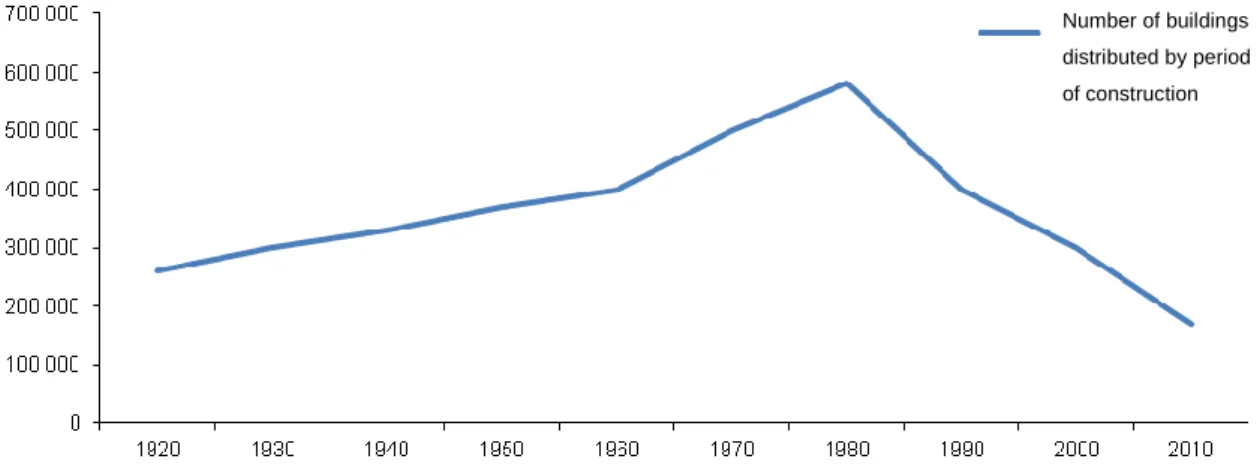
Figure 4 Number of buildings ordered by period of construction. Data source: Census 2011 ... 20
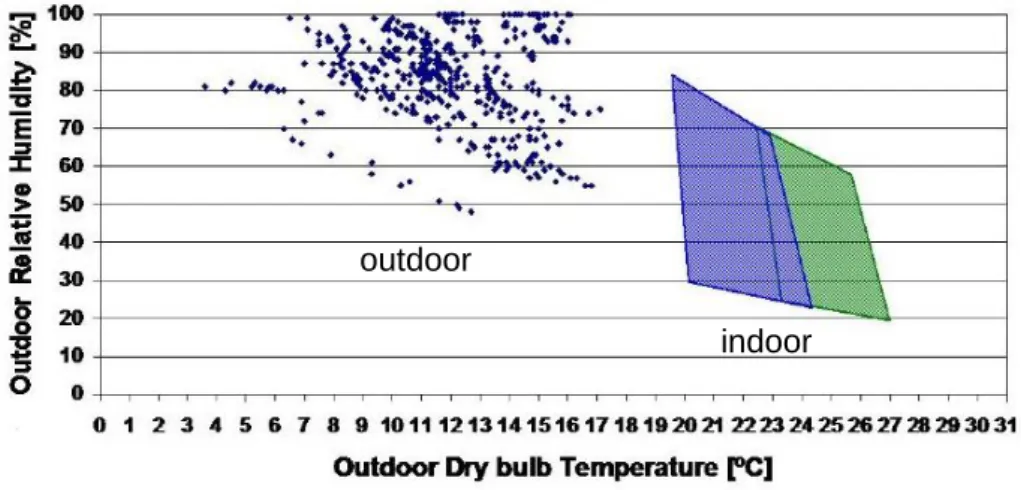
Figure 5 Acceptable operative temperature ranges for naturally conditioned spaces (ASHRAE 55-2004) ... 21
Figure 6 Acceptable range of operative temperature and humidity, ASHRAE 55-2004 (Olesen and Brager 2004) ... 22
Figure 7 Metric version of the bioclimatic chart for warm climates by Olgyay (Szokolay 2007) ... 24
Figure 8 Herbert Jacobs House, Solar Hemicycle, 1943-1948, F. L. Wright (Smith 1998) ... 30
Figure 9 A typological grammar (Los 1988) ... 34
Figure 10 Building thermal balance in winter and in summer ... 40
Figure 11 Net contribution of a double glazing (Alvarez 2006) ... 42
Figure 12 Green Tower building. Differences between indoor temperatures and outdoor temperatures for one winter month (2001) ... 47
Figure 13 Thermal needs of some residential buildings in Portugal calculated by using RCCTE 1990 method ... 51
Figure 14 Beires House. Sketch (Cianchetta and Molteni 2004) ... 54
Figure 15 Beires House. Street view (Cianchetta and Molteni 2004) ... 54
Figure 16 Beires House. Patio-garden (Cianchetta and Molteni 2004) ... 54
Figure 17 CTO. Thermal network of the Porto solar house (Balcomb 1984) ... 54
Figure 18 CTO. Cumulative temperature distribution in winter and in summer (Fernandes 1987) ... 54
Figure 19 CTO. Thermal behavior in winter under thermostatic control. January 1986 (Maldonado, Fernandes et al. 1987) ... 55
Figure 20 CTO. Calculation of auxiliary energy in free-floating mode. January-February 1986 (Maldonado, Fernandes et al. 1987) ... 55
Figure 21 Vale do Rosal. SE view - winter (Simões 2007) ... 55
Figure 22 Vale do Rosal. SE view - summer (Simões 2007) ... 55
Figure 23 Vale do Rosal. Interior temperatures during 21 February-7 March 1997 (Simões 2007)... 55
Figure 24 House in Moledo. Floor plan (Corrêa 2011) ... 56
Figure 25 House in Moledo. Site integration (Corrêa 2011) ... 56
Figure 26 House in Moledo. East façade (Corrêa 2011) ... 56
Figure 27 Multifamily house in Vila do Conde. Southwest façade (Roulet, Cox et al. 2005) ... 56
Figure 28 Multifamily house in Vila do Conde. Northeast façade (Coelho 2007) ... 56
Figure 29 Green Tower. South façade (Tirone Nunes 2013) ... 57
Figure 30 Green Tower. Site integration (Roulet, Cox et al. 2005) ... 57
Figure 31 Elemental House. Floor plan (Cecilia and Levene 2011)... 57
Figure 32 Elemental House. Entrance (Cecilia and Levene 2011) ... 57
Figure 33 Elemental House. Interior space (Cecilia and Levene 2011) ... 57
Figure 34 Óasis House. East façade (Nascimento and Gonçalves 2005) ... 58
Figure 35 Óasis House. West façade (Nascimento and Gonçalves 2005) ... 58
vii
Figure 40 House in Provesende. Southwest façade (Ramos 2007) ... 59
Figure 41 House in Provesende. Interior patio (Ramos 2007) ... 59
Figure 42 House in Beja. Exterior view (Cabral 2009) ... 59
Figure 43 House in Beja. Interior view (Cabral 2009) ... 60
Figure 44 House in Beja. Clerestory (Cabral 2009) ... 60
Figure 45 House Lóios. Main façade (Floret 2011) ... 60
Figure 46 House Lóios. Internal courtyard (Floret 2011) ... 60
Figure 47 ‘Energy signatures’ - direct gain, sunspace and trombe wall (Balcomb 1986) ... 66
Figure 48 LT curves for residential buildings in South Europe (Baker and Steemers 1990) ... 67
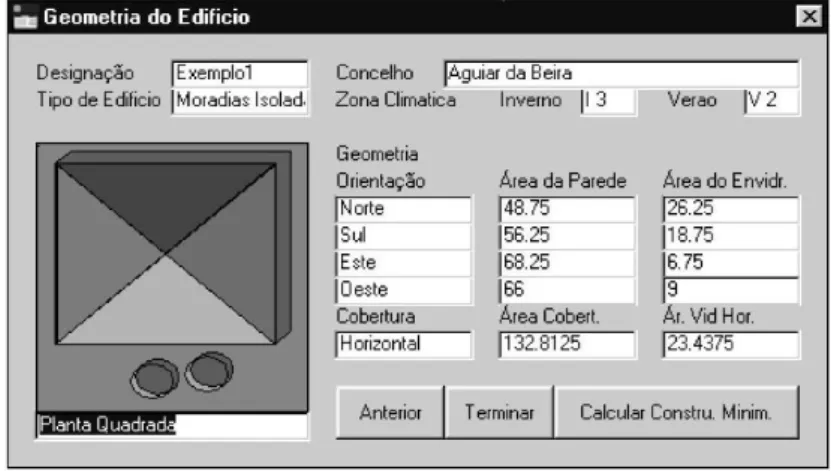
Figure 49 User interface of the LT software for Portugal (Baker, Guedes et al. 2013) ... 68
Figure 50 User interface of the expert system developed by Graça (Graça 1999) ... 68
Figure 51 Climate consultant user interface – design guidelines ... 69
Figure 52 Structure of ES. Adapted from Arain and Pheng (2006) ... 71
Figure 53 Lightsolve expert system user interface (Gagne, Andersen et al 2011) ... 71
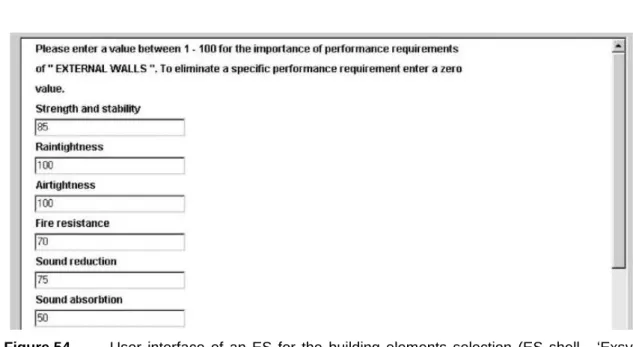
Figure 54 User interface of an ES for the building elements selection (ES shell - ‘Exsys Corvid’) (Alibaba and Özdeniz 2004) ... 72
Figure 55 Comfie ES – heat losses module (Peuportier and Sommereux 1991) ... 73
Figure 56 Categories of building design parameters and their connection with physical values ... 77
Figure 57 Types of architectural spaces according to the level of exposure of their components to the exterior ... 85
Figure 58 Tool interface for the calculation of the nominal heating needs of a given space ... 91
Figure 59 Relation between the utilization factor (η) and the ratio of the gross solar gains to gross heating needs (GLR) (RCCTE 1990)... 94
Figure 60 Influence of the UA and inertia on the heating needs. Porto, S, 10% of glazing ratio ... 99
Figure 61 Influence of the UA and inertia on the cooling needs. Porto, S, 10% of glazing ratio ... 99
Figure 62 Influence of the UA and inertia on the heating needs. Bragança, S, 10% of glazing ratio .. 99
Figure 63 Influence of the UA and inertia on the cooling needs. Bragança, S, 10% of glazing ratio .. 99
Figure 64 Influence of the glazing ratio on the heating and cooling needs. Porto, S, heavy inertia .... 100
Figure 65 Influence of the orientation on the heating needs. Porto, S, heavy inertia ... 100
Figure 66 Influence of the orientation on the cooling needs. Porto, S, heavy inertia ... 100
Figure 67 Heating, cooling and total thermal energy needs. Porto, SE, med. inertia, int. shading ... 102
Figure 68 Heating, cooling and total thermal energy needs. Bragança, S, med. inertia, int. shading . 104 Figure 69 Heating, cooling and total thermal energy needs. Bragança, S, heavy inertia, int. shading 104 Figure 70 Heating, cooling and total thermal energy needs. Bragança, N, heavy inertia, int. shading105 Figure 71 Heating, cooling and total thermal energy needs. Bragança, W, heavy inertia, int. shading ... 105
Figure 72 Heating, cooling and total thermal energy needs. Porto, S, med. inertia, int. shading ... 106
Figure 73 Heating, cooling and total thermal energy needs. Porto, S, heavy inertia, int. shading ... 106
Figure 74 Heating, cooling and total thermal energy needs. Porto, N, heavy inertia, int. shading ... 107
Figure 75 Heating, cooling and total thermal energy needs. Porto, W, heavy inertia, int. shading ... 107
Figure 76 Heating, cooling and total thermal energy needs. Lisboa, S, med. inertia, int. shading ... 108
viii
Figure 81 Heating, cooling and total thermal energy needs. Évora, S, heavy inertia, int. shading .... 110
Figure 82 Heating, cooling and total thermal energy needs. Évora, N, heavy inertia, int. shading ... 111
Figure 83 Heating, cooling and total thermal energy needs. Évora, W, heavy inertia, int. shading .... 111
Figure 84 Heating, cooling and total thermal energy needs. Porto, S, med. inertia, ext. shading ... 112
Figure 85 Heating, cooling and total thermal energy needs. Porto, S, heavy inertia, ext. shading ... 112
Figure 86 Heating, cooling and total thermal energy needs. Porto, SE, heavy inertia, int. shading .... 113
Figure 87 Heating, cooling and total thermal energy needs. Porto, SW, heavy inertia, int. shading ... 113
Figure 88 Heating, cooling and total thermal energy needs. Porto, N, heavy inertia, ext. shading ... 114
Figure 89 Heating, cooling and total thermal energy needs. Porto, E, heavy inertia, ext. shading ... 114
Figure 90 Heating, cooling and total thermal energy needs. Porto, S, weak inertia, int. shading ... 115
Figure 91 Heating, cooling and total thermal energy needs. Porto, W, weak inertia, int. shading ... 115
Figure 92 Different types of ‘energy signatures’ according to spaces orientation ... 117
Figure 93 LT graphics (RCCTE method)/LT graphics (Baker and Steemers). S,N and E/W ... 123
Figure 94 LT graphics (RCCTE method)/LT graphics (Baker and Steemers). Horizontal surfaces .... 124
Figure 95 First sketch of the decision tree ... 127
Figure 96 Decision tree for the thermal assessment of residential spaces in Portugal ... 128
Figure 97 Identification of the elements of a given space ... 134
Figure 98 Thermal inertia decision tree ... 141
Figure 99 Exsys Corvid. List of variables ... 151
Figure 100 Exsys Corvid. Action block ‘Thermal procedures’ ... 152
Figure 101 Exsys Corvid. Logic Block ‘Global thermal conductance per useful floor area’ ... 153
Figure 102 Exsys Corvid. User interface 1 – presentation of the design tool ... 156
Figure 103 Exsys Corvid. User interface 2 – location of the architectural space ... 156
Figure 104 Exsys Corvid. User interface 3 – scope of intervention – new/retrofit ... 156
Figure 105 Exsys Corvid. User interface 4 – building orientation ... 157
Figure 106 Exsys Corvid. User interface 5 – type of exterior walls ... 157
Figure 107 Exsys Corvid. User interface 6 – area and U-value of exterior walls ... 157
Figure 108 Exsys Corvid. User interface 7 – contact with the roof ... 158
Figure 109 Exsys Corvid. User interface 8 – area and U-value of the roof ... 158
Figure 110 Exsys Corvid. User interface 9 – useful floor area ... 158
Figure 111 Exsys Corvid. User interface 10 – thermal inertia ... 159
Figure 112 Exsys Corvid. User interface 11 – party walls mass ... 159
Figure 113 Exsys Corvid. User interface 12 – floors mass ... 159
Figure 114 Exsys Corvid. User interface 13 – ceilings mass ... 160
Figure 115 Exsys Corvid. User interface 14 – partitions mass ... 160
Figure 116 Exsys Corvid. User interface 15 – orientation of the architectural space ... 160
Figure 117 Exsys Corvid. User interface 16 – recommendations and results 1 ... 161
Figure 118 Exsys Corvid. User interface 17 – recommendations and results 2 ... 161
Figure 119 Exsys Corvid. User interface 18 – recommendations and results 3 ... 161
Figure 120 Exsys Corvid. User interface 19 – recommendations and results 4 ... 162
Figure 121 Exsys Corvid. User interface 20 – recommendations and results 5 ... 162
ix
Table 2 Orientation factor considered by the RCCTE 1990 (RCCTE 1990) ... 41
Table 3 Orientation factor considered by the RCCTE 2006/REH 2013 (RCCTE 2006) (ITeCons 2013) ... 41
Table 4 Main features of Architecture and Construction of some cases of residential buildings in Portugal ... 52
Table 5 Main features of energy valorization of some cases of residential buildings in Portugal ... 53
Table 6 Characteristics of different types of methods for the thermal assessment in building design taking into account users’ background in Architecture ... 64
Table 7 Critical inputs – design parameters, physical values and indicators ... 79
Table 8 Default values of spaces geometry ... 84
Table 9 Values attributed to the global thermal conductance of exterior elements... 87
Table 10 Thermal inertia values ... 88
Table 11 Architectural spaces orientation ... 88
Table 12 Glazing ratio (%) ... 89
Table 13 Solar factor ... 89
Table 14 Values attributed to the design parameters – operative values ... 95
Table 15 Graphics of thermal needs 1 – number of the figure, space location, orientation, thermal inertia and shading ... 103
Table 16 Graphics of thermal needs 2 – number of the figure, space location, orientation, thermal inertia and shading ... 103
Table 17 Aid proceedings related with the building orientation ... 129
Table 18 Aid proceedings related with the thermal insulation position and global thermal conductance for new spaces ... 130
Table 19 Aid proceedings related with the thermal insulation position and global thermal conductance for retrofitted spaces ... 131
Table 20 Aid proceedings related with the constructive solutions for exterior walls and roofs ... 132
Table 21 Aid proceedings related with the thermal inertia ... 134
Table 22 Aid proceedings related with the massiveness of the building elements ... 135
Table 23 Discretization of massive elements with finishings with reduced resistance (used in scenarios 1-4) ... 138
Table 24 Discretization of non-massive elements and/or with finishings with high resistance (used in scenarios 1-4) ... 138
Table 25 Discretization of combined solutions for exterior walls (used in scenario 3) ... 139
Table 26 Discretization of combined solutions for exterior walls (used in scenario 4) ... 139
Table 27 Combination of elements of a given space and resulting thermal inertia ... 140
Table 28 Aid proceedings related with the glazing and shading ... 142
Table 29 Aid proceedings related with the parameters of energy valorization ... 143
Table 30 Schematic representation of the function, behavior and structure components of the building/architectural space design as well as their variables and most relevant relationships ... 149
1
1
Introduction
1.1 Motivation
Buildings sector is responsible for a relevant part of the energy use of a society together with transport and industry. In the case of Portugal, energy in buildings represents around one third of the primary energy use (IEA 2011). Most of it is under the form of electricity, substantially obtained from fossil fuels, with a thermal efficiency that represents, for the worst cases, around 30%. So, buildings are called upon to respond to the need to mitigate the global warming and to the reduction of energy imports, i.e., the fossil fuels. This can be achieved by reducing the energy needs through proper building design in tune with the climate. In addition, if it’s the case, by allowing for the production of electricity from the Sun.
Figure 1 Houses in Janas, Sintra. Prize DGE 2003 (Mourão and Santa Rita 2003)
Recently, values of up to 60% of the electricity used in Portugal have been produced from renewable sources (APREN 2014). That trend expresses the progress in recent years towards a dominant share of electricity originated from renewable, while depending on the yearly changing meteorology, that will be the tendency towards the future. Yet, this effort from the energy supply side lacks the corresponding generalized approach from the demand side. That concerns obviously all major energy sectors, i.e. transportation, buildings and industry. According to the 5th Intergovernmental Panel on Climate Change Report, the building sector represents the most cost-effective potential for CO₂ mitigation, which is attributed for being achievable through good design
2
practices, among other means. Moreover, regarding different energy uses in buildings, the study of different scenarios by IPCC previews that the energy challenge will need to be mainly tackled at the level of the thermal energy. The IPCC report also indicates gaps in the knowledge of energy in buildings, pointing out that current indicators refer too much to ‘efficiency’ instead of ‘sufficiency’ (IPCC 2013). Through the latter perspective, built environment should not be regarded as a problem but as an opportunity to tackle energy challenges and to contribute for the aimed sustainable development.
The connection between energy efficiency and energy sufficiency is particularly challenging for the case of the building stock in Portugal. Recalling concepts, while energy efficiency is the result of an action that is undertaken to produce a service or a good, using less energy resource than before, sufficiency appears at an earlier stage. Sufficiency means that before the strategies for any target for energy efficiency, action must be taken to anticipate the strictly necessary end use or useful energy for the required service.
The concept above has definitely a great potential if applied to the building stock: to new buildings, obviously and, with some limitations, also to rehabilitation. To clarify that, there is a need to typify the end uses of energy in buildings. Broadly, two main categories of energy end uses can be identified: those related to the thermal comfort and health (daylighting, ventilation, heating and cooling) and those related to the activities undertook indoors (cooking, domestic hot water, audiovisual, various appliances, such as computing, copying, etc).
The first category of energy end uses bears its expression from the deep origins of humanity: the energy related to buildings as shelters against ‘enemies’, being the extremes of climate itself often part of those. So, architectural expressions throughout the World ended by reflecting some cultural specificity, all of them being shaped by climate and geography (rivers, endogenous materials, etc.). A building must be defined by two sets of conditions: its functional purpose and the climate context, while the ultimate criteria for any building is always to be healthy and comfortable (Figure 2). The response to the climate must come firstly from the building design itself, i.e., its architecture and its physics in terms of materials, thicknesses and physical integration. An eventual hiatus between the performance obtained through the dipole architecture-physics and the pre-defined comfort and health requirements shall then ask for the
3
contribution of additional technologies or equipment for lighting, ventilation, heating and cooling. The topic of this thesis is related with the building response to the climate in order to implement, if not exacerbate, sufficiency, leaving the role of efficiency for the cases where technologies are still to be involved.
Figure 2 Approach of the building both as a shelter and as an energy system (Fernandes 2014) Portugal has a ‘Temperate’ climate, according to Köppen-Geiger climate type classification, belonging to the subgroup of ‘Mediterranean’ climate (Peel, Finlayson et al. 2007). The coast receives oceanic influences, resulting in the amenity of temperatures. The interior has continental influences registering higher thermal amplitudes. The South, due to lower latitudes, registers higher temperatures, closer to those of the Mediterranean climate. Through all the territory, hot summers without rain alternate with mild seasons, in which rainy days succeed disorderly. Daveau refers that ‘the annual rhythm of the weather that characterizes Mediterranean countries is frankly original at a worldwide scale’. Besides this, Mediterranean climate is the only climate type in which the heat peak coincides with greater dryness (Daveau 1995), which means that the need for mechanical cooling, if any, is not justifiable, at least, by the high moisture levels.
The heating season in Portugal has an average duration of six months. Portuguese cities have quite less heating degree days in comparison with many other European cities. The heating degree days of Lisbon on a 20ºC basis are 1600, which represent almost half of the HDD in London (2900) and one third of Stockholm (4400) (BizEE 2014).
4
Portuguese vernacular architecture of residential buildings represents a fine tuned relationship with both the function and the climate (Figure 2). Supplementary heating was traditionally obtained through fireplaces and hot water produced by wood burning. This was the existing context in the early 80’s, when the need for the first regulation for
energy in buildings for Portugal emerged, exclusively focused on housing buildings –
the Regulation of the Characteristics of the Thermal Behavior of Buildings (RCCTE 1990). At the time, a worldwide blossoming of initiatives to elaborate codes to simulate building thermal behavior and passive solar approaches started being addressed, in response to the first oil crisis of 1973.
The type of regulation that was adopted for Portugal was inspired from the interpretation of the pre-existing situation of comfort in the building stock at the light of the concepts discussed below:
1. Heating or cooling residential buildings was a vestigial practice at the time, so there were no generalized actual levels of heating or cooling to be reduced through more efficient equipment;
2. The regulation to be created should not be based on the actual consumption for comfort, which was almost inexistent or quite meager, but should be expressed in terms of potential energy needs to satisfy pre-defined comfort targets. Those energy needs would be quantified as hypothetical values for each climate zone within the country. Reference levels stated in a grill of values would guide and led to excellence;
3. The climate was offering an opportunity to undertake new type of actions while designing housing buildings by putting the focus on the architecture and on the building physics before starting advocating added energy systems to fill in the gaps between the current bad architectural and physical design of the existing residential buildings and the minimal thermal comfort conditions, as defined for the designated adaptive comfort (ASHRAE 2004), definitely the most appropriate one in the case at study for housing in Portugal;
4. Fanger’s comfort concept (Fanger 1972) is not to be applied to these
buildings, as the adaptive comfort fits better the transition and ‘adaptation’ context
described above.
The RCCTE was published in 1990 with almost one year in advance of its starting enforcement date (January 1, 1991), in order to allow for the preparation of public services and professional bodies for its implementation. What happened is that both
5
bodies, the services and professions, were slow. Namely, architects were not prepared for the application of the RCCTE, as their education in the Portuguese Architecture Schools and training was ‘beaux arts’ oriented, with little incursion into building physics, and engineers were not familiar with the buildings heating practice and even less with the exploration of the building physics for the sake of the enhancement of the building performance in terms of comfort. Yet, in reality, the majority of buildings built at the time were not even designed by architects. Even though, an intense new building construction program was underway in the country since the early eighties.
About ten years later, the first EU Energy Performance of Buildings Directive (EPBD 2002) was issued. Its message was, to say the least, wrongly understood by the services and professionals in Portugal eager to expand a market for heating and cooling appliances almost inexistent until then. The EPBD focus had in mind the current practice regarding the use of heating systems in residential buildings in Northern EU countries. That explains why the first attempt was to discipline the use of energy by reducing its consumption through energy efficiency. Yet, some energy sufficiency was also considered through more effective ways of insulating the exterior envelope, both the walls and the roof, as well as windows. However, the emphasis was more on the energy efficiency and reduction of heating wasted energy than on the sufficiency, through proper use of the building physics. The EPBD starting points were not the same of the RCCTE.
For the Portuguese case, as for other regions in the Mediterranean area, the generalized practice of heating through centralized systems did not exist. So, the strategy for Portugal, as for most of the Mediterranean countries, should start by emphasizing the role of the sufficiency at the level of the building architecture and physical construction (insulation, solar gains, etc.) to reduce the level of the energy needs for comfort. In such a context, the EPBD was not a timely reference for the proper management of energy use in residential buildings in Portugal and the RCCTE philosophy, more difficult to be understood and to be welcomed by professionals, started to be abandoned with the transposition of the EPBD in 2006.
In 2004 a new comfort concept, the adaptive comfort (ASHRAE 55-2004), emerged. In fact, it came in support of the RCCTE 1990 approach as it was calling upon the user to contribute by adapting the indoor climatic conditions to the outdoor ones. The adaptive comfort introduced some flexibility on the temperature settings requiring occupants to
6
adapt their clothing to the indoor climatic conditions to create favorable comfort conditions. Through sufficiency, the adaptive comfort, as well as RCCTE, was reducing the energy needs both in winter and in summer. The fact is that those principles of RCCTE regulation were waived by the engineering professionals, rushing for sizing heating and cooling apparatus. The regulation has been adjusted in that sense, i.e., the energy values of the RCCTE 1990 expressing hypothetical ‘energy needs’, not associated to the actual ‘energy consumptions’, were replaced by the updated RCCTE 2006 ‘actual energy consumption levels’.
Later on, a somehow misleading terminology appeared in Brussels. The ‘net zero energy building’ (NZEB) relates two energies that have nothing to do with each other – the so called ‘production of energy’ is connected with the outdoor conditions and the available surface on the roof, while the ‘energy consumption’ is related with targets associated to the building use indoors for its specific purpose, located in a specific climate, with its specific design and construction. Besides this, NZEB mixes up the two categories of energy end uses: the one related to physics that can and shall be exploited through architecture and construction in relation with the climate and the one connected to appliances and to the potential production of final energy locally, such as electricity by PV. The lack of theoretical consistency is such that while the solar energy through PV panels is accounted and valued, the process to value and to account the energy caught through windows, as daylight and solar heating energy, tends to be underestimated, when it should be not just taken into account but maximized in the winter season and retained outside in the summer.
In such a context, this thesis proposes to go back to the former RCCTE concept, exploring the approach of the building as a thermal system to enhance the contribution of the building physics for the comfort targets of residential buildings in Portugal in both winter and summer, at the light of the concept of ‘adaptive comfort’.
The approach here is to explore the responsibility of the architect through his first gesture when designing a building, ensuring the continuity and integration of the built environment. The generation of interior comfortable spaces is the result of their creation/modification into the pre-existing natural environment – both of proximity and global – using the potential of the inexhaustible energy of the Sun. These procedures make clear the responsibility of architects for the sufficiency, before engineers will later come to tackle the efficiency. The specific motivation is, then, to be able to anticipate,
7
in the starting process of the design of a building, the use of the critical inputs to guide the architect in taking the most adequate move into the direction towards an energy sufficient building from the earliest stage.
1.2 Context
The connection of the Architecture with the Climate is inherent to the origin of shelters. The gregarious vocation of human beings has driven over centuries to the creation of ‘human settlements’ for defense, protection and mutual aid. In this process, local and environmental constraints have constituted conditions for the construction of urban artifacts different in forms and materials. Cities on the top of hills in Yemen valley and buildings in Cappadocia constitute examples of this differentiation such as houses with steep roofs in Austria mountains versus spherical or terrace roof types in Greece or Portugal.
In more recent times, with the explosion of the urban phenomena, the technological advances and the growing requirements for comfort and wellbeing led to the exploration of all forms of energy, mostly fossil fuels dependents. And so, such an intensity of energy use led to levels of energy consumption of oil equivalent per capita per year up to extremes as 8 ton or more which can be observed, for instance, in the paroxysm of American cities, and more recently, of Arabic as well as some Chinese cities, while the mean value for the World is barely above 1 ton of oil equivalent per capita.
That was the fundament for the alerts issued in the late eighties by the Gro Brundtland UN Report, putting into question the type of growth and the use of fossil energy sources (Brundtland 1987). That would lead to the global warming caused by the increase of concentration of CO₂ in the Atmosphere due to the emissions produced by the combustion of fossil fuels. The need for a new approach to the energy use emerged, as the energy environmental impact was no longer exclusively at a local pollution level but also at a global scale. The solution appeared formulated in two alternatives: a) at the energy sources levels to reduce the use of fossil fuels and to promote instead the use of renewable energy sources and, b) more relevant from the point of view of the society, to undertake all kinds of measures to reduce the energy demand both through energy efficiency and energy sufficiency, the latter owing to definitely precede the former.
8
Here, the alerts of the Brundtland report and, later on, of the UN Climate Change Commission, which 5th Report has just been issued in 2014 (IPCC 2014), are present in the scope of this thesis. The opportunities for comfort and health are to be met firstly through sufficiency by exploring the architecture and building physics potentialities. However, if that is not possible, then a technological energy system must complete the building task by fulfilling the needs of comfort and health through the best and more appropriate energy means. The ideal is that the technological part could be assumed by renewable energy sources. Nonetheless, there is a need to be also aware that other fuels may be used. In that case, eventual environmental/economic constraints shall inspire and support the priority to be given to the approach of the sufficiency.
At the building scale, as well as at the city scale, it is possible to identify the built environment as an energy system or conglomerate of energy systems, where functions of collection, storage and dissemination of energy received from the environment may coexist. That is the case of the free heating as well as the free daylighting, from the sun, and the free cooling from the wind. Obviously, there are regions where severe climates require energy solutions involving harder technologies and other types of energy resources. In Germany, residential buildings, not so long ago, used to require an order of magnitude of 150 kWh/m².year for heating, That is now under progressive drastic reductions down to 50 or 30 kWh/m².year mainly through strict insulation of the envelope, i.e. sufficiency measures.
The situation in other countries, such as Portugal, is quite different, as the climate conditions are much softer and the heating consumption would never need to reach values similar to those in Germany. In addition, there is not even a generalized practice of using centralized heating systems in Portugal, so far. Gas or electric appliances and fireplaces are currently used for heating. That does not prefigure significant actual current expenses on heating that could encourage the adoption of retrofitting measures in the existing building stock justified on economic terms by an effective return on investment as it occurs for Germany. Instead, that shall inspire the exploration of the potentialities of the architecture itself in tune with the environment (local and global) characteristics in order to get closer to comfort and well-being conditions corresponding to the adaptive comfort. This way, it will be possible for a residential building, or even buildings with other functions with low density of occupation, to create comfortable indoor environments without exacerbating the use of heating and even more of cooling
9
systems which, even if technologically efficient, would tend to lead to energy consumptions that could be dimed or even avoided.
Still with a proto scientific content, houses of the Vernacular Architecture and of regionalist styles are identifiable in the most diverse latitudes and longitudes of our planet, and presented in one of the first references to Architecture building design
made by the roman architect and engineer Marcus Vitruvius Pollio in the 1st century
B.C. In ‘The Ten Books of Architecture’, Vitruvius made several considerations about the adaptation of the building to the site context: ‘If our designs for private houses are to be correct, we must at the outset take note of the countries and climates in which they are built. One style of house seems appropriate to build in Egypt, another in Spain, a different kind in Pontus, one still different in Rome, and so on with lands and countries of other characteristics. This is because one part of the earth is directly under the sun's course, another is far away from it, while another lies midway between these two.’ (Vitruvius, Book VI, chapter I – ‘On Climate as determining the style of the house’ (Morgan 1914). Vitruvius outlines recommendations that begin with the most desirable orientation for streets regarding dominant winds. Later on, suggestions are made for the most proper solar exposure of different compartments of the house, concerning occupation patterns, with bedrooms facing east in order to receive the morning sunlight and the dinner rooms facing southwest for the light of late afternoon.
Vitruvius also addressed the relationship of the building with the place, local materials such as pozzolan, the proportions of buildings and defensive/protection aspects.
Another relevant aspect is the strength of empiricism – ‘We must, therefore, avoid
mistakes in this matter and beware of the common experience of many communities. For example, Mytilene in the island of Lesbos is a town built with magnificence and good taste, but its position shows a lack of foresight. In that community when the wind is south, the people fall ill; when it is northwest, it sets them coughing; with a north wind they do indeed recover but cannot stand about in the alleys and streets, owing to the severe cold.’(Vitruvius, Book I, cap.VI) (Morgan 1914). Here, the influence of the building design and of the urban design in the healthy conditions is also underlined by Vitruvius.
The vernacular and empirical learning were an achievement of a long search for the building adaptation to the site, which was based in the knowledge through trial and error. This approach was applied not only for buildings but also for the territory
10
planning. Portuguese coastal cities are located in the northern shores of rivers, taking benefit of the southern solar exposure. Gaia, the twin city of Porto in the southern river bank of the Douro, is an exception as the urban fabric of the riverfront has been shaped by the storage of port wine which demands moist and cold conditions.
V. Olgyay and A. Olgyay advocated in the early 60’s that thermal and daylighting comfort could be provided in some cases by a climatic understanding without the need for energy input (Olgyay and Olgyay 1963). The Figure 3 illustrates the scheme of Olgyay brothers’ for passive building design complemented with a recent adaptation of the same scheme by Arup engineering group (ARUP 2011).
Figure 3 Definition of Building Passive Design (Olgyay and Olgyay 1963) (ARUP 2011)
The Arup scheme confronts the values associated to both buildings designed in harmony with the climate and those without climate adaptation which are called ‘badly designed buildings’. Two different approaches of thermal comfort are addressed: the Fanger’s and the adaptive ones. The line 4 of ‘mechanical heating or cooling’ represents the temperature 21ºC. When the actual temperature of the interior space of the building is below 21ºC, this should be heated and, if above, it should be cooled. The building designed with good construction options allows for the reduction in summer and increase in winter of the interior temperatures but it becomes evident that
11
temperatures close to line 4 only could be assured by the use of mechanical systems. Yet, the latter could even totally or partially be dispensed if the adaptive comfort conditions are assumed. On the other hand, the ‘badly-designed building’, with constructive choices that are indifferent to climatic conditions, needs to recur to heating/cooling systems in order to compensate for the consequences of the bad
constructive choices. In the case of some buildings, as the so called ‘net zero energy
buildings’, the building design disregards building physics potential in the Portuguese
climate while putting all energy merit of the building on some external ‘gadgets’ of
energy generation, as wind generators and PV solar panels.
In fact, and partly due to those misleadings, currently buildings are easily designed and built in opposition to the principles appealing for an architecture adapted to the climate. The two conditions or modes of interior environmental control vs the building interaction with the site were designated by D. Hawkes ‘selective/regional’ and ‘exclusive/global’ (Hawkes 1982). S. Yannas had defined those two building approaches by the ‘modulator’ of climate for the ‘selective/regional’ mode and the ‘compensator’ for the exclusive/regional mode (Yannas 1989), attributing the climate-modulating function to the architecture and the compensating function to the engineering.
The strategy of environmental control of the exclusive/global mode considers the human comfort as being the result of universal values for thermal, acoustic and lighting of buildings performance, disconnected from the climate specificity and being used anywhere and in any context. There are also cases of buildings designed without HVAC systems and also without any intention of adaptation to climate what results in
buildings that ‘behave worse than the climate’ (Serra 1988). Many of these buildings
subsequently call upon ‘compensator’ systems. This mode of intervention in the built environment had its maximum expression in the architecture of the International Style, during the years 30-50. The potential of the reinforced concrete was explored in buildings with weak thermal inertia, with large glazing areas and systematically using heating and cooling systems in order to ‘compensate’ for the energy needs resulting from those architectural and constructive options.
In Portugal, the regional architecture gained momentum, decades before, with the
investigation on constructive solutions thought the ‘Popular Architectural Survey’
sponsored by the National Association of Architects in 1950’s (SNA 2004). However, in Architecture, both at an academic and practical level, the knowledge of the architecture
12
adapted to the climate has been progressively abandoned since the appearance of the Modern Movement in the first decades of the 20th century, at a time when energy was cheap and environment was not even discussed. Only in the 80-90´s decades of the
XXth century, architects became aware of the sustainability challenge. Firstly, this was
as a consequence of the implementation of the thermal regulation. Secondly, a few interesting cases of contemporary environmental conscious buildings were emerging in the country, mostly of them being a result of a team of both architects and engineers (Correia Guedes, Alves et al. 2009).
It was in the context above that emerged the RCCTE supported on the building passive approach to quantify the hypothetical heating and cooling energy needs, bearing in mind the capabilities of the dialogue of architecture and building physics (construction) with the climate. That way, instead of regulating the actual energy consumption which would have little meaning and, even less quantitative expression for Portugal, the RCCTE, in the early nineties, created an algorithm involving the most relevant physical parameters of the building. Giving appropriate values to parameters, such as the walls insulation and inertia, the openings area towards south according to the climate, expressed by the number degree-days, allowed to establish a grid of reference values for the heating and cooling seasons to which the actual buildings should be refereed to. And so a table of virtual building performance was created. In this way, the concept of sufficiency was fully implemented through promoting buildings that by their physics could end up by requiring less energy and making it easier to heat or cool the house, as the needs would have been reduced at the building design and construction phases.
Meanwhile, as already mentioned before, the recent evolution of the concept of comfort was also favorable to the RCCTE approach. The Fanger’s statistical thermal comfort
from the 70’s was based in principles that were questionable from several points of
view, namely, by Psychologists. Yet, it was unable to satisfy 100% of the occupants, always leaving a limit of 10% dissatisfied occupants. The concept of adaptive comfort, recently adopted by ASHRAE (55-2004) as an alternative, starts from the point that the building occupant is no longer a passive recipient of the given unique statistical indoor thermal environment, which must have a relationship with the outdoor climate but, instead must be the first actor regarding his own comfort.
The above shows the need and, also, the opportunity that can represent the anticipation during the building design, of what can determine/influence most of the
13
performance of the architecture in terms of the thermal comfort conditions in view of the adaptive comfort and, also, of the quality of the indoor air. Obviously there are numerous numerical codes created from 70’s to simulate and to quantify the energy performance of buildings. However, for the building sketch, during the conceptual design, the most important proceeding is to calculate the potential energy needs to satisfy pre-defined comfort targets. Thus, under the adaptive comfort concept, the identification of the critical inputs and further the aggregation of the several values of Physics enables that the building design framework can anticipate the conditions in order to meet the ‘climate modulator’ function of the Architecture of the ‘selective mode’.
1.3 Thesis Structure
The structure of this thesis, besides the introduction, is constituted by further seven chapters as follows:
Chapter 2, ‘Definition of the problem’, presents the context and the precise formulation
of the research questions.
Chapter 3, ‘State of the Art’, describes in general terms the adaptation of the
Architecture and the Construction to temperate climates, throughout the time, in particular since the seventies of the past century, when emerged the passive solar approaches. The problematic of the thermal performance of buildings, as well as, an overview of building design tools for architectural assessment are addressed.
Chapter 4, ‘Methodology’, presents the method adopted, setting out the basic steps
supported in the order of priority of the essential design parameters which allow for bringing to the architectural practice an early and straightforward direction leading to a favorable thermal performance of architectural spaces.
Chapter 5, ‘Thermal analysis’, justifies and presents the calculation tool for sensitivity
analysis, based on the RCCTE calculation approach and method. The application of the latter allows the generation and the organization of the data, as well as the graphic representation needed for the thermal assessment design tool.
14
Chapter 6, ‘Results. Analysis and discussion’, presents the results of the sensitivity
analysis itself and their discussion. Relevant issues related with the interconnection of critical inputs and energy performance indicators, as well as physical values for integrating in building design, are obtained.
Chapter 7, ‘Guided methodology – decision trees used to build the Expert System’,
describes how a system of decision trees is built with rules of thumb and key data, such as reference values and graphics of thermal needs, extracted from the sensitivity analysis in Chapter 6. In the end, the transposition of decision trees contents to an inference method is made through the Exsys Corvid.
Chapter 8, ‘Conclusions and perspectives’, presents the conclusions and final remarks.
It also includes a complementary listing of issues to be considered in future work which could not be addressed in the context of this study.
15
2 Definition of the problem
The issue that makes the substratum of this thesis can be summarized by stating that, despite the emergency and generalization of the use of heating and cooling systems, and recognizing their relevance in some climates, namely those particularly cool or warm and humid, the alert issued by the United Nations and other political bodies to meet the reduction of the emissions of CO₂ calls for a reflection in what regards the energy use in buildings and the availability of alternative solutions focused in the residential buildings case, in particular, for moderate climates.
The approach, then, shall be a twofold one. Firstly, to treat separately housing buildings and office/institutional buildings where there may occur a higher occupation of spaces. Secondly, to distinguish between the two existing comfort types: the Fanger’s comfort concept (Fanger 1973) and the adaptive comfort (ASHRAE 55-2004) and discuss where and in which conditions to use one or the other.
Commercial and institutional buildings with high density of occupation are likely to use heating/cooling systems managed and controlled under the Fanger’s comfort criteria, while the adaptive comfort seems better fitting the current conditions of indoor environments in housing. In the first case, while buildings will be provided with the so called air conditioning, the potential to mitigate their energy uses for comfort will appear through some more or less extensive interventions in the envelope, mainly through shading, most probably through technology. In this case, the concern regarding the reduction of the CO₂ emissions will be mostly addressed through efficient technologies including ICT, i.e., information and communication technologies. Instead, housing
buildings in temperate climates may respond to the CO₂reduction challenge by doing
as much as possible through building physics, in line with the concepts of the passive architecture (Figure 2). That would not exclude the support of some heating or mechanical ventilation systems, in which the levels of the energy required would be reduced to two steps: firstly, by sufficiency, i.e., by taking measures to reduce the basic needs, and, then, by energy efficient systems or just appliances in winter and proper management of the building (shading, cross ventilation, etc.) in summer.
The latter is ultimately an approach of the building taken as an energy system itself that owes to collect the energy from the Sun, stock it somehow in the walls and surfaces
16
backed by thermal mass and diffuse it through the surrounding places. That could seem to lead to a caricature of the building. That shall not be the case. Buildings are also cultural elements integrated in the environment with traditional contexts. The first role of the architecture is to respond to that challenge through the design of the building, while fulfilling its functions in a particular climate. However, the physical behavior of the building can only be tackled once the first sketch has been drafted. That happens commonly also for the structural design. For that reason, most of the decisions at the earlier stage of the design are of great influence in what concerns the future building thermal performance.
To make buildings a part of the environment and designing/building them to explore their dialogue with the climate, in order to approach the thermal comfort conditions, is what could be said to be the scope of the energy sufficiency. This thesis bears on the
wide built experience since the early 80’s regarding the passive solar approach to
buildings design with so many different names such as solar architecture, passive solar architecture, bioclimatic architecture, etc. Yet, the need to be scientifically objective and consequent in terms of methodology and analysis of results require some confinement to the scope of this thesis which can be expressed in two questions:
1. Which are the critical parameters, aggregated or not, that can be used as design inputs anticipating the thermal enhancement of the project of a residential building from the beginning of the Architecture building design practice?
2. In order to advance in the approach to materialize the passive architectural design or the design with the climate, how to select, arrange/aggregate and integrate those critical parameters in a straightforward usable tool that takes into account the building design characteristics?
Explaining further:
1. Which are the critical parameters, aggregated or not, that can be used as design inputs anticipating the thermal enhancement of the project of a residential building from the beginning of the Architecture building design practice?
A wide number of parameters influence the thermal performance of buildings, bearing in mind the environment indoors, i.e. at the level of conditions to assure the thermal comfort. As referred above, thermal comfort has been defined basically in two ways: the Fanger’s definition (Fanger, 1972) and the adaptive comfort (De Dear and Brager
17
2002) (Roaf, Nicol et al. 2010). The theme will be addressed more in depth later on in this section. For now, adaptive comfort can be identified in simple words as based on the principle that people experience differently and adapt, up to a certain extent, to a variety of indoor conditions, depending on their clothing, their activity and general physical condition. Therefore, contrary to the conventional heating/cooling which is based on pre-set temperatures and humidity levels to be guaranteed by mechanical equipment in a rather strictly manner, the adaptive approach is based on a non fixed set of conditions, taking into account thermal perception and behavior of the user, requiring him to take an active role in controlling his indoor environment around values that are connected with the temperatures outdoors.
This requires the identification of the parameters that have a significant influence in the thermal response of the building as well as of those that are directly influenced by architectural design decisions. These parameters interact with each other, requiring sensitivity studies, given the climate specificity (Ellis and Mathews 2001).
A parametric study for residential buildings by Shaviv and Peleg aiming at to determine the critical input parameters (Shaviv and Peleg 1991) made progress in this domain. Their results allowed the distribution of architecture and constructive choices of the building design through the following categories:
1. Parameters which strongly influence the building thermal performance but that
are not influenced by other design parameters, as it is the case of thermal insulation;
2. Parameters with strong influence on building performance and that are sensitive
to other parameters, as windows size and orientation;
3. Parameters with weak influence on the building thermal performance and
insensitive to other design parameters, as shape factor and absorptance of opaque surfaces.
This suggests at this stage that a reduced number of parameters are largely responsible for the building thermal performance. Thus, the architectural building design should be focused on design solutions for those parameters that have more influence in the energy behavior of architectural spaces. These findings represent a great contribution to a more straightforward assessment of architectural spaces. Yet, the determination of critical parameters shall take into account building design