! ! ! ! ! ! ! ! ! !
!
Is Green the New Black?
The Impact of Sustainability on Brand Attitude:
Conscious Fashion, a Case Study on H&M
Melanie Ehrsam - 152114190
Dissertation submitted in partial fulfillment of the requirements for the
degree of MSc in Management at Católica-Lisbon School of Business
& Economics
Thesis written under the supervision of Professor Pedro Celeste
June 2016
Acknowledgments
I would like to take the opportunity to thank some people who have contributed to this work. First of all, I would like to thank my dissertation advisor, Professor Pedro Celeste, who not only helped and advised me whenever I had a doubt or concern but was also fast in communicating with me, which made the writing of this thesis much easier.
Thanks to the 167 people, between friends and strangers, who took some time out of their day to fill out my survey. Especially, to the 128 who made it to the end of the survey. This thesis would not exist without them.
I would also like to kindly thank my friends and family, who gave me moral support while writing, what is now, my last work as a student. Finally, a very special thank you to my friend Fabian Fels for all his advises.
Abstract
Dissertation Title: “Is Green the New Black? The Impact of Sustainability on Brand
Attitude: Conscious Fashion, a Case Study on H&M”
Author: Melanie Ehrsam
The fast-fashion industry has been criticized along the years for its lack of environmental and social ethics. In this frame we find H&M, the world’s second largest fashion retailer. The Swedish fast-fashion retailer has set its goal towards making fashion sustainable and has launched in 2011 its sustainable clothing line “Conscious”.
The present dissertation aims to discover the potential of sustainable fashion in changing consumers’ attitude towards the brand. For this matter, literature concerning important theories about sustainability, consumer reaction towards sustainable products, sustainable marketing and brand attitude will be discussed. This literature review will be followed by a case study, focused on H&M’s sustainable goals and its “Conscious” line. Market research, composed by an online survey, will support the case study in order to, later, provide with recommendations and teaching notes.
The results of this study supports that the “Conscious” line has the power to change consumer attitude towards H&M. It was confirmed that exposure to facts about the sustainable activities of a brand has a positive impact and triggers a spill over effect to unrelated areas. After displaying information about “Conscious”, significant improvement was observed in attitudes such as willingness to pay, evaluations of products and even general judgments about H&M.
Keywords: sustainability, sustainable fashion, fast-fashion, brand attitude, H&M,
Resumo
Titulo da Dissertação: “É Verde o Novo Preto? O Impacto de Sustentabilidade em Atitude
face à Marca: Moda “Conscious”, o Caso da H&M”
Autor: Melanie Ehrsam
A industria da “fast-fashion” tem sido criticada ao longo dos anos pela falta de ética ambiental e social. Neste enquadramento encontramos a H&M, o segundo maior retalhista de moda no mundo. O gigante da “fast-fashion” tem como objetivo tornar sustentável a moda e lançou em 2011 a sua própria linha de moda sustentável, denominada “Conscious”.
A seguinte dissertação pretende descobrir o potencial da moda sustentável em relação à mudança da atitude dos consumidores face à marca. Nesse contexto, foram investigados temas relevantes sobre sustentabilidade, reação dos consumidores face à produtos sustentáveis, marketing sustentável e atitude face à marca. Também foi desenvolvido um caso de estudo focado nos objetivos sustentáveis da H&M e, em particular da “Conscious”. Um estudo de mercado, composto por um questionário online, vai apoiar o caso de estudo para posteriormente apresentar recomendações e notas didáticas.
Os resultados do estudo suportam que a “Conscious” tem o poder de mudar a atitude dos consumidores face à H&M. Foi confirmado que a exposição a dados sobre as atividades sustentáveis da marca tem consequências positivas em diferentes áreas. Depois de exibir informação sobre a “Conscious”, foram observadas melhorias significativas na atitude do consumidor como intenção de compra, avaliação de produtos e até avaliações gerais sobre a H&M.
Palavras-chave: sustentabilidade, moda sustentável, fast-fashion, atitude face à marca,
List of Figures
Figure 1 - Issues addressed in H&M’s first commitment Figure 2 - Issues addressed in H&M’s second commitment Figure 3 - Issues addressed in H&M’s third commitment Figure 4 - Issues addressed in H&M’s fourth commitment Figure 5 - Issues addressed in H&M’s fifth commitment Figure 6 - Issues addressed in H&M’s sixth commitment Figure 7 - Issues addressed in H&M’s seventh commitment
Index Acknowledgments……….…….i Abstract……….ii List of Figures………...iv Index………...v 1. Introduction……….…1
1.1 Research Problem and Key Research Questions……….……..2
1.2 Methodology……….………….2
1.3 Outline……….…………...2
2. Literature Review………...3
2.1. Corporate Social Responsibility (CSR) as a response to ethical demands……….3
2.2. Sustainable products and the ethical consumer……….……...3
2.2.1. Drivers and barriers to sustainable product consumption………...4
2.3. The rise of Sustainable Marketing……….6
2.3.1. Green Marketing………..………..……….……7
2.3.2. Social Marketing………..………..……….…7
2.4. Sustainable products and their role in changing brand attitude………....8
2.4.1. Brand attitude………..………..……….…….8
2.4.2. Components of brand attitude………..………...………9
2.4.3. Line extensions………..………..……….10
3. Case Study……….11
3.1. Rana Plaza……….…….11
3.2. “McFashion” akaThe Fast Fashion Industry……….……12
3.2.1. The hidden cost of fast fashion…………..……….……….……….13
3.3. Sustainable Fashion: Detoxing the garment industry………14
3.4. The H&M group………15
3.5. Greening the company: H&M Conscious Actions……….…….16
3.6. “Conscious” by H&M……….………...22 3.7. Greening or “GreenWashing”? ……….…..22 4. Market Research……….………..25 4.1. Methodology……….……..25 4.2. Sample Characterization……….…………..27 4.3. Analysis……….…..27
4.3.1. Sustainability and Consumers…………..……..……….………..………27
4.3.2. The “Conscious” Line…………..……….….………...29
4.3.3. Attitude towards H&M…………..………..………...…………..32
4.4. Discussion………...33
5. Conclusion……….36
5.1. Recommendations for H&M………37
5.2. Limitations and Future Research……….………38
6. Teaching Notes………..39 6.1. Synopsis………..39 6.2. Target audience………..39 6.3. Teaching Objectives……….…..39 6.4. Assignment Questions………...………40 7. References……….……….42 7.1. Academic Papers………...……….42
7.2. Case Study Sources……….………...46
1. Introduction
Environmental and social concerns have been increasing along the years and have led to the popular term known nowadays as “sustainability”. It is no secret that sustainability is one of the biggest trends spreading through all industries. Consumers are more aware of their surroundings and its problems, which has led to an increased demand of environmental-friendly products. No stranger to the pressure derived from consumers, media and activists is the fashion industry. Big companies like Nike have been in the public eye, after scandals related to matters such as child labor and unfair salary came out to the public. Dubious practices have pushed consumers to question the business ethics behind the products they buy and have triggered concerns that demand nothing else but sustainable practices. Companies will have to evolve if they intend to survive in this new, and greener, industry.
Very much aware of this need of change was fashion giant H&M, who saw the potential benefits of creating a sustainable line extension and launched “Conscious”, its sustainable clothing line, in 2011. “Conscious” aims to provide consumers with products that are good for the planet, the people and their wallets by using only materials from sustainable sources like recycled and organic cotton. H&M is not only committed to produce in a responsible way but targets also social problems like unfair wages and child labor. Nevertheless, H&M’s ambition goes beyond creating only a sustainable line. The company is planning to expand its green practices outside the “Conscious” line and strives to turn its whole value chain into a sustainable one. Green products can be greatly beneficial for companies and their brands, as firms who succeed in creating the image of an environmental-friendly and socially responsible company are rewarded with the support of consumers who are more willing to purchase their products. Moreover, these products benefit not only of a price premium, thus increased revenues, but also enhance the external image of the company as well as the attitude of consumers towards the brand.
It is therefore the aim of the following paper to discover if the commercialization of sustainable products through the “Conscious” line, and the commitment of H&M towards a sustainable future, is in fact capable of creating a positive impact among consumers and reflect on attitude towards the brand.
1.1 Research Problem and Key Research Questions
The following paper seeks to discover the impact of sustainable fashion, more specifically the impact of “Conscious”, on consumers’ attitude towards H&M. In order to address the stated problem, the subsequent four research questions will be addressed:
1. What is the importance and impact of sustainability on consumers’ everyday life, mainly, when shopping for clothing?
2. What is the level of consumer awareness towards the “Conscious” line and how receptive are they to consume its products? Moreover, could “Conscious” potentially be a source of increased revenue?
3. Are H&M’s advertising campaigns effective in promoting its sustainable goals and “Conscious” line or is there a better way?
4. In what way does sustainability influence the attitude of consumers? 1.2 Methodology
For the writing of this paper, and answering of research questions, primary and secondary data will be used. For primary data, an online survey was performed and will be further explained in one of the following chapters. As for secondary data, papers about past studies, H&M sustainability reports and information gathered from diverse online sources were used.
1.3 Outline
This paper will be divided in the following way. Literature Review is up next to create the framework were, later, the case study and market research will be presented. Afterwards, conclusions, recommendations to the company, limitations and future research will be stated. Finally, the paper will end with a chapter addressing teaching notes.
2. Literature Review
2.1. Corporate Social Responsibility (CSR) as a response to ethical demands
CSR includes all company activities that aim the enhancement of social wellbeing (Korschun, Bhattacharya and Swain, 2014 and Mishra and Modi, 2016) and represent the company’s commitment to its perceived social obligations (Sen and Bhattacharya, 2001, Luo and Bhattacharya, 2006, Sen, Bhattacharya and Korschun, 2006 and Verrochi, 2009). These activities address the social expectations of stakeholders and are therefore capable of generating positive corporate image and associations. Given to external pressure and backed up by extensive research, many companies have embraced CSR practices (Mishra and Modi, 2016) as its positive impact on a variety of cognitive, affective and behavioral aspects has been proven (Sen, Bhattacharya and Korschun, 2006). Socially responsible behavior has the power of changing product performance perception in a positive way (Chernev and Blair, 2015), increasing reputation and company identity (Verrochi, 2009) and helping to build customer satisfaction (Luo and Bhattacharya 2006). As a matter of fact, consumers like CSR-related products for two main reasons. First, because of their capacity of serving as social signals of kindness and philanthropy and second, for its self-signaling ability (Bennet and Chakravarti, 2008). Good CSR reputation is able of decreasing price sensitivity, increasing brand loyalty and sales while allowing consumers to achieve moral gratification. Furthermore, socially responsible behavior benefits attitudes towards the brand even for companies with negative reputation (Chernev and Blair, 2015) and influences beliefs and attitudes towards new products (Brown and Dacin, 1997). Considering all these factors, CSR activities could potentially be a source of competitive advantage (Luo and Bhattacharya 2006 and Mishra and Modi, 2016).
2.2. Sustainable products and the ethical consumer
Sustainable development is defined as development that “meets the needs of the present without compromising the ability of future generations to meet their own needs” (Hunt, 2011). The growing interest in environmental issues has led to an increase in ethical production and recycling activities, which in turn have boosted the diffusion of green marketing and conscious behavior (Essoussi and Linton, 2010). It is thanks to these consumption changes that the market for environmentally friendly products has
experienced an exceptional growth during the past few decades (Newman, Gorlin and Dhar, 2014). As demand for greener products and companies expands, sustainability, as a business approach, continues to attract firms and managers who see this green product trend as a way of creating product differentiation (Essoussi and Linton, 2010 and Rios et al., 2006). By breaking old rules and norms, companies have started to focus not only on their own economic benefit but also on delivering environmental and social benefits (Chabowski, Mena and Gonzalez-Padron, 2011).
Even though environmental issues, such as global warming, are being considered threats to modern society, they also represent opportunities for companies (Luchs et al., 2010) as consumers report to be willing to pay (WTP) a premium for ethically produced products (Kotler, 2011). Firms engaging in green behaviors get higher financial gains and market share as well as improved employee commitment and firm performance (Gleim et al., 2013). Moreover, it has been proven that socially responsible actions increase customer satisfaction, firm valuation and reduces firm idiosyncratic risk (Cronin et al., 2010), besides of improving consumers’ attitudes towards the company and its brands (Chernev and Blair, 2015). Unfortunately, despite the positive attitude of consumers towards sustainable products, this does not always translate into increased green consumption. Therefore, sustainable products are still a fraction of the overall demand (Gleim et al, 2013 and Luchs et al., 2010).
2.2.1. Drivers and barriers to sustainable product consumption
Factors influencing the consumption of ecological products can be classified into internal, external and situational. However, value, beliefs, norms and habits have also proven to be important when attempting to explain green behaviors (Carrete et al., 2012).
• Cost
Green products are often related to higher cost, not only monetary but also connected to information search and performance risk. Nevertheless, out of the costs associated to these products, economic cost is probably the most influential one (Gleim et al., 2013) given that consumers perceive sustainable products as being more expensive (Chang, 2011). Very often green products are priced higher
than normal products making the sustainability appeal dependent of the product category (Luchs et al., 2010). Moreover, the lack of familiarity with these products makes it difficult for consumers to understand the effect of using, for example, recycled materials in the production (Essoussi and Linton, 2010). Given these high costs, consumers may experience a social dilemma when purchasing green products as they try to maximize their personal interest while supporting the actions of society (Gleim et al., 2013).
• Social Norms
Past research has proven that individuals are highly influenced by the social group they identify themselves with (Childers and Rao, 1992). Nevertheless, the weight of that influence will depend on the characteristics of the product, the coercive power of the group and the individual’s susceptibility (Pickett-Baker and Ozaki, 2008). Just as social norms have a positive impact on environmental conservation (Cronin et al., 2010) they can also lead to non-green consumptions (Gleim et al., 2013).
• Personal Norms
Social norms lead to more specific personal norms, which includes what consumers feel they should do when confronted with a determined consumption situation. These personal norms derive from social norms and lead consumers to act according to the groups’ beliefs (Gleim et al., 2013) being responsibility towards the behavior an important moderator, like social norms, in the development of personal norms (Osterhus, 1997).
• Personal Beliefs (PCE)
A person’s belief that his actions, in this matter the purchase of green products, will make a difference on the environment is known as Perceived Consumer Effectiveness (PCE). PCE is considered an important forecaster of sustainable consumption (Chang, 2011, Cronin et al., 2010 and Gleim et al., 2013). Conscious consumers try to consider the social and environmental impact of their buying behavior because of the belief that their actions can make a positive impact on the planet. However, it is not uncommon that consumers believe their individual purchase, independently of being green, will fail in making a difference on the environment (Gleim et al., 2013). This is considered to be one of the main reasons hindering people from engaging in pro-ecological consumption, even when ecological concern is expressed, as individuals believe that the responsibility relies
not on them but on governments and/or big organizations (Laroche, Bergeron and Barbaro-Forleo, 2001).
• Trust
When customers evaluate a green product it is trust in the company that directly influences the way the product is perceived (Gleim et al., 2013). In order to create trust the product must match the company’s sustainable statements (Wagner, Lutz and Weitz, 2009). Unfortunately, some firms have tried to take advantage of consumers’ environmental concerns by employing green claims without actually changing their processes and products (Mendleson and Polonski, 1995). The negative effect of these actions have originated a general lack of trust in green firms and is nowadays an infamous obstacle that companies must try to beat (Cronin et al., 2010).
• Credibility
Credibility is gained by investing in projects that improve a company’s sustainable impact on the environment, which at the same time creates environmental legitimacy by representing the firm’s commitment to sustainability. Even though disclosure is greatly demanded by stakeholders, it still happens that companies engage in misleading green product promotion (Olsen, Slotegraaf and Chandukala, 2014), better known as “Greenwashing” (Gleim et al., 2013), which describes the actions of companies engaging in deceiving or even false green claims (Do Paço and Reis, 2012). Severe negative publicity and boycotts are the consequences for companies that get caught at “Greenwashing” (Mendleson and Polonski, 1995).
2.3. The rise of Sustainable Marketing
Sustainable marketing stands for marketing that focuses on creating sustainable development as well as a sustainable economy (Hunt, 2011). One of the problems it faces is how to stimulate customers to choose products based on ethical attributes instead of attributes like performance or price (Peloza, White and Shang, 2013). As discovered by Pickett-Baker and Ozaki (2008), most consumers are not really aware of green product marketing and thought the marketing used to promote these products did little to engage them. Hence, green communication is one of the biggest weaknesses of sustainable consumption given that most of the messages fail at making an impression in the minds of consumers (Borin, Cerf and Krishnan, 2011).
2.3.1. Green Marketing
Green Marketing is contemplated as one of the greatest trends in business (Ku et al., 2012). It is advertising that raises attention towards environmental problems while proposing behaviors that may help to amend these issues (Fowler and Close, 2012). Communicating green products plays a relevant role in creating a green identity and, thanks to CSR visibility, improving the influence on customer response (Olsen, Slotegraaf and Chandukala, 2014). However, environmental benefits are often difficult to see or verifiable only after some time. This has tempted many companies to advertise their products with false environmental claims (Tucker et al., 2012) in order to benefit from the willingness to pay (WsTP) premium for pro-environmental products (Luchs et al., 2010). As a consequence, consumers have turned skeptical and cynical towards green marketing (Chang, 2011, Cronin et al., 2010, Fowler and Close, 2012 and Rios et al., 2006), which negatively affects companies with authentic claims (Borin, Cerf and Krishnan, 2011). This is especially concerning given that high credibility is capable of leading to positive brand attitude as it influences advertising in terms of attitude, behavioral intentions and even purchase intention (Tucker et al., 2012). For sustainable marketing to succeed, marketers will have to develop strategies to help them overcome the problems associated with green marketing, mainly credibility, cynicism and confusion (Mendleson and Polonski, 1995).
2.3.2. Social Marketing
Social Marketing considers the interests and worries of society (Verrochi, 2009) and seeks to advertise an idea, cause or behavior (Kotler, 2011) in order to encourage people to behave in a certain way that will benefit the individual and society in general (Bloom and Novelly, 1981). The support of these causes makes consumers’ purchase intention to rise as they see the company in a more positive way (Simmons and Becker-Olsen, 2006). It is therefore no surprise that companies decide to put these activities into action to increase favorable judgments and product choice. These social causes can range in a variety of forms, from charity donations to the development of green and ethical products (Verrochi, 2009). As for usage, social marketing can be employed in several occasions, being one of the most appropriate ones informing
consumers of a practice that may potentially improve their lives (Fox and Kotler, 1980).
2.4. Sustainable products and their role in changing brand attitude
The last decade has revealed the value of branding as one of the highest management priorities, given that companies started to recognize brands as one of the most important possessions among their intangible assets. For consumers, brands are a mean of identification and differentiation of products, as well as a signal of quality level, a way of reducing risk and creating trust (Keller and Lehmann, 2006). Moreover, brands have a strong symbolic value as they allow customers to manifest their self-image and communicate, to themselves and others, the person they are or aspire to be (Keller, 1998). Marketers, on the other hand, are in the position of influencing customers’ beliefs, behaviors and decisions by using branding as a manipulation tool, given its power of translating rational reasons into emotional choices (Pickett-Baker and Ozaki, 2008).
2.4.1. Brand attitude
Brand attitude is the connection between a brand and the evaluations of its products (Farquhar, 1989). It is therefore one of the main components of a brand’s value (Keller and Lehmann, 2006). Brand attitude represents the judgments and global evaluations (Keller, 2003). It includes cognitive, affective and behavioral intentions (Olsen, Slotegraaf and Chandukala, 2014) and is frequently influenced by the introduction of new products (Aaker and Jacobson, 2001 and Keller and Lehmann, 2006). Given its relative stability, it is considered a valuable predictor of consumer behavior (Mitchell and Olson, 1981). Brand attitude is one of the main components of brand equity and vital for a brand to succeed (Aaker and Jacobson, 2001). It has been proven that information about the ecological nature of the company (Rios et al, 2006) as well as a firm’s CSR activities influence consumers’ attitudes towards companies and brands (Wagner, Lutz and Weitz, 2009). Moreover, the introduction of new green products is capable of improving brand attitude as social and/or environmental responsibility, because of its capacity to humanize a firm, allows consumer to better relate with the company (Olsen, Slotegraaf and Chandukala, 2014).
2.4.2. Components of brand attitude
• Cognitive
Cognitive evaluations are judgments about a brand that derive from beliefs (Farquhar, 1989). With the objective of reinforcing certain brand associations, managers highlight special product attributes given that these associations are the foundation of a brand’s identity and play an important role when changing brand attitude (Olsen, Slotegraaf and Chandukala, 2014). Companies who engage in socially responsible activities manage to increase consumers’ belief about the brand’s social responsibility (Du, Bhattacharya, and Sen 2007). This positive impact spills over to other unrelated beliefs such as performance and quality (Chernev and Blair, 2015). Therefore, building a brand’s identity around social responsibility by introducing green products has an influence on consumers’ overall cognitive evaluations of the brand (Olsen, Slotegraaf and Chandukala, 2014). Nevertheless, engaging in misleading CSR information can negatively affect the green beliefs about a firm and adversely influence attitude towards the company (Wagner, Lutz and Weitz, 2009).
• Affective
Affective responses include emotions and feelings towards brands, such as social status or the “feel-good” sensation consumers get of using a brand’s product (Farquhar, 1989). Emotions have an important role in influencing consumer response to brands as well as decisions and attitudes. The desired self-concept that green products enhance, allowing consumers to “feel good” about a purchased item (Picket-Baker and Ozaki 2008), could explain why consumers are more inclined to choose products of companies that engage in pro-environmental activities (Du et al, 2007). Therefore, consumers’ affective evaluations will increase as the brand strengthens its green identity (Olsen, Slotegraaf and Chandukala, 2014).
• Behavioral
Environmental values have a key role in promoting green behavior as they affect beliefs, which affect personal norms and later lead to pro-environmental behavior (Picket-Baker and Ozaki, 2008). Nevertheless, concern about the environment does not always imply green behavior or actual purchase (Chang, 2011 and Luchs, 2010). Behavioral intentions originate from habits (Farquhar, 1989), even
though consumers show a significant degree of concern for the environment they do not engage in green consumptions as frequently as expected (Gleim et al., 2013). This mismatch of intention and behavior is called the value-action gap (Picket-Baker and Ozaki, 2008), better known as “The Green Gap”, which refers to what consumers belief they should do to protect the environment and how they actually behave (Fowler and Close, 2012). Despite associated costs of green consumption being the main deterrent of pro-environmental consumption (Gleim et al., 2013), CSR is able of increasing purchase intention, loyalty and support (Olsen, Slotegraaf and Chandukala, 2014) as well as affecting a company’s image and even its financial performance (Cronin et al., 2010 and Wagner, Lutz and Weitz, 2009). WsTP does not measure the economic value of a product but the willingness of acquiring moral peace of mind (Essoussi and Linton, 2010). This could explain the notable growth experienced by the eco-friendly market (Newman, Gorlin and Dhar, 2014).
2.4.3. Line extensions
Line extensions are created by brands that apply their existing names to new products in the same category (Farquhar, 1989 and Kirmani, Sood and Bridges, 1999) and can produce positive feedback for the parent company (Keller and Lehmann, 2006). It is a strategy used by companies looking to access customers who demand further characteristics such as more features or higher quality. Using an established brand name lowers costs while allowing leveraging from the parent brand (Kirmani, Sood and Bridges, 1999) but it does not guarantee the extension’s success and it could even weaken the parent brand (Reddy, Holak and Bhat, 1994). Nevertheless, line extensions have proven their role as brand attitude changers (Olsen, Slotegraaf and Chandukala, 2014), considering that even a small innovative sub-brand is able of changing the judgments of a parent brand (Aaker and Jacobson, 2001).
3. Case Study 3.1. Rana Plaza
It was the 23th of April 2013, a normal workday for Shila Begum, one of the roughly 3639 workers of “Rana Plaza” in Bangladesh. Like every morning, workers arrive around 7,45 am and at 8am, a bell announces the start of their 13 to 14-and-a-half hour shift. This day however, there is unrest among the workers. They refuse to enter the building given to the large cracks discovered in the factory walls. As a result, the building is evacuated. Nevertheless, Sohel Rana, the owner of Rana Plaza claims the building to be safe and threatens workers to return the following day. Wednesday morning, the 24th of April 2013, giving in to the pressure, Shila and her coworkers reluctantly enter the building. It is now 8,45 am and the electricity goes out, not an uncommon scenario in the factory, so the workers wait in the dark for the five generators to start working. This time however, a loud explosion announces the start of what later would be considered the most fatal disaster in history of the garment industry.
A corner pillar gives way, the floor starts shacking and in a matter of seconds, Rana Plaza collapses. Shila was rescued after one day of being trapped under the remains. She is one of the lucky ones, together with about other 2500 workers who were rescued alive. Unfortunately, she is now unable to work given to the pain she suffers in her arm and the trauma left by the events of that day. Nevertheless, around 1130 workers weren’t this lucky and never made it out alive.
Among the rubble, investigators found clothing belonging to western labels like Benetton, Mango, Primark and Walmart. Other 25 brands were linked to the five factories operating in Rana Plaza and public outrage demanded proper financial compensation for the victims and their families. In order to oversee the raising and distribution of medical and financial remuneration, “The Rana Plaza Coordination Committee” was created. Nonetheless, convincing all companies to pay appropriate compensation was not an easy task and only after more than two years, on June 8th 2015, the committee finally announced to have achieved the target sum of $30 million.
People around the world saw the poor conditions workers were forced to work in, where some received as little as 12 cents an hour. Public pressure demanding preventive measures and remedy affected not only the companies that supplied from Rana Plaza
factories, but also the garment industry as a whole. Brands like H&M, despite having no working relationship with the factory, acted fast and contributed to the Rana Plaza trust fund from the beginning. These brands received positive feedback from consumers, given to its willingness to remedy the harm done to these people. On the other hand, brands like Benetton, which contributed only after two years, triggered a negative reaction on consumers.
The collapse of Rana Plaza marks a turning point in the fashion industry. Despite being the result of structural failure, this disaster brought real and severe issues to the public eye, mainly, the consequences of a globalized desire for cheap clothing and the human cost of fast fashion.
3.2. “McFashion” akaThe Fast Fashion Industry
Once upon a time, two fashion seasons dictated the trends for a year. They were called Spring/Summer and Fall/Winter, but then, Zara came along. Inditex, Zara’s parent company, was the pioneer in fast fashion. Short production cycles, a fast supply chain and incredibly low prices characterize this business model. It captures trends almost instantly and encourages consumers to be constantly looking out for new pieces. As Zara is capable of taking a design from paper to the shop in only two weeks, it manages to create excitement among consumers who eagerly go to the stores to get the latest trends before they disappear. Meanwhile, several retailers have adopted the fast fashion business model, such as H&M and Mango.
Gone are the days of two seasons per year, there are now up to 52 “micro seasons” and new trends coming out every week. Fast fashion is characterized by speed, and most importantly, very affordable prices. The goal of fast fashion is to get consumers to buy as much and as fast as possible, without good pricing, this would be impossible. One question remains, how is it possible for retailers to sell their garments to these prices?
3.2.1. The hidden cost of fast fashion
There are an estimated amount of 40 million garment workers employed by the fast fashion industry. Mostly located in Eastern Europe and Asia, these workers receive shockingly low wages and work under unsafe conditions. What many don’t know is that it would be practically impossible for fast fashion to exist without the usage of exploited work force. Behind every 8-euro-Primark-dress, there is an underpaid worker working under what many consider are inhuman conditions. Prove of this are the stitched SOS labels found in 2014 on Primark clothing. These labels had “degrading sweatshop conditions” and “forced to work exhausting hours” stitched on the back, and even though there were speculations about these being part of some kind of hoax, it was impossible not to wonder about how, and under what conditions, were clothes being produced.
Besides of the human cost, there are evident environmental consequences related to the production and transportation of clothing. Specially concerning, and one of many examples, is the case of the Citarum River in Indonesia. After concluding investigations performed by Greenpeace, brands like Adidas, GAP and H&M came under fire given to their involvement with PT Gistex Group, a company responsible of dumping hazardous chemicals directly into the Citarum River. These chemicals are highly toxic, some being able of burning skin when in direct contact and others deadly for wildlife. Over 200 textile factories operate next to the river, turning it into one of the most polluted in the world. The effects have been devastating, dead fish float on the surface of the river and former fishermen have been forced to work as plastic collectors, that they later sell for recycling in order to survive.
Over the years, big companies like Forever 21, H&M and Zara have been accused of engaging in these dubious activities. It is a fact that clothing has gotten cheaper for consumers, nevertheless, fast fashion does not highlight where in the supply chain have costs been cut to bring these low prices to existence. The truth is, the only affected ones are the workers, who now receive a few cents for each garment they produce. This not being enough, fast fashion has created a society of disposability, where throwing away a piece of clothing after being worn only a few times is considered normal. Garments are no longer produced to last, but to be replaced after a
few weeks. Some try to engage in activities that seem to alleviate the problem, like charity donations or recycling. Most of the clothing, however, still ends up on landfills and lies there for decades until it decomposes. Moreover, as most of the materials used are non-biodegradable, like nylon and polyester that are made from petrochemicals, they release toxic gases into the air that end up polluting the environment. This problem passes often unnoticed, as the consequences aren’t immediate or easy to spot. This is why consumers dispose clothing without feeling much guilt, without knowing that it isn’t only the cheap workforce who suffers the consequences, but in the long term; society as a whole.
The garment industry is considered to be the second biggest polluter after the oil industry. The human and environmental issues related to this industry are undeniable, which makes it obvious that change is needed. Players like NGO’s and the press have brought the truth to light and companies risk severe retaliations if they fail to apply more sustainable practices. People power is changing the fashion world, conscious consumers are speaking out and in order to survive, companies will have to listen.
3.3. Sustainable Fashion: Detoxing the garment industry
Sustainability is all about reducing, reusing and recycling. Following this belief, sustainable fashion has the goal of finding a way for garments to be produced, marketed and used in the most environmentally and socially responsible way as possible. Vogue already predicted it in 2007; “sustainable fashion does not appear to be a short term trend” and this could not have been more accurate. Fast-forward to 2016, were external pressure has forced companies to come up with several ways of greening their supply chains. Nevertheless, fast fashion still encounters itself on rough waters. Many claim that the sole nature of fast fashion, one that incites exuberant consumerism and disposability, already makes it impossible for the business model to ever be truly sustainable. In order to fight these claims retailers will have to work hard to prove the opposite. Fast fashion retailers are focusing their efforts on proposing their own way of sustainability. Opposite to less production and consumption, which is proposed by standard sustainability beliefs, they present a vision based on fair living wage and safe working conditions, using natural fibers for production, polluting less by replacing dangerous chemicals and creating a
closed-loop system that ensures the reutilization of unwanted clothes. Fast fashion retailers are doing it all, or so they claim.
Greenpeace’s “Detox Campaign” is one of many initiatives pressuring companies to change. This one in particular wants retailers to commit to end all use and release of poisonous chemicals from their supply chain as well as products until January 2020. Among the companies who have accepted the ambitious challenge we find H&M, which is one of the few who appear to be truly committed to the sustainable cause.
3.4. The H&M group
H&M is probably Sweden’s biggest fashion success story. The company was founded under the name of Hennes in 1947 and started off as a women’s wear retailer. It was only in 1968 that the name was changed to Hennes & Mauritz, better known as H&M, as a result of the acquisition of Mauritz Widfoss, a hunting and fishing equipment store. After almost 70 years, H&M’s empire is now formed by the brands H&M, COS, & Other Stories and Cheap Monday. The fashion giant has expanded to 61 countries with more than 3900 stores worldwide, making H&M the second-largest fashion retailer in the world.
H&M’s business concept focuses on three main topics, design, quality and sustainability. According to the company, these three points should not depend on money, so it’s goal of providing the latest trends made out of the best material, and to the best price, while using human as well as natural resources in the most responsible way. H&M’s headquarters is placed in Stockholm. From there, more than 260 in-house designers, pattern makers and print designers work to create the most diverse collections. Instead of owning factories, H&M works with around 820 independent suppliers mostly located in Asia and Europe. The company has generated work for more than 1 million people and considers that, as its suppliers operate in many of the world’s poorest countries, it is a main player in driving change and getting people out of poverty.
Not underestimating the importance of sustainability, H&M has developed a plan to make fashion more sustainable without jeopardizing quality or price. Led by Anna Gedda, head of sustainability at the H&M group, a team of around 200 people work to implement
sustainable actions and to control supplier compliance with H&M’s “Sustainability Commitment”, the company’s own version of a Code of Conduct. At the heart of this initiative, we find H&M “Conscious”.
3.5. Greening the company: H&M Conscious Actions
As stated by Karl-Johan Persson, CEO of the H&M group, “I believe that companies that take responsibility for people and the environment will be the most successful in the long run”. H&M’s belief in a sustainable fashion future has taken them to develop a plan build upon seven commitments, which they hope will eventually lead them to be economically, socially and environmentally sustainable. This year, the company has issued its 2015 sustainability report, which is the company’s 14th report so far. It explains in detail all of H&M’s achievements and future goals based on their commitments.
1. Provide fashion for conscious customers
To provide conscious fashion, H&M has set several actions in practice. They aim to increase the use of sustainably sourced materials such as organic cotton, recycled fibers and innovative new materials like Tencel, which is made out of certified eucalyptus and has a lower impact on the environment than cotton. Currently 20% of H&M’s materials are sustainably sourced (Appendix 2). In 2015, 31,4% of H&M total cotton usage was sustainable, organic, recycled or Better Cotton1, which shows a significant increase when compared to the mere 7,6% in 2011 (Appendix 3). Moreover, it has the ambitious goal of using only sustainable cotton in all its production by 2020. H&M is also attempting to replace solvent-based glues, whose chemicals are potentially dangerous for workers. In 2015, 24,1% of all shoes were made with water-based glues, which is a safer and less toxic option. Additionally, until 2017, H&M is planning to use only man-made cellulosic fibers like viscose that do not contribute to the deforestation of protected forests. In order to do so, H&M promotes the use of fabrics coming from FSC certified plantations or the use of alternative sources such as recycled textile fibers. Another topic concerning many consumers is animal welfare. This is why H&M does not perform animal tests on their beauty products nor do they use real fur, exotic skins or angora wool. For showing their
1 Better Cotton comes from the Better Cotton Initiative. A non-‐profit organization that grows cotton in a better and
commitment to the cause, H&M aims to make fully traceable all materials derived from animals, such as wool and down, until 2018 (Appendix 4).
2. Choose and reward responsible partners
H&M works with about 820 independent suppliers who manufacture the clothing in 1900 factories. Around 1,6 million people are employed by these factories and about 60% are women, which many times play an important role at sustaining their families. H&M feels therefore great responsibility towards its suppliers, as the textile industry is sometimes the only way out of poverty. As H&M seeks to establish long-term partnerships, they make sure to provide their partners with training and the right tools in order to help them improve their performance. This includes as well rewarding good performance. In this matter, H&M offers strategic partnerships to their best suppliers, which allows them to benefit from joint capacity planning for up to five years ahead (Appendix 5).
Moreover, the company has changed their Code of Conduct and transformed it into a “Sustainability Commitment”, one that besides of fundamental compliance requirements also includes aspirational goals that their suppliers have to integrate. In order to assess their suppliers’ sustainability performance, offer support and rewards, H&M has developed over the past two years a new program called “Sustainable Impact Partnership Program” (SIPP). This new Sustainability Index will replace their former Code of Index, which served to measure sustainability performance, during 2015. Additionally, in order to show their commitment with transparency, H&M, who was one of the first brands in
making their supplier list public, has expanded the list in order to include names and locations of the most important plants providing fabrics and yarns.
One of their most important goals is to assure a fair living wage to all workers. In order to do this, H&M has developed a Fair Living Wage roadmap together with NGOs, unions and other important players. This fair wage should cover at least a workers basic needs and a discretionary income (Appendix 6). Nevertheless, this is a difficult topic that varies from one country to the other. In order to succeed, H&M aims for the wage to be negotiated at least on a factory level involving unions or democratically elected worker representatives. To ensure that suppliers are actually implementing the right pay structure and systems, defined by the “Fair Wage Method” and developed by the Fair Wage Network, H&M is working with its suppliers to ensure that the company’s purchasing practices support the implementation of these wages (Appendix 7). However, H&M is not alone at promoting fair payments. Prove of this is the conjoint effort of the company and other important players to form a new collaboration called Action, Collaboration, Transformation (ACT) that aims to improve wages by promoting responsible purchasing practices.
3. Be ethical
H&M has a clearly defined Code of Ethics, which embraces matters ranging from legal compliance to no-gift policies. This code has to be signed by all business partners and is supported with training provided by H&M. The company also counts with an internal audit system and a whistleblowing procedure. The efforts are focused on preventing corruption and detecting non-compliance. Another important issue are human rights. As
H&M operates in many countries were these rights aren’t always respected, they have made sure to implement a policy based on the UN Guiding Principles on Business and Human Rights in order to address these problems (Appendix 8). Other important policies worth noting are H&M’s global diversity, anti-discrimination, equality and harassment policies as well as their advertising policy, which promotes the use of advertising in a responsible way by choosing models and images that carry a positive message.
4. Be climate smart
In 2015, H&M managed to use only renewable energy for their own operations; this means offices, stores and warehouses, in all markets with credible renewable energy certificates that met the company’s evaluation criteria about quality and impact. This represented a 78% of that year’s global energy usage (Appendix 9). Additionally, they succeeded in reducing its total greenhouse gas emissions by 56% compared with 2014. The company is focused on maintaining their low emissions and even decreasing it further by promoting renewable energy in markets where certificates do not meet H&M’s standards. Nevertheless, as only about 10% of the climate impact occurs during the retail phase, H&M is also concerned about reducing emissions along their whole value chain (Appendix 10). This means choosing sustainable materials, controlling and helping to reduce the emission of suppliers by using the above-mentioned SIPP program.
5. Reduce, reuse, recycle
When it comes to recycling, the biggest concerns are clothes and textiles, which end up in landfills when consumers no longer need them. However, around 95% of these products could be reused or recycled. For the textile industry, this represents a new production source with low environmental impact. Considering this, H&M has put their focus on closing the loop. This means moving from a linear to a 100% circular model that uses only sustainably sourced materials (Appendix 11). In order to achieve this goal, H&M has been providing since 2013 garment collecting boxes in almost all of their H&M (brand) stores and in an increasing number of their other brands (Appendix 12). Given that current technology limits this kind of recycling to be used on a big scale, H&M has started to invest in innovative ideas. An example of this is the one million dollar grant provided annually through their “Global Change Award”, one of the biggest competitions aiming to discover innovations capable of protecting the earth’s natural resources (Appendix 13).
6. Use natural resources responsibly
One of the most concerning global problems is the access to clean water. Only raw material production, like cotton, is responsible for 87% of H&M’s water footprint so the company has teamed up with organizations such as the WWF to set new standards and ensure responsible water usage (Appendix 14). In terms of chemical discharge, H&M has
set a number of requirements in order to have a better control of the chemicals used by suppliers. Moreover, the company is part of the Zero Discharge of Hazardous Chemicals (ZDHC) group, which has the ambitious goal of having a zero discharge of dangerous chemicals by 2020.
7. Strengthen communities
This last commitment is focused on creating shared value in the communities were H&M operates. In order to secure growth and profitability, the company beliefs it should have a positive impact on the people surrounding them. More than merely creating jobs, H&M wants to ensure that these jobs also originate better livelihoods for people and their communities. This includes educating and training workers as well as making development programs accessible to them (Appendix 15). In this matter, H&M is working with partners like UNICEF and WaterAid. Besides of these partnerships, H&M’s founder and major shareholder family has financed the “H&M Foundation” (Appendix16). This nonprofit and independent organization is mainly focused in education, clean water and strengthening women. Areas that were chosen by H&M customers and employees through an online voting performed in 2013.
3.6. “Conscious” by H&M
H&M alone, with its 3610 stores in 61 markets, remains the most important as well as the most well known brand from the H&M group. It is also the brand with the most diverse product ranges. From sportswear to its newest “H&M beauty” range, launched in 2015, H&M is constantly being refreshed. With pressure to create a greener image building up, the company has taken a step further. The H&M brand, besides of being the most popular one of the group is also home of “Conscious”, H&M’s sustainable line and its ultimate commitment towards sustainability.
This clothing line represents all of H&M’s efforts to achieve a more sustainable fashion future and was launched in spring 2011. Only products with the highest sustainability credentials get to be labeled with their “H&M Conscious” tag. In order to be called “Conscious” the garments must be made of at least 50% independently certified sustainable materials. Exception to this rule is recycled cotton, which, to ensure high quality garments, can only be blended on a ratio of maximum 20%. Nevertheless, this is a challenge being currently addressed by H&M, who is investing on finding a way of recycling cotton without compromising quality.
Since 2011, the line has expanded to several other areas. In October 2014, H&M launched its first “Conscious Denim” collection. The production of denim is normally a heavy process with important social and economical impacts. These issues arise not only from the growing of cotton but also from the toxic dyes used during production. Creating sustainable denim sounds therefore more like science fiction or “Greenwashing” than reality. Nevertheless, H&M managed to do this by working with Jeanologia, a Spanish company whose technology used 98% less water and 79% less energy than traditional techniques. This partnership successfully developed the capsule collection with 40 different pieces. Later in September 2015, H&M released the “Denim Re-Born”, its latest range of sustainable denim. This time the pieces were produced with a blend of organic cotton and recycled fibers collected from their in-store donation program (Appendix 17).
To complement “Conscious”, H&M launched in 2012 its first “Conscious Exclusive” line. This variation shows red-carpet ready pieces in order to prove that high-end fashion can be sustainable, and affordable, as well. This years collection was launched in April, in
order to coincide with the exhibition “Fashion Forward: 300 years of Fashion” sponsored by H&M, and represents the brand’s collaboration with the Louvre’s Musée des Artes Décoratifs in Paris. All 35 pieces were inspired by the museum’s art archives and includes, for the first time at H&M, three wedding dresses. The garments combine sophistication with sustainable materials such as beads made out of recycled glass (Appendix 18). Even though prices are considerably higher than normal H&M or “Conscious” clothing, they still remain affordable with shirts starting at 35€ and wedding dresses at 200€. Even A-list celebrities, such as Penelope Cruz and Vanessa Hudgens, have been seen wearing pieces from the “Conscious Exclusive” collection to important events such as Vanity Fair’s Oscar after-party (Appendix 19). Proving that, sustainable fashion, far away of being the clothing choice of hippies, is glamorous enough for the Oscars.
From investing in top-notch technology and launching sustainable lines, to custom dressing celebrities with eco-friendly dresses for the 2016 MET Gala, one of fashion’s most prestigious nights, H&M is truly making it all. As a result, the group has been included five times in the list of the “The World’s Most Ethical Companies”, four times in the “World Index” and in 2015, for the first time, in the “Dow Jones Sustainability Europe Index”. The company is on a mission of turning “fashion sustainable and sustainability fashionable”, as said by H&M’s CEO. Despite of the company’s effort to address sustainability from different angles, a question remains unanswered; is H&M capable of convincing the skepticals who do not buy into H&M’s sustainability claims?
3.7. Greening or “GreenWashing”?
The fashion industry is held responsible for innumerable cases of environmental and social problems. Companies face the challenge of changing the perception that “affordable” cannot go in hand with “sustainable”. H&M knows this problem all too well. The company has been repeatedly under attacked of not only skeptical consumers and protesting workers, but also international organizations like NGOs.
As the company was expected to produce over 600 million garments, only in 2015, and expand its number of stores by 10% to 15% every year, critics put in question the company’s commitment towards sustainability. H&M has fought the attacks by stating
that the only way to sustain a growing world population is through the creation of jobs. This means that producing less or even leaving developing countries would cause more harm to its inhabitants than good, as millions are directly or indirectly dependent on the fast fashion industry and their overly consumerist clientele. Despite H&M’s goal of paying a fair living wage to all its workers until 2018, some ask themselves why aren’t they already doing it. Moreover, many do not understand how can the prices be kept low while making profit and ensuring fair payments for everyone. Even with H&M’s garment collecting efforts, the current technology does not allow recycling of all materials at a large scale, meaning that landfills will still be growing at an exponential rate. Likewise, even organizations like the Clean Clothes Campaign have accused H&M of using sustainability as a marketing stunt, despite the several awards gained by the company for its greening efforts.
Society is used to see companies as the “evil” ones, driven only by economical gain without measuring the consequences. Nevertheless, people forget it is them who possess most of the power to shape a company’s behavior, as companies would be forced to change in prospect of not having consumers. It is true that there is more companies could do, however, it has to be understood that this is a highly complex industry. Besides of technological and economical restrictions, overview and control of the players is incredibly complicated as the value chain is dispersed all over the globe.
Consumers and critics are hard to convince and skepticism surrounds the company, as it remains focused on its mission of making fashion more sustainable. Will they ever succeed? Or will they end up labeled as one of the many “Greenwashing” companies who use sustainability as a marketing stunt? Sustainable lines seem to be a step to the right direction but more research is needed to conclude if sustainability is actually capable of changing attitudes. Meanwhile, H&M will have to wait and see if its “Conscious” collection and green actions pay off and succeed in changing consumers’ attitude towards the brand.
4. Market Research 4.1. Methodology
For matters of this study, a survey using the Qualtrics platform was created and later analyzed using spss. The questionnaire was made public through social media and the topics divided in the following five sections:
1. Shopping habits & attitude towards H&M
The survey started with a demographic question about gender, given that some questions presented to the respondents depended on it. It was decided that the topic of research wouldn’t be explained to the respondents beforehand. This was of major importance in order to test the existence of a change in attitude after exposing the respondents to sustainable ideas and information.
2. Sustainability
The aim of this second part was to discover information about the importance of sustainability in every day life, sustainable products and sustainable fashion.
3. “Conscious” by H&M
For both sections, WsTP and advertising, respondents were divided according to gender in order to be exposed to the appropriate image. They were further divided into two, control and treatment, sub-groups. Using randomization, half of the respondents were sent to each sub-group.
• Willingness to pay
According to gender, sub-groups received the same product, a T-shirt, and set of six different prices with the first option already representing a 10% increase on the real retail price and the last price a 60% increase. For female sub-groups, prices started at 8,8€ and finished at 12,8€. For male sub-groups, prices started at 7,7€ and finished at 11,2€. Each of the price options was 10% higher than its predecessor. As a basis for price increase, real retail prices were used (Appendix 20).
Control groups:
The T-shirt, branded as “Conscious”, was shown together with details about real production standards implemented by H&M, nevertheless, the product was displayed without price. Equivalent price increase in percentage was not disclosed to participants, which were subsequently asked about their WsTP for the “Conscious” T-shirt.
Treatment groups:
For this group the T-shirt was unbranded. Information about price and production standards, which were not of sustainable nature, was provided. Following, the respondents were told H&M’s “Conscious” line was selling the same T-shirt but with a more sustainable production process and materials. Participants received the same prices, this time around, with their equivalent price increase in percentage. Respondents were later asked to state how much more would they be WTP for the “Conscious” T-shirt.
• Advertising
Two different ads were included in this part of the study.
The first ad aimed to test its convincing power and discover the effect on attitude towards “Conscious” clothing.
Control group:
This group received H&M’s real advertising with no modification. It was only informed that the displayed products belonged to H&M’s “Conscious” denim line.
Treatment group:
Additional information about pricing, taken from similar products in H&M’s current “Conscious” catalogue, and details referring to the more sustainable production process was provided.
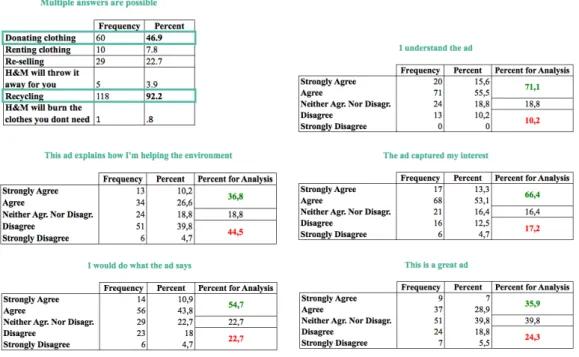
The second ad was focused on H&M’s recycling system. In this case, all 128 respondents saw the same advertising.
4. H&M
Both questions in this part aim to discover possible changes in opinion towards H&M, after exposure to information regarding “Conscious” and sustainability.
5. Demographics
Finally, information about nationality, age and current professional status was recovered.
4.2. Sample Characterization
In total, 167 answers were recorder. Nevertheless, after cleaning the sample, only 128 responses were considered valid and used for the analysis. Respondents came from 14 different nationalities with 54,7% of them being female and 45,3% male. 50% were between 21 and 23 years old, followed by 43,8% with ages ranging between 24 and 26 years old. 5,5% stated to be 18 to 20 years old and only 0,8% 27 to 30 years old. 65,6% were Master students, 17,2% bachelor students as well as workers (Appendix 21). The target group was decided to be people in their late teens to their late twenties as they will mainly be university students or recent workers and have similar economical and social background.
4.3. Analysis
For matters of simplification, values for agree and strongly agree will be counted together, as well as values for strongly disagree and disagree.
4.3.1. Sustainability and Consumers
Respondents were asked about what they considered to be the most important factors when shopping for clothing. For this, five factors had to be ranked from most to least important. 52,3% chose “Design” as the most important. “Price” was second most chosen (46,9%), followed by “Quality” (36,7%). 46,9% chose “Brand” in fourth place and 65,6%, of the participants chose “Eco-friendliness” as the least important factor. Only 25%, stated to take into account social & environmental issues when shopping. 75% agreed on caring about the opinion of friends and family and being concerned with wearing the latest trends (50,7%). 72,7% have a few go to brands they wouldn’t change and 62,5% would prefer buying a few high quality clothes rather than buying a lot (Appendix 22). Through independent sample T-test analysis, significant difference
was found between this last statement and genders, with p=0,022, being the mean of males higher than the one of females (Appendix 23).
When asked about sustainability, 89,8% said to be familiar with the term. After presenting its definition, 72,7% of respondents affirmed that sustainability was important for them and 50% agreed it was for their friends/family as well. 83,6% expressed to be concerned with environmental and social problems and 67,2% affirmed they recycle (paper, plastic etc.) as much as they can. 70,3% would be interested in buying sustainable products, 89% feel like they should be more sustainable and 81,2% belief their individual consumption could “make a difference” (Appendix 24). Through independent sample T-test analysis, significant differences in mean scores were found between genders and “I recycle as much as I can”(p=0,013), “I feel like I should be more sustainable”(p=0,24) and “I can make a change by engaging in sustainable consumption”(p=0,018). For all three variables, female means were higher (Appendix 25).
Concerning green products, 54,7% claimed to buy them, with the majority being women, as crosstabulation proved significant difference (p=0,041) between genders. The most bought green products were “Vegetables & fruits” with 50% and the least chosen option, “Clothing”, with 10,9%. On the social context, 69,5% said to know someone who uses sustainable brands with 56,3% stating it was their friends/colleagues who engaged in green consumption. “Family” was chosen 32,8% and “Someone famous I like/follow” 14,1% (Appendix 26). In total, 71,9% of the respondents were WTP more for sustainable products with no significant difference between gender (Appendix 27). 91,4% agreed to understand the benefit of these products, 76,3% believe they are better for their health/body and 45,6%, agree on being open to change their current brand for a sustainable option. 49,6%, believe these products have better quality, 51,8% agree on them being better than normal products, however, only 16,10% thought they were affordable. By performing an independent sample T-test, significant difference between the mean scores of genders and “they are affordable” (p=0,041) as well as “they are better for my body/health” (p=0,040) was found. Means were higher for males in the first case and in the second, for females (Appendix 28).