Lisbon University Vrije University Amsterdam
Faculty of Sciences Faculty of Earth and Life
Centro de Matem´atica e Science
Aplicac¸˜oes Fundamentais Department of Theoretical
Biology
Rich dynamics in multi-strain models:
non-linear dynamics and deterministic
chaos in dengue fever epidemiology
Ma´ıra Aguiar Freire dos Santos
PhD thesis in association
to obtain the doctoral degree in biology with specialization in population biology of Lisbon University, and to obtain the doctoral degree in Life Sciences of Vrije Universiteit Amsterdam
Lisbon University Vrije University Amsterdam
Faculty of Sciences Faculty of Earth and Life
Centro de Matem´atica e Science
Aplicac¸˜oes Fundamentais Department of Theoretical
Biology
Rich dynamics in multi-strain models:
non-linear dynamics and deterministic
chaos in dengue fever epidemiology
Ma´ıra Aguiar Freire dos Santos
PhD thesis in association
to obtain the doctoral degree in biology with specialization in population biology of Lisbon University, and to obtain the doctoral degree in Life Sciences of Vrije Universiteit Amsterdam
Thesis supervised by Professor Doctor Bob W. Kooi and Professor Doctor Francisco Dion´ısio
Acknowledgments: This thesis was done in association with Amsterdam Uni-versity. The research in this thesis has been supported by the Funda¸c˜ao para a Ciˆencia e a Tecnologia, FCT grant SFRH/BD/43236/2008, and has been further supported by the Portuguese FCT project PTDC/MAT/115168/2009 and by the EU project DENFREE under Framework Program 7. The work was carried out at Centro de Matem´atica e Aplica¸c˜oes Fundamentais, Science Faculty, Lisbon University, Portugal.
Note: For interpretation of the references to color in the figures and figure legends, the reader is referred to the electronic version of this thesis and or to the web version of each article.
1
“In the middle of difficulty lies opportunity.”
Contents
Resumo 7
Samenvatting 13
English summary 19
1 Introduction 25
1.1 The SIR Epidemic Model . . . 27
1.2 Dengue fever Epidemiology . . . 31
1.3 Multi-strain models motivated by dengue fever epidemiology: a review . . . 36
1.4 Discussion and conclusions . . . 50
2 Epidemiology of dengue fever: A model with temporary cross-immunity and possible secondary infection shows bifurcations and chaotic behavior in wide parameter regions 53 2.1 Introduction . . . 54
2.2 Basic two-strain epidemic model . . . 56
2.3 Time series analysis . . . 58
2.3.1 Time series simulations . . . 59
2.3.2 State space plots . . . 60
2.3.3 Maxima return map of I from state space plot . . . 61
2.3.4 Numerical bifurcation diagram . . . 61
2.3.5 Quantifying unpredictability: Lyapunov exponents . . . . 64
2.4 Bifurcation analysis by continuation . . . 66
2.4.1 Stationary states for the symmetric case . . . 66
2.4.2 Bifurcations analysis beyond equilibria . . . 68
2.5 Conclusion . . . 74
3 Torus bifurcations, isolas and chaotic attractors in a simple dengue fever model with ADE and temporary cross-immunity 77 3.1 Introduction . . . 77
4 CONTENTS
3.2.1 Symmetries . . . 80
3.3 Bifurcation diagrams for various α values . . . 82
3.3.1 Bifurcation diagram for α = 3y−1 . . . 82
3.3.2 Bifurcation diagram for α = 2y−1 . . . 83
3.3.3 Bifurcation diagram for α = 1y−1 . . . 84
3.4 Two-parameter diagram . . . 86
3.5 Lyapunov spectra for various α values . . . 87
3.6 Conclusions . . . 88
Appendix . . . 88
3.A Epidemic model equations . . . 88
4 The role of seasonality and import in a minimalistic multi-strain dengue model capturing differences between primary and sec-ondary infections: complex dynamics and its implications for data analysis 91 4.1 Introduction . . . 92
4.2 The seasonal multi-strain epidemic model . . . 94
4.3 Analysis techniques . . . 97
4.4 Bifurcation analysis . . . 99
4.4.1 Bifurcation analysis of the non-seasonal model . . . 100
4.4.2 Bifurcation analysis of the seasonal models . . . 102
4.5 Time series . . . 106
4.5.1 Lyapunov exponents and predictability: . . . 108
4.5.2 Implications for data analysis: . . . 110
4.6 Discussion and conclusions . . . 110
Appendix . . . 113
4.A Seasonal forcing . . . 113
4.B Attractors in state space . . . 114
4.B.1 Attractors in state space for the non-seasonal multi-strain dengue model . . . 114
4.B.2 Attractors in state space for the low seasonal multi-strain dengue model . . . 117
4.B.3 Attractors in state space for the seasonal multi-strain dengue model with import of infected . . . 118
4.C Bifurcation diagram comparison . . . 119
4.D Lyapunov exponents and import factor . . . 119
5 Scaling of stochasticity in dengue hemorrhagic fever epidemics 123 5.1 Introduction . . . 123
5.2 Modeling dengue fever epidemiology . . . 124
5.3 The stochastic model . . . 125
5.4 The role of import . . . 129
CONTENTS 5
5.6 Conclusions . . . 134
6 Irregularity in dengue fever epidemics: difference between first and secondary infections drives the rich dynamics more than the detailed number of strains 137 6.1 Introduction . . . 138
6.2 Two competing multi-strain models: a dimensional problem . . . 139
6.2.1 The two-strain model versus the four-strain model . . . 141
6.3 Numerical analysis . . . 143
6.4 Discussion and Remarks . . . 148
Appendix . . . 149
6.A Unpacking the n-strain model into a four-strain model . . . 149
Bibliography 153
Acknowledgments 161
Resumo
Palavras chaves: modelos matem´aticos, dengue, multi-estirpe, imu-nidade cruzada tempor´aria, caos deterministico
Ao longo da hist´oria, as doen¸cas infecciosas veem causado o enfraquecimento e morte prematura de grandes parte da popula¸c˜ao humana, gerando s´erias preocu-pa¸c˜oes sociais e econˆomicas. Muitos s˜ao os fatores quem tˆem contribuido para a persistˆencia e o aumento na ocorrˆencia de doen¸cas infecciosas, tais como factores demogr´aficos, mudan¸cas pol´ıticas, sociais e econˆomicas, mudan¸cas ambientais, adapta¸c˜ao microbiana, etc. Segundo a Organizao Mundial de Sa´ude (OMS), as doen¸cas infecciosas s˜ao a segunda principal causa de morte no mundo, depois das doen¸cas cardiovasculares (WHO, 2010).
Dentre as doen¸cas transmiss´ıveis mais preocupantes, o dengue ´e, de acordo com a OMS, um problema de sa´ude p´ublica internacional, com mais de 55% da populao mundial vivendo em ´areas com risco de transmiss˜ao da infec¸c˜ao. O den-gue, uma infec¸c˜ao viral transmitida por mosquitos, ´e uma das principais causas de doen¸ca e morte nos tr´opicos e subtr´opicos. A infec¸c˜ao pelo v´ırus do den-gue pode ser causada por qualquer uma das quatro cepas existentes, designadas por serotipos DEN − 1, DEN − 2, DEN − 3 e DEN − 4. Estes serotipos s˜ao distintos, por´em, antigenicamente relacionados. A infec¸c˜ao gerada por um deter-minado serotipo confere imunidade total e permanente (ao longo da vida) para apenas aquele serotipo, e tamb´em imunidade cruzada tempor´aria para os outros serotipos. A imunidade cruzada tempor´aria tem uma dura¸c˜ao estimada que varia de trˆes a nove meses, e est´a relacionada com os n´ıveis de anticorpos gerados du-rante a resposta imune ´a uma primeira infec¸c˜ao pelo v´ırus do dengue. Afirma-se que o alto n´ıvel destes anticorpos seria suficiente para a prote¸c˜ao contra outras infec¸c˜oes causadas por patogenos antigenicamente relacionados.
O dengue pode se manifestar em duas formas cl´ınicas: dengue cl´assico (DC), uma forma n˜ao-fatal da doen¸ca, e dengue hemorr´agica (DH), que pode evoluir para uma forma muito grave conhecida como s´ındrome do choque do dengue (DSS). Estudos epidemiol´ogicos associam os casos graves da doen¸ca (DH) com a
segunda infec¸c˜ao do dengue. Existem boas evidˆencias relacionando as infec¸c˜oes sequenciais pelos v´ırus do dengue e o aumento para os riscos do desenvolvimento do dengue hemorr´agico. Esta associa¸c˜ao se deve a um processo imunol´ogico cha-mado de antibody-dependent enhancemet (ADE). O antibody-dependent enhan-cement ocorre quando os anticorpos pr´e-existentes, provenientes de uma primeira infe¸c˜ao do dengue, n˜ao neutralizam mas sim real¸cam a nova infec¸c˜ao pelo v´ırus do dengue.
N˜ao existe uma medica¸c˜ao espec´ıfica para a infec¸c˜ao do dengue. O tratamen-to dos casos de dengue cl´assico ´e apenas de suporte e para os casos de dengue hemorr´agico a hospitaliza¸c˜ao ´e frequentemente necess´aria para obten¸c˜ao de um tratamento adequado. A vacina contra o dengue ainda n˜ao esta dispon´ıvel, uma vez que ter´a que simular prote¸c˜ao para todos os quatro serotipos existentes. Atu-almente, algumas vacinas candidatas encontram-se em diversos est´agios de desen-volvimento. At´e o presente momento, a preven¸c˜ao na exposi¸c˜ao e o controle dos vetores s˜ao as ´unicas alternativas para a preven¸c˜ao da transmiss˜ao do dengue.
A modela¸c˜ao matem´atica tornou-se uma ferramenta importante para a com-preens˜ao da epidemiologia e da dinˆamica das doen¸cas infecciosas. Uma s´erie de modelos deterministicos, tais como o modelo Suscept´ıvel-Infectado (SI) e o mo-delo Suscept´ıvel-Infectado-Recuperado (SIR), por exemplo, tˆem sido propostos com base nos padr˜oes de fluxo para cada um dos compartimentos representan-do os est´agios da representan-doen¸ca. O modelo epidemiol´ogico SIR divide a popula¸c˜ao de indiv´ıduos em trˆes classes: Suscept´ıveis (S), Infectados (I) e Recuperados (R). Este tipo de modelo pode ser utilizado para representar, por exemplo, as doen¸cas infecciosas que n˜ao conferem imunidade permanente, possibilitando a reinfec¸c˜ao. Assumindo que a transmiss˜ao da doen¸ca se faz de pessoa para pessoa, os in-div´ıduos suscept´ıveis tornam-se infectados e infecciosos (capazes de transmitir a doen¸ca), se curam e se tornam recuperados (com imunidade tempor´aria ao pat´ogeno causador da doen¸ca). Depois de um determinado per´ıodo tempo, acon-tece a perda desta imunidade e o indiv´ıduo tornar-se novamente suscept´ıvel, po-dendo se reinfectar. A dinˆamica multi-estirpe ´e geralmente modelada utilizando extens˜oes dos modelos do tipo SIR. Para capturar as diferen¸cas entre a primeira e a segunda infec¸c˜ao ´e preciso considerar pelo menos dois serotipos diferentes na composi¸c˜ao do modelo do tipo SIR.
A dinˆamica da epidemiologia do dengue ´e particularmente complexa, com grandes flutua¸c˜oes (varia¸c˜oes em quantidade ao longo do tempo) na incidˆencia da doen¸ca. Modelos matem´aticos recentes para a transmiss˜ao do v´ırus do den-gue se concentram no efeito ADE e na imunidade cruzada tempor´aria. Estes modelos apresentam resultados de flutua¸c oes cr´ıticas com distribui¸c˜ao em lei de potˆencia para os casos da doen¸ca, caos determin´ıstico e dessincroniza¸c˜ao ca´otica, devido a sua estrutura multi-estirpe. O comportamento ca´otico ´e obtido quando assumindo infectividade muito alta para a segunda infec¸c˜ao do dengue, isto ´e, as-sumindo que os indiv´ıduos na segunda infec¸c˜ao pelo v´ırus do dengue transmitem a doen¸ca com uma taxa muita mais elevada do que os indiv´ıduos na primeira
infec¸c˜ao. Considera¸c˜oes da imunidade cruzada tempor´aria associada ao efeito ADE gera uma nova janela ca´otica inesperada e biologicamente mais realistas, onde a infectividade dos indiv´ıduos na segunda infec¸c˜ao do dengue ´e reduzida devido a severidade da doen¸ca e a prov´avel hospitaliza¸c˜ao causada pelo processo imunol´ogico do ADE.
Nesta tese apresentamos a an´alise e os resultados obtidos em diferentes ex-tens˜oes do modelo cl´assico SIR. Estes modelos foram motivado pela epidemiolo-gia do dengue e a sua peculiar caracter´ıstica imunol´ogica causada pelo antibody-dependent enhancement. O nosso estudo se concentra em um modelo m´ınimal´ıstico, em que pelo menos dois serotipos diferentes s˜ao necess´arios para descrever as di-feren¸cas entre as infec¸c˜oes primaria e secund´aria causadas pelas differentes cepas do v´ırus do dengue. Os modelos dividem a popula¸c˜ao humana em suscept´ıveis, infectados e recuperados, e utiliza ´ındices para diferenciar cada um dos serotipos. Os indiv´ıduos podem ser: (1) suscept´ıveis sem nenhuma infec¸c˜ao pr´evia pelo v´ırus do dengue, (2) infectados e recuperados pela primeira vez, (3) suscept´ıveis com um hist´orico de infec¸c˜ao pr´evia e (4) infectados pela segunda vez (por uma cepa diferente da primeira infec¸c˜ao) e, prov´avelmente hospitalizados devido ao pro-cesso de ADE. O modelo minimal´ıstico apresenta uma dinˆamica estrutural rica ao incorporar aos modelos j´a existentes para a transmiss˜ao do dengue, o per´ıodo de imunidade cruzada tempor´aria associada ao processo de antibody-dependent enhancement capaz de gerar diferen¸cas nas taxas de transmiss˜ao para as infec¸c˜oes primarias e secund´arias da doen¸ca.
No Cap´ıtulo 1 apresentamos as propriedades do modelo b´asico SIR aplica-do ao estuaplica-do das aplica-doen¸cas transmiss´ıveis. A an´alise da dinˆamica apresentada, identificando os limites e os pontos de equil´ıbrio, com o objectivo de introduzir a nota¸c˜ao e a terminologia utilizada. Estes resultados s˜ao posteriormente generali-zados para os modelos motivados pela epidemiologia do dengue. No Cap´ıtulo 2, o modelo b´asico do tipo SIR para dois serotipos diferentes ´e apresentado e analisa-do. Este cap´ıtulo enfatiza o aspecto multi-estirpe e seus efeitos sobre a popula¸c˜ao humana. Os efeitos da dinˆamica dos vetores e ou da sazonalidade n˜ao s˜ao mo-delados explicitamente, sendo levados em conta apenas pelos parˆametros efetivos do modelo. No Cap´ıtulo 3 apresentamos uma an´alise detalhada dos pontos de bifurca¸c˜oes encontrados para os parˆametros de ADE (φ) e de imunidade cruzada tempor´aria (α).
No Cap´ıtulo 4, o modelo sazonal do dengue ´e apresentado. Com base nos dados dispon´ıveis de monitoramento do dengue, o papel da for¸ca sazonal e os casos importados da doen¸ca foram considerados como efeitos biologicamente relevantes para a determina¸c˜ao do comportamento dinˆamico do sistema. O comparativo entre trˆes cen´arios distintos (n˜ao-sazonal, sazonal e sazonal com casos importados da doen¸ca) ´e apresentado neste cap´ıtulo. A adi¸c˜ao da sazonalidade e de poss´ıveis casos importados da doen¸ca institui complexidade ´a dinˆamica e apresenta boa concordˆancia qualitativa entre os dados emp´ıricos dos casos graves da doen¸ca (DH) e o output do modelo.
At´e o momento, apenas esses modelos minimal´ısticos tˆem a possibilidade de ser qualitativamente bem compreendido e, eventualmente testados contra os dados existentes. A simplicidade do modelo (poucos parˆametros e poucas va-ri´aveis de estado) oferece uma perspectiva promissora na inferˆencia dos valores dos parˆametros, utilizando os dados referentes ao numerero de casos de dengue hemorr´agico. A estima¸c˜ao de parˆemetros em s´eries temporais ca´oticas ´e noto-riamente dif´ıcil devido ´a imprevisibilidade a longo prazo versus previsibilidade a curto prazo. Recentemente, esta previsibilidade a curto prazo tem sido usada em inferˆencia estat´ısticapara para abordagens temporalmente localizadas encon-trandi dificuldades na obten¸c˜ao de uma resposta final definitiva para a melhor estimativa dos parˆametros.
A capacidade de prever os futuros surtos do dengue na ausˆencia de interven¸c˜ao humana tem como objetivo compreender o efeitos das medidas de controle da doen¸ca, incluindo a implementa¸c˜ao de programas de vacina¸c˜ao, quando esta es-tiver dispon´ıvel e acess´ıvel. Os ensaio com esta vacina dever˜ao ser realizados em um ano em que o numero de casos da doen¸ca for suficientemente altos (e n˜ao em um ano em que o n´umero de casos da doen¸ca fossem naturalmente baixos) afim de facilitar os teste estat´ısticos para a efic´acia da vacina. Desta maneira, a previs˜ao do n´umero de casos da doen¸ca com base no balan¸co determin´ıstico do n´umero de indiv´ıduos infectados e indiv´ıduos suscept´ıveis seria de grande utilidade pr´atica. A propaga¸c˜ao de doen¸cas ´e um fenˆomeno inerentemente estoc´astico, mas os modelos para a propaga¸c˜ao do dengue s˜ao em sua maioria expressos matema-ticamente por um conjunto equa¸c˜oes diferenciais deterministicas, que s˜ao mais f´aceis de analisar. A aproxima¸c˜ao do campo m´edio, uma aproxima¸c˜ao utiliza-da em processos estoc´asticos para a obten¸c˜ao de dinˆamicas determin´ısticas, ´e uma boa aproxima¸c˜ao para ser utilizada a fim de compreender melhor o com-portamento dos sistemas estoc´asticos em determinadas regi˜oes de parˆametro. No entanto, apenas os modelos estoc´asticos, ao contr´ario dos modelos deterministi-cos, podem captar as flutua¸c˜oes observadas em algumas das s´eries temporais de dados emp´ıricos. No Cap´ıtulo 5, a vers˜ao estoc´astica do modelo multi-estirpe minimal´ıstico ´e apresentado. Neste cap´ıtulo investigamos a intera¸c˜ao entre esto-casticidade, sazonalidade e casos importados da doen¸ca. A introdu¸c˜ao de estocas-ticidade ´e capaz de explicar as flutua¸c˜oes observadas em algumas s´erie temporais de dados para os casos graves do dengue, revelando um cen´ario onde o ru´ıdo e o esqueleto determin´ıstico se interagem fortemente. Para uma popula¸c˜ao suficiente-mente grande, o modelo estoc´astico ´e bem descrito pelo esqueleto determin´ıstico, capturando a dinˆamica essencial da doen¸ca. O modelo estoc´astico gera, a partir das informaes topol´ogicas da dinˆamica, a percep¸c˜ao sobre os valores relevantes dos parˆametros do modelo.
O modelo minimal´ıstico do dengue ´e um sistema com 9 dimens˜oes e, tem boas chances de poder se utilizado em uma futura inferˆencia estat´ıstica, para estimar todas as condi¸c˜oes iniciais e os poucos parˆametros do modelo. Os dados emp´ıricos dispon´ıveis para os casos de dengue hemorr´agico consistem na incidˆencia mensal
de casos hospitalizados e, para este tipo de dados, o modelo capaz de gerar in-fec¸c˜oes prim´aria e secund´aria causadas por differentes serotipos do dengue (sem a necessidade de se considerar diferen¸cas nas dinˆamicas para cada um dos diferentes serotipos existentes), apresenta uma boa concordˆancia qualitativa entre os dados emp´ıricos e o output do modelo (ver Cap´ıtulo 4 e Cap´ıtulo 5). Diferentemente do modelo minimal´ıstico multi-estirpe para a transmiss˜ao do dengue, o modelo incluindo os quatro serotipos ´e matematicamente representado por um sistema com 26 equa¸c˜oes diferenciais. Este sistema apresenta uma dimens˜ao elevada (25 dimens˜oes) e dif´ıcilmente poder´a ser utilizado em inferˆencia estat´ıstica, devido ao elevado n´umero de vari´aveis e condi¸c˜oes iniciais.
No Captulo 6, o modelo para a transmiss˜ao do dengue incluindo todos os se-rotipos existentes ´e apresentado. Com os quatro sese-rotipos, DEN − 1, DEN − 2, DEN − 3 e DEN − 4, as classes SIR s˜ao identificadas por ´ındices para cada um dos serotipos. A assimetria epidemiol´ogica entre as cepas continua a n˜ao ser considerada. Os dados serologicos existentes para cada um dos serotipos em separado s˜ao recentes e escassos, n˜ao sendo capazes de fornecer informa¸c˜oes fide-dignas ´as poss´ıveis diferen¸cas existentes entre os parˆametros biol´ogicos (tais como as taxas de infec¸c˜ao e taxas de recupera¸c˜ao) para cada uma das quatro cepas do v´ırus do dengue. Neste cap´ıtulo apresentamos a compara¸c˜ao entre os diagramas de bifurca¸c˜ao para os dois modelos multi-estirpe, assumindo respectivamente 2 e 4 serotipos diferentes na transmiss˜ao da doen¸ca. Para a regi˜ao de interesse biologico (onde os indiv´ıduos infectados pela segunda vez transmitem menos do que os indiv´ıduos infectados pela primeira vez, devido a severidade da doen¸ca) os pontos de bifurca¸c˜ao acontecem em regi˜oes similares para o parˆametro do efeito ADE.
A lei da parcimˆonia favorece o mais simples dos dois modelos concorrentes e desta forma, conclu´ımos que o modelo minimal´ıstico para a transmiss˜ao do dengue (dois serotipos), na sua simplicidade, ´e um bom modelo para ser ana-lisado. O modelo minimal´ıstico do dengue ´e capaz de produzir a complexidade esperada para explicar as flutua¸c˜oes observadas nos dados emp´ıricos da doen¸ca e apresenta, dentro da possibilidade, baixa dimensionalidade. A Inferˆencia es-tat´ıstica utilizando os dados emp´ıricos para estimar os parˆametros b´asicos de transmiss˜ao, infectividade, a gravidade da doen¸ca (parmetro ADE) e per´ıodo de imunidade cruzada tempor´aria, ´e de extrema importˆancia e definitivamente ne-cess´aria para identificar os eventuais desvios do caso mais simples de simetria, que foram investigados aqui. O estudo da estima¸c˜ao dos parˆametros utilizando o modelo minimal´ıstico do dengue est´a em andamento.
A dinˆamica vetorial tamb´em pode desempenhar um papel importante na com-preen¸c ao da epidemiologia do dengue. As investiga¸c˜oes descritas nesta tese sur-gerem uma s´erie de poss´ıveis dire¸c˜oes para a continuidade desta pesquisa e, em termos de trabalho futuro, a investiga¸c˜ao de extens˜oes do modelo minimal´ıstico poder´a abordar as seguintes quest˜oes e problemas: (1) Qual ´e a real contribui¸c˜ao das infec¸c˜oes prim´arias e secund´arias para a fora de infec¸c˜ao? Indiv´ıduos na
segunda infec¸c˜ao transmitem mais ou menos do que a indiv´ıduos na primeira infec¸c˜ao? (2) Existem diferen¸cas significativas entre as taxas de infec¸c˜ao para cada um dos serotipos existentes? At´e que ponto a estrutura de bifurca¸c˜ao pode explicar a real contribui¸c˜ao da diversidade viral? (3) Formular hip´oteses usando o mecanismo adequado de imunidade cruzada tempor´aria e a prote¸c˜ao gerada em infec¸c˜oes recorrentes. (4) Modelar ensaios de vacinas, com base na previsibilidade a curto prazo em sistemas ca´oticos, para futura implementa¸c˜ao de programas de imuniza¸c˜ao, quando a(s) vacina(s) tetravalente estiver dispon´ıveil e acess´ıvel. E finalmente (5) propor alvos para a interven¸c˜ao e para o planeamento de medidas controle, baseando-se no impacto esperado da doen¸ca. O Meu interesse especial se concentra na poss´ıvel parametriza¸c˜ao do modelo a partir dos dados referentes ´a incidˆencia da doen¸ca grave e na prevalˆencia de infec¸c˜ao. Esta ferramenta epi-demiol´ogica ajudaria a compreender os efeitos das medidas de controle e, poderia ser utilizada para orientar as pol´ıticas de preven¸c˜ao e controle da transmiss˜ao do v´ırus do dengue, gerando uma percep¸c˜ao sobre a previs˜ao dos surtos futuros do dengue.
Samenvatting
Sinds mensenheugenis hebben infectie ziekten geleid tot slepende ziektes en vroeg-tijdige sterfte onder grote delen van de wereld bevolking, leidend tot grote sociale en economische problemen. Vele factoren hebben bijgedragen tot het in stand houden en de toename van infectie ziekten: demografisch factoren, politieke, so-ciale en economische veranderingen, verandering van de gezondheidszorg, enz. Volgens de Wereldgezondheidsorganisatie (WHO), zijn ze wereldwijd de tweede doodsoorzaak na hart en vaat ziektes (WHO, 2010). De laatste jaren zijn wis-kundige modellen belangrijke gereedschappen geworden voor het verkrijgen van kennis over infectieziekten en hebben ze bijgedragen aan de grote vooruitgang in het maken van strategie¨en voor het beheersen van ziektes, bijvoorbeeld bij het opzetten van vaccinatie programma’s.
Knokkelziekte (Eng. dengue) is een door muggen, de tijgermug, overgedra-gen virale infectieziekte. Deze ziekte is in de laatste jaren een groot internati-onaal gezondheidsprobleem geworden en een belangrijke ziekte en sterfte bron in (sub)tropische gebieden. Knokkelkoorts wordt veroorzaakt door vier antigeen verschillende virussen, bekend als dengue-varianten DENV 1, DENV 2, DENV 3 en DENV 4. Infectie met ´e´en serotype geeft levenslange immuniteit voor slechts dat serotype en maar tijdelijke immuniteit voor de andere serotypes. Tijdens de reactie op de infectie worden antilichamen gegenereerd. Het duurt drie tot negen maanden voordat het niveau van die antilichamen voldoende is om bescherming te bieden tegen infectie door een ander, maar gerelateerd, serotype.
Er zijn twee varianten van de ziekte: knokkelkoorts (dengue fever (DF)) een vorm zonder fatale afloop en hemorrhagische knokkelkoorts (dengue hemorrhagic fever (DHF)) die tot een shock kunnen leiden, bekend als een “dengue shocksyn-droom” (DSS) vaak met fatale afloop.
Epidemiologische studies wijzen erop dat de hemorrhagische dengue eerder optreedt door een tweede infectie bij iemand die eerder een knokkelkoorts-aanval door een ander knokkelkoorts-virus heeft doorgemaakt. Een proces beschreven als “antibody-dependent enhancement” (ADE) is hiervoor verantwoordelijk. Daarbij kunnen de antilichamen die tijdens een eerdere infectie door een ander serotype aangemaakt zijn, niet neutraliseren maar zelfs de nieuwe infectie verergeren.
De behandeling van de milde vorm is alleen symptomatisch en ondersteunend. De ernstige vorm vereist daarentegen veel aandacht waarbij de pati¨ent voldoende moet drinken, en eventueel extra vocht moet krijgen via een infuus. Er bestaat nog geen vaccin tegen knokkelkoorts omdat een beschermende immuunreactie gestimuleerd moet worden voor de vier serotypes. Meerdere kandidaten, zoals tetravalent vaccines, zijn op dit moment in verschillende stadia van ontwikkeling. Tot nu toe is voorkoming van muggenbeten de enige mogelijke preventie-ve bestrijdingsmaatregel tegen preventie-verspreiding van de ziekte. Muggenbeten kunnen worden voorkomen door bijvoorbeeld het dragen van bedekkende kleding, het ver-wijderen van mogelijke besmettingshaarden zoals schoon stilstaand water waar de muggen bij voorkeur hun eitjes in leggen en het gebruik van verdelgingsmiddelen tegen de muggen.
Wiskundige modellen zijn een interessant gereedschap geworden voor het leren begrijpen van de epidemiologie en dynamica van infectieziekten. Er een aantal deterministische compartimentsmodellen, zoals de SI en SIR modellen, voor het beschrijven van het verloop van ziektes in een populatie. In het SIR model wordt onderscheid gemaakt tussen drie klassen: vatbaar (Susceptible), besmettelijk (In-fected) en genezen (Recovered). Dit model kan gebruikt worden als er levenslange immuniteit is en waarbij de infectiebesmetting overgedragen wordt van mens op mens: de vatbaren worden ge¨ınfecteerd en besmettelijk en daarna weer beter. Men kan dit model ook zo uitbreiden dat na een immuniteitsperiode tijdelijk genezen personen weer vatbaar worden.
Bij meerdere vormen van de ziekte worden in het algemeen andere uitbreidin-gen van de SIR-modellen gebruikt. Bijvoorbeeld de verschillen tussen de eerste knokkelkoorts infectie veroorzaakt door ´e´en variant van de virus en een tweede infectie door een andere variant te bestuderen zijn twee-varianten SIR-modellen gebruikt. Modellen voor interacties tussen meerdere varianten met ADE maar zonder een tijdelijke immuniteitsperiode hebben deterministisch chaotisch gedrag laten zien waarbij de infectiviteit van de tweede infectie. De uitbreiding met een tijdelijke cross-immuniteitsperiode geeft een nieuw type chaotische gedrag bij onverwachte maar biologisch realistische parameterwaarden voor de infectiviteit voor de tweede infectie.
In dit proefschrift worden meerdere uitbreidingen van de klassieke enkel-variant SIR populatie model bestudeerd. Deze modellen zijn van toepassing voor het bestuderen van een knokkelkoorts epidemiologie met het kenmerkende ADE fenomeen. We zijn ge¨ıntereseerd in een minimalistisch model waarbij tenminste twee varianten nodig zijn om de verschillen tussen de eerste en een tweede infectie te kunnen beschrijven. In het model worden voor twee populaties de volgende klassen onderscheiden. Personen kunnen vatbaar zijn zonder ooit ge¨ınfecteerd geweest te zijn, besmettelijk van de eerste infectie, vatbaar terwijl de persoon al een keer besmet geweest is voor een tweede infectie, en besmettelijk en genezen voor de tweede infectie nu door een andere variant en tenslotte volledig genezen. De personen die voor de tweede keer besmet zijn hebben meer kans in het
zieken-huis te belanden vanwege het ADE effect en dat leidt tot de ernstige vorm van de ziekte. De uitbreiding van bestaande knokkelkoorts modellen met een tijdelijke cross-immuniteit laat een rijk dynamisch gedrag zien met deterministische chaos voor biologisch meer realistische parameterwaarden.
In Hoofdstuk 1 worden de eigenschappen van het basale SIR epidemiologisch model voor infectie ziekten beschreven met daarbij een overzicht van de analyse van het dynamisch gedrag, zoals het identificeren van drempels voor het uitbre-ken van de ziekte en evenwichten. Daarbij wordt ook meteen de terminologie ingevoerd. Deze resultaten worden daarna gegeneraliseerd voor geavanceerdere knokkelkoorts epidemiologie modellen.
In Hoofdstuk 2 wordt het twee-varianten SIR-type model gegeven voor knok-kelkoorts epidemiologi¨en. Hoofdstuk 3 geeft een gedetailleerde bifurcatie analyse van de basale multi-varianten knokkelkoorts model in termen van de ADE para-meter φ en de parapara-meter voor de tijdelijke immuniteit voor een andere variant α.
Hoofdstuk 4 behandelt de invloed van seizoensinvloeden waarbij tweede in-fecties met tijdelijke cross-immuniteit mogelijk zijn. Waarnemingen van inciden-ties van knokkelkoorts suggereren dat seizoensinvloeden maar ook de import van ziektes via ge¨ınfecteerde personen mede bepalend zijn voor het dynamisch gedrag van knokkelkoorts incidenties. Verschillende scenario’s: resp. geen, lage en sterke seizoensinvloeden met daarbij een beperkte import via ge¨ınfecteerde personen worden bestudeerd. Deze uitgebreide modellen laten complexe dynamiek zien die kwalitatief goed overeenstemmen met empirische waarnemingen over DHF gevallen.
Tegenwoordig is het mogelijk alleen van twee-varianten modellen het gedrag kwalitatief goed te doorgronden en waarvan de voorspellingen vergeleken kunnen worden met waarnemingen. De eenvoud van het model (lage aantal parameters en toestandsvariabelen) maakt het mogelijk parameterwaarden te schatten waarbij gebruik gemaakt wordt van waargenomen aantallen DHF gevallen. Deze schat-tingstechnieken zijn notoire moeilijk toe te passen op tijdsreeksen met chaotisch gedrag. Maar korte termijn voorspellingen zijn mogelijk. Als men de effecten van beleidsmaatregelen wil begrijpen is het belangrijk toekomstige uitbraken van knokkelkoorts te kunnen voorspellen. Ook al zou een virus vaccin beschikbaar komen, dan blijft dit relevant voor de implementatie van vaccinatie programma’s. Om een voorbeeld te geven: als een proef voor het bepalen van de effectiviteit van vaccinaties gedaan wordt in een jaar waarin de ziekte alleen voorkomt bij een beperkt aantal personen dan zijn deze waarnemingenstatistische gezien veel moeilijker te interpreteren dan wanneer de proef in een jaar uitgevoerd zou wor-den waarin de ziekte veel vaker voorkomt. Het kunnen voorspellen wanneer de volgende knokkelkoorts epidemie optreed en hoe groot die is, is dus van groot praktisch belang.
Ofschoon de overdracht van ziektes een inherent stochastisch fenomeen is zijn knokkelkoorts modellen meestal geformuleerd met deterministische
differentiaal-vergelijkingen. De gemiddelde veldbeschrijving (“mean field approximation”) geeft vaak een goede benadering en kan gebruikt worden om een beter begrip te krijgen van het gedrag van stochastische systemen voor bepaalde situaties. Daar-bij worden de gemiddelde hoeveelheden benaderd door correlaties te verwaarlo-zen. Echter, in sommige gevallen kunnen alleen stochastische in tegenstelling tot deterministische modellen waargenomen fluctuatie beschrijven.
In Hoofdstuk 5 wordt een stochastische versie van het multi-varianten model beschreven. Deze formulering houdt rekening met essenti¨ele verschillen tussen de eerste en de tweede besmettingen in knokkelkoorts epidemiologie. De interactie tussen stochasticiteit, seizoenen en import wordt onderzocht. Het introduceren van stochasticiteit is noodzakelijk om waargenomen fluctuaties in beschikbare gegevens bestanden laat een scenario zien waarbij ruis en de complexe determi-nistisch gedrag elkaar sterk be¨ınvloeden. Wanneer de populatie groot genoeg is kan het stochastisch systeem goed benaderd worden met een deterministisch mo-del met behoud van de essenti¨ele dynamiek. Daarmee krijgt men inzicht in de relevante parameterwaarden op grond van enkel topologische informatie over de dynamiek.
Het twee-varianten knokkelkoorts model is een 9 dimensionaal systeem (d.w.z. dat er 9 toestandsvariabelen zijn) en daarmee lijken toekomstige parameterschat-tingen haalbaar waarbij alle beginvoorwaarden (hier 9) naast een beperkt aantal parameters vastgelegd kunnen worden. Lange termijn epidemiologische waarne-mingen van maandelijkse ziekenhuisopnamen met DHF zijn beschikbaar. Om dit soort gegevens te kunnen analyseren zijn modellen noodzakelijk die zowel eerste als tweede besmettingen met verschillende varianten kunnen voorspellen. Deze modellen waarbij ADE en tijdelijke cross-immuniteit gemodelleerd zijn maar de verschillen in het dynamisch gedrag van verschillende samen voorkomende knok-kelziekte serotypes genegeerd worden, hebben goede kwalitatieve overeenkomst tussen empirisch waarnemingen en model voorspellingen laten zien (zie Hoofd-stuk 4 en HoofdHoofd-stuk 5).
Het vier-varianten model is een 25 dimensionaal systeem in plaats van 9 di-mensionaal bij het twee-varianten model. In dit model vormen de verschillende epidemiologische klassen (zoals vatbaar, besmettelijk en genezen) van de vier verschillende varianten, DENV 1, DENV 2, DENV 3 en DENV 4 de SIR waar-bij ook nu weer geen epidemiologische asymmetrie tussen de varianten wordt aangenomen. Parameters van een systeem met veel dimensies zijn moeilijk te schatten ondermeer omdat een groot aantal beginwaarden meegeschat moeten worden. Verder zijn waarnemingen over het serotype alleen van recente gevallen beschikbaar en daarmee zijn de waargenomen tijdsreeksen te kort om realisti-sche informatie te verkrijgen over het verschil in biologirealisti-sche parameters zoals infectieviteit en genezingssnelheid van alle varianten. In Hoofdstuk 6 worden bifurcatie diagrammen voor het twee-varianten en het vier-varianten model met elkaar vergeleken waarbij de bijdrage aan de infectieviteit van de tweede infectie kleiner is dan die van de eerste infectie. Knokkelkoorts pati¨enten met een tweede
besmetting door een andere variant worden vanwege het ADE fenomeen ernstig ziek en opgenomen in het ziekenhuis. Daardoor dragen ze minder bij aan de infectiekracht (dus φ < 1). Daarom zijn de bifurcaties die optreden bij parame-terwaarden met φ < 1 erg interessant en niet alleen voor φ ≫ 1 zoals eerdere modellen suggereerden.
We concluderen dat het twee-varianten model ondanks zijn eenvoud (rela-tief lage aantal toestandsvariabelen en aantal parameters) een goed model is dat complexe dynamisch gedrag voorspelt en dat de waargenomen empirische waar-nemingen kan verklaren. Momenteel wordt dan ook het twee-varianten model gebruikt om, inclusief de beginwaarden, parameters te schatten.
English summary
Throughout human history, infectious diseases have caused debilitation and pre-mature death to large portions of the human population, leading to serious social-economic concerns. Many factors have contributed to the persistence and increa-se in the occurrence of infectious diincrea-seaincrea-se (such as demographic factors, political, social and economic changes, environmental change, public health care and infra-structure, microbial adaptation, etc.). According to the World Health Organiza-tion (WHO), are the second leading cause of death globally after cardiovascular diseases (WHO, 2010). In recent years, mathematical modeling became an im-portant tool for the understanding of infectious disease epidemiology and has led to great advances in conceiving disease control strategies, including vaccination programs.
One of the most important infectious diseases is dengue, a major international public health concern with more than 55% of world population at risk of acquiring the infection. Dengue is a viral mosquito-borne infection, a leading cause of illness and death in the tropics and subtropics. Dengue fever is caused by four antigenically distinct viruses, designated dengue types 1, 2, 3 and 4. Infection by one serotype confers life-long immunity to only that serotype, and temporary cross-immunity to other related serotypes. The temporary cross-immunity period lasts from three to nine months and it is related to antibody levels created during the immune response to a previous dengue infection. It is stated that such high antibody levels would be enough to protect the individual against an immediately new dengue infection caused by a different but related serotype.
Two variants of the disease exist: dengue fever (DF), a non-fatal form of illness, and dengue hemorrhagic fever (DHF), which may evolve toward a severe form known as dengue shock syndrome (DSS). Epidemiological studies support the association of DHF with secondary dengue infection. There is good evidence that sequential infection increases the risk of developing DHF due to a process described as antibody-dependent enhancement (ADE), where the pre-existing antibodies to previous dengue infection cannot neutralize but rather enhance the
new infection.
Treatment of uncomplicated dengue cases is only supportive, and severe den-gue cases requires careful attention to fluid management and proactive treatment of hemorrhagic symptoms. A vaccine against dengue is not yet available, since it would have to simulate a protective immune response to all four serotypes, although several candidates of tetravalent vaccines are at various stages of de-velopment. So far, prevention of exposure and vector control remain the only alternatives to prevent dengue transmission.
In recent years, mathematical modeling became an interesting tool for the un-derstanding of infectious diseases epidemiology and dynamics. A series of deter-ministic compartment models such as Infected (SI) and Susceptible-Infected-Recovered (SIR) for example, have been proposed based on the flow patterns between compartments of hosts. The SIR epidemic model divides the population into three classes concerning the disease stages: susceptible (S), In-fected (I) and Recovered (R). This model framework can represent infectious diseases where waning immunity can happen. Assuming that the transmission of the disease is contagious from person to person, the susceptibles become infected and infectious, are cured and become recovered. After a waning immunity period, the recovered individual can become susceptible again to reinfection.
Multi-strain dynamics, such as dengue epidemiology, are generally modeled with extended SIR-type models. Dengue fever dynamic is well known to be particularly complex with large fluctuations of disease incidences. To capture differences in primary and secondary dengue infections, a two-strain SIR-type model for the host population has to be considered. Dengue models including multi-strain interactions via ADE, but without temporary cross-immunity, have shown already deterministic chaos when strong infectivity on secondary infection was assumed. The addition of the temporary cross-immunity period in such models brings a new chaotic attractor in wider and unexpected parameter region. In this thesis we present different extensions of the classical single-strain SIR model motivated by modeling dengue fever epidemiology with its peculiar ADE phenomenology. We focus on a minimalistic model, where the notion of at least two different strains is needed to describe differences between primary and se-condary dengue infections. The models divide the host population into suscepti-ble, infected and recovered individuals with subscripts for the respective strains. The individuals can be (1) susceptibles without a previous dengue infection; (2) infected and recovered for the first time; (3) susceptible with an experienced pre-vious dengue infection and (4) infected for the second time with a different strain, more likely to be hospitalized due to the ADE effect leading to severe disease. Our analysis shows a rich dynamic structure, including deterministic chaos in wi-der and more biologically realistic parameter regions, just by adding temporary cross-immunity to previously existing dengue models.
In Chapter 1 we present the properties of the basic SIR epidemic model applied to infectious diseases. A summary of the analysis of the dynamics identifying the
thresholds and equilibrium points in order to introduce notation and terminology are presented. These results were then generalized to a more advanced models motivated by dengue fever epidemiology. In Chapter 2 the basic two-strain SIR-type model motivated by modeling dengue fever epidemiology is presented. In this chapter we focused on the multi-strain aspect and its effects on the host population. The effects of the vector dynamics or seasonality is taken in account only by the effective parameters of the SIR-type model, but these mechanisms are not modeled explicitly. In Chapter 3 a detailed bifurcation analysis for the basic multi-strain dengue model is presented where the ADE parameter φ and the temporary cross-immunity parameter α are studied.
In Chapter 4 the seasonally forced system with temporary cross-immunity and possible secondary infection is analyzed. This study was motivated by dengue hemorrhagic fever monitoring data. The role of seasonality and import of infected individuals are now considered as biologically relevant effects to determine the dynamical behavior of the system. A comparative study between three different scenarios (non-seasonal, low seasonal and high seasonal with a low import of infected individuals) is presented. The extended models show complex dynamics and qualitatively a good agreement between empirical DHF monitoring data and the obtained model simulation.
At the moment only such minimalistic models have a chance to be qualitati-vely understood well and eventually tested against existing data. The simplicity of the model (low number of parameters and state variables) offer a promising perspective on parameter values inference from the DHF case notifications. Such a technical parameter estimation is notoriously difficult for chaotic time series due to the long term unpredictability versus short term predictability. Recent-ly, this short term predictability has been used for temporally local approaches in statistical inference on the cost of difficulty in obtaining a final definite best answer to the parameter estimation problem.
Being able to predict future outbreaks of dengue in the absence of human interventions is a major goal if one wants to understand the effects of control measures. Even after a dengue virus vaccine has become accessible or available, this holds true for the implementation of a vaccination program. For example, to perform a vaccine trial in a year where the disease epidemic generate a low number of cases, would make the statistical tests of vaccine efficacy much more difficult compared with the information provided by a vaccine trial performed in a epidemic year with much higher numbers of cases. Thus predictability of the next season’s height of the dengue peak, on the basis of deterministic balance of infected and susceptible, would be of major practical use.
Although the fact that disease propagation is an inherently stochastic phe-nomenon, dengue models are mainly expressed mathematically as a set of de-terministic differential equations, which are easier to analyze. The mean field approximation, an approximation of stochastic processes leading to deterministic dynamics, is a good approximation to be used in order to understand better the
behavior of the stochastic systems in certain parameter regions, where the dyna-mics of the mean quantities are approximated by neglecting correlations. Howe-ver, it is only stochastic, as opposed to deterministic, models that can capture the fluctuations observed in some of the available time series data. In Chapter 5 the stochastic version of the minimalistic multi-strain model is presented. In this chapter we investigate the interplay between stochasticity, seasonality and impor-ted cases of the disease. The introduction of stochasticity reveal a scenario where noise and complex deterministic skeleton strongly interact. For large enough population size, the stochastic system could be well described by the determinis-tic skeleton, where the essential dynamics are captured, gaining insight into the relevant parameter values purely on topological information of the dynamics.
The two-strain dengue model is a 9 dimensional system and therefore, future statistical inference can still attempt to estimate all initial conditions as well as the few model parameters. Concerning data availability, long term epidemiologi-cal data consist on monthly incidences of hospitalized DHF cases. For such a data scenario, models that are able to generate both primary and secondary infection cases (with a different strain, without the need of considering differences on the dynamics of different co-circulating dengue serotypes), have shown a good quali-tative agreement between empirical data and model output (see Chapter 4 and Chapter 5). These results were obtained just by combining the ADE effect, ge-nerating difference in transmissibility on primary and secondary infections, with the temporary cross-immunity aspect. Differently from the minimalistic dengue model, the four-strain model is mathematically represented by a system of 26 ODE’ s. It becomes a very high dimensional system and obviously very difficult to be used for parameter inference due to the high number of initial conditions. In Chapter 6 we present the multi-strain dengue model for the four existing se-rotypes. For four different strains, 1, 2, 3 and 4, we now label the SIR classes for the hosts that have seen each one of the possible strains. Again, without epidemi-ological asymmetry between strains, once the serotype data are recent and very short to give any realistic information concerning difference in biological parame-ters (such as infection and recovery rates) for a given strain. In this chapter we present the bifurcation diagram comparison for both two-strain and four-strain model. In the relevant parameter region of φ < 1, when dengue patients in a secondary infection evolving to severe disease due to the ADE phenomenon con-tribute less to the force of infection, the bifurcation points appear to happen at similar parameter regions, well below the region of interest φ ≈ 1.
We conclude that the two-strain model in its simplicity is a good model to be analyzed giving the expected complex behavior to explain the fluctuations observed in empirical data. Statistical inference to estimate the basic parameters of transmission, infectivity, disease severity (ADE parameter) and temporary cross-immunity period using empirical data of incidence of severe disease is needed to identify eventual deviations from the simplest symmetric case investigated here. Further work on the parameter estimation using the minimalistic dengue
model is in progress.
The vector dynamics might also play a role in understanding the final picture when comparing the model output with the available empirical data. Following the investigations described in this thesis, a number of research directions could be addressed, involving the minimalistic dengue model. Future work would be to investigate extensions of the multi-strain model to address the following questi-ons and issues: (1) How much (more or less than first infection) does secondary infection contribute to the force of infection? (2) Does there exist a difference between the forces of infection for the different strains and to what extent can the bifurcation structure explain the viral diversity contribution? (3) Formulate hy-potheses using the mechanism of temporary cross-immunity suitable to recurrent infections protection. (4) Model the vaccine trials based on short term predic-tability of chaotic systems to be applied when tetravalent vaccines will become available. And (5) propose targets for intervention and control design according to the expected impact of the disease. My special interest would be to get the model fully parametrized on data referring to incidence of severe disease and pre-valence of infection. With such a model framework we would be able to give an insight into the predictability of upcoming dengue outbreaks. This epidemiolo-gical tool would help to understand the effects of control measures and therefore to guide the policies of prevention and control of the dengue virus transmission.
Chapter 1
Introduction
Throughout human history, infectious diseases have caused debilitation and pre-mature death to large portions of the human population, leading to serious socio-economic concerns. Many factors have contributed to the persistence and increase in the occurrence of infectious disease (demographic factors, political, social and economic changes, environmental change, public health care and infrastructure, microbial adaptation, etc.), which according to the World Health Organization (WHO), are the second leading cause of death globally after cardiovascular dis-eases (WHO, 2010).
Research on basic and applied aspects of host, pathogen, and environmen-tal factors that influence disease emergence, transmission and spread have been supported so far, and the development of diagnostics, vaccines, and therapeu-tics has been greatly increased. In recent years, mathematical modeling became an interesting tool for the understanding of infectious diseases epidemiology and dynamics, leading to great advances in providing tools for identifying possible approaches to control, including vaccination programs, and for assessing the po-tential impact of different intervention measures.
Epidemiological models are a formal framework to convey ideas about the components of a host-parasite interaction and can act as a tool to predict, under-stand and develop strategies to control the spread of infectious diseases by helping to understand the behaviour of the system under various conditions. They can also aid data collection and parameter estimation. The purpose of epidemio-logical models is to take different aspects of the disease as inputs and to make predictions about the numbers of infected and susceptible people over time as output.
In the early 20th century, mathematical models were introduced into
infec-tious disease epidemiology, and a series of deterministic compartment models such as Infected (SI), Infected-Susceptible (SIS), Susceptible-Infected-Recovered (SIR), and e.g Susceptible-Exposed-Susceptible-Infected-Recovered (SEIR)
have been proposed based on the flow patterns between compartments of hosts. In our days, most of the models developed try to incorporate other factors fo-cusing on several different aspects of the disease, which can imply rich dynamic behaviour even in the most basic dynamical models. Factors that can go into the models include the duration of disease, the duration of infectivity, the infection rate, the waning immunity, and so forth. In such a way, differential equation models are a simplified representation of reality, which are designed to facilitate prediction and calculation of rates of change as functions of the conditions or the components of the system.
There are two common approaches in modeling, the deterministic and the stochastic one. In the first case, the model is one in which the variable states are uniquely determined by parameters in the model and by sets of previous states of these variables. In mathematics, a deterministic system is a system in which no randomness is involved in the development of future states of the system. In a stochastic model, randomness is present, and variable states are not described by unique values, but rather by probability distributions. Stochastic epidemic models are appropriate stochastic processes that can be used to model disease propagation. Disease propagation is an inherently stochastic phenomenon and there are a number of reasons why one should use stochastic models to capture the transmission process. Real life epidemics, in the absence of intervention from outside, can either go extinct with a limited number of individuals getting ultimately infected, or end up with a significant proportion of the population having contracted the disease in question. It is only stochastic, as opposed to deterministic, models that can capture this behaviour and the probability of each event taking place.
Only few stochastic processes can be solved explicitly. The simplest and most thoroughly studied stochastic model of epidemics are based on the assumption of homogeneous mixing, i.e. individuals interact randomly at a certain rate. The mean field approximation is a good approximation to be used in order to un-derstand better the behaviour of the stochastic systems in certain parameter re-gions, where the dynamics of the mean quantities are approximated by neglecting correlations, giving closed ordinary differential equations (ODE) systems, hence mathematically deterministic systems which are easier to analyse.
In the following section of this chapter we present the properties of the basic SIR epidemic model for infectious diseases with a summary of the analysis of the dynamics, identifying the thresholds and equilibrium points. The goal is to introduce notation, terminology, and results that will be generalized in later sections on more advanced models motivated by dengue fever epidemiology as an example of multi-strain systems.
1.1
The SIR Epidemic Model
The SIR epidemic model divides the population into three classes: susceptible (S), Infected (I) and Recovered (R). It can be applied to infectious diseases where waning immunity can happen, and assuming that the transmission of the disease is contagious from person to person, the susceptibles become infected and infectious, are cured and become recovered. After a waning immunity period, the recovered individual can become susceptible again. This model was for the first time proposed by William Ogilvy Kermack and Anderson Gray McKendrick in 1927 (Weisstein, 2010). The model was brought back to prominence after decades of neglect by Anderson and May (Anderson & May, 1979).
In the simple SIR epidemics without strain structure of the pathogens we have the following reaction scheme for the possible transitions from one to another disease related state, susceptibles S, infected I and recovered R,
S + I −→ I + Iβ I −→ Rγ R −→ Sα
for a host population of N individuals, with contact and infection rate β, recovery rate γ and waning immunity rate α. The dynamic model in terms of ordinary differential equations (ODE) reads,
˙
S = −β
NIS + α(N − S − I) (1.1) ˙I = β
NIS − γI , (1.2)
where we use the time derivative ˙S = dS/dt with time t for a constant pop-ulation size of N = S + I + R individuals. The solution of R(t) is given by R(t) = N − I(t) − S(t) which can be calculated using the solution of the ODEs. The susceptible individuals become infected with infection rate β, recover from the infection with recovery rate γ and become susceptible again after waning immunity rate α.
In Fig. 1.1 we show the dynamical behaviour of the susceptible, infected and recovered individuals in a given population N , when solving the above ODE system.
The basic SIR model has only fixed points as possible stationary solutions, that can be calculated setting the rates of change ˙S and ˙I to zero. For the disease free equilibrium state, the solution is given by
I∗
1 = 0 (1.3)
S∗
0 20 40 60 80 100 0 10 20 30 40 50 S,I,R (t) t infected susceptible recovered
Figure 1.1: Time dependent solution simulation for the SIR epidemic model. With a population N = 100, and starting values I = 40, S = 60 and R = 0, we fixed β = 2.5, α = 0.1, and γ = 1. In green the dynamics for the susceptibles S(t), in pink the dynamics for the infected I(t) and in blue the dynamics of the recovered R(t). Note that N = 100 allows for the interpretation for the class abundances in percentages.
and for the disease endemic equilibrium state, the solution is
I∗ 2 = N µ 1 − γ β ¶ α (α + γ) (1.5) S∗ 2 = N γ β . (1.6)
The epidemic dynamic as a function of the infection rate parameter β and the recovery rate parameter γ shows the spread of the epidemic when β > γ (see Fig. 1.2a)), and its extinction when β < γ (see Fig. 1.2b)).
a) 0 10 20 30 40 50 0 10 20 30 40 50 I(t, β ) t b) 0 10 20 30 40 50 0 5 10 15 20 25 I(t, β ) t c) 0 1 2 3 4 5 6 0 0.5 1 1.5 2 2.5 I stationary values β
Figure 1.2: Epidemic dynamics as a function of β. With the same initial values as used in Fig. 1.1, we plot time dependent solutions I(t) for several β values. In a)β ∈ [1.5, 2.5], with a resolution ∆β = 0.1 and in b) β ∈ [0, 0.9] where ∆β = 0.2. In c) the stable stationary states as function of β.
In order to analyse the stability of the equilibrium states, we look at the Jacobian matrix and its eigenvalues.
Let the dynamics for the state x := (S, I) be f (x), hence d
dtx = f (x) which
explicitly gives ∆x := x(t) − x∗ as a small perturbation around the fixed point
x∗. We linearize the dynamic d dt∆x =
d
dt(x(t) − x
∗) applying Taylor’s expansion
f (x∗+ ∆x) = f (x∗) + df dx ¯ ¯ ¯ ¯ x∗ · (∆x) + O((∆x)2) (1.7)
with f (x∗) = 0 for the fixed point and neglecting higher order terms. For our
system we have the following linear differential equation system
d dt µ S(t) − S∗ I(t) − I∗ ¶ = ∂f ∂S ∂f ∂I ∂g ∂S ∂g ∂I ¯ ¯ ¯ ¯ ¯ ¯0 @ S I 1 A= 0 @ S∗ I∗ 1 A · µ S − S∗ I − I∗ ¶ (1.8)
where f := (f, g) and the Jacobian matrix is explicitly given by −NβI∗− α −β NS ∗− α β NI ∗ β NS ∗− γ =: A (1.9)
where we have to insert for S∗ and I∗, the respective steady states. In order to
decoupled the linear differential equation system, we diagonalize the matrix A, (1.9), with the eigenvalue decomposition A u = λ u, u is an eigenvector of A, and λ is an eigenvalue of A corresponding to the eigenvector u.
The eigenvalues can be calculated setting the determinant of [A − λ I] equal zero. For the disease free equilibrium state (I∗
1 and S1∗), Eq. (1.3) and Eq. (1.4),
the eigenvalues are given by
λ1 = β − γ (1.10)
λ2 = −α (1.11)
and for the disease endemic equilibrium state (I∗
2 and S2∗), Eq. (1.5) and Eq. (1.6),
the eigenvalues are giving by
λ1 = − α 2 µ 1 + β − γ α + γ ¶ + s · α 2 µ 1 + β − γ α + γ ¶¸2 − (β − γ)α (1.12) λ2 = − α 2 µ 1 + β − γ α + γ ¶ | {z } − v u u t· α 2 µ 1 + β − γ α + γ ¶¸2 − (β − γ)α | {z } . (1.13) =: a =: b
Note that if b > 0 the eigenvalues are real numbers, giving the contraction or expansion of the trajectories near to the considered fixed point. If b < 0, the
eigenvalues become complex, where the real part a gives the contraction or ex-pansion, and the imaginary part ip|b| gives the frequency of oscillations of the trajectories spiralling into the fixed point as is shown in Fig. 1.2b).
The fixed point I∗
1 is stable when β < γ, where both eigenvalues are
neg-ative. For β > γ the fixed point I∗
2 is now stable. Here, the real part of the
eigenvalues are negative and the imaginary part of the eigenvalues gives the os-cillations towards the fixed point. The stability of the system changes when one of the eigenvalues of the system becomes zero. At this critical point, I∗
1 becomes
unstable and I∗
2 stable. Figure 1.2c) shows the eigenvalues for the disease free
equilibrium state as functions of β. For detailed information on the solution of a linear two dimensional ODE system, see (Mattheij & Molenaar, 1996).
The stochastic SIR epidemic is modelled as a time-continuous Markov process to capture population noise. The dynamics of the probability of integer infected and integer susceptibles, while the recovered follow from this due to constant population size, can be given as a master equation (van Kampen, 1992) in the following form dp(S, I, t) dt = β N(S + 1)(I − 1) p(S + 1, I − 1, t) (1.14) +γ(I + 1) p(S, I + 1, t) +α(N − (S − 1) − I) p(S − 1, I, t) −µ β N + γI + α(N − S − I) ¶ p(S, I, t) .
This process can be simulated, e.g., by the Gillespie algorithm giving stochas-tic realizations of infected and susceptibles in time (Gillespie, 1976, 1978).
a) 0 10 20 30 40 50 60 0 20 40 60 80 100 I(t) t b) 0 50 100 150 200 250 300 350 400 450 500 0 20 40 60 80 100 I(t) t c) 0 5000 10000 15000 20000 25000 30000 35000 40000 45000 0 20 40 60 80 100 I(t) t
Figure 1.3: Stochastic simulations for the basic SIR epidemic model. Here 10 realizations are plotted. We fixed α = 0.1, γ = 1 and β = 2.5. The deterministic trajectory is shown (pink line) top of the stochastic realizations for different population size N . In a) N = 100, in b) N = 1000 and in c) N = 100000.
For mean values of infected hIi and susceptibles hSi, defined as e.g.
hIi(t) := N X S=0 N X I=0 I p(S, I, t) . (1.15)
one can calculate the dynamics by inserting the master equation into the defini-tion of the mean values obtaining
d dthSi = αhRi − β N hSIi (1.16) d dthIi = β N hSIi − γhIi
with hRi = N − hSi − hIi. For more details on the calculations see e.g. (Stol-lenwerk & Jansen, 2011). These equations for the mean dynamics include now due to the non-linear transition rates in the master equation also higher moments hS · Ii. The simplest approximation to obtain a closed ODE system is to neglect cross-correlations hS · Ii − hSi · hIi ≈ 0, the so-called mean field approximation (originally introduced for spatially extended systems in statistical physics (Stol-lenwerk et al., 2010)). Hence, the equation system Eq. (1.16), with identifying the higher moment hS · Ii = hSi · hIi by a product of simple moments, gives again the ODE system for SIR system as it was just presented above. For cer-tain parameter regions the mean field approximation describes the system well in terms of its mean dynamics and only small fluctuations around it. Then the pre-viously shown analysis of the system is appropriate. However, noise can stabilize transients, a feature which becomes important in parameter regions where in the deterministic description a fixed point is reached via decreasing oscillations, as we have observed them in the SIR system. The noisy system would show here continued oscillations (Alonso et al., 2006).
In Fig. 1.3 we compare the deterministic and stochastic dynamics and we see that the magnitude of stochastic fluctuations decreases when the population size increases. However, the good approximation (see Fig. 1.3c)) is only achieved when the population size is large enough. For small population size, most simulation die out very quickly (see Fig. 1.3a)). Almost all mathematical models of diseases start from the same basic premise, that the population can be subdivided into a set of distinct classes. The most commonly used framework for epidemiological systems, is still the SIR type model, a good and simple model for many infectious diseases. Different extensions of the classical single-strain SIR model show rich dynamic behaviour in measles, e.g. (Stone et al., 2007), or in generalized multi-strain SIR type models to describe the epidemiology of dengue fever, e.g. (Aguiar & Stollenwerk, 2007; Aguiar et al., 2008).
1.2
Dengue fever Epidemiology
Dengue is a viral mosquito-borne infection which in recent years has become a major international public health concern. According to the estimates given by (PDVI, 2011), 3.6 billion (55% of world population) are at risk of acquiring
dengue infection (see Fig. 1.4)). It is estimated that every year, there are 70−500 million dengue infections, 36 million cases of dengue fever (DF) and 2.1 million cases of dengue hemorrhagic fever (DHF), with more than 20.000 deaths per year (WHO, 2009; PDVI, 2011; CDC, 2011). In many countries in Asia and South America DF and DHF has become a substantial public health concern leading to serious social-economic costs.
Figure 1.4: Worldwide Dengue distribution 2010. In red Countries and areas where dengue has been reported. Data source: World Health Organization (WHO) & Centers for Disease Control and Prevention (CDC). Adapted from (Gubler, 2002; Mackenzie et al., 2004).
Dengue fever is transmitted by the female domestic mosquito Aedes aegypti, although Ae. albopictus and Ae. polynesiensis can also act as transmission vector (Favier et al., 2005). Virus transmission in its simplest form involves the ingestion of viremic blood by mosquitoes and passage to a second susceptible human host. The mosquito becomes infected when taking a blood meal from a viremic person. After an extrinsic incubation period, the mosquito becomes infective and remains so during its entire life span (Rigau-P´erez et al., 1998). As the blood meal stimulates ovoposition, which undergoes at least one, often more, reproductive cycles there is an opportunity of vertical transmission to the eggs, passing the virus to the next generation of mosquitoes (Rosen et al., 1983; Monath, 1994; CDC, 2011).
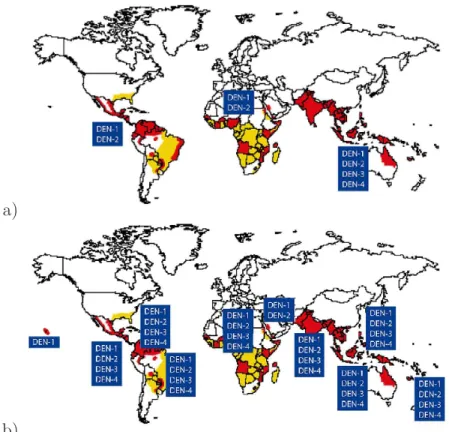
There are four antigenically distinct dengue viruses, distributed around the world, designated DEN − 1, DEN − 2, DEN − 3, and DEN − 4 (see Fig. 1.5). The co-circulation of all four dengue serotypes and their capacity to produce severe dengue disease was demonstrated as early as 1960 in Bangkok, Thailand (Halstead et al., 1969). DHF occurred first only in Bangkok, but was dissemi-nated to the whole region during the 1970s (Gubler, 2002; Halstead et al., 1969; Chareonsook et al., 1999). Physicians in Thailand are trained to recognize and treat dengue fever and practically all cases of DHF and DSS are hospitalized. A
a)
b)
Figure 1.5: Global distribution of dengue virus serotypes. In a) 1970 and in b) 2010. Data source: World Health Organization (WHO) & Centers for Disease Control and Prevention (CDC). Adapted from (Gubler, 2002).
system for reporting communicable diseases including DHF/DSS was considered fully installed in 1974 and the data bank of DHF and DSS is available at the Ministry of Public Health, Bangkok (Chareonsook et al., 1999).
Infection by one serotype confers life-long immunity to only that serotype and temporary cross-immunity to other serotypes exists. It lasts from three to nine months, when the antibody levels created during the response to that infection would be enough to protect against infection by a different but related serotype (Halstead, 1994; Matheus et al., 2005; WHO, 2009; SES, 2010; Dejnirattisai et al., 2010). Two variants of the disease exist: dengue fever (DF), a non-fatal form of illness, and dengue hemorrhagic fever (DHF), which may evolve toward a severe form known as dengue shock syndrome (DSS).
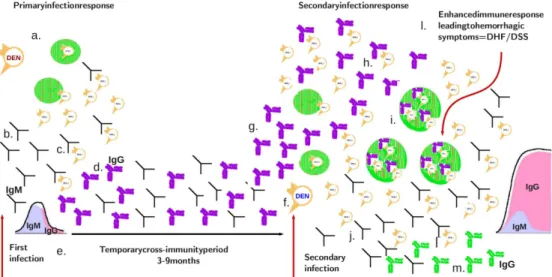
Figure 1.6: Scheme of the immunological response on recurrent dengue infections. In (a.) the first infection with a given dengue virus serotype, in (b.) production of antibodies (Immunoglobulin M (IgM)), in (c.) inactivation of the virus and in (d.) production of antibodies (IgG class, the so called memory antibodies). In (e.) the temporary cross-immunity period, that lasts between 3-9 months. After that period, the individual can get infected again with another dengue virus serotype, different from the first one (f.). In (g.) the IgG from the previous dengue infection binds to the new virus but do not inactivate them. In (h.) the complex antibody-virus enhances the new infection (i.). In (j.) the late production of antibodies (IgM class) which is then able to inactivate the new viruses, leading to (l.), an enhanced immune response, such that hemorrhagic symptoms are observed. In (m.) production of IgG antibodies.
Epidemiological studies support the association of DHF with secondary dengue infection (Halstead, 1982, 2003; Nisalak et al., 2003), and there is good evidence
that sequential infection increases the risk of developing DHF, due to a process described as antibody-dependent enhancement (ADE), where the pre-existing an-tibodies to previous dengue infection cannot neutralize but rather enhance the new infection.
In the first dengue infection virus particles will be captured and processed by so-called antigen presenting cells. These viruses will be presented to T-cells causing them to become activated. Likewise, B-cells will encounter their anti-gen free floating and become activated. The B-cells produce antibodies that are used to tag the viruses to encourage their uptake by macrophages and inactivate them. In a second infection, with a different strain, the antibodies from the first infection will attach to the new virus particles but will not inactivate them. The antibody-virus complex suppresses innate immune responses, increasing intracel-lular infection and generating inflammatory citokines and chemokines resulting in enhanced disease (Halstead, 1982, 1994; Dejnirattisai et al., 2010; Guzm´an et al., 2010). Fig. 1.6 is an scheme to illustrate the immunological response on recurrent dengue infections.
DF is characterized by headache, retro-orbital pain, myalgia, arthralgia, rash, leukopenia, and mild thrombocytopenia. The symptoms resolve after 2 − 7 days. DHF is a potentially deadly complication that is characterized by high fever and hemorrhagic phenomena. DHF develops rapidly, usually over a period of hours, and resolves within 1 − 2 days in patients who receive appropriate fluid resusci-tation. Otherwise, it can quickly progress to shock (WHO, 2009; CDC, 2011). Treatment of uncomplicated dengue cases is only supportive, and severe dengue cases requires careful attention to fluid management and proactive treatment of hemorrhagic symptoms (CDC, 2011; WHO, 2009). A vaccine against dengue is not yet available, since it would have to simulate a protective immune response to all four serotypes (Stephenson, 2005), although several candidates of tetravalent vaccines are at various stages of development (WHO, 2011).
Mathematical models describing the transmission of dengue viruses appeared in the literature early as 1970 (Fischer & Halstead, 1970). More recently, math-ematical models describing the transmission of dengue viruses have focused on the ADE effect and temporary cross-immunity trying to explain the irregular behaviour of dengue epidemics. Such models ultimately aim to be used as a predictive tool with the objective to guide the policies of prevention and control of the dengue virus transmission, including the implementation of vaccination programs when the candidate dengue fever vaccines will be accessible.
In the literature, multi-strain interaction leading to deterministic chaos via antibody-dependent enhancement effect has been described previously e.g. (Fer-guson et al., 1999; Schwartz et al, 2005; Billings et al., 2007) but neglecting temporary cross-immunity. Consideration of temporary cross-immunity is rather complicated and up to now not in detail analysed. Models formulated in e.g. (Wearing & Rohani, 2006; Nagao & Koelle, 2008; Recker et al., 2009; Loure¸co & Recker, 2010), did not investigate closer the possible dynamical structures. In