Validation of the Brazilian-Portuguese Version of a Short Questionnaire to
Assess Knowledge in Cardiovascular Disease Patients (CADE-Q SV)
Gabriela Lima de Melo Ghisi,
1Gabriela S. S. Chaves,
2Jessica Blanco Loures,
2Gabriela Moreira Bonfim,
2Raquel Britto
2 Toronto Rehabilitation Institute, University Health Network,1 Toronto – CanadaUniversidade Federal de Minas Gerais (UFMG),2 Belo Horizonte, MG – Brazil
Mailing Address: Gabriela Lima de Melo Ghisi • 347 Rumsey Road Toronto ON M6S 5B7 – Toronto E-mail: [email protected]
Manuscript received March 19, 2018, revised manuscript May 21, 2018, accepted June 27, 2018
DOI: 10.5935/abc.20180169
Abstract
Background: Patient education is an essential part of cardiovascular patients’ care targeting self-management behavior to reduce risk factors and subsequent events. Herein, a short and reliable tool to assess patients’ knowledge in Brazil is warranted.
Objectives: To translate, culturally-adapt and psychometrically validate the Portuguese version of the Coronary Artery Disease Education Questionnaire Short Version (CADE-Q SV).
Methods: The Portuguese CADE-Q SV – translated and culturally-adapted - was reviewed by five bilingual experts in cardiovascular disease. This version was then pre-tested in 21 patients, and clarity of items was checked using a Likert-type scale ranging from 1 = not clear to 10 = very clear. It was then psychometrically tested in 200 cardiovascular patients (41%women; mean age = 58.4 ± 11.6 years old). The internal consistency was assessed using Kuder-Richardson-20 (KR-20) and Cronbach’s alpha, test-retest reliability through intraclass correlation coefficient (ICC), factor structure using confirmatory factor analysis, and construct validity regarding educational level, family income, and time of diagnosis.
Results: All questions were considered clear by patients (clarity range:7.8-9.6). KR-20 was 0.70. All ICC values were > 0.70. Factor analysis revealed 6 factors, all internally consistent. Construct validity was supported by significant differences in total scores by educational level and family income (p < 0.001). The overall mean was 13.08 ± 2.61. The area with the highest knowledge was risk factors and the lowest was psychosocial risk.
Conclusions: The Portuguese CADE-SV was demonstrated to have good validity and reliability. This tool can be applicable in clinical and research settings, assessing cardiovascular patients’ knowledge as part of an education programming. (Arq Bras Cardiol. 2018; 111(6):841-849)
Keywords: Cardiovascular Diseases; Coronary Artery Disease; Surveys and Questionnaires; Patient Education as Topic; Knowledge; Educational Status.
Introduction
Cardiovascular diseases (CVDs) are among the leading burdens of disease and disability worldwide,1 particularly in
low and middle-income countries (LMICs) such as Brazil.2
Cardiac rehabilitation (CR) is an outpatient secondary prevention care model designed to mitigate this burden.3
Indeed, participation in CR has been shown to reduce morbidity and mortality by 20%, in a cost-effective manner.4-7
Improved risk factor control, psychosocial well-being, and health behaviors are also shown in LMICs with CR participation.8
However, there are incredibly few studies in this setting showing the long-term success of CR, which rests in part on the patient’s ability to maintain health behaviors, including participation in regular physical activity after the end of the program.9,10
Patient education is an essential part of the rehabilitation of CAD patients targeting self-management behavior to reduce
risk factors and subsequent cardiac events.11 The American
and Canadian Cardiovascular Societies include patient education as a quality indicator of CR,12,13 and this component
is also recommended in the delivery of CR in LMICs.14
Indeed, meta-analyses of education for cardiovascular patients suggest it is associated with improvements in self-management behaviors,9-11,15 health-related quality of life,16 decreases in
healthcare costs,16 and recurrence of acute events.15
In this context, the Coronary Artery Disease Education Questionnaire (CADE-Q) was previously developed and psychometrically validated as a valid and reliable tool to inform Brazilian healthcare providers oft what their cardiovascular patients know about their condition.17 It was later validated to English.18
It has also been used in several studies, including randomized controlled trials.19 Although both versions demonstrated good
reliability and validity, CADE-Q presented lack of detailed assessment of all core components of cardiac rehabilitation, such as nutrition and psychosocial risk. Therefore, a second version (CADE-Q II) was developed and validated in English.20
However, both tools take around 20 minutes to be completed, and there was a need for a short and quick instrument to more easily assess CR patients’ knowledge in clinical practice. This tool was validated in English and it is called CADE-Q SV.21 The aim of
Methods
Design and Procedures
The design of this study consisted of a series of cross-sectional, observational studies. Data was collected between September 2017 and February 2018.
First, the translation and cultural adaptation was performed. This process followed strict norms approved by the author and co-authors and was based on the protocol proposed by Guillemin et al:22 (1) initial translation, (2) back-translation,
(3) committee review of those translations and back-translations, and (4) pre-testing for equivalence using bilingual individuals. The initial translation was performed by an independent translator, aware of the objectives and concepts underlying the study and sought to detect ambiguities and unexpected meanings in the original items. The back-translation was performed by a second translator, blinded to the initial objectives of the study and the original version. All versions were reviewed by a committee of three bilingual experts. This version was then pre-tested in 20 patients and clarity of items was checked. To assess clarity, patients were asked to rate each item on a Likert-type scale ranging from 1 (not clear) to 10 (very clear). Results were used to refine the Brazilian-Portuguese version of CADE-Q SV.
Second, a psychometric validation was performed. The refined tool was administered to a larger sample of current cardiovascular ambulatory patients from a public hospital in Belo Horizonte, Minas Gerais. The instrument was applied through monitored self-administration (i.e. researchers maintained a neutral stance during the administration, answering questions about the research and encouraging participants to answer all questions). The questionnaire was re-administered one month after the first application in 21 randomly selected participants to assess test-retest reliability. Data were collected between June and November 2017.
Participants
For the psychometric validation, a convenience sample of 200 ambulatory cardiovascular patients was recruited. The sample size calculation for this analysis was based on Hair &Anderson’s23 recommendation of 10 subjects per
item. Since CADE-Q SV has 20 items, a sample size of 200 is considered valid. The inclusion criteria were the following: confirmed cardiac diagnosis or multiple cardiovascular risk factors. The exclusion criteria were the following: younger than 18 years old, illiterate, any significant visual, cognitive or mental impairment which precludes the participant’s ability to answer the questionnaire.
CR participants were characterized according to gender, age, educational level, family income, comorbidities, clinical risk factors, and history and duration of participation in CR. The participant’s clinical characteristics were obtained from the medical chart, and socio-demographic characteristics were self-reported.
Measure: The CADE-Q SV scale
CADE-Q SV assesses cardiovascular patients’ knowledge about their condition. It was designed to be a true/false/I don’t know questionnaire, with 20 items, four in each domain as
follows: medical condition, risk factors, exercise, nutrition, and psychosocial risk. Each correct answer equals to one point; therefore, the maximum score possible is 20 overall, four by domain, and one per item. The tool has been developed in English and psychometrically tested in Canadian CR participants.21
This tool can be used to tailor any type of educational intervention addressed to cardiovascular patients, not only in CR programs.
Statistical analysis
SPSS Version 24.0 was used.24 The level of significance for
all tests was set at 0.05. Psychometric properties were tested as per the Consensus-based Standards for the selection of health Measurement Instruments (COSMIN) taxonomy.25 First, internal
consistency was assessed by the Kuder-Richardson-20 (KR-20) overall, and by Cronbach's alpha of each factor (based on factor structure, described below). For this analysis, values equal to, or higher than 0.70 were considered acceptable,23 reflecting the
internal correlation between items of the same area.
Second, factor structure was assessed using confirmatory factor analysis. The main component method for factor extraction was used with consideration being given only to those with eigen values > 1.0. After the selection of the factors, a correlation matrix was generated, whereby the associations between items and factors were observed through factor loadings greater than 0.40 on only one factor.23 The varimax method with Kaiser
normalization was used to interpret the matrix.26
Third, test-retest reliability was assessed using intraclass correlation coefficient (ICC). ICC values lower than 0.7027 were
considered bad items. Finally, criterion validity was also assessed by comparing CADE-Q SV total scores with the participant’s level of education, family monthly income and time of diagnosis, using independent sample t-tests and Pearson’s correlation. Item completion rates were also described.
A descriptive analysis of the Portuguese CADE-Q SV was performed. A mean total score was computed to reflect total knowledge. Independent sample t-tests, one-way analysis of variance, and chi-square tests were used as appropriate to assess differences in total knowledge based on patient’s socio-demographic and clinical characteristics. Continuous variables were all normally distributed (confirmed by Kolmogorov-Smirnov test) and were reported with mean and standard deviations. Categorical variables were reported by absolute numbers, percentages and, when applicable, confidence intervals.
Results
Participants’ characteristics
The characteristics of participants from the psychometric validation are described in Table 1. Overall, 200 cardiovascular ambulatory patients completed the Portuguese version of CADE-Q SV, of which 118 (59.0%) were male, and the mean age was 58.4 ± 11.6 years old.
Translation, cultural adaptation and pre-testing
Table 1 – Sociodemographic/Clinical Characteristics of the Participants and total scores and differences among subgroups (n = 200)
Characteristic CADE-Q SV Total Score
Sociodemographic (mean ± SD) p
Age, years (mean ± SD) 58.4 ± 11.6 -
-Age dichotomous n (%) Less than 65 years old 132 (66.0) 13.6 ± 2.4 0.001†
65 years old or older 68 (34.0) 12.2 ± 2.8
Sex n (%) Male 118 (59.0) 13.3 ± 2.5 0.23
Female 82 (41.0) 12.8 ± 2.8
Educational level n (%) Never went to school 8 (4.0) 12.0 ± 3.2 < 0.001‡
Less than High School 128 (64.0) 12.5 ± 2.5
High School 54 (27.0) 14.1 ± 2.4
University 8 (4.0) 15.5 ± 1.2
Post-graduation 2 (1.0) 17.0 ± 0.0
Monthly family income n (%) No income 15 (7.5) 12.6 ± 1.8 0.04*
Less than 1 minimum salary 98 (49.0) 12.8 ± 2.7
Between 1 and 3 minimum salaries 69 (34.5) 13.2 ± 2.6
Between 4 and 5 minimum salaries 12 (6.0) 14.2 ± 2.0
6 or more minimum salaries 4 (2.0) 16.0 ± 2.0
Clinical
Acute Cardiac Event n (%) Acute Myocardial Infarction 113 (56.5) 13.5 ± 2.5 0.03*
Comorbidities n (%) Hypertension 179 (89.5) 13.1 ± 2.6 0.91
Dyslipidemia 138 (69.0) 13.1 ± 2.5 0.81
Stress 71 (35.5) 13.1 ± 2.5 0.81
Peripheral Obstructive Arterial Disease 54 (27.0) 12.5 ± 3.0 0.06
Diabetes Type II 53 (26.5) 13.4 ± 2.2 0.36
Arrhythmia 51 (25.5) 12.4 ± 2.4 0.04*
Stable Apnea 42 (21.0) 12.9 ± 2.9 0.58
Depression 41 (20.5) 12.8 ± 2.4 0.37
Obesity 40 (20.0) 13.3 ± 2.6 0.65
Unstable Angina 37 (18.5) 12.7 ± 2.2 0.55
Smoking 19 (9.5) 14.4 ± 2.2 0.08
Alcoholic behaviour 6 (3.0 14.5 ± 1.9 0.18
Time from diagnosis
Time from diagnosis, years (mean±SD) 8.6 ± 9.1 -
-Time from diagnosis, n (%) Less than 1 year 50 (25.0) 13.6 ± 2.4 0.23
Between 1 and 5 years 44 (22.0) 12.6 ± 2.8
Between 6 and 10 years 23 (11.5) 12.9 ± 2.6
Between 11 and 15 years 25 (12.5) 13.9 ± 2.2
More than 15 years 38 (19.0) 12.6 ± 2.6
SD-standard deviation; Significant differences between groups: (*) p < 0.05, (†) p < 0.01, (‡) p < 0.001. Note: Income shown in Brazilian minimum salaries. One minimum
salary corresponds to BRL$ 954,00 or USD$ 292.95.
used in the Brazilian context (item 11). Previously, this item had names of statin medications popular in North America, and since the tool was used in different countries it was adapted to read “ ‘Statin’ medications (such as atorvastatin and simvastatin) limit how much cholesterol your body absorbs from food”. Based on the feedback received from the experts
we have included two examples of popular medications used in Brazil. No other adaptations were made. Table 2 displays all items of the Portuguese version of CADE-Q SV.
Table 2 – Clarity (n = 21), means and Standard Deviations of CADE-Q SV scores per item, item completion rates (n = 200), ICC (n = 20), and Mean Scores per area
Area Item Mean ± SDClarity* Mean ± SDScore Item completion rates (%) ICC Mean ScorePer area
1 – Medical 1. Heart disease only happens in older people
who smoke or have high cholesterol. 8.5 ± 1.9 0.73 ± 0.45 98.5 0.75 2.38 ± 0.76
3. “Angina” is chest pain or discomfort in your
arm, back or neck. 8.1 ± 3.0 0.75 ± 0.44 98.5 0.71
6. Medications such as aspirin (ASA) help
prevent blood clots from forming. 8.5 ± 2.6 0.86 ± 0.35 98.5 0.70
11. “Statin” medications (such as atorvastatin and simvastatin) limit how much cholesterol
your body absorbs from food.†
8.8 ± 1.8 0.05 ± 0.21 98.5 0.72
2 – Risk Factors 2. Lifestyle changes such as healthy eating can
lower your chances of developing heart disease. 9.1 ± 1.9 0.89 ± 0.32 98.0 0.80 2.95 ± 0.88
12. To help control your blood pressure, eat less
salt and exercise regularly. 9.5 ± 0.8 0.97 ± 0.16 98.5 0.83
16. To control cholesterol, become a vegetarian
and avoid eating eggs. 8.7 ± 1.5 0.51 ± 0.50 98.5 0.77
18. You cannot prevent diabetes with exercise
and healthy eating. 8.7 ± 2.1 0.58 ± 0.49 98.5 0.85
3 – Exercise
4. Resistance training (lifting weights or using elastic bands) can strengthen your muscles and
help lower your blood sugar.
8.0 ± 2.5 0.63 ± 0.48 98.5 0.72 2.69 ± 1.01
8. A warm-up before exercising raises your heart
rate and lowers your chance of getting angina. 8.8 ± 1.6 0.63 ± 0.48 98.5 0.70
13. If you get chest discomfort while walking,
speed up to see if it goes away. 9.0 ± 1.6 0.86 ± 0.35 98.5 0.79
17. You are exercising at the right level when your heart rate is in the target zone and you can
still talk comfortably.
8.4 ± 2.4 0.57 ± 0.50 98.5 0.80
4 – Diet 5. Eating more meat and dairy products is a good way to add more fiber to your diet. 8.1 ± 2.2 0.47 ± 0.50 98.0 0.72 2.09 ± 0.84
9. Prepared or processed foods, such as canned soup and bacon, usually have a lot of
salt (sodium).
8.8 ± 2.1 0.90 ± 0.30 98.5 0.98
14. Trans fat is an unhealthy type of fat that is
often found in baked or fried foods. 7.8 ± 2.9 0.78 ± 0.41 98.5 0.74
20. To help lower your blood pressure, eat healthy foods more often, such as vegetables,
fruits, and whole grains.
9.6 ± 0.9 0.94 ± 0.24 98.5 0.94
5 – Psychosocial Risk 7. The only effective way to manage stress is to avoid people who cause unpleasant feelings. 8.2 ± 3.0 0.35 ± 0.48 98.5 0.77 1.97 ± 0.70
10. Depression is common after a heart attack and increases the chance of having another
heart attack.
8.5 ± 2.2 0.63 ± 0.48 98.0 0.78
15. Sleep apnea (pauses in breathing during sleep) can increase your chance of having
another heart attack.
8.1 ± 2.7 0.05 ± 0.21 98.5 0.77
19. Stress increases your chance of having a heart attack as much as high blood pressure
and diabetes.
9.1 ± 1.4 0.94 ± 0.23 98.5 0.72
Total 8.6 ± 3.2 13.08 ± 2.61 - -
-SD-standard deviation; ICC-intraclass correlation coefficient; (*) Clarity was assessed using a Likert-type scale ranging from 1 = not clear to 10 = very clear; (†) item
Clarity of items ranged from 7.8 to 9.6, and overall clarity of the tool was 8.6 ± 3.2, which shows the Portuguese version of CADE-Q SV was clear to patients.
Psychometric validation
The internal consistency of the entire sample was assessed by KR-20(0.70). Regarding factor analysis, results from the Kaiser-Meyer-Olkin index (KMO = 0.78) and Bartlett’s Sphericity tests (X2 = 490.481, p < 0.001) indicated that
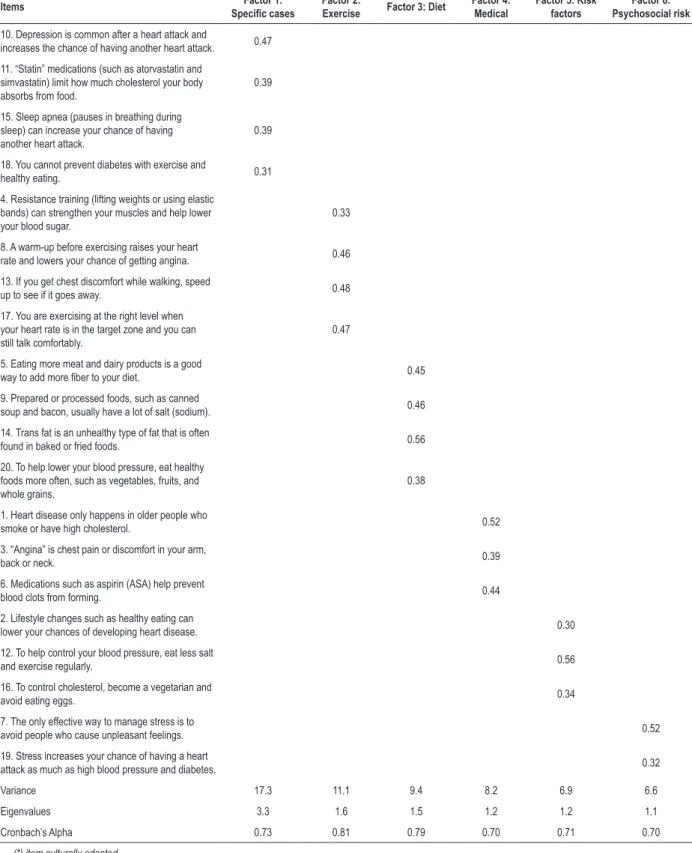
the data were suitable for factor analysis. Six factors were extracted, representing 59.0% of the total variance. All factors were reliable (Cronbach’s alpha ranged from 0.70-0.81). These factors were called: medical, risk factors, exercise, diet, psychosocial risk, and specific cases. Table 3 shows the factor loadings for each item based on loadings greater than 0.30 on only one factor.
The test-retest reliability was evaluated through the ICC for each item, and the ICCs for all items meet the minimum recommended standard. In regard to construct validity, CADE-Q SV total scores were compared by participant’s level of education, family monthly income and time of diagnosis. As shown in Table 1, patients with lower educational level had significantly higher needs than those with higher education (p < 0.001), and participants with no income or less than 1 minimum salary had lower knowledge than participants that earn 4 minimum salaries per month or higher (p < 0.05). No differences were found regarding time of diagnosis.
Cardiovascular patients’ knowledge about their condition Table 2 displays the means and standard deviations of each CADE-Q SV item, as well as total scores per area. Items with the highest scores (i.e., with the highest number of correct answers) were the following: “to help control your blood pressure, eat less salt and exercise regularly”, “stress increases your chance of having a heart attack as much as high blood pressure and diabetes”, and “to help lower your blood pressure, eat healthy foods more often, such as vegetables, fruits, and whole grains”. Items with the lowest knowledge (i.e., items with the lowest scores) were the following: “ ‘statin’ medications (such as atorvastatin and simvastatin) limit how much cholesterol your body absorbs from food”, “sleep apnea (pauses in breathing during sleep) can increase your chance of having another heart attack”, and “the only effective way to manage stress is to avoid people who cause unpleasant feelings”. The area with the highest knowledge was risk factors and the one with the lowest was psychosocial risk. Patients spend around 10 minutes to complete the tool.
Table 1 presents the total score per participant’s characteristics. As displayed, patients that had a myocardial infarction or have arrhythmia had significantly higher knowledge than their counterparts (p < 0.05). In addition, younger participants (i.e. less than 65 years old) had significantly higher knowledge than participants who were 65 years old or older.
Discussion
Education is a core component of CR and cardiac care, and is necessary to promote patient’s understanding of secondary
prevention strategies and adherence to these strategies. Herein, a short and reliable tool to assess cardiovascular patients’ knowledge – called CADE-Q SV - has been translated, culturally adapted, and psychometrically validated through a rigorous process. Internal consistency, test-retest reliability, criterion validity, and factor structure were all established, and demonstrate the utility of this tool.
Results of this study were consistent with those presented in the original validation,21 particularly in relation to criterion
validity (correlation to educational level) and all areas being considered internally consistent (α > 0.70). In this validation, there are 6 factors, even thoughthe tool has 5 areas. The new factor was called “specific cases” and included questions related to comorbidities and specific diagnosis that may not be relevant to all cardiovascular patients (e.g., diabetes and sleep apnea). Adult patients learn based on their personal needs and when the information is not relevant to them they may not have interest to learn about it.28,29 Therefore, these items were combined
in one factor and in future studies with the tool, researchers should flag these items and see if cardiovascular patients with or without these comorbidities will have the same knowledge.
The overall mean, as well as the means of the areas, were low, reinforcing the need for educational strategies to teach cardiovascular patients, which have been reinforced in publications about strategies to treat these patients in low-and middle-income countries.14 Thus, the areas with
higher knowledge in this study (risk factors) were different from the areas identified in the original validation (exercise and diet).21 This result was expected since in this study we
have administered the survey in ambulatory cardiovascular patients, while the original study was with CR patients.
Future research is needed to further establish the psychometric properties of the Portuguese version of CADE-Q SV. First, in relation to the potential strategies to educate cardiovascular patients, it should be determined whether the scale is sensitive to change (i.e., responsiveness), such as after CR or educational programs. Second, there are other measurement properties of the scale that require assessment, such as criterion validity. Moreover, test-retest reliability was performed in 20 patients, and the literature points that the minimum number should be 50.27 Third, the
type of sample and the fact that participants were recruited from only one site also limits this study. Therefore, the Portuguese CADE-Q SV should be administered in other health programs and Brazilian states, to ensure it is appropriate and performs well in more general settings. Finally, future research is needed to assess whether the scale is sensitive to change, such as following participation in CR, or to test implementation of new education materials. Second, whether CADE-Q SV is a valuable and valid tool to identify knowledge differences in CR patients should be explored.30 For this study patients did not receive any
feedback regarding their knowledge; however, we encourage clinicians and researchers to provide this to patients.
Conclusions
Table 3 – Factor loadings from confirmatory factor analysis
Items Specific casesFactor 1: Factor 2:
Exercise Factor 3: Diet
Factor 4: Medical
Factor 5: Risk factors
Factor 6: Psychosocial risk
10. Depression is common after a heart attack and
increases the chance of having another heart attack. 0.47
11. “Statin” medications (such as atorvastatin and simvastatin) limit how much cholesterol your body absorbs from food.
0.39
15. Sleep apnea (pauses in breathing during sleep) can increase your chance of having another heart attack.
0.39
18. You cannot prevent diabetes with exercise and
healthy eating. 0.31
4. Resistance training (lifting weights or using elastic bands) can strengthen your muscles and help lower your blood sugar.
0.33
8. A warm-up before exercising raises your heart
rate and lowers your chance of getting angina. 0.46
13. If you get chest discomfort while walking, speed
up to see if it goes away. 0.48
17. You are exercising at the right level when your heart rate is in the target zone and you can still talk comfortably.
0.47
5. Eating more meat and dairy products is a good
way to add more fiber to your diet. 0.45
9. Prepared or processed foods, such as canned
soup and bacon, usually have a lot of salt (sodium). 0.46
14. Trans fat is an unhealthy type of fat that is often
found in baked or fried foods. 0.56
20. To help lower your blood pressure, eat healthy foods more often, such as vegetables, fruits, and whole grains.
0.38
1. Heart disease only happens in older people who
smoke or have high cholesterol. 0.52
3. “Angina” is chest pain or discomfort in your arm,
back or neck. 0.39
6. Medications such as aspirin (ASA) help prevent
blood clots from forming. 0.44
2. Lifestyle changes such as healthy eating can
lower your chances of developing heart disease. 0.30
12. To help control your blood pressure, eat less salt
and exercise regularly. 0.56
16. To control cholesterol, become a vegetarian and
avoid eating eggs. 0.34
7. The only effective way to manage stress is to
avoid people who cause unpleasant feelings. 0.52
19. Stress increases your chance of having a heart
attack as much as high blood pressure and diabetes. 0.32
Variance 17.3 11.1 9.4 8.2 6.9 6.6
Eigenvalues 3.3 1.6 1.5 1.2 1.2 1.1
Cronbach’s Alpha 0.73 0.81 0.79 0.70 0.71 0.70
1. Roth GA, Johson C, Abajobir A, Abd-Allah F, Abera SF, Abyu G, et al. Global, regional, and national burden of cardiovascular diseases for 10 causes, 1990 to 2015. J Am Coll Cardiol. 2017;70(1):1-25.
2. Gaziano TA, Pagidipati N. Scaling up chronic disease prevention interventions in lower- and middle-income countries. Annu Rev Public Health. 2013;34:317-35.
3. Hamm LF, Sanderson BK, Ades PA, Berra K, Kaminsky LA, Roitman JL, et al. Core competencies for cardiac rehabilitation/secondary prevention professionals: 2010 update: position statement of the American Association of Cardiovascular and Pulmonary Rehabilitation. J Cardiopulm Rehabil Prev. 2011;31(1):2-10.
4. Clark AM, Haykowsky M, Kryworuchko J, MacClure T, Scott J, DesMeules M, et al. A meta-analysis of randomized control trials of home-based secondary prevention programs for coronary artery disease. Eur J Cardiovasc Prev Rehabil. 2010;17(3):261-70.
5. Davies E, Moxham TI, Rees K, Singh S, Coats AJ, Ebrahim S, et al. Exercise training for systolic heart failure: Cochrane systematic review and meta-analysis. Eur J Heart Fail. 2010;12(7):706-15.
6. Anderson L, Oldridge N, Thompson DR, Zwisler AD, Rees K, Martin N, et al. Exercise-based cardiac rehabilitation for coronary heart disease. J Am Coll Cardiol. 2016;67(1):1-12.
7. Wood DA, Kotseva K, Connolly S, Jennings C, Mead A, Jones J, et al; EUROACTION Study Group. Nurse-coordinated multidisciplinary, family-based cardiovascular disease prevention programme (EUROACTION) for patients with coronary heart disease and asymptomatic individuals at high risk of cardiovascular disease: a paired, cluster-randomised controlled trial. Lancet. 2008;371(9629):1999-2012.
8. Turk-Adawi K, Grace SL. Narrative review comparing the benefits of, participation cardiac rehabilitation in high-, middle- and low-income countries. Heart Lung Circ. 2015;24(5):510-20.
9. Aldcroft SA, Taylor NF, Blackstock FC, O’Halloran PD. Psychoeducational rehabilitation for health behavior change in coronary artery disease: a systematic review of controlled trials. J Cardiopulm Rehabil Prev. 2011;31(5):273-81.
10. Mullen PD, Mains DA, Velez R. A meta-analysis of controlled trials of cardiac patient education. Patient Educ Couns.1992;19(2):143-62.
11. Ghisi GL, Abdallah F, Grace SL, Thomas S, Oh P. A systematic review of patient education in cardiac patients: do they increase knowledge and promote health behavior change? Patient Educ Couns. 2014;95(2):160-74.
12. Grace SL, Poirier P, Norris CM, Oakes GH, Somanader D, Suskin N; Canadian Association of Cardiac Rehabilitation. Pan-Canadian development of cardiac rehabilitation and secondary prevention quality indicators. Can J Cardiol. 2014;30(8):945-8.
13. Thomas RJ, King M, Lui K, Oldridge N, Pina IL, Spertus J, et al; AACVPR; ACC; AHA; American College of Chest Physicians; American College of Sports Medicine; American Physical Therapy Association; Canadian Association of Cardiac Rehabilitation; European Association for Cardiovascular Prevention and Rehabilitation; Inter-American Heart Foundation; National Association of Clinical Nurse Specialists; Preventive Cardiovascular Nurses Association; Society of Thoracic Surgeons. AACVPR/ACC/AHA 2007 performance measures on cardiac rehabilitation for referral to and delivery of cardiac rehabilitation/secondary prevention services endorsed by the American College of Chest Physicians, American College of Sports Medicine, American Physical Therapy Association, Canadian Association of Cardiac Rehabilitation, European Association for Cardiovascular Prevention and Rehabilitation, Inter-American Heart Foundation, National Association of Clinical Nurse Specialists, Preventive Cardiovascular Nurses Association, and the Society of Thoracic Surgeons. J Am Coll Cardiol. 2007;50(14):1400-33.
14. Grace SL, Turk-Adawi KI, Contractor A, Atrey A, Compbell NR, Derman W, et al. Cardiac rehabilitation delivery model for low-resource settings: an International Council of Cardiovascular Prevention and Rehabilitation Consensus Statement. Prog Cardiovasc Dis. 2016;59(3):303-22.
References
preliminary evidence of its validity and reliability to assess cardiovascular patients’ knowledge in Brazil. It is hoped that this tool can support healthcare providers and CR programs to evaluate their patients’ knowledge in clinical practice and promote greater provision of educational strategies.
The use of the Portuguese version of CADE-Q SV for clinical and research purposes will be free of charge, and all information – including the tool - is available online at https://cadeq.wordpress.com/.
Acknowledgements
We would like to acknowledge the undergraduate students Ully Caproni and Thiago Martins for the help with data collection in this study.
Author contributions
Conception and design of the research: Ghisi GLM, Chaves GSS, Britto R; Acquisition of data: Loures JB, Bonfim GM; Analysis and interpretation of the data: Ghisi GLM, Chaves GSS, Loures JB, Bonfim GM, Britto R; Statistical analysis and Writing of the manuscript: Ghisi GLM, Chaves GSS; Obtaining financing:
Britto R; Critical revision of the manuscript for intellectual content: Ghisi G, Chaves GSS, Loures JB, Bonfim GM.
Potential Conflict of Interest
No potential conflict of interest relevant to this article was reported.
Sources of Funding
This study was funded by FAPEMIG and CNPq.
Study Association
This study is not associated with any thesis or dissertation work.
Ethics approval and consent to participate
15. Dusseldorp E, van Elderen T, Maes S, Meulman J, Kraaij V. A meta-analysis of psycho-educational programs for coronary heart disease patients. Health Psychol. 1999;18(5):506-19.
16. Brown JP, Clark AM, Dalal H, Weich K, Taylor RS. Patient education in the management of coronary heart disease. Cochrane Database Syst Rev. 2011 Dec 7;(12):CD008895.
17. Ghisi GL, Durieux A, Manfroi WC, Herdy AH, Carvalho T, Andrade A, et al. Construction and validation of the CADE-Q for patient education in cardiac rehabilitation programs. Arq Bras Cardiol. 2010;94(6):813-22.
18. de Melo Ghisi GL, Oh P, Thomas S, Benetti M. Development and validation of an English version of the Coronary Artery Disease Education Questionnaire (CADE-Q). Eur J Prev Cardiol. 2013;20(2):291-300.
19. Chaves GS, Ghisi GL, Grace SL, Oh P, Ribeiro AL, Britto RR. Effects of comprehensive cardiac rehabilitation on functional capacity and cardiovascular risk factors in Brazilians assisted by public health care: protocol for a randomized controlled trial. Braz J Phys Ther. 2016;20(6):592-600.
20. Ghisi GL, Grace SL, Thomas S, Evans MF, Oh P. Development and psychometric validation of the second version of the Coronary Artery Disease Education Questionnaire (CADE-Q II). Patient Educ Couns. 2015;98(3):378-83.
21. G h i s i G L , S a n d i s o n N, O h P. D e v e l o p m e n t , p i l o t t e s t i n g a n d psychometric validation of a short version of the coronary artery disease education questionnaire: The CADE-Q SV. Patient Educ Couns. 2016;99(3):443-7.
22. Guillemin F, Bombardier C, Beaton D. Cross-cultural adaptation of health-related quality of life measures: literature review and proposed guidelines. J Clin Epidemiol. 1993;46(12):1417-32.
23. Hair JF, Anderson RE, Tatham RL, Black W. Multivariate data analysis. 5th ed. New Jersey: Prentice Hall; 1998.
24. IBM Corp. (2016). IBM SPSS statistics for windows, version 24.0. Armonk (NY): IBM Corp.
25. Mokkink LB, Terwee CB, Patrick DL, Alonso J, Stratford PW, Knol DL, et al. The COSMIN checklist for assessing the methodological quality of studies on measurement properties of health status measurement instruments: an international Delphi study. Qual Life Res. 2010;19(4):539-49.
26. Kaiser HF. The application of electronic computers to factor analysis. Educ Psychol Meas.1960;20(1):141-51.
27. Terwee CB, Bot SD, de Boer MV, van der Windt DA, Knol DL, Dekker J, et al. Quality criteria were proposed for measurement properties of health status questionnaires. J Clin Epidemiol. 2007;60(1):34-42.
28. Ghisi G, Grace SL, Thomas S, Evans MF, Oh P. Development and psychometric validation of a scale to assess information needs in cardiac rehabilitation: The INCR Tool. Patient Educ Couns. 2013;91(3):337-43.
29. Timmins F, Kaliszer M. Information needs of myocardial infarction patients. Eur J Cardiovasc Nurs. 2003;2(1):57-65.