E S T U D O S I I
Cidadania, Instituições e Património Economia e Desenvolvimento Regional Finanças e Contabilidade Gestão e Apoio à Decisão Modelos Aplicados à Economia e à Gestão
Faculdade de Economia da Universidade do Algarve
F
COMISSÃO EDITORIAL
António Covas Carlos Cândido Duarte Trigueiros Efigénio da Luz Rebelo João Albino da Silva João Guerreiro
Paulo M.M. Rodrigues Rui Nunes
_______________________________________________________________________
FICHA TÉCNICA
Faculdade de Economia da Universidade do Algarve
Campus de Gambelas, 8005-139 Faro Tel. 289817571 Fax. 289815937 E-mail: [email protected]
Website: www.ualg.pt/feua
Título
Estudos II - Faculdade de Economia da Universidade do Algarve
Autor
Vários
Editor
Faculdade de Economia da Universidade do Algarve Morada: Campus de Gambelas
Localidade: FARO Código Postal: 8005-139
Capa e Design Gráfico
Susy A. Rodrigues
Compilação, Revisão de Formatação e Paginação
Lídia Rodrigues
Fotolitos e Impressão
Grafica Comercial – Loulé
ISBN 972-99397-1-3 Data: 26-08-2005 Depósito Legal 218279/04 Tiragem 250 exemplares Data Novembro 2005
RESERVADOS TODOS OS DIREITOS REPRODUÇÃO PROIBIDA
Modelling the interaction between the tourism accomodation
industry and the environment
Pedro Pintassilgo
Faculdade de Economia, Universidade do Algarve
João Albino Silva
Faculdade de Economia, Universidade do Algarve
Resumo:
Neste artigo apresenta-se um modelo sobre a indústria de alojamento turístico, a qual mantém uma relação dialéctica, de impacte e dependência, com a qualidade ambiental – um recurso comum compósito. Mostra-se que o livre acesso conduz, geralmente, à sobre-exploração económica e ambiental, isto é à “tragédia do recurso comum”. Esta situação afecta, igualmente, a indústria turística no seu todo, pois o alojamento e a qualidade ambiental desempenham papéis centrais nesta actividade económica. O resultado deste cenário é um turismo de massas, caracterizado por turistas com reduzida disponibilidade a pagar.
Os resultados do modelo indicam que, exceptuando situações em que as externalidades positivas são muito significativas, ou em que o livre acesso enfrenta restrições activas, nomeadamente no que se refere a espaços com as características apropriadas para a actividade, a entrada de empresas deverá ser limitada, tendo por base não só o critério de eficiência económica mas, também, o de sustentabilidade.
Palavras-chave: recursos comum; livre acesso; externalidades; turismo;
alojamento turístico.
Abstract:
This paper models the tourism accommodation industry, which both impacts and depends on environmental quality – a composite common pool resource. It is shown that open-access leads, generally, to both economic and environmental over-exploitation, i.e. “the tragedy of the commons”. This also affects the overall tourism industry, as tourism accommodation and environmental quality play central roles in it. Basically, it leads to mass tourism characterised by tourists with low willingness to pay.
The model results emphasise that, apart from situations where positive externalities are very significant, or the open-access faces binding restrictions such as land availability,
firms’ entry should be limited, not only on the grounds of efficiency but also on sustainability.
Keywords: common pool resources; open-access; externalities; tourism;
accommodation industry
1. Introduction
The interaction between tourism and natural environment is, generally, one of impact and dependency. On the one hand, tourism generates impacts such as those associated with its infrastructures (e.g. changing views and landscape), people and vehicles traffic (e.g. noise, air and water pollution) and over-utilisation of natural resources (Tisdell, 1987). On the other hand, tourism is generally highly dependent on environmental quality. According to Mieczkowski (1995) the reason for this dependency is that tourism is the only sector that offers natural environment as a very important part of its product.
Natural environmental resources typically present the characteristics of common pool resources (Ostrom and Field, 1999): the exploitation by one user reduces resource availability for others (subtractability) and exclusion of additional users is especially difficult and costly (difficulty of exclusion). Hardin’s (1968) seminal paper alerted that the users of these resources are caught in a process that leads to the destruction of the resources on which they depend. The author entitled this as “the tragedy of the commons”.
After Hardin’s paper, an extensive literature on common pool resources has been developed (Hess, 2005). A few contributions in the tourism economics area have also emerged. Healy (1994) addresses the common pool problem in tourism landscapes and concludes of its susceptibility to overuse and the lack of incentive to invest in maintaining or improving them. It also analyses the different property rights used to manage these resources. Briassoulis (2002) discusses the central role of common pool resources on sustainable tourism development and the policy design principles for their management. Recently, Field, Lass and Stevens (2004) study the open-access externalities due to congestion and resource degradation in the southern Thai islands, through a revealed preference analysis. It concludes that open-access produces very substantial welfare losses, which may undermine the demand for the islands in the long run.
The present paper models the tourism accommodation industry, which both impacts and depends on the environmental quality – a composite common pool resource. It contributes to the literature by modelling the problem of common pool resources in this industry. It also establishes a bridge, as suggested by Tisdell (1987), between the theory of open access in a tourism industry that relies on the environment and “some of the theory of common-property resources, as for instance developed for common-access in fishing [Gordon (1954) and Clark (1976) Chapter 2]”.
The paper is organised as follows. First, the market model is presented in its demand and supply sides. Second, the open-access dynamics and equilibrium are explored. Third, the social optimum solution is determined, both in the absence and presence of externalities. Fourth, a comparison between open-access and social optimum solutions is undertaken and limited entry regulations are discussed. Finally, the main conclusions are presented.
2. The Market Model
Consider a tourism destination whose main attractions are environmental amenities (e.g. sun and beach), which faces competition from many other destinations worldwide. Assume, also, that environmental quality is the only factor that differentiates the tourists’ willingness to pay for these substitute destinations.
In this section the local tourism accommodation market is modelled. The option for this industry was due to two motives: first, as accommodation is a pre-condition for tourism it is usually regarded as barometer of the overall tourism sector; second, its direct and complementary infrastructure results, usually, in significant environmental impacts.
2.1 Demand
Given the existence of many competing destinations it is assumed that demand is perfectly elastic to price, for a given level of environmental quality (equation (1)). The environmental quality index (EQI), defined in equation (2), takes values in the range [0, 1] and decreases at an increasing rate with the number of firms. The number of firms is used as the determinant of environmental quality as, in the accommodation industry, the main environmental impacts emerge from the infrastructures associated with firms’ establishment. The assumption that EQI decreases at an increasing rate reflects the idea that the higher the number of firms the higher will be the environmental quality loss due to the entrance of another firm. When there are no firms the environment is at its virgin state and EQI takes the value 1. This index takes value zero when the number of firms is such that the environment does not provide any tourist attraction – therefore, the corresponding price that tourists are willing to pay is nil.
Equation (2) sets a negative relationship between tourism development and environmental quality, which is typical of a Conventional Mass Tourism. Other forms of tourism may, however, lead do different relationships between tourism and environmental quality (Pigram, 1980) – including the case in which environmental quality actually improves with tourism development.
Equation (2) also implies that when a firm enters the industry it decreases the environmental quality available for all others (subtractability). As it is also difficult to exclude additional users of environmental quality, it clearly exhibits the properties of a composite common-pool resource – including, among others, landscapes, air and water quality and sites sanitation.
P=aEQI (1) 2 1 n EQI n = − (2) Where:
P- represents the price; EQI- environmental quality index; a- demand parameter;
n- number of firms; n- number of firms that leads the environmental quality index to zero.
Thus, the demand side of the market can be summed-up as:
2 1 n P a n = − (3) 2.2 Supply
The tourism accommodation industry is, generally, characterised by its diversity (Bull, 1995). Not only it is common to find different products targeting different market segments, but also product differentiation within each segment – through factors such as service quality and location. This diversity, whenever there is freedom of entry and exit and a large number of firms, gives rise to a monopolistic competition market structure (Tribe, 1999).
The present model assumes, nonetheless, a perfect competitive market with symmetric firms, which supply an homogeneous product, use the same technology and are equally efficient. This assumption was considered appropriate for a theoretical approach to the outcomes of open access as it simplifies the model but does not change its main results. In fact, open-access dynamics and long-run outcomes are basically the same in monopolistic competition and in perfect competition. In both market structures, firms entry (leave) if there are economic gains (losses), which yields a long run equilibrium where profits are nil. Furthermore, for empirical applications, the present model can easily be extended to handle with different market segments and product differentiation.
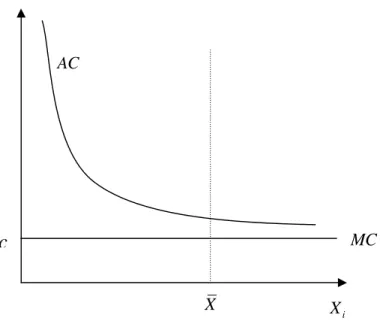
The preponderance of fix costs is a major feature of tourism supply activity, especially in the accommodation industry (Bull, 1995). Marginal costs, on the other hand, are frequently very small and approximately constant. In line with these characteristics the present model assumes a constant marginal cost, which is lower then the average cost at firm’s full capacity (Figure 1). The total cost function of firm i is defined as:
( )
i iC X =cX +FC (4)
Where:
( )
iC X - represents the total cost of producing output Xi; c - marginal cost;
FC - fix cost.
Figure 1. Firm’ s Cost structure
AC - average cost; MC - marginal cost; X- firm’s output at full capacity.
MC AC i X X c
Each firm produces the output level that maximises its profits. Hence, it solves the following problem:
( )
i i i i i X i Max X PX cX FC subject to X X Π = − − ≤ (5) Where:( )
i XiΠ - represents the profit of firm i, when producing output Xi.
As marginal costs are lower than the average cost at full capacity output
(
c<AC X( )
)
, the corresponding firm’s optimal output, in the short run, is defined by system (6) and is represented in Figure 2.0 0, s i P c X X P c X P c θ ⇐ < = ∈ ⇐ = ⇐ > (6)
Figure 2. Firm’s Short-Run Supply Curve
i X X s i X P c
In the long-run, as firms cannot incur in permanent losses, the firm’s supply curve is defined by system (7) – which is represented in Figure 3.
( )
( )
0 s i P AC X X X P AC X ⇐ < = ⇐ ≥ (7)Figure 3. Firm’s Long-Run Supply Curve
The short-run and lung-run market supply curves are defined, respectively, by the systems (8) and (9). 0 0, s s i P c X nX nX P c nX P c α ⇐ < = = ∈ ⇐ = ⇐ > (8)
( )
( )
0 s s i i P AC X X nX nX P AC X ⇐ < = = ⇐ ≥ (9) P( )
AC X i X X s i X3. Open-Access
This section explores the outcomes of the open-access regime, i.e. no entry and exit barriers in the industry. In this regime firms will entry the industry whenever profits are earned and leave in the presence of losses. The entry of new firms may, however be limited by restrictions such as availability of land with the required characteristics. Hereafter, it is assumed that these restrictions are not binding in the open-access equilibrium1. Thus, this equilibrium can be defined as follows:
( )
(
)
2 0 1 0 i n X a X cX FC n X a c FC n n aX Π = ⇔ − − − = ⇔ − − = (10)From equation (10) it can be concluded that the number of firms at the open-access equilibrium increases with n, X and a and decreases with the cost parameters c and
FC.
The following equations represent the environmental quality index and price at the open-access equilibrium.
(
)
2 1 X a c FC n cX FC aX EQI n aX − − + = − = (11)( )
cX FC P AC X X + = = (12)Environmental quality and price increases with the costs parameters and decreases with X. Environmental quality also decreases with a.
1
If the restrictions are binding firms earn positive profits in the open-access equilibrium. This equilibrium, may also coincide with the social optimal solution.
4. Social Optimum Solution
Let us now determine the number of firms and the aggregate level of activity that corresponds to the social optimum. This is obtained, in a static long run-equilibrium analysis, by maximising the net social benefit
(
NSB)
of the activity, i.e. the difference between all benefits and costs that it generates to the society. In order to isolate the effect of externalities both its absence and presence will be considered.4.1 Absence of Externalities
As the demand is perfectly elastic, and consequently there’s no consumer surplus, the net social benefit is given by the aggregate economic rent of the industry. The optimum number of firms is, therefore, the one that maximises this rent.
2 1 i n NSB n n a X cX FC n = Π = − − − (13)
The first order condition of the maximisation problem is given by equation (14).
0 i i i d dNSB dP dEQI n n X dn dn dEQI dn Π = Π + = Π + = (14)
When a new firm enters the market the are two main effects on the net social benefit. On the one hand, it increases by the profit of the additional firm and, on the other hand, it decreases by the losses that all the other firms incur due to price decrease.
The solution of equation (14) is:
(
)
3 X a c FC n n aX ∗ − − = (15)This is the global maximum point, as NSB is a strictly concave function (for positive values of n).
Therefore: 1 3 OA n∗ n = (16)
The following equations represent the environmental quality index and price at the social optimum solution.
(
2)
3 a c X FC EQI aX + + = (17)(
2)
3 a c X FC P X + + = (18)Environmental quality and price increases with the costs parameters and decreases with X. Increases in parameter a have a negative effect on environmental quality and positive on price.
4.2 Presence of Externalities
Tourism, usually, generates a vast set of economic, social and environmental external effects on individuals, firms and governments (Bull, 1995). The tourism accommodation industry, in particular, is no exception. It benefits, among others, the activities which provide its intermediate consumptions (e.g. furniture; textiles; food and beverage), the ones used by tourists (e.g. transports; shops; restaurants; bars and entertainment) and the government, through tax revenue. Its main external costs are, generally, those associated with environmental impacts (e.g. spoiling views and landscapes; noise, air and water pollution) and governmental expenses to finance public goods (e.g. extra policing, health services and infrastructures maintenance).
In the presence of externalities the net social benefit is obtained by adding to the aggregate rent of the industry its external benefits
(
EB)
and subtracting its external costs(
EC)
.( )
( ) ( )i
Hereafter the difference between external benefits and external costs is defined as net externalities
(
NE)
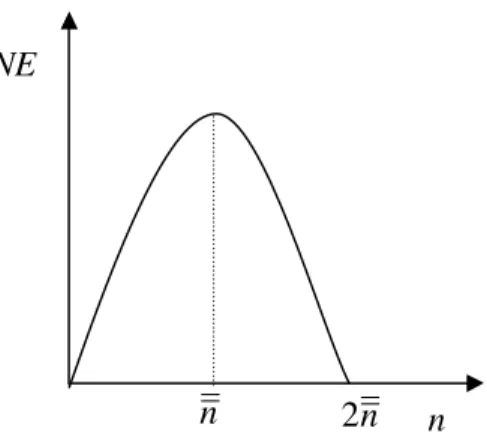
. It is also assumed that net externalities increase at a decreasing rate with the number of firms, till it reaches its maximum value, and decreases at an increasing rate thereafter – equation (20). Hence, for a small number of firms the net external effect of an additional firm is positive, whereas the opposite occurs for a large number of firms. This assumption is a natural corollary of equation (2), in which environmental quality decreases at an increasing rate with the number of firms.(
)
( ) ( ) ( ) 2
NE n =EB n −EC n =bn n n− . (20)
Where:
n- denotes the number of firms that correspond to the maximum net externalities;
b- function parameter.
Figure 4. Net Externalities
The maximisation of NSB, as defined in equation (19), yields the following first order condition: 0 i i d dNSB dNE n dn dn dn Π = Π + + = (21)
Therefore, the entry of an additional firm has three effects on the net social benefit: its own profit, the losses that all other firms incur due to the price decrease and the additional net externalities that it generates.
n
n
NE
The solution of equation (21) is given by:
(
)
2 2 2 2 2 2 3 9 3 X a c FC bn b n bn n n aX a X aX ∗∗ − − + = + − (22)This is also the global maximum point as NSB remains a strictly concave function (for positive values of n).
System (23) establishes the relation between the number of firms that maximises net social benefits in the presence and in the absence of externalities – n∗∗and
n∗, respectively. n n n n n n n n n n n n ∗∗ ∗ ∗ ∗∗ ∗ ∗ ∗∗ ∗ ∗ < ⇐ > = ⇐ = > ⇐ < (23)
The two optimal solutions coincide if the number of firms that maximises net externalities also maximises the industry’s aggregate rent. The number of firms that maximises net social benefits in the presence of externalities is lower (higher) than the one in the absence of externalities, if the number of firms that maximises the industry’s aggregate rent is higher (lower) than the one that maximises net externalities.
5. Discussion
In this section the open access and the social optimum solutions, in the absence and presence of externalities, are compared. The analysis is undertaken assuming that if there’s only one firm in the market it will earn positive economic profits – this assumption rules out the trivial case in which one firm is both the open-access equilibrium and the optimal solution.
5.1 Absence of Externalities
From the equations that define the long run equilibria the following results are obtained: * OA
n <n ; P*>POA; * OA
X <X and OA 0
i i
∗
Π > Π = . Figure 5 illustrates these outcomes.
Figure 5. Market and Firm Equilibria
D and Sstand for market demand and supply, respectively; E and Eifor market and firm equilibrium; and the indices ∗ and OA denote social optimum and open-access.
( )
(
2 2)
2 ( ) aX TR n P n nX n n n n = = − (24)( )
(
)
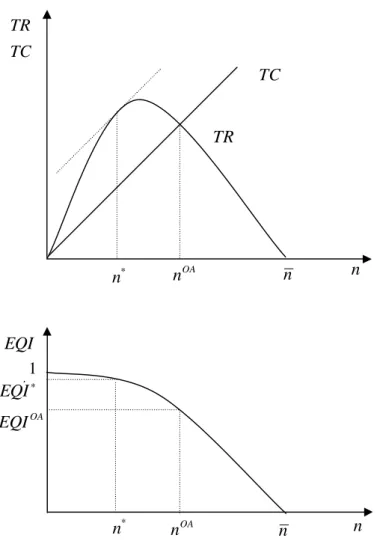
TC n =n cX+FC (25)For positive values of n, TR is a concave function, with a maximum point at 3
n
n = and TCis a linear function. Figure 6 shows these functions as well as the open-access and social optimum solutions.
P
( )
AC X X OA S * S * D OA D * E OA E OA i i X∗ X X = = c AC i X i E∗ OA i E OA D OA E X c * DFigure 6. Open Access and Social Optimum Solutions
The first graph of Figure 6 resembles the classic Gordon-Schaefer model (Gordon, 1954), which shows the problem of economic over-fishing in the open-access regime. Like the Gordon-Schaefer model, the present model of the tourism accommodation industry is also centred on a common pool resource (environmental quality) and the intensity of its use (measured by the number of firms).
As Figure 6 illustrates, although total output is higher in open access than in the social optimum solution, the latter not only yields higher economic rent but can also yield higher revenue.
The model shows the open-access regime is clearly inefficient. It leads to both economic and environmental over-exploitation, since by decreasing the number of firms there’s a simultaneous increase in the net social benefit and the environmental quality.
EQI n * n EQI∗ OA EQI n 1 OA n TR TC TR n n TC * n nOA n n n n 1
In order to take this industry from open-access to the social optimum limiting entry regulations should be applied. These could take the form of:
- issuing a limited number of permits; - limiting land use;
- taxing the industry.
By limiting the number of permits to the social optimum an economic rent is created. The mechanisms used to attribute these permits can, however, have very distinct distributive effects. The regulatory entity can, for example, issue the permits for free or auction it.
Limiting land use, through a spatial planning, can be a fundamental procedure to take the tourism industry away from open-access, co-ordinate it with other activities and guarantee the preservation of natural, built and socio-cultural resources (Collins, 1999).
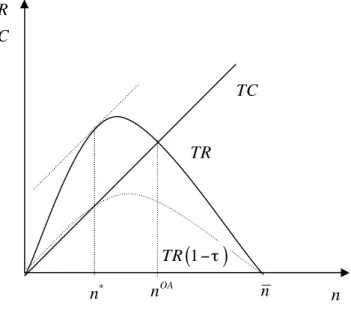
Taxing is also an alternative to restrict the number of firms. In this case, however, all economic rent is earned by the State. Let us illustrate it with an ad-valorem tax
( )
τ on the accommodation price.In the new equilibrium:
( ) (
1) ( )
0i n τ P n X cX FC
Π = − − − = (26)
Thus, the tax that leads to the social optimum is given by:
( )
(
)
( )
* * P n c X FC P n X τ = − − (27)Figure 7. Regulating the Industry through an Ad-Valorem Tax
5.2 Presence of Externalities
As shown in section 4, if external effects are present the number of firms that corresponds to the social optimum can diverge from the number that maximises the industry’s aggregate rent. System (28) establishes the relation between the optimal solutions and the open access equilibrium.
( )
( )
( )
( )
( )
( )
( )
( )
( )
* OA OA oA oA oA oA oA oA oA oA oA oA oA oA oA oA oA oA oA n n n n n n n n n n n n n n n n dTR n dTC n dNE n n n n n n dn dn dn dTR n dTC n dNE n n n n n n dn dn dn dTR n dTC n dNE n n n n n n dn dn dn ∗∗ ∗ ∗ ∗∗ ∗ ∗ ∗∗ ∗ ∗ ∗∗ ∗ ∗∗ ∗ ∗∗ < < ⇐ > = < ⇐ = > > ⇐ < ≤ > > ⇐ > ∧ − > = > ⇐ > ∧ − = < < ⇐ > ∧ − < (28)Hence, in the presence of externalities the optimum number of firms can be lower, equal or higher then at the open access equilibrium. Nonetheless, for the optimum number
TR TC TR n n TC * n nOA
(
1)
TR −τ nof firms to be equal to, or higher than, the open access equilibrium, one of the required conditions is that the number of firms that corresponds to maximum net externalities exceeds the number of firms at the open-access equilibrium. This condition is, generally, not verified when a tourism industry presents relevant environmental impacts, which decrease environmental quality at an increasing rate.
Therefore, apart from very specific situations where positive externalities are very significant, compared with the industry’s aggregate rent and its negative externalities, open-access leads, as in the absence of externalities, to an inefficient solution where the number of firms exceeds the social optimum.
Conclusions
This paper models the tourism accommodation industry, which impacts and depends on environmental quality. The main conclusion is that open-access leads, generally, to both economic and environmental over-exploitation, i.e. “the tragedy of the commons”. This also affects the overall tourism industry, as tourism accommodation and environmental quality play central roles in it. Basically, it leads to mass tourism characterised by tourists with low willingness to pay – typically low purchasing power tourists.
It is shown that tourism can destroy tourism, which is also emphasised by Tisdell (1994) when crowding from a large number of tourists deter other tourists from visiting the site or when tourism damages assets which attracts tourists.
The model results emphasise that firms’ entry should, generally, be limited, not only on the grounds of efficiency but also on sustainability. The exceptions are the cases where positive externalities are very significant, compared with the industry’s aggregate rent and its negative externalities, or where there are binding restrictions, such as land availability, in the open-access equilibrium. Apart from these specific situations, the open-access equilibrium is inefficient, compared to the social optimum solution, as it leads to the dissipation of economic gains and to environmental quality looses. It is also unsustainable as it compromises the well being of future generations – both in the economic and environmental dimensions.
Externalities, which are very common in the tourism accommodation industry, should be taken into account in setting its social optimum solution. Nonetheless, in its presence, the optimum number of firms is also, generally, below the open access equilibrium. Thus, the need for limited entry regulations remains, although its magnitude may differ from the case where externalities are not present.
The interdependency between tourism and the environment is very complex. This paper only explores the case in which tourism development leads to environmental quality decrease. However, as Tisdell (1987) stresses a proper planned and regulated tourism can,
tourists. The achievement of this goal depends on the type of tourism and the adequacy of the overall planning associated with it. The modelling of this situation is a natural avenue for further research. Another possible extension to the present paper is to move from a static long run equilibrium approach to a dynamic modelling approach and explore, among other aspects, the intertemporal distribution of costs and benefits.
References:
Briassoulis, H. (2002), Sustainable Tourism and Question of the Commons, Annals of Tourism
Research, 29, 596-611.
Bull, A. (1995) The Economics of Travel and Tourism, Addison Wesley Longman.
Clark, C. (1976) Mathematical Bio-economics: the Optimal Management of Renewable
Resources, New York, Wiley.
Collins, A. (1999), Tourism Development and Natural Capital, Annals of Tourism Research, 26, 98-109.
Field, B., D. Lass, and T. Stevens (2004), External Costs from Increased Islands Visitations: Results from the Southern Thai Islands, Tourism Economics, 10(2), 207-219.
Gordon, H. (1954), The Economic Theory of a Common Property Resource: the Fishery,
Journal of Political Economy, 62, 124-142.
Hardin, G. (1968), The Tragedy of the Commons, Science, 162, 1243-1248.
Healy, R. (1994), The “Common Pool” Problem in Tourism Landscapes, Annals of Tourism
Research, 21, 1065-1085.
Hess C. (2005) The Comprehensive Bibliography of the Commons in Digital Library of the
Commons [Web Page] < http://dlc.dlib.indiana.edu/cpr/index.php>, Accessed June 2005. Mieczkowski, Z. (1995) Environmental Issues of Tourism and Recreation, University Press of
America.
Ostrom, E. and B. Field (1999), Revisiting the Commons: Local Lessons, Global Changes,
Science, 284, 5412, 278-282.
Pigram, J. (1980) Environmental implications of Tourism Development, Annals of Tourism
Research, 7, 554-582.
Tisdell, C. (1987), Tourism, the Environment and Profit, Economic Analysis & Policy, 17, 13-30.
Tisdell C. (1994) Economics of Environmental Conservation – Economic for Environmental
and Ecological Management, Developments in Environmental Economics-1, Elsevier.