doi: 10.3389/fmars.2019.00626
Edited by: Angel Borja, Technological Center Expert in Marine and Food Innovation (AZTI), Spain Reviewed by: Marcus Geoffrey Haward, University of Tasmania, Australia Heliana Teixeira, University of Aveiro, Portugal *Correspondence: Rui Santos [email protected]
Specialty section: This article was submitted to Marine Affairs and Policy, a section of the journal Frontiers in Marine Science Received: 21 December 2018 Accepted: 23 September 2019 Published: 11 October 2019 Citation: Barracosa H, de los Santos CB, Martins M, Freitas C and Santos R (2019) Ocean Literacy to Mainstream Ecosystem Services Concept in Formal and Informal Education: The Example of Coastal Ecosystems of Southern Portugal. Front. Mar. Sci. 6:626. doi: 10.3389/fmars.2019.00626
Ocean Literacy to Mainstream
Ecosystem Services Concept in
Formal and Informal Education: The
Example of Coastal Ecosystems of
Southern Portugal
Helena Barracosa1,2,3, Carmen B. de los Santos2, Márcio Martins2, Cátia Freitas2and
Rui Santos2*
1Escola Secundária João de Deus, Agrupamento de Escolas João de Deus, Faro, Portugal,2ALGAE – Marine Plant Ecology Research Group, Center of Marine Sciences, University of Algarve, Faro, Portugal,3CFAE Levante Algarvio, Vila Real de Santo António, Portugal
The concept of ecosystem services (ES) emerges as strategic to explain the influences that the ocean, and in particular coastal ecosystems, have on us and how we influence them back. Despite being a term coined several decades ago and being already wide-spread in the scientific community and among policy-makers, the ES concept still lacks recognition among citizens and educators. There is therefore a need to mainstream this concept in formal education and through Ocean Literacy resources. Although important developments in OL were done in the United States, particularly through the National Marine Educators Association (NMEA), this concept was only recently introduced in Europe. In Portugal, several informal OL education programs were developed in the last years, yet formal education on OL and, in particular, on ES is still very deficient. To address this limitation, the “Environmental Education Network for Ecosystem Services” (REASE), founded in 2017 in the Algarve region by a consortium of educational, environmental and scientific institutions, aims to increase OL through the dissemination of the perspective of how ES provided by coastal vegetation may contribute to the human well-being. The projects and activities implemented by REASE focus mostly on formal-education of school children and include: (1) capacity building for K-12 teachers, (2) educational programs to support and develop ES projects in schools, including a citizen science project to evaluate blue carbon stocks in the Algarve, (3) the publication of a children’s book about the ES provided by the local Ria Formosa coastal lagoon, with a community-based participatory design (illustrations made by schoolchildren) and (4) a diverse array of informal education activities to raise awareness on the importance of coastal ecosystems on human well-being. REASE challenges are being successfully addressed by identifying threats to local coastal ecosystems that people worry about, and highlighting solutions to improve and maintain their health.
Keywords: ocean literacy, behavior change, project-based learning, blue carbon, coastal ecosystems, citizen science, environmental education, participatory action research
INTRODUCTION
The oceans, covering 71% of the Earth’s surface, have a profound influence on human well-being, by providing services or benefits such as oxygen, food, pharmaceutical compounds, jobs and climate regulation (Dupont and Fauville, 2017). At the same time, human activities, such as overfishing, coastal development, pollution, and those causing the rising of CO2 concentrations in the atmosphere, are influencing the ocean by, for example, making it warmer and more acidic with consequences to the marine organisms and ecosystems (Fabry et al., 2008; Hoegh-Guldberg and Bruno, 2010; Cheung et al., 2013). Coastal ecosystems, as part of the global ocean, should be a particular target in the global conservation agenda for being under the impacts of an increasing population density along the planet coasts (Lotze et al., 2006) and for providing highly valuable services both at the local and global scale (Barbier et al., 2011). For instance, coastal vegetated ecosystems such as saltmarshes and seagrasses have experienced large losses and degradation in the last decades due to urban development and pollution of coastal areas (Lotze et al., 2006), putting at risk all the ecosystem services (ES) we benefit from and depend upon (Millennium Ecosystem Assessment
[MEA], 2005). The high value of these ecosystems relies on
their role, for example, in maintaining local fisheries, thus in food provision (Unsworth et al., 2018), controlling pollution and diseases by filtering nutrients and pathogens out of the water (Lamb et al., 2017) and protecting the coasts from flooding and erosion (Duarte et al., 2013; Ondiviela et al., 2014). In addition, these ecosystems rank amongst the most efficient ecosystems in sequestering and storing CO2, thus contributing to climate change mitigation (Fourqurean et al.,
2012; Duarte et al., 2013). The carbon stored in coastal
vegetation sediments, commonly called “coastal blue carbon”
(Nellemann and Corcoran, 2009), remain trapped for very
long periods of time (centuries to millennia) resulting in carbon stocks larger than in terrestrial vegetation (Fourqurean et al., 2012; Chmura, 2013; Duarte et al., 2013). However, the capacity of the coastal vegetated ecosystems to provide blue carbon storage and other benefits is threatened as a consequence of the human impacts (Waycott et al., 2009;
Pendleton et al., 2012). There is an urgent, global need to revert their degradation and to secure benefits now and in the future (Cullen-Unsworth and Unsworth, 2018).
The concept of ES, i.e., the benefits that humans get from nature (Millennium Ecosystem Assessment [MEA], 2005), emerges as strategic to explain the influences that the ocean, and in particular coastal ecosystems, have on us and how we influence them back, which is the essence of the Ocean Literacy (OL,Ocean Literacy Campaign, 2013). Educating people on marine ES, so they get a better understanding of the tight bond between natural habitats and human well-being, constitutes a powerful strategy to advance toward a more ocean-literate society, i.e., a society that “understands the Essential Principles and Fundamental concepts about the ocean,” that “is able to make informed and responsible decisions regarding the ocean and its resources,” and that “can communicate about
the ocean in a meaningful way” (Ocean Literacy Campaign, 2013). Despite being a term coined several decades ago, in the 1980s (Millennium Ecosystem Assessment [MEA], 2005), and being already wide-spread in the scientific community and among policy-makers, the ES concept still lacks popularity among citizens and educators. There is therefore a need to mainstream this concept in formal education and through Ocean Literacy resources.
The “Ocean Literacy Essential Principles and Fundamental Concepts” (Ocean Literacy Campaign, 2013) is a cornerstone document to guide educators on the seven most important concepts that citizens should know about the oceans. Some of these principles indirectly refer to the ES delivered by the ocean and its ecosystems. For instance, principle 3.f. mentions that the ocean has had, and will continue to have, a significant influence on climate change by absorbing, storing, and moving heat, carbon and water, principle 4.c. “The ocean provided and continues to provide water, oxygen, and nutrients, and moderates the climate needed for life to exist on Earth,” principle 5, “The ocean supports a great diversity of life and ecosystems,” includes a specific mention (5.i.) to coastal ecosystems, in particular estuaries, in providing “important and productive nursery areas for many marine and aquatic species,” and in principle 6 “The ocean and humans are inextricably interconnected,” there are many references to marine ES such as food, medicines, jobs, navigation and culture (6.a. to 6.c). These ES-related principles are, however, built on a global scale, so tailoring them to local necessities and problems is needed so that they will have a more efficient impact.
Although important developments in OL have been done in United States, particularly through the achievements of the National Marine Educators Association (NMEA), this concept was only recently introduced in Europe. The first Conference on Ocean Literacy in Europe was only held in 2012. Despite the fact that OL is a political priority to the EU, little has been done to improve it, as recognized by
theEuropean Marine Science Educators Association [EMSEA],
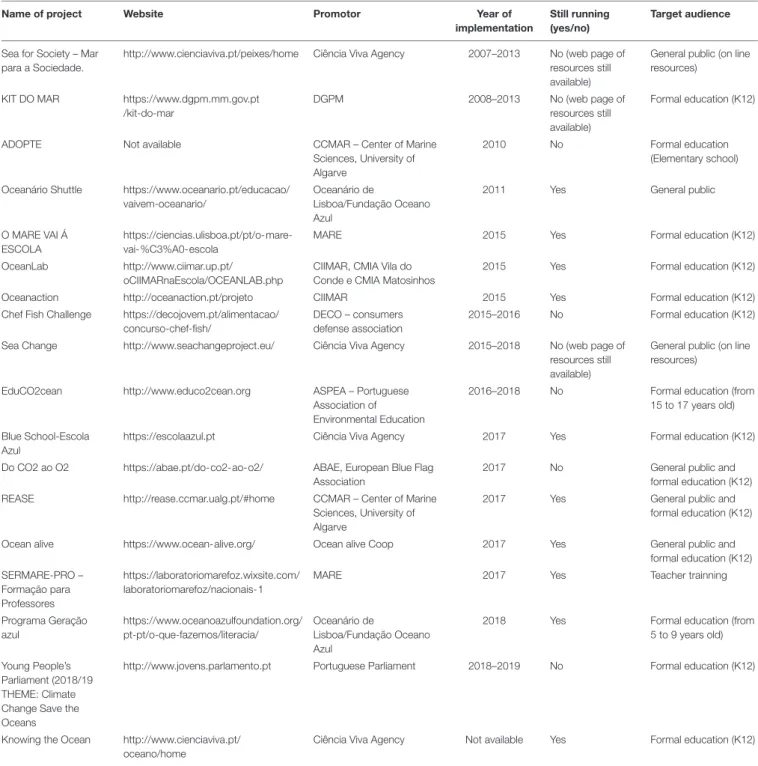
2013. OL concepts are not present in most European school’s curricula (Water World Adventure Learning Approach, 2016), although Portugal was among the first countries to implement informal OL education projects (Table 1), in particular through the project “Knowing the Ocean” that aimed to stimulate the citizens’ involvement with the ocean based on the North American Ocean Literacy initiative. In fact, due to the Portuguese geographic location and its long maritime tradition, many education programs that included sea-related activities were developed before OL became the hallmark for sea-related environmental education, for example the centers for monitoring and environmental interpretation, CMIA, in northern Portugal1,2,3. In terms of OL targeting specifically the
Portuguese coastal ecosystems there are two programs running at present (Table 1), Ocean Alive4, focused on the seagrasses of the
1www.cmia-viana-castelo.pt/servicos-educativos/atividades-grupos
2www.cmia-viladoconde.net/eventoseatividades.php
3www.cmia-matosinhos.net/eventoseatividades.php?page=2&ipp=10&t=2 4https://www.ocean-alive.org
TABLE 1 | Past and present ocean literacy education projects developed in Portugal.
Name of project Website Promotor Year of
implementation
Still running (yes/no)
Target audience
Sea for Society – Mar para a Sociedade.
http://www.cienciaviva.pt/peixes/home Ciência Viva Agency 2007–2013 No (web page of resources still available)
General public (on line resources)
KIT DO MAR https://www.dgpm.mm.gov.pt /kit-do-mar
DGPM 2008–2013 No (web page of
resources still available)
Formal education (K12)
ADOPTE Not available CCMAR – Center of Marine
Sciences, University of Algarve
2010 No Formal education
(Elementary school)
Oceanário Shuttle https://www.oceanario.pt/educacao/ vaivem-oceanario/
Oceanário de
Lisboa/Fundação Oceano Azul
2011 Yes General public
O MARE VAI Á ESCOLA
https://ciencias.ulisboa.pt/pt/o-mare-vai-%C3%A0-escola
MARE 2015 Yes Formal education (K12)
OceanLab http://www.ciimar.up.pt/
oCIIMARnaEscola/OCEANLAB.php
CIIMAR, CMIA Vila do Conde e CMIA Matosinhos
2015 Yes Formal education (K12)
Oceanaction http://oceanaction.pt/projeto CIIMAR 2015 Yes Formal education (K12)
Chef Fish Challenge https://decojovem.pt/alimentacao/ concurso-chef-fish/
DECO – consumers defense association
2015–2016 No Formal education (K12)
Sea Change http://www.seachangeproject.eu/ Ciência Viva Agency 2015–2018 No (web page of resources still available)
General public (on line resources)
EduCO2cean http://www.educo2cean.org ASPEA – Portuguese
Association of Environmental Education
2016–2018 No Formal education (from
15 to 17 years old)
Blue School-Escola Azul
https://escolaazul.pt Ciência Viva Agency 2017 Yes Formal education (K12)
Do CO2 ao O2 https://abae.pt/do-co2-ao-o2/ ABAE, European Blue Flag Association
2017 No General public and
formal education (K12) REASE http://rease.ccmar.ualg.pt/#home CCMAR – Center of Marine
Sciences, University of Algarve
2017 Yes General public and
formal education (K12)
Ocean alive https://www.ocean-alive.org/ Ocean alive Coop 2017 Yes General public and
formal education (K12) SERMARE-PRO – Formação para Professores https://laboratoriomarefoz.wixsite.com/ laboratoriomarefoz/nacionais-1
MARE 2017 Yes Teacher trainning
Programa Geração azul https://www.oceanoazulfoundation.org/ pt-pt/o-que-fazemos/literacia/ Oceanário de Lisboa/Fundação Oceano Azul
2018 Yes Formal education (from
5 to 9 years old)
Young People’s Parliament (2018/19 THEME: Climate Change Save the Oceans
http://www.jovens.parlamento.pt Portuguese Parliament 2018–2019 No Formal education (K12)
Knowing the Ocean http://www.cienciaviva.pt/ oceano/home
Ciência Viva Agency Not available Yes Formal education (K12)
Sado estuary and the network REASE5, which is presented and
discussed below.
Even though some informal OL education programs have been developed in Portugal, there is a need for formal education in the classroom arena, tailored to local ecosystems. Based on this principle, the “Environmental Education Network for Ecosystem Services” of the Algarve region (REASE, from its
5http://rease.ccmar.ualg.pt/#home
abbreviation in Portuguese) aims at planning and implementing environmental education projects on coastal ecosystem services with a special focus on the formal-education of school children. The network was founded in 2017 and includes institutions in the Algarve region interested in disseminating the perspective of the ES, namely the Center of Marine Sciences (CCMAR) of the University of Algarve, schools and associations of schools, science outreach centers, teachers training centers and non-governmental organizations.
OCEAN LITERACY EDUCATION IN
PORTUGUESE SCHOOLS
The main target for ocean literacy dissemination is the primary and secondary students (K-12) because school is mandatory for all and not everyone has access to informal educational contexts. However, ocean literacy and environmental education continues to be disregarded in the formal K-12 curricular programs in Portugal as well as in other European and American countries (Fauville et al., 2012), resulting in a citizenry that is not equipped to deal capably with many environmental problems. Teachers and schools need scientific support to understand ocean problems and to take on the challenges of disseminating OL. Thus, contemporary projects involving scientists, school teachers and students are needed to explore ocean problems in innovative ways. The current REASE project and the MARE and OCEANLAB training programs for teachers (Table 1) are good examples of this.
The main obstacles to the inclusion of OL in the Portuguese school is the overly fragmented curricular program by many disciplines, the length of the ordinary curricular program that does not encourage extra-curricular activities, the weak tradition of interdisciplinary project development as well as the lack of conditions for collaborative work among teachers (Santiago et al., 2012;OECD, 2018a). This is particularly relevant because ocean problems are complex and require transdisciplinary approaches. In addition, the Portuguese educational system based on national exams to access higher education at Universities exerts a pressure on teachers, students and families, for whom the main objective is to prepare the students for the exams, promoting a general standardization of school education. However, important reforms have been recently introduced, which may provide an opportunity for the inclusion of OL in the standard curriculum. In July 2018, Portugal officially adopted the Legislative Orders no. 55/2018, which obligates Portuguese schools (1st, 5th, 7th and 10th grades) to join the “Project for Autonomy and Curriculum Flexibility” (PACF). PACF provides schools with the necessary conditions to adjust the national curricular program with local contents. Schools may thus integrate innovative methodologies and practices to promote better learning. This project includes the National Education Strategy for Citizenship to introduce citizenship education in the schools. This strategy has created mandatory teaching areas, such as environmental education, sustainability, human rights and health. In addition, it promotes partnerships with NGOs and other institutions. PACF recommends to develop curricula according to the local contexts, associated with active methodologies such as project-based learning methodologies.
This recent legislation represents an opportunity to introduce and explore the theme of coastal ES and OL in the Portuguese school curriculum. Ocean literacy provides a way for students and teachers to work with their communities, and to change behaviors to reduce negative impacts on the ocean and its resources, ensuring that a healthy ocean will be available for future generations. Furthermore, the OECD (Organization for Economic Co-operation and Development) Learning Framework 2030 (OECD, 2018b) acknowledges that the concept of
“competency” implies more than just the acquisition of knowledge and skills; it involves the mobilization of knowledge, skills, attitudes and values to meet complex demands (like the concept of ES). One of the recommendations of OECD’s Skills Strategy Diagnosis for Portugal is “adjusting decision-making power to meet local needs.”
ENVIRONMENTAL EDUCATION
NETWORK FOR ECOSYSTEM SERVICES
IN SOUTHERN PORTUGAL (REASE):
MISSION AND VISION
The eastern coast of Algarve in southern Portugal is dominated by the Ria Formosa lagoon and the Guadiana river estuary with its Castro Marim saltmarshes. These are coastal protected areas recognized for their ecological and socio-economic importance where the preservation of ecosystems cohabits with their long-term, historical economic exploitation. Ria Formosa lagoon is probably the main employer of Algarve, where touristic usufruct shares this territory with artisanal fishing activities, salt extraction and mostly important, bivalve production. This anthropogenic pressure is increasing and diversifying, producing important disturbances in the landscape, habitats and species. These estuarine-lagoon ecosystems are dominated by seagrasses and saltmarshes, which support high biodiversity including iconic, endangered species such as seahorses, the provision of food resources, the purification of the water and the regulation of nutrient biogeochemical cycles, including globally relevant ES of carbon sequestration, ocean acidification mitigation, enable cultural and recreational practices and goods that relate people with the natural system and many dimensions of well-being that result on high touristic demand. This is the background that motivated the recent creation of the REASE network, whose aim is to increase coastal OL through the dissemination of the perspective of the ES provided by coastal vegetation, and in particular, how saltmarshes and seagrasses contribute to the well-being of the local population. The ultimate goal is to increase awareness of ES to promote the preservation and conservation of coastal ecosystems and the public pressure to manage them for sustainability.
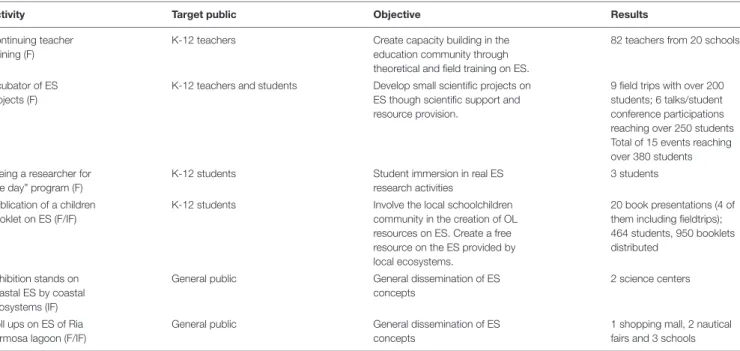
The REASE strategy is not only to focus on primary and secondary schools, which are the key institutions with higher potential to deliver scientific knowledge on ES and OL to students through formal education, but also to deliver informal education of the general public by institutions such as environmental education centers, science centers, museums and aquaria. The specific objectives of REASE are (1) to train primary and secondary teachers on coastal ES and OL, (2) to create an incubator of innovative ES and OL projects that may be developed in schools under the PACF and in environmental education institutions, endowed with the scientific, technical (laboratory and field) equipment for the design, implementation and replication throughout schools, and (3) to promote informal activities for all types of public to improve the awareness on ES and OL. Table 2 summarizes the activities conducted by REASE,
TABLE 2 | Activities conducted by the REASE network to mainstream the concept of ecosystem services (ES) in the western Algarve region (Portugal), including the target public, objective, and results obtained in the first year.
Activity Target public Objective Results
Continuing teacher training (F)
K-12 teachers Create capacity building in the
education community through theoretical and field training on ES.
82 teachers from 20 schools
Incubator of ES projects (F)
K-12 teachers and students Develop small scientific projects on ES though scientific support and resource provision.
9 field trips with over 200 students; 6 talks/student conference participations reaching over 250 students Total of 15 events reaching over 380 students “Being a researcher for
one day” program (F)
K-12 students Student immersion in real ES
research activities
3 students
Publication of a children booklet on ES (F/IF)
K-12 students Involve the local schoolchildren
community in the creation of OL resources on ES. Create a free resource on the ES provided by local ecosystems.
20 book presentations (4 of them including fieldtrips); 464 students, 950 booklets distributed
Exhibition stands on coastal ES by coastal ecosystems (IF)
General public General dissemination of ES
concepts
2 science centers
Roll ups on ES of Ria Formosa lagoon (F/IF)
General public General dissemination of ES
concepts
1 shopping mall, 2 nautical fairs and 3 schools Each activity is categorized in formal (F) and informal (IF) education.
which will be developed below. The number of participating teachers was 82 from 20 schools, which represents 3% of the total number of K-12 teachers in municipalities of eastern Algarve (Loulé, Faro, Olhão, Tavira and Vila Real de Santo António).
Continuing Teacher Training
The training of teachers is central in the REASE attempts to increase the knowledge on ES in the region. This is particularly relevant in Portugal as the ES concept is relatively new (the concept was disseminated by the United Nations Millennium Ecosystem Assessments, publishied in 2005) and the Portuguese teacher’s population is old, so that at the time they graduated the ES concept was not known. Data from 2015 to 2016 indicate that in 104,386 school primary and secondary teachers in public schools, there were only 383 under the age of 30. In fact, the age of teachers has increased drastically in the last decade revealing a worrisome lack of renovation. In the 1990’s the number of teachers above 50 and below 35 years old was similar (aging index about 100), whereas in 2017 the number of teachers above 50 was 33 times higher than the number of teachers below 35 years old (Figure 1).
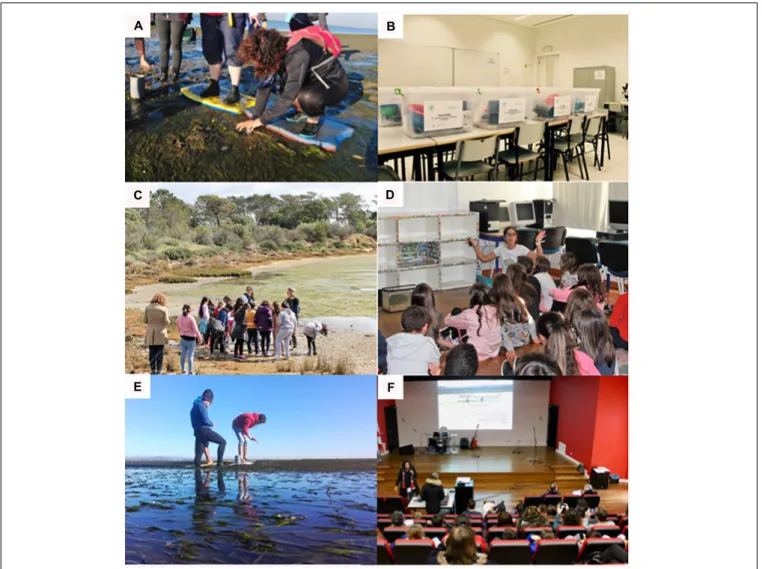
Given the increasing aging of the teaching class, continuing training of K-12 teachers is fundamental, especially in emerging areas such as ES and OL. Continuing teacher training in southwestern Portugal is formally provided by the Teacher Training Centers of “Levante Algarvio” in Vila Real de Santo António, “Ria Formosa” in Faro and “Litoral à Serra” in Loulé, being all of them involved in the foundation of REASE and in its activities. From the start of REASE in November 2017, to November 2018, a total of 7 training actions for teachers (Figure 2A) were delivered on coastal ES by researchers from
the Center of Marine Sciences of University of Algarve, CCMAR. Eighty-two teachers from 20 schools were trained in the first year, 60 of which have implemented related activities to approximately 1200 K-12 students.
Incubator of ES Projects
The REASE network includes an “incubator of ES projects” (Figure 2B) that provides scientific support to K-12 education centers to develop small scientific projects with their students as an opportunity to learn about current scientific research related to ES. The learning process in science is more effective when the students are introduced and directly immersed into the scientific work throughout an “inquiry” learning process, instead of just learning about the “products” of science. They should have a question to investigate as a background of the learning process (Dewey, 1938). The ES projects launched within this framework were therefore based on experimentation, so students follow the scientific process of formulating problems, testing hypotheses, analyzing data, finding answers and presenting and communicating the results. This approach aims to reinforce the principle that an ocean-literate person may be able to communicate about the ocean in a meaningful way, a skill that the students put in practice through participation in various school events (conferences, competitions, meetings) where they present the results of their investigations. Finally, the incubator of ES projects is also based on the principle that field visits and experimentation are unique opportunities to learn about the coastal ecosystems and their services since, during such activities, students interact with the ecosystems through observations of natural processes and learn how they are connected to their well-being.
FIGURE 1 | Aging index (no. of teachers with more than 50 years/no. teachers with less than 35 years × 100). Source: Pordata (https://www.pordata.pt/DB/Portugal/Ambiente+de+Consulta/Tabela, assessed in 13-12-2018).
The flag pioneering project of REASE incubator is the “Carbono Azul” (Blue Carbon). This scientific project aims at mapping the blue carbon stocks of coastal vegetated ecosystems in the Algarve region6. Mapping the blue carbon stored in
saltmarshes and seagrasses requires some training on the scientific protocols to quantify the organic carbon stored in the sediment and vegetation, as well as specific laboratory and field resources that may not be available in every school. For that reason, the first step was the implementation of training actions for teachers (see previous sub-section “training”). Secondly, the schools were provided with a field kit containing the materials needed to collect and analyze vegetation and sediment samples, including among other items, a handheld GPS, sampling cores, thermometer and zip lock bags (Figure 2B). In addition, one of the schools of the REASE network (AEJD Faro) was assigned as the “Incubator of ES project” headquarters and it was provided with laboratory equipment needed for the analysis of samples (laboratory oven and muffle furnace), to be shared with all other schools, teachers and students included in the REASE network, reinforcing in this way the inter-school cooperation and sharing of resources. Apart from the laboratory equipment needed for the “Blue Carbon” project,
6http://rease.ccmar.ualg.pt/#map
the “Incubator of ES project” headquarters was provided as well with microscopes and binocular magnifiers to develop other scientific projects. The Blue Carbon project is supported by a digital platform where the blue carbon data may be deposited and shared. The Internet and geographic information system (GIS) web applications developed by REASE allow participants to collect large volumes of location-based ecological data and submit them electronically to a centralized database. An app is also being developed7 to directly upload field
measurements, photos and blue carbon data into the website of the project, where data are scientifically validated and analyzed by CCMAR researchers. The ubiquity of smartphones, the potential for digital photo and the development of an infrastructure for creating simple online data-entry provide added potential for democratizing the project development, allowing the creation of data-entry systems for community-based projects of ecological research asDickinson et al. (2012)
recommended. Such empowerment means that data that may drive resource management decisions, are more likely to be in the hands of the people who will be affected by the outcomes, which reinforces the degree of participation and implication and guarantees its own sustainability.
FIGURE 2 | REASE activities for formal education includes (A) continuing training for K-12 teachers on ecosystem services (ES); (B) an incubator of innovative projects on ES, such as mapping the blue carbon in the Algarve that includes the delivery of a field kit; (C) field trips with schoolchildren; (D) using storytelling to educate on ES using local examples; (E) researcher for one day program; and (F) public presentations. All identifiable individuals have delivered a written consent for the publication of the images.
In the framework of the “Incubator of ES projects,” the REASE network has co-organized field trips with schools to the Ria Formosa Natural Park and the Castro Marim saltmarsh Natural Reserve in which about 500 K-12 students have participated in the last year (Figure 2C). During the field trips, the “Blue Carbon” and other projects (e.g., assessment of the ES of biodiversity support by seagrass meadows, in particular commercial bivalves) have been implemented, in which students actively participated in the collection of plants and sediment samples from different locations and measured environmental parameters.
The “Formosa” Story: A Booklet for
Children on ES
The use of appropriate stories may enhance the Ocean Literacy of children and also educate them toward a more sustainable attitude in relation to the environment. When a child listens
to a story narrated by a person who has a deep knowledge on environmental issues, it has the chance to experience a new field of sensations by becoming a part of the story (Barton and Booth, 1990). REASE followed this approach by publishing a children booklet entitled (“Formosa”)8that is being used as an educational
tool for teaching the ES provided by seagrass meadows in the Ria Formosa lagoon. The creation of the booklet was, at the same time, an educational and participatory project, in which local schoolchildren prepared drawings to illustrate the booklet after hearing the story from the author at their school and after participating in a field trip to visit the ecosystem that is the booklet’s protagonist, the seagrass meadows of Ria Formosa. The published booklet was then presented to the local community in a public event where children, parents and scholars were invited. After its publication, about 20 presentations (Figures 2D,F, 4 of
8http://rease.ccmar.ualg.pt/downloads/attachments/FORMOSA%20Maquete%
them including a field trip to visit seagrass meadows, Figure 2C) of the booklet story were given by its author to more than 400 children at schools andCiência Viva centers. A total of 950 paper copies were distributed in the first year in schools and in several fairs and other ocean-related meetings and events.
“Researcher for One Day” Program
While knowledge of the theoretical framework of the ES and OL topics is indispensable, it is not always easy to directly relate it with the real world. In most cases, students have very little knowledge of the coastal marine habitats in the Ria Formosa as a real-world concept, despite living extremely close to them and having studied them in the classroom. The only exceptions are the children of the lagoon’s users, such as fisherman and clam cultivators. To promote engagement and active education, REASE developed the “Researcher for one day” program where selected students (by their teachers) participated in the research activities of CCMAR, directly interacting with researchers during a field sampling campaign (Figure 2E). This allows a hands-on experience, and interaction with someone who has experience on scientific issues related to ES. This direct contact can be critical to instilling a life-long interest in science. Such arrangements are, however, difficult to organize on a large-scale, due to practical limitations.
Informal Education
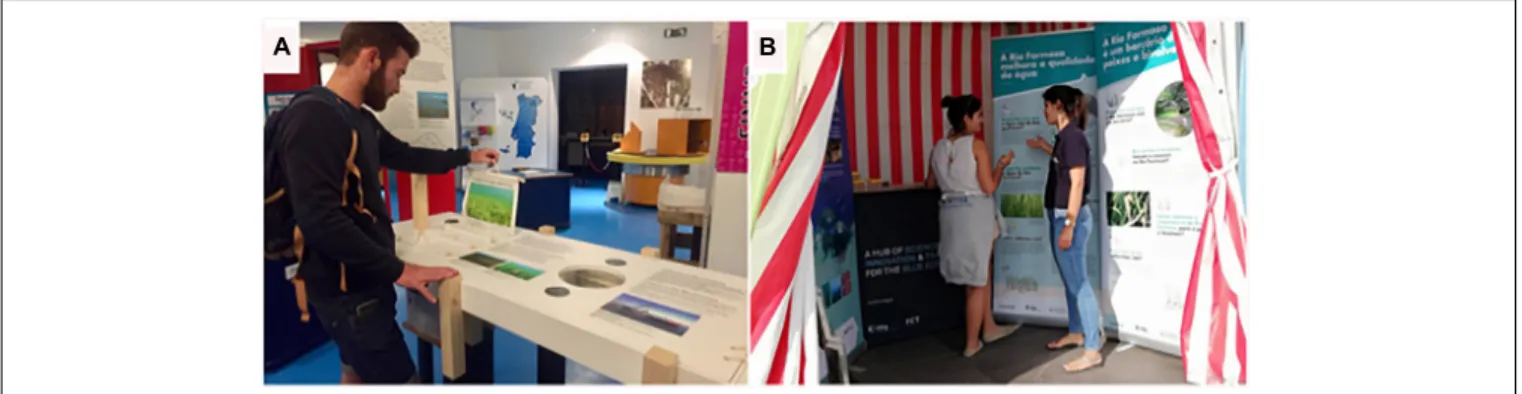
The formal education is the main focus of the REASE network to mainstream ES in the eastern Algarve region, but learning is not limited to formal education. To embrace a wider audience, different informal activities were developed, including exhibitions, workshops, “talks with scientists,” radio interviews to REASE members, among others. The Ciência Viva science centers (of Faro and Tavira), as partners of the REASE network, had an active role in the informal education activities through the presentation of a permanent interactive exhibition on the ES of coastal vegetated ecosystems of Ria Formosa lagoon (Figure 3A). As well, roll-ups on the ES services of Ria Formosa lagoon (Figure 3B), namely the water purification, the carbon sequestration, biodiversity support and ocean acidification mitigation, were prepared and exhibited in
shopping malls, nautical fairs and in schools to commemorate environmental events.
CHALLENGES AND LESSONS LEARNED
The greatest challenge of REASE is to raise the awareness of K-12 students on the benefits that coastal vegetated ecosystems deliver and how they are crucial for the well-being of populations. This challenge was addressed first by training and rising the ES awareness of school teachers who then conveyed it to students. This is probably the best strategy to reach most of families and thus a vast audience, through their children (Uzzell et al., 1994; Ballantyne et al., 1998; Bamberg and Möser, 2007). If the youngest of families learn the benefits of local ecosystems, there is a good possibility that this knowledge will pass on to their parents raising their awareness as well. In order to increase successfully the awareness of teachers and then of students, it is fundamental to make it interesting and exciting. This challenge was successfully addressed by identifying threats to local ecosystems that people worry about, and by discussing solutions to improve and maintain their health.Then it was necessary to implement exciting projects that involved not only laboratory work but most importantly, field excursions and sampling so that the teachers and their students get in touch with the natural environments and may break the monotony of the day to day work within the school buildings. For this, we developed a close collaboration between researchers and educators. A model project was developed, the Blue Carbon Project (see text footnote 6), whose field and laboratory protocols were tested and improved with teachers. A critical component was the creation of educational materials, including information that allows participants to understand the scientific background, a field kit with everything necessary to collect samples and field information, clear and precise field and laboratory protocols and laboratory conditions to analyze the samples. Potential educational benefits of REASE projects range from acquiring skills needed to collect data accurately to critical scientific
FIGURE 3 | REASE activities for informal education include, among others, (A) interactive permanent exhibitions on ES of coastal vegetated ecosystems at science centers, and (B) roll-ups exhibitions in shopping malls, nautical fairs and in schools. All identifiable individuals have delivered a written consent for the publication of the images.
thinking and inquiry, in which participants apply knowledge to generate new questions and then design studies or develop models to answer those questions. Furthermore, the data collected is scientific valuable once is validated by researchers, and has in itself educational value. The experience of collecting data for use by professional scientists is highly motivating, fosters scientific knowledge, and provides opportunities for interacting with members of likeminded communities within local environments (Bonney et al., 2014). The deeper involvement of teachers and students in REASE activities is resulting in increasingly robust learning outcomes. It is gratifying to see that the number of schools and teachers interested in participating is steadily increasing and that researchers have been invited for a number of informal events to discuss on local environmental issues and problems.
One of the lessons learned is that teachers need to understand that not knowing the answer is okay and that science does not have answers to all the questions and problems. Teachers need to overcome the paradigm that they are the holders of all knowledge, to a new paradigm where teachers and students have to co-construct knowledge so that the learning process is focused on the student. Additional training and resources to facilitate this paradigm are needed, for example, methodological training directed to cooperative work, problem-, project- and inquiry-based learning. On what concerns resources, the challenge is how to overcome difficulties related to heavy and fragmented curricula by many disciplines giving limited time to develop projects with students, large numbers of students per class, reduced budgets, lack of transportation to take the students to the field, and many other growing challenges facing schools. However, during the REASE first year, teachers have found ways to overcome those challenges and have shared them within the network so that others may benefit from solutions found, for example developing partnerships with the municipalities and the national agency “Ciência Viva”9. Our empirical assessment,
based on the feedback received from teachers, shows as well that it is possible to develop interdisciplinary projects integrating various subjects such as biology, geology, physics, chemistry, geography and mathematics. This is particularly relevant because ocean problems are complex and require interdisciplinary approaches.
Environmental and educational impacts of REASE are difficult to measure. However, we are considering three distinct ways of evaluation: the contribution to scientific knowledge through the ES data that is being collected and is being made available at the site (see text footnote 6), the number of blog news published on the activities developed with the students10 and the impacts on behavior,
i.e., if participants become more environmentally responsible individually or collectively, in the present, or in the future. Outdoor educational interventions, including field trips and experiential work, have generally a positive effect (Fiennes et al., 2015), but this effect is attenuated over time. This
9http://www.cienciaviva.pt/home/
10http://rease.ccmar.ualg.pt/#news
reinforces the need for continued interventions as it is being done in REASE rather than timely interventions. The long-term effects of REASE may be evaluated by mixed method methodologies including quasi experimental research design (e.g., pretest–posttest), semi-structured interviews and focus groups (Cook and Campbell, 1979;Stern et al., 2014). A relevant immediate impact of REASE was the successful submission of the project Erasmus + 2018-1-PT01-KA229-047540, Human Impacts @ Coastal Ecosystems,” by one of the schools of the network, “Francisco Fernandes Lopes.” The project involves 6 EU countries to recognize the importance of protecting coastal ecosystems and among other objectives includes the implementation of the Blue Carbon project of REASE in those countries.
With increasingly severe local and global environmental problems, time is running out to develop an ocean literate citizenry that is “capable of understanding, supporting, and demanding the policy changes necessary to protect the ocean” (Schoedinger et al., 2006). Ocean-literate individuals take action, and through active participation in OL experiences, attach emotion and values to the ocean and its resources. However, ocean literacy and environmental education continues to be sub-valorized in the K-12 educational system in Portugal, resulting in a citizenry that is not equipped to deal proficiently with many environmental problems that are considered out of sight and out of mind. PAFC reform could be an opportunity to change this. The PAFC project gives legal space for all schools to spontaneously and progressively adhere to the possibilities for curriculum design, especially project-based learning, where the promotion of OL could conquer a pool position.
AUTHOR CONTRIBUTIONS
HB, CS, and RS contributed conception and design of the study. All authors wrote sections of the manuscript, contributed to manuscript revision, and read and approved the submitted version.
FUNDING
This work was funded by Fundo Ambiental, ENEA 2020 and Portuguese national funds from FCT – Foundation for Science and Technology through project UID/Multi/04326/2019 granted to CCMAR, and the post-doctoral fellowship (SFRH/BPD/119344/2016) granted to CS.
ACKNOWLEDGMENTS
We thank the REASE team: Associação Almargem, Agrupamento de Escolas João de Deus/Faro, Centro de Ciência Viva do Algarve, Centro de Ciência Viva de Tavira, Centro de Formação de Professores Levante Algarvio, Centro de Formação de Professores Litoral à Serra and Centro de Formação de Professores Ria Formosa.
REFERENCES
Ballantyne, R., Connell, S., and Fien, J. (1998). Students as catalysts of environmental change: a framework for researching intergenerational influence
through environmental education.Environ. Educ. Res. 4, 285–298. doi: 10.
1080/1350462980040304
Bamberg, S., and Möser, G. (2007). Twenty years after Hines, Hungerford,
and Tomera: a new meta-analysis of psycho-social determinants
of proenvironmental behavior. J. Environ. Psychol. 27, 14–25. doi:
10.1016/j.jenvp.2006.12.002
Barbier, E. B., Hacker, S. D., Kennedy, C., Koch, E. W., Stier, A. C., and Silliman,
B. R. (2011). The value of estuarine and coastal ecosystem services. Ecol.
Monogr. 81, 169–193.
Barton, B., and Booth, D. (1990).Stories in the Classroom: Storytelling, Reading aloud and Roleplaying with Children. Portsmouth, NH: Rigby Heinemann. Bonney, R., Shirk, J. L., Phillips, T. B., Wiggins, A., Ballard, H. L., Miller-Rushing,
A. J., et al. (2014). Next steps for citizen science.Science 243, 1427–1436. Cheung, W. W., Watson, R., and Pauly, D. (2013). Signature of ocean warming in
global fisheries catch.Nature 497, 365–368. doi: 10.1038/nature12156 Chmura, G. L. (2013). What do we need to assess the sustainability of the tidal salt
marsh carbon sink?Ocean Coast. Manag. 83, 25–31. doi: 10.1016/j.ocecoaman.
2011.09.006
Cook, T. D., and Campbell, D. T. (1979).Quasi-Experimentation: Design & Analysis Issues in Field Settings. Boston, MA: Houghton Mifflin.
Cullen-Unsworth, L. C., and Unsworth, R. (2018). A call for seagrass protection. Science 361, 446–448.
Dewey, J. (1938).Experience and Education. New York, NY: Collier Books.
Dickinson, J. L., Shirk, J., Bonter, D., Bonney, R., Crain, R. L., Martin, J., et al. (2012). The current state of citizen science as a tool for ecological research and
public engagement.Front. Ecol. Environ. 10:291–297. doi: 10.1890/110236
Duarte, C. M., Losada, I. J., Hendriks, I. E., Mazarrasa, I., and Marbà, N. (2013). The role of coastal plant communities for climate change mitigation and adaptation. Nat. Clim. Change 3, 961–968. doi: 10.1371/journal.pone.0044727
Dupont, S., and Fauville, G. (2017). “Ocean literacy as a key toward sustainable
development and ocean governance,” in Handbook on the Economics and
Management of Sustainable Oceans, eds P. Nunes, L. E. Svensson, and A. Markandya (Cheltenham: Edward Elgar Publishers).
European Marine Science Educators Association [EMSEA] (2013). European
Marine Science Educators Association. Available at: http://www.emsea.eu (accessed December 01, 2018).
Fabry, V. J., Seibel, B. A., Feely, R. A., and Orr, J. C. (2008). Impacts of ocean
acidification on marine fauna and ecosystem processes.ICES J. Mar. Sci. 65,
414–432. doi: 10.1093/icesjms/fsn048
Fauville, G., Säljö, R., and Dupont, S. (2012). Impact of ocean acidification on
marine ecosystems: educational challenges and innovations.Mar. Biol. 160,
1863–1874. doi: 10.1007/s00227-012-1943-4
Fiennes, C., Oliver, E., Dickson, K., Escobar, D., Romans, A., and Oliver, S. (2015). The Existing Evidence-Base About the Effectiveness of Outdoor Learning. Carlisle: Institute of Outdoor Learning.
Fourqurean, J. W., Duarte, C. M., Kennedy, H., Marbà, N., Holmer, M., Mateo, M. A., et al. (2012). Seagrass ecosystems as a globally significant carbon stock. Nat. Geosci. 5, 505–509. doi: 10.1002/eap.1489
Hoegh-Guldberg, O., and Bruno, J. F. (2010). The impact of climate change on
the world’s marine ecosystems.Science 328, 1523–1528. doi: 10.1126/science.
1189930
Lamb, J. B., van de Water, J. A., Bourne, D. G., Altier, C., Hein, M. Y., Fiorenza, E. A., et al. (2017). Seagrass ecosystems reduce exposure to bacterial pathogens of humans, fishes, and invertebrates.Science 355, 731–733. doi: 10.1126/science. aal1956
Lotze, H. K., Lenihan, H. S., Bourque, B. J., Bradbury, R. H., Cooke, R. G., Kay, M. C., et al. (2006). Depletion, degradation, and recovery potential of estuaries and coastal seas.Science 312, 1806–1809. doi: 10.1126/science.1128035
Millennium Ecosystem Assessment [MEA] (2005).Ecosystems and Human Well
Being: Synthesis. Washington, DC: Island Press.
Nellemann, C., and Corcoran, E. (eds). (2009).Blue Carbon: The Role of Healthy
Oceans in Binding Carbon: A Rapid Response Assessment. Nairobi: UNEP.
Ocean Literacy Campaign (2013). Ocean Literacy: The Essential Principles of
Ocean Sciences K-12. Available at: http://www.coexploration.org/oceanliteracy/ documents/OceanLitConcepts_10.11.05.pdf (accessed December 18, 2018).
OECD (2018a).Curriculum Flexibility and Autonomy in Portugal - an OECD
Review. Available at:
https://www.oecd.org/education/2030/Curriculum-Flexibility-and-Autonomy-in-Portugal-an-OECD-Review.pdf (accessed
September 6, 2019).
OECD (2018b). Skills Strategy Implementation Guidance for Portugal:
Strengthening the Adult-Learning System, OECD Skills Studies. Paris: OECD Publishing.
Ondiviela, B., Losada, I. J., Lara, J. L., Maza, M., Galván, C., Bouma, T. J., et al. (2014). The role of seagrasses in coastal protection in a changing climate.Coast. Eng. 87, 158–168. doi: 10.1016/j.coastaleng.2013.11.005
Pendleton, L., Donato, D. C., Murray, B. C., Crooks, S., Jenkins, W. A., Sifleet, S., et al. (2012). Estimating global “blue carbon” emissions from conversion and degradation of vegetated coastal ecosystems.PLoS One 7:e43542. doi: 10.1371/ journal.pone.0043542
Santiago, P., Donaldson, G., Looney, A., and Nusche, D. (2012).OECD Reviews
of Evaluation and Assessment in Education: Portugal 2012. Paris: OECD Publishing.
Schoedinger, S., Cava, F., and Jewell, B. (2006). The need for ocean literacy in the classroom: part I.Sci. Teach. 73, 44–47.
Stern, M. J., Powell, R. B., and Hill, D. (2014). Environmental education program evaluation in the new millennium: what do we measure and what have
we learned?Environ. Educ. Res. 20, 581–611. doi: 10.1080/13504622.2013.83
8749
Unsworth, R. K., Nordlund, L. M., and Cullen-Unsworth, L. C. (2018). Seagrass
meadows support global fisheries production.Conserv. Lett. 12:e12566. doi:
10.1111/conl.12566
Uzzell, D. L., Davallon, J., Bruun Jensen, B., Gottesdiener, H., Fontes, J., Kofoed,
J., et al. (1994).Children as Catalysts of Environmental Change, Report to
DGXII/D-5 Research on Economic and Social Aspects of the Environment (SEER). Final Report, Contract No. EV5V-CT92-0157. Brussels: European Commission.
Water World Adventure Learning Approach (2016).Water World Adventure.
Available at: http://waterworldadventure.eu/#fb-news (accessed December 2018).
Waycott, M., Duarte, C. M., Carruthers, T. J., Orth, R. J., Dennison, W. C., Olyarnik, S., et al. (2009). Accelerating loss of seagrasses across the globe threatens coastal ecosystems.Proc. Natl. Acad. Sci. U.S.A. 106, 12377–12381. doi: 10.1073/pnas.0905620106
Conflict of Interest:The authors declare that the research was conducted in the absence of any commercial or financial relationships that could be construed as a potential conflict of interest.
Copyright © 2019 Barracosa, de los Santos, Martins, Freitas and Santos. This is an open-access article distributed under the terms of the Creative Commons Attribution License (CC BY). The use, distribution or reproduction in other forums is permitted, provided the original author(s) and the copyright owner(s) are credited and that the original publication in this journal is cited, in accordance with accepted academic practice. No use, distribution or reproduction is permitted which does not comply with these terms.