Ahmet Cakir
ERGONOMIC Institute, Germany
Patricia Ordóñez de Pablos
University of Oviedo, Spain
and High Technology
Industries:
Social development and high technology industries: strategies and applications / Ahmet Cakir and Patricia Ordonez de Pablos, editors.
p. cm.
Includes bibliographical references and index.
Summary: “This book highlights the relationships between contemporary high technology and social development, the development and application of high technology, high technology competition, and economic development as it pertains to high technology”--Provided by publisher.
ISBN 978-1-61350-192-4 (hardcover) -- ISBN 978-1-61350-193-1 (ebook) -- ISBN 978-1-61350-194-8 (print & perpetual access) 1. High technology industries--Social aspects. 2. Social planning. I. Cakir, Ahmet, 1943- II. Ordsqez de Pablos, Patricia, 1975-
HC79.H53S63 2010 303.48’3--dc23
2011029150 British Cataloguing in Publication Data
A Cataloguing in Publication record for this book is available from the British Library.
All work contributed to this book is new, previously-unpublished material. The views expressed in this book are those of the authors, but not necessarily of the publisher.
Development Editor: Myla Harty
Production Editor: Sean Woznicki
Typesetters: Mackenzie Snader, Milan Vracarich, Jr. Print Coordinator: Jamie Snavely
Cover Design: Nick Newcomer
Published in the United States of America by
Information Science Reference (an imprint of IGI Global) 701 E. Chocolate Avenue
Hershey PA 17033 Tel: 717-533-8845 Fax: 717-533-8661 E-mail: [email protected] Web site: http://www.igi-global.com
Copyright © 2012 by IGI Global. All rights reserved. No part of this publication may be reproduced, stored or distributed in any form or by any means, electronic or mechanical, including photocopying, without written permission from the publisher. Product or company names used in this set are for identification purposes only. Inclusion of the names of the products or companies does not indicate a claim of ownership by IGI Global of the trademark or registered trademark.
Chapter 8
Ciro Campos Christo Fernandes
Getulio Vargas Foundation, Brazil
Luiz Antonio Joia
Getulio Vargas Foundation, Brazil
E-Government Maturity
Levels in Brazil:
Lessons Drawn from Several
Brazilian States
ABSTRACT
This chapter examines the experiences of e-government programs in state public administrations, identifying differences in trajectory and levels of maturity achieved, by focusing on the Brazilian states of Alagoas, Minas Gerais, Paraná, Pernambuco and São Paulo. The study devised and implemented a framework for analyzing the development of e-government, incorporating components and factors related to strategy and organizational structure. The evidence collected corroborates the hypothesis that strategic vision, planning and organizational coordination structures are associated with experiences that have progressed through to the deployment of e-government projects of greater complexity. It was further detected that the alignment between strategy and program is a critical factor for achieving higher stages of maturity, although a linear and sequential linkage is not always verifiable between the stages of vision, planning, organization and implementation of electronic government.
INTRODUCTION
In general, experiments in e-government are more easily recognized by the presence of Internet ser-vices, which is a high visibility aspect that seems to represent a means for obtaining tangible results swiftly and inexpensively. However, escalation by simply placing a growing number of Internet services should not be dissociated from concerns about their quality, comprehensiveness and ade-quacy to the needs of citizens (OECD, 1998; 2003; UKP-POST, 1999; Commission, 2003). Electronic government has the potential to transform the manner of rendering services to citizens and, from a broader perspective, the political relationship between the two parties (Fountain, 2001; Burn & Robins, 2003). However, e-government is faced with the characteristics of functional insularity that are typical of public administration. The integrating potential of new technologies can be undermined by the institutional bureaucracy of public administration (Marche & Mcniven, 2003).
In Brazil, e-government has been included on the agenda of federal government policies since 2000, incorporating a comprehensive vision of the strategic application of Information Technology (IT) in building the information society (Fernandes & Pinto, 2003). The prior trajectory of the organi-zation of IT left a technological and institutional legacy that hinders progress, particularly in terms of functional verticalization and specialization that was exacerbated by the obsolete technology of centralized data processing (Saur, 1997).
In the Brazilian states, e-government is an item that is currently being assimilated in the govern-ment agenda, with several experiences in progress. A survey in 2003 found that IT management in state government is characterized by dismantling and decentralization, as strategic positioning plans are adopted separately in each organ (PNAGE, 2004). This situation reveals a degree of fragmentation and a lack of a coordinated and comprehensive policy. Another survey in 2006 detected advances in policy implementation, organizational
struc-tures and projects identified with the concept of e-government, particularly the dissemination of portals of unified services (Fernandes, 2006).
Thus, this chapter analyzes the trajectory of electronic government programs in Brazil focusing on the progress achieved in its states. It adopts the premise that there are identifiable levels of maturity associated with the degree and intensity with which projects and initiatives are transforming agents of the structures and pro-cesses. The hypotheses of the research consider that the maturity of e-government depends on the ability to give ongoing support to a process of transformation, requiring the alignment between strategies and structures of public administration and the e-government program.
BACKGROUND
The experiences of e-government are advanced applications of IT in the highly complex context of public organizations (Snellen, 2000). The need to provide prescriptive indications generated models for comparative analysis of experiences, based on parameters of maturation or development (Deloitte Research, 2000; Heeks, 2001; Accenture, 2002; PWC, 2002; UN/DPEPA-ASPA, 2002). The enhancement of these models depends on the incorporation of organizational factors and dimensions, and especially the strategic perspec-tive, considering that it involves longitudinal experiences of prolonged maturation (Davison et al., 2005).
The application of information technologies can work towards a change in processes and the transformation of the organization, provided that it is geared to meeting the perceived needs for the achievement of institutional goals and objectives (Davenport, 1994; Hammer and Champy, 1993). A similar approach is found in the literature on the public sector, as the integration of IT systems and infrastructure on the management process is essential for effective results and reflects the
strategic vision of the organization (Kraemer e King, 1986; 2005; Kraemer & Dedrick, 1997; Margetts, 2003). But, the identification of the needs of the organization is far from occurring in an uncomplicated manner, as the politics within the organization and the interests and intentions of the participants affect the diffusion of innova-tions in IT (Markus & Robey, 1988).
The theoretical reference base of this research applies a model of strategic alignment adapted to the organizational context and the characteristics of electronic government, deploying and optimiz-ing their development with the incorporation of constructs for a detailed analysis of the experi-ences in progress in the public administration of Brazilian states.
An Integrated Model of
e-Government Maturity
An integrated model for assessing the maturity of e-government established by Davison, Wagner & Ma (2005) combines elements of traditional models of maturity with the approach of strategic alignment in IT of Henderson & Venkatraman (1993). The latter represents an application in the IT field of the theory of adjustment between the
or-ganization’s strategy and its internal structure, the classic reference of which is the work of Chandler (1962). Thus, besides the adjustment between the organization’s strategy and its internal structure, the adjustment between the IT strategy with the IT organizational structure and management is also required. The imperative of this double adjustment presupposes the organization’s ability to coordi-nate and build support internally for sustaining a coherent orientation by aligning the IT area with the overall strategy. Figure 1 presents the model of Davison et al. (2005), developed from the original approach of strategic IT alignment, according to Henderson & Venkatraman (1993), and applied to the public sector.
The model assumes four critical areas for the alignment and sustainment of strategic coherence: (i) government strategy; (ii) infrastructure, pro-cesses and organizational culture of government; (iii) e-government strategy; and (iv) infrastructure and e-government processes. The strategic fit is the core variable that indicates the alignment between the (overall and e-government) strategies and the organizational components (infrastructure, processes and organizational culture).
Applying this approach to alternative trajecto-ries of e-government development is the advance
Figure 1. The Model of Davison et al. Source: Davison et al. (2005), adapted from Henderson & Ven-katraman (1993).
afforded by the integrated model. This model analytically incorporates various combinations be-tween the development of electronic government services - the subject of several maturity models - and the construction and implementation of a strategy within the complex government context. The model stipulates five stages of electronic gov-ernment maturity, with different configurations and alternative trajectories. Figure 2 shows the possible sequences of trajectories between the aforesaid stages and, for each of them, it presents in the boxes the matrix of alignment between gen-eral strategy, e-government strategy, government infrastructure and e-government infrastructure. Each domain is represented by the darkened box within the matrix.
In general terms, the model seeks to reflect the complexity and disparities that may occur
between structure and strategy, considering that the organization responsible for conducting e-government can be organized and conducted with a degree of autonomy in relation to the govern-ment as a whole. The stages of maturity are linked together under different possible sequences, lead-ing to specific configurations of alignment be-tween strategy and structure. Stage 1 represents the manifestation of the outline of the intent of an e-government policy without a strategy or plan being configured in this sense. It is defined as the “rhetoric stage,” witnessed by the mere presence of the website on the Internet.
Stage 2 is structured around the alternatives of initial engagement in e-government either by formulating a strategic vision of government (2a), building a strategic vision of electronic govern-ment (2b) or by the immediate developgovern-ment of
electronic government systems or projects (2c). While the first two alternatives reflect a more conventional path structured around a formal-rational sequence, the latter reflects the choice for implementation without a previously outlined strategy.
Stage 3 permits very different configurations determined by the preceding trajectory, on a case-by-case basis. The trajectories that were initiated by the construction of the strategic vision of gov-ernment (2a) can advance sequentially towards the achievement of a strategic plan of government, with its simultaneous deployment in the area of electronic government (3a), or follow a less desir-able - though more plausible - path of immediate implementation of e-government services (3b). In this case, the achievement of progress will be negatively affected by the emergence of a gap between the strategy of government and the attempt to develop e-government systems and applications that are not adequately compatible with this strategy.
The trajectories initiated with the design of a specific strategic vision of electronic govern-ment (2b) may, in turn, be moving either toward the inclusion of this vision in a strategic vision of government as a whole (3a), yet to be defined, or toward the implementation of e-government services (3c). Both directions may be considered desirable, because they allow for adjustments, in the first case between strategies, and in the second between strategy and structure.
The trajectories that dispense with a strategic vision, whereby electronic government is launched via initiatives of introduction of IT systems and innovations (2c), can progress to the construction of an e-government strategy (3c), albeit led by the technological area. This is a desirable trajec-tory, as opposed to the unfavorable alternative of misalignment with the planning of the govern-ment as a whole (3b). The gap generated in this trajectory may originate either from a strategic vision that does not incorporate the treatment of e-government, and therefore a specific vision
and planning for IT, consistent with its require-ments and potential (trajectory 2a-3b), or from the deployment of systems and services without the support of an e-government strategy (trajec-tory 2c-3b).
Stage 4 represents a confluence in which full alignment between government and e-government strategies and the structures and systems of elec-tronic government is achieved (4). It enables the integration between services and a strong col-laboration between agencies, although without resulting in changes in structures and processes in the back office. Stage 5 marks the end of the transition to e-government, with the transforma-tion of structures and integrating organizatransforma-tional redesign, with full use made of the potential of IT (5).
Operationalization of the
Model in the Research
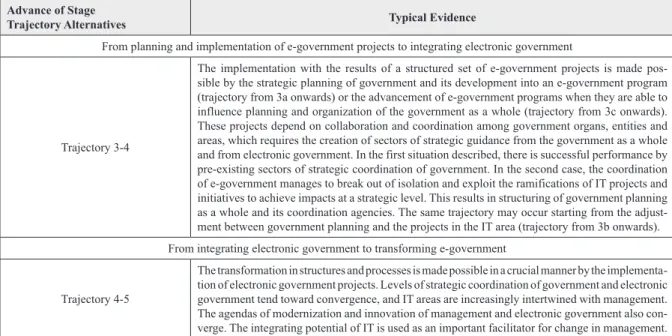
As a core purpose of this research, an attempt was made to refine and operationalize the integrated model for detailed analysis of e-government pro-grams and their institutional inclusion, incorpo-rating evidence from recent surveys of Brazilian state experiences (Fernandes, 2006). With this in mind, the stages of development of electronic government defined by Davison et al. (2005) were itemized as typical sets of evidence, systemati-cally defined on the basis of the model (Table 1). The construction of a descriptive framework of the trajectories (Table 2) sought to go beyond the elaboration of the formulators of the model, characterizing them in more detail with a vision to their inclusion in the research.
The first evolutionary stage of maturation is the configuration of electronic government as mere “rhetoric” (1) and not as effective public policy. The second stage may adopt one of three configurations: strategic vision of government (2a); vision of electronic government (2b) or focus on systems (2c). The third stage may also adopt one of three configurations: strategic
plan-ning of government (3a); maladjustment between government strategy and e-government (3b), or automating e-government (3c). The next stage is integrating e-government (4) and the final stage is transforming e-government (5). The typical
characteristics of these configurations of matu-rity stages of e-government are presented in Table 1.
The temporal sequencing between the configu-rations of stages results in alternative trajectories of
Table 1. Typical evidence of configurations of the stages of electronic government
Stage/Configurations Typical Evidence
1. “Rhetoric”
Initiatives such as the creation of service and information sites on the Internet occur in an isolated manner conducted by organs and enti-ties or as mere institutional disclosure of government. The organization and manner of operation of the IT area is traditional, inserted as a specialized tool or technical service.
2a. Strategic vision of government
The government has a clearly formulated and widely known strategic vision that identifies, gives unity and directs the administration toward transformation of the infrastructure, processes and culture. However, taking advantage of the potential of electronic government is not incorporated in this vision.
2b. Vision of electronic government
There is a strategic vision of e-government, but it is not based on a vision of government as a whole. The implementation of electronic government is hampered by the lack of strategic alignment of government.
2c. Focus on systems
Typical projects and initiatives of e-government are implemented in a sectorialized manner: service and information sites on the Internet, intranets, electronic mail (e-mail) and sectorial systems and databases. There is not a strategic vision of its alignment with overall public ad-ministration and government policy. These projects are limited in their scope and effectiveness due to the lack of coordination and integration.
3a. Strategic government planning
The planning of government objectives and goals includes electronic government. This planning expresses a strategic vision and is effective in its implementation, resulting in an e-government program aligned with the priorities of the government as a whole.
3b. Maladjustment between government strategy and electronic government
The lack of a strategic vision and planning of IT policy leads to the implementation of projects without the integrating and transforming potential of electronic government. There is a misalignment between government vision and planning and IT projects and initiatives. This situation can be attributed either to the strategic vision of government as a whole, or to the sectorialized deployment of IT projects.
3c. Automating electronic government
There is an e-government policy structured around strategic vision and planning of IT. Within the scope of this policy, there is a partial implementation of comprehensive projects in its development, with potential impacts on the entire structure of public administration: a unified portal of information and services; integration of systems and databases; government intranet (information highway) and electronic communication (e-mail and others). The implementation of this policy is limited by its isolation in the IT field.
4. Integrating electronic government
E-government policy is structured around a strategic vision and planning of IT, aligned with the vision and planning of the government as a whole. There is an advanced implementation of e-Government projects mentioned in stage 3c, spurred on by coordination and collabora-tion among agencies and entities. These projects create impacts on the entire structure of public administracollabora-tion, notably via standards for electronic services; integrated electronic systems and services involving systems and sectors; and information highway, government intranet and electronic communication throughout public administration.
5. Transforming electronic government
E-government policy and government policy as a whole aligned their strategic vision and planning, thereby enabling projects with an impact on government performance. These projects require prior restructuring of organs and entities geared to the integration between processes. A set of projects in advanced implementation includes: integration between unified attendance desk services; virtual organizational networks in strategic areas; electronic services for problem-solving with back office automation; electronic transactions; government intranet with telephone link-up and dissemination of virtual communication tools.
Table 2. Typical evidence of alternatives of maturation trajectories
Advance of Stage
Trajectory Alternatives Typical Evidence
From “rhetoric” to the insertion of electronic government in the government agenda Sequence of trajectory 1 - 2
From “rhetoric” to a strategic vision of government
Trajectory 1-2a
The government decides to formulate a transforming strategic vision, but there is no intention to adopt electronic government. The activities and projects in the IT area continue following the traditional model. Initiatives to provide services and information on the Internet continue to occur in an isolated and sporadic manner.
From “rhetoric” to a strategic vision of electronic government
Trajectory 1- 2b
The intention to adopt electronic government is demonstrated in strategic management agencies or organs of the administration, leading to the decision to formulate a strategic vision of e-government. That vision remains limited to the areas involved with IT management.
From “rhetoric” to a “focus on systems”
Trajectory 1-2c
Sporadic and isolated initiatives advance toward the implementation of projects and actions of electronic government, upon the initiative of the IT areas or organs and entities with entrepreneurial skills and resources.
From inclusion in the government agenda to planning and implementation of e-government projects Sequence of trajectory 2-3
From a strategic vision of govern-ment to e-governgovern-ment inserted in
strategic planning Trajectory 2a-3a
The transforming strategic vision requires the incorporation of IT as an enabling component of the integration and transformation of structures and processes. Consequently, the strategic planning of objectives and goals includes a series of e-government projects, aligned with government priorities. From a strategic vision of
govern-ment to strategic planning discon-nected from e-government projects
and initiatives Trajectory 2a-3b
The transforming strategic vision does not assimilate the potential of IT. Strategic planning does not include e-government projects as a central and priority issue. IT projects and initiatives are formulated in alignment with government planning, albeit without a long-term vision, thus falling short of its transforming potential.
From a strategic vision for e-gov-ernment to electronic gove-gov-ernment inserted in strategic planning
Trajectory 2b-3a
The strategic vision of electronic government spurs on and influences the construction of compre-hensive and transforming strategic planning of government. Consequently, the strategic planning of government objectives and goals is aligned with the vision of electronic government.
From a strategic vision for e-government to automating electronic
government Trajectory 2b-3c
The strategic vision of electronic government guides the formulation and implementation of e-gov-ernment projects. These projects are conducted by different bodies and mechanisms of coordination and networking among agencies and entities that are restricted to the IT field.
From a “focus on systems” to auto-mating e-government
Trajectory 2c-3c
The performance of IT areas or of departments or organs responsible for computerization projects with horizontal impacts promotes progress toward electronic government as emerging policy and planning, albeit without support in government planning as a whole. These areas and/or agencies strengthen their integration into government with the formulation of strategic planning for IT that incorporates the concepts of electronic government. The projects are increasingly formulated and implemented in alignment with comprehensive e-government planning, but this policy remains limited. From a “focus on systems” to the
implementation of e-government projects and initiatives
Trajectory 2c-3b
The performance of IT areas or agencies responsible for computerization projects enables the ad-vance of projects to incorporate the concepts of electronic government, but government planning and its priorities are obstacles to projects with such characteristics. Consequently, its performance tends to be entrepreneurial in style, with the occupation of spaces and mobilization of support and resources to make projects viable with horizontal impacts on the whole public administration area. Unlike the 2a-3b trajectory, the projects incorporate an advanced vision of IT that finds no support in the planning of government as a whole.
maturation of e-government, as per the description presented in Table 2. Eleven alternative trajectories that are distributed throughout the four sequences of advancement from one stage to another more advanced stage were systematically devised.
Then, from mere “rhetoric,” e-government can be included in the government agenda as part of a strategic vision of government (trajectory 1-2a); as a strategic vision of electronic government (trajectory 1-2b); or as projects and actions with components of e-government implemented in isolation (trajectory 1-2c).
The advance from the inclusion in the agenda to the structuring of e-government plans and projects can occur via different trajectories: the inclusion of e-government as a government plan-ning program supported by a strategic vision of government (trajectory 2a-3a) or a strategic vi-sion of electronic government (trajectory 2b-3a); the implementation of projects and initiatives of e-government planning disconnected from government planning as a whole, due to the lack of a vision of electronic government (trajectory 2a-3b) or the absence of vision and planning of the government as a whole (trajectory 2c-3b); and
lastly, the implementation of e-government as a structured program based on a strategic vision of the theme (trajectory 2b-3c), or an advance in e-government projects and initiatives for their horizontal dissemination, although without the backing of global government planning (trajec-tory 2c-3c).
The trajectories between the configurations of stage 3 and 4 and between stages 4 and 5 do not allow for alternatives. In the first situation, it is a question of evolving from projects or a pro-gram in e-government being implemented to the generation of impacts on the integration between government organs, entities and areas, spurred on by IT (trajectory 3-4). Advanced integration, with the transformation of structures and processes that provide new organizational models, marks the transition to a stage of greater e-government maturity (trajectory 4-5).
METHODOLOGY
This research is a multiple case study focused on the application of a model for analysis of the
Advance of Stage
Trajectory Alternatives Typical Evidence
From planning and implementation of e-government projects to integrating electronic government
Trajectory 3-4
The implementation with the results of a structured set of e-government projects is made pos-sible by the strategic planning of government and its development into an e-government program (trajectory from 3a onwards) or the advancement of e-government programs when they are able to influence planning and organization of the government as a whole (trajectory from 3c onwards). These projects depend on collaboration and coordination among government organs, entities and areas, which requires the creation of sectors of strategic guidance from the government as a whole and from electronic government. In the first situation described, there is successful performance by pre-existing sectors of strategic coordination of government. In the second case, the coordination of e-government manages to break out of isolation and exploit the ramifications of IT projects and initiatives to achieve impacts at a strategic level. This results in structuring of government planning as a whole and its coordination agencies. The same trajectory may occur starting from the adjust-ment between governadjust-ment planning and the projects in the IT area (trajectory from 3b onwards). From integrating electronic government to transforming e-government
Trajectory 4-5
The transformation in structures and processes is made possible in a crucial manner by the implementa-tion of electronic government projects. Levels of strategic coordinaimplementa-tion of government and electronic government tend toward convergence, and IT areas are increasingly intertwined with management. The agendas of modernization and innovation of management and electronic government also con-verge. The integrating potential of IT is used as an important facilitator for change in management.
trajectory development of electronic government in five Brazilian states. The choice of a case study research strategy is based on the complexity and profusion of factors and circumstances that affect government policies with a transversal impact and range, such as electronic government (Yin, 2001; Vergara, 2005). The multiple case study enables the comparison and identification of criti-cal factors for development of these experiences, particularly the association between these factors and the stages of electronic government.
The research drew on documentary sources and people linked to the organs responsible for e-government programs. Semi-structured interviews were conducted between October and December 2006, based on a list of open questions, directed at eight leaders of these organs in each state. A written record was generated after each interview and ratified by the source. In addition to this, documentation collected directly or by indication of the respondents was examined. The evidence obtained from the interviews was compared with the documentation. The survey sought to provide evidence for so-called literal replication of the approach under scrutiny (Yin, 2001: 123-127). The treatment of the data was guided by iterative analysis in light of the systematic dimensions, factors and evidence in the theoretical sphere (Eisenhardt, 1989).
DESCRIPTION OF THE CASES
The description of the cases that follows focuses on the experiences of the creation and implemen-tation of electronic government through to the end of 2006 in the five states surveyed, namely Alagoas, Minas Gerais, Paraná, Pernambuco and Sao Paulo. The evidence was systematized in the form of narratives that seek to reconstruct the sequence of events and their relevant relation-ships for an analysis based on the evidence and the typical systematized trajectories unveiled in the previous section.
Alagoas: The state IT organization was the
precursor in creating the government information and service website in 1996, which was an isolated initiative that already incorporated an embryonic vision of electronic government. From 2001 on-wards, it began to deploy an information highway to serve the organs and entities of state govern-ment. The expansion of the information highway was linked to the provision of network services, especially e-mail, triggering the widespread use of micro-computers (PCs) and Internet access among state departments. The formulation of the vision of electronic government in the state emerged as an initiative of managers and technicians of that organ who during the course of 2003 successfully advocated its inclusion in the multi-annual plan-ning for the 2004-2007 period.
Electronic government was included as an activity comprising one of the basic pillars of government planning, geared to the introduction of innovations in management. An intersectorial coordination structure established in 2004 set up the departments with transversal intercommunica-tion, attributing the key role in formulating and implementing technical and operational projects to the IT sector. The IT support areas in all or-gans were also linked to a coordination structure reporting to the strategic command of electronic government.
The expansion of the information highway gained momentum with its institutional configu-ration as the government’s information highway, use of which is mandatory and which integrates all the organs bodies. Major sectorial advances have occurred in projects structured around the provision of an Internet connection: distance learn-ing; administration of management information about schools; automation and interconnection of procedures in police stations and the deploy-ment of the health information system, using the interconnection between municipalities. In the area of government procurement, an Internet portal was launched in 2005 concomitantly with organizational restructuring of the sector through
the creation of an entity providing administrative support services. The establishment of standards, supported by assessment evaluation and techni-cal support mechanisms for government sites on the Internet, began to be introduced from 2006 onwards, though a single integrating portal of information and services on the Internet has yet to be implemented.
Minas Gerais: Electronic government arose
pursuant to a request from the managers respon-sible for formulating the vision and strategic planning of the government that came into office in 2003. A survey conducted by technical consul-tants produced recommendations and the defini-tion of acdefini-tions incorporated in the government’s plan, preparation of which was completed at the end of the same year. The electronic government proposed consists of a selected set of programs submitted to an intensive system of management, controlled by government command.
The program is conducted from a unit created in 2003 in the department responsible for the planning, budgeting and administration areas, sup-ported by an intersectorial coordination structure that brings together all departments heads. In ad-dition to this, an informal structure elicits broader participation of all IT area managers in a forum for exchanging information and discussing projects. The implementation of e-government projects during the 2003-2006 period was endorsed by the political weight and transversal insertion of that department, in a context in which alignment of the organs to a policy of fiscal adjustment supported by innovations in management was sought. The department in question was also responsible for coordinating this policy.
Electronic government reported advances in the generation of managerial information afforded by the corporate systems, enhancing the control of expenses, notably via tax collection and the payroll. The creation of a shopping portal on the Internet in 2004, and the dissemination of elec-tronic bidding procedures and coordinated tenders between various organs enabled the unification
of relationship channels with suppliers and im-proved procedures, covering a significant portion of government purchases. With greater visibility, advances have also occurred in the provision of services and information via the Internet, namely a single integrating portal established in 2005, and the setting of standards, guidelines and goals for the sites linked to the portal. The integration between call centers and the single portal was an-other step forward that had a transforming impact on traditional work processes, as the call centers were unified and the attendance restructured to use information from the portal.
Paraná: The e-government policy was the
result of a specific request from the state governor in 2000, involving managers and technicians of the Office of the Governor’s Chief-of-Staff, the ombudsman, the department responsible for sci-ence and technology and the state IT company, for the development of the vision and planning of the program. In 2001, the program was formally institutionalized by a decree which defined its guidelines and coordination structure. Simulta-neously, it launched the unified information and services portal of the government on the Internet.
E-government emerged in a context of weak state planning, marked by fragmentation and the lack of a unifying vision or priorities with a mobilizing impact on the entire administra-tion. This assessment, taken from interviews, is corroborated by the absence of documentation containing the strategic vision and/or definitions of government except for multi-annual plans for budget programming that are mandatory in Brazilian public administration. This situation remained unchanged during the two subsequent government mandates after 1999.
The program is conducted at the strategic level by an intersectorial committee, from inside the Office of the Chief-of-Staff, based on working groups and on a systemic structure of coordination of all state departments, through their chief execu-tives. The bulk of the technical and operational works is carried out by the state IT company,
which plays an influential role in the articulation and formulation of projects. With a track record of solid performance in government through the provision of services on the Internet since 1995, this company has accumulated expertise in the area, coming to occupy a prominent position in the arrangements to sustain the program. Since the start of the new government mandate in 2003, the company acquired more autonomy in formulating and implementing projects, due to the exodus of personnel from the strategic coordination areas.
There has been a marked expansion and development in services offered on the Internet supported by cooperative efforts of the state IT company – responsible for updating the unified portal – along with other organs. The ongoing dissemination of data and information on the budget and public accounts has been conducted through a transparency website maintained by the government. The management of services remains fully decentralized and standards and mechanisms for monitoring and evaluation are not adopted.
The advances made in integration among systems are sectorial initiatives, a highlight in the recent period being the integration between systems in the area of collection and inspection for the control of the taxpayer’s tax situation, involving registration in the income tax and high-way department areas. Despite having a unified network infrastructure, provided by the state IT company, hiring and utilization of services remains the responsibility of each organ. The hiring of equipment and services and management of IT resources also remains fully decentralized
Pernambuco: Interest in electronic
govern-ment came in the form of precursory initiatives in the supply of connectivity, network services, communication via email and website develop-ment by the state IT company from 1995 onwards. The company incorporated Internet coordina-tion within its structure, by organizing training and disseminating events, thereby fostering the interest of state departments in the new tools and technologies. In the period prior to 1998, it
developed these services and enhanced the ex-ploitation of their potential, with the provision of public Internet access in the state library and the computerization of the official gazette. These were innovations that resulted from projects developed for clients of the company within the sphere of public administration.
The period of government between 1999 and 2002 saw the creation of a vision, in tandem with government planning, marked by an emphasis on state reform, though without specific treatment of IT in the strategic formulation of the time. Never-theless, leaders of the IT company concentrated on designing models and gaining acceptance of a comprehensive e-government program by the upper echelons of government. Transition planning for the subsequent government mandate – one of continuity, since the governor was re-elected – was marked by the explicit incorporation in early 2003 of electronic government as a program with its related structures for coordination and implementation. This e-government program was included as a support tool for the modernization of management and institutional reform in the state.
The organizational structure adopted houses the e-government program in the sector respon-sible for state reform. There are also sectors of intersectorial strategic coordination and opera-tionalization of projects and activities, the latter involving the IT areas of the departments. One notable characteristic is that this structure was created in the wake of widespread organizational restructuring of the state as part of a new design seeking to establish mechanisms for horizontal coordination between the departments and agen-cies. Moreover, the restructuring included the state IT company, which was transformed into an agency to reflect a new format for organization and action, focused on project development and outsourced procurement of services.
The creation of an inclusive information highway to integrate the organs and entities of state administration was a priority project that was completed in 2005. Since then, it has been
managed by hiring unified access and network services, with the introduction of this previously untried outsourcing model. A similar project is underway to engage services of data storage, ap-plications and equipment maintenance. The period from 2003 to 2006 saw sectorial advances in the development of electronic systems and services with the intensive use of Internet and network com-munication. These include the computerization of the highway area (State Traffic Department) and the Department of Finance, the implementation of online appointment scheduling over the Internet for the National Health System, as well as school enrollment controlled by a single computerized system for the public elementary school grid.
Corporate systems for automation of admin-istrative activities common to the organs and entities are in the process of being technologically upgraded in the areas of payroll, personnel and pur-chasing control, including the creation of services and access to information on the Internet. In the case of government procurement, the creation of a portal on the Internet gave rise to more profound change, transforming traditional procedures, with the spread of electronic bidding procedures and services to government suppliers. In general, the provision of Internet services through government websites continues to be decentralized with the consequent dispersion of initiatives. There is no progress toward creating a unified portal for in-formation and services. Similarly, the initiatives of integration between systems are still sporadic, though with important innovations such as the deployment of an integrated management system for managerial information.
São Paulo: Since 1995, there emerged a
government strategy directly geared toward tax adjustment, promoting projects and initiatives in the area of management that require coordination and transversality covering the entire state public administration. The implementation of this strat-egy has generated a demand for information and control systems with advanced IT applications. However, there was a lack of strategic vision of
electronic government at that time. The planning and building of organizational structures consis-tent with strategic IT inclusion were postponed for a prolonged period. Thus, in Sao Paulo the implementation of electronic government relied on informal arrangements and its structuring as a program only occurred in 2003.
In the period from 1995 to 1998, projects with a critical impact on the performance of tax adjustment were implemented, as they enhanced the integration and control over the entire state administration structure. A strategic information system supported the coordination of projects and priority actions under the direct control of the governor. Other systems were developed for the control of expenses with personnel and out-sourcing, and the registration of real estate and governmental actions by municipalities. These initiatives were accomplished without the use of Internet resources, using a technological infra-structure that fell far short of its needs.
In the area of finance, a major sectorial break-through was achieved during this period with the computerization of tax collection and financial administration. On the other hand, innovation in the delivery of services to citizens was introduced using what had been a highly successful precedent, though removed from the use of new IT resources, namely the unification of services in a single physical space (a project called “Poupatempo” i.e. Timesaver) was not associated with the com-puterization of procedures and use of the Internet. The construction of an information highway infrastructure with network services and the subsequent unification of procurement and man-agement of services occurred in the period from 1999 through 2002. Also during this period, the creation of online Internet auctions, combined with other support tools of government procure-ment, sparked off changes in government ten-dering procedures in all organs. The creation of government sites was relatively insignificant as a first step in e-government, though the supply of services and information over the Internet spread
widely, albeit without systematic monitoring and evaluation structures. The creation of a unified portal with advanced resources of information and navigation organization in 2005 replaced the previous portal, which had been operated using a simple redirect function
Between 1995 and 2002, the e-government initiatives were conducted by a team of multi-institutional origin, constituted within the Office of the Governor’s Chief-of-Staff subsequently converted into the government and management department. This team benefited from the ease of interaction with the whole government, as well as privileged access to the governor and the techni-cal support of the state IT company. The concern with the creation of a formal structure emerged with the distancing and subsequent death of the governor during the period from 1999 to 2001. The governor had been directly involved with e-government projects and had exercised personal leadership over them
However, the program and its organizational structure were only implemented in 2003 with the creation of an intersectorial coordination body that resulted from the transformation of the structure originally focused on management quality strategic actions. Thus, the strategic control
unified e-government with the innovation agenda in management. The technical team that had worked informally was incorporated in the new arrangement, including pre-existing IT coordina-tion units structured in a tradicoordina-tional manner. An important step was the creation of strategic-level positions in the structures of all organs and enti-ties to conduct projects in IT, giving capillarity to the operationalization of projects and activities of e-government.
Despite the inclusion and scope of this structure, the managers interviewed revealed an emerging dispute over control of the program involving the state IT company’s attempt to broaden its sphere of action and influence. This evidence indicates a possible weakening of the ties between e-government and government strategy as a whole, which might eventually result in more autonomous operation of the company and the consequent isolation of the program in the IT area.
ANALYSIS OF THE RESULTS
The configurations and trajectories followed by electronic government are quite varied, as shown in Table 3, which also indicates the level
Table 3. Configurations and trajectories of electronic government
Case Configuration
Alagoas Rhetoric (1) Focus on systems (2c) Automating electronic government (3c) Integrating electronic government (4) Minas Gerais Strategic vision of government (2a) Strategic government planning (3a) Integrating electronic government (4)
Paraná Rhetoric (1) Vision of electronic government (2b) Automating electronic govern-ment (3c) Pernambuco Rhetoric (1) Focus on systems (2c) egy and electronic government Maladjustment between
strat-(3b)
Integrating electronic government (4) São Paulo Strategic vision of government (2a) egy and electronic government Maladjustment between
strat-(3b)
Integrating electronic government (4)
Level of
of maturity attained in each state. An attempt was made to compare the evidence of the cases with the typical systematized evidence in Tables 1 and 2. The following paragraphs list the analysis on a state-by-state basis.
Alagoas: There are reports of sporadic website
creation initiatives on the Internet since 1996, revealing an early stage (“rhetoric”) of e-govern-ment. The deployment of the information highway and network services from 2001 onwards repre-sents an innovative mode of intervention by the state IT agency, which is geared to transversal projects and focused on the customer. This marks the transition to evolution to the “focus on systems” stage (2c). The formulation by the IT organ of a strategic vision of electronic government and commitment to its assimilation by government planning as a whole indicates progress to the next stage, namely “automating electronic govern-ment” (3c) in the course of 2003. The incorpora-tion of e-government to statewide planning and concomitant creation of its strategic coordination structures marks the transition to “integrating electronic government” (4). Projects that depend on intersectorial coordination, such as the creation of a unified shopping portal, standardization of government websites and consolidation of the information highway, are associated with this stage in Alagoas.
Minas Gerais: No evidence was collected of
a precursory stage (1) in Minas Gerais. Electronic government emerges in the course of 2003, due to the need perceived during the discussion of the strategic vision of the government to focus on IT and its potential. This short stage can be construed as that of the “strategic vision of government” (2a), the dynamic of which is moving towards the incorporation of e-government projects to the planning of priority actions of the government as a condition for making that vision viable. How-ever, there is temporal simultaneity between the construction of the strategic vision of government, carrying out a diagnosis of the IT area, strategic government planning and the decision on priority
projects. Thus, the stage of “strategic government planning” (3a) does not fit in sequentially and is hardly distinguishable from the previous stage (2a). Similarly, the integrating electronic govern-ment (4) has already been mapped out since 2003, with the creation of coordination structures and the e-government program. Evidence of implementa-tion of projects based on the integraimplementa-tion between organs and entities are identified after 2004, with the unified information and service portal and the government procurement portal.
Paraná: Since 1995 there were precursory
initiatives by the state IT company, especially the creation of a website on the Internet. In 2000, the creation of an e-government policy was requested by the governor, but it was disconnected from the vision and planning of government. This situation can be classified as the “vision of electronic gov-ernment” stage (2b), which in the case of Paraná was unable to elicit the construction of more comprehensive planning. The implementation of a unified government portal, already in construc-tion by the state IT company, occurred simulta-neously with the creation of the e-government program and its coordination structure in 2001. The “automating electronic government” stage (3c) was outlined since then, with the weaken-ing of the strategic coordination throughout the subsequent period. The weakness of government planning has led to a more autonomous role of the state IT company, accentuating the isolation of electronic government. The implementation of integrating projects such as the unified portal and the information highway are operating below their potential, possibly due to a lack of coordination capacity over government as a whole.
Pernambuco: Precursory initiatives had
oc-curred since 1995, with intense activity of the state IT company that evolved from isolated and experimental projects, associated with the first stage of electronic government (“rhetoric”) to the effective dissemination of models, tools and services typical of electronic government. The advance to the “focus on systems” stage (2c) can
be associated with the introduction of advanced projects of electronic services, witnessed by the computerization of transactions and the publica-tion of the official gazette. However, it is not pos-sible to define precisely the beginning of that stage. The performance of the state IT company remains isolated, though during the period of government between 1999 and 2002, the leaders advocated the need for an e-government program in a context in which the government was building its strategic vision and planning geared toward the reform of the state. Thus, this period is associ-ated with the configuration of a “maladjustment between government strategy and systems of e-government” (3b), the main characteristic of which seems to be the dispute and possible resistance to assimilation of electronic government at the strategic decision level. From 2003 onwards, the creation of the program and the structures for its coordination and the subsequent restructuring of the IT area throughout the state administration are a clear indication of the emergence of “integrating electronic government” (4). However, the profile of the progress achieved since then indicates a certain prevalence for actions for the construction of infrastructure in relation to developments in electronic government services. Taking advantage of the installed infrastructure in the development of electronic government services is recommended for the maturation of this experience and progress-ing to the next stage.
São Paulo: There is no precursory stage seen in
the trajectory of São Paulo, because the assimila-tion of new informaassimila-tion and communicaassimila-tion tech-nologies and the Internet in particular occurs out of step in relation to the needs arising from a strong strategic vision and planning of government. In the period from 1995 to 1998, this strategic vision emerges at the same time that IT projects critical to the performance of government are implemented, though without vision and planning of electronic government. Throughout this period, projects for information and control and network communica-tions systems are implemented through an informal
arrangement and without a strategic horizon in IT. Nevertheless, the projects are successful, but the state does not advance in a planned manner in the construction of infrastructure, systems and electronic government services, despite many sectorial achievements. Thus, the stage of “mal-adjustment between government strategy and electronicgovernment systems” (3b) was present since 1995 and is indistinguishable from the previ-ous stage (“strategic vision of government” – 2a), because the implementation of priority projects and actions occurred since the beginning of the government that same year. The creation of the e-government program and its convergence with the management modernization program occurred in 2003 during the third continuity mandate. It is then configured at the “integrating electronic government” stage (4). The prolonged period of misalignment indicates the effectiveness of the informal arrangement adopted, but meant that poor strategic advantage was taken of the synergies between innovative actions in management and electronic government, witnessed by the creation and dissemination of “Poupatempo” disconnected from the Internet. In addition to this, it weakened the strategic performance of government, which saw the advance of e-government projects though without institutional support for their long-term continuity, generating disputes over their control since 2005.
CONCLUSION
This chapter applied a comprehensive framework for analyzing the development of electronic gov-ernment, incorporating components and factors related to the organizational strategy and structure. The evidence gathered supports the hypothesis that the construction of a strategic vision, planning and organizational coordination structures accompany the experiences of electronic government that ad-vance through to the deployment of more complex projects. These projects depend on collaboration
and coordination between the organs and at the same time deepen the integration between them and their customers. The contrast between the case of Paraná and the others is clear proof of this: it is the only state that has not advanced to the “integrating electronic government” stage due to the weakness of its government strategy.
The alignment between strategy and electronic government as a critical factor for advancement to higher stages of maturity is found in the trajectories of Pernambuco and São Paulo. The circumstances in both cases are different, indicating that dispari-ties can occur as much from lack of support at the strategic level for advancement or making e-government projects viable (Pernambuco), as from accepting informal arrangements for the conduct of electronic government (São Paulo).
The model outlined in the theoretical refer-ences has proved effective in the systematization of chains of events assumed for the formulation of vision and planning, the creation of organiza-tional structures and project implementation. The cases support the premise that the sequences are not necessarily linear and, indeed, a trajectory based on a formalist and rational sequencing seems unusual. This trajectory, which assumes the vision-planning-implementation-organization sequence, was only found in Minas Gerais, though with the stages being almost simultaneous or even chronologically merged.
In all the cases investigated, a certain amount of difficulty was encountered in defining the transition between stages of the second level (“strategic vision of government”, “vision of electronic government” and “focus on systems”) and the third level (“strategic government plan-ning,” “automating electronic government” or “maladjustment between government strategy and electronic government”). The rapid progres-sion to stage 4 indicates that deciprogres-sion styles with characteristics of flexibility, informality and focus on results seem surprisingly more frequent in Brazilian public administration.
It should be pointed out that the framework itself loses credibility in its ability to categorize and identify factors affecting the trajectory of electronic government, because the probable differences in performance and perhaps the most important obstacles to the maturation of these ex-periences are concentrated in stage 4. A possible improvement of this framework should therefore examine the analytical denouement of “integrat-ing electronic government,” seek“integrat-ing factors that enable the comparison of experiences located at this same stage.
As inferences on the cases and their respective trajectories that can inspire further research, it is clear that the different configurations assumed at each stage affect the subsequent stages in different ways. It is in this sense that electronic government reveals a greater tendency towards projects geared to infrastructure – especially the construction of information highways – in cases starting out at the “focus on systems” stage, namely Alagoas, and even more characteristically, Pernambuco. In both cases, the state agency responsible for IT in public administration played a key role in the emergence of e-government policy.
The cases that originated from the strategic needs of government resulted in the rapid imple-mentation of projects, the results of which were deemed to be critical to the overall performance of governments. This is seen clearly in Sao Paulo, though it also occurred in Minas Gerais with projects that generated a reduction in costs and an improvement in controls and management. One question suggested by the analysis of these experiences is to what extent “skipping steps” in Minas Gerais or implementation expedited by informal arrangements in São Paulo, eventually weaken the long-term consolidation of electronic government.
The case that originated from the construction of a vision of electronic government that does not “contaminate” government strategy as a whole – exemplified by Paraná – did not evolve very favorably as an isolated program that failed to
reach the stage of “integrating electronic govern-ment” (4). The impact of the strategic weakness of the government on that trajectory has already been mentioned. Its probable evolution will be towards a resumption of control by the state IT company, which already appears to be happening. The emergence of the program from the IT area is therefore a circumstance to which the tendency to isolation and greater difficulty in providing strategic breadth to the program may be attributed.
REFERENCES
Accenture (2002). E-Government Leadership –
Realizing the Vision. The Government Executive
Series.
Burn, J., & Robins, G. (2003). Moving towards eGovernment: a case study of organizational change processes. Logistics Information Management,
16(1), 25–35. doi:10.1108/09576050310453714
Commission (2003). The Role of eGovernment for
Europe`s Future, Communication from the
Com-mission of the European Communities, Brussels Chandler, A.D. (1962). Strategy and Structure. New York: Doubleday
Davenport, T. H. (1994). Reengenharia de
proces-sos. São Paulo: Campus.
Davison, R. M., Wagner, C., & Ma, C. K. (2005). From government to e-government: a transition model. Information Technology & People, 18(3), 280–299. doi:10.1108/09593840510615888 Deloitte Research. (2000). At the Dawn of
E-Government. New York: Deloitte Consulting.
Eisenhardt, K. M. (1989). Building theories from case study research. Academy of Management
Review, 14(4), 532–550.
Fernandes, C. C. C. (2006). Governo Eletrônico. In: FUNDAP/CONSAD. Avanços e Perspectivas
da Gestão Pública nos Estados. Foundation for
Administrative Development / National Council of Federal State Management Secretaries, 135-167 Fernandes, C. C. C. & Pinto, S. L. (2003). Sociedad de la Información en Brasil: balance y perspec-tivas. Nueva Sociedad (187),153-168
Fountain, J. E. (2001). Building the Virtual State:
Information Technology and Institutional Change.
Washington, D.C.: Brookings.
Hammer, M., & Champy, J. (1993). Reengenharia.
S. Paulo. Campus.
Heeks, R. (2001). Understanding e-Governance
for Development. i-Government Working Paper
Series, 11
Henderson, J. C., & Venkatraman, N. (1993). Stra-tegic alignment: leveraging information technol-ogy for transforming organizations. IBM Systems
Journal, 32(1), 4–16. doi:10.1147/sj.382.0472
Kraemer, K., & Dedrick, J. (1997). Computing and public organizations. Journal of Public
Ad-ministration: Research and Theory, 7(1).
Kraemer, K. L., & King, J. L. (1986). Computing and Public Organizations. Public Administration
Review, (46): 488–496. doi:10.2307/975570
Kraemer, K. L., & King, J. L. (2005). Informa-tion technology and administrative reform: will e-government be different? International Journal
of Electronic Government Research, 2(1).
Marche, S., & Mcniven, J. D. (2003). E-govern-ment and e-governance: the future isn’t what it used to be. Canadian Journal of Administrative
Scienc-es, 20(1), 74–86. doi:10.1111/j.1936-4490.2003.
tb00306.x
Margetts, H. (2003). Electronic Government: a revolution in public administration? In Peters, B. G., & Pierre, J. (Eds.), Handbook of Public
Markus, M. L., & Robey, D. (1988). Informational technology and organizational change: Causal structure in theory and research. Management
Sci-ence, 34(5), 583–594. doi:10.1287/mnsc.34.5.583
OECD. (1998). Information Technology as an
Instrument of Public Management Reform: a Study of Five OECD Countries. Paris: Organization for
Economic Co-operation and Development OECD. (2003). The E-Government Imperative. E-Government Studies. Paris: Organization for Economic Co-operation and Development PNAGE (2004). Diagnóstico Geral das
Adminis-trações Públicas Estaduais. Ministry of Planning,
Budget and Management, 2004
PWC. (2002). Estudo de Benchmarking Global
em e-Government. Price Waterhouse & Coopers.
Saur, R. (1997). A tecnologia da informação
na reforma do estado. Ciência da Informação, 26(1). Jan/Apr.
Snellen, I. (2000) Public Service in an Informa-tion Society. In: Peters, B. G. and Savoie, D.
Governance in the Twenty-first Century:
Revital-izing the Public Service. Montreal & Kingston: McGill-Queen’s University Press
UKP-POST. (1999). Electronic Government -
In-formation Technologies and the Citizen. London:
United Kingdom Parliament - Parliamentary Of-fice of Science and Technology.
UN/DPEPA-ASPA. (2002). Benchmarking
E-government: A Global Perspective. York: United
Nations / Division for Public Economics and Public Administration - American Society for Public Administration. N.
Vergara, S.(2005). Métodos de pesquisa em
ad-ministração. S. Paulo: Atlas
Yin, R. K. (2001). Estudo de caso – planejamento