Adherence to the Mediterranean
Dietary Pattern and associated
factors among adolescents from Vila
Nova de Gaia
Fatores associados à adesão ao Padrão
Alimentar Mediterrânico em
adolescentes de Vila Nova de Gaia
Inês Alexandra da Silva Jorge
ORIENTADO POR: Prof.ª Doutora Sara Rodrigues
COORIENTADO POR: Dr.ª Maria Antónia Ruão e Dr.ª Mariana Rei
TRABALHO DE INVESTIGAÇÃO
1.º CICLO EM CIÊNCIAS DA NUTRIÇÃO | UNIDADE CURRICULAR ESTÁGIO
FACULDADE DE CIÊNCIAS DA NUTRIÇÃO E ALIMENTAÇÃO DA UNIVERSIDADE DO PORTO
TC
Abstract
Introduction: The Mediterranean Dietary Pattern (MDP) is proven to be one of the
healthiest dietary models, with strong health benefits. Although adolescence is a crucial phase for the acquisition of healthy food habits that persist into adulthood and have large impact on health, the MDP is being abandoned by younger generations in Mediterranean countries.
Aim: To analyze the adherence to the MDP and its associated factors in a sample
of adolescents from Vila Nova de Gaia (VNG).
Methods: The sample consisted of 185 adolescents aged between 10 and 19 years
from VNG. Socio-demographic and anthropometric data was gathered, and the KIDMED Index was self-administered to evaluate the adherence to the MDP.
Results: Most adolescents showed a low/moderate adherence to the MDP (63,2%).
Age and parents’ educational level were the utmost factors positively related with the possibility of optimal MDP adherence. However, sex, school location, number of household members and BMI were not confirmed to have significant influence over MDP adherence levels.
Conclusions: These results highlight the importance of the parents’ education
level in adolescents’ MDP adherence, allowing the identification of the priority groups for a possible intervention, namely, the younger adolescents and those whose parents show a lower educational level.
Keywords: Mediterranean Dietary Pattern, Adolescents, KIDMED Index, Nutritional
ii
Resumo
Introdução: O Padrão Alimentar Mediterrânico (PAM) é, comprovadamente, um
dos modelos alimentares mais saudáveis com fortes benefícios a nível de saúde. Apesar da adolescência ser uma etapa crucial para a aquisição de hábitos alimentares saudáveis que persistem na fase adulta, tem-se verificado um abandono progressivo do PAM pelas gerações mais jovens dos países mediterrânicos.
Objetivo: Analisar os fatores associados à adesão ao PAM de uma amostra de
adolescentes de Vila Nova de Gaia (VNG) através do Índice KIDMED.
Metodologia: A amostra foi constituída por 185 adolescentes de VNG, com idades
compreendidas entre os 10 e 19 anos. Foram recolhidos dados sociodemográficos e antropométricos e foi autoadministrado o Índice KIDMED para avaliar a adesão ao PAM.
Resultados: A maioria dos adolescentes apresentou adesão baixa/moderada ao
PAM (63,2%). A idade e o nível de escolaridade dos pais foram os fatores mais relacionados positivamente com a possibilidade de adesão ótima ao PAM. Contudo, não se confirmou que o sexo, localização do agrupamento de escolas, número de elementos do agregado familiar e classificação do IMC tivessem influência significativa no nível de adesão ao PAM.
Conclusões: Estes resultados permitem realçar a importância do nível de
escolaridade dos pais na adesão ao PAM dos adolescentes, permitindo identificar os grupos prioritários para uma possível intervenção, nomeadamente, os adolescentes mais novos e aqueles cujos pais apresentam menor nível educacional.
iv
Acronyms
BMI – Body Mass Index
DGE – Direção Geral de Educação
ISPUP – Instituto Superior de Saúde Pública da Universidade do Porto MDP – Mediterranean Dietary Pattern
VNG – Vila Nova de Gaia
Abstract ...i Resumo ... ii Acronyms ... iv Table of content ... v Introduction ... 1 Aims ... 3 Methods ... 3 Results ... 6 Discussion ... 10 Conclusion ... 14 Acknowledgements ... 16 References ... 17 Appendix ... 22
Introduction
The Mediterranean Dietary Pattern (MDP) includes nutritional and socio-cultural aspects typical of the countries with Mediterranean features, reflecting the great diversity of cultures and traditions(1). However, some dietary characteristics stand
out: (I) the prevalent consumption of plant-based food, such as vegetables, fruit, whole grain cereals, pulses and nuts; (II) the use of olive oil as the main source of fat; (III) the moderate intake of dairy products, mainly yogurt and cheese; (IV) the moderate consumption of fish and eggs; (V) the low intake of meat, preferring poultry meat over red meat that is reserved only for special occasions and (VI) the low to moderate wine intake with main meals(2-4). Traditionally, the predominant
cooking techniques were stews and soups typically seasoned with olive oil and aromatic herbs(2). In addition to the dietary characteristics and cooking
techniques, the MDP also includes the choice of fresh and local products that respect seasonality and biodiversity(1, 4, 5), socializing with family and friends
during the mealtime, as well as sharing recipes from generation to generation(2, 4).
Currently, it is known that an optimal adherence to the MDP is associated with better control and lower risk of developing different types of chronic and degenerative diseases with a possible effect on increasing life expectancy and quality of life(6-13). Specifically, in adolescents, a higher level of adherence to the
MDP may be related to enhanced quality of life and well-being(14) as well as
improved cognitive skills(15) and, consequently, better academic performance(16).
Similarly, there also seems to be an inverse relationship between the adherence to the MDP and body mass index (BMI)(17, 18), waist circumference,(17) and total
2
body fat(17). Despite all these benefits, over the past few years, MDP has been
abandoned by young people in Mediterranean countries(19-24). On the other hand,
a “Western” dietary pattern, richer in saturated fat, refined cereals and processed food(25) has emerged(26-28). This phenomenon is called “Nutrition Transition” and it
is associated with an increased prevalence of overweight and obesity(2, 24, 28). In
Portugal, this trend is also present(29) in children and adolescents, noticing low
levels of adherence to the MDP(30, 31), although studies about this subject are still
scarce. Moreover, adolescence is a transition stage in which psychological, social and physiological changes of great importance take place. Eating habits acquired during this phase are crucial as they usually persist in adulthood and can have an impact on the future health of the individual(32-34).
Internationally, in the past few years, several studies have been carried out to understand the factors associated with the dietary habits of children and adolescents. Hence, scientific evidence highlights the influence of the socioeconomic level over the eating habits of the younger population(17, 21, 35, 36),
as well as the educational level of parents(18, 20, 21, 37, 38), especially the mother’s
education(21, 23, 39-41). Age(23, 40, 42) and the living place (rural or urban
environment)(21, 43, 44) also seem to play a preponderant role. With this information
in mind, it is essential to study the factors associated with MDP adherence in Portuguese adolescents to design and develop public health intervention programs that can minimize the impact of “Nutrition Transition” and the associated diseases and maximize adherence to the MDP, since it is a healthy dietary pattern with proven benefits(45-48).
Aims
This study aimed to analyze the adherence to the MDP and its associated factors in a sample of adolescents from Vila Nova de Gaia (VNG). In particular, it is intended to:
1) Evaluate the adherence to the MDP in a sample of adolescents from VNG, trough the KIDMED Index;
2) Determine the association between the KIDMED Index Score and the following variables: age, sex, BMI by age and sex, location of the school (coast versus inland), adolescent’s school year, parents’ education level, total household monthly income and number of household members.
Methods
Ethics
The present research work used secondary data from the Master’s Dissertation in Health Education entitled “Reprodutibilidade e validade do Índice KIDMED numa amostra de adolescentes portugueses” whose execution obtained the approval of the Ethics Committee of Instituto de Saúde Pública da Universidade do Porto (ISPUP), the authorization of the Direção Geral de Educação (DGE) through the system of monitoring surveys in the school environment (registration number 0702600001), the authorization of the school directors, the authorization of the parents and adolescents, and the authorization of the author to use the KIDMED Index.
4
The study population was composed of adolescents attending the 5th to the 12th
school grade in the city of VNG. Of the total 14 public school groups in VNG (convenience sample), the 5 that had both primary school and high school were chosen. From these 5 school groups, the nearest (more urban) and the furthest (more rural) from the coast were selected to obtain a sample as heterogeneous as possible. Within the schools included, the students' classes were randomly selected and all the students in these classes were considered as potential participants.
In total, the sample included 185 adolescents aged between 10 and 19 years with Portuguese nationality, with no special educational needs that would prevent them from completing data collection independently and without special diets (for example, vegetarianism) or conditioned by diseases (such as celiac disease).
Data collection
Data collection was performed during the school period, from January to March 2020.
The personal data of each participant was initially collected, namely, sex, age, weight and height (self-reported), location of the school (coast versus inland), adolescent’s education, father’s education, mother’s education, total household monthly income and composition.
Regarding the education of the mother and the father, students had to indicate whether they had completed the 1st cycle of primary school, 2nd cycle of primary
school, 3rd cycle of primary school, high school, Bachelor, Master or Doctorate.
For household composition, adolescents had to report the number of people living in the same house permanently. In relation to the total monthly income of the
household, students had the option to select “0-499€”, “500-999€”, “1000-1999€”, “>2000€” or “Don’t know/No answer”.
Using the reported weight and height data, BMI was calculated using the following formula: [body weight (kg)/height2 (m)]. Then, the BMI percentiles for sex and age
were determined according to the World Health Organization (WHO)(49) reference
growth curves for children and adolescents aged 5-19 years. BMI of adolescents was then classified as underweight (P<3), normal weight (P3-P85), pre-obesity (P85-P97) or obesity (P>97).
To measure adherence to the MDP, the KIDMED Index was used. A translated and adapted version(50) derived from the original one developed by Serra-Majem et
al(36) was self-administered to the target population. KIDMED is an index based on
MDP principles consisting of 16 closed-ended questions, with the associated score ranging from 0 to 12. Questions with a negative connotation with MDP adherence are scored -1 point, while questions with a positive connotation are scored +1 point. The sum of the scores for all the questions allows the classification of the adherence to the MDP as low (≤3 points), moderate (4-7 points) and high/optimal (≥8 points)(36).
Statistical analysis
The statistical analysis was performed through the software SPSS ® version 26.0 for Windows. The descriptive analysis consisted of calculating the mean and standard deviation as well as the minimum and maximum values of cardinal variables and absolute frequencies for nominal and ordinal variables. As the sample size was greater than 100, the cardinal variables’ normality was analyzed
6
through the Skewness and Kurtosis coefficients so that the most appropriate statistical tests could be applied. The null hypothesis was rejected when the significance level (p) was less than 0,05.
The “Adherence to the MDP” was transformed into a dichotomous variable by combining participants with low and moderate adherence into a single category, hence this variable was left with 2 groups: “Low/Moderate adherence” and “High adherence”. Furthermore, the “Parents’ education” variable was created by selecting the highest degree of school education completed by both parents. In the same way, due to the low number of participants, those in the “Underweight” category (n=2) were excluded and “BMI classification” was divided into 3 groups: “Normal weight”, “Pre-obesity” and “Obesity”.
The degree of association between pairs of variables was evaluated by Pearson’s (r) and Spearman’s (ρ) correlation coefficients.
The Student’s T-Test and the Fisher’s Exact Test were used for comparing means and proportions of independent samples, respectively.
Binary logistic regression was performed to identify the independent variables that are associated with the level of adherence to the MDP, the 95% confidence intervals (95% CI) and the respective Exp (β) were also calculated.
Results
Sample characterization and adherence to the MDP
The sample consisted of 185 adolescents, mostly female (60%), with an average age of 13,85 ± 2,46 years and 24,9% of students attending the 2nd cycle of primary
school, 38,4% the 3rd cycle of primary school and 36,8% the high school. Regarding
the BMI classification, more than half of the sample is classified as normal weight (55,1%), 21,1% as pre-obese and 12,4% as obese.
The number of members in the household ranged from 2 to 11, with an average of 4 people. In addition, most of the adolescents (54,5%) belong to a household whose total income is between 500-1999€ per month. Furthermore, 74,1% of the parents finished primary or high school and just 22,2% concluded university degrees. Regarding MDP adherence, 63,2% of students had low/moderate adherence while 36,8% showed high adherence. The average KIDMED Index Score was 6,76 ± 2,04 points. This score was mainly because most adolescents eat breakfast every day (87,6%), consuming cereals/cereal products (76,2%) and dairy products (82,7%) at this meal. As well as due to the daily intake of one piece of fruit or natural juice (70,8%) and the intake of vegetables once a day (83,2%) (Appendix A – Table 1).
Factors associated with MDP adherence
It was observed that the proportion of MDP adherence is associated with the school year attended by the adolescents (p=0,044) and the education level completed by their parents (p=0,001). It was found that most adolescents who had a low/moderate adherence to the MDP (41,9%) attended the 3rd cycle of primary
school. Of the students with high adherence to the MDP, 48,5% attended high school (Table 2). It was also reported that 47,7% and 36,0% of adolescents with low/moderate adherence to the MDP have parents who only finished primary school and high school, respectively. Of the adolescents who show high adherence to the MDP, 44,8% and 34,3% have parents who completed high school and graduated from university, respectively (Table 2).
8
Table 2- Characterization of the sample according to the level of adherence to the Mediterranean Dietary Pattern (MDP) – Adolescents from Vila Nova de Gaia, 2020.
MDP adherence n (%) p Low/moderate (n=117) High (n=68) Sex Female 72 (61,5) 39 (57,4) 0,641* Male 45 (38,5) 29 (42,6) School group Coast 52 (44,4) 24 (35,3) 0,278* Inland 65 (55,6) 44 (64,7) Education Level 2nd cycle 33 (28,2) 13 (19,1) 0,044* 3rd cycle 49 (41,9) 22 (32,4) High School 35 (29,9) 33 (48,5) BMI classification Normal weight 67 (66,3) 35 (55,6) 0,384* Pre-obesity 21 (20,8) 18 (28,5) Obesity 13 (12,9) 10 (15,9) Parents’ education Primary School 53 (47,7) 14 (20,9) 0,001* High School 40 (36,0) 30 (44,8) University 18 (16,2) 23 (34,3) Total Household monthly income 0-499€ 6 (5,1) 2 (2,9) 0,585* 500-999€ 25 (21,4) 8 (11,8) 1000-1499€ 28 (23,9) 17 (25,0) 1500-1999€ 13 (11,1) 10 (14,7) >2000€ 13 (11,1) 8 (11,8) Do not know/No answer 32 (27,4) 23 (33,8)
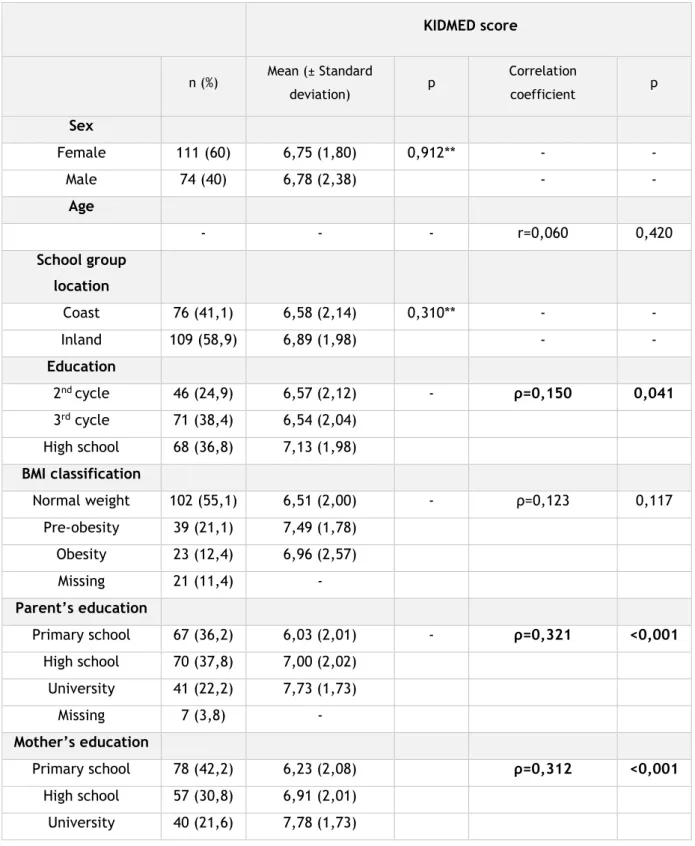
Regarding the level of association between pairs of variables, there was a statistically significant association between the KIDMED Index Score and the adolescents’ year of schooling, being positive but very weak (ρ=0,150; p=0,041); between KIDMED Index Score and mother’s educational level, also being positive and weak (ρ=0,301; p<0,001); and between KIDMED Index Score and father’s level of education, being positive and weak (ρ=0,321; p<0,001) (Appendix B – Table 3). Through the Student T-Test it was observed that there are no significant differences between the KIDMED’s Index Score and the sex of students, as well as between the KIDMED’s Index Score and the school group location (Appendix B - Table 3).
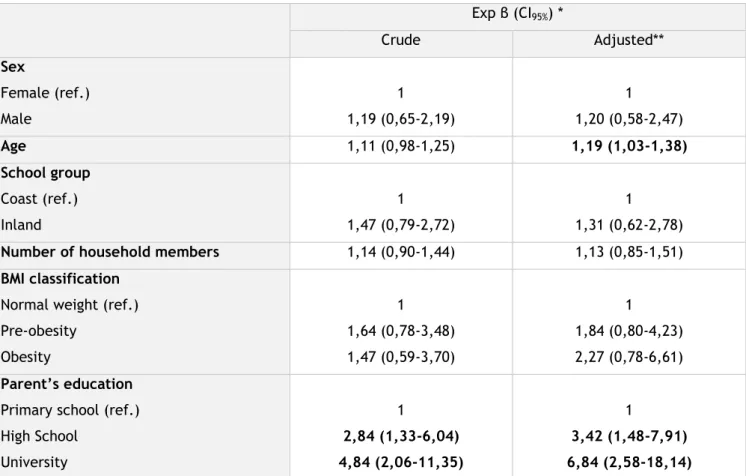
The results obtained in the binary logistic regression are in Table 4. Regarding the quality of the model, R2
N = 0,197 and p=0,699 were obtained for the adjusted
binary logistic regression.
Through unadjusted binary logistic regression, it was found that the higher the parent’s educational level, the more likely adolescents are to have a high level of adherence to the MDP. When the model is adjusted, this effect remains statistically significant, revealing that adolescents whose parents completed high school are 3,42 times more likely to have high adherence to the MDP than those whose parents only finished primary school (OR=3,42; 95% CI:1,48; 7,91). Likewise, students whose parents have completed university degrees are 6,84 times more likely to demonstrate optimal adherence to the MDP compared with students whose parents who only finished primary school (OR=6,84; 95% CI:2,58; 18,14). Regarding age, in the adjusted model, it was noticed that the older the
10
adolescent, the more likely it is to have high adherence to the MDP (OR=1,19; 95% CI: 1,03; 1,38) (Table 4).
Table 4 – Factors predicting Mediterranean Dietary Pattern (MDP) adherence - adolescents from Vila Nova de Gaia, 2020.
Exp β (CI95%) * Crude Adjusted** Sex Female (ref.) Male 1 1,19 (0,65-2,19) 1 1,20 (0,58-2,47) Age 1,11 (0,98-1,25) 1,19 (1,03-1,38) School group Coast (ref.) Inland 1 1,47 (0,79-2,72) 1 1,31 (0,62-2,78)
Number of household members 1,14 (0,90-1,44) 1,13 (0,85-1,51)
BMI classification
Normal weight (ref.) Pre-obesity Obesity 1 1,64 (0,78-3,48) 1,47 (0,59-3,70) 1 1,84 (0,80-4,23) 2,27 (0,78-6,61) Parent’s education
Primary school (ref.) High School University 1 2,84 (1,33-6,04) 4,84 (2,06-11,35) 1 3,42 (1,48-7,91) 6,84 (2,58-18,14) * From Binary logistic regression models; ** Adjusted for all variables present in the table
Discussion
The results of this study highlight the need to improve MDP adherence among adolescents from Vila Nova de Gaia, as the large majority (63,2%) have low/moderate adherence and only 36,8% of the sample can be classified as having high adherence to the MDP. These results are in line with others obtained in the north of Portugal, where only 42,1% and 40,8% of the adolescents showed high adherence to MDP, respectively(31, 51). Interestingly, a study carried out in a sample
aged between 11 and 16 years old from Algarve, reports a much higher level of adherence to the MDP than the present study. Thus, 52,5% of adolescents from Algarve show optimal adherence to the MDP and only 5,4% are considered as having a low adherence(52).
The need to improve adherence to the MDP of adolescents crosses several Mediterranean countries. In Spain, the high adherence ranges from 30,9% in the south of the country(53) and 26% in the Catalonia region(20). In northern Italy, only
19,6% of adolescents have optimal adherence to the MDP(54), while in the south
this value is even lower, standing at 9,1%(17). In Greece, the high level of MDP
adherence among young people ranges from 8,3%(18) to 21%(23).
Adolescents are moving away from MDP by reducing their consumption of fruits, vegetables, pulses and fish(22, 38, 41, 43), and increasing the intake of “fast food”,
sweets and soft drinks(17, 21), which confirms the occurrence of “Nutrition
Transition”(55, 56). The partial results of the KIDMED Index reinforce this premise
since 39,5% of adolescents consume pastry and confectionery products for breakfast and only 29,7% eat a second piece of fruit every day, similarly, only 40,5% report eating vegetables more than once a day. Although, 87,6% of the participants eat breakfast every day, data from a recent WHO report shows that adolescents’ daily breakfast intake has been decreasing, with Portugal having the largest decline among 13-year-old girls compared to data from 2014(34). This data
reflects the need to promote the MDP, especially for the young population group, taking into account that it is at this stage of life that the dietary habits prevailing during adulthood are created and can influence the development of several chronic diseases(34, 57).
12
In this study, it was found that adolescents whose parents completed a higher level of education were more likely to have a better level of adherence to the MDP. Several authors confirm the association between parents’ education and a better quality of diet, related to a high level of adherence to the MDP(18, 20, 37, 38, 58). The basis of this association is thought to be the fact that a higher education
level of parents means a higher socioeconomic level and therefore more financial availability to buy healthy food(18, 39, 43). This idea is supported by the study
conducted by Alburquerque et al which shows that increased MDP adherence is associated with a higher dietary cost(30). Higher education of parents can also lead
to deeper knowledge about food and nutrition which promotes an optimal adherence to a healthier dietary pattern(39). In this study, total household monthly
income is not correlated with the KIDMED Index Score, probably due to the low response rate in this item (29,7% responded “Don’t know/No answer”). However, it is described that one of the main determinants of the degree of adherence to the MDP is the socioeconomic level(44, 59). Reflecting on this issue, it is clear that
reducing educational and economic inequalities could have a positive impact on the adoption of healthier eating habits(34), namely, by improving the level of MDP
adherence.
In relation to age, some studies pointed to a decrease in adherence as age increases(23, 31, 42, 53). However, a systematic review(44) highlighted that most of the
analyzed studies do not support the hypothesis that MDP adherence varies considerably with age and the trend previously mentioned was only observed in less than half of the studies. However, these results are not in line with what was found in the present study, in which older adolescents were more likely to have optimal MDP adherence. Similar results were reported in the study by Archero et
al where primary school children were found to make less healthy food choices, resulting in lower adherence to the MDP(54).
In the present study, variables like sex, school group location, number of household members and BMI classification were not related to MDP adherence. Regarding the influence of sex on the level of MDP adherence, scientific evidence showed no significant differences in adolescence(42, 53, 54, 60, 61), except in one study
conducted on a representative sample of the young Greek population, in which female adolescents had higher adherence to the MDP(18).
Although there was no association between MDP adherence and BMI classification, Mistretta et al reported that good MDP adherence was associated with a 29% decrease in the possibility of adolescents being overweight or obese(17). On the
other hand, a systematic review(6) emphasizes that this relationship is not
consistent for this age group. The results presented in our study may be affected by the fact that weight and height are self-reported since there is a trend to underestimate weight(62, 63) and overestimate height, which will affect the
accuracy of BMI classification(63).
Concerning the schools groups’ locations, the closest to the coast is situated in a more urban area and the furthest in a more rural area. Thus, it would be expected that in more rural areas the MDP adherence would be higher as described in the literature(43, 53, 64, 65). However, contrary to expectation, this association did not
achieve statistical significance, possibly due to the fact that, although the schools furthest from the coast were considered more rural, they are still part of the city of Vila Nova de Gaia that is mainly an urban environment.
14
This research work has some limitations that should be taken into account when interpreting the results. It is known that its cross-sectional design does not allow the establishment of causal relationships, moreover, a relatively small convenience sample was used. Anthropometric data were self-reported, which may cause problems, specifically in younger adolescents.
The main strengths of this study are the fact that KIDMED Index was self-administered, avoiding interviewer bias. Moreover, the version of KIDMED Index applied was previously translated and adapted to the target population and, although the sample size was relatively small, it was as heterogeneous as possible including students from two school groups with different characteristics, adolescents of different school years (5th to 12th) and ages (10 to 19 years old).
Finally, it should be noted that studies on MDP adherence in the young Portuguese population are still scarce. Thus, the main contribution of this research work is that it generates hypotheses about this subject that can be used as the baseline for future investigation.
Conclusion
Taking into account the high proportion of adolescents with low/moderate adherence to the MDP, it is crucial to design and implement public health intervention programs in order to maximize their adherence to a healthier dietary pattern. This study identifies the groups that could benefit the most from these intervention programs that enhance MDP adherence, in this case, the younger adolescents and those whose parents have a lower level of education. Reflecting on the role of parents in the acquisition of healthy lifestyles, it would be interesting and beneficial for them to participate in these intervention programs, especially for those with a lower educational level.
16
Acknowledgements
À minha orientadora, Professora Sara Rodrigues, por me ter despertado o interesse para um tema tão cativante. Agradeço-lhe por todo o apoio prestado na elaboração deste trabalho, pelo rigor científico que me incutiu e pela transmissão de conhecimentos.
À Dr.ª Mariana Rei por me ter cedido os dados utilizados no presente trabalho de investigação, mas sobretudo, pelo acompanhamento constante. Tenho a certeza de que a sua dedicação e paciência foram imprescindíveis para a realização deste trabalho.
Aos meus pais, família e Daniel pelo apoio constante e incondicional nesta etapa e em todas as outras.
References
1. Donini LM, Serra-Majem L, Bulló M, Gil Á, Salas-Salvadó J. The Mediterranean diet: culture, health and science. Br J Nutr. 2015; 113 Suppl 2:S1-3.
2. Pinho I, Rodrigues S, Franchini B, Graça P. Padrão alimentar mediterrânico: promotor de saúde. PNPAS. Lisboa: Direção-Geral da Saúde; 2016. [citado em:
30/06/2020]. Disponível em:
https://alimentacaosaudavel.dgs.pt/activeapp2020/wp-
content/uploads/2020/01/Padr%C3%A3o-Alimentar-Mediterr%C3%A2nico-Promotor-de-Sa%C3%BAde-1.pdf.
3. Davis C, Bryan J, Hodgson J, Murphy K. Definition of the Mediterranean Diet; a Literature Review. Nutrients. 2015; 7(11):9139-53.
4. Bach-Faig A, Berry EM, Lairon D, Reguant J, Trichopoulou A, Dernini S, et al. Mediterranean diet pyramid today. Science and cultural updates. Public Health Nutr. 2011; 14(12a):2274-84.
5. Serra-Majem L, Román-Viñas B, Sanchez-Villegas A, Guasch-Ferré M, Corella D, La Vecchia C. Benefits of the Mediterranean diet: Epidemiological and molecular aspects. Mol Aspects Med. 2019; 67:1-55.
6. Martinez-Lacoba R, Pardo-Garcia I, Amo-Saus E, Escribano-Sotos F. Mediterranean diet and health outcomes: a systematic meta-review. Eur J Public Health. 2018; 28(5):955-61.
7. Dinu M, Pagliai G, Casini A, Sofi F. Mediterranean diet and multiple health outcomes: an umbrella review of meta-analyses of observational studies and randomised trials. Eur J Clin Nutr. 2018; 72(1):30-43.
8. Sofi F, Macchi C, Abbate R, Gensini GF, Casini A. Mediterranean diet and health status: an updated meta-analysis and a proposal for a literature-based adherence score. Public Health Nutr. 2014; 17(12):2769-82.
9. Huo R, Du T, Xu Y, Xu W, Chen X, Sun K, et al. Effects of Mediterranean-style diet on glycemic control, weight loss and cardiovascular risk factors among type 2 diabetes individuals: a meta-analysis. Eur J Clin Nutr. 2015; 69(11):1200-8. 10. Kastorini CM, Milionis HJ, Esposito K, Giugliano D, Goudevenos JA, Panagiotakos DB. The effect of Mediterranean diet on metabolic syndrome and its components: a meta-analysis of 50 studies and 534,906 individuals. J Am Coll Cardiol. 2011; 57(11):1299-313.
11. Grosso G, Marventano S, Yang J, Micek A, Pajak A, Scalfi L, et al. A comprehensive meta-analysis on evidence of Mediterranean diet and cardiovascular disease: Are individual components equal? Crit Rev Food Sci Nutr. 2017; 57(15):3218-32.
12. Martínez-González MA, Salas-Salvadó J, Estruch R, Corella D, Fitó M, Ros E. Benefits of the Mediterranean Diet: Insights From the PREDIMED Study. Prog Cardiovasc Dis. 2015; 58(1):50-60.
13. Menotti A, Puddu PE. How the Seven Countries Study contributed to the definition and development of the Mediterranean diet concept: a 50-year journey. Nutr Metab Cardiovasc Dis. 2015; 25(3):245-52.
14. Esteban-Gonzalo L, Turner AI, Torres SJ, Esteban-Cornejo I, Castro-Piñero J, Delgado-Alfonso Á, et al. Diet quality and well-being in children and adolescents: the UP&DOWN longitudinal study. Br J Nutr. 2019; 121(2):221-31.
18
15. Chacón-Cuberos R, Zurita-Ortega F, Martínez-Martínez A, Olmedo-Moreno EM, Castro-Sánchez M. Adherence to the Mediterranean Diet Is Related to Healthy Habits, Learning Processes, and Academic Achievement in Adolescents: A Cross-Sectional Study. Nutrients. 2018; 10(11):1566.
16. Esteban-Cornejo I, Izquierdo-Gomez R, Gómez-Martínez S, Padilla-Moledo C, Castro-Piñero J, Marcos A, et al. Adherence to the Mediterranean diet and academic performance in youth: the UP&DOWN study. Eur J Nutr. 2016; 55(3):1133-40.
17. Mistretta A, Marventano S, Antoci M, Cagnetti A, Giogianni G, Nolfo F, et al. Mediterranean diet adherence and body composition among Southern Italian adolescents. Obes Res Clin Pract. 2017; 11(2):215-26.
18. Kontogianni MD, Vidra N, Farmaki AE, Koinaki S, Belogianni K, Sofrona S, et al. Adherence rates to the Mediterranean diet are low in a representative sample of Greek children and adolescents. J Nutr. 2008; 138(10):1951-6.
19. García Cabrera S, Herrera Fernández N, Rodríguez Hernández C, Nissensohn M, Román-Viñas B, Serra-Majem L. KIDMED TEST; PREVALENCE OF LOW ADHERENCE TO THE MEDITERRANEAN DIET IN CHILDREN AND YOUNG; A SYSTEMATIC REVIEW. Nutr Hosp. 2015; 32(6):2390-9.
20. Fauquet J, Sofi F, López-Guimerà G, Leiva D, Shalà A, Punti J, et al. Mediterranean diet adherence among Catalonian adolescents: socio-economic and lifestyle factors. Nutr Hosp. 2016; 33(6):1283-90.
21. Grosso G, Galvano F. Mediterranean diet adherence in children and adolescents in southern European countries. NFS journal. 2016; 3:13-19.
22. Arcila-Agudelo AM, Ferrer-Svoboda C, Torres-Fernàndez T, Farran-Codina A. Determinants of Adherence to Healthy Eating Patterns in a Population of Children and Adolescents: Evidence on the Mediterranean Diet in the City of Mataró (Catalonia, Spain). Nutrients. 2019; 11(4):854.
23. Papadaki S, Mavrikaki E. Greek adolescents and the Mediterranean diet: factors affecting quality and adherence. Nutrition. 2015; 31(2):345-9.
24. Tognon G, Hebestreit A, Lanfer A, Moreno LA, Pala V, Siani A, et al. Mediterranean diet, overweight and body composition in children from eight European countries: cross-sectional and prospective results from the IDEFICS study. Nutr Metab Cardiovasc Dis. 2014; 24(2):205-13.
25. Tsakiraki M, Grammatikopoulou MG, Stylianou C, Tsigga M. Nutrition transition and health status of Cretan women: evidence from two generations. Public Health Nutr. 2011; 14(5):793-800.
26. Bibiloni Mdel M, Martínez E, Llull R, Pons A, Tur JA. Western and Mediterranean dietary patterns among Balearic Islands' adolescents: socio-economic and lifestyle determinants. Public Health Nutr. 2012; 15(4):683-92. 27. Belahsen R. Nutrition transition and food sustainability. Proc Nutr Soc. 2014; 73(3):385-8.
28. CIHEAM/FAO. Mediterranean food consumption patterns: diet, environment, society, economy and health. A White Paper of Priority of feeding knowledge programme. Rome: CIHEAM-IAMB; 2015. [citado em: 30/06/2020]. Disponível em: http://www.fao.org/3/a-i4358e.pdf.
29. Rodrigues SS, Caraher M, Trichopoulou A, de Almeida MD. Portuguese households' diet quality (adherence to Mediterranean food pattern and compliance with WHO population dietary goals): trends, regional disparities and socioeconomic determinants. Eur J Clin Nutr. 2008; 62(11):1263-72.
30. Albuquerque G, Moreira P, Rosário R, Araújo A, Teixeira VH, Lopes O, et al. Adherence to the Mediterranean diet in children: Is it associated with economic cost? Porto Biomedical Journal. 2017; 2(4):115-19.
31. da Rocha Leal FM, de Oliveira BMPM, Pereira SSR. Relationship between cooking habits and skills and Mediterranean diet in a sample of Portuguese adolescents. Perspectives in Public Health. 2011; 131(6):283-87.
32. McNaughton SA, Ball K, Mishra GD, Crawford DA. Dietary patterns of adolescents and risk of obesity and hypertension. J Nutr. 2008; 138(2):364-70. 33. Twig G, Yaniv G, Levine H, Leiba A, Goldberger N, Derazne E, et al. Body-Mass Index in 2.3 Million Adolescents and Cardiovascular Death in Adulthood. N Engl J Med. 2016; 374(25):2430-40.
34. Inchley. J CD, Budisavljevic. S, Torsheim. T, Jastad. A, Cosma. A et al. Spotlight on adolescent health and well-being: Findings from the 2017/2018 health behaviour in School-aged Children (HBSC) survey in Europe and Canada. Copenhagen: World Health Organization Regional Office for Europe; 2020. [citado em: 30/06/2020]. Disponível em: https://www.euro.who.int/en/health- topics/Life-stages/child-and-adolescent-health/health-behaviour-in-school-aged-
children-hbsc/publications/2020/spotlight-on-adolescent-health-and-well-
being.-findings-from-the-20172018-health-behaviour-in-school-aged-children-hbsc-survey-in-europe-and-canada.-international-report.-volume-1.-key-findings.
35. Iaccarino Idelson P, Scalfi L, Valerio G. Adherence to the Mediterranean Diet in children and adolescents: A systematic review. Nutr Metab Cardiovasc Dis. 2017; 27(4):283-99.
36. Serra-Majem L, Ribas L, Ngo J, Ortega RM, García A, Pérez-Rodrigo C, et al. Food, youth and the Mediterranean diet in Spain. Development of KIDMED, Mediterranean Diet Quality Index in children and adolescents. Public Health Nutr. 2004; 7(7):931-5.
37. Taylor JP, Evers S, McKenna M. Determinants of healthy eating in children and youth. Canadian Journal of Public Health/Revue Canadienne de Sante'e Publique. 2005:S20-S26.
38. Martinez E, Llull R, del Mar Bibiloni M, Pons A, Tur JA. Adherence to the Mediterranean dietary pattern among Balearic Islands adolescents. British journal of nutrition. 2010; 103(11):1657-64.
39. Sahingoz SA, Sanlier N. Compliance with Mediterranean Diet Quality Index (KIDMED) and nutrition knowledge levels in adolescents. A case study from Turkey. Appetite. 2011; 57(1):272-77.
40. Bargiota A, Delizona M, Tsitouras A, Koukoulis GN. Eating habits and factors affecting food choice of adolescents living in rural areas. Hormones. 2013; 12(2):246-53.
41. Roccaldo R, Censi L, D’Addezio L, Toti E, Martone D, D’Addesa D, et al. Adherence to the Mediterranean diet in Italian school children (The ZOOM8 Study). International journal of food sciences and nutrition. 2014; 65(5):621-28.
42. Galan-Lopez P, Sánchez-Oliver AJ, Ries F, González-Jurado JA. Mediterranean Diet, Physical Fitness and Body Composition in Sevillian Adolescents: A Healthy Lifestyle. Nutrients. 2019; 11(9):2009.
43. Grosso G, Marventano S, Buscemi S, Scuderi A, Matalone M, Platania A, et al. Factors associated with adherence to the Mediterranean diet among adolescents living in Sicily, Southern Italy. Nutrients. 2013; 5(12):4908-23.
20
44. Idelson PI, Scalfi L, Valerio G. Adherence to the Mediterranean Diet in children and adolescents: A systematic review. Nutrition, Metabolism and Cardiovascular Diseases. 2017; 27(4):283-99.
45. Llargues E, Franco R, Recasens A, Nadal A, Vila M, Pérez MJ, et al. Assessment of a school-based intervention in eating habits and physical activity in school children: the AVall study. J Epidemiol Community Health. 2011; 65(10):896-901.
46. Wang Y, Cai L, Wu Y, Wilson R, Weston C, Fawole O, et al. What childhood obesity prevention programmes work? A systematic review and meta‐analysis. Obesity reviews. 2015; 16(7):547-65.
47. Lazarou C, Panagiotakos DB, Matalas A-L. Level of adherence to the Mediterranean diet among children from Cyprus: the CYKIDS study. Public Health Nutrition. 2009; 12(7):991-1000.
48. Rito AI, Dinis A, Rascôa C, Maia A, Mendes S, Stein-Novais C, et al. Mediterranean Diet Index (KIDMED) Adherence, Socioeconomic Determinants, and Nutritional Status of Portuguese Children: The Eat Mediterranean Program. Portuguese Journal of Public Health. 2018; 36(3):122-30.
49. de Onis M OA, Borghi E, Siyam A, Nishida C, Siekmann J. Growth reference 5-19 years. 85 ed.: World Health Organization 2007. 660-7. Disponível em:
https://www.who.int/growthref/who2007_bmi_for_age/en/.
50. Rei M, Severo M, Rodrigues S. Reprodutibilidade e validade do Índice KIDMED, numa amostra de adolescentes portugueses [Dissertação de Mestrado em Educação para a Saúde]. 2019/2020
51. Evaristo OS, Moreira C, Lopes L, Abreu S, Agostinis-Sobrinho C, Oliveira-Santos J, et al. Associations between physical fitness and adherence to the Mediterranean diet with health-related quality of life in adolescents: Results from the LabMed Physical Activity Study. The European Journal of Public Health. 2018; 28(4):631-35.
52. Mateus MP, Graça P. Adesão ao padrão alimentar mediterrânico em jovens no Algarve. Doutoramento em Ciências do Consumo Alimentar e Nutrição Porto: Universidade do Porto. 2014
53. Grao-Cruces A, Nuviala A, Fernández-Martínez A, Porcel-Gálvez AM, Moral-García JE, Martínez-López EJ. Adherence to the Mediterranean diet in rural and urban adolescents of southern Spain, life satisfaction, anthropometry, and physical and sedentary activities. Nutr Hosp. 2013; 28(4):1129-35.
54. Archero F, Ricotti R, Solito A, Carrera D, Civello F, Di Bella R, et al. Adherence to the Mediterranean diet among school children and adolescents living in northern Italy and unhealthy food behaviors associated to overweight. Nutrients. 2018; 10(9):1322.
55. Moreira P, Santos S, Padrão P, Cordeiro T, Bessa M, Valente H, et al. Food patterns according to sociodemographics, physical activity, sleeping and obesity in Portuguese children. International journal of environmental research and public health. 2010; 7(3):1121-38.
56. Durão C, Oliveira J, Almeida MDVd. Portugal e o padrão alimentar mediterrânico. Revista da SPCNA. 2008; 14
57. Lake AA, Mathers JC, Rugg-Gunn AJ, Adamson AJ. Longitudinal change in food habits between adolescence (11–12 years) and adulthood (32–33 years): the ASH30 Study. Journal of Public Health. 2006; 28(1):10-16.
58. Monjardino T, Lucas R, Ramos E, Barros H. Associations between a priori-defined dietary patterns and longitudinal changes in bone mineral density in adolescents. Public health nutrition. 2014; 17(1):195-205.
59. Bonaccio M, Di Castelnuovo A, Bonanni A, Costanzo S, De Lucia F, Persichillo M, et al. Decline of the Mediterranean diet at a time of economic crisis. Results from the Moli-sani study. Nutrition, Metabolism and Cardiovascular Diseases. 2014; 24(8):853-60.
60. Cabrera SG, Fernández NH, Hernández CR, Nissensohn M, Román-Viñas B, Serra-Majem L. KIDMED test; prevalence of low adherence to the Mediterranean Diet in children and young; a systematic review. Nutricion hospitalaria. 2015; 32(6):2390-99.
61. Arriscado D, Muros JJ, Zabala M, Dalmau JM. Factors associated with low adherence to a Mediterranean diet in healthy children in northern Spain. Appetite. 2014; 80:28-34.
62. Bowring AL, Peeters A, Freak-Poli R, Lim MS, Gouillou M, Hellard M. Measuring the accuracy of self-reported height and weight in a community-based sample of young people. BMC Med Res Methodol. 2012; 12:175.
63. De Vriendt T, Huybrechts I, Ottevaere C, Van Trimpont I, De Henauw S. Validity of self-reported weight and height of adolescents, its impact on classification into BMI-categories and the association with weighing behaviour. Int J Environ Res Public Health. 2009; 6(10):2696-711.
64. Farajian P, Risvas G, Karasouli K, Pounis GD, Kastorini CM, Panagiotakos DB, et al. Very high childhood obesity prevalence and low adherence rates to the Mediterranean diet in Greek children: the GRECO study. Atherosclerosis. 2011; 217(2):525-30.
65. Lazarou C, Kalavana T. Urbanization influences dietary habits of Cypriot children: the CYKIDS study. International journal of public health. 2009; 54(2):69-77.
22
Appendix A
Table 1 – Answers obtained in the KIDMED Index - Adolescents from Vila Nova de Gaia, 2020.
KIDMED n (%)
Yes No
1. “Do you eat one piece of fruit or drink a natural fruit juice
every day?” 131 (70,8) 54 (29,2)
2. “Do you eat a second piece of fruit every day?” 55 (29,7) 130 (70,3)
3. “Do you eat fresh (e.g. salad) or cooked vegetables (e.g.
soup) regularly, once a day?” 154 (83,2) 31 (16,8)
4. “Do you eat fresh or cooked vegetables more than once a
day?” 75 (40,5) 110 (59,5)
5. “Do you eat fish (e.g. sardine, hake, shrimp) regularly (at
least 2 to 3 times per week)?” 127 (68,6) 58 (31,4)
6. “Do you eat in fast food restaurants once a week or
more?” 34 (18,4) 151 (81,6)
7. “Do you like and eat pulses (e.g. beans, peas, chickpeas,
lentils) more than once a week?” 132 (71,4) 53 (28,6)
8. “Do you eat pasta or rice almost every day (5 or more times
per week)?” 159 (85,9) 26 (14,1)
9. “Do you eat cereals or cereal products (e.g. oats, bread)
for breakfast ?” 141 (76,2) 44 (23,8)
10. “Do you eat nuts (e.g. walnuts, almonds, hazelnuts)
regularly (at least 2 to 3 times a week)?” 40 (21,6) 145 (78,4)
11. “Do you use olive oil at home?” 176 (95,1) 9 (4,9)
12. “Do you have breakfast every day?” 162 (87,6) 23 (12,4) 13. “Do you eat dairy products (yogurt, milk cheese) for
breakfast?” 153 (82,7) 32 (17,3)
14. “Do you eat confectionery or pastry products (e.g.
cookies, cakes, croissants, donuts) for breakfast?” 73 (39,5) 112 (60,5) 15. “Do you eat 2 yoghurts and/or 2 slices of cheese per day?” 72 (38,9) 113 (61,1) 16. “Do you eat sweets and treats several times a day (e.g.
24
Appendix B
Table 3 – Associations and correlations between KIDMED Index Score and variables of interest (sex, age, school group location, education, BMI classification, mother’s education, father’s education, parent’s education, total household monthly income and number of household members) - Adolescents from Vila Nova de Gaia, 2020.
KIDMED score n (%) Mean (± Standard deviation) p Correlation coefficient p Sex Female 111 (60) 6,75 (1,80) 0,912** - - Male 74 (40) 6,78 (2,38) - - Age - - - r=0,060 0,420 School group location Coast 76 (41,1) 6,58 (2,14) 0,310** - - Inland 109 (58,9) 6,89 (1,98) - - Education 2nd cycle 46 (24,9) 6,57 (2,12) - ρ=0,150 0,041 3rd cycle 71 (38,4) 6,54 (2,04) High school 68 (36,8) 7,13 (1,98) BMI classification Normal weight 102 (55,1) 6,51 (2,00) - ρ=0,123 0,117 Pre-obesity 39 (21,1) 7,49 (1,78) Obesity 23 (12,4) 6,96 (2,57) Missing 21 (11,4) - Parent’s education Primary school 67 (36,2) 6,03 (2,01) - ρ=0,321 <0,001 High school 70 (37,8) 7,00 (2,02) University 41 (22,2) 7,73 (1,73) Missing 7 (3,8) - Mother’s education Primary school 78 (42,2) 6,23 (2,08) ρ=0,312 <0,001 High school 57 (30,8) 6,91 (2,01) University 40 (21,6) 7,78 (1,73)
Missing 10 (5,4) - Father’s education Primary school 103 (55,7) 6,43 (2,13) ρ=0,264 <0,001 High school 52 (28,1) 7,10 (1,81) University 18 (9,7) 8,17 (1,65) Missing 12 (6,5) - Total Household monthly income 0-499€ 8 (4,3) 6,13 (2,30) - ρ=0,094 0,205 500-999€ 33 (17,8) 6,21 (2,19) 1000-1499€ 45 (24,3) 6,84 (1,95) 1500-1999€ 23 (12,4) 7,04 (1,77) >2000€ 21 (11,4) 7,29 (1,65) Do not know/no answer 55 (29,7) 6,80 (2,22) Number of household members - - - ρ=0,036 0,635 Total 185 (100) 6,76 (2,04) - - - **T-test for independent samples