Engineering
ISSN: 1809-4430 (on-line)
_________________________
FLOW PROPERTIES AND PATTERN FLOW PREDICTION OF FOOD INDUSTRIAL POWDERS
Doi:http://dx.doi.org/10.1590/1809-4430-Eng.Agric.v37n4p627-636/2017
JOSÉ P. LOPES NETO1*, ARIADNE S. MEIRA2, JOSÉ W. B. DO NASCIMENTO2
1*Corresponding author.Universidade Federal de Campina Grande/ Campina Grande - PB, Brasil.
E-mail: [email protected]
ABSTRACT: More and more industries are faced with new products that need to be stored in silos which, in general, require knowledge of their physical properties and, above all, flow. Food industries are among those using powders as raw materials likely to develop functional problems. Thus, the aim of the present study was to investigate the flow properties of six food powders using equipment called Powder Flow Tester, and the results were compared with those recommended by the Eurocode 1 Part 4 international standard. Wide range of variation in the flow properties responses was observed, suggesting that their expression through a single average value may not be suitable for vertical silos. It was concluded that only the bulk density of products is in accordance with the standard. In relation to flow, only flaked corn is able to flow without possibility of obstruction in the discharge with higher discharge outlet dimensions, being also recommended for flaked oat.
KEYWORDS: silos, mass flow, powder flow tester, discharge
INTRODUCTION
The importance and potential of studies on vertical silos and all their phenomena increases with the advancement of the Brazilian industry, developing and storing a range of new products, many of them with totally unique flow properties. The processing of many granular materials generally involves different unit operations such as aeration, fluidization, pneumatic conveying, blending, grinding, compaction and storage in bins or hoppers. The reliable flow of powders is an important issue since it can affect the final product quality and the efficiency of the processes (Leturia et al., 2014).
Being one of the main problems involving flow in silos, the formation of cohesive arching or vaults is responsible for partially or completely restricting silo unloading. In addition, the sudden rupture of these elements represents great risk to structure and users, as it causes a sudden increase in pressure on the silo walls, which may lead it to collapse.
Many cases of documented silos disasters involve their incorrect design because the flow properties are not properly known. Carson (2000) investigated the causes of the fall of a silo used to store high-density polyethylene fluff and pellets and was conclude the cause of this failure was determined to be mass flow loads. The silo was structurally designed only for funnel flow. Carson & Holmes (2003) present a case of a disaster in a silo with the capacity to store 9000 tons of fly ash. Gutiérrez et al. (2009) did an experimental study about silos collapse causes and concluded that a ladder like pattern that arises around the cylinder surface in a spiral of diamond shaped localizations, and develops into a plastic collapsing fold grows around the collapsing silo.
In addition, in the case of specific products such as biomass for fuel production, security issues related to spontaneous heating of stored product (Larsson et al., 2012) and the consequent risk of fire and explosion should be carefully taken into consideration (García-Torrent et al. 2012;. Ramírez et al., 2010).
Using flow properties information, Jenike (1964) applied a two-dimensional stress analysis to develop a methodology to determine the discharge outlet to promote flow in hoppers (Chen et al., 2012). By simulating the discharge of cohesive products in a cylindrical silo in reduced model, Lopes Neto & Nascimento (2012) reproduced the occurrence of cohesive arching resulting from the combination of flow properties of the products tested with the geometric characteristics of the model, which reflects the high complexity degree of the issue. These authors concluded that the model used for the sizing of the discharge outlet did not satisfy the experimental condition for recommending overestimated values.
When comparing two formulations for the sizing of discharge outlet for the storage of cohesive products, Lopes Neto et al. (2013) concluded that the studies for the sizing the discharge outlet produced dimensions 2.2 times lower than those of Jenike (1964), therefore closer to those experimentally found, but still without exact representation of reality.
Aiming at deepening the knowledge on the subject, this study aimed to determine the flow properties of five food powders and the dimensioning of conical hoppers and discharge outlets using torsional shear apparatus.
MATERIAL AND METHODS
This study was conducted in partnership with the Laboratories of Rural Buildings and Ambience (LaCRA) and Laboratory of Waste Analysis (LabRes), both belonging to the Federal University of Campina Grande, UFCG. The study included six commercial food products: cornstarch, flaked oat, cassava flour, wheat flour with yeast, wheat flour without yeast and flaked corn.
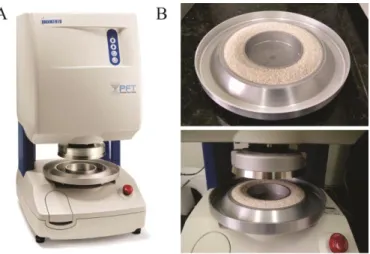
The equipment used for the tests was the Powder Flow Tester – PFT (Figure 1A),
manufactured and calibrated by Brookfield Eng. Labs., belonging to the Engineering Academic Unit of UFCG. Samples were prepared as recommended in the equipment handbook with previous sieving of products in order to analyze only the product portion with particle size smaller than
850μm. After sieving, samples were placed on collecting tray having its surface equalized with the
aid of rotational movement blade (Figure 1B). After filling the tray, it was weighed again and the mass of the sample to be analyzed was obtained by the subtraction from its initial value. Only one sample to be tested was selected for each product.
The equipment configuration and operation, the collection and processing of data with subsequent storage and export to many different file formats were performed using the Powder Flow Pro integrated computer program version 1.2 Build 20. Once sample was prepared, the collection tray was positioned at the base of the equipment and by activating the Run command in the main program window, the equipment automatically down the tray cover up to contact with the product, sample was achieved by application of the compressive load previously established at 4.82 kPa.
The shear method used by the Powder Flow Tester is via torsional shear method along with the compressive load, and the process could be viewed in real time by the main window of the Powder Flow Pro software. For carrying out the tests, the equipment has two test modes, a quick mode and a default mode. The difference between the two test modes is the amount of repetitions that the default mode performs compared to the quick mode. For all tests, the default mode was chosen, with the generation of five shear wrappings for each sample.
For the performance of the shear testing of products with the wall surface, a new sample of each product was used and the collection tray cover was replaced by a polished steel surface cover accompanying the equipment. Again, the default mode was chosen, applying the load to the equipment and the result being monitored in real time by the Powder Flow Pro software.
At the end of each test, the software presents a report with all previously selected variables, which were presented both in the form of graphics and tables. The main information collected from
trials relating to the flow properties of products were major consolidation stress (σM), unconfined
yield stress (fc), internal friction angle (Ø), effective internal friction angle (δ), cohesion (C), bulk
density (γ) instantaneous flow function (FF), flow index (FFC) and wall friction angle (Øw).
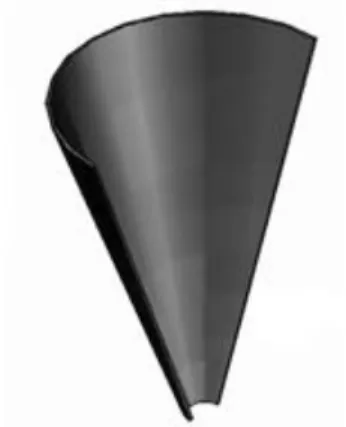
With regard to the dimensioning of hoppers, a conical model (Figure 2) was chosen both for mass and funnel flow situations. For the mass flow, the software presented the result of the
calculation of the hopper half angle (θmmass) and minimum hopper outlet (Dmmass), [eq. (1)]. To the
funnel flow, the software also presented the minimum rathole diameter to be adopted as discharge
outlet (Dmfunnel), [eq. (2)]. The G(Ø) value was obtained as [eq. (3)] proposed by Arnold et al.
(1979).
FIGURE 2. Conical hopper model simulated.
(1)
(2)
where,
Dmmass - minimum hopper outlet for mass flow (m);
Dmfunnel - minimum hopper outlet for funnel flow (m);
σCR - unconfined critical stress (Pa);
γ - bulk density (N.m-3),
Ø - internal friction angle (º).
The unconfined yield stress (σCR) value used in equations 1 and 2 was obtained by the product
Function Flow chart (FF) and conical hopper flow factor (ff) presented by the software. In all assays, value of 1.4 was established for the conical hopper flow factor, whereas for the funnel flow, the relation used for the discharge outlet design was the height / diameter ratio of a silo equal to 4. All average flow properties results obtained in the tests were compared to values normalized by EUROCODE 1 Part 4 (European Standard, 2006) and with studies previously carried out in Jenike Shear Cell apparatus. Throughout the experiment, temperature and relative humidity were kept constant at 24 °C and 60%, respectively.
RESULTS AND DISCUSSION
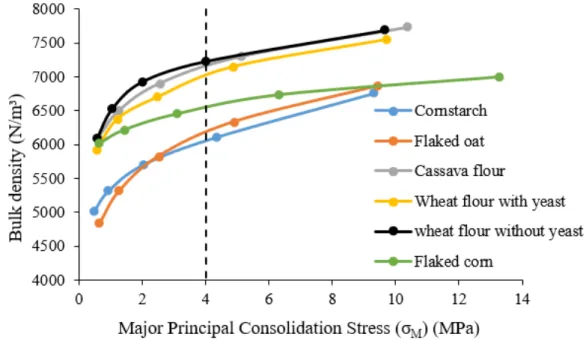
Figure 3 shows increasing bulk density (γ) with increasing major consolidation stress (σM)
for five products tested due to the gradual accommodation of their particles. This indicates, among
other aspects, that the adoption of a single value (average) for this variable, γ in vertical silos
project may result in scaling errors, especially in the hopper discharge outlet.
FIGURE 3. Bulk density versus major principal consolidation stress.
Another point that is greatly influenced by the bulk density variation is the pressure developed by the product on the silo bottom walls. The higher the bulk density value of the stored product, the greater the pressure exerted on the silo structure; however, it is noteworthy that no international standard takes this variation into account, using only an average value in formulations.
bulk density variations may be more pronounced in conditions or parts of the silo that developed lower consolidation stress.
EUROCODE 1 Part 4 (European Standard, 2006) standard does not present flow property values specific for products studied in this research, only generalizing this type of product as flour,
which admits a bulk density variation between 6500 and 7000 N.m-3. Thus, it could be inferred that
with the exception of corn starch and flaked oat, all other products are within the range recommended by the standard. However, if this analysis is performed taking into account only average consolidation stress values above 4 MPa, it could be said that all products are covered by standards of EUROCODE 1 Part 4 (European Standard, 2006).
In determining the flow properties of powder food product by using the direct shear Jenike
Shear Cell apparatus, Lopes Neto et al. (2009) found average values of 6500 and 7700 N.m-3 for
cornstarch and wheat flour respectively, which results are above those found in this study, which can be explained, among other reasons, by possible differences that may exist between the two devices used, highlighting the need for further comparative studies.
The performance of the shear test via Powder Flow Tester occurs through the shear of a product sample via torsional shear apparatus with pre-shear stress of 4.82 kPa, while the shear by means of Jenike Shear Cell is direct and unidirectional with compressive loads varying from 15 to 4kPa.
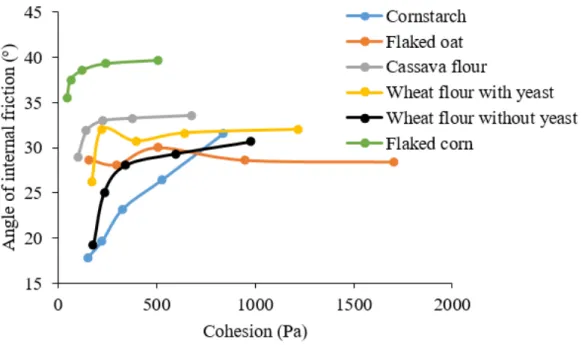
Figure 4 shows a more marked variation of the internal friction angle as a function of the cohesion of particles for corn starch and wheat flour without yeast in comparison to the other products, with all results below range recommended by EUROCODE 1 Part 4 (European Standard, 2006) for flour between 40 and 44.5º.
FIGURE 4. Internal friction angle versus Cohesion.
Figure 5 shows an inversely proportional relationship between internal friction angle and
consolidation stress up to 2MPa, assuming, from this value, a less fluctuating value. The average δ
FIGURE 5. Effective internal friction angle versus major principal consolidation stress.
Figure 6 shows the same proportionality relation of the previous figure, highlighting the smallest average values equal to 18.5 and 18.1º for flaked oat and flaked corn, respectively. According to EUROCODE 1 Part 4 (European Standard, 2006), the friction angle between flour particles and the surface of polished steel wall (low friction classed as slippery) shall vary from 11.5 to 15.5º. If the average value of angles up to normal stress of 2 MPa is analyzed, the highest average of 31º for cornstarch and wheat flour with and without yeast, while the remaining products showed values below 23º. However, if the entire normal stress range is considered, averages recorded do not exceed the value of 28º for corn starch and wheat flour with and without yeast. None of the other products assume average values lower than 20º.
FIGURE 6. Effective angle of wall friction versus normal stress.
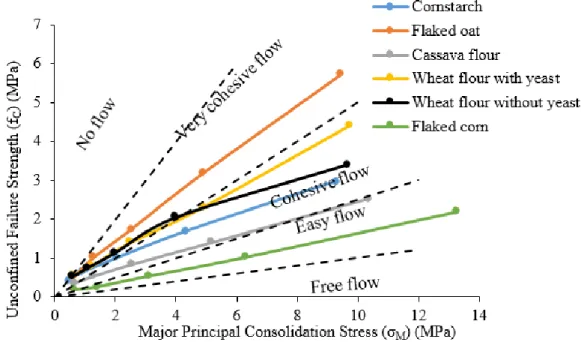
Figure 7 shows the lowest flowing capacity of flaked oat in relation to other products tested,
which is closely related to the highest cohesion values (C) and effective internal friction angle (δ)
obtained for this product coupled with the largest amplitude variation of the bulk density (γ) as a
function of the consolidation stress. On the other hand, flaked corn shows the highest flowability, although having average internal friction angle value higher than that of flaked oat, which presents lower particle cohesion and lower average effective internal friction angle, which certainly provided it lower flow index (ffc) by Jenike (1964).
For the analysis of the flow index, flaked oat can be classified as a product of very cohesive flow, while only flaked corn would be able to flow without the possibility of abrupt flow changes and the formation of mixed flow that, according to Sadowski & Rotter (2011), is characterized when the limits of the flow channel intercept the silo walls even during the unloading process and are characteristic of silos classified as slender, whose H/D ratio is greater than or equal to 2.
FIGURE 7. Flow function of food powders analyzed.
The other products are classified as of cohesive flow with chances of occurrence of funnel flow, formation of cohesive arches and fluctuations in the outlet flow. The flowability of cassava flour, wheat flour without baking powder and cornstarch is similar to that observed in other products such as grounded corn by Lopes Neto et al. (2013) and sawdust and hard coal by Chen et al. (2012).
Thus, it was observed that this classification includes a series of products to the most diverse applications since food products in primary production process, as in the case of grounded corn, processed foods ready for marketing and products intended for power generation.
It is important to note in Figure 7 that most products studied extrapolated, even within a narrow limit, the flow classification ranges for the various consolidation stress values applied, which reinforces the idea that the correct description of flow of a product should not be performed based on only a single value (Chen et al., 2012).
The differences observed in each Flow Function can also be assigned to several factors in addition to flow properties such as the particle size distribution of each product. Fürll & Hoffmann (2013) explain that smaller and more cohesive particles can fit amongst largest ones, losing friction with each other and therefore, changing the ability of the product as a whole to flow with more or less difficulty.
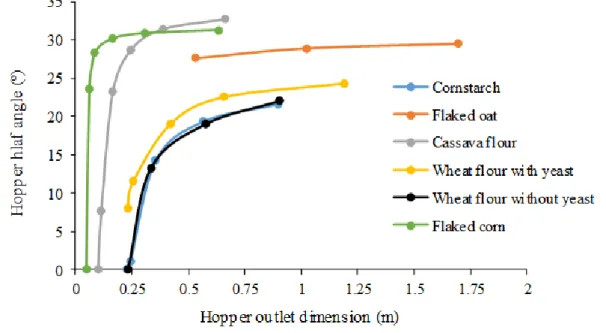
a maximum slope of 29.5º (hopper with the lowest vertical height), the opening will need to be approximately 1.7 m for discharging without risk of interference in the flow. In case of choosing lower hopper half angle equal to 27.6º (hopper with the highest vertical height), the minimum opening should be at least 0.53m. It was not possible to generate results using this method for values below this minimum slope.
FIGURE 8. Discharge outlet versus hopper half angle.
The lower discharge outlet values were obtained for cassava flour and flaked corn, which is supported by the flow function classifications more satisfactory for discharge to occur. For the other products, maximum opening reach up to 1.25 m, as in the case of wheat flour with yeast.
The values obtained in this study corroborated to those described for wheat flour (0.21 m), soybean meal (0.23 m) and sawdust obtained by Lopes Neto et al. (2009), Lopes Neto et al. (2013) and Chen et al. (2012), respectively. However, when compared to grounded corn found by Lopes Neto et al. (2009), there is a discrepancy of more than 40%, which may be related, among other factors to particle size distribution, shape and stiffness of grounded corn particles.
As the shear strength investigations with crushed grain products show, their flowability is influenced above all by the particle size in the case of particle size distributions with very small standard deviation. In real distributions with larger standard deviation, it is primarily the portion of cohesive fine material that determines the flowability (Mellmann et al., 2014).
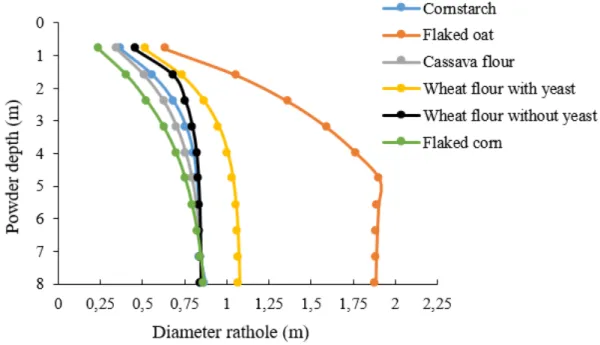
FIGURE 9. Rathole diameter variation.
CONCLUSIONS
It could be concluded that in laboratory test with Powder Flow Tester, only bulk density values found for the products tested are within the range recommended by the EUROCODE 1 Part 4 (European Standard, 2006). For the internal friction angle and the friction angle with the wall, the values found do not fit international standard recommendations.
Only flaked corn showed capacity to flow unobstructed (easy flow); cornstarch, cassava flour and wheat flour with and without yeast, the flow classification was of cohesive flow type, flaked oat had very cohesive flow type.
For mass flow, minimum opening above 0.5 m is required for a silo designed to store six products with slope of 27.6º with the vertical axis. To the funnel flow, the worst situation would be for flaked oat for presenting higher possibility of forming pipe flow.
It is concluded that the determination of flow properties is critical for the correct flow design in silos and poorly dimensioned structures are subject to structural collapse.
ACKNOWLEDGMENTS
The authors would like to thank the Research Group on Silos (SILOS) and the Study Group
on Livestock and Rural Constructions (GCAMB) – Federal University of Campina Grande, Brazil,
for their support in this research.
REFERENCES
Arnold PC, Mclean AG, Roberts AW (1979) Bulk Solids: storage, flow and handling. New South Wales: University of Newcastle, p153-168.
Carson JW (2000) Silo Failures: case histories and lessons learned. Jenike and Johanson Incorporated p.1-15. Available: http://www.inti.gob.ar/cirsoc/pdf/silos/silo-failures.pdf. Accessed: Dec 12, 2015. Carson JW, Holmes T (2003) Silo failures: why do they happen? Task Quarterly 7(4):499-512. Available: http://www.inti.gob.ar/cirsoc/pdf/silos/TQ407B-G.pdf. Accessed: Feb 20, 2016.
Chen P, Yuan Z, Shen X, Zhang Y (2012) Flow properties of three fuel powders. Particuology 10(4):438-443. Available: http://www.sciencedirect.com/science/article/pii/S1674200112000697. Accessed: Jan 18, 2015.
European Standard - EUROCODE 1 Part 4. Actions on structures: silos and tanks. 2006, 112p.
Fürll C, Hoffmann T (2013) The influence of the granulometric condition on the flow characteristics of shredded grain products in their dependence on the duration of storage. Powder Technology 235:307-311. DOI: http://dx.doi.org/10.1016/j.powtec.2012.10.040
García-Torrent J, Ramírez-Gómez Á, Querol-Aragón E, Grima-Olmedo C, Medic-Pejic L (2012) Determination of the risk of self-ignition of coals and biomass materials. Journal of Hazardous Materials 213:230-325. Available:
http://www.sciencedirect.com/science/article/pii/S0304389412001288. Accessed: Sep 06, 2014. DOI: http://dx.doi.org/10.1016/j.jhazmat.2012.01.086
Gutiérrez G, Boltenhagen P, Lanuza J, Clément E (2009) Traffic and granular Flow’07. Silo Collapse:
an experimental study. Springer Berlin p517-523.
Jenike AW (1964) Storage and flow of silos. Salt Lake City: University of Utah, 89p. (Bulletin, 123)
Larsson SH, Lestander TA, Crompton D, Melin S, Sokhansanj S (2012) Temperature patterns in large scale wood pellet silo storage. Applied Energy 92:322-327. DOI:
http://dx.doi.org/10.1016/j.apenergy.2011.11.012
Leturia M, Benali M, Lagarde S, Ronga I, Saleh K (2014) Characterization of flow properties of cohesive powders: A comparative study of traditional and new testing methods. Powder Technology 253:406-423. DOI: http://dx.doi.org/10.1016/j.powtec.2013.11.045
Lopes Neto JP, Nascimento, JWB do, Silva RC, Costa CA (2013) Powder flow criteria for design of vertical silo walls. Engenharia Agrícola 33(3):453-462. Available:
http://www.scielo.br/scielo.php?pid=S0100-69162013000300003&script=sci_arttext. Accessed: Jul 24, 2014.
Lopes Neto JP, Nascimento JWB do (2012) Características de fluxo e projeto de tremonhas cônicas em silos verticais. Revista Brasileira de Engenharia Agrícola e Ambiental 17(3):339-345.
Lopes Neto JP, Silva VR, Nascimento JWB do (2009) Propriedades de fluxo de produtos pulverulentos alimentícios. Revista Brasileira de Engenharia Agrícola e Ambiental 13(5):639-644.
Mellmann J, Hoffmann T, Fürll C (2014) Mass flow during unloading of agricultural bulk materials from silos depending on particle form, flow properties and geometry of the discharge opening. Powder Technology 253:46-52. DOI: http://dx.doi.org/10.1016/j.powtec.2013.11.010
Miccio F, Barletta D, Poletto M (2013) Flow properties and arching behavior of biomass particulate solids. Powder Technology 235:312-321. DOI: http://dx.doi.org/10.1016/j.powtec.2012.10.047 Ramírez A, García-Torrent J, Tascón A (2010) Experimental determination of heating and self-ignition risks associated with the dusts of agricultural materials commonly stored in silos. Journal of Hazardous Materials 175(1-3):920-927. Available:
http://www.ncbi.nlm.nih.gov/pubmed/19944529.http://www.sciencedirect.com/science/article/pii/S0032 591012007243http://www.sciencedirect.com/science/article/pii/S003259100900268X Accessed: Feb 14, 2015.
Sadowski AJ, Rotter JM (2011) Steel silos with different aspect ratios: II - behaviour under eccentric discharge. Journal of Constructional Steel Research 67(10):1545-1553. Available: