CUIDADO É FUNDAMENTAL
UNIVERSIDADE FEDERALDO ESTADODO RIODE JANEIRO. ESCOLADE ENFERMAGEM ALFREDO PINTO
RESEARCH DOI: 10.9789/2175-5361.rpcfo.v12.7095
DOI: 10.9789/2175-5361.rpcfo.v12.7095 | Carvalho IAB, Menezes KS, Magalhães JM et al. | Psychoactive substances users’ profile
CUIDADO É FUNDAMENTAL
UNIVERSIDADE FEDERALDO ESTADODO RIODE JANEIRO. ESCOLADE ENFERMAGEM ALFREDO PINTOR E V I S T A O N L I N E D E P E S Q U I S A
PSYCHOACTIVE SUBSTANCES USERS’ PROFILE
Perfil dos usuários de substâncias psicoativas
Perfil de los usuarios de sustancias psicoactivas
Iara Aparecida Borges de Carvalho1, Karoliny Silva Menezes2, Juliana Macêdo Magalhães3, Fernanda Cláudia Miranda Amorim4, Marcia Astrês Fernandes5, Claudia Maria Sousa de Carvalho6
How to cite this article:
Carvalho IAB, Menezes KS, Magalhães JM, Amorim FCM Fernandes MA, Carvalho CMS. Psychoactive substances users’ profile. Rev Fun Care Online. 2020 jan/dez; 12:326-331. DOI: http://dx.doi.org/10.9789/2175-5361.rpcfo.v12.7095.
ABSTRACT
Objective: The study’s purpose has been to comprehend the sociodemographic profile of psychoactive
substances users from a Center for Psychosocial Care. Methods: It is a descriptive, exploratory, and retrospective research with a quantitative approach. This investigation counted with 302 medical records from patients that were assisted in a city of the Maranhão State. Results: The participants’ sociodemographic profile was mainly characterizing male individuals, within the age group from 29 to 39 years old, single, having incomplete elementary education, living in the city where the research was performed, living with their parents, being either self-employed or unemployed. It was also found that alcohol was the most used drug followed by crack. Conclusion: Daily drug consumption might have contributed to establishing the sociodemographic characteristics presented here. Nevertheless, the patients’ desire for rehabilitation from chemical dependency is widely known; moreover, the bond formed with the health professional becomes indispensable for achieving a satisfactory treatment.
Descriptors: Illegal drugs, mental health, drug users. RESUMO
Objetivo: Conhecer o perfil sociodemográfico dos usuários de substâncias psicoativas de um CAPS ad III. Método: Pesquisa descritiva,
explorativa, retrospectiva, de abordagem quantitativa. A amostra foi formada por 302 prontuários selecionados entre os 1411 pacientes cadastrados em um município do Maranhão. Resultado: O perfil sociodemográfico dos participantes é na maioria do sexo masculino, com faixa etária mais expressiva de 29 a 39 anos, solteiros, que estudaram até o ensino fundamental incompleto, residem na cidade da pesquisa, moram com os pais, são autônomos ou desempregados. Observou-se que o álcool foi a droga mais utilizada. Conclusão: O consumo diário de drogas também pode ter contribuído para a constituição das características sociodemográficas apresentadas.
1 Nursing Graduate by the Centro Universitário UNINOVAFAPI. 2 Nursing Graduate by the Centro Universitário UNINOVAFAPI.
3 Nursing Graduate, MSc Professor at the Centro Universitário UNINOVAFAPI. 4 Nursing Graduate, MSc Professor at the Centro Universitário UNINOVAFAPI. 5 Nursing Graduate, PhD Professor at the Universidade Federal do Piauí (UFPI). 6 Nursing Graduate, MSc Professor at the Centro Universitário UNINOVAFAPI.
Todavia, sabe-se do desejo de reabilitação do dependente químico e o vínculo do mesmo com o profissional habilitado de saúde se torna indispensável para o tratamento.
Descritores: Drogas ilícitas. Saúde Mental. Consumidores de drogas.
RESUMÉN
Objetivo: Conocer el perfil sociodemográfico de los usuarios de sustancias
psicoactivas de un CAPS ad III. Método: Investigación descriptiva, retrospectiva, de abordaje cuantitativo. La muestra fue formada por 302 prontuarios de pacientes catastrados en un municipio del Maranhão.
Resultados: El perfil sociodemográfico de los participantes es del
sexo masculino, con edad más expresivo de 29 a 39 años, solteros, que estudiaron hasta la enseñanza fundamental incompleta, reside en la ciudad de la investigación, viven con los padres, son autónomos o desempleados. El alcohol fue la droga más utilizada. Conclusion: Se concluye que el consumo diario de drogas también puede haber contribuido a la constitución de las características sociodemográficas presentadas en esa investigación. Sin embargo, se sabe del deseo de rehabilitación del dependiente químico y el vínculo del mismo con el profesional habilitado de salud se vuelve indispensable para el tratamiento.
Descriptores: Drogas ilícitas. Salud mental. Consumidores de drogas.
INTRODUCTION
The abusive use of additions in today’s society has been a complex problem and, although historical-cultural transformations and scientific and technological innovations have been striking in recent years, the conceptions and models of a practical approach to such phenomena have not advanced significantly and require studies and reflections related to interventions.1
According to the national survey of alcohol and drugs, alcohol is the most consumed licit drug in Brazil, followed by tobacco. Among illicit drugs, marijuana is the most consumed, followed by cocaine and crack.2 Around 5% of the world’s population within the age group from 15 to 64 years old, which corresponds to about 243 million people, is currently using illicit drugs. Another worrying finding, according to the study, is that only one in six drug users have access to or receives some type of drug dependence treatment every year.3
Regarding the interpersonal relationships, the Ministry of Health emphases the following as the main risk factors: the drug user peers that either approve or value doing drugs, and the systematic rejection of organized rules, practices or activities. On the other hand, non-users who do not approve or value drug use, and those who engage in activities of any kind (recreational, school, professional, religious or other), are protectors against drug use, since they do not engage in alcohol misuse and other drugs.4
Hence, the understanding about psychoactive substances users, their characteristics, risk factors, and needs, they all together propitiate the implementation of new contact strategies and essential bonds for the implementation of programs towards the promotion, prevention, and appropriate treatment to different necessities.5
Objective: To get to know the sociodemographic profile of psychoactive substances users who attend to a Centro de
Atenção Psicossocial – Álcool e outras Drogas (CAPS ad III)
[Center for Psychosocial Care - Alcohol and other Drugs].
METHODS
It is a descriptive, exploratory, and retrospective study with a quantitative approach. The descriptive research has as main objective the description of the characteristics of a certain population or phenomenon, as well as the establishment of relations among the variables.6
As far as exploratory research is concerned, this method aims to familiarize itself with a subject that is still little known, and slightly explored. At the end of an exploratory research, one will know more about that subject, and be able to construct hypotheses. Like any exploration, exploratory research depends on the intuition of the explorer (in this case, the intuition of the researcher). Because it is a very specific type of research, it almost always takes the form of a case study. Like any research, it also depends on a bibliographic search, because even if there are few references on the subject investigated, no research today starts completely from scratch. There will always be some work, or interview with people who have had practical experiences with similar problems or analysis of analogous examples that can stimulate understanding.6
Exploratory research has as main objective to provide clarification and understanding for the problem studied. Its research process is not structured characterizing itself as flexible. Therefore, the necessary information is vaguely defined.7
The quantitative research is carried out in the search for precise, accurate results, proven through measures of pre-established variables, in which it tries to verify and explain its influence on other variables, through the analysis of incidence frequency and statistical correlations. Therefore, this study has quantitative characteristics, because the data collected will be submitted to statistical techniques, working with quantities and percentages.8
This research was developed in a CAPS ad III that is located in the Maranhão State. Nowadays, this CAPS covers an average of 250 patients per month, however, it is necessary to highlight that it receives users from neighboring regions.
The sample consisted of 302 randomly selected records among the 1,411 patients enrolled in a Center for Psychosocial Care. We included the records of individuals who fell within the temporal cut from July 20th, 2008, to December 31st, 2015, and medical records with incomplete data and medical records of persons less than 18 years old were excluded.
Data were collected over the period from April to May 2017, after approval by the Research Ethics Committee from the Centro Universitário UNINOVAFAPI. The instrument used was a questionnaire for analyzing medical records.
The questionnaire is a formalized set of questions to obtain information from the interviewed person.7
The questionnaire is a research technique composed of a set of questions that are submitted to people for the purpose of obtaining information.9
The questionnaire was organized by ordinal numbering and has 17 items in order to achieve the objectives of the research, such items were elaborated according to the patient’s anamnesis.
The items listed were objectively completed in the variables: gender, age, place of residence, religion, marital status, educational level, with whom resides, income, and transcribed in the following variables: profession, main drugs used, physical, psychological and behavioral alterations and the type of service that is performed by the user.
Data collection took place in a reserved room of the co-participant institution in order to keep the information confidential on the morning shift from Monday to Sunday and during the five-hour period, according to the availability of the researchers and the institution itself.
Observing the determinations of the Resolution No. 466/2012 that establishes bioethical parameters to be followed in research and values for the maintenance of the principles of bioethics, the research was initiated only after the authorization of the co-participant institution and approval of the project by the Research Ethics Committee from the
Centro Universitário UNINOVAFAPI, under the Legal Opinion
No. 1.847.366, approved on December 2nd, 2016.
Herein, the Informed Consent Form (ICF) and the Term of Commitment for Data Usage (TCDU) were used as important documents for the ethical analysis of a research project, in which it guarantees the participant rights. Aiming to assure the participants confidentiality, a numeric code was used.
RESULTS AND DISCUSSION
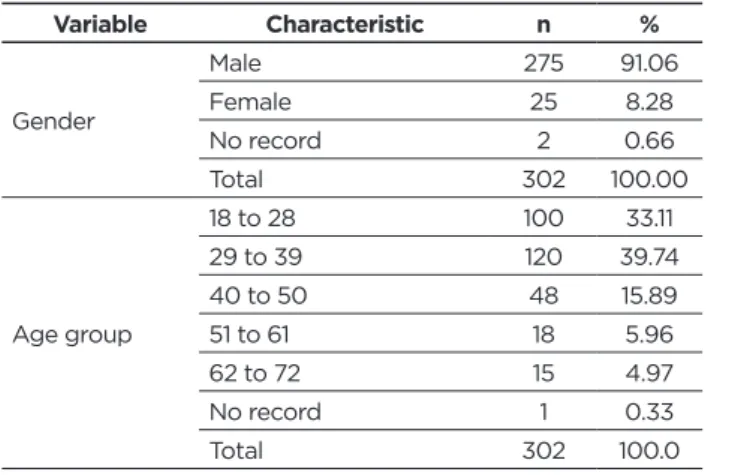
The results of the present study were presented in 6 different tables considering the sociodemographic aspects of the group studied (n=302).
Table 1 shows the sociodemographic characterization of users of a CAPS ad III in relation to variables: gender, age group, educational level, marital status, monthly income, profession, religion, municipality of residence and with whom resides.
Table 1 - Sociodemographic characteristics of the
psychoactive substances users. Caxias city, Maranhão State, 2008-2015. Variable Characteristic n % Gender Male 275 91.06 Female 25 8.28 No record 2 0.66 Total 302 100.00 Age group 18 to 28 100 33.11 29 to 39 120 39.74 40 to 50 48 15.89 51 to 61 18 5.96 62 to 72 15 4.97 No record 1 0.33 Total 302 100.0 Variable Characteristic n % Schooling Illiterate 31 10.26 Elem. sch. 1 110 36.42 Elem. sch. 1 56 18.54 High school 63 20.86 Incomplete college 6 1.99 Complete college 2 0.66 No record 34 11.26 Total 302 100.00 Marital status Single 157 51.99 Married 89 29.47 Divorced 29 9.60 Widow 8 2.65 Common-law marriage 2 0.66 No record 17 5.63 Total 302 100.00 Monthly income (MW) <1 57 18.87 1 to 2 9 2.98 3 1 .33 No record 235 77.81 Total 302 100.00 Profession Autonomous job 90 29.80 Unemployed 74 24.50 Farm man 36 11.92 Bricklayer 29 9.60 Motorcycle driver 9 2.98 Driver 6 1.99 Housekeeper 7 2.32 No record 51 16.89 Total 302 100.00 Religion Catholic 149 49.34 Evangelic 26 8.61 No religion 18 5.96 No record 109 36.09 Total 302 100.00 Municipality of residence Caxias 225 74.50 Aldeias Altas 15 4.97 S. João do Soter 7 2.32 Buriti Bravo 7 2.32 Coelho Neto 5 1.66 Duque Bacelar 1 0.33 Afonso Cunha - -Others 23 7.62 No record 19 6.29 Total 302 100.00 Residing Parents 122 40.40 Family 96 31.79 Alone 22 7.28 Others 44 14.57 No record 18 5.96 Total 302 100.0
The profile of drug users undergoing treatment in the
CAPS ad III of Caxias is similar to that found in other
national studies. The majority of drug users in Brazil are young adults, men, with an average age of 30 years old and single. Furthermore, in most cases, there is a low level of schooling, with only two in ten attending or completing high school. Most users get their monthly income through periodic or autonomous jobs.10
In relation to the religious denominations present in our country, evangelicals presented relatively less frequency of users of psychoactive substances and Catholics had a higher frequency of users. This matches with the literature, in which it can be seen that the more conservative denominations tend to have fewer users of alcohol and drugs among their members.1
Table 2 - Type of drugs taken by the psychoactive substances
users. Caxias city, Maranhão State, 2008-2015.
Drugs n % Alcohol 234 77.48 Crack 124 41.06 Marijuana 75 24.83 Tabaco 62 20.53 Cocaine 25 7.28 Others 18 5.96 No record 6 1.99 Total 302 100.0
Source: Direct research, 2017.
*Multiple-answer questions may add more than 100%.
Alcohol is the gateway to other drugs. Consequently, crack is not usually the first drug to be used and there may be other psychoactive substances.12 The ease access to crack and all other drugs, whether legal or illegal, has contributed to the early use of drugs.13
Table 3 - Motives presented by the psychoactive substances
users to take drugs. Caxias city, Maranhão State, 2008-2015.
Motives n % Friends influence 134 44.37 Curiosity 74 24.50 Uncertainty 11 3.64 Others 9 2.98 No record 158 52.32 Total 302 100.0
Source: Direct research, 2017.
*Multiple-answer questions may add more than 100%.
It is worth mentioning that most of the information about the reasons that led the users to start drug use were absent. Perhaps this is due to the fact that the user feels ashamed when the practice of substance use is characterized as criminal, in which the user is seen and/or identified as criminal, and may lead to the omission of information due to the prejudice generated.14 notion of concept sustained by
some ideologies presupposes that it is only from abstinence that the drug user, understood as deviant from social rules, can be socially accepted by his act, in a kind of adjustment and “decontamination”.15
Teens are more susceptible to the opinion and assessment of friends. The approval of friends is a factor that greatly influences how the teenager behaves, which increases the risk of using psychoactive substances. Often, friends convey a message of over-valuation of alcohol, tobacco, and other drugs, so that consumption promotes popularity in the group.16 In addition to social valorization, adolescents often find it difficult to impose their opinion, not resisting the influence of friends, which contributes to the use of alcohol and other drugs.17
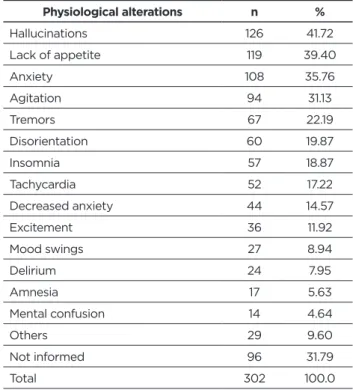
Table 4 - Physiological alterations when the drug user is
undergoing psychoactive substances abstinence. Caxias city,
Maranhão State, 2008-2015. Physiological alterations n % Hallucinations 126 41.72 Lack of appetite 119 39.40 Anxiety 108 35.76 Agitation 94 31.13 Tremors 67 22.19 Disorientation 60 19.87 Insomnia 57 18.87 Tachycardia 52 17.22 Decreased anxiety 44 14.57 Excitement 36 11.92 Mood swings 27 8.94 Delirium 24 7.95 Amnesia 17 5.63 Mental confusion 14 4.64 Others 29 9.60 Not informed 96 31.79 Total 302 100.0
Source: Direct research, 2017.
*Multiple-answer questions may add more than 100%.
One of the factors associated with the consumption of psychoactive substances is anxiety. Anxiety can be a motivating factor for the abuse of alcohol and other drugs.18 Anxiety is the most recurrent psychiatric comorbidity, reaching almost half of users of licit and illicit drugs.19
People, who drink excessively, when they decrease consumption or completely abstain, may present with a set of symptoms and signs, named Alcohol Abstinence Syndrome (AAS). The most common physical and psychological signs and symptoms of alcohol withdrawal are anxiety, agitation, tremors, mood swings, and complications such as hallucinations and delirium.20 There are studies, which corroborates with the present study and with the study cited above, which state that the most common signs and symptoms of AAS are anxiety, hallucinations, agitation, tremors, and mood changes.21
Table 5 - The care provided to drug users. Caxias city, Maranhão State, 2008-2015. Care n % Individual care 205 67.88 Welcoming 142 47.02 Family care 73 24.17 House visits 26 8.61 Night care 18 5.96 No record 22 7.28 Total 302 100.0
Source: Direct research, 2017.
*Multiple-answer questions may add more than 100%.
Concerning the type of care given to the users of psychoactive substances, it was observed that the individual care was the predominant modality followed by the initial reception. This is consistent with the literature that states that the prevailing practice of health professionals in these services is individual care.22 This fact can be highlighted when it states that the clinical model of individual care is still the predominant form of work among professionals.23
Individual care is the modality intended for patients who need frequent monitoring and direct attention of the health team, but do not need hospitalization. The care is characterized by prescription medications, psychotherapy, and counseling.24
Table 6 - Problems associated with drug use by the
psychoactive substances users. Caxias city, Maranhão State, 2008-2015. Associated problems n % Family 73 41.95 Fights 56 32.18 Police 50 28.74 Justice 35 20.11 No record 76 43.68 Total 214 100.0
Source: Direct research, 2017.
*Multiple-answer questions may add more than 100%.
Complicating factors include precocity of drug use, time of use, amounts consumed, cognitive deficits, lack of motivation for change, comorbidities, and family and financial problems.25 Patients bearing comorbidities and using drug at the same time present greater difficulties for adherence to treatment, not responding well to therapeutic approaches directed to only one of the presented symptoms, necessitating the combination of medications.26
As it was verified a greater proportion of users are single due to the difficulty that this group has to maintain relationships. So, the chemical dependent person would rather use drugs than be with the family.27
High levels of household violence can also trigger frequent divorces.28
Table 7 - CID-10 percentage indication of drug users. Caxias
city, Maranhão State, 2008-2015.
CID 10 n % F.10.2 131 43.38 F. 19.2 161 53.31 Others 8 2.65 No record 2 0.66 Total 302 100.0
Source: Direct research, 2017.
Multiple drug use is a common habit among drug addicts. Crack, the main drug for many users, but who becomes addicted to it, usually also uses other drugs such as marijuana, cocaine, and alcohol. In the early years of CAPS ad III, clients were more alcoholic, but they are currently using multiple drugs. Crack is the main drug, but it is not the only drug consumed. When they do not find the crack, users consume whatever they have nearby.29
CONCLUSIONS
It is concluded that the sociodemographic profile resembles in several regions of the country, regardless of the service that the users are intended for treatment. Note the presence of psychiatric comorbidity among the chemical dependents, since some participants reported feeling hallucinations, anxiety, delusions, mood swings, agitation, and tremors, which accentuates the importance of diagnosis and treatment.
It is also observed that alcohol is the gateway to illicit drugs. Usually, the user does not only consume one type of drug, which can be concluded in the diagnosis, that although alcohol is the drug most used by users of CAPS ad, being ICD F19.2 the dominant diagnosis, which represents the use of multiple drugs.
It should be noticed that the majority of the study participants were single users and had some family conflict associated with the use of a psychoactive substance. Therefore, it is highlighted that with the abusive use of chemical substances the user loses the family bond, can no longer obtain interest for the constitution of a family, thus justifying the high rate of single users.
Daily drug use may also have contributed to the withdrawal from the labor market, since as long as the dependent spends most of his time on obtaining or using the drug, so he relinquishes or disregards daily responsibilities. It can be seen that chemical dependence negatively affects several areas of life of the individual and, as a characteristic, has an early onset of drug use, which may be an important factor for the constitution of the sociodemographic characteristics presented in this research.
Nonetheless, the patients’ desire for rehabilitation from chemical dependency is widely known; moreover, the bond formed with the health professional becomes indispensable for achieving a satisfactory treatment. The good performance of health professionals while caring for users of alcohol and other drugs is paramount, due to the qualified interventions that are provided to those users.
REFERENCES
1. Souza, J. Kantorski, L. Embasamento político das concepções e práticas referentes às drogas no Brasil. SMAD, Rev. Eletrônica Saúde Mental Álcool Drog. (Ed. Port.), Ribeirão Preto, v. 3, n.2, 2007.
2. Inpad. Instituto Nacional de Políticas Públicas do Álcool e Outras Drogas. Levantamento Nacional de Álcool e Drogas. UNIFESP. São Paulo, 2012.
3. Unodc. Organização das Nações Unidas - ONU. Programa para o Controle Internacional de Drogas. Escritório das Nações Unidas sobre Drogas e Crime. O Desafio das Novas Substâncias Psicoativas. Brasília, 2012.
4. Brasil, Ministério da Saúde. Secretaria Executiva. Coordenação Nacional de DST/Aids. A Política do Ministério da Saúde para atenção integral a usuários de álcool e outras drogas. Brasília, Editora: Ministério da Saúde, 2013.
5. Seibel SD, Toscano Jr A. Conceitos básicos e classificação geral das substâncias psicoativas. In: Seibel SD, Toscano Jr A. Organizadores. Dependência de drogas. São Paulo: Atheneu, 2000.
6. Gil, A.C. Métodos e técnicas de pesquisa social. 6 ed. São Paulo: Atlas, 2008.
7. Malhotra et al. Introdução a pesquisa de Marketing. São Paulo: Pearson Prentice Hall, 2005.
8. Michel, M. H. Metodologia e pesquisa científica em Ciências Sociais. São Paulo: Atlas, 3 ed. 2005.
9. Gil, A.C. Como elaborar projetos de pesquisa. 4 ed. São Paulo: Atlas, 2011. 10. Secretaria Nacional de Políticas Sobre Drogas - SENAD. Adultos
jovens são os principais usuários de crack. Brasília, DF. 2013. 11. Dalgalarrondo, P. et al. Religião e uso de drogas por adolescentes. Rev.
Bras. Psiquiatr. São Paulo, v. 26, n. 2, p. 82-90, Jun. 2004.
12. Associação brasileira de psiquiatria et al. Projetos e Diretrizes. Abuso e Dependência de Múltiplas Drogas: Rio Janeiro, 2012.
13. Jorge, M. S. B. et al. Ritual de consumo do crack: aspectos socioantropológicos e repercussões para a saúde dos usuários. Ciênc. saúde coletiva, Rio de Janeiro, v. 18, n. 10, p. 2909-2918, Out. 2013. 14. Machado, A. R; Miranda, P. S. C. Fragmentos da história da atenção
à saúde para usuários de álcool e outras drogas no Brasil: da Justiça à Saúde Pública. Hist. cienc. Saúde. Manguinhos, Rio de Janeiro, v. 14, n. 3, p. 801-821, Set. 2007.
15. Moraes, M. O modelo de atenção integral à saúde para tratamento de problemas decorrentes do uso de álcool e outras drogas: percepções de usuários, acompanhantes e profissionais. Ciênc. saúde coletiva, Rio de Janeiro, v. 13, n. 1, p. 121-133, Fev. 2008.
16. Cardoso, L. R. D.; Malbergier, A. A influência dos amigos no consumo de drogas entre adolescentes. Estud. psicol. (Campinas), Campinas, v. 31, n. 1, p. 65-74, Mar. 2014.
17. Duan, L., C. et al. Trajetórias de influências sociais de amizades como preditores de longo prazo de uso de drogas desde o início até o final da adolescência. Jornal da Juventude e da Adolescência. V.38, Mar. 2009. 18. Lopes, A. P.; Rezende, M. M. Ansiedade e consumo de substâncias
psicoativas em adolescentes. Estud. psicol. (Campinas), Campinas, v. 30, n. 1, p. 49-56, Mar. 2013
19. Silva Junior AG, Mascarenhas MTM. Avaliação da atenção básica em saúde sob a ótica da integralidade: aspectos conceituais e metodológicos. 3.a ed. Rio de Janeiro: Cepesc/UERJ; 2006.
20. Laranjeira, R. et al. Consenso sobre a Síndrome de Abstinência do Álcool (SAA) e o seu tratamento. Rev. Bras. Psiquiatr., São Paulo, v. 22, n. 2, p. 62-71. Jun. 2000.
21. Maciel, C; Kerr-Correa, F. Complicações psiquiátricas do uso crônico do álcool: síndrome de abstinência e outras doenças psiquiátricas. Rev. Bras. Psiquiatr., São Paulo, v. 26, supl. 1, p. 47-50, Maio, 2004. 22. Figueiredo, V. V; Rodrigues, M. M. P. Atuação do psicólogo nos CAPS
do Estado do Espírito Santo. Psicol. estud., Maringá, v. 9, n. 2, p. 173-181, Agosto. 2004.
23. Dimenstein, M. O psicólogo e o compromisso social no contexto da saúde coletiva. Psicol. Estud., Maringá, v. 6, n. 2, p. 57-63, Dez. 2001. 24. Brasil, Ministério da Saúde. Saúde Mental no SUS: os centros de
atenção psicossocial. Secretaria de Atenção à Saúde, Departamento de Ações Programáticas Estratégicas. Brasília: Ministério da Saúde, 2004.
25. Guimaraes, C. F. et al. Perfil do usuário de crack e fatores relacionados à criminalidade em unidade de internação para desintoxicação no Hospital Psiquiátrico São Pedro de Porto Alegre (RS). Rev. psiquiatr. Rio Gd. Sul, Porto Alegre, v. 30, n. 2, p. 101-108. Agosto, 2008. 26. De boni, R. et al. Tratamento. In: SENAD. Prevenção do uso de drogas:
capacitação para conselheiros e lideranças comunitárias. Ministério da Justiça, Secretaria Nacional de Políticas sobre Drogas. – 5. ed. – Brasília:SENAD, 2013.
27. Fontes, A et al. Redução de danos – uma abordagem legítima para lidar com o consumo de substâncias psicoativas. In: FIGLIE, N. B; BORDIN, S.; Laranjeira, R. 3 ed. Rio de Janeiro: Ed. Roca, 2004. 28. Rabello, P. M. et al. Violência contra a mulher, coesão familiar e drogas.
Rev. Saúde Pública, São Paulo, v. 41, n. 6, p. 970-978, Dez. 2007. 29. Marques, A. C. P. R.; Cruz, M. S. O adolescente e o uso de drogas. Rev.
Bras. Psiquiatr., São Paulo, v. 22, supl. 2, p. 32-36, Dez., 2000.
Received in: 10/12/2017 Required revisions: Did not have Approved in: 09/04/2018 Published in: 27/02/2020
Corresponding author
Juliana Macêdo Magalhães
Address: Rua Vitorino Orthiges Fernandes, 6123
Bairro Uruguai, Teresina/PI, Brazil
Zip code: 64073-505 E-mail address: [email protected]
Telephone number: +55 (86) 99978-8725 Disclosure: The authors claim to have no conflict of interest.