in the Lower Cretaceous of Portugal
Octavio Mateus-'-"
&
Miguel Telles
Antunesv-"?
Projecto "POCT1I3653 11PALl2000 - Studies on Portuguese Paleontology (Post - Paleo zoic) "
1- Museu da Lourinha, 2530-157 Lourinha, Portu gal. 2- Academia das Ciencias de Lisboa, Portugal. 3- European Academy of Sciences, Arts and Human ities, Paris . 4- Centro de Estudos Geologicos, Faculdade de Ciencia s e Tecnolo gia (UNL) , Quinta da Torre, 2829-516 Caparica, Portugal.
omateus@d inocasts.com ; M.T.A. e-mail address:ip241333@ ip.pt
Abstract
Key-words: Dinosaur trackways; Lower Cretaceous; Apt ian! Albian; Olhos de Agua; Obidos; Portugal.
A new Lo wer Cretaceous (Apt ian-Albian) dino saur tracksite at the Olhos de Agua beach is described. Itis the first vertebrate fossil finding ever found in the conc erned un it, and yielded 128 tracks in 17 trackways within an are a of ca. 80 square metres. Three tridactyl footprint morphotypes have been recognized: - Type I("lguanodontipus-like")-trackways D, F, K, J and P; - Typ e 2 (large theropod), although larger in size, typically from aGrallator-lik etheropod footprint, i.e , A, B,G, H and 0 trackways; - Type 3 (medium siz e theropod); M is the only track ofthis type. There are other, poorly preserved, unidentified trackways. The theropod, swinging trackway B was produced by an animal that was limping. The theropod track M starts eastwards but drastically changes westwards, speeding up at the same time; this dinosaur decided to turn around and run in the opposite direction .
Thi s site sho ws three main trackway directions: to the South, to the East, and westwards. Exc ept for the trackway 0, large theropods A, B , G and H walked southwards. Perpendicularly to the se, ornithopods, small theropods and unidentified trackmakers walked towards Ea st (5) and West (7). The segregation oftrackmakers and directions, with large theropod traekways southwards and other dinosaurs ' west or eastwards, may mean that large theropods patrolled a walkway area to an important resource, most probably water, often frequented by ornithopods and smaller theropods. There is no evidence of social behavior or gregarism: footprints ' overposition shows that the large, southwards walkin g theropods passed on different occasions. Three trackway sequences can be established by chronologie order.
Resumo
Palavras-chave: Pistas de Dinossauros; Cretacico inferior; Apti anol Albiano; Olhos de Agua; Obidos; Portugal.
E
descrita uma nova jazida de pistas de dinossauros no Cretacico inferior (Aptiano-Albiano) na praia de Olhos de Agua, a primeira ocorrencia de fosseis de vertebrados na Unidade estratigrafica em cau sa. Foram observadas 128 pegadas e 17 pistas numa superficie de ca. de 80 m2 , pennitindo reconhecer tres morfotipos de pegadas tridactilas: - Tipo I("lguanodontipus")- pistas D, F, K, J e P; - Tipo 2 (Teropode de grande porte), pegadas tip icas de teropode, semelhantes aGrallator,i.e. pistas A, B, H, H e 0; Tipo 3 (Teropode de porte rnedio), representadas so na pista M. Alem destas ha algumas pistas mal conservadas, nao identificadas. A pista B, de teropode,e
sinuosa e foi produzida por urn animal que coxeava. Outro easo interessantee
0da pista M, dirigida de inieio paraEste mas que muda drasticamente de direccao, para Oeste, ao mesmo tempo que0 movimento se acelerou;0 dinossauro decidiu virar-se e correr em sentido oposto.
Esta jazida evidencia pistas segundo tres direccoes principais: para SuI, para Este e para Oeste. Com a excepcao da pista 0, os grandes teropodes dirigiam-se para SuI (pistas A, B , G e H). Perpendiculannente a estas, ha pistas de orn itopodes, pequ enos teropodes e dinossauros nao identificados dirigidas para Este (5) e para Oeste (7) . A reparticao segregada em grupo s de pistas e de direccoes (com pistas de grandes teropodes dirigidas para SuI e de outros dino ssauros para Oeste ou para Este pode signi ficar que grandes teropodes vigiavam areas de acesso a urn reeurso importante, muito provavelmente agua, frequentemente procurada por omitopodes e teropodes de menor porte. Nao ha indicios de comportamento social ou de gregarismo; a sobreposicao depegadas mostra que os grandes teropodes que se dirigiam para SuI passaram em varias ocasioes. Foi possivel caracterizar tres sequencias de
Ciencias da Terra (UNL), 15
Introduction
Portugal is rich in dinosaur footprints. A new tracksite was discovered by Antonio Miranda who reported it to the Museu da Lourinha. The site is in the Lower Cretaceous beds at the Olhos de Agua beach, Obidos Municipality, central western Portugal (UTM-sector obtained by GPS : 0478262E, 4362995N). According to the Carta Geologica de Portugal 1:50.000 Folha 26-C
(Francaet al., 1960), the site concerns the Aptian-Albian
unit "Cornplexo gresoso de Olhos Arnarelos e Pousio da Galeota". This is the first fossil ev idence of vertebrates ever found in this unit (Table 1).
Trackways, tracktypes and trackmakers
Currently, 128 footprints in 17 narrow-gauge trackways are exposed at the Olhos de Agua site within an area of ca. 80 square metres (table 2). Three tridactyl footprint morphotypes numbered as Type 1, Type 2 and Type 3 have been recognized.
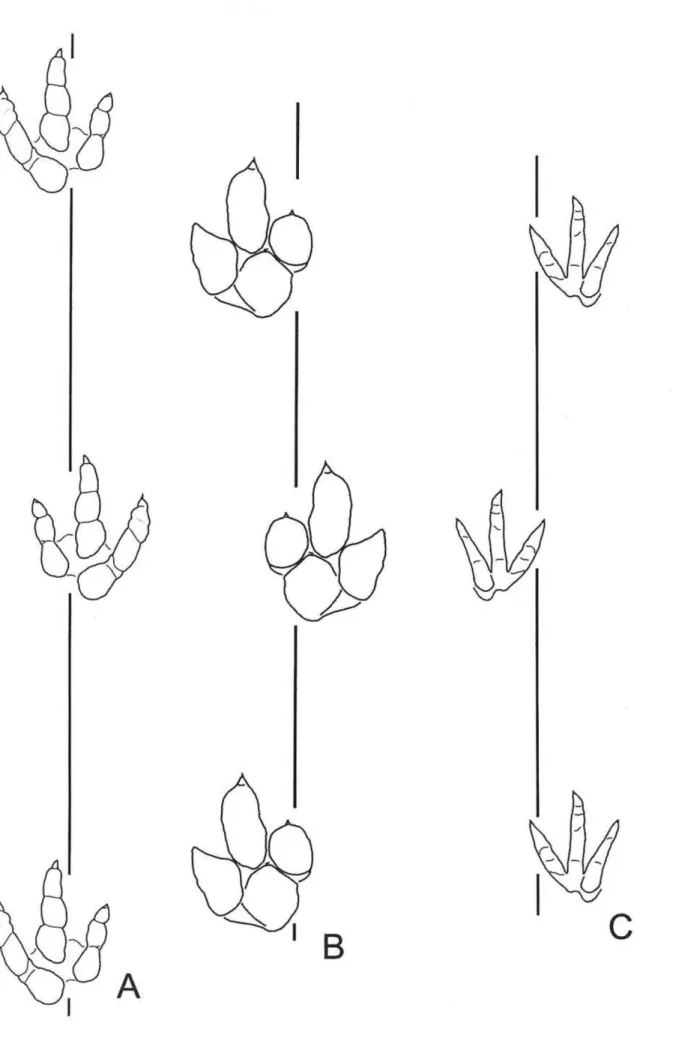
Type 1 (iguanodontid)
The trackways D, F, K ,Jand P are assigned to type 1.
Medium to large sized tracks with wide and round digit marks.
Footprint size range: between 35 and 60 em long and 35 to 42 em wide.
Length/width ofthe footprint ratio: between 1 and 104. The fingers are large, well-defined and separated, and ellipsoid in shape. Small claw prints are sometimes visible in all fingers, The angles between digits 11-III and 11-III-IV are nearly similar.
The "heel" print is curved. This results into the rounded shape of the hind part of the footprint.
The pace angle ranges between ca. 130 and 150°; the trackway is narrow-gauged.
The manus print is visible in the trackway D. Although the claw prints are sometimes visible, the
general shape is a typical ofan"Iguanodon"track.
The morphotype isIguanodontipusorCaririchnium
that indicates an iguanodontid trackmaker (Sarjeant et aI., 1998).
Type 2 (large theropod)
Trackways A, B ,G,Hand O.
Elongate, medium and large size footprints with long, indented fingers with claw marks.
Length from 30 em up to 38 ern and width between 24 and 27 em.
The aspect ratio is between 1.2 and 104.
The angle between the digits II andillis smaller (ca. 20°)
than between digits III and IV (ca. 30°=. The morphology allows us to assign these footprints to theropods due to the angle between the digits, to the well marked ungueal phalanges, the longer than wide track, the well defined hind ofthe foot, the impression of each digit being separated from the others, and the well-visible claws and finger pads. The pace angle ranges between 160 and 178°.A well-defmed
track is 2 em deep. There are no marks from digit1.
Although larger in size, the shape of these tracks is
Grallator-like. The morphotype is Grallatoror
Eubrontes.The different between these genera has
been motif of debate. According to Weems (1992)
Eubrontesdiffer fromGrallatorby a footprint longer
than 25ern,The trackmaker is a large theropod.
Type 3 (medium theropod)
The trackway M is the only undoubtedly of this morphotype.
Small and medium footprints with narrow digits and well-defined claws.
The footprint is longer (25 em) than wide (20 cm) . The aspect ratio is about 1.25.
The digits are very narrow (the digit length is more than seven times its width) with well marked claws. The angles between the three fingers are nearly the same.
The "heel"-print is poorly vis ible or absent. The pace angle is about 160°.
The elongation index, marks ofthe claws, and the long and thin toes allow the attribution to a medium size theropod.
Unidentified
The mostly poorly preserved trackways E,J,N and P
are made by medium-sized ornithopods or theropods.
Table I
Lower Cretaceous dinosaur tracksites (by stratigraphic order) known in Portugal, including this new finding(*).
Site Track maker A~e and Geelogical Unit Reference
Olhos de Agua Theropoda and Aptian-Albian ("Complexo gresoso de Olhos
This study (Obidos)(*) Ornithonoda Amarelos e Pousio da Galeota" Unit)
Praia Grande
Theropoda, Sauropoda and Madeira&Dias, 1983; Antunes,
do Rodizio Lower Aptian! Bedulian
(Sintra) Ornithopo~ 1984; Santos, 1998: 10
Praia da
Iguanodontid (one site) and
Salema (Vila do Barremian Santoset al.,2000c
Bispo) small theropods (two sites) Praia Santa
Iguanodontidae Barremian Santoset al.,2000c: 20
(Vila do Bispo)
Lagostelros Theropoda, Sauropoda and
Hauterivian ("Formayao de Ladeiras" Unit) Antunes (1976), Meyeretat.
The trackways C, I, L and N have most probably been produced by ornithopods while
Q
seems to be a theropod track. There are a few more poorly pre-served and isolated tracks at the southwestern part of the site, in a surface much eroded by the sea.Particularities and behaviour
The theropod trackway B was produced by an animal that has a pace length asymmetry, suggesting that it was limping . All the left foot steps are 1 to 30 em shorter than the right steps. Besides that, this trackway is swinging while others are relatively straight (except for the theropod G that curves westwards and for M) . The right/left pace asymmetry cannot the caused by tectonic deformation because it is observed only in the trackway B and along its whole length.
The theropod trackway M starts eastwards but drastically changes its direction westwards, to its right, speeding up at the same time. For some reason , this dinosaur (either predator or prey) decided toturn around and run (with longer strides) in the opposite direction.
This site shows three main trackway directions: south, east and westwards. Except for the theropod trackway
0,
large theropod trackways A, B, G and H trend southwards. Perpendicularly to these, ornithopods, small theropods and unidentified trackmakers walked towards the East (in 5 cases) and West (in 7).This segregation oftrackmakers and directions (large theropods southwards and other dinosaurs west or eastwards) may mean that large theropods patrolled a walkway area to an important resource, most probably
water, that also was often frequented by ornithopods and smaller theropods .
There is no evidence for social behavior or gregariousness. Footprints' superposition shows that the large, southwards walking theropods passed in different occasions, without apparent time order. Three temporal trackway sequences (named A to Q) can be established: L, A, P, H, B, F; M, B; and P, J, G (fig. 3).
Conclusions
1.A new Early Cretaceous (Aptian-Albian) dinosaur tracksite at the Olhos de Agua beach is described. This is the first vertebrate fossil finding ever found in the concerned unit.
2. The Olhos de Agua site yielded 128 footprints in 17 trackways within an area of ca. 80m2.
3. Three tridactyl footprint morphotypes, described in the text, have been recognized:
- Type 1 (Iguanodontid), trackways D, F, K, J and P; - Type 2 (large theropod), although larger in size, the elongate, medium and large size footprints with long, in-dented fmgers with claw marks are typically from a theropod
(Eubrontesmorphotype), i.e. A, B,G,Hand0 trackways;
- Type 3 (medium size theropod) , small and medium footprints with very narrow fingers and well-defined claws; M is the only track ofthis type. The elongation index, marks of the claws, and the long and thin toes allow us to ascribe it to a medium size theropod.
4. There are other, poorly preserved, unidentified trackways - E, J, Nand P from medium-sized ornithopods or theropods, while the trails C, I, Land N seem to have been produced by ornithopods, and Q by a theropod.
Table2
Metric data ofthe Olhos deAguatracksite.
The hip height(h)is estimated as four times the foot length, while the velocity(v)is given by the formula(v=0,7826.SU67.h"I.17) where SL is the stride length (Alexander, 1976; Lockley& Meyer, 1999: 5) .
A 18,87 17 Theropod 39 31 232 118 178 1,9 156
B 18,02 19 Theropod 32 25 200 100 160 1,9 128
C 1,6 3 Ornithopod 30 30 160 81 1,4 120
D 2,6 4 Orn ithopod 41 34 187 92 178 1,2 164
E 2,15 4 ? -30 -25 144 80 150 1,2 120
F 3,3 4 Orn ithopod 50 41 220 123 120 1,3 200
G I3 12 Theropod 42 34 230 120 160 1,7 168
H 11,9 12 Theropod 35 27 220 110 150 2,0 140
I 6,2 8 Ornithopod 60 42 173 87 130 0,7 240
J 2,1 3 ? 30 22 210 107 150 2,2 120
K 4,9 7 Ornithopod 35 35 152 93 1,1 140
L 3,25 6 Ornith. or Ther. 30 26 150 83 160 1,2 120
M 10 14 Theropod 25 19,5 100
N 3 Theropod?
0 1,1 2 Theropod 47 49 110 188
P 2,05 3 Orn ithopod
Ciencias da Terra (UNL), 15
5. The theropod, swinging trackway B was produced by an animal that was limping, all the left foot steps being shorter than the right ones; near all other trackways are relatively straight.
6. The theropod track M starts eastwards but drastically changes westwards, speeding up at the same time; this dinosaur decided to tum around and run in the opposite direction.
7. This site shows three main trackway directions to the South, the East and westwards. Except for the theropod trackway0,large theropods A, B,GandHwalked south-wards. Perpendicularly to these, ornithopods, small theropods and unidentified trackmakers walked towards today's East (5 trackways) and West (7).
8. The segregation oftrackmakers and directions, with large theropod trackways southwards and other dinosaurs' west or eastwards, may mean that large theropods patrolled a walkway area to an important resource, most probably water, that also was often frequented by ornithopods and smaller theropods. .
References
9. There is no evidence of social behavior or gregariousness.
Acknowledgements
We thank the Museu da
Lourinha,
the Camara Municipal de Obidos and the Centro de Estudos Geologicos da Universidade Nova de Lisboa for logistic support. This study was supported(0.Mateus) by a "Bolsa de Doutoramento Praxis XXI BD/21616/99" granted by the Fundacao para a Ciencia e a Tecnologia.We also thank Antonio Miranda for reporting us the site and for help in the field, and Vasco Ribeiro for reporting new theropod footprints at Salema. Our thanks are due to Ana Sarzedas, Nicolai Christiansen, Nuno Mendes, and Ricardo Araujo for their help in the field; and FelixPerez Lorente and Anne Schulp for useful suggestions.
Alexander,R.McN. (1976) - Estimates of speeds of dinosaurs.Nature, London, 261: 129-130.
Antunes, M. T. (1976) - Dinossaurios eocretacicos de Lagosteiros.Ciencias da Terra (UNL),Lisboa, 1:1-35.
Antunes, M. T. (1984) - Novas pistas de Dinossaurios no Cretacico inferior- Discussao, Com.Serv.Geol. Portugal,Lisboa, 70(1):
123-124.
Franca, J. C.; Zbyszewski, 0. & Almeida, F. M. de (1960) - Carta Geologica de Portugal 1/50 000. Noticia explicativa da
folha 26-C. Peniche. Servicos Geol6gicos Portugal,Lisboa.
Lockley, M. 0. & Meyer, C.A (1999) - Dinosaur tracks and other fossil footprints of Europe. Columbia Univ. Press. New
York,323p.
Madeira, J.& Dias,R.(1983) - Novas pistas de dinossaurios no Cretacico Inferior.Comun. Servo Geol. Portugal,Lisboa, 69(1):
147-158.
Meyer, C. A; Lockley, M.G.; Robinson, J.W.& Santos, V.F. (1994) - A comparison of well-preserved sauropod tracks from the
Late Jurassic of Portugal and the Western United States: evidence and implications.Gaia,Lisboa, 10: 57- 64.
Santos,V. F. (1998) - Dinosaur tracksites in Portugal: The Jurassic-Cretaceous record.I Encontro Internacional sobre Paleobiologia
dos Dinossaurios,Lisboa: 7-16.
Santos,V.F.; Dantas, P.; Moratalla, J. J.; Terrinha, P.; Coke, C.; Agostinho, M.&Galopim de Carvalho, A. M. (2000) - Primeiros
vestigios de dinossaurios na orla mesozoica algarvia, Portugal.I Congresso Iberica de Paleontologia,Evora: 21-22.
Santos, V.F.; Dantas, P.; Moratalla, J. J.; Terrinha, P.; Coke, C.; Agostinho, M.& Galopim de Carvalho, A M. (2000). Rastos de
iguanodontideos no Cretacico da Bacia Algarvia, Portugal.I Congresso Iberica de Paleontologia,Evora: 22-23.
Santos, V. F.; Lockley, M.G.; Moratalla, J. J.&Galopim de Carvalho, AM. (1992) -The longest dinosaur trackway in the world?
Interpretations of cretaceous footprints from Carenque, near Lisbon, Portugal. Gaia,Lisboa, 5: 18-27.
Sarjeant, W. A. S.; Delair, J.B. Lockley, M.0. (1998) -The footprints of Iguanodon: a history and taxonomic study.Ichnos,
6(3):183-202.
Weems, R. E. (1992) - A re-evaluation ofthe taxonomy ofNewark supergroup saurischian dinosaur tracks, using extensive statistical
Ciencias da Terra (UNLJ. 15
sao-.... .... _ . ...,
....
--
.
s.n.dt8ooR .. ; O LH OSDE AGUA..- - ~>'1\
...~\IIle"",.,. • •= =0: :) ~
~-l-- .... Cri;IoI ..
PrW*_"_ ... ..
~-*~&-- _ aPwab " J ~• ~\
t.gclio ....,omo ..
...
.
Pr.. ...c-. ..
PotoEtc.Ioda
.,..,.
..)
( ">
'->
"Q
8 A H
~~
CG ~ ., E <> Qt__.
l (1. "_ -
-...--
:
J ~
I p q!
O ~
-N<> ____
M<> ~ ---"'" ;7
'" ,.'0"'."" "
rnap0"'"
0,",de """ iracksiteTho_U'oW-.~'"
__
A'"Q .Tho - " . . . .Ciencias da Terra (UN L),15