Avaliação Psicológica em Doentes com Rosácea:
Um Estudo de Caso-Controlo com Symptom Checklist
-90 - Revised
Rui Tavares- Bello1, Nuno Torres2
1Dermatology Service, Hospital Militar de Belém. Presently, Unidade de Dermatologia do Hospital dos Lusíadas, Lisboa, Portugal 2Clinical Psychologist,. Doctorate in the Centre for Psychoanalytic Studies, University of Essex, UK. Presently, William James Center for Research, Instituto Superior de Psicologia Aplicada (ISPA), Lisboa, Portugal
RESUMO – Introdução: A rosácea, uma prevalente dermatose facial crónica, é classicamente considerada uma “psicodermatose” já que factores psicológicos são determinantes no seu desencadeamento ou evolução. Os doentes padecendo de rosácea foram descritos como imaturos, ansiosos, com reduzida auto-estima, com sentimentos de vergonha ou culpa, ou como “psiconeuróticos”, com configurações histéricas ou obsessivo-compulsivas. Objectivo: Neste estudo foi investigado o distress psicopatológico de doentes com rosácea, comparados com um grupo de dermopatas sofrendo de dermatoses agudas, acidentais, não conspícuas. Um objectivo adicional foi o de avaliar a influência determinada pelos dados demográficos e características clínicas sobre os resultados finais. Ma-terial e Métodos: Os participantes foram 53 doentes com rosácea e 190 outros dermopatas, com idades compreendidas entre os 18 e os 72 anos foram recrutados duma consulta externa hospitalar de Dermatologia. A rosácea foi clinicamente avaliada e classificada bem como registada a duração da doença. Foi aplicado a todos os doentes o questionário de auto-resposta SCL-90-R para avaliar o
distress psicológico e registar as queixas emocionais e psico-vegetativas. Resultados: As análises estatísticas revelaram uma efectiva
influência independente das variáveis rosácea, género, nível escolar/educacional e da Interacção rosácea/género nas variáveis psi-cométricas. Os doentes com Rosácea revelaram valores superiores aos da população do grupo controlo nas dimensões sensibilidade interpessoal (F[1,241]=3,57, p<0,01). No que concerne às diferenças entre géneros, as doentes com rosácea registaram valores superiores aos dos da população controlo nas dimensões ansiedade, depressão, sensibilidade interpessoal, obsessões e compulsões, ideação paranóide e somatização, ao contrário dos doentes do género masculino em que tal apenas se verificou na sensibilidade interpessoal. No que se refere aos efeitos da duração da doença, os doentes com rosácea com mais de 1 ano de duração regista-ram scores significativamente mais elevados de ideação paranóide do que os doentes com durações de doença inferiores a um ano (F[2,52]=3,79, p<0,05). Conclusões: Os doentes sofrendo de rosácea – em contraste com outros doentes com outras dermatoses – revelam um distress psicossocial significativo, o qual não se correlaciona no entanto com o sub-tipo clínico da dermatose.
PALAVRAS-CHAVE – Psicometria; Rosácea/psicologia; Stress Psicológico.
Psychological Evaluation in Rosacea Patients: A
Case-Control Study using Symptom Checklist -90 - Revised
ABSTRACT – Background: Rosacea, a prevalent chronic facial skin condition, is classically referred to as a “psychodermatosis”, in
that psychological factors are relevant both in its initiation and course. Rosacea patients have been described as immature, anxious, with diminished self-esteem and with feelings of guilt and shame, or as psychoneurotic, with hysterical or obsessive compulsive con-figurations. Objective: In this study we investigated the psychopathological distress experienced by rosacea patients, as compared to a group of dermatological patients suffering from acute, non-conspicuous, accidental dermatoses. One additional purpose was to assess the influence that demographic features and clinical factors had on final results. Patients/Methods: A total of 243 patients with rosacea, aged from 18 to 72 years’ old were enrolled from an outpatient dermatology clinic in a hospital setting. Rosacea was objectively rated and disease duration recorded. The SCL-90 (R) was used to assess participants psychological distress and to record
Correspondência: Rui Carlos Tavares-Bello, MD Av. António Augusto Aguiar, 24 – 8º Dto
1050-016 Lisboa, Portugal E-mail: [email protected] Recebido/Received 29 Janeiro/29 January 2016 Aceite/Accepted 1 Abril/1 April 2016
emotional and psycho vegetative complaints. Results: Statistical analysis revealed a definite independent influence of the variables rosacea, gender, school level, and also of the interaction rosacea/gender on the psychometrical variables. Rosacea patients scored higher than controls with respect to interpersonal sensitivity (F[1,241]=3.57, p<0.01). Concerning gender differences, female pa-tients scored always higher than controls in anxiety, depression, interpersonal sensitivity, obsession-compulsion, paranoid ideation and somatization, whereas male patients did so only for interpersonal sensitivity. As to the effects of disease duration, rosacea patients’ for more than one year revealed significantly higher scores of paranoid ideation than patients’ with less than one year duration (F[2,52]=3.79, p<0.05). Conclusions: Patients suffering from rosacea – as opposed to other dermatoses – do experience significant psychosocial distress, which was nevertheless found to be unrelated to disease clinical sub-type.
KEY-WORDS – Psychometrics; Rosacea/psychology; Psychometrics; Stress, Psychological.
INTRODUCTION
Rosacea is a prevalent chronic inflammatory skin disorder that involves primarily the convex areas of the face. Often cal-led “the curse of the Celts”, rosacea in fact is more common, though not exclusive, in fair-skinned people and in women, although men seem to be more severely affected. The onset is usually in the 3rd or 4th decades of life and the peak incidence
is around 40/50 years of age.1-4
Several clinical signs and symptoms (facial flushing, per-sistent erythema, telangiectasia, papules, pustules, tissue hypertrophy, ocular complaints and skin sensitivity…) do occur in several combinations and grades of severity although in the majority of patients a particular presentation usually domina-tes the clinical appearance.5 Accordingly, the condition has
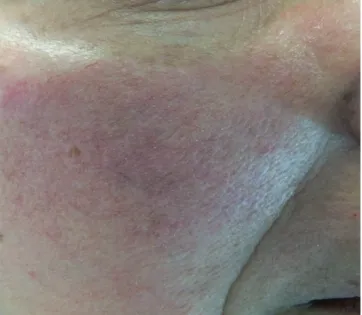
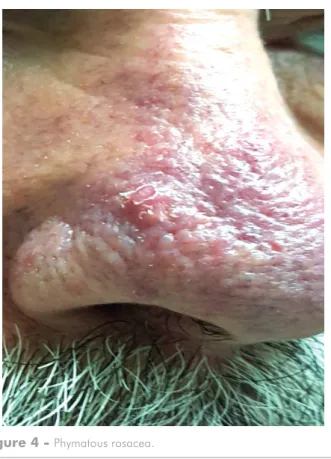
been classified on clinical grounds, into four major sub-types: 1) erythemato-telangiectatic; 2) papulo-pustular; 3) phyma-tous and 4) ocular rosacea4 (Fig.s 1-5).
Often both patients and non-dermatologist physicians un-derestimate the condition, taking it as a merely cosmetic con-cern or, otherwise, view it just as minor psychological ailment. In fact, blushing – the most peculiar and the most human of
all expressions6 – has been usually regarded as a hallmark of
Figure 1 - Erythemato-telangiectatic rosacea.
Figure 2 - Erythemato-telangiectatic rosacea.
embarrassment,7 but the red face with hypertrophied nose is
also viewed as a sign of excessive alcohol consumption.5
Mo-reover, the disorder conveys patients a disgraceful appearan-ce, which, along with the resulting sense of shame and social inadequacy portend important repercussion in their daily lives.8
Psychological factors are relevant both in the initiation and course of rosacea. In fact, for the last century, both social and emotional impact, diminished self-esteem and psychiatric co-morbidities have been reported to occur in these patients.9-12
They have been described as immature, anxious, with dimi-nished self-esteem and feelings of guilt and shame,13,14 or as
psychoneurotic, with hysterical or obsessive-compulsive confi-gurations.15
In the present study we intended to explore and draw conclusions on the psychopathologic distress experienced by Portuguese rosacea patients as compared to a group of der-matological patients suffering from acute, non-conspicuous, accidental dermatoses.
METHODS
Sample/Population: Were enrolled 53 rosacea (ROS)
pa-tients from an outpatient dermatology clinic in a public hospi-tal setting, in Lisbon. Their ages ranged from 18 to 72 years old (mean age was 35.8 years and standard deviation of 16.1 years). A control group with 190 patients were also included, that suffered from acute, accidental, non-conspicuous derma-toses (as opposed to long lasting, constitutional dermaderma-toses or those that affect normally exposed parts of the skin like the face, hands or the neck area or otherwise areas with important psychological impact such as the hands or genitalia). Examples of those that were included in the control group: tinea versico-lor, tinea pedis, superficial bacterial, fungal and viral infections, contact dermatitis, toenail dystrophies, pityriasis rosea, mild scalp seborrheic dermatitis…).
Procedure: Participants were randomly picked from our
Cli-nic nosological database and asked to participate in the study. Demographic features (gender, age, marital status and edu-cational level) and clinical data (disease duration and clinical classification) were controlled. Of the 53 ROS patients, the sub--types erythemato-telangiectatic and papulopustular variants clearly predominated, with 20 and 25 patients, respectively. The phymatous variant was present only in 8 cases. Ocular rosacea was diagnosed in 10 patients, but never an isolated finding and, therefore, it was not considered as a distinct subgroup for analysis.
Instrument: The measuring tool was the Symptom Checklist
- 90 (R) (SCL-90 (R)),16 namely the Portuguese version.17 SCL-90
(R) is a multidimensional self-report symptom inventory desig-ned to evaluate psychological distress and to record emotional and psychovegetative complaints. Its relevance has been proven in psychiatric and nonpsychiatric patients as well as in normal, non-emotionally disturbed individuals. It is a 90-item question-naire that includes the following 9 subscales: somatization (12 items); obsessive-compulsive (10 items); interpersonal sensitivity (9 items); depression (13 items); anxiety (10 items);
anger/hos-tility (6 items); phobic anxiety (7 items); paranoid ideation (6
items) and psychoticism (10 items). Subjects respond to each of the 90 statements on a five-point Likert scale, ranging from “not at all” (scored as 0) to “extremely” (scored 4). The final score of each subscale is the mean of the corresponding subscale items.
Statistical analyses were performed by the program SPSS version 11.0. Demographic differences were analysed by One--Way Analysis of variance (ANOVA); all the other analyses with categorical independent variables were performed using Multi-variate Analysis of Covariance (Mancova): the analyses with or-dinal independent variables were performed using Spearman’s non-parametric correlation methods.
Figure 4 - Phymatous rosacea.
RESULTS
Age differences were not significant (F [1 241]= 3.18,
p=0.08) between the rosacea group (M=35.6, SD=16.1)
and the control group (M=30.8, SD=18.5) . The same does not apply however to the other demographic variables, with women overrepresented (F [1, 241]= 9.16, = 0.003) in the study group (64%) and underrepresented in the control group (41%), and also with a significant difference found between the 2 groups in the variable educational level (F [1, 241]=14.48,
p<0.001.), with ROS patients having higher school level
(M=12.5, SD=3.9) than controls (M=10.3, SD=3.6). Multi-variate analyses of covariance (ROS and gender as indepen-dent and SCL-90® subscales as dependent variables) were
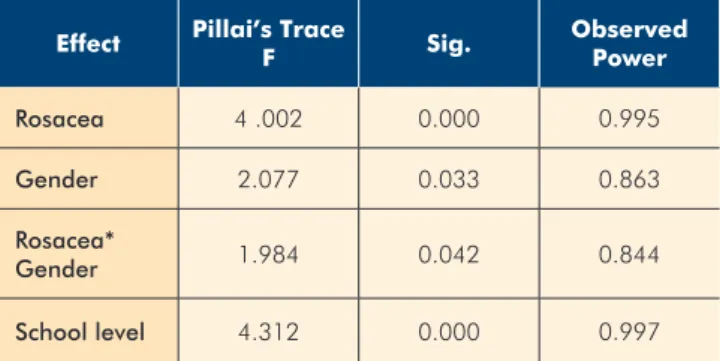
performed. Pillai’s and Wilks’ Lambda tests allowed to see that there were significant effects of the independent variables in the psychometric variables (Table 1).
Univariate effects tests failed to demonstrate significant di-fferences in the psychometric variables between the rosacea and control patients, except for interpersonal sensitivity. In fact, ROS patients scored significantly higher than controls in this sub scale (Table 2). As far as gender is concerned, no sig-nificant difference could be found between males and females in the SCL-90® scores, except for a marginally significant (F
[1,238] = 3.29, P=0.07), higher depression score in males (M=0.87, SD=0.67), as compared to females (F=0.84,
SD=0.61).
Significant two-way interaction effects between gender and rosacea were however found in the sub scales anxiety (F [1,238] = 4.77, p=0.03), depression (F [1238]=8.97,
p=0.003), interpersonal sensitivity (F [1,238]=5,25, p=0.02), obsessive-compulsive (F [1,238]=13,64, p<0.001), paranoid
ideation (F [1,238]=5.19, p=0.02) and, lastly, somatization
(F[1,238]= 9.89, p=0.002).
These interaction effects showed that female ROS patients scored higher than males, as opposed to the control group, where males clearly outscored females. It was also clear that while female ROS patients scored always higher than female controls, the very opposite was seen in the male population who, except for interpersonal sensitivity, scored always lower than their male counterpart controls.
Clinical classification, gender and psychometric variables, using both a One-Way Analysis of variance between gender and clinical sub-types (F[1,52]=0.66, p=0.42) and Spear-mans` non-parametric correlations between clinical sub--types and the psychometric variables, both failed to show
Table 1 -
Effects of Rosacea, gender, Educational
level and of Interaction between Rosacea and
Gender on SCL-90 scale scores, using “Mancova
Multivariate Test”.
Effect Pillai’s Trace
F Sig. Observed Power Rosacea 4 .002 0.000 0.995 Gender 2.077 0.033 0.863 Rosacea* Gender 1.984 0.042 0.844 School level 4.312 0.000 0.997
Table 2 -
SCL-90 scores of rosacea and control patients
Mean St error Significance
ANXIETY 0-Control 0.86 0.05
1-Rosacea 0.83 0.09
DEPRESSION 0-Control 0.88 0.05
1-Rosacea 0.77 0.09
PHOBIC ANXIETY 0-Control 0.49 0.04
1-Rosacea 0.49 0.08
HOSTILITY 0-Control 0.88 0.05
1-Rosacea 0.91 0.10
INTERPERSONAL SENSITIVITY 0-Control 0.82 0.05 **
1-Rosacea 1.10 0.09
OBSESSIVE-COMPULSIVE 0-Control 1.07 0.05
1-Rosacea 1.02 0.09
PARANOID IDEATION 0-Control 0.88 0.05
1-Rosacea 0.99 0.09 PSYCHOTICISM 0-Control 0.56 0.04 1-Rosacea 0.57 0.08 SOMATIZATION 0-Control 0.82 0.04 1-Rosacea 0.79 0.08 ** P<=0.01
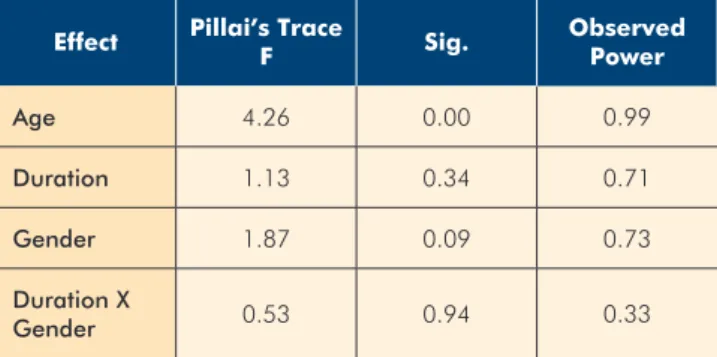
significant differences (Table 3). Concerning disease duration, a multivariate analysis of covariance was performed with the SCL-90® subscales as dependent variables, disease duration
(3 levels: <1Y; 1-5Y and >5Y) and gender as independent ones and age as co-variable. No effects reached the level of significance. However, univariate tests revealed significance (F[2,52]=3.79, p=0.03) of disease duration in paranoid
idea-tion (Table 4), where scores were shown to be much higher in
patients suffering from the condition for more than one year and slightly decreasing in the longer lasting disease (>5Y), particularly among males (Fig. 6).
DISCUSSION
The precise elucidation on the exact aetiology of rosacea (ROS) is yet to be made. Although successively attributed to genetic, behavioural, psychogenic, climatic, nutritional, infec-tious and immunological factors,18-21 evidence has
accumu-lated that underneath the diverse clinical settings, there are always vascular abnormalities, as such strengthening Unna`s original view point of rosacea being basically a vascular di-sorder.22,23 In fact, a basic microcirculatory disturbance of the
facial angular veins (involved in a direct brain cooling mecha-nism)23,24 has been said to play a pivotal role. Additionally, Table 3 -
Effects of age, rosacea’s duration, gender
and of interaction between rosacea’s duration and
gender on SCL-90 scale scores using “Mancova
Multivariate Test".
Effect Pillai’s Trace
F Sig. Observed Power Age 4.26 0.00 0.99 Duration 1.13 0.34 0.71 Gender 1.87 0.09 0.73 Duration X Gender 0.53 0.94 0.33
Table 4 -
SCL-90 scores according to disease’s duration
1Dependent Variable Duration Mean Std. Deviation Significance
ANXIETY 1.00 0.60 0.45 2.00 0.97 0.51 3.00 0.75 0.46 DEPRESS 1.00 0.42 0.46 2.00 0.90 0.70 3.00 0.74 0.56 FOBANXI 1.00 0.26 0.28 2.00 0.53 0.54 3.00 0.52 0.58 HOSTILIT 1.00 0.58 0.49 2.00 1.16 0.83 3.00 0.75 0.56 INTSENSE 1.00 0.76 0.24 2.00 1.23 0.64 3.00 1.06 0.63 OBCOMP 1.00 0.60 0.46 2.00 1.07 0.67 3.00 1.08 0.60 PARANIDE 1.00 0.64 0.32 * 2.00 1.16 0.48 3.00 0.91 0.48 PSYCHOTI 1.00 0.47 0.44 2.00 0.65 0.43 3.00 0.51 0.48 SOMATIZA 1.00 0.57 0.53 2.00 0.92 0.58 3.00 0.73 0.47 * P<=0.05
association with migraine and with vasodilator substances (alcohol, foods…)25-28 and life circumstances (menopause…)
are frequently observed in clinical practice. On investigative grounds, it has been shown that the potent vasodilator subs-tance P is increased in the serum and it is over expressed in the perivascular neural network of the affected skin.29,30 Other
neural peptides - VIP and CRH – are probably involved as well in the neural vasodilatory and pro inflammatory background of rosacea.31-33 In short, it is believed that whatever the nature
of the stimulus – emotional, environmental, microbiological, immunological…- frequent and repeated blushing may lead, on the long term, to a permanent loss of the skin vascular tone, as such resulting in erythema and oedema of the tis-sues,34 further aggravated by actinic damage of the dermal
connective tissue and the ensuing loss of supportive strength to the vasculature walls.35
The way these classic and new pathogenic data (namely on the role of the disturbed innate immunity and systemic car-diovascular comorbidities)36-39 relate with the clinical evidence
on rosacea patients` personality and psychism is a matter still under debate and investigation. The fact remains that ROS pa-tients are usually said to be anxious or phobic, with obsessive traits or disorder and, accordingly, their lives are compromised by self-consciousness, social anxiety and avoidance.17, 40
The present study is a hospital-based comparative one, encompassing 53 adult rosacea patients and 190 control sub-jects with other skin diseases. The operational tool was the SCL-90®, a widely used multidimensional self-report inventory,
designed to detect and quantify different aspects of psychopa-thology. Statistical analysis allowed detecting definite effects of the variables rosacea, gender, educational level and the
interaction rosacea/gender in the psychometric dependent variables (SCL-90® subscales). Overall, the ROS group of
pa-tients scored significantly higher than controls with respect to
interpersonal sensitivity, a dimension that normally denotes
feelings of personal inadequacy and inferiority, mixed with fee-lings of being criticized by others. However, when isolated and discriminated for gender and for the presence/absence of ro-sacea, data clearly demonstrated much higher scoring among ROS female patients as far as anxiety, depression,
interper-sonal sensitivity, obsessive-compulsive, paranoid ideation and
somatization. The influence of gender was also evident in the fact that female ROS patients scored always higher than their control counterparts, in contrast with the ROS male patients that, somewhat surprisingly, – except for personal sensitivity - scored lower than the male controls. Also of note, the different clinical subtypes of ROS showed no significant difference in what concerns the effect on psychometric values.
Although still a small population and merely correlatio-nal data, these results do confirm those previously reported in that ROS, as well as chronic dermatologic disorders, portend serious psychological and social repercussions to the indivi-dual.41,42 The psychometric sub scale interpersonal sensitivity
clearly underlines that fact. Also noteworthy we found gender differences that underline – in a mostly urban, middle class population - the strong impact skin and looks have in fema-les` self-image and esteem and social interactions. Bearing in mind the chronicity and visibility of rosacea, it is thus hypothe-tically conceivable that most patients gradually become self--conscious of their ailment, in an extent that may both interfere with social interactions and, as such, possibly reinforcing di-sease pathomechanisms via generated autonomic responses that may further increase facial erythema,43 skin inflammation
and, possibly, systemic comorbidities. These complex chains of events would ultimately result on positive self-perpetuating feedback mechanisms that ultimately would result in an end-less, vicious circle.
CONCLUSIONS
Definite effects were detected of the variables rosacea, gender, educational level and the interaction rosacea/gen-der in the psychometric variables. As a whole, the rosacea group scored significantly higher than controls with respect to interpersonal sensitivity, which denotes feelings of inferio-rity, personal inadequacy and of being criticized by others. This is particularly so in the female gender, with male pa-tients seemingly somewhat more protected concerning these psychometric scale variables. Finally, it clearly deserves to be mentioned the lack of significance between ROS clinical sub--type and psychopathology, as such underlining the subjective and individually based character of psychological suffering in this setting.
Surely deserving further investigation, it is our goal to extend this sample in order to both further investigate these trends and explore these demographic correlations. One inte-resting approach would be to compare these data with those collected from other chronic facial dermatoses such as acne.
Figure 6 - Means of paranoid ideation in three stages of rosacea’s duration and by gender; Three levels scored as: 1- less than one year; 2- one to five years and; 3 - more than five years.
Notwithstanding, a complementary approach that may be in-teresting to explore would be to correlate these data with QoL measurements including both a specific rosacea (ROSAQoL)44
and a specialist Quality of Life instrument (DLQI).
Conflitos de interesse: Os autores declaram não possuir con-flitos de interesse. Suporte financeiro: O presente trabalho não foi suportado por nenhum subsídio ou bolsa. Direito à privacidade e consentimento escrito: Os autores declaram que pediram consentimento ao doente para usar as imagens no artigo.
Conflicts of interest: The authors have no conflicts of interest to declare. Financing Support: This work has not received any contribution, grant or scholarship. Privacy policy and informed consent: The authors declare that the patient gave written infor-med consent for the use of its photos in this article.
REFERENCES
1. Plewig G, Kligman AM. Rosacea. In: Plewig G, Kligman AM, editors. Acne and Rosacea. Berlin: Springer Verlag; 2000. p.456-67.
2. Berg M, Liden S. An epidemiological study of rosacea. Acta Dermatol Venereol.1989; 69: 419-23.
3. Drake L. Survey maps typical progression from rosacea’s first appearance. Rosacea Revi.1995:2.
4. Wilkin J, Dahl M, Detmar M, Drake L, Feinstein A, Odom R, et al. Standard classification of rosacea: Report of the national Rosacea Society Expert Committee on the Clas-sification and Staging of Rosacea. J Am Acad Dermatol. 2002; 46:584-7.
5. Powell C: Rosacea. N Engl J Med, 2005; 352:793-803. 6. Darwin C. The expression of the emotions in man and
animals (1872). In: Porter DM, Graham PW, editors New York: Penguin Books: 1993.p. 364-93.
7. Buss AH. Self-consciousness and Social Anxiety. San Francisco: Freeman; 1980.
8. Drott C, Claes G, Olsson-Rex L, Dalman P, Fahlén T, Göthberg G. Successful treatment of facial blushing by endoscopic transthoracic simpathectomy. Br J Dermatol. 1998; 138:639-43.
9. Sowinska-Gługiewicz I, Ratajczak-Stefanska V, Maleszka R. Role of psychological factors in course of the rosacea. Rocz Akad Med Bialymst. 2005; 50Suppl 1:49-53. 10. Klaber R, Wittkover E. The pathogenesis of rosacea. Br J
Dermatol Syphil. 1939; 2: 501-19.
11. Sobye P. Aetiology and pathogenesis of rosacea. Acta Dermatol Venereol, 1950; 30:137-58.
12. Balkrishnan R, McMichael AJ, Hu JY, Camacho FT, Shew KR, Bouloc A, et al.Correlates of health-related quality of life in women with severe facial blemishes. Int J Derma-tol. 2006; 45:111-5.
13. Gupta MA, Gupta AK, Chen SJ, Johnson AM. Comorbi-dity of rosacea and depression: an analysis of the Na-tional Ambulatory Medical Care Survey and NaNa-tional
Hospital Ambulatory Care Survey-Outpatient Depart-ment data collected by the US National Center for Heal-th Statistics from 1995 to 2002. Br J Dermatol, 2005; 153:1176-81.
14. Cormia FE. Basic concepts in the production and mana-gement of the psychosomatic dermatoses-II. Br J Derma-tol. 1951; 63:129-51.
15. Panconesi E. Psychosomatic Dermatology. In: Panconesi E, editors. Clinics in Dermatology Stress and Skin Disea-ses: Psychosomatic Dermatology. Philadelphia: JB Lip-pincott; 1984.p.131-3.
16. Derogatis LR, Lipman RS, Covi L. SCL-90: An Outpatient Psychiatric Rating Scale – Preliminary Report. Psycho-pharmacol Bull. 1973; 9:13-28.
17. Baptista A. A génese da perturbação de pânico: A im-portância dos factores familiares e ambientais durante a infância e a adolescência. [Dissertação de doutoramen-to,]. Porto: Instituto de Ciências Biomédicas Abel Salazar, Universidade do Porto; 1993.
18. Koblenzer CS. Flushing reactions and rosacea. In: Ko-blenzer CS, editor. Psychocutaneous Disease. Orlando: Grune and Stratton; 1987.p. 230-7.
19. Grosshans E. Bilan des notions ètiologiques actuelles de la rosacée. J Agregés. 1977; 10:427-33.
20. Marks R. Concepts in the pathogenesis of rosacea. Br J Dermatol. 1968; 80:170-7.
21. Rebora A. Rosacea. J Invest Dermatol. 1987; 88(Suppl 3):569-605.
22. Wilkin JK. Rosacea: a review. Int J Dermatol. 1983; 22:393-400.
23. Wilkin JK. Rosacea: pathophysiology and treatment. Arch Dermatol. 1984; 130:359-62.
24. Brinnel H, Friedel J, Caputa M, Cabanac M, Grosshans E. Rosacea: disturbed defense against brain overheating. Arch Dermatol Res. 1989; 281:66-72.
25. Spoendlin J, Voegel JJ, Jick SS, Meier CR. Migraine, trip-tans, and the risk of developing rosacea. A population--based study within the United Kingdom. J Am Acad Dermatol, 2013; 69:399-406.
26. Caputa M, Perrin G, Cabanac M. Ecoulement sanguine reversible dans la veine ophtalmique: mecanisme de re-froidissement sèlectif du cerveau humain. CR Acad Sci. 1978; 287:1011-4.
27. Wilkin JK. Heat, not caffeine, induces flushing in erythe-matotelangiectatic rosacea. J Invest Dermatol 1979; 73:310-2.
28. Wilkin JK. Quantitative assessment of alcohol-provoked flushing. Arch Dermatol. 1986; 122:63-5.
29. Kurkmoglu N, Alaybeyi F. Substance P immunoreactivity in rosacea. J Am Acad Dermatol. 1991; 25:725-6. 30. Powell FC, Corbally N, Powell D. Substance P and
rosa-cea. J Am Acad Dermatol. 1993; 28:132-3.
31. Wollina U. Rhinophyma-unusual expression of simple--type keratins and S 100 A in sebocytes and abundance of VIP-receptor-positive dermal cells. Histol Histopathol. 1996; 11:111-5.
32. Fimmel S, Schnitger A, Glass E, Zouboulis CC. Keratino-cyte- and seboKeratino-cyte-derived factors modify UVB activity on endothelial cells: a possible mechanism for the develop-ment of vascular changes in rosacea. J Invest Dermatol Res. 2004; 122:A3.
33. Zouboulis CC. Acne vulgaris and rosacea. In: Grans-tein RD, Luger T, editor. Neuroimmunology of the Skin. Basic Science to Clinical Practice. Berlin: Springer-Verlag; 2009. p. 225-32.
34. Wilkin JK, Josephs JA. Infrared photographic studies of rosacea. Arch Dermatol. 1980; 116:676-8.
35. Marks R, Harcourt-Webster JN. Histopathology of rosa-cea. Arch Dermatol. 1969; 100:683-91.
36. Yamasaki K, Di Nardo A, Bardan A, Murakami M, Ohtake T, Coda A, et al. Increased serine protease acti-vity and cathelicidin promotes skin inflammation in rosa-cea. Nat Med. 2007; 13:975-80.
37. Bevins CL, Liu FT. Rosacea: skin innate immunity gone awry? Nat Med. 2007; 13:904-6.
38. Duman N, Ersoy Evans S, Atakan N. Rosacea and
cardiovascular risk factors: a case-control study. J Eur Acad Dermatol Venereol. 2014; 28:1165-9.
39. Hua TC, Chung PI, Chen YJ, Wu LC, Chen YD, Hwang CY,et al.Cardiovascular comorbidities in patients with ro-sacea: A natiowide case-control study from Taiwan. J Am Acad Dermatol. 2015; 73:249-53.
40. Cotterill JA. Rosácea y enrojecimiento facial, hiperhidro-sis. In: Grimalt F, Cotterill JA, editors. Dermatologia y Psiquiatria – Historias Clinicas Comentadas. Madrid: Bi-blioteca Aula Medica; 2002. p. 239-44.
41. Finlay AY, Ryan TJ. Disability and handicap in dermatolo-gy. Int J Dermatol. 1996; 35:305-11.
42. Jowett S, Ryan T. Skin disease and handicap: An analy-sis of the impact of skin conditions. Soc Sci Med. 1985; 20:425-9.
43. Bar LH, Kuypers BR. Behaviour therapy in dermatologic practice. Br J Dermatol. 1973; 88:591-8.
44. Nicholson K, Abramova L, Chren MM, Yeung J, Chon SY, Chen SC. A pilot quality-of-life instrument for acne rosa-cea. J Am Acad Dermatol. 2007; 57:213-21.