Repositório ISCTE-IUL
Deposited in Repositório ISCTE-IUL: 2018-04-23
Deposited version: Post-print
Peer-review status of attached file: Peer-reviewed
Citation for published item:
Godinho, C. A., Updegraff, J. A., Alvarez, M.-J. & Lima, M. L. (2017). When is congruency helpful? Interactive effects of frame, motivational orientation, and perceived message quality on fruit and vegetable consumption. Journal of Health Communication. 22 (12), 942-950
Further information on publisher's website: 10.1080/10810730.2017.1382614
Publisher's copyright statement:
This is the peer reviewed version of the following article: Godinho, C. A., Updegraff, J. A., Alvarez, M.-J. & Lima, M. L. (2017). When is congruency helpful? Interactive effects of frame, motivational orientation, and perceived message quality on fruit and vegetable consumption. Journal of Health Communication. 22 (12), 942-950, which has been published in final form at
https://dx.doi.org/10.1080/10810730.2017.1382614. This article may be used for non-commercial purposes in accordance with the Publisher's Terms and Conditions for self-archiving.
Use policy
Creative Commons CC BY 4.0
The full-text may be used and/or reproduced, and given to third parties in any format or medium, without prior permission or charge, for personal research or study, educational, or not-for-profit purposes provided that:
• a full bibliographic reference is made to the original source • a link is made to the metadata record in the Repository • the full-text is not changed in any way
The full-text must not be sold in any format or medium without the formal permission of the copyright holders. Serviços de Informação e Documentação, Instituto Universitário de Lisboa (ISCTE-IUL)
Av. das Forças Armadas, Edifício II, 1649-026 Lisboa Portugal Phone: +(351) 217 903 024 | e-mail: [email protected]
When is congruency helpful? Interactive effects of frame, motivational orientation and perceived message quality on fruit and vegetable consumption
Cristina A.Godinho1 John A. Updegraff2 Maria-João Alvarez3 Maria Luísa Lima1
1. Instituto Universitário de Lisboa (ISCTE-IUL), CIS-IUL, Lisboa, Portugal
2. Kent State University, Ohio, USA
3. Faculdade de Psicologia, Universidade de Lisboa, Portugal
This study was supported by a grant from the Portuguese Foundation for Science
and Technology (FCT), with the reference SFRH/BD/66193/2009, awarded to the first
author.
Word count (excluding figures/tables): 4525
Corresponding author: Cristina Godinho
CIS-IUL, Instituto Universitário de Lisboa Av. das Forças Armadas,
1649-026 Lisboa
Abstract
Health messages framed to match peoples´ motivational orientation are generally more
effective in promoting health behavior change, but some inconsistencies have been
found. This study aimed to test whether the perceived quality of a health message may
be a moderator of the congruency effect. Undergraduate participants (N = 109) read a
health message promoting fruit and vegetable (FV) intake in which the frame (gain vs.
loss) was either congruent or incongruent with their motivational orientation. Perceived
message quality and intention to increase FV intake were assessed after message
exposure, and self-reported FV intake was assessed one week later. Effects for
congruency were not found, but significant interactions between congruency and
perceived message quality were found for intention and FV intake. When messages
were congruent, higher intentions and FV intake were observed when perceived
message quality was high, but the reverse pattern was observed when perceived
message quality was low. A mediated moderation model suggested that intention
mediated the interaction between congruency and perceived message quality on fruit
and vegetable intake. Only when the quality of a message is strong does matching the
frame of a message to the recipient´s motivational orientation increase adherence to
health behaviors such as FV intake.
Keywords: Persuasive communication; Message framing; Motivational orientation;
When is congruency helpful? Interactive effects of frame, motivational orientation
and perceived message quality on fruit and vegetable consumption
Health communications intended to change health behaviors, such as fruit and
vegetable intake, often emphasize the consequences of adherence or non-adherence
(Michie et al., 2013). These consequences can be communicated with either a gain or a
loss frame. A gain-framed message stresses the positive consequences of change, e.g.,
"if you eat five or more portions of fruit and vegetables a day you will be protected
against several diseases", whereas a loss-framed message stresses the negative
consequences of failing to implement such changes, e.g., "if you do not eat five or more
portions of fruit and vegetables a day you will be at risk for several diseases".
A large body of research identifies the circumstances under which a certain frame
is more effective in promoting healthy behavior (for reviews see Rothman & Updegraff,
2011; Updegraff & Rothman, 2013). One relatively robust finding is that individual
differences in motivational orientation moderate the relative effectiveness of gain- and
loss-framed messages (Covey, 2014, Godinho, Alvarez, & Lima, 2016). Individual
differences in motivational orientation include differences in approach or avoidance
tendencies, i.e., predominance of behavioral activation system or the behavioral
inhibition system (e.g., Mann, Sherman, & Updegraff, 2004; Updegraff, Sherman,
Luyster, & Mann, 2007) and in the end-states to which people self-regulate their own
behavior, i.e., promotion or prevention regulatory focus (e.g., Higgins, 1997; Latimer et
al., 2008; Sasaki & Hayashi, 2015). Among individuals primarily oriented towards
achieving the presence of positive outcomes (i.e., approach-oriented and promotion
oriented individuals), a gain frame is generally more effective, whereas for individuals
primarily oriented towards avoiding the presence of negative outcomes (i.e.,
(e.g., Mann et al., 2004). This pattern has been called the congruency effect, as it refers
to the increased effectiveness of a health message when the gain vs. loss frame is
congruent with the recipient’s motivational orientation.
The congruency effect has been demonstrated in the context of a variety of
behaviors, including flossing (e.g., Mann et al., 2004; Uskul, Sherman, & Fitzgibbon,
2009) and human papillomavirus vaccination (Gerend & Shepherd, 2007), suggesting
that using congruently-framed messages is a useful strategy for promoting adherence.
Despite these generally supportive findings (Covey, 2014), some issues remain unclear.
For example, some studies have not found support for the congruency effect (e.g.,
Meyers, 2010), and the most robust evidence for this effect comes from studies on
dental flossing. Even in the context of dental flossing, some boundary conditions of the
congruency effect have been noted (Updegraff et al., 2007), for example, showing that it
appears only when the underlying arguments are strong. Thus, additional research is
needed to further identify the boundary conditions of the congruency effect, both by
examining it in a behavioral domain in which it has not previously been studied – such
as fruit and vegetable consumption – and also by testing whether message quality might
moderate the effect of congruency on intentions and behavior.
Message quality and the congruency effect
We propose that the effectiveness of using congruently-framed health messages
rests on the message having perceived high quality. Most of the research conducted on
message quality has used the Elaboration Likelihood Model (ELM; Petty & Cacioppo,
1986) as a theoretical backdrop. According to the ELM, high message elaboration
occurs whenever the receiver is both motivated to process the content of the message
and has the ability to do so (Petty, Barden, & Wheeler, 2002). It has been proposed that
as presenting a message that is congruently framed with the recipient’s motivational
orientation – may increase the recipient’s ability and/or motivation to process the
message more thoroughly (Dimmock, Jackson, Clear, & Law, 2013; Updegraff et al.,
2007).
The ELM also predicts that when people are relatively thoughtful in their
consideration of the information presented in the message (i.e., under high elaboration
conditions), the quality of the message will influence the attitude towards the topic, with
high quality messages leading to more persuasion than low quality messages (Petty,
Cacioppo, & Goldman, 1981). In the context of nearly all ELM-based research, message
quality has referred to the strength of a message’s underlying arguments: high quality
representing strong arguments, and low quality representing weak arguments. One study
in the domain of oral health behaviors showed that when people read health messages
framed to be congruent with their motivational orientation, they were more sensitive to
an argument quality (i.e., argument strength) manipulation than when the message
frame was incongruent with motivational orientation (Updegraff et al., 2007). Thus, it
was concluded that congruency should only promote persuasion and behavior change
when message quality is high. When message quality is low, congruency may lead to
reduced persuasion.
However, persuasion is dependent upon the context, and it is hard to establish
rules for developing arguments that will be systematically viewed as strong across
contexts (Petty & Wegener, 1998). Message recipients may perceive a message as being
high or low quality due to factors other than the strength of the underlying arguments.
These factors include perceived identification, perceived informativeness, and perceived
realism (Cho & Boster, 2008), and variability exists in the degree to which people may
DeBono, 1985). In the context of health message framing, and in line with the results of
previous research (Updegraff et al., 2007), we anticipate that perceived message quality
should moderate the influence of framed messages on the outcomes that matter most in
health behavior research: intentions to adhere, and subsequent adherence behavior.
When messages are perceived as having good quality, congruency should lead to greater
persuasion: in a health context, this should translate into higher intentions to adhere to a
health behavior and greater adherence. In contrast, when messages are perceived as
being of relatively low quality, congruency should have no influence on persuasion, or
worse, a detrimental influence on persuasion. In short, we predict that perceived
message quality acts as a moderator of the influence of congruency on intention and
behavior, and should emerge as an important boundary condition for the congruency
effect.
Aims of the study
The purpose of this study was twofold. First, we sought to examine the utility of
using congruently-framed messages to promote fruit and vegetable consumption, a
health behavior for which the congruency effect has not yet been demonstrated. Like
dental flossing, fruit and vegetable consumption is a behavior that must be performed
daily, for which people often show less than recommended levels of adherence, and also
one in which dispositional factors are known to shape people’s response to persuasive
messages (e.g., Latimer, Katulak, Mowad, & Salovey, 2005). Second, we sought to shed
light on some inconsistencies in the literature by examining the role that perceived
message quality plays in message framing effects such as the congruency effect.
Method Participants
One hundred and twenty-seven university students enrolled in the study. Fourteen
did not complete the follow-up questionnaire and another four were excluded from the
analysis for being allergic or having medical restrictions concerning the eating of fruit
and/or vegetables. This resulted in a final, longitudinal sample of 109 students, who
received course credit for participation. Participants´ age ranged from 16 to 46 years (M
= 19.59; SD = 3.59) and 75 (70.1%) were women.
Procedure
After providing informed consent, participants first reported whether they had any
restrictions related to fruit and vegetable intake and replied to measures assessing their
motivational orientation, and past fruit and vegetable intake in an online survey. At least
one week later, participants came into the lab individually and were randomly assigned
to read either a loss or gain framed message promoting fruit and vegetable intake. After
the message, participants reported their intention towards eating more fruit and
vegetables in the following week. Participants then completed the manipulation check
measures, rated the message´s quality and provided some social-demographic
information. One week after this experimental session, participants received an e-mail
with a link to the final online questionnaire that assessed their fruit and vegetable intake
over the previous week.
Measures
Motivational orientation. The BIS/ BAS scale (Carver & White, 1994) was used to assess participants´ motivational orientation. The scale is composed of 20 items, 13
assessing approach motivations (BAS, i.e., the desire to approach positive occurrences;
Cronbach’s α = .80), and the other seven assessing avoidance motivations (BIS, i.e., the sensitivity and concern with the occurrence of unpleasant events; Cronbach’s α = .75).
4 (“very true for me”). Motivational orientation was determined by subtracting the subject´s mean score in BIS from the mean score obtained in BAS, resulting in a
measure of whether a person was predominantly approach or avoidance-motivated,
which varied between -3 and 3, with negative values representing avoidance and
positive values representing approach.
Perceived message quality. Perceptions about message quality were assessed by three items (Cronbach’s α = .86) used in Updegraff and colleagues (2007): “what is
your overall opinion about the message”, “how credible do you think the message was”
and “would you recommend that the message be used in a public service
announcement”. Answers were given on 7-point scale ranging from 1 (“very negative”/ “not credible at all” / “definitely not recommend”) to 7 (“very positive” / “completely credible” / “definitely recommend”).
Intention. Intention to eat daily recommended portions of fruit and vegetables was assessed by three items (Cronbach’s α = .87) presented in Updegraff and colleagues
(2007): “Do you intend to eat five or more portions of fruit and vegetables a day?”,
“Will you try to eat five or more portions of fruit and vegetables a day?”, “Are you
planning to eat five or more portions of fruits and vegetables a day?”. Response options ranged from 1 (“not at all”) to 7 (“very much”).
Manipulation check. Two items (Cronbach’s α = .70) similar to those reported by Rothman, Martino, Bedell, Detweiler and Salovey (1999) were used to evaluate the
success of the framing manipulation. The first item was “How would you describe the
message in terms of the tone of the information presented?” with response options
ranging from -4 (“mostly negative”) to +4 (“mostly positive”). The second item was
scale ranging from -4 (“the problems of not eating fruits and vegetables”) to +4 (“the
benefits of eating fruits and vegetables”).
Fruit and vegetable intake. Fruit and vegetable intake was measured twice with items described in Luszczynska, Tryburcy and Schwarzer (2007): “Within the last two
weeks (T1) / last week (T3), how often have you eaten a portion of fruit and / or vegetables (excluding potatoes)?”. Several examples of what a portion of fruit and
vegetables could be were given, such as “one cup of raw leafy vegetables” or “one
medium apple, banana, orange, pear”. A similar measure has been validated against
dietary biomarkers and food frequency questionnaires (Steptoe et al., 2003). Responses
were given in a scale ranging from 1 (“once per day or less”) to 7 (“more than four times a day”).
Materials
The gain-framed message explained the positive effects of eating at least 5
portions of FV a day, whereas the loss-framed message presented the negative effects of
not eating this same amount of FV (see Table 1)1. Messages were presented in a
2-minute video format, with the text presented on a computer screen accompanied by
voice narration, in order to insure that all participants received the message in full (see
Appendix for full text).
1 Although regulatory focus theory (Higgins, 1997) was not the focus of the present study, the messages
were prepared in order to address some issues highlighted by the theory. One issue is the disentangling between the presence of a reward and the absence of an aversive outcome (both gains) and between the
presence of an aversive outcome or the absence of a reward (both losses). To keep the presentation of
information constant, the messages only referred to the presence of rewarding vs. aversive outcomes, while referring to the exact same consequences (i.e., same consequences framing, see Rothman & Salovey, 1997). Moreover, the messages controlled for the fact that some outcomes might be considered intrinsically promotional (e.g., being attractive), while others may be considered intrinsically preventive (e.g., having better health), by balancing the number of each type of outcomes.
Analytic strategy
Prior to testing the study hypotheses, an analyses of variance (ANOVA) and a
chi-square test were performed in order to insure that no significant differences in the
studied variables existed between those who completed the study and those who
dropped out.
In order to test whether perceived message quality moderates the effect of
congruency on intention and fruit and vegetable intake, two hierarchical regressions
were performed. Baseline fruit and vegetable intake was included in the first step of
both regressions to account for pre-existing differences in intake. As in prior studies
(e.g., Mann et al., 2004), the congruency effect was represented by an interaction
between message frame and motivational orientation. The hypothesized moderation of
the congruency effect by perceived message quality was tested through the three-way
interaction (i.e., message frame x motivational orientation x perceived message quality).
It was predicted that higher perceived message quality leads, by itself, to higher
intention and fruit and vegetable intake. No specific hypotheses were held for the main
effects of the other two predictors, or for the second-order interactions. Nonetheless, all
were included in the model to ensure that the hypothesized three-way interaction was
not dependent upon it.
Prior to analysis, the message frame variable was dummy-coded (with 0 for loss-
and 1 for gain-frame). The three variables were entered at step two as independent
predictors in the regressions. The two-way interaction terms were entered at step three
and finally the three-way interaction at step four. Considering that reduced power is
associated with higher-order interaction terms (Aiken & West, 1991), and that the
interaction was determined through a one-tailed test. All other reported p-values were
two-tailed.
To simplify the interpretation of any significant three-way interactions, a
categorical variable representing congruency (0 = incongruent; 1 = congruent) was
created, referring to whether the message frame was congruent (vs. incongruent) with
participants´ motivational orientation. Pairwise comparisons (LSD) were then
performed, examining the simple effects of congruency among those perceiving low
message quality (-1SD) and high message quality (+1SD), while controlling for baseline
fruit and vegetable intake.
Finally, a mediated moderation model was tested using PROCESS macro (Model
7; Hayes, 2013). Intention was defined as the mediator between congruency (defined as
a categorical variable) and fruit and vegetable intake, with perceived message quality
moderating the relationship between congruency and intention.
Results Manipulation and randomization check
As expected, the gain-framed message was perceived as being more positive in
tone (M= 2.64; SD= 1.39) than the loss-framed message (M= 0.71; SD= 2.35), F(1, 106)
= 27.59, p < .001, and as mostly emphasizing the benefits of fruit and vegetable
consumption (M= 2.43; SD= 1.54), while the loss-framed message emphasized the costs
of not eating fruit and vegetables (M= -0.46; SD= 2.18), F(1, 106) = 63.38, p < .001. No
other differences were found between the gain vs. loss frame conditions in baseline fruit
and vegetable intake, age and gender (all p´s > .10), attesting the success of the
randomization procedures.
Inter-correlations, means and standard deviations for all study variables are shown
in Table 2. Analyses of variance (ANOVA´s) showed no significant differences on
motivational orientation, perceived message quality, intention, baseline fruit and
vegetable intake and age between the longitudinal sample and those who dropped out
(all p´s > .27), and a chi-square test revealed no gender differences between the groups.
Perceived Message Quality
As shown in Table 2, perceptions of message quality were generally positive (M
= 5.19, SD = 1.32) but ranged considerably (minimum = 1.67, maximum = 7). Message
quality was not related to any baseline measures including motivational orientation (see
Table 2). Participants perceived the gain-framed message to be of higher quality (M =
5.62, SD = 1.15) than the loss-framed message (M = 4.76, SD = 1.31), p < .001.
However, there was no significant congruency effect on perceptions of argument
quality, as the frame x motivational orientation interaction on message quality was not
significant (β = .03, p = .83). Thus, perceptions of message quality were uncorrelated
with congruency. Given that perceived message quality was unrelated to congruency, it
allowed us to examine the extent to which message quality might moderate the
influence of the congruency effect on intentions and behavior.
Intention for fruit and vegetable intake after message exposure
Baseline fruit and vegetable intake, entered in the first step of the hierarchical
regression, was a significant predictor of intention after message exposure (β = .30, p <
.001), and explained 7.3% of its variance. In the second step, message frame,
motivational orientation and perceived message quality explained 27.4% of the variance
on intention, ∆F(3, 101) = 9.36, p < .001. Inspection of the individual contributions of each variable revealed, as expected, a significant and positive effect of perceived
was also significant (ß = .29, p = .02), suggesting that the joint influence of message
frame and motivational orientation depended on perceived quality of the message. The
inclusion of this third-order interaction contributed significantly to the prediction of
intention, ∆R2= .03, ∆F(1, 97) = 4.11, p = .046, explaining an additional 2.2% of variance.
Congruency, when represented as a categorical variable, was again unrelated to
perceived message quality, t(107) = 1.29, p = .20, again allowing us to examine
message quality as a moderator of congruency on intention. As hypothesized, this
categorical congruency variable significantly interacted with perceived message quality
to predict intention (β = .26, p = .03). As Figure 1 shows, perceived message quality had
an effect on intention for both congruent and incongruent groups. However, as
expected, the difference between low and high message quality was more pronounced in
the congruent (M = 5.91; SE= .37 vs. M = 3.71; SE= .40, p < .001) than in the
incongruent conditions (M = 5.56; SE= .48 vs. M = 4.20; SE= .42, p = .04), suggesting
that when the message frame is congruent with motivational orientation, persuasion is
more dependent on perceived message quality.
Fruit and vegetable intake during the following week
As would be expected, baseline fruit and vegetable intake significantly predicted intake at the one-week follow-up (β = .30, p < .001; 26.7% variance explained). Importantly, the three independent variables entered in step two jointly explained additional variance in follow-up intake, ∆F(3, 102) = 3.21, p = .03). Of these three predictors, only motivational orientation was a significant independent predictor (β = 0.21, p = .01), and the second-order interactions entered at step three did not
significantly explain fruit and vegetable intake, ∆F(3, 99) = 0.39, p = .76. As hypothesized, the three-way interaction between message quality, frame and
motivational orientation was significant and positive (β = .29, p = .04). With its inclusion, 36% variance of fruit and vegetable intake was explained, ∆R2= .02, ∆F (1, 98) = 3.35, p = .07. Thus, the effect of congruency on fruit and vegetable intake depended upon perceived message quality.
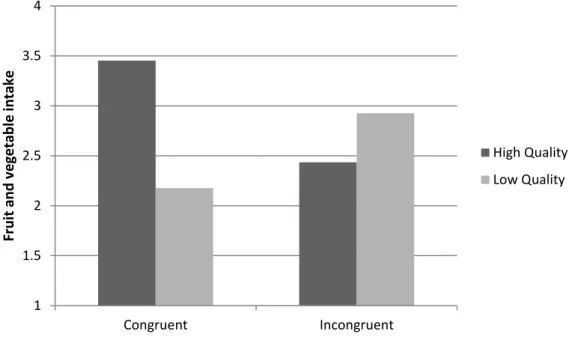
When representing congruency as a categorical variable, its interaction with perceived message quality was likewise significant (β = .28, p = .01). Figure 2 depicts the interaction between congruency and perceived message quality. As hypothesized, when frame was incongruent with own motivational orientation, no effect of perceived message quality was found on fruit and vegetable intake (M = 2.93; SE= .41 vs. M = 2.44; SE= .44, p= .42). However, when frame was congruent, perceived message quality exerted a positive influence, with those perceiving higher quality reporting higher fruit and vegetable intake (M = 3.45; SE= .36) than those who perceived lower quality (M = 2.18; SE= .39), p = .02.
Mediation analyses
Findings thus show that message quality moderated the influence of congruency
effect on the outcomes of both intentions and behavior, suggesting that intentions could
plausibly have mediated the joint influence of message quality and congruency on
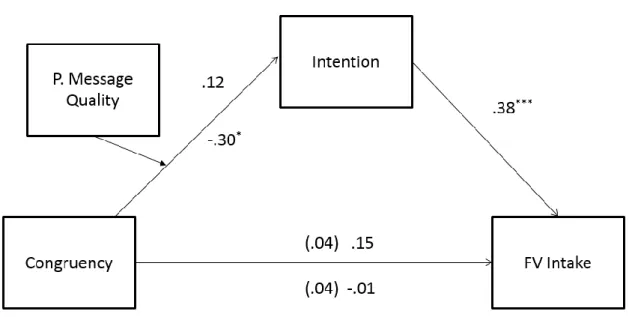
behavior. Therefore, we specifically tested this mediated moderation model. At low
levels of perceived message quality (i.e., values at one standard deviation below the
mean), the hypothesized mediated moderation effect was found (Figure 3), with a
negative significant indirect effect of congruency on fruit and vegetable intake through
intention emerging, βIndirect effect = -.11, 95% CI [-.22; -.03]. Put simply, when people
perceived the message as being of poor quality, the congruency effect was conducive to
lower intentions and, consequently, to lower fruit and vegetable intake, as expected.
deviation above the mean) the indirect effect of congruency on fruit and vegetable
intake through intention was non-significant βIndirect effect = .05, 95% CI [-.02; .15].
Discussion
A growing body of literature attests the effectiveness of matching a health
message’s frame to individuals´ motivational orientation (Updegraff & Rothman, 2013).
However, these congruency effects have not always been obtained (Covey, 2014),
underscoring the need to identify boundary conditions of the congruency effect. The
present study sought to test whether perceived message quality may impose limits to the
effectiveness of congruently framed messages, while also examining the extent to which
the congruency effect could apply to the domain of fruit and vegetable intake.
As hypothesized, perceived message quality had an impact on congruency, both
for intention immediately after message exposure, as well as for fruit and vegetable
intake a week further. Across both intentions and self-reported intake, congruency had
more positive influence on persuasion when perceived message quality was high rather
than low. Therefore, when the message was congruent with recipients’ dispositions,
people appeared to be more sensitive to the perceived quality of the message, showing
higher intentions and higher fruit and vegetable intake when they perceived the message
to be of high quality. Conversely, lower perceived message quality led to lower
intentions, which carried over to fruit and vegetable intake a week later. In other words,
when the message was perceived of being of lower quality, congruency was
counterproductive, leading to lower levels of fruit and vegetable intake. Furthermore, we found that this effect on behavior was mediated by intentions, when perceived
message quality was low. Under these circumstances, congruency interacted with
perceived message quality to determine peoples´ intentions after message exposure, that
The major implication of the present findings is that attention should be paid to
message quality when trying to predict congruency effects on intention and behavior.
Even in cases where message quality is not explicitly manipulated as through an
argument strength manipulation (cf. Updegraff et al., 2007), variability in peoples´
perceptions of message quality may be enough to augment or even reverse framing
effects. Thus, measuring peoples´ perceptions about message quality may help to
disentangle effects that may have been obscured in previous research.
These results may be due to several possible mechanisms. As suggested by
Updegraff and collaborators (2007), the fact that people were more sensitive to message
quality when messages were congruently framed supports the notion that the
congruency effect may be driven, in part, by increased elaboration of a health message.
Elaborating on a strong message increases persuasion. Conversely, elaborating on a
weak message decreases persuasion. Alternately, it is also possible that people “feel
right” (Cesario, Grant, & Higgins, 2004) about their reactions to congruently-framed messages, which in turn could lead to the observed effects. Feeling right about one’s
positive reaction to a message increases persuasion, while feeling right about one’s
negative reaction to a message decreases persuasion. Thus, two theoretical perspectives
support the observed role of message quality as a moderator of framing effects on
adherence behavior, but further research is needed to test these possibilities against each
other. However, our findings do show that a future research that identifies the
mechanisms that underlie message congruency effects is a critically important direction
for future work, as it can help identify the contexts in which congruency may promote
persuasion and behavior change, as well as the contexts where it will likely not.
The fact that the gain-framed message was perceived as being of higher quality is
conceived by our young adult sample as a behavior that serves promotion-oriented
concerns such as accomplishment or vitality more so than prevention-oriented concerns
such as safety or reduction of long-term health risks. As stressed by Rothman,
Wlaschin, Bartels, Latimer and Salovey (2008), for behaviors that reflect promotion-oriented concerns, gain-framed messages may be perceived as having better “fit” and
general appeal than loss-framed messages, leading to a tendency to evaluate the gain
frame more positively than the loss frame for fruit and vegetable intake promotion.
Alternatively, the loss-framed message may have evoked a greater sense of threat (e.g.,
Shen & Dillard, 2007) which may have led to greater message derogation by some
participants, particularly those low in perceived self-efficacy (cf. Witte, 1992; van 't
Riet, Ruiter, Werrij, & De Vries, 2010). However, we emphasize that although
gain-framed messages were perceived as being of higher quality than loss-gain-framed messages,
there was no overall difference in their effect on either intentions or subsequent intake,
underscoring the limits of using perceived message quality solely as a proxy for
message effectiveness.
Some limitations of this study need to be mentioned. First, the sample was
composed by young adults, most of whom were women, which may impose some
limitations to the generalization of the present findings. Also, although our measure of
fruit and vegetable intake has been validated in prior research (Steptoe et al., 2003),
fruit and vegetable intake was assessed through self-report and may be subject to errors
in recall. Message quality was measured rather than manipulated, so our study does not
identify which ingredients make young adults perceive a message as having higher or
lower quality. Nevertheless, the major contribution of our study is to show that, even
when the underlying strength of the arguments is objectively the same, variation in
manner consistent with explicit manipulations of argument strength (see Updegraff et
al., 2007).
The present study makes two important contributions to the health communication
and message framing literatures. First, it shows that matching the frame of a health
message to people’s motivational orientation is not a simple method that will always work, and reinforces the need to understand the exact circumstances under which
congruency may improve adherence to health behaviors. Second, it shows that when the
supporting message is perceived of generally high quality, congruency can promote
increases in fruit and vegetable consumption. We also suggest that future researchers
should evaluate peoples´ perceptions of message quality, as it may help to resolve
References
Aiken, L. S., & West, S. G. (1991). Multiple regression: Testing and interpreting
interactions. Thousand Oaks, CA: Sage Publications.
Carver, C. S., & White, T. L. (1994). Behavioral inhibition, behavioral activation, and
affective responses to impending reward and punishment: The BIS/BAS
scales. Journal of Personality and Social Psychology, 67(2), 319-333. doi:
10.1037/0022-3514.67.2.319
Cesario, J., Grant, H., & Higgins, E. T. (2004). Regulatory fit and persuasion: Transfer
from "feeling right". Journal of Personality and Social Psychology, 86(3),
388-404. doi: 10.1037/0022-3514.86.3.388
Cho, H., & Boster, F. J. (2008). Effects of gain versus loss frame antidrug ads on
adolescents. Journal of Communication, 58(3), 428-446. doi:
10.1177/0093650207313158
Covey, J. (2014). The role of dispositional factors in moderating message framing
effects. Health Psychology, 33(1), 52-65. doi: 10.1037/a0029305
Dimmock, J. A., Jackson, B., Clear, S. E., & Law, K. H. (2013). Matching temporal
frame to recipients' time orientation in exercise messaging: Does argument quality
matter?. Psychology of Sport and Exercise, 14(6), 804-812. doi:
10.1016/j.psychsport.2013.06.002
Gerend, M. A., & Shepherd, J. E. (2007). Using message framing to promote
acceptance of the human papillomavirus vaccine. Health Psychology, 26(6),
745-752. doi: 10.1037/0278-6133.26.6.745
Godinho, C. A., Alvarez, M. J., & Lima, M. L. (2016). Emphasizing the losses or the
promote fruit and vegetable intake. Appetite, 96, 416-425. doi:
10.1016/j.appet.2015.10.001
Hayes, A. F. (2013). Introduction to Mediation, Moderation, and Conditional Process
Analysis: A Regression-Based Approach. New York: Guilford Press.
Higgins, E. T. (1997). Beyond pleasure and pain. American Psychologist, 52(12),
1280-1300. doi: 10.1037/0003-066X.52.12.1280
Latimer, A. E., Katulak, N. A., Mowad, L., & Salovey, P. (2005). Motivating cancer
prevention and early detection behaviors using psychologically tailored messages.
Journal of health communication, 10(S1), 137-155.
Latimer, A. E., Rivers, S. E., Rench, T. A., Katulak, N. A., Hicks, A., Hodorowski, J.
K., ... & Salovey, P. (2008). A field experiment testing the utility of regulatory fit
messages for promoting physical activity. Journal of Experimental Social
Psychology, 44(3), 826-832. doi: 10.1016/j.jesp.2007.07.013
Lavine, H., & Snyder, M. (1996). Cognitive processing and the functional matching
effect in persuasion: The mediating role of subjective perceptions of message
quality. Journal of Experimental Social Psychology, 32(6), 580-604. doi:
10.1006/jesp.1996.0026
Luszczynska, A., Tryburcy, M., & Schwarzer, R. (2007). Improving fruit and vegetable
consumption: A efficacy intervention compared with a combined
self-efficacy and planning intervention. Health Education Research, 22(5), 630-638.
doi: 10.1093/her/cyl133
Mann, T., Sherman, D., & Updegraff, J. (2004). Dispositional motivations and message
framing: A test of the congruency hypothesis in college students. Health
Meyers, R. E. (2010). Moderating the effectiveness of messages to promote physical
activity in type 2 diabetes (Doctoral dissertation). Retrieved from:
http://scholarcommons.usf.edu/cgi/viewcontent.cgi?article=2718&context=etd
Michie, S., Richardson, M., Johnston, M., Abraham, C., Francis, J., Hardeman, W., ... &
Wood, C. E. (2013). The behavior change technique taxonomy (v1) of 93
hierarchically clustered techniques: Building an international consensus for the
reporting of behavior change interventions. Annals of Behavioral Medicine, 46(1),
81-95. doi: 10.1007/s12160-013-9486-6
Petty, R. E., & Cacioppo, J. (1986). Communication and persuasion: Central and
peripheral routes to attitude change. New York: Springer-Verlag.
Petty, R. E., & Wegener, D. T. (1998). Matching versus mismatching attitude functions:
Implications for scrutiny of persuasive messages. Personality and Social
Psychology Bulletin, 24(3), 227-240. doi: 10.1177/0146167298243001
Petty, R. E., Barden, J., & Wheeler, S. C. (2002). The elaboration likelihood model of
persuasion: Health promotions that yield sustained behavioral change. In R. J.
DiClemente, R.A. Crosby, R. A., & Kegler, M. (Eds.), Emerging theories in
health promotion practice and research (pp. 71-99). New York : Jossey-Bass. Petty, R. E., Cacioppo, J. T., & Goldman, R. (1981). Personal involvement as a
determinant of argument-based persuasion. Journal of Personality and Social
Psychology, 41(5), 847-855. doi: 10.1037/0022-3514.41.5.847
Rothman, A. J., & Salovey, P. (1997). Shaping perceptions to motivate healthy
behavior: The role of message framing. Psychological Bulletin, 121(1), 3-19. doi:
Rothman, A. J., & Updegraff, J. A. (2011). Specifying when and how gain- and
loss-framed messages motivate healthy behavior: An integrated approach. In G. Keren
(Ed.), Perspectives on Framing (pp. 257–278). New York: Psychology Press.
Rothman, A. J., Martino, S. C., Bedell, B. T., Detweiler, J. B., & Salovey, P. (1999).
The systematic influence of gain-and loss-framed messages on interest in and use
of different types of health behavior. Personality and Social Psychology
Bulletin, 25(11), 1355-1369. doi: 10.1177/0146167299259003
Rothman, A. J., Wlaschin, J. T., Bartels, R. D., Latimer, A., & Salovey, P. (2008). How
persons and situations regulate message framing effects: The study of health
behavior. In A. J. Elliot (Ed.), Handbook of approach and avoidance motivation
(pp. 475-486). New York: Taylor & Francis.
Sasaki, H., & Hayashi, Y. (2015). Regulatory fit in framing strategy of parental
persuasive messages to young children. Journal of Applied Social Psychology,
45(5), 253-262. doi: 10.1111/jasp.12292
Shen, L., & Dillard, J. P. (2007). The influence of behavioral inhibition/approach
systems and message framing on the processing of persuasive health
messages. Communication Research, 34(4), 433-467. doi:
10.1177/0093650207302787
Snyder, M., & DeBono, K. G. (1985). Appeals to image and claims about quality:
Understanding the psychology of advertising. Journal of Personality and Social
Psychology, 49(3), 586-597. doi: 10.1037/0022-3514.49.3.586
Steptoe, A., Perkins-Porras, L., McKay, C., Rink, E., Hilton, S., & Cappuccio, F. P.
(2003). Psychological factors associated with fruit and vegetable intake and with
biomarkers in adults from a low-income neighborhood. Health Psychology, 22(2),
Updegraff, J. A., & Rothman, A. J. (2013). Health message framing: Moderators,
mediators, and mysteries. Social and Personality Psychology Compass, 7(9),
668-679. doi: 10.1111/spc3.12056
Updegraff, J. A., Sherman, D. K., Luyster, F. S., & Mann, T. L. (2007). The effects of
message quality and congruency on perceptions of tailored health
communications. Journal of Experimental Social Psychology, 43(2), 249-257. doi:
10.1016/j.jesp.2006.01.007
Uskul, A. K., Sherman, D. K., & Fitzgibbon, J. (2009). The cultural congruency effect:
Culture, regulatory focus, and the effectiveness of gain-vs. loss-framed health
messages. Journal of Experimental Social Psychology, 45(3), 535-541. doi:
10.1016/j.jesp.2008.12.005
van't Riet, J., Ruiter, R. A., Werrij, M. Q., & De Vries, H. (2010). Self-efficacy
moderates message-framing effects: The case of skin-cancer detection.
Psychology & Health, 25(3), 339-349. doi:10.1080/08870440802530798
Witte, K. (1992). Putting the fear back into fear appeals: The extended parallel process
model. Communications Monographs, 59(4), 329-349.
Table 1.
Outcomes related to eating (or not) the recommended amount of FV referred in each message frame type.
Gain Frame
Eating fruits and vegetables…
Loss Frame
Not Eating fruits and vegetables…
their sufficient daily consumption can help
prevent major diseases
their insufficient daily consumption can
cause major diseases Eatingfruit and vegetables supplies vitamins
and minerals
Not eating fruit and vegetables results in a lack ofvitamins and minerals
you will be helping the immune system you will be damaging the immune system which works to keep you healthy and safe from
such diseases
which will fail to keep you healthy and safe from such diseases
resulting in increased energy resulting in decreasedenergy,
better moods worse moods
an increased sense of well-being a decreasedsense of well-being
Having an adequate supply of these nutrients in
the bloodstreamis also important for maintaining attractive hair and skin
Not having an adequate supply of these
nutrients in the bloodstream results in
non-attractivehair and skin
promotes an active metabolism promotes an inactive metabolism
which burns fat which accumulates fat
contributing to an overall tonedand attractive body
contributing to an overall untonedand
unattractive body
Substantial positive effect on test performance and academic achievements
substantial negativeeffect on test performance and academic achievements you will be proud of yourself for sticking to
your goals
you will feel disappointed with yourself for
withdrawing from your goals
you will be protected against disease you will be unprotected against disease you will feel good about yourself you will feel bad about yourself
Table 2.
Bivariate correlations between study variables and descriptive statistics.
(1) (2) (3) (4) (5) (6) Mean (SD) 1. Motiv. Orientation (T1) 1 0.15 (0.62) 2. P. Message Quality (T2) .175 1 5.19 (1.32) 3. Intention (T2) .172 .422** 1 5.03 (1.32) 4. FV intake (T1) -.088 -.049 .266** 1 2.81 (1.38) 5. FV intake (T3) .177 .123 .384** .518** 1 2.91 (1.44) 6. Age (T1) .180 -.011 .057 .209* .234* 1 19.59 (3.59)
Table 3.
Hierarchical regressions of intention (Time 2 )and fruit and vegetable consumption (Time 3) on message frame, motivational orientation and perceived message quality.
Outcome variable
Step Variables entered ß (Step 1) ß (Step 2) ß (Step 3) ß (Step 4) Semi-partial R2 In ten ti o n ( T2 ) 1 Baseline FV intake .269 *** .298 *** .300 *** .281 *** .073 2 Message Frame -.083 -.090 -.123 .012 MO .138 .139 .167 .009 P. Quality .424 *** .427 *** .386 *** .068 3 Frame x MO -.045 -.130 .005 P. Quality x MO .091 -.158 .007 Frame x P. Quality .011 .046 .001 4 Frame x MO x P. Quality .330 ** .029 R2 .073 .274 .281 .310 R2 .073 .202 .007 .029 F 8.13 *** 9.36 *** 0.32 4.11 ** FV In ta ke ( T3 ) 1 Baseline FV intake .517 *** .546 *** .535 *** .519 *** .248 2 Message Frame .024 .018 -.009 .000 MO .211 ** .182 .207 .000 P. Quality .095 .042 .006 .014 3 Frame x MO -.004 -.080 .002 P. Quality x MO .065 -.157 .007 Frame x P. Quality .089 .124 .007 4 Frame x MO x P. Quality .292 ** .022 R2 .267 .330 .338 .360 R2 .267 .063 .008 .022 F 38.23 *** 3.21 ** 0.38 3.35 **
Note. Message frame is a dummy variable (0 = loss-frame; 1= gain-frame); MO = motivational orientation; P. Quality = perceived message quality; Semi-partial R2 are presented for each predictor in the final model (Step 3).
Figure 1. Estimated means of intention as a function of congruency and perceived message quality. Baseline fruit and vegetable intake was entered as covariate.
2 2.5 3 3.5 4 4.5 5 5.5 6 6.5 Congruent Incongruent Inten ti o n High Quality Low Quality
Figure 2. Estimated means of fruit and vegetable intake as a function of congruency and perceived message quality. Baseline fruit and vegetable intake was entered as covariate.
1 1.5 2 2.5 3 3.5 4 Congruent Incongruent Fr u it a n d v egeta b le in ta ke High Quality Low Quality
Figure 3. Moderated mediation model of the effect of congruency on fruit and vegetable intake through intention at high (values presented outside the figure) and low (values
Appendix.
Health message promoting fruit and vegetable intake (gain / loss frame).
The World Health Organization recommends a daily intake of at least 5 portions of fruit and vegetables. Fruit and vegetables are important components of a healthy diet, and their (sufficient/ insufficient) daily consumption can help (prevent/ cause) major diseases, such as cardiovascular diseases and certain cancers.
(Eating/ Not eating) fruit and vegetables (supplies/results in a lack of) vitamins and minerals that play a fundamental protective role in the body, and help to repair already damaged tissues. (If you eat/ If you do not eat) the recommended portions of fruit and vegetables (you will be helping/you will be damaging) the immune system, which (works/will fail) to keep you healthy and safe from such diseases.
Furthermore, (a balanced/ a non-balanced) diet that (is/is not) rich in fruit and vegetables has a direct effect on the brain, resulting in (increased / decreased) energy, (better/worse) moods and (an increased/ a decreased) sense of well-being. (Having/Not having) an adequate supply of these nutrients in the bloodstream (is also important for maintaining attractive/ results in non-attractive) hair and skin, and promotes an (active/inactive) metabolism, which (burns/ does not burn) fat, contributing to an overall (toned/ untoned) and (attractive/unattractive) body. Plus, (good nutrition/ bad nutrition), (rich/poor) in fruits and vegetables, can have a substantial (positive/negative) effect on test performance and academic achievements.
There have probably been times in the past when you have managed to eat 5 portions a day. This means that eating a sufficient amount of fruit and vegetables simply takes motivation and organization. If you (do it / do not do it) you will (be proud of / feel disappointed with) yourself for (sticking to /withdrawing from) your goals.
Eating 5 portions of fruit and vegetables a day is easy, and most of all it´s tasty! If you (eat / do not eat) this amount of fruit and vegetables per day, you will be (protected / unprotected) against disease, you will feel (good/bad) about yourself and you will have (better/worse) health!