ORIGINAL RESEARCH—ERECTILE DYSFUNCTION
Dropout in the Treatment of Erectile Dysfunction with PDE5:
A Study on Predictors and a Qualitative Analysis of Reasons
for Discontinuation
jsm_27872361..2369Ana A. Carvalheira, PhD,* Nuno Monteiro Pereira, MD, PhD,†João Maroco, PhD,* and
Vera Forjaz, MSc*
*Research Unit of Psychology and Health, University Institute of Applied Psychology, Lisbon, Portugal;
†iSex—Association for the Advanced Study of Human Sexuality, ULHT, Lisbon, Portugal
DOI: 10.1111/j.1743-6109.2012.02787.x
A B S T R A C T
Introduction. Phosphodiesterase type 5 inhibitors (PDE5) are currently the first line treatment for erectile dysfunc-tion (ED). However, previous research shows that PDE5 treatments have high discontinuadysfunc-tion rates. Understanding the reasons for discontinuing PDE5 will be necessary to optimize the response to treatment.
Aim. The main goals were: (i) to analyze discontinuation rate of PDE5; (ii) to identify the discontinuation predictors; and (iii) to study the reasons for discontinuation using a qualitative methodology.
Main Outcome Measures. The PDE5 discontinuation rates, predictors, and reasons for discontinuation treatment. Methods. A total of 327 men with clinical diagnosis for ED who had been treated with PDE5 were successfully interviewed by telephone, after giving their informed consent by snail mail. Telephone interviews, concerning their ongoing treatment, were carried out using a standardized questionnaire form with quantitative and qualitative items. Participation rate was 71.8%.
Results. Of the total sample, 160 men (48.9%) had discontinued PDE5 treatment. The discontinuation rate was higher among men with diabetes (73%) and in iatrogenic group (65%), and lower in venogenic etiology (38.7%). We differentiated three groups of men who discontinued treatment (i) during the first 3 months (55.1%); (ii) between 4 and 12 months (26.9%); and (iii) after a period of 12 months (18%). Qualitative analyses revealed diverse reasons for discontinuation: non-effectiveness of PDE5 (36.8%), psychological factors (e.g., anxiety, negative emotions, fears, concerns, dysfunctional beliefs) (17.5%), erection recovery (14.4%), and concerns about the cardiovascular safety of PDE5 (8.7%) were the most common. Older men and men whose partners were involved in the treatment, were less likely to discontinue treatment.
Conclusion. Half the subjects discontinued medication. Mostly, there was a combination of factors that led to discontinuation: non-effectiveness and psychosocial factors appear to be the main reasons. Addressing those factors will allow following up with appropriate focus on relevant topics in order to improve compliance. Carvalheira AA, Pereira NM, Maroco J, and Forjaz V. Dropout in the treatment of erectile dysfunction with PDE5: A study on predictors and a qualitative analysis of reasons for discontinuation. J Sex Med 2012;9:2361–2369.
Key Words. Erectile Dysfunction; PDE5; Dropout; Vardenalfil; Sildenafil; Tadalafil
Introduction
T
he emergence of the first inhibitor ofphos-phodiesterase type 5 (PDE5) (sildenafil) revolutionized the therapeutic intervention on men’s sexual health. There is clear evidence that
phosphodiesterase inhibitors are efficacious in the treatment of the broad population of men with erectile dysfunction (ED) (see [1] for a revision). However, despite the good outcomes of PDE5 [2–4], high rates of treatment discontinuation were present in several studies, ranging from 14% to
57% [5–8]. Higher PDE5 discontinuation rates were found in other studies, reaching 80.4% [9,10]. As recently suggested [11], this phenomenon led to a central issue in PDE5 treatment: if erectile func-tion is so important for well-being, self-esteem, and relationships, and there is an easy and effective way to treat ED, why do men discontinue treatment? The answer to this question can only be found in the complex relationship between efficacy, treat-ment satisfaction, adverse effects, safety concerns, cost, and multiple psychosocial factors [12].
Moreover, data available suggest that the reasons for treatment discontinuation can be divided into “absolute” and “relative” [11]. The absolute reasons refer to medical problems, lack of efficacy, and severe side effects. However, these are not the reasons for discontinuation for some patients, which may be due to more “obscure” reasons: effect less than anticipated, lack of spon-taneity, decreasing libido, disharmony in partner relationships, increasing age, and a variety of comorbidities [6–8,11,13].
Several studies reported treatment-related
reasons that may be responsible for discontinuation: lack of efficacy, side effects, fear of side effects, unwillingness to accept drug-dependent erection, inconvenience in obtaining sildenafil, and change to another ED treatment [5,10–12,14–18]. Further-more, some studies have reported yet further reasons for treatment discontinuation, namely: lack of opportunity for sexual intercourse, partners’ or patients’ emotional willingness for resuming sexual activity, unacceptability of planned sexual activity, and the quality of the relationship [5–7,12,14,15,19]. There appears to be a large number of patients who never start, or discontinue, the treatment due to its financial cost [8,14]. However, several studies contradict this statement, showing that the dropout rate due to the cost is low [6,7]. According to findings from the Cologne study, in a sample of 8,000 men, almost half were willing to pay 25 Euros per month for ED treatment, and 8% were willing to pay any amount [20].
As has been suggested, the only positive reason for discontinuing PDE5 is when the patient is “cured” of his ED, being that erectile function recovery is cited as one of the reasons for PDE5 discontinuation [7,8,10,11,14,21].
Determining the reasons for discontinuation, and compliance with PDE5 treatments, appears to be a fundamental issue in order to optimize the response to treatment, and to develop strategies to reduce the dropout rate (or to improve compli-ance). Additionally, specific factors should be
addressed when choosing the best PDE5 for the individual patient, creating an individualized treat-ment plan [22,23]. A better understanding of diversity of reasons for discontinuation at different follow-up moments will allow an appropriate focus on common issues and relevant factors. We believe the best way to achieve this information and knowledge is through a qualitative study.
Qualitative methods are based on different epis-temological assumptions from those in quantita-tive approaches, and can be especially useful for studying the individuals’ experiential dimension [24]. The phenomenological approach is a quali-tative method that aims at probing participants to relay individual meanings or lived experiences of a given phenomenon [25]. We believe that this approach is specially suited for the study of men’s experience of taking and abandoning the PDE5.
Aims
The aims of this study were: (i) to analyze the PDE5 discontinuation rate; (ii) to identify the pre-dictors of discontinuation; and (iii) to study the reasons for PDE5 discontinuation. Our main goal was to make a qualitative analysis to achieve a thorough understanding of the men’s reasons for discontinuing treatment. In the case of an experi-ential dimension, which is personal, and may be multifactorial, we believe that a qualitative method is most suited. Nevertheless, in addition to a content analysis, we made a quantitative analysis to study the reasons for PDE5 discontinuation.
Methods
Participants
Demographic Variables
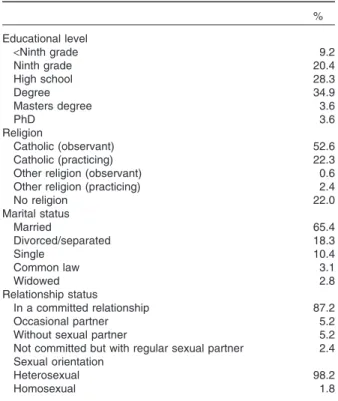
A total of 327 men, with clinical diagnosis for ED and PDE5 prescription for longer than 6 months, were successfully interviewed. The participation rate was 71.8%. The average age of participants was 56.30 (standard deviation 11.44, range 25–81). Most were in a committed relationship (87.2%). Data on educational level, marital status, and reli-gion are presented in Table 1.
Health-Related Variables
A percentage of 22.9 were active smokers.
Instrument
A comprehensive, detailed questionnaire was developed and piloted for this study, based on the literature review and on the researcher’s clinical experience.
Our questionnaire is composed of 45 items, and contemplated quantitative and qualitative variables (incorporating sociodemographic, clinical, and dropout-related items). Sociodemographic infor-mation included age, educational level, religion, sexual orientation, and marital and relationship status. The health-related items included health problems, comorbidities, ongoing medication, smoking habits, substance abuse, and genital and urinary surgeries.
Other quantitative variables included: partner involvement in the patient’s treatment, partner’s sexual activity, frequency and duration of PDE5 use, expectations regarding the PDE5, other treat-ment options sought by men, frequency of appointments, and satisfaction with their doctor. Also, men were asked to rate the importance of 11 reasons for discontinuing PDE5, on a five-point Likert scale (1—reason not at all important to
discon-tinue treatment to 5—reason completely important to discontinue treatment).
If PDE5 was prescribed by the doctor and the patient did not initiate treatment, an open-ended question was made to assess the reasons that led the patient to not initiate treatment.
The questionnaire also contemplated two open-ended questions: (i) How did you take the inhibitor?; and (ii) What reasons led you to stop medication?
Procedure
From the base cohort, we identified all patients who had been diagnosed with ED and received PDE5 prescription for longer than 6 months in an andrological outpatient’s clinic, where the authors worked. The patients eligible for this study were men with clinical diagnosis of ED and with history of PDE5 use or prescription. Exclusion criteria were: taking antidepressant, history of alcohol and substance abuse, hypogonadism, Peyronie’s disease, and the presence of a severe psychopatho-logical disorder. All the subjects did an intracav-ernous alprostadil injection test, associated with penile rigidometry (Rigiscan test) and a penile Doppler ultrasound. When a veno-occlusive dysfunction was suspected, a pharmacocavernos-ometry was systematically performed. The classi-fication of etiologies was made in six categories, based on rigidometry, penile Doppler ultrasound, and medical history: (i) arteriogenic (arterial
insuf-ficiency): shows an insufficient rigidometry
response and penile Doppler ultrasound confirms a cavernosal arterial insufficiency; (ii) venogenic (veno-occlusive dysfunction): medical history reveals an history of unstable and/or short-lasting erections, the rigidometry shows an oscillatory or null response, and penile Doppler ultrasound does not show arterial insufficiency; (iii) neurogenic: cases of neurologic pathology (e.g., cerebral vas-cular accident, spinal cord injury); (iv) diabetes: included were men with an history of diabetes for more than 20 years, and rigidometry confirms the diagnosis of organicity; (v) iatrogenic: based on two criteria—medical history of radical
prostatectomy/brachytherapy/radiation therapy
for prostate cancer (iatrogenic
medication-induced etiology was not included) and rigidom-etry confirms the diagnosis of organicity; and (vi) psychogenic: medical history suggests psychologi-cal cause and rigidometry and penile Doppler ultrasound did not suggest organicity.
The patients were contacted by telephone for the study’s presentation and then received the informed consent by regular mail at the discharge address; at this point, full written information about the project and its aims was provided. Sub-jects were contacted for second time after 1 week. Once confirmation had been received from the potential participants, a telephone interview was scheduled. Interviews took between 30 and 50 minutes. No remuneration was provided. We believed that telephone interviews are an adequate method to collect data on such a private topic
Table 1 Participants’ characteristics
% Educational level <Ninth grade 9.2 Ninth grade 20.4 High school 28.3 Degree 34.9 Masters degree 3.6 PhD 3.6 Religion Catholic (observant) 52.6 Catholic (practicing) 22.3
Other religion (observant) 0.6
Other religion (practicing) 2.4
No religion 22.0 Marital status Married 65.4 Divorced/separated 18.3 Single 10.4 Common law 3.1 Widowed 2.8 Relationship status In a committed relationship 87.2 Occasional partner 5.2
Without sexual partner 5.2
Not committed but with regular sexual partner 2.4 Sexual orientation
Heterosexual 98.2
Homosexual 1.8
allowing for greater self-disclosure than face-to-face interviews. Moreover, this method allowed the inclusion of men from different and distant regions.
Interviews were conducted by both the main researcher and a trained research assistant. They were carried out using the standardized question-naire form in a Google Docs online research data-base. A username and password were established to ensure database security. Complete qualitative and quantitative data from the interviews were intro-duced directly through the live form and stored in the database.
Pilot testing was carried out to test the proce-dure, the database system, and the questionnaire in order to be clear and understandable and to provide comprehensive response choices. A number of errors were identified and corrected during pilot testing.
This study received ethical approval from the Ethics Committee of the University Institute of Applied Psychology and from the Ethics Commit-tee of Lusófona University.
Statistical Analysis
All statistical analyses were performed with SPSS (v. 19.0, SPSS Inc., Chicago, IL, USA). A logistic regression was conducted to examine the predic-tors of discontinuation of PDE5 in this sample. We tested the association between the etiology of ED and discontinuation rate with a chi-square test.
Significant effects were assumed for P< 0.05.
Regarding open-ended questions, transcribed data were organized into categories and a content analysis was performed.
Results
Discontinuation Rate of PDE5
Of the total sample (N = 327) and during a follow-up period of 3 years, 160 men (48.9%) dis-continued PDE5 treatment, 148 men (45.3%) were still using the inhibitor, and 19 (5.8%) did not start the treatment although a doctor pre-scribed it. The discontinuers mean age was 56.1 (min 27, max 79), 67.5% were married, 17.5% divorced/separated, 9.4% single, and 3.1% widowers.
Among this group of discontinuers, 49.4% of men used the PDE5 in every single intercourse.
Moreover, 35% of men had experienced one or more adverse effects with PDE5. In addition, 37.5% had switched from one PDE5 to another,
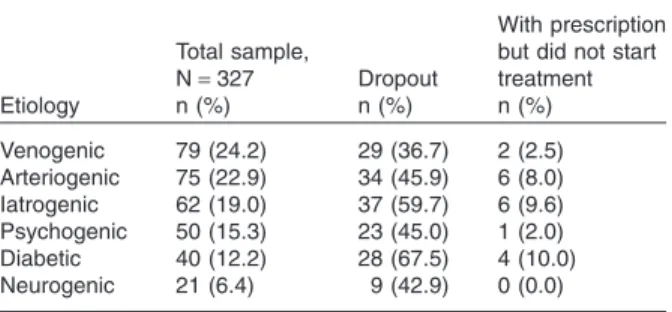
and 50.6% had tried at least one other treatment for ED, besides PDE5. Forty-six percent referred that the treatment did not meet their expectations. The main etiologies in the total sample were veno-genic (24.2%) and arterioveno-genic (22.9%). The highest dropout rates were observed in individuals with diabetes (67.5%) and iatrogenic etiology (59.7%) (Table 2).
The etiologic diagnosis was determined
through the evaluation of the clinical history, blood tests, intracavernous Alprostadil injection test associated with Rigiscan test, and penile Doppler ultrasound. In some cases Pharmacocav-ernosometry and pharmacocavernosography were also used. The high percentage of venogenic eti-ologies in the total sample (24.2%) and the rela-tively low percentage of arteriogenic etiologies can be explained by the fact that this is a specialized center, where the most complex cases are referred to.
Of these 160 men who discontinued treatment, 20.3% stated that their partner was little or sexu-ally active, 42.1% reported that their partner was active, and 37.6% responded “not too much or too little.” Twenty-two percent of men who dropped out stated that their partner did not know about the treatment, 24% believe that the partner was not involved in solving the problem, and 25.6% of men were accompanied by their partners to the consultation.
Predictors of Discontinuation
A logistic regression was conducted to assess whether age, etiology, side effects, partner’s involvement in the treatment, and partner’s level of sexual activity could predict PDE5 discontinu-ation. The overall model was found to be
signifi-cant (c2(16) = 46.912, P< 0.001). Older men were
less likely to discontinue treatment (odds ratio [OR] = 0.956, P = 0.005). Men whose partner was involved in the treatment were less likely to
dis-Table 2 Etiologies of ED in the total sample and discontinuers
Etiology
Total sample,
N= 327 Dropout
With prescription but did not start treatment n (%) n (%) n (%) Venogenic 79 (24.2) 29 (36.7) 2 (2.5) Arteriogenic 75 (22.9) 34 (45.9) 6 (8.0) Iatrogenic 62 (19.0) 37 (59.7) 6 (9.6) Psychogenic 50 (15.3) 23 (45.0) 1 (2.0) Diabetic 40 (12.2) 28 (67.5) 4 (10.0) Neurogenic 21 (6.4) 9 (42.9) 0 (0.0)
continue the treatment, as compared with men whose partner was not involved in the treatment (OR = 0.345, P = 0.01). Men who reported side effects were less likely to discontinue treatment (OR = 0.396, P = 0.002). When compared with the subjects with venogenic etiologies, there was a sig-nificant increase in the dropout in subjects with
arteriogenic (OR = 3.4, P = 0.01), diabetes
(OR = 6.9, P = 0.001), and iatrogenic (OR = 7.5,
P< 0.001). None of the other variables were
sig-nificant predictors of dropout.
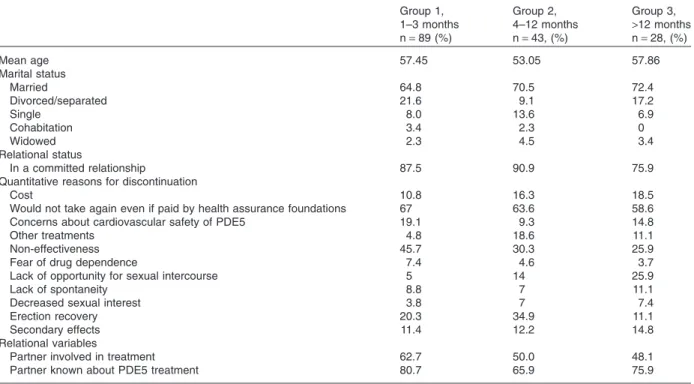
Characterization of the Three Dropout Groups We analyzed the discontinuation rates in three follow-up moments: (i) men who dropped out during the first 3 months (55.1%); (ii) men who dropped out between 3 and 12 months (26.9%); and (iii) men who dropped out after a period of 12 months (18%) (Table 3).
Correlation between Etiology and Discontinuation We explored the correlation between the etiology of ED and discontinuation rate. There was a sig-nificant correlation between these variables
c2 (6) = 18.125, P< 0.05. The dropout rate was
higher among men with diabetes (73%) and in iatrogenic group (65%), and lower in the group of venogenic etiology (38.7%). Men with venogenic
etiology were younger (mean age 48.2) than men with diabetes (mean age 60.4) and iatrogenic eti-ology (mean age 63.1).
Quantitative Analysis of Reasons for Discontinuing PDE5
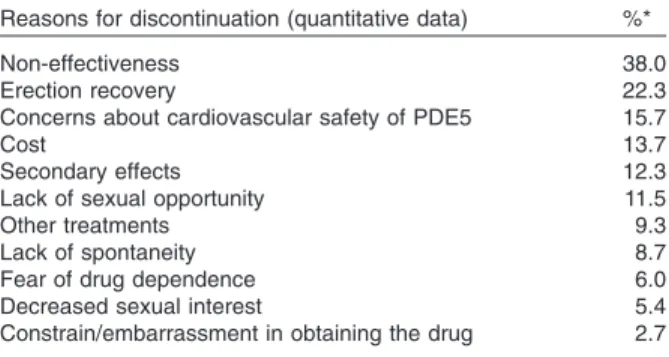
We used 11 items with a five-point Likert scale to study the reasons for discontinuation. This quan-titative analysis revealed that the main reasons for PDE5 discontinuation were: the non-effectiveness of PDE5 (38%), recovery of erections (22.3%), and concerns about the cardiovascular safety of PDE5 (15.7%). All reasons are presented in Table 4.
Qualitative Analysis of Reasons for Discontinuing PDE5
The subjects’ answers to the question, “What
reasons led you to stop taking the medication?” were
analyzed, and allowed the identification of a diverse set of reasons for discontinuation of the drug, which are organized and presented in Table 5. The main reason found was the lack of efficacy of PDE5, reported by 36% of subjects (40% iatrogenic, 23% diabetes, 20% arterogenic, 6% venogenic, 6% psychogenic, and 5% neuro-genic). Other reasons for the abandonment of the drug were psychological factors including anxiety,
Table 3 Characterization of the 3 dropout groups
Group 1, 1–3 months Group 2, 4–12 months Group 3, >12 months n= 89 (%) n= 43, (%) n= 28, (%) Mean age 57.45 53.05 57.86 Marital status Married 64.8 70.5 72.4 Divorced/separated 21.6 9.1 17.2 Single 8.0 13.6 6.9 Cohabitation 3.4 2.3 0 Widowed 2.3 4.5 3.4 Relational status In a committed relationship 87.5 90.9 75.9
Quantitative reasons for discontinuation
Cost 10.8 16.3 18.5
Would not take again even if paid by health assurance foundations 67 63.6 58.6
Concerns about cardiovascular safety of PDE5 19.1 9.3 14.8
Other treatments 4.8 18.6 11.1
Non-effectiveness 45.7 30.3 25.9
Fear of drug dependence 7.4 4.6 3.7
Lack of opportunity for sexual intercourse 5 14 25.9
Lack of spontaneity 8.8 7 11.1
Decreased sexual interest 3.8 7 7.4
Erection recovery 20.3 34.9 11.1
Secondary effects 11.4 12.2 14.8
Relational variables
Partner involved in treatment 62.7 50.0 48.1
negative emotions, fears, concerns, and dysfunc-tional believes, inherent to the use of PDE5 (17.5%), not taken into account in the therapeutic intervention. Other reasons identified were the recovery of erections (14.4%), side effects (10%), relational or interpersonal factors that include problems or conflicts in the relationship or unavailable sexual partners (9.3%), and concerns about cardiovascular safety of PDE5 (8.7%). The high cost of medication was reported by only 6.6% and mostly by men who dropped out after 1 year. To clarify the importance of cost on the abandon-ment of the drug, subjects were asked if they would take the drug again if it was reimbursed. A per-centage of 64.4 of men reported that they would not return to taking the inhibitor even if it was reimbursed, and 6.5% responded “I do not know.” The other reasons for discontinuation are pre-sented in Table 5. We also identified a small group of “unclear reasons,” where individuals who seem to hide the real reasons, or whose speech is confusing and unclear, were included. We also specified a group “When an erection is not
enough” (title of an article by Althof [12]) to
iden-tify two individuals who reported that the treat-ment of ED is more than restoring the capacity to have erections.
The main reasons given by the group that dis-continued PDE5 in the first 3 months (group 1) were non-effectiveness, erection recovery, concern about cardiovascular safety, and psychological factors. Relational factors and side effects were mentioned by significantly more subjects who dis-continued the treatment after 4 months (groups 2 and 3), and subjects who dropped out after 1 year (group 3) also mentioned the high cost and medical complications as reasons (see Table 5).
Patients Who Did Not Start Treatment
A total of 19 patients (5.8%) never took PDE5, although a doctor prescribed it. Their mean age was 62 years (min 40, max 81), 89.5% were in a committed relationship, 78.9% were married, 10.5% divorced/separated, 5.3% single, and 5.3% widowed. Content analysis revealed the following reasons for not initiating treatment with PDE5: five men reported relational variables, mainly a not sexually active partner, and five other men had concerns about cardiovascular safety of PDE5. Five men reported general concerns and resistance to taking drugs, and one man complained about the high cost of the pill. Three men reported unclear reasons.
Discussion
Discontinuation Rate and Etiology
One goal of this study was to analyze the PDE5 discontinuation rate. In our sample of 327 men with ED and PDE5 prescription for longer than 6 months, the discontinuation rate was 48.9% during a follow-up period of 3 years. This finding is supported by previous research [5–8,13,19]. Half of the discontinuers used the inhibitor with every intercourse, 35% referred to have experienced some adverse effects, and 50.6% had already tried other treatments for ED. The discontinuation rate was higher among men with diabetes (73%) and in iatrogenic group (65%), which can be explained by the lower efficacy of inhibitors on these etiologies. The discontinuation rate was lower in the group of venogenic etiology (38.7%), which can be explained by the higher efficacy of inhibitors in this etiology and by the lower age of subjects. Quantitative Analysis of Reasons for
Discontinuing PDE5
The majority of treatment discontinuations occurred during the first 3 months (55.1%). According to the quantitative analysis, main reasons to discontinue treatment during this period were non-effectiveness, erection recovery, and concerns about cardiovascular safety of the inhibitor. In the period between 4 and 12 months, the major reasons were non-effectiveness, erection recovery, and other treatment options. Among men who discontinued treatments after a period of 12 months, the main motives were non-effectiveness, cost, and lack of opportunity for sexual intercourse.
The high cost of the inhibitor is considered to be one important motive evoked by patients to
Table 4 Quantitative data of reasons for discontinuation
of PDE5 (n= 160)
Reasons for discontinuation (quantitative data) %*
Non-effectiveness 38.0
Erection recovery 22.3
Concerns about cardiovascular safety of PDE5 15.7
Cost 13.7
Secondary effects 12.3
Lack of sexual opportunity 11.5
Other treatments 9.3
Lack of spontaneity 8.7
Fear of drug dependence 6.0
Decreased sexual interest 5.4
Constrain/embarrassment in obtaining the drug 2.7 *“To what extent have the following reasons contributed for you to have
stopped taking the pill?” Five-point Likert scale (nothing, little, not too much nor too little, somewhat, a lot). This percentage is the sum of the categories
T able 5 Qualitative analysis of reasons for discontinuation of PDE5 in the three dropout groups (n = 160) Themes (reasons for discontinuation) † T otal, N= 160 (%)* Group 1, 1–3 months Group 2, 4–12 months Group 3, > 12 months Sample statements n = 89 (%) n = 43 (%) n = 28 (%) Non-effectiveness 36.8 47.2 34.8 7.1 “It didn’t work for me, I have diabetes ” Erection recovery 14.4 15.7 18.6 3.6 “It gave me an extraordinary self-confidence and I never needed it again ” Side effects 10.6 5.6 9.3 28.5 “I blushed and had headaches ” Relational/interpersonal factors (e.g., relationship problems, non-active partner) 9.3 5.6 1 1.6 17.8 “All my sexual problems have to do with my wife ” Concerns about cardiovascular safety of PDE5 8.7 10.1 6.9 7.1 “I was afraid it may harm my heart ” Dysfunctional believes inherent to the use of PDE5 7.5 1 1.2 4.6 0 “I stopped because the erection is different, it seems out of the body , not real ” Emotional variables that cause personal distress not taken into account in treatment 6.3 10.1 2.3 0 “If I were better psychologically , better the pill could work ” “My problem is a psychological blockage ” “I’m nervous and anxious ” High cost 6.2 3.3 6.9 14.3 “I don’t take it more often because it is expensive ” Unwillingness to accept drug-dependent erections and/or lack of ability to program sexual activity 5.0 4.5 4.6 7.1 “I had a dependency on the pill that I did not consider positive ” General concerns and fears 3.7 4.5 0 7.1 “I’m convinced that these pills will sooner or later be bad for my health ” “I’m afraid that they will be bad for my health, because I have been taking them for a long time ” Medical events that arose during treatment 3.1 0 0 17.8 (e.g., hemodialysis) Occasional use (for best performance or dealing with occasional stress) 3.0 1.1 2.3 3.6 “I just took on very special occasions to have more fun ” Unclear reasons 2.5 2.2 4.6 0 Unclear reasons, ambiguous and confusing speeches, hiding something “When an erection is not enough ” 1.2 2 0 0 “This pill takes away sensibility and inhibits our intimacy , it modifies our masculinity . It’s an erection without pleasure ” “I can have my hand wide open with my fingers stretched and pointed out, but what is the pleasure that it gives me? ” *T otal number of subjects who discontinued PDE5. The following columns report the three groups of dropout: at the first 3 months, between the 4th and 12t h month, and 1 year or more. †“What reasons led you to stop medication? ”
abandon treatment in some studies [8,10,14]. However, the present study does not confirm it, as showed by other studies [6,7,20]. Our findings revealed that “high cost” was referenced by only 13.7% of the total sample of men who discontin-ued treatment (N = 160). One possible explana-tion for this result is the high economic level of the participants, although the only indicator we have is the 42% of subjects with high educational level. However, only 28.5% of men who discontinued treatment referred that they would return if paid by health insurance (65% of men would not).
The non-effectiveness was the main reason in the three groups. The meaning of this lack of efficacy is explained, in most subjects, by the ED etiology (mainly iatrogenic and diabetes) and comorbidities. Regarding the predictors for
treat-ment discontinuation, a significant model
emerged. Older men and men whose partner was involved in the treatment were less likely to dis-continue treatment. Although unexpected, side effects did not predict discontinuation. On the contrary, men who reported side effects were less likely to discontinue treatment. This result is con-sonant with the qualitative results: side effects were not a major reason to discontinue treatment (only 12.3% of the participants). Thus, the quan-titative analysis (consisting of items in a Likert scale) was neither sufficient nor adequate for a more accurate disclosure of the factors involved in the abandonment of treatment. Furthermore, these data also corroborate the need and the importance of a qualitative methodology to assess the experiential dimension of treatment discontinuation.
Qualitative Analysis of the Meaning of Discontinuation
The content analysis revealed 14 different reasons
to discontinue the PDE5 treatment:
non-effectiveness, erection recovery, concerns about car-diovascular safety of PDE5I, dysfunctional believes inherent to the use of the inhibitor, emotional vari-ables that cause personal distress, general concerns and fears, unwillingness to accept drug-dependent erections, side effects, relationship factors, high cost, medical comorbidities that emerged during treatment, an occasional use to improve perfor-mance, and unclear reasons. This qualitative analy-sis also showed that the discontinuation is more frequently motivated by a combination of factors than by a singular reason. Non-effectiveness (mainly in iatrogenic etiology) and psychosocial factors (e.g., fears, anxiety, negative emotions,
dys-functional believes, masculinity issues) appear to be the main reasons for discontinuation of the treat-ment. This result empirically supports Althof’s pro-posal of considering (i) patient variables such as anxiety or unrealistic expectations; (ii) partner vari-ables; and (iii) interpersonal sexual and nonsexual variables, such as the quality of the couple’s rela-tionship [12] in the treatment approach.
Moreover, qualitative analysis also corroborates some quantitative results: cost (mentioned by only 6.2% of subjects) and side effects (referred by 10.6%), are not compelling reasons to abandon treatment.
These findings enlighten the importance of taking into account this diversity of reasons in the moment of prescription and during the follow-up.
Conclusion
Results on qualitative analysis show the necessity to address some topics at the moment of pre-scription, namely to discuss treatment goals and expectations, demystify certain beliefs and misper-ceptions, discuss partner issues, and identify fears and concerns about the drug. The adequacy of education in the initial treatment period may impact positively the compliance with PDE5 treat-ment. Findings also revealed the necessity to address psychological and relational variables during follow-up: concerns and fears, as well as dysfunctional beliefs inherent to the use of PDE5, negative emotions, and relational/interpersonal problems, such as the incapacity to resuming sexual activity or erotic discrepancies.
There are limitations in this study that must be considered. The research was developed with a sample of men that went to a private clinic for ED, which cannot be assumed to be representative of all men suffering from ED (due to the economic status and the clinic being very specialized). Because of the private healthcare setting, the study population is not totally representative of all social and demographic variables. We also assume that patients of higher socioeconomic status were over-represented. Furthermore, a small number of men were not able (or did not want) to specify the reason for discontinue treatment, merely stating, “It didn’t work,” or were not willing or able to provide further explanations.
We believe that the strength of this study is the analysis of men’s narratives on their reasons to discontinue treatment, which revealed a combina-tion of factors. To acknowledge those factors will allow following up with appropriate focus on
rel-evant topics in order to optimize the response to treatment of ED with PDE5. A combined treat-ment approach might be fundatreat-mental in some cases.
Acknowledgment
This study was supported by a grant from Foundation for Science and Technology, Portugal. The authors wish to thank Pfizer PECANZ for the grant to support this study.
Corresponding Author: Ana A. Carvalheira, PhD, Research Unit of Psychology & Health, University Institute of Applied Psychology, Lisbon 1149-041, Por-tugal. Tel: 00 351 218 811 700; Fax: 00 351 218 860 954; E-mail: [email protected]
Conflict of Interest: None.
Statement of Authorship
Category 1
(a) Conception and Design
Ana A. Carvalheira; Nuno Monteiro Pereira (b) Acquisition of Data
Ana A. Carvalheira; Vera Forjaz (c) Analysis and Interpretation of Data
Ana A. Carvalheira; João Maroco
Category 2
(a) Drafting the Article
Ana A. Carvalheira; Vera Forjaz; João Maroco (b) Revising It for Intellectual Content
Ana A. Carvalheira; Nuno Monteiro Pereira
Category 3
(a) Final Approval of the Completed Article Ana A. Carvalheira; Nuno Monteiro Pereira; Vera Forjaz; João Maroco
References
1 Eardley I, Donatucci C, Corbin J, El-Meliegy A, Hatzimou-ratidis K, McVary K, Munarriz R, Lee SW. Pharmacotherapy for erectile dysfunction. J Sex Med 2010;7:524–40.
2 Goldstein I, Lue T, Padma-Nathan H, Rosen R, Steers W, Wicker P. Oral sildenafil in the treatment of erectile dysfunc-tion. N Engl J Med 1998;338:1397–404.
3 Carson CC, Burnett AL, Levine LA, Nehra A. The efficacy of sildenafil citrate (Viagra) in clinical populations: An update. Urology 2002;60(2 Suppl 2):12–27.
4 Gonzalgo ML, Brotzman M, Trock BJ, Geringer AM, Burnett AL, Jarow JP. Clinical efficacy of sildenafil citrate and predic-tors of long-term response. J Urol 2003;170(2 Pt 1):503–6. 5 Ljunggren C, Hedelin H, Salomonsson K, Ströberg P. Giving
patients with erectile dysfunction the opportunity to try all three available phosphodiesterase type 5 inhibitors contributes
to better long-term treatment compliance. J Sex Med 2008;5:469–75.
6 Klotz T, Mathers M, Klotz R, Sommer F. Why do patients with erectile dysfunction abandon effective therapy with sildenafil (Viagra)? Int J Impot Res 2005;17:2–4.
7 Son H, Park K, Kim SC, Paick J. Reasons for discontinuation of sildenafil citrate after successful restoration of erectile func-tion. Asian J Androl 2004;6:117–20.
8 Jiann B, Yu C, Su C, Tsai J. Compliance of sildenafil treatment for erectile dysfunction and factors affecting it. Int J Impot Res 2006;18:146–9.
9 Salonia A, Gallina A, Zanni G, Briganti A, Dehò F, Saccà A, Suardi N, Barbieri L, Guazzoni G, Rigatti P, Montorsi F. Acceptance of and discontinuation rate from erectile dysfunc-tion oral treatment in patients following bilateral nerve-sparing radical prostatectomy. Eur Urol 2008;53:564–70. 10 Basar M, Akbulut Z, Atan A, Gungor S, Tekdogan U. Causes of
sildenafil citrate treatment discontinuation in erectile dysfunc-tion patients (poster secdysfunc-tion P-026). Int J Impot Res 2003;15: S51–70.
11 Ströberg P, Hedelin H, Bergström A. Is sex only for the healthy and wealthy? J Sex Med 2007;4:176–82.
12 Althof S. When an erection alone is not enough: Biopsycho-social obstacles to lovemaking. Int J Impot Res 2002;14:S99– 104.
13 Souverein P, Egberts A, Meuleman E, Urquhart J, Lufkens H. Incidence and determinants of sildenafil (dis)continuation: The Dutch cohort of sildenafil users. Int J Impot Res 2002; 14:259–65.
14 Casabe A, Cobreros C, Bechara A, Roletto L, Chéliz G, Hochman S. Drop out reasons in responders to sildenafil (moderated poster 9). Int J Impot Res 2001;13:S5.
15 Hatzichristou D, Moysidis K, Apostolidis A, Bekos A, Tzortzis V, Hatzimouratidis K, Ioannidis E. Sildenafil failures may be due to inadequate patient instructions and follow-up: A study on 100 non-responders. Eur Urol 2005;47:518–23.
16 Seftel A. Challenges in oral therapy for review erectile dys-function. J Androl 2002;23:729–36.
17 Raina R, Lakin M, Agarwal A, Sharma R, Goyal KK, Mon-tague DK, Klein E, Zippe CD. Long-term effect of sildenafil citrate on erectile dysfunction after radical prostatectomy: 3 year follow-up. Urology 2003;62:110–5.
18 Potts A, Grace V, Gavey N, Vares T. Viagra stories: Challeng-ing erectile dysfunction. Soc Sci Med 2004;59:489–99. 19 Sato Y, Tanda H, Kato S, Onishi S, Nitta T, Koroku M. How
long do patients with erectile dysfunction continue to use sildenafil citrate? Int J Urol 2007;14:339–42.
20 Braun M, Wassmer G, Klotz T, Reifenrath B, Mathers M, Engelmann U. Epidemiology of erectile dysfunction: Results of the “Cologne Male Survey”. Int J Impot Res 2000;12:305– 11.
21 Pescatori E, Drei B, Morgia G, Salvaging FF. The oral treat-ment failure patient (abstract). Curr Sex Health Rep 2006; 3:20–4.
22 Corona G, Mondaini N, Ungar A, Razzoli E, Rossi A, Fusco F. Phosphodiesterase type 5 (PDE5) inhibitors in erectile dys-function: The proper drug for the proper patient. J Sex Med 2011;8:3418–32.
23 Chung E. Failure of PDE5 inhibitor use: A case of nonre-sponder? (CME). J Sex Med 2010;7(4 Pt 1):1321–3. 24 Schwandt TA. Constructivist, interpretivist approaches to
human inquiry. In: Denzin NK, Lincoln YS, eds. Handbook of qualitative research. Thousand Oaks, CA: Sage; 1994:189–214. 25 van Manen M. Researching lived experience: Human science for an action sensitive pedagogy. Albany: State University of New York Press; 1990.