Understanding How and Why Spatial Segregation
Endures: A Systematic Review of Recent Research on
Intergroup Relations at a Micro-Ecological Scale
Leonor Bettencourta, John Dixonb, Paula Castroa
[a] Instituto Universitário de Lisboa (ISCTE-IUL), Centro de Investigação e Intervenção Social (CIS-IUL), Lisbon, Portugal. [b] School of Psychology, Open University, Milton Keynes, United Kingdom.
Social Psychological Bulletin, 2019, Vol. 14(2), Article e33482, https://doi.org/10.32872/spb.v14i2.33482 Received: 2019-01-29 • Accepted: 2019-05-31 • Published (VoR): 2019-08-16
Handling Editor: Sabina Toruńczyk-Ruiz, University of Warsaw, Warsaw, Poland
Corresponding Author: Leonor Bettencourt, Instituto Universitário de Lisboa (ISCTE-IUL), Centro de Investigação e Intervenção Social (CIS-IUL), Avenida das Forças Armadas, Edifício I, 1649-026 Lisboa, Portugal. E-mail:
Related: This article is part of the SPB Special Issue "A Festschrift in Honour of Maria Lewicka", Social Psychological Bulletin 14(2), https://spb.psychopen.eu
Abstract
Social psychological research has increasingly extolled the benefits of intergroup contact as a means of promoting positive relations. However, a growing body of research suggests that formal policies of desegregation are often offset by informal ‘micro-ecological’ practices of
(re)-segregation, in everyday life spaces. This paper presents a systematic literature review of recent evidence on this topic (2001-2017), outlining key findings about how, when, where, and why micro-ecological divisions are reproduced. Informal segregation can happen based on ethnicity, religion, socioeconomic status, gender, or gender and ethnicity, despite people being in a shared place. People generally maintain patterns of ingroup isolation as a result of: a) negative attitudes and stereotypes; b) ingroup identification and threat; or c) feelings of anxiety, fear and insecurity. Educational settings have been the main context studied, followed by leisure and recreational places, public urban places and public transport. The paper also identifies three areas of potential future research, highlighting the need to: (1) capitalise on methodological innovations; (2) explore systematically how, when and why the intersectionality of social categories may shape micro-ecological practices of contact and separation; and (3) understand more fully why micro-micro-ecological patterns of segregation are apparently so persistent, as well as how they might be reduced.
Keywords
micro-ecology of segregation, systematic review, intergroup relations, contact hypothesis
Segregation plays an important role in perpetuating inequalities and prejudice in every‐ day realities of social life, even in formally integrated societies. People spend their daily time in various places, such as leisure or public places, which at first may seem to offer the opportunity to come into contact with different social groups. However, such mixing is not always common. Understanding how, when and why it happens has been the sub‐ ject of study of several social psychologists. Indeed, the study of intergroup segregation is important for two main reasons. First, by limiting the access of some social groups to valued resources, segregation helps maintain social inequalities in institutions of health, housing, education and employment. Second, by limiting interaction between members of different social groups, segregation fosters intergroup prejudice and therefore creates conditions under which intergroup and interpersonal conflict and discrimination become more likely.
In psychology, the link between segregation and prejudice has been addressed by a long tradition of research on the contact hypothesis (Allport, 1954; Brown & Hewstone, 2005; Moody, 2001; Pettigrew, 1961). This tradition has demonstrated that interaction be‐ tween groups - particularly when it occurs under favourable conditions (e.g., equality of status) - tends to promote positive emotions such as empathy and forgiveness and to re‐ duce negative emotions such as anxiety and threat (Pettigrew & Tropp, 2011). Indeed, work in this tradition is often framed as one of psychology’s most important contribu‐ tions to creating a more equal and tolerant society and combating problems such as rac‐ ism, homophobia, ageism and xenophobia (Vezzali & Stathi, 2017). For this reason, con‐ tact research has long underpinned policies advocating institutional desegregation, as ex‐ emplified most famously in the Brown versus the Board of Education case, which heral‐ ded the end of legally enforced racial segregation in the US (Dixon, Durrheim, & Thomae, 2014).
Dismantling the legal foundations of segregation, however, does not inevitably lead to either more frequent or more positive forms of contact between groups. At an institu‐ tional level, segregation may persist in residence, employment and schooling, driven, among other things, by enduring everyday practices of discrimination (e.g., Massey & Denton, 1993). Moreover, even in contexts where desegregation has been successfully im‐ plemented, and where members of different groups in theory have ample opportunities to interact, segregation may be reinstituted via mundane, informal, and ‘preference driv‐ en’ practices of avoidance. Indeed, a growing body of research suggests that the formal policies of desegregation are typically offset by informal ‘micro-ecological’ (Dixon, Tredoux, Durrheim, Finchilescu, & Clack, 2008) practices of (re)segregation, enacted across a range of everyday and institutional settings (e.g., Dixon & Durrheim, 2003;
group divisions, and limit the opportunity for individual members to experience inter‐ group contact, understanding how, when and why they occur becomes a significant re‐ search problem. More broadly, because analyses of such practices require research that captures individuals’ everyday actions and activities, they also refocus social psychology on a historically important but increasingly neglected imperative (see Doliński, 2018): the study of real behaviour, through its observation in naturalistic settings.
The present paper presents a systematic literature review of research on social psy‐ chology on the micro-ecology of intergroup segregation in everyday life spaces. We con‐ sider the nature and extent of empirical evidence on this form of segregation, and discuss the social psychological processes that may help sustain and explain it. In particular, this systematic literature review regards recent evidence on micro-ecological practices of seg‐ regation, focusing on work that (1) has employed observation in naturalistic settings, alone or together with other methodologies; (2) has been published between 2001 and 2017, a period when the study of micro-level segregation emerged as a systematic re‐ search topic in social psychology [though we also acknowledge the significance of earlier studies conducted both by psychologists (e.g., Schofield & Sagar, 1977) and by researchers working in other disciplines (e.g., Davis, Seibert, & Breed, 1966)]. Specifically, this review aims to analyse: a) the types of segregation, contexts and methodologies on which social psychology researchers have focused; b) the main findings they have produced; and c) the psychosocial processes that may help explain observed micro-ecological patterns of interaction and segregation.
We also identify areas of future research and the directions (e.g., multi-method, inter-disciplinary) that it may take to help develop a fuller understanding of the persistence of micro-ecological segregation.
Method
Information Sources and Search Strategy
A systematic literature search was conducted in eight electronic databases: 1) Academic Search Complete 2) PsycARTICLES, 3) PsycINFO, 4) Psychology and Behavioural Scien‐ ces Collection, 5) Scopus, 6) ScienceDirect, 7) Web of Science, and 8) Google Scholar. The search was restricted to original and peer-reviewed research written in English and other languages, and studies published between January 2001 and December 2017. The follow‐ ing groups of keywords were combined and used to identify the studies: a) “social groups” OR “racial groups”; AND b) “micro-ecology of segregation” OR “micro-ecology of contact” OR “micro-ecology of everyday life spaces” OR “racial segregation” OR “so‐ cio-spatial segregation” OR “micro-ecological behaviour” OR “informal segregation” OR “classroom segregation”; AND c) “observation” OR “case study” OR “intergroup contact” OR “spatio-temporal interactions”; AND d) “qualitative” OR “mixed methods” OR
“micro-ecological research” OR “quantitative”. Additionally, a hand search was conducted in the references of the relevant papers and in a previous literature review on the issue of mi‐ cro-ecology of segregation (Dixon et al., 2008), for potentially relevant citations.
Inclusion and Exclusion Criteria
Studies were included in this review if they met the following criteria: 1) investigated how, why or when different (social, ethnic, religious) groups interact with or avoid one another in everyday spaces; 2) studied the local spatial practices of contact/segregation of different groups; and 3) used observational methods - i.e., direct observation of people’s behaviour in everyday natural situations - either alone or in conjugation with other methods - for addressing practices of contact and segregation in natural settings. Studies were excluded that: 1) focused only on macro-spatial segregation, i.e., residential, socioe‐ conomic, or housing segregation, or distribution of different groups on a city or national scale; 2) used only laboratory experimental methodologies for producing contact or seg‐ regation; and 3) did not employ an observational methodology.
Study Selection and Data Extraction
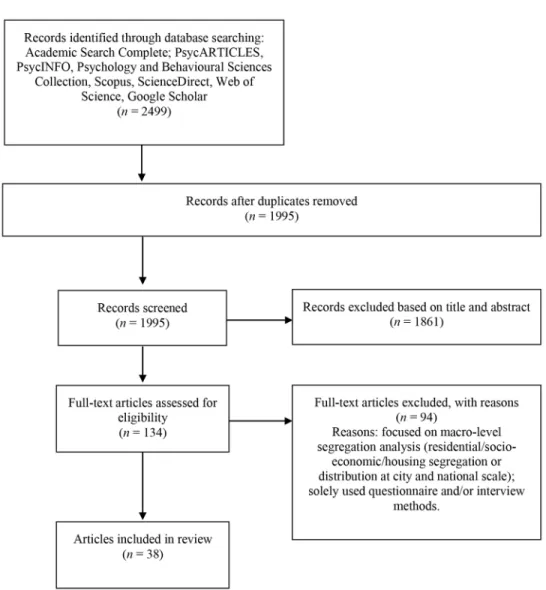
We conducted a four-phase process, following the Preferred Reporting Items for System‐ atic Reviews and Meta-Analyses (PRISMA) Statement (see Liberati et al., 2009). The initial search with the keywords above resulted in 2499 articles, reduced to 1995 when all dupli‐ cates were removed (see Figure 1). The selection of the relevant studies began with an examination of the information included in the title and abstract, which helped exclude articles obviously non-relevant. This left 134 articles whose titles and abstracts met the inclusion criteria, and which were fully read. The reading showed that 94 of these 134 articles did not, in fact, meet the inclusion criteria, and these were excluded. They fo‐ cused, for example, on macro-level segregation analysis (residential demography), or solely used questionnaire or interview methods, without observation. After all studies had been reviewed, 38 studies remained as fully relevant (see Figure 1). From these, data were extracted using both quantitative and qualitative syntheses. Regarding quantitative synthesis, the following data were extracted: a) type of segregation and sample character‐ istics; b) context of study (setting and country); and c) methodology (only observation or mixed method). Regarding the qualitative synthesis, it was focused on: a) aim of the study; and b) main findings. This approach enabled us to explore the nature and key find‐ ings of recent research on how groups interact with each other in particular contexts, as well as to elucidate the psychosocial processes that may underlie local patterns of inter‐ action or segregation.
Results
A total of 38 articles were included in the review (see Figure 1).
Figure 1. Results of the search strategy based on the PRISMA statement (Liberati et al., 2009).
The findings of the review will now be reported in two major sections. The first section reports a quantitative analysis of the articles, looking at (1) the type of segregation stud‐ ied; (2) the sample; (3) the context of study; and (4) the methodology/ies used. The second section reports a detailed qualitative analysis of the articles, summarising the central findings in two sub-sections. This analysis was conducted as follows. First, each article
was read in its entirety. Second, the central findings regarding the patterns of segregation and interaction found were identified (first sub-section). Third, regarding the studies us‐ ing a mixed methodology, the results found by each method (questionnaires, interviews/ focus group), and the psychosocial processes that researchers used to explain micro-eco‐ logical patterns of segregation in a given setting were identified (second sub-section).
Research on the Micro-Ecology of Segregation: A Quantitative
Overview
As shown in Table 1, 11 of the 38 located studies focused solely on observations. The re‐ maining 27 used a mixed method approach, complementing observational methodologies with interviews/focus group (N = 18), questionnaires (N = 5), and interviews/focus group plus questionnaires (N = 4).
Regarding the contexts of study, the micro-ecology of segregation has mainly been stud‐ ied in school and university settings (N = 20). Within this body of work, research has been mainly developed in South Africa (N = 7), with researchers studying the seating pat‐ terns of students of multi-ethnic university dining halls (Alexander, 2007; Schrieff, Tredoux, Dixon, & Finchilescu, 2005), public steps (Tredoux, Dixon, Underwood, Nunez, & Finchilescu, 2005), lecture theatres (Koen & Durrheim, 2010) and classrooms
(Alexander & Tredoux, 2010), university residences (Schrieff, Tredoux, Finchilescu, & Dixon, 2010), and private and desegregated co-educational high schools (Keizan & Duncan, 2010).
The USA is the country that comes next in number of studies (N = 5). Here the micro-ecology of segregation has been studied in educational settings: notably, classrooms and other informal settings in university campuses (Cowan, 2005), classrooms and other school settings in an elementary school (Henze, 2001), middle school cafeterias (Echols, Solomon, & Graham, 2014), university dining halls (Lewis, 2012), and youth sports events in the suburbs (Messner & Bozada-Deas, 2009). In Northern Ireland (n = 3), too, studies have explored the meeting halls and buses of segregated schools (McKeown, Cairns, Stringer, & Era, 2012), university lecture theatres (Orr, McKeown, Cairns, & Stringer, 2012), and classrooms of integrated secondary schools (McKeown, Stringer, & Cairns, 2016). The remaining five articles investigated relations in multi-ethnic university and high-school cafeterias in England (Clack, Dixon, & Tredoux, 2005; Ramiah, Schmid, Hewstone, & Floe, 2015), a public school recess in a working-class neighbourhood in Spain (Rodriguez-Navarro, García-Monge, & Rubio-Campos, 2014), the classrooms of three multiethnic secondary schools in Belgium (Van Praag, Boone, Stevens, & Van Houtte, 2015), and the classrooms of two high schools in the Netherlands and the USA (de Haan & Leander, 2011).
Table 1
Summary of Studies From 2001 to 2017 Relative to Studies’ Type of Segregation Analysed, Sample, Context of Study and Methodology
Authors
Type of
segregation Sample Context of study Methodology
Schrieff et al. (2005)
Ethnica White (minority group) and
black university students (majority group) using the dining hall.
2 university dining halls of the University of Cape Town, South Africa.
Observation
Alexander (2007) Ethnic Black and white university
students using the dining hall.
2 university dining halls of a multi-ethnic university in South Africa.
Observation
Tredoux et al. (2005)
Ethnic University students from different ethnic groups using the steps.
Jameson steps located on the campus of the University of Cape Town, South Africa.
Observation
Cowan (2005) Ethnic 2177 groups of university
students from 4 ethnic groups: African American, Asian American, Latinos, Whites.
6 California State University campuses, USA – classrooms and informal settings on campus.
Observation
Clack et al. (2005) Ethnic University students from
different ethnic groups using the cafeteria.
Multi-ethnic university cafeteria in a city in the north-west of England.
Observation
Tredoux and Dixon (2009)
Ethnic Users from different ethnic groups (blacks, coloured and whites) of 10 establishments.
Nightclubs in Long Street in Cape Town’s city centre, South Africa.
Observation
Koen and Durrheim (2010)
Ethnic 1st year university students -blacks, coloured, Indian and whites.
University lecture theatres at the University of kwaZulu-Natal, Pietermaritzburg campus, South Africa.
Observation
Swyngedouw (2013)
Ethnic Users of a train line, from different neighbourhoods of an ethnically segregated city.
L-train line in Chicago, USA. Observation
Priest et al. (2014) Ethnic Users of urban public places, from different ethnic groups.
Urban public places in Victoria, Australia.
Observation
Dixon and Durrheim (2003)
Ethnic Visitors of a beachfront from different ethnic groups - black, white, Asian, coloured.
Scottburgh’s beachfront, South Africa. Observation and interview/focus group Durrheim and Dixon (2005)
Ethnic Visitors of a beachfront from different ethnic groups - black, white, Asian, coloured.
Scottburgh’s beachfront, South Africa.
Observation and interview/focus group
Durrheim (2005) Ethnic Visitors of a beachfront from
different ethnic groups - black, white, Asian, coloured.
Scottburgh’s beachfront, South Africa.
Observation and interview/focus group
Salari et al. (2006) Ethnic Seniors attendants from diverse ethnic groups.
3 Senior centres in a western state in the USA.
Observation and interview/focus group
Arjona and Checa (2008)
Ethnic Users of a bus line from different ethnic groups.
Bus of a line of Roquetas de Mar, in Almería, Spain.
Observation and interview/focus group
Authors
Type of
segregation Sample Context of study Methodology
Hunter (2010) Ethnic Club-goers of different ethnic
groups.
A predominantly black nightclub, The Spot, in Chicago, USA. Observation and interview/focus group Echols et al. (2014)
Ethnic 6th, 7th, and 8th school graders from different ethnic groups: white, Latino, Asian, African American, and biracial.
Cafeteria of a multi-ethnic middle school in Northern California, USA.
Observation and interview/focus group
Spitz (2015) Ethnic Users of public places of a
neighbourhood: black, white, and Latino/a residents and business owners.
Urban public places of the sociocultural diverse neighbourhood of Riverwest, in Milwaukee, Wisconsin, USA.
Observation and interview/focus group
Besharati and Foster (2013)
Ethnic Residents of the Indian community.
Indian community of Mokopane, Akasia, South Africa.
Observation and interview/focus group
Van Praag et al. (2015)
Ethnic Students of 3 secondary schools, from different ethnic groups.
Classrooms of 3 Flemish multiethnic secondary schools -St. Bernardus, Mountain High, and Catherine College, Belgium. Observation and interview/focus group Kesten et al. (2011)
Ethnic Local authority staff, youth workers, community development workers, staff working in schools, representatives of local community; ‘Black African’ communities-Ghanaian and Somali.
Urban public places in Milton Keynes, England. Observation and interview/focus group de Haan and Leander (2011)
Ethnic High school students from different ethnic groups.
Classrooms of 2 high schools. One in Utrecht, Netherlands, and the other is Kempton High in a moderately sized Midwestern city in the USA.
Observation and interview/focus group
Alexander and Tredoux, (2010)
Ethnic 749 black and white university students.
University classrooms in a public university in South Africa. Observation and interview/focus group Keizan and Duncan (2010)
Ethnic Adolescents’ students from different ethnic groups.
Free time of students in 2 different private, desegregated, co-educational high schools in Gauteng province, South Africa.
Observation and interview/focus group
Henze (2001) Ethnic Students from different ethnic
groups, teachers,
administrators, other staff, and parents.
Classrooms, meetings and other key events in Cornell Elementary School, in northern California, USA.
Observation and interview/focus group and questionnaire
Lewis (2012) Ethnic University students using
dining halls during lunch time, from different ethnic groups.
University dining-halls in Southtown University, in the southern USA. Observation and interview/focus group and questionnaire Schrieff et al. (2010)
Ethnic University students of different ethnic groups.
2 undergraduate university catered residences (one female,
Observation and questionnaire
Authors
Type of
segregation Sample Context of study Methodology
one male) at the University of Cape Town, South Africa.
Ramiah et al. (2015)
Ethnic White and Asian students, aged 16-18 and 10-11 years old.
High school cafeteria in England.
Observation and questionnaire
Nagle (2009) Religiousb Protestant and Catholic users
of Belfast City Centre in public events (e.g., Gay Pride, St. Patrick’s Day, May Day, Lord Mayor’s Carnival).
Urban public places in Belfast City Centre, Northern Ireland.
Observation
Abdelmonem and McWhinney (2015)
Religious Protestant and Catholic users of the public parks.
Public parks in Belfast, Northern Ireland. Observation and interview/focus group and questionnaire McKeown et al. (2012)
Religious Protestant and Catholic students aged 16 and above.
Spaces of segregated schools: meeting room; meeting hall and bus (before and after students attending a cross-community weekend), in Northern Ireland. Observation and interview/focus group and questionnaire
Orr et al. (2012) Religious Protestant and Catholic 2nd
year undergraduate students.
Lecture theatres in a university in Northern Ireland.
Observation and questionnaire
McKeown et al. (2016)
Religious Protestant and Catholic students aged 11–12 and 13–14 years old.
Classrooms of 3 integrated secondary schools in Northern Ireland.
Observation and questionnaire
Pérez Tejera (2012)
Socioeconomicc Users of 40 public squares and
parks from different socioeconomic status groups.
Urban public places - squares and parks – in Barcelona, Spain.
Observation
Stillerman and Salcedo (2012)
Socioeconomic Users of shopping malls, from different socioeconomic status groups.
2 shopping malls in Santiago, Chile. Observation and interview/focus group Krellenberg et al. (2014)
Socioeconomic Users of green spaces and residents from different socioeconomic status groups of the surrounding
neighbourhoods.
4 green public spaces of a socioeconomically mixed neighbourhood in Santiago, Chile.
Observation and questionnaire
Garrido (2013) Socioeconomic Residents of enclaves (villagers) and slums (squatters).
Public urban places in Metro Manila, Philippines. Observation and interview/focus group Messner and Bozada-Deas (2009)
Genderd Women and men volunteers on
youth sports events.
Youth sports events in a small independent suburb of Los Angeles, USA. Observation and interview/focus group Rodriguez-Navarro et al. (2014) Gender and Ethnice
School students: immigrant newcomers, girls and boys.
School recess of a public school from a working-class neighbourhood in Castile-León, Spain. Observation and interview/focus group aN
The next most frequently studied contexts were leisure or recreational public places (N = 16). Such places were widely varying and included an open beach in post-apartheid South Africa (Dixon & Durrheim, 2003; Durrheim, 2005; Durrheim & Dixon, 2005) and senior citizen centres in a USA western state (Salari, Brown, & Eaton, 2006). They also included public urban places in Northern Ireland (N = 2; Abdelmonem & McWhinney, 2015; Nagle, 2009), Spain (Pérez Tejera, 2012), Australia (Priest, Paradies, Ferdinand, Rouhani, & Kelaher, 2014), the USA (Spitz, 2015), the Philippines (Garrido, 2013), South Africa (Besharati & Foster, 2013), and England (Kesten, Cochrane, Mohan, & Neal, 2011), as well as green public places in Chile (Krellenberg, Welz, & Reyes-Päcke, 2014), pubs and nightclubs in South Africa (Tredoux & Dixon, 2009) and the USA (Hunter, 2010), and shopping malls in Chile (Stillerman & Salcedo, 2012). Finally, two studies focused on un‐ derstanding the use and seating patterns of different ethnic groups along a bus line in a province of Spain (Arjona & Checa, 2008) and on a train line in the USA, Chicago (Swyngedouw, 2013).
In terms of social categories, research has mainly studied the everyday local patterns of segregation between different ethnic groups (N = 27; e.g., Arjona & Checa, 2008;
Durrheim & Dixon, 2005; Kesten et al., 2011; Lewis, 2012; Ramiah et al., 2015;
Swyngedouw, 2013; Tredoux & Dixon, 2009). For this, it has focused on students (e.g.,
Alexander & Tredoux, 2010), beachgoers (e.g., Dixon & Durrheim, 2003), senior centre at‐ tendants (Salari et al., 2006) and public transport users (e.g., Arjona & Checa, 2008;
Swyngedouw, 2013). However, various authors have also investigated micro-ecological segregation in relation to religious categories (N = 5; Abdelmonem & McWhinney, 2015;
McKeown et al., 2012; McKeown et al., 2016; Nagle, 2009; Orr et al., 2012), socioeconomic status (N = 4; Garrido, 2013; Krellenberg et al., 2014; Pérez Tejera, 2012; Stillerman & Salcedo, 2012), gender (N = 1; Messner & Bozada-Deas, 2009), and gender and ethnic background (N = 1; Rodriguez-Navarro et al., 2014). Taking into account the considerable diversity of types of segregation and contexts studied, the next section will outline the main findings of such studies.
Main Findings of Research: A Qualitative Overview
Micro-Ecological Patterns ObservedIn general, studies have shown that local patterns of segregation occur even in contexts that at first sight seem inclusive, because different groups are co-present there, thus re‐ vealing how informal segregation can happen despite people being in a shared space (McKeown et al., 2016). This finding characterises almost all of the studies (see Appendix 1 for a table showing a summary of the studies’ main findings). That is, micro-ecological observations of people’s behavioural patterns in various places reveal that, independent of the nature of the analysed context, groups from different ethnic, religious, socioeco‐ nomic backgrounds or of different gender tend to isolate themselves and to interact at an intragroup level only, even in settings where no formal boundaries to intergroup interac‐
tion exist (e.g., Durrheim, 2005; McKeown et al., 2012; Pérez Tejera, 2012; Rodriguez-Navarro et al., 2014). Some relevant empirical findings are worth highlighting as exam‐ ples of this pattern, regarding different types of segregation: a) ethnic; b) religious; c) so‐ cioeconomic; d) gender; and e) gender and ethnic.
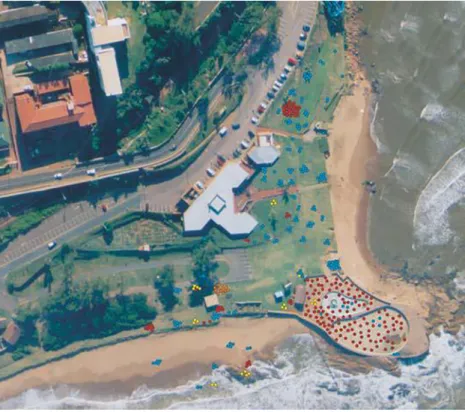
Ethnic segregation — Studies of ethnic interactions on a public open beach in the new post-apartheid South Africa have shown how the formal end of a regime that legalised institutional segregation may be insufficient to dissolve informal segregation behaviours in leisure spaces (Dixon & Durrheim, 2003; Durrheim & Dixon, 2005; Durrheim, 2005). Indeed, in this research, the behaviour of observed black and white beachgoers exhibited clear patterns of avoidance of the other across a number of scales. First, at the most inti‐ mate scale, “umbrella space” segregation by race was almost complete (see Figure 2), with black and white beachgoers tending to sit in racially homogeneous clusters (Durrheim & Dixon, 2005). Second, segregation was also manifest via broader spatial patterns of racial distribution across the beachfront, as expressed via the statistically uneven distribution of white and black beachgoers across different sectors (Dixon & Durrheim, 2003). Third, segregation occurred via temporal patterns of movement and avoidance. Specifically, whites tended to maintain racial distances from blacks by occupying the beach early, clustering together, and then gradually withdrawing if black beachgoers entered the beach in greater numbers (Durrheim & Dixon, 2005; Durrheim, 2005).
Such patterns of segregation are the most common finding revealed in this review. Moreover, while some studies suggest that members of different minority groups may display lower levels of segregation than those that characterise majority-minority rela‐ tions (e.g., Keizan & Duncan, 2010), segregation can also occur between minority sub‐ groups, as shown by Besharati and Foster (2013). In this study, members of the Indian minority community in Mokopane (South Africa) identified themselves with different categories, namely ‘South African Indians’ and ‘immigrant Indians’, and this categorisa‐ tion was in turn expressed in terms of socio-spatial divisions between their members. Research conducted in educational settings shows that there may be a gradual tendency for friendships to occur in ethnically homogeneous groups over a semester (Koen & Durrheim, 2010), and how ethnic micro segregation may increase over time (Alexander & Tredoux, 2010; Koen & Durrheim, 2010), and that patterns of segregation may also be consistent over time. Schrieff et al. (2010), for example, found that the organisation of seating arrangements in a university dining hall evinced stable, long-term patterns of ethnic segregation.
Figure 2. Map of micro-ecological patterns of ethnic segregation on a beachfront in post-apartheid
South Africa (see Durrheim & Dixon, 2005).
Note. The map captured relations on the morning of December 28, 1999. White occupants are
indicated in blue, Black occupants in red, Indian occupants in yellow and Coloured occupants in orange.
An interesting topic running through some of the reviewed articles is the idea of link‐ ing the macro with the micro level contexts, as illustrated by Swyngedouw’s (2013) study. The study focused on analysing the seating patterns on the Red Line train from South Side to the North Side in Chicago. It showed that segregation on the Red Line expressed both local seating choices and wider forms of geographical and social exclusion in the city. Commuters tended to sit mainly with people who looked similar to themselves and appeared to be from the same area in Chicago. At the same time, as the trains travelled from north to south Chicago, such patterns also reflected the wider racial organisation of residential segregation in the city, including local demographic patterns and social norms.
Religious segregation — Orr et al. (2012) evidence how even in a place where students are free to choose where to sit, such as a university lecture theatre, they tend to sit next
to individuals with the same religious background, a categorisation not immediately rec‐ ognisable by visual identity cues as obvious as skin colour (Orr et al., 2012). Indeed, a growing body of work conducted in Northern Ireland – known as a ‘divided society’ characterised by profound patterns of ethnonational and religious segregation (Nagle, 2009) – has shown how religious identities may shape micro-ecological behaviours in both educational and public places. Nagle (2009) and Abdelmonem and McWhinney’s (2015) studies in Belfast, for example, indicate how Protestants and Catholics tend to cre‐ ate intergroup boundaries in public places, giving rise to local segregation patterns. For instance, in public events organised in Belfast’s City Centre designed to promote ‘shared space’, notably the annual St. Patrick’s Day celebrations, some Protestants tend to segre‐ gate themselves in city-centre space. Arguably, this is because they feel uncomfortable in an environment that is perceived to reflect Catholic, nationalist “triumphalism” (Nagle, 2009). These findings show how the micro-ecology of spatial segregation may shape not only local patterns of intergroup contact, but also the broader social and political organi‐ sation of a given urban environment (Abdelmonem & McWhinney, 2015; Nagle, 2009). Socioeconomic segregation — Micro-ecological patterns of segregation in everyday life can stem from individuals’ choices based on socioeconomic status (Garrido, 2013). People tend to employ practices of social and economic exclusion when using shopping malls (Stillerman & Salcedo, 2012), parks or squares in the city (Pérez Tejera, 2012), green public places (Krellenberg et al., 2014) or public places situated in parts of the city with profound status distinctions between residents (Garrido, 2013). Pérez Tejera (2012) sug‐ gests that public places with the presence of immigrants (independently of their ethnici‐ ty) and other social groups with evident cues of lower economic power are seen as less secure. The result is the avoidance of these places and the emergence of segregated areas (Pérez Tejera, 2012), seen as comfort zones by the individuals that have chosen them (Garrido, 2013). The same occurs when poor residents avoid specific malls for fear of feel‐ ing humiliated by wealthier customers (Stillerman & Salcedo, 2012). In sum, there is a tendency to avoid proximity to, and potential mixing with, residents of a different socioe‐ conomic status (Garrido, 2013; Krellenberg et al., 2014). These findings reflect once again the connection between macro and micro segregation, as local segregated public places in the city may express the city’s macro socioeconomic organisation (Krellenberg et al., 2014).
Gender and gender and ethnicity — We found only two studies focusing on gender segregation, which suggests it has been neglected in the micro-ecological literature (Messner & Bozada-Deas, 2009; Rodriguez-Navarro et al., 2014). Exploring the interaction between gender and ethnic segregation, Rodriguez-Navarro et al. (2014) found that boys segregated from immigrants in school recess activities to a greater degree than girls. Moreover, girls were more prone to interact with boys and to engage in cross-gender ac‐
tivities than vice versa, with boys being more likely to reject girls’ presence in activities such as sports (Rodriguez-Navarro et al., 2014). Along similar lines, Messner and Bozada-Deas’s (2009) study revealed how micro-ecological patterns of gender segregation unfold between mothers and fathers at their children’s sport events. In this study, fathers tend to assume a leadership role during soccer games, leaving mothers with a secondary or non-participatory role. This, in turn, led to the creation of gender homogeneous spaces, with no or little interaction between women and men.
Two opposing examples — Qualifying the main findings of this systematic review, which confirmed the widespread occurrence of micro-ecological patterns of segregation, is the work of Cowan (2005) and Hunter (2010), both developed in the USA. Cowan (2005) found no differences in the percentages of inter-ethnic and intra-ethnic groupings of students present in ethnically diverse university campuses in six southern California State University campuses - within four ethnic groups (African American, Asian Ameri‐ can, Latinos, and whites) - and also confirmed that interethnic contact was more frequent in ethnically heterogeneous environments. In turn, Hunter (2010) found that a predomi‐ nantly black nightclub in downtown Chicago provided a unique opportunity for black clients to interact across ethnic lines with people who were not from their own neigh‐ bourhoods. Both studies show that in multi-ethnic contexts individuals may not invaria‐ bly act in ways that reproduce segregation.
A brief summary — In sum, the two examples above notwithstanding, the micro-ecolo‐ gy literature shows people generally maintain patterns of in-group isolation (e.g., Keizan & Duncan, 2010; Kesten et al., 2011; McKeown et al., 2012; Nagle, 2009; Priest et al., 2014;
Ramiah et al., 2015). It is important to recognise, of course, that the degree of such isola‐ tion may vary across contexts and social groups. The social context created by crowding, for example, leads individuals to be less willing to associate with members of other groups (Clack et al., 2005; Durrheim & Dixon, 2005). Moreover, different levels of segre‐ gation may characterise relations among different groups (Keizan & Duncan, 2010; Lewis, 2012), and patterns of segregation may occur between minority sub-groups as well as be‐ tween minority-majority groups (Besharati & Foster, 2013). Given their sheer prevalence and potentially negative consequences, it is important to understand why such kinds of segregationist behaviours are so common and persistent. Addressing this issue, the next section explores some potential social psychological processes that may help explain such behaviours.
Social Psychological Processes Associated With Micro-Ecological Segregation Several researchers (e.g., Besharati & Foster; 2013; Durrheim & Dixon, 2005; Spitz, 2015) have emphasised the need to understand the social psychological processes that underpin nonverbal ‘macrokinetic’ behaviours maintaining socio-spatial divisions (Dixon et al.,
2008). In order to address such social psychological processes in their studies, some re‐ searchers have employed mixed method approaches – for example, by combining obser‐ vations with interviews or focus group methods (e.g., Dixon & Durrheim, 2003;
Rodriguez-Navarro et al., 2014) and/or questionnaires (e.g., Lewis, 2012; McKeown et al., 2012). Drawing on these studies, we explored the social psychological processes linked to patterns of micro segregation. The studies’ findings were decomposed into three catego‐ ries of processes, based on the mechanisms identified by the researchers: 1) negative atti‐ tudes and stereotypes; 2) ingroup identification and threat; and 3) feelings of anxiety, fear and insecurity.
Negative attitudes and stereotypes — Several studies explored how local patterns of segregation might be associated with beliefs and stereotypes about specific ethnic or reli‐ gious groups (e.g., Dixon & Durrheim, 2003; McKeown et al., 2012) that people construct and internalise and with affective responses towards such groups (Bigler & Liben, 2006). Through their interviews conducted in a newly desegregated beach in South Africa,
Durrheim and Dixon (2005) found that black beachgoers interpreted patterns of racial segregation as expressions of white racism and an attempt to maintain racial privilege. Specifically, they argued that negative stereotypes of black beachgoers as ‘dirty’ or ‘dan‐ gerous’ led whites to practice avoidance. Drawing on themes that were prominent within the ideology of apartheid, by contrast, white South Africans explained segregation as part of the ‘natural order of things’, a normal and legitimate expression of universal cul‐ tural and biological differences (Durrheim & Dixon, 2005).
The relationship between racist talk and embodied segregationist practices is also present in the study of Arjona and Checa (2008) conducted on public transport. Through the analysis of semi-structured interviews with Spanish and foreign bus users, the study explained how the frontiers maintained in inter-racial interactions stem from prejudice and stereotype towards immigrants, which “regulate the possibility of contact, and the fi‐ nal result of which is a personal apartheid” (Arjona & Checa, 2008; p. 202). The same pro‐ cesses are highlighted in studies on suburban (Besharati & Foster, 2013) and urban public places (Spitz, 2015) and classrooms (Henze, 2001). The argument common to all studies regards the way in which racist talk leads to a well-defined racial positioning in the spaces of everyday life. This may be highly resistant to change (Durrheim, 2005) enacting “hidden and hostile racism” (Besharati & Foster, 2013; p. 49) and naturalising asymmetries and exclusions (Arjona & Checa, 2008), where, for instance, blacks are stereotyped by whites as ‘aggressive’ and whites stereotyped by blacks as ‘racists’ (Durrheim, 2005).
Another prominent body of work in Northern Ireland suggests that religious segrega‐ tion between Protestants and Catholics emerges in part as a consequence of negative atti‐ tudes towards the religious outgroup (McKeown et al., 2012). Moreover, Abdelmonem and McWhinney (2015) suggest that such prejudice in turn stems from individuals’ fear of losing their identity as Protestants or Catholics, a fear that manifests particularly
when ‘control over space’ is at stake. Spatial practices of segregation are not merely rela‐ ted to ‘who uses the space’ for both Protestants and Catholics (Abdelmonem &
McWhinney, 2015). Instead they are also associated with a desire to maintain territorial control, which may lead to the recreation of informal boundaries within spaces expected to be integrative of different groups (Abdelmonem & McWhinney, 2015).
Regarding micro-ecological segregation by gender, Messner and Bozada-Deas (2009)
suggest women and men’s segregationist positioning and interaction in places, namely in youth sports events, result from their own beliefs of women’s role as “team moms” and men’s role as coaches. The “gendered language and meanings” (Messner & Bozada-Deas, 2009; p. 68) people use when talking about women and men reinforces conventional gen‐ dered divisions as the natural order of things, a stereotyping process translated into seg‐ regationist behaviours in places. The authors suggest that this gender-segregated context can be perpetuated in society as children are initiated into it at a very early stage (Messner & Bozada-Deas, 2009).
Ingroup identification and threat — A related process involved in micro segregation concerns the strength of individuals’ bonds with their ingroup, i.e., their ingroup identifi‐ cation (Turner, Hogg, Oakes, Reicher, & Wetherell, 1987). Defensive responses to per‐ ceived ingroup threat are related to intergroup dynamics (Tajfel & Turner, 1986) and to associated processes of ingroup identification and intergroup differentiation (e.g., Tajfel & Turner, 1986). Various studies in our review rely on this social identity framework to explain why the desire to interact with others increases when they are perceived as fel‐ low members of social categories, including the categories of ethnicity (de Haan & Leander, 2011; Keizan & Duncan, 2010; Schrieff et al., 2010; Van Praag et al., 2015), reli‐ gion (Orr et al., 2012), or from a combined category based on gender and religion
(McKeown et al., 2016). According to this perspective, positioning in space is often a situ‐ ated expression of social identity (de Haan & Leander, 2011) with ingroup identity threat helping to shape micro-ecological behaviours under particular conditions. For example, the local over-representation of a group usually underrepresented in general society – e.g., when high school students with an immigrant background outnumber students of national origin (Van Praag et al., 2015) – may invoke identity threats (e.g., fears about losing cultural dominance). As a result, majority group members can become more prone to join and interact with members of their ingroup and more likely to segregate them‐ selves from members of the outgroup (see also de Haan & Leander, 2011; Keizan & Duncan, 2010). A clear example of how such identity threat may lead to micro-ecological segregation comes from an interview with a Turkish-descendent high school student talking about her relationship with other female classmates of Belgian descent:
“In this [current] class group, you are part of the group, but there [referring to class group of Mathematics-Sciences], I have never felt more ignored in my life. There was this group of girls in my class group that always made fun of others. They
were called ‘airwijven’ [pretentious girls]. For example, they all had handbags from one specific brand. Like, for me, it’s not that important. I actually do not care” (Van Praag et al., 2015; p. 171, our emphasis).
The study of de Haan and Leander (2011) illustrates how students recruit spaces to con‐ struct and preserve ethnic identities. This may, in turn, both justify the existence of such ‘ethnic spaces’ and legitimatise the choice to not mix with other groups. Students’ school identity practices are linked to explicit and implicit representations of the other ethnical‐ ly different, in which power relations between ethnic groups are implied. As one student of a USA high school claims, regular use of the term ‘nigger’ in the school hallway by ‘black people’ made him acknowledge the ‘authority’ of black students over that space, which he primarily assumed was shared (de Haan & Leander, 2011).
In Salari et al.’s (2006) study on micro segregation among native and immigrant at‐ tendants of senior centres, a higher identification of the majority group members with their ingroup was associated with a stronger tendency to protect their group interests and status position (Verkuyten & Brug, 2004). The authors found that natives tended to represent immigrants as being of lower social status and, by implication, to create segre‐ gated seating patterns. In a context where decision-making power was generally limited, choosing where to sit in the dining hall – a shared space – offered one of the few oppor‐ tunities native attendants had to establish group boundaries and position themselves as belonging to a higher status social category.
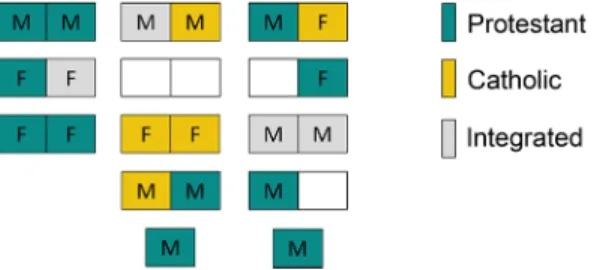
McKeown et al.’s study (2016) is a particularly interesting example regarding process‐ es of ingroup identification, as it demonstrates how both gender and religious identifica‐ tion may shape segregation. In this study, even though students often chose to sit in the classroom next to a peer of the same religious background – Protestant or Catholic – sit‐ ting next to a student of the same gender was statistically more prevalent (see Figure 3). That is, in making their seating choices, students’ gender identification prevailed over re‐ ligious identification (McKeown et al., 2016). Students sat beside other students with whom they identified, despite the opportunity for intergroup contact (McKeown et al., 2016). Choosing to sit next to someone with whom people identify the most also relates to feelings of positivity and comfort (McKeown et al., 2016), which can be associated with deep-seated feelings of anxiety, fear and insecurity in mixed environments (Stillerman & Salcedo, 2012).
Figure 3. Map of the distribution of students in a school classroom according to students’ seating
choice in terms of religious background and gender (see McKeown et al., 2016).
This review has enabled another mechanism to be identified. Employing an innovative approach, Lewis (2012) argued that the preference to interact with the ingroup is related not only to negative ethnic attitudes and stereotypes, but also and more significantly to the lower energy group members expend when getting to know other people who are similar rather than different to them, with whom they identify. The choice to self-segre‐ gate, he argues, may reflect a drive for energy conservation at a social and psychological level (Lewis, 2012). As a black female university student interviewed in his research poin‐ ted out:
“If you’re a minority person, generally coming in [to Southtown] you have to pick which side of the racial fence you’re going to be on (…) It’s kind of hard to straddle the fence. It takes a lot of work (…)” (Lewis, 2012; p. 281, our emphasis).
Feelings of anxiety, fear and insecurity — People tend to avoid contact with others if such contact creates feelings of discomfort or nervousness (Stillerman & Salcedo, 2012). As Integrated Threat Theory (Stephan & Stephan, 2000) suggests, these feelings of threat may lead ingroup members to dislike outgroup members, leading to stronger feelings of intergroup anxiety, fear and insecurity, and fewer intrinsic intergroup interactions. Avoiding others may also express a sense of territoriality and the feelings of safety it brings (Kesten et al., 2011). Others are avoided due to the fear of feeling potentially out of place, having awkward exchanges or even being humiliated by others with a higher soci‐ oeconomic status (Garrido, 2013; Stillerman & Salcedo, 2012). In contexts undergoing ma‐ jor transformations, such as shopping malls (Stillerman & Salcedo, 2012), people tend to feel anxious about the higher probability of encountering new and different groups that those transformations entail, which may be accompanied by a fear of feeling out of place (Stillerman & Salcedo, 2012). As a result, they may behave in ways that minimise the op‐ portunity of experiencing contact across group lines in everyday activity spaces. For in‐ stance, explaining why he felt uncomfortable at a shopping mall’s association with a poorer area of the city of Santiago, Chile, a wealthy resident referred to shoppers as “fau‐ na”: “I don’t like this mall very much because the parking lot is dangerous. The fauna are
more diverse, and it’s not really a good place for an outing. I feel insecure here” (Stillerman & Salcedo, 2012; p. 320).
The research reviewed also suggests that in contexts supportive of interethnic inter‐ actions – such as school and university classrooms – the possibility of interacting with the other ethnic groups creates anxiety where white students are the majority (Alexander & Tredoux, 2010; Keizan & Duncan, 2010; Schrieff et al., 2010). Even if the discourse of the majority often seems to reflect a desire for ethnic and social integration, anxiety may limit the degree of intergroup contact (Keizan & Duncan, 2010), resulting in ethnically homogeneous areas in the same place without social mixing. In their South African re‐ search, Alexander and Tredoux (2010) found such ethnically homogeneous areas were created by different ethnic groups of students in mixed shared spaces of a multi-ethnic university campus. These areas offered a sense of belonging, security, comfort and ac‐ ceptance and the chance to express oneself without fearing any judgment (Alexander & Tredoux, 2010).
Simultaneously, however, these areas also served to exclude racial others, regardless of whether exclusion was intended or not. Indeed, in their study, Alexander and Tredoux (2010) found that students sometimes described the decision-making process regarding the spaces they occupy as expressing “unspoken rules of space” (p. 380). As one of their ‘coloured’ student participants explained
“It’s like that kind of people that you are like sit there. (…) That’s why you go there, and you can be loud and you can laugh. If you like loud and out of place on the [Jammie] stairs then everybody looks at you, you have to know your place. It’s not like that there [at the billiard tables]” (p. 379).
This tension between perceived exclusion and belonging is also evident in a study about religious segregation between Catholics and Protestants in public places of Belfast’s downtown, where some integrated parks have ironically expanded spaces of division (Abdelmonem & McWhinney, 2015). On one hand, majority group members make every use of larger areas of the parks. On the other hand, and in response, minority group members have isolated themselves from the majority group in ever smaller public territo‐ ries.
The study of Rodriguez-Navarro et al. (2014) conducted in a Spanish school provides a final powerful example of how feelings of anxiety and insecurity may lead to micro seg‐ regationist patterns by ethnicity and sometimes gender. The authors argue that due to insecurities of not being accepted and being mocked by their peers outside the class‐ room, new male immigrant students may follow the recess norms dictated by the most powerful groups of boys (Rodriguez-Navarro et al., 2014). An ethnographic field note re‐ garding a new immigrant student exemplifies how this situation may perpetuate gender segregation during recess:
“When the time for recess came, before leaving the class the teacher asked the chil‐ dren “who is going to play with Willy?” Many girls were willing to play with him but, in the end, a couple of boys grabbed Willy (…). When the children went out to play, the boys walked to a concrete patch in which they improvised a soccer field. (…) Some girls approached the boys. From time to time, they waved to Willy, asking him to join them. Finally, some of the boys started yelling and acting out to “scare” the girls away […]” (Rodriguez-Navarro et al., 2014; p. 354).
Discussion and Future Directions
This paper has systematically reviewed the empirical work on micro-ecological processes of inter-group segregation from 2001 to 2017. Research has revealed how such segrega‐ tion marks social relations across a wide range of contexts, often occurring in civic, pub‐ lic and educational settings that are ostensibly integrated. The reviewed research has re‐ vealed educational settings as the main context of study of micro-ecological processes, followed by leisure and recreational places, public urban places and public transport. The predominance of educational settings may also be due to the traditional convenience of using students as participants in psychology research. Even though there is a body of work on religious, socioeconomic and gender patterns of segregation, ethnic segregation remains by far the type of micro segregation most often studied. The research was con‐ ducted predominantly in English language countries where inter-ethnic or religious con‐ flicts are prominent. We also found that, over the years, there has been a growing inter‐ est among authors in adopting a mixed method approach in order to understand the so‐ cial psychological processes that may underlie observed behavioural patterns of segrega‐ tion.
Following Allport’s contact hypothesis (1954), researchers have long argued that the isolation of groups maintains negative attitudes and stereotypes, while increased contact reduces intergroup prejudice (Pettigrew & Tropp, 2006). This systematic review has shown that the mere co-presence of two groups in the same place may be insufficient to produce intergroup contact and, by implication, to reduce intergroup prejudice, which is also in line with Allport’s studies (1954). However, the novelty of micro-ecological re‐ search lies in its focus on studying individuals and groups’ experience in everyday life, rather than focusing on structured contact and explicit processes, through traditional methodological tools, such as laboratory experiments and questionnaire surveys, which do not fully capture the nature and meaning of contact in real life settings. The overall message of the review is that intergroup interactions must be analysed in the concrete realities of everyday settings in order to unlock their complexities and the complexity of the psychosocial processes underlying them. This requires forms of research that are still relatively rare and underdeveloped in the field of contact research, such as those based on direct and naturalistic observation.
What this review has also shown, however, is the recent emergence of a body of work that has attempted to fill this gap, revealing how segregation often arises through em‐ bodied practices within the intimate arenas of everyday life spaces. It has shown, too, that such practices can express a range of underlying and interrelated psychosocial pro‐ cesses, including negative attitudes and stereotypes (e.g., Durrheim & Dixon, 2005), in‐ group identification and perceived threat (e.g., Van Praag et al., 2015), feelings of anxiety, fear and insecurity (e.g., Keizan & Duncan, 2010).
This paper has also attempted to highlight the importance of studying the micro-ecol‐ ogy of intergroup segregation for social psychology and the emerging problems that seg‐ regation may cause. Studying the micro-ecology of segregation, we would add, is not on‐ ly a matter of knowing how people locate themselves publicly in places and/or under‐ standing how this limits intergroup contact. It is also a matter of understanding if and when members of different social categories are able to freely access, share and interact within different places as citizens. In this sense, it is also a way of understanding how citizenship itself is experienced and challenged on a daily basis in the concrete places of everyday life (Di Masso, 2015). As we have seen, for example, micro-ecological processes may demarcate who belongs where with whom in everyday settings, establishing territo‐ rial claims within ostensibly ‘public’ places, fostering complex patterns of perceived ex‐ clusion, or even challenging the basic rights of certain categories of person to occupy or use supposed shared places such as beaches (e.g., Durrheim & Dixon, 2005) or parks (Abdelmonem & McWhinney, 2015). Understanding how and why such processes unfold, how they are experienced, and perhaps most important, how they might be transformed, is an important topic for future research.
To conclude our review, we wish to identify three further areas of potential future re‐ search, thereby setting an agenda for work in the field.
Embracing Methodological Innovation
As our review illustrates, most social psychological work on the micro-ecological expres‐ sion of segregation has consisted of relatively small scale, cross-sectional studies that en‐ tail observing socio-spatial practices in a single context (e.g., seating patterns in school cafeterias or public transport). This work has been valuable in establishing the nature and extent of segregation on an intimate scale of analysis; however, it has arguably ne‐ glected how segregation is reproduced over time across the full range of social contexts that individuals inhabit in their everyday lives. In this sense, we would argue that social psychologists might benefit from exploring methodological developments in companion disciplines. Such work includes innovations in the use of Participatory GIS methods for understanding how community members themselves perceive intergroup boundaries lo‐ cated across varying socio-spatial scales and across different social contexts (e.g., Huck et al., 2019), methods for estimating the global nature and extent of segregation of everyday
activity spaces (e.g., Li & Wang, 2016), and methods for tracking and analysing individu‐ als’ everyday movements in cities (e.g., Greenberg Raanan & Shoval, 2014).
With regards to the latter, some researchers have recently argued for the need to de‐ velop a richer picture of the ‘time geography’ of segregation as expressed via individuals’ use of everyday activity spaces such as parks and shopping centres and via their routine patterns of movement along public pathways such as footpaths and streets (e.g., Kwan,
2013; Wang, Li, & Chai, 2012). Difficulties in acquiring relevant data probably explain why so little research has investigated how, in this broader sense, micro-ecological pat‐ terns of segregation (and contact) may become part of the ‘choreography of everyday life’ (Pred, 1977). However, recent advances in the tracking of everyday mobility practices
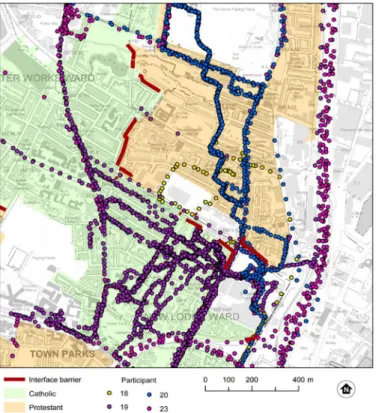
using GPS technology, allied to the emergence of sophisticated GIS analytics for captur‐ ing, coding and visualising such practices, is opening up exciting new avenues of re‐ search (Palmer et al., 2013), on which some psychologists are beginning to draw (see Fig‐ ure 4 below).
As an example, consider Dixon and colleagues’ work on Catholics’ and Protestants’ use of public environments in north Belfast, Northern Ireland’s capital city (Dixon et al., in
press; Hocking et al., 2018). Using a combination of GPS tracking and questionnaire sur‐ vey methods, these researchers analysed over 1000 hours of movement data, based on the collection of over 20 million GPS data point. They found that north Belfast is character‐ ised by high levels of sectarian segregation, expressed via residents’ limited use of public facilities and pathways located in outgroup areas. They also found, however, that the use of shared destinations was fairly common, particularly in the period between 12 and 6pm, and mainly based in relatively neutral spaces of consumption such as shopping cen‐ tres and retail outlets. Analysis of associated questionnaire data suggested that Catholic and Protestant residents’ self-reported willingness to use activity spaces beyond their own communities was shaped by factors such as realistic threat, symbolic threat and past experiences of positive and negative contact with members of the ‘other’ community. Moreover, both intergroup threat and contact were associated with the amount of time residents actually spent in spaces beyond their own communities.
In our view, this integrative combination of subjective psychological data with data on concrete mobility practices over time offers rich possibilities for future research on activity space segregation. Such a combination, of course, also highlights the importance of developing interdisciplinary research frameworks, capitalising on emerging technolo‐ gies for investigating human mobility, and drawing new techniques for mapping the divi‐ ded city (see also Huck et al., 2019).
Figure 4. Capturing residents’ movements through everyday spaces in Belfast using GPS tracking
and GIS data capture and representation (see Hocking et al., 2018).
Exploring the Intersection of Category Memberships in Everyday
Practices of Segregation
As noted already, research on the micro-ecological dimension of segregation has recently started to move beyond a narrow focus on ethnic and racial categories to include work, for example, on gendered and sectarian relations (e.g., McKeown et al., 2016). The next step will be to systematically explore how, when and why the intersectionality of social categories and identities shape micro-ecological practices of contact and separation in ev‐ eryday activity spaces.
As an example of the potential significance of such work, consider the recent debate around gender and seating arrangements on Haredi bus routes in Israel. Between 1997 and 2011, ‘Mehadrin’ bus lines running to and from ultra-orthodox Haredi Jewish com‐ munities in cities such as Jerusalem, practised gender segregation. Women were expected to dress ‘modestly’, to enter buses via a back entrance, and to sit in the back regions of buses. This practice reflected a particular intersection of religious and gendered identi‐ ties. Outlawed by the Israeli High court of Justice in 2011, instances where both secular
women and Haredi women were threatened by Haredi men because they chose to sit in the front of a ‘Mehadrin bus’, have continued to attract high profile media coverage and lawsuits, as well as academic debate (see Harel, 2004; Greenfield, 2007; Triger, 2013;
Warburg, 2011). The academic debate has revolved, among other things, around the ques‐ tion of whether the front versus back nature of gendered seating patterns on Haredi bus routes represents a form of gender discrimination, the unwarranted obtrusion of reli‐ gious conceptions of gender relations into the public sphere, or the legitimate and volun‐ tary expression of religious identity by Haredi women.
Our point here is not to intervene in this debate. Rather, we use this example to high‐ light how the complex intersection of social categories can reveal the political complexi‐ ties of micro-ecological patterns of division, taking the field beyond the rather narrow, often binary, categories of race and ethnicity on which most previous work has focused. Such complexities, in our view, represent a potentially important focus of future research - not least because they bear upon the problem of social change.
Promoting Micro-Ecological Change
If micro-ecological patterns of segregation are, at least in some circumstances, viewed as an obstacle to achieving social integration and reducing intergroup prejudice, then two related questions follow. First, why are the boundaries created by practices apparently so recalcitrant, emerging even in contexts where integration is being actively promoted? Second, how might we devise interventions to reduce the segregation in everyday life spaces and encourage new forms of contact across ethnic, racial, gendered and cultural barriers? In short, the theme of social change is critical to future work in the field.
The recalcitrance of micro-ecological boundaries is easy to understand in societies that practice de jure segregation. Under ‘Jim Crow’ race laws in the US, for example, ra‐ cial divisions were legally enforced for such mundane activities as eating in restaurants or using a drinking fountain. You could be put in prison for flouting them. Similar rules were applied by the strictures of ‘petty apartheid’ in South Africa, which in its most ex‐ treme moments regulated such banal activities as queuing in post-offices and swimming in public baths. However, the corollary assumption that removing these legal foundations would dismantle the segregation of everyday places has not proven correct in either soci‐ ety (Dixon et al., 2008). Even in the absence of legal foundations, as our review has stark‐ ly revealed, the segregation of everyday life places is persistent and widespread.
The present review has also shed some light on why these forms of segregation are difficult to change. On the one hand, as the previously discussed work of Swyngedouw (2013) illustrates, divisions on a micro-ecological scale may reflect divisions at a broader level: the patterns of racial segregation on public transport that she identified reflect not only Chicago commuters’ seating choices, but also the wider residential polarisation of the city. As commuters travel the Red Line from South Side (comprising mainly African American neighbourhoods) to the North Side (comprising mainly white neighbour‐
hoods), the racial demography of carriages shifts accordingly. Future research might fur‐ ther address this kind of relationship between micro and macro level processes of segre‐ gation in an attempt to develop strategies to promote socio-spatial change. On the other hand, our review has also emphasised the potential role of psychological processes such as negative attitudes and stereotypes, prejudice, social identification, threat, and sense of place in shaping individuals’ preferences to maintain interactional distances and bounda‐ ries in everyday life spaces. Again, we would emphasise that work that links the psycho‐ logical mechanisms directly to actual micro-ecological behaviours in everyday settings remains relatively sparse and is again a topic ripe for further research and, not least, the‐ orisation.
In addition, we need to know more about how micro-ecological practices, and the so‐ cial psychological mechanisms that underpin them, might be altered and what kinds of interventions might encourage greater intergroup contact. As an instructive closing ex‐ ample, consider McKeown, Williams, and Pauker’s (2017) research in a primary school in the UK, which explored the consequences of a ‘value in diversity’ storybook intervention on seating patterns amongst 4 to 6 year-old children in a lunchroom setting. Prior to this intervention, such seating patterns displayed clear patterns of segregation along racial lines. However, immediately after listening to a story that emphasised the importance of valuing racial diversity, inclusion and contact, children’s lunchtime seating arrangements displayed reduced levels of segregation. Qualifying this optimistic finding, McKeown et al. (2017) found this change to be short lived – 48 hours later, lunchtime self-segregation by race had re-emerged amongst children in their study. Even so, this work shows how teacher-led interventions may have the potential to promote intergroup contact. More broadly, it highlights the importance of exploring both why micro-ecological patterns of segregation are so persistent and how they might be reduced as an imperative for future work.
Funding: The research was supported by national funds through FCT – Fundação para a Ciência e a Tecnologia, I. P., as part of the project PD/BD/114075/2015.
Competing Interests: The authors declare that there are no potential conflicts of interest with respect to the research, authorship, and/or publication of this article.
Acknowledgments: The authors have no support to report.
References
Abdelmonem, M. G., & McWhinney, R. (2015). In search of common grounds: Stitching the divided landscape of urban parks in Belfast. Cities, 44, 40-49. https://doi.org/10.1016/j.cities.2014.12.006
Alexander, L. (2007). Invading pure space: Disrupting black and white racially homogenised spaces.
South African Journal of Psychology, 37, 738-754. https://doi.org/10.1177/008124630703700405
Alexander, L., & Tredoux, C. (2010). The spaces between us: A spatial analysis of informal segregation at a South African university. Journal of Social Issues, 66, 367-386.
https://doi.org/10.1111/j.1540-4560.2010.01650.x
Allport, G. W. (1954). The nature of prejudice. Garden City, NY, USA: Doubleday.
Arjona, A., & Checa, J. C. (2008). Traveling together, sitting apart; a case of ethno-localization in everyday life spaces. Papeles de Población, 14(58), 183-207.
http://www.redalyc.org/articulo.oa?id=11205810
Besharati, S., & Foster, D. (2013). Understanding informal segregation: Racial and spatial identities among the Indian minority of Mokopane. Diversities, 15, 37-51.
Bigler, R. S., & Liben, L. S. (2006). A developmental intergroup theory of social stereotypes and prejudice. Advances in Child Development and Behavior, 34, 39-89.
https://doi.org/10.1016/S0065-2407(06)80004-2
Brown, R., & Hewstone, M. (2005). An integrative theory of intergroup contact. In M. P. Zanna (Ed.), Advances in experimental social psychology (Vol. 37, pp. 255-343). San Diego, CA, USA: Elsevier Academic Press. https://doi.org/10.1016/S0065-2601(05)37005-5
Clack, B., Dixon, J., & Tredoux, C. (2005). Eating together apart: Patterns of segregation in a multi-ethnic cafeteria. Journal of Community & Applied Social Psychology, 15, 1-16.
https://doi.org/10.1002/casp.787
Cowan, G. (2005). Interracial interactions at racially diverse university campuses. Journal of Social
Psychology, 145, 49-64. https://doi.org/10.3200/SOCP.145.1.49-64
Davis, M., Seibert, R., & Breed, W. (1966). Interracial seating patterns on New Orleans public transit. Social Problems, 13, 298-306. https://doi.org/10.2307/799256
de Haan, M., & Leander, K. M. (2011). The construction of ethnic boundaries in classroom interaction through social space. Culture & Psychology, 17, 319-338.
https://doi.org/10.1177/1354067X11408136
Di Masso, A. (2015). Micropolitics of public space: On the contested limits of citizenship as a locational practice. Journal of Social and Political Psychology, 3, 63-83.
https://doi.org/10.5964/jspp.v3i2.322
Dixon, J., & Durrheim, K. (2003). Contact and the ecology of racial division: Some varieties of informal segregation. British Journal of Social Psychology, 42, 1-23.
https://doi.org/10.1348/014466603763276090
Dixon, J., Durrheim, K., & Thomae, M. (2014). Desegregation. In J. Wright (Ed.), International
Encyclopedia of the Social and Behavioral Sciences (2nd ed., pp. ##-##). Amsterdam, The
Netherlands: Elsevier.
Dixon, J., Tredoux, C., Davies, G., Huck, J., Hocking, B., Sturgeon, B., . . . Bryan, D. (2019). Parallel lives: Intergroup contact, threat and the segregation of everyday activity spaces. Journal of
Personality and Social Psychology. Advance online publication.