Key Contributing Factors to the Acceptance of
Agents in Industrial Environments
Stamatis Karnouskos
, Senior Member, IEEE
, and Paulo Leit ˜ao
, Senior Member, IEEE
Abstract—Multiple software agent-based solutions have been developed during the last decades, and applied with varying success to different domains offering control, reconfiguration, diagnosis, monitoring, etc. However, the promise that they once posed in terms of a new alternative decentralized approach offering modularity, flexibility and robustness, is only partially fulfilled. This paper investigates some key factors, i.e., design, technology, intelligence/algorithms, standardization, hardware, chal-lenges, application and cost, which are hypothesized to be linked to the Industrial Agent acceptance. Empirical data was acquired via a conducted survey, and statistically an-alyzed to investigate the support of the posed hypotheses. The results indicate that all the factors are seen important issues that play a role toward deciding for or against an industrial agent solution.
Index Terms—Cyber-physical systems, industrial agents, industrial acceptance, multiagent systems (MAS), survey.
I. INTRODUCTION
M
ULTIAGENT systems (MAS) [1] is a suitable technol-ogy to develop modular, flexible, robust, and adaptive complex (large-scale) systems, based on the decentralization of functions (e.g., control, reconfiguration, diagnosis, monitoring etc.) over a community of distributed, autonomous, and co-operative agents [2], [3]. The application of agent technology allows the achievement of important features, namely modu-larity, flexibility, robustness, adaptability, reconfigurability, and responsiveness. The software agents’ concept, established in the early 1990s, has attracted the attention of academia and in-dustry communities, as reflected in the significant number of conferences and workshops organized around the world. These concepts were initially applied to business, electronic com-merce, and management systems, but its application to industrial domains, such as manufacturing, logistics, telecommunications, smart grids and healthcare, have also been reported in several surveys [2], [4]–[9].Industrial Agents share the common ground with software agents, inheriting their characteristics such as intelligence,
Manuscript received September 21, 2015; revised April 9, 2016, Au-gust 1, 2016, and AuAu-gust 7, 2016; accepted September 2, 2016. Date of publication September 8, 2016; date of current version April 18, 2017. Paper no. TII-15-1453.(Corresponding author: S. Karnouskos.)
S. Karnouskos is with SAP, Karlsruhe 76131, Germany (e-mail: [email protected]).
P. Leit ˜ao is with the Polytechnic Institute of Braganc¸a, Braganc¸a 5300, Portugal, and also with LIACC - Artificial Intelligence and Computer Sci-ence Laboratory, Porto 4150-181, Portugal (e-mail: [email protected]).
Color versions of one or more of the figures in this paper are available online at http://ieeexplore.ieee.org.
Digital Object Identifier 10.1109/TII.2016.2607148
autonomy, and cooperation, but their application domains are the industrial environments and applications and, therefore, need to adhere to industrial requirements [2], [6], [9]–[11]. Examples of such requirements may comprise the specific hardware integra-tion, reliability, fault-tolerance, scalability, industrial standard compliance, quality assurance, resilience, manageability, and maintainability. Depending on the application scenarios, these requirements may have different degrees of importance and the focus is on well established, stable and proven approaches rather than experimental and not fully-tested features [6]. In any utilization scenario, Industrial Agent solutions need to fully comply with enterprise operational context and guarantee the business continuity.
In the last years, several efforts were performed to advance the domain of agents and more specifically introduce them in the real-world industrial settings. For example, in 2005, the Agentlink III coordination action for agent-based computing, funded by the European Commission, promoted a strategic roadmap in agent technology aiming to analyze the past and cur-rent states of agent technologies, and to identify the challenges and obstacles that need to be tackled for the higher commercial adoption of the technology [12]. In Germany, the VDI/VDE GMA Technical Committee 5.15 on Multiagent Systems also surveyed the use of MAS in industrial automation [11], [13].
Under the scope of various other projects, such as [2], [6], [8], [11], [14], agents prototypes that have been realized and operated in industrial environments were surveyed. Despite the rigorous research investigations and developed prototypes, a breakthrough and wide-spread usage in operational industrial settings were not achieved. Ten years ago, examples of indus-trial applications were rare and the implemented functionalities were highly restricted [15]. The Agent Link roadmap [12] con-firmed that at the time the survey was carried out (in 2005), the agent technology was still in its infancy, both in terms of tech-nology maturity and also in the programing skills widespread among commercial software developers. Today, after more than a decade from the first industrial application of agent technol-ogy, namely in a production line for producing cylinder heads for diesel engines at the German Daimler–Chrysler factory plant in Stuttgart [16], the progress has been at best incremental.
Key initiatives, such as Industrie 4.0 [17] and Industrial In-ternet [18], are emerging and feature Cyber-Physical Systems (CPS) as a key element for their success. The emergence of CPS in the last few years, and their prevalence in industrial do-mains [14], may provide a new opportunity for Industrial Agents [2], [19]. The reason may be associated with the software agent and especially MAS characteristics, which are envisioned to be featured by CPS at large.
Although in the last few years, more industrial applications of agent technology are witnessed, resistance for a wider adop-tion by the industrial decision makers still exists, and the level of adoption expected and projected ten years ago, remains unattained today. The pertinent issue that arises from this dis-cussion is to try to understand why, after more than ten years, the agent technology is not more widely adopted in industrial environments. It needs to be noted that in some areas, agents have already a decent adoption, but only a limited utilization of agent technology in industrial domain is reported in the lit-erature. Therefore, this paper focuses on the factors that may impact the Industrial Agent acceptance.
In the literature, several survey review papers were published analyzing the level of adoption of agent technology in industrial environments (see, e.g., [2]–[8], [15], [19]–[26]). These review papers surveyed a set of agent-based solutions deployed in in-dustry and concluded that very few agent systems were really built for industry. These survey papers also reflect and discuss some potential road blockers for a wider adoption by indus-try stakeholders. However, all these efforts do not investigate in a quantifiable manner the link between the factors that con-strain the wider agent acceptance in industrial environments. This work extends and complements these efforts, by investi-gating and assessing empirically via a survey, the impact of key factors to Industrial Agent acceptance. This surveyed data con-siders the valuable knowledge in Industrial Agents domain by experts coming from industry and academia.
This paper is organized as follows: Section II discusses the theoretical aspects behind the selection of the factors to be an-alyzed in the survey and Section III presents the data used to perform the survey. Section IV introduces the empirical data analysis, and Section V discusses the achieved results and ex-tracts proper observations. Finally, Section VI rounds up the paper with the conclusion.
II. IDENTIFICATION OFKEYFACTORS
Several surveys [4]–[7], [15], [19], performed in the last years, have tried to understand the possible barriers that are block-ing the wider adoption of agent technology in industrial envi-ronments. Among others issues, these surveys have identified several important barriers, namely the demand of industry for proven and mature technologies, the initial investment, the in-dustrial standard compliance, the missing development method-ologies, the scalability and interoperability, and the integration of physical automation devices.
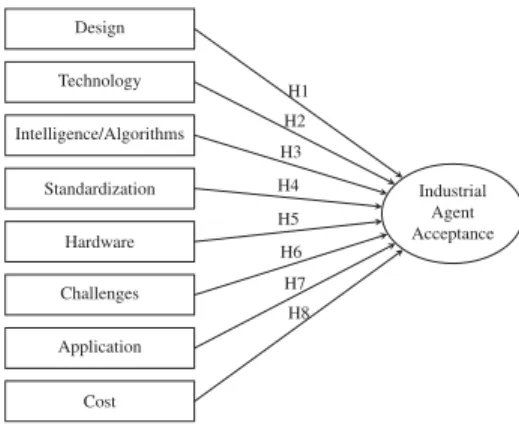
Based on the literature review, on the experience of the au-thors in developing Industrial Agent-based solutions, as well as discussions within the IEEE IES technical committee on Industrial Agents (tcia.ieee-ies.org), a set of key factors have been identified as causes that may have an impact on the Indus-trial Agent acceptance. Grouping common issues, the following factors have been identified (as illustrated in Fig. 1): design, technology, intelligence/algorithms, hardware, cost, standard-ization, application, and challenges. These key factors are seen as relevant for the decision makers when they consider the adop-tion of Industrial Agent soluadop-tions.
The hypotheses posed in this paper, and marked as H1-H8 inFig. 1, claim that the respective factors may have a positive contribution to the Industrial Agent acceptance, if adequately
Fig. 1. Proposed model with key factors and hypotheses.
tackled. The proposed model, based on the identified hypotheses for the key factors that may impact the Industrial Agents accep-tance, is empirically validated with data obtained by the survey which are subsequently statistically analyzed.
A. Design
Industrial Agents offer a new and alternative way to design complex flexible, robust, and reconfigurable systems based on the decentralization of functions. This implies a paradigm shift requiring the distributed thinking as a new way to design these systems, which may pose a possible barrier for decision makers and developers [5]. Industrial agent systems should have clear proposition on the functionalities, services, and (measurable) value-added aspects that they can offer, but not necessarily fo-cus solely on the technical aspects. This is seen as important as decision makers are reluctant of accepting unpredictable emer-gent behaviors that can appear in these systems [24]. The design of industrial solutions should ensure the achievement of impor-tant properties, namely security, business continuity, scalability, reliability, robustness, fault tolerance, modularity, and interop-erability [4], [21], [24]. In particular, the interopinterop-erability may be a key issue in the development of distributed and heteroge-neous systems which also characterize industrial systems [4]. For this purpose, the use of open-standard interfaces in the de-sign of industrial agent-based systems may be important for the decision-makers acceptance. The existence of a compara-tive methodology analysis [27], as well as best practices [7] for demonstrators running in industry that show the applicability of agents principles, may also play an important role.
B. Technology
technologies in various stages, such as advanced analytics with self-service delivery, Internet of Things (IoT) and IoT platforms, digital security, hybrid cloud computing, machine learning, autonomous vehicles, smart advisors, and smart robots. Hence, Industrial Agents contributing and benefiting from these tech-nologies, seem to have significant potential in the mid (5–10 years) and long term (10+ years).
The integration with legacy systems is a very important factor to support the demand for smooth migration, due to the inex-istence of methods for wrapping legacy systems by agents in an automatic manner [21]. In fact, most integration efforts of agent-based applications with legacy systems was at a database level and not with planning or scheduling applications [29]. However, also other efforts have concentrated on CPS integra-tion and simulaintegra-tion of service-ready devices [30], [31]. The availability of methodologies that simplifies the engineering of agent-based systems (integrating the design, analysis, simula-tion, and deployment phases) is seen also as highly relevant [5], [15]. Of key importance is the capability to offer to developers scalable and robust development platforms addressing the indus-trial requirements [4], [15]). In addition to the development plat-forms, the use of modern Integrated Development Environments tools may simplify the development, testing, and deployment in industrial environments.
C. Intelligence/Algorithms
Industrial Agents are largely software agents that comply with the diverse industrial requirements required for the domain they are utilized. Being software agents, a key factor for the indus-trial acceptance may be the easy and transparent introduction of new and effective algorithms. The latter enable them to operate in heterogeneous and dynamic environments and enhance their collaborative aspects, especially in distributed environments. Agent intelligence may also be reached by embedding self-* algorithms, which properly regulate their behaviors, contribut-ing for the emergence of the desired system characteristics. The latter is seen as a potential promising approach when it comes to dynamic and complex industrial environments. However, de-cision makers may be hesitant to adopt them, due to the increase of complexity associated to the presence of (distributed) intel-ligence in industrial systems [5], which in turn may act as a possible road-blocker for the Industrial Agent acceptance.
D. Hardware
Industrial agent-based systems comprise of software agents managing, operating, or collaborating with physical hardware devices, being able to implement several paradigms, e.g., holonic [23], [32], CPS [14], bionic, reconfigurable and evolv-able production systems, etc. With the continuous empowerment of embedded devices (following Moore’s law), agents can now also easily be embedded in these devices as an integral part of them [2], [33]. The integration of physical automation devices (normally tens or hundreds) with the software control system is usually performed on a case-by-case basis, requiring a huge and expensive effort to be implemented, which may be a possible major barrier for the Industrial Agents acceptance [5]. To tackle it, the consideration of methodologies and standard interfaces that support the easy, fast, transparent, and reusable integration
of physical automation devices and their functionalities are re-quired. In light of the CPS emergence, hardware considerations that target embedded agents in hardware devices as well as cloud integration may be catalytic [33]. In light of the expected high heterogeneity, the existence of common APIs abstracting from the hardware details but still taking advantage of their capabili-ties (computation, communication, physical mobility, etc.) may be decisive for the acceptance of industrial agents.
E. Cost
Cost plays an important role to the adoption of any solu-tion in the industry, and it is multiangled, e.g., includes cost of software development or acquisition, deployment, mainte-nance and management, personnel training, migration of legacy systems, and hardware acquisition. The required investment to deploy agent-based solutions is usually higher than in traditional solutions [5], [24], in the sense that the adaptation and reconfig-uration offered by MAS solutions normally require the presence of flexible and even redundant automation systems. In addition, the other angles of the cost factor may impact the short and mid-term return of investment, which may create a high barrier for the introduction of the technology to the specific industry.
F. Standardization
Standardization is pointed out by industry experts and also emerges in various surveys [7], [15], [24] as the major key factor that impacts the industrial adoption of the agent technol-ogy. The Foundation for Intelligent Physical Agents (FIPA— www.fipa.org) defines a set of standards for the development of MAS [24], focusing especially on the specification of the agents’ behaviors and interaction among heterogeneous soft-ware agents. However, FIPA is currently not sufficiently address-ing many requirements and particularities imposed by industrial environments [34], which may impact the adoption of industrial agent-based systems. The same applies to other related con-cepts and technologies provided by international standardization organizations, such as World Wide Web Consortium (W3C— www.w3c.org) and the Organization for the Advancement of Structured Information Standards (OASIS—www.oasis-open.org). However, as key web/Internet standards are being developed in the latter, these could form a basis upon which interoperable and standardized agent solutions can be built. Supporting both key industrial automation and web/Internet technology standards may act as an enabler for Industrial Agent technologies and solutions.
G. Applications
[24], but can provide benefits in soft real-time applications, such as in production planning and scheduling [23]. It is estimated that only “30% of the world’s control tasks and about 60% of the diagnostic tasks would benefit from the application of agent-based techniques” [24]. Therefore, a key factor that may impact the industrial adoption of agent technology is related to actual type of applications that better benefit from the advanced and innovative features provided by agents.
H. Challenges
As an emergent technology, the success of its industrial adop-tion is strongly dependent on how well some key challenges and road-blockers can be tackled. For instance, although some ben-efits of the agent approach can be shown at technical level [27], the proof of tangible business benefits is much more challeng-ing, and often cannot be quantified in advance due to the lack of adequate economic tools and analyses. Industrial Agents re-quire acceptance of their technologies and confidence in their paradigm (e.g., operating in distributed manner), which may be quite difficult to accept in tightly controlled hierarchical industrial settings. Furthermore, although several agent-based systems exist [3], benchmarking approaches that evaluate mul-tiple of these solutions in concrete scenarios are not sufficiently developed, which make difficult to evaluate, compare, and pick the right technologies. The same holds true for methodologies and business models, which have not been adequately addressed with industrial settings in mind. These challenges, seen from the perspective of different players, may be considered as critical issues that should be addressed in the near future to increase the Industrial Agents acceptance.
III. APPROACH ANDDATA
The followed approach aims toward identifying and quan-tifying the potential impact of factors to the Industrial Agent acceptance. As such, the approach can be characterized as a quantitative positivist research [36], and the way its assessment was performed followed the typical approaches in quantitative research field. Having identified the key factors via a literature review, and hypothesized their effects to the Industrial Agent acceptance, the next step comprises of empirical data collection via a survey.
The sample size of this survey is random and comprises a va-riety of people coming from industry, academia, governmental orgs, etc., with varying degrees of expertise on agents. The sur-vey questions [37] have been constructed with the aim to capture the factors as good as possible, by also taking into account the previous complementary surveys in the area, namely [5], [35]. The collection of data was realized online, where the respon-dents provided their input in a five-level Likert scale [38] per question. An indicator was providing feedback to the respon-dents with respect to errors (e.g., forgotten to rate a question) as well as the current percentage of completion for the survey. The data was collected anonymously, with the exception of some demographic data which were explicitly asked. Due to the way, the data collection was done, it was guaranteed that there would be no missing data.
The questions per factor in the survey are encoded as variables, i.e., D1-D8 (Design), T1-T5 (Technology), H1-H4 (Hardware), I1-I5 (Intelligence/Algorithms), C1-C7 (Cost), S1-S6 (Standardization), A1-A6 (Application), CH1-CH8 (Chal-lenges), and IAA1-IAA6 (Industrial Agent Acceptance). The empirical data comprises of 118 valid answers (N=118). All of the variables are measured on the Likert scale, and therefore, there is no reason to exclude variables on skewness unless they exhibit no variance. A kurtosis value in any of the variables that is greater than 1 (or less than −1) may be seen as poten-tially problematic. However, in practice, only values>2.2 (or <−2.2) are problematic [39]. In the dataset, there are some variables that depict kurtosis, however, all of them are less than the practical limits posed (i.e.,[−2,2]) and, therefore, there is no need to exclude any of them from the dataset, since sufficient variance exists.
As indicated, some demographics on the dataset have been collected. More specifically, it is worth noting that 50% of re-spondents came from universities, 24.6% from industry, 8.5% from small and medium enterprises, 11% from research centers, and 3.4% from nonprofit organizations. With respect to the po-sition, several categories are present, i.e., professors (27.1%), engineers/developers (24.6%), researchers (18.6%), managers (15.3%), students (7.6%), and others (6.8%). Most of the re-spondents (59.3%) have over ten years of professional expertise, while 30.5% have four to nine years of expertise, and only 10.2% are relative inexperienced with one to three years of expertise. Similarly, the years of agent expertise also vary, i.e., 40.7% have more than ten years of agent expertise, while 40.7% have four to nine years of agent expertise, and only 18.6% are relative new to the area with one to three years of agent expertise.
It needs to be pointed out that these demographics overall are not surprising as the survey has been disseminated among the relevant stakeholders of IEEE IES Technical Committee on Industrial Agents as well as relevant conferences, workshops, and agent development mailing lists. As such, the results pre-sented here may depict at large views of the (industrial) agents community.
IV. EMPIRICALDATAANALYSIS
For the analysis of the empirical quantitative data, typi-cal methods are used, i.e., Explorative Factor Analysis (EFA) followed-up by Structural Equation Modeling (SEM) that includes Confirmatory Factor Analysis (CFA) [40]. The aim of carrying out EFA is to investigate if the theoretically con-sidered factors are also evident in the dataset, or if additional ones emerge from the dataset that were not considered. After the cautionary measure of EFA, SEM is applied and the results of the proposed model and the support (or not) of the posed hypotheses is depicted.
A. Explorative Factor Analysis
TABLE I
CRONBACH’SALPHA PERFACTOR
Factor Variables Cronbach’sα
Design {D1, ..., D8} 0.914
Technology {T1, ..., T5} 0.811
Intelligence / Algorithms {I1, ..., I5} 0.857
Standardization {S1, ..., S6} 0.880
Hardware {H1, ..., H4} 0.819
Challenges {CH1, ..., CH5, CH7, CH8} 0.871
Application {A1, ..., A6} 0.861
Cost {C1, ..., C6} 0.847
Industrial Agent Acceptance {IAA2, ..., IAA6} 0.851
0.696, which is seen as adequate [41]. In addition, the Bartlett’s test of sphericity, that tests the null hypothesis that the correla-tion matrix is an identity matrix, and which would indicate that the factor model is inappropriate is significant; hence, the null hypothesis can be rejected. As such, it is meaningful to proceed with the EFA.
The EFA is conducted using the maximum likelihood as an extraction method and Promax with Kaiser normalization as rotation. The aim is to see if the observed variables load to-gether are correlated and meet the criteria for reliability and validity. A clear loading of variables on factors is witnessed.
Hairet al.[42] note that significant factor loadings based on
the survey sample size should be approximately 0.5 or higher. It is noted that three variables, i.e., C7, CH6, and IAA1, are below this threshold, and therefore, it was decided to exclude them from further analysis (as also shown inTable I). The nine identified factors explain 57.35% of the total variance in the empirical data. The factors demonstrate sufficient discriminant validity as the correlation matrix shows no correlations above 0.7 and there are no problematic cross-loadings. For reliability, the Cronbach’sα[43] for each factor is calculated, and as shown inTable I, all of them are over 0.8, which indicates good internal consistency [44].
B. Structural Equation Modeling
SEM comprises several statistical methods including CFA. The utilization of CFA aims to investigate the fitness of the pro-posed model (as shown inFig. 1). Specifically, it is investigated how well the proposed factor structure accounts for the corre-lations between the variables on the basis of the empirically collected data.
The relative Chi square (CMIN/DF), which is the division of Chi square (CMIN) with the degrees of freedom (DF), is a ratio used to measure the fitness. In this case, the CMIN/DF is 1.256, which indicates a good fit, as only ratios greater than 2 represent an inadequate fit. Other measures of fitness include the Goodness of Fit Index (GFI), and the GFI adjusted for DF (AGFI) [45]. Both GFI and AGFI should be less than or equal to 1, where a value of 1 indicates a perfect fit. In this case, the GFI is 0.696 and the AGFI is 0.670, hence, within the acceptance limits. Another fitness measure is the Comparative Fit Index (CFI) [46], which is identical to relative noncentrality index. The CFI is calculated as 0.89 and as it is very near to 0.9, it indicates an acceptable fit [47]. The root mean square error of
Fig. 2. Structural equation model in AMOS.
TABLE II
TESTING OFHYPOTHESES
Hypothesis Path Path coef CR value Support
weight >1.96 Decision
H1 Design→IAA 0.211 2.391 Supported
H2 Technology→IAA 0.220 2.356 Supported
H3 Intelligence/Algorithms→IAA 0.243 2.650 Supported
H4 Standardization→IAA 0.196 2.172 Supported
H5 Hardware→IAA 0.198 2.201 Supported
H6 Challenges→IAA 0.220 2.410 Supported
H7 Application→IAA 0.218 2.411 Supported
H8 Cost→IAA 0.248 2.680 Supported
approximation (RMSEA) measures the discrepancy between the fitted model and the covariance matrix in the population. In this case, RMSEA is calculated as 0.047, indicating a good fit [48]. The analysis of the structural equation model is shown in
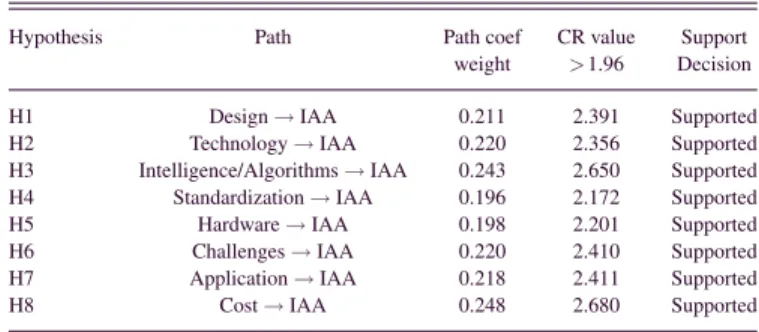
Fig. 2which shows the AMOS [40] model with all factors and corresponding variables (as summarized also in Table I), as well as the errors. The values on the arrows represent the path coefficients (standardized estimates) which indicate the weight of the links in the path analysis. As it can be seen inFig. 2, all factors have (as hypothesized H1–H8) a positive contribution to the Industrial Agent acceptance.
1.96 (or lower than−1.96) indicates two-sided significance at the customary 5% level. As it can be seen, all of the CR results for all hypotheses are over 1.96 and, therefore, significant. As such, all of the posed hypotheses are supported by the empirical data.
V. DISCUSSION ANDLIMITATIONS
The acceptance of Industrial Agent solutions is hypothesized to be influenced by several key factors. From the statistical analysis on the collected data, all of the hypotheses H1–H8 (shown in Fig. 1) are supported as their CR value is above the 1.96 limit (shown in Table II). Hence, the empirical data collected via the survey, indicate the support for the theoretical model proposed. Such holistic support may act as a guide for key aspects that need to be addressed if agent-based solutions are to be widely accepted in industry. Some key aspects are pointed out here, while a more qualitative analysis of this survey [37] reveals additional insights.
Design aspects dealing with security, scalability, reliability, robustness, fault-tolerance, openness, modularity, heterogene-ity, decentralization, and best practices are seen as key parts. The survey reveals widespread support for these areas with over 80% of the participants considering them as key aspects. This is in line with the expectations that industrial environments are complex systems that have to work under real-world condi-tions. In addition, they have to comply not only to a diverse set of landscapes, but be able to deal with emerging industrial needs captured in the mentioned characteristic aspects. A good tackling of design related factors is seen as catalytic toward the wider Industrial Agent acceptance.
Technology plays a key role, and it is evident that a “one-size-fits-all” technology stack is way too limited. As such, support for open contemporary technologies is seen as pivotal. The latter in-creasingly includes Internet-based technologies that are applied in industrial automation domain. In addition, the usage of mod-ern tools and development environments where Industrial Agent solutions can be developed, deployed, and assessed are needed. The latter are nowadays seen as standard in software-based so-lutions, and similar support in agents is expected. Hence, the integration with legacy technologies but at the same time open-ness and flexibility to embrace new ones are seen as catalytic toward increasing the Industrial Agent acceptance.
Intelligence and algorithms enable Industrial Agent solutions to achieve their goals and be effective. As such, these pose as key elements toward the Industrial Agent acceptance. Here, the emphasis is given to the integration of such algorithms in a modular and “plug & play” approach, as well as to the fact that the needs rely not on monolithic approaches but rather more on the distributed ones that enhance the characteristics of agents, e.g., their collaboration, distributed data processing, and decision-making. Resource efficiency is also pursued, but it comes at a lower priority, probably due to the explosion on the quality and quantity of resources (communication, computation, memory, storage, etc.) that are available to modern industries.
Standardization is seen as overwhelmingly affecting the In-dustrial Agent acceptance. Standard solutions seem to be pre-ferred and it is believed that industrial automation standards need to be considered and supported. Open Internet and web technologies are seen as the way to go, while admittedly that industry standards for Industrial Agent practices are missing.
Hardware is gaining importance, especially when Industrial Agents are used in the emerging domain of CPS. The support for multiple hardware platforms via common APIs that strike the balance between taking advantage of common hardware capa-bilities while enabling largely programing of them without deal-ing with the specificities is needed. Strong bundldeal-ing to hardware may be needed in some domains, but generally an abstraction level is requested, e.g., in the notion of what the Android OS is doing for the various available mobile devices. Being able to achieve this, it may act as a catalyst toward increasing the Industrial Agent acceptance.
The acceptance of Industrial Agents is bound to some key challenges. All of the investigated challenges should be con-sidered, e.g., business benefits, tools for economic analysis of Industrial Agents, methodologies, business models, better tech-nologies, and benchmarking. It is understood that this area is not adequately investigated and more efforts should be put here as it does impact the (industrial) decision makers view.
The concrete application of Industrial Agents influences also their acceptance. Up to now, the success is mainly in the areas of simulation and emulation of assets/behaviors, and Industrial Agents have successfully been used for monitoring, managing, reconfiguring, and even programing assets. However, real-time control aspects are still work in progress.
Cost tackling is always a sensitive issue and does play a role toward the Industrial Agent acceptance. Any industrially launched solution has to justify its utilization in a way or another in a cost-wise manner in the mid and long term. Costs ought to be seen at multiple levels, out of which cost for hardware, software development, initial deployment, training, and maintenance are seen as critical.
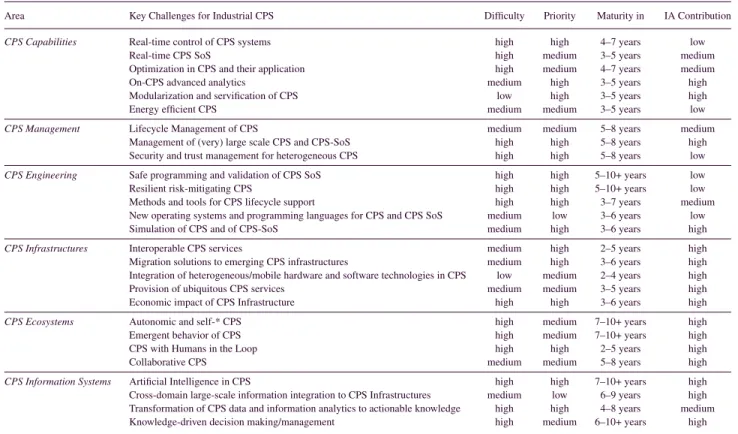
The area of CPS is relevant for Industrial Agents and several efforts have been carried out the last years that demonstrate this link as a survey shows [33]. Key challenges have been identi-fied for CPS [19], and as Industrial Agents already contribute to it [33], the question arises if by increasing the acceptance of Industrial Agents, this could act as an enabler for the CPS domain. As seen in Table III, there are several areas that are common both to 1) the factors that impact Industrial Agent ac-ceptance and 2) the identified challenges for industrial CPS. As such, if Industrial Agents can tackle those issues, they might be able to achieve wider acceptance as they will be in tandem with a key emerging technology, i.e., CPS which are on the roadmap for many diverse industries. The last column inTable IIIshows, according to authors’ view, where agents could meaningfully contribute. It has to explicitly pointed out that Table III does not stem from the empirical data of this paper, and constitutes a point of view by the authors that ought to be seen as potential future research.
TABLE III
CPS CHALLENGES[19] TOWARDSWHICHINDUSTRIALAGENTSCOULDCONTRIBUTE
Area Key Challenges for Industrial CPS Difficulty Priority Maturity in IA Contribution
CPS Capabilities Real-time control of CPS systems high high 4–7 years low
Real-time CPS SoS high medium 3–5 years medium
Optimization in CPS and their application high medium 4–7 years medium
On-CPS advanced analytics medium high 3–5 years high
Modularization and servification of CPS low high 3–5 years high
Energy efficient CPS medium medium 3–5 years low
CPS Management Lifecycle Management of CPS medium medium 5–8 years medium
Management of (very) large scale CPS and CPS-SoS high high 5–8 years high
Security and trust management for heterogeneous CPS high high 5–8 years low
CPS Engineering Safe programming and validation of CPS SoS high high 5–10+ years low
Resilient risk-mitigating CPS high high 5–10+ years low
Methods and tools for CPS lifecycle support high high 3–7 years medium
New operating systems and programming languages for CPS and CPS SoS medium low 3–6 years low
Simulation of CPS and of CPS-SoS medium high 3–6 years high
CPS Infrastructures Interoperable CPS services medium high 2–5 years high
Migration solutions to emerging CPS infrastructures medium high 3–6 years high
Integration of heterogeneous/mobile hardware and software technologies in CPS low medium 2–4 years high
Provision of ubiquitous CPS services medium medium 3–5 years high
Economic impact of CPS Infrastructure high high 3–6 years high
CPS Ecosystems Autonomic and self-* CPS high medium 7–10+ years high
Emergent behavior of CPS high medium 7–10+ years high
CPS with Humans in the Loop high high 2–5 years high
Collaborative CPS medium medium 5–8 years high
CPS Information Systems Artificial Intelligence in CPS high high 7–10+ years high
Cross-domain large-scale information integration to CPS Infrastructures medium low 6–9 years high
Transformation of CPS data and information analytics to actionable knowledge high high 4–8 years medium
Knowledge-driven decision making/management high medium 6–10+ years high
critical ratios (as shown in Table II) are very similar, one can hardly prioritize them, and all of them should be considered in any agent solution proposition to industry.
Although this quantitative approach, in which the survey and the empirical data assessment provide key insights on the factors that should be tackled, there are several limitations. From the theory viewpoint, several aspects that had already been identi-fied in the literature including general factors that impact any industrial solutions acceptance, have been considered. These factors are handled at abstract level, but at nature they are more complex and should be investigated individually to get a better understanding of their key components. In addition, there might exist several interdependencies among these factors which are not adequately investigated here. The context of the individ-ual respondents is not fully taken into consideration apart from some general demographic characteristics. However, other as-pects, such as geographical and cultural asas-pects, IT knowledge, programing experience, industry domain, and learning readi-ness, are not considered. In addition, a larger sampling group, selected via proportional stratified sampling, might be beneficial to derive some more confident results.
VI. CONCLUSION
Agent technologies have been systematically investigated the last decades, and although several cases of their utilization exist in industry, their breakthrough and wide-scale acceptance is yet to be seen. Several surveys in the literature [4]–[7], [15], [19] point toward some reasons, but mostly from a qualitative view point. In this paper, the focus is on a quantitative methodology.
Having identified the potential factors that impact the Indus-trial Agent acceptance (considering also the aforementioned surveys), empirical data is collected via a survey, and statis-tics are applied in order to assess the potential impact of those factors to industrial agent acceptance.
The identified factors considered in this paper are: design, technology, intelligence/algorithms, hardware, cost, standard-ization, application, and challenges. All of these are found to influence the Industrial Agent acceptance (in a statistically sig-nificant way as analyzed). Addressing the discussed challenges is not seen as an easy undertaking. Roadmaps that have been laid out before, dealing with the challenges in (industrial) agent do-main, have not really been realized, with several challenges still being open. As such, it is very challenging to provide a concrete roadmap and timelines that can be credibly kept. However, it must be pointed out that there are key elements whose prevalence in the last few years give hope that agents may once more come to the foreground. These elements include the transformation of business to digital business, with the strong interconnection of all stakeholders over Internet-based services as envisioned in Industry 4.0, as well as the ubiquity offered by cloud-based ser-vices. In addition, areas that pertain (industrial) agent concepts and technologies including data mining, data management, (ar-tificial) intelligence/machine learning, autonomous CPS, etc., are on a meteoric rise.
that (industrial) agents may yet have another (last?) chance to enter mainstream and achieved the long-promised impact. How-ever, the agent community needs to learn from the failures and successes of the past, and properly tackle the issues related to the factors discussed.
REFERENCES
[1] M. Wooldridge,An Introduction to Multi-Agent Systems. New York, NY, USA: Wiley, 2002.
[2] P. Leit˜ao and S. Karnouskos, Eds.,Industrial Agents: Emerging Appli-cations of Software Agents in Industry. New York, NY, USA: Elsevier, 2015.
[3] T. Jess, P. Woodall, and D. McFarlane, “Evaluating the applicability of multi-agent software for implementing distributed industrial data manage-ment approaches,” inStudies in Computational Intelligence. New York, NY, USA: Springer, 2015, pp. 199–207.
[4] M. Pˇechouˇcek and V. Maˇr´ık, “Industrial deployment of multi-agent tech-nologies: Review and selected case studies,”Auton. Agent Multi-Agent Syst., vol. 17, no. 3, pp. 397–431, May 2008.
[5] P. Leit˜ao, “Agent-based distributed manufacturing control: A state-of-the-art survey,”Eng. Appl. Artif. Intell., vol. 22, no. 7, pp. 979–991, Oct. 2009.
[6] M. Metzger and G. Polakow, “A survey on applications of agent tech-nology in industrial process control,”IEEE Trans. Ind. Informat., vol. 7, no. 4, pp. 570–581, Nov. 2011.
[7] P. Leit˜ao, V. Maˇr´ık, and P. Vrba, “Past, present, and future of in-dustrial agent applications,”IEEE Trans. Ind. Informat., vol. 9, no. 4, pp. 2360–2372, Nov. 2013.
[8] P. Vrbaet al., “A review of agent and service-oriented concepts applied to intelligent energy systems,”IEEE Trans. Ind. Informat., vol. 10, no. 3, pp. 1890–1903, Aug. 2014.
[9] V. Vyatkin, “Software engineering in industrial automation: State-of-the-art review,”IEEE Trans. Ind. Informat., vol. 9, no. 3, pp. 1234–1249, Aug. 2013.
[10] A. Pereira, N. Rodrigues, and P. Leit˜ao, “Deployment of multi-agent systems for industrial applications,” inProc. IEEE 17th Int. Conf. Emerg. Technol. Factory Autom., Sep. 2012, pp. 1–24.
[11] P. G¨ohneret al.,Agentensysteme in der Automatisierungstechnik. Berlin, Germany: Springer, 2013.
[12] M. Luck, P. McBurney, O. Shehory, and S. Willmott,Agent Technol-ogy: Computing as Interaction (A Roadmap for Agent Based Computing). AgentLink III, Sep. 2005.
[13] Multi Agent Systems in Industrial Automation, Verein Deutscher Inge-nieure (VDI) Verband Der Elektrotechnik Elektronikinformationstechnik (VDE), VDI-Standard: VDI/VDE 2653 Std., Jun. 2010.
[14] A. W. Colomboet al., Eds.,Industrial Cloud-Based Cyber-Physical Sys-tems: The IMC-AESOP Approach. New York, NY, USA: Springer, 2014. [15] V. Maˇr´ık and D. McFarlane, “Industrial adoption of Agent-Based
tech-nologies,”IEEE Intell. Syst., vol. 20, no. 1, pp. 27–35, Jan. 2005. [16] K. Schild and S. Bussmann, “Self-organization in manufacturing
opera-tions,”Commun. ACM, vol. 50, no. 12, pp. 74–79, Dec. 2007.
[17] H. Kagermann, W. Wahlster, and J. Helbig, “Securing the future of German manufacturing industry: Recommendations for implementing the strate-gic initiative INDUSTRIE 4.0,” German Nat. Acad. Sci. Eng., Munich, Germany, Tech. Rep., 2013. [Online]. Available: http://goo.gl/HY0fzx [18] S.-W. Linet al., “Industrial internet reference architecture,” Ind. Internet
Consortium (IIC), Needham, MA, USA, Tech. Rep., Jun. 2015. [Online]. Available: http://www.iiconsortium.org/IIRA-1-7-ajs.pdf
[19] P. Leit˜ao, A. W. Colombo, and S. Karnouskos, “Industrial automation based on Cyber-Physical systems technologies: Prototype implementa-tions and challenges,”Comput. Ind., vol. 81, pp. 11–25, Sep. 2015. [20] D. Mcfarlane and S. Bussmann, “Developments in holonic production
planning and control,” Production Planning Control, vol. 11, no. 6, pp. 522–536, Jan. 2000.
[21] L. Monostori, J. V´ancza, and S. Kumara, “Agent-based systems for manufacturing,”CIRP Ann. – Manufacturing Technol., vol. 55, no. 2, pp. 697–720, Jan. 2006.
[22] W. Shen, L. Wang, and Q. Hao, “Agent-based distributed manufacturing process planning and scheduling: A state-of-the-art survey,”IEEE Trans. Syst., Man, Cybern., C, vol. 36, no. 4, pp. 563–577, Jul. 2006.
[23] R. F. Babiceanu and F. F. Chen, “Development and applications of holonic manufacturing systems: A survey,” J. Intell. Manuf., vol. 17, no. 1, pp. 111–131, Feb. 2006.
[24] V. Maˇr´ık and J. Laˇzansk´y, “Industrial applications of agent technologies,”
Control Eng. Practice, vol. 15, no. 11, pp. 1364–1380, Nov. 2007. [25] H. Van Dyke Parunak, “A practitioners’ review of industrial agent
ap-plications,”Auton. Agents Multi-Agent Syst., vol. 3, no. 4, pp. 389–407, 2000.
[26] V. Dignum and F. Dignum, “Designing Agent Systems: State of the practice,”Int. J. Agent-Oriented Softw. Eng., vol. 4, no. 3, pp. 224–243, Nov. 2010.
[27] F. Bergenti, M.-P. Gleizes, and F. Zambonelli, Eds.,Methodologies and Software Engineering for Agent Systems. New York, NY, USA: Springer, 2004.
[28] “Gartner’s 2015 hype cycle for emerging technologies identifies the computing innovations that organizations should monitor,” Gartner, Stamford, CT, USA, Aug. 18, 2015. [Online]. Available: http:// www.gartner.com/newsroom/id/3114217
[29] R. A. Belecheanuet al., “Commercial applications of agents,” inProc. 5th Int. Joint Conf. Auton. Agents Multiagent Syst., 2006, pp. 1549–1555. [30] A. W. Colombo, S. Karnouskos, J. M. Mendes, and P. Leit˜ao, “Industrial
agents in the era of service oriented architectures and cloud based industrial infrastructures,” inIndustrial Agents: Emerging Applications of Software Agents in Industry. New York, NY, USA: Elsevier, Mar. 2015, pp. 67–87. [31] S. Karnouskos and M. M. J. Tariq, “Using multi-agent systems to simulate dynamic infrastructures populated with large numbers of web service enabled devices,” inProc. Int. Symp. Auton. Decentralized Syst., Athens, Greece, Mar. 2009, pp. 1–7.
[32] S. M. Deen, Ed.,Agent Based Manufacturing: Advances in the Holonic Approach. New York, NY, USA: Springer, 2003.
[33] P. Leit˜ao, S. Karnouskos, L. Ribeiro, J. Lee, T. Strasser, and A. W. Colombo, “Smart agents in industrial cyber–physical systems,”Proc. IEEE, vol. 104, no. 5, pp. 1086–1101, May 2016.
[34] I. Seixas and P. Leit˜ao, “Standards compliance in industrial agents appli-cations,” inProc. 39th Annu. Conf. IEEE Ind. Electron. Soc., Nov. 2013, pp. 7446–7451.
[35] J. P. M¨uller and K. Fischer, “Application impact of multi-agent systems and technologies: A survey,” inAgent-Oriented Software Engineering. New York, NY, USA: Springer, 2014, pp. 27–53.
[36] D. Straub, M.-C. Boudreau, and D. Gefen, “Validation guidelines for IS positivist research,”Commun. Assoc. Inform. Syst., vol. 13, no. 24, pp. 380–427, 2004.
[37] P. Leit˜ao and S. Karnouskos, “A survey on factors that impact indus-trial agent acceptance,” inIndustrial Agents: Emerging Applications of Software Agents in Industry. New York, NY, USA: Elsevier, Mar. 2015, pp. 401–429.
[38] G. Norman, “Likert scales, levels of measurement and the “laws” of statis-tics,”Adv. Health Sci. Educ., vol. 15, no. 5, pp. 625–632, Feb. 2010. [39] V. A. Sposito, M. L. Hand, and B. Skarpness, “On the efficiency of using
the sample kurtosis in selecting optimalLpestimators,”Commun.
Statist.-Simul. Comput., vol. 12, no. 3, pp. 265–272, Jan. 1983.
[40] B. M. Byrne,Structural Equation Modeling With AMOS: Basic Concepts, Applications, and Programming, ser. Multivariate Applications Series, 2nd ed. Oxford, U.K.: Routledge, Taylor & Francis Group, 2009. [41] H. F. Kaiser and W. B. Michael, “Little jiffy factor scores and domain
validities,”Educ. Psychol. Meas., vol. 37, no. 2, pp. 363–365, Jul. 1977. [42] J. F. Hair, W. C. Black, B. J. Babin, and R. E. Anderson,Multivariate
Data Analysis, 7th ed. Englewood Cliffs, NJ, USA: Prentice Hall, 2010. [43] l. Cronbach, “Coefficient alpha and the internal structure of tests,”
Psy-chometrika, vol. 16, no. 3, pp. 297–334, Sep. 1951.
[44] D. George and P. Mallery,IBM SPSS Statistics 21 Step by Step: A Simple Guide and Reference, 13th ed. Upper Saddle River, NJ, USA: Pearson, 2013.
[45] J. Tanaka and G. Huba, “A fit index for covariance structure models under arbitrary GLS estimation,”Brit. J. Math. Statist. Psychol., vol. 38, no. 2, pp. 197–201, Nov. 1985.
[46] P. M. Bentler, “Comparative fit indexes in structural models,”Psychol. Bull., vol. 107, no. 2, pp. 238–246, 1990.
[47] J. C. Loehlin,Latent Variable Models: An Introduction to Factor, Path, and Structural Analysis, vol. 12, 3rd ed. Mahwah, NJ, USA: Lawrence Erlbaum Associates Publishers, 1998, no. 4.
[48] R. C. MacCallum, M. W. Browne, and H. M. Sugawara, “Power analy-sis and determination of sample size for covariance structure modeling,”
Psychol. Methods, vol. 1, no. 2, pp. 130–149, 1996.