Bárbara Zini Ramos1, José Maria de Lima2, Milson Evaldo Serafim3, Aline Renée Coscione4, Raul Magalhães Ferraz5, Lucas Mota Amorim6, Guilherme Lopes7
(Received: January 23, 2019; accepted: July 03, 2019)
ABSTRACT: The cultivation of coffe crops in Brazil, especially on Latosols, has been increasing over the years, despite limitations such as aluminum toxicity, low fertility and very long drought periods. In this scenario, soil amendments to mitigate these restraints are necessary. Since these limitations are not restricted to the arable layer, application of gypsum becomes an efficient alternative to sustain soil fertility and deepen the root system to get water from the deeper layers of soil. However, high doses of gypsum can cause unbalance among Ca2+, Mg2+ and K+. The objective of this work was to evaluate these bases as well as their ionic pairs, and the presence of sulfate along the soil profile 16 months after the application of high gypsum doses in a Latosol under coffee crops. An inicial dose of gypsum was applied in the entire area, followed by four treatments, in triplicate and randomized blocks, set as follows: G0 - zero gypsum applied over the planting line after the initial soil preparation; G7- 7 t ha-1 of gypsum in the planting line (1.75 kg m-1); G56 - 56 t ha-1 of gypsum in the planting line (14 kg m-1), all with brachiaria
between the coffee planting lines; and CV7 - 7 t ha-1 of gypsum in the line and no brachiaria between the planting lines. The soil
profile was sampled in layers up to 2.40 m depth and the soil solution was extracted by suctioning the sample-saturated paste. Following this extraction, the soil solution was analyzed by combustion for total carbon contents, ion chromatography and ICP-OES/flame photometry, for chemical species, and speciation was done using Minteq software. After 16 months of gypsum application, 96% of K+ in soil solution was at 0.35 to 0.45 m in its free form. Leaching of Ca2+ and Mg2+ occurred predominantly
in their free forms, although a more significant contribution of CaSO40 and MgSO40 ionic pairs was observed when compared to
K2SO40.
Index terms: Nutrients leaching, oxisol, soil profile.
ESPECIAÇÃO IÔNICA EM UM LATOSSOLO VERMELHO DISTRÓFICO CULTIVADO COM CAFÉ SOB ALTAS DOSES DE GESSO
RESUMO: O cultivo de café no Brasil, especialmente em Latossolos, tem aumentado ao longo dos anos, apesar de algumas limitações, como a toxicidade do alumínio, baixa fertilidade e períodos de seca muito prolongada. Neste cenário, alterações no solo para mitigar essas limitações são necessárias. Como estas limitações não se limitam à camada arável, a aplicação de gesso torna-se uma alternativa eficiente para uma fertilidade sustentável do solo ao longo do perfil do solo e para aprofundar o sistema radicular, a fim de obter água das camadas mais profundas do solo. Entretanto, altas doses de gesso podem causar desequilíbrio entre Ca2+, Mg2+ e K+. O objetivo deste trabalho foi avaliar essas bases, assim como seus pares iônicos, e sulfato
ao longo do perfil do solo, 16 meses após a aplicação de doses elevadas de gesso em um Latossolo sob cafeeiro. Os tratamentos foram quatro, além da dose inicial de gesso, aplicada em toda a área, durante o preparo do solo, com três repetições e em blocos casualizados, definidos da seguinte forma: G0 – zero de gesso após a primeira dose aplicada durante o preparo inicial do solo; G7- 7 t ha-1 de gesso na linha de plantio (1,75 kg m-1); G56 - 56 t ha-1 de gesso na linha de plantio (14 kg m-1), todos
com braquiária entre as linhas de plantio de café; e CV7 - 7 t ha-1 de gesso na linha e sem braquiária entre as linhas de plantio.
Amostramos o perfil do solo em camadas, até 2,4 m de profundidade, 16 meses após a aplicação do gesso, e extraímos a solução do solo por sucção da pasta saturada. Após a extração, a solução do solo foi analisada por combustão para determinação do teor total de carbono, cromatografia iônica e ICP-OES/fotometria de chama, e a especiação da solução foi feita usando o software Minteq. Após 16 meses da aplicação do gesso, 96% do K+ da solução do solo na camada 0.35 - 0.45 m foi encontrado em sua
forma livre. Para Ca2+ and Mg2+, a lixiviação também ocorreu predominantemente em suas formas livres, porém a contribuição
dos pares iônicos CaSO40 andMgSO40 foi muito mais significativa comparativamente ao K2SO4º. Termos para indexação: Lixiviação de nutrientes, solo oxídico, perfil do solo.
1 INTRODUCTION
Coffee crops are mainly planted between 700 and 1200 m of altitude and on topografic 1In memoriam
2,6Centro de Ciências Agrárias, Ambientais e Biológicas/PPGSQE/UFRB - Tv. P. Brejinhos, 540 - 736 - 44.380-000 - Cruz das
Almas - BA [email protected], [email protected]
3Instituto Federal de Educação, Ciência e Tecnologia de Mato Grosso - Campus Cáceres - Avenida dos Ramires, s/n - Cx. P. 244 -
78.200-000 - Mato Grosso - MT [email protected]
4Instituto Agronômico - Avenida Barão de Itapura, nº 1.481 - 13.020-902 - Campinas - SP - [email protected]
5,7Universaidade Federal de Lavras/UFLA - Departamento de Ciência do Solo/DCS - 37. 200-000 - Lavras - MG - [email protected],
situations favorable to mechanization (Vale et al., 2014). The dominant soils in such conditions are Cambisols, Ultisols and Oxisols.The Oxisols (Latosols) have low fertility, with high aluminum
The objective in this work was to continue the previous work (Ramos et al., 2013), and assess the dynamics of the Ca2+, Mg2+, K+ and SO
42- in the soil profile, by chemical speciation in the soil solution of a Red Latosol, under coffee crop which was planted with high doses of agricultural gypsum.
2 MATERIAL AND METHODS
The experimental area is located at Fazenda AP Família, which belongs to Agropecuária Piumhi LTDA, in São Roque de Minas, in the Physiographic Region of Upper São Francisco river basin, Center-West of the State of Minas Gerais, Brazil, in the latitude 20°14’42”S and longitude 46°21’57”W. The climate of the region is Cwa, according to the Köppen classification, with annual average rainfall of 1,344 mm, with a dry season that extends from May to September. The annual average temperature is of 20.7ºC, with average relative humidity of 60%, and an altitude of 900 m (Menegasse et al., 2002).
The soil is classified as a very clayey oxidic-gibbsitic mineralogy typic Dystrophic Red Latosol (Embrapa, 2018), which corresponds to an Anionic Acrustox (Soil Survey Staff, 1999). This is the most predominant soil in this region. Regarding particle size distribution, the soil has 763 and 819 g kg−1 of clay (∅<0.002 mm), 39 and 33 g kg−1 of silt (0.002–0.05 mm), and 198 and 148 g kg−1 of sand (0.05–2 mm) in the Ap and Bw horizons, respectively. Amounts of SiO2, Al2O3 e Fe2O3, as well as the weathering indexes (Ki e Kr) and fertility parameters of soil, with and without braquiaria in the inter-row of coffee plants, for depths up to 0.80 m, are available in Ramos et al, 2013. Liming, gypsum, and fertilizer application, done during planting, formation, and coffee production are described in Serafim et al. (2011).
As used in a conventional tillage, the soil was limed and amended with gypsum (2 t ha-1, which was spread over the soil surface), as well as fertilization in furrows 50-cm wide and 60-cm deep, before planting the coffee (Coffea arabica L., Catucaí Amarelo Multilínea). This quantity of gypsum corresponded to 50% of the recommendation, based on the clay content of the soil, according to the soil analysis and considering the layer of 0.0-0.10 m. After this initial soil preparation, Urochloa ruziziensis was planted as a cover plant in the entire area before planting the lines of coffee plant (Serafim et al., 2011).
and a low calcium contents below the plowing layer. These factors are adverse to coffee production, limiting root deepening, causing less water uptake, especially during the drought period, generalized nutrient deficiency, low organic matter content, and low cation exchange capacity (CEC). These factors are reinforced by the uneven distribution of rainfall during the year in these locations (Lopes & Guilherme, 2016), resulting in low productivity and quality of the coffee product (Serafim et al., 2011).
To mitigate high aluminum and increase the low calcium content deeper in the soil profile, agricultural gypsum (CaSO4.2H2O) has been used complementary to limestone (Bortolanza & Klein 2016), reducing water stress and avoiding productivity losses through soil management practices (Silva et al, 2019). However, despite the many benefits of gypsum application to agricultural production, there are still many inconstancies concerning the amount of gypsum to be applied, which depends on the type of soil, rainfall index, and the cultivation system (Kost et al., 2014, Tiecher et al., 2018).
An intensive coffee cultivation system was developed in São Roque de Minas, Minas Gerais State, Brazil, denominated the AP Romero System (Serafim et al., 2011). It is characterized by the application of high doses of agricultural gypsum in an operation known as “white irrigation”, in addition to soil fertilization and the cultivation of brachiaria between the lines of the coffee plants. Despite the positive results observed by the coffee producers of the region, as shown in Serafim et al. (2011), technical information is still lacking, especially about the chemical species in the soil profile and leaching of bases such as potassium and magnesium to layers beyond the root system.
In a previous study, Ramos et al. (2013) found a decrease in the contents of K+ in the soil solution down to 0.85 m. The authors verified that under the effect of gypsum (7 and 56 t ha-1) 16 months after application, the content of exchangeable K+ was close to the critical values needed for
maintaining proper coffee crop nutrition.
Chemical speciation of soil solution is a valuable tool to understand the availability, movement, and form of nutrients along the soil profile, which cannot be accessed routinely by soil fertility laboratories. Such information can help producers to make decisions regarding the best dose and to understand plant’s response to the adopted system (Zambrosi et al., 2007).
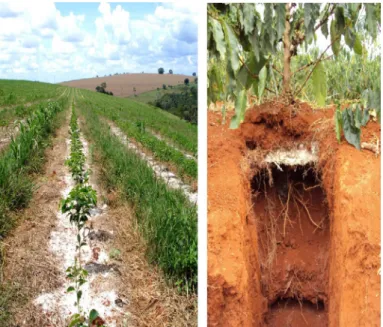
Besides the inicial gypsum dose, which was applied in the entire area, four treatments, in triplicate and randomized blocks, were set as follows: G0 - zero gypsum applied after the application of after the application of gypsum during the initial soil preparation; G7- 7 t ha-1 of gypsum in the planting line (1.75 kg m-1); G56 - 56 t ha-1 of gypsum in the planting line (14 kg m-1), with brachiaria between the coffee planting lines; and CV7 - 7 t ha-1 of gypsum in the line and no brachiaria between the planting lines (Figure 1). Sixteen months later, the soil profile in each treatment was sampled in the planting lines at the following depths: 0.15 to 0.25, 0.35 to 0.45, 0.75 to 0.85, and 2.35 to 2.45 m (Figure 1 – right), totalizing 96 samples. These samples were air-dried, crushed, passed through a 2 mm mesh sieve, placed in plastic bags, and stored for the further analysis.
To extract the soil solution, we used the saturated soil-paste method (Wolt, 1994). To do this, ultrapure water was slowly added to 300 g of soil sample until reaching the saturation point. The sample rested for 16 h then was placed in a Büchner funnel, containing paper filter (rapid filtration) coupled to a Kitassato flask. The solution was extracted under vacuum for about 9 h, and then filtered through 0.45 µm cellulose membrane and stored for further analysis. The pH was determined directly in the extract. The dissolved organic carbon (DOC) was quantified (Varian, TOC analyzer) for total carbon content, by combustion at 950oC. The contents of the Ca2+, Mg2+, Mn2+, Cu2+, Zn2+, Fe3+, Al3+ in the soil
solution were determined by plasma emission spectroscopy with optical detection (Varian, Vista MPX, axial view), while K+ and Na+ were determined by flame photometry (Micronal B462). Ion chromatography (Dionex, ICS 1100 with IONs OACK AS23 column for anions or Ion Pack CS12A for cations) was used to determine F-, Cl-, NO2-, NO3- PO
42-, SO42- and NH4+. Results below the equipment’s quantification limit were observed for Cu2+, Zn2+, Fe3+, Al3+, PO
42-, corresponding to 0.06, 0.03, 0.35, 0.07, and 0.03 mg L-1, respectively. Thus, these species were not considered neither for soil solution chemical speciation or the ionic strength calculations. The soil solution ionic strength (μ) was calculated according to Sposito (1989):
where Ci is concentration of ion (mol L-1) of each ion, and Zi is the respective charge.
The soil solution chemical speciation was done using the Visual Minteq program (Gustaffson, 2018), based on the total concentrations (mg L-1) of all the cations, anions, DOC, and pH obtained as described above, for each treatment and soil depth sampled in the field. The results of soil chemical tests were submitted to analysis of variance. The experimental design was a randomized block design with three replications. The clustering of the means was done by the Scott-Knott test, adopting the p values 0.05 as criterion of significance of the difference between the means. The data were processed using the software SISVAR 5.6, Build 86 (Ferreira, 2014).
FIGURE 1 - Partial view of the experimental area (left) and detail of the sampling trench showing the gypsum-buried layer of the 56 t ha-1 treatment (right).
3 RESULTS AND DISCUSSION
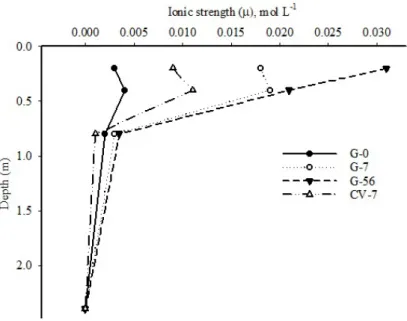
Ionic strength (μ) of the soil solution of treatments is demonstrated in Figure 2. Ionic strength decreases with the increase in soil depth. Despite the higher solubility of gypsum, when compared to lime, 16 months of leaching wasn’t enough to cause a significant increase of calcium and sulfate in the subsoil. Results reported by Ramos et al. (2013) indicated presence of Ca2+, Mg2+, and K+ 16 months after the application of gypsum, only until 0.45-m of depth. The results presented in Figure 2 for the treatments G7 and CV7 corroborate with the results obtained by Ramos et al. (2013). Furthermore, treatments G7 and G56 in the planting line differed only in the surface layer, indicating that, in addition to carrying ions, solubilization of gypsum and consequent leaching take longer than 16 months to produce some result deeper in the soil profile.
The increase in the concentration of electrolytes in the soil solution, indicated by the ionic strength, reduces the thickness of the diffuse electric-double layer, neutralizes negative surfaces, reduces pH, increases mobility, and reduces adsorption of bases in the solid phase of the soil (Sposito, 1989). Therefore, Ca2+, Mg2+, and K+ are subject to leaching to the subsurface layers of soil. The magnitude of this effect is a function
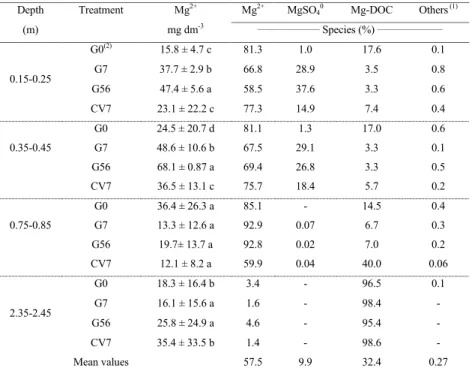
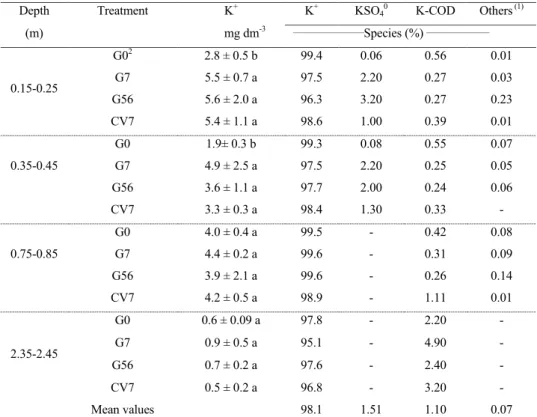
of the dominant cation in the soil solution. In the present study, it is Ca2+, which is provided by the gypsum. We found higher amounts of Ca2+ in the soil solution (Table 3), followed by Mg2+ (Table 4), and K+ (Table 5).
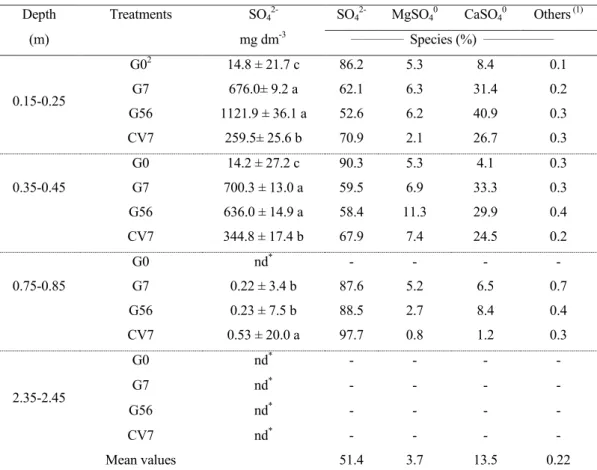
The free form of SO42- was the most dominant chemical species in the soil solution, regardless of the treatment or sampled depth (Table 1), corroborating results found by Zambrosi et al. (2007) on a soybean nutrition experiment. The authors evaluated the distribution of ionic species in the soil solution of a Latosol cultivated in a no-tillage system (NTS), five years after the application of agricultural gypsum. The highest proportion ionic pairs was for CaSO40, followed by MgSO40, with the highest percentages present in the planting line at the depth of 0.85 m, being higher for the higher doses of gypsum. In this case, up to 4% of sulfate was MgSO4, and up to 13.5% CaSO4. Other ionic pairs (NaSO4-, KSO
4-, HSO4-, MnSO
40, AlSO4+, NH4SO4-) were found in the soil solution of samples from the planting line. These other species account for about 0.4% of the total (Table 1).
We verified an increase in the content of SO42- at 0.15 to 0.25 and 0.35 to 0.45 m depth in the inter-row of G7 treatment, which
is covered
with Urochloa ruziziensis, as compared to treatment CV7, where the inter-row were left nude.FIGURE 2 - Effect of gypsum on ionic strength (µ), mol L-1 of the solution of of Latosol under coffee crop and high doses of gypsym.
G0 - only the first applied gypsum during soil preparation; G7- 7 t ha-1 of gypsum in the planting line (1.75 kg m-1); G56 - 56 t ha-1 of gypsum in the planting line (14 kg m-1), all of them with brachiaria between the coffee plant lines; and CV7 - 7 t ha-1 of gypsum in the line and no brachiaria between the lines.
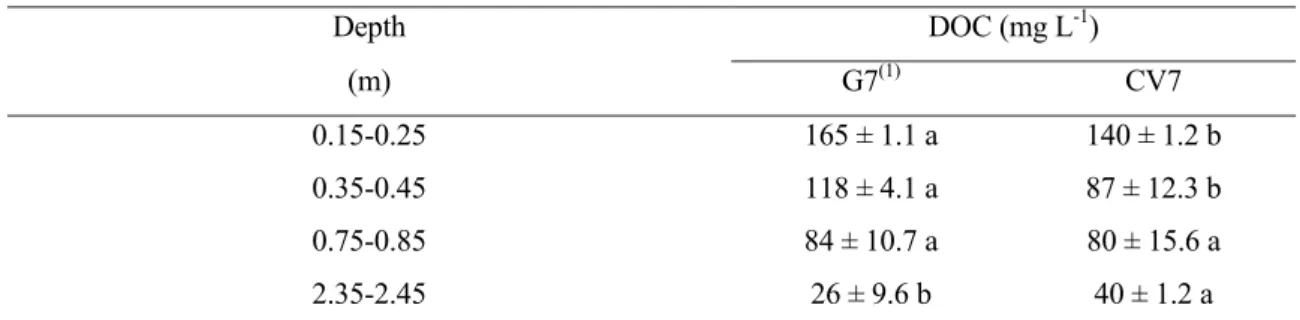
Gypsum percolation to the depth 0.35-0.45 m increased SO42- and Ca2+ (Table, 1), allowing bether growth of root system. It resulted in higher DOC (Table 2), due to the growth of Urochloa ruziziensis root system. In the same area, Serafim et al. (2011) also found that the roots of the coffee plants reached an average depth of 1.40 m. Ramos et al. (2013) reported higher amounts of Ca2+ and Mg2+ in treatments G7 and G56, compared to G0 and CV7, at 0.35- to 0.45-m depth.
The contents of Ca2+ (Table 3) showed significant differences at 0.15-0.25 m depth, indicating differences between treatments with gypsum only among the preparation (G0) and the treatments G7 and G56. Increasing dose of gypsum, caused an increase of Ca2+ contents in
the soil solution until the depth from 0.75 to 0.85 m. This was accounted for by leaching of Ca2+ to deeper layers of the soil where higher gypsum was applied. Regarding the cultivation of Urochloa ruziziensis, there was difference between the treatment G7 and CV7 only in the layer from 0.75 to 0.85 m. Serafim et al. (2012), Crusciol et al. (2016), Inagaki et al. (2016), and Zoca & Penn (2017) also found similar results, demonstrating that the application of gypsum caused an increase in the levels of Ca2+ in the subsurface layers of the soil, and indicating the carriage of this nutrient to the layers beyond the depth of application. We observed no differences in the contents of Ca2+ and SO42- between treatments G7 and G56 at depths from 0.35 to 0.45 and 0.75 to 0.85 m (Table 3).
TABLE 1 - Distribution of SO42-, MgSO4 and CaSO4 in the solution of a Latossol planted with coffee with high doses of gypsum.
Depth Treatments SO42- SO42- MgSO40 CaSO40 Others (1)
(m) mg dm-3 ____________ Species (%) ________________ 0.15-0.25 G02 14.8 ± 21.7 c 86.2 5.3 8.4 0.1 G7 676.0± 9.2 a 62.1 6.3 31.4 0.2 G56 1121.9 ± 36.1 a 52.6 6.2 40.9 0.3 CV7 259.5± 25.6 b 70.9 2.1 26.7 0.3 0.35-0.45 G0 14.2 ± 27.2 c 90.3 5.3 4.1 0.3 G7 700.3 ± 13.0 a 59.5 6.9 33.3 0.3 G56 636.0 ± 14.9 a 58.4 11.3 29.9 0.4 CV7 344.8 ± 17.4 b 67.9 7.4 24.5 0.2 0.75-0.85 G0 nd* - - - - G7 0.22 ± 3.4 b 87.6 5.2 6.5 0.7 G56 0.23 ± 7.5 b 88.5 2.7 8.4 0.4 CV7 0.53 ± 20.0 a 97.7 0.8 1.2 0.3 2.35-2.45 G0 nd* - - - - G7 nd* - - - - G56 nd* - - - - CV7 nd* - - - - Mean values 51.4 3.7 13.5 0.22
Means followed by the same letter in the column do not differ between each other by the Scott-Knot test (p≤0.05).
(1) Other species of sulfate: NaSO4-, KSO4-, HSO4-, MnSO40, AlSO4+, NH4SO4-.
(2) G0 - only the first applied gypsum during soil preparation; G7- 7 t ha-1 of gypsum in the
planting line (1.75 kg m-1); G56 - 56 t ha-1 of gypsum in the planting line (14 kg m-1), all of
them with brachiaria between the coffee plant lines; and CV7 - 7 t ha-1 of gypsum in the line
and no brachiaria between the lines. *nd: not detected.
Coffee Science, Lavras, v. 14, n. 3, p. 281 - 290 jul./sep. 2019
TABLE 3 - Mean contents of Ca2+ and respective chemical speciesin the soil solution of a
Latossol planted with coffee with high doses of gypsum.
Depth Treatments Ca2+ Ca2+ CaSO
40 Ca-DOC Others (1) (m) mg dm-3 ____________________ Species (%) _________________ 0.15-0.25 G0(2) 32.1± 20.1 c 78.9 1.2 19.8 0.1 G7 261 ± 29.6 b 62.1 33.9 3.8 0.2 G56 446 ± 32.0 a 52.9 42.8 3.5 0.8 CV7 160 ± 10.5 b 73.6 18.0 8.3 0.1 0.35-0.45 G0 16.0 ± 14.5 b 79.1 1.6 18.9 0.4 G7 287 ± 20.8 a 62.4 33.9 3.5 0.2 G56 253 ± 39.1 a 64.7 31.4 3.6 0.3 CV7 160 ± 5.7 a 71.6 21.9 6.3 0.2 0.75-0.85 G0 14.0 ± 14.0 b 83.6 - 16.1 0.3 G7 27.5 ± 27.3 a 92.5 0.1 7.2 0.2 G56 28.0 ± 16.7 a 91.8 0.03 7.8 0.4 CV7 19.0 ± 18.7 c 58.1 0.04 41.8 0.06 2.35-2.45 G0 nd* - - - - G7 nd* - - - - G56 nd* - - - - CV7 nd* - - - - Mean values 54.5 11.6 8.8 0.20
Means followed by the same letter in the column do not differ between each other by the Scott-Knot test (p≤0.05).
(1) Other species of calcium: CaCl+, CaHCO
3+, CaNO3+, CaF+, CaH2PO4+, CaHPO4
(2) G0 - only the first applied gypsum during soil preparation; G7- 7 t ha-1 of gypsum in the planting line (1.75 kg m-1); G56 - 56 t ha-1 of gypsum in the planting line (14 kg m-1), all of them with brachiaria between the coffee plant lines; and CV7 - 7 t ha-1 of gypsum in the line and no brachiaria between the lines.
*nd: not detected.
TABLE 2 - Mean contents of DOC in the solution of a Latossol planted with coffee with high doses of gypsum. Depth DOC (mg L-1) (m) G7(1) CV7 0.15-0.25 165 ± 1.1 a 140 ± 1.2 b 0.35-0.45 118 ± 4.1 a 87 ± 12.3 b 0.75-0.85 84 ± 10.7 a 80 ± 15.6 a 2.35-2.45 26 ± 9.6 b 40 ± 1.2 a
Means followed by the same letter in the line do not differ between each other by the Scott-Knot test (p≤0.05).
(1) G7- gypsum in the preparation and 7.0 t ha-1 of gypsum in the planting line; CV7- absence
Coffee Science, Lavras, v. 14, n. 3, p. 281 - 290, jul./sep. 2019 Lack of significant differences in this case
means that the period of 16 months (basically one rainy season) was not a enough time to allow increasing leaching even with such a huge difference between gypsum doses. Further evaluations will certainly show differences.
The free form of Ca2+ was the main chemical species in the soil solution, regardless of the treatment and depth from which the samples were collected with an average proportion of 54.5% (Table 3). Zambrosi et al. (2007) also found the free form of Ca2+ represented 54%. Marques et al. (2011) also found that the effect of gypsum on the content of water-soluble nutrients increased the content of Ca2+ in the soil at the 0-0.20 m layer, when compared to the treatment without gypsum. The ionic pair CaSO40 represented 11.6% of the species in the planting lines (Table, 3). However, considering the total added gypsum to de soil, summing all the calcium species showed in the speciation calculation that less than 1% of added Ca2+ was found in the soil solution. The highest percentages of CaSO40 were found in the
treatments with the highest doses of gypsum (7 and 56 t ha-1), reaching 0.45 m in the soil profile. This shows that, although the formation of the iron pair occurs and is carried to the layer beyond the application, 16 months was not enough a time to allow losses of these cations layers beyond the depth of the roots. Leaching of CaSO40 is of paramount importance to carry calcium and improve the root environment deeper in the soil profile (Zandoná, 2015; Zoca & Penn ,2017).
From 0.15 to 0.85 m, the ionic pair with DOC in the treatments with gypsum, only in the preparation (G0) represented 18.3% in the soil solution. The treatments G7 and G56 (7 and 56 t ha-1) represented less than 5% (Table, 3).
Initially, Ca2+ is carried by DOC. Later, with the presence of gypsum, CaSO40 becomes more important for carrying Ca2+ to the deeper layers of soil profile. We also observed that to the 0.45-m depth, higher doses of gypsu0.45-m pro0.45-moted an increase in the content of Mg2+ in the soil solution (Table 4).
TABLE 4 - Mean contents of Mg2+ and respective chemical species in the solution of a Latossol planted with coffee with high doses of gypsum.
Depth Treatment Mg2+ Mg2+ MgSO
40 Mg-DOC Others (1) (m) mg dm-3 __________________ Species (%) ___________________ 0.15-0.25 G0(2) 15.8 ± 4.7 c 81.3 1.0 17.6 0.1 G7 37.7 ± 2.9 b 66.8 28.9 3.5 0.8 G56 47.4 ± 5.6 a 58.5 37.6 3.3 0.6 CV7 23.1 ± 22.2 c 77.3 14.9 7.4 0.4 0.35-0.45 G0 24.5 ± 20.7 d 81.1 1.3 17.0 0.6 G7 48.6 ± 10.6 b 67.5 29.1 3.3 0.1 G56 68.1 ± 0.87 a 69.4 26.8 3.3 0.5 CV7 36.5 ± 13.1 c 75.7 18.4 5.7 0.2 0.75-0.85 G0 36.4 ± 26.3 a 85.1 - 14.5 0.4 G7 13.3 ± 12.6 a 92.9 0.07 6.7 0.3 G56 19.7± 13.7 a 92.8 0.02 7.0 0.2 CV7 12.1 ± 8.2 a 59.9 0.04 40.0 0.06 2.35-2.45 G0 18.3 ± 16.4 b 3.4 - 96.5 0.1 G7 16.1 ± 15.6 a 1.6 - 98.4 - G56 25.8 ± 24.9 a 4.6 - 95.4 - CV7 35.4 ± 33.5 b 1.4 - 98.6 - Mean values 57.5 9.9 32.4 0.27
Means followed by the same letter in the column do not differ between each other by the Scott-Knot test (p≤0.05).
(1) Other species of magnesium: MgCl+, MgHCO
3+, MgF+, MgHPO4.
(2) G0 - only the first applied gypsum during soil preparation; G7- 7 t ha-1 of gypsum in the
planting line (1.75 kg m-1); G56 - 56 t ha-1 of gypsum in the planting line (14 kg m-1), all of
them with brachiaria between the coffee plant lines; and CV7 - 7 t ha-1 of gypsum in the line
and no brachiaria between the lines. *nd: not detected.
Coffee Science, Lavras, v. 14, n. 3, p. 281 - 290 jul./sep. 2019 Rampim et al. (2011) also observed that,
when using up to 5 t ha-1 of gypsum, Mg2+ leached to 0.40-m depth, one year after application. Serafim et al. (2012), who studied the application of 6 doses of gypsum (0, 3, 6, 9, 12, and 15 t ha-1) in a dystroferric Red Latosol, observed that the increase in the doses of gypsum resulted in leaching of Mg2+ from the plowing layer.
Among the inorganic anions, SO42- bonded mostly to Mg2+, 9.9%. This ion pair was observed, although in smaller percentages, until 0.85-m depth (Table, 4). These results corroborate the findings of Zambrosi et al. (2007), who also observed that Mg2+ was mostly associated with SO
42- (0.6%) when compared to Cl-, NO3-, F- (0,1%) at 0.40 m of depth. According to Nava et al. (2012), the rate of movement of Mg2+ in the profile depends on the existence of other anions in the soil solution, especially nitrates and chlorides, derived mainly
from the mineralization of OM, or, in the case of sulfates, from the application of agricultural gypsum, which was the case of the present study. Caires et al. (2003) observed that, after 30 months of applying gypsum, the concentration of Mg2+ increased in the subsoil layers and, after 32 months, the gypsum continued to promote Mg2+ leaching to greater depths.
Contents of K+ in the soil solution ranged from 0.001 to 0.014 cmolc dm-3 (Table 5). No influence of Urochloa ruziziensis cultivation was found in any of the evaluated depths. The content of K+ in the soil solution between 0.003 (Malavolta, 2006) and 0.01 cmolc dm-3 (Guimarães et al., 1999) has indicated as a critical value for crop development. We found the highest values at 0.45m depth in the planting line, providing K+ at greater depths, which is beneficial for plant absorption (Crusciol et al., 2016).
TABLE 5 - Mean contents of K+ and respective chemical species in the solution of a Latossol
planted with coffee with high doses of gypsum.
Depth Treatment K+ K+ KSO
40 K-COD Others (1) (m) mg dm-3 __________________Species (%) ________________ 0.15-0.25 G02 2.8 ± 0.5 b 99.4 0.06 0.56 0.01 G7 5.5 ± 0.7 a 97.5 2.20 0.27 0.03 G56 5.6 ± 2.0 a 96.3 3.20 0.27 0.23 CV7 5.4 ± 1.1 a 98.6 1.00 0.39 0.01 0.35-0.45 G0 1.9± 0.3 b 99.3 0.08 0.55 0.07 G7 4.9 ± 2.5 a 97.5 2.20 0.25 0.05 G56 3.6 ± 1.1 a 97.7 2.00 0.24 0.06 CV7 3.3 ± 0.3 a 98.4 1.30 0.33 - 0.75-0.85 G0 4.0 ± 0.4 a 99.5 - 0.42 0.08 G7 4.4 ± 0.2 a 99.6 - 0.31 0.09 G56 3.9 ± 2.1 a 99.6 - 0.26 0.14 CV7 4.2 ± 0.5 a 98.9 - 1.11 0.01 2.35-2.45 G0 0.6 ± 0.09 a 97.8 - 2.20 - G7 0.9 ± 0.5 a 95.1 - 4.90 - G56 0.7 ± 0.2 a 97.6 - 2.40 - CV7 0.5 ± 0.2 a 96.8 - 3.20 - Mean values 98.1 1.51 1.10 0.07
Means followed by the same letter in the column do not differ between each other by the Scott-Knot test (p≤0.05).
(1) Other species of potassium: KCl, KNO 3.
(2) G0 - only the first applied gypsum during soil preparation; G7- 7 t ha-1 of gypsum in the
planting line (1.75 kg m-1); G56 - 56 t ha-1 of gypsum in the planting line (14 kg m-1), all of
them with brachiaria between the coffee plant lines; and CV7 - 7 t ha-1 of gypsum in the line
There was more K+ in the soil solution in the treatments with gypsum than found in treatment G0 at depth of 0.45 m. This is due, primary, to the K input by the mineral fertilization of soil for coffee planting. Potassium was predominantly found in its free form. Considering the electrolytes and the diffuse electric-double layer scenario, leaching of K+ was caused by the dominant presence of Ca2+ over the diffuse double layer. Deeper in the soil profile, we verified that there was no difference between the content of K+ between treatment G0 and those with higher doses of gypsum. Leaching of K+ can be attributed to the gypsum “pulse” (Quaggio, et al., 1982). Potassium leaching is promoted by the high electrolytes concentration, reflected by the high ionic strength of the soil solution and the consequent reduced thickness of the electric-double layer with dominance of Ca2+ on the diffuse double layer.
As a monovalent cation, K+ is more leachable in soil when compared to Ca2+ and Mg2+. On the other hand, Ca2+, with lower hydration radii than Mg2+ is more adsorbed to the soil colloids, and is strongly retained in the soil when compared to Mg2+ and K+.
4 CONCLUSIONS
After 16 months of gypsum application, 96% of K+ in soil solution was at 0.35 to 0.45 m in its free form, besides de presence of the ionic pairs KSO40 e K-COD. K-COD was related to the bracharia planted in the inter rows of coffee plants For Ca2+ and Mg2+ leaching occurred predominantly in its free forms, although a more significant contribution of CaSO40 and MgSO
40 ionic pairs was observed when compared to K2SO40.
The use of high doses of gypsum in the soil requires long-term monitoring to better evaluate the feasibility of this practice in terms of chemical changes throughout the soil profile, mainly to further leaching of K+ and Mg2+, which are already found in lower concentrations in the soil.
5 ACKNOWLEDGMENTS
The authors would like to express their appreciation to Fapemig and CNPq for the financial support and scholarships, to Agropecuaria Piumhi - AP, for allowing this research in its Commercial Coffee farm and providing all the necessary field support, and to Soil Science Department - UFLA for all the necessary laboratorial support.
6 REFERENCES
Bortolanza, D.R., Klein V.A. Soil Chemical and Physical Properties on an Inceptisol after Liming (Surface and Incorporated) Associated with Gypsum Application. Revista Brasileira de Ciência do Solo, Viçosa, Brazil, v.40: e0150377, 2016.
Caires, E.F.; Blum, J.; Barth, G.; Garbuio, F.J.; Kusamn M.T. Alterações químicas do solo e resposta da soja ao calcário e gesso aplicados na implantação do sistema plantio direto. Revista Brasileira de Ciência do Solo, Viçosa, Brazil. v. 27, p. 275-286., 2003. doi.: 10.1590/ S0100-06832003000200008
Crusciol, C.A.C., Artigiani, A.C.C.A., Arf, O., Filho, A.C.A.C., Soratto, R.P., Nascente, A.S., Alvarez, R.C.F., Soil fertility, plant nutrition, and grain yield of upland rice affected by surface application of lime, silicate, and phosphogypsum in a tropical no-till system. Catena, v. 137, p.87–99, 2016.
EMPRESA BRASILEIRA DE PESQUISA
AGROPECUÁRIA – EMBRAPA. Sistema brasileiro de classificação de solos. 5.ed. Brasília, Embrapa; 2018.
Ferreira, D.F. 2014. Sisvar: A Guide for its bootstrap procedures in multiple comparisons. Ciência e Agrotecnolgia, Lavras, v.38, n. 2, p.109-112, mar./abr., 2014. doi.: 10.1590/S1413-70542014000200001 Guimarães, P.T.G.; Garcia, A.W.R.; Alavarez Viegas, V.H.; Prezotti, L.C.; Viana, A.S.; Miguel, A.E.; Malavolta, E.; Correa J.B.; Lopes, A.S.; Nogueira, F.D.; Monteiro, A.V.C. Cafeeiro. In: Ribeiro, A.C.; Guimarães P.T.G.; Alvarez Viegas V.H. (Ed.). Recomendações para o uso de corretivos e fertilizantes em Minas Gerais: 5a aproximação. Viçosa, MG: Comissão de Fertilidade do Solo do Estado de Minas Gerais, 1999. Gustaffson, J. P. Visual Minteq - version 3.0 beta; Acesso em 17/12/2018. Disponível em: < https:// vminteq.lwr.kth.se/>.
Inagaki MT, Sá JC de M, Caires EF, Gonçalves DRP. Lime and gypsum application increases biological activity, carbono pools, and agronomic productivity in highly weathered soil. Agriculture, Ecosystems and Environment, v. 231, p.156–165, 2016.
Kost, D., Chen, L., Guo, X., Tian, Y., Ladwig, K., Dick, W.A.,. Effects of flue gas desulfurization and mined gypsums on soil properties and on hay and corn growth in eastern Ohio. J. Environ. Qual., v.43, p. 312–321, 2014.
Lopes AS; Guilherme LRG. Career Perspective on Soil Management in the Cerrado Region of Brazil. Advances in Agronomy, v.35, p. 1-72, 2016. doi: 10.1016/bs.agron.2015.12.004,
Malavolta, E. Manual de nutrição mineral de plantas. 1 ed. São Paulo, Agronômica Ceres, 2006.
Marques, R.R.; Crusciol, C.A.C.; Castro, G.S.A.; Perim, L. Water-soluble nutrients in aerial plant parts of peanut and white oat as affected by lime and gypsum application. Revista Brasileira de Ciência do Solo, Viçosa, Brasil, v. 35. p.513-522, 2011. doi: 10.1590/ S0100-06832011000200020.
Menegasse, L.N.; Gonçalves, J.M.; Fantinel, L.M. Disponibilidades hídricas na Província Cárstica de Arcos-Pains-Doresópolis, Alto São Francisco, Minas Gerais. Aguas Subterraneas v.16, p. 1-19, 2002. doi. 10.14295/ras.v16i1.1297
Nava, G.; Ernani, P.R.; Sá, A.A.; Pereira, A.J. Soil Composition and nutritional status of apple as affected by long-term application of gypsum. Revista Brasileira de Ciência do Solo, Viçosa, Brazil, v. 36, p.215-222, 2012. Quaggio, J.A.; Dechen, A.R.; Raij, B. van. Efeitos da aplicação de calcário e gesso sobre a produção de amendoim e lixiviação de bases no solo. Revista Brasileira de Ciência do Solo, Viçosa, Brazil, v. 6, p.189-194, 1982.
Ramos, B.Z.; Toledo, J. P. V. F.; Lima, J.M.; Serafim, M. E.; Bastos, A. R. R.; Guimaraes, P.T.G.; Coscione, A.R. Doses de gesso em cafeeiro: influência nos teores de cálcio, magnésio, potássio e pH da solução de um Latossolo Vermelho distrófico. Revista Brasileira de Ciência do Solo, Viçosa, Brasil, v.37, p. 1018-1026, 2013. .doi: 10.1590/S0100-06832013000400019. Rampim L.; Lana, M.C.; Frandioloso, J.F.; Fontaniva S. Atributos químicos de solo e resposta do trigo e da soja ao gesso em sistema semeadura direta. Revista Brasileira de Ciência do Solo, Viçosa, Brasil, v. 35, p.1687-1698, 2011 doi: 10.1590/S0100-06832011000500023.
Serafim M.E.; Oliveira, G.C.; Oliveira, A.S.; Lima, J.M.; Guimarães, P.T.G.; Costa, J.C. Sistema conservacionista e de manejo intensivo do solo no cultivo de cafeeiros na região do, MG: Um estudo de caso. Bioscience Journal, v. 27, p. 964-977, 2011. Serafim, M.E.; Lima, J.M.; Lima, V.M.P.; Zeviani, W.M.; Pessoni P.T. Alterações físico-químicas e
movimentação de íons em Latossolo gibbsítico sob doses de gesso. Bragantia, v. 71: p. 30-40, 2012. doi: 10.1590/S0006-87052012005000006
Silva, B. M. ., Oliveira, G. C. ., Serafin, M. E. ., Silva, E. A.a S., Guimaraes, P. T. G. ., Melo, L. B. B. ., Norton, L. D. ., Curi, N. C.. Soil moisture associated with least limiting water range, leaf water potential, initial growth and yield of coffee as affected by soil management system. Soil & Tillage Research, v. 189, p. 36–43, 2019 DOI: 10.1016/j.still.2018.12.016
Soil Survey Staff. Soil Taxonomy,. A Basic System of Soil Classification for Making and Interpreting Soil Surveys, second. ed. USDA Soil Conservation Service, US Gov. Printing Office, Washington – DC , 1999 Sposito, G. The chemistry of soils. New York: Oxford University Press; 1989.
Tiecher T, Pias OHC, Bayer C, Martins AP, Denardin LGO, Anghinoni I. Crop response to gypsum application to subtropical soils under no-till in Brazil: a systematic review. Revista Brasileira de Ciência do Solo, Viçosa, Brazil, v.4, 2018 :e0170025. https://doi. org/10.1590/18069657rbcs20170025
Vale AR do; Calderaro RAP; Fagundes FN. A CAFEICULTURA EM MINAS GERAIS: estudo comparativo entre as regiões Triângulo Mineiro/ Alto Paranaíba e Sul/Sudoeste. Revista de geografia agrária. Edição especial do XXI ENGA-2012, p. 1-23, jun., 2014.
WOLT, J.D. Obtaining soil solution: laboratory methods. In: Soil solution chemistry: applications to environmental science and agriculture. 1 ed. New York, John Wiley, 1994. 345p.
Zambrosi, F.C.B.; Alleoni, L.R.F.; Caires, E.F. Aplicação de gesso agrícola e especiação iônica da solução de um Latossolo sob sistema plantio direto. Ciência Rural, v. 37, p. 110-117, 2007. doi: 10.1590/S0103-84782007000100018.
Zandoná R. R.; Beutler A. N.; Burg, G. M.; Barreto, C. F.; Schmidt, M. R. Gesso e calcário aumentam a produtividade e amenizam o efeito do déficit hídrico em milho e soja. Pesquisa Agropecuária Tropical, v. 45, n. 2, p. 128-137, 2015.
Zoca, S.M.; Penn, C. An important tool with no instruction manual: a review of gypsum use in agriculture. Advances in Agronomy, v.144, p.1-44, 2017.