Volume 5, Number 5, May 2016 (Serial Number 47)
Journal of Environmental
Science and Engineering B
Dav i d
David Publishing Company www.davidpublisher.com
P u b l i s h i n g Dav i d
Publication Information:
Journal of Environmental Science and Engineering B (formerly parts of Journal of Environmental Science and
Engineering ISSN 1934-8932, USA) is published monthly in hard copy (ISSN 2162-5263) and online (ISSN 2162-5271) by David Publishing Company located at 616 Corporate Way, Suite 2-4876, Valley Cottage, NY 10989, USA.
Aims and Scope:
Journal of Environmental Science and Engineering B, a monthly professional academic journal, covers all sorts of
researches on environmental management and assessment, environmental monitoring, atmospheric environment, aquatic environment and municipal solid waste, etc..
Editorial Board Members:
Prof. Joaquín Jiménez Martínez (France), Dr. J. Paul Chen (Singapore), Dr. Vitalie Gulca (Moldova), Prof. Luigi Maxmilian Caligiuri (Italy), Dr. Jo-Ming Tseng (Taiwan), Prof. Mankolli Hysen (Albania), Dr. Jungkon Kim (South Korea), Prof. Samira Ibrahim Korfali (Lebanon), Prof. Pradeep K. Naik (India), Dr. Ricardo García Mira (Spain), Prof. Konstantinos C. Makris (Gonia Athinon & Nikou Xiouta), Prof. Kihong Park (South Korea).
Manuscripts and correspondence are invited for publication. You can submit your papers via Web Submission, or E-mail to [email protected], [email protected] or [email protected]. Submission guidelines and Web Submission system are available at http://www.davidpublisher.com.
Editorial Office:
616 Corporate Way, Suite 2-4876, Valley Cottage, NY 10989, USA Tel: 1-323-984-7526, 323-410-1082
Fax: 1-323-984-7374, 323-908-0457
E-mail: [email protected]; [email protected]; [email protected] Copyright©2016 by David Publishing Company and individual contributors. All rights reserved. David Publishing Company holds the exclusive copyright of all the contents of this journal. In accordance with the international convention, no part of this journal may be reproduced or transmitted by any media or publishing organs (including various websites) without the written permission of the copyright holder. Otherwise, any conduct would be considered as the violation of the copyright. The contents of this journal are available for any citation. However, all the citations should be clearly indicated with the title of this journal, serial number and the name of the author.
Abstracted/Indexed in:
Google Scholar
CAS (Chemical Abstracts Service) Database of EBSCO, Massachusetts, USA Chinese Database of CEPS, Airiti Inc. & OCLC Cambridge Science Abstracts (CSA)
Ulrich’s Periodicals Directory
Chinese Scientific Journals Database, VIP Corporation, Chongqing, China Summon Serials Solutions
Proquest
Subscription Information:
Price (per year): Print $600, Online $480 Print and Online $800 David Publishing Company
616 Corporate Way, Suite 2-4876, Valley Cottage, NY 10989, USA Tel: 1-323-984-7526, 323-410-1082; Fax: 1-323-984-7374, 323-908-0457 E-mail: [email protected]
Digital Cooperative Company: www.bookan.com.cn
David Publishing Company www.davidpublisher.com
DAVID PUBLISHING
Journal of Environmental
Science and Engineering B
Volume 5, Number 5, May 2016 (Serial Number 47)
Contents
Environmental Chemistry
215 Heavy Metal Determination in the Bottom Solid Waste Ash Produced from Sabah and Shuaiba Hospital Incinerators in Kuwait
Saleh Al-Muzaini
Environmental Climate
224 Green House in Semi-arid Regions of Mexico
Maria de los Angeles Rechy Carvajal, Emil von Roth and Jose Alberto Murillo Rodriguez
Ecological Environment
228 Factors Affecting the Ovilarval Density of Aedes Spp. Mosquitoes in Selected Rice Fields of
Muňoz, Nueva Ecija
Jerome Cadiente Soriano and Clarissa Yvonne Jueco-Domingo
Environmental Energy
237 Decommissioning of Uranium Pilot Plants at IPEN-CNEN/SP: Facilities Dismantling, Decontamination and Reuse as New Laboratories for Strategic Programs
Paulo Ernesto de Oliveira Lainetti, Antônio Alves de Freitas, Francisco Mário Feijó Vasques , Robson de Jesus Ferreira, Marycel Elena Barbosa Cotrim and Maria Aparecida Faustino Pires
243 Building Sector: The Different Ways to Improve Their Energetic Efficiency
Clito Afonso and Ricardo Pereira
Environmental Management and Assessment
254 Short-term Intensive Sustainable Restoration of Grasslands and Prairies Invaded with High Densities of Nitrogen-fixing Weeds: A Test with the Invasive Plant Lespedeza Cuneata
Jack Cornell and Alexander Wait
261 The Prospect and Feasibility Assessment of Brine Shrimp (Artemiafranciscana) Culture in Bangladesh
Journal of Environmental Science and Engineering B 5 (2016) 215-223 doi:10.17265/2162-5263/2016.05.001
Heavy Metal Determination in the Bottom Solid Waste
Ash Produced from Sabah and Shuaiba Hospital
Incinerators in Kuwait
Saleh Al-Muzaini
Earth Sciences and Environment Department, Kuwait University, Safat 23942, Kuwait
Abstract: In Kuwait, there is growing concern over the disposal of wastes produced by hospitals since hospital wastes contain
hazardous and infected wastes. All hospitals in Kuwait have adopted incineration as an alternative method to dispose of their wastes. Due to inefficient combustion of hospital incinerators, the Kuwaiti government decided to shut down all hospital incinerators, while the Sabah Incinerator (SAHI) and Shuaiba Incinerator (SUHI) were kept running. This study was initiated to focus on the determination of heavy metals in the bottom ashes produced by the SAHI and SUHI incinerators. Bottom ash was collected over a period of one year and heavy metals were determined. They were shown variation in their concentrations due to the initial waste composition and the operational procedures of the hospital incinerators.
Key words: Hazard, hospital waste, incineration, toxic metals.
1. Introduction
In Kuwait, there is a major concern over the increasing amount of hospital wastes as shown in Fig. 1. The amount of hospital wastes generated have doubled in the past 40 years to reach 5 kg to 10 kg per
patient, which corresponds to a total of 6 × 10³ tons
per year of hazardous hospital solid wastes. The expectation indicates that this figure will increase in the future due to the single disposable items used per patient [1].
Ninety-five percent of current hospital wastes were incinerated in nearly 25 facilities. However, inefficient combustion of hospital incinerators leads hospital incinerators to generate toxic emissions during their daily operations. As a result of epidemiological studies conducted by health authorities, it was revealed that there is a correlation between the proximity of a residence to a hospital incinerator and the incidence of various types of cancer. Thus, the health authorities decided to shut down hospital incinerators and retained
Corresponding author: Saleh Al-Muzaini, Ph.D., main
research field: environment engineering.
the operation of the Sabah Hospital Incinerators (SAHI), which was modernized later on. At the same time, a new incinerator was installed at Shuiaba area called Shuaiba Hospital Incinerator (SUHI). Even though incinerations are good means to reduce the volume of hospital wastes and eliminating infectious components, the subject of hospital incineration is still under public debate. Recent studies showed that the impact of carcinogenic emissions from new hospital incinerators on human health was to be much low [2]. Comprehensive studies have been carried out on the impact of air pollutants in fly ash, while some general information is available from recent published studies on the determination of heavy metals in the bottom ash of hospital incinerators, which are yet to be understood. A preliminary study was conducted on the nature of bottom ash from hospital incinerators in Kuwait in 2001. The results revealed that bottom ash produced by hospital incinerators contained high levels of heavy metals such as Zn, Fe, Pb, Cr, Cu, Mn, Ni and Cd. The study suggested that further study should be conducted to understand the differences in the levels of heavy metals [3]. Lo, H. M., and Liao,
D
Heavy Metal Determination in the Bottom Solid Waste Ash Produced from Sabah and Shuaiba Hospital Incinerators in Kuwait
216
Fig. 1 Average hospital composition waste [33].
Y. L. [4] showed that incinerator bottom ash can create a significant risk to the environment. Recently, the European Union Council Declared that, hospital bottom ash as a dangerous waste material [5]. Unsafe disposal of hospital waste ash in a landfill can cause contamination to the soil and groundwater due to leaching of heavy metals [6]. For this reason, hospital waste ash requires special attention [7] during its disposal. Alba, N., et al. [8] reported that six hospital medical waste incinerator samples in northern Spain were collected and analyzed. Results showed high concentrations of chromium in hospital waste ash. However, Zhao, L., et al. [9] studied the chemical properties of heavy metals in hospital wastes incinerator ashes in China. They reported that heavy metals, such as Ca, Cr and Na were found in various quantities, where Cr had the highest concentration among other heavy metals. Kougemitrou, I., et al. [10] studied bottom ash samples from hospital waste incinerators in Athens, Greece. The results of their research showed that hospital waste ash contained a high content of heavy metals such as Cu and Cr. Zhao, L., et al. [11] studied hospital waste incinerator ash due to the outbreak of severe acute respiratory
syndromes in China. The analyses showed that hospital bottom ashes contained a larger amount of heavy metals such as Ba, Cu, Cr, Mn, Ni, Pb, Sn, Ti and Zn. Heavy metals, such as Ba, Cr, Ni and Sn, were present in the residual fraction, while Mn, Pb and Zn were present in the Fe-Mn oxides fraction and Cu was present in the organic matter fraction. Zakaria, M., et al. [12] evaluated hospital waste incinerator performances based on their physical and chemical characteristics of bottom ashes. They concluded that incineration processes can easily destroy organic compounds and some heavy metals found in the hospital wastes. Furthermore, Levasseur, B., et al. [13] reported the hospital incinerators could produce large quantities of bottom ashes depend is on the amount of hospital wastes. Astar, M. [14] reported that incineration provides the ultimate means of disposal for toxic compounds. Tessitors, J., and Frankle, C. [15] pointed out that many hospital authorities decided to dispose of all hospital wastes through incineration for the following reasons: (1) landfill authorities are unwilling to accept any hospital wastes, and (2) liability consideration due to possible transmission of diseases such as AIDS and viral diseases. Doyle, B.W.,
Heavy Metal Determination in the Bottom Solid Waste Ash Produced from Sabah and Shuaiba Hospital Incinerators in Kuwait
217
et al. [16] and Timothy A., et al. [17] stated that pollutants in the bottom ashes from hospital waste incinerators may pose hazards to the environment if they are not properly disposed of. Rich, C., and Cherry, K. [18] pointed out that it is important to have a clear procedure to dispose of hospital wastes, as otherwise, these is a risk of severe acute respiratory diseases spreading later on. While Shen, T. [19] highlighted that the public are always concerned about hospital wastes, the potential risk always existed. Over 80% of many main elements, such as Fe, P, Al, Sr, Ca and some of the toxic elements, such as Cr, Co, Mg, Ni, Mo can remain in the bottom ash after incineration [20]. Also, 90% of Cd and 88% of Sb can be volatilized but they also remain in the bottom ash [20]. Based on recent research, low volatility heavy metals, such Ni, Cr, Cu and Zn always remain in the bottom ash [21]. The aim of this work was to identify heavy metals and their levels in hospital bottom ash and to compare the results of this study with published results. For this study, bottom ash samples were collected and analyzed over a period of one year.
2. Materials and Methods
2.1 Hospital Incinerator
This study was carried out in two hospital incineratorsSAHI and SUHI. They are located in urban areas. The nature of the incinerated waste is hospital waste and hospitals regularly incinerate without any preliminary sorting. SAHI was built in 1980 but since 2002 major technical modifications were made to update the current standards. SUHI, the second incinerator was built in 2010 and is located in the south of Kuwait city. Both incinerators are equipped with two combustion chambers with design capacities between 350 kg/h and 650 kg/h of hospital wastes. They are fitted with efficient electrostatic precipitators and liquid lime scrubbers. The combustion chamber temperature goes up to 1,500 °C. The decontaminated exhaust is released into the atmosphere by a 50 m high chimney. Bottom ash
residues are transported by vibrating conveyors and stored in a bunker. All ash residues are subsequently transported to trucks for final disposal in a landfill. 2.2 Bottom Ash Sampling and Analysis
The bottom ash samples were collected from two incinerators. All samples were taken between January and December 2013. The bottom ash samples were collected at the end of operation day. A total number of 96 samples were collected in a period of one year from the combustion chamber. The samples were kept in a closed non-contaminating plastic bag. Each sample was about 1 kg to 2 kg. After all of the samples were collected, they were transported to the laboratory where they were analyzed. In the laboratory, each ash sample was crushed in a porcelain mortar and pestle, passed through a #40-mesh sieve, and stored in glass bottles. All ash samples were dried in the oven at 105 °C for 3 hour to remove any humidity. Approximately 1 gm + 2 gm of dry ash sample was placed in a
digestion tube and then 15 mL of HNO3 (100%) was
added and mixed thoroughly for 1 hour at 70 °C. The sample was cooled to room temperature before filtration. After filtration, 50 mL of the sample was collected and sent directly for analyses. The Inductively Coupled Plasma-Optical Emission Spectrometry (ICP-OES). Varian SPS3 analysis [22] was used for the analysis of heavy metals such as Cd, Co, Cr, Fe, Ni, Mn, Mo, Pb, Se, Sn, Sr, V and Zn. The ICP-OES instrument was already calibrated using reference standards and suitable blanks in order to produce high quality reading. Sampling and analysis were performed according to the Standard Methods [23].
3. Results and Discussion
3.1 Chemical Characteristics of Bottom Ash
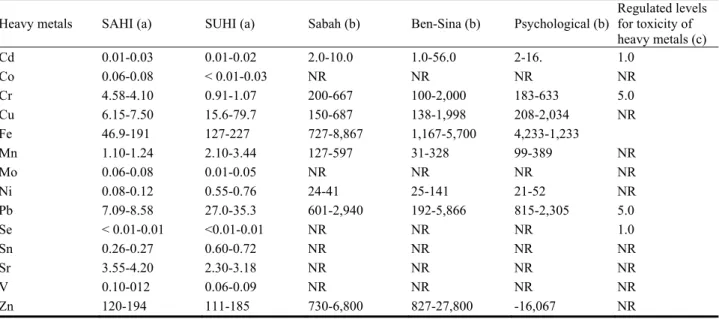
The bottom ash samples were investigated for heavy metal concentration (Cd, Co, Cr, Cu, Fe, Mn, Mo, Ni, Pb, Se, Sn, Sr, V and Zn). Table 1 shows the concentrations of heavy metals in the bottom ash of SAHI.
Heavy Metal Determination in the Bottom Solid Waste Ash Produced from Sabah and Shuaiba Hospital Incinerators in Kuwait
218
Table 1 Concentration of heavy metals in bottom ash SAHI.
Sample No. Heavy Metals 1 2 3 4 5 6 7 8 9 10 11 12 Average Cd 0.01 0.01 0.01 0.03 0.03 0.01 0.02 0.02 0.02 0.01 0.01 0.01 0.02 Co 0.08 0.08 0.07 0.07 0.08 0.06 0.06 0.07 0.06 0.06 0.08 0.07 0.07 Cr 4.10 4.58 4.58 4.50 4.52 4.51 4.10 4.10 4.52 4.51 4.50 4.58 4.42 Cu 6.99 6.18 7.50 6.18 6.17 6.16 6.98 6.15 6.17 6.18 6.25 6.20 6.42 Fe 46.9 191 172 170 163 160 165 169 170 165 189 190 163 Mn 1.02 1.10 1.24 1.2 1.00 1.23 1.0 1.01 1.22 1.19 1.18 1.22 1.13 Mo 0.08 0.08 0.08 0.07 0.06 0.07 0.08 0.07 0.06 0.07 0.06 0.08 0.07 Ni 0.12 0.11 0.09 0.10 0.08 0.12 0.11 0.10 0.09 0.12 0.12 0.12 0.09 Pb 7.09 8.58 7.76 7.10 7.75 7.12 7.13 7.10 7.09 7.76 7.99 7.14 7.47 Se < 0.01 0.01 0.01 < 0.01 0.01 0.01 < 0.01 0.01 < 0.01 < 0.01 0.01 0.01 0.01 Sn 0.27 0.26 0.27 0.26 0.26 0.26 0.27 0.27 0.26 0.26 0.26 0.26 0.26 Sr 3.58 3.55 4.23 4.20 3.60 3.60 3.75 3.59 3.60 3.62 3.67 4.20 3.77 V 0.10 0.11 0.12 0.10 0.10 0.10 0.11 0.11 0.11 0.12 0.11 0.12 0.12 Zn 194 120 192 180 130 190 192 191 193 130 194 193 175 * All reading in mg/L.
The concentration of Cd varied from 0.01 mg/L to 0.03 mg/L with an average of 0.02 mg/L, while Co concentration ranged from 0.06 mg/L to 0.08 mg/L with an average of 0.07 mg/L. However, concentration of Cr ranged from 4.10 mg/L to 4.58 mg/L with an average of 4.42 mg/L. The concentration of Cu ranged from 6.18 mg/L to 7.5 mg/L with an average of 6.42 mg/L, but Fe concentration ranged from 46.9 mg/L to 191 mg/L with an average of 163 mg/L. The concentration of Mn varied from 10 mg/L to 1.24 mg/L with an average of 1.13 mg/L, and Mo concentration ranged from 0.06 mg/L to 0.08 mg/L with an average of 0.07 mg/L. The concentration of Ni ranged from 0.08 mg/L to 0.12 mg/L with an average of 0.09 mg/L. Pb concentrations ranged from 7.08 mg/L to 8.58 mg/L with an average of 7.47 mg/L; however, Se concentrations ranged from < 0.1 mg/L to 0.1 mg/L with an average of 0.1 mg/L. Sn concentration varied from 0.26 mg/L to 0.27 mg/L with an average of 0.26 mg/L. Sr, V and Zn concentrations ranged from 3.58 mg/L to 4.30 mg/L, 0.10 mg/L to 0.11 mg/L, and 120 mg/L to 194 mg/L, respectively, while their average concentrations were 3.77 mg/L, 0.12 mg/L and 175 mg/L, respectively. The levels of heavy metals in bottom ash of the SAHI had an abundance
of Zn > Fe > Pb > Cu > Cr >Sr> Mn > Sn > V > Ni > Mo > Co > Cd > Se in each sample. Table 2 shows the ash samples from SUHI.
Cd concentrations ranged from 0.01 mg/L to 0.02 mg/L with an average of 0.02 mg/L; however, Co concentrations ranged from < 0.01 mg/L to 0.03 mg/L with an average of 0.01 mg/L. Cr concentrations ranged from 0.91 mg/L to 1.07 mg/L with an average of 0.94 mg/L. Cu concentrations varied from 15.6 mg/L to 79.7 mg/L with an average of 52.3 mg/L; however, Fe concentrations ranged from 1.72 mg/L to 227 mg/L with an average of 197 mg/L. Mn concentrations ranged from 2.10 mg/L to 3.44 mg/L with an average of 2.65 mg/L, but Mo concentrations ranged from 0.01 mg/L to 0.05 mg/L with an average of 0.02 mg/L. Ni concentrations varied from 0.5 mg/L to 0.76 mg/L with an average of 0.63 mg/L, but Pb concentrations ranged from 27 mg/L to 35.3 mg/L with an average of 30.83 mg/L. Se concentrations ranged from < 0.01 mg/L to 0.01 mg/L with an average of 0.01 mg/L, but Sn concentrations varied from 0.60 mg/L to 0.72 mg/L with an average of 0.67 mg/L. Sr concentrations ranged from 2.17 mg/L to 3.20 mg/L with an average of 2.75 mg/L, but V concentrations ranged from 0.06 mg/L to 0.09 mg/L
Heavy Metal Determination in the Bottom Solid Waste Ash Produced from Sabah and Shuaiba Hospital Incinerators in Kuwait
219
Table 2 Concentration of heavy metals in bottom ash SUHI.
Sample No. Heavy Metals 1 2 3 4 5 6 7 8 9 10 11 12 Average Cd 0.02 0.02 0.01 0.01 0.01 0.01 0.02 0.02 0.02 0.01 0.02 0.02 0.02 Co 0.03 < 0.01 0.01 0.01 0.01 0.01 0.01 < 0.01 0.01 0.01 0.01 <0.01 0.01 Cr 1.07 0.91 0.92 0.92 0.92 0.91 0.91 0.93 0.92 0.94 0.91 1.00 0.94 Cu 19.6 15.6 79.7 20.0 70.0 60.1 73.1 72.1 30.1 50.1 70.1 70.2 52.25 Fe 172 191 227 200 180 178 203 210 222 210 185 190 197 Mn 2.19 3.44 2.20 2.10 3.0 2.10 3.00 3.20 2.10 2.20 3.00 3.30 2.65 Mo 0.05 0.04 0.01 0.01 0.01 0.02 0.01 0.01 0.01 0.02 0.03 0.04 0.02 Ni 0.55 0.76 0.63 0.6 0.61 0.70 0.50 0.57 0.70 0.71 0.58 0.59 0.63 Pb 27.30 29.00 35.30 27.00 28.00 30.00 29 33.10 32.10 33.00 32.10 34.10 30.83 Se < 0.01 0.01 < 0.01 < 0.01 < 0.01 0.01 0.01 0.01 0.01 0.01 0.01 < 0.01 0.01 Sn 0.63 0.72 0.69 0.60 0.70 0.70 0.71 0.64 0.63 0.65 0.70 0.64 0.67 Sr 3.18 2.17 2.31 3.20 2.80 2.30 2.30 2.31 2.80 3.00 3.00 3.10 2.75 V 0.08 0.09 0.06 0.06 0.06 0.08 0.09 0.06 0.06 0.07 0.06 0.07 0.07 Zn 120 185 111 130 125 120 130 140 130 135 140 145 134 * All reading in mg/L.
with an average of 0.07 mg/L. Zn concentrations ranged from 111 mg/L to 185 mg/L with an average of 134 mg/L. The levels of heavy metals in the bottom ash of SUHI had an abundance of Fe > Zn > Cu > Pb > Sr > Mn > Cr > Sn > Ni > V > Mo > Cd > Co > Se. In general, the levels of heavy metals in the bottom ash revealed a wide variation in the concentration of heavy metals due to the hospital wastes’ contents.
This also means that incinerators were found to be inadequate in eliminating all of the metal contents. Furthermore, it appeared that the quantities of heavy metals in the hospital wastes may be high and cannot be eliminated easily by incineration. The concentration of Fe was the highest compared to other heavy metals, as shown in Fig 2. Also, metals, such as Zn, Cu and Pb, have high concentrations and can be compared to other elements. The variation in the concentration of heavy metals was probably due to two factors. The first factor was the variation in the hospital waste’s composition, while the second factor was the improper operation of the two incinerators [24]. These levels were not unexpected since hospital wastes normally contain about 20% nonorganic materials and, occasionally, the levels increase as high as 30% [24]. Results show that some of the toxic elements (Cr, Co,
Mg, Ni and Mo) always remained in the bottom ash due to their properties of metals [20, 21]. Table 1 shows that SAHI had the highest contents of Zn, Fe, Pb, Cu, Cr, while Zn and Fe had the highest concentrations, while Cd and Se had the lowest concentrations. Table 2 shows that the concentrations of Fe, Zn, Cu, Pb, Sr and Mn were the highest among other metals, while Se, Co, Cd, Mo had the lowest concentrations. Presence of Fe and Zn in the bottom ashes of two incinerators may due to the presence of cans, bottle capsules, pigments, and plastic materials [3, 25]. The results revealed that in comparing the total waste volume of two hospitals in the combustion chamber with the final ash residual collected after incineration process. Results indicated that the most of the waste loaded was burned properly and volume reduction has been achieved in all runs. The result also showed that the ashes collected from incineration process contained high concentrations of Fe, Zn, Cu and Pb. This is due to the fact that their small particles sizes were present and increased their availability surfaces to expose more to the adsorption process. The results revealed that the highest concentration of Fe in the ash might have been due to its highest melting point (1,493 °C), which makes it available in a larger
Heavy Metal Determination in the Bottom Solid Waste Ash Produced from Sabah and Shuaiba Hospital Incinerators in Kuwait
220
Fig. 2 Average concentration of heavy metals in bottom ash of incinerators.
Table 3 Comparison of parameters of bottom ash of hospital incinerators with published results and EPA TCLP levels.
Heavy metals SAHI (a) SUHI (a) Sabah (b) Ben-Sina (b) Psychological (b) Regulated levels for toxicity of heavy metals (c) Cd 0.01-0.03 0.01-0.02 2.0-10.0 1.0-56.0 2-16. 1.0 Co 0.06-0.08 < 0.01-0.03 NR NR NR NR Cr 4.58-4.10 0.91-1.07 200-667 100-2,000 183-633 5.0 Cu 6.15-7.50 15.6-79.7 150-687 138-1,998 208-2,034 NR Fe 46.9-191 127-227 727-8,867 1,167-5,700 4,233-1,233 Mn 1.10-1.24 2.10-3.44 127-597 31-328 99-389 NR Mo 0.06-0.08 0.01-0.05 NR NR NR NR Ni 0.08-0.12 0.55-0.76 24-41 25-141 21-52 NR Pb 7.09-8.58 27.0-35.3 601-2,940 192-5,866 815-2,305 5.0 Se < 0.01-0.01 <0.01-0.01 NR NR NR 1.0 Sn 0.26-0.27 0.60-0.72 NR NR NR NR Sr 3.55-4.20 2.30-3.18 NR NR NR NR V 0.10-012 0.06-0.09 NR NR NR NR Zn 120-194 111-185 730-6,800 827-27,800 -16,067 NR
* Note: (a) This study; (b) [3]; and (c) [26]. 0.02 0.07 4.42 6.42 163 1.13 0.07 0.09 7.47 0.01 0.26 3.77 0.12 175 0.02 0.01 0.94 52.25 197 2.65 0.02 0.63 30.83 0.01 0.67 2.75 0.07 134 0.001 0.011 0.101 1.001 10.001 100.001 1000.001 Cd Co Cr Cu Fe Mn Mo Ni Pb Se Sn Sr V Zn SAHI Incinerator SUHI Incinerator
Heavy Metal Determination in the Bottom Solid Waste Ash Produced from Sabah and Shuaiba Hospital Incinerators in Kuwait
221
amount in the bottom ashes. When the levels of heavy metal of this study were compared with published data, it was found that the existing incinerators' performances were much better than previously, as shown in Table 3.
It seemed likely that both SAHI and SUHI incinerators had high efficiency to reduce the heavy metals. This means that the incinerator performance depends entirely on the combustion degrees. To classify the produced bottom ash from the two incinerators as hazardous or not, toxicity characteristic leaching procedure and characteristic waste Toxicity Characteristic Leaching Procedure (TCLP) list was applied [26]. According to the TCLP guidelines, results showed that Cd, Cr and Se had a lower concentration than TCLP. But Pb concentration was found to have exceeded the permissible limits. Due to Pb toxicity, the bottom ash is considered hazardous waste, as shown in Table 3. Therefore, the produced bottom ash from the two incinerators may be classified as hazardous wastes, and care should be taken during dumping [25, 27, 28]. Otherwise, it can cause problems to the surrounding environment [29, 30]. Therefore, utilization of bottom ash is much safer than dumping it in landfill sites [31-33].
4. Conclusions
The results of this study demonstrated that incineration is the best technology to destroy the increasing volume of hospital wastes. Hospital incinerators do not completely destroy heavy metals, but simply concentrate them into bottom ash. Bottom ash residues arising from both incinerators were found to contain high concentrations of hazardous elements, such as Cd, Co, Cr, Cu, Fe, Mn, Mo, Ni, Pb, Se, Sn, Sr, V and Zn. However, the performances of both incinerators were much better than previously. Fe, Zn, Pb and Cu were found in the bottom ashes of two hospital incinerators. They were in high concentrations compared to other heavy metals found in the bottom ashes. Moreover, the highest melting
points of some heavy metals mean a larger amount of their residues. The average concentrations of Pb were found to be higher than TCLP; therefore, bottom ashes could be classified as hazardous waste on most sampling days. It is likely to have highly mobile constituents of heavy metals. If they were improperly managed, they could contaminate the groundwater. Therefore, it is recommended that more efforts are needed to identify why bottom ashes contain high concentrations of Fe, Zn, Pb and Cu. Hospital bottom ashes should be disposed by properly designed engineered treatment methods.
Acknowledgements
The author is grateful to the Kuwait Institute for Scientific Research (KISR) management for the financial support to conduct this project. The author would like to express his warm thanks to Prof. Alan Moghissi for his guidance and good comments on this manuscript. Thanks are also due to Prof. Mohammed Al-Sarawi, manager of Earth Sciences and Environment Department, Kuwait University (KU), for his critical review of the manuscript. Special thanks go to author's laboratory staff who always kept things running and doing analysis on time. The author’s wishes to thank the engineers and technical staff from the National Cleaning Company (NCC) for their technical information and support during this study.
References
[1] Al-Humaidan, S. M. 2006. “Ahmadi Hospital Waste Management and Health care: Workers Perception”.
The Proceedings of 4th Euro-Arab Environment Conference and Exhibition. 27-29, November, State of Kuwait, 589-599.
[2] Elliott, P., Shaddick, G., and Kleinschmidt, L. 2000. “Cancer Incidence Adverse near Municipal Waste Incinerators in Great Britain.” Br. Journal Cancer 73: 702-710.
[3] Al-Meshan, M., Nasrallah, H., and Ahmed, A. 2001. “Comparative Study of Heavy Metals in Bottom Ash from Hospital Incinerators in the State of Kuwait.”
Heavy Metal Determination in the Bottom Solid Waste Ash Produced from Sabah and Shuaiba Hospital Incinerators in Kuwait
222
[4] Lo, H., and Liao, Y. 2007. “The Metal Leaching and Acid-neutralizing Capacity of Msw. Incinerator Ash Co-disposed with Msw. in Landfill Sites.” Journal of
Hazardous Materials 142: 512-519.
[5] Gidarakos, E., Petrantonaki, M., Anastasiadou, K., and Schramm, K. 2009. “Characterization and Hazard Evaluation of Bottom Ash Produced from Incinerated Hospital Waste.” Journal of Hazardous Materials 172: 935-942.
[6] Shim, Y., Rhee, S., and Lee, W. 2005. “Comparison of Leaching Characteristics of Heavy Metals from Bottom and Fly Ashes in Korea and Japan.” Waste
Management 25: 473-480.
[7] Alba, N., Gasso, S., Lacorte, T., and Baldasano, H. 1997. “Characterization of Municipal Solid Waste Incineration Residues from Facilities with Different Air Pollution Control System.” Waste Management 47: 1170-1179.
[8] Ibanez, R., Andres, A., Viguri, J. R., Ortiz, I., and Ibrabien, J. A. 2000. “Characterization and Management of Incinerator Wastes.” Journal of
Hazardous Materials 15: 793: 2-5.
[9] Zhao, L., Zhang, F., Wang, W., and Zhu, J. 2009. “Chemical Properties of Heavy Metals in Typical Hospital Waste Incinerator Ashes in China.” Waste
Management Journal 29 (3): 114-115.
[10] Kougemitrou, I., Godelitsas, A., Tsabaris, C., Stathopoulos, V., and Papandreou, P. 2011. “Characterization and Management of Ash Produced in the Hospital Waste Incinerator of Athens, Greece.”
Journal of Hazardous Materials 187 (1-3): 421-432.
[11] Zhao, L., Zhang, F., Mengjun, L., Zhen, G. L., and Wu, D. 2010. “Typical Pollutants in Bottom Ashes from a Typical Medical Waste Incinerator.” Journal of
Hazardous Materials 15 (173): 181-185.
[12] Zakaria, M., labib, O., Mohammed, M., El-Shall, W., and Hussein, A. 2005. “Assessment of Combustion Products of Medical Waste Incinerators in Alexandria.”
The Journal of the Egyptian Public Health Association
80 (3-4): 407-431.
[13] Levasseur, B., Myriam, C., Jean-Francois, B., and Mercier, G. 2006. “Metals Removal from Municipal Waste Incinerator fly Ashes and Reuse of Treated Leaches.” Journal of Environmental Engineering 132 (5): 497-505.
[14] Astar, M. 1985. “Cost Estimating for Hazardous Waste Incineration.” Pollution Engineering 1: 20-25.
[15] Tessitors, J., and Frankle, C. 1988. “Incineration of Hospital Infectious Waste.” Pollution Engineering
Journal 2: 82-88.
[16] Doyle, B. W., Drum, D. A., and Lauber, J. D. 1985. “The Smoldering Question of Hospital Wastes.”
Pollution Engineering 1: 35-39.
[17] Timothy, A., Timothy, O., and Morenike, A. Ji. 2013. “Heavy Metals Concentrations Around of a Hospital Incinerator and a Municipal Dumpsite in Ibadan City, South-West Nigeria.” Journal of Apply Science and
Environment Management 17 (3): 419-422.
[18] Rich, C., and Cherry, K. 1989. “The Liabilities of Hospital Waste Incineration.” Pollution Engineering 1: 48-57.
[19] Shen, T. 1986. “Hazardous Waste Incineration: Emissions and Their Control.” Pollution Engineering: 1: 50-53.
[20] Belevir, H., and Moench, H. 2000. “Factors Determining the Element Behavior in Municipal Solid Waste Incinerators.” Field studies, Environment
Science Technology 34: 2501-2506.
[21] Toledo, J., Corella, J., and Corella, L. 2005. “The Partitioning of Heavy Metals in Incineration of Sludge and Waste in a Bubbling Fluidized Bed, Interpretation of Results with a Conceptual Model.” Journal
Hazardous material B 126: 158-168.
[22] Varian Co. 2006. “ICP-OES Spectrometers: Varian SPS3, Sample Preparation, System and Diluter, Operation Manual.” Varian Australia Pty. Australia. [23] Water Pollution Control Federation (WPCF). 2005.
“Standard Methods for the Examination of Water and Wastewater.” Test Methods, Water Pollution Control Federation, Washington, DC: WPCF.
[24] Powell, C. 1987. “Incineration of hospital wastes.”
Hazardous Waste Management 37 (7): 836-839.
[25] Gautam, V., Thapar, R., and Sharma, M. 2010. “Biomedical waste Management: Incineration vs. Environmental Safety.” Indian Journal of Medical
Microbiology 28 (3): 131-192.
[26] USEPA (United State Environmental Protection Agency). 2010. “Toxicity Characteristic Leaching Procedure.” Fed. Register, 51, 216 and 40642: USEPA. [27] Nurmesniemi, R., Poykio, K., Manskinen, O. D., and
Makela, M. 2012. “Comparison of the Forest Fertilizer of Fly Ash Fractions from the MW Power Plant of a Fluting Board Mill Incinerating Peat and Forest Residues.” The 27th International Conference on Solid
Waste Technology and Management, March 11-14, Ph.
Pa., USA, 706-716.
[28] EC. 2003. Council Decision of 19 December 202
Establishing Criteria and Procedure for the Acceptance of Waste at Landfills. Pursuant to Article 16 of and
Annex II to Directive 1999/31/EC.
[29] Al-Muzaini, S., and Jacob, P. 1997. “Trace Metals in the near Shore Sediments of the Shuaiba Industrial Area of Kuwait from August 1993 to June 1994.” J.
Heavy Metal Determination in the Bottom Solid Waste Ash Produced from Sabah and Shuaiba Hospital Incinerators in Kuwait
223 [30] Al-Muzaini, S., and Jacob, P. 1996. “The Distribution
of V, Ni, Cr, Cd and Pb in Topsoil of the Shuaiba Industrial Area of Kuwait.” Environmental Toxicology
and Water Quality Environment International Journal
11: 285-292.
[31] Orava, H., Nordman, T., and Kuopanportti. H. 2006. “Increase the Utilization of Fly Ash with Electrostatic Precipitation.” Mineral Engineering 19 (15):1596-1602. [32] Pasquini, M., and Alexander, M. 2004. “Chemical
Properties of Urban Waste Ash Produced by Open Burning on the Jos Plateau: Implications for Agriculture.” Science of the Total Environment 319
(1-3): 225-240.
[33] Zhang, S., Yamasaki, S., and Nanzyo, M. 2002. “Waste Ashes for Use in Agricultural Production I: Lining Effect Content of Plant Nutrients and Chemical Characteristics of Some Metals.” Science of the Total
Environment 248 (1-3): 215-225.
[34] Al-Sudairawi, M., Saeed, T., Al-Rashidi, M., Yafaoui, H., Al-Shatti, A., Al-Wadi, M., Ahmed, N., Sinan, M., Al-Awadi, L., Rashad, M., and Bahaaeldien, M. 2001.
Assess the Impact of Air Pollution Emitted from Medical Waste Incinerators on the Hospital Environment and the Surrounding Areas. Final report.
Journal of Environmental Science and Engineering B 5 (2016) 224-227 doi:10.17265/2162-5263/2016.05.002
Green House in Semi-arid Regions of Mexico
Maria de los Angeles Rechy Carvajal1, Emil von Roth2 and Jose Alberto Murillo Rodriguez3
1. Faculty of Forestry, Universidad Autónoma de Nuevo León, Linares, Nuevo León 67700, Mexico 2. Aegis Structural Engineers, Studio City, California 91604, USA
3. Universidad Autónoma de Nuevo León, Linares, Nuevo León 67700, Mexico
Abstract: The subject structure was consisted of a proto-type house with plan dimensions of 8 m × 4 m. A variety of materials was
used to the construction, with special emphasis on using environmentally friendly non-toxic materials. The structure’s core consisted of reinforced concrete frames with masonry infill walls. Inside faces of the walls and the roof’s outside face were covered with proprietary composite panels, which are manufactured with a mixture of cement, volcanic ash, and local sawmill waste. These panels were analyzed for their physical and chemical properties, as well as for their resistance to decay and insects when subjected to extreme conditions for 15 years. The panels have also shown to provide thermal insulation and nonflammable when in direct contact with fire. The roof surface was further covered with a blend of local drought-resistant succulents and cacti. This study provides a detailed review of the construction process and materials employed.
Key words: Prototype house, thermal insulation, non-combustible, resistant to decay.
1. Introduction
The objective of this research was to develop a low-cost method to improve thermal insulation for houses located in the semi-arid Northeast of Mexico. This research was carried out in the city of Linares, in the state of Nuevo León, having the geographic coordinates: 20°50′16″ N and 99°32′41″ W (Fig. 1).
According to the Köppen-Geiger climate classification, the climate in this area is considered
semi-arid (BSh). The average annual precipitation is
600 mm/m², dropping to an average of 400 mm/m² during dry years. Most of the precipitation takes place during the months of May and September. This climate has led to the formation of thorn savannahs (known as Matorral in the Spanish language).
The region where the study was performed is rural, which leads to the restriction of being limited to use locally available raw material. Automated production of lightweight pumice or wood concrete block stones is therefore not practically feasible.
A research project carried out at the Faculty of
Corresponding author: Maria de los Angeles Rechy
Carvajal, professor, research field: forestry.
Forestry of the Universidad Autónoma de Nuevo León (Linares, Mexico) studied various locally available materials with the intent of identifying their suitability for thermal insulation purposes. Local availability and material cost led to the choice of wood concrete. This material is characterized by being nonflammable and highly resistant to biologically induced degradation.
2. Materials
2.1 Traditional Clay Masonry Construction
The traditional construction is clay masonry based with thatch or palm-leaf roofs. The clay masonry bricks employed have a density of 2 g/cm³ and a thermal conductivity of 1.20 W/(m·K). Lighter straw clay bricks have a density of 1.6 g/cm and a thermal conductivity of 0.80 W/(m·K). Such values do not allow for energy-saving construction. Additionally, clay construction requires constant maintenance to achieve good durability.
2.2 Current Concrete Masonry Construction
Hollow concrete masonry construction with reinforced concrete roofs has displaced the traditional building
D
Green House in Semi-arid Regions of Mexico
225
Fig. 1 Geographical location of the studied area.
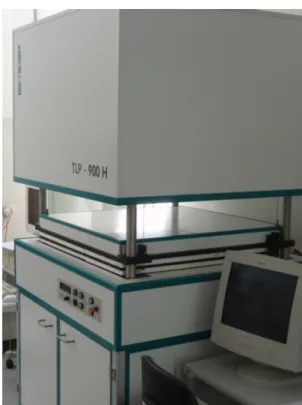
method over the last few decades. This foster by the ease of construction, durability, and speed of construction. Concrete’s thermal conductivity λ is 2.1 W/(m·K). This results for 15 cm thick hollow concrete masonry blocks in a thermal conductivity λ is 0.80 W/(m·K). As a result, the thermal isolation of today's homes in the region is not good. Thermal conductivity values are determined experimentally through hot plate tests (Fig. 2).
Without considering thermal boundary layers, the
thermal resistance Rw/(Rwall) for these walls is
0.15/0.80 = 0.19 m²·K/W. A 12 cm thick roof has a
Fig. 2 Equipment for determination of heat transfer.
thermal resistance of Rr/(Rrof) = 0.12/2.1 = 0.06
m²·K/W. These values are too low for habitable spaces in semi-arid regions given that minimum recommended
R-values are Rw = 0.50 m²·K/W and Rr 1.0 m²·K/W
for walls and roofs respectively. Lack of thermal insulation makes these houses barely habitable, This leads to high costs related to cooling and heating.
Although high-density building materials typically exhibit high load capacities, they are also typical characterized by low thermal insulation properties.
3. Construction Method Used
3.1 Wood Concrete as Insulating Material
The previously mentioned research led to the selection of wood concrete as insulation material due to local availability and low-income wages. Wood chips needed for manufacture of this insulation material can be procured easily at low cost. A common concrete mixer (Fig. 3) can be used to mix the wood chips and cement. Manufacture of insulating wall panels is benefitted by the use of a hydraulic press or jack. Poured-in-place roof insulation can be compacted with a manual compactor.
3.2 Installation of Thermal Insulation
Installation of the insulation is relatively simple. Wall panels are adhered to the interior faces of the walls. At the roof, the insulating wood concrete layer is placed below and prior to pouring the load-carrying reinforced concrete plate.
Green House in Semi-arid Regions of Mexico
226
Fig. 4 Outside view of the prototype house.
A prototype house with an area of 4 × 8 m was built to test the effectiveness of the wood concrete insulation material (Fig. 4). The walls were provided with 5 cm thick insulation panels adhered to the inside faces. The poured-inplace roof insulation thickness was 8 cm. (Fig. 5). Average grade wood concrete (density ρ = 0.6 g/cm³) was used to allow for installation of normal household items (lamps, pictures, etc.).
4. Results and Discussion
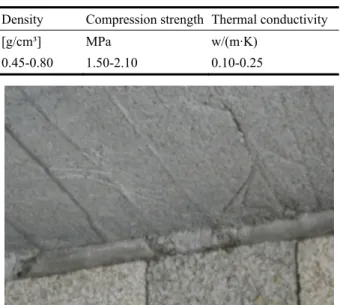
The research results for wood concrete was performed following DIN 4108 and DIN EN 832 (2011), being shown in Table 1.
Thermal insulation for cooled and heated houses should provide at the exterior of the building in order to allow for thermal inertia of the heavy concrete construction to contribute to a balance of interior temperatures. In buildings that are not cooled and only heated when required, the thermal insulation should be provided at the interior in order to take advantage of the nocturnal fall of temperature during the Summer and of quick heating with minimized temperature loss during the Winter.
The thermal conductivity λ of wood concrete is 0.16 [W/(m·K)], thus resulting in a thermal resistance
for the walls of Rwall = 0.15/0.80 + 0.05/0.16 = 0.50
[m²·K/W] and for the roof of Rroof = 0.12/2.1 +
0.08/0.16 = 0.56 [m²·K/W].
The insulation provided at the walls met the minimum requirement for habitable spaces. In contrast,
Table 1 Research results for wood concrete.
Density Compression strength Thermal conductivity
[g/cm³] MPa w/(m·K)
0.45-0.80 1.50-2.10 0.10-0.25
Fig. 5 Interior corner showing wall and roof interface.
Fig. 6 Green roof with drought-resistant plants.
the insulation at the roof required improvement. This roof insulation improvement was achieved through a green roof insulation layer. Detailed quantitative information on the level of thermal insulation provided by the green roof was not available at time of this publication because of the large variability of green roof assemblies and the complexity of determining the thermal insulation achieved.
Permanent temperature controls at the interior and exterior surfaces showed an average temperature delta of close to 10 °C during summer months.
Reference
Green House in Semi-arid Regions of Mexico
227 House Construction.” The International Conference on
Dryland, Deserts and Desertification. Sede Boquer. Israel.
[2] Heyer, E. 1993. Witterung und Klima. Stuttgart: Teubner Verlag.
[3] Vermosen, G. 2008. Un Plastique Nature. Belgium: Vermosen-Bonheiden.
[4] Lohmeyer, G. C. O., Bergmann, H., Post, M. 2005.
Praktische Bauphysik. Germany: Teubner Verlag Stuttgart.
[5] Din 4108. 2015. Wärmeschutz in Hochbau. Berlin: Beuth Verlag.
[6] Proporowitz, H., Unruh, H. 2008:
Baubetrieb-Bauverfahren. München: Hanser Verlag.
[7] Köhler, M., Barth, G., Brandwein, T. 1993.
Fassadenbegrünung und Dachbegrünung. German:
Journal of Environmental Science and Engineering B 5 (2016) 228-236 doi:10.17265/2162-5263/2016.05.003
Factors Affecting the Ovilarval Density of Aedes Spp.
Mosquitoes in Selected Rice Fields of Muňoz, Nueva
Ecija
Jerome Cadiente Soriano and Clarissa Yvonne Jueco-Domingo
College of Veterinary Science & Medicine, Central Luzon State University, Nueva Ecija 3120, Philippines
Abstract: Variables among the macroclimate, microclimate and rice canopy categories and three other different farming systems
were evaluated on their effects to the egg and larval density of Aedes spp. mosquitoes known as transmitters of animal and human diseases. No statistical difference in egg density (#eggs/mL) among farming systems (P = 0.345) were observed. However, there was significant difference in larval density (#larvae/mL) among farming systems (P < 0.001) particularly between organic and conventional farms and between organic and mixed farms at (P < 0.05). Among the variables in the macroclimate category, wind velocity and ambient temperature significantly influenced larval density in conventional farms. Among the variables in the microclimate category, water temperature significantly contributed to larval density in both the mixed and conventional farms whereas water turbidity, in conventional farms. Among the variables in the rice canopy category, the number of tillers per plant was a significant contributor to larval density in all farm types. No variable among the environmental exposure categories affected the larval density in organic farms.
Key words: Mosquito larval control, farming system, ovilarval density, organic farming, Aedes Spp. Mosquito.
1. Introduction
Mosquitoes serve as transmitters of human and animal diseases. The increasing trend of mosquito borne diseases remains a challenge to national and international health agencies to implement strategies to control it. Some of the known diseases are yellow fever, encephalitis, dengue, and dirofilariasis, fowl pox [1].
Vector control is an important strategy known to enhance the sustainability of high drug coverage. It helps interrupt transmission in combination with mass drug administration particularly in high risk, peri-urban areas and prevent-re-establishment of transmission in vulnerable areas [2].
From the global standpoint, approximately 140 million hectares of land are annually devoted to rice cultivation. Because the rice fields are flood on a semi-permanent basis during each growing season,
Corresponding author: Clarissa Yvonne Jueco-Domingo,
Ph.D., main research field: parasitology.
they provide ideal breeding habitat for a number of potential vectors of vector borne diseases [3].
Natural environment such as the interaction between temperature, rainfall or variations in daily microclimates may be important determinants in density of eggs and larvae of mosquitoes in breeding sites. These are very important factors in the identification of key vector-breeding sites and the reason is they are mosquito productive.
By determining environmental factors that influence density of eggs and larvae of Aedes spp. mosquitoes in three different rice farm systems in the Science City of Muñoz Nueva Ecija namely, pure organic, mixed and conventional farming, farmers could be advised to be on the look out for the density of mosquito eggs and larvae in order to make them responsible for adopting modified human behaviors that would protect them, their family and even their livestock reared around their farms against the bites of mosquitoes.
D
Factors Affecting the Ovilarval Density of Aedes Spp. Mosquitoes in Selected Rice Fields of Muňoz, Nueva Ecija
229
Hence, the study determined the presence of association between environmental factors together with the different rice farm systems being adopted by rice farmers in the Science City of Muñoz, Nueva Ecija and the egg and larval density of Aedes spp. of mosquitoes. Specifically, the study determined whether the following environmental factors affected the egg and larval density of Aedes spp. mosquito: (1) types of farming systems namely organic, mixed and conventional farms; (2) macroclimate factors such as rainfall, humidity, ambient temperature and wind velocity; (3) microclimate factors such as water temperature, water pH and water turbidity; and (4) rice canopy factors such as rice height (cm), number of tillers per rice plant and number of panicles per rice plant. Likewise, the study predicted egg and larval densities of Aedes spp. mosquitoes using multiple logistic regression models computed from environmental factors found to be effect modifiers at (p < 0.05).
2. Material and Methods
2.1 Identification and Collection of Samples
Three organic, three mixed and three conventional rice farms were identified within the Science City of Munoz, Nueva Ecija for sampling collection through the assistance of the Philippine Rural Reconstruction Movement farmers’ cooperative. External in puts such as herbicides, fertilizers and pesticides applied on the rice fields by farmers were noted.
Evaluation of rice plants and collection of water samples with mosquito eggs and larvae were done from three different sites of each rice field as replicates. Duration of collection period for the entire study was two months with weekly collections for a total of eight (8) collections.
2.2 Gathering of Macroclimate Variables
Macroclimate variables include meteorological
factors such as ambient temperature (oC), humidity
(%), wind velocity (mps) and rainfall (mm). They were taken from the Agrometeorological office of the
Dept. of Agronomy, Philippine Rice Research Institute in Maligaya, Science City of Munoz and Nueva Ecija.
2.3 Gathering of Characteristics of Rice Paddy Water Around fifty (50) milliliters (mL) of water from the rice paddies were collected and placed in clean properly labeled plastic bottles. Samples from the water were submitted for pH and water turbidity analysis at the Philippine Rice Institute Department of Agronomy. The pH was measured using a pH meter while the water turbidity was analyzed using spectrophotometric measurement for light absorbance (nanometer). Water temperature was measured from all sample sites using the Field Environmental Thermometer.
2.4 Evaluation of Rice Canopy Development
All rice plants within the area of one by one square meter, also designated for collection site of water sample, which was evaluated for rice canopy factors:
1. Plant height in centimeters (cm)-taken from the base of the plant which was submerged in water until the highest tip of the plant. A meter stick was used for measuring;
2. Number of tillers per plant-number of culmns or tillers was counted per plant and the mean per sampling site was recorded;
3. Number of panicles per plant-number of panicles was counted per plant and the mean per sampling site was recorded.
2.5 Identification & Counting of Eggs and Larvae of Aedes spp. Mosquitoes
Three (3) different collection sites for each type of rice farm were sampled for water to determine the number of eggs and larvae. Each site was marked with a flag to identify the area for collection throughout the study period.
Around 240 mL of water with eggs and larvae was collected from each replicate site and placed in
Factors Affecting the Ovilarval Density of Aedes Spp. Mosquitoes in Selected Rice Fields of Muňoz, Nueva Ecija
230
chemically clean bottles. An aliquot of ten 10 mL was transferred to a vial and a thin layer of mineral oil was placed over the surface of the water sample to suffocate the larvae. After the larvae have been killed, the entire contents of the vial were poured into a Petri dish and the eggs and larvae were counted using magnifying lens.
Only Aedes spp. mosquito eggs that were laid singly and did not have lateral floats were counted. The larvae that hanged diagonally from the water surface were assumed to be Aedes spp. Although Culex spp. also has larvae that hang diagonally from the water surface, the females prefer to lay eggs in stagnant, dirty water as compared to Aedes spp. that lay eggs in rice paddies.
Egg density per milliliter was computed by number of eggs counted divided by 10 mL while larval density per mL was measured by the number of larvae counted divided by 10 mL. Values of the egg and larval densities were transmuted according to the area of the entire rice field.
2.6 Data Analysis
Mean scores of the replicates of each rice farm were computed. One-way analysis of variance was used to evaluate the significant difference of the different environmental exposure variables by farm and the significant difference of mean egg and larval densities by farm.
Multivariate analysis was done to assess the association of exposure variables grouped in categories or as individual entity to the mean egg density or mean larval density. Each category, for instance, macroclimate, microclimate and plant canopy was forced into a multiple logistic regression model. A regression model per category was created which served as the main effects model. Each exposure variable under that category was assessed on how it interacted to the main effects model. The category which had a log likelihood ratio p-value of less than 0.05 was considered an effect measure
modifier. Hence, it could significantly modify either the mean egg density or the mean larval density.
Similarly, individual exposure variables were subjected to multivariate analysis to assess their association to the mean egg density or mean larval density. Each exposure variable was forced into a multiple logistic regression model. An exposure variable which had a log likelihood ratio p-value of less than 0.05 was considered an effect measure modifier, hence, it could significantly modify either the mean egg density or the mean larval density.
3. Results and Discussion
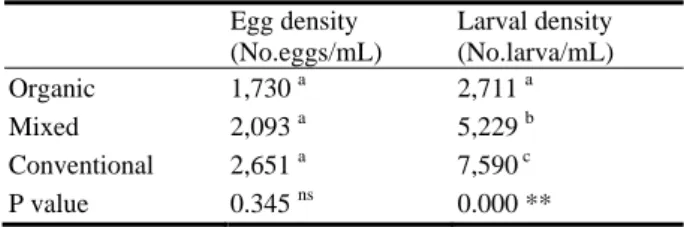
Comparing the summation of the mean egg density (#eggs/mL) and larval density in organic, mixed and conventional farms, ANOVA showed no significant difference at (p = 0.345) in the egg density while larval density was significantly different among the farming systems at (p < 0.001) (Table 1). This implies that the water paddies in mixed and conventional farms are better culture grounds for sustaining larval development. On the other hand, water paddies of organic farms are least attractive for sustaining larval density.
Likewise, results imply that egg density is not a good monitoring index for mosquito density in evaluating strategies for integrated vector control management program since there is no difference in the density among farms despite of a significant difference in the larval density. Hence, between egg and larval density, the latter is more sensitive as environmental index for monitoring mosquito density. Table 1 Analysis of variance of the summation of the mean egg and larval density by farming system.
Egg density (No.eggs/mL) Larval density (No.larva/mL) Organic 1,730 a 2,711 a Mixed 2,093 a 5,229 b Conventional 2,651 a 7,590 c P value 0.345 ns 0.000 **
* ns-not significant (similar superscripts are not significantly different);
Factors Affecting the Ovilarval Density of Aedes Spp. Mosquitoes in Selected Rice Fields of Muňoz, Nueva Ecija
231
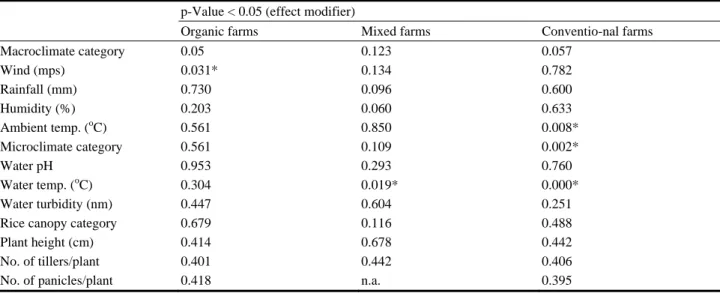
Table 2 shows the crude analysis of environmental exposure categories by farm type to identify which one would be an effect modifier (p < 0.05) to egg density of Aedes spp. Macroclimate variables
include the ambient temperature (oC), humidity (%),
wind velocity (mps) and rainfall (mm). Results showed that only the macroclimate had a moderate modifying effect at p = 0.05 to egg density in organic farms. In the case of mixed farms, no environmental exposure category had any association with egg density while the microclimate category had a modifying effect at p = 0.002 to egg density in conventional farms. Microclimate variables include those which characterize the water quality of the rice paddies such as water pH, water temperature and water turbidity.
When taken individually (Table 3), the wind was a
significant contributor under the macroclimate category at p = 0.031 in organic farms while it was the ambient temperature at p = 0.008 in conventional farms. The water temperature under the microclimate category was a significant contributor to egg density at p = 0.019 in mixed farms and p = 0.000 in conventional farms.
Table 4 shows the crude analysis of environmental exposure categories by farm type to identify which one would be an effect modifier (p < 0.05) to larval density of Aedes spp. Results showed that no environmental exposure category had a modifying effect to larval density in organic farms. However, the microclimate category was an effect modifier at p = 0.031 in mixed farms whereas all environmental exposure categories were effect modifiers to larval density in conventional farms.
Table 2 Multivariate analysis of environmental exposure categories by farm type against egg density of Aedes spp.
Organic farm Mixed farm Conventional farm
Macroclimate 0.05* 0.123 0.057
Microclimate 0.561 0.109 0.002**
Plant canopy 0.679 0.116 0.488
*significant; **highly significant.
Table 3 Significant exposure variables to mean Egg Density (ED).
p-Value < 0.05 (effect modifier)
Organic farms Mixed farms Conventio-nal farms
Macroclimate category 0.05 0.123 0.057 Wind (mps) 0.031* 0.134 0.782 Rainfall (mm) 0.730 0.096 0.600 Humidity (%) 0.203 0.060 0.633 Ambient temp. (oC) 0.561 0.850 0.008* Microclimate category 0.561 0.109 0.002* Water pH 0.953 0.293 0.760 Water temp. (oC) 0.304 0.019* 0.000* Water turbidity (nm) 0.447 0.604 0.251
Rice canopy category 0.679 0.116 0.488
Plant height (cm) 0.414 0.678 0.442
No. of tillers/plant 0.401 0.442 0.406
No. of panicles/plant 0.418 n.a. 0.395
* na-not applicable; *statistically significant.
Factors Affecting the Ovilarval Density of Aedes Spp. Mosquitoes in Selected Rice Fields of Muňoz, Nueva Ecija
232
Table 4 Multivariate analysis of environmental exposure variables by farm type against larval density of Aedes spp.
Organic farm Mixed farm Conventional farm
Macroclimate 0.342 0.511 0.000**
Microclimate 0.302 0.031** 0.000**
Plant canopy 0.059 0.054 0.000**
*significant; **highly significant.
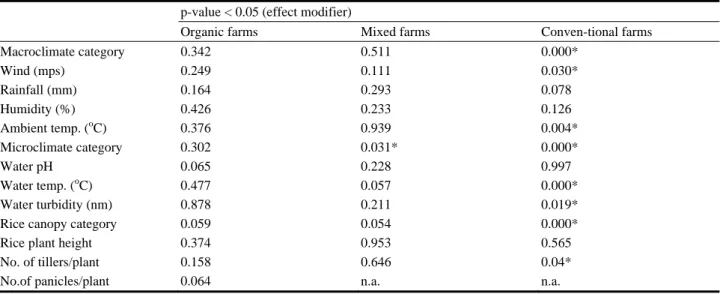
When taken individually (Table 5), the wind velocity and ambient temperature strongly contributed to the macroclimate category in affecting the larval density in conventional farms at p = 0.030 and p = 0.004 respectively. Water temperature and water turbidity strongly contributed to the microclimate category in affecting the larval density in conventional farms at p = 0.000 and p = 0.019 respectively. Finally, the number of tillers per plant strongly contributed to rice canopy category in affecting the larval density in
conventional farms at p = 0.04. Rice canopy indicators include plant height (cm), the number of tillers per plant and number of panicles per plant.
Table 6 shows the analysis of variance of the mean values of individual exposure variables by farm type. Water temperature, water pH, number of tillers and panicles per rice plant significantly differed by farm system whereas, water turbidity and plant height were not significantly different at p = 0.115 and p = 0.766 respectively, significantly by farm type.
Table 5 Significant exposure variables to mean Larval Density (LD).
p-value < 0.05 (effect modifier)
Organic farms Mixed farms Conven-tional farms
Macroclimate category 0.342 0.511 0.000* Wind (mps) 0.249 0.111 0.030* Rainfall (mm) 0.164 0.293 0.078 Humidity (%) 0.426 0.233 0.126 Ambient temp. (oC) 0.376 0.939 0.004* Microclimate category 0.302 0.031* 0.000* Water pH 0.065 0.228 0.997 Water temp. (oC) 0.477 0.057 0.000* Water turbidity (nm) 0.878 0.211 0.019*
Rice canopy category 0.059 0.054 0.000*
Rice plant height 0.374 0.953 0.565
No. of tillers/plant 0.158 0.646 0.04*
No.of panicles/plant 0.064 n.a. n.a.
* na-not applicable; *statistically significant
Table 6 Comparison of mean values of environmental exposure variables by farm systems.
Organic farms Mixed farms Conventio-nal farms p-value
Mean H2O temp. (To) 33.87 34.46 34.83 0.002**
Mean H2O pH 7.790 7.754 7.521 0.002**
Mean H2O turbidity 88.58 90.514 91.162 0.115
ns
Mean rice ht. (cm) 34.26 35.37 35.65 0.766ns
Mean no. of tillers/plant 33.00 27.97 29.45 0.002**
Mean no. of panicles/plant 296 293 341 0.04**
* ns-not significant; ** means highly significant.
Factors Affecting the Ovilarval Density of Aedes Spp. Mosquitoes in Selected Rice Fields of Muňoz, Nueva Ecija
233
Multiple logistic regression models were created to predict larval density using all the environmental exposure variables that were identified as effect modifiers at p < 0.05. Since majority of the environmental exposure variables strongly modified larval density than egg density (Tables 3 and 5), only prediction equations for larval density were computed.
Mixed Farms
Estimated equation for larval density =-41,881 +
525(H2O (Temp.)) + 2,161(H2O (pH)) + 129 H2O
(Turbid.)
Estimated equation for larval density =10,771 - 20 (Rice Ht) - 231(Rice Tillers)
Conventional Farms
Estimated equation for larval density =-2,805- 580(Rainfall) - 449(Humidity) + 1,983(Wind) +
1,467(Temp.)
Estimated equation for larval density = -134,062 +
3426 (H2O (Temp.)) + 8 (H2O (pH)) + 240
(H2O(Turbid.))
Estimated equation for larval density = 21,824-98 (Rice ht.)-479 (Rice tillers)
From results of the study, the implications are herein presented.
3.1 Macroclimate Category
In general, the macroclimate category was not significantly associated with egg density in all farm systems since the collection period was made during rainy season with no significant differences in macroclimate variables across the different farms based on location and replication site (p > 0.05). Thus, the macroclimate category did not produce a significant difference in its effect on the egg density among the different farm systems. On the other hand, it was significantly modified the larval density in conventional farms.
Wind velocity was found to be a significant
contributor to this category. Wind affects the survival of mosquitoes which sustains disease transmission. A gentle breeze facilitates a flight range of 10 meters. The flight range for females is usually longer than males and some have been recorded as far as 75 miles from their breeding source [4]. Aedes spp. mosquitoes vary with species and some are reported to migrate many miles from their aquatic larval habitat.
Similarly, ambient temperature was also seen as a contributor. Environmental temperature is essential in hastening the maturity of female mosquitoes to breed and lay eggs and in hastening the hatching of eggs to larvae [5].
3.2 Microclimate Category
In general, the microclimate category was significantly associated and effectively modified the egg density in conventional farms and larval density in mixed and conventional farms. Variables under the microclimate category are those which characterize the water quality of the rice paddies. External inputs in mixed and conventional farms could have affected the water quality that significantly influenced egg and larval densities in these farm systems [6].
Water temperature in mixed and conventional farms
was found to be significantly warmer (34.46 oC and
34.83 oC, respectively) than in organic farms. Studies
have observed that female mosquitoes are more attracted to warm temperatures. Since water is the preferred breeding and egg laying site of mosquitoes these could be the reason why more eggs were oviposited in conventional farms. Similarly, mosquito larvae must live in water from 7 days to 14 days depending on water temperature. Since larval density was significantly different among the three farm systems and microclimate variables with water temperature being a significant contributor, significantly modified larval density in mixed and conventional farms, this could imply that both farms were very conducive in sustaining the lifespan of the larvae.
Factors Affecting the Ovilarval Density of Aedes Spp. Mosquitoes in Selected Rice Fields of Muňoz, Nueva Ecija
234
Table 7 Summary of regression analysis on larval density in mixed farms based on microclimate variables.
Predictor Coef. St Dev. T-stat P value Constant -41,881 16,904 -2.48 0.019 H2O temp. 525.2 265.8 1.98 0.057 H2O pH 2,161 1,757 1.23 0.228 H2O turbidity 129.0 100.9 1.28 0.211 * S = 3,570; R-Sq = 24.6%; R-Sq (adj) = 7.4%.
Table 8 Summary of regression analysis on larval density in mixed farms based on rice canopy variables.
Predictor Coef. St Dev. T-stat P value Constant 10,771 2,815 3.83 0.001 Rice Ht -20.3 343.8 -0.06 0.953 Rice Till -231.4 498.7 -0.46 0.646 * S = 3,694; R-Sq = 16.7%; R-Sq (adj) = 11.5%.
Table 9 Summary of regression analysis on larval density in conventional farms based on macroclimate variables.
Predictor Coef. St Dev. T-stat P value Constant -2805 36,960 -0.08 0.940 Rainfall -580.3 319.8 -1.81 0.078 Humidity -448.7 285.9 -1.57 0.126 Wind velocity 1,983.3 877.6 2.26 0.030 Ambient temp. 1,467.3 477.6 3.07 0.004 * S = 4,024; R-Sq = 51.7%; R-Sq (adj) = 46.0%.
Table 10 Summary of regression analysis on larval density in conventional farms based on miroclimate variables.
Predictor Coef. St Dev. T-stat P value Constant -134,062 25,811 -5.19 0.000 H2O Temp 3,426.0 461.0 7.43 0.000 H2O pH 8 1,939 0.00 0.997 H2O Turbidity 240.36 98.01 2.45 0.019 * S = 3,203; R-Sq = 68.5%; R-Sq (adj) = 65.8%.
Table 11 Summary of regression analysis on larval density in conventional farms based on microclimate variables.
Predictor Coef. St Dev. T-stat P value Constant 21,824 1,612 13.54 0.000 Rice Ht -97.9 168.8 -0.58 0.565 Rice Till -479.4 225.0 -2.13 0.040 *S = 2,993; R-Sq = 71.7%; R-Sq (adj) = 70.1%.
Water turbidity was found to significantly modify the larval density in conventional farms. Water turbidity is a consequence of fertilizer application. Fertilizers contain nitrogen, phosphorus and potassium [7]. Microorganisms in the soil decompose
them in order to release the nutrients needed by the plants. Sources of organic fertilizers are green manure composed of decaying vegetation, crop residue or rice straw and animal manure. It takes three days for green manure to be decomposed, one month for crop residue
Factors Affecting the Ovilarval Density of Aedes Spp. Mosquitoes in Selected Rice Fields of Muňoz, Nueva Ecija
235
and one week for animal manure. Whereas, inorganic fertilizers were being used in conventional farms take two to three weeks. In this study, fertilizers used by organic farms were processed poultry manure while mixed and conventional farms utilized inorganic fertilizer (registered brand name “Crop Giant 15-15-30”) [7].
Water samples were analyzed for the presence of microscopic organisms. Results revealed the presence of filamentous green algae such as Oedogonium, Microspora and Zygnemopsis. Simple blue-green algae and filamentous blue-green algae were also found such as Rivularia and Oscillatoria, respectively. Likewise, unicellular zooflagellates such as Euglenoids, Ciliates (Paramecium, Colpoda) and Rotifers were seen.
Usually, fertilizers are applied in the flooded fields before transplanting the rice. Since inorganic fertilizers take a long time to be decomposed by the microorganisms, the presence of nitrogen, phosphorus and potassium in the water increase the growth of green and blue green algae that supply the food chain of mosquito larvae for their growth and development [4]. In addition, presence of these algae also supports the life of zooflagellates that also add to the water turbidity [7].
3.3 Rice Canopy Category
In general, rice canopy category significantly modified the larval density only in conventional farms. Specifically, the number of tillers per plant significantly contributed to the category. Number of tillers per plant serves as plant canopy for resting sites and protection from adverse elements including high temperature, low humidity and heavy winds. After feeding, female mosquitoes seek out resting places. After digesting the blood meal, the adult will oviposit in an appropriate habitat. Washino and Wood [8] studied characteristics of land cover in California which were dominated by low mosquito producing rice fields and high mosquito producing rice field
using remote sensing. Probability of females completing the gonotrophic cycle could be estimated by the state of vegetation canopy development of the potential habitat.
3.4 Other Findings
Plenty of livestock that grazed around the farms were observed of which, the nearest grazing distance from the perimeter of the rice paddies was 30 meters. These animals were goats, swamp buffaloes, cattle, free range chickens and ducks. Similarly, residents around the farms also engaged in backyard piggeries. Other domestic animals living near the farms were dogs and cats.
The presence of livestock occupying the pastures near the rice paddies provides a dynamic support to Aedes spp. mosquito population. Soon after adult female mosquitoes emerge from the rice fields they will seek sources of blood meal to nourish their eggs after mating [9]. Since livestock is always available anytime as blood meal for these mosquitoes, there will always be eggs laid and larvae maintained until they develop into adults in the water paddies of these farms that have particular characteristics in their microclimate and rice canopy variables that support the life cycle of Aedes spp. mosquitoes [8].
In addition, Aedes spp. mosquitoes are mechanical or biological vectors of a number of diseases affecting animals such as dirofilariasis and fowl pox and a number of zoonotic pathogens that are transmitted to humans from animal reservoirs such as arboviruses causing encephalitis aside from the known human disease such as Dengue. Hence, the presence of livestock adds to the maintenance cycle of pathogens transmitted by Aedes spp. mosquitoes.
4. Conclusion
Larval density is a good monitoring index for mosquito density in evaluating environmental indices for integrated vector control. Rice paddies in mixed and conventional farms are better density culture