Elsa Margarida Almeida de Sousa
Production and perception of the English
/h/: the case of native Portuguese speakers
of English as a Foreign Language
Master Thesis
Master in English Language, Literature and Culture
Supervised by
Professor Isabel Ermida
Professor Anabela Rato
iii
To my parents and brother, Sources of endless love, support and happiness.
v
ACKNOWLEDGEMENTS
Firstly, I would like to thank Professor Isabel Ermida for accepting to supervise this project. Thank you for all the support, helpful advice and for introducing me to the thrilling field of English Linguistics.
Secondly, thank you Professor Anabela Rato for the unwavering support and interest on this study. Thank you for sharing your knowledge on the field and reassuring me everything was going to be perfectly fine.
Mom and dad, thank you for never giving up on me and always trust me. Thank you for all the kindest words, the unconditional love and endless support. You’re the real proof true love exists and the greatest sources of inspiration. I would also like to thank my brother, for all the serenity, courage and positivity you conveyed me and still do.
A special thanks to my dearest friends, Du and Iris, for being my daily motivation especially on the heaviest days. Thank you for all the longest conversations, the small talks and advice. Thank you for making me stronger, positive and ambitious.
I would also like to thank Eduarda for drawing the pictures used in the Production test. I hope all of your dreams come true and I am certain your talent will be recognized.
To the participants of the experimental study, thank you very much for the kind words and for your crucial participation.
Last but not least, thank you Julien. Thank you for having faith in me and reassuring me I would overcome all the unforeseen events and obstacles. Thank you for all the helpful discussions, love and care.
-What happens when people open their hearts? -They get better. Haruki Murakami
vii
ABSTRACT
Production and perception of the English /h/: the case of native Portuguese speakers of English as a Foreign Language
When learning English as a Foreign Language (EFL) Portuguese speakers tend to have some difficulties in the production of certain English sounds (Koerich, 2002; Kluge, Rauber, Reis & Bion, 2007; Reis, 2010; Rato, 2013; Osborne, 2015), including /h/, which does not exist in the Portuguese phonological system. Therefore, it may be considered a “new” sound according to Flege’s Speech Learning Model (1995). In the Portuguese language, the <h> is silent. Two types of production deviations have been reported regarding the production of English /h/ by native speakers of Romance languages, namely hypercorrection and/or omission (John & Cardoso, 2007). They tend to either produce /h/ in phonemic contexts in which it does not occur in English (e.g.: I hurt my [h]ankle) or not produce the voiceless glottal fricative at the beginning of the word. Although these deviations have been investigated in terms of pronunciation, few studies have examined perception, and most importantly, the link between production and perception. Therefore, the present study investigates the production and perception of English /h/ by Portuguese speakers of English to describe the most common types of misproductions, to analyse potential perceptual difficulties in the discrimination and identification of the target sound, and to examine whether inaccuracies in production correlate with perceptual problems.
The experimental study examined the production and perception of English /h/ by 38 Native Portuguese. Participants had to perform four main tasks: two focused on the production of /h/ in isolated words and in context while the other two examined these L2 learners’ ability to identify and distinguish the phoneme. The results show that a great majority of the L2 learners produced the new phoneme accurately and that /h/ is better produced in isolation rather than in context. Nevertheless, instances of /h/ insertion occurred more frequently in the word-reading task and h-deletion in the picture story narration. Perception data shows that L2 learners were able to recognize the phonetic features involved in the realization of English /h/, thus establishing a new phonemic category in their L2 inventory. Furthermore, a link between these two speech domains was found as their results are so close and a significant difference was not found.
ix
RESUMO
Produção e perceção de /h/ no Inglês: o caso de Portugueses nativos que têm o Inglês como segunda língua.
Ao aprender Inglês como Língua Estrangeira, Portugueses nativos tendem a ter alguma dificuldade na produção de determinados sons Ingleses (Koerich, 2002; Kluge, Rauber, Reis & Bion, 2007; Reis, 2010; Rato, 2013; Osborne, 2015), incluindo /h/, que não existe no sistema fonológico Português. Desta forma, o som pode ser considerado como “novo” de acordo com o Speech Learning Model, proposto por Flege (1995). Na língua Portuguesa, <h> é silenciado. Dois tipos de produção divergentes relacionados com a produção do /h/ Inglês por nativos de línguas românticas têm sido reportados, nomeadamente hipercorrecção e/ou omissão (John & Cardoso, 2007). Falantes nativos destas línguas tendem a produzir /h/ em contextos fonémicos onde não ocorre em Inglês (ex.: I hurt my [h]ankle) ou então não o produzir no início da palavra. Apesar destas divergências terem sido investigadas em termos de pronúncia, poucos estudos têm examinado a perceção, e mais importante, a ligação entre produção e perceção. Por essa razão, o presente estudo investiga a produção e perceção do /h/ Inglês por Portugueses nativos para descrever os tipos de erro mais comuns na produção, analisar as potenciais dificuldades perceptivas na discriminação e identificação do som-alvo, e examinar se produções erradas estão relacionadas com problemas perceptuais.
O estudo experimental analisa então a produção e perceção do som alvo por 38 Portugueses nativos. Os informantes realizaram 4 testes principais: 2 testes consistiam na produção de /h/ em palavras isoladas e também em contexto e os restantes 2 testes analisam a habilidade dos participantes em identificar e discriminar este mesmo fonema. Os resultados obtidos mostram que grande parte dos L2 aprendentes produziram correctamente o novo fonema, particularmente quando isolado (i.e. no teste de leitura). Contudo, uma maior ocorrência de inserções foi verificada no teste de leitura enquanto a omissão de /h/ teve uma maior percentagem no teste de narração. Os resultados obtidos no teste de perceção mostram que os participantes reconheceram as características fonéticas envolvidas na realização do fricativo surdo Inglês. Além disso, foi verificada uma ligação entre os dois domínios de comunicação visto que não foi encontrada uma diferença significativa entre os dados de produção e perceção.
xi TABLE OF CONTENTS ACKNOWLEDGEMENTS ... v ABSTRACT ... vii RESUMO ... ix List of abbreviations ... xv
List of figures ... xvii
List of tables ... xix
INTRODUCTION ... 1
CHAPTER 1 THEORETICAL FRAMEWORK ... 13
1.1 Second Language Speech Acquisition ... 13
1.1.1 Speech Production ... 14
1.1.2 Speech perception ... 22
1.1.3 Interface between production and perception ... 25
1.1.4 Transference and interference ... 28
1.2 A brief articulatory description of the phoneme /h/ ... 34
1.2.1 Place of articulation ... 35
1.2.2 Manner of articulation ... 35
1.3 The realization of /h/ by non-native speakers ... 35
1.3.1 Omission ... 36
1.3.2 Hypercorrection ... 37
CHAPTER 2 METHOD ... 39
2.1 Research questions and hypothesis ... 39
2.2 Participants ... 41
xii 2.2.2 L1 speakers ... 42 2.3 Materials ... 43 2.3.1 Questionnaires ... 43 2.3.2 Testing materials ... 44 2.3.2.1 Production ... 44 2.3.2.1.1 Stimuli ... 44 2.3.2.1.2 Procedures ... 45 2.3.2.2 Perception ... 46 2.3.2.2.1 Stimuli ... 47 2.3.2.2.2 Procedures ... 49 2.4 Data analysis ... 52
2.4.1 Assessment of Production data ... 52
2.4.2 Assessment of Perception data ... 56
CHAPTER 3 RESULTS AND DISCUSSION ... 59
3.1 Production test ... 59
3.2 Perception test ... 65
3.3 Production and Perception... 68
3.4 Discussion ... 70
CONCLUSION ... 75
BIBLIOGRAPHY ... 79
ANNEXES ... 87
Annex A – Calendar ... 87
Annex B – Background questionnaire for L2 participants... 88
Annex C – Background questionnaire for L1 participants ... 89
Annex D – Summary of the statistical descriptive data of the background questionnaire (L2 participants) ... 92
Annex E – List of words used in the word-reading task (P1) ... 94
xiii
Annex G – Drawings used in the narrative production task (P2) ... 104
Annex H – Stimuli organization of the oddity discrimination task ... 105
Annex I – Intensity Normalization Script ... 108
Annex J – Stimuli used in the identification test ... 109
Annex K – Computer screens of the perpception test ... 111
Annex L – Computer screens of a stimuli being analyzed using Praat ... 114
xv
List of abbreviations
AOL – Age of learning AOA – Age of Arrival CA – Contrastive Analysis
CEFR – Common European Framework of Reference CHP – Critical Period Hypothesis
CP – Categorical Perception
EFL – English as a Foreign Language ESL – English as a Second Language FL – Foreign language
NESs – Native English Speakers NPSs – Native Portuguese Speakers LFI – Length of Formal Instruction L1 – Native language
L2 – Second language
SLA – Second Language Acquisition SLM – Speech Learning Model VOT – Voice Onset Time
xvii
List of figures
Figure 1. Levels of proficiency of Foreign Languages (Common European Framework of
Reference for Languages: Learning, Teaching, Assessment (CEFR), 2001, p. 24) ... 3
Figure 2. Description of phonological skills a learner must accomplish (2001, p. 115) ... 5
Figure 3. The speech chain (Reetz & Jongman, 2009, p. 2) ... 14
Figure 4. The three physiological components in the process of speech perception (Liberman & Blumstein, 1998, p. 4) ... 15
Figure 5. The vocal tract (Reetz & Jongman, 2009, p. 10) ... 17
Figure 6. Place and manner of articulation of English consonants (Azevedo, 1981, p. 72) ... 19
Figure 7. Place and Manner of articulation of European Portuguese Consonants (Barroso, 1999, p. 104) ... 20
Figure 8. Place and Manner of articulation of English and Portuguese consonants (Azevedo, 1981, p. 72) ... 21
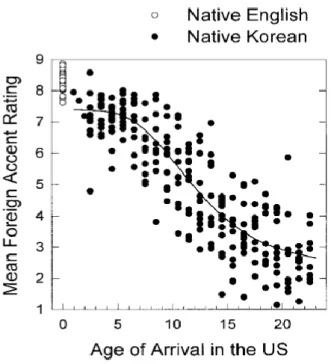
Figure 9. Mean Foreign Accent obtained from Native English and Native Korean (Flege, Yeni-Komshian, & Liu, 1999, p. 85) ... 26
Figure 10. Postulates and hypothesis from Flege's Speech Learning Model (Strange, 1995, p. 239) ... 31
Figure 11. The compared results from Flege and Eefting's study (1987) ... 33
Figure 12. Examples of the images used for the first production test. ... 45
Figure 13. Print screen of the discrimination task. ... 50
Figure 14. Print screen of the identification task. ... 51
Figure 15. Soundwave provided by Praat of the sentence <I say heart> ... 53
Figure 16. Soundwave provided by Praat of the sentence <I say art> ... 53
Figure 17. Mean percentage of accurate productions in P1 and P2... 61
Figure 18. Mean percentages scores of P1. ... 62
Figure 19. Mean percentages scores obtained in P2... 63
Figure 20. Mean percentage of incorrect productions in P1 and P2. ... 64
Figure 21. Mean percentage scores obtained in the ID task. ... 66
Figure 22. Mean percentage scores obtained in the DISC task. ... 67
Figure 23. Total global scores of the Perception test. ... 67
xix
List of tables
Table 1. Background information of the native English speakers ... 42
Table 2. Examples of minimal pairs used in the discrimination test ... 47
Table 3. Example of change and catch trials used in the experiment ... 48
Table 4. Organization of the data collected from the first production exercise (words that have the target phoneme in word-initial position) ... 54
Table 5. Organization of the data of production test 1 (words beginning with vowels) ... 54
Table 6. Organization of the data collected from the second production exercise (story) ... 55
Table 7. Organization of the results of the discrimination test (trials without /h/) ... 56
Table 8. Organization of the results of the discrimination test (trials with /h/) ... 56
Table 9. Organization of the results of the perception test ... 57
Table 10. T tests results of the mean correct percentage from the Production task (/h/ in word-initial position) ... 60
Table 11. T tests results of the mean percentage of incorrect productions in the Production task (words with /h/ in initial position). ... 64
Table 12. T tests results of the Perception test ... 65
1
INTRODUCTION
It comes as no surprise that English is nowadays considered a universal language and one of the most spoken languages worldwide. Due to globalisation, i.e., the social and economic growth of countries, the notions of multiculturalism and melting pot have become strongly present in our lives and, consequently, English functions as the bridge of linguistic communications between different people, communities and cultures. By living in a world without boundaries, i.e. a global world where you can travel to, and work or study in any country, the acquisition of a second language (L2) becomes extremely important, especially when that language is English.
Nowadays, in Portugal, we are all exposed, indirectly but very frequently, to the English language mainly through the media (Internet, television, radio, films, among others). This amount of exposure to English helps people improve their language skills and facilitates communication, even if speakers’ native language (L1), i.e. Portuguese, is not shared (Rubio & Lirola, 2010). Nevertheless, in the professional world, having a certificate that attests one’s ability to speak, read, listen and write in English is essential. Although some other languages such as Spanish and Mandarin have the highest number of speakers worldwide, and are becoming important as far as technology is concerned (Godenzzi, 2006; Pak, 2012) , English still keeps its significant status as lingua franca.
In the Portuguese national curriculum, English was officially introduced in 2012 in the curriculum of the junior school (i.e. 5th grade of basic education) with an emphasis on oral
production. Its introduction in the curriculum of elementary school was optional, that is, the school could decide according to its resources, as stated in the Decree-law n.º 139/20121, article
n.º9, line 1:
1 – As escolas do 1.º ciclo podem, de acordo com os recursos disponíveis, proporcionar a iniciação da língua inglesa, com ênfase na sua expressão oral.
In this sense, in 2012, English classes were taught in primary schools as an extra-curricular subject. The main goal was, and still is, to increase the amount of exposure to the
2
lingua franca and, as a result, improve students’ communication skills. As Strecht-Ribeiro explains, “the main objective of modern language teaching is clearly one of communication, that is to say, socialisation, or the interaction between individuals within a social context” (Strecht-Ribeiro, 2005, p. 34).
The implementation of English language learning in the first years of school has come as a result of the partnership between the British Council Portugal and the Portuguese Direcção-Geral da Educação (DGE) in order to promote a sense of a multicultural Europe as well as promote mobility, employment and understanding between nations. Throughout the years, the number of children enrolled in English classes rose significantly in primary schools. Due to this fact, in 2014 DGE stated that, according to article N.º9, line 1 of the Decree-law n.º 176/2014,
“A disciplina de Inglês inicia-se, obrigatoriamente, no 3.º ano de escolaridade e prolonga-se nos 2.º e 3.º ciclos, num total de sete anos, com o regime de progressão e tr4ansição fixado por despacho normativo do membro do Governo responsável pela área de educação”
Since 2014, English classes have been included in the national curriculum and become compulsory for every child at the age of 7/8 years (which, in Portugal, corresponds to the 3rd
grade of primary school). Being the first Foreign Language (FL) that children are exposed to, it is expected that by the time they become adults they will acquire an independent level of proficiency and be better prepared for a steadier, stronger and omnipresent phenomenon of globalisation and multiculturalism. In Report on Rethinking Education (2013) the European Parliament argued that learning a Foreign Language in the early years is, in fact, more effective than in later years:
…poor language skills constitute a major obstacle to the free movement of workers and to the international competitiveness of enterprises in the Union,(…) language learning is deemed to be much more effective at an early age” (Neveďalová, 2013, p. 7)
The contents of FL classes focus on the amount of vocabulary a person acquires as well as on the three most important foundations of a nation: literature, culture and language (CEFR, 2001, p. 56, 135). These areas may improve people’s writing, speaking and reading skills as well as listening and, therefore, develop a better fluency and ease when using the language. In order to guarantee a certain level of consistency in Europe regarding the teaching of foreign languages and the proficiency levels, the European Council introduced the Common European
3
Framework of Reference for languages (CEFR) in 2001 so that it would help Europe reinforce social cohesion, intercultural dialogue, European identity and citizenship, employment and mobility between countries.
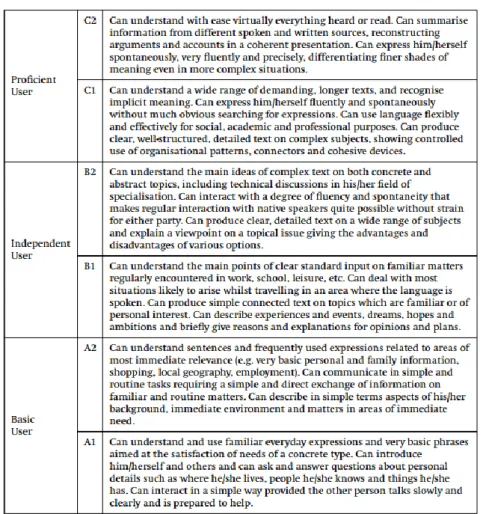
In the CEFR, the Council defined six levels of language proficiency: elementary user (A1 and A2), independent user (B1 and B2), advanced and proficient user (C1 and C2). As we can see in Figure 1, the learning outcomes for each level are succinctly described.
Figure 1. Levels of proficiency of Foreign Languages (Common European Framework of Reference for Languages: Learning, Teaching, Assessment (CEFR), 2001, p. 24)
As aforementioned, the CEFR emphasizes the importance of facilitating communication and focuses on the learning outcomes the learner must accomplish for each level of proficiency. Therefore, as stated by DGE in Portaria n.º 260-A/2014, at the end-state of compulsory learning,
4
i.e. high school (Lei n.º 85/2009, Artigo 1.º e 2.º)2, students are expected to acquire a B2+ level
of proficiency in English3. For this reason, it is expected that a native Portuguese speaker will be
able to interact socially in the FL, i.e. be an independent user, able to interact with others more easily than before, in familiar contexts as well as in non-familiar ones (e.g. the student’s presence in a foreign country). According to the Framework, not only do the learning goals focus on linguistic skills, but they also include pragmatic and sociolinguistic competences, the latter being broadly referred to as communicative language competences:
Linguistic competences include lexical, phonological, syntactical knowledge and skills and other dimensions of language as a system, independently of the sociolinguistic value of its variations and the pragmatic functions of its realisations. (2001, p. 13)
In this sense, the linguistic competences that an individual must acquire in the FL include the main linguistic domains. Regarding the phonological competence (2001, p. 116), it is subdivided into three areas (Moyer, 2013):
Phonemes and allophones: the basic unit of speech and their phonetic realizations in different contexts (for example, the same English phoneme, /t/, can have different allophonic realizations depending on the context, [t] and [tʰ] as in <steam> and <team>, respectively);
Syllable structure and the language-specific phonotactics;
Prosody: stress, segment length, intonation, rhythm, pitch and speech rate;
In order to successfully perceive and produce the FL speech sounds, the learner has not only to learn how to recognize the contrastive features of the segments but also their allophonic realizations, the language-specific phonotactic constraints, and many suprasegmental features.
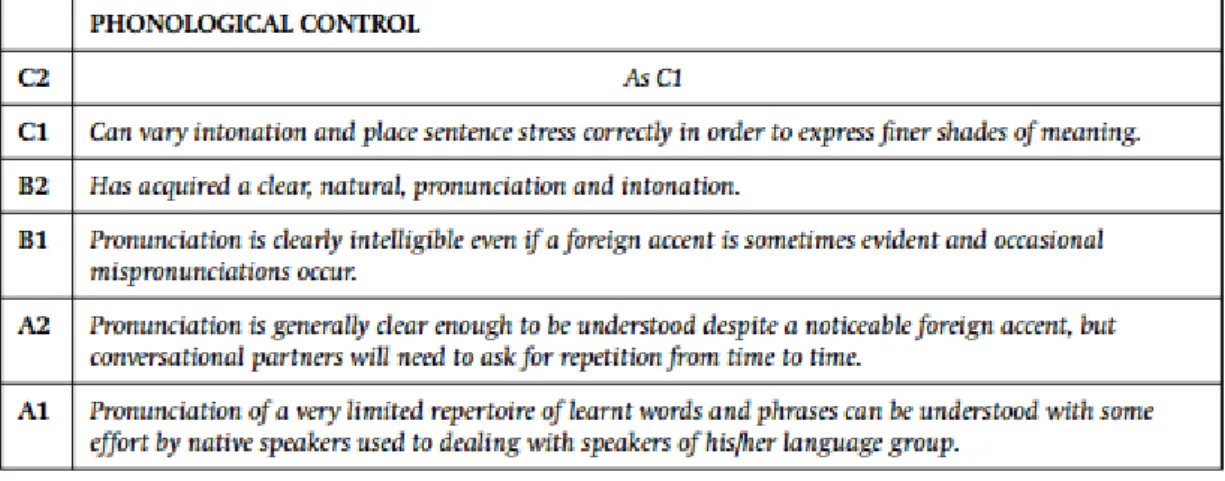
Similarly to the objectives stated for each level of proficiency in the CEFR, the learner is expected to achieve specific goals for each level as far as phonological competence is concerned. For example, a person who is enrolled in English classes, acquiring the A2 level does not have the same phonological competence as someone who is studying B2 and is not even expected to
2 Diário da República, 1.ª série – N.º166 – 27 de agosto de 2009. 3Diário da República, 1.ª série – N.º 241 – 15 de dezembro de 2014.
5
have by the time A2 classes are finished. As the level increases, the objectives become more demanding (see Figure 2).
Figure 2. Description of phonological skills a learner must accomplish (2001, p. 115)
There is a clear emphasis on the notions of pronunciation, foreign accent, intelligibility, fluency and the presence (thus, comparison) of two phonological systems. These are notions, and occurrences, that may automatically distinguish those who are native speakers of English from the ones who are not and the presence of a foreign accent is one of the most important signs that give away a person’s non-native origin. Let us focus on two specific linguistic systems: Portuguese and English. A great majority of children, who were born in Portugal, have the L1 phonological system almost complete at the age of 4/5 years old (Sim-Sim, 1998; Sim-Sim et al., 2008) and two years later, they are enrolled in English classes. In this sense, European Portuguese is their L1 and English becomes their L24. Although these two phonological systems
have some differences, they also share some similarities in certain sounds (Azevedo, 1981). For example /f/, /v/ and /ɛ/, people are somehow familiar to certain phonemes which makes the process of the acquisition of these English sounds easier (1981, p. 57). On the other hand, the “new” phonemes, i.e. those sounds which do not exist in the L1 phonological system, are difficult for natives to produce (Escudero, 2005) which may result in a foreign accented speech.
In order to clarify the influence of the L1 phonological system in the process of L2 acquisition, as well as the “new” and “similar” concepts here used, in 1986 Flege carried out a
4 In this case, L2 is being used with a broader meaning that includes both learning contexts/ environments. Thus, L2 and FL are used
6
study to investigate “the extent to which L2 learners approximate the phonetic norms of an L2 for “new” and “similar” phones” (Flege, 1987, p. 48). In the study, the author defines “new” phones as the ones which do not have a counterpart in the L1 (e.g. the English /h/ does not exist in the Portuguese phonological system) and “similar” phones are those present in both phonological systems but whose production may vary depending on the context. In this sense, Flege explains that L2 learners categorize L2 phones by the process of equivalence qualification, i.e. L2 phones are classified according to the knowledge of the L1 categories.
“It is commonly accepted that L2 learners “identify” L2 phones in terms of native language (L1) categories and, as a result, use articulatory patterns established during L1 acquisition to realize those L2 phones” (ibid)
In the study, Flege divided the subjects into six groups of 42 women, who were divided into 6 groups (7 subjects in each group), differing in previous linguistic experience: 14 were Native French (7 monolingual and 7 bilingual subjects) and the remaining 28 were Native English (7 monolingual and 21 bilingual subjects). The groups were tested on the production of specific, similar L2 phones (/u/ and /t/ in both languages) and a new L2 phone (French realization of /y/ for the native English). The results supported Flege and Hillenbrand’s hypothesis (1984) that L2 phones are, in fact, compared with and, thus, mapped onto L1 categories but only to a certain extent. L2 learners do assimilate L2 phones to established L1 categories but they are also able to acquire new L2 phones successfully, depending on the quantity and quality of input that a learner is exposed to. The study’s results also showed that on the one hand, the new phone is most likely to be produced in its phonetic norm once acquired and, on the other hand, a similar phone may be interchangeably produced either as L1 and L2 categories.
(…) adults are capable of learning to produce new phones in an L2, and of modifying their previously established patterns of articulation when producing similar L2 phones. It appears that the mechanism of equivalence classification leads them to identify acoustically different phones in L1 and L2 as belonging to the same category. This ultimately may prevent them from producing similar but now new phones authentically. (Flege J. E., 1987, p. 62)
As non-native speakers tend to diverge from the phonetic norms of English, they are easily recognizable by the presence of a foreign accent. It is through the foreign accent that a set of personal characteristics such as our language and social background are transmitted to the others. Moyer (2013, p. 10) explains that accent “provides clues about our age, gender, regional
7
background, level of education, and even social class”. Nonetheless, most people are able to change their speech in different environments in order to be respected and/or claim their status (Giles et al., 1991; 2007).
“When speaking with others, we continually adjust our pronunciation and alter our prosody in order to clarify meaning, punctuate important points, and signal distance vs. affiliation. In other words, we use accent to position ourselves vis-à-vis others. Thus, accent is a fluid, contextualized expression of our personal and social identity as well as our communicative stance” (2013, p. 10)
Broadly speaking, accent and pronunciation are regarded as equivalent terms but for the present study it is important to clarify the distinctions. Due to its variability, accent is not easily defined but, when contrasting to pronunciation, it represents a dynamic feature of fluency (Moyer, 2013). As noted, accent gives automatic knowledge of our personal, social and educational background but it also refers to the linguistic characteristics that differentiate the semantics and pragmatics of our speech. These include how we produce a set of segments, i.e. the way we articulate sounds, as well as suprasegmental features. In sum, Moyer defines accent as “a set of dynamic segmental and suprasegmental habits that convey linguistic meaning along with social and situational affiliation” (Moyer, 2013, p. 11). On the other hand, according to the author, pronunciation refers to “the place and position of speech organs (tongue, lips, teeth, uvula, larynx, nasal cavity, etc) when producing specific speech sounds” (Ibid, p. 10).
Throughout the years, people tend to judge the other in an automatic way, though unconsciously. How we speak and, most importantly, our accent becomes one of the primary means by which we are judged and not only does it affect our linguistic competence but it also affects how the other regards us. These can include our position towards the other, difficulty to establish a trustworthy relationship and worth, thus our status is compromised.
Native or non-native, the presence of an accent is inevitable; however, a heavy foreign accent may have a negative impact (Lippi-Green, 1997; Derwing & Munro, 2009; Lev-Ari, Shiri, & Keysar, 2010) on how L2 learners are perceived. Several studies were carried out in order to describe some of the effects of this phenomenon (Lambert et al. 1960; Lane, 1963; Giles, 1970; Gumperz, 1982; Fayer and Krasinski 1987; Holden & Hogan 1993) and explain the reasons behind the presence of a foreign accent (Sapon 1952; Penfield, 1965; Lenneberg 1967; McLaughlin 1977; Flege 1992a). Accordingly, a few models have been proposed in order to
8
explain the main difficulties L2 learners have when acquiring an L2 phonological system. One of the most widely cited theoretical models in L2 speech acquisition is Flege’s Speech Learning Model (SLM, 1995) which will be further described in Chapter 1.
Several factors have a strong influence on the L2 learner’s ability to acquire/ learn the L2 phonological system and have been studied by L2 speech researchers, including age of onset acquisition (Flege & Fletcher, 1992; Singleton & Lengyel, 1995; Flege et al., 1995b; Bongaerts et al., 1997; Piske, 2001, 2007; Piske, MacKay, & Flege, 2001; Flege & MacKay, 2004), quality and quantity of L2 input (Flege & Liu, 2001; Jia, Strange, Wu, & Collado, 2006), L1 and L2 usage (Flege & Nozawa, 1997; Flege, 1999; Piske, MacKay, & Meador, 2002; Flege, Schirru, & MacKay, 2003), among others. One of the aspects that have been widely investigated in L2 speech research is the link between the age at which people start acquiring/learning an L2 and their phonological competence throughout the years. Generally speaking, studies have demonstrated that the earlier a person starts learning an L2, the more native-like their speech will be. This does not mean that a late learner is not able to acquire such a native-like pronunciation but in most cases a foreign accent may be still detectable in their speech.
“late” second language learners – those who acquire a language after early childhood – typically show different patterns of L2 perception and production than “early” learners. As a result, “late” second language users are often readily identified because they typically speak with a foreign accent. (Munro & Bohn, 2007, p. 7)
By learning an L2 at an early age, the amount of exposure to the language is higher and the phonetic and phonological properties of the L2 are most likely to be perfectly perceived and produced in later years. As noted by Piske, in Munro & Bohn (2007, p. 302) there are some interesting similarities between learning an L2 in a classroom environment and being an immigrant where the majority/dominant language is the L2. The author claims that “immigrant L2 learners and students in a foreign language classroom may learn an L2 under the same conditions” (ibid) which include AOL (early vs. late learners) and exposure to an L2, as explained next.
Not only FL learners may be exposed to inaccurate pronunciations from their classmates (and teachers) but also L2 learners may spend most of their time with non-native speakers of the L2 and may therefore be exposed to a substantial amount of foreign-accented speech. Similarly, some immigrants may not use the L2 frequently, despite living in the L2-speaking country for
9
many years; the same occurs with FL learners, depending on the teaching approach in the FL classroom (immersion programs, traditional grammar-translation approach) and the role of explicit instruction, namely the phonetics/phonology of the target language.
As far as differences are concerned, in the same study, Piske mentions that L2 learners learn/acquire the language in a country where the L2 is the predominant language, whereas FL learners learn the language where the L1 is the predominant language, i.e. they are not living in an L2-speaking country. Additionally, there is also the different exposure of input: L2 learners (immigrants) are exposed to a larger quantity of high-quality input (native-like input) and use the L2 more frequently than FL learners.
As the frequent usage of the L2 will certainly help learners to improve their language skills, the recurrent usage of their native language also has an influence on the FL. Flege and colleagues have analyzed the importance of factors that influence the learning of L2 speech and have investigated both subject and phonetic variables affecting bilinguals' production and perception of L2 consonants and vowels (e.g., Flege et al., 1995b; Flege et al., 1997; Piske et al., 2001; Flege, Piske and MacKay, 2002) and their findings reveal that foreign accent also results from the frequent usage of the L1, that is, “ultimate attainment in the pronunciation of an L2 is not only dependent on AOL, but also on language use patterns” (Munro & Bohn, 2007, p. 305). It is advisable, then, to create settings where the L2 learner can use the L2 more frequently, e.g.: adult L2 learners who enrol in English classes should speak in English throughout the class and make an effort to use it as much as possible in other English-speaking environments. According to a few studies, formal instruction may also have an effect in L2 speech learning. For example, Flege and his colleagues carried out studies on the effect of EFL formal instruction on foreign accent (Flege et al., 1995, Flege et al., 1999) and the results showed that formal instruction helps learners improve L2 pronunciation accuracy, particularly if it includes phonetic training (Piske T. , 2007).
Moreover, Piske (2007) adds that “students in a foreign language classroom should particularly benefit from learning environments in which they receive a substantial amount of high-quality input over a period of many years” and for this reason, it is important to study the effects of formal instruction on L2 learners’ phonological development. On the one hand, children are exposed to the L2 from an early age, benefiting from several years of formal instruction in which the use of the L2 is expected to be more frequent and the accent more native-like. On the
10
other hand, adults who do not spend as much time in the L2 classroom as children do are most likely to use the L2 in classes as well as in the workplace, but not at home.
As far immigrants are concerned, the amount of high quality and quantity exposure they receive can improve the learner’s phonological competences in the L2. Moreover, when immersed in a classroom environment and subjected to start learning an L2 at an early age, it is most likely that these L2 learners will be proficient learners. In order to investigate this, Flege and Liu (2001) conducted a study to test if there was a connection between AOL and formal instruction and their results supported the idea that formal instruction has an important role when acquiring an L2 phonological system and this is most seen in early bilinguals rather than late bilinguals as they are immersed in L2 environments from childhood. Therefore, the study of L2 acquisition not only involves the study of language itself (e.g. grammar) but also other fields such as education and psychology (Munro & Bohn, 2007).
Research has focused on the challenges that L2 learners face due to processes of interference and transference between the L1 and L2 phonological systems of learners and for this reason, Munro and Bohn defend that “the objects of study in L2 speech research must include not only speech sounds, but L2 learners themselves” (2007, p. 4) ESL has been the main topic of research and various studies have proven to be of great help to the understanding of speech production and perception of non-native speakers of English (Bohn and Flege, 1990; Flege, Munro and Fox, 1994; Flege, MacKay, and Meador, 1999; Rato, 2013).
Regarding native Portuguese learners of English as a Foreign Language (EFL), one of the most difficult phonemes to produce is the voiceless glottal fricative /h/ (Osborne, 2015). As abovementioned, the feature “aspiration” does not exist in the Portuguese phonological system (Azevedo, 1981, p. 72) which normally results in two common errors for the native speakers of Romance languages: the omission of the sound in English words such as <house> and <holidays> and/or the insertion of /h/ where it does not exist (e.g.: I [h]ate apples) (John & Cardoso, 2007). Thus, the speaker is easily recognized by his/her foreign accent and in this particular case, communication may be broken due to the misproduction of the English phoneme and his/her speech intelligibility may be compromised. Even though there have not been many studies investigating the learning of this non-native by L2 learners, Gonzalo-Llera (2011) and John and Cardoso (2007) showed that this difference in pronunciation also occurs in other Romance languages such as Spanish and French, respectively.
11
The present study aims at investigating the production and perception of this “new” phonetic category as far as native Portuguese speakers of English are concerned. In the light of James Emil Flege’s Speech Learning Model, the specific objectives of this research are the following: 1) examine whether Portuguese EFL advanced learners are able to perceive accurately a "new" L2 phonetic category; 2) investigate whether these learners produce the English phoneme /h/ correctly, namely in word initial and medial positions; 3) analyse if there exists an effect of elicitation technique (word reading vs. picture story description) on the production of the target phoneme; 4) study these FL learners’ ability to discriminate and identify the target phoneme accurately and 5) verify if there is a link between the production and perception abilities of Portuguese learners in the acquisition/learning of the target phoneme.
According to Piske, Mackay and Flege (2001), and Piske (2007) the factors that most affect L2 pronunciation are AOL (Age of learning) and L2 use. Other factors, such as L1 background, and quantity and quality of L2 input are also strong predictors of a foreign accent. Following the research carried out by John and Cardoso (2007), the authors state that the insertion of /h/ occurs mostly “in stressed syllables, with a preceding pause or vowel, with /h/ in proximity, and in more formal speech” (2007, p. 265) and /h/ omission happens as a consequence of the non-representation of the phoneme to an L1 category. As far as perception is concerned, learners are expected to notice the realization of the sound, having little difficulty in discriminating (i.e. distinguishing) as well as identifying (i.e. labelling) it. Nonetheless, it is predicted that the participants of the experiment will have more difficulty in producing the /h/ sound than perceiving it, as the Portuguese language has its representation orthographically but no phonological representation.
The present dissertation is structured in the following way:
Chapter 1 briefly describes the mechanisms of speech production and perception, as well as the interface between the two linguistic domains of speech acquisition, and explains the processes of transference and interference between the L1 and the L2. In addition, the first chapter of the dissertation also includes an articulatory description of the English glottal fricative (/h/), and a summary of the mains patterns of misproduction of the target sound.
12
The method of the experimental study is described in Chapter 2. This section includes the research questions and hypotheses, information about the participants, the production and perception tasks and the procedures of data collection and analysis.
Chapter 3 presents the results of the data analysis in three sections. Firstly, the production results, secondly, the perception data and, thirdly, the comparison between the production and perception data. Finally, it provides a discussion of the findings in light of the theoretical models of L2 speech acquisition.
13
CHAPTER 1
THEORETICAL FRAMEWORK
This chapter is concerned with the theoretical context related to the topic of the dissertation. Firstly, an explanation of the mechanisms related to speech acquisition will be given in order to familiarize and contextualize the reader with linguistic notions present throughout the study. These include descriptions of the production and perception mechanisms as well as the interface between these two speech domains. Nevertheless, we will focus on the two phonological systems this study is concerned with (English and Portuguese), giving a special attention to the processes of transference and interference between L1 and L2. Furthermore, a brief articulatory description of the phoneme /h/ is introduced followed by its realization as far as non-native speakers of English are concerned.
1.1 Second Language Speech Acquisition
Over the past few decades, second language acquisition has been one of the most studied themes in Linguistics, more specifically in the branch of Phonetics and Phonology. As bilingualism is becoming a worldwide phenomenon, the need to understand processes and mechanisms behind the acquisition of an L2 are receiving a lot of attention, especially when it comes to the way listeners receive the message and the way a message is conveyed. Flege defines speech learning as the process by which L2 learners come to “articulate or perceive a speech sound differently after (as compared to before) massive exposure to a foreign language” (Munro & Bohn, 2007, p. 3). In other words, speech learning focuses on how a second language learner comes to produce or perceive, i.e. distinguish, the sounds of the L2 after he or she is exposed to the L2. By being in direct contact with the language, the learner will be able to better perceive and produce the L2 sounds.
The cognitive processes involved in acquiring a second language will automatically lead the EFL student to create a comparison between the two phonological systems. On the one hand, sounds which are acoustically similar to the L1 will be not as difficult to produce as what Flege defines as new sounds, i.e. sounds that differ acoustically from L1 categories. Though unconsciously, the FL student will engage in processes of transference and interference between
14
the two languages, which can either help or stop learners from producing the L2’s phonetic norms.
1.1.1 Speech Production
Speech production, or articulatory phonetics, is the study of how a speaker articulates the vocal tract’s structures in order to produce consonants and vowels of a language. This particular process is divided into three main phases: conceptualization, formulation and articulation (Levelt, 1989; Levelt, Roelofs, & Meyer, 1999). In the first phase, the speaker determines the message he/she is trying to convey, formulation involves the process of translating this abstract thought into a linguistic form while, last but not least, articulation refers to the anatomic processes that transform the conceptual representation into sounds. From the three cognitive processes mentioned, the third one (articulation) is the most important for the current part of the dissertation.
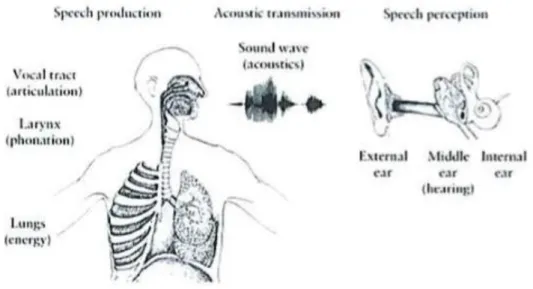
The study of articulatory phonetics explains how humans produce speech sounds by the transformation of air-flowing energy into acoustic energy. Figure 3 shows the mechanism of speech chain which is divided in three phases.
15
The first phase, speech production, shows that three physiological structures interact with each other in order to produce the sounds of a language. The lungs are the main source of energy that is needed so that phonation can occur in the larynx, which will then be articulated in the vocal tract.
Figure 4. The three physiological components in the process of speech perception (Liberman & Blumstein, 1998, p. 4)
In the lungs, the manner of the airstream mechanisms can be divided into two: egressive (air being pushed out) and ingressive (air being pushed in). Nevertheless, these manners can occur in three anatomic components of the speech chain: the lungs (pulmonic), when the glottis is closed (glottalic) and when the velum is closed (velaric). As far as English is concerned, a great majority of its sounds are produced by a pulmonic egressive airstream mechanism. In this sense, as far as speech production is concerned, the sounds of a language can be explained according to the manner of the airstream (either egressive or ingressive) and the initiator (pulmonic, glottalic and velaric).
Regarding speech production, the main role of the larynx is “to convert a relatively steady flow of air out from the lungs into a series of almost periodic, i.e. ‘quasi-periodic,’ puffs of air” (Liberman & Blumstein, 1998, p. 4). This transformation occurs at the glottis, either open or
16
closed, by the movement of the vocal cords inwards or outwards, producing a source of acoustic energy. In this sense, the vocal cords play an important role in determining whether a sound is voiced or voiceless, i.e. when vibration occurs or not when producing certain phonemes. If the vocal cords are close together, the airflow is obstructed causing vibration and voiced sounds occur. On the other hand, when the vocal folds are apart, the airstream coming out from the lungs passes freely though the larynx and voiceless sounds are produced.
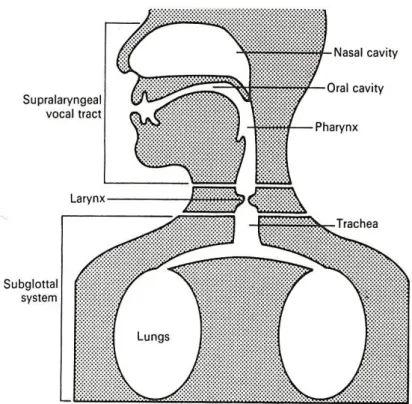
When the energy reaches the supraglottal system (the vocal tract), the sounds are modified and articulated in order to produce the target phoneme. The vocal tract can be divided into three components that function as tunnels where the airflow can pass and be articulated: the nose (nasal cavity), the mouth (oral cavity) and the pharynx. In this sense, the supralaryngeal vocal tract functions as a variable acoustic filter since the speaker modifies the shape of this system in order to produce speech. Hence, phonemes are described according to their manner and place of articulation which are the distinctive features that enable listeners to distinguish one sound from the other, as explained next.
Speech sounds are divided into two major classes: consonants (often abbreviated as C) and vowels (abbreviated as V). For the present study, we shall focus on the place and manner of articulation as far as consonants are concerned. As the vocal tract is the place where sounds are modified and shaped, its organs are responsible for the articulation of phonemes and thus they are called articulators which can be either active or passive. The articulators that move are called the active articulators (e.g.: tongue, velum and larynx) while the articulators which are fixed, i.e. those that do not move, are termed as passive articulators (e.g. teeth, alveolar ridge and the velum). Nevertheless, it is important to remark that certain articulators can be either passive or active (an example is the lips where the upper lip functions usually as the passive articulator while the lowers lip is normally the active articulator).
17 Figure 5. The vocal tract (Reetz & Jongman, 2009, p. 10)
Let us focus now on the different ways the vocal tract is shaped in order to produce speech and describe English consonants (Reetz & Jongman, 2009):
1. Bilabial sounds are produced by the touch of the upper and lower lip as is the case in the beginning of words such as <mouse>, <bicycle> and <pure>;
2. Labiodental consonants are those where the lower lip moves in order to touch the upper front teeth (e.g.: <fantastic> and <vulnerable>);
3. Dental: the initial sound in <those> and <thought> is produced when either the tip or blade of the tongue makes contact with the upper front teeth; 4. Alveolar sounds are shaped when either the tip or blade of the tongue
touches the alveolar ridge, producing the initial sound in words such as <top>, <note> and <zapping>;
5. Retroflex is a sound that occurs when the tip of the tongue is raised towards the back of the alveolar ridge (e.g.: <right>);
18
6. Examples of postalveolar consonants include <shine>, <chocolate> and <juice>. They are articulated by the movement of the tip or blade of the tongue towards the back of the alveolar ridge;
7. Palatal: the front of the tongue and the hard palate come together as in <youth>;
8. Velar sounds are produced when the back of the tongue makes contact with the velum (e.g.: <costume>, <great> and <long>;
9. When the vocal folds are separated and the glottis open, a glottal sound is articulated and the English /h/ is the only one that possesses this distinctive feature (e.g.: <horoscope>).
Nevertheless, if one wishes to describe the complete features of speech sounds, one should also refer to the obstruction of the vocal tract, i.e. the manner of articulation. These distinguishable features occurring in the vocal tract are the following (Ibid):
1. Stops (also known as plosives) are sounds in which the articulators come together so that the airstream is blocked or constrained. When the velum is raised, both nasal and oral cavities are closed. Nevertheless, due to the pressure in the mouth, the air is forced to explode in a small outburst as in the initial sound of the following words: <brilliant>, <tangle> and <kitchen>; 2. Nasal sounds occur when the air tries to escape through the oral cavity but
since the velum is lowered, the cavity is obstructed. Thus the airflow is forced to pass through the nasal cavity and nasal sounds are produced (e.g.: <must>, <night> and <song>;
3. Fricatives are produced when the air is forced to go through a narrow passage which is created when two articulators come close together. Even though there is no complete obstruction, the pulmonic air is forced through the passage, leading to the production of hissing sounds (e.g.: <fight>, <thorough> and <ice>);
4. Affricate sounds are produced when a stop is immediately followed by a fricative, as it happens in <change> and <knowledge>;
5. Approximants: because its characteristics include those present in consonants and vowels, approximants can also be referred to as
semi-19
vowels. Due to the fact that the air flow is slightly obstructed, approximants occur when one articulator approaches the other but not close enough to cause friction (e.g.: <wine> and <young>). In these two examples, the airflow escapes through the middle section of the oral cavity and this is why they are called central approximants. On the other hand, in the initial sound in <light>, the air passes freely through the sides of the oral cavity (lateral approximants).
In sum, the production of English consonants can be distinguished according to their phonation (voiced and voiceless sounds), place of articulation (bilabial, labiodental, dental, alveolar, postalveolar, palatal, velar and glottal) and manner of articulation (stops, nasal, affricate, fricative, lateral approximant and approximant). Figure 6 summarizes the place and manner of articulation of English consonants.
Figure 6. Place and manner of articulation of English consonants (Azevedo, 1981, p. 72)
As aforementioned, native Portuguese who are speakers of English find certain sounds difficult to produce at first (e.g.: /h/ is often not produced by native Portuguese). Conversely, there are other phonemes present in both phonological systems as is the case of /s/ and /k/. For this reason, it is important to compare the English phonological system to the European Portuguese (EP) one.
The European Portuguese phonological system consists of 24 phonemes for consonants. Most of these phonemes are also present in English but its production can depend on context as
20
well as the size of an individual’s vocal tract. The following table presents the place and manner of articulation of consonants in the European Portuguese system.
Figure 7. Place and Manner of articulation of European Portuguese Consonants (Barroso, 1999, p. 104)
However, there are some phonemes which do not occur in one of the languages (see Figure 8). For example, the English dental fricative /θ/ and glottal fricative /h/ are not present in figure 7 which means that these two sounds will be regarded as non-native for Portuguese people. In this sense, as far as production is concerned, it is expected that speakers who have EP as their L1 and English as their L2 will have more difficulty in articulating the non-native sounds as they do not know how to articulate them. The following figure provides information on what sounds are present in both languages as well as the ones that only occur in English.
21
Figure 8. Place and Manner of articulation of English and Portuguese consonants (Azevedo, 1981, p. 72)
A native Portuguese is expected to have little difficulty in producing sounds which are present in both phonological. For example, NPSs (native Portuguese speakers) are not expected to have difficulties in producing the English /p/ due to the fact that they have already acquired the articulatory knowledge to produce that sound in their L1. On the other hand, sounds not found in the L1 inventory (e.g.: the English fricatives /ɵ/ and /ð/) are expected to be phonetically realized with a certain difficulty since NPSs lack the knowledge on how to shape their vocal tract in order to realize those sounds.
Having covered the main processes on L1 and L2 speech production, the following section focuses on speech perception and the processes as well as mechanisms behind this speech domain.
22
1.1.2 Speech perception
Speech perception, or auditory phonetics, tries to explain how listeners make sense of the sounds they hear, how they discriminate and identify the phonemes present in the phonological system of a language in order to understand what is being said. In order to do so, the sounds being articulated by the speaker are transformed into acoustic signals (sound waves) followed by the conversion of these signals into a set of discrete units by the hearer (Reetz & Jongman, 2009). As these articulatory gestures are then transformed into acoustic patterns, pragmatics, semantics and syntax are some of the linguistic fields of study that can affect how a message is perceived. At the acoustic level, speech signals are continuous but as far as perception is concerned, they are composed by “individual phonemic segments, that is, vowels and consonants” (Rato, 2013). As Reetz and Jongman explain, “the speech signal can rarely be segmented in a way that corresponds to perceived individual phonetic units” (Reetz & Jongman, 2009, p. 251), thus the acoustic signals are characterized by their non-linearity with human perception.
Researchers have developed several topics in order to explain how hearers interpret acoustic signals as speech sounds. Some examples include The Motor Theory of Speech Perception and Categorical Perception.
The Motor Theory of Speech (1985) defends that speech is perceived when the listener observes the speech sounds being articulated by the speaker.
The objects of speech perception are the intended phonetic gestures of the speaker, represented in the brain as invariant motor commands that call for movements of the articulators through certain linguistically significant configurations. (Liberman & Mattingly, 1985, p. 2)
The authors state a difference between “the gestural events” and the “attributes of the gestural events”. The former are concerned with the physical authenticity of each sound while the latter involve the features we attribute to it (e.g.: [n] is the physical reality of the sound while nasal alveolar are its distinctive features). As the processes behind the production of speech are influenced by gestures represented in the speaker’s brain, its perception is then influenced by the movement of the articulators. These acoustic signals are automatically converted into a phonetic gesture and it is the latter that the listener perceives.
23
Following this perspective, the authors reach the conclusion that speech production and perception are directly linked since “perception of the gestures occurs in a specialized mode (…) responsible also for the production of phonetic structures” (Ibid, 3). Furthermore, this link “is innately specified” and systematic “because it results from lawful dependencies among gestures, articulator movements, vocal-tract shapes and signals” (Ibid, 6). These are the main statements provided by the Motor Theory, which will be explained in more detail next. Firstly, we will focus on the object of speech perception followed by a description of the link between the speech domains and their interrelation.
The Motor Theory states that “phonetic perception is perception of gesture” (Ibid, 21) which is “based on evidence that the invariant source of the phonetic percept is somewhere in the processes by which the sounds of speech are produced” (Ibidem). In other words, the production of any speech sound is based on its distinctive and fixed properties, automatically configured in the vocal tract. For example, in order to produce the first sound in <mouse>, a labial sound is produced which is characterized by the upper and lower lips touching each other and the airflow escaping through the nasal cavity. In sum, as far as the Motor Theory is concerned, these invariant properties are the objects of speech perception which “correspond to the speaker’s intentions” (Ibid, 23).
Given the connection between gestures and acoustic signals, an interrelation between speech production and perception becomes obvious. As aforementioned, production and perception share an inherent link, meaning that every human is able to perceive speech as well as to produce it. Even though infants do not ascribe any linguistic meaning to what they hear, they are able to perceive sounds (Best, McRoberts, & Sithole, 1987; Eimas et al., 1971; Eimas, 1974). Furthermore, the authors explain that every human perceives phonetic gestures but the recognition and categorization of significantly phonetic gestures is different in infants and adults.
Perception of the phonetic categories can properly be generalized only if the acoustic patterns are taken for what they really are: information about the underlying gestures. No matter that the child sometimes mistakes the phonological significance of the gesture, so long as that which he perceives captures the systematic nature of its relation to the sound; the phonology will come in due course. (Liberman & Mattingly, 1985, p. 25)
24
This interrelation between production and perception is special because it only occurs in speech. In addition, it is characterized as systematic “by virtue of a model of the vocal tract that embodies the relation between gestural properties and acoustic information” (Ibid, 29). The perception of these gestures occurs in a specialized mode, as abovementioned, which is also responsible for the production of speech. Following this idea, the authors explain that speech perception occurs in a specific part of the brain, the “specialized neural architecture”, responsible for the performance of certain computations that will “provide central cognitive processes with representations of the objects or events belonging to a natural class that is ecologically significant for the organism” (Ibid, 27). In other words, the notion of specialized mode refers to the fact that speech perception is a specific linguistic domain that takes place in a certain part of the brain where the phonetic gestures are represented, enabling the listener to understand the information provided by the articulation of those gestures.
In sum, the Motor Theory provided and revised by Liberman and Mattingly (1985), states that the object of study for speech perception is to be found in the phonetic gestures the speaker articulates. Nevertheless, the listener is able to perceive those phonetic gestures rather than the acoustic signals, meaning that speech perception and speech production are intertwined and one cannot occur without the other. This link is innate, meaning that all humans are able to perceive speech due to the fact that it occurs in a specialized neural architecture. In this sense, the neuromotor commands found in this area are responsible for the representation of the phonetic gestures, thus the listener is able to perceive speech.
The second theory, Categorical Perception, holds that stimuli are organized in categories rather than in labels. The hypothesis states that “stimuli, equally spaced along some physical continuum, are perceived as belonging to one or another perceptual category instead of varying as a function of their physical values” (Reetz & Jongman, 2009, p. 265). In the same book, Reetz and Jongman describe an experiment that focused on the identification and discrimination of two categories (/dɑ/ and /tɑ/) in order to test this theory. The stimuli were presented in a random manner and the results showed that the variation from one category to the other was “abrupt or categorical” (Ibid: 266) in the identification test. As the author had predicted, when “the two stimuli are difficult to distinguish, listeners will identify a given stimulus X half the time as A and half the time as B” (Ibid: 267) which the discrimination test proved. Given the results, the author concludes that, after all, “discrimination is indeed no better than identification” (ibid: 268). In
25
sum, the Categorical Perception theory claims that listeners perceive sounds when members of the same category rather than discrete units.
As far as SLA is concerned, several factors do have an influence on how learners perceive and then produce L2 sounds. These include age of learning, the amount of exposure as well as quality input that the learner receives. Such factors prove that every human is able to adapt to different language contexts and the more he/she is exposed to an L2, the greater his/her perception of L2 speech will be. Furthermore, some researchers argue that “the way in which listeners divide a continuum is determined by language-specific experience” (Reetz & Jongman, 2009, p. 275). However, in response to this experience, the L2 learner is expected to reorganize and adapt the cognitive structures responsible for the perception of L2 phonetic norms instead of L1. Thus, as Reetz and Jongman explain, “there is a high degree of plasticity in the perceptual system” (Ibidem) present both in adults and children. The notion of plasticity is linked to the Critical Period Hypothesis (1967) which we will explain in the following sub-chapters along with other theories.
1.1.3 Interface between production and perception
As aforesaid, speech production and perception share a direct link when it comes to the acquisition of any language. However, the nature of this link remains unclear. Some critics believe that the presence of a foreign accent is due to the inability to produce L2 sounds correctly, after a period has passed (Lenneberg, 1967) while others explain that incorrect perception of the L2 sounds leads to stronger foreign accents (Rochet, 1995)
Throughout the years, some studies have claimed that people are able to speak a language with undetectable foreign accent if and only if that same language is learned before puberty (Lenneberg, 1967). By extending this process to SLA (Johnson & Newport, 1989) the Critical Period Hypothesis (CPH) states that people are able to produce the phonetic norms of a language within a limit of age, from childhood until adolescence/ puberty (12 years old). After that time, as humans mature neurologically the ability to learn a language diminishes and, as a consequence, new phonetic norms cannot be learned perfectly. This means that as humans go through processes of neural maturation the notion of neural plasticity diminishes and, as an effect, so does the neural part responsible for articulatory representations. Thus, as far as this
26
model is concerned, it is expected that late learners (i.e., learners who are older than 12 years old) speak an L2 with a stronger foreign accent than early learners (i.e. learners who are 12 years old or younger). Even though the CPH model is consistent with the fact that the earlier someone acquires an L2, the more native-like their speech is (thus, the less noticeable their foreign accent will be) it does not explain the fact that there are some early L2 learners who speak English with a detectable foreign accent (Flege et al.,1995; 1999).
By applying the Critical Period Hypothesis on second language learners, Flege and his colleagues carried out some experiments in order to prove if there is, in fact, an age-related limit as far as L2 accent is concerned. In 1999, Flege and Liu conducted a study in order to examine the degree of foreign accent in Native Koreans who have English as their L2. These participants were immigrants in the United States who reached American soil between the ages of 2 to 23. Along with AOA (Age of arrival), the authors also took into consideration the usage of L1 and L2 by the participants as well as the amount of exposure to those same languages. The study focused on the production of English sentences by native Koreans being evaluated by Native English, as far as foreign accent is concerned, and the results showed that there is in fact a relation between AOA (or AOL as far as the significant amount of exposure is concerned) and foreign accent. In general terms, the results this study provides do show that AOL, along with language usage, influences the presence of a foreign accent, as we can see in Figure 9.
Figure 9. Mean Foreign Accent obtained from Native English and Native Korean (Flege, Yeni-Komshian, & Liu, 1999, p. 85)
27
However, the study also proved that not every single early learner is able to speak an L2 with undetectable foreign accent. As we can see in figure 6 there are also adult or late learners of English who were able to speak the L2 with foreign accent but not as strong as expected. Moreover, we can also see that there are early learners who do speak English with detectable foreign accent, contrarily to what the Critical Period Hypothesis states. Therefore, we can conclude that the presence of a foreign accent occurs not only in late learners, i.e. after a critical period has passed, but also in early learners. From this point of view, accented pronunciations are not to be completely explained by the inability to produce the phonetic norms of an L2 after puberty.
Even though production has been the main focus of L2 studies of foreign accent, some researchers argue that perception plays an important role as far as accent is concerned (Rochet, 1995). Generally speaking, the amount of exposure to an L2 functions as a positive influence on the production of L2 sounds as well as its perception (Flege & Liu, 2001; MacKay, Piske, Flege & Schirru, 2001). One important example that proves the crucial role of perception is related to the fact that L2 learners face some difficulties when producing L2 sounds that are not present in their L1’s phonological system. By processes of assimilation, L2 leaners tend to categorize L2 sounds to the most similar one found in the L1, leading to perceptive errors which often result in the misproduction of certain phonemes. As Rochet points out, “L2 phones that are not part of L2 learners’ L1 inventories are usually perceived as belonging to some L1 category” (1995, p. 392). In this sense, as far as Rochet is concerned, the ultimate attainment in L2 speech is to be analysed and observed by an orderly function between production and perception, i.e. improvements in perception will lead to improvements in production.
In order to understand the nature of the link between these two speech domains, Sheldon and Strange examined the relationship between production and perception. In their study (1982), the authors focused on the perception of the English /r/ and /l/ by Native Japanese who were learning English at the time they were tested. The results showed that participants found the phonemes more difficult to perceive rather than to produce. As the participants were enrolled in English classes, it is normal that their production was more accurate since their English education might teach them the articulatory norms to produce the sounds of the L2 (Flege, 1991). For this reason, Sheldon and Strange proved that perceptual difficulties may occur even if after production skills are acquired.