DOI: 10.9789/2175-5361.2019.v11i3.607-612 | Menezes HF, Ferreira RGS, Silva PCPO, et al. | ...
The Theoretical-Methodological Conceptions of Jonh
Thompson: Production Analysis and Its Contribution for
the Nursing Research Field
Concepções Teórico-Metodológicas de Jonh Thompson: Análise de Produções
e Contribuição para a Pesquisa em Enfermagem
Concepciones Teórico-Metodológicas de Jonh Thompson: Análisis de
Producciones y Contribución para La in Vestigación en Enfermeria
Harlon França de Menezes1*; Rosa Gomes dos Santos Ferreira2; Priscila Cristina Pereira de Oliveira da Silva3; Maria Manuela Vila Nova Cardoso4; Ann Mary Machado Tinoco Feitosa Rosas5; Emilia Jales Simões de Souza6
How to quote this article:
Menezes HF, Ferreira RGS, Silva PCPO, et al. The Theoretical-Methodological Conceptions of Jonh Thompson: Production Analysis and Its Contribution for the Nursing Research Field. Rev Fund Care Online.2019. Apr./ Jul.; 11(3):607-612. DOI: http://dx.doi.org/10.9789/2175-5361.2019.v11i3.607-612
ABSTRACT
Objective: The study’s purpose has been to identify academic productions, in the stricto sensu nursing programs, where Thompson’s reference is adopted, and also to discuss the Thompson’s theoretical-methodological conceptions and its contribution to both Nursing knowledge and practice. Methods: It is a descriptive study with a documentary basis, also reflexive, whose analysis consisted of theses/dissertations abstracts done by nurses in Brazil, which were related to Thompson’s theoretical-methodological conceptions.
Results: 17 productions were identified, 07 doctoral theses (41.17%), 10 masters’ dissertations (58.83%), with emphasis on the Escola de Enfermagem Anna Nery from the Universidade Federal do Rio de Janeiro. Conclusion: The nursing studies permeated by sociology can expand the view that a technique, an educational strategy, and a technology may emerge due to the social scenario, furthermore, the needs permeated by values and the dynamics between science and society. It is assumed to be important for both the scientific and nursing research scenario, understanding the inherent modifications of care that come from a critical-social reflexive product, which can be contemplated by adopting as the analysis guiding principle, then being seen as theorists immersed in the sociology trendline.
Descriptors: Nursing, Culture, Hermeneutics, Nursing Research, Postgraduate Nursing Education.
1 Nursing Graduate, MSc in Nursing by the Escola de Enfermagem Anna Nery (EEAN) from the UFRJ. Universidade Federal do Rio de
Janeiro (UFRJ), Brazil.
2 Nursing Graduate, MSc in Nursing by the Escola de Enfermagem Anna Nery (EEAN) from the UFRJ, PhD student at enrolled in the
Nursing Postgraduate Program at UFRJ, Coordinator of the Research Ethics Committee at UFRJ, Coordinator of the SIG Telenfermagem Mental Health Institute of Psychiatry at UFRJ. Universidade Federal do Rio de Janeiro (UFRJ), Brazil.
3 Nursing Graduate, MSc in Nursing by the Escola de Enfermagem Anna Nery (EEAN) from the UFRJ. Universidade Federal do Rio de
Janeiro (UFRJ), Brazil.
4 Nursing Graduate, PhD in Nursing, Adjunct Professor of the Methodology Department of the Escola de Enfermagem Anna Nery
(EEAN) from the UFRJ. Universidade Federal do Rio de Janeiro (UFRJ), Brazil.
5 Nursing Graduate, PhD in Nursing, Adjunct Professor of the Methodology Department of the Escola de Enfermagem Anna Nery
(EEAN) from the UFRJ. Universidade Federal do Rio de Janeiro (UFRJ), Brazil.
6 Nursing Graduate, MSc in Nursing by the Escola de Enfermagem Anna Nery (EEAN) from the UFRJ, Nurse of the Institute of Psychiatry
RESUMO
Objetivo: Identificar produções acadêmicas, nos programas stricto sensu de enfermagem, onde se adota referencial de Thompson e discutir concepções teórico-metodológicas e contribuição de Thompson para o conhecimento e prática da Enfermagem. Método: Estudo descritivo-documental, reflexivo, cuja análise constituiu-se por resumos de teses/dissertações por enfermeiros no Brasil, relacionadas às concepções teórico-metodológicas de Thompson. Resultados: Identificou-se 17 produções, 07 teses de doutorado (41,17%), 10 dissertações de mestrado acadêmico (58,83%), com destaque para a Escola de Enfermagem Anna Nery da Universidade Federal do Rio de Janeiro. Conclusão: Estudos de enfermagem permeados pela sociologia ampliam a visão de que uma técnica, uma estratégia educativa, uma tecnologia emergem em razão do cenário social, das necessidades permeadas por valores e da dinâmica existente entre ciência e sociedade. Acredita-se ser importante para o cenário cientifico e investigativo de enfermagem, compreender as modificações inerentes ao cuidar, advindas de um produto crítico-reflexivo social, que pode ser contemplado por adotarmos como norteador de análise, teóricos imersos no viés da sociologia.
Descriptores: Enfermagem, cultura, hermenêutica, pesquisa em enfermagem, educação de pós-graduação em enfermagem.
RESUMEN
Objetivo: Identificar producciones académicas, en los programas stricto sensu de enfermería, donde se adopta referencial de Thompson y discutir concepciones teórico-metodológicas y contribución de Thompson para el conocimiento y práctica de la Enfermería. Método: Estudio descriptivo-documental, reflexivo, cuyo análisis se constituyó por resúmenes de tesis / disertaciones por enfermeros en Brasil, relacionadas a las concepciones teórico-metodológicas de Thompson. Resultados: Se identificaron 17 producciones, 07 tesis de doctorado (41,17%), 10 disertaciones de maestría académica (58,83%), con destaque para la Escuela de Enfermería Anna Nery de la Universidad Federal de Río de Janeiro. Conclusión: Estudios de enfermería permeados por la sociología amplían la visión de que una técnica, una estrategia educativa, una tecnología emergen en razón del escenario social, de las necesidades impregnadas de valores y de la dinámica existente entre ciencia y sociedad. Se cree que es importante para el escenario científico e investigador de enfermería, comprender las modificaciones inherentes al cuidar, provenientes de un producto crítico-reflexivo social, que puede ser contemplado por adoptar como orientador de análisis, teóricos inmersos en el sesgo de la sociología.
Descriptores: Enfermería, Cultura, Hermenêutica, Investigación en Enfermería, Educación de Postgrado en Enfermería.
INTRODUCTION
Nursing research evolves in scope, pertinence and depth.1 Therefore, it is major to preserve, promote and
renew the scientific foundation of the discipline, before the dynamism of social needs, by research developed in the
stricto sensu graduate programs, considering the complexity
of health and the systems responsible for offering qualified services and actions, for the promotion of health, prevention and treatment of diseases.2
Moreover, it is fundamental to recognize that Nursing will always have the responsibility of developing, with exclusivity, studies on objects that are inherent to it, capable
of expanding its body of knowledge and ability to respond to old and new issues posed by its daily work life.2
Accordingly, reflecting on scientific methods and their rigors are indispensable for the development of nursing practice, as well as the ability to investigate, to question what is put simply, sometimes hidden in the tangles of relationships and processes that involve the human being.3
The incorporation of theoretical and methodological frameworks to contribute to scientific discussion is essential for obtaining a product of qualified research, which differentiates science from the empiricism.
Herein, we are able to mention several theoretical-methodological references used in nursing studies, but in this article, we emphasize the reference of the sociologist John Brookshire Thompson. Born on July 20th, 1951, British,
sociologist and professor at the University of Cambridge, brings as an object of study” the influence of media and ideology in the formation of modern societies.”
In his analysis, Thompson advocates a critical and reflexive idea about ideology through the realization that facts are the result of intersections and socio-historical constructions. The use of strategies that, in certain contexts, are conducive to producing, creating, instituting, sustaining and reproducing actions, gestures, and speeches (symbolic forms), bases the ideology presented in a certain social context, historical and temporal, passive evaluation, modification and reconstruction of the constituent elements.
He also mentions that what he calls “symbolic forms” are not ideological in themselves and depend on the socio-historical context in which they are inserted.4 Symbolic
forms are significant actions, objects, gestures, speeches and/or expressions of various kinds and cultural analysis is the “study of these symbolic forms in relation to historically specific and socially structured contexts and processes within which and through which these symbolic forms are produced, transmitted, and received.”5
Thompson proposes, in his Social Theory of Mass Communication, a differential analysis and construction of the term ideology, permeated by a relation that names “power and domination”, a result of socio-historical development that naturally leads to a definitive conception.6
For the author, to study ideology is to examine the ways in which meaning serves to sustain and establish relations of power and domination,5 but which are not watertight,
but asymmetric and because of this, dominate a certain context in their social-historical presentation.
Hence, through this theory, Thompson subsidizes nursing, the appreciation of objects of study that permeate the field of actions (symbolic forms), analyzing them as a result of a socio-historical product, bringing the possibility of the dialectical application to development of the materials, being configured as a theoretical and methodological reference in these researches.
The author also proposes, through Hermeneutics of Depth (methodological reference), the interpretation/ reinterpretation, relating contexts and elements, constructing a meaning to the symbolic form.
Given the aforementioned, we believe that the use of this theoretical-methodological framework in the field of nursing research is of immense importance and, thenceforth, the following goals of this article appear:
• Identifying the academic productions, in stricto sensu graduate programs, which were developed by nursing and adopted the Thompson’s reference; • Discussing the main theoretical-methodological
conceptions and Thompson’s contribution to the area of professional knowledge and practice in Nursing.
METHODS
It is a descriptive study with a documentary basis. The unit of analysis consisted of summaries of theses and dis-sertations published by nurses in Brazil, related to the theoretical-methodological conceptions of J. Thompson.
For the collection of data, a search was made on the website of the Centro de Estudos e Pesquisa em Enfermagem
(CEPEn) [Center for Studies and Research in Nursing] from
the Associação Brasileira de Enfermagem (ABEn) [Brazilian Nursing Association].
The data were collected in the CEPEn/ABEn Thesis and Dissertation Catalogs available online at: http://www. abennacional.org.br, link “CEPEn” - “Research Information and Researchers in Nursing - Catalog”, where it holds the productions developed in all nursing graduate programs in Brazil, recognized by the Coordenação de Aperfeiçoamento
de Pessoal de Nível Superior (CAPES), from 2001 to 2014.
This period was selected because the site provided the documents to those years in the period of data collection.
It should be emphasized that the year of the catalog refers to the period in which the studies were received, organized and systematized by CEPEn, and does not neces-sarily reflect the year of publication of the study. Thus, we find studies from several years of publication (since 1985), but cataloged and organized in the period specified above.
Data collection took place in February 2016. The first step was to adopt the keyword: “John Thompson”, where the Adobe Reader “locate” tool was used.
The summaries of the studies published in the Catalogs were read and then classified, grouped and systematized according to the aspects: year of publication; type of studies (thesis/dissertation); training institution; study objectives; and, the main concepts of the referential.
It should be noted that four studies were added in 2016, which were already in the final phase, including a doctoral thesis, and three Master’s dissertations, all of which are linked to the Research and Education Health
Center of the Escola de Enfermagem Anna Nery from the
Universidade Federal do Rio de Janeiro (EEAN/UFRJ).
Once the instrument was properly filled, the descrip-tive analysis was carried out. The data were correlated and discussed in the light of the theoretical constructs of John Thompson and nursing research, aiming to further understand the phenomenon and also to answer the stu-dy’s purposes.
RESULTS AND DISCUSSION
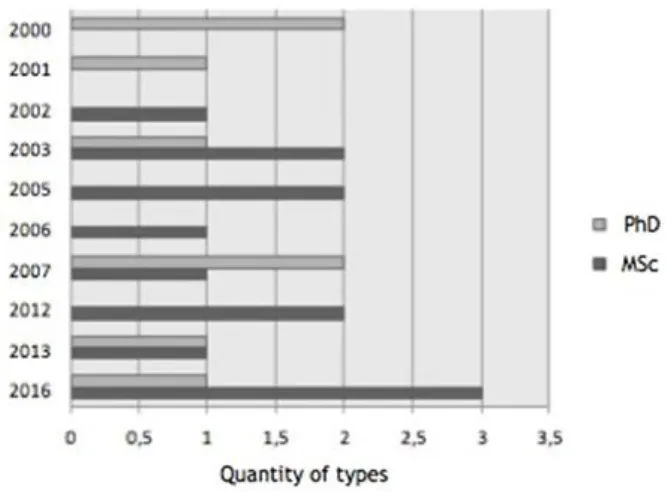
During the analysis we identified a total of 17 productions (100%), out of which 07 Doctoral theses (41.17%) and 10 academic Master’s dissertations (58.83%). Figure 01 shows these productions.
Figure 1: Production over the years. Rio de Janeiro State, 2016. The EEAN/UFRJ leads the use of this reference (16/90%), followed by the Universidade Federal de Santa Catarina (01/10%). The main responsibility for the hegemony of the
EEAN, about the production of knowledge in the light of
Thompson’s reference, is due to its history in Rio de Janeiro State and Brazil, and due to political issues and socioeco-nomic development linked to the time of the first in Brazil, implemented in the EEAN in 1972.7
The first production using the Thompson framework was a doctoral thesis defended in 2000 at the EEAN/UFRJ, which consisted of a historical analysis of the political, ideological and social influences of the seniority as a teaching-learning strategy in the undergraduate course.
The author contemplated the exploration of his objectives, elaborating his analysis through the concepts presented by Thompson, as follows: culture, symbolic forms, and ideo-logy. The postures, attitudes, actions, speeches, gestures, images, texts, among others, are denominated by Thomp-son as Symbolic forms and are produced by somebody, in certain historical and social context, transmitted to others and reproduced in historical scenarios often differentiated.5
From the moment these overlap with the previous ones, they institute what this referential denominates “relation
of power and domination” that is asymmetric and gains potentiality in surpassing the previous one.
This result emerged in the construction of this acade-mic production of doctorate in 2000, since it identified that the teaching-learning strategy in the undergraduate course adopted is directly related to the socio-historical and political scenario that presented itself to the institutional times, desires and objectives to be achieved by the institution, regarding the development of nursing graduation.
Therefore, the solidification of this reference, in this first nursing scientific production to be used by Thompson, pro-vided a theoretical and methodological basis for the lines of research initiated there through Research Groups and their mobility, through academic guidelines.
The Research Groups are essential for the consolidation of post-graduation, as well as for the construction of new theoretical-methodological approaches, directly collaborating in the training and qualification of researchers who invest in the production and dissemination of knowledge.8
Consequently, nursing research priorities are oriented to paradigms that guide research, such as nursing care, care subjects, cross-national problems, professional competencies and research fields that require induction for their develop-ment and strengthening, expressing the disciplinary facet of the field of research, focused not only on morbid processes and clinical issues, but also on the integral vision of the health-disease-care process.9
Therefore, it is necessary to invest in the generation of knowledge for the constitution of an epistemological status that supports the status of Nursing in the field of science. This requires systematic investigative approaches based on explanations, appropriate methodologies, and theories that support the models and processes of care.10
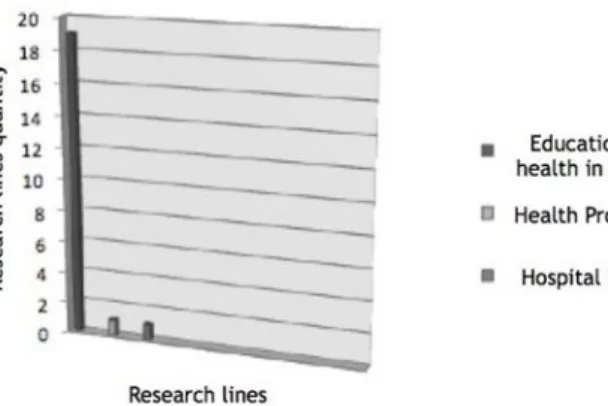
In these productions, an emphasis is given to the discus-sions inherent in educational practices, the application of teaching-learning strategies in the field of nursing education, either in undergraduate and postgraduate studies or in the daily routine, totaling 13 subjects (76.5%).
This study shows that, in the nursing research area, more specifically in the Nursing Education sector, the Research Groups, on the subject, have been working in Brazil as partner structures with the Programs, the community and health services, in order to provide a vocational training focused on social reality, the construction and encouragement of professional development policies in the area, and awake-ning to a critical pedagogy through the coping of complex daily problems.11 Figure 02 shows the main lines of research
where studies have been developed that used the Thompson reference.
Figure 02: Main research lines. Rio de Janeiro State, 2016.
The study also reveals the need to develop new paradigms and methods, essential to ensure the rigor and reliability of the generated knowledge, demanding the renunciation of already consolidated paradigms and methods in the various disciplinary fields, as well as the constitution of truly multidis-ciplinary teams, which stands as a challenge to be overcome.12
The main sociological concepts favored by Thompson and used by the authors raised in this study were: symbolic forms, ideology, culture and operational modes.
Symbolic forms are constituted as attitudes, objects, images, gestures, and speech these forms are constructions structured, interpreted and understood by the people who produce and receive them, in the various contexts of the family, school, work, among other places, and give meaning to integrating them with other aspects of their lives. Because they are inserted in various socio-historical contexts, due to the diversity of subjects involved, social relations, forms of communication, multiplicity of action can produce traces of their social condition of production and become objects of valorization, evaluation, and conflicts.5
The theory demonstrates five characteristics of symbolic forms, as their respective aspects: intentional, conventional, structural, referential and contextual, which are related to what is understood by the terms meaning, meaning and meaning. These terms allow the symbolic forms to be seen as significant phenomena, and still emphasize in the con-textual aspect, the socially structured characteristics of the symbolic forms, which are crucial to the analysis of culture. Furthermore, it emphasizes the capacity of the symbolic forms of affirming, expressing, portraying what was produ-ced as a reference, that is, it projects the meaning that was constructed by the producer and which will be reinterpreted by the recipient.5
The symbolic forms are not passively absorbed, they are transmitted culturally, and the individuals actively and creatively give them meaning, producing a meaning in the receiving process itself. It is necessary, then, to pay attention to its conception of culture: culture is the pattern of meanings embodied in symbolic forms, which includes actions, verbal manifestations and significant objects of various kinds, by virtue of which individuals communicate with each other and share their experiences, conceptions, and beliefs.5
Given this perception, cultural phenomena can be unders-tood as symbolic forms in structured contexts and cultural analysis, such as the study of the significant constitution and the social contextualization of symbolic forms. These are produced by subjects and for subjects within specific socio-historical contexts with spatial and temporal charac-teristics of that context. Both the producer and the recipient have resources and capabilities that can influence how they are produced, understood, received and interpreted. The symbolic forms can be exchanged in the social relations between producers and receivers; this exchange has a series of characteristics and is denominated cultural diffusion.5
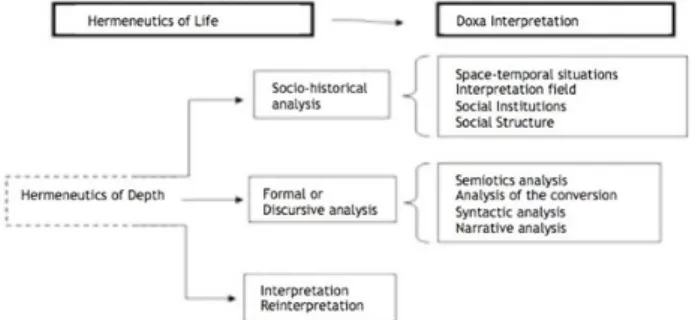
The methodological path of Hermeneutics of Depth sys-tematized by Thompson has fostered few studies about the interpretation and analysis of cultural phenomena, but it denotes a rigorous contextualization of analytical, socio-his-torical, formal and interpretive/reinterpretation movements. In constructing the concepts of symbolic forms and ideo-logy, the author argues about the need for a suitable metho-dological framework to analyze them. So, it is developed a method that is called Hermeneutics of Depth (HD), which was carried out in the following three phases: socio-historical analysis, formal or discursive analysis and interpretation. The scheme created by Thompson synthesizes the various phases of HD’s approach, placing them for the Doxa, or hermeneutics of everyday life explanation below.
Figure 03: Hermeneutics of Depth by Thompson.
These phases should be seen as distinct analytical dimen-sions of a complex interpretative process. Depending on the subject of analysis and the proposed research, a variety of research methods can be used at each stage as long as the actions are interrelated. In fact, what the author emphasizes when he proposes to HD and the need to interrelate methods of analysis that make possible the understanding and inter-pretation of the symbolic forms, understanding them as meaningful constructions.
The purpose of the socio-historical analysis is to recons-truct the social and historical conditions of production, cir-culation, and reception of symbolic forms. Specific temporal space situations, interaction fields, institutions and social structures can be described. Allowing to examine the rules and conventions, social and institutional relations and the distribution of power and resources.
The second phase is formal or discursive analysis, which is concerned with the internal organization of symbolic forms structural features, their patterns, and relationships. It can be performed through semiotic analysis, conversation analysis, syntactic analysis, narrative analysis, and argumentative analysis. In this phase, symbolic forms are separated into themes with specific meanings to expose the patterns and effects that constitute and operate within a symbolic form in order to evidence content and meanings.
The last phase of HD is the interpretation/reinterpretation that is facilitated by historical partner analysis and by formal or discursive analysis. For it uses its results, but makes a new movement to give new thought through synthesis, proposing to creatively construct possible meanings. Give an interpre-tative explanation of what is being represented or said, and it is this transcendent character that must be understood by the process of interpretation. Giving a meaning that can diverge from the meaning constructed by the subjects that constitute the socio-historical world, and may even generate a conflict of interpretation.
Thus, in the first and second phases, methods are used to analyze symbolic forms as a significant phenomenon, and in the socio-historical context that were produced and received through social relations. Where both producers and recipients use their resources. In the third phase, considering that the symbolic form was initially interpreted by those who produced and received it, so, in order to analyze the data, it is necessary to use methods that favor reinterpretation. We can make an analogy of HD described by Thompson as a gear, where one phase drives the other.
In the case of the interpretation of ideology, the same HD reference is used with its three phases. Making the social contextualization and the significant constitution of the sym-bolic forms. However, the ideological aspect is highlighted in a more critical way. To highlight the ways in which meaning serves to establish relations of power and domination. Sho-wing how the meaning mobilized by symbolic forms serves to nourish and sustain the possession and exercise of power. Consequently, of the relations of domination in which the subjects are inserted.
From the point of view of Thompson’s methodological framework, the researcher is offered the possibility of a relia-ble understanding of the triggering of that symbolic form in space-time variation, its applicability and value by the sub-jects, as well as its repercussion in the course of its existence and use by people immersed in different times and spaces. The elements that make up the social world are immersed in historical aspects and traditions and for this reason, facts and speeches cannot be discussed and analyzed only by the said in its literal form of expression.5
Based on the intention of the theoretical-methodological referential contemplated in this reflection, the sociologist Thompson offers the property of the critic and the interpre-tation of data, through the socio-historical context in which they are under an evaluation optics for the reconstruction of
new elements applied to the society, and not the minimization of past facts and assumptions.
Considering this referential, it becomes possible to ela-borate an analytical profile based on historicity, making what previously, for the layman, would constitute a mistake or serious misconception in the conduct of activities, in the different time spaces, in movements that, at that time, within a differentiated social and historical contextualization, the one proposed to meet the local demands and intentions.
CONCLUSIONS
The studies in the nursing research area progress through investigations inherent to the development and technological innovation, to those of a historical nature, as well as those that discuss and analyze the continuous and formative process of its professionals.
In this context, we present John Thompson and his theo-retical-methodological construction, where he disseminates the concept of a social product that is applied, assessed, used, reconstructed and renewed by society itself. It is then necessary to bring this reference to the research scenario in the Nursing Education and Training field and for this reason; it is perhaps the reason for the increasing adoption of this author by the militants of this area of study.
The author fits perfectly into the discussion of what rea-sons, means, and motives, a teaching methodology, a new educational strategy emerges within a social context, within a temporality, where the actors, their values, their culture and also their needs.
Herein, we underline the discussions inherent to educatio-nal practices, the application of teaching-learning strategies in the field of nursing training, whether in undergraduate and postgraduate studies or in the daily work, totaling 13 productions (76.5%).
Nursing studies permeated by sociology broaden the view that a technique, an educational strategy, a technology emerges because of the social scenario presented, the needs permeated by values and the dynamics between science and society.
We consider that it is important for both the scientific and nursing research scenarios to understand the changes inherent in care, arising from a critical-social reflexive pro-duct, which can be contemplated by adopting as the analysis guiding principle, then being seen as theorists immersed in the sociology trendline.
REFERENCES
1. Santos VC; Anjos KF; Almeida OS. Perceptions of senior students regarding research in nursing at the undergraduate course. Rev Enferm UFSM 2013; 3 (1):144-154.
2. Rodrigues RAP; Robazzi MLCC; Erdmann AL; Fernandes JD; Barros ALBL; RAMOS; Souza FR. Doctoral Theses from Nursing Postgraduate Programs in Brazil and their Association with the Millennium Development Goals. Revista Latino-Americana de Enfermagem (Online), v. 23, p. 395-403, 2015.
3. Rosa LM; Sebold LF; Arzuaga MA; Santos VEP; Radünz V. Nursing theoretical frame works and production of scientific knowledge. Rev. enferm. UERJ, 2010; 18(1): 120-5.
4. Oliveira AL; Silva LE. Ideologia segundo John Thompson: Reflexões da política de educação no período da ditadura militar brasileira. (1964-1985). Revista HISTEDBR On-line, Campinas, nº 54, p. 220-229, dez. 2013.
5. Thompson JB. Ideologia e cultura moderna. 6. ed. Rio de Janeiro: Vozes; 2011.
6. Lopes FTP. Ideologia e cultura na obra de John B. Thompson. Revista espaço acadêmico, n. 158, julho 2014, ano XIV. P.18-28 7. Backes VMS; Prado ML; Lino MM; Ferraz F; RKS; Canever BP.
Grupos de Pesquisa de Educação em Enfermagem do Brasil. Rev. esc. enferm. USP [Internet]. 2012 [cited 2016 May 31] ; 46 (2): 436-442. Available from: http://www.scielo.br/scielo.php?script=sci_ arttext&pid=S0080-62342012000200023&lng=en. http://dx.doi. org/10.1590/S0080-62342012000200023.
8. Gomes DC; Backes VMS; Lino MM, Canever BP; Ferraz F; Schveitzer MC. Produção científica em Educação em Enfermagem: grupos de pesquisa Rio de Janeiro e Minas Gerais. Rev Gaúcha Enferm. 2011; 32 (2):330-7.
9. Oliveira DC. Nursing research priorities and research lines: an on-going discussion. Rev enferm UERJ, 2014; 22(5):712-6.
10. Scochi CG; Gelbcke FL; Ferreira MA; Lima MADS; Padilha KG; Padovani NA; Munari DB. Doutorado em Enfermagem no Brasil: formação em pesquisa e produção de teses. Rev. Latino-Am. Enfermagem. 2015; 23 (3): 387-94.
11. Rosa LM; Silva GS; Nunes R et al. Scientific production of oncology nursing: temporal cut 2002 to 2012. Rev enferm UFPE on line [Internet]. 2015 [acesso em 10 de maio de 2015]; 9 (3): 7055-64. Disponível em: http://www.revista.ufpe.br/revistaenfermagem/ index.php/revista/article/view/6670/pdf_7373
12. Mendes ALTM; Aperibense PGGS; Almeida Filho AJ; Peres MAA. Curso de mestrado da Escola Anna Nery 1972-1975: singularidades da formação e desafios na implantação. Esc Anna Nery [Internet]. 2015 [acesso em 10 de maio de 2015]; 19 (1): 11-17. Disponível em: http://www.scielo.br/pdf/ean/v19n1/1414-8145-ean-19-01-0011.pdf
Received on: 06/30/2017 Required Reviews: None Approved on: 09/11/2017 Published on: 04/02/2019
*Corresponding Author:
Harlon França de Menezes Rua Afonso Cavalcanti, 275 Cidade Nova, Rio de Janeiro, Brasil E-mail address: [email protected] Telephone number: +55 21 9 9547-0635 Zip Code: 20.211-110 The authors claim to have no conflict of interest.