Communication in Palliative Care: a Bibliometric Study
Cuidados Paliativos e Comunicação: Estudo Bibliométrico
Cuidados Paliativos y Comunicación: Estudio Ibliometrico
Adriana Marques Pereira de Melo Alves1; Solange Fátima Geraldo da Costa2; Maria Andréa Fernandes3*;
Patrícia Serpa de Souza Batista4; Maria Emília Limeira Lopes5; Ana Aline Lacet Zaccara6
How to quote this article:
Alves AMPM, Costa SFG, Fernandes MA, et al. Communication in Palliative Care: a Bibliometric Study. Rev Fund Care Online. 2019.11(n. esp):524-532. DOI: http://dx.doi.org/10.9789/2175-5361.2019.v11i2.524-532
ABSTRACT
Objective: This study’s aim has been to analyze the bibliometric indicators of research on communication used in palliative care. Methods: This bibliometric study was carried out with a sample consisting of 67 articles published during the period 2007-2016 and available in LILACS, MEDLINE and Scielo electronic databases.
Results: The analysis of the indicators showed that there was a significant, albeit non-progressive, growth of studies on palliative care and communication in the last ten years. The year of 2016 stood out as the one with the highest number of studies (22%). Internationalization of the research on the subject was verified since most of the articles were published in international journals (80.6%) in English (76.2%). Conclusion: There is a need for developing research with a higher level of evidence on palliative care and communication that can be applied to patient care.
Descriptors: Palliative Care, Communication, Bibliometrics.
1 Nursing graduate, PhD student in Nursing at UFPB, Professor at UFPB, Leader of the Research Group: Núcleo de Estudos e Pesquisas
em Bioética e Cuidados Paliativos (NEPBCP) at UFPB. E-mail address: [email protected]. Universidade Federal da Paraíba (UFPB), Brazil.
2 Nursing graduate, PhD in Nursing by the Universidade de São Paulo (USP), Full Professor at UFPB. E-mail address: solangefgc@gmail.
com. Universidade Federal da Paraíba (UFPB), Brazil.
3 Nursing graduate, PhD student in Nursing at UFPB. E-mail address: [email protected]. Universidade Federal da Paraíba (UFPB),
Brazil.
4 Nursing graduate, PhD in Education by the UFPB, Professor at UFPB, Vice Leader of the Research Group: Núcleo de Estudos e Pesquisas
em Bioética e Cuidados Paliativos (NEPBCP) at UFPB. E-mail address: [email protected]. Universidade Federal da Paraíba (UFPB), Brazil.
5 Nursing graduate, PhD in Education by the Universidade Federal do Rio Grande do Norte (UFRN), Professor at UFPB. E-mail address:
[email protected]. Universidade Federal da Paraíba (UFPB), Brazil.
6 Nursing graduate, PhD student in Nursing at UFPB. E-mail address: [email protected]. Universidade Federal da Paraíba
RESUMO
Objetivo: Analisar os indicadores bibliométricos acerca da produção cientifica sobre cuidados paliativos e comunicação disseminados em periódicos online no campo da saúde. Método: - Estudo bibliométrico cuja amostra foi composta por 67 artigos, publicados no período de 2007-2016 nas bases de dados Lilacs, MedLine e Scielo. Resultados: A análise dos indicadores mostrou que houve crescimento expressivo das publicações sobre cuidados paliativos e comunicação, nos últimos dez anos, mesmo de forma não progressiva. O ano de 2016 se destacou como o de maior produção de estudos (22%). Verificou-se a internacionalização dos estudos sobre a temática, tendo em vista que a maioria foi publicada em periódicos internacionais (80,6%), na língua inglesa (76,2%). Conclusão: Existe a necessidade do desenvolvimento de pesquisas com maior nível de evidência na área dos cuidados paliativos e da comunicação, para que possam ser aplicados na assistência ao paciente.
Descritores: Cuidados paliativos, Comunicação, Bibliometria.
RESUMEN
Objetivo: Analizar los indicadores bibliométricos acerca de la producción científica sobre cuidados paliativos y comunicación diseminados en periódicos online en el campo de la salud. Método: Estudio bibliométrico cuya muestra fue compuesta por 67 artículos, publicados en el período 2007-2016 en las bases de datos Lilacs, MedLine y Scielo. Resultados: El análisis de los indicadores mostró que hubo crecimiento expresivo de las publicaciones sobre cuidados paliativos y comunicación, en los últimos diez años, incluso de forma no progresiva. El año 2016 se destacó como el de mayor producción de estudios (22%). Se verificó la internacionalización de los estudios sobre la temática, teniendo en vista que la mayoría se publicó en periódicos internacionales (80,6%), en la lengua inglesa (76,2%). Conclusión: Existe la necesidad del desarrollo de investigaciones con mayor nivel de evidencia en el área de los cuidados paliativos y de la comunicación, para que puedan ser aplicados en la asistencia al paciente.
Descriptores: Cuidados paliativos, Comunicación, Bibliometría.
INTRODUCTION
The introduction of new technologies in recent decades involving diagnosis and treatment methods has led to changes in caring for the patient. Despite this, new evolutionary patterns of chronicity or emergence of side-effects come into existence, making evident the need for a special approach in dealing with incurable diseases.1
Palliative care consists of practices aimed at patients with progressive and irreversible disease who does not respond to treatment. Accordingly, professionals aim to provide adequate and integral care for these patients and comfort in their final moments.2
Therefore, such care alleviates suffering, focusing on the sick person, because it values interpersonal relationships in the process of dying and feelings such as compassion, empathy, humility, and honesty. In addition, this care is supported by the relationship between professional and patient, which minimizes diagnosis and prognosis issues.3
It should be emphasized that palliative care and curative care can be carried out concurrently. However, considering the complications or worsening of the disease, the skills of
a multiprofessional team should be used to help the patient and his family to adapt to the life changes imposed by the disease and face the irreversible health condition and/or the possibility of dying. Thus, the importance of palliative care for patients with life-threatening diseases is undeniable since they demand specialized care. Palliative care focuses on relieving the patients’ physical, psychological, social and spiritual needs, and on integrating the patient’s and family members’ beliefs, values, cultural and religious practices, communication, music therapy, pharmacology, spirituality, among others.4
Communication stands out among these strategies, which can be viewed as a complex process that involves the perception, understanding, and transmission of messages in the interaction between patients and health professionals. It should be emphasized that the control of pain and symptoms, the interdisciplinary teamwork, and the adequate use of communication skills and interpersonal relationships are the basic triad of palliative care. This is a process that has two dimensions: verbal, which occurs through the expression of spoken or written words; and non-verbal, characterized by the way of speaking, gestures, facial expressions, body posture, and the physical distance that people maintain among themselves.5
In a study on the nurses’ view of the relationship between the concepts of communication and strategies to communicate with terminally ill patients, it was verified that verbal communication is perceived, used, and valued by nurses as an instrument for promoting humanized care. For them, verbal communication is used for providing support, security, trust, strength, and hope; non-verbal communication is recognized by the professionals through affective touch, which contributes to improve the patients’ quality of life.6
Hence, effective communication is considered an essential strategy for integral and humanized care since it is possible to recognize and accept the patient’s needs empathically. Therefore, communication skills are essential to professionals caring for palliative care patients regardless of their basic training or area of expertise, because these skills allow them to deal with the patients’ emotional state more efficiently. Thus, communication becomes a skill especially necessary to the success of the treatment, since it assumes a fundamental role in the care plan and deserves the same attention received by biomedical professionals.7
Considering the relevance of palliative care and the low number of studies on this subject and on the professionals’ communication with terminally ill patients published in national and international journals, we developed the following question to guide this review: “What are the research trends in the communication used in palliative care?” Hence, this study’s objective is to analyze the bibliometric indicators of research on communication used in palliative care.
METHODS
This is a bibliometric study, which is designed to develop and analyze the bibliometric indicators of the scientific and technological production in a research field. Bibliometric indicators have been used to plan activities and analyze the development of scientific and technological research in institutions, the researchers’ productivity, journals, and emerging research fields.
The databases Literatura Latino-Americana e do Caribe em
Ciências da Saúde (LILACS) [Latin American and Caribbean
Health Sciences Literature], Medical Literature Analysis and Retrieval System Online (MedLine), and Scientific Electronic Library Online (Scielo) were searched for articles by cross--referencing the descriptors “cuidados paliativos” [palliative care] and “comunicação” [communication], and “palliative care” and “communication”.
It should be noted that the search in these databases was performed using the health terminology from the Medical Subject Headings (MeSH) and the uniterms from the Health Sciences Descriptors (DeCS). Data were collected in January 2017.
The inclusion criteria were: articles on communication used in palliative care, published in national and interna-tional journals; available online; indexed in the databases
LILACS, Scielo, or MedLine; published in the period
2007-2016; available in full in Portuguese, English and Spanish; and addressing the communication used in palliative care in the title or keywords.
Primarily, 275 articles were found in the databases. We excluded 111 studies since their titles or keywords did not present the uniterms and 97 duplicated studies. Conclusively, by applying the inclusion criteria, 67 articles were selected to compose the corpus of this research.
The selected articles were read in full and later analyzed with the help of a data collection instrument developed by us. The following parameters were analyzed: year of publi-cation; periodic data; authors’ education and professional qualification; author’s home country; study data on modality, approach and level of evidence; and keywords.
The following evidence hierarchy was used in this study: Level I: evidence resulting from the meta-analysis of multiple controlled and randomized clinical studies; Level II: Evidence obtained from individual studies with an experimental design; Level III: evidence from quasi-experimental studies; Level IV: Evidence from descriptive (non-experimental) or qualitative studies; Level V: evidence from case studies; and Level VI: evidence based on the experts’ opinions.9
The descriptive statistical analysis was carried out for data analysis. Also, a conceptual map was developed using the Cmap Tools® software to visualize the keywords and the selected articles in this study. Conceptual maps are diagrams that present hierarchical relationships between concepts, aiming to represent conceptual structures in a simplified and ordered way so that they can be visualized and analyzed in depth.10
RESULTS AND DISCUSSION
Concerning the period 2007-2016, there is a growing trend of publications from 2010, with 8 (12%) articles shed in 2011. On the other hand, 6 (9%) articles were publi-shed in 2012 and 5 (7%) in 2013, which means a decrease in the number o publications. In 2014 there was another growth because 8 (12%) articles were published in that year, followed by 6 (9%) in 2015. Finally, 15 (22%) articles were published in 2016, representing the largest number of publications (Figure 1).
Figure 1 – Distribution of the selected publications by year.
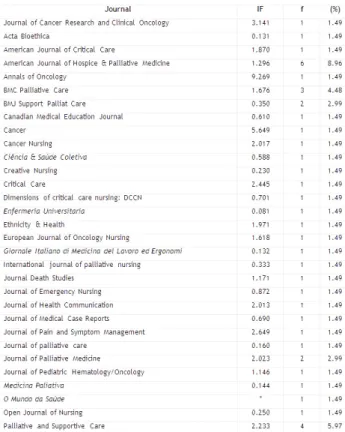
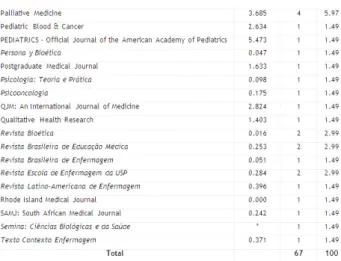
Recording the journals, from the 48 scientific journals identified, the ones that accepted articles on Palliative Care and Oncology were highlighted. Six (8.96%) articles were published in the American Journal of Hospice & Palliative Medicine, followed by 4 (5.97%) in Palliative and Supportive Care and Palliative Medicine each. These were the journals that most published articles on communication used in palliative care, as can be seen in Table 1.
*Impact Factor (IF) not found.
Concerning the impact factor (IF) of the journals in the period 2015-2016, Table 1 shows that Annals of Oncology stood out (IF = 9,269), followed by Cancer (FI = 5,649) and PEDIATRICS - Official Journal of the American Academy of Pediatrics (IF = 5,473). The Brazilian journal with the highest IF was Science & Collective Health (IF = 0.588).
Regarding the most used language, 51 (76.2%) of the articles were written in English, 13 (19.4%) in Portuguese and 3 (4.4%) in Spanish. All articles were from 16 cou-ntries, and many of them from English-speaking ones. Twenty-four (35.8%) articles were from the United States, 13 (19.4%) were from Brazil, 8 (11.9%) from England, and 4 (5.9%) from Canada. The remaining 18 (26.8%) articles were published in the following countries: Spain, Chile, Japan, Sweden, Netherlands, Norway, Israel, China, South Africa, Italy, New Zealand.
Considering the number of authors per article, 10 (14.9%) articles had one author, with emphasis on the arti-cles with two authors, 18 (26.9%), three authors, 10 (14.9%), four authors, 9 (13.4%), and five or more, 20 (29.9%).
Observing the research field, Medicine stood out with 31 articles (46.3%), followed by Nursing with 25 (37.3%), Psychology with 9 (13.4%), and Sociology with 2 (3.0%), which demonstrates the researchers’ interest in several fields, with emphasis on the health sciences.
In regards to the first authors’ academic education, 36 (38.8%) authors had PhD, 17 (25.3%) had Specialist’s Degree, 13 (4.4%) had Master’s Degree, and one (1.4%) was a Nursing graduate.
Bearing in mind the research method, 44 (65.7%) were original articles; 20 (29.8%) were reviews of the literature, and 3 (4.47%) presented no information. Among the ori-ginal articles, 18 (40.9%) were of the exploratory studies, 20 (45.4%) used a qualitative approach, 2 (4.5%) were case studies, and the remaining 4 (9.1 %) articles represented the other methods found: one cohort study, one cross-sectional study, one randomized clinical trial, and one systematic review with meta-analysis.
Regarding the evidence level, most of the studies—31 (46.2%) of 67—had evidence level IV; 29 (43.2%) had the
level of evidence VI, and the remaining articles (1.49%) had the evidence levels I, II and III each. Thirty-four (77.3%) original articles presented that the ethical principles invol-ving human research were followed.
Based on the keywords from the selected studies, a conceptual map, presented in Figure 2, was developed, considering the aspects related to the adequacy and link between different concepts in a bidirectional perspective.
Figure 2 – Conceptual map developed by using the selected studies’ key-words.
Communication between patients, families and health care professionals is a central component of end-of-life care. However, this review highlights that limited research on this subject has been conducted. Furthermore, improving communication skills during care requires supporting stra-tegies such as courses and ability-based guidance. Therefore, effective communication combined with clinical skills has positive effects on the health care practice.11
The Annals of Oncology journal published most of the articles on communication in palliative care, as presented in
Table 1. It is a journal of the European Society of Medical
Oncology and the Japanese Society of Medical Oncology, with emphasis on studies on oncology.12 This journal has
been growing over the years along with its impact factor, which in 1997 was 2,548 and currently reaches the mark of 9,269, already occupying the 215th position in the Journal Citation Reports (JCR). This journal is 11th in the field of oncology among the 213 magazines.
It is also emphasized that the journal with the highest impact factor calculated by the JCR is also from the field of oncology. This shows that oncological research on severely ill patients has been highlighted and attracted the researchers’ interest. However, some journals had low IFs, including the Brazilian ones. As a study points out,13 there has been an
advance in science, technology, and innovation activities in recent decades, as well as the number of publications indexed in international databases, has been increased.
However, another study pointed out that the impact of publications did not follow the publication growth rates, which was evidenced by the low number of citations found in the international indexes, compared to the journals from developing countries. In addition, most Brazilian journals had IFs below the median value by research field in the
inter-national indices, which may be related to the low presence of foreign authors, international collaboration in Brazilian research and high use of the Portuguese language. Thus, it is necessary to qualify the Brazilian journals to improve their performance in these indices. To accomplish this, institu-tional and research management and funding issues must be overcome.14
Regarding the language used in scientific research, most journals published articles in English according to the results. A study highlighted that English dominates international communication since several people from different countries are communicating and exchanging information in English as a result of globalization.15
There is a worldwide tendency to establish English as the international language of science because publishing studies in a language understood by most individuals increase the chances of being cited later and allow researchers from all over the world to communicate and share knowledge. Researchers have been increasingly struggling to publish their studies in English, working hard to write an article in a language that they often have little experience.
The United States leads the ranking of scientific research, while Brazil achieved the 15th position.17 The United States,
Western Europe, and Japan are scientific superpowers and invest heavily in research, resulting in a large number of published articles having good translation and most of the citations. However, countries such as Brazil, China, and India have been showing a growth in the number of publi-cations. Regarding Brazilian scientific production, 70% of the selected studies were carried out by Brazilian authors,18 and no foreign authors were found in articles published in Brazilian journals.
This may be due to the domination of English in interna-tional research and the fact that most of the selected articles were in Portuguese. However, some Brazilian journals have been publishing articles in English or in another language, which may facilitate their international acknowledgment.
The growth in writing articles in partnership with other authors is widely accepted worldwide. The competition impo-sed by science, whose productivity is measured by the number of publications and the journals’ impact factor, strengthens co-authorship. Thus, most of the studies are carried out in partnership with other authors because it reduces costs, saves time, helps to manage human and financial resources, and favors multidisciplinary events and the experience exchange.19
In this sense, collaborative research has become one of the pillars of scientific production in various fields. It is a means of improving the articles’ quality and impact. This growing trend in developing articles in partnership with other authors will continue through shared global priorities, driven partially by international agencies, such as the World Health Organization.20
The researcher Elaine Wittenberg-Lyles is the author with the largest number of studies on communication in palliative care. She is an Associate Professor at the Markey
Cancer Center and the Department of Communication at the University of Kentucky, United States of America. She is also an author of books in this field, such as Communication in Palliative Nursing, published in 2012.
There is a consensus on the importance of improving knowledge in order to achieve better economic, social and environmental development in countries. Therefore, quali-fying teachers and researchers skilled in absorbing, produ-cing, and using knowledge has become an important issue for all countries.21
In Brazil, the post-graduate programs have improved, consequently increasing the number of people having a Master’s Degree or PhD. This can be explained by the increa-sing number of courses offered, stimulated through scholar-ships, the need for implementing stricto sensu courses so that educational institutions could become universities, and the increasing social demand for professionals more qualified so that they can be inserted in the labor market.
In 1999, there were 29,895 students enrolled in 800 PhD courses in Brazil, and 4,831 individuals with PhD. In 2011, these numbers increased to 71,387, 1,606 and 12,217, res-pectively. In this sense, the number of people having PhD increased by approximately 153%.22
The selected study with the highest evidence level is a systematic review of the effect of communication considered a tool for decision making during the end-of-life period. Furthermore, it showed that communication can help the decision-making process when there are limited technological resources. However, more high-quality studies are essential to address the effects of communication on decision-making, including the agreement between the patient’s wishes and the care received.23
This study’s results showed that there is, in fact, a need for publications having higher levels of scientific evidence in the field of palliative care and communication in order to carry out replicable studies on patient care. Among the selected studies, the randomized clinical trials had the highest scien-tific evidence level. This may be related to the subjectivity of this theme, which is derived from the biomedical approach.
An integrative review on palliative care has also demons-trated the different evidence levels among the publications analyzed due to the greater number of exploratory, descrip-tive, and qualitative studies carried out with a small sample of cancer patients and health care professionals.24
The conceptual map presented in Figure 2 was develo-ped by organizing the descriptors from the selected articles according to their morphological relationship and similarity in terms of meaning. It can be observed that the most fre-quently used descriptors were: cuidados paliativos,
comuni-cação, and cuidados de final de vida. It should be noted that
the descriptor cuidados de final de vida is included in the MeSH as end-of-life care.
So, by inspecting the conceptual map, it is possible to point out some important aspects, such as the factors related to communication in palliative care and the people who
promote them or are benefited from them. As the concep-tual map shows, it is possible to visualize how important communication is in the process of dying from a chronic, progressive, and fatal disease (Figure 2).
The first axis of the map shows that bad news, anxiety, sadness, and pain are hinder the communication in pallia-tive care. The selected studies considered communication, interpersonal relationships, nonverbal communication and communication skills as essential factors for those involved in the finiteness process.
Communicating bad news about the patient’s death gene-rates anxiety, sadness, and fear. A study indicates that the patient’s and the family’s previous knowledge is important in planning adequate communication and that nonverbal communication is recommended in dealing with the emotio-nal responses caused by a bad prognosis. In addition, the use of silence is necessary since the patient and the family need to process the diagnosis. If they need to cry, it is recommended to give them time to express their feelings. According to the authors, for an effective and true communication, patients and families will eventually overcome any hopelessness if a strong support is available. Good communication skills are important for a better patient’s and family’s well-being, as well as for improving professional qualification.25
The second descriptor axis of the analyzed papers clarifies that communication in palliative care is promoted by an inter-disciplinary team, creating contributions for establishing new forms of organizing palliative care. So, the interdisciplinary team should have the necessary skills to help the patient and his family to adapt to the limitations imposed by the terminal disease and to promote the necessary reflection in the face of a progressive and incurable disease.
A study on communication in the transition from curative care to palliative care in oncology pointed out that commu-nication was presented as an effective tool for achieving and maintaining a more sensible, real and beneficial relationship among the interdisciplinary team, the patient, and the family, benefiting the planning and continuity of the therapy, even if the patient has an incurable disease.
The third descriptors axis relates communication in pal-liative care with empathy, adherence to treatment, quality of life, end-of-life experience, culture, death, and grief. It can be seen that this axis fits into the fundamental princi-ples: integral, total and continuous care, which considers the physical, psychological, cultural, social and spiritual aspects; the patient and his/her family constitute the unit to be cared for, always with a systemic approach; improving the quality of life, adapting to new realities; conception of autonomy; effectiveness, efficiency and empathy in teamwork and support for grief and communication. All this is essential for quality palliative care.
Palliative care is both a philosophy of care and an orga-nized and structured system for providing specialized care, focusing on promoting the patient’s and family’s quality of life with adequate emotional and cultural sensitization.
Thus, for health professionals working in palliative care, it is essential to know when and what to speak, to know how to silence and to listen, and to be with the patient and to be accessible to their needs.28
It is in this sense that the investigated articles used several descriptors to report that palliative care is intended for the terminally ill patient, the elderly with dementia, the youth, children, family, and mothers in grief. It should be emphasized that the development of palliative care was initially intended for cancer patients and, over the last decades, also included the care for patients with chronic, progressive, degenerative and fatal diseases.
In this reality, many issues constitute all experiences from the diagnosis to the grief after the patients’ death, which demands care, as well as technical procedures. The patient needs mainly a sensitive listening since it is necessary for quality communication.29
The end-of-life period makes the process of caring more complex since patients require to be cared for according to their own age and needs. Integral care for the end-of-life patients needs to be offered. In this context, the adequate use of communication skills is the foundation that sustains palliative care. The human contact that involves caring and being cared for allows it that the transmission of messages occurs. Hence, the knowledge of techniques or strategies for interpersonal communication that facilitate interaction and altruism is of paramount importance.5 All professionals
involved in this process need communication as a therapeutic resource, since they work with people who are experiencing the end of life in different scenarios.
CONCLUSIONS
The analysis of the bibliometric indicators showed the increasing visibility of studies on communication in palliative care over the years. In addition, it was possible to recognize that most of the studies on this subject were published in English international journals, highlighting the United States, a country considered an international power of scientific production.
Considering the authors’ academic education, it was found that most of the analyzed studies were carried out by researchers and PhDs in the field of Health Sciences, but in collaboration with other authors.
The descriptors highlights communication as a tool for palliative care patients: cancer patients, terminal patients, the elderly, young people, and children. Communication may be used in the face of suffering, sadness and anxiety, facilitating the relationship between professionals and patients.
In palliative care, communication skills can be performed by an interdisciplinary team, with emphasis on doctors, nur-ses, and psychologists. The increasing interest of physicians, nurses and psychologists in this area is a reality that seems to meet the health needs of a population that is increasingly aging and unhappy with the current biomedical model.
Hence, it highlights the researchers’ concern about the measures for possibly helping patients who are experiencing the end of life or with chronic degenerative disease to improve their quality of life by means of palliative care, considering the biopsychosocial and spiritual dimensions. So, communication becomes a very relevant tool because it provides patient and family with autonomy, adherence to treatment, assistance during grief. It also serves to communicate bad news.
This evident growth in scientific production in recent years is in line with the need for greater investment in qua-lifying the palliative care professionals or related services, aiming to continuously improve care and contribute to maxi-mize the well-being and quality of life of people receiving palliative care.
This study contributed to identify the main global trends in communication in palliative care, which could significantly guide future investigations. It is suggested the development of research on this subject possessing higher levels of scientific evidence so that further studies on care can be replicated. Nevertheless, this review has limitations, such as the small number of Brazilian publications. In addition, other databases could be searched for more publications.
REFERENCES
1. Andrade CG, Costa SFG, Lopes MEL. Cuidados paliativos: a comunicação como estratégia de cuidado para o paciente em fase terminal. Ciênc saúde coletiva [Internet]. 2013[acesso em 2017 jul 20];18(9):2523-30. Disponível em: http://dx.doi.org/10.1590/S1413-81232013000900006
2. Mierendorf S, Gidvani V. Palliative care in the emergency department. The Permanente Journal [Internet]. 2014 [acesso em 2017 jun 19];18(2):77-85. Disponível em: https://doi.org/10.7812/ TPP/13-103
3. Correia FR, Carlo MMRP. Avaliação de qualidade de vida no contexto dos cuidados paliativos: revisão integrativa de literatura. Rev Latino-Am Enfermagem [Internet]. 2012 [acesso em 2017 jun 18];20(2):401-10. Disponível em: http://dx.doi.org/10.1590/S0104-11692012000200025
4. França JFRS, Costa SFG, Lopes MEL, Nóbrega MML, França ISX. Importância da comunicação nos cuidados paliativos em oncologia pediátrica: enfoque na Teoria Humanística de Enfermagem. Rev Latino-Am Enfermagem [Internet]. 2013 Jun [acesso em 2017 jun. 23];2013; 21(3):780-6. Disponível em:http://dx.doi.org/10.1590/ S0104-11692013000300018
5. Araújo MMT, Silva MJP. Estratégias de comunicação utilizadas por profissionais de saúde na atenção à pacientes sob cuidados paliativos. Rev esc enferm USP [Internet]. 2012 jun [acesso em 2017 maio. 27];46(3):626-32. Disponível em:http://dx.doi.org/10.1590/ S0080-62342012000300014
6. Brito FM, Costa ICP, Costa SFG, Andrade CG, Santos KFO, Francisco DP. Comunicação na iminência da morte. Rev Anna Nery [Internet]. 2014 jun [acesso em 2017 jun 26];18(2):317-22. Disponível em:http://dx.doi.org/10.5935/1414-8145.20140046 7. Borges MM, Santos Junior R. A comunicação na transição
para os cuidados paliativos: artigo de revisão. Rev Brasileira de Educação Médica [Internet]. 2014 [acesso em 2017 maio 26];38(2):275-82. Disponível em:https://dx.doi.org/10.1590/S0100-55022014000200015
8. Glãnzel W. Bibliometric methods for detecting and analysing emerging research topics. El profesional de La información [Internet]. 2012[acesso em 2017 jun 14];21(2):194-201. Disponível em: http://eprints.rclis.org/16947/1/Bibliometric%20methods.pdf 9. Stetler CB, Morsi D, Rucki S, Broughton S, Corrigan B, Fitzgerald
J, et al. Utilization-focused integrative reviews in a nursing service. Applied Nursing Research [Internet]. 1998 [acesso em 2017 jun 13];11(4):195-206. Disponível em: https://doi.org/10.1016/S0897-1897(98)80329-7
10. Parisoto MF, Moreira MA, Moro JT, Kilian AS, Dröse Neto B. Utilização de mapas conceituais para buscar indícios de aprendizagem significativa na Física aplicada à Medicina. Rev Electrónica de Enseñanza de las Ciencias [Internet]. 2016[acesso em 2017 jun 13];15(3):347-62. Disponível em:http://reec.uvigo.es/ volumenes/volumen15/REEC_15_3_2_ex994.pdf
11. Montgomery,KE, Kathleen JS, Verna HF. “Communication during palliative care and end of life: Perceptions of experienced pediatric oncology nurses.” Cancer nursing [Internet]. 2017[acesso em 2017 ago 8];40(2): E47-57. Disponível em: https://www.ncbi.nlm.nih.gov/ pubmed/27044058
12. Annals of Oncology [Internet]. About the Journal [acesso em 2017 jul 16]; Disponível em: https://academic.oup.com/annonc/pages/ About
13. Strehl L, Calabró L, Souza DO, Amaral L. Brazilian Science between National and Foreign Journals: Methodology for Analyzing the Production and Impact in Emerging Scientific Communities. PloS one [Internet]. 2016 [acesso em 2017 jul 16];11(5):1-15. Disponível em: https://doi.org/10.1371/journal. pone.0155148
14. Packer AL. A eclosão dos periódicos do Brasil e cenários para o seu porvir. Educação e Pesquisa [Internet]. 2016 [acesso em 2017 jul 16];40(2):301-23. Disponível em:http://dx.doi.org/10.1590/S1517-97022014061860
15. Xue J, Zuo W. English Dominance and Its Influence on International Communication. Theory and Practice in Language Studies [Internet]. 2013 [acesso em 2017 jul 23]; 3(12): 2262-6. Disponível em: http://www.academypublication.com/issues/past/ tpls/vol03/12/16.pdf
16. NASSI-CALÒ L. Estudo aponta que artigos publicados em inglês atraem mais citações. SciELO em Perspectiva [Internet]. 2016 [acesso em 2017 jul 18]. Disponivel em: http://blog.scielo.org/ blog/2016/11/04/estudo-aponta-que-artigos-publicados-em-ingles-atraem-mais-citacoes/
17. Scopus. SCImago Journal & Country Rank [Internet]. 2011 [acesso 28 jul 2017]. Disponível em:http://www.scimagojr.com/ journalrank.php?area=2900&country=BR&year=2016
18. Wilsdon J et al. Knowledge, networks and nations: Global scientific collaboration in the 21st century. London: The Royal Society; 2011. 19. Garcia CC, Martrucelli CRN, Rossilho MMF, Denardin
OVP. Autoria em artigos científicos: os novos desafios. Rev Bras Cir Cardiovasc [Internet]. 2010 [acesso em 2017 jul 22];25(4):559-67. Disponível em: http://dx.doi.org/10.1590/S0102-76382010000400021
20. Adams J. The rise of research networks New collaboration patterns are changing the global balance of science. Nature. 2012;(490):335-6 21. Moritz GO, Moritz MO, Pereira MF, Maccari EA. A pós-graduação brasileira: evolução e principais desafios no ambiente de cenários prospectivos. Future Studies Research Journal. 2013;5(2):03-34. 22. Cirani CBS, Campanario MA, Silva HHM. A evolução do
ensino da pós-graduação senso estrito no Brasil: análise exploratória e proposições para pesquisa. Avaliação: Rev da Avaliação da Educação Superior [Internet]. 2015 [acesso em 2017 jul 19];20(1):163-87. Disponível em: http://www.redalyc.org/ pdf/2191/219138341010.pdf
23. Oczkowski SJ, Chung HO, Hanvey L, Mbuagbaw L, You JJ. Communication tools for end-of-life decision-making in the intensive care unit: a systematic review and meta-analysis. Critical Care [Internet]. 2016[acesso em 2017 jul 22];20(1):78-97. Disponível em: https://doi.org/10.1186/s13054-016-1264-y
24. Palmeira HM, Scorsolini-Comin F, Peres RS. “Cuidados paliativos no Brasil: revisão integrativa da literatura científica.” Aletheia [Internet]. 2011 [acesso em 2017 jul 19]; 35(36):179-89. Disponível em:http://pepsic.bvsalud.org/scielo.php?script=sci_arttext&pid =S1413-03942011000200014
25. Ganca LL, Gwyther L, Harding R, Meiring M. What are the communication skills and needs of doctors when communicating a poor prognosis to patients and their families? A qualitative study from South Africa. SAMJ: South African Medical Journal. 2016;106(9):940-4.
26. Hermes HR, Lamarca ICA. Cuidados paliativos: uma abordagem a partir das categorias profissionais de saúde. Ciênc Saúde Coletiva [Internet]. 2013[acesso em 2017 jul 24];18(9):2577-88. Disponível em: http://dx.doi.org/10.1590/S1413-81232013000900012. 27. Frossard A. The Palliative Care as public policy: introductory
notes. Cad. EBAPE.BR [Internet]. 2016 [acesso em 2017 jul 15];14(spe):640-55. Disponível em: https://dx.doi.org/10.1590/1679-395114315
28. Moreira LG, Silva EA, Silva TAM. A luta entre a Dama de Negro e a Dama de Branco: cuidados de Enfermagem na terminalidade. Revista de Saúde [Internet]. 2016[acesso em 2017 ago 8];7(1):39-41. Disponível em: http://dx.doi.org/10.21727/rs.v7i1.88
29. Furtado MEMF, Leite DMC. Cuidados paliativos sob a ótica de familiares de pacientes com neoplasia de pulmão. Interface [Internet]. 2017 [acesso em 2017 ago 10]:1-19. Disponível em: http:// dx.doi.org/10.1590/1807-57622016.0582
Received on: 10/07/2017 Required Reviews: None Approved on: 11/22/2017 Published on: 01/15/2019
*Corresponding author
Maria Andréa Fernandes Rua João Batista Fernandes, 77 Aeroclube, João Pessoa, Paraíba, Brazil E-mail address: [email protected]
Telephone number: +55 83 98881-8318 Zip code: 58.036-820 The authors claim to have no conflict of interest.