Nitrogen fertilization in sugarcane nurseries
Adubação nitrogenada em viveiros de cana-de-açúcar
DOI:10.34117/bjdv6n1-204
Recebimento dos originais: 30/11/2019 Aceitação para publicação: 20/01/2020
Mauro Wagner de Oliveira
Doutor em Ciências - Energia Nuclear na Agricultura Universidade Federal de Alagoas -
Centro de Ciências Agrárias - BR 104, Km 85 Rio Largo - Alagoas E-mail: [email protected]
Terezinha Bezerra Albino Oliveira
Doutora em Engenheira de Produção Universidade Federal de Alagoas -
Centro de Ciências Agrárias - BR 104, Km 85 Rio Largo - Alagoas E-mail: [email protected]
Christiano Nascif
Mestre em Produção de Ruminantes Universidade Federal de Viçosa
Rua Aimorés, 19, Bairro São Sebastião, Viçosa - Minas Gerais E-mail: [email protected]
Carlos Henrique de Castro Nogueira
Mestrando em Agronomia – Produção Vegetal Universidade Federal de Alagoas
Centro de Ciências Agrárias - BR 104, Km 85 Rio Largo - Alagoas E-mail: [email protected]
Wesley Oliveira de Assis
Engenheiro Agrônomo Universidade Federal de Alagoas
Centro de Ciências Agrárias - BR 104, Km 85 Rio Largo - Alagoas E-mail: [email protected]
Sávio Tavares Ferreira Borges
Engenheiro Agrônomo Universidade Federal de Alagoas
Centro de Ciências Agrárias - BR 104, Km 85 Rio Largo - Alagoas E-mail: [email protected]
ABCTRACT
The production of healthy sugarcane seedlings and varieties with high yield potential is the most costly aspect in setting up a sugarcane field. This study evaluated the effect of nitrogen fertilization at 0, 40, 80, 120 and 160 kg N ha-1 on plant nutritional status and seedling yield of two varieties of sugarcane: RB835486 and RB867515. The study was conducted in an experimental design of randomized blocks with four replications in a medium textured soil in the city of Mercês, located in the Mata Mineira region, from October 2015 to March 2016. The soil received liming and gypsum at
a dose of 5.0 t of dolomitic limestone and 1.5 t of gypsum. The soil was then plowed, harrowed and subsoiled. We applied 100 kg P (229 kg P2O5) and 200 kg potassium to the bottom of the planting furrow. Nitrogen fertilization did not affect plant nutritional status and seedling yield. The plants were well nourished and the average yield was 65 t of seedlings per hectare.
Key words: Production system, sustainability, nutrient cycling, agricultural management. RESUMO
A produção de mudas de cana-de-açúcar sadias e de variedades de alto potencial produtivo é o item que mais onera na implantação de um canavial. No presente estudo avaliou-se o efeito da adubação nitrogenada, nas doses de zero, 40, 80, 120 e 160 kg de N ha-1, sobre o estado nutricional das plantas e a produção de mudas de duas variedades de cana-de-açúcar: RB835486 e RB867515. O estudo foi conduzido em delineamento em blocos ao acaso com quatro repetições, em um solo de textura média, no município de Mercês, Zona da Mata Mineira, no período de outubro de 2015 a março de 2016. O solo recebeu calagem e gessagem, na dose de 5,0 t de calcário dolomítico e 1,5 t de gesso, sendo posteriormente arado, gradeado e subsolado. Aplicaram-se 100 kg de P (229 kg de P2O5) e 200 kg de potássio no fundo do sulco de plantio. Não houve efeito da adubação nitrogenada sobre o estado nutricional das plantas e a produção de mudas. As plantas estavam bem nutridas e a produtividade média foi de 65 t de mudas por hectare.
Palavras-chave: Sistema de produção, sustentabilidade, gerenciamento agrícola.
1 INTRODUCTION
One of the technologies used for setting up a sugarcane field is the use of healthy, vigorous seedlings and sugarcane varieties with high yield potential. In order to obtain quality seedlings, adequate mineral nutrition, among other factors, is essential. Nitrogen is important in sugarcane nutrition and physiology, as it is a constituent of proteins and nucleic acids (MALAVOLTA et al., 1997). Furthermore, nitrogen and potassium are absorbed in greater amounts by the sugarcane (OLIVEIRA et al., 2018; RAIJ, 2011). The absorbed N increases the meristematic activity of the shoot, resulting in higher tillering and leaf area index (LAI) of the seedlings, in addition to increasing leaf longevity. This increase in LAI increases solar radiation use efficiency, measured as carbon dioxide fixation rate, thus increasing seedling yield. This study aimed to evaluate the effect of nitrogen fertilization at doses of 0, 40, 80, 120 and 160 kg N ha-1 on plant nutritional status and seedling yield of two sugarcane varieties: RB835486 and RB867515.
2 MATERIAL AND METHODS
The study was conducted in a randomized block design with four replications in a medium textured soil from October 2015 to March 2016. The experimental 18area is in the city of Mercês, located in the Zona da Mata Mineira region of the state of Minas Gerais (MG). Prior to the installation of the study, the soil was sampled at depths of 0-20 and 20-40 cm to evaluate soil fertility. Based on
60% in the 0-20 cm layer and reduce aluminum saturation in the subsurface layers, as proposed by Oliveira et al. (2018). The organic matter content at 0-20 and 20-40 cm was 25.0 and 18.0 g dm-3, respectively, which is considered medium by Oliveira et al. (2018).
After the application of limestone and gypsum, the soil was plowed and harrowed. Thirty days after plowing, the soil was harrowed and furrows were opened at a spacing of 1.2 m for the planting of the sugarcane. The plots consisted of five furrows (5 m long). At the bottom of the furrows, 100 kg of phosphorus (229 kg of P2O5 equivalent) and 200 kg of potassium per hectare were applied as
simple superphosphate and potassium chloride. Then, the two sugarcane varieties (RB835486 and RB867515) were planted using eight-month-old seedlings with excellent vigor and health. The seedlings were distributed in the furrows and clipped into stalks with two to three buds. They were then covered with a layer of soil of five to six cm. Lastly, Sencor (Metribuzin) herbicide was applied at a dose of 4.0 L per hectare.
When the sugarcane was about 30 cm high, nitrogen fertilization (0, 40, 80, 120 and 160 kg of N ha-1) was carried out using urea as the N source. The fertilizer was buried between the rows of sugarcane to avoid losses by volatilization, as recommended by Oliveira et al. (2018). At the maximum growth stage of the sugarcane (late January 2016), leaves +3 were collected to assess plant nutritional status. The assessments were done in the three central meters of each plot, following the methods described by Malavolta et al. (1997) and Oliveira et al. (2018). N, P, K, Ca, Mg, S, B, Cu, Fe, Mn and Zn contents were determined in the leaf lamina (MALAVOLTA et al., 1997). In March 2016, seedling yield was evaluated by cutting the plants close to the ground and cut at the height of the apical bud. The mean values of nutrient content in the leaf lamina and seedling yield were submitted to analysis of variance (FERREIRA, 2008).
3 RESULTS AND DISCUSSION
There was no varietal effect or nitrogen fertilization effect on leaf nutrient content and seedling yield. The plants had adequate nutrient supply based on the leaf contents cited by Malavolta et al. (1997); Oliveira et al. (2018) and Raij (2011).
The mean nursery yield was 65 t of seedlings per hectare. The coefficients of variation for leaf nutrient contents and seedling yield were lower than 10.0% (data not shown). Thus, the lack of effect of variety and nitrogen fertilization was not due to experimental variability.
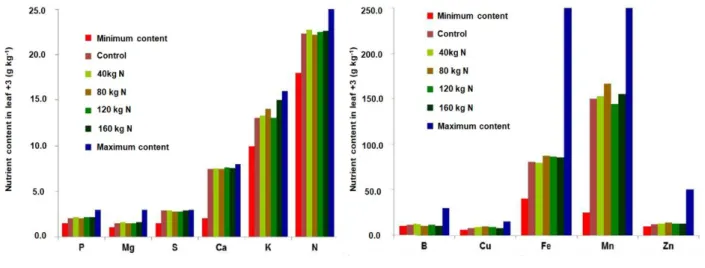
Figure 1 shows the mean values of macronutrient and micronutrient leaf contents of the two sugarcane varieties, compared to minimum and maximum levels cited by Malavolta et al. (1997); Oliveira et al. (2018) and Raij (2011). By analyzing Figure 1, it is clear that boron, copper, and zinc
leaf contents were slightly above the minimum level, while the other nutrient contents were within adequate limits.
FIGURE 1. Mean values of leaf macronutrients and micronutrients of the two sugarcane varieties compared to minimum and maximum values cited in Brazilian literature.
Source: Author
The lack of influence of nitrogen fertilization on nutritional status and seedling yield is as a result of the mineralization of soil organic matter and the higher nutritional efficiency of the sugarcane root system. This is likely due to the application of sufficient amounts of limestone and gypsum to neutralize the exchangeable aluminum, as well as simple superphosphate (1,250 kg per hectare) applied to the bottom of the planting furrow.
The mineralization of soil organic matter, which was previously mentioned as one of the factors responsible for the lack of response to nitrogen fertilization, is corroborated in studies conducted in the coastal plains of Pernambuco by Salcedo et al. (1985). These authors measured carbon and nitrogen mineralization during the sugarcane cycle in a Red-yellow podzolic, sandy oxisolic soil, sampling the soil at 0-20, 20-40 and 40-60 cm before planting and 3, 6, 11 and 16 months after planting. Total carbon contents of 6.7, 4.1 and 3.4 g kg-1 and total N contents of 0.7, 0.4
and 0.3 g kg-1 were found at 0-20, 20-40 and 40-60 cm. Salcedo et al. (1985) found estimated amounts of the potentially mineralizable N of 139 and 132 kg per hectare at 0-20 and 20-60 cm, respectively, and a mineralization constant of 0.074 per week. Although the soil was considered of low fertility, based on the results the authors believe that the amounts of mineralized organic N would be enough to satisfy the requirements of the sugarcane.
One more factor that may have contributed to the lack of sugarcane response to nitrogen fertilization is the greater efficiency of the plant root system to absorb nitrate when there is adequate
availability (MALAVOLTA et al., 1997; OLIVEIRA et al., 2018). In plants with adequate P supply, there is increased nitrate uptake from the soil solution and in the root-to-shoot translocation of nitrate, increasing amino acid synthesis in leaves (MAGALHÃES, 1996; OLIVEIRA et al., 2018). Magalhães (1996) found an noteworthy influence of P availability (both of nutrient and endogenous solutions) on N uptake and metabolism in corn. Plants with adequate phosphorus supply before and during the kinetic study showed almost constant nitrate uptake during the experiment. However, plants lacking P before and during the experimental period were unable to absorb nitrate from the solution. As there is a higher supply of P, we believe that sugarcane has a behavior similar to that seen in corn plants adequately supplied with P. Studies on sugarcane conducted in the region of Passos, southern Minas Gerais, showed that increasing the P dose applied in the furrow resulted in higher accumulation of N in shoot biomass. There was an increase of about one kg of N in biomass for each kg of P applied via fertilization. These results are most likely influenced by the changes caused by N uptake and metabolism, as previously found by Magalhães (1996).
4 CONCLUSIONS
Nitrogen fertilization did not affect plant nutritional status nor did it increase seedling yield.
REFERENCES
FERREIRA, D. F. SISVAR: um programa para análises e ensino de estatística. Revista Symposium, Lavras, v. 6, p. 36-41, 2008.
MAGALHÃES, J. V. Absorção e translocação de nitrogênio por plantas de milho (Zea mays, L.)
submetidas a períodos crescentes de omissão de fósforo na solução nutritiva. Viçosa, MG. 76 p.
Dissertação de Mestrado em Solos e Nutrição Mineral de Plantas – Universidade Federal de Viçosa, 1996.
MALAVOLTA, E.; VITTI, G.C.; OLIVEIRA, S.A. Avaliação do estado nutricional das plantas – Princípios e Aplicações (2ª Edição). Piracicaba: Associação Brasileira para Pesquisa da Potassa e do Fosfato, 1997. 319p.
OLIVEIRA, M.W.; MACÊDO, G.A.R.; MARTINS, J.A.; SILVA, V.S.G.; OLIVEIRA, A.B. Mineral nutrition and fertilization of sugarcane. In Sugarcane - Technology and Research, 1st ed (Ed AB de Oliveira) Londres: Intech - Open Science pp. 169-191. 2018.
RAIJ, B. Fertilidade do solo e manejo de nutrientes. Piracicaba: International Plant Nutrition Institute, 2011. 420p.
SALCEDO, I. H.; SAMPAIO, E.V.S.; ALVES, G. D. Mineralização do carbono e do nitrogênio em solo cultivado com cana-de-açúcar. Revista Brasileira de Ciência do Solo, v.9., n.1, p.33-38, 1985.